



Abstract
This study examines the particle size-dependent effects of basalt powder as a supplementary cementitious material and develops a predictive model linking fineness to concrete strength. Four basalt powders (400, 800, 1600, and 2400 mesh) replaced slag at a constant dosage and water-binder ratio. Compressive strength was measured at 3, 7, 28, and 90 days, and XRD, TG-DTG, MIP, and SEM were used to investigate hydration, Ca(OH)2 consumption, pore structure, and microstructure. The results show that finer basalt powder enhances both early and long-term strength. Coarse basalt powder mainly contributes through micro-filler effects, while ultrafine basalt promotes additional C-(A)-S-H formation through both micro-filling and pozzolanic reactions, significantly reducing porosity. A strong inverse linear relationship between D90 and compressive strength at 28 and 90 days is established, offering a reliable tool for performance prediction. This work provides insights into the structure–property relationship of basalt powder fineness and introduces a particle-size-based design framework for high-performance, low-carbon concrete.
Keywords
1. Introduction
In response to the global wave of infrastructure expansion and the urgent need to address climate change, the development of environmentally friendly high-performance concrete with excellent mechanical and durability properties has become a major challenge and core research direction in the field of civil engineering materials.1,2 Among various approaches, the use of supplementary cementitious materials to partially replace cement is considered one of the most promising strategies for reducing carbon emissions from the cement industry and improving the sustainability of concrete.3,4 In recent years, with advancements in ultrafine grinding technology, the “particle size effect” of mineral admixtures and their refined control over the microstructure and macroscopic performance of cement-based composites have become a cutting-edge research hotspot.5–7
Basalt powder, as a potential pozzolanic material, is based on the presence of reactive SiO2 and Al2O3, which can undergo secondary reactions with the Ca(OH)2 produced during cement hydration, generating cementitious products such as calcium silicate hydrate (C-S-H), thereby improving the long-term performance of concrete. 8 Previous studies have confirmed that the incorporation of basalt powder enhances the late-age strength of concrete and improves its impermeability.9,10 More in-depth studies have begun to reveal its mechanisms for influencing the microstructure, such as refining pore structure and optimizing the interfacial transition zone.11–13 Meanwhile, systematic studies on other ultrafine mineral admixtures, such as ultrafine fly ash,14,15 nanosilica,16,17 and ultrafine slag,18,19 have shown that when the particle size is reduced to the micron or nanometer scale, these materials not only exhibit enhanced pozzolanic reactivity, but also significantly amplify their physical filler effect and their role as nucleation sites for hydration products. This is crucial for accelerating early hydration, reducing porosity, and improving matrix densification.20–22 Bibliometric analysis indicates that research on “ultrafine admixtures” and the “microstructure–performance relationship” is increasingly appearing in top journals, marking the field’s shift towards mechanism-driven exploration.23,24
However, despite the broad consensus established in studies of ultrafine mineral admixtures, a critical research gap remains regarding the quantitative structure–property relationship between particle size and performance for basalt powder as a distinct system. Existing studies have predominantly focused on comparing the overall performance of basalt powder with other supplementary cementitious materials or have examined only a limited number of particle-size levels (e.g., conventional vs. ultrafine), lacking investigations across a continuous and wide particle-size gradient that spans from coarse powder to ultrafine powder.25–27 This makes it difficult to accurately identify the “critical particle size” at which its strengthening effects undergo significant change and to describe the dynamic transition of its governing mechanism—from being primarily controlled by physical filling to being dominated by chemical reactivity. In addition, most studies evaluate macroscopic mechanical performance and microstructural mechanisms separately, without establishing an integrated and controlled experimental framework that links key particle-size parameters to a complete, quantitative chain of influence encompassing hydration-product evolution, pore refinement, microstructural densification, and ultimately, compressive strength development. Notably, there is a pronounced lack of reliable mathematical models capable of directly and quantitatively predicting the relationship between critical fineness parameters of basalt powder (such as D90) and concrete compressive strength at various ages, particularly long-term strength. The absence of such predictive tools significantly limits performance-oriented design and the engineering application of basalt powder in high-performance concrete.
To systematically address the aforementioned research gaps, the central innovation of this study lies in experimentally establishing a continuous particle-size spectrum ranging from 400 to 2400 mesh, through which the particle-size–dependent multi-scale enhancement mechanisms of basalt powder in concrete are elucidated for the first time. Furthermore, a linear prediction model for long-term compressive strength based on the D90 fineness parameter is developed. This work seeks to answer several fundamental questions: Does a distinct particle-size threshold exist that governs the strengthening effect of basalt powder? How does particle-size variation quantitatively influence early-age and long-term strength development? What are the synergistic mechanisms—encompassing hydration-product regulation, pore-structure refinement, and microstructural optimization—that underpin these macroscopic performance differences? To this end, four basalt powders with particle sizes of 400, 800, 1600, and 2400 mesh were used to replace slag at an equal mass in concrete mixtures with fixed mix proportions. Compressive strength at 3, 7, 28, and 90 days was systematically measured, and multi-scale characterization techniques including X-ray diffraction (XRD), thermogravimetric analysis (TG–DTG), mercury intrusion porosimetry (MIP), and scanning electron microscopy (SEM) were employed. The objectives of this study are to: (1) quantitatively reveal the evolution of compressive strength as particle size decreases; (2) clarify the influence of particle size on Ca(OH)2 storage and consumption kinetics within hydration products; (3) uncover the physicochemical synergy of particle-size effects from the perspectives of pore-structure refinement and microstructural morphology; and (4) ultimately establish a robust linear regression model linking basalt powder D90 and concrete compressive strength at 28 and 90 days, thereby providing direct theoretical and data-driven support for performance-driven mix design based on particle-size control.
2. Material and methods
2.1. Raw materials
The cementitious material used in the experiments was 42.5R Ordinary Portland Cement (OPC) with a density of 3.05 g/cm3. The mineral admixtures included S95-grade slag powder, Class F Type II fly ash, and four basalt powder samples with different fineness levels. The 28-day compressive strength activity indices of the slag powder and fly ash were 96% and 76%, respectively. The basalt powders were mechanically ground and sieved into four different particle size groups: 400 mesh (BP400), 800 mesh (BP800), 1600 mesh (BP1600), and 2400 mesh (BP2400), with their corresponding D90 values of 35.7 μm, 22.2 μm, 8.4 μm, and 6.5 μm, respectively. Figure 1 presents the cumulative particle size distribution curves of the four basalt powders. Fine aggregate was natural river sand with a fineness modulus of 2.70, while coarse aggregate consisted of continuously graded crushed stone with particle sizes ranging from 5 to 20 mm. The sieve analysis results are provided in Tables 1 and 2. The chemical admixture used was a polycarboxylate-based high-performance superplasticizer with a water reduction rate of 35%. The mixing water was laboratory tap water. The chemical compositions of all raw materials were determined using X-ray fluorescence spectroscopy (XRF), and the results are summarized in Table 3. Particle size distribution and cumulative volume of basalt powder. Chemical composition of raw materials (%). Sieve analysis results of fine aggregate. Sieve analysis results of coarse aggregate.


2.2. Experimental methods
2.2.1. Mix proportion design and specimen preparation
Concrete mix proportions (kg/m3).
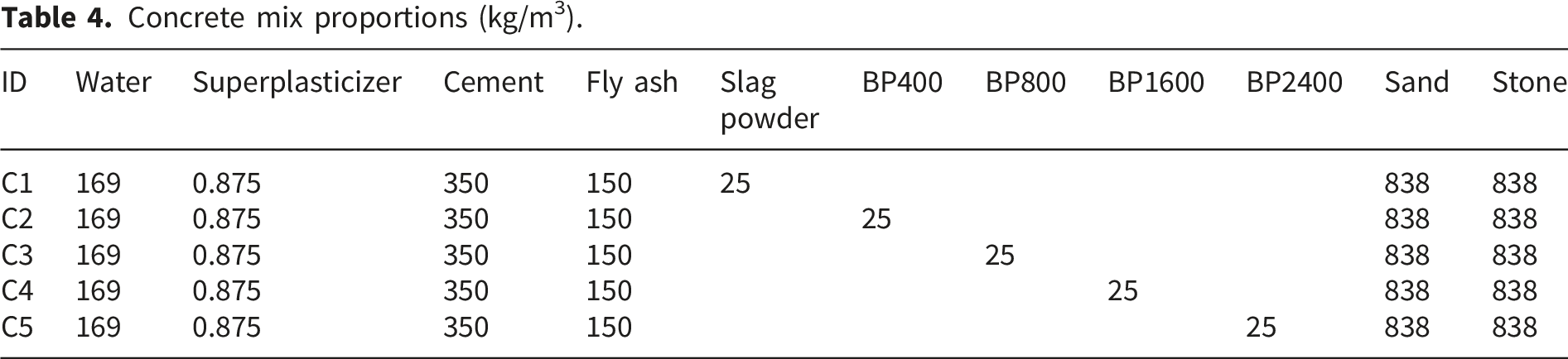
Concrete was mixed using a 60 L forced mixer. The dry materials were pre-mixed for 60 seconds, after which the superplasticizer and mixing water were added and mixed for an additional 150 seconds. The mixture was then poured into 100 mm×100 mm×100 mm steel molds, vibrated, covered with plastic film, and cured in a standard curing room at (20±2)°C with a relative humidity of ≥95% for 24 hours before demolding. The specimens were further cured until the designated testing ages (3, 7, 28, and 90 days). Simultaneously, neat paste samples were prepared for microscopic performance testing.
2.2.2. Performance testing
Compressive strength: Three specimens from each group were tested using a TYE-300 compression testing machine (Wuxi Jianyi Instrument & Machinery Co., Ltd.) at a loading rate of 0.6 MPa/s to determine the compressive strengths at 3, 7, 28, and 90 days. The arithmetic mean of the three measurements was reported.
2.2.2.1. Pore structure analysis
For 28-day specimens, internal, unstressed fragments (approximately 5–10 mm) were collected after crushing. Hydration was terminated by immersing the samples in absolute ethanol for 7 days, followed by vacuum drying at 40 °C for 48 h. Pore size distribution and cumulative pore volume were measured using a PoreMaster 60 automatic mercury intrusion porosimeter (Anton Paar, USA) with an applied pressure range of 0.1–400 MPa, corresponding to pore diameters from 3 nm to 360 μm.
2.2.2.2. Microstructural morphology and compositional analysis
Dried fragments were gold-sputtered and examined using an Ultra55 high-resolution field-emission scanning electron microscope (Carl Zeiss, Germany) to observe microstructural morphology.
2.2.2.3. Thermogravimetric analysis
Hydration-stopped samples were ground to pass a 75-μm sieve. A differential scanning calorimeter (PerkinElmer DSC 800, USA) was used to obtain TG-DTG curves under a nitrogen atmosphere (flow rate: 50 mL/min), with a heating rate of 10 °C/min from 30 °C to 1000 °C. Hydration product contents were quantitatively analyzed based on characteristic mass-loss intervals.
2.2.2.4. Phase analysis
A SmartLab X-ray diffractometer (Rigaku, Japan) was used for phase identification of powdered samples. The scanning range was 5°–70° (2θ), with a step size of 0.02° and a scanning rate of 5°/min, employing Cu Kα radiation (λ = 0.15418 nm).
3. Results and discussion
3.1. Mechanical properties
To investigate the influence of basalt powder particle size on the mechanical performance of concrete, four basalt powders with different fineness levels (400 mesh, 800 mesh, 1600 mesh, and 2400 mesh) were used to replace slag powder at an equal mass, with slag serving as the reference material. The compressive strengths at 3, 7, 28, and 90 days were systematically evaluated, and the results are presented in Figure 2. Overall, the compressive strength at all curing ages exhibited a gradual increase as the particle size of basalt powder decreased, with all mixtures showing strength values equal to or higher than those of the slag-containing control group (C1). This indicates that, at an appropriate dosage, basalt powder can effectively replace slag as a supplementary cementitious material while exhibiting a pronounced particle-size effect. Compressive strength of concrete and its correlation with basalt powder particle size.
With respect to early-age strength development, the 3-day compressive strength followed the order: C5 (2400 mesh) > C4 (1600 mesh) > C1 (slag) > C3 (800 mesh) > C2 (400 mesh). Among these, C5 achieved the highest strength (33.1 MPa), representing an approximately 8.5% increase over C1. A similar trend was observed at 7 days, where C5 reached 40.3 MPa, about 4.7% higher than C1. These results demonstrate that finer basalt powder exhibits higher early-age pozzolanic activity and stronger nucleation effects, which promote the formation and precipitation of early hydration products and thereby enhance early strength. In contrast, the 400-mesh basalt powder, characterized by its coarser particles and lower specific surface area, exhibits slower dissolution of reactive components and limited physical filling capability, resulting in the lowest early-age strength among all groups.28–30
With the extension of curing age, the pozzolanic reactivity of basalt powder becomes increasingly pronounced. At 28 days, the compressive strength of the C5 mixture reached 55.8 MPa, exceeding that of the C1 group (52.4 MPa), whereas C2 exhibited only 42.6 MPa, significantly lower than the other mixtures. By 90 days, the strength of C5 further increased to 65.0 MPa, representing an improvement of approximately 10.2% compared with C1, and all basalt powder mixtures showed a monotonic increase in strength with decreasing particle size. This trend indicates that the reactive SiO2 and Al2O3 in finer basalt powders dissolve more readily under alkaline conditions and participate in pozzolanic reactions with Ca(OH)2 produced during cement hydration, forming additional C–S–H gel and continuously enhancing long-term strength. Moreover, ultrafine particles (e.g., 1600 mesh and 2400 mesh) exhibit superior micro-aggregate filling capability, effectively refining the pore structure of the matrix, reducing defects within the interfacial transition zone, and further improving the overall compactness of the hardened composite. It is worth noting that although slag powder itself possesses high reactivity, its enhancement effect in this system is still inferior to that of the 1600 mesh and 2400 mesh basalt powders. This may be attributed to the high content of reactive silica and alumina in basalt powder, which is more readily involved in reactions in the finer particle state. Additionally, the synergistic effect between the morphological and chemical properties of basalt powder is more pronounced than that of slag powder.
To further quantify the relationship between basalt powder fineness and compressive strength, linear regression analysis was conducted with D90 as the independent variable and compressive strength at different curing ages as the dependent variable (Figure 3). The results indicate a strong negative correlation between the two variables. As the curing age increases, the absolute value of the slope gradually increases (from 0.15668 to 0.55902), suggesting that the sensitivity of compressive strength to fineness is greater at later ages than at early ages. Additionally, the goodness of fit (R2) for all ages was above 0.86, with R2 values for 28 days and 90 days exceeding 0.97, indicating a highly stable linear dependence between basalt powder fineness and long-term compressive strength. This provides a quantitative basis for strength design in concrete by adjusting the fineness of supplementary cementitious materials in practical engineering applications. X-ray diffraction patterns of mineral phases in concrete after 28 days of curing.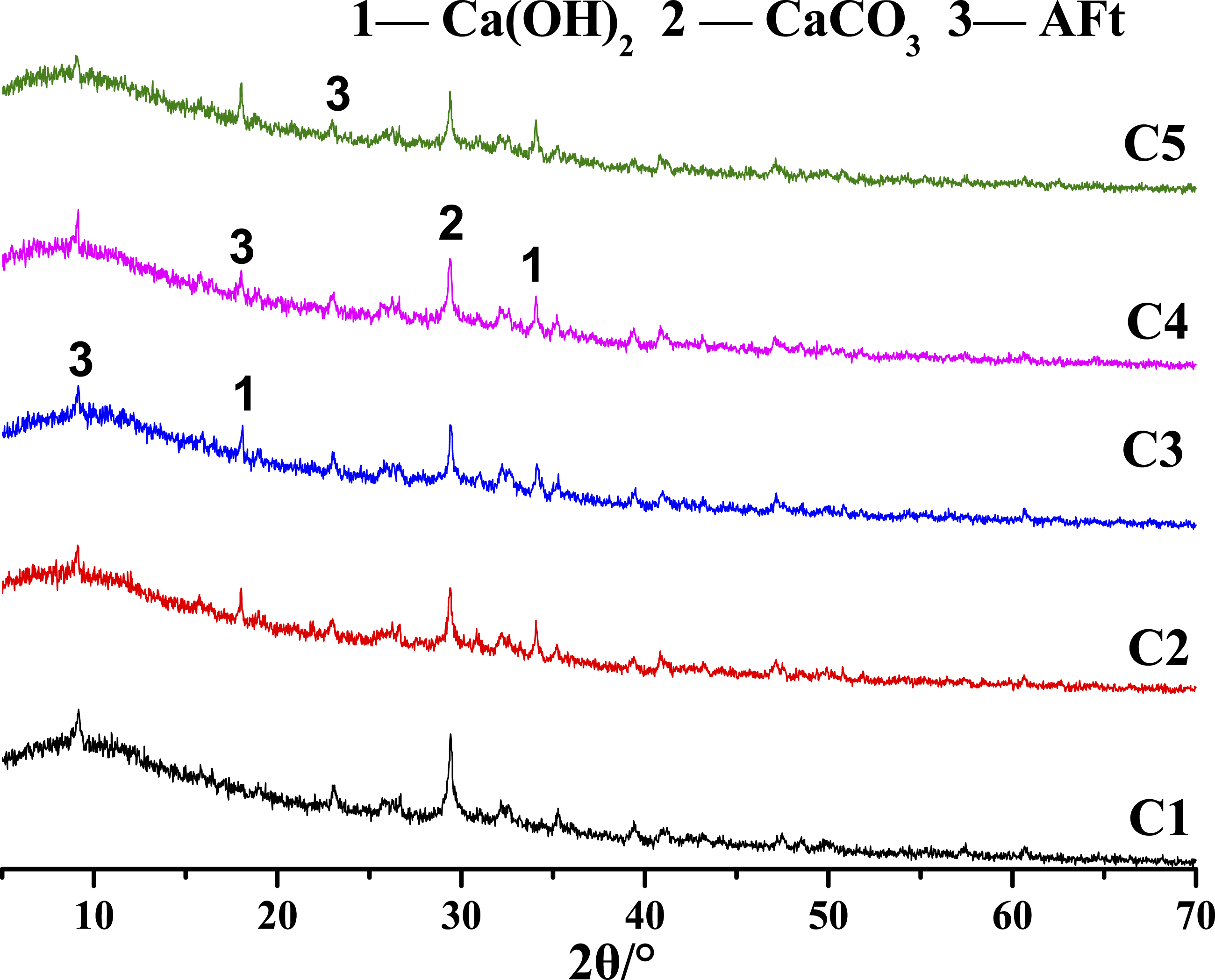
In summary, within the mix proportion range investigated in this study, replacing slag powder with an appropriate amount of basalt powder effectively enhances the compressive strength of concrete, with finer basalt powder exhibiting a more pronounced strengthening effect. The strengthening mechanisms primarily include: (i) early-age nucleation and filling effects that accelerate cement hydration, and (ii) long-term pozzolanic reactions that continuously generate additional gel phases and refine the microstructure. The linear fineness–strength model established in this study provides theoretical guidance and technical support for the efficient utilization of basalt powder in concrete applications.
3.2. Evolution of hydration products
Figure 3 presents the XRD patterns of concrete samples after 28 days of curing. It can be observed that different types and fineness of supplementary materials have a significant impact on the composition of the hydration products. In the control group (C1, with slag powder), the primary crystalline phases identified were ettringite (AFt) and calcium carbonate (CaCO3). The diffraction peak of CaCO3 was relatively strong, which may be related to the carbonation of free calcium ions in the paste. At the same time, no distinct diffraction peaks for calcium hydroxide (Ca(OH)2) were observed, indicating that slag powder participated in reactions under alkaline conditions and consumed part of the Ca(OH)2.
When slag powder was replaced with an equal mass of basalt powder (C2–C5), the diffraction patterns exhibited pronounced changes. All mixtures containing basalt powder showed distinct Ca(OH)2 diffraction peaks, and the peak intensity increased progressively with decreasing particle size of the basalt powder, with the most prominent signals observed in C4 (1600 mesh) and C5 (2400 mesh). Meanwhile, the diffraction peaks of CaCO3 were relatively attenuated, indicating that the incorporation of basalt powder modified the carbonation process and altered the chemical environment governing hydration. The AFt diffraction peak remained stable across all mixtures, suggesting that the formation of sulfate-bearing phases was not significantly affected.
The observed changes can be primarily attributed to the pozzolanic activity of basalt powder and its fineness effect. Basalt powder, which is rich in active SiO2 and Al2O3, can undergo secondary reactions in the presence of Ca(OH)2 provided by cement hydration, producing gel phases such as C-S-H and C-A-H. This process consumes Ca(OH)2 and suppresses its carbonation to CaCO3. As the fineness of basalt powder increases, its specific surface area increases, resulting in higher reactivity, which further promotes the consumption of Ca(OH)2. Consequently, in C4 and C5 mixtures, the intensity of Ca(OH)2 diffraction peaks is weakened, and the CaCO3 peaks are also affected. Moreover, the nucleation effect of ultrafine particles may accelerate the hydration of cement clinker minerals, further optimizing the distribution of hydration products.31,32
In conclusion, the XRD results indicate that basalt powder, particularly finer grades, exhibits significant pozzolanic activity and can effectively participate in the cement hydration process, modulating the alkalinity and product composition of the system. This provides a mineralogical basis for the use of basalt powder as a substitute for slag powder in concrete.
Figure 4 presents the TG curves of concrete pastes after 28 days of curing for each mix. All samples exhibit the typical four-stage mass loss characteristics: evaporation of adsorbed water (<100 °C), dehydration of C-S-H gel (100–400 °C), decomposition of Ca(OH)2 (400–570 °C), and decomposition of CaCO3 (570–800 °C).33,34 By quantitatively analyzing the mass loss in each temperature range, the influence of basalt powder fineness on the composition of hydration products can be revealed (Table 5). The results show that with the increase in basalt powder fineness, the content of Ca(OH)2 in the paste exhibits a gradual increase, while the content of CaCO3 decreases progressively. The content of C-S-H fluctuates within a certain range but remains generally stable. TG-DTG curves of hydration products in concrete after 28 days of curing. Content of hydration products in concrete samples calculated from Figure 4.

Comparing the slag powder control group (C1) with the basalt powder test groups (C2–C5), it can be observed that the Ca(OH)2 content in the C1 group is only 2.91%, significantly lower than that in the basalt powder groups (4.32%–4.87%). This indicates that slag powder has higher reactivity and consumes a large amount of Ca(OH)2 in the early stages of hydration to form C-S-H and C-A-S-H gels. In contrast, the pozzolanic reaction of basalt powder is relatively slow, resulting in a higher accumulation of Ca(OH)2 in the system. Notably, as the fineness of the basalt powder increased from 400 mesh to 2400 mesh, the Ca(OH)2 content gradually increased from 4.32% (C2) to 4.87% (C5). This suggests that the higher specific surface area of finer particles may accelerate the early hydration of cement clinker, generating more Ca(OH)2. Although the pozzolanic activity of basalt powder also increases with fineness, the rate of Ca(OH)2 consumption by the pozzolanic reaction appears to be outpaced by the rate of its generation from enhanced cement hydration at this age.
Meanwhile, the variation in CaCO3 content follows an opposite trend to that of Ca(OH)2: the C1 group has the highest CaCO3 content (26.44%), while in the basalt powder groups, the CaCO3 content gradually decreases from 17.40% (C2) to 15.83% (C5) with increasing fineness. This is partly related to the refinement of the internal pore structure of the paste, which increases the resistance to CO2 penetration. On the other hand, it also reflects the effect of ultrafine basalt powder (such as 1600 mesh and 2400 mesh) on improving the paste’s densification, reducing the pore channels required for carbonation reactions. The C-S-H content in all groups ranges between 9.08% and 10.13%, showing relatively small fluctuations. Although the total quantity of C-S-H is not dramatically altered, this minor variation should not be overlooked, as C-S-H is the primary phase responsible for strength development. The changes in Ca(OH)2 and CaCO3 content are macroscopic manifestations of the combined effects of the physical filling effect (which densifies the microstructure and may hinder CO2 diffusion) and the pozzolanic reaction (which consumes Ca(OH)2) of basalt powders with different fineness levels. These processes ultimately influence the pore structure and durability of the hardened paste.
Overall, although the increase in basalt powder fineness did not significantly change the total amount of C-S-H, it effectively adjusted the ratio of Ca(OH)2 to CaCO3 in the hydration products by enhancing pozzolanic activity and optimizing the microstructure, which in turn influenced the alkalinity reserve and long-term durability of the paste. This result aligns with the trend of strength increase observed with finer powders in the compressive strength tests, further confirming the synergistic effect of ultrafine basalt powder in promoting secondary hydration and improving the microstructure.
3.3. Mechanism of pore structure evolution
The pore structure distribution curves and data of concrete paste at 28 days of age, obtained by MIP testing, are shown in Figures 5 and 6. The results indicate that replacing slag powder with an equal mass of basalt powder leads to systematic changes in the pore structure characteristics of the concrete, with basalt powder fineness being a key factor in regulating the evolution of pore structure. In general, as the fineness of the basalt powder increases (from 400 mesh to 2400 mesh), the internal pores of the paste gradually refine, the proportion of harmful large pores decreases, and the microstructure tends to become more compact. Pore size distribution (a) control group with slag (C1), (b) groups with 400 mesh and 800 mesh basalt powder (C2, C3), (c) groups with 1600 mesh and 2400 mesh basalt powder (C4, C5) and cumulative pore volume. Volume fraction of pores at each pore size range in the samples.

Specifically, the pore size distribution of the control group C1 (with slag powder) exhibits a bimodal characteristic, with the main peak located in the 100-200 nm range, corresponding to medium-sized capillary pores. When basalt powder with a fineness of 400 mesh is used to replace an equal amount of slag powder (C2), the pore size distribution curve shifts to the right, and the proportion of large pores (>1000 nm) increases from 7.7% to 9.5%. This indicates that the coarser basalt powder, due to its lower pozzolanic activity and limited physical filling effect, failed to effectively optimize particle packing, resulting in a coarser pore structure. However, as the fineness of the basalt powder increases to 800 mesh (C3), 1600 mesh (C4), and 2400 mesh (C5), the pore size distribution curve significantly shifts to the left, and the micro-pore structure is notably refined. Among these, the proportion of gel pores ≤20 nm increases continuously from 26.5% in C1 to 35.5% in C5, while the proportion of large pores (>1000 nm) gradually decreases to 6.3% in C5. This indicates that ultrafine basalt powder (≥800 mesh) has a significant micro-aggregate filling effect and pozzolanic activity. Its high specific surface area not only optimizes the particle gradation of the cementitious system, filling the existing large pore spaces, but its active components also participate in secondary hydration reactions in the alkaline environment, generating C-S-H and other gel products, which further block and subdivide the capillary pore channels, causing the pore structure to evolve toward smaller pore sizes. 35
From the correlation analysis between pore structure parameters and macro-performance, the refinement of pores is highly consistent with the early compressive strength and hydration product analysis results. The total amount of pores with a pore size ≤100 nm (including gel pores and fine capillary pores) increases from 61.2% in C1 to 81.8% in C5. These pores contribute significantly to the strength of the paste and are unfavorable to fluid permeability, which, from a microscopic mechanism perspective, explains why ultrafine basalt powder can significantly improve the later-stage compressive strength and durability potential of concrete. In addition, the reduction in capillary pore size and the decrease in the proportion of harmful large pores mean that some of the interconnected seepage paths within the paste are reduced, and the tortuosity increases. This will directly benefit the reduction of material permeability and enhance its resistance to corrosion. 36
3.4. Microstructural morphology analysis
To elucidate, at the microscale, the influence of basalt powder fineness on the formation of concrete structure, SEM was employed to observe representative specimens (C1, C2, C4, and C5) after 28 days of curing. The results are shown in Figure 7. The evolution of microstructural morphology clearly corroborates the pore structure variations revealed by the mercury intrusion porosimetry, and visually reflects the regulating effect of basalt powders with different fineness levels on the matrix densification. SEM images of concrete after 28 days of curing.
As seen in Figure 7, the matrix structure of the slag powder control group (C1) is relatively dense, but local pores of varying sizes and insufficiently hydrated particles are still visible. When basalt powder with a fineness of 400 mesh is used to replace an equal amount of slag powder (C2), the microstructure of the matrix shows significant coarsening and loosening, with an increased number of pores and larger pore sizes, and weaker particle bonding. This morphological characteristic is fully consistent with the result from the mercury intrusion test, where the C2 group exhibited the highest proportion of large pores (>1000 nm) at 9.5%, indicating that the coarser basalt powder has insufficient pozzolanic activity, limited micro-aggregate filling effects, and may have introduced structural defects due to weak interfacial regions. As the fineness of the basalt powder is significantly increased to 1600 mesh (C4) and 2400 mesh (C5), the microstructure undergoes a fundamental improvement. The internal pores of the specimens are filled and subdivided by a large amount of fibrous and network-like gel products, with the original pore boundaries becoming blurred, and the matrix presenting a continuous and dense overall structure. Particularly for the C5 specimen, no significant large pores or cracks can be observed at the microscale, indicating good structural homogeneity. This morphological evolution directly confirms that ultrafine basalt powder optimizes the microstructure through dual effects: on one hand, its extremely fine particles provide excellent physical filling effects, optimizing particle packing and reducing initial pore sizes; on the other hand, the high specific surface area enhances its pozzolanic activity, promoting secondary hydration reactions, with the resulting abundant gel products further blocking, bridging, and refining the pores, achieving a transition of the pore structure from “coarse to fine.” In conclusion, the SEM observations are highly consistent with the quantitative pore structure analysis, visually confirming that as the fineness of the basalt powder increases, the concrete matrix undergoes a significant transformation from loose and porous to dense and homogeneous.
4. Conclusions
This study systematically investigates the particle-size-dependent effects of basalt powder as a supplementary cementitious material on the mechanical properties and microstructure of concrete. Through a carefully designed continuous particle size spectrum (ranging from 400 to 2400 mesh), the research quantitatively elucidates the regulatory role of fineness and establishes a predictive model that links the key particle size parameter (D90) to the long-term compressive strength. The main findings are as follows: (1) The reduction in basalt powder particle size significantly enhances both the early and long-term compressive strength of concrete. The 2400 mesh sample exhibited the highest 90-day compressive strength (65.0 MPa), approximately 10.2% higher than the slag reference group. (2) The underlying mechanism transitions from being predominantly governed by physical micro-filling for coarser particles (e.g., 400 mesh) to a synergistic combination of enhanced physical packing and pronounced pozzolanic reactivity for ultrafine particles (1600 and 2400 mesh). This combination promotes the formation of additional C-(A)-S-H gel, consumes portlandite, and refines the pore structure. (3) A robust inverse linear relationship was established between the D90 of basalt powder and the compressive strength at 28 and 90 days (R2 > 0.97). This relationship provides a reliable quantitative tool for predicting concrete strength based on the fineness of the supplementary cementitious material, facilitating performance-based mix design. (4) Multi-scale characterization (including XRD, TG-DTG, MIP, and SEM) confirmed that ultrafine basalt powder optimizes the microstructure by reducing harmful large pores, increasing the volume of small gel pores, and promoting the formation of a denser, more homogeneous matrix. This microstructural refinement is the fundamental reason for the observed improvements in macro-mechanical properties.
In conclusion, this study clarifies the quantitative structure-property relationship for basalt powder in concrete, demonstrating that its performance can be precisely tailored through particle size control. The established linear prediction model, along with the elucidated multi-scale mechanisms, provides a scientific foundation and a practical framework for the efficient utilization of basalt powder in the development of high-performance and sustainable concrete.
Footnotes

Author contributions
Lujun Jia: Investigation, Formal analysis, Writing - original draft. Jichuan Huo: Investigation, Formal analysis. Jiayuan Ye: Investigation, Project administration. Ping Zhao: Formal analysis, Supervision. Kai Luo: Supervision, Writing - review & editing. Youli Xu: Supervision.
Funding
The authors disclosed receipt of the following financial support for the research, authorship, and/or publication of this article: The authors gratefully acknowledge the financial support from the Lhasa Science and Technology Program (LSKJ202632), Southwest University of Science and Technology Outstanding Talent Cultivation Fund Program (25zx7170), Sichuan Province Technology Program (2023YFG0379), the National Key Research and Development Program of China (No. 2022YFC3803102), the Mianyang Polytechnic (Key project of natural science: MZ24ZD01).
Declaration of conflicting interests
The authors declared no potential conflicts of interest with respect to the research, authorship, and/or publication of this article.
Data Availability Statement
No data was used for the research described in the article.