



Abstract
This study aims to evaluate the effects of basalt fibers on the triaxial compressive permeability and shear performance of concrete after exposure to high temperatures under different cooling methods. The triaxial compressive strength, permeability, and shear performance of ordinary concrete (OC) and basalt fiber-reinforced concrete (BFRC) were investigated. The results indicate that the incorporation of basalt fibers significantly improves the density and compressive strength of concrete, with the most pronounced enhancement observed at a 1.0% volume fraction. After high-temperature exposure, the mass loss rates of both OC and BFRC increased with rising temperatures, while the relative dynamic elastic modulus gradually decreased. Performance degradation was more pronounced under water cooling conditions compared to natural cooling conditions. The addition of basalt fibers effectively reduced the mass loss rate and improved the relative dynamic elastic modulus. In triaxial compression tests, natural cooling was more effective than water cooling at maintaining the strength and toughness of concrete. During water cooling, the thermal shock effect resulted in increased internal cracking, thereby significantly increasing the permeability. However, the addition of basalt fibers effectively reduced the porosity of concrete, thus enhancing its impermeability. Furthermore, in variable-angle shear tests, basalt fibers significantly improved the shear performance and toughness of concrete, particularly under water cooling conditions. The findings of this study provide theoretical and practical references for the application of basalt fiber-reinforced concrete in high-temperature environments.
Introduction
Basalt fiber, a high-performance inorganic fiber made from melted natural basalt rock, exhibits excellent physical and chemical properties. 1 Notably, no chemicals or harmful materials are added during the production process, which has positioned basalt fiber as a green material since its inception in 1923.1,2 In recent years, researchers have reported various properties of basalt fibers.3–8 Dalinkevich et al. 3 highlighted that basalt fiber’s strength is comparable to that of alkali-free glass fiber, while offering superior acid and alkali resistance. Fiore et al. 4 studied the elastic modulus of basalt fibers and glass fibers of different sizes, finding that the elastic modulus of basalt fibers is on average 17.11% higher than that of glass fibers, reaching 89 GPa. Wu et al. 5 reported the corrosion resistance of basalt fibers in acidic, alkaline, and saline environments, showing high salt resistance, moderate acid resistance, and significant degradation in alkaline conditions. Singha 6 noted that basalt fibers exhibit an upper working temperature limit of 650°C and a softening point of 1050°C. In contrast, alkali-free glass fibers exhibit a working temperature limit of 460°C and a softening point of 600°C. Hence, basalt fibers are considered superior in terms of high-temperature resistance compared to alkali-free glass fibers. 6 Similar findings were reported by Ying and Zhou, 7 who observed only a 30% loss in tensile strength after basalt fibers were exposed to a 400°C environment for 2 h. Jabbar et al. 8 emphasized that while basalt fibers have a lower density than steel fibers, they still provide comparable reinforcement and effectively reduce the self-weight of materials. Notably, the diameter of basalt fibers should generally exceed 3.5 μm to avoid inhalation risks, which may lead to cancer. 9
Recently, many researchers have explored the use of basalt fibers as additives to enhance the mechanical properties of concrete. The results consistently indicate improvements in crack resistance, compressive strength, fatigue resistance, and impact resistance.8,10–15 Notably, during service, concrete structures are subjected to various harsh conditions, including sulfate attacks, freeze-thaw cycles, and high temperatures from fires.16,17 Zhao et al. 16 argued that high-temperature damage caused by fires is unique and sudden compared to other environmental conditions (e.g., corrosion, freeze-thaw cycles), often leading to severe structural failures in a short time. The existing literature has reported the effects of basalt fibers on the properties of concrete after high-temperature exposure.18–22 Ren et al. 18 demonstrated that basalt fibers enhance the impact resistance of concrete by improving its energy absorption capacity under high-temperature conditions. Afzal et al. 19 observed that incorporating basalt fibers into high-strength concrete significantly reduces the probability of explosive spalling during high-temperature exposure due to their bridging effect. Wang et al. 20 found that the toughness of basalt fiber concrete notably increases at temperatures below 400°C, with an optimal improvement observed at a fiber volume fraction of 0.4%. Yang et al. 21 noted that basalt fibers change the failure mode of concrete after high-temperature exposure from tensile failure at room temperature to shear failure. Lu et al. 22 reported that basalt fiber-reinforced concrete exhibits higher compressive strength and lower strength loss rates than ordinary concrete under identical high-temperature conditions.
Research on the mechanical properties of basalt fiber-reinforced concrete after high-temperature exposure has primarily focused on uniaxial stress conditions,18–22 with limited studies concerning triaxial stress conditions and shear performance. Furthermore, the impact of cooling methods after high-temperature exposure on the mechanical properties of concrete materials cannot be overlooked.23,24 Accordingly, this study systematically investigates the coupled triaxial compression–permeability behavior and variable-angle shear performance of basalt fiber-reinforced concrete (BFRC) after high-temperature exposure under different cooling regimes. Unlike most existing works that focus primarily on uniaxial compressive strength, this study introduces triaxial and shear loading conditions to better simulate complex stress states encountered in real structures. The results provide quantitative reference data for evaluating BFRC performance after high-temperature exposure under multiaxial loading conditions.
The influence of basalt fiber volume fraction on the workability and compressive strength of concrete
Materials
Performance parameters of basalt fibers.

Experimental plan
Mix proportions.

Slump
The slump test results for the fresh mixtures are illustrated in Figure 1. The slump values decreased as the basalt fiber volume fraction increased. Similar findings regarding the influence of the basalt fiber volume fraction on the slump of various types of concrete have been reported in previous studies.25–27 Wang et al.
28
suggested that basalt fibers fill some voids within the concrete, increasing the friction between cement paste and aggregates and thereby reducing the concrete’s workability. Alaskar et al.
25
noted that if basalt fibers affect the workability of concrete, the flowability can be improved by adding superplasticizers. Alaskar et al.
25
further noted that for every 0.1% increase in basalt fiber content per cubic meter of concrete, an additional 0.4 L/m3 of superplasticizer could restore the desired workability. Katkhuda and Shatarat
29
expressed similar views. Slump test results and reduction rate.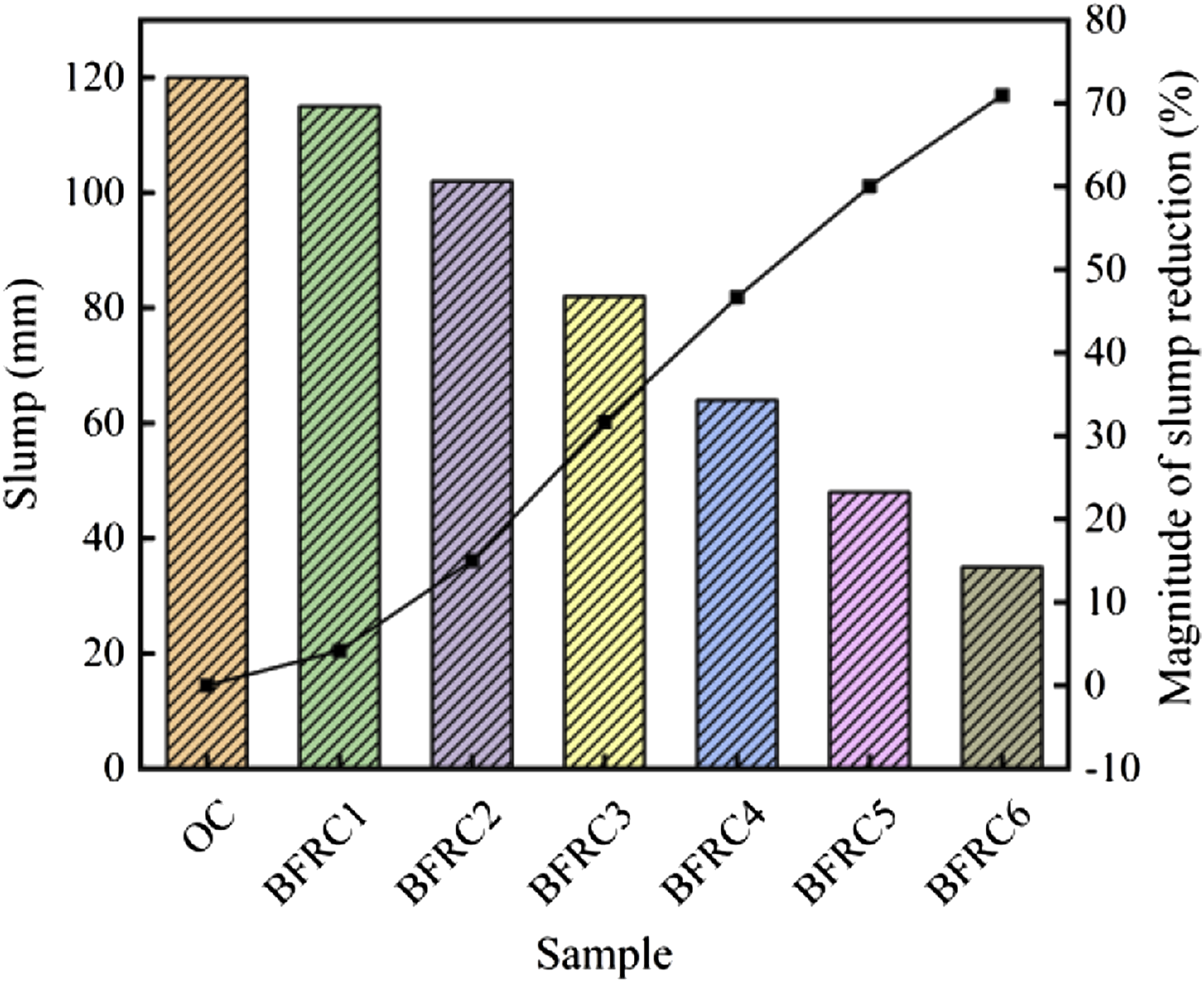
Compared to OC, the slump reduction of mixtures containing basalt fibers is illustrated in Figure 1. Initially, the reduction in slump caused by basalt fibers was not significant. However, as the basalt fiber volume fraction exceeded 0.5%, the reduction became more pronounced. Furthermore, Figure 1 reveals that the rate of slump reduction increased with higher basalt fiber volume fractions. Similar results were reported by Shoaib et al. 30 and Li et al. 31 Salahaddin et al. 32 explained that at lower basalt fiber volume fractions, the fibers occupy a smaller volume in the mixture, exerting minimal influence on the flowability of the aggregates. However, when the volume fraction exceeds 0.5%, the fibers occupy more space, increasing friction and resistance among the aggregates, which significantly limits the mixture’s workability and reduces slump. 32
The results in Figure 1 suggest an exponential relationship between slump and basalt fiber volume fraction. A regression analysis was performed, and the relationship is indicated within equation (1). The calculated slump values using equation (1) were compared with the experimental results, as shown in Figure 2. The comparison indicates minimal errors between the experimental and fitted values, suggesting that equation (1) can reliably predict the relationship between slump and basalt fiber volume fraction. However, equation (1) may become unreliable at very high basalt fiber volume fractions. This is because at high volume fractions, fiber agglomeration may occur in the mixture. Such agglomeration not only reduces the homogeneity of the mixture but also increases local resistance, further affecting slump.
33
Comparison of slump test results and fitting results.

Water absorption
The water absorption test results are presented in Figure 3, which illustrates that the water absorption rate first decreases and then increases with the increase in the basalt fiber volume fraction. When the basalt fiber volume fraction is 1.0%, the water absorption rate is the lowest at 3.8%, representing a 15.56% reduction compared to OC. When the basalt fiber volume fraction reaches 1.5%, the water absorption rate exceeds that of OC, reaching 4.7%, representing an increase of 4.44%. Niu et al.
34
and Khan et al.
35
have also reported similar results. The reasons for this trend are as follows: (1) At lower basalt fiber volume fractions, the fibers are dispersed in the concrete matrix, playing a “bridging” role in microcracks, which improves the compactness of the concrete, reduces porosity, and thereby limits water penetration
35
; (2) at higher basalt fiber volume fractions, fiber agglomeration may occur, precipitating the formation of non-homogeneous regions within the concrete, creating localized pores or voids, and increasing water infiltration pathways, thereby resulting in higher water absorption rates.
35
Furthermore, Adesina
36
noted that when the basalt fiber volume fraction is excessively high, the bond performance between the cement paste and fibers may decrease, which can also result in an increase in water absorption. Water absorption test results.
Compressive strength
The results of the compressive strength test are presented in Figure 4, which indicates that the compressive strength increases initially and then decreases with the increase in the basalt fiber volume fraction. Furthermore, the compressive strength of BFRC1 is similar to that of OC. When the basalt fiber volume fraction is 1.0%, the compressive strength reaches a maximum value of 48.5 MPa, which represents an 11.24% increase compared to OC. Previous reports have also observed similar trends.26,37,38 This is primarily because when the basalt fiber volume fraction is 0.25%, the fibers fail to significantly improve the structural integrity and stress distribution of the concrete, resulting in minimal changes in compressive strength.
38
When the basalt fiber volume fraction is between 0.5% and 1.0%, the fibers are effectively dispersed within the concrete, providing bridging and crack-inhibiting effects, thereby enhancing the strength of the concrete.
39
As illustrated in Figure 4, the compressive strength of BFRC6 is significantly lower than that of OC, with a reduction of 8.49%. Yang et al.
37
also reported similar results. Li et al.
40
noted that an excessively high fiber volume fraction can lead to fiber agglomeration and reduced dispersion, resulting in localized voids. This weakens the interfacial bond between the cement matrix and fibers, ultimately reducing the compressive strength. Compressive strength test results.
Physical and mechanical properties of OC and BFRC after exposure to high temperatures
High-temperature procedure
Redesigned mix proportions and sample designations.

Before the high-temperature simulation experiment was conducted, all samples were placed in an oven at 105°C and dried for 24 h to minimize the possibility of explosive spalling during high-temperature treatment.41,42 After the drying process, the samples were transferred to a muffle furnace and heated at a rate of 5°C per minute until reaching the preset temperatures of 200°C, 400°C, 600°C, and 800°C, and each temperature was maintained for 2 h. Additionally, the room temperature (20°C) was set as a control. After the high-temperature experiment, two cooling methods were applied, namely, natural cooling and water cooling, with the water cooling duration set to 25 min. 43
Experimental plan
Experimental equipment.

Mass loss rate
Mass loss rates of OC and BFRC after natural cooling and water spray cooling (%).
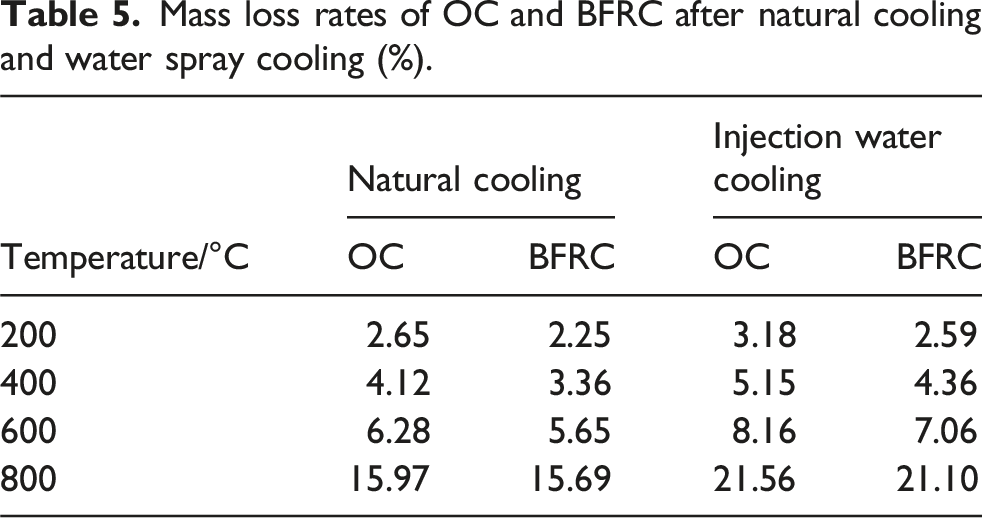
As indicated in Table 5, under the same cooling conditions and temperature, BFRC exhibits lower mass loss rates than OC. For instance, after exposure to 400°C, the mass loss rate of BFRC is reduced by 18.45% and 15.34% compared to OC under natural cooling and water cooling conditions, respectively. Chen et al. 43 also reported similar results. This is because basalt fibers, with their high melting point (approximately 1350°C), maintain their integrity in high-temperature environments and mitigate concrete mass loss by hindering crack propagation.44,47 Notably, at 800°C, the ability of basalt fibers to reduce the mass loss of concrete is not particularly significant. In other words, the reinforcing effect of basalt fibers is more pronounced at medium and low temperatures (200°C–600°C). This is mainly because, after exposure to 800°C conditions, the cement matrix becomes highly loose, and the bond strength between the basalt fibers and the matrix is substantially reduced, rendering the fibers less effective in mitigating mass loss. 48
Based on the mass loss rate data in Table 5, it is evident that the mass loss rate of OC after water cooling has a linear amplification factor compared to that after natural cooling, and this amplification factor is closely related to temperature. Moreover, the effect of basalt fibers in reducing the mass loss rate is also closely related to temperature. Therefore, this study introduces parameters related to temperature and basalt fibers to derive the mass loss rate under other conditions based on the mass loss rate of OC after natural cooling, defined as MN-OC. The specific derivation process is as follows: (1) After water cooling, assuming KOC is a linear amplification factor related to temperature T, the mass loss rate of OC after water cooling is defined as shown in equation (2).’

Based on the data in Table 5, the calculations yield a as 0.00025 and b as 0.15. The final formula for calculating the mass loss rate of OC after water cooling is expressed in equation (3). (2) After natural cooling, assuming the reinforcing effect of basalt fibers is determined by a reduction coefficient that varies with the temperature, defined as NBFRC, the mass loss rate of BFRC after natural cooling is expressed in equation (4).

By fitting the data in Table 5, it was determined that the relationship between NBFRC and temperature is expressed in equation (5).
Therefore, the formula for calculating the mass loss rate of OC after natural cooling is as follows: (3) After water cooling, assuming KBFRC is a linear amplification factor related to temperature, the mass loss rate of BFRC after water cooling is defined via equation (7).

By fitting the data in Table 5, KBFRC was determined to be KBFRC = 0.0002 T + 0.11. Combining equation (4) and equation (7), the formula for calculating the mass loss rate of BFRC after water cooling is as follows:
Notably, the temperature range for the above predictive formulas is 200°C–800°C. At higher or lower temperatures, significant nonlinear variations may occur, rendering the fitted formulas potentially unsuitable, particularly under extreme high-temperature conditions.
Relative dynamic elastic modulus
Based on the ultrasonic pulse velocity test results, the relative dynamic elastic modulus of OC and BFRC after high-temperature exposure was calculated using equation (9).
49
The calculation results are presented in Figure 5. Relative dynamic elastic modulus of OC and BFRC under different cooling methods: (a) natural cooling, (b) water cooling.

Notably, the relative dynamic elastic modulus of concrete materials represents their internal compactness and density. A higher relative dynamic elastic modulus indicates a denser internal structure, implying enhanced shape and structural stability under external loads. 49 As demonstrated in Figure 5, similar to the mass loss rate results, the relative dynamic elastic modulus of both OC and BFRC decreases with increasing temperature, regardless of the cooling method (natural cooling or water cooling). For example, after exposure to 600°C, the relative dynamic elastic modulus of OC was 0.4356 and 0.3267 under natural cooling and water cooling conditions, respectively, while that of BFRC was 0.4792 and 0.4073 under the same conditions. Furthermore, at the same temperature, the relative dynamic elastic modulus was significantly lower under water cooling conditions than under natural cooling conditions. This is primarily because during natural cooling, the internal temperature of the concrete decreases gradually, resulting in relatively uniform and slow structural damage. In contrast, water cooling causes a rapid decline in concrete temperature, generating larger thermal stresses within the material and exacerbating crack formation and propagation. 46
Additionally, Figure 5 illustrates that under the same conditions, the relative dynamic elastic modulus of BFRC is consistently higher than that of OC. This indicates that basalt fibers enhance the internal compactness of concrete even after high-temperature exposure. For instance, after exposure to 400°C, the relative dynamic elastic modulus of BFRC increased by 12.01% compared to OC under natural cooling conditions and by 11.2% under water cooling conditions. Similar findings have been reported in previous studies.50,51 After exposure to 200°C and natural cooling, the relative dynamic elastic modulus of BFRC exceeded 1, indicating that the internal compactness of BFRC surpassed that at room temperature. This may be attributed to the continuation of hydration reactions within the concrete during natural cooling, as well as the bridging and interfacial reinforcement effects of basalt fibers, which effectively restricted crack propagation and improved the compactness of the concrete.
Triaxial compression performance
Strength
The triaxial compressive strength of OC and BFRC after high-temperature exposure, obtained from the triaxial compression tests, is illustrated in Figure 6, which indicates that for both OC and BFRC, the triaxial compressive strength at a confining pressure of 8 MPa is always greater than that at 4 MPa under the same conditions. This result is consistent with previous studies.47,52 Meng et al.
53
suggested that under axial pressure, the confining pressure induces a “hoop effect” in concrete, enhancing the constraint on cracks and making it more difficult for them to propagate radially, thus increasing the triaxial compressive strength. Furthermore, according to the Mohr-Coulomb criterion, an increase in confining pressure enhances the shear strength of the material, thereby increasing its triaxial compressive strength. With respect to the triaxial compressive strength at room temperature, OC and BFRC exhibit an increase in triaxial compressive strength at 200°C after natural cooling, whereas the triaxial compressive strength of OC and BFRC gradually decreases after water cooling. This may be attributed to the fact that natural cooling can improve the microstructure of the material to some extent, whereas water cooling exacerbates thermal stress effects, leading to a gradual reduction in triaxial compressive strength.
54
Additionally, as illustrated in Figure 6, under the same conditions, the triaxial compressive strength of the samples after water cooling is always lower than that after natural cooling. This trend aligns with the results from the mass loss rate and ultrasonic pulse velocity tests. Triaxial compressive strength of OC and BFRC under different cooling methods: (a) natural cooling, (b) water cooling.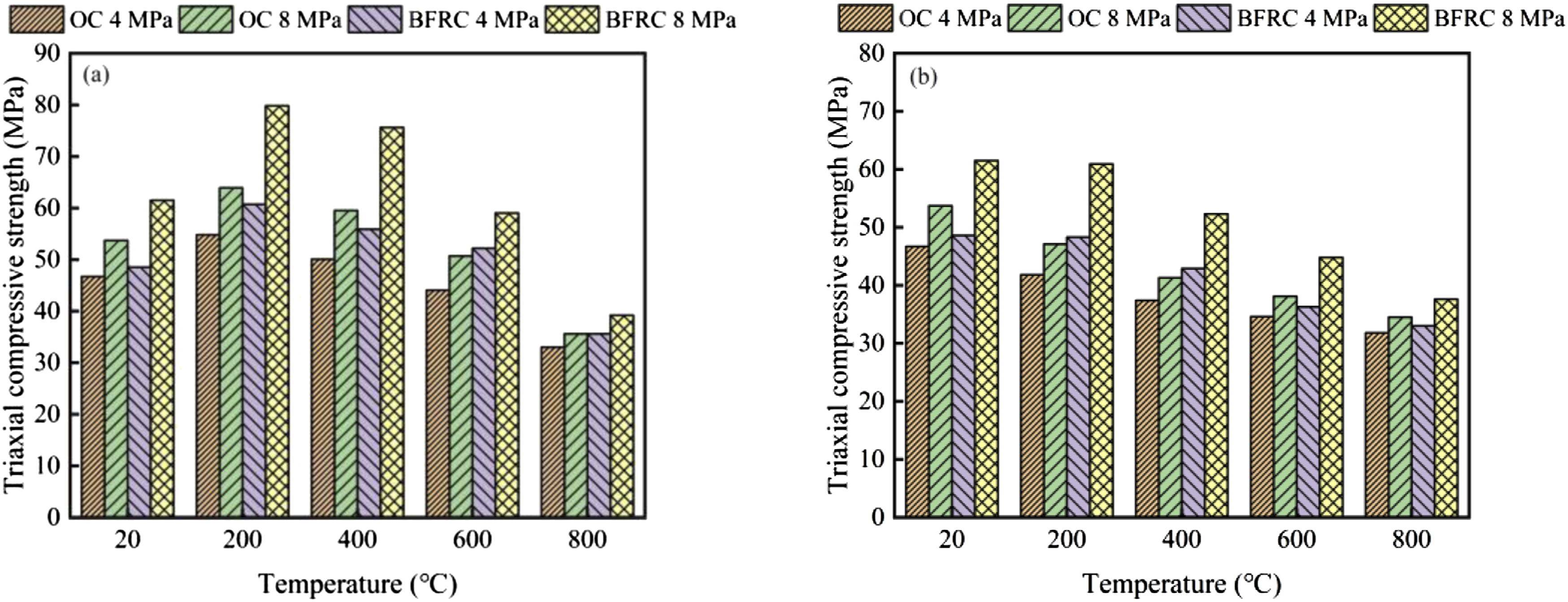
Figure 6 also suggests that under identical conditions, the triaxial compressive strength of BFRC is consistently greater than that of OC. For example, at 400°C and under a confining pressure of 4 MPa, the triaxial compressive strength of OC is 50.1 MPa after natural cooling, whereas BFRC reaches 55.9 MPa, representing an increase of 11.58%. This indicates that basalt fibers have a beneficial reinforcing effect on concrete subjected to high temperatures and triaxial loading. Notably, (1) under the same conditions, the reduction in the triaxial compressive strength of BFRC with increasing temperatures is smaller than that corresponding to OC; (2) the reinforcing effect of basalt fibers is more pronounced at a confining pressure of 8 MPa compared to 4 MPa. The underlying reasons are as follows: (1) in high-temperature environments, the concrete matrix weakens due to factors such as moisture evaporation and microcrack propagation, but basalt fibers can effectively inhibit the formation and propagation of these microcracks to some extent 55 ; (2) as confining pressure increases, cracks and pores are further restricted, making it more difficult for them to expand. The bridging effect of basalt fibers becomes more effective under these conditions, further limiting crack propagation. 56
Based on the data in Figure 6, it is evident that the triaxial compressive strength of OC and BFRC after natural cooling and water cooling exhibits a clear mathematical relationship. Therefore, this study establishes a predictive model for the triaxial compressive strength of OC and BFRC by considering the effects of temperature, confining pressure, and basalt fiber reinforcement. The detailed derivation process is as follows:
Typically, the effect of confining pressure on the triaxial compressive strength of concrete materials is linear. If K1 is the temperature-dependent coefficient for the influence of confining pressure, the relationship between the triaxial compressive strength f
c
of OC and the confining pressure can be expressed via equation (10).
Figure 6 illustrates that the reinforcing effect of basalt fibers on concrete varies with temperature and confining pressure. Therefore, a parameter α is introduced to describe the basalt fiber reinforcement effect. The mathematical expression of α is assumed to be that conveyed in equation (11).
Accordingly, the triaxial compressive strength of BFRC after natural cooling can be expressed as follows:
By normalizing the temperature, let T
n
= T/800. Based on the data in Figure 6, the relationship between K1 and temperature is obtained through fitting and is expressed in equation (13). Similarly, the relationship between K2, temperature, and confining pressure is expressed via equation (14):

Coefficient γ is introduced to unify the predictive model for the triaxial compressive strength of OC and BFRC after natural cooling, as expressed in equation (15).
In the equation, when the sample is OC, γ = 0; when the sample is BFRC, γ = 1.
Figure 6 illustrates that the triaxial compressive strength of OC and BFRC after water cooling is significantly lower than that after natural cooling. Furthermore, the triaxial compressive strengths obtained under the two cooling methods exhibit a power function decay relationship. Therefore, this study introduces a power function as the reduction coefficient for the triaxial compressive strength after water cooling, as conveyed in equation (16).
Based on the data in Figure 6, the values of a and b are obtained through fitting, with a = −0.505 and b = −0.093.
Combining equations (15) and (16), the predictive model for the triaxial compressive strength of OC and BFRC after water cooling is expressed via equation (17).
In the equation, when the sample is OC, γ = 0; when the sample is BFRC, γ = 1.
Failure modes
The failure modes of the samples from the triaxial compression experiments are shown in Figure 7, which illustrates that the cooling method significantly affects the failure modes of the samples. Compared to natural cooling, the samples subjected to water cooling exhibit more severe failure characteristics, particularly at 600°C and 800°C. This is attributed to the steep temperature gradients caused by water cooling, which induce thermal stresses within the concrete, precipitating the formation of more cracks and spalling.
46
Notably, at 400°C, the OC samples subjected to water cooling already exhibit evident localized spalling, while the samples cooled naturally at the same temperature exhibit only minor surface cracking. Moreover, at 800°C, the samples cooled by water display the most severe damage, with cracks penetrating the entire sample. In contrast, the samples that were cooled naturally, although experiencing some spalling, retain a relatively intact overall shape. Therefore, abrupt water cooling exacerbates the degree of damage to the concrete, resulting in prominent crack propagation and surface spalling. Failure modes of OC and BFRC obtained from triaxial compression tests: (a) natural cooling, 4 MPa, (b) natural cooling, 8 MPa, (c) water cooling, 4 MPa, (d) water cooling, 8 MPa.
Figure 7 demonstrates that basalt fibers significantly improve the failure modes of concrete. Under the same temperature and confining pressure conditions, the failure modes of BFRC are more intact compared to OC, with fewer cracks and reduced crack propagation. Particularly at 600°C and 800°C, basalt fibers enhance the toughness of the concrete, preventing rapid crack propagation in BFRC. Even after exposure to 800°C conditions, the overall failure of BFRC remains moderate, with cracks distributed more evenly and without pronounced localized fragmentation or large-scale spalling. In contrast, OC samples exhibit obvious spalling and through-crack phenomena. This indicates that basalt fibers provide a restraining effect under high-temperature and highly confining pressure environments, effectively enhancing the crack resistance and structural stability of concrete.
Stress–strain curves
The axial stress-strain curves obtained from triaxial compression experiments after natural cooling and water cooling are illustrated in Figures 8 and 9, respectively. A comparison of the stress-strain curves under natural cooling and water cooling conditions suggests that the cooling method significantly affects the triaxial compression stress-strain behavior of both OC and BFRC. Under natural cooling conditions, the peak stress of the samples increases with temperatures between 20°C and 400°C, reaching maximum values at 200°C and 400°C. This is because moderate temperatures evaporate moisture and improve the bonding of cementitious materials. However, at 600°C and 800°C, the peak stress of naturally cooled samples decreases significantly, especially at 800°C, where the internal structure of the material suffers severe damage, and increased porosity results in a substantial reduction in strength. In contrast, water-cooled samples exhibit lower peak stress at the same temperatures, particularly under high-temperature conditions (600°C and 800°C). The rapid temperature change caused by water cooling induces concentrated thermal stresses, increasing the brittleness of the material and accelerating crack propagation. The abrupt cooling process of water cooling intensifies the formation and expansion of internal cracks in the concrete, significantly reducing the overall strength of the material. This is particularly evident at 800°C, where the stress-strain curve drops sharply, indicating more severe failure characteristics. Therefore, the cooling method dramatically influences the performance of concrete; natural cooling preserves better strength and toughness, whereas water cooling introduces thermal stresses that result in a substantial reduction in strength. Axial stress-strain curves obtained from triaxial compression tests after natural cooling: (a) OC, 4 MPa, (b) OC, 8 MPa, (c) BFRC, 4 MPa, (d) BFRC, 8 MPa. Axial stress-strain curves obtained from triaxial compression tests after water cooling: (a) OC, 4 MPa, (b) OC, 8 MPa, (c) BFRC, 4 MPa, (d) BFRC, 8 MPa.

Figures 8 and 9 also indicate that the incorporation of basalt fibers significantly enhances the triaxial compressive strength and toughness of concrete. When comparing the stress-strain curves of OC and BFRC, it is evident that BFRC exhibits higher peak stress under all temperature conditions. Moreover, basalt fibers effectively increase peak stress and improve ductility, as indicated by the slower post-peak decline of the curves. This demonstrates that BFRC possesses enhanced crack resistance and ductility. Under high-temperature conditions, specifically at 600°C and 800°C, although the peak stresses of both OC and BFRC decrease, BFRC outperforms OC significantly. Basalt fibers continue to delay crack propagation at high temperatures, thus improving the overall toughness of the concrete. In contrast, OC exhibits more brittle failure at high temperatures, with its curve dropping precipitously after reaching the peak stress level, while BFRC’s curve declines more gradually. This indicates that basalt fibers effectively suppress crack propagation at high temperatures. Therefore, the reinforcing effect of basalt fibers is not only significant at room temperature but also evident under high-temperature conditions, improving the compressive strength and crack resistance of concrete. This enhances the toughness and overall stability of the concrete.
Permeability
The permeability of OC and BFRC was calculated using Darcy’s law, as expressed in equation (17). The permeability calculation results for OC and BFRC are shown in Figure 10. Permeability calculation results: (a) natural cooling, (b) water cooling.

Figure 10 indicates that the cooling method significantly affects the permeability of concrete, with water cooling leading to a more pronounced increase in permeability. A comparison of the permeability of OC and BFRC under natural and water cooling conditions reveals that water cooling notably enhances material permeability. This is primarily due to the thermal shock effect caused by the abrupt temperature changes during water cooling, which generates more cracks and pores inside the concrete, thereby increasing fluid passageways. For example, under a confining pressure of 4 MPa, the maximum permeability of OC under natural cooling conditions is 18.98 × 10⁻¹⁸ mm2, while after water cooling conditions, it increases to 19.42 × 10⁻¹⁸ mm2, representing a 2.32% increase. Similarly, at 8 MPa confining pressure, the maximum permeability of OC under natural cooling conditions is 15.42 × 10⁻¹⁸ mm2, which rises to 16.88 × 10⁻¹⁸ mm2 after water cooling. Although the increase is smaller, the effect of the cooling method on permeability is still evident. A similar trend is observed in BFRC. For instance, at 4 MPa confining pressure, the maximum permeability of BFRC under natural cooling conditions is 14.54 × 10⁻¹⁸ mm2, which increases to 15.16 × 10⁻¹⁸ mm2 after water cooling, representing an increase of approximately 4.27%. These results indicate that the thermal stress effects induced by water cooling exacerbate the formation and propagation of cracks, resulting in increased permeability.57–60
Figure 10 also suggests that an increase in confining pressure significantly suppresses the permeability of both OC and BFRC. Under different confining pressures, as the pressure increases from 4 MPa to 8 MPa, the permeability of OC and BFRC decreases substantially. For example, for OC under natural cooling, the maximum permeability decreases from 18.98 × 10⁻¹⁸ mm2 at 4 MPa to 15.42 × 10⁻¹⁸ mm2 at 8 MPa, representing a reduction of approximately 18.77%. This phenomenon can be attributed to the compression of the pore structure within the concrete under highly confining pressure, leading to the enhanced closure of cracks and reducing fluid pathways, thereby lowering permeability.60,61 Additionally, the incorporation of basalt fibers effectively reduces the permeability of concrete under all experimental conditions. For example, under an 8 MPa confining pressure, the maximum permeability of BFRC under natural cooling conditions is 9.98 × 10⁻¹⁸ mm2, significantly lower than that of OC 15.42 × 10⁻¹⁸ mm2, representing a reduction of 35.28%. This difference demonstrates the reinforcing effect of basalt fibers within the concrete, which effectively limits the formation and propagation of cracks, reducing the connectivity of pores and consequently lowering permeability.38,44 Therefore, it can be concluded that BFRC exhibits significantly better impermeability than OC after high temperatures and cooling. The ability of basalt fibers to control permeability is particularly evident under highly confining pressure and extreme environmental conditions.
Variable-angle shear performance
Normal stress and shear stress
Based on the shear angle and shear load, the normal stress and shear stress were calculated,
62
and the results for OC and BFRC under different experimental conditions are presented in Figures 11–15. Figures 11–15 illustrate that as the shear angle increases, the shear load, normal stress, and shear stress of both OC and BFRC gradually decrease. This indicates that an increase in the shear angle weakens the ability of concrete to resist shear failure. This phenomenon is primarily attributed to the stress decomposition effect caused by the increase in the shear angle, which alters the distribution of internal stresses within the concrete.
63
Notably, under 200°C and natural cooling conditions, the shear load, normal stress, and shear stress of BFRC increase. Furthermore, under the same experimental conditions, the shear load, normal stress, and shear stress of BFRC are consistently greater than those of OC. Similar to previous experimental results, water cooling reduces the shear load, normal stress, and shear stress of both OC and BFRC. Failure load, normal stress, and shear stress at room temperature: (a) OC, (b) BFRC. Failure load, normal stress, and shear stress of OC after natural cooling: (a) 200°C, (b) 400°C, (c) 600°C, (d) 800°C. Failure load, normal stress, and shear stress of OC after water cooling: (a) 200°C, (b) 400°C, (c) 600°C, (d) 800°C. Failure load, normal stress, and shear stress of BFRC after natural cooling: (a) 200°C, (b) 400°C, (c) 600°C, (d) 800°C. Failure load, normal stress, and shear stress of BFRC after water cooling: (a) 200°C, (b) 400°C, (c) 600°C, (d) 800°C.
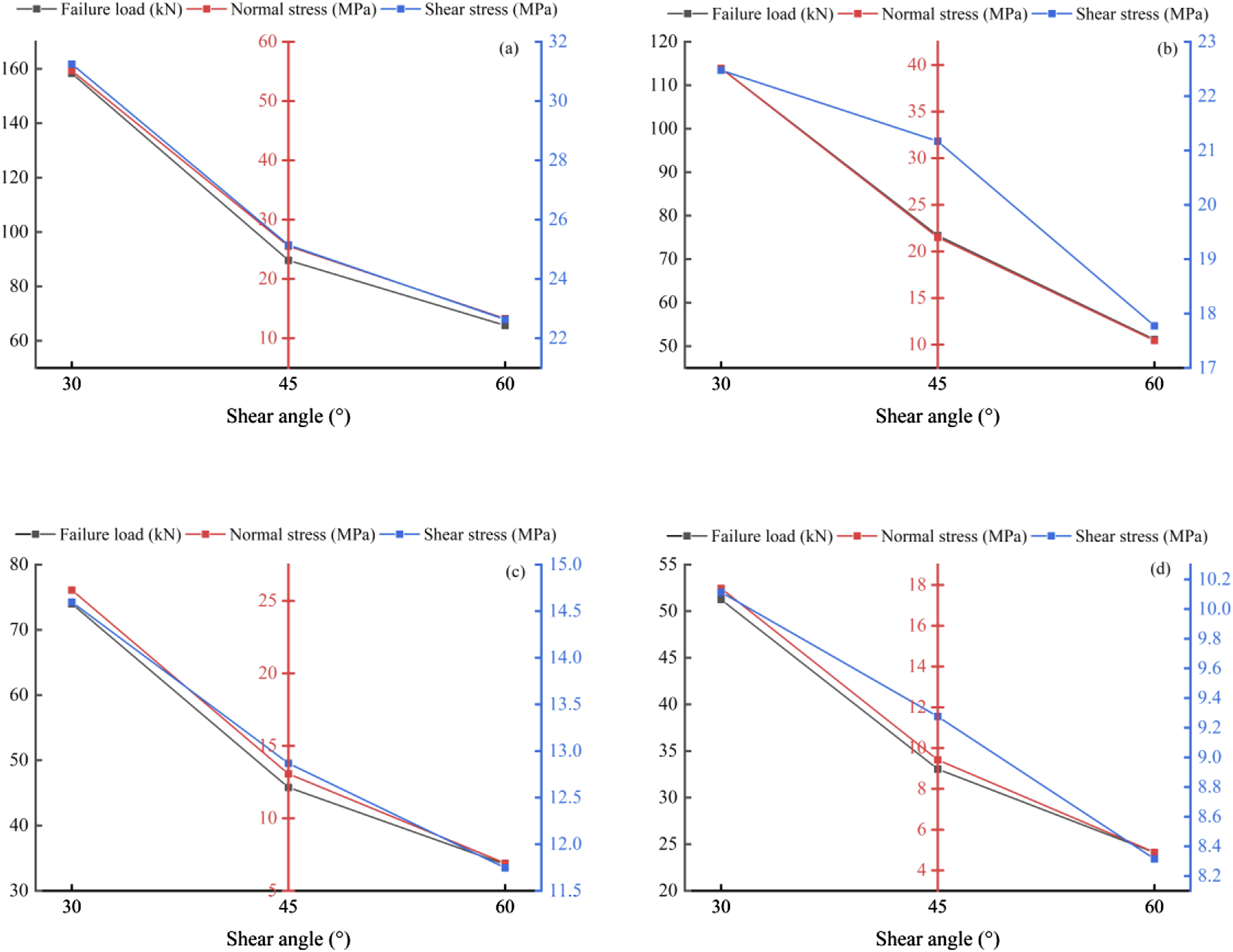
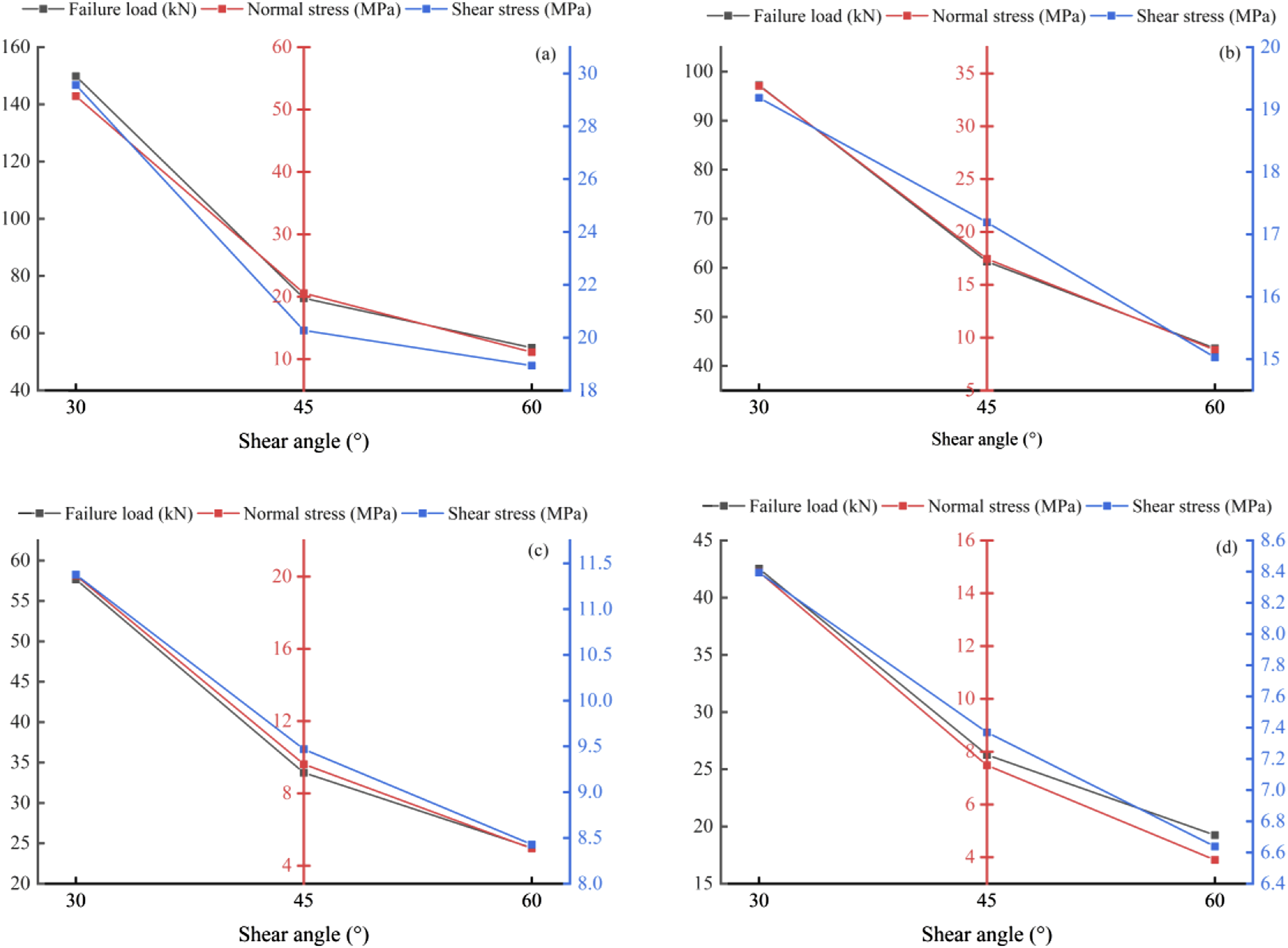
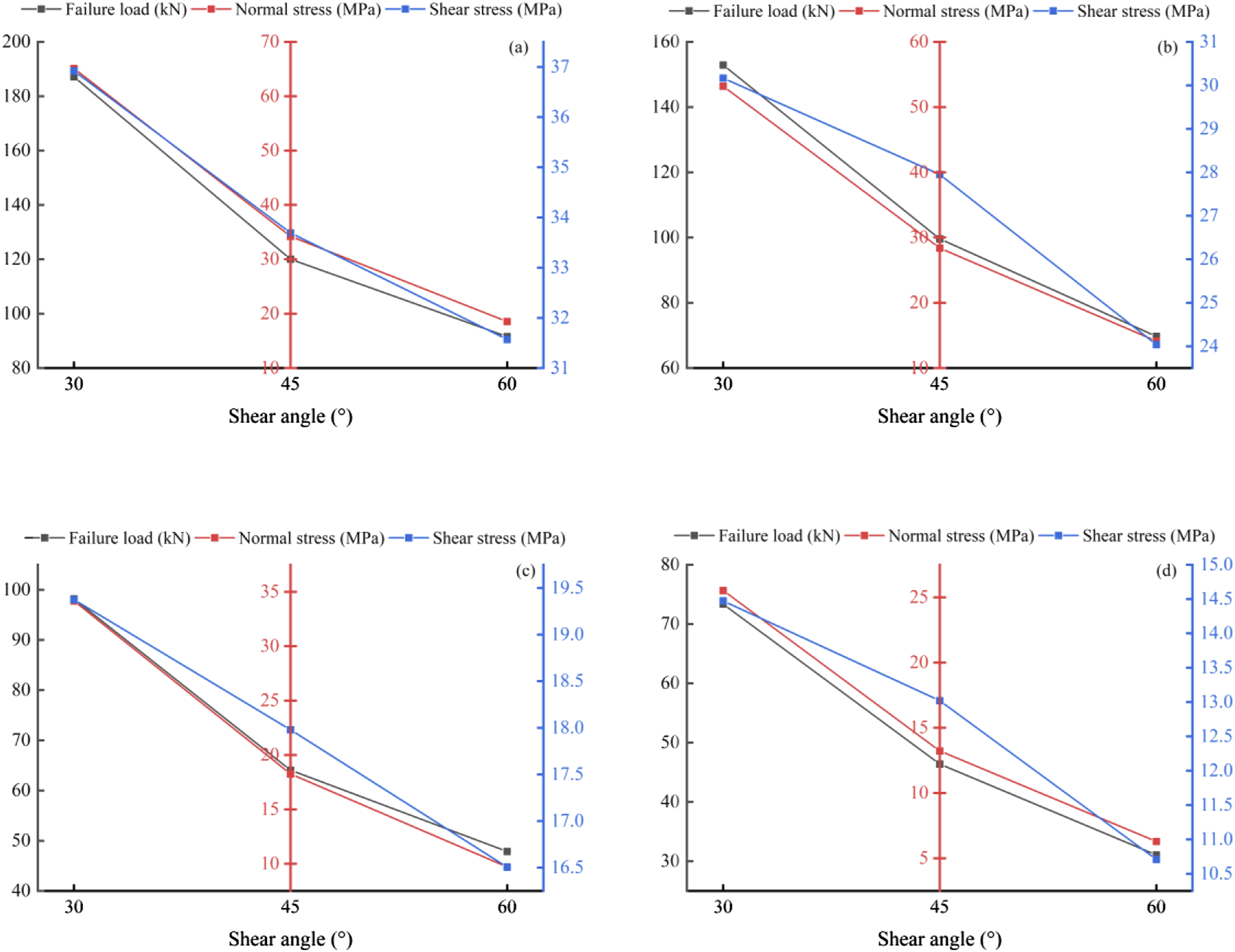

In conclusion, in the variable-angle shear tests, basalt fibers do not alter the trends of concrete material properties with changes in the shear angle or temperature. However, basalt fibers effectively enhance the interfacial strength of concrete, thereby improving its resistance to shear failure.
Stress–strain curves
The variable-angle shear stress-strain curves obtained after natural cooling are depicted in Figure 16, and those obtained after water cooling are presented in Figure 17. Figures 16 and 17 indicate that as the temperature increases, the stress-strain curves of both OC and BFRC exhibit a slower growth rate in the ascending phase and a slower decline rate in the descending phase. Similar phenomena have been reported in previous studies.64,65 Liu et al.
66
explained this phenomenon by suggesting that as the temperature rises, the evaporation of moisture in concrete increases porosity and reduces compactness. These changes in the internal structure cause concrete to exhibit greater strain under compression, with slower stress growth and decline. As a result, the stress-strain curves exhibit a slower growth rate in the ascending phase and a slower decline rate in the descending phase. A comparison of Figures 16 and 17 indicates that this phenomenon is more pronounced after water cooling than after natural cooling. According to Liu et al.,
66
this is primarily due to the increased porosity caused by rising temperatures, and water cooling introduces more pores into the concrete than natural cooling, making this effect more evident. Additionally, Figures 16 and 17 demonstrate that BFRC exhibits a faster growth rate in the ascending phase of the stress-strain curves compared to OC. This is because basalt fibers improve the tensile strength and crack resistance of concrete, reducing the formation of cracks and pores. Consequently, BFRC experiences faster stress growth under shear loading, as reflected by the faster ascending phase in the stress-strain curves. Variable-angle shear stress-strain curves of OC and BFRC after natural cooling: (a) 30°, (b) 45°, (c) 60°. Variable-angle shear stress-strain curves of OC and BFRC after water cooling: (a) 30°, (b) 45°, (c) 60°.

Cohesion and internal friction angle
Based on the Mohr-Coulomb criterion, the cohesion and internal friction angle of OC and BFRC were calculated using equation (18). The calculation results for cohesion are presented in Figure 18, and those for the internal friction angle are illustrated in Figure 19. Cohesion calculation results: (a) natural cooling, (b) water cooling. Internal friction angle calculation results: (a) natural cooling, (b) water cooling.
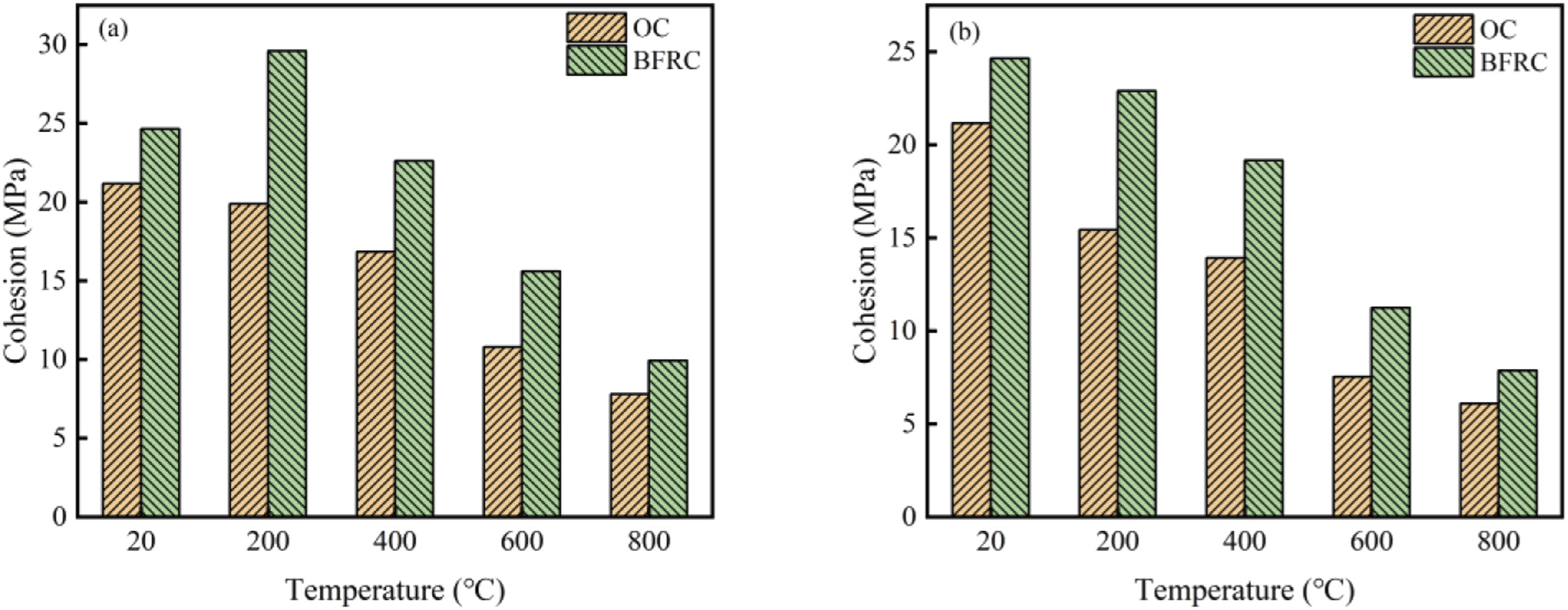
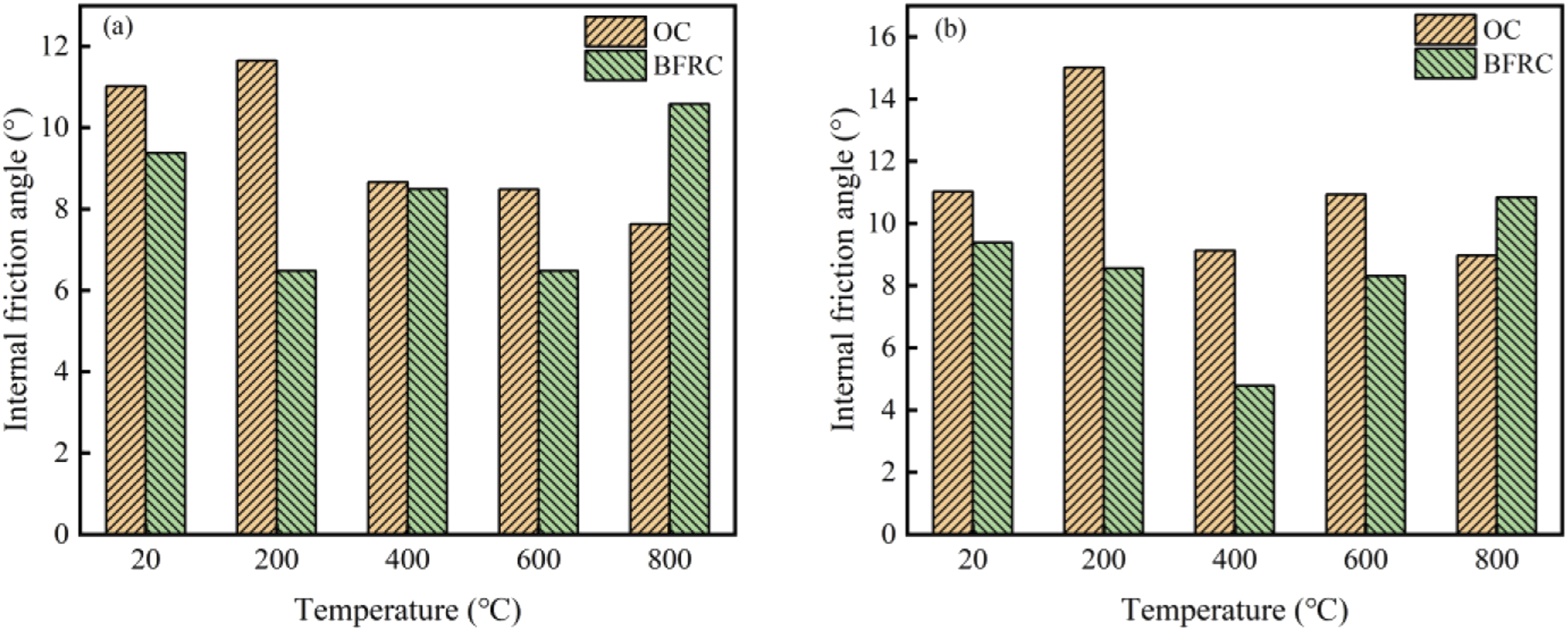
Figures 18 and 19 suggest that both the cohesion and internal friction angle of OC and BFRC indicate a decreasing trend with increasing temperature. For instance, under natural cooling conditions, the cohesion of OC decreases from 21.16 MPa at room temperature to 7.8 MPa at 800°C. Similarly, the cohesion of BFRC decreases from 24.64 MPa at room temperature to 9.93 MPa at 800°C. The internal friction angle exhibits a similar trend. These results are consistent with the findings of Yang et al.67,68 This decline is primarily attributed to significant changes in the microstructure of concrete under high temperatures, including the decomposition of hydration products, increased porosity, and weakened bonding between fibers and the matrix. 69 Notably, different cooling methods significantly affect the cohesion and internal friction angle of OC and BFRC. After water cooling, the cohesion and internal friction angle of both OC and BFRC are lower than after natural cooling. For example, at 200°C, the cohesion of OC decreases from 19.89 MPa under natural cooling to 15.43 MPa under water cooling, while the internal friction angle decreases from 11.65° to 15.01°. This indicates that water cooling increases the brittleness of concrete and reduces its shear resistance.
Figures 18 and 19 also suggest that basalt fibers significantly improve the cohesion of concrete. At all temperature conditions, the cohesion of BFRC is higher than that of OC. For example, at room temperature, the cohesion of BFRC is 24.64 MPa, which is significantly higher than OC’s 21.16 MPa. This demonstrates that the reinforcing effect of basalt fibers effectively enhances the shear resistance of the material. However, BFRC only exhibits a higher internal friction angle than OC at 800°C. This may be due to the reduced frictional effect between fibers and the matrix at lower temperatures, leading to a lower internal friction angle. At 800°C, changes in the structural properties of the fibers might enhance their friction with the matrix, resulting in a higher internal friction angle compared to OC. This suggests that the impact of basalt fibers on the frictional slip resistance of concrete becomes more prominent under extreme high-temperature conditions.
Shear toughness index
The toughness index measures the energy absorption capacity of concrete materials before failure, reflecting their ductility.
69
Previous studies have reported two methods for calculating the toughness index: One calculates the area under the stress-strain curve, and the other uses energy dissipation to calculate toughness.70,71 Although the stress-strain curve integration method represents the energy absorption capacity of concrete throughout the loading process, it cannot distinguish the energy absorption capacity at the peak stress level. The greatest advantage of the energy dissipation method is its ability to capture the energy dissipation characteristics during the post-peak stage. However, since concrete is a quasi-brittle material, discussing post-peak energy dissipation characteristics has limited significance. Therefore, this study focuses on the toughness index of OC and BFRC before the peak stress stage. Additionally, to account for the peak stress and the strain corresponding to the peak stress, a new method for evaluating the toughness index is proposed, with the calculation method expressed in equation (19).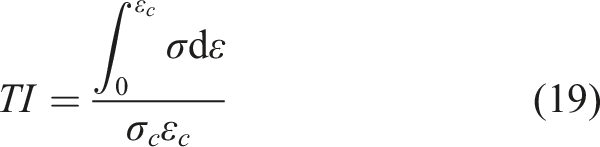
Based on equation (19), the shear toughness index of OC and BFRC under different experimental conditions was calculated, and the results are presented in Figure 20, which illustrates that after natural cooling, the toughness index of OC and BFRC decreases gradually with increasing temperature. However, at a shear angle of 60° and a temperature of 200°C, the toughness index of both OC and BFRC increases. This may be because the 60° shear angle approximates a sliding failure mode, where the principal direction of shear stress aligns closely with the transverse loading mode of the concrete, resulting in a different toughness index behavior compared to the 30° and 45° shear angles. After water cooling, the toughness indices of OC and BFRC exhibit different trends. For OC, the toughness index decreases with increasing temperatures, while for BFRC, it increases gradually. This is likely due to the thermal stresses and crack propagation induced by water cooling being mitigated by the bridging effect of basalt fibers. The fibers absorb more energy during crack bridging, thereby improving the material’s toughness. Notably, as illustrated in Figure 20(a) and (b), regardless of whether the material is OC or BFRC, the toughness index after water cooling is higher than that after natural cooling. Similar findings have been reported by Yu et al.
72
This phenomenon can be attributed to the rapid condensation of internal moisture during water cooling, which increases the porosity of the concrete. Changes in the pore structure provide additional “buffering” space, allowing the concrete to undergo greater deformation under shear loading, thereby increasing the toughness index.
73
Toughness calculation results: (a) natural cooling, (b) water cooling.
Conclusions
This study aimed to investigate the effects of basalt fibers and cooling methods on the physical and mechanical properties of concrete after exposure to high temperatures. Based on the findings, the following conclusions were drawn: (1) At low volume fractions, basalt fibers effectively enhance the compactness and strength of concrete. However, as the volume fraction increases further, fiber agglomeration leads to reduced workability, increased water absorption, and decreased compressive strength. The optimal basalt fiber volume fraction in this study is 1.0%. (2) Regardless of the cooling method (natural cooling or water cooling), the mass loss rate of both OC and BFRC increases with temperature, while the relative dynamic elastic modulus decreases. Compared to natural cooling, water cooling generates greater internal thermal stress, resulting in higher mass loss rates and lower relative dynamic elastic moduli for OC and BFRC. Additionally, the incorporation of basalt fibers significantly reduces the mass loss rate and enhances the relative dynamic elastic modulus, with the most pronounced effects observed in the medium-to-low temperature range of 200°C to 600°C. (3) The triaxial compressive strength and failure modes of OC and BFRC after exposure to high temperatures are significantly influenced by the cooling method. Natural cooling preserves triaxial compressive strength and toughness more effectively than water cooling, as thermal stress concentration in water cooling exacerbates crack propagation. The incorporation of basalt fibers significantly improves crack resistance and triaxial compressive strength, particularly under high temperatures and highly confining pressures, demonstrating excellent reinforcement and ductility. (4) Water cooling, due to abrupt temperature changes, induces thermal shock effects that increase internal cracks in concrete, significantly raising permeability. In contrast, increased confining pressure effectively suppresses permeability. Basalt fibers substantially reduce permeability, demonstrating excellent impermeability, particularly under highly confining pressure and extreme environmental conditions, where BFRC outperforms OC. (5) Although the shear load, normal stress, and shear stress of OC and BFRC decrease with increasing shear angle and temperature, the presence of basalt fibers effectively enhances the overall shear resistance of concrete, specifically under high temperatures and high shear angles. After natural cooling, the toughness index of OC and BFRC decreases with increasing temperatures. However, under water cooling conditions, the toughness index of OC decreases, while that of BFRC increases gradually, indicating the superior performance of BFRC in resisting thermal and shear effects. (6) At 800°C, the positive influence of basalt fibers on the compressive strength and permeability is notably reduced compared to the lower temperature exposures. This suggests that while basalt fibers are effective at moderate temperatures, their role in enhancing concrete properties diminishes at extremely high temperatures.
Future research directions
This study has explored the effects of basalt fibers and cooling methods on the physical and mechanical properties of concrete after exposure to high temperatures. However, there are several limitations, and future research could focus on the following directions: (1) The optimization of fiber dispersion processes: Future studies could further optimize the dispersion process of basalt fibers in concrete to minimize the agglomeration of fibers at high volume fractions. (2) Future studies should focus on the long-term durability of fiber-reinforced concrete under extreme thermal environments. In particular, the effects of post-fire recovery, repeated thermal exposure, and prolonged curing after high-temperature events deserve further investigation. Moreover, comprehensive studies involving multi-factor coupling—such as temperature, cooling rate, fiber volume fraction, and confining pressure—are encouraged to reveal the synergistic influence on mechanical and permeability properties. These efforts will contribute to a deeper understanding of the material’s performance and degradation mechanisms under realistic service conditions. (3) Comparison with other fiber materials: Future research could compare basalt fibers with other types of fibers (e.g., carbon fibers, glass fibers) to identify differences in their effects on the performance of concrete under high temperatures and different cooling methods. This could help determine the optimal reinforcement material combinations.
Footnotes

Author contributions
Guohai Feng: Writing–review and editing; Kai Li: Funding acquisition; Jie Zhang: investigation.
Funding
The author(s) disclosed receipt of the following financial support for the research, authorship, and/or publication of this article: Key Scientific Research Projects of Universities in Henan Province, Grant numbers is 24B560020.
Declaration of conflicting interests
The author(s) declared no potential conflicts of interest with respect to the research, authorship, and/or publication of this article.
Data Availability Statement
The data used to support the findings of this study are included within the article.