




Abstract
This study aims to develop a novel computational model to accurately quantify the interfacial interactions between matrix resin and fillers in polymer-based composites, thereby overcoming the limitations of existing theories and computational models in assessing interfacial interactions, such as limited application scope and unclear boundary conditions. By exploring the dynamic behavior of matrix resin molecular chains, a theoretical model for interfacial interactions was constructed based on molecular chain dynamics theory, and corresponding computational formulas were derived. To validate the model, bisphenol A epoxy resin and hollow glass microspheres were selected as experimental materials, and experimental studies were conducted using dynamic thermomechanical analysis and other methods. The results demonstrate that the proposed molecular chain dynamics model can accurately quantify the interfacial interactions in polymer-based composites, successfully determining the interfacial interaction parameter A value of 0.42 between bisphenol A epoxy resin and hollow glass microspheres, which falls into the category of “ordinary interfacial interaction.” This study not only provides a solid theoretical foundation for the optimization design and performance enhancement of composites but also holds broad application prospects in fields such as military aviation, aerospace, naval equipment, and high-end terrestrial equipment, potentially driving advancements in composite material design technology.
Introduction
Polymer-based composite materials have become a global focus of research since their inception in the 1960s. These materials have shown great potential applications in various fields, including military aviation, aerospace, naval, and high-end terrestrial equipment. They are regarded as key strategic materials for both military and civilian uses.1–4 Polymer-based composite materials consist of polymer matrices, including thermoplastic5,6 and thermosetting7,8 resins. Functional fillers incorporated into the polymer matrix enhance the performance of the composite materials. Based on the nature of the reinforcing agents, polymer-based composite materials can be subdivided into continuous fiber-reinforced,2,9 short fiber-reinforced, 10 and particle-reinforced11–13 composite materials.
The overall performance of composite materials is influenced by the properties of the matrix resin and the reinforcements. Additionally, the performance is influenced by the interfacial interactions between the matrix and the reinforcements. 14 Once the composition and structure of the composite materials are determined, the interfacial interactions become the dominant factors determining the performance of the composite materials. Based on the stress state of the fillers, the testing and calculation of their internal interfacial interactions are divided into two main categories: static mechanical testing methods and dynamic mechanical testing methods.
Static mechanical testing methods
Static mechanical testing is used to assess the interfacial interactions between the resin and fillers in composite materials. This method mainly uses direct or indirect methods of mechanical performance testing. Commonly used testing methods for long fiber-reinforced composites include single fiber pull-out, micro-droplet embedding pull-out, and fiber push-out tests.15,16 These methods can directly reveal the interfacial interactions between the long fibers and the matrix resin. In contrast, for composites reinforced with particles or short fibers, the interfacial effects between the matrix resin and fillers must be inferred indirectly through mechanical performance testing data.
The modulus of elasticity model proposed by Sato and Furukawa17,18 established a relationship between the elastic modulus of composite materials and that of the matrix resin and introduced the concept of interfacial action. However, because the calculation of interfacial action depends on empirical parameters, the accuracy of the model is limited. Similarly, Turesanyi’s strength model19,20 considers the mechanical strength of the composite materials and the matrix resin and interfacial parameters. However, the application of the model is limited due to the difficulty in determining shape parameters for irregularly shaped fillers.
Dynamic mechanical testing methods
Dynamic mechanical testing mainly involves measuring the dynamic mechanical parameters of composite materials and matrix resin, thereby indirectly deducing the interfacial action between the matrix resin and the filler. Ashid et al. studied short-cut nylon fiber-reinforced neoprene rubber and observed a linear relationship between the maximum loss factor of the composite material and the volume fraction of short-cut fibers. Based on their observation, they proposed a theoretical model of the loss factor.21,22 Rigdahl and others studied composite foam materials and further derived parameters for characterizing the interfacial action between the matrix and hollow glass microspheres. Their derived formula subdivides the loss factor of the composite material into contributions from the matrix resin, the filler, and the interface between the resin and the filler.23–26
In summary, current theoretical models and computational formulas mainly focus on fillers of specific forms, limiting their universality and applications in determining interfacial actions. Thus, developing a new theoretical model and computational formulas is urgent. This model should be more universally applicable to fillers of various forms, and its boundary conditions and criteria should be clearer and more rigorous to precisely explain the complex mechanisms of interfacial actions within polymer-based composite materials.
Establishment of molecular chain dynamics model and interface interaction calculation formulas for polymer-based composite materials
The development of molecular chain dynamics model and interface interaction calculation formulas
In low-temperature environments, polymer molecular chains struggle to overcome internal friction and intermolecular forces due to insufficient energy, making them primarily exist in a constrained state of local vibrations. This state limits significant movements and conformational changes of the molecular chains, causing the material to exhibit rigidity and brittleness characteristics similar to glass. This condition of the material is academically referred to as the “glassy state.”
27
However, as the environmental temperature increases, polymer molecular chains absorb more thermal energy from their surroundings. When the environmental temperature reaches the glass transition temperature, the accumulated thermal energy provides sufficient mobility to the molecular chains, allowing them to break free from their constraints, thereby achieving more free movement patterns, such as moving and rotating. This change facilitates the transition of the polymeric material from a glassy state to a more elastic and plastic high-elastic state. During this transition, a certain amount of energy is required to initiate larger-scale motions of the molecular chains, known as the activation energy for polymer molecular chain motion. This activation energy is the energy required to overcome intermolecular interactions and internal friction. The activation energy for the motion of polymer molecular chains can be accurately calculated using a modified form of the Arrhenius equation: Equation (1).26,28,29

The activation energy for molecular chain segment motion of any fixed-size pure matrix resin is constant, and it is denoted as


For any given matrix resin and filler system, Diagram of activation energy variation region for molecular chain movement in polymer-based composite materials.
When
Calculation of the interaction of interfaces
The additional interfacial activation energy


The formula is further transformed to

However, the situation becomes more complex when dealing with polymer fillers. As a result, a detailed investigation needs to be conducted on the energy consumption in molecular chain motion between the matrix resin and the polymer fillers. To precisely measure and calculate the activation energy for the molecular chain motion of composite materials, we selected the glass transition temperature of the matrix resin as a critical temperature point for observation and analysis.
At the glass transition temperature of the matrix resin, the energy consumption of the polymer fillers is significantly lower than that of the matrix resin. In this case, the activation energy for the molecular chain motion of the polymer fillers,
In dynamic thermal mechanical analysis, the ability of polymer molecular chains to consume energy is commonly characterized using the loss modulus. Therefore, the loss modulus of the polymer fillers within the composite material at the glass transition temperature of the matrix resin can be assessed using dynamic mechanical thermal analysis. If their loss modulus relative to that of the matrix resin is negligible, then the energy consumption of the polymer fillers at the glass transition temperature will be significantly lower than that of the matrix resin.
For inorganic rigid fillers and polymer fillers where the energy loss of the fillers themselves is neglected,

Transform the formula:


Criteria for boundary conditions and interface interactions in the molecular chain dynamics model of polymer-based composite materials
In the previous section, by establishing the molecular chain dynamics model of polymer-based composite materials, the formula for calculating the interaction between the filler and the matrix resin at the interface was derived. In this section, we discuss the application boundary conditions and the relative criteria for determining the magnitude of interface interactions.
Boundary conditions applied in molecular chain dynamics models
The application of boundary conditions in molecular dynamics models requires both internal and external boundaries. Internal boundary conditions refer to the influencing factors inherent to the composite material, including the matrix resin and fillers. External boundary conditions refer to the test conditions of dynamic thermomechanical analysis.
Internal boundary conditions
This study investigates the molecular dynamics model of polymer-based composite materials, primarily focusing on the effect of interfacial interactions between fillers and matrix resins on the activation energy of resin molecular chain segment movement. In constructing this model, we mainly focused on the volumetric fraction relationship between the filler and the matrix resin, excluding various parameters, such as the morphology, size, physicochemical surface properties, strength, and modulus of the filler. Thus, we derived equations (9) and (10), applicable to all types of inorganic fillers.
However, when applying the model to polymer fillers, careful consideration must be given to the glass transition temperature range of both the matrix resin and the polymer fillers. Particularly when the glass transition temperature of the matrix resin lies within the glass transition range of the polymer fillers, the energy dissipation by the filler may become significant and should not be overlooked. In such cases, the relative contributions of the resin and the filler to energy consumption at the glass transition temperature point of the matrix resin need to be further assessed. Specifically, the loss modulus temperature spectra of both materials can be obtained through dynamic mechanical analysis, and comparisons can be made at the glass transition temperature point of the matrix resin. At this temperature, if the loss modulus of the filler is significantly lower than that of the greatly reduced matrix resin, the energy consumption by the filler can be considered negligible. Thus, equations (9) and (10) remain applicable.
Furthermore, in the actual design and application of composite materials, the bonding strength between the filler and the matrix resin is often enhanced by chemically modifying the filler surface to form a modification layer with physical and chemical properties similar to those of the matrix resin. This modification layer is usually extremely thin, and its thickness is only in the nanometer or micrometer range.30,31 Given that the volume of the modification layer is almost negligible compared with that of the matrix resin, our derived equations (9) and (10) remain valid when dealing with such modified fillers.
External boundary conditions
External conditions refer to the testing conditions used during dynamic mechanical analysis (DMA) of materials. These conditions include sample size, DMA loading form (such as compression, bending, or tension), static force, dynamic force, loading frequency, and heating rate. Under different loading conditions, the interfacial interactions experienced by the molecular chains of the matrix resin can vary. For example, in tension and bending loading modes, the force interactions between the filler and the matrix resin differ, thereby affecting the interfacial interactions.
Criteria for interfacial interactions based on molecular chain dynamics models
The value of A in equation (10), depending on the relative magnitudes of
When
When
When 0 <
When
Materials and experimental methods
To verify the feasibility of the above theoretical model and the calculation formula for interfacial interactions, we selected a bisphenol A epoxy resin/polyetheramine curing agent system as the matrix resin and used inorganic rigid hollow glass microspheres as the filler to prepare the composite material.
Materials
Parameters of XLD3000.

Sample preparation
During the preparation process, the required raw materials were accurately weighed according to the mass ratio of NPEL-128 type epoxy resin, T403 type polyetheramine hardener, and BYK-A530 type defoamer (100:42:2). Subsequently, the materials were homogeneously mixed using mechanical stirring for 5 min. Afterward, the mixture was placed in a vacuum oven for degassing to fully remove the air bubbles in the material. After the mixture was degassed, it was poured into pre-prepared molding molds and cured at room temperature for 12 h, followed by a 2 h cure at 120°C. The finalized samples were numbered and labeled as EP, and five test samples were prepared for each testing requirement.
Hollow microspheres XLD3000 were added to the base resin to separately prepare composite material fillers with volume fractions of 10, 20, 30, 40, and 50%. Afterward, the mixtures containing the hollow microspheres were placed back into a vacuum oven for degassing and then poured into molds for gradient curing. The mixtures were first cured at room temperature for 12 h and then cured at 120°C for 2 h. After curing, the samples were labeled according to the type and volume fraction of hollow microspheres they contained. The epoxy resin system mixed with XLD3000 microspheres was denoted as EP-XLD-10, EP-XLD-20, EP-XLD-30, EP-XLD-40, and EP-XLD-50. Five test samples were prepared for each test item.
Testing and characterization methods
Density and porosity
MH-300A solid density determiner manufactured by Kunshan Egret Precision Instrument Co., Ltd was used to determine the density of the samples following the ISO 1183-1:2004 standard. The porosity content in composite materials was calculated following the ASTM D2734:2003 standard. The test samples were cylindrical, measuring 40 mm in diameter and 4 mm in height.
Compressive properties
The E44.106 type electronic universal testing machine, manufactured by MTS Industrial Systems China Co., Ltd, was used to determine the compressive properties of the material following the GB/T2567-2008 standard. The test samples were cylindrical, with a diameter of 8 mm and a height of 10 mm. Five samples were tested for each test item at a testing speed of 5 mm/min.
Dynamic thermomechanical analysis
The instrument used in this experiment was the DMA1000+ dynamic mechanical analyzer, produced by 01 dB in France. The dimensions of the tensile samples were 50 mm × 10 mm x 3 mm. During the temperature sweep, the temperature ranged from 30°C to 140°C at loading frequencies of 20, 40, 60, 80, and 100 Hz. The grip length for the tensile samples was 10 mm at both ends, leaving an effective test length of 30 mm after the samples were clamped.
Scanning electron microscope
The testing equipment used was the SU5000 model field emission scanning electron microscope manufactured by Hitachi. Before testing, the sample was subjected to gold sputtering to enhance its conductivity and imaging quality. During the test, the accelerating voltage was set to 10 kV to ensure high-quality images. The sample was analyzed at 25°C.
Experimental results and analysis
Density and porosity
Theoretical density, measured density, and porosity of composite materials with different volume fractions of hollow microspheres.

As shown in Table 2, the actual density of the EP-XLD material system was higher than the theoretical density, resulting in a negative porosity. This phenomenon may be attributed to the crushing or breaking during the mixing process of the matrix resin and hollow microspheres, causing an unusually high measured density. Overall, the measured density of the material was close to the theoretical density, and the “void” content in the material can be considered negligible.
Given the data provided in Table 2, we have plotted the curves for theoretical and actual densities of the EP-XLD material system. Figure 2 reveals a linear declining trend in material density with an increase in the volume fraction of the filler. The density of EP-XLD-50 was the lowest at 0.69 g/cm³. Comparison of theoretical density and actual density of the EP-XLD material system.
Compressive properties
Compressive performance is one of the essential tests for assessing the mechanical properties of materials, especially when composites made with hollow microsphere fillers are considered for lightweight applications. It serves as a key indicator of material performance.34,35
By analyzing the data in Figure 3, we observed that as the usage of hollow microspheres gradually increased, both the compressive strength and modulus of the composite foam material decreased, which aligns with reported results in the literature.36,37 Specifically, the compressive strength and modulus of the pure matrix resin were 91.23 MPa and 6.55 GPa, respectively. As the volume fraction of hollow glass microspheres increased, the compressive strength and modulus decreased to 55.60 MPa and 4.11 GPa, respectively. Compressive strength and compressive modulus of EP-XLD.
This decline can be attributed to two key factors. First, the compressive strength of the matrix resin is significantly higher than that of the hollow glass microspheres used. Thus, the overall compressive performance of the composite is mainly determined by the matrix resin, while the hollow microspheres play only a supportive role. Second, as the volume fraction of hollow microspheres increases, the content of the matrix resin relatively decreases, disrupting the continuous phase structure of the matrix resin and further weakening the mechanical properties of the material.
Dynamic thermomechanical analysis
Linear fitting parameters for molecular chain motion activation energy.

According to the Dynamic thermomechanical analysis data, the incorporation of hollow microspheres significantly lowers the glass transition temperature (T g ) of the EP-XLD composite material, and this trend remains consistent across different loading frequencies. The decrease in T g indicates that the molecular chain segments of the matrix resin can start to move at lower temperatures, thereby affecting its thermal stability. This change may have significant impacts on the mechanical properties, dimensional stability, and processing properties of the composite material and should be taken into consideration during material design and application.
Calculation of activation energy of molecular chain motion in composite materials and filler interface interaction
The parameters for calculating the activation energy of molecular chain motion in Table 3 and using equation (1) were used to construct the linear fitting formulas for the activation energies of the molecular chains for EP and EP-XLD (Figure 4). Linear fitting of activation energies for molecular chains in EP and EP-XLD systems.
Linear fitting formula for the activation energy of material molecular chain movement.

According to our established polymer-based composite material molecular chain dynamics model, as per equation (9), and based on the activation energies of molecular chain movements in EP and EP-XLD in Table 4, we derived a universal formula for the activation energy of molecular chain movement in the EP-XLD material system, as shown in Figure 5. Linear fit of the universal formula for the activation energy of EP-XLD molecular chain movements.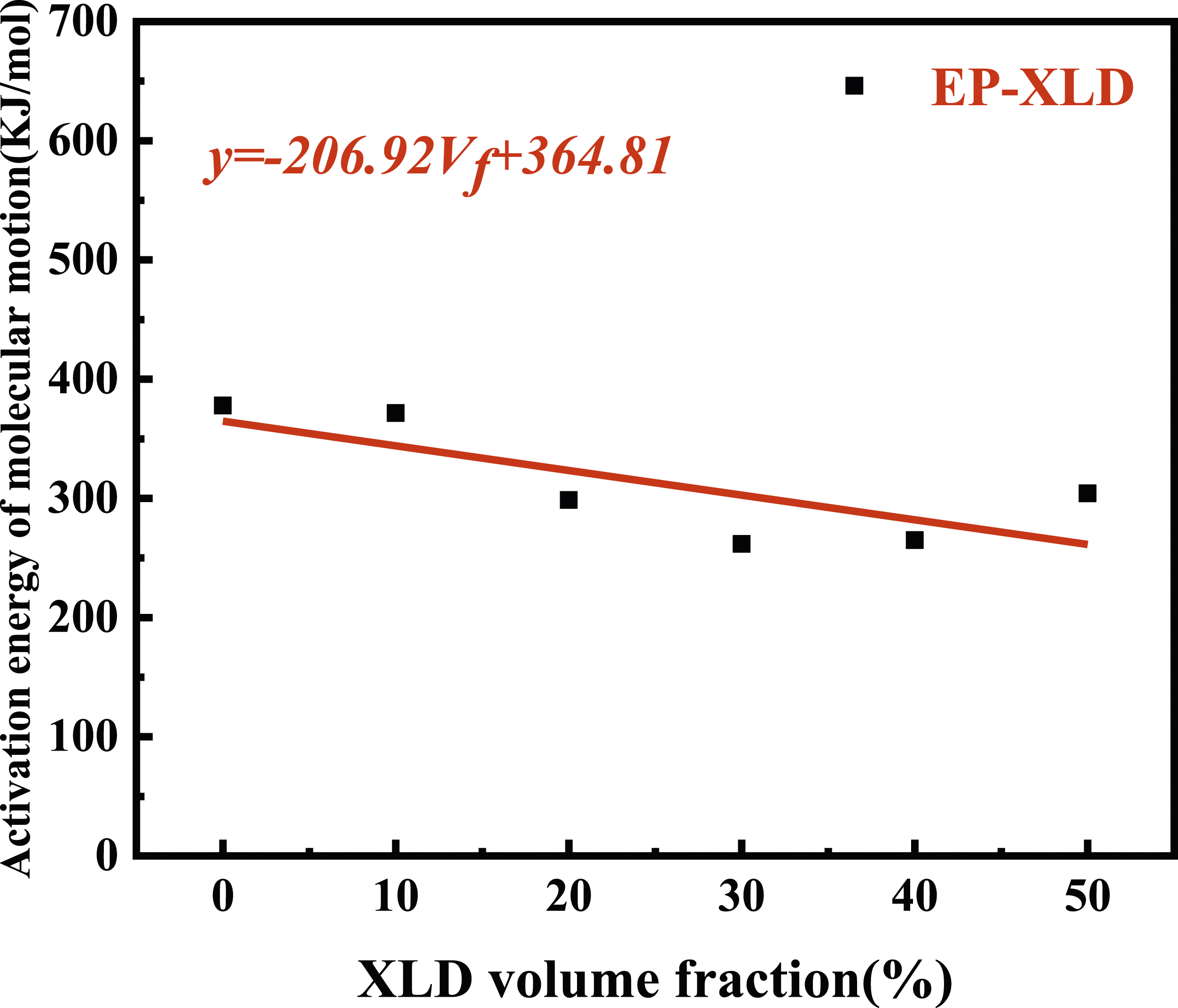
We derived the formulas for the activation energy of molecular chain movements in the EP-XLD composite materials as follows:
Combining equation (9), when 
By combining formula (10) and the measured activation energy of 377.76 kJ·mol−1 for the pure matrix resin molecular chain movements from Table 4, we can determine the interfacial interaction A value between XLD and the matrix resin:
The A value ranges from 0 to 1, indicating that the interfacial interaction between XLD hollow microspheres and the matrix resin is less than the interactions among the matrix resin molecular chains. However, the presence of XLD hollow microspheres does restrict the relative movement of the matrix resin molecular chains to some extent. According to the criteria in section “3.1.2,” this interaction is classified as “normal interfacial interaction.”
Interface action of packing per unit surface area
For conventional polymer-based composites, the interface action of the fillers should be adequate at the same volume fraction. However, when studying the specific effects of the intrinsic properties of fillers on their interface action, relying solely on interface action value A is insufficient. The interface action of fillers is significantly affected by multiple intrinsic factors, such as their material properties, particle size, shape, arrangement orientation, and surface physicochemical characteristics. Taking the hollow glass microspheres discussed in this study as an example, the interface action produced by the spherical fillers in composites is closely related to their material composition and also influenced by their particle size. To accurately explore their interface mechanism, we considered the change in activation energy of molecular chain movement per unit area. In this study,
Although the supplier provided a particle size range for XLD hollow microspheres, slight variations were observed in particle size between different batches. As a result, we conducted a detailed measurement of the actual particle size distribution and average particle size of XLD hollow microspheres. By imaging XLD hollow microspheres using a scanning electron microscope and inputting the obtained image data into the particle size distribution calculation software Image J for analysis, we accurately obtained the particle size distribution and average particle size of XLD, and the specific data are presented in Figure 6. (a) Scanning electronic microscopy image of XLD, (b) particle size distribution of XLD.
The scanning electronic microscopy images of XLD reveal that the hollow microspheres are well-preserved. The results calculated using the Image J software are shown in Figure 6(b), indicating an average particle size for
The size of the samples subjected to dynamic thermomechanical analysis in this study was sized at 50 mm × 10 mm × 3 mm. Each clamp was used to hold the samples 10 mm at both the top and bottom, resulting in effective testing dimensions of 30 mm × 10 mm × 5 mm. Therefore, the total effective testing volume of the samples is
The volume of a single XLD hollow microsphere is:

The surface area of a single XLD hollow microsphere, 

This result shows that XLD hollow microspheres have an impact capability of 1.75 kJ/(mol·m2) on the motion of polymer chains in the matrix resin. By quantitatively describing the effect of fillers on polymer chain mobility under conditions of unit area filler, the impact of filler surface conditions, such as material, roughness, and chemical properties, on the mobility of polymer chains in the matrix resin can be determined.
Conclusion
This study aimed to develop a novel computational model based on molecular chain dynamics to accurately quantify the interfacial interactions between matrix resin and fillers in polymer-based composite materials. To address the limitations of existing theoretical models and computational formulas, which have unclear application boundary conditions and criteria for determining interfacial interactions, we established a molecular chain dynamics theoretical model and derived corresponding computational formulas. The proposed model considers the dynamic behavior of matrix resin molecular chains and the effects of fillers on their activation energy. By exploring the relationships between the activation energy for molecular chain movement and the volume fraction of the filler, we derived a formula for calculating the interfacial interaction parameter A. This parameter allows us to quantify the strength of interfacial interactions between the matrix resin and the filler.
To validate the feasibility of our model, we conducted experimental studies using bisphenol A epoxy resin and hollow glass microspheres as the matrix resin and filler, respectively. Through dynamic thermomechanical analysis, we calculated the activation energies for the movement of molecular chains in the pure matrix resin and the composite materials with different volume fractions of hollow glass microspheres. Based on our proposed model, we determined the interfacial interaction parameter A to be 0.42, indicating an “ordinary interfacial interaction” between bisphenol A epoxy resin and hollow glass microspheres. Our findings demonstrate that the molecular chain dynamics model proposed in this study provides a more universal approach for quantifying interfacial interactions in polymer-based composite materials. The model offers clear application boundary conditions and criteria for determining the strength of interfacial interactions, thereby overcoming the limitations of existing models. This study not only provides a solid theoretical foundation for the optimization design and performance enhancement of composites but also holds broad application prospects in fields such as military aviation, aerospace, naval equipment, and high-end terrestrial equipment.
In summary, the novel computational model based on molecular chain dynamics successfully achieves its research objective of accurately quantifying the interfacial interactions in polymer-based composite materials. The derived formulas and established criteria for interfacial interactions represent a significant advancement in the field, offering practical tools for material scientists and engineers working on composite material design and performance enhancement.
Footnotes
Declaration of conflicting interests
The author(s) declared no potential conflicts of interest with respect to the research, authorship, and/or publication of this article.
Funding
The author(s) received no financial support for the research, authorship, and/or publication of this article.
