



Abstract
Free vibrations of an axially moving multiscale composite beam in thermal environment are analyzed. The beam material is epoxy resin with variously reinforced and randomly oriented or aligned in electric field carbon nanofibers (CNFs). To describe the thermomechanical properties of the beam material, published dynamic characteristic of stationary multiscale composites were taken into consideration. Using the frequency–temperature equivalence principle, the nanocomposite material of the beam is modeled using four-parameter fractional rheological model. The dynamic characteristics of the multiscale polymer beam in the frequency domain made it possible to determine the partial equation of motion of the axially moving beam. The Galerkin method is used to solve the governing partial differential equation. The effects of various nanofiber reinforcements of randomly oriented, and aligned in electric field fibers at different temperatures, on the free vibration of the axially moving beam are investigated.
Introduction
Axially moving objects can be found in many different technical devices. They include among others paper webs during production, processing and printing, tubes transporting fluids, biomedical panels as parts of nano-robots operating in blood vessels, and objects moving at changing temperatures in space. In all of these various technical applications, typically one tends to maximize the transport speed in order to increase productivity and optimize investment and operating costs of this sometimes very expensive and complicated equipment. An obstacle in the realization of these aspirations lies in very common dynamic behavior of axially moving systems. Research on the dynamics of axially moving systems, due to new fields of application, has been practically uninterrupted since the middle of the last century. For an up-to-date review of the literature in this area, see the study of Pham and Hong. 1
On the other hand, the problem of modeling the dynamics of new composites in a temperature environment is one of the most current research topics in material engineering. Thermosetting epoxy resin is a widely used polymeric material in applications such as composites, adhesive, and coatings owing to its superior mechanical strength, adhesive properties, thermal stability, and chemical resistance. However, epoxy itself is brittle. Addition of carbon-based nano-fillers such as carbon nanotubes (CNTs), carbon nanofibers (CNFs), and graphene nanoplatelets (GnPs) improve mechanical and tribological properties of epoxy-based composites. Compared to conventional fiber-reinforced composites, polymer nanocomposites show higher stiffness and strength due to significantly higher modules of nanofillers and nanoscale effects.
The CNTs have been regarded as useful reinforcements for multi-scale composites from the initial studies of the nineties of the last century. For example, in order to make better use of low CNTs, Shen 2 applied a functionally graduated concept to polymer nanocomposites and found that their mechanical properties could be improved by the uneven distribution of CNTs in the polymer matrix. Also, mechanical responses of functionally graded stationary composite structures reinforced with CNTs (FG-CNTRC) were investigated. Among those, Lei et al. 3 presented an analysis of the dynamic stability of cylindrical panels FG-CNTRC. Ke et al. 4 investigated the dynamic stability of FG-CNTRC beams under periodic axial force. Yang et al. 5 investigated the dynamic buckling of thermos-electro-mechanically loaded FG-CNTRC beams integrated with piezoelectric layers. These studies revealed that the distribution pattern and volume fraction of CNTs have an impact on the maintenance of the dynamic stability of polymer stationary nanocomposite structures. The state of research of mechanical properties of CNT-reinforced composites in the papers of Liew et al. 6 is presented. Although significant progress was made on CNT-filled nanocomposites, agglomeration and relatively high production costs made further use of CNTs difficult for reinforcement in polymer nanocomposites.
From the beginning of our century, graphene as a nanofiller has attracted a lot of attention from researchers. Lee et al. 7 measured the mechanical properties of a single graphene layer by nanoindentation, indicating that the Young’s modulus is about 1 TPa, and the strength is 130 GPa. In comparison with CNTs, graphene has comparable tensile strength and Young’s modulus but a much larger surface area. More importantly, graphene and its derivatives are cheaper when they are synthesized on a large scale. 8 These advantages make graphene and its derivatives excellent alternatives to CNT, while at the same time improving the mechanical properties of polymeric materials. The superiority of graphene as a reinforcing material has been verified in studies that showed that graphene nanocomposites exhibit a much higher Young’s modulus and tensile strength than nanocomposites reinforced with the same amount of CNT. 9 Thermal properties of stationary graphene nanocomposites were investigated in the study of Wang et al. 10 The experimental results indicated that incorporation of graphene oxide powders (GOPs) reduces the thermal expansion coefficients and considerably increases the thermal conductivity of polymer matrix. The thermomechanical properties of multiscale fiber-reinforced composites based on carbon nanofibers dispersed in epoxy resin were investigated in the study. 11 Dynamic instability of multilayer stationary nanocomposite beam reinforced with a low content of GOPs was studied by Wu et al. 12
In studies of thermomechanical properties of epoxy resins reinforced with carbon nanofibers, the research of the S. G. Prolongo and co-researchers team is of particular importance.13,14 Due to the influence exerted, the aim of these studies was to obtain a homogeneous dispersion of CNFs in epoxy resin and to create a strong interface between the nanofibers and the polymer matrix through CNF functionalization. The effect of CNF functionalization and the content of nano-enhancers on the physical and thermomechanical properties of epoxy resin was investigated in References 13 and 14.
The analysis of the current literature on the subject shows that the recently observed development of studies on the mechanical and tribological properties of epoxy nanocomposites is not accompanied by equally intensive studies of the dynamic properties of these materials. Knowledge of how various nanofiber reinforcements affect the dynamic behavior of epoxy composites in a thermal environment is very important and indispensable when creating new large-scale structures. The author, experienced in studying the dynamics of other structures, made an attempt to answer this need in this study.
One major factor limiting the property improvements achieved to date in epoxy nanocomposites has been the fact that the carbon nanofillers are typically randomly oriented. 15 However, recent research has shown that CNFs can be aligned in a liquid epoxy resin using an alternating or direct current electric field. Under the application of an electric field between a pair of parallel plate electrodes, the nanofillers may align to form a chain-like network in the direction of the electric field.16–21 This mechanism of the self-aligning of conductive carbon nanofillers in polymers offers a new opportunity to create multi-scale structures. Recent studies showed that along with agglomeration of carbon nanoparticles in polymer matrix, proper orientation of the particles could improve mechanical strength and tribology of nanocomposites.22,23 The practical application of such new nanocomposites requires testing their dynamics.
The subject of this study is the free vibration analysis of an axially moving multiscale composite beam taking into account the effect of temperature. The beam material is epoxy resin with variously reinforced and randomly oriented or aligned in electric field carbon nanofibers. To describe the thermomechanical properties of the beam material, published dynamic characteristics of stationary multiscale composites were taken into consideration. Using the frequency–temperature equivalence principle, the nanocomposite material is modeled using four-parameter fractional rheological model. The dynamic characteristics of the multiscale polymer beam in the frequency domain made it possible to determine the partial equation of motion of the composite beam. The Galerkin method is used to solve the governing partial differential equation. The effects of various nanofiber reinforcement of randomly oriented, and aligned in an electric field, carbon nanofibers at different temperatures on the free vibration of an axially moving composite beam are investigated.
Temperature–frequency equivalence
It is known that most viscoelastic materials exhibit dynamic behavior which depends strongly on frequency and temperature. When such a material is subjected to periodic load, the induced deformation is also periodic out of phase. Then the stress–strain relationship can be characterized by complex modulus given in the frequency domain by

Polymers, as the material of the beam, are composed of long intertwined and cross-linked molecular chains, each containing many atoms. The internal molecular interactions which occur during vibration lead to energy dissipation and damping. If the polymers are homogenous and isotropic, the stiffness and damping characteristics vary with temperature and frequency. The shear and extensional moduli are closely related to each other for homogenous and isotropic polymers. 24
The complex modules properties of polymers vary strongly with temperature, in ways particular to each polymer composition. Figure 1 illustrates nonlinear behavior of some typical polymers. Effect of temperature on complex modules behavior.
Figure 1 shows that above softening temperature Ts in the transition region, the shear modulus decreases rapidly and the loss factor rises to a maximum in the temperature Tm and then falls again. In temperatures above the transition region, the modulus is low, and as the temperature continues to rise, the material disintegrates. Meanwhile, the effect of frequency for many polymers is the inverse of the effect of temperature. Increasing frequency is similar to the effect of decreasing temperature, but at much different rates, as Figure 2 illustrates. The difference is very significant. While the temperature may vary by a few hundred degrees to reach the transition region, the corresponding change of frequency encompass many orders of magnitude. In this range, the frequency can vary from 10−8 Hz to 108 Hz or more. For low frequencies, the loss factor and shear modulus increase slightly. In transition region one can observe a strong increase of loss factor, which takes maximal value and then significantly decreases. In this region, the shear modulus increases. Above the transient region, one can notice further decrease of loss factor and slight increase of the shear modulus, which takes maximal value. Effect of frequency on complex modules behavior.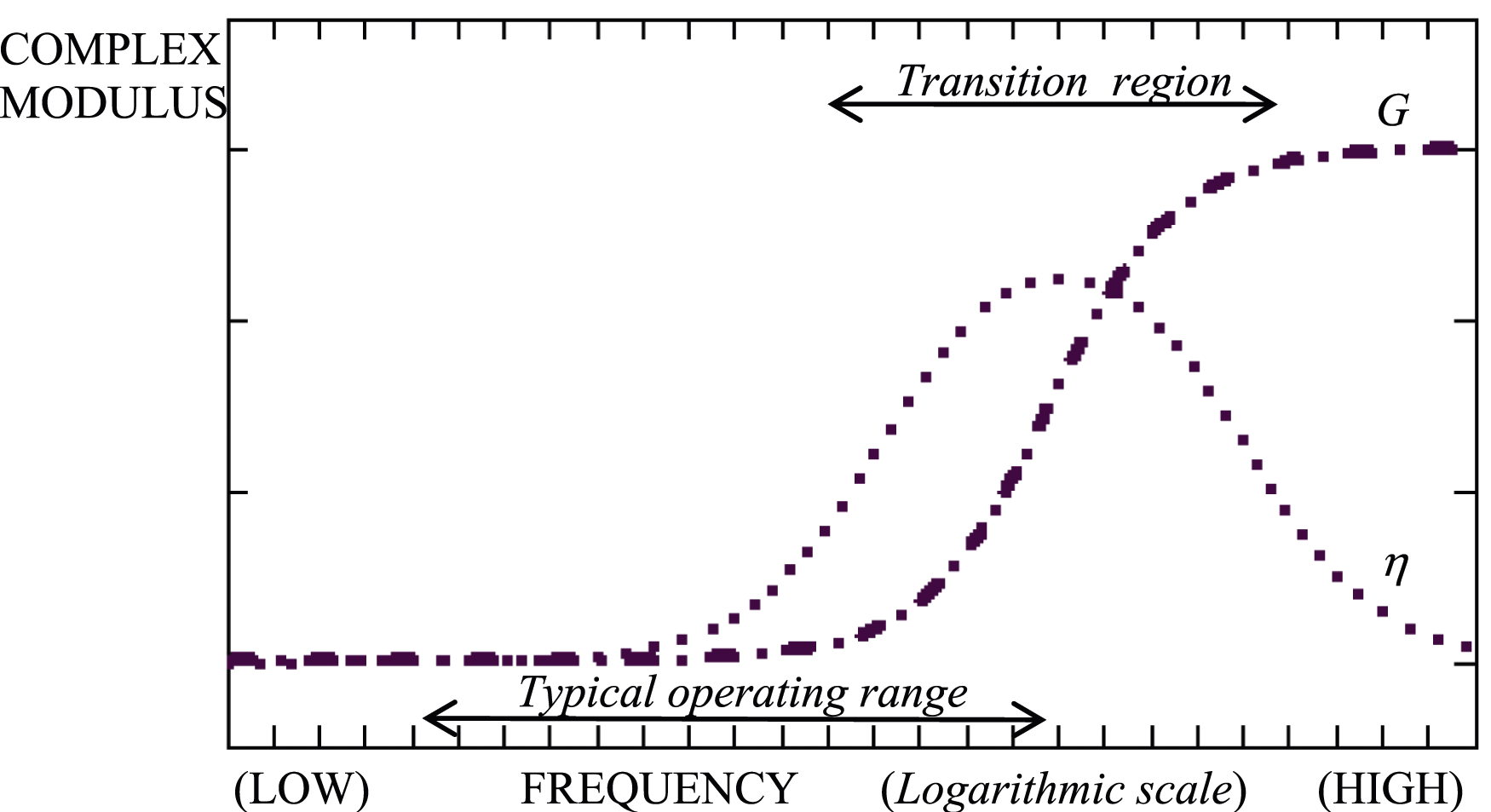
Factional rheological model of the composite material
The basis dependence of linear viscoelasticity, that the stress function is linearly dependent on the past history of the strain function, is expressed by Boltzmann’s superposition principle in the form


For isotropic materials following procedures known in elasticity, the deviation tensor’s components of stress sij and strain eij are introduced and then equation (3) reduces to two independent equations G(ω) is the complex shear modulus, κ(ω) is the complex bulk modulus, and δij is the Kronecker’s delta.


G(ω) represents the behavior of material in simple shear and κ(ω) under hydrostatic stresses. Each of these moduli can be defined independently in the frequency domain using one of the rheological models.
Until recently, rheological models containing integer-order derivatives have been widely used. However, these models inadequately describe the rheological properties of real materials. For example, for the classical three-parameter standard rheological model, the relaxation function in equation (2) has a decreasing exponential character. However, the single exponential response functions do not well approximate the behavior of most real materials. Specifically, a single exponential relaxation function undergoes most of its relaxation over about one decade in time scale. Real materials relax over many decades of the time scale. Constitutive equations covering many decades of time scale have been constructed using fractional derivatives.
Most often in studies of dynamics of viscoelastic systems to determine the complex moduli the fractional model is used. 25 To model the dynamic behavior of an axially moving multiscale composite beam under thermal loading, the fractional standard rheological model was used in this paper, whereas the hydroelastic behavior was considered as elastic.
The constitutive equation of the fractional standard rheological model is as follows (Figure 3): Fractional standard rheological model.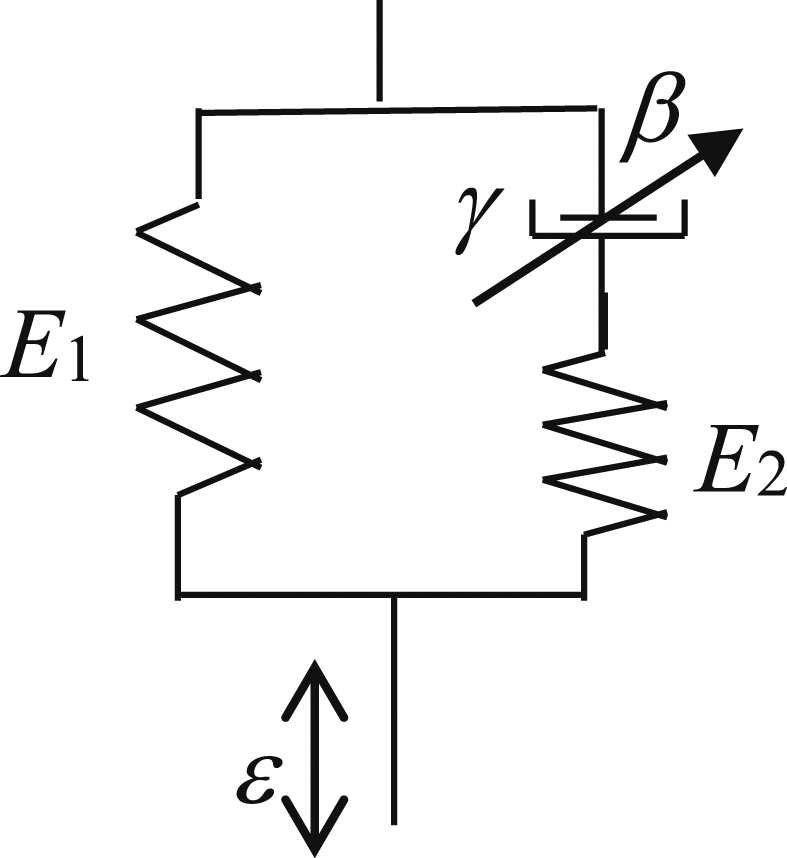

Taking into account the relaxation time constants



As a result of the phase lag between stress and strain, the dynamic stiffness of viscoelastic material can be treated as a complex number. To receive rheological model of the beam, in accordance with the frequency–temperature equivalence principle, the frequency ω is replaced by the reduced frequency ωα(T) depended on the temperature. Substituting equation (9) into the constitutive equation (8) one receives the complex Young’s modulus in the frequency domain

Equation (10) presents rheological model of the beam material. On the base of equation (10), the shift of the storage modulus for different temperatures in the frequency domain can be determined.
Mathematical model of the moving composite beam
Composite beam of the length l, the width b, and the thickness h is considered. The beam moves along the longitudinal direction x at the constant velocity c. The co-ordinate system and configuration of the model are shown in Figure 4. Axially moving beam.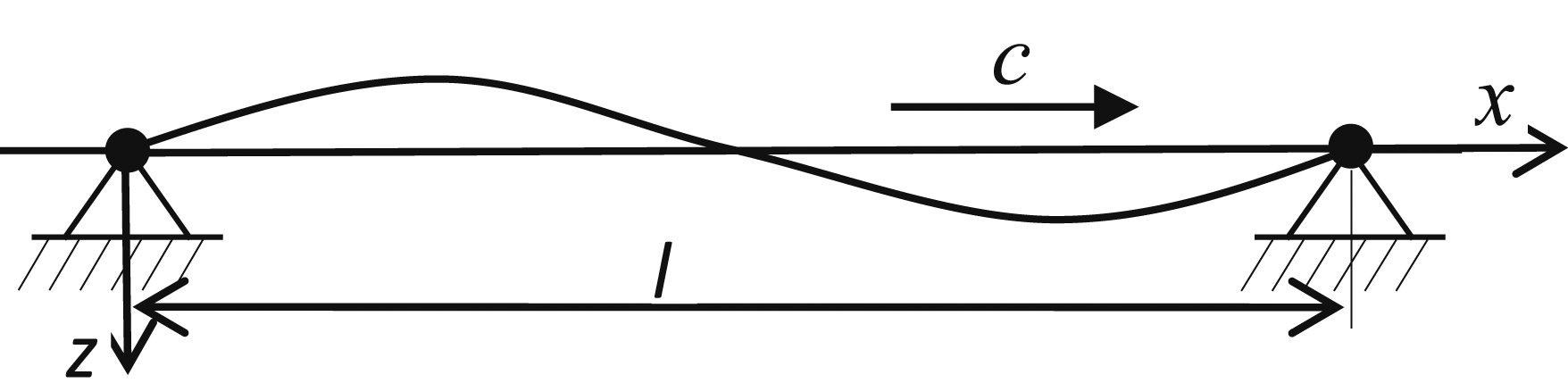
To derive mathematical model of the beam, the following assumptions have been made: 1. the moving beam is made with epoxy resin with variously reinforced and randomly oriented or aligned in electric field carbon nanofibers; 2. all points which are there on the normal to the axis of the beam undergo the same transverse deflection; 3.
The partial differential equation resulting from the Hamilton’s principle for a transverse motion of the axially moving plate was derived in the book
26
and has the following form:
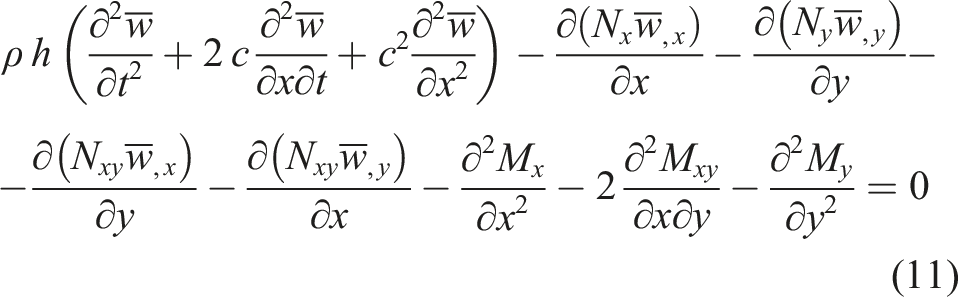
In the case of the axially moving beam, the equation for the transverse motion is

Bending moment per unit length expresses the dependence:

The boundary conditions referring to simple supports at x = 0 and x = l:

The governing equation (12) can be transposed to a dimensionless form using the following terms:


The dimensionless boundary conditions referring to simple supports at ξ = 0 and ξ = 1:

Partial differential equation (16) and boundary conditions (17) constitute mathematical model of the axially moving multiscale composite beam. The problem has been solved using the Galerkin method. The following finite series representation of the transverse displacement has been assumed:

The 4-term finite series representation of the dimensionless transverse displacement of the beam has been taken in numerical investigations. In the Galerkin method the series (18) is substituted in equation (17), all terms of the equation are multiplied by sin(iπξ), and then the result is integrated in the domain [0,1]. The set of received ordinary differential equations for n = 4 can be written in the state space form:

The spectral analysis of the state matrix permits the vibration analysis of the axially moving multiscale composite beam in thermal environment.
Identification of rheological parameters
The use of polymeric viscoelastic materials in axially moving systems requires knowledge of the complex modulus behavior of the composite material over wide ranges of frequency and temperature. Meanwhile, the results of thermal analyses of stationary materials presented in Appendix show the dynamic mechanical properties of pure epoxy resin as well as reinforced with ordered and disordered CNFs for one specific oscillation frequency. In the case of disordered nano-fibers, stationary materials with different contents of untreated and amine-functionalized CNFs were tested. The obtained results show changes in the storage module and the loss coefficient at the oscillation frequency of 1 Hz in the tested temperature range.
The dependence of the loss coefficient on temperature makes it possible to identify the temperature transition region for stationary materials. In the middle of this region, the maximum value of the loss factor appears. In the process of identifying the parameters of the fractional rheological model of a material over a wide frequency range, the value of the maximum loss factor plays a key role. Using the Pritz formulas, 25 the slope of the frequency characteristic of the module in the transition region was determined. The value of the shift coefficient of this characteristic in the transition region can be identified by the value of the vibration frequency at which the temperature characteristics were determined.
In the glassy temperature range, both the storage module and the loss coefficient of the polymer nanocomposite change their values approximately linearly. The knowledge of the value of the identification frequency of the temperature characteristics enables the calculation of the parameters of the rheological model of the material. Keeping the slope of the frequency characteristic in the transition range for the specified values of the storage modulus and the loss coefficient in the glassy range, the values of the parameters of the fractional rheological model were determined.
Rheological model parameters of epoxy resin 1 with non-treated and functionalized CNFs.


Frequency characteristics of the neat epoxy resin 1; the storage module (a) and the loss coefficient (b); ((ooo) T = 50°C; (
Rheological model parameters of epoxy resin 2 with aligned CNFs.


Frequency characteristics of the storage module (a) and the loss coefficient (b) (T = 50°C; neat epoxy resin 2 (….), a single 0.6 wt% CNF of a nanocomposite (
Investigation results
Approximation of the thermomechanical characteristics and identification of the parameters of fractional rheological models allowed to analyze the free vibrations of an axially moving beam in a temperature environment. The following beam parameters were adopted in the numerical tests: l = 0.3 m, b = 0.03 m, and h = 0.003 m. The constant longitudinal load Nx = 5 N/m was taken into consideration.
Using the fractional rheological models of the considered materials, first the natural frequencies of the stationary beam under a longitudinal load in the studied temperature range were determined. For a beam on a simple support under tensile load, the natural frequencies are defined by E(T) is Young’s modulus of beam material at temperature T; I
b
is the moment of inertia of the beam cross section, and m
l
is the mass per unit length of the beam.
Figures 7 and 8 show the first natural frequencies in the tested temperature range of beams made of neat epoxy resin 1 and neat epoxy resin 2, respectively. Lowest natural frequencies of a stationary beam made of neat epoxy resin 1 in the tested temperature range (( Lowest natural frequencies of a stationary beam made of neat epoxy resin 2 in the tested temperature range (( 

The point curves in Figures 7 and 8 represent the positions of the first natural frequencies of the epoxy beams calculated taking into account the isochrone (1 Hz) measurement values of the storage module in formula (20). The curves marked with crosses in Figures 7 and 8 represent the positions of the first natural frequencies calculated taking into account in formula (19) the values of the storage modulus resulting from the identified fractional rheological models of the tested materials.
In Figures 7 and 8, the differing calculation results of the natural frequencies of neat epoxy beams are presented in the temperature region. These differences result mainly from the different production technologies of both resins. Moreover, in the case of neat resin 2, in the experimental studies 22 only the temperature transition region and the rubber region were the measurement range for the elastic modulus. In the experimental study, 14 which was the basis for the results of the frequency calculations shown in Figure 7, the glass temperature region, transition region, and rubber region were taken into account. In studies of the dynamics of an axially moving epoxy beam reinforced with CNFs, these different ranges of identifying the thermomechanical properties of the materials tested were taken into consideration. In comparative studies of the influence of different nano-reinforcements on the dynamics of beams made of both resins, only the temperature transition region was investigated in the frequency domain. In the temperature glassy region, only the change in CNF content and nano-fiber functionalization were the subjects of the study.
The investigation results of the stiffness of the beam in the temperature domain were used in the study of the natural frequencies of the axially moving beam depending on the transport speed. Examples of calculation results are shown in Figure 9. In this Figure at the temperature T = 195°C, the graphs of the imaginary parts and the real parts of the eigenvalues of the beam made of neat epoxy resin 1 are shown. Imaginary parts denote the natural frequencies of the beam, while real parts denote the corresponding dimensionless damping. Eigenvalues of the axially moving beam made of neat epoxy resin 1 (T = 195°C); the imaginary parts (a) and the real parts (b).
With the increase of the transport speed, the natural frequencies decrease, and at the critical transport speed sw the first natural frequency is equal to zero. Then the imaginary parts of the lowest conjugated eigenvalue are zero and one of them has positive real part (Figure 9). Then the divergent loss of stability of the beam movement occurs. In the supercritical transport speeds above the divergence range, at the transport speed cf, the values of the two lowest natural frequencies are equal. Then one of two lowest conjugated eigenvalues has positive real part and nonzero imaginary part. Flutter beam movement instability occurs.
Figure 10 shows critical transport speeds and supercritical flutter speeds of a beam made of pure epoxy resin 1 over the entire temperature range tested. Investigation results of the critical transport speeds of the beam made of epoxy resin 1 with non-treated and functionalized CNFs and epoxy resin 2 with aligned CNFs are shown in Tables 3 and 4, respectively. Critical transport speeds of the beam made of neat epoxy resin 1 in the tested temperature range (( Critical transport speeds of the beam made of epoxy resin 1 with non-treated and functionalized CNFs. Critical transport speeds of the beam made of epoxy resin 2 with aligned CNFs.


Results of comparative investigations.

In contrast to neat epoxy 1, the reinforcement of which with non-treated and functionalized CNFs caused a decrease in the glass transition temperature, the reinforcement of neat epoxide 2 with aligned in electric field carbon nanofibers causes an increase in the glass transition temperature. Equalization in an electric field of nano reinforcements also causes that the temperature characteristic of the modulus of elasticity in the transition region is characterized by a lower slope than the analogous characteristics of nanocomposites with non-treated and functionalized CNFs. Like the temperature characteristic, also the frequency response of the epoxy resin 2 reinforced with aligned CNFs in the transition region has a smaller slope. As a result, the ratio of the critical transport speed of the occurrence of flutter instability to the critical velocity of occurrence of divergence of the axially moving beam made of epoxy resin 2 at the glass transition temperature has the lowest value.
Final remarks
The improvement of the mechanical strength and tribological properties of polymers reinforced with carbon nano-fibers, demonstrated in the studies of stationary systems by numerous researchers, inspired the author to initiate research on the dynamics of objects made of these materials. The subject of this study is the free vibration analysis of an axially moving multiscale composite beam in thermal environment. The beam material is epoxy resin with variously reinforced and randomly oriented or aligned in electric field carbon nanofibers. Using the frequency–temperature equivalence principle, the nanocomposite material was modeled using four-parameter fractional rheological model.
To describe the thermomechanical properties of the beam material, published dynamic characteristics of stationary multiscale composites were taken into consideration. In the available literature on the subject, there are very few publications in which the results of experimental studies of thermomechanical properties of multi-scale polymers are presented. For this reason, the results of two studies were used, the main aim of which was, respectively, to obtain a homogeneous dispersion of carbon nano-fibers in an epoxy resin and to evaluate the tribological performance of nanofiber alignment. The fragmentary nature of the published experimental studies of two different epoxy resins was the greatest difficulty in conducting comparative studies of the dynamics of an axially moving epoxy beam. In comparative studies of the influence of different nano-reinforcements on the dynamics of beams made of both resins, only the temperature transition region was investigated in the frequency domain.
The results of comparative studies indicate that the alignment in the electric field of carbon nanofibers causes the temperature characteristic of the modulus of elasticity in the transition region is characterized by a lower slope than the analogous characteristics of nanocomposites with non-treated and functionalized CNFs. Also, the frequency response of the epoxy resin reinforced with aligned CNFs in the transition region has a smaller slope. Hence, the ratio of the critical transport speed of the occurrence of flutter instability to the critical velocity of occurrence of divergence of the axially moving beam made of epoxy resin reinforced with aligned CNFs at the glass transition temperature has the lowest value.
The obtained results indicate the need for further research in this field. The tendency of the deterioration of the dynamic properties of objects made of materials, the nano-reinforcements of which improve their static properties, demonstrated in this study, should be confirmed. Confirmation should primarily be based on the acquisition of data for the identification of the research object through a planned experiment. In the absence of the possibility of conducting experimental studies in this study, the data for the identification of the object came from published works whose main purpose was static research.
Footnotes
Declaration of conflicting interests
The author(s) declared no potential conflicts of interest with respect to the research, authorship, and/or publication of this article.
Funding
The author(s) received no financial support for the research, authorship, and/or publication of this article.
