Double-Double (DD) laminates are discussed as an alternative to conventional laminates used in aerospace practice, which are usually composed of 0°, 45°, 90°, and −45° plies. Double-Double laminates promise advantages mainly due to simplification of design, optimization, and manufacturing processes. Stacking-sequence independent bending properties of DD laminates allow for significant simplification in context of buckling analysis, as a recent publication shows. However, not all conceivable ply-orientation combinations in DD’s building block lead to it. The present short communication outlines briefly how stacking-sequence independent bending properties arise from DD’s laminate architecture. The analysis reveals two valid and also a single invalid angle selection, for DD’s balanced 4-ply building block.
Double-Double laminates show advantageous aspects for composite design1,2 in terms of optimization3 and also for buckling problems. A recent study on buckling of simply supported rectangular DD laminates4 outlines the effect of the stacking-independence of DD laminates on identifying optimum laminates for certain buckling-load states. As a consequence, stacking-sequence discussions, known from conventional laminates, with up to millions of conceivable combinations, are obsolete for DD, which represents a remarkable simplification for designers. It has neither been outlined in the literature why DD laminates show stacking-independent bending properties, nor it has been verified that independence is achieved for all conceivable ply orders in the building block.
The present short communication outlines why some DD laminates show stacking-sequence independent bending properties. The parameters φ and Ψ denote ply orientations in the following. The presented analyses refer to the conventional notation of the classical laminate theory (CLT), which is well described in Nettles,5 for example. A brief summary of relevant entities used hereafter is provided in the Appendix.
Analysis
The building block (BB) of a DD laminate is defined by four plies. The general form is described by
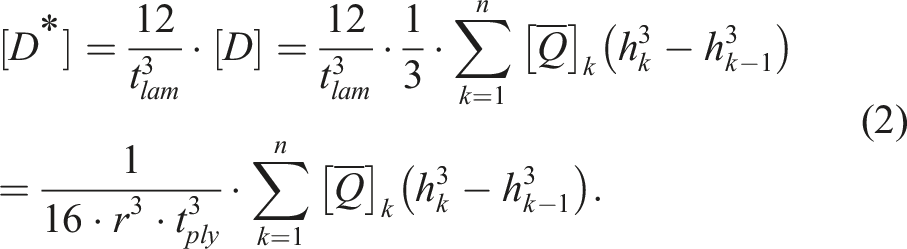
the corresponding angle-specific ply-stiffness matrices are denoted as hereafter. The thickness-normalized bending-stiffness matrix [D*] is defined as
it is well known that [D] depends on the stacking sequence for conventional laminates. However, the particular DD architecture leads to the fact that thickness-normalized bending properties are independent from the repeat parameter r, which is the key for remarkable simplification in context of laminate optimization when buckling problems are examined.
The following section outlines how stacking independence arises from DD’s laminate architecture. Therefore, equation (2) is analyzed in more detail. Table 1 summarizes the relevant terms for the analysis.
Relevant terms for bending-stiffness matrix.
r
k
hk
hk−1
1
1
−r⋅4⋅tply/2 + 1⋅tply
−r⋅4⋅tply/2 + 0⋅tply
2
−r⋅4⋅tply/2 + 2⋅tply
−r⋅4⋅tply/2 + 1⋅tply
3
−r⋅4⋅tply/2 + 3⋅tply
−r⋅4⋅tply/2 + 2⋅tply
4
−r⋅4⋅tply/2 + 4⋅tply
−r⋅4⋅tply/2 + 3⋅tply
2
5
−r⋅4⋅tply/2 + 5⋅tply
−r⋅4⋅tply/2 + 4⋅tply
6
−r⋅4⋅tply/2 + 6⋅tply
−r⋅4⋅tply/2 + 5⋅tply
7
−r⋅4⋅tply/2 + 7⋅tply
−r⋅4⋅tply/2 + 6⋅tply
8
−r⋅4⋅tply/2 + 8⋅tply
−r⋅4⋅tply/2 + 7⋅tply
9
…
The term determines the relative contribution of a specific ply in the laminate stack to the total bending stiffness of the whole laminate. From Table 1, one can deduce the parametric expression depending on r and k, which covers each entry.
When r = 1 only four plies contribute. The dependence of the term from r changes when the total number of plies increases. The repetitive pattern of the DD laminate leads to the fact that the total number of ply contributions can be summarized in four groups, referring to the BB-plies’ stiffness matrices: . Note that refers to the first ply in the DD building block, while in conventional CLT calculation it refers to the k-th ply in the whole laminate stack. Table 1 shows that the factor is found in all terms. In combination with equation (2), it blanks out. A simple case study is executed hereafter to outline how stacking independence arises. The study covers the repeat values r = 1, 2, 3.
Evaluation for different r-cases
For the simple case r = 1, the normalized bending stiffness from equation (2) is determined to
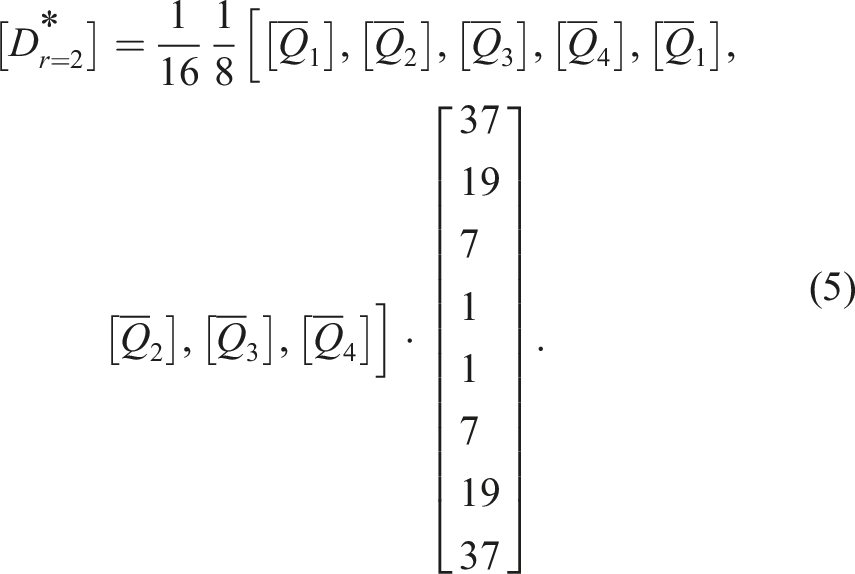
for the case r = 2 (eight-ply laminate), one finds
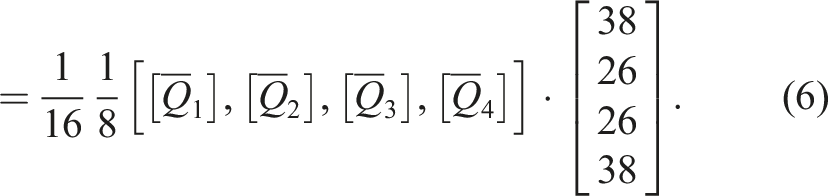
which can be summarized to
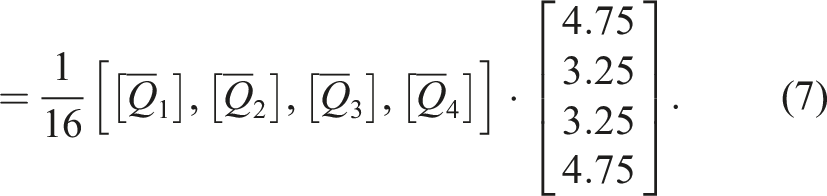
adapted to the format in equation (4), this leads to
for r = 3, one obtains similarly after summarizing
The previous cases show commonalities, as the following list shows.
the vector 1/16 · […]T is found in all three previous equations. It can be denoted as a normalized-contribution vector
the vector determines the relative contributions of the individual plies to the total normalized bending stiffness. In fact, one observes a kind of homogenization for increasing r, as the normalized relative contributions nci of the plies approach a value of 1/4. When the relative ply contributions are compared, one finds differences for the provided r-cases. However, one also finds important parallels, which are important in context of the examined stacking-sequence independence. Careful observation shows that the sums nc1 + nc2 = 8 and nc1 + nc3 = 8 are independent from r. This is not true for nc1 + nc4 and nc2 + nc3. Those observations are the key to the stacking sequence independence of DD laminates. It is essential to recall that a single BB in a DD laminate is always balanced. The global ply-stiffness matrices for a +φ ply and a −φ ply are
the 11, 12, 22, and 66 coefficients are independent from the ply-angle sign. Thus, when, for example, we set , , and , in the equations (9)–(11), the 11, 12, 22, and 66 coefficients of [D*] will be identical for all the provided r-cases. The [D*] matrix will be of the form
as the sign of the 16 and 26 coefficients in and changes with the ply-angle sign, the term in (see Table 1) blanks out when ± terms are summed. This leads to the fact that are found proportional to 1/r2.
Generalization
The preceding numerical examples led to the observation that the sum of the normalized contribution vector entries is always
the following analyses aim to the verify this observation, based on equation (3). Utilizing equation (13) allows for writing the normalized bending-stiffness matrix as
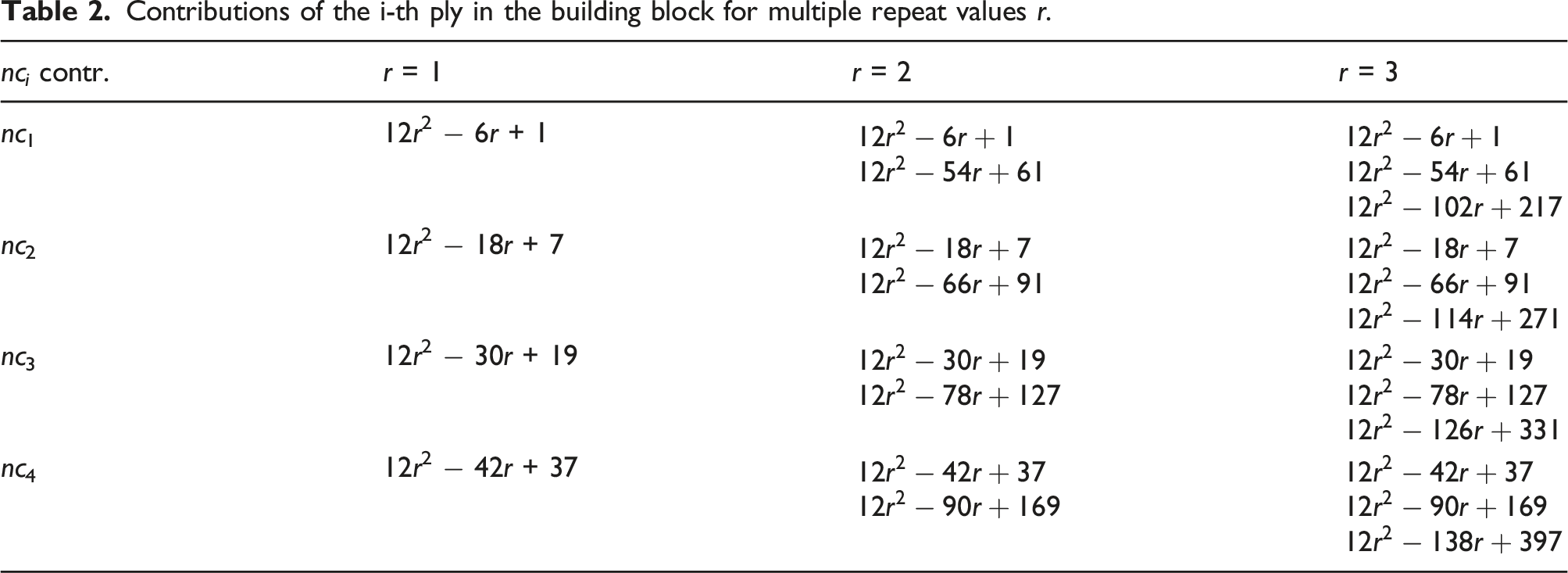
each contribution nci refers to a single ply of the building block. The total contribution of the first ply in the building block is composed of multiple fractions, when r increases. For r = 3, for example, the total contribution is composed of three summands, one from each of the three building blocks in the full laminate (Table 2). The following table plots the individual contributions, for the repeat range r = 1, 2, 3.
Contributions of the i-th ply in the building block for multiple repeat values r.
nci contr.
r = 1
r = 2
r = 3
nc1
12r2 − 6r + 1
nc2
12r2 − 18r + 7
nc3
12r2 − 30r + 19
nc4
12r2 − 42r + 37
The numerical examples in Section 3 indicate that the summed contributions of two plies in the building block to [D*] are found constant for different building-block repeats. This represents the basis for r-independence of the [D*] matrix. Therefore, Table 3 provides different combinations of summed ply contributions. The utilized nomenclature is as follows. The ID , for example, refers to the case when the first two plies in the building block refer to the ply angle φ ( and ).
Summed contributions.
Contr. to [D*]
r = 1
r = 2
r = 3
= 8
= 8
= 8
= 8
= 8
= 8
= 14
= 9.5
= 26/3 ≈ 8.667
= 2
= 6.5
= 22/3 ≈ 7.333
The results in Table 3 substantiate the numerical examples from the previous section. For the cases and , the summed contributions are found independent from the repeat parameter r.
Thus, [φ, − φ, Ψ, − Ψ] and [φ, − Ψ, − φ, Ψ] are valid BBs for DD. Both lead to the desired effect, that the normalized bending-stiffness matrix [D*] entries 11, 12, 22, and 66 are independent from the repeat parameter r. The other cases ( and ) show that the BB angle selection [φ, − Ψ, Ψ, − φ] is invalid, as it does not lead to the desired independence from r.
Conclusion
Building-block-repeat independent normalized bending properties are a unique aspect of DD laminates, which simplify laminate optimization tasks in context of buckling analysis. The present short communication outlines how independence arises from DD’s particular laminate architecture, which is characterized by simply stacking multiple, balanced four-ply building blocks r-times .
Whenever the building block angles fulfill: |angle1| = |angle2| or |angle1| = |angle3| stacking independence is present for the 11, 12, 22, and 66 coefficients of the [D*] matrix. The analysis reveals that building blocks with |angle1| = |angle4| are invalid selections, when looking for independence from r. Thus, [φ, − φ, Ψ, − Ψ] and [φ, − Ψ, − φ, Ψ] are valid building blocks for DD laminates, while [φ, Ψ, − Ψ, − φ] is found an invalid building block stacking sequence.
Footnotes
Declaration of conflicting interests
The author(s) declared no potential conflicts of interest with respect to the research, authorship, and/or publication of this article.
Funding
The author(s) disclosed receipt of the following financial support for the research, authorship, and/or publication of this article: The project “101101974 - UP Wing” is supported by the Clean Aviation Joint Undertaking and its members and funded by the European Union.
Disclaimer
Views and opinions expressed are however those of the author only and do not necessarily reflect those of the European Union or Clean Aviation Joint Undertaking. Neither the European Union nor the granting authority can be held responsible for them.
CRediT author contribution statement
As the sole author, Erik Kappel is responsible for the whole content.
ORCID iD
Erik Kappel
Appendix
References
1.
TsaiSW. Double-double: new family of composite laminates. AIAA J2021; 59: 4293–4305. DOI: 10.2514/1.J060659.
2.
TsaiSW.Double-Double A new perspective in the manufacture and design of composites. Stanford, California: JEC/Stanford Publication, 2022. ISBN 978-0-9819143-3-6.
3.
KappelE. Double-Double laminates for aerospace applications - finding best laminates for given load sets. Composites Part C: Open Access2022; 8: 100244.