



Abstract
In this work, similar (2A12) and dissimilar (6061) aluminum alloy sheets are validly joined using self-piercing rivet process. A quasi-static experiment is proposed to investigate the mechanical behaviors, failures mode, and mechanism of the different joints. Moreover, a method based on deep learning algorithm is anticipated to detect the appearance defects of the SPR welded joints. The results indicated that 2A12 joints of similar sheets contained the advantageous static strength and 6061 similar sheet joints had superior anti-vibration performance conducts. The joints with 6061-2A12 sheets introduced the most decent and comprehensive mechanical properties. The main failure mode of 2A12 similar sheet joints was substrate fracture. The performance of the substrate affects the failure mode of the joint and the plasticity of the substrate is better. When the time comes, the failure mode is mostly pull-off failure. Poor plasticity of the substrate can easily lead to substrate breakage. The reason for joint pull-off and button fall-off failure is that there is large plastic deformation in the lower plate of the joint and the mechanical internal locking structure is damaged. 2A12 substrate breakage belongs to a composite fracture that combines intergranular fracture and microvoid aggregation type fracture. The area of the 6061 substrate near the edge of the sample is shear fracture and the area near the center of the sample thickness is dominated by microvoid aggregation type normal fracture. The effectiveness of the method was verified by conducting a series of experiments and the detection accuracy of the method can reach about 90%. The detection speed was as high as 50 frames per second (FPS), which can effectively solve the problem that the rivet quality was difficult to monitor.
Introduction
The development and application of aerospace materials represents the comprehensive strength and technological level of a country. Lightweight, high strength, and highly reliable aluminum alloy materials are often used in the manufacture of aircraft. Simply put, Al-Cu-Mg series hard aluminum alloy 2A12 is widely used in aerospace and other fields due to its mechanical properties, corrosion resistance, heat treatment, and hardening. It is used because of its high specific strength and specific stiffness. Henceforth, it is mainly considered for the production of skeleton parts, skin, rivets, and wing ribs. It is further used in engine nacelles, high load parts and other auxiliary components. 1 The Al-Mg-Si 6061 aluminum alloy has the advantages of high specific strength, excellent machinability, corrosion resistance, oxidation resistance, etc. Therefore, it is widely used in structural parts of aerospace electronic products. 2 However, traditional spot welding is difficult to join quickly and efficiently due to the special physicochemical properties of aluminum alloys. 3
In recent years, the self-piercing riveting (SPR) technology has emerged as a new mechanical fastening joining technology which is suitable for point joining between lightweight alloy sheet materials. 4 The strength of the joints is increased by 30% compared to traditional spot welding. There is no thermal deformation in the joint and it does not generate spatter. 5 So, the only air source is required and no circulating water cooling is required for the self-piercing riveting process. 6 There are no contaminants generated in the whole process. Moreover, the riveting technology has higher fatigue strength. 7 The SPR has become the most significant technology for car body joining, and it also has great prospects for the application of joining aircraft skin materials. 8 Zhao et al. successfully joined TA1 sheet with SPR without introducing a heat source. Moreover, the fatigue fractures failure mechanism of the joint was studied. 1 He et al. conducted a study on titanium alloy SPR joints and found that the static strength of the titanium sheet as the top sheet of the joint was higher than that of the bottom sheet. 9 Zhang et al. investigated the mechanical properties of the SPR joint with the local softening zone. 10 Liao et al. proposed a new joining process called double-sided self-piercing riveting which uses tubular rivets of simple geometry placed between the two parts to be joined. 11 Li et al. studied the influence of local friction on the rivet insertion process, joint properties, and static lap shear strength by modifying the local surface of the top sheet around the rivet piercing site with different impression tools. 3 Huang et al. proposed an SPR method using a flanged pipe rivet. This joining technology can solve the problems of oblique rivet and wrong rivet position which are commonly found in SPR with a pipe rivet. 12 Wu et al. introduced the effect of double joint arrangement change in relation to the load acting on the shearing force. It was reported that the order of various joint alignment in the double overlay joint affects the joint behavior during the shearing test. 13 The later research reminded that the yield point and strain hardening of rivets enables significant changing of the sheet joining process and specific finished joint parameters. Moreover, many studies have harnessed the composite self-piercing riveting process to achieve SPR connections across various materials and evaluate joint mechanical properties. 14 These encompass friction self-piercing riveting, electromagnetic self-piercing riveting, self-piercing-through riveting, pre-holed self-piercing riveting, post-curing self-piercing riveting, and versatile self-piercing riveting, among others including machine learning.15,16 Over the span of years, the artificial intelligence algorithms are widely used in mechanical manufacturing, 17 material structure design and performance prediction, 18 protein structure design and prediction, and other fields. 19 The process optimization and monitoring by deep learning algorithms have been widely used in mechanical, material and other fields with the accumulation of raw data. The remaining useful life (RUL) of mechanical equipment is realized by convolutional neural networks and recurrent neural networks. 15 The deep learning algorithms are used by many researchers to monitor the manufacturing process. In materials science, the Mask R-CNN algorithm and microstructure feature tracking are used to characterize the microscopic changes of materials after some stress is applied to them. These are used to assist in the study effects of microscopic deformation of materials on macroscopic properties. 20
The neural networks have also been applied in the field of SPR such as artificial neural networks (ANNs) used to predict the quality of self-punching riveting. 21 The prediction of blocking value and bottom residual thickness of the molded joint through Back Propagation neural network are also known. 22 At present, the method of evaluating the quality of riveting is mainly used through the tolerance band method of the force-displacement curve. 23 However, the tolerance band formed by the upward and downward displacement of the qualified joint force-displacement reference curve is not only insensitive to lateral displacement, but also cannot monitor rivet offset, button cracking, and joint cracking. Furthermore, there is a certain detection blind spot in the tolerance band. In applications, 24 the quality of the key's appearance is primarily detected by spot checks. It is further extremely dependent on the judgment of engineers and it is very easy to leave safety hazards.
Based on preliminary investigation, there are no investigations on self-piercing riveting for the 2A12 aluminum alloy sheet and appearance quality assessment. This article reports a quasi-static test to study the mechanical behaviors and failure of the joints with similar (2A12) and dissimilar (6061) aluminum alloy sheets. Also, proposed an appearance quality evaluation method based on deep learning algorithms for real-time detection of defects in the SPR process. It aims to provide relevant data support for the research and application of SPR technology in the aerospace field.
Experimental approach
Specimen preparation
The substrate materials are 2A12 and 6061 aluminum alloy sheets and the dimension of the substrate is 110 × 20 × 1.5 mm. The mechanical properties of the substrate are tested with the microcomputer-controlled electronic universal testing machine (MTS CMT4304). The tensile rate was kept at 5 mm/min and the engineering stress–strain curves of the two sheets were obtained from the experiment as shown in Figure 1. There is no apparent sheet yielding stage in the substrate withdrawal process. Stress–strain of the substrates.
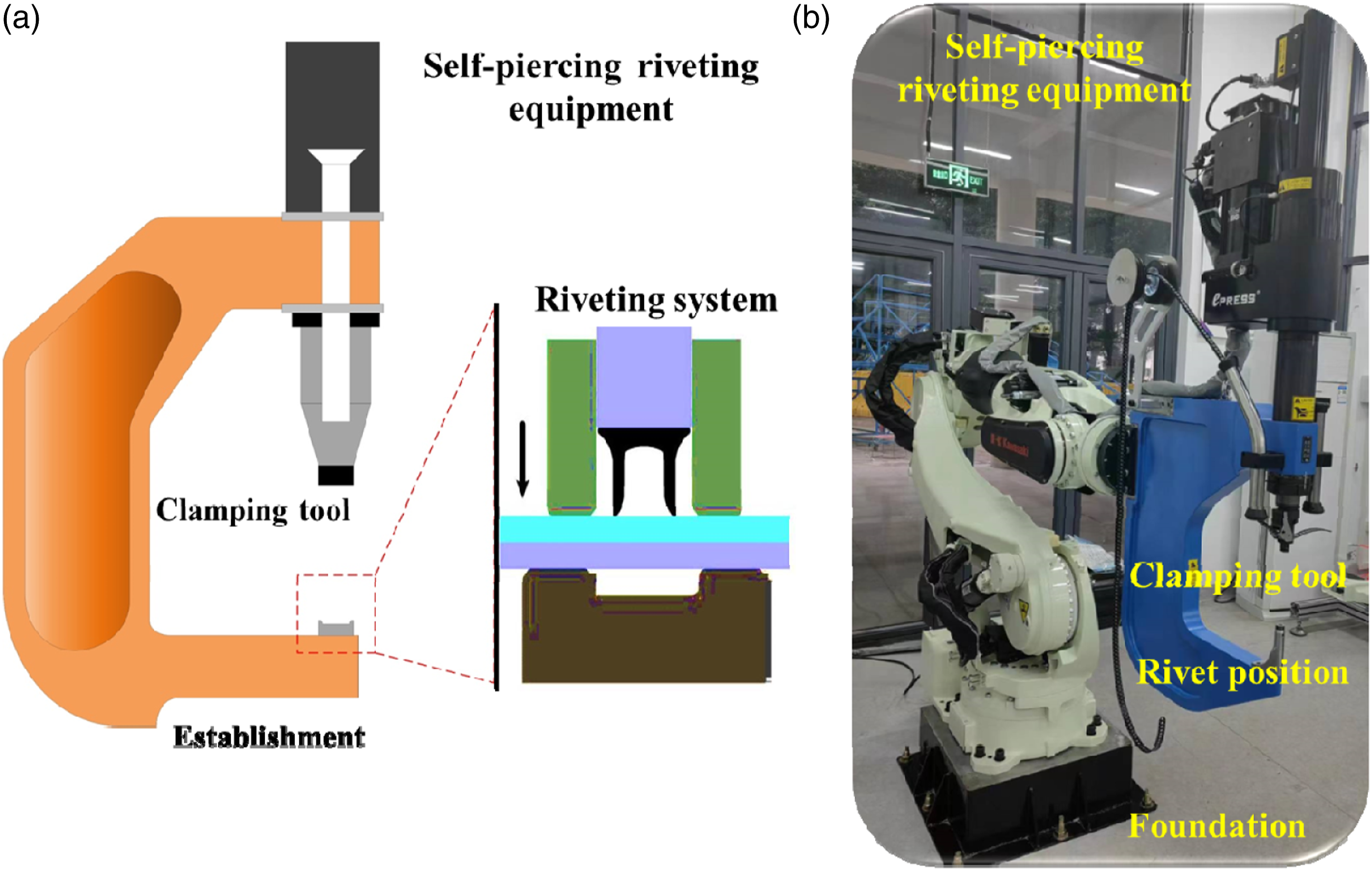
The SPR experiments were carried out on the EPRN-TF SPR equipment (EPRESS Technology Co., Ltd, Shenzhen China). The specimen preparation complied with welding standard GB-2649 (EPRESS Technology Co., Ltd, Shenzhen China). The 2A12 sheet as Group A and the 6061 sheet as Group B were nominated in the study. The rivet length is 5 mm and the die is used as a punch. The riveting quality is monitored online by the load-travel curve during the riveting process. The joints are cut by wire-cutting and forming quality evaluation parameters of the joint are measured with a two-dimensional projector to obtain the optimal riveting parameters through repeated tests. The SAA (2A12-2A12), SAB (2A12-6061), SBA (6061-2A12), and SBB (6061-6061) joints were prepared using 6 specimens each set respectively for the quasi-static tests. The structure of die, rivet, and specimen geometry is shown in Figure 2(a) and (b). Figure 3 illustrates the schematic and real photographs of self-piercing riveted equipment. Likewise, the schematic of SPR equipment and its corresponding experimental photograph of SPR machine are demonstrated in Figure 3(a) and (b). The structure of materials (a) die, rivet, and (b) specific geometry of the specimens. The schematic and real photographs of self-piercing riveted equipment (a) Schematic of SPR equipment (b) Corresponding experimental photograph of SPR machine.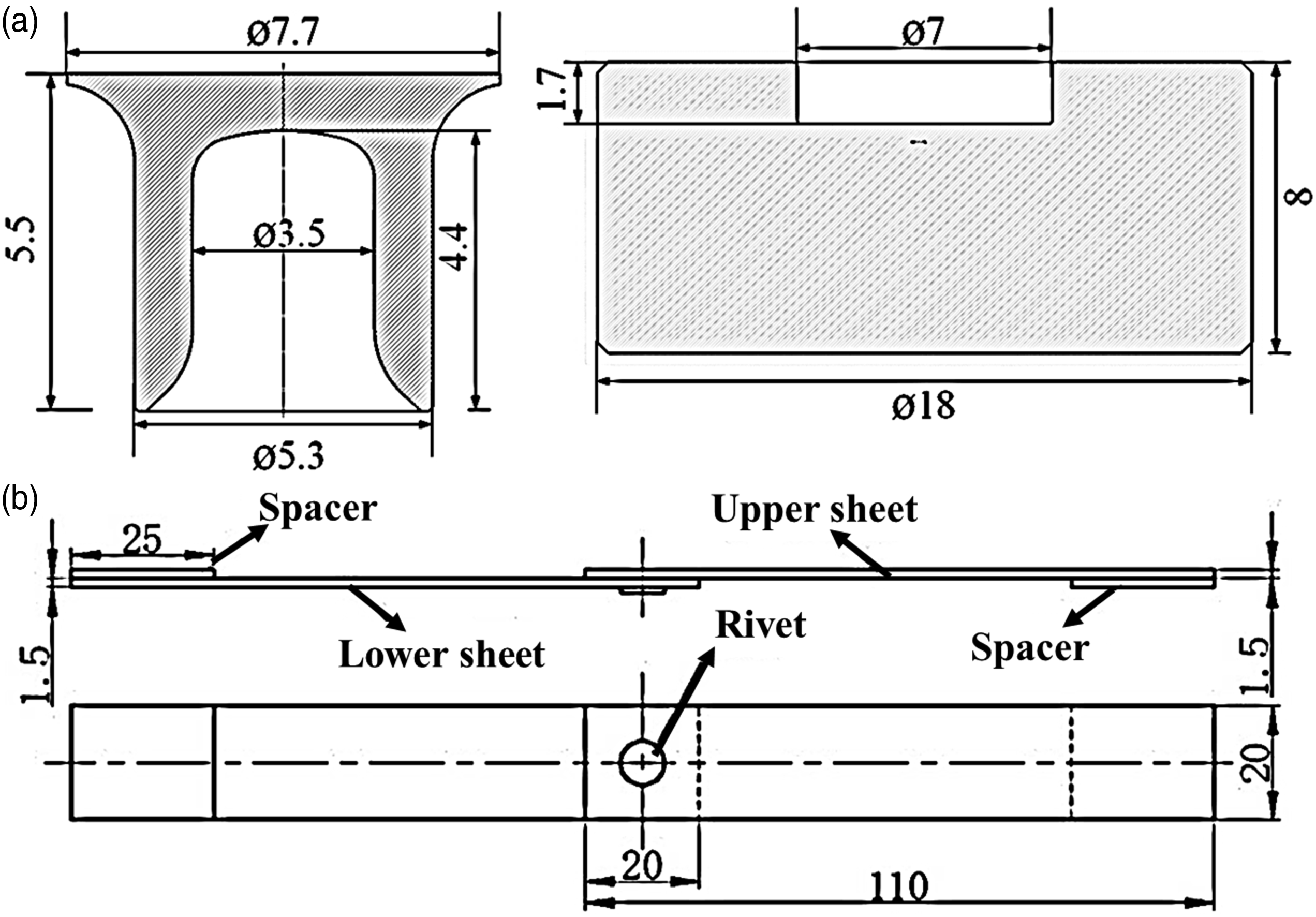
Quasi-static testing approach
The quasi-static testing was carried out on the testing machine. The specific method is as follows: the gasket added at both ends of the specimen to reduce the impact of the additional torque caused by the force misalignment of the specimen; each set is used in 6 specimens for testing to consider the stability of the static properties and the test tensile rate was set to 5 mm/min. The load–displacement curves of the joints are shown in Figure 4. The student’s “t” distribution was chosen to verify the test data and eliminated the dashed line invalid specimen. The quasi-static test results of the joints.
Figure 3 shows that the elastic deformation of the joint occurred with the increase of shear load in the first stage and the distribution of each curve in this stage was concentrated. The peak load of the SBB joints almost occurs at the 2.5 mm position. Likewise, the SAA joints are occurred near to the 1.5 mm position. The SAA joints quickly entered the failure stage after the elastic deformation, but the SBB joint had an obvious plastic deformation stage. Finally, the failure stage of the intersection point and the ultimate failure displacement of the SBB joints were larger than that of the SAA joints. The peak load position of the SBA and SAB joints was similar. Similarly, both were around 2.5 mm and the ultimate failure displacement of the joints was also relatively similar to 3.5 mm and 4.5 mm. The difference was that the SBA joints had a shorter plastic deformation stage.
Results and discussion
Test results and analysis
Appearance quality assessment method
The SPR appearance defect detection is achieved based on the Yolov5 algorithm method as shown in Figure 5. The joint images are acquired by a visual sensing device, where types of defects includes failed riveting, repeated riveting, overly riveting, button cracking, and sheet cracking. The data in a data-enhancing method is expanded such as rotation, color transformation, and random cropping. It can effectively improve the data diversity to ensure the generalization ability of the algorithm. The expanded data was labeled before it became effective. Then, the labeled data were randomly divided into training sets, verification sets, and test sets constitute 70%, 15%, and 15%, respectively. Schematic diagram of yolov5 self-punching riveting appearance defect detection.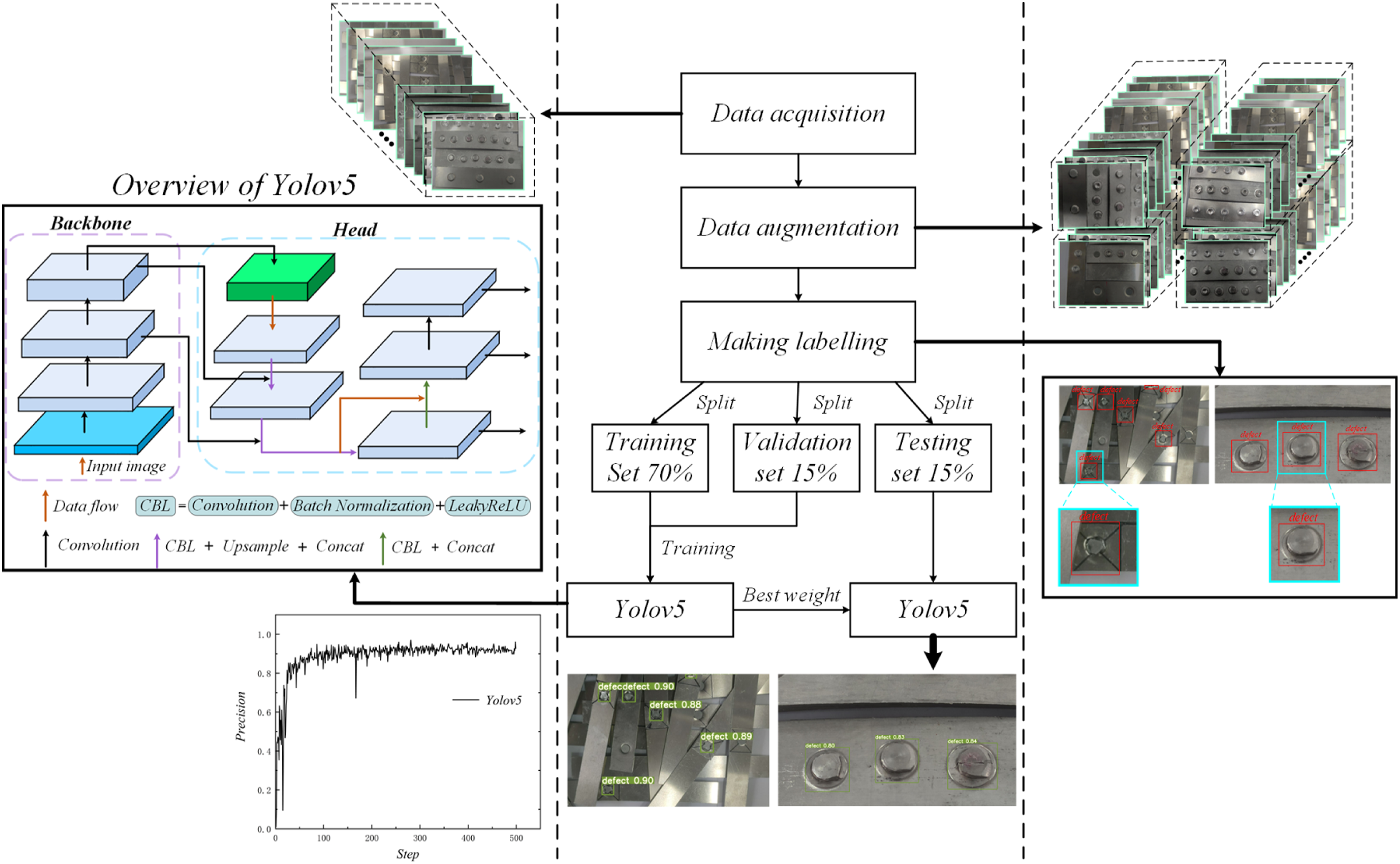
For the training and verification of the algorithm with a total of 500 epochs for training, the training set and the verification set were used. The algorithm used in this paper belongs to the supervised learning algorithm. The labeled data is used to train the network model and the error between the model predictions. The true value was used as the loss value for the specific analysis. Each layer's data is updated through back propagation. The optimal solution of the entire hypothetical space is found after continuous learning. The network model finally gained the ability to identify various faults. The training accuracy change curve identifies the final accuracy stable at 90%. The test results are analyzed and the accuracy of the untrained image recognition algorithm is obtained more than 80%. The detection speed of the algorithm is as high as 50 FPS which had good real-time performance. In short, the SPR joints image quality evaluation method based on Yolov5 not only has high detection accuracy, but also has a fast detection speed. So, the joints rendering defect supervision method based on the deep learning algorithm will effectively solve the security risks caused by the riveting defects.
Joint behavior analysis
The profile visual inspection method is used to detect the nail head height, internal locking value and bottom remaining thickness. The forming quality of the self-piercing riveted joint is also determined as shown in Figure 6. Generally speaking, the four types of joints, SAA, SAB, SBA, and SBB, are all well-formed and the cross-section symmetry of the joints is relatively good. Comparing Figure 6(a) and (b), we can see that the nail head height of the SAA joint (0.28 mm) is higher than the nail head height of the SAB joint (0.26 mm). This is because of the rivets penetrate inside the upper plate and the lower plate. Once, the yield strength of the 2A12 aluminum alloy of the lower plate of the SAA joint is higher than that of the 6061 aluminum alloy of the lower plate of the SAB joint, and the rivets are relatively difficult to penetrate. The welded joint cross-section views for each category (SAA, SAB, SBA, and SBB).
It results in a slightly higher nail head height of the SAA joint. The internal locking value of the SAA joint (0.27 mm) is larger than the internal locking value of the SAB joint (0.25 mm). The yield strength of the 2A12 aluminum alloy of the lower plate of the SAA joint is higher than that of the 6061 aluminum alloy of the lower plate of the SAB joint. The rivet penetrates into the SAA joint. The riveted piercing results were compared with the lower plate of the SAB joint when lowering the plate side. It encounters greater resistance in the vertical direction which causes more force to be decomposed into the horizontal direction. It further causes greater lateral plastic deformation of the rivet legs which in turn leads to the SAA joint to produce a larger internal lock value than the SAB joint. The remaining thickness at the bottom of the SAA joint (0.38 mm) is larger than the SAB joint (0.25 mm). This is due to the larger nail head height of the SAA joint compared to the SAB joint. The internal locking value is larger, when the SAA joint is formed. The lateral displacement of the rivet penetrating into the lower plate is greater than the longitudinal displacement. So, the remaining thickness at the bottom of the SAA joint is larger.
Comparing Figure 6(b) and (c), it can be seen that the nail head height of the SAB joint (0.26 mm) is larger than the nail head height of the SBA joint (0.32 mm) which is explained from the perspective of impulse. The impulse at the SAB joint and the SBA joint is the same when the rivet is about to pierce the upper plate of the joint. However, the speed of the rivet rapidly decays during the piercing process due to the effect of friction. Therefore, it will pierce the upper plate when the rivet pierces the upper plate. When entering the lower plate, the residual impulse makes it more difficult for the rivet to penetrate the 2A12 aluminum alloy with relatively high strength than the 6061 aluminum alloy. So, the nail head height of the SBA joint is relatively higher. The internal locking value (0.25 mm) is smaller than the internal locking value (0.29 mm) of the SBA joint. This is because of the 2A12 aluminum alloy of the lower plate of the SBA joint is stronger than the 6061 aluminum alloy of the lower plate of the SAB joint. Likewise, the SBA joint has greater lateral plastic deformation when the rivets are entered the lower plate. Therefore, the internal locking value of the SAB joint is lower than that of the SBA joint. The remaining thickness at the bottom of the SAB joint (0.25 mm) is larger than the remaining thickness at the bottom of the SBA joint (0.41 mm). This is because of the nail head height of the SAB joint is lower than that of the SBA joint. The 6061 aluminum alloy of the lower plate of the SAB joint is smaller than the 2A12 aluminum alloy of the lower plate of the SBA joint where the riveting is done easier. Comparing Figure 6(c) and (d), it can be seen that the nail head height of the SBA joint (0.32 mm) is higher than that of the SBB joint (0.18 mm). The internal locking value of the SBA joint (0.29 mm) is higher than that of the SBB joint. The internal locking value (0.27 mm) is larger and the remaining thickness at the bottom of the SBA joint (0.41 mm). The remaining thickness at the bottom of the SBB joint (0.22 mm) is stable. The reason for this is that the results are consistent with the above analysis and this is all happened due to the SBA joint morphology. The strength of the lower plate 2A12 aluminum alloy is higher than that of 6061 aluminum alloy. Further analysis of the joint cross section shows that the rivets of the SAA joint are slightly thicker and the wall thickness in the toe area of the rivets is thinner. There are slight cracks in the base metal sheet. From this, it can be inferred that the SAA joint is very likely to have plate fracture. For SAB and SBA joints, there were no obvious cracks be seen in the joint forming diagram. The rivet feet are well opened, but the remaining thickness is too small. It can be inferred that the thick bottom part is the weakest position. The SBB joint has the lowest nail head height and sufficient internal locking value. However, the bottom remaining thickness is minimal and pull-off failure is likely to occur. The joint forming quality cannot accurately determine the failure mode of each joint and further research is required.
The graph comparison of the forming quality parameters for the welded joints is shown in Figure 7. The value of the variation of the interfacing of joints with similar sheets was only 0.02 mm, while the height of the rivet head and the remaining thickness of the lower of SAA joints are greater than those of SBB joints. Due to the strength of the 2A12 sheet is greater than that of the 6061 sheet. The rivet was not easy to pierce when forming the SAA joint compared to the SBB joints. Likewise, the rivets of the SBB joint penetrated deeper and formed a mechanical interlocking structure under the action of bottom mold. So, the differences between the two interlock values of the joints were small. The interlock value, rivet head height, and bottom residual thickness of the SBA joints are greater than those of the SAB joints. The largest lateral plastic deformation occurs during the examination of the outer structure of the joints. The residual impulse makes it difficult to penetrate the relatively strong 2A12 aluminum alloy after a rivet of SBA joint pierced the upper sheet. The rivet shank produced greater lateral plastic deformation. The forming quality parameters of the riveted joints.
The static properties of the joints.

Failure analysis
Typical failure modes of the joints are shown in Figure 8. It can be seen from static experiment results that the main failure mode of the SAA joint was the upper sheet fractured (4 specimens) and one specimen failed in the lower sheet. The pulled-out with button-off indicates that the interlock strength of the joints is higher than that of the substrate. Meanwhile, due to the high brittleness of the 2A12 substrate, cracks and defects were prone to appear on the substrates during the riveting process. The main failure modes of the other joints were pulled-out. Thus, the one specimen of SAB joint was fractured in the lower sheet. The remaining three specimens of the SBA joints were presented pulled-out with button-off. The pulled-out failure indicated that the mechanical interlocking structure of the joints was damaged and the rivet was pulled out from the substrate. It was attributed to the good plasticity of the 6061 sheet. The button-off was caused by cracks or defects easily generated during the riveting process when 2A12 was used as the lower sheet. Therefore, the cracks or defects were further enlarged during the static test. However, when the top and bottom sheets are the same, then the failure will be removed.25,26 In this case study, consistent behavior was analyzed for SBB, but for SAA it was different and flexible behavior. In fact, this type of analysis is observed due to the material of the SAA joint is aluminum alloy 2A12. The 2A12 aluminum alloy is relatively brittle and has insufficient toughness. Therefore, when the stud feet penetrate the 2A12 plate, a large number of micro-cracks are created inside the plate. So the microcracks expand further and cause the joint to fracture during the static tensile test. Typical failure modes of the joints.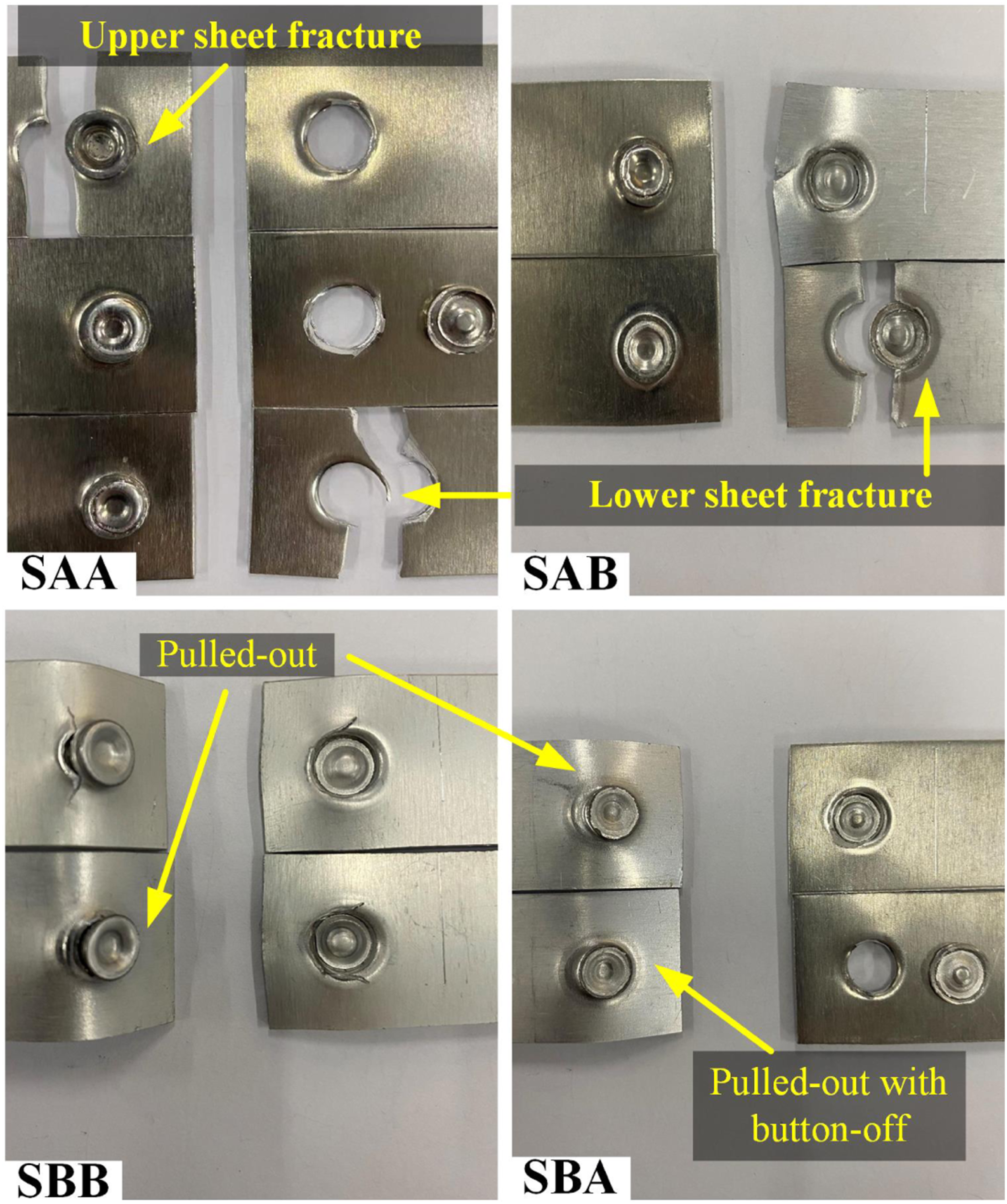
The scanning electron microscope (SEM) was used to conduct microscopic analysis of each typical failure mode and composite failure specimens of the SBA joint. The pull-out specimens of the SAA joint top sheet defect and the SAB bottom-off joint sheet failure specimen were selected. Figure 9 shows that the SEM analysis of pulled-out with button-off failure of The SBA joints. Since, 4 areas of the most severe macroscopic damage on the joint were selected for SEM analysis. Thus, the area A is the tensile direction as shown in Figure 9(a). Areas A and C reveal visible gray and white streak marks which is typical scratch morphology as displayed in Figure 9(a) and (c). The gray part is 2A12 aluminum alloy metal oxide and the white part is 2A12 aluminum alloy after the metal oxide was removed. Area D presented a small number of dimples indicating that plastic deformation existed in the area as shown in Figure 9(d). There is no apparent topography as shown in Figure 9(b). Moreover, the metal oxide layer is well preserved. The scratches and plastic deformations in area A were the most severe followed by areas C and D compared to 4 photographs. The plastic deformation is almost invisible in area B. The rivet gradually moved towards area A and C during the static experiment. It finally pulled-out completely near area A. It indicates that the lower SAA joint sheet had undergone a large plastic deformation. The mechanical interlocking structure of the joint is destroyed which is also consistent with the macroscopic failure morphology of the joint. The SEM analysis of pulled-out with button-off of the joints.
The SEM analysis of upper sheet fracture of the joints is shown in Figure 10. Figure 10(a) reveals that fracture zone A could not find any brittle or ductile fracture characteristics. The zone was composed of a large number of flat and smooth shear surfaces, indicating that the fracture of the specimen was mainly subjected to shear stress. Figure 10(b) presents that fracture zone B has a large area of stone-like morphology with different shapes and sizes. It further belongs to the typical along-crystal fracture characteristic. It is a brittle fracture shape in the morphology. A small number of micropores and tear edges can be seen in the area C as shown in Figure 10(c). Therefore, it belongs to the ductile fracture. It shows that there is a large area of brittle fracture and local ductile fracture in the area B. The analysis results in this work show that the stress during the fracture of the forming area of the mechanical lock structure is the shear stress. The mechanical locking strength of the SAA joint is greater than the tensile strength of the substrate. The fracture at the edge of the upper plate is generally brittle fracture but there are also fractures with local toughness. It can be found that the stress in the formation area of the interlock structure was shear stress. The interlock strength of the SAA joint is greater than the tensile strength of the sheet and the fracture at the edge of the upper sheet was generally brittle fracture. However, there were also local ductile fractures in the morphology. The SEM analysis of upper sheet fracture of the joints.
The SEM analyzes of lower sheet fracture of the joints are displayed in Figure 11. Figure 11(a) shows that the micropores and tear edges appeared in fracture zone A and the deformation of the fracture surface was quite severe. The shear lip was clearly visible in the structures. It belongs to the microporous aggregate fracture. Figure 11(b) reveals that a large amount of coating attached to the surface of the lower sheet, indicating that there is a large degree of friction between the lower sheet and rivet. Figure 11(c) exhibits that several large cracks were obviously found in the area C which illustrating that the area is subjected to a larger force and the deformation is more serious. Figure 11(d) demonstrates that a small number of semi-elliptical dimples are distributed in area D which is generated from the action of shear stress and belongs to shear fracture. It can be concluded that the joint was first torn near the edge and the lower sheet fracture process is marked with a red arrow in the photograph. The SEM analysis of lower sheet fracture of the joints.
Conclusions
In this paper, similar (2A12) and dissimilar (6061) aluminum alloy sheets were joined using an advantageous method called self-piercing riveting. The joints with similar 2A12 sheets contained the best static strength and the joints with similar 6061 sheets had superior anti-vibration performance. Besides, the joints with 6061-2A12 sheets achieve the most decent and broad mechanical properties on substrates surfaces. The main failure mode of joints with similar 2A12 sheets was substrate fracture in the experiments. Equally, the main failure modes of the other joints were pulled-out property and some of them with button-off behaviors. The fracture of the 2A12 substrate belongs to the fracture of the composite intergranular and microporous aggregate. Furthermore, a real-time detection method for riveting rendering defects in different scales, illumination and rotation scenarios based on deep learning algorithm was proposed and realized. The effectiveness of the method was verified by the self-piercing riveting experiments. The detection accuracy of the method is about 90%. The detection speed reached 50 FPS which can be effective for the ultrasonic welding process. It can be further advantageous to solve the problem in riveting process and useful for automotive industry application.
Highlights
i. The study determined that the self-piercing riveting is advantageous and superior to other composited processes (e.g., composited friction stir welding, laser welding, and electromagnetic welding) to address the microstructural and morphological difficulties. ii. The quasi-static experiment is proposed to investigate the mechanical behaviors, failure mode and mechanism of the different joints. It is used to analyze the dynamic load when investigating the internal structures of the self-piercing riveted joints (aluminum alloy sheets = (similar 2A12) and (dissimilar 6061). iii. The similar metals (2A12) used to fabricate the sheet joints contained the best static strength and the similar metals (6061) produced with the sheet joints provided superior anti-vibration performance. Altogether, SPR joints with (6061-2A12) sheets introduced the advantageous and comprehensive mechanical properties according to SEM/EDS analysis. iv. The microstructural performance analysis of the SPR joints proved and revealed that the accuracy of the implemented approach can reach up to 90%. Moreover, the detection speed was measured up to 50 FPS.
Footnotes
Author contributions
Z Lun contributed to the conception of the study; H Xiaole performed the experiment and the data analysis and wrote the manuscript; Z Abbas contributed to the conception of the study and helped to perform the analysis with constructive discussions; G Zixin helped to perform the analysis with constructive discussions; Z Abbas and MS Islam performed the data analysis and edited the entire manuscript.
Declaration of conflicting interests
The author(s) declared no potential conflicts of interest with respect to the research, authorship, and/or publication of this article.
Funding
The author(s) disclosed receipt of the following financial support for the research, authorship, and/or publication of this article: This research is supported by National Natural Science Foundation of China (Grant No. 12104324); Postdoctoral Science Foundation of China (No. 2021M703392); Scientific Research Startup Fund for Shenzhen High-Caliber Personnel of SZPT (No.6022310046 K); Postdoctoral Startup Fund of Shenzhen Polytechnic University (No. 6021330001K and No. 6022331008K).
