




Abstract
In the past ten years, as awareness of biodegradability has increased, so has the utilization of natural fiber-reinforced composites. Along with the material properties, dynamic responsiveness is also necessary for the efficient design of these natural reinforced composites. In the current work, elastic characteristics and interfacial stress are evaluated for natural fiber-reinforced composites utilizing micromechanics and finite element methods. Later, employing explicit dynamic analysis, the natural composite plate was examined under impact loading. The analytical results used to verify the finite element models at each stage show good agreement. To carry out the current study, natural fiber-reinforced composites like hemp, sisal and flax as well as hemp + sisal, sisal + flax and hemp + flax hybrid composites were evaluated for their elastic modulus in longitudinal, transverse, in-plane and out of plane directions as well as their major and minor Poisson’s ratio. By adjusting the impactor’s velocity from 2 m/s to 11 m/s, the deformation, stresses, internal energy and energy summary of the hybrid natural fiber-reinforced composite are calculated from the impact analysis. Based on all the findings, the performance of hemp fiber and hemp fiber-based hybrid composites is better than all other composites taken into consideration for the current work. This research is utilized to build composite materials that function effectively under gradual loading.
Introduction
Natural fiber-reinforced composite materials are attracting many researchers due to their special characteristic, which is biodegradability. Along with biodegradability, high specific strength and stiffness attract greater applications, including aerospace and automotive. Green composites are being used in industry more and more as a result of their eco-friendly nature. Aerospace, automotive, military, construction, packaging, medical, sporting goods and railway are examples of industrial applications. 1
Many studies have been found on the types of natural fiber, their extraction and mechanical properties. Nowadays, applications of natural polymer composites as engineering materials are becoming state of the art at a faster rate. It follows that the ability of the engineer to design for the characteristics of natural polymer composites is an important advantage. 2
The main disadvantage associated with the composite material is that it is very weak against impact damage3,4 and the strongest natural fibers govern the composite impact responses. 5 Special attention will be given to civil aviation crafts where the composite material used for these vehicles will be verified for impact hits. Bird strike impact damage on composite laminate was presented with the help of the finite element method. 6 Composite materials are orthotropic in nature and, considering this, the composite laminates are studied for progressive damage by using the finite element method. 7
For automotive applications such as door trim panels, impact strength is the most important property to ensure passenger safety through good crash behaviour. The impact strength of flax fiber-reinforced composites is estimated. 8 Low velocity impact analysis is also performed on the pineapple leaf fiber-reinforced composite. 9
Micro-mechanism studies have been imposed on the rocks to study these materials under impact loading. 10 The principal stresses of the composite laminate under impact loading are reported to study the impact damage process with the help of the finite element method. 11 Total energy, internal energy, kinetic energy and deformation after impact loading are the important factors in impact analysis. Total energy is a useful parameter for verifying the correctness of the simulation results of an explicit FE model. If the total energy is approximately constant, the overall error of the simulation result is usually less than 1%. 12 Energy absorption is also used to characterize the behaviour of composite material under impact load because an increase in the energy absorption of the material reduces the velocity of the projectile. 13
The generally used methodology for composite analysis is multi-scale coupled numerical study, that is, the single composite ply properties are found in the first stage and, using these results as input, the laminate level total composite laminate will be studied. 14 The combination of micromechanics with the finite element method is used to study the effects of humid tropical ageing on composite materials. 15 And the ANSYS Parametric Design Language (APDL) is efficient when performing a huge number of calculations with different material properties. 16 Using homogenization, the influence of interfacial defects is also highlighted using micromechanics and the finite element method for nanoparticle reinforced composites.17,18 Hybridization of fibers enhances the performance of the resulting composite. 19 Taking these works into account, a knowledge gap in the analysis of natural fiber-reinforced composites is identified. The impact analysis is performed on frequently used natural fiber-reinforced composites by varying the velocity of the impactor from 2 m/s to 11 m/s. The main objective of the present work is to analyse the natural fiber-reinforced composite under impact load with the perspective of maximum deformation, equivalent stress, normal strain and maximum principal stress with internal energy. Finally, the energy conversation chart can be plotted under a low velocity loading condition. Although many research articles are available on the impact strength of natural fiber-reinforced composites, the analysis of composites under low impact load and energy equivalence with respect to cycles is the novelty of the present work. The methodology proposed in this work can be applicable to any natural fiber-reinforced composites as these materials can be used in aerospace, automotive, military, construction, packaging, medical and sporting goods applications. The elastic properties required for the impact analysis are obtained from micromechanics and the finite element method. For the analysis, different combinations of the natural composites are taken for analysis.
Materials and methodology
In the present work, the main objective is to know the behaviour of natural fiber-reinforced composites subjected to impact loading. For that, the work is planned in two phases. The first phase identifies natural fiber-reinforced composite properties. For that work, hemp, sisal, flax fibers and hybrid composites such as hemp, sisal, flax and flax fiber epoxy matrix reinforced composites are selected and these composite properties are evaluated by using the micromechanics method. The micromechanics approach is used to know the composite materials’ elastic properties from constituent properties and interfacial stresses using the mechanics of material approach. Using these combinations and the finite element method, the natural fiber-reinforced composites and their interfacial stresses are estimated with proper validation. An epoxy resin (LY556) matrix is used as a hosting medium. The volume fraction of the natural fiber is maintained at 50% because the work includes the impact behaviour of both single natural and hybrid natural composites. In hybrid reinforced composites, an equal contribution is given to the two natural fibers. For example, in the case of sisal and flax composites, the sisal fiber volume fraction is 25% and the flax fiber–reinforced composite is 25%. While incorporating two different fibers to prepare a hybrid composite and giving equal weightage to each fibers considered for the work, the weight fraction is fixed at 50%, which has also given equal weightage to the fiber and matrix phases. In this perspective, the fiber contribution is fixed at 50%. In all the cases considered for the study, the orientation of fiber is 0°.
Longitudinal modulus, transverse modulus, major and minor Poisson’s ratio, in-plane and out of plane stresses are evaluated from micromechanics models generated in Finite element software. Interfacial stresses are also estimated in the first phase of the work. In this phase, the fiber volume fraction of the fiber is fixed at 0.50. The fibers are idealized to be distributed uniformly in the hosting medium and perfect bonding between the fibers and epoxy is considered for the present work. 20
In the next phase, the behaviour of natural fiber-reinforced composites subjected to impact loading is identified. Using the homogenized properties of natural composite, a plate made of 100 × 100 × 10 mm is studied and subjected to lower velocity impact loads. The low velocity impact load varies from 2 m/s to 11 m/s when applied to the natural composite plate.
Natural fiber-reinforced composite elastic properties
The elastic properties of hemp (H), sisal (S) and flax (F) fiber-reinforced epoxy composites, as well as hybrid composites such as hemp + sisal (H + S), sisal + flax (S + F) and hemp + flax (H + F), are modelled using micromechanics concepts. The natural fibers are uniformly distributed in the epoxy matrix and assumed to be perfectly bonded with epoxy resin. By selecting one array from the total material and applying periodic boundary conditions, the composite elastic properties were estimated by applying appropriate loading. A SOLID186 element is selected to create the finite element mesh. A higher order 20-node 3-D solid element called SOLID186 displays quadratic displacement behaviour. Twenty nodes, each with three degrees of freedom – translations in the nodal x, y and z directions – define the element.
The longitudinal elastic properties such as E1, ν12 were estimated by applying load parallel to the fiber direction, which is called the E1 model, and transverse elastic properties like E2, ν21 were estimated by applying the same in the transverse direction, known as the E2 model. By applying the load in the respective directions, the shear modulus of the composite in and out of plane is also estimated. The E1, E2 and G12 models are validated with analytical equations. The E1 model’s accuracy is verified with the Rule of Mixtures. The E2 Model is verified with Bettie’s reciprocal theorem. The in-plane modulus G12 is verified with an analytical equation. A good association is observed between FE and analytical equations in all cases. The material properties of hemp, sisal, flax and epoxy matrix are collected from open literature.
21
The Figure 1 shows the finite element models at 50% volume fraction generated in ANSYS software. Finite element models at 50% volume fraction.
The longitudinal modulus (E1) is high for hemp fiber-reinforced composites, and hybridization of hemp fiber with sisal or flax fiber also benefited in terms of longitudinal modulus at fixed volume fraction. However, the same hybridization is ineffective in increasing transverse modulus. The longitudinal modulus is verified with the analytical equation of the Rule of Mixture (E1 Model) (E1 = Ef*Vf + Em*Vm) where E1 is the composite longitudinal modulus, Ef is the modulus of fiber, Vf is the volume fraction of the fiber, Em is the Young’s modulus of matrix and Vm is the volume fraction of matrix. The transverse modulus (E2 Model) is verified with the Betti’s reciprocal theorem. (E1/ν12 = E2/ν21) where ν12 is the major Poisson’s ratio obtained from the E1 model and ν21 is the minor Poisson’s ratio obtained from the E2 model. Perfect closeness is observed between the FE and analytical results (Figure 2). Elastic properties for different composites considered for the present study, along with their validation, are provided in Table 1. Finite element contours of flax and hybrid (Sisal + Flax) epoxy composite. Elastic properties of natural fiber-reinforced composite.

Interfacial stresses of natural fiber-reinforced composite.

Impact analysis of natural composites
In this section, the impact analysis was performed on natural composites by varying the impact velocity from 2 m/s to 11 m/s as the magnitude of the low impact velocity tests will be carried up to 11 m/s. For that, a plate has been modelled with a dimension of 100 mm × 100 mm × 10 mm. The explicit dynamic analysis was performed by assigning the properties of natural composite as mentioned in Table 1 to the plate, and changing the velocity of the impactor. In the composite plate, the fibers are aligned in the global X-direction in 0° orientations. The bottom XY plane of the composite plate is fixed in all directions. The impactor is modelled as a cylindrical rod with a weight of 27.74 g, made of stainless steel.
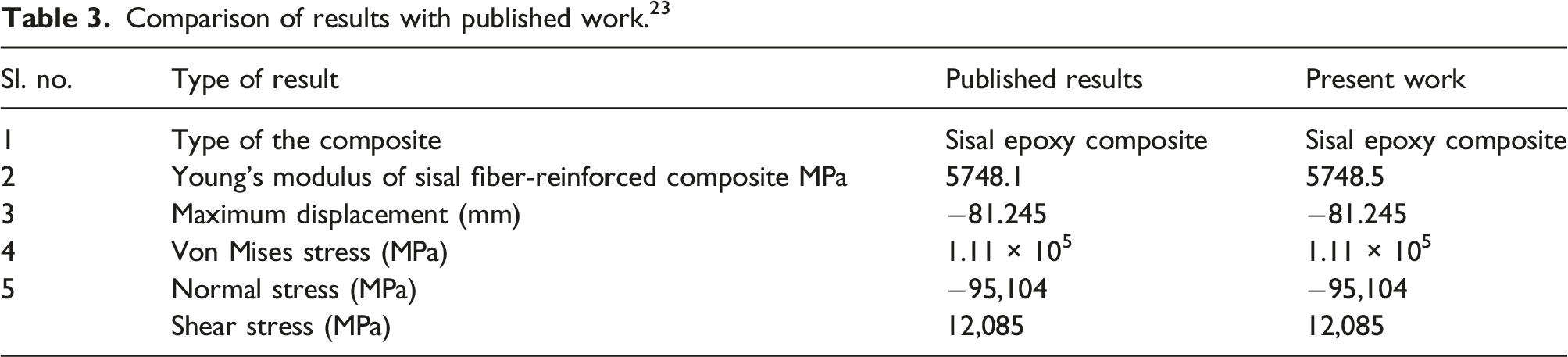
By performing the analysis, the deformation, equivalent stresses, principal stresses, normal and shear strain of the natural composite is identified with respect to the velocity, which varies from 2 m/s to 11 m/s (Figure 3). The finite element methodology is validated by comparing the results obtained from the previous work.
23
An impact analysis is performed for different natural fiber-reinforced composites. The elastic modulus predicted from the experimental work is compared with the micromechanics approach. Maximum displacement, von Mises stresses, normal stresses and shear stress are predicted using the same elastic properties, geometry and loading conditions as in the published results and perfect agreement is observed between the published and present results. The geometrical model is created by following ASTM D256 standards. Table 3 shows the closeness between the published and present work. Finite element model for impact analysis and deformation hemp and flax composite at 11 m/s velocity. Comparison of results with published work.
23

The deformation of the composite plate is a very important factor after being impacted. In this work, the natural composite plate which is impacted by 2 m/s to 11 m/s was reported in Figure 4. Hemp and hemp-associated hybrid composites, such as hemp + sisal and hemp + flax reinforced composites, showed less deformation than sisal and flax fiber-reinforced composites.
24
That means hemp and hemp-based hybrid composites offer more resistance to the applied impact loads than other natural fiber-reinforced composites. And under the same impact force, the resistance to the defromation under impact load is inversely proportional to the maximum defromation.
25
Displacement w.r.t velocity.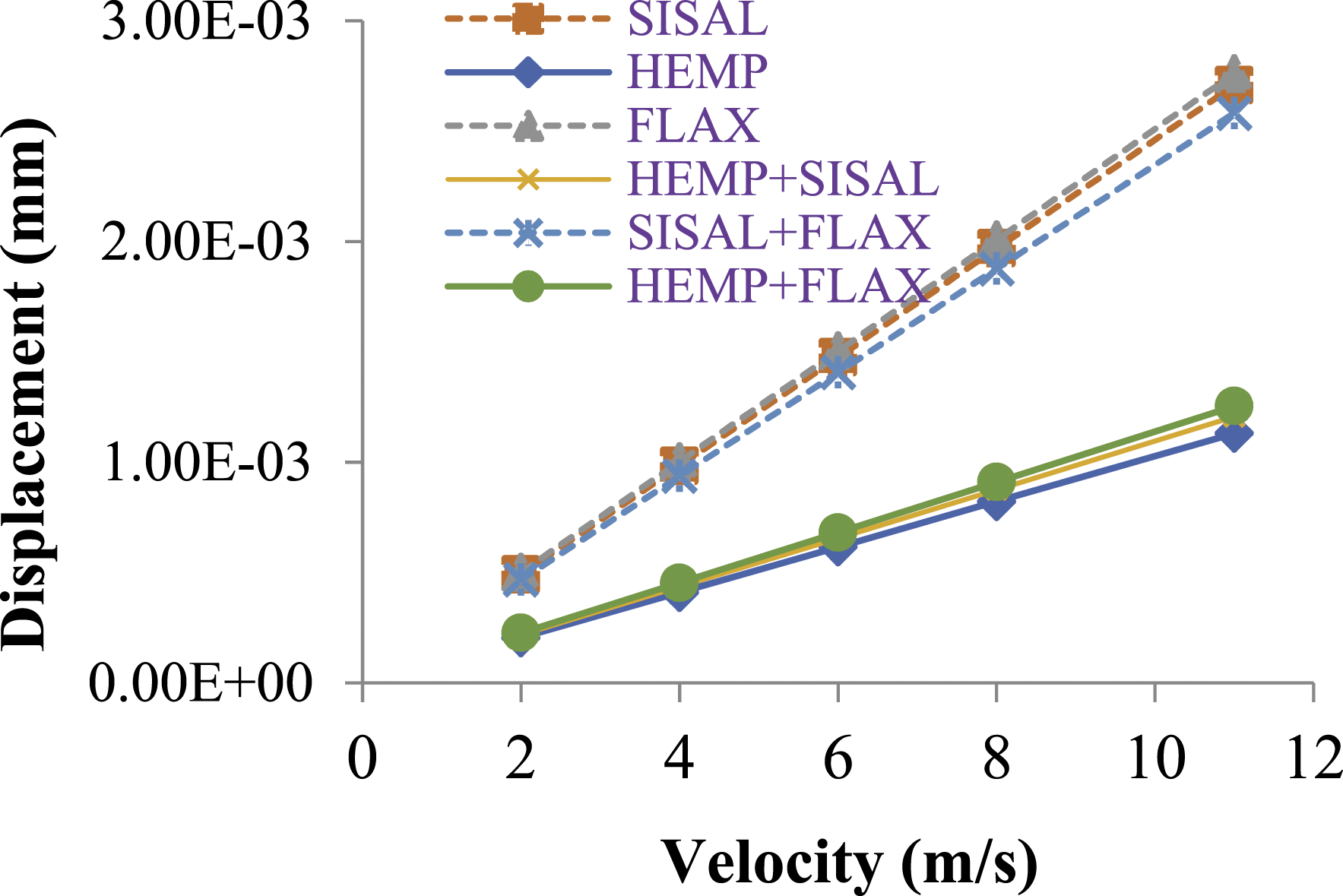
Unlike deformation, the equivalent or von Mises stresses do not show any differences with the type of natural composite. The hemp, sisal, flax, hemp + sisal, sisal + flax and hemp + flax composites showed the same magnitude of equivalent stresses at every velocity of impact load considered for the study. From the design perspective, these selected natural composites will not show any differences in von Mises stresses as these stress consider dilatational energy but simply distortional energy (changes in shape; changes in volume) (Figure 5). Equivalent stresses w.r.t velocity.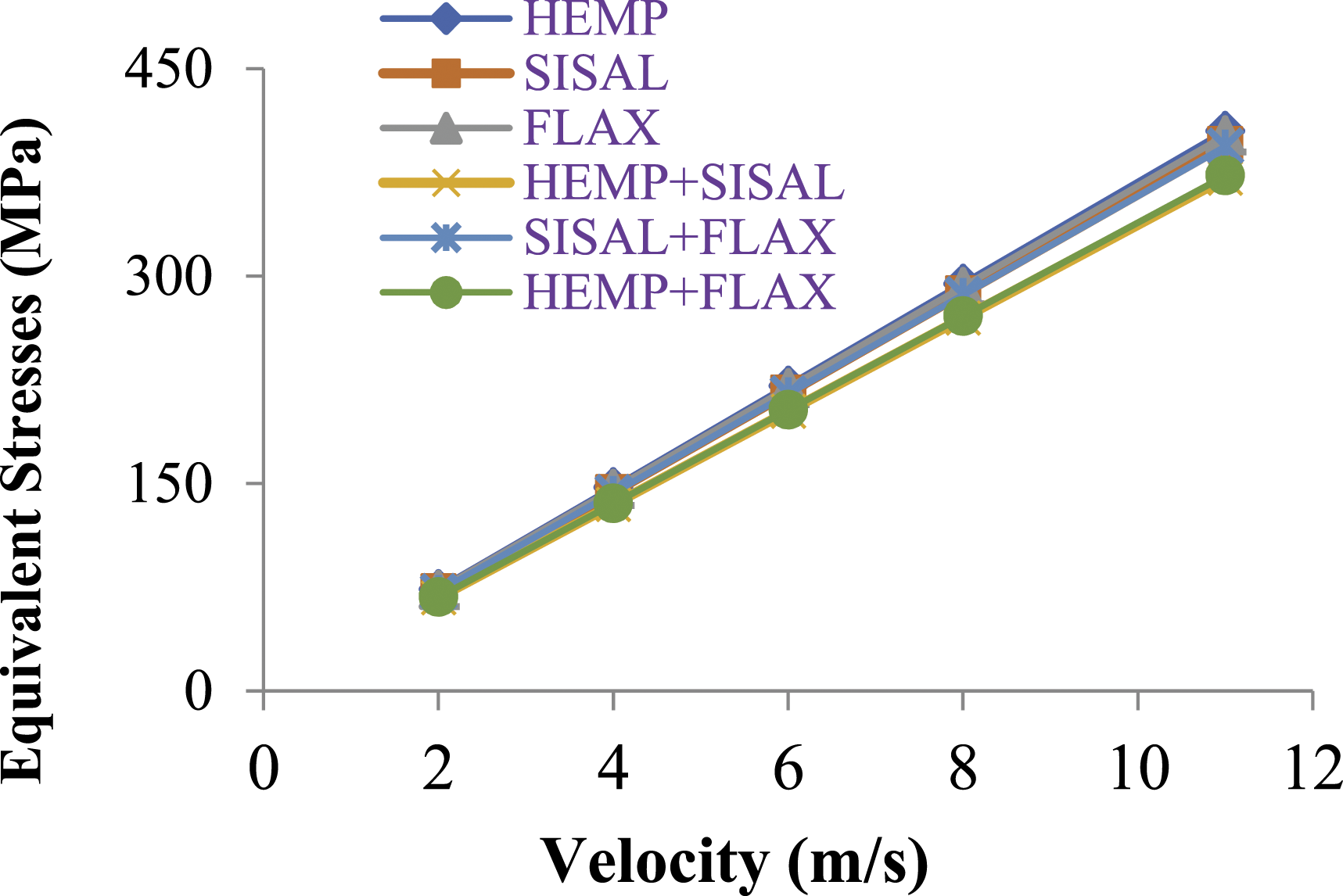
The von Mises stress does not consider dilatational energy but simply distortional energy (changes in shape) (changes in volume), as the present study considers the composite response is same under the considered conditions as a result, and the same response is attained in von Mises stress.
Figure 6 presents the variation of maximum principal stresses of natural composites with respect to the velocity of the impactor. Increasing the velocity of the impactor, the impactor’s magnitude is also increasing. And the hemp fiber-reinforced natural composite showed more resistance to these stresses. The normal strain is presented in Figure 7. The hemp fiber and hemp fiber-based hybrid composite showed less normal strain than flax, sisal and these fiber-based hybrid composites. Maximum principal stresses w.r.t velocity. Normal strain w.r.t velocity.

Figure 8 shows the variation of internal energy of the natural composite after being impacted at 2 m/s and 11 m/s velocity. At the lowest velocity load, the internal energy of all the natural composite, that is, hemp, sisal, flax, hemp sisal, sisal + flax and flax and hemp composite is the same. However, at higher velocity, the hemp and hemp-based composite showed higher internal energy due to their high stiffness than remaining composite. Internal energy of the natural composite after the impact.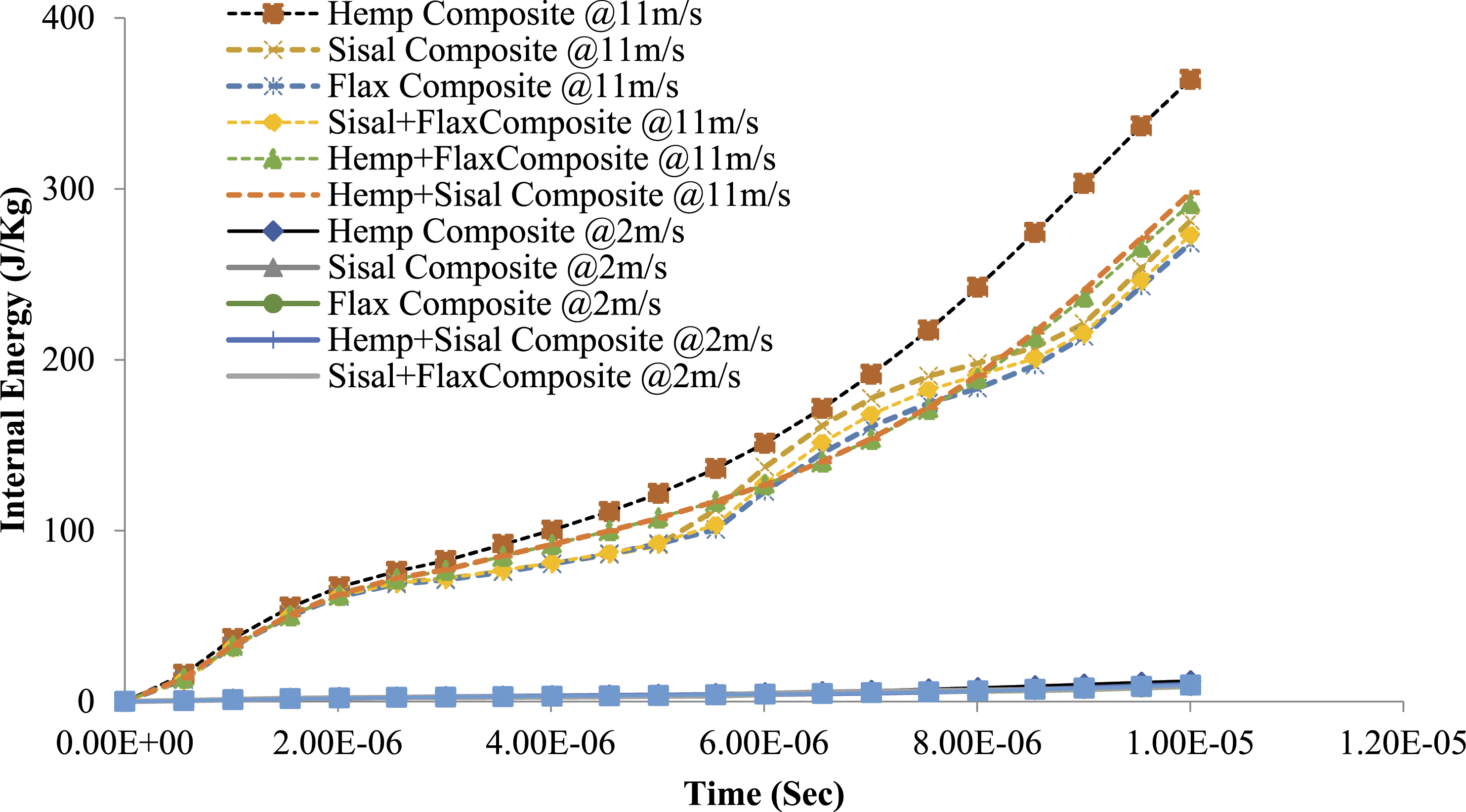
According to the conservation law of energy, it can neither be created nor destroyed. However, energy is transmitted from one form to another form. It possesses kinetic energy (KE) before hitting the composite plate by the impactor. This kinetic energy is transmitted into the natural composite after being hit by the impactor. In explicit dynamic analysis, it is possible to know the transformation of these energies with respect to time. The explicit dynamic models for the natural composite are verified by considering the total energy of the system. As it is represented in Figure 9, the total energy is approximately constant. This condition checks and verifies most of the simulation models for dynamic analysis.
12
The changes in the total energy indicate the inaccuracy of the solution. From the results, there are no changes in the total energy and the energy error is very small, and this process is used to validate and verify the accuracy of the FE models considered for the analysis. In the present work, all the models showed consistent total energy in all the cases. Figure 9 shows the energy conversation chart for hemp natural fiber-reinforced composite at 2 m/s impact load. From this graph, it is observed that the total energy variation is almost constant. At lower impact velocity (2 m/s), the internal energy is very small, which means the impact response is controlled by the impactor instead of impact velocity.
26
Energy conversation chart of hemp fiber composite at 2 m/s velocity.
Initially, the kinetic energy of the impactor is obtained by the formula as shown in equation (1)
At the same time, the internal energy (IE) of the natural composite is at its most negligible. The kinetic energy is decreasing with an increase in the number of cycles. At the same time, the internal energy of the plate is rising. That means the kinetic energy is being transmitted into internal energy. This scenario holds true for all natural materials, but the point at which the kinetic energy equals the internal energy is the valuable point in this result. The internal energy is generated by permitting the deformation of the composite plate by the impactor velocity.
For hemp fiber-reinforced composites, at 108 cycles, the KE is equal to IE at 2 and 11 m/s velocity. For sisal fiber composite, it is happening at 127 cycles, for flax composite at 120 cycles, hemp + sisal hybrid composite 123 cycles, sisal + flax 125 cycles and hemp + flax 118 cycles.
From Figure 10, it is observed that the kinetic energy of the impactor is absorbed by the hemp composite in 108 cycles and that later the KE of the impactor is dropped to a minimum. This behaviour is the same at 2 and 11 m/s velocities of the impactor. The reason for this behaviour is the dominant stiffness of the hemp composite. During the impact process, the major impact energy of the impactor is transformed into internal energy.
27
Variation of K.E, I.E of the hemp natural composite with respect to cycles at 2 m/s, 11 m/s.
Figure 11 shows the energy summery of sisal fiber-reinforced composite. In this case, the material takes 127 cycles to absorb the energy of the impactor, compared to hemp fiber composite, which takes more time to absorb the energy under the same working conditions. In comparison to sisal, flax fiber composites respond quickly to load and absorb energy, as shown in Figure 12. Variation of K.E, I.E of the sisal natural composite with respect to cycles at 2 m/s, 11 m/s. Variation of K.E, I.E of the flax natural composite with respect to cycles at 2 m/s, 11 m/s.

Figure 13 shows the energy summary of the hemp and sisal hybrid composite. The internal energy increases with the increase in the cycles, whereas the kinetic energy is reduced. Internal energy became the major energy contributor after 123 cycles. Variation of K.E, I.E of the hemp + sisal hybrid natural composite with respect to cycles at 2 m/s, 11 m/s.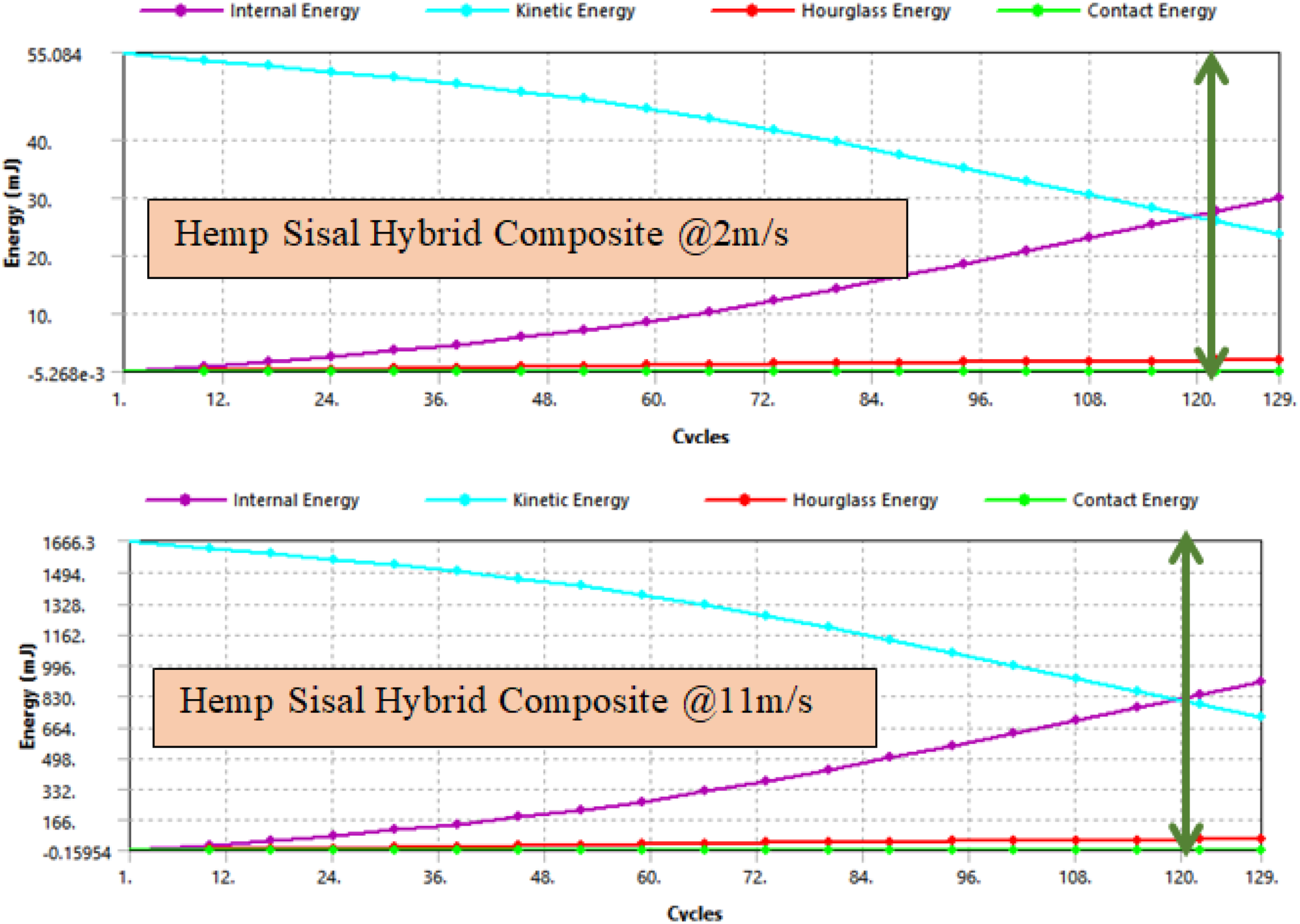
The variation of the kinetic energy and internal energy of sisal and flax hybrid composites was shown in Figure 14. Kinetic energy is the most prominent energy at the start of the cycles, and internal energy becomes prominent after 123 cycles. Variation of K.E, I.E of the sisal + flax hybrid natural composite with respect to cycles at 2 m/s, 11 m/s.
Similar to the above composite materials, the hemp flax material was manufactured and the variation of the energy with respect to the cycles at 2 m/s and 11 m/s was reported (Figure 15). The results show similar trends for sisal, hemp and flax hybrid composites. When compared between the three hybrid composites, the hemp flax hybrid composite absorbed the energy more quickly. Variation of K.E, I.E of the hemp + flax hybrid natural composite with respect to cycles at 2 m/s, 11 m/s.
Conclusion
Natural composite materials’ elastic properties and these material behaviours under impact loading are estimated by using micromechanics and explicit dynamic analysis respectively. The following conclusions are obtained from the present work: 1. The hybridization effect of natural fibers is beneficial to the longitudinal modulus. However, the enhancement is not reflected in the transverse modulus due to hybridization at a fixed volume fraction of each fiber. 2. Under impact loading of 2 m/s to 11 m/s, hemp-associated hybrid composites such as hemp + sisal and hemp + flax fiber-reinforced composites exhibited less deformation than sisal and flax fiber-reinforced composites under impact loading of 2 m/s to 11 m/s. 3. The differences in the kinds of fiber are not showing any differences in the generation of von Misses stresses under the impact loading. 4. At higher velocity, the hemp and hemp-based composites showed higher internal energy due to their highest stiffness than the remaining composites. 5. The impact load absorbing capacity is higher for hemp fiber-reinforced composites.
Footnotes
Declaration of conflicting interests
The author(s) declared no potential conflicts of interest with respect to the research, authorship, and/or publication of this article.
Funding
The author(s) received no financial support for the research, authorship, and/or publication of this article.
