




Abstract
Analytical models to describe the mechanical behaviour of an adaptive sun protection facade system (Adaptex) are presented. First, a one-dimensional (1D) rigid link model is developed. Stretching and bending deformation of textile bands are represented with the aid of extensional and rotational springs respectively. The model is described by two generalized coordinates only. The second analytical model employs a continuous description based on the Kirchhoff plate theory. The Rayleigh–Ritz method is applied to analyse the deformation behaviour of the textile bands. In comparison with the experimental results, it can be found that the continuous model simulates the real deformation of the facade system, thus its morphological behaviour, very effectively. The results of a parametric study indicate that the stiffness of the textile bands, the geometric dimensions and the position of load application have significant effects on the deformation behaviour.
Keywords
Introduction
Thermal protection is playing an increasingly important role in the field of façades and urban design. Ever higher surface temperatures not only increase the need for cooling indoors, but also lead to heat accumulation in cities. In view of resource scarcity and rising need for energy independence, new sustainable approaches are increasingly being demanded in architecture and construction. In this context, the climatisation of buildings in hot climates is a particularly resource-intensive task. However, heat waves and heat accumulation in cities are a rising problem in Mediterranean climates as well. 1 New developments in the field of materials research can help to make building facades temperature-adaptable and thus reduce energy consumption. By developing adaptive solar shades that change their permeability in response to temperature, solar gains can be regulated, preventing buildings and occupants from overheating.
In recent decades, concepts for adaptive facades have been inspired by vernacular techniques such as the Mashrabia as seen in the Institute du Monde Arabe 1987. Foldable, origami panels have been introduced as seen in Al Bahr Towers by Aedas Architects in 2012. These adaptive systems have already demonstrated that climatic adaptation can be effective. 2 However, these hinged and folding mechanisms consist of modular elements with individual motorized control components, resulting in complex mechanisms that may become non-functional after a short period of time.
In contrast, there are initial approaches, such as the one Ocean Pavilion by Soma architects, which uses flexible membranes to create soft malleability through compliant textile louvers. This approach significantly reduces the number of components and distributes stresses that occur during actuation. It has been shown that flexible, adaptive facades with compliant mechanisms have great potential to prevent overheating, improve daylight utilization of a building, and perform additional functions such as ventilation. 3 However, built examples have often been accompanied by high constructive and control costs. With the use of energy autarkic actuation principles through shape memory alloys, the energy for operation can be significantly reduced. 4 Textile composites made of glass fibre-reinforced fabric offer also durable elasticity and UV-resistance while showing high strength due to the laminated structure.
This work showcases a mechanism of a soft textile band actuated by shape changing materials. A temperature adaptive material shape memory alloy is coupled and integrated as thin wire into a textile band, see Figure 1. As a flexible component, the hybrid material system from shape memory alloy and textile bands performs adaptive and kinetic behaviour.
5
Prototype of sun protection facade Adaptex Wave.
From a mechanical point of view, the form-finding of the membrane is defined in the relation to structural forces, such as compression or tension loads induced by the actuator and forces resulting from material straining. Furthermore, the form-finding is based on behavioural performance criteria such as material properties, scale of the structure and environmental and spatial functions. In the design process, an integration of these performative characteristics with mechanical aspects is required. It is also essential to evaluate the functionality of this model through mechanical analysis.
The purpose of this study is to develop a geometrically nonlinear, mechanical model using a small number of generalized coordinates in analytical formulations and to investigate the underlying mechanisms of the structure. The model shall be used to determine the deformation behaviour of the facade system and will be compared with results from experiments.
Adaptex functional mechanism
The kinetic actuation principle of Adaptex Wave is based on Shape memory alloys (SMA). Depending on the temperature, the material can adopt to different crystal structures, so-called phases. This allows them to “remember” their previous shape at certain temperatures and deform back.
Adaptex Wave consists of wave-shaped textile bands, which are interwoven with a shape memory alloy wire along their entire length, see Figure 2. When sunlight increases the ambient temperature, the wire heats up and contracts by a few percentages. The tensioning wire creates a force that pulls the textile band gradually into a buckled position. Due to the increased curvature, the band closes and allows less solar radiation to pass through. As soon as the temperature drops again, the elastic band returns to its original state and the system opens again, see Figure 3. In that manner, a hybrid system with a cyclic actuation is created. Activated shading system (picture: Janis Rozkalns). Working mechanism of facade system.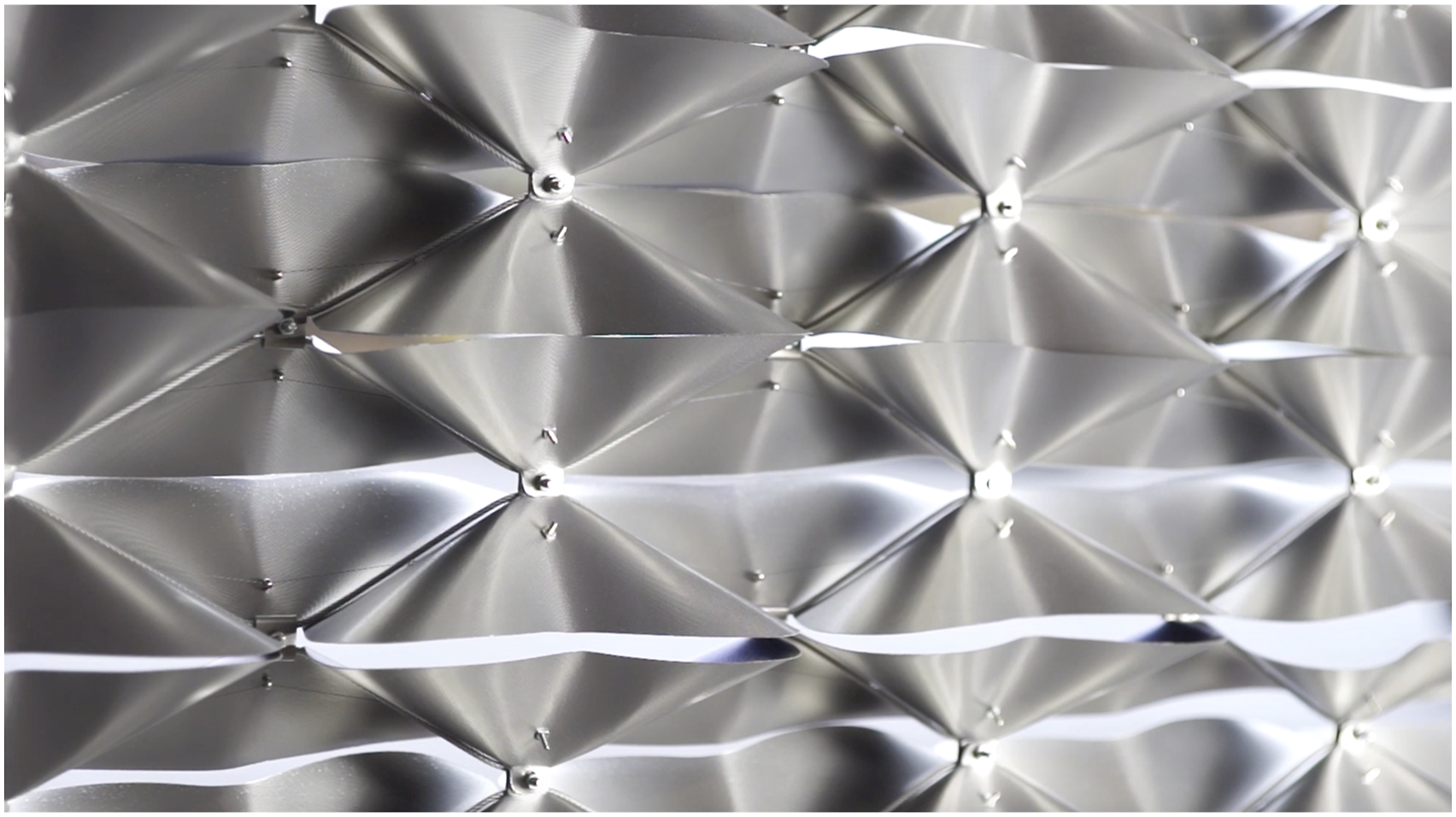

The textile geometry was determined and optimized in a continuous exchange between physical development and conceptual processing. Based on geometric simulation of the optimal relaxed and deformed shape of the textile, cutting patterns for manufacturing the textile bands are being generated. Adaptex Wave has a variable opening factor of 5–70%. 6
It is fabricated from durable, high-performance materials suitable and tested for facade applications. The textile bands are composed from laminated, flexible, glass-fibre-reinforced fabric. Tensile tests showed that the deformation of the textile laminate in warp and weft direction stayed constant.
Because each band is attached to a cable net in an undulating configuration, it consists of sections with a curved geometry (wings) that can be examined individually, see Figure 3. The change in shape of the textile bands and thus the percentage of shading generated has been simulated using the software Rhino3d. 6
Experiment
The force and displacement of the SMA during the opening and the closing of the system can be recorded by using a newton meter and distance measure. Figure 4 shows an experimental test setup. Experimental test setup.
The textile band used in the Adaptex Wave facade system (shown in Figure 4) is made up of two layers of fibreglass weaves with PTFE coating giving the band isotropic material characteristics. The thickness of the textile band is 0.28 mm. The material of SMA is NITINOL, which is composed of 55%–56% Nickel and 44%–45% Titanium.
As the temperature rises, the force in the shape memory alloy increases simultaneously, and the textile band is deformed due to compression, i.e., the facade gradually closes. Two important parameters can be obtained through this experiment, namely the required force in the shape memory alloy of the entire band (Fs) and the corresponding shading percentage, which can be used to compare with the 1D and 2D model. It should be noted that the force acting on a single wing – as used later in the models – can be obtained by dividing the force corresponding to the entire strip with the number of units per strip. Figure 5 shows the mechanical behaviour of the system, where percentage of shading and force in the SMA are provided against changing temperature and contraction of the SMA. Effect of temperature changes on SMA contraction, shading percentage and force acting on the band during activation.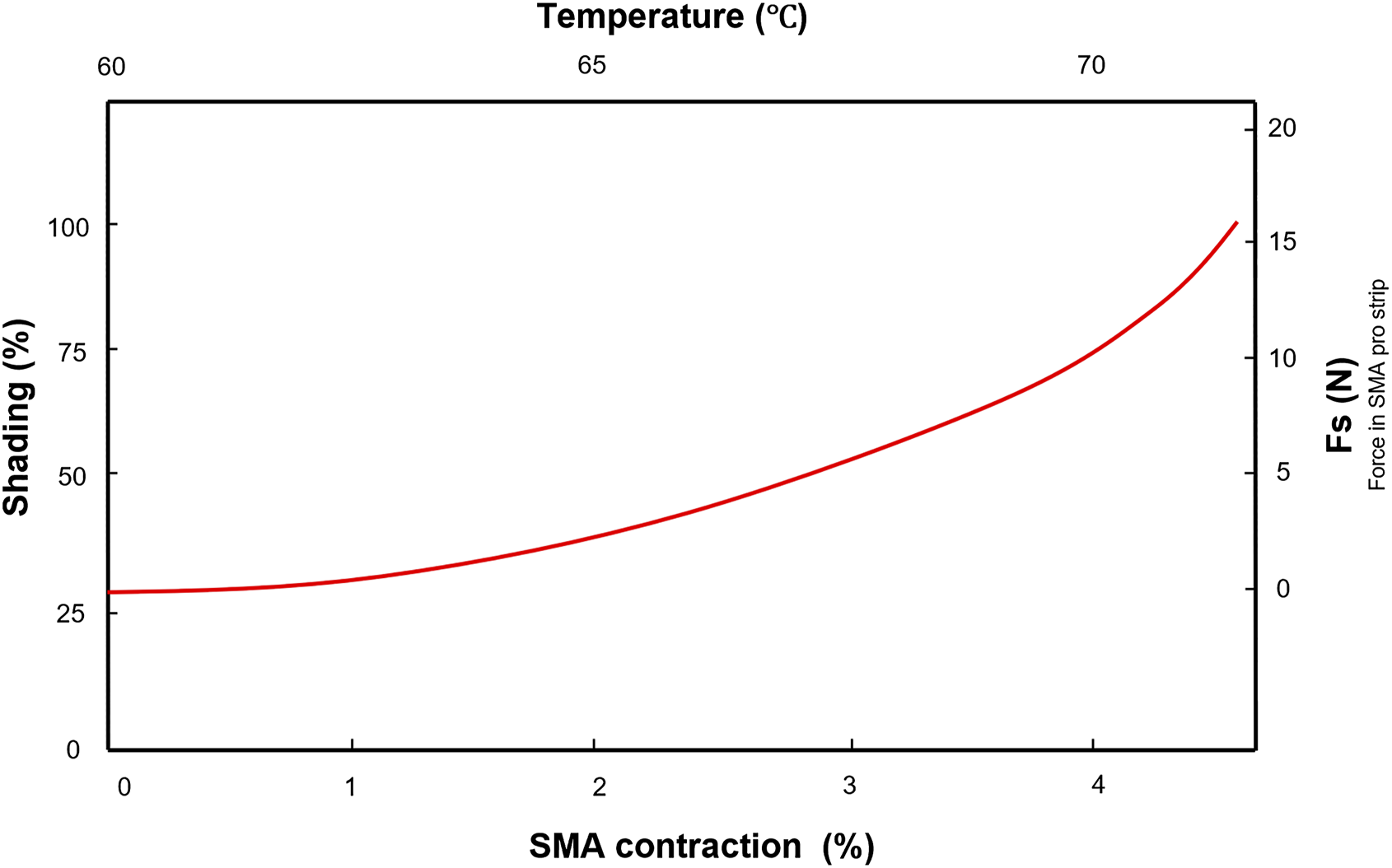
Mechanical modelling
1D rigid link model
The upper and lower wings in a unit of the Adaptex Wave facade system are independently fixed to the external substructure (see Figure 2). The 1D model was developed as a triangular structure based on a wing, considering the number of units per strip, fixation, connection and loading of the textile bands. A wing of the textile band can be simplified as a rigid link model, see Figure 6. The system consists of four hinged struts of length l
s
, three linear rotation springs and one linear extensional spring. The bending stiffness of textile bands can be represented by three rotational springs of stiffness, c1 c2 and c3.7,8 The stiffness of the extensional springs is used to simulate the tensile stiffness of the textile bands and is denoted with k.7,8 The system is simply supported, see Figure 6. The connection point of SMA and the textile band is located at vertex of the arc, at where the external force P act. And the force P is temperature-sensitive and generated by the contraction of the SMA wire. Considering the symmetric deformations of this model, the model has only two degrees of freedom, thus the spatial configurations of this system can be described by two generalized coordinates q1 and q2, which are the angles between the horizontal line and the respective rigid links. Sketch of discrete one-dimensional model subjected to a point load P.
To model the structural response, the total potential energy principle is employed.
9
The total potential energy V(q
i
, P) with respect to this discrete model is given by the sum of the deformation energies from rotational springs, U
c
(q
i
), and the extensional springs, U
k
(q
i
), minus the work done by the load


The energy stored in the extensional spring is given by

The changes in the angles at the respective joints Δθ, the deformation of the extensional spring Δx and the distance the load moves


Dimensions and material parameters of one-dimensional model.
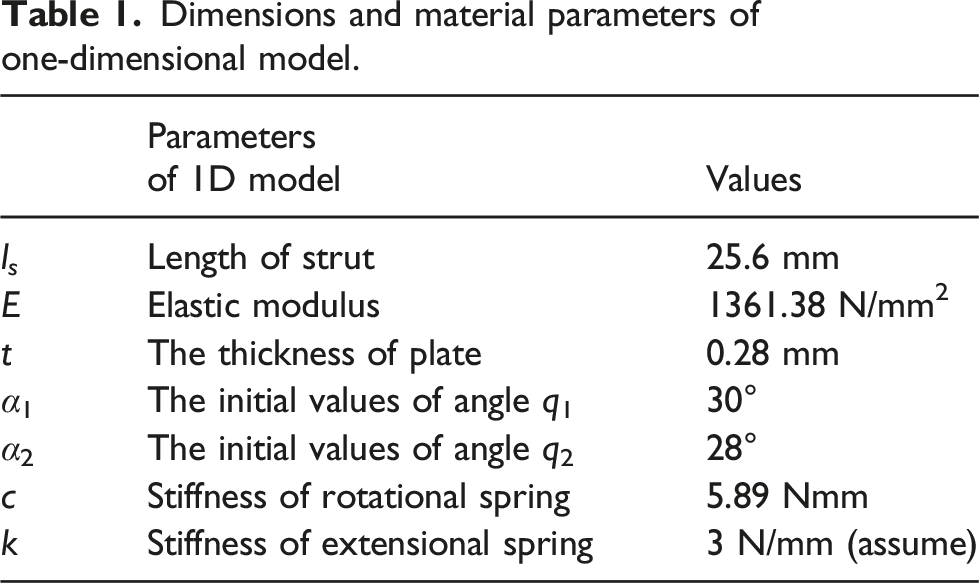
The equilibrium path in terms of load (P) against generalized coordinate (q1, q2) is shown in the Figures 7 and 8. The initial value of angle q1 is 30°. It gradually expanded with the increase of force and then reaches its maximum value while the force also arrives at its maximum. With decreasing load P the angle starts to decrease. The behaviour of angle q2 is different to angle q1. It keeps decreasing continuously and varies from positive to negative values. The corresponding deformation of the model is visualized in the Figure 9. Load P vs. generalized coordinate q1. Load P vs. generalized coordinate q2. Visualization of the deformation (1D model).


The maximum force (0.703 N) represents a limit point from where the system would lose the stability, see Figures 7 and 8. However, the SMA wire introduces loading that represents rigid loading (displacement-control). It is feasible to continuously increase the displacement of the model up to full closure of the membrane, without instability problems.
Continuous two-dimensional (2D) model
In this study, a continuous analytical model is developed for one wing. The initial shape of the 2D analytical model is shown in Figure 10. The plate has one fixed support edge at y = 0, and the other three edges are free. There is an initial imperfection w0 in the z-direction, providing the initial shape of the textile band. A point load P is applied at a known point (xP, yP) on the plate. The external force P applied in the 2D model is the combined force due to the contraction of the SMA, which is generated by temperature changes. The relationship between the force and temperature was obtained experimentally (see Figure 5). Sketch of 2D model with one fixed edge subjected to point load P.
The Rayleigh-Ritz method has been applied to solve the given problem.
11
The first step of the method is to find a suitable approximative function, which satisfies the geometric boundary conditions.12,13 Initial geometric imperfections of the rectangular plate associated with zero initial stress are denoted by normal displacement w0; in-plane initial imperfections are neglected. Therefore, the approximative function is expressed by:
The geometric boundary conditions of this model at the fixed support edge are no displacements at edge y = 0. Moreover, no rotation is allowed at the same position. The geometric boundary conditions can be expressed by the following four equations:
According to these conditions, approximative functions can be selected. The displacement w(x, y) can thus be approximated as

With the chosen approximative function, the two-dimensional model successfully simulates the initial morphology of the textile band, including the arched shape and the slope in the y-direction, as shown in Figure 11. Visualization of model in initial state in the three-dimensional coordinate.
As mentioned in the section on experiments, the thickness of the textile band is 0.28 mm, which is small compared to the planar dimensions. Kirchhoff plate theory for thin plates is applied.14,15 The curvatures of the middle surface of the plate are given by
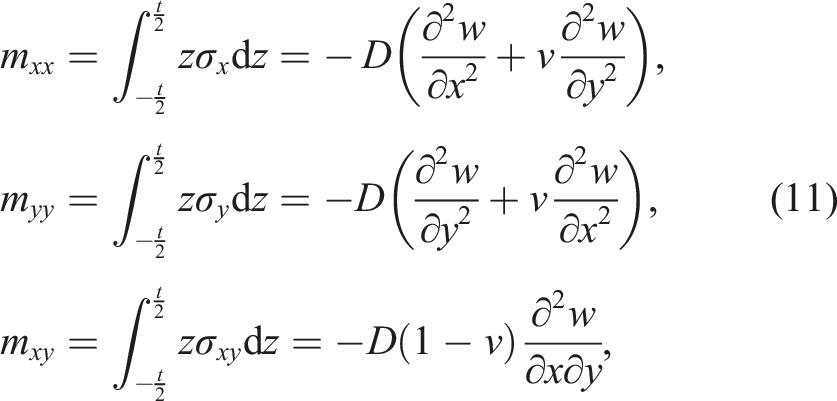
Using the generalized Hooke’s stress-strain law for isotropic elastic plates under plane stress, the bending moments can be obtained
16
This plate is under the action of pure bending, thus the strain energy of the plate is equal to the bending strain energy (Wb), and it is calculated by
18


The total potential energy V is defined as the difference between the strain energy stored in the plate and the work done by the applied load,
19
thus
Dimensions and material parameters of two-dimensional model.

Comparison of two-dimensional model and experimental results
In order to compare the 2D model with experimental results, parameters for comparison need to be determined. Two parameters are selected, namely the shading percentage S and the force in SMA per wing Fw (unit of the strip).
The shading percentage is shading area divided by the area of the initial opening. The unshading area of 2D model can be obtained by integrating the function of the outside edge of the 2D model along the entire length. The shading area is the initial opening minus the unshading area.
For comparison, the forces in the experiment need to be adjusted in two aspects. Firstly, the force in SMA of the whole strip (Fs), which is measured by experiment, should be transformed into the force in SMA per wing (Fw), as shown in Figure 12.
where n is denoted as the number of wings of a strip. Secondly, the force measured in the experiments (Fw) is in the direction of the SMA, while the force acting on the 2D model (P) is a point force parallel to the z-direction. With the geometric relationship shown in Figure 13, the force in SMA per wing in 2D model can be obtained by Projection of the shape memory alloy in the xz plane. Geometric relationship between Fw and P.


The comparison between experimental results and the numerical result of the 2D model is summarized in Figure 14. The following conclusions can be gained: (1) According to the results of the analytical model, the initial shading percentage is 30% in the case of no external force, which is the same for the experiment, see Figures 3 and 11. Hence, the initial geometry of the textile band is well represented by the function (see equation (9)). (2) Shading percentages can range from 30% to 70% depending on the architectural design. The required force to reach 70% shading effect is 1.0 N based on the results of the 2D model, which corresponds well with experimental results, see Figure 14. (3) For shading percentages smaller than 85%, the results of the analytical model and the experiment are in very good agreement. The discrepancy gradually grows in the range of 85%–95% indicating an applicable range of the presented model of up to 85% shading. The increasing deviations for large percentages of shading are deemed to be associated with considering linearized curvatures, thus small deformations. (4) The relationship between force and deformation is also relatively similar and can be approximated as a linear relationship (pure Bending). Comparison of experiments and 2D model in terms of force in SMA per wing Fw vs. shading percentage S.

In general, the 2D model simulates the mechanical behaviour of a real facade effectively, as shown in Figure 15. The model can be used for subsequent parametric studies. Deformation under different magnitudes of forces.
It can be found that in the range of shading percentage from 85% to 95%, the results of 2D model deviates from the experimental data. There are further reasons for that. On one hand, the directions of force in the analytical model are always parallel to the z-direction, while in practice is perpendicular to the surface of textile band. The direction of the force will change with the deformation of the textile band. When the deformation is large, the horizontal component of external force is bigger, which can also help the facade to close. On the other hand, the free edge of the model is a straight edge, which does not entirely correspond to the real curved edge (see Figure 2), that effects the shading area particularly at large deformation.
Parameter Study of two-dimensional model
The 2D model simulates well the initial shape of the textile band and is also able to describe deformation under the action of forces applied by the SMA wire. This model can be used for parametric studies. Three important parameters are investigated: the point of application, the flexural rigidity of the plate and the geometry.
Different positions of application
The point of application is located at the connection point of SMA and the textile band for this plate model. The position of this point does not change in the length direction, which ensures symmetrical deformation of the textile band in the length direction. But it is possible to change the position in the width direction, that is, in y-direction. The changes in distance (a) between point of application and fixed edge affect the displacements in z-direction and point of application, which is applied to calculate the work done by external forces W
P
. The relationship between Force Fw and shading percentage S in case of different distances, a = 10 mm, 15 mm and 20 mm, are calculated independently with the python program. And the results are shown in Figure 16. The following insight can be obtained by comparing the results of such three distances. It is possible to close the facade with less force if the point of application is far from the fixed edge. Therefore, a large distance is beneficial for the deformation of this model. This distance can be increased appropriately in the design for achieving the purpose of reducing the force. Force in SMA per wing Fw vs. shading percentage S, in case of different point of application.
Different flexural rigidities of the plate
The flexural rigidity of the plate can be calculated by the formula D = Et3/12(1 − ν2). When different materials are used, the Young’s modulus E and the poisson’s ratio ν of the plate changes accordingly. The flexural rigidity of the plate is also affected by the change of plate’s thickness, even if the same material is used. As mentioned above, the materials of the textile band is made up of two layers of fibreglass weaves together. Therefore, the different flexural rigidity of the plates was analysed, where – owing to the linear dependency – larger flexural rigidity cause larger loads to close the membrane. The mechanical behaviour of the model is thus also very sensitive to the changes of thickness of the plate.
Different geometry of plate
This arch-shaped textile band has three geometric parameters, that is, the length, the width and the height. The model is tilted down in the y-direction at the initial state. If the width increases, it will lead to a reduction in the area of the initial opening, which is advantageous for the closure of the facade. But, considering the serviceability of the facade, sufficient light transmission should be ensured in the initial state. So it is not advisable to increase the width. On the other, the change of the length will not influence the initial shading percentage. By increasing the length of each cell, the number of cells can be significantly reduced, which reduces the amount of material used to fix and connect them. In this parameter study of geometry, three different length of textile are investigated (l = 180 mm, 240 mm, 360 mm). The length change of the textile bands has an effect on the parameter l in the ansazt function 8. In the case of new lengths, the corresponding ansazt function will be used for the energy method. As shown in Figure 17, increasing length makes it more difficult to close the facade. Another noticeable point is that, when the percentage of shading is less than 60%, which means that the deformation of the textile band is small, the change in length has little effect on the force, see Figure 17. If the final design goal for the percentage of shading is 60%–70%, changing the length can effectively reduce the number of cells. However, if 100% shading is expected, only changing the length is not sufficient. The other geometric parameters, such as the geometry of the outer edges and the height of arch, would need to be adjusted accordingly. Force in SMA per wing Fw vs. shading percentage S, in case of different textile band’s length.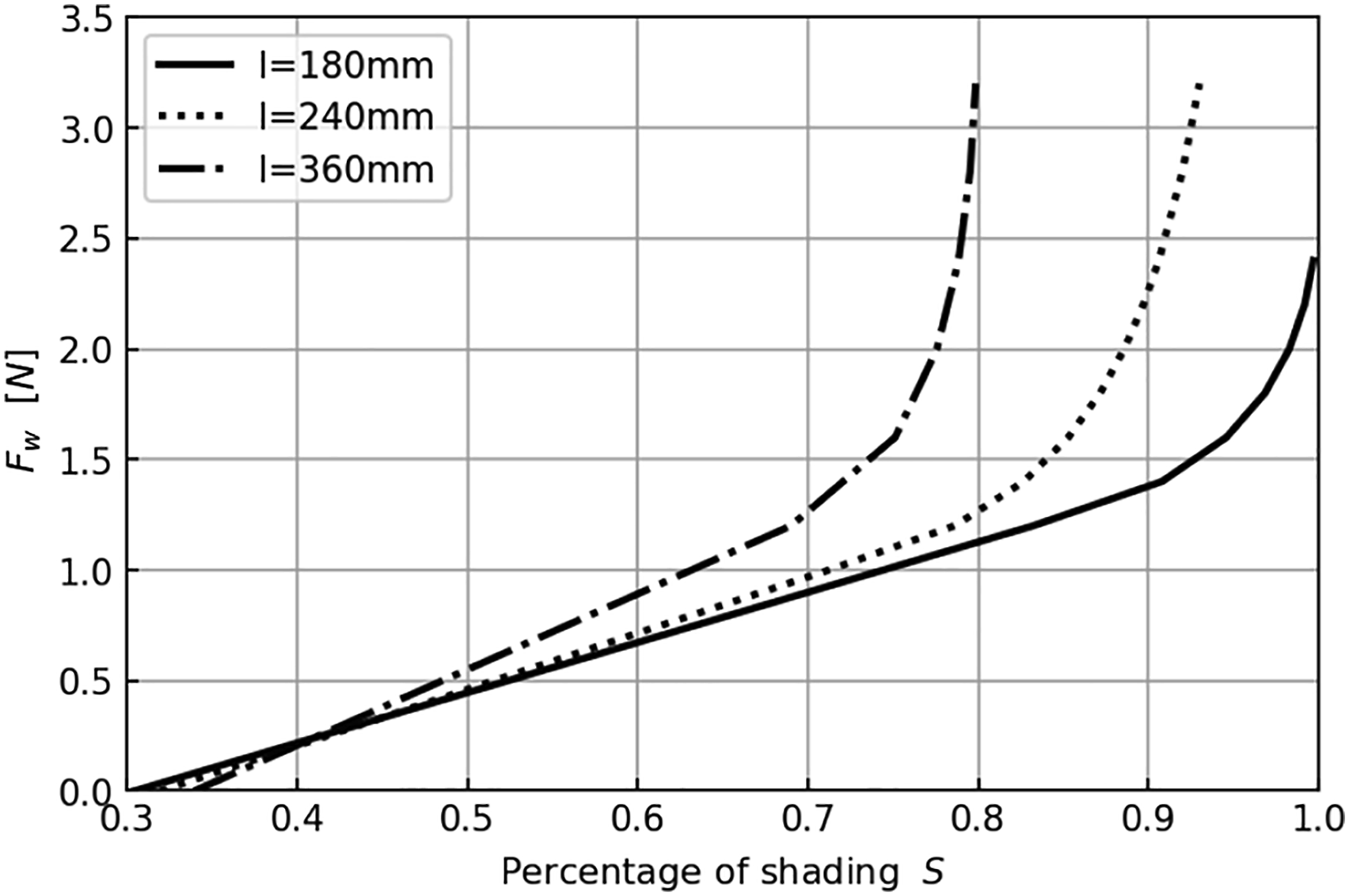
Discussion
The one-dimensional model significantly simplifies the complex problem. The working mechanism of the textile band is effectively simulated with rigid links and springs. On the other hand, experimental findings do not show the limit point behaviour as presented by the rigid link model. Thus, the 1D model should only be considered until the maximum load is reached, and it can be used for investigating parameters, which influence the general mechanical behaviour.
It has been shown that the two-dimensional model is capable to simulate the relationship between force and displacement of the Adaptex wave well, with results being validated by comparison against experimental results. The model can calculate the percentage of shading, which is not possible with the 1D model. Another advantage is that more parameters can be studied, which is very helpful to understand the characteristics of the facade and for future design practice. Comprehensive parametric studies can be performed with the aid of the model.
There are still some aspects that can be improved: (1) A more accurate simulation of the geometry of the textile band is necessary, especially the shape of the outer edges, which are concave curves towards the inside to improve predictions of large deformation. That would introduce further generalized coordinates to the model. (2) Only the effect of bending deformation based on linearized curvatures is considered in 2D model. Large deformations of the textile band are present when the system exhibits large percentages of shading, which is not considered currently. The transverse deformation may cause significant membrane forces in situations of large deformation.
21
Geometric nonlinear plate behaviour would then need to be considered.
22
Conclusions
Textile composites with SMA offer a high degree of freedom for designing the next generation of facade systems, in particular by textile construction methods and finishing processes, such as laminating or coating, that can be controlled by material compositions. The geometrical parameters also offer a high degree of flexibility in the design process. In order to predict the mechanical behaviour of the system in case of a change in scale or material, a mechanical model has been created that allows to adapt the system to changing locations and architectural contexts.
In the current work, two models were successfully developed to simulate the deformation behaviour of the facade system Adaptex. A discrete 1D model provides similar deformation characteristics up to the maximum load in comparison with the actual facade system. However, the 1D model cannot capture the behaviour of the system in enough detail to obtain insight for design practice.
In order to compensate for the deficiencies of the 1D model, the second model directly uses a continuous 2D description. Results of the 2D model compare well with experimental findings, such that (1) The percentage of shading is in excellent agreement up to 85% of total shading. And the applicable range of the 2D model is from 30% to 85% shading. (2) Deformation path and applied loading are in good agreement.
With the aid of the model, comprehensive parameters can be performed investigating the effect of geometry and material parameters. The following conclusions were drawn form the parameter studies: (1) There is less force required, when the distance between the point of load application and the fixed edge is longer. (2) In case the thickness of the textile film becomes larger, that is, the bending stiffness of the textile band increases, the magnitude of the external force also becomes larger. (3) The greater the length of the textile band, the greater the force required to close the membrane.
For future work, the mechanical behaviours of the whole facade should be considered. The connections and interactions between each wing are not taken into account. If a whole strip of the textile band would be simulated, the geometry should be further adjusted.
In summary, with the mechanical modelling, a step forward to optimizing the working mechanism of the facade system Adaptex is provided. Thus, the behaviour of the physical model can be better analysed and evaluated and, at the same time, trial-and-error loops can be avoided in the development of components and manufacturing processes. With this approach architects and engineers are enabled to focus on the transformative capacity and inherent dynamics of matter. This also contrasts the engineering concepts of “deformation” with that of “formation.”
Footnotes
Acknowledgements
Some of the findings within this paper were previously presented at the 1st WÆFestival 2021. In the spirit of the festival, collaborative research originated from the gathering and thus results are presented herein. Adaptex was developed as a research project between 2017 and 2021. It was funded by BMBF – the Federal Ministry of Education and Research, Germany, within the Framework of Zwanzig20 – Partnerschaft fur Innovation Research Consortium smart3 –materials – solutions – growth. The research project was a collaboration between partners from industry, science and design: weißensee school of art and design, Priedemann Facade-Lab, Fraunhofer IWU, Carl Stahl ARC, Verseidag-INDUTEX, ITP GmbH, SGS Ingenieurdienstleistungen im Bauwesen. We acknowledge support by the German Research Foundation and the Open Access Publication Fund of TU Berlin.
Declaration of conflicting interests
The author(s) declared no potential conflicts of interest with respect to the research, authorship, and/or publication of this article.
Funding
The author(s) received no financial support for the research, authorship, and/or publication of this article.
