



Abstract
This article introduces the special issue on ‘Geographies of Value and Valuation’ and has a threefold objective. Apart from introducing the contributions to the special issue, it reviews important modes of thinking with regard to the spatial politics of value and valuation, and identifies some ways forward for geographers’ engagement with questions of value, valuation and value experience. It discusses Marxist thought on value primarily by considering recent texts by David Harvey, and reflects on the multiple ways in which value is performed through the philosophies of Brian Massumi and John Dewey, diverse economy scholarship, and the burgeoning research in sociology and science and technology studies on valuation. It also encourages geographers to consider valuation as more than the preserve of humans, to heed value as non-cognitive experience, and to experiment with value, valuation and value experience to affirm, enact and institutionalize more-than-capitalist worlds at a time of poly-crisis. Engaged pluralism and cross-fertilization across theoretical traditions will help geographers in realizing the potential contributions their engagement with value and valuation can make over and above the considerable achievements so far.
Boundary objects
Value remains a fraught topic in contemporary geography. It is no exaggeration to state that debates about value have been dominated by Marxist thought, with David Harvey as one thinker who has made particularly pertinent contributions (Harvey, 1982, 2018; Henderson, 2004). He is by no means the only one, as work on capitalist natures (Andueza, 2021; Kay and Kenney-Lazar, 2017; Robertson and Wainwright, 2013), resource extraction (Arboleda, 2020; Sica, 2018), land and housing (Markley, 2024; Yrigoy, 2023) and financialization (Christophers, 2016; Lock, 2024; Purcell et al., 2020), among others, has suggested. Henderson’s (2013) Value in Marx offers a highly original take on the multiple understandings of value across Marx’s writing. More generally, the Marxist literature on value has revealed many pertinent insights in how value, valuation and devaluation have configured, reconfigured and transformed human, environmental and physical geographies. Nonetheless, calls for a rethinking of value within the Marxist tradition have emerged (As Barua, 2016; Kay and Kenney-Lazar, 2017; Lee, 2006: 306) write, we see the need for an expanded conception of value, which recognizes the heterogeneity of the planet’s living beings and the entanglements between them but is also capable of distinguishing between different types of values and how they are created, exchanged, and consumed, including capitalist and economic values as well as moral, ethical, spiritual, cultural, and personal values.
The pluralization of conceptions of value, values and valuation is well underway, in particular outside Marxist thought in our discipline. Within global production networks literature, for instance, there has been increasing discussion of value (Bryson and Vanchan, 2020; Foster, 2024; Kalvelage et al., 2023). However, most of the impetus comes from developments in cognate disciplines such as sociology and science and technology studies (STS), against the background of long-standing interest among anthropologists (Appadurai, 1986; Graeber, 2001; Kopytoff, 1986). The late Clive Barnett (2014) was one of the first geographers to engage with the rise of a new value pragmatism building off the post-Bourdieusian ‘sociology of conventions’ proposed by Boltanski and Thévenot (2006 [1991]). He hoped that a programme of ‘plural geographies of worth’ focused on ‘the ordinary ways in which the ongoing give and take of imperatives to justify, practices of evaluation, and expectations of accountability (would) open up spaces for acting a little bit differently, here and there’ (Barnett, 2014: 157). This programme can benefit from the multiple social science approaches to valuation as a social practice, on which the pragmatist philosopher John Dewey has had profound influence (Heinich, 2020a, 2020b; Muniesa, 2012).
The implication is that, now more than before, value and valuation are boundary objects within geography. Star and Griesemer (1989) introduced the notion of boundary object to denote scientific objects that both inhabit different social worlds where agents in particular contexts place different demands and constraints on them, and are also sufficiently robust to maintain a shared identity across those contexts. Focusing on geography with its different theoretical traditions, research fields and sub-disciplines, I suggest that thinking of value and valuation as boundary objects is helpful. On one level, this thinking articulates the power of pluralism. Human, environmental and physical geographers in their multiple divisions and constellations engage with a huge diversity of topics and themes in which questions of value and valuation inevitably surface. These range from longer-standing concerns such as labour exploitation, the undervaluing of care-giving, resource extraction, urban development and protection of habitats and more-than-human worlds to more recent debates about how to respond to the biodiversity and climate crises, the merits of degrowth approaches, the rise of platform capitalism and so forth. In all instances, a politics of valuation plays out that revolves around the creation, identification and/or assignment of value; practices and procedures for making radically different uses, functions and outcomes commensurable with each other; and the identification of values as qualities worth aspiring to and/or as principles that inform decision-making. This politics is not only emplaced but also constitutive of the numerous spatiotemporal processes studied by geographers. It is unreasonable to expect that a single conceptualization, or family of conceptualizations, of value and valuation would be sufficient or even adequate across all those concerns (cf. Appadurai, 1986).
On another level, the idea of value and valuation as boundary objects also draws attention to the risk of geographers thinking and writing about value and valuation resorting to what Bernstein (1988) called fragmenting pluralism – that is, a situation in which geographers of a certain hue are only able to communicate within narrow, homogeneous communities of practice with members sharing similar habits of thought, research practices and dispositions. Bernstein, and geographers drawing on his ideas (Barnes and Sheppard, 2010; Kwan and Schwanen, 2016), have highlighted the importance of engaged pluralism – a configuration in which geographers with different orientations and dispositions engage in conversations and contact zones that are as open as possible and where participants actively try to avoid marginalizing or excluding certain views and approaches.
The special issue of Environment and Planning F introduced by this article has a dual aim. It seeks, first, to offer a conduit for the diversification of engagement with value and valuation within geography. This is why it includes seven empirically grounded papers plus a commentary that offer a range of different theoretical engagements with value and valuation in human geography. The focus on human geography is not by design as it was hoped that the original call for papers would also reach and appeal to physical geographers. The special issue also, and second, seeks to raise the profile of pluralist engagement with questions of value and valuation within geography as discipline.
The objective of this introductory article is threefold. Besides introducing the special issue contributions, it reviews important modes of thinking about value and valuation in geography and cognate disciplines. Given the immensity of the topic it is inevitably selective, particularly as far as the Marxist tradition is concerned. Here the focus is primarily on recent work by Harvey before attention shifts to understandings of value as performance. With regard to the latter, the discussion covers both developments in sociology and STS and work by philosopher Massumi, diverse economy scholars, and Dewey. Thinking on valuation as a more-than-human process is also considered, primarily through Whitehead, because this offers potential – yet to be realized – to draw additional fields and sub-disciplines into geographical inquiry into value and valuation. This is linked to the article’s third objective of offering suggestions about how thinking on value and valuation can be developed further within geography.
Value between social relation and performance
Within the political economy tradition theorizing value is not the preserve of Marxist thought (see Otchere-Darko, 2024; Sheppard and Barnes, 1990). However, given the specific history of Anglophone human geography, Marxism has come to dominate political economy perspectives on value in our discipline, and with many fortuitous outcomes. Rather than attempting a comprehensive review, I consider some of the recent writings on value by David Harvey. He has probably theorized value and its geographical aspects and implications longer and more often than any other geographer, and with profound influence on the thinking of other Marxist geographers. His work also foregrounds the mobility of value, which makes him more of a mobilities scholar than hitherto recognized. Harvey, of course, follows Marx in recognizing that value, in the words of Christophers (2016), ‘is not something with a tangible, uncontestable reality, like price’ but ‘refers to something one cannot lay eyes on’ (p. 332). Thus, in Marx, Capital and The Madness of Economic Reason Harvey (2018) writes that value is, a constantly changing and unstable metric being pushed hither and thither by the anarchy of market exchange, by revolutionary transformations in technologies and organisational forms, by unfolding practices of social reproduction, and transformations in the wants, needs and desires of whole populations expressed through the cultures of everyday life. (p. 220)
Starting from Marx’s understanding of value as socially necessary social labour, he considers value a social relation that is both immaterial and mobile. Value ‘craves a material expression’ (p. 50) as money and creates all kinds of objective effects when it flows, and when it gets arrested or locked down. Unlike the Marxist orthodoxy of prioritizing the sphere of production, Harvey (2018, 2019, 2020) highlights how value dialectically ties together ‘valorization’, ‘realization’ and ‘distribution’ in spatiotemporally dynamic and unstable constellations that generate, reconfigure and destruct (human) nature, space and place. Valorization refers here not only to the production of commodities and surplus value but, in recognition of feminist scholarship in geography and beyond, the social reproduction of labour. Realization concerns the articulation of value in and through consumption, mediated by money and aided by advertising and numerous other mechanisms that incite, cultivate and shift needs, desires and preferences. Distribution, finally, refers to the ways in which value as money is apportioned to stakeholders as wage, tax, rent, interest, or profit.
Like other Marxist geographers and building on his earlier writings on cities and spatial fixes, Harvey (2018, 2019, 2020) foregrounds the importance of land, the built environment and rent to the mobility and ‘spiralling’ of value. It is in this context that he has begun to elaborate his concept of anti-value, which he has dubbed the Marxist equivalent to physics’ anti-matter. If surplus-value is a forceful process of generating excess value in and for the future (cf. Massumi, 2018), then anti-value is in some sense its opposite. It puts the ‘more-than’ of surplus-value at risk by slowing down circulation or spurring downwards cycles into being. Anti-value is at work when value is halted and rendered unavailable for realization in, for instance, stocked commodities, real estate or physical infrastructure. The risk is that relative deceleration reduces future (real) prices. Such loss becomes more likely with increasing financial debt, which after all is a claim weighing down on future value creation and realization. It becomes a near certainty when debts become unserviceable. All of this makes devaluation an important topic for geographical scholarship (see Knuth et al., 2019).
Qua concept anti-value concept has significant potential, which largely remains to be explored and examined critically by geographers. It has enabled Harvey (2018, 2019, 2020) to think through process of systemic debt accumulation and devaluation, as happened during the sub-prime mortgage crisis and COVID-19 pandemic. Markley (2024) has recently extended and refined this line of thinking by examining how the racist theory of value practised by US real estate professionals for most of the 20th-century channelled devaluation into Black residential spaces. The result has not only been a consolidation of Black residential segregation but, owing to value’s relational character, the creation of (surplus) value (and its subsequent extraction) in other residential and real estate places. Markley’s work offers a powerful example of how the value/anti-value dialectic can be mobilized in (spatiotemporal) boundary-making practices.
Harvey (2018) also uses anti-value as stepping stone to sketch the contours – no more than that – of a politics of anti-value. He helpfully argues that the revisionism of adapting the ‘value calculus’ to account for the ‘true’ value of nature, care labour, or the fruits of the arts and sciences will only prolong capitalist value creation (pp. 90–91). Harvey (2018) also suggests that ‘the heterotopic spaces within the interstices of the capitalist system but outside of the rule of the law of value’ (p. 89) should be protected from capture by that rule. Those spaces, he explains, are constituted by post/degrowth, anarchist or indigenous communities and spacetimes of non-alienated labour. Harvey’s nod to Foucault’s (1986 [1967]) heterotopia is amplified by his use of ‘interstice’ – an open, unoccupied space-time from where, for Whitehead (1977 [1929]: 105), difference and novelty proceed and, for Harvey, powerful critiques of capitalism’s version of value can be mounted. 1 Harvey’s invocation of a fairly complex topology to avoid a straightforward inside/outside distinction is noteworthy because it leaves room for a post- or non-capitalist otherness. Nonetheless, he offers few concrete suggestions about what else that otherness can do to nourish and disperse post-capitalist logics of value. Turning to other thinkers, most notably Massumi (2018) and Gibson-Graham (1996, 2008; Gibson-Graham and Dombroski, 2020), is helpful in this context.
In 99 Theses on the Revaluation of Value, Massumi (2018) introduces a sophisticated Deleuzian-Whiteheadian approach to protecting and expanding non- and more-than-capitalist worlds. Two aspects of his work are of particular interest here in connection to Harvey’s thinking on value. First, and more so than Harvey, he recognizes the performativity of scholarly thought and works to reframe value ontologically, thereby ‘thinking creatively in order to generate actual possibilities where none formerly existed’ (Gibson-Graham, 2008: 625). Building on his earlier work on affect and Whiteheadian philosophy, Massumi develops non-capitalist conceptions of value and surplus-value that transcend the subjective/objective binary. Massumi’s concern is to (re)insert aesthetic categories such as zest, adventure, wonder and beauty into the definition of value and to offer non-normative modes of e-valuating events. As Cresswell (2021) also suggests, Massumi’s reworking of value and valuation practices can displace and refract capitalist habits. The difference it makes is potentially largest to spatial practices, experiences and arrangements that remain undervalued under contemporary capitalisms, such as play and care. However, objects – say, segregated cycling lanes – that policymakers and consultants conventionally appraise using institutionalized techniques could also be valued differently if aesthetic categories were used. This would take discussions of the value of segregated cycling infrastructure beyond potential savings in disability adjusted life years, public health costs saved, or numbers of cyclists – however, important and helpful such quantified measures can be. It would open-up opportunities to consider, for instance, playfulness in cycling, the relatively safe opportunities for developing additional cycling skills (e.g. cycling with one hand, or turning one’s head when cycling) in young/recent cyclists, and the palpable experience of protection that segregated cycling infrastructures afford.
Second, there is a resonance between Massumi and Harvey’s spatial imaginaries for thinking non- and/or post-capitalist alternatives. Massumi (2018) writes that the ‘postcapitalist future will grow in the pores of the capitalist field of life, in much the same way as Marx said capitalist society grew in the pores of feudalism’ (p. 87). The ‘immediate task’, therefore, is to ‘create temporary autonomous zones’. An anarchist concept from the 1980s, temporary autonomous zones (TAZs) constitute open, networked and mobile places that are invisible to state apparatuses and the control the latter seek to exert (Bey, 1985). TAZs are beyond naming and representation and thrive in interstices; they are open, replete with ‘hyper-differentiation’ and ‘overflowing with alter-organization’ (Massumi, 2018: 87). Massumi’s spati(otempor)al imaginary for places where new value concepts and valuation practices can proliferate, is intriguing but also retains a whiff of capitalocentrism (Gibson-Graham, 1996). It ultimately suggests that post-capitalism and its alternative modes of valuation exist ‘in a subordinate, complementary, oppositional, or outsider relationship to capitalism’ (Gibson-Graham and Dombroski, 2020: 8) and makes those modes more fleeting, fickle and fragile than they may be. Indeed, a diverse economies approach to value and valuation would probably reveal much more variety, stability and permanence to non- and more-than-capitalist understandings of value and valuation practices across many more sites and places in the present than the TAZ metaphor can accommodate. Diverse economy scholars have written about value and valuation. Diprose (2020), for instance, has called for more scholarly attention to markets as more-than-capitalist value regimes where formal and informal rules give some level of assurance that (monetary) values in the present will persist into the future. This thinking to some extent draws on research on valuation in sociology and STS, which has been taken up in geography for almost 20 years (Lee, 2006). It has, however, become more popular recently, as the papers in this special issue attest.
Valuation rather than value
Since the 1980s, a fertile research tradition focused on value and valuation has developed in sociology and STS, which has drawn on, or responded to, the thought on value and valuation by Bourdieu and Dewey (Hutter, 2021; Lamont, 2012). Within this, the neo-pragmatist approaches developed in France are closest to geography. These approaches come in at least two lineages. One is centred on Boltanski and Thévenot (2006 [1991]), whose On Justification inspired Barnett’s (2014) call for a plural geographies of worth research programme, and includes work by Nathalie Heinich, which has begun to impact geographical inquiry (Lake, 2024; this special issue). Her Des Valuers [Values] (Heinich, 2017) remains to be translated into English but (some of) its arguments have been published in various articles in Anglophone journals (Heinich, 2020a, 2020b). The other is grounded in actor-network theory and foregrounds the performativity of practices, as illustrated in work on economization (Çalişkan and Callon, 2010; Callon 2021 [2017]), finance (Muniesa, 2012) and food (Heuts and Mol, 2013).
Central to both neo-pragmatist approaches is the idea that value is not simply given but actively created, typically through experimentation with institutions and regulations. Value is thus explicitly considered in practical and processual terms, as emerging from valuation as Dewey (1922, 1939, 1943, 2004 [1916]) originally proposed. The specific ways in which valuation occurs and operates are, of course, understood differently by different authors. Heinich (2020a, 2020b) argues that understanding valuation requires paying due attention to valuing subjects with shared axiological representations and skills, the affordances of the valued objects, and the context in which valuation occurs. Heinich understands contexts predominantly in terms of the formal and informal rules that regulate and stabilize valuation processes, but this a-spatial perspective risks reducing space to a passive background against which valuation occurs. Lake (2024) begins to offer an explicitly spatialized version of Heinich’s subject/object/context approach to valuation, which recognizes the importance of Deweyan deliberative processes as well as space and place.
Despite its a-spatial character, Heinich’s (2020b) approach to valuation does combine and integrate three different understandings of value. These are value-as-worth, value-as-good and value-as-principle. Worth is about value that is bestowed, for instance through practices of measuring quantitatively, making qualitative judgements, or becoming attached to something. This bestowing of value results in certain objects – artefacts, persons, actions, spatial forms or processes, and so on – being transformed into valued goods. Moreover, the recurrence of acts of bestowing and transformation enables, (re)produces and reflects abstract principles that are valued positively, such as beauty, coherence, or zest. The analytical separation of value-as-worth, value-as-good and value-as-principle has some heuristic value. For one, it allows geographers and others to examine the intersections and co-evolution of the three analytical categories. It thus makes it possible to pinpoint the slippage between value and values that sometimes occurs in scholarship on value and valuation (see also Keith, 2024). It also offers a simple framework for reflecting on theorizations of value and valuation. It enables us to see, for instance, that Harvey’s conceptualization of value-as-worth is very advanced. Yet, when it comes to value-as-principle, his approach more limited and limiting, with acceleration of circulation – of which time-space compression is one manifestation – playing a critical role. In contrast, one of Massumi’s (2018) distinctive contributions lies in the explicit attempt to pluralize value-as-principle and to challenge the primacy of speed/acceleration, efficiency, value for money and the like in capitalist valuation practices.
Nonetheless, there are aspects where Heinich’s approach to valuation can be developed. One such aspect concerns in/commensurability and commensuration practices, which are related to, but also broader than, valuation practices. Commensuration is ‘the transformation of different qualities into a common metric’ (Espeland and Stevens, 1998: 314) and generates all kinds of consequences. For many thinkers of value, commensuration is central to value. Bigger and Robertson (2017) could not be clearer: ‘At its root, value is the quality of being measurable and comparable with other things’ (p. 68). Graeber (2013) is close to this view when he writes that ‘[t]hat which is thus rendered comparable can be considered under the rubric of “value” and this value, like that of money, lies in its equivalence’ (p. 224). He uses the plural – values – to denote ‘unique, crystallized forms’ which lack such equivalence. Marxist geographer Swyngedouw prefers to separate value and valuation from commensurability. In Kay and Kenney-Lazar (2017), he argues for recognition of the ‘radical incommensurability of different socio-ecological systems and configurations of valuation’ (p. 303). This decoupling of value and valuation from equivalence opens up a space for considering in geographical thought and research not simply the performativity of practices of commensuration but also the violence they (can) enact.
This, in turn, draws attention to a second lacuna in the discussion so far, which relates to the politics of valuation (see also Bigger and Robertson, 2017; Lake, 2024). Key questions in this regard relate to who or what decides what gets valued, when, where and how – that is, by what means and on whose terms. To some extent these are questions about the dominance and evolution of ‘regimes of value/valuation’ or ‘valuation constellations’. The first of these terms refer to the set of more or less durable rules for the creation, assessment and attribution of value (cf. Bigger and Robertson, 2017; Myers, 2001 [1991]). The second is a broader concept elaborated by Waibel et al. (2021). It refers to the relatively stable arrangements of rules of valuation; material infrastructures for valuation; and the power geometries that link valuation objects (e.g. geography departments), valuator(s) (e.g. QS, The Guardian) and audience(s) (e.g. prospective students, staff, donors). Valuation constellations have their own geographies and (re)configure geographies, but this evolving interplay remains to be centred in empirically oriented scholarship.
And yet, a focus on regimes or constellations of valuation can result in underappreciation of the uniqueness of particular valuation events or situations, and the conflicts and contestations that play out in them. Lake (2024) makes a closely related argument about the politics of valuation, based on Dewey’s work on valuation and through the example of land as object of valuation. Conflicts over land, Lake suggests, tend to result from the privileging of one mode of valuation over others due to the power of habit, inertia and market rationality whereas land’s affordances and modalities of value 2 are plural and their relative importance varies across particular cases. The addition of ‘across particular cases’ at the end of the preceding sentence is crucial and brings out the contingency of prevailing modes of valuation. In Deweyan fashion, Lake suggests that alternative – including post- or more-than-capitalist – modes of valuation can and should be identified, trialled, evaluated and selected for institutionalization through public debate and deliberation.
Introduction of Lake’s (2024) Deweyan take on valuation also opens-up the third lacuna in much scholarship on valuation, including Heinich’s approach – that is, reliance on the subject/object dualism. Both Lake (2024) and Muniesa (2012) emphasize that Dewey (1939) sought to overcome the subject/object dualism in his discussions of value and valuation, especially in Theory of Value. Nonetheless, both could have gone further in elaborating the specific place of valuation in Dewey’s broader philosophical project, and reflecting on the implications this might have for research on valuation in contemporary places and times.
Dewey (2004 [1916]) recognized that ‘to value’ encompassed both ‘to prize, to esteem’ (p. 228), ‘in the sense of holding precious, dear’ (Dewey, 1939: 5) and ‘to apprize, to estimate’ (Dewey, 2004 [1916]: 228) or ‘apprais[e] in the sense of putting a value upon, assigning value to [which] involves comparison’ (Dewey, 1939: 5). Where prizing is mostly emotional, apprizing or appraisal is mostly intellectual. 3 ‘To value in the latter sense is to valuate or evaluate’ (Dewey, 2004 [1916]: 229). Valuation is also a somewhat uncommon occurrence, which takes place when something is the matter and immediate or intrinsic values that can be mobilized unthinkingly through prizing no longer suffice. Valuation, then, is the activity of contributing an instrumental or contributory (rather than intrinsic) value when a problematic situation creates uncertainty and desires. The encountered problem forces inquiry, a process of deliberation in which alternative courses of action are appraised. This process ideally involves the application of an experimental, scientific method to collected data, although learnt standards, creativity and imagination are also important (Dewey, 1938, 1943, 2004 [1916]). Inquiry is unmistakenly pragmatic as it focuses on the practical consequences of alternative courses of action, so that a good enough choice or judgement results.
Dewey (1922: 349) is clear that valuation is not a matter of introspection by a (human) subject as in utilitarian philosophy, which has had such profound influence on conceptualizations of decision-making in behavioural geography and the behavioural sciences. Valuation and inquiry are strictly public and observable activities, irrespective of whether they involve a human being, another kind of organism, or a nation-state. The rejection of valuation as subjective is central to what Muniesa (2012) terms Dewey’s flank movement – that is, his attempt to avoid the bifurcation of the world and value into subjective or objective (see also Lake, 2024). Dewey rather sought to foreground valuation as performance and event.
Prompted by problematic situations, Deweyan valuation unfolds within ongoing praxis, and ultimately seeks to overcome uncertainty, shock and disturbance and to restore harmony with the environment. As Cutchin (2004) argues, this restorative function is more than adaptation of a subject to a pregiven and ontologically separate environment. Restoration is best considered a transactional process of mutual and reciprocal co-evolution, which is why Cutchin proposes to call it ‘place integration’. Restoration’s focus, however, is on (re-)establishing harmony, which thus constitutes Dewey’s primary value-as-principle.
Dewey remains vague about the character of harmony, no doubt because he considered this something to be worked out situationally. Yet how this value-as-principle is interpreted has consequences for how valuation unfolds. Within ontologies that posit worlds or systems characterized by a single or multiple equilibria harmony will revolve around return to a status quo or a progression from an old to a new stable state. If, however, assumptions of equilibrium are completely foregone, for instance because the climate crisis makes them increasingly untenable, then harmony and, by implication, valuation will become something altogether different. It may, for instance, be about maintaining the coherence of a particular arrangement within a wider set of interactions in ways that allow the arrangement’s constituent elements to be reconfigured, replaced or otherwise changed. In short, the character of valuation is conditioned by broader ontologies. If and how that character evolves when and where ‘actual or threatened shock and disturbance of a situation’ (Dewey, 1939: 54) is the default rather than an exception is a question geographers might consider in future work.
Valuation beyond practice, and value as experience
Let us return once more to Heinich’s approach to valuation. If its subject/object dualism is already challenged by Dewey’s conceptualization of valuation, then the approach is further complicated by Halewood’s (2010) claim that values as a priori principles did not exist for Alfred North Whitehead. And yet, value is central to his philosophy. This apparent paradox begins to dissolve once we realize that challenging and reworking the ‘bifurcation of the world into two systems of reality’ (Debaise, 2017 [2015]; Whitehead, 1920: 30) was Whitehead’s core philosophical concern. One of these systems is ‘nature as the cause of awareness’, imbued with primary qualities like mass, velocity, configuration, or movement and that are ultimately ‘senseless, valueless, purposeless’ (Whitehead, 1967 [1925]: 17, emphasis added). The other is ‘nature as apprehended in awareness’, which is furnished by the mind with secondary qualities like colour or scent as psychic additions. The first nature is the world of causes and of facts, the second that of reasons and values. Whitehead not only suggested that all kinds of dualism had been inscribed into this bifurcation, but also that science continued to privilege the first nature to the exclusion of the other. While he considered the bifurcation of nature already untenable in the early-20th century, it remains widely practised in many contemporary epistemic cultures (as everybody complicating that bifurcation who has tried to publish papers in ‘interdisciplinary’ scientific journals will sooner or later realize!).
Much can be written about Whitehead’s thought on value; Halewood (2010) offers an excellent overview. Suffice it to say that in a Whiteheadian framework valuation is radically decentred from human subjects, and about the creation of contrast and novelty in the evolving universe. 4 As philosopher, Whitehead was always clear that there were no separate realms of facts and values but most so in his final writings. In a lecture from 1941 he argued that the ‘two worlds’ of Activity, fact, finitude and mortality and of Value, infinitude and immortality ‘require each other, and together constitute the concrete Universe’ so that ‘any adequate description of one World includes characterizations derived from the other’ (Whitehead, 1974 [1948]: 87). His solution, within the metaphysical system he developed, was to assume that Values 5 as non-representational qualities or potentialities ingress into the (f)actual activity that constitutes the universe to generate contrast, change and creativity. In Process and Reality, Whitehead (1977 [1929]) uses the concepts of ‘actual entities’, or bits of activity, that congregate into more stable, observable ‘societies’ like a human being, a car, or a city. Each actual entity, Whithead suggests, is dipolar and has a physical and a mental or conceptual side. The balance of these poles differs across actual entities and societies, but even the most physical ones – rocks, for instance – have mental components that allow them to be (and remain) what they are and change according to patterns that mathematics can represent. As the mental pole increases in importance and capacity, actual entities and societies entertain greater potential for contrast, change and creativity, in part because new Values can ingress more easily. On balance, human beings have or develop the greatest capacity for such ingression and for co-evolution with the environments with which they are entangled. Some of this capacity resides in human consciousness but most in non-cognitive experience.
Valuation is a precise and technical term within Whitehead’s metaphysics (Whitehead, 1974 [1948], 1977 [1929]: 241). It refers to the manner in which values as non-representational qualities are organized for possible inclusion, modification and/or exclusion in actual entities and societies. It can therefore be understood as critical to the introduction of difference in what a society is and does. Difference is here both commensurable and incommensurable. Commensurable difference is about what can be measured quantitatively or qualitatively vis-à-vis an earlier baseline – as in t1 versus t0; incommensurable difference is otherness without equivalence that eludes and exceeds measurable degrees of presence or absence. Recall Massumi’s focus on zest, adventure, wonder and beauty. These exemplify non-representational qualities that exceed measurement or commensurability and can be put into words – however inaccurately – once observed in the world of Activity. Valuation, and its conjoined cousin evaluation, which refers to how non-representational qualities are actually included, modified and/or excluded in the evolving universe, are not restricted to human beings and certainly not to rational human beings. While Dewey occasionally referred to organisms rather than human beings in discussions of valuation, he has generally been understood as focusing on human activity and as an anthropocentric thinker. Like Jackson (1995) I consider this unduly limiting; however, I would also suggest that Whitehead’s understanding of valuation, while substantively different, opens up a perspective on value and valuation that is in broad alignment with the understanding of interactions and activity in the more-than-human world proposed by, for instance, Ruddick (2017).
A second point worth making about value in Whitehead’s writings is that he prioritized value experience over value itself. What matters to actual entities and societies is how they experienced value. Especially in Modes of Thought, Whitehead (1968[1938] ) emphasizes that humans and other societies not only enjoy their own worth but also, and especially, that of other actual entities and societies. This distributed, more-than-human experience of value(s) is what enables comparison and – though Whitehead does not use the word – commensuration, which in turn affords experiences of success and failure (p. 103). In fact, the experience of value is so primordial that it formats human beings’ pre-cognitive grasp of the totality of existence ‘into a threefold scheme, namely, “The Whole,” “That Other,” and This-My-Self’ (p. 110) and a semi-conscious sense of ‘Have a care, here is something that matters!’ (p. 116). Modes of Thought thus suggests that value is not simply performed out of thin air in valuation practices. For Whitehead value is ‘in’ and constitutive of the wider world and is experienced by human and other organisms as immediate and intrinsic. The centrality of value experience to non-cognitive perception and feeling made him argue that ‘[w]e have no right to deface the value experience which is the very essence of the universe’ (p. 111). Yet the implications reach further. We should also heed Halewood’s suggestion that the claim that ‘something matters’ places a demand on his readers. Whitehead asks that we consider the role and the weight we give to the notion of value in our thinking and acting. He demands that we consider why and how value matters or can be made to matter in specific instances, occasions or institutions. It is easy to say we that want justice; it is harder to ascertain how we make both justice and a lack of justice matter here and now in this particular case. (Halewood, 2010: 243, emphasis added)
We are asked to stay not only with the trouble (Haraway, 2016) but also with experience – that is, the challenge of acting as a self with (more-than-human) others to realize (what we collectively) value in the moment, no matter how difficult this might be (and usually is when justice is concerned). This argument to some extent resembles Lake’s (2024) insistence on the need to heed the uniqueness of particular valuation situations and conflicts. Yet it also goes beyond that. Appreciating how the immediacy of pre-cognitive value experience shapes conscious experience and thought can open up different modes of valuation as social practice. It can support the insertion of aesthetic categories as values in standardized valuation practices and constellations as Massumi calls for, normalize more-than-capitalist modes of valuation, and refract Deweyan public inquiry and valuation. As Manning (2020) suggests, it also opens-up space for neurodiverse modes of experience, in part because some forms of neurodivergence result in immediate value experiences being less, or at least differently, dominated by conscious perception and feeling vis-à-vis common experience under neurotypicality. As an aspect of value performance, value experience is worth geographers’ attention.
A geographical sensibility
Neither this article nor the special issue it introduces seek to herald or institute yet another field of sub-discipline within geography. This is partly because ‘debates about value . . . occasionally surface in economic geography’ (Lee, 2006: 427) and are therefore not new. It is also because the institution of additional fields and sub-disciplines may further fragment the discipline (Castree et al., 2022) and create valuation constellations that put some of the plural manners in which geographers might engage with value and valuation as boundary objects at risk of marginalization. Preferable is a transversal approach that weaves new webs among both existing sub-disciplines and prevailing traditions of conceptualizing and studying value and valuation. The point is to create (more) connections and multilogue (rather than dialogue) in the manner of, for instance, Lee (2006), Barua (2016) and Bigger and Robertson (2017). Such a transversal approach could be cultivated through the creation of a stronger sensibility with regard to value and valuation across the whole discipline. This is why I propose the questions in Table 1 as sensitizing devices that could be adopted and adapted by any geographer. Of course, the potential use of the questions is not restricted to geographers. Addressing them may also help to foreground the relevance of geography to value and valuation as studied within the interdisciplinary field of valuation studies.
Sensitizing questions about value and valuation for geographers.
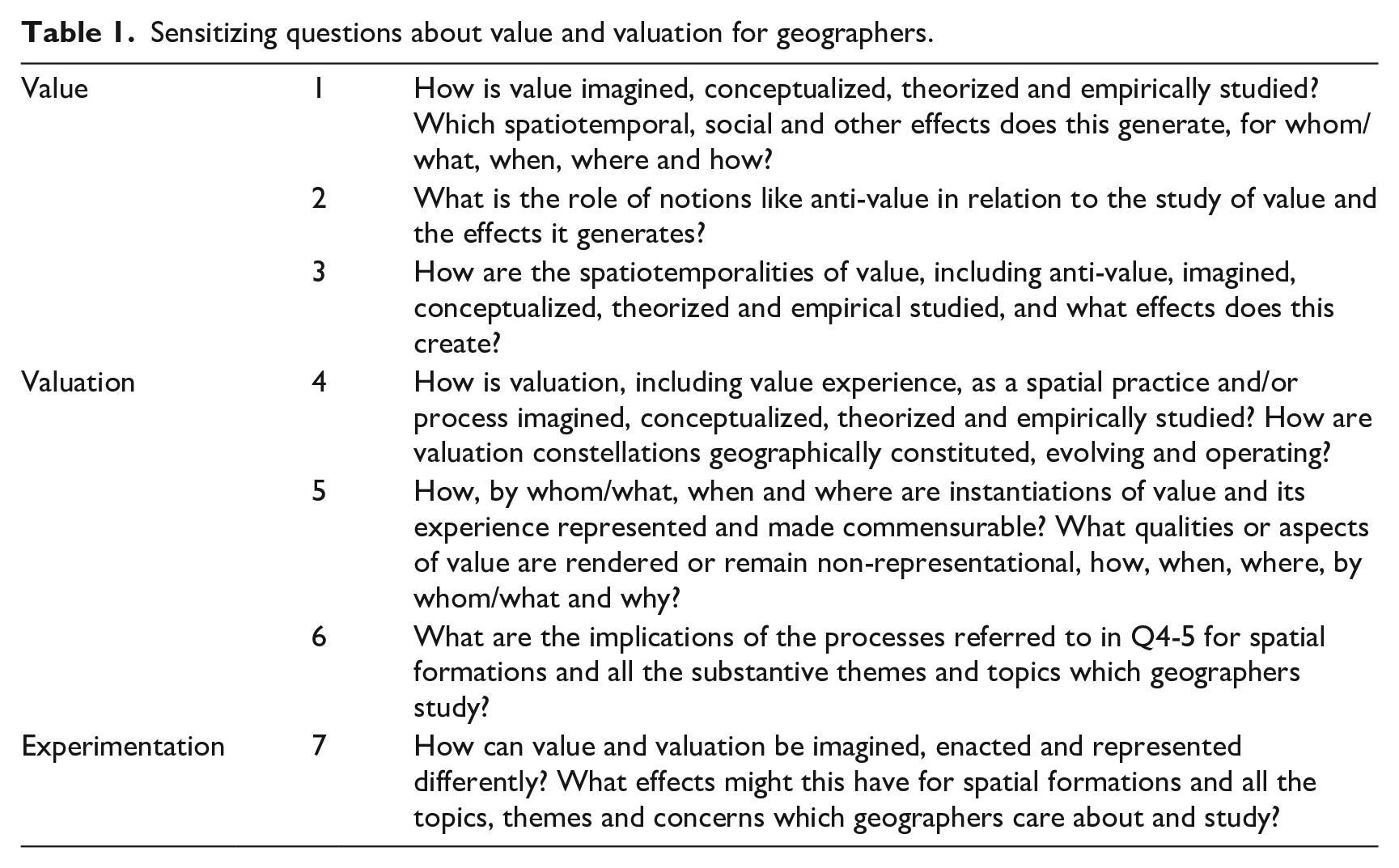
The questions are anything but definite or complete; many others, and no doubt better ones, can be developed. Readers will notice that themes discussed above, such as anti-value, spatial imaginaries, commensuration and the politics of valuation, feature in the questions. The purpose of the questions is to raise awareness about how questions of value and valuation are significant to so much of what geographers do in research, teaching and engagement. The questions also have a pragmatist character and seek to encourage (more) geographers to experiment – that is, to create, invent, trial, experience, assess and document new or alternative modes with, and as part of, their work. This experimentation can take myriad forms but two deserve special mention. These are the advancement of post- and decolonial perspectives on value and valuation, and digital geographies of value and valuation, including the rise and proliferation of digital platforms. Neither have I managed to discuss so far; both fortunately feature in contributions to the special issue.
The questions contain some uncommon terms, like spatiotemporal(ities) and spatial formations. These clumsy concepts are meant to foreground the importance of thinking space and time together in relation to value and valuation – as stressed by Keith (2024) in his contribution to the special issue – and to be inclusive. Thrift (1996) titled one of his books Spatial Formations, and I have always considered this a broad and inclusive catch-all for more specific concepts like territory, network, place, scale, region or mobility in ways that retain their temporal and processual character. This is how spatial formation is used here.
The contributions to this issue
Beyond this introduction, the special issue consists of seven substantive papers and one commentary, in which Keith (2024) offers thoughtful reflections on the papers. The latter deal with many valuation objects, from digital start-ups (Moisio and Rossi, 2024) to humanitarian goods and services (Midgley, 2024), but there are clear foci. Land is centred in the contributions by Otchere-Darko (2024), Hercelin and Dörry (2024) and Randell-Moon (2024), with the first two considering controversies over value and valuation in the context of resource extraction. Three other contributions consider specific aspects of urban development (Barnfield, 2024; Johnson et al., 2024; Moisio and Rossi, 2024).
Across all papers, the economic and economization (Çalişkan and Callon, 2010) loom large. Partly because of this, thinking from sociology and STS on valuation as performance directly informs all but two papers. Heinich’s approach is particularly popular, featuring prominently in the contributions by Hercelin and Dörry, Midgley, and Barnfield, albeit complemented by the work of Boltanski and Thévenot (Hercelin and Dörry, Midgley) and the Foucauldian-Deleuzian notion of the diagram (Barnfield). Moisio and Rossi draw more on the work on valuation by Callon and cross-fertilize this with a Marxist approach to understanding urban development and the state informed by the writings of Hardt and Negri. In a way Otchere-Darko’s contribution is the most Marxist when it comes to value.
One distinctive contribution of the special issue lies in charting what happens with value and valuation in the context of decolonization and coloniality. This clearly is an area where geographers can enrich and challenge the sociology and STS thinking on valuation as performance. Randell-Moon’s contribution questions (Western-centric) concerns over neoliberalization as the rendering economic of everything and shows how, in Country under Australia’s First Nations’ custodianship, Western-style economization promotes narrow conceptions of the economic that are entangled with settler colonialism. These notions separate the economic from the cultural and fail to recognize how First Nations’ communities, and elders in particular, practise a more-than-capitalist diverse economy. In her paper on procurement by European and North American humanitarian organizations, Midgley highlights how intentions to decolonize operations through localization of procured goods and services are often trumped by the perceived need to practise efficiency and accountability as values-as-principles. Finally, while not engaging with sociology and STS research on valuation, Otchere-Darko highlights the importance of thinking about temporality and the more-than-human world in land valuation. His paper shows how, in Southwest Ghana and Tanzania’s Lindi-Mtwara region, local communities try to shift valuation processes so that land is valued no longer as a stock of resources to be paid off at once when it is bought for resource extraction but rather as a flow of resources and affordances that sustain more-than-human communities and life-worlds. This framing is still one of land as a resource but reimagines this in a manner that recognizes the entanglement of past, present and future in how local communities experience land and its affordances.
Otchere-Darko’s paper is one of several that centre valuation conflicts and, if sometimes implicitly, encourage experimentation with different modes of valuation. Valuation conflicts also feature in Hercelin and Dörry’s analysis of different modes of valuation in the context of mining in Madagascar, and Midgley’s paper on humanitarian procurement. Both offer rich detail on how such conflicts are negotiated and sometimes reconciled. Others suggest how certain modes of valuation continue to dominate because of extant configurations of power relations. Thus, Barnfield shows how, notwithstanding his careful conceptualization of power relations and changes in the UK Government’s valuation procedures, national government actors, procedures and practices shape in fundamental ways how local development initiatives across England are funded and enacted. Midgley’s analysis can be read as suggesting that, when push comes to shove, localization of procurement as value-as-principle faces efficiency and accountability as formidable opponents. Moreover, while highlighting various alternative and practical modes of valuing First Nations’ cultural practices, Randell-Moon’s paper also draws attention to the inherited, deeply uneven field marked by centuries of settler colonialism in which those modes of valuation have to assert themselves, flourish and become normalized.
This brings me to the notion of valuation constellations, even if none of the contributions mentions this directly. The observations about the socio-spatial unevenness of modes of valuation by Midgley, Barnfield and Randell-Moon can, at least to some extent, be related to historically emerged and relatively inert, slow-to-adapt valuation constellations. It would seem that it is not simply rules or modes of comparison that are at stake – as a valuation regime concept would have it – but also the power geometries between actors and infrastructures for valuation. This hunch is reinforced by the findings from Johnson et al.’s study of retail real estate valuation in England. They highlight inertia in the prevailing mode of valuing retail real estate. This mode has some features of Deweyan inquiry but also depends on the power geometries that limit what valuators can do in practice and, presumably, the (digital) infrastructures those valuators have at their disposal to perform valuation. The notion of valuation constellation can also help to explain some of the observations in Moisio and Rossi’s paper. It would seem that the operation of valuation constellations underpins the role of the national and local state in the modulation of the urban fields that are conducive to the (financial) valuation of start-up unicorn Wolt in Finland. Valuation constellations in operation also appear to prime Italy’s Naples region for positive valuation and investment by knowledge-intensive industries through the creation of a polarized labour force.
Collectively the papers highlight the spatial politics of values and valuation practices and the manner in which valuation conflicts are negotiated and/or fester in situations and contexts that are conditioned by valuation constellations. This, it could be argued, realizes Barnett’s (2014) plural geographies of worth, albeit perhaps not (yet) as a research programme. The papers also showcase the existence of ‘an expanded conception of value’ within geographical scholarship that considers how ‘different types of values and how they are created, exchanged, and consumed’ (Kay and Kenney-Lazar, 2017: 306). This is a considerable achievement worth celebrating, and certainly demonstrates the potential to ‘open up spaces for acting a little bit differently, here and there’ (Barnett, 2014: 257).
And yet, without wanting to suggest that this special issue is representative of geography’s engagement with questions of value and valuation, I also observe trajectories where different theoretical traditions for studying the geographies of value and valuation might lead parallel lives rather than engage in the engaged pluralism that I – and hopefully others – prize. There is ample room for trajectories of multilogue, horizontally between contemporary perspectives on value and valuation from political economy, sociology and STS, and vertically across time. Dewey and Whitehead are inevitably socio-spatially situated thinkers but their work, like that by Harvey, Massumi or Gibson-Graham and other thinkers on the geographies of value and valuation, speaks directly to contemporary concerns. It warrants critical reflection and, like that of other thinkers discussed in this article and special issue, provincialization and/or decolonization but remains germane to the spatial politics of value, valuation and value experience on a more-than-human planet where humans and other agents negotiate the poly-crisis in value-laden and valuating ways.
Footnotes
Declaration of conflicting interests
The author declared no potential conflicts of interest with respect to the research, authorship, and/or publication of this article.
Funding
The author received no financial support for the research, authorship, and/or publication of this article.