



Abstract
Land plays a central role in the explorations of value, embodying notions of use, exchange, common property and deeply held beliefs. However, with the discovery of natural resources, land values become even more dynamic and imbricated beyond pre-existing notions. What can be learnt about land values from resource extraction? Focusing on petro-geographies in Southwest Ghana and Tanzania’s Lindi-Mtwara, the current study calls attention to temporality and human–nonhuman relations within notions of land values and valuation processes. The research utilises a multi-method approach, grounding analysis in key expert interviews, policy documents, secondary research and empirical data on land use and development statistics. It shows that, in Southwest Ghana, calls for subsistence and food security highlight the deepening linkages between land’s caloric use values and nature’s intrinsic values. Here, food security is not easily subsumed within instrumental use values but rather interlinked within the complex ecology of (un)polluted nature. In Lindi-Mtwara, calls for intergenerational sustenance re-valuate land’s exchange value as a flow of resources rather than a stock to be paid off. Here, social histories and future capabilities become key considerations in deliberations over the market value of lands. The research thus highlights the interdependencies, social relations and temporalities of value triggered by resource extraction, the neglect of which often leads to conflict and loss.
Introduction
Across the social sciences and humanities, notions of value bring up several meanings, located in theoretical traditions within politics, economy, ecology and culture. Land plays a central role here, serving as a locale for explorations into value. It provides nourishment, embodies territorial belonging, replicates social structure and hierarchy, serves as a store of wealth, and functions as a medium for human and nonhuman interactions (Li, 2014b). Land thus represents the ultimate livelihood, commodity, commons and resource.
However, with the discovery of natural resources, multiple and often conflicting land values emerge by activating, entrenching or transforming different webs of interests (Meinzen-Dick and Mwangi, 2008). Resource discovery and extraction provide key moments for examining such shifting and contested values and re-valuations of land. The energy capabilities of resources like petroleum amplify its materialisation and operationalisation (cf. Zimmerman, 1933). Since the mid-2000s, energy security discourses have been utilised to legitimise land expropriations particularly in African countries (Cotula, 2012; Harvey and Pilgrim, 2011; Le Billon and Sommerville, 2017; McMichael, 2013). These discourses further implicate lands within industrial, financial, environmental and agricultural values, among others.
Explorations into land and value are ultimately whittled down by scholars and analysts into notions of use, exchange, common property and deeply held beliefs. For the Physiocrats, value is located within land’s agro-mineral surpluses (Kuczynski and Meek, 1972; Mazzucato, 2018). For Georgists, land is common property upon which individual and social labour can be applied as a measure of value (George, 1881, 2006 [1879]). Value within Marxism revolves around the socially necessary labour time embodied in commodities. Here, the reproduction of labour is prefaced by the expropriation of lands, and the appropriation of use values and surplus values as rent and profit (Harvey, 2009, 2010; Marx, 1844, 1976 [1867], 2000). Other philosophical treatments of value also unearth practices mobilised around belief systems, social structures and indigeneity (Appadurai, 1986; Graeber, 2001; Munn, 1986; Strathern, 1987). Currently, value sits within neoliberal thinking (Hayek, 1944), framed within the principles of enhancing market exchange, low transaction costs and the investment potential of lands (Deininger, 2003; Deininger and Binswanger, 1999; Deininger and Feder, 2014; de Soto, 2000; North, 1990). However, in the face of resource discovery, land values become less static. In such moments of resource-driven change, pre-existing values are reshaped, re-valorised and sometimes new ones are created. In effect, values become more dynamic and imbricated beyond existing notions (Li, 2014a, 2014b; Martinez-Alier et al., 1998; Otchere-Darko and Ovadia, 2020).
This research therefore examines the shifting valuations and re-valuations of land in Southwest Ghana and Tanzania’s Lindi and Mtwara regions (henceforth Lindi-Mtwara). These regions have been considered emerging hubs of offshore petroleum since the mid-2000s (US-EIA, 2010; Ernst and Young, 2012). Since oil and gas production began in the regions, land has been re-valorised, re-regulated and taken on a more pronounced role as a site of contention. What can be learnt about land value from resource extraction in these spaces? The findings elucidate temporality and human–nonhuman relations as shifting land values in the face of such petro-industrial activities.
In Southwest Ghana, calls by local chiefs, nongovernmental organisations (NGOs) and other local groups for food security amid petroleum extraction acknowledge not only the caloric use values of land but also nature’s intrinsic values; value notions articulated for the non-human (O’Neill, 1993). 1 Threats and evidence of pollution accentuate the interconnections between farmlands, groundwater, air quality and marine life. Food security therefore implicates and intertwines the use values of both land and sea within the complex ecology of nature’s intrinsic values. Subsistence value is therefore not easily subsumed under anthropocentric instrumental use values but rather re-valuated and interlinked with intrinsic values (Martinez-Alier et al., 1998; Næss, 1973; O’Neill, 1993).
In Tanzania’s Lindi-Mtwara, residents argue for land compensations to reflect the ageing of crops, the scale of gas projects and guaranteed employment sustenance. These calls for intergenerational sustenance re-valuate land’s exchange value as a flow of resources rather than a one-off payment, token or compensation (cf. Martinez-Alier, 2002). Intergenerational sustenance therefore implicates the displacement of labour and its social relations while re-valuating the social histories and future capability that are displaced within expropriations (cf. Dey Biswas, 2020; Unruh, 2006).
The current study draws attention to temporality and human–nonhuman relationality to highlight value shifts and interconnections triggered by the petroleum production. It contributes to the limited empirical expositions of the shifting and plural land values (Dey Biswas, 2020), particularly in resource extraction contexts (Le Billon and Sommerville, 2017; Otchere-Darko and Ovadia, 2020). Specifically, the empirical discussions highlight the interdependencies of use and intrinsic values, the socialisation of exchange values and the temporalities of land benefits as insights. The neglect of these re-valuations often leads to conflicts (Otchere-Darko and Ablo, 2022; Siakwah, 2018), and sometimes loss of life, as the case of Mtwara especially shows (Must, 2018).
The rest of the article is as follows. Section ‘Methods and materials’ outlines the research methods. Sections ‘Struggles over subsistence value in Southwest Ghana’ and ‘Intergenerational sustenance as value in Lindi-Mtwara’ provide empirical insights from the two cases vis-à-vis oil impacts on agriculture, conflict, compensations and the environment. Sections ‘Discussion’ and ‘Conclusion’ discuss the main findings and conclude in conversation with the theoretical concepts. The subsequent section delves into theoretical understandings of value as they apply to land.
On land and value
Understandings of land and value are entangled in myriad economic, physical, temporal, territorial and philosophical notions, with varied theoretical expositions (Mazzucato, 2018). Here, I focus on the Physiocrat, Georgist, Marxist and neoclassical value interventions, and examine their key land questions. These economistic interpretations of social reality have offered varied understandings of value (including the place of land) since the 17th century, often in an attempt to identify productive activities within specific economic, social and political contexts (Lichtenstein, 1983; Mazzucato, 2018).
For the Physiocrats, a group of French economists in the 18th century, value tends to be derived from land’s agro-mineral surpluses (Kuczynski and Meek, 1972). Here, value is enhanced by supporting the productive landed classes (identified as farmers and miners) against exploitation by non-productive rentier classes (Kuczynski and Meek, 1972; Mazzucato, 2018). The Physiocrats’ treatment of land as a source of sustenance bears similarities with the Georgists (an economic movement inspired by Henry George, the 19th-century American land reformer), although Georgists do not limit land to agricultural uses (Forkosch, 1980). Georgists regard land as common property, motivated by religious, philosophical and economic underpinnings (George, 1953, [1891], 2006 [1879]; Haila, 2016). Guided by the labour theory of property, Henry George posited human exertion and toil as ‘the source and natural measure of all value’ (George, 1898: 228). Despite acknowledging the contingency of use and exchange values on conditions and contexts, George used the labour process to begin examinations of value: ‘land is required for the exertion of labour in the production of wealth’ 2 (George, 2006 [1879]: 162). Such a labour process confers ‘a right of private ownership in things produced by labour’ (George, 1953 [1891]: 1). George departed from this Lockean starting point that labour applied to land justifies private property ownership (cf. Locke, 1689), arguing that land itself is common property even if labour products (including those on land) can be owned individually (George, 1953 [1891]).
For George, labour bestows a right of private land possession but not ownership and confers ownership, of the fruits of labour on individuals (George, 1891 [1953]; Pullen, 2012). Perhaps the most notable Georgist intervention is the ‘land value tax’ proposal to socialise land rents. George regarded land rent as a product of societal labour, a result of dense populations and economic agglomeration. He therefore prescribed a land value tax on rents to alleviate poverty and speculation linked to private ownership (George, 2006 [1879]). He proposed to tax socially produced land rents separately from private land improvements: ‘it is not necessary to confiscate land; only to confiscate rent’ (George, 2006 [1879]: 224). Here, the state would expropriate the larger societal land rent, incentivising landowners to invest and receive a small share of rents for prior improvements (Whitaker, 2001). George’s land value tax was praised for ‘cast[ing] doubt on the sanctity of property rights in land’ (Blaug, 2000: 278). However, it also drew criticisms for potentially singling out rents while neglecting other unearned surpluses, for lacking clarity on social rent and private improvements, for transferring the tax-burden to renters, as well as discouraging land investments (Blaug, 2000; Pullen, 2012).
Applied to Ghana and Tanzania’s petroleum sectors, as the paper shows, such taxes may be useful in providing possibilities to socialise the future capabilities of land. Specifically, such taxes may socialise the windfall resource rents to enhance the local social net (cf. Obeng-Odoom, 2014b) and potentially contribute to addressing food security issues. However, if applied to land rents, especially in Southwest Ghana where community land shares have been proposed, this may disincentivize smallholder activity or potentially pass taxes to unintended renters. Another theoretical intervention worthy of exposition is Marx’s analysis of land and value. Marx viewed land as a gift of nature, and a factor of production with non-economic affordances governed by societal relations (Marx, 1976 [1867], 1999; Munro, 2022). He defines value as socially necessary labour time embodied in commodities, with social necessity referring to use values or societal needs under prevailing production conditions and labour skills (Marx, 1976 [1867]; Harvey, 2010, 2018). Hence, labour application on land yields use values indispensable to human activity. In this context, land is important for industrial production, including rendering additional surplus values as rent. This is because capitalists assemble land and other inputs to produce commodities for exchange while extracting surplus values as profit (Harvey, 2010; Marx, 2000). The landowner also captures part of the surplus value as absolute rent from capital investment on undeveloped lands, as differential rents from quality lands, or from investment on lands (Harvey, 2009; Marx, 1981 [1894], 2000; Munro, 2013, 2022). Thus, use value is socially necessary for exchange value, while exchange value and subsequent surpluses underwrite production costs including wages, raw materials and land rents (Harvey, 2010). This use-exchange relation reinforces value as socially necessary labour time.
Marx viewed labour’s historical estrangement from land as alienation from land’s economic, metabolic and territorial affordances; an estrangement resulting from the creation of wage-dependent labour (Foster, 1999; Harvey, 2004, 2009, 2010, 2018; Marx, 1844, 1976 [1867]). Harvey subsequently outlined contemporary forms of Marx’s ‘primitive accumulation’, including modern-day enclosures, degradation and commodification of genetic materials, habitats, agriculture and expanding resource frontiers through ‘accumulation by dispossession’ (Harvey, 2004, 2010, 2018).
However, Marxist analysis has been criticised for subsuming both nature (including land) and labour within labour value theory, a process which devalues nature and appropriates unpaid ecological work (Bunker, 1985; Martinez-Alier, 2002; Martinez-Alier et al., 2010). This is significant in the context of the current paper: petroleum-driven threats to land and sea in Southwest Ghana impact not only use values (food security) but also the local ecology (which affects both humans and nonhumans), bringing into stark reflection human–nonhuman relations. These socio-ecological relations surrounding land and sea mediate and sometimes interject capital circulation and attempts at exclusion. In Tanzania’s Lindi-Mtwara, long-standing landed social relations are also expressed through intergenerational attachments and congealed socio-historical labour. Mtwara residents therefore saw the piping of gas to Dar-es-Salaam as an attempt to alienate their social-history, future capability and hopes of petro-development. This was a contributor to the 2012–2013 protests in Mtwara and violent government response (Ahearne and Childs, 2018; Must, 2018).
Land and labour displacement processes are currently framed within theoretical ideas of neoliberal market exchange value, with significant influence over contemporary land use policies. An example is the Structural Adjustment Programme advocated by the World Bank and IMF in 1980s–90s African contexts (World Bank, 1975, 1992). Here, value is considered a product of economic exchange, based on a good’s ability to meet, and maximise individual utility, tastes and preferences (Deininger, 2003; Deininger and Binswanger, 1999; Deininger and Feder, 2014; Hayek, 1944). Such a conception of value also offers the possibility to accept loss of a commodity in monetary form, which is a key aspect of land compensation policies. Here, individual subjective utility and price determine value. Applied to land, this neoclassical subjectivity posits ‘individual natural rights’ to land for satisfying desires under market exchange (Obeng-Odoom, 2018: 316–318). The ‘individual’ in this context might include land investors, private land owners, oil and gas companies, or in some cases public or traditional figures using their position for private land transactions. Hence, market exchange for land is not conducted in a vacuum. It must contend with pre-existing social relations. Similarly, under the new institutional economic theory, bureaucratic and market institutions must assign property rights and enhance the process of exchange, including simplifying transaction costs (de Soto, 2000; North, 1990). As the paper will show, companies and state institutions in Ghana and Tanzania introduce various strategies to simplify transaction costs. Residents and community elites, particularly in Southwest Ghana, also sometimes imitate these corporate languages albeit in an attempt to routinise and purportedly socialise land transaction benefits. These notions of land and value emerge as more complex and shifting as the petroleum economy expands in Southwest Ghana and Lindi-Mtwara.
Methods and materials
The research utilised multiple methods, grounding analysis in key expert interviews, policy documents and other empirical data on land use and development statistics (Creswell and Clark, 2011; Tarrow, 2010). The two case studies (Southwest Ghana and Lindi-Mtwara) were first selected based on the contemporary oil and gas finds (Ernst and Young, 2012; US-EIA, 2014), 3 which have increasingly become pertinent for their respective national energy security and development narratives. Second, the cases were selected based on data availability and research on the spatial imprint of oil on the land and ocean territories of both cases, particularly petroleum impacts on land use policies, practices and shifting land values.
A 6-month fieldwork was conducted in Southwest Ghana (November 2017–April 2018) involving mapping actors and relations, stakeholder interviews and collecting data on land-use permits. A total of 31 key informant interviews (25–45 minutes each) were also conducted via non-probabilistic purposive sampling, with representatives of local authorities, local chiefs, oil companies and NGOs.
Exploratory interviews and systematic reviews were conducted for Lindi-Mtwara (July–December 2018) to overcome challenges of fieldwork access, travel and cost restrictions. Specifically, I interviewed two researchers and systematically reviewed four reports and papers covering land-use policy, practice and institutional governance surrounding the gas extraction in Lindi-Mtwara (Southeast Tanzania). They focused on residents, land users, gas companies and local authorities. The report by Shanghvi (2014), based on interviews with 137 household-heads and 2 focus group discussions, documents the socio-economic and environmental impacts of gas extraction in Lindi-Mtwara. Must (2018) utilises 835 quantitative and semi-structured interviews to examine the local protests and violent state reactions surrounding the gas economy in Lindi-Mtwara. Kamat (2017) also analyses emerging discourses of land use and development utilising 160 quantitative interviews, 24 in-depth interviews and four 6-person focus group discussions. Finally, Ahearne and Childs (2018) examine local articulations of marginalisation based on 60 interviews and 5 focus group discussions within Lindi-Mtwara. The review of the publications focused on context, thick description, subjective meanings, sampling, data sources, analysis and claims regarding land values (Popay et al., 1998). This review approach helped to overcome challenges regarding the depth of interpretation and the generalisability of findings.
Hence, in both petro-geographies, the analysis involved (1) tracing the language, framings, policies, interpretations and chronology of land values stated by state and non-state actors and (2) comparing them to extractive policies and spatial outcomes. Critical discourse analysis was used to examine the connections between language, policies and practices (Fairclough, 2001a, 2001b; cf. Otchere-Darko and Ovadia, 2020). Using MAXQDA 2018 software, the discourse analysis involved categorising and coding interviewee responses and policy content into themes, emphasising framings, interests, agreements, exclusions and counter-discourses (Braun and Clarke, 2006; Entman, 1993; Martinez-Alier et al., 1998). Such analyses of discourses and framings allowed for examining the shifting land values in their material contexts, highlighting their attendant social relations and practices (Herzog, 2018).
Struggles over subsistence value in Southwest Ghana
Shifting values and displacements on land and sea
There are certain things that will never change; you can’t survive without a farm and food. (Interview, Nana Armo III, 12 April 2018)
In Southwest Ghana, questions of food security and subsistence have emerged to counteract and challenge the landed impacts and displacements of petroleum infrastructures. Since production commenced in 2010, the oil economy has impacted agriculture (Ackah, 2016; Arhin, 2023; Ogbe et al., 2023; Siakwah, 2017), farmlands (Ablo and Asamoah, 2018; Cuba et al., 2014), as well as farming and fishing livelihoods (Adusah-Karikari, 2014; Otchere-Darko and Ovadia, 2020; Sam and Buckle, 2017). Land struggles in Southwest Ghana highlight the valorisation of oil over agriculture livelihoods which are mostly smallholder and family run. Around 80% of Ghanaian lands are typically entrusted to chiefs and families under allodial and usufruct land rights (Kasanga, 2003). In Southwest Ghana, about 35% of the working population are engaged in agriculture, a figure that tends to be higher in rural areas with cheaper lands (WRCF, 2017). Research has identified over 63,000 ha of petroleum-driven spatial developments in Southwest Ghana (Otchere-Darko and Ovadia, 2020), displacing hundreds of farmers and affecting over 85 villages (Sam and Buckle, 2017). In rural areas, such land impacts entail compulsory state land acquisitions for gas plants, pipelines and other speculated developments (Ablo and Asamoah, 2018; Fiave, 2017; Sam and Buckle, 2017; Interview, COLANDEF, 18 September 2018; Interview, WRCF, 17 October 2018). The compulsory acquisitions are spearheaded by state agencies (Ghana Gas Company, Ghana National Petroleum Corporation), multinationals (SINOPEC, ENI, etc.) and other companies.
Compulsory acquisition processes are highly contested in Ghana. Out of 1336 compulsory land acquisitions from 1850–2004, the government compensated landowners in only a few cases (Obeng-Odoom, 2012: 322). Current land and property valuation practices in Ghana are based on market values (Anim-Odame, 2011; Obeng-Odoom and Ameyaw, 2011), which serve as the basis for compensations (GoG, 2020; sections 255–256). However, there is little consensus in practice on what constitutes fair compensation (Obeng-Odoom, 2014a). Within compulsory land acquisitions for farmlands, state land valuers calculate compensations for lands and crops, the latter involving highly contested processes of assigning prices to crops destroyed and estimating their maturity (Ablo and Asamoah, 2018; Obeng-Odoom, 2012). In Southwest Ghana, land acquisition for the 120 ha Atuabo gas development was characterised by untransparent, untimely and inadequate compensation payments for the more than 100 farmers. There was also limited room for conventional negotiation and community inclusion in determining the value of crops (Ablo and Asamoah, 2018). Similar rural contestations have emerged over compulsory land acquisitions by the state for the earmarked Atuabo freeport (810 ha) as well as the Bonyere/Domunli (8000 ha) and Nyankrom (1560 ha) special economic zones (Otchere-Darko, 2020).
In urban Southwest Ghana, lands have also been acquired by the oil and other private companies to satisfy demands for petroleum office complexes (e.g. Tullow Company office), gated communities (e.g. the ‘Oil Village’) and speculated affluent developments (e.g. ‘Petronia City’; Eduful and Hooper, 2015; Obeng-Odoom, 2014b; Otchere-Darko and Ovadia, 2020). The oil economy also triggered other extractive activities like artisanal mining and sand winning (Interview, Agriculture Data Analysis Officer, 16 January 2019).
The emergence of oil has therefore been linked to significant rural and urban population changes. Between 2000 and 2020, the Southwest Ghana population increased by 44% (718,000 to over 1 million). Curiously, between the 2000 and 2010 census years, the Southwest population increased by 23%, more than the broader Western Region figure of 20% (GSS, 2023). Peri-urban populations in Southwest Ghana (e.g. Sekondi-Takoradi, Shama and Ahanta West) increased by 120% in 2000–2020 driven by rural–urban and other external migration flows of people in search of oil-related jobs (GSS, 2023; Interview, Social Welfare Department, 1 March 2018; Interview, WRCF). Rural displacement occurs first via enclosure of lands required for food security, and second by transforming the economy through a technologically intensive oil industry that does not require local labour (Otchere-Darko and Ovadia, 2020). 4 Studies have therefore examined compensation struggles and other land disputes in the Southwest Ghana oil economy (Ablo and Asamoah, 2018; Eduful and Hooper, 2015; Fiave, 2017; Obeng-Odoom, 2014b; Otchere-Darko and Ovadia, 2020), an issue which features prominently in civil society calls for transparency (Oppong, 2020) and local demands for direct oil benefits (Ackah-Baidoo, 2013; Frimpong, 2015; GhanaWeb, 2010; Owusu, 2018). Within the physiocratic line of thinking, these petroleum production activities affect the productive class of farmers and seasonal labour especially in the rural areas (cf. Kuczynski and Meek, 1972). However, the emerging land uses are in service to the oil production offshore and would be considered a similarly productive activity within the physiocratic sense. Hence, it is important to understand such processes as accumulation by dispossession rather, highlighting the estrangement of labour from land’s caloric use values (Marx, 1844, 1976 [1867]; Harvey, 2004).
These contentions are also evidenced offshore because the Gulf of Guinea, as the zone of oil extraction, has become a key site of oil-related contestations (Ackah-Baidoo, 2013; Adjei and Overå, 2019; Owusu, 2018; Owusu et al., 2023). Fishing is a long-standing economic activity in Southwest Ghana, and in many communities, farmers also fish (Obeng-Odoom, 2014a). Fish catch declined in 2010–2020 from 305,000 mt to around 297,000 mt, with fisherfolk blaming the oil industry despite the decades-long trend of decrease (Adjei and Overå, 2019; Owusu et al., 2023). Fisherfolk contend that the oil activities restrict fish catch while oil companies and the state blame ‘irresponsible’ fishing practices (Adjei and Overå, 2019). Of particular contention has been the creation of oil exclusion zones and restricted hotspots (Adjei and Overå, 2019; Owusu et al., 2023; Interview, Journalist A, 11 November 2017; Modern Ghana, 2016). Fisherfolk complain that these restrictions have prolonged fishing times, increased fuel use and extended sailing routes, exacerbated by reported harassment by naval security services staff (Adjei and Overå, 2019; Ayifli et al., 2013; Owusu et al., 2023; Siakwah, 2018).
Struggles over the sea territory have also brought up environmental issues concerning chemical dumping and spills, seaweed growth, and impacts on marine life (Ackah-Baidoo, 2013; Amarfio, 2010; FONGhana, 2014; Kuranchie-Mensah et al., 2013; Nyarko et al., 2011; Siakwah, 2018; Smith, 2010; Yeboah, 2010; Interview, Journalists, 11 November and 7 December 2017). Particularly, the washing ashore of 21 dead whales since 2010 has led to fisherfolk, oil companies and the state accusing each other (Opoku, 2022). A 2014 report by the local Environmental Protection Agency (EPA) attributed the whale deaths to ‘possible ship strikes, entanglement with fishing gear and ingestion of marine debris’ (EPA, 2014: 14), with no connections made to the offshore oil industry (Interview, Local EPA, 14 February 2018). However, studies by a local NGO challenged the EPA report and attributed the whale deaths to offshore oil activities (FONGhana, 2014). In response to calls for a Fisheries Impact Assessment, the local EPA retorted that the existing Environmental Impact Assessment report was sufficient to cover marine impacts as stipulated in policy (EPA, 1999; Interview, Local EPA, 2018; Tullow-Ghana, 2009). However, in practice, the EPA is hamstrung by capacity constraints, limiting their ability to conduct routine environmental monitoring and observation activities fully and independently or to verify information provided by oil companies (Interview, Local EPA, 2018; Siakwah, 2018). The threat to both food security and marine life highlights the human–nonhuman relations that are at the core of such contestations. Some communities have also reported oil-related environmental and health issues like air pollution, headaches and skin rashes (Arthur and Amo-Fosu, 2020; Aryeh-Adjei et al., 2015; Asaah et al., 2014; Ayifli et al., 2013) while others have limited awareness of such unfolding impacts (Aryeh-Adjei et al., 2015) but have been excluded from institutional discussions on the environmental impacts (Asaah et al., 2014; Bawole, 2013). Such impacts reveal contestations over the intrinsic value of nature within the instrumental logic of oil production and even local fishing practices, although both activities are not equivalent in terms of resources and influence. Moore (2015) characterises extractive environmental impacts as negative value, depicting a set of contradictions that question ‘the ontology of value and nature’ and highlighting the uneven temporalities between capital reproduction and the rest of nature (Moore, 2015: 192–193). However, these discussions on ecological threats in Southwest Ghana emphasise the value of nature beyond notions of human instrumentality and use values (O’Neill, 1993; citing Næss, 1973 and Moore, 1922), triggered by and contested through petroleum’s livelihood impacts.
Food security, livelihoods, and transaction costs
The aforementioned impacts have affected and compounded food security issues, particularly food prices and the general cost of living. In Western Ghana 5 (which includes the Southwest), prices for a 5 kg bag of locally grown staple foods like maize, yam and cassava increased by over 360% between 2010 and 2017 (from Gh₵2.9/$0.5 to Gh₵13.4/$2.1). 6 This increase was higher than the national average of Gh₵9.8/$1.5, as shown in Figure 1 (MOFA, 2018).
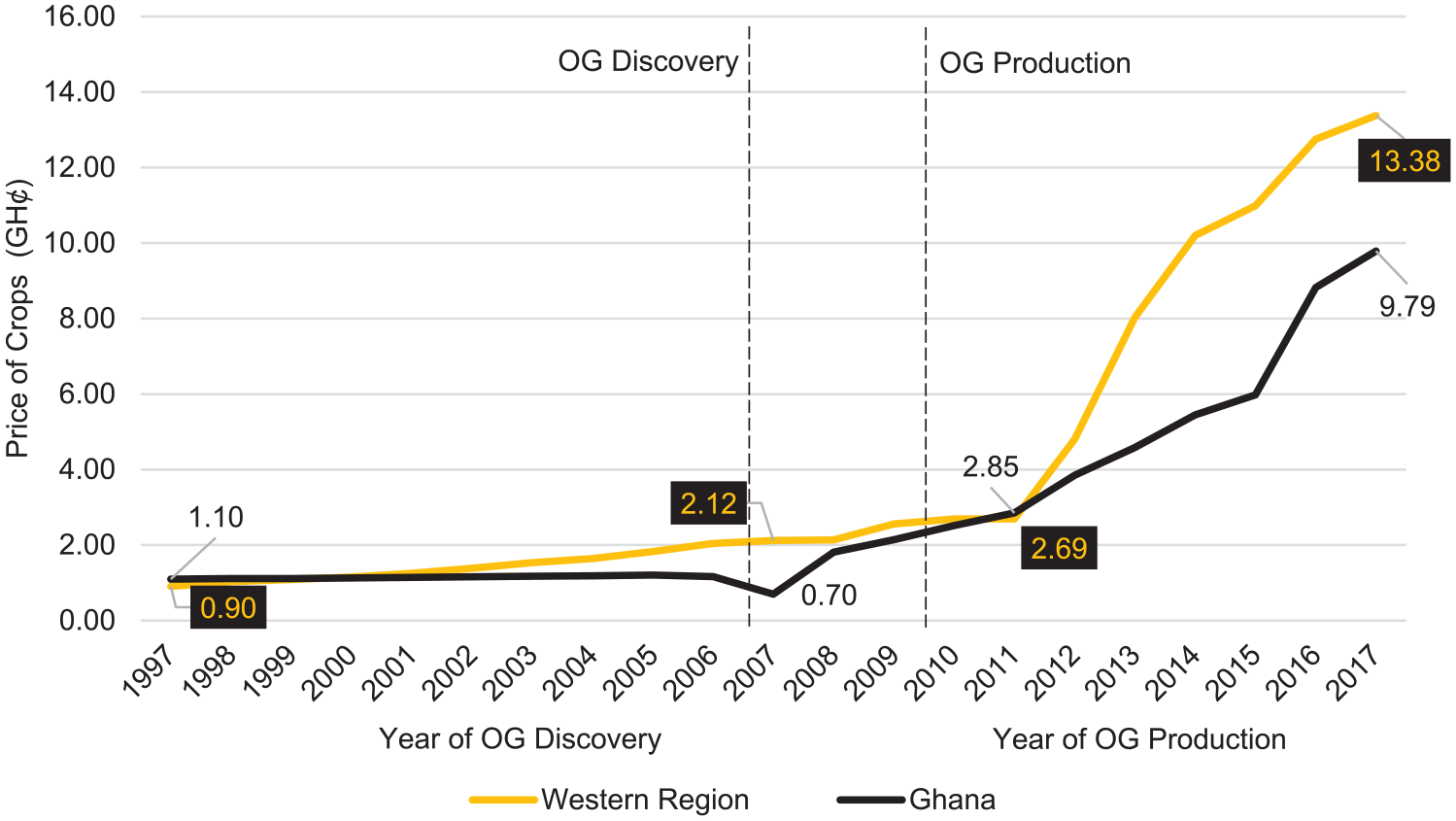
Combined price for 5 kg of locally produced maize, yam, cocoyam, cassava and plantain.
As one interlocuter lamented, I have lived in Takoradi [Southwest Ghana], Cape-Coast, Accra, Kumasi, Tema, Sunyani and Wenchi. Takoradi is an expensive place to live now, it is. Food prices have shot up. (Interview, Journalist A)
The threats to the use values of land as well as intrinsic ecological values therefore impact food security. Similar trends in Figure 1 are found in Alemzero et al. (2021) who reveal 28%–100% price increases for rice, fish and pepper in selected towns in 2009–2014. The figure is also consistent with Ackah’s (2016) study revealing that a 1% increase in oil revenues reduced agricultural output by 0.44%, conditioned by other structural political-economic factors (Siakwah, 2017). About 11% of Ghana’s yearly oil revenues are invested in agricultural programmes, but these investments have been inconsistent and unequal. Oil-funded agriculture projects usually suffer from clientelism, while sectors like education are better prioritised (Arhin, 2023; Ogbe et al., 2023).
In Southwest Ghana, responses by petroleum companies, state actors and some NGOs
7
to these oil-related land and subsistence threats include skills-upgrading and alternative livelihood projects to support the land-affected and fisherfolk (Otchere-Darko and Ovadia, 2020). As explained by one Community Liaison for an oil company, We selected some of the fishermen and fishmongers and gave them training on how to organize their businesses. We [also] brought in some consultants to take them through some business organization projects. (Interview, Liaison Officer, 22 September 2018)
These Corporate Social Responsibility (CSR) programmes underscore the concerns over food security and employment, linked to the oil-driven impacts. Such programmes are however premised on voluntary project-funding and address neither land alienation nor food security issues. They contain no binding or long-term requirements and are dependent on the benevolence of companies that usually seek to enhance their own reputations (Sowa, 2019). While some versions of CSR are (optimistically) theorised as creating shared value (cf. Porter and Kramer, 2011), this is not applicable in the two cases. Here, the CSR projects are mostly compensatory in nature and timing. In Southwest Ghana, they entail ad hoc compensation add-ons based on the voluntary initiatives of the oil companies that often seek to scale back local demands, including demands for a localised oil rent system (Interviews, 2017–2019). In effect, the CSR initiatives are applied to further compensate for extraction activities and make transactions harmonious: . . . all these initiatives that they [oil companies] are embarking [on], it is just a support they are trying to give to the communities to have cordial relationships with them. Assuming that they say ‘no, we are not going to provide anything to the communities’, they can even stop. But because they want to live harmoniously, they try to do something so that – more especially the fisher[folk] because you all eat from the same grounds, and they were there before the oil companies. So, they do not want a situation whereby there will be conflicts all the time that the oil companies are fighting fisher[folk]. (Interview, Liaison Officer)
In contrast to the moral arguments for justifying land acquisitions for industrial agriculture (cf. Li, 2014b), extractive activities are decidedly commercial, as the Liaison Officer emphatically retorted. Nonetheless, similar moral narratives of poverty reduction, development and economic growth are invoked in the oil extraction-related CSR projects (Le Billon and Sommerville, 2017). These CSR programmes are at best seen as making transaction costs ‘socially responsible’, sometimes cushioning the compulsory land acquisition impacts in the drive towards realising land exchange values and oil rents (Otchere-Darko and Ovadia, 2020). Within these unfolding land, livelihood and environmental impacts, respondents and affected landowners reveal, frame and proffer counter-values and valuation processes to safeguard their livelihoods.
From transaction costs to community shareholder value
Local landowners in Southwest Ghana, particularly land custodians like chiefs and family heads, have raised questions around the subsistence values of land to challenge the petroleum-driven food security issues and the extractive industry’s ineffective responses. As a prescription, some landowners suggest translating land transactions into future employment benefits: if investors come and they want land, I will give the land in the form of equity so whatever they want to establish that means the community would have a share in it. So, at least we will also be partners in that particular business. So, we can go into agreement and even make an MoU [Memorandum of understanding] in terms of employing members of the community. (Interview, Obrempong Dekyi XIV, 9 March 2018)
In this case, the chief purports to interpret land values into community sustenance and shareholding values. In theory, this potentially creates a quasi-ground rent arrangement and coerces capital to function as a landed entity with seasonal harvests/shares (Otchere-Darko and Ovadia, 2020).
Another local chief even specified that he would ‘include clauses in agreements where those companies would employ 20% of members of this community: from manager to cleaner’ (Interview, Gyabin V). This notion of continuous and mandatory translation of land into labour benefits has diffused into the land-valuation language of other chiefs, who hope to expand the idea into future deliberations with oil companies (Interview, Kwamena V, 18 March 2018).
These prescriptions attempt to reconcile the increasing land transfers with a social strategy of appropriating ground rents and future investments. Such strategies attempt to input land as a flow of resources and its lifelong affordances into a continuous transactional process, rather than as a stock of resources to be paid off at once. Cognizant of the contested role of traditional chiefs as stewards of community lands in Ghana, it is important to stress that such shareholding strategies are not necessarily aiming to socialise land rents akin to the Georgist land value tax prescription (George, 2006 [1879]). The land actors’ propositions could also face myriad potential challenges as the discussion section shows. Nonetheless, these shifting and sometimes contradictory values of land highlight strategies to avert land loss, and to enhance food security and capability, often interlinked with local ecology. In Tanzania’s Lindi-Mtwara region, questions of intergenerational sustenance further elucidate the temporal underpinnings of land value amid gas production.
Intergenerational sustenance as value in Lindi-Mtwara
Market values versus replacement costs within institutional land compensations
Tanzania’s offshore gas extraction activities have impacted the nearby Lindi-Mtwara regions in diverse ways, including affecting farming and fishing livelihoods (Kamat, 2018; Musoma et al., 2023). Particularly, compensations for compulsorily acquired agricultural lands are central to land value and valuation contentions. Affected communities increasingly direct grievances towards particularly state petroleum and mining companies (Pedersen and Jacob, 2017). In 2011–2014, compensation litigations in Tanzania increased from 11,000 to 35,000, with Lindi-Mtwara featuring prominently (Komu, 2014).
Land compensations in Tanzania are based on the market values guaranteed in various land regulation and acquisition policies (Komu, 2014; URT, 1967, 1999a, 1999b, 2001). The calculation of market values is based on the ‘comparative method evidenced by actual recent, sales of similar properties or by use of income approach or replacement cost method where the property is of special nature and not saleable’ (URT, 2001: s9-s10). In practice, this entails a set of values for land, crops and building estimates combined (Komu, 2014). By contrast, the valuation method used by multinationals, international finance and donor organisations in Tanzania is based on replacement costs, entailing land costs in cases where comparable market prices are difficult to estimate (Komu, 2014). Particularly, these organisations utilise the compensation procedures prescribed by the World Bank and International Finance Corporation aimed at enhancing sustainable livelihoods within compensations (see DFID, 1999; FAO, 2012; Komu, 2014; URT, 2003; World Bank, 2004). These international standards provide more comprehensive livelihood improvement compensation programmes and are often widely used than Tanzanian national policies. The national policies also contain inconsistencies regarding compensation nomenclature. While national policies like the 1999 Land and Village Land Acts assure ‘full, fair and prompt compensations’, inconsistencies exist in the 1997 Investment Act (emphasising ‘fair, adequate and prompt compensation’) and the 2009 Export processing Zone Act (‘just and prompt compensation’) (Komu, 2014; URT, 1997: s29, 1999a: s3, 1999b: s3, 2009: s29). In effect, there is a wide variation between the land acquisition and compensation standards utilised by international and state companies in Tanzania with implications for the gas economy in Lindi-Mtwara (Kamat et al., 2019; Pedersen and Jacob, 2017; Pedersen and Kweka, 2017). In Ghana, there are similar disagreements, particularly among valuers and land economists, about the land valuation process in compensations and specifically about double counting, land use rights and cropped versus bare lands (Obeng-Odoom, 2014a). This disagreement is replicated in Southwest Ghana (Ablo and Asamoah, 2018), but is more intense in Tanzania’s gas sector.
Specifically, in the 1974 land acquisitions for the Songo Songo gas-to-electricity project in Lindi-Mtwara, the state-run Tanzania Petroleum Development Corporation (TPDC) failed to honour compensations after compulsorily acquiring 150 ha of lands (Shanghvi, 2014: 61). However, subsequent acquisitions towards the project (1998–2000), this time with World Bank finance, followed international compensation standards albeit with an unclear policy framework (Komu, 2014; Pedersen and Kweka, 2017). Additional land acquisitions (2004–2010) by Canadian company Artumas-Wentworth backed by Dutch development finance for the Mtwara gas-to-electricity project also utilised international standards (Pedersen and Kweka, 2017).
These divergent compensation standards have led to inconsistent payments. For example, in Madimba and Msanga Mkuu villages, compensation per square metre of land (between TSh50/$0.02 and TSh80/$0.03) were below agreed amounts ($0.7–$0.8) (Shanghvi, 2014). Initial compensations for the 2000 ha Likong’o Mchinga gas plant – involving TPDC, Equinor, ExxonMobil, Shell and others – were reduced from $570,000 to $220,000 after a re-evaluation by government agencies (Audit-Office, 2018). Affected Likong’o Mchinga residents were also prevented from planting perennial crops even when proceedings between the government and the multinationals were halted over conflicting compensation standards (Pedersen and Kweka, 2017). In Songo Songo, half the agreed amounts for a coconut tree ($11–$17) were paid (Oxfam, 2017). In Mtwara district, council officials valued a full-grown coconut tree at $107 but payments were not made (Shanghvi, 2014). Mauriel and Prom (M&P) also took over from Artumas-Wentworth in 2014 and paid compensations five times lower ($0.1 per square metre) than its predecessor which had paid for both land and trees (Kamat et al., 2019). Lands acquired in Lindi for gas-related urban expansions were also compensated at $183–$320 per acre but resold for $4581–$8253 per acre, raising questions as to ‘how the “market values” had been calculated’ (Pedersen and Kweka, 2017: 222–223).
Government agencies try to pressurise multinationals to use national standards to avoid risks of setting higher compensation precedents (Interview, Researcher, 21 January 2019; Oxfam, 2017; Pedersen and Kweka, 2017). The 2015 Tanzania Petroleum Act mandates gas companies to prepare yearly CSR plans (URT, 2015b: s222). Hence, some companies (e.g. M&P, StatOil, Exxon) also use CSR projects to complement compensations as well as to expedite land acquisition and project implementation, practices discouraged by the government (MPEPTL, 2014). Limits on compensations enable the state to cheaply acquire and sub-lease future lands to finance its interests in joint ventures with multinationals (Pedersen and Jacob, 2017). Hence, affected landowners prefer the more generous international compensation standards and sometimes criticise the government’s restrictions (Kamat, 2017; Kamat et al., 2019; Pedersen and Kweka, 2017).
In effect, in a study by Shanghvi (2014), 66% of the sampled household-heads in Lindi-Mtwara report negative experiences of compensation processes. Farmers and landowners in Msimbati, Mtandi, Mngoji and Madimba villages also highlight the lack of transparency in valuations and compensations as the most pressing issues (MPEPTL, 2014). For those without alternative lands, the inconsistent, untimely and unclear compensations render them with less economic options. In all, residents contend that compensations are too low and crucially do not lead to intergenerational economic opportunities (Lange, 2008; Shanghvi, 2014). Others also criticise the unfair distribution of service levies and payments provided to some communities and individuals directly impacted by the gas plants and pipelines (URT, 2015a: s17; Wangwe et al., 2017). Land compensation issues therefore figure prominently in contestations, together with inter-community struggles over land boundaries and benefits (Pedersen and Jacob, 2017; Shanghvi, 2014; Thobias and Kseniia, 2017; Wangwe et al., 2017). These concerns are exacerbated by reported ecological impacts of the gas production, including chemical waste dumping, gas flaring, explosion incidents and a reported whale death in 2016 (Kamat, 2018; Kamat et al., 2019; Shanghvi, 2014; Wangwe et al., 2017). The most overt conflict has, however, been the 2012–2013 Mtwara riots over the piping of gas to Dar-es-Salaam, with a violent government response killing 12 people. The riot was seen as an expression of resentments against historical neglect, urban bias and distributive injustices over failed promises to utilise the gas locally (Ahearne and Childs, 2018; Kamat, 2017; Must, 2018). The choice of Dar-es-Salaam also compounded the feeling that ‘the government “grabbed” land [for the pipelines] and did not pay a proper price for it’ (Must, 2018: 98). The land-grabbing discourse in Tanzania became particularly charged when former Lands Minister Anna Tibaijuka called for a nationwide survey of the largely unregistered rural lands to revalorise its inherent ‘dead capital’ (123-Tanzania, 2013; Maganga et al., 2016). This narrative had already been introduced into policy to expand land access options for individuals and companies (Landlinks, 2016; Mpogole and Kipene, 2013; URT, 2002, 2004: s113). Hence, the gas economy revalorised local lands with ensuing struggles over acquisitions, compensations and livelihoods, highlighting the limits of both the incumbent market values and replacement cost approaches. In response, counter-narratives emerged focusing on land as a flow of resources with the capacity for intergenerational sustenance.
From market values and replacement costs to intergenerational land values
Land-affected individuals in Lindi-Mtwara argue for sustaining the temporal values of land through intergenerational forms of compensation. Some residents argue that the monetary values of the compensations should correspond to the future scale of the project to be undertaken. That is, larger gas projects should pay more in compensation (Kamat, 2017; Wangwe et al., 2017). Other compensation claimants also highlight the limits of the market valuation approach in compensation policies. Kamat (2017) discusses a resident of Mtandi village who argued for gas pipeline compensations to reflect the 75-year lifeline of her uprooted coconut trees. Wangwe et al. (2017: 13) report from a roundtable workshop on governance in Lindi-Mtwara’s gas economy that ‘other villagers also have been demanding to be compensated to the scale of the project; such that larger investment projects are expected to pay more than small projects pay’. Such notions of the scale and longevity of land’s affordances highlight the longer temporalities imbued in land as well as the disjuncture with the abruptness of compulsory acquisition and compensatory exchange values (Martinez-Alier et al., 1998). It brings into stark relief the continuous non-monetary payoffs of land versus the limits of one-time monetary compensations. Other residents from rural Mtwara also expressed willingness to receive low compensations but only on the condition that long-term employment opportunities for their children would be enhanced (Kamat, 2017; Kamat et al., 2019). Hence, as in Southwest Ghana, some Lindi-Mtwara residents were willing to undervalue and transcribe land’s monetary prices to create intergenerational employment opportunities. This willingness points to land compensations that go beyond economic exchange to encompass intergenerational sustenance. It emphasises both the non-economic future capability and the economic exchangeability afforded by the fixity and permanence of land, foregrounding land’s capability for future security (Dey Biswas, 2020). By arguing for compensations to be based on the ageing of crops, on the scale of the proposed projects or on guaranteed employment sustenance, residents highlight that the market values (real-time and net present monetary compensations) do not represent the potential flow of affordances granted by land over time. Such notions aim to revaluate the past histories and future capabilities (Dey Biswas, 2020) of land’s use values into future intergenerational rents. They therefore challenge the appropriation of land’s continual affordances by gas companies, central government and investors (Li, 2014b).
Discussion
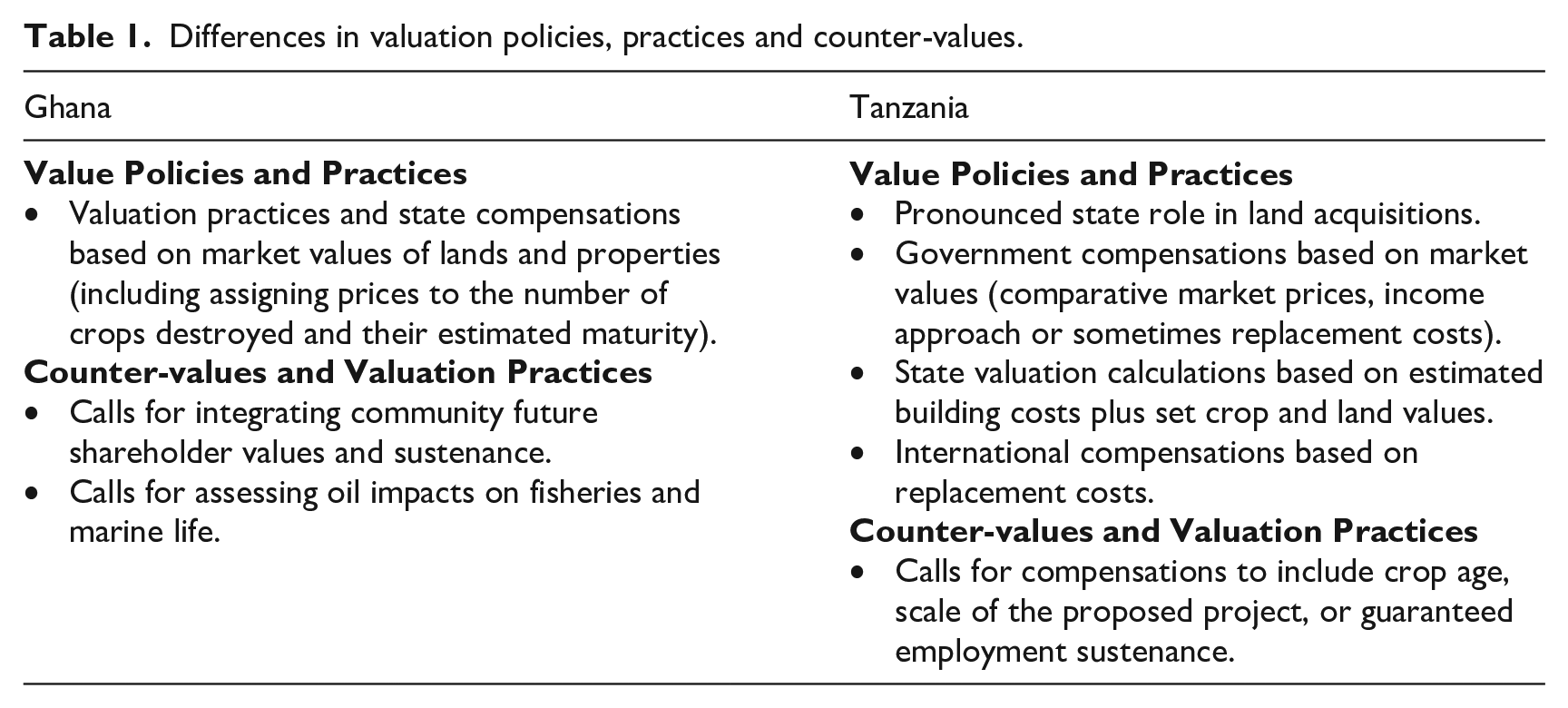
The study calls attention to temporality and human–nonhuman relations within land value and valuation processes in petro-geographies, by exploring contestations surrounding subsistence and intergenerational sustenance. In the face of petro-extraction in Southwest Ghana and Lindi-Mtwara, lands are re-valuated beyond imbrications of use and exchange values. Residents and land actors in the respective regions challenge the dominance of petro-capital and economic values enacted in policy and practice. They contend against the subsuming and simplifying of plural values and re-emphasise the diverse ‘resourceness’ of land (Li, 2014b: 589). Both case studies are differentiated by the institutional approaches to land valuation and compensation (Table 1). However, they exhibit common notions of temporality and human–nonhuman relationalities in proffered land values and valuation processes, amid similarly inconsistent land valuation and compensation processes.
Differences in valuation policies, practices and counter-values.
Of temporality
In Southwest Ghana, questions of subsistence highlight the threats to instrumental use values of land for farming and subsistence. As shown in Table 1, residents and some landowners re-emphasise the subsistence values of land and food security. The call for food security represents the historically embodied labour that residents have expended to enculture their lands to their foods and ecology (Foster, 1999; Marx, 1867 [1976]). It highlights the assembling of historical time to enhance future capability. The attempts by land actors in Southwest Ghana to obtain further rents and socialise landed benefits (particularly through community land shareholder agreements with oil companies) aim to enhance the future capabilities of land. They imitate corporate languages and invoke a shared social history of ‘community’ to potentially derive future benefits. However, such attempts inadvertently imitate the corporate investment strategies and moral market claims of investors and companies (Deininger, 2003; Deininger and Binswanger, 1999; Deininger and Feder, 2014; de Soto, 2000; North, 1990). In theory, such leveraging of land for ‘communal’ shares or rents (cf. George, 2006 [1879]) might introduce a new form of land-use transaction in land valuations and decisions. Such shareholder agreements might involve the disposal of occupancy rights while protecting usufruct and allodial rights, thus maintaining possibilities for plural rights 8 with social and market elements. However, these agreements could face various challenges including legal difficulties, and unintended impacts on smallholders, akin to the unintended-incidence critiques of the Georgist land value tax (Blaug, 2000; Pullen, 2012). They also risk excluding those considered outside this shared social history, such as migrants. In addition, given that the oil industry is technologically intensive, the feasibility of socialising land agreements into community and labour sustenance agreements potentially remains limited. In effect, applying the proposed community land shareholder agreements could perpetuate threats to food security in Southwest Ghana. Perhaps, socialising and localising windfall oil rents, rather than lands, may be more useful (cf. Obeng-Odoom, 2014b) to meet local demands for a localised oil rent system. This could, for instance, take the form of utilising petroleum rents to fund social programmes, including food contingency plans and projects in Southwest Ghana (cf. Öhlund et al., 2020).
In Lindi-Mtwara, contestations over compensations unpack land as a flow of resources over time for intergenerational sustenance. The use of present market values in Tanzania’s valuation and compensation policies (albeit applied inconsistently and incoherently) is criticised for neither paying attention to social history and future capability nor aligning with the intergenerational and temporal values. In addition, the state’s aggressive land acquisition strategies and speculative practices (e.g. reselling for higher amounts) to resurrect dead capital (Maganga et al., 2016) highlight how time similarly features within institutional investment strategies. Here, affected land users and owners are compensated for present use and exclusivity, with limited attention to social history and future capability (Dey Biswas, 2020).
In effect, Lindi-Mtwara residents position the compensatory value of land in relation to the potential flow of intergenerational benefits that can be derived. Interlocuters affirm intergenerational and temporal land values to challenge the notions of land as a stock of resources to be paid off through one-time exchange values. They argue for compensations to be based on the ageing of crops, on the scale of the proposed gas projects or on guaranteed employment sustenance. Such intergenerational attachments and congealed socio-historical labour express long-standing landed social relations. The piping of gas from Mtwara to Dar-es-Salaam was therefore resisted as an alienation of such social-history and future capability. Compared to Ghana, inconsistent compensation procedures in Tanzania’s gas sector are more intensely contested, perhaps due to the latter’s multiplicity of live projects and the state’s more pronounced role (Pedersen and Kweka, 2017).
Of human–nonhuman relations
In Southwest Ghana, the threat to both food security and marine life, and the calls for assessing impacts on fisheries, highlight the human–nonhuman relations that are at the core of valuation contestations. Farming, fishing and land-tending enable cycles of renewal that sustain future generations (Le Billon and Sommerville, 2017; Öhlund et al., 2020). Hence, interlocuters invoke subsistence and sustenance values to contest pollution impacts, displacements and other livelihood challenges linked to the petroleum economy. The environmental impacts of oil and gas activities in Southwest Ghana, and to a lesser extent in Lindi-Mtwara, reveal contestations over the intrinsic value of nature even within the instrumental logic of oil production. Land forms part of a complex ecology that is similarly threatened by petro-industrial activities (Martinez-Alier, 2002; Martinez-Alier et al., 2010; Næss, 1973; O’Neill, 1993). Loose regulations regarding hazardous oil production processes and their domino impacts on unsafe fishing practices threaten the non-instrumental value of marine life and its existence independent of any usefulness for human satisfaction (cf. O’Neill, 1993). Hence, expressions of subsistence values and future livelihoods are not easily subsumed under anthropocentric instrumental use values but rather re-valuated and interlinked with intrinsic values of preserving non-human and (by extension) human existence, the latter involving counteracting the compounding threats to food security on land and sea.
Conclusion
What more can resource extraction tell us about land value? The study has first unpacked the notions of use values to highlight future subsistence and human–nonhuman interlinkages. In the face of the ecological impacts due to fossil fuel extraction, land’s intrinsic values become even more apparent and emphasised (Næss, 1973; O’Neill, 1993). Food security in Southwest Ghana is a key use value of land in the face of petroleum impacts. The threats to land and marine life can be characterised as negative value, an ecological response to contemporary extractive frontiers (Moore, 2015). However, subsuming food production merely into ‘use’ or human instrumentality underestimates nature’s own metabolic processes (Martinez-Alier, 2002; Martinez-Alier et al., 2010; Næss, 1973; O’Neill, 1993). In effect, the calls for food security emphasise the need to protect caloric use values and the intrinsic values of land and nature.
Secondly, the research has revealed notions of exchange value beyond a stock of resources (land) to be traded (one-time compensations and payments) but rather as a continuous relation of sustenance derived from land as a flow of resources. Intergenerational sustenance does not only highlight the alienation of labour and its social relations from land and sea, but also unearths the displacement of social histories and appropriation of future capability embedded therein (cf. Dey Biswas, 2020).
In both regions, the process of accumulation-by-dispossession provides the analytical breadth for understanding the diffused forms of displacement across urban, rural and marine spaces and impacts on food security, environmental degradation and livelihood challenges (Harvey, 2004; Marx, 1844, 1976 [1867]; Luxemburg, 1951 [1913]). However, Georgist thinking possibly presents a more practical approach for capturing and socialising land values in the two areas through the socialisation of future land capabilities (cf. George, 2006 [1879]). In both cases, land owners and occupants attempt to transcribe land’s rent-yielding capacity to reproduce subsistence and sustenance, sometimes as a response to the state’s speculative activities. Interlocuters highlight different strategies for clawing back future rents and land-driven benefits from the oil production process. They speak of such rent strategies individually but often invoke notions of community, and they emphasise the continuous benefits of land. Temporality here goes beyond esoterically held principles but rather emphasises land’s capability for future security (Dey Biswas, 2020). Applied here, the notion of temporality unearths the historical care and other unpaid labour activities that enable social reproduction and subsistence; considerations that are subsumed and undervalued in the oil production process (cf. Martinez-Alier, 2002; Martinez-Alier et al., 2010; Moore, 2015).
In summary, the research calls for sustained emphasis on time and human–nonhuman relations as shifting land values in the face of petro-industrial activities. Specifically, it highlights the interdependencies of use and intrinsic values, the socialisation of exchange values, and the temporalities of land benefits. Interlocuters criticise that these dynamic and evolving values are side-lined in the valuations by fossil fuel companies and the state, and they aim to protect a way of life that secures their livelihood and possibly future generations (cf. Dey Biswas, 2020; Öhlund et al., 2020). Some of their propositions may offer limited policy scalability in current land policies and valuation strategies (cf. Unruh, 2006) but do place nature and social relations as central considerations in valuating lands, especially in resource extraction contexts. As more African countries become first time oil and gas producers, future research can explore the impacts and shifts in land values as well as the ethical, policy and practical implications of different land valuation practices. Future research can also further distinguish between different temporalities (historical, future, social time, nonhuman), their implications for land values and potential application into existing policies.
Footnotes
Acknowledgements
Many thanks to Steve Graham for the constructive and helpful comments on the paper.
Declaration of conflicting interests
The author declared no potential conflicts of interest with respect to the research, authorship, and/or publication of this article.
Funding
The author disclosed receipt of the following financial support for the research, authorship, and/or publication of this article: The author would like to acknowledge funding from the University of Milan-Bicocca Doctoral School for the initial research.
