



Abstract
Geography’s fieldwork culture has been subject to much scrutiny in recent decades. With roots in colonial exploration and shaped by Enlightenment ideals of reason and rationality, the presence of emotion in physical geography fieldwork has remained invisible, unspoken. This article draws on geomorphologists’ fieldwork stories, accessed via questionnaire and interviews, to provide insight into the emotion work involved in collaborative fieldwork, depicted here through a career/life-course chronology. This in turn enables articulation of the ‘feeling rules’ of geomorphology fieldwork; implicit, unwritten expectations of ‘how to be’ a field geomorphologist. Acknowledging that fieldwork is a positive aspect of the discipline for many, the article provides insight into the ways that the burdens of fieldwork may shift throughout a career and considers the implications for creating more inclusive field environments.
Objectivity, science, emotion and physical geography
‘. . . we university scholars do not teach about the realities of research. Perhaps it is unteachable, but we should at least talk about what we do and how it feels. Such conversations are not had, other than in passing with individual colleagues’.
Geography’s fieldwork culture has been robustly critiqued in recent decades (Bracken and Mawdsley, 2004; Dosu, 2021; Hall et al., 2002; Kobayashi, 1994; McEwan, 1998; Mol and Atchison, 2019; Olcott and Downen, 2020), yet the presence of emotion in physical geography or geoscience fieldwork has received scant attention. This negation of emotion – itself a negation of the researcher as subject – is characteristic of science as defined through the Scientific Revolution and European Enlightenment. The development of scientific idea(l)s in Europe from the 16th century through figures such as Bacon, Descartes, Newton, Hobbes, Hume and others (Matthews, 2021 [1991]; Shapin, 2009; Wynter, 2003) entailed four important and intersecting moves: (1) the dualistic separation of mind from matter, reason/rationality from body and emotion; (2) mechanistic thinking, understanding the natural world as driven by discoverable laws rather than final causes; (3) the development of scientific method, scientific reasoning being arrived at through a ‘methodical disciplining of the personal and contingent’ (Shapin, 2009: 32); (4) secularisation, shifting from the pursuit of knowledge as seeking to understand God’s intention to the pursuit of knowledge in service of the State. Wynter (2003) explains that these developments simultaneously entailed a (European) re-description of what it means to be human, to what she terms ‘Man2’; the civilised, rational man fulfilling the interests of the State – and this in the context of European imperial ambition. The legacy of these ideas is a notion that the intellectual life of academic work is often assumed to be non-physical and non-emotional, and the inter-personal dimensions of knowledge production are overlooked (Svallfors, 2021 [2020]). But more than this, Man2 was the understanding of being human against which other cultures were seen as less-than-human, legitimising colonialism (Wynter, 2003). This European cosmological-philosophical-scientific-cultural transformation provides the logic of geography’s fieldwork culture: the more remote, rugged and ‘extreme’, the better; the geographer-scientist demonstrably negating the physical and emotional burdens of subjective human experience in the heroic pursuit of science for/and empire. As Bracken and Mawdsley (2004) put it, Geography’s roots in colonial exploration are ‘dominated by the intrepid explorer, the surveyor of jungles and mountain ranges and the dedicated colonial officer posted to the far-flung fringes of Empire’ (p. 282).
Despite the critiques of this culture – and some efforts to change (e.g. Anadu et al., 2020; Carabajal and Atchison, 2020; Dalrymple and Lane, 2024; Hughes, 2016; Snyder and Reynolds, 2024) – body and emotion remain written out of the science of physical geography and, probably still, rarely spoken of. Substantial dimensions of the practice of doing field science thus remain invisible. This article draws on geomorphologists’ accounts of their fieldwork experiences to delineate the ‘feeling rules’ (Hochschild, 2012 [1983]) of geomorphology fieldwork and demonstrate the variety of ‘emotion work’ that can be required to align with these rules. Fieldwork always exists within a network of social relations, and the article brings to light the role of feeling rules and emotion work in the social practices of fieldwork. In doing so, it contributes to the development of critical physical geography (Lave, 2014; Lave et al., 2014) in its commitment that ‘the same power relations that shape the landscape also shape who studies them and how’ (Lave et al., 2018: 5), furthering awareness of the multi-dimensional practices through which physical geography/geoscience knowledge is arrived at. This is in two senses: first, in recognising and articulating field researchers’ everyday experiences in order to open potential for being better colleagues, research leaders and managers; second, through a broader concern with learning how legacies of geography’s (and the field sciences’) colonial history remain diffused throughout the discipline today, reproduced in the minutiae of our daily interactions.
Emotion in research
Despite the academic culture noted earlier, the presence of emotion in academic life has been increasingly recognised and researched in the last two decades, in the lives of both faculty (Barclay, 2021; Bloch, 2002, 2012; Svallfors, 2021 [2020]) and students, the latter including in geography (Hill et al., 2021; Marvell and Simm, 2021; Ye et al., 2021).
The broad context of academic work, amid the neoliberalisation and professionalisation of universities, has been demonstrated to require alignment to particular ways of being and feeling (Barclay, 2021). Focusing specifically on emotion in research, Bloch (2002, 2012) highlights emotions deriving from the structural conditions of competition and peer assessment – not least the fear and frustrations associated with ‘reviewer 2’. However, these studies consider the academic community at large and the ways universities work in general, rather than paying attention to the specific research practices of any one discipline – practices that may well extend beyond universities. In contrast, Barbalet (2002) focuses more on epistemological concerns, in the role(s) of emotion in the pursuit of science and processes through which scientific discoveries are arrived at, highlighting motivation, commitment, trust and confidence as central.
Social researchers are increasingly recognising the role of emotion in their research, a development influenced by feminist methodologies (Hubbard et al. (2001) and Barclay (2021) note the prominence of feminist theorists in work on emotion in academic life more broadly). Hubbard et al. (2001) distinguish between (1) ‘emotional labour’ on the part of the researcher (of which, more below); (2) ‘emotionally sensed knowledge’ in the research process, whereby emotion has an epistemic function, and (3) sociology of emotion, incorporating emotion as (part of) the research focus. They suggest that many technical aspects of research entail emotional labour, including budget management, teamwork (particularly conflict, tension and challenge within a team), writing and interviewing skills. Much of their discussion centres around the role of emotion in the researcher’s interactions with research participants, a theme also addressed by others (Bergman et al., 2015, 2018; Jansson, 2010; Kleinman and Copp, 2012 [1993]; McGarrol, 2017; Punch, 2012). Emotion has a function in both navigating and maintaining access to research participants and in the research/participant encounter, for example, while interviewing. Nevertheless, interrogation of the significance of emotions in or for research remains rare, even within sociology (Svallfors, 2021 [2020]).
Some social researchers acknowledge emotional dimensions of research that are more likely to have commonality with physical geography research. These include the emotional impact of potential physical dangers such as river crossings or dogs (Punch, 2012). Jokinen and Caretta (2016) recount emotion driving behaviours in the field, not least in a desire to ‘carry on’, resulting in substantial long-term bodily consequences. Anxieties about the research itself – its progress and questions of data quality and quantity – are highlighted by McGarrol (2017), who also argues that emotion in qualitative social research should be understood as contextualised by researcher life-course. More recently, Jenkins (2020) discusses motherhood in relation to the demands of long-haul fieldwork (‘long-haul’ in distance travelled and/or time away from home). This latter point is one that has been articulated specifically in relation to geomorphology fieldwork, Lininger et al.’s (2021) wide-ranging discussion of motherhood and fieldwork noting the ‘emotional barrier’ of cultural norms associated with motherhood clashing with work activities, and associated ‘parental guilt’ (p. 2768). Their article, of course, is notable specifically because it articulates something normally left unspoken in physical geography. As Barclay (2021) argues, the ‘discipline’ of any domain of research ‘extends beyond methodology to the feelings and behaviours that are required of the academic’ (p. 16).
This article offers insights into what might be termed the ‘feeling rules’ (Hochschild, 2012 [1983], see Table 1 for definition) of field geomorphology, based on geomorphologists’ accounts of their fieldwork experiences across research, consultancy and teaching. It draws attention to the existence of emotion work in geomorphological fieldwork and broadens the range of emotional burdens recognised. In doing so, it offers grounds for more openness about what fieldwork involves and consideration of how those undertaking fieldwork may be better prepared and supported. Noting that geomorphology falls within the broader disciplinary scopes of both geology and geography and that disciplinary boundaries are themselves constructs of convenience, the feeling rules at work are very likely relevant across the field sciences more broadly. The focus on geomorphology here reflects the limits of the data and boundaries of the study from which they are derived.
Summary definition of key terms.
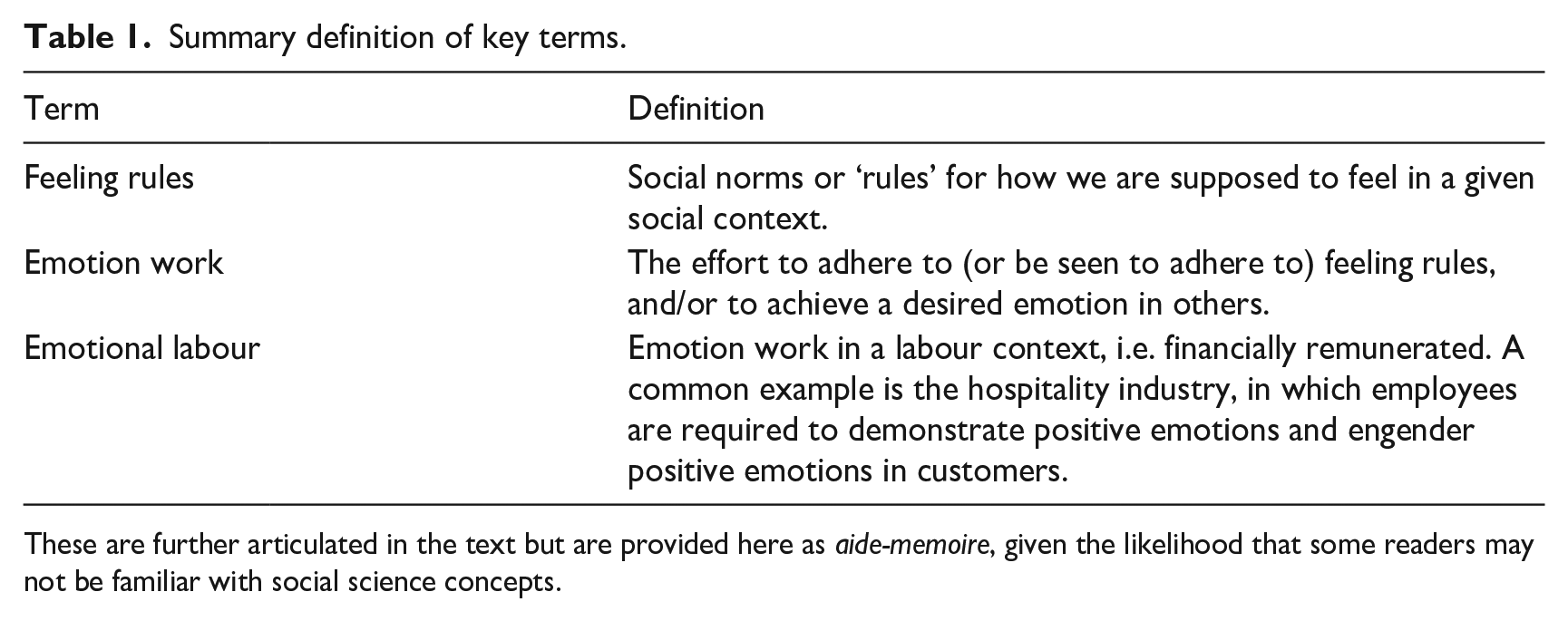
These are further articulated in the text but are provided here as aide-memoire, given the likelihood that some readers may not be familiar with social science concepts.
In what follows, the terms ‘emotion work’ and ‘emotional labour’ are introduced, noting how they have been applied to research and clarifying their use in this study. The empirical methods are then explained. The article goes on to articulate the social-emotional aspects of fieldwork present in participants’ descriptions of their fieldwork, ordered as a ‘career chronology’ or life-course from early career to older age. Identification of the feeling rules at work follows, with the article concluding by highlighting the implications of articulating these feeling rules.
Emotion regulation, emotion work and emotional labour
The terms emotion work and emotional labour stem from sociologist Arlie Hochschild’s (1979, 2012 [1983]) work. Adult’s emotive experiences in everyday life are governed by social norms or ‘rules’ that establish expectations for how we should feel and the emotions we should express in particular situations. Simple examples are feeling happy at a party or sad at a funeral. ‘Emotion work’ is the effort to change an emotion or feeling, whether in degree or quality, to conform to the feeling rules of any given context. This may entail evocation of a desired emotion and/or suppression of an undesired emotion, involving cognitive, bodily and/or expressive techniques. The resulting displays of emotion or ‘gestures of exchange’ (Hochschild, 1979: 569) can be commoditized within the workplace. Further developing these ideas in The Managed Heart, Hochschild (2012 [1983]) defined emotional labour as emotion work that has exchange value, being sold for a wage. Two extremes were used to exemplify: the positive emotions required of the airline flight attendant; and the negative emotions displayed by the debt collector.
A wealth of subsequent work has applied notions of emotion work and emotional labour in a variety of service and professional sectors, including tourism and hospitality, education, clergy, medicine and healthcare, personal care, law and prisons (Anleau and Mack, 2005; Brennan, 2006; Kinman et al., 2011; Nylander et al., 2011; Rayment, 2015; Toerian and Kitzinger, 2007; Xu et al., 2020). Different researchers interpret the concepts in different ways, sometimes conflating them (Leighton, 2012). For Hochschild (2012 (1983)), emotion work happens in private contexts and has use value, while emotional labour has exchange value in the labour market. Leighton (2012), though, deploys both these terms in the context of employment: emotional labour referring to regulation of emotions with customers/outsiders of the employing organisation; and emotion work referring to interactions with colleagues within the organisation (having use value but not exchange value). As she notes, working in teams may blur the boundary between the two. The same is likely to be true for fieldwork in geomorphology: rather than having direct exchange value, emotion work has use value in enabling and facilitating success in an activity that is often – thought not always – part of paid employment.
In this study, I avoid the use of the term emotional labour, referring instead to emotion work as encompassing any instance where emotion is regulated, that is, effort is made to conform to the feeling rules of the situation. This is not to deny that such emotion work may be central to success in the labour economy, including for students who are seeking to develop their currency in that economy. Rather, it signals that the demands of emotion work are not an explicit expectation of labour role performance. This very likely increases the possibility that the burden of emotion work falls unevenly; that some individuals may succeed despite lower adherence to the feeling rules, and the degree to which success necessitates emotion work may reinforce other inequalities in disciplines known to be low in diversity (Dowey et al., 2021; Marín-Spiotta et al., 2020).
Fieldwork stories as method
The empirical evidence offered here stems from a qualitative study exploring the dimensions of geomorphology fieldwork that are ‘written out’ of scientific accounts of research. The focus of that research project is epistemological, particularly paying attention to the cognitive, social, embodied and affective dimensions of producing knowledge through fieldwork (e.g. see Couper, 2023), drawing on a conceptual mix of philosophy and human geography (e.g. Merleau-Ponty, 1962; Thrift, 2008; Whatmore, 2006; Wittgenstein, 1953). The methodology foregrounded geomorphologists’ own accounts of fieldwork, asking them to ‘tell me your fieldwork stories’. An online questionnaire comprising primarily open-ended questions yielding qualitative data was disseminated via the international geomorphology mailing list, GEOMORPH-LIST (hosted in Canada) and via X (formerly Twitter) using hashtags (#geomorphology, #fieldwork) and tagging geomorphology associations to request re-tweets. Participants in the questionnaire were then given the option to volunteer for a follow-up interview. Semi-structured interviews were held online using Microsoft Teams during 2020, recorded and audio-transcribed for subsequent analysis. Again, open questions were used, aiming to encourage participants to talk freely about their fieldwork experiences. Both methods encompassed the knowledge-producing fieldwork of research or consultancy and field teaching, as relevant to individual participants.
The questionnaire yielded useable responses from 39 participants, with 14 volunteering for interview. These interview participants varied in length of experience from postgraduate masters’ and doctoral researchers to retired professors and included individuals working in universities, private consultancy and governmental organisations. They were mixed gender, predominantly white or white-passing and located in nine countries across five continents (though with strong presence from North America and none in Asia). The questionnaire and interviews were conducted in English, although some participants are certainly multi-lingual. This study is, then, a small-scale qualitative study that provides insights into the variety and richness of geomorphologists’ field experiences, within the context of Anglophone geomorphology. It is worth noting that geomorphology is variously aligned with physical geography and/or geology in different national and institutional contexts, and participants’ educational backgrounds reflect this (e.g. with bachelor’s degrees or equivalent in geology, geography, physical geography and environmental science).
Analysis of questionnaire and interview data was via coding. Initial ideas for codes were largely concept-driven, shaped by the aims and theoretical framing of the project, but these ideas developed through the process of interviewing and transcribing interviews. The resulting codebook was thus partly concept-driven, partly data-driven. This article derives from the data-driven elements, in a recurring theme of seemingly negative experiences connected with social relations within and beyond the field. Although not the primary focus of the research, ethically it seemed this could not be ignored: participants chose to tell their own stories in order to be heard in some sense. This is, then, an inductive analysis. In practice, coding made use of Woolf and Silver’s (2018) distinction between ‘strategy’ and ‘tactics’, identifying analytical goals and specific tasks to achieve them. Coding was then managed in NVivo, although no automated coding was used. The codebook aided consistency in application of codes.
The data presented here incorporate geomorphologists’ stories of field teaching as well as research and consultancy for two reasons. First, while clear distinction between research and teaching is common in the UK because of structural factors (funding, reward and, increasingly, binary career opportunities), it is less prevalent elsewhere. Geomorphologists’ fieldwork with students ranges from field-based teaching of a class/cohort, through undergraduate or postgraduate students assisting with staff field research, to staff supervising and assisting postgraduate students’ field research. Second, teaching is a means through which disciplinary cultures are reproduced.
As many of the research participants are themselves academics, preservation of their anonymity requires careful attention. Participants are allocated numbers rather pseudonyms. While this can have a dehumanising effect, names can be read in ways that infer particular aspects of social identity (gender, ethnicity, etc.), and I neither wish to mis-represent participants nor to risk them being recognised by colleagues. Where participant quotations are used to evidence and illustrate claims, care has been taken to exclude any details of field location, methods, project aims or findings that may be recognisable to others, for example, through participants’ research publications. Participant numbers identify the number of questionnaire response (Qx) or interview (Iy). For those who participated in both, the source of quotation is the first listed: Q15/I10 is the same individual as I10/Q15, the former indicating a quote from the questionnaire, the latter from interview.
In the next section, participants’ experiences are recounted in a form of researcher chronology or life-course, extending from early career to older age. This is not to imply that all field geomorphologists necessary experience all stages, and some stages may be experienced in different order. As Hall (2014) reveals in human geography, a researcher’s career trajectories may well not conform to the normative ideals of ‘specialization, progression, linearity and the accumulation of academic capital’ (p. 39). Rather, the chronology/life-course is a narrative device to structure findings.
A chronology of emotion work
It is important to emphasise that fieldwork is often associated with positive emotions, and this is undoubtedly reflected in geomorphologists’ and geologists’ more personal writings on their work (e.g. Burt, 2003; Trudgill, 2003; Wohl, 2009; or the accounts in Burt and Thompson, 2020), as well as in the interviews in this study. Arguably, geomorphologists who have self-selected to participate in a study about fieldwork are probably the most likely to feel positively about fieldwork. The four ‘academic emotions’ that Pekrun and Linnenbrink-Garcia (2012) describe as most pertinent in academic work (and specifically relating to students’ learning) – topic emotion; achievement emotion; epistemic emotion and social emotion – were all in evidence. Participants spoke of a sense of connection with the landscape and processes and appreciation of visual aesthetics; a sense of achievement on completing work; the excitement of ‘detective work’ and the camaraderie of time spent with colleagues. The social dimension of fieldwork was often associated with the most positive aspects of fieldwork, working together (with colleagues and/or students), building relations and collaboratively ‘working out’ the geomorphology. These positive emotions provide a backdrop for this article and are important in fieldwork but are not the focus here. Rather, this article uses the negative social emotions participants recounted to elucidate the feeling rules at work.
Early career
Masters’ students and PhD researchers will inevitably find themselves in new situations as they develop their experience, and this can involve some uncertainty about what they are doing: one participant recalled being ‘utterly bewildered’ (I10) when doing fieldwork for their masters’ degree. However, even when confident in their own abilities, social context can be inhibiting: ‘. . . sometimes going out with a large group can be difficult to navigate your position in the hierarchy. It’s hard to know when to speak up about doing something differently when you are not the PI. Especially if you don’t interact with that person on a regular basis’. (Q2/I11) ‘I don’t speak up as much, especially if there’s big personalities, I’m like ‘Alright, they’re not going to listen to little old me’, you know’. (I11/Q2) ‘I have to feel out the people first and, you know, I don’t like to ruffle feathers I guess is really what it gets down to, and so that definitely can get difficult’ (I11/Q2)
This participant made it clear that at times, they could see different ways of doing something, or different ways of looking at something, yet felt unable to say so. The social/academic hierarchy of the field team can thus have direct impact on the science, as well as on the experience of individuals. If more junior members of a team feel inhibited, this effectively closes off potentially valuable contributions that could influence the outcomes of research.
Another early career researcher described anxiety associated with adjusting to different styles of leadership, having experienced one principal investigator (PI) who ‘had all of these trips planned out six to eight months in advance, with every step of the trip planned out, and there was not a lot of wiggle room’ and moving to another who ‘was like, “We’ll figure it out when we get there”’ (I1/Q11). There were also instances of ‘managing upwards’, attempting to ensure contingency planning happened in advance of a trip despite not being the lead researcher and to keep things calm when problems did arise: ‘my advisor for my PhD for example, does not handle troubleshooting or things going wrong very well, and so you know his, like, anger would- I was just like, it’d be hard to both of us be in. . ., trying to figure this out, he’s fuming mad, I’m like very patient, you know. That would get hard’. (I11/Q2)
The ‘apprenticeship’ of joining more experienced researchers in the field, then, can entail substantial emotional self-regulation.
Within the team
Researchers can, of course, experience difficult moments when working with others at any stage of their career. Examples described by participants included a personality clash within a team of four resulting in paired working arranged to separate those two individuals (I11/Q2) and a geomorphologist joining a project dominated by a different discipline where: ‘one of the co-directors of the . . . project was not welcoming, in the least bit. They had predetermined ideas on the geology and geomorphology, wrong ones, and did not appreciate change that my work brought to the project. I simply worked more directly with the rest of the team, all of whom were very welcoming, and provided my final products with little fanfare’. (Q25)
This participant was clear that they often work on multi-disciplinary projects, and while issues of ‘communication or direction’ are not uncommon, they are usually resolved.
In one case, a research team bringing together individuals from a number of different countries was a source of anxiety when one member went against local customs: ‘I was very anxious when he was prepared to go onto a property, and drive a vehicle onto a property, where we didn’t have permission.’ . . . ‘he’s much younger; he doesn’t mind taking a bit of a chance if you like. And he’d say “Come on let’s simply go.”. . . But I just don’t like doing that and I remember one particular incident where I was personally, erm, very anxious’. (I10/Q15)
In such moments, participants have actively managed either their own emotion or the emotions of others. As a cooperative or collaborative endeavour, fieldwork in a team is facilitated by (exhibited) positive emotion. In the words of one early career researcher: ‘. . . it can really bring down the group if you have one major bummer in the crowd who just keeps kind of negging everything that you are doing’. (I1/Q11)
These incidents are, perhaps, within what might be considered the ‘normal’ (and unavoidable) range of emotion work associated with working among a group. At the more extreme end, one female respondent also reported having to cope with substantial sexual harassment some decades previously, including this incident: ‘I was the only woman, and erm, you know while it’s supposed to be dry and drug free somebody had brought drugs up, and the guys got a bit, odd, one evening. And er, you know the rifles came out, and there were misogynistic statements spray-painted in the area that we had the as the washroom’. (I5)
Disappointingly, this issue cannot yet be considered historic in the field sciences (Clancy et al., 2014; Langin, 2022), although one male participant raised this as a concern, clearly keen to avoid being part of the problem: ‘I have been aware since I was an undergraduate of, erm, issues in the geosciences related to retention of women . . . and how high of a proportion of the anecdotal experiences of people exiting are related to bad fieldwork experiences. So, I guess that was something that- somebody was talking about it for me to have been aware of it, right? [PC: Yeah] And that has- that has shaped me, erm, to be something that I try to be aware of but I don’t, I don’t actually feel like I have great answers other than just sincerity and trying to be honest and present, you know?’
Taking the lead
The increased responsibility that comes with a step in career progression can itself be a source of excitement: ‘One of the things I do remember that one day, they let the two field assistants, let us go off and map by ourselves and we were like “Oh, like are you sure?” [Both laugh] It was probably like the simplest stuff ever but yeah we were like, I guess felt powerful that we were given that responsibility, to be able to do it by ourselves’. (I8/Q22)
However, responsibility is just that: responsibility for other people and their work. This includes responsibility to keep people going when they are flagging (something early career researcher I1/Q11 had been on the receiving end of), which can require work to hide one’s own struggles: ‘. . . this is something bad if I get a student who is snoring [both laugh]. But this is- because I think in fieldwork, I should be in the best spirit. Because in this way I can help the others if they are down, or if they have any other problems. But if I cannot sleep for days, then it is very hard to keep on’. (I14/Q21)
In many cases, the emotion work of leadership appears to derive from either the stress of unpredictability or a mismatch between expectations and what actually happens. Where field assistance takes the form of students (undergraduate or postgraduate), they may arrive with varying levels of prior experience. One participant described the difficulties of balancing a desire for inclusivity with a need to ensure students would be able to cope with the demands of their work: ‘. . . especially when you are out far away for a month you wanna make sure that you have people that will be able to, handle that environment. And if they have no experience, and they’ve never done anything like that, you just don’t know what you’re getting, right? Like they might be totally suitable’. . . . ‘until you’ve, like, actually been in a camp in the middle of nowhere you just don’t know what it’s like, right?’ (I8/Q22)
Over time, this participant had found themselves adapting to accommodate students who had no prior experience of outdoor working, but the uncertainty of outcome and frustration when expectations were not met was clearly still a source of struggle: ‘Like you get the whole gamut from students who are able to identify what needs to be done and ask questions the whole time, to students who even at the end of two months are still waiting to be told exactly what to do and they’ll do just that and nothing more’. (I8/Q22)
Others spoke of having to cope with mishaps, ranging from postgraduates leaving a crucial piece of equipment at home (I14/Q21) or getting their vehicle stuck (I5/Q24) to undergraduate students causing pollution (I6/Q35) or injuring themselves with a knife (I6/Q35, and Q21/I14, in separate incidents). But the possibility of mishap was also a source of stress: ‘. . . it’s funny, before I had my own daughter, the first time I ever felt what it was going to be like to be a parent was when I was teaching and we were walking along and there was kind of a cliff drop off thing. . .you know the students were much closer to the edge of that cliff than I wanted them! [laughs] It’s kind of- this sense of angst of like “Oh my god” like you know? They’re adults, they’re gonna do what they want to do but I- you know, just nervous about them being out in these environments and, you know, the what ifs’. (I9/Q5).
Other people in the vicinity of the field site can also cause some anxiety. One interviewee (I14/Q21) described a particular sense of responsibility taking female students to remote areas, sensing a risk of aggression from local males. They were conscious not to show that fear to the students due to the risk of making them afraid (and the participant used the words ‘fear’ and ‘afraid’ themselves), saying ‘all this stress . . . remains inside me’.
Family and parenthood
The challenges and tensions of combining motherhood with geomorphology fieldwork have already been articulated by Lininger et al. (2021). Some of their points were echoed among participants in this study, describing difficulties managing breastmilk (Q34), for example, or the complexities of organising fieldwork (Q20) and childcare when both parents are ‘busy in the same seasons’ (I8/Q22). But four female and two male participants spoke of the difficulties of separation from family. This can be felt even before fieldwork begins: ‘I have a hate and love relationship w fieldwork. I love obtaining the data and seeing “my sites” in real life, but I suffer badly from home sickness. Even months before departure. Often it ain’t bad while I’m away – it’s the thought of being away from my partner and child’. (Q7/I3)
At least three participants made reference to ‘being away’ or ‘missing family’, with one (Q37/I2) also explaining that it ‘can be difficult to immerse myself in the field experience’ as a result. Communication technologies can help ‘stay in contact’ (I3/Q7) and ‘keep[. . .] that connection’ (I8/Q22), although that can be difficult in the most remote locations, dependent upon satellite telephone. One participant currently tries to limit the time they are away as a result. Farrelly et al. (2014), writing in the context of human geography and anthropology, describe the ‘absence/presence’ of children for themselves as mothers on fieldwork: the absence of children is a constant presence. This is clearly relevant here. What is notable, though, is that this is not just a difficulty for mothers. This is not to claim that it is necessarily ‘the same’ for fathers as for mothers, but that all parents can be affected by the emotional burden of being away from family.
Older age
Three participants, including one male and one female, highlighted difficulties associated with ageing bodies and the demands of fieldwork. This is about the physical labour of hiking, carrying packs, lifting equipment, working in rugged and remote environments and in heat – and also a result of the physical toll of many years of doing these things. But for the two of these participants who volunteered for interview, there clearly were emotional and social dimensions to this: ‘. . . I’m past it. I cannot keep up with younger colleagues, and this annoys me’. (Q15/I10) ‘. . . for the younger guys, I’ll be honest to you, they thrived. I found that I wilted in the late afternoons and it was one of the reasons why I dipped out of last year’s trip’. (I10/Q15) ‘. . . as I got older, you know, it’s become more challenging. I mean it’s actually done a number on my joints . . . just the weight of all that equipment, all those years. Just over-use, right?’ (I5/Q24) ‘I think one of the things that I’m contemplating is how I need to change my experiences in the field as I age, as I’m realising that the physical part of it, particularly hefting . . . a tonne of equipment around, is getting a little bit, er, challenging. I mean I have started to adapt by . . . getting the students to set it up [laughs], rather than me being involved so much but I don’t kind of like that dynamic either. So for me it’s, it’s how do I navigate aging in the field, I think, and I don’t have the answers yet’. (I5/Q24)
In both cases, the interviewees gave an impression – if not explicitly articulated – of not being able to ‘keep up’ with expectations (whether others’ or their own) and not wanting to give up.
Feeling rules
Hochschild (1979) coined the term ‘feeling rules’ to refer to the emotional norms of social situations, that is, the ‘rules’ to which we conform, at least outwardly. The accounts in the career/life-course chronology of fieldwork above give some insights into the internal struggles of field researchers. Emotion work is performed in the management of these emotions – keeping the struggles internal – to conform to the feeling rules of fieldwork. Rather than articulate these feeling rules, those accounts offer a ‘negative’ picture of them; a sense of what falls outside of the feeling rules. The next step is to identify the rules at work.
Burt and Thompson (2020), in their edited collection celebrating fieldwork, emphasise curiosity as the ultimate ingredient – both precursor to and outcome – of fieldwork. Indeed, curiosity and excitement are very much in evidence throughout the 50 contributions to their text, again emphasising that fieldwork often has very positive associations. But across my research participants’ testimonies were themes that further articulate the feeling rules at work.
The dominant theme is emotional resilience in the face of adversity. Such adversity includes, for example, inclement weather (cold, windy, misty, changing or unpredictable weather); equipment failure; equipment not arriving; unexpectedly high flow conditions for river surveys; physical challenge and/or perceived danger associated with the terrain (relief, gradient and instability), dense vegetation cover, or insubstantial bridges; human mistakes including losing a field map, forgetting batteries, or navigational errors; wildlife, from ‘bugs’ to brown bears and polar bears; and the physical burden of carrying a heavy load (backpacks, field equipment, rifles in some cases). Persistence and patience were mentioned in questionnaire responses describing times fieldwork had not gone as expected. One respondent described a capacity to ‘go for it in fieldwork’, ‘almost an emotional force’ (Q12/I13), as essential in the discipline. According to another, ‘one must be tenacious, never quitting’, noting this is ‘pretty much the same as any aspect of Geology or most/all sciences’ (Q13). This motivation to complete the task on hand despite the ‘fun and games’ (I12/Q27) of adverse conditions or the fatigue of a long day (I1/Q11) was also evident in interviews, resulting in a sense of achievement or accomplishment when the work is completed.
The social dimensions of collaborative fieldwork – camaraderie, building friendships and the bond of a shared experience – were among the highlights for many participants. And fieldwork goes well when the motivational commitment is shared. One participant described a ‘fantastic field assistant’ as ‘the easiest going, very productive, very conscientious . . . easy person to work with’ (I7/QX). Others spoke of fieldwork being memorable because of the very positive way students worked, here with postgraduate and then undergraduate students, respectively: ‘. . . I never, ever felt so hot, but somehow the students had so good er, spirits, I never ever had so good students like at that time and we were singing- but at the same time, they did the work precisely so that- that was a good thing that I didn’t have to push them to work’. (I14/Q21) ‘They were like little kids. They had so much fun, got so muddy, and it was just- it really- it was really pleasing to me that they could accept the fact that this was fun, and had yielded interesting results’. (I6/Q35)
In both cases, what some might see as bodily discomforts – of heat, or being muddy – are set aside or overcome in pursuit of the science. Feeling rules are implicitly conveyed from one generation to another.
To bring the ‘feeling rules’ of geomorphology fieldwork into view, then, there is expectation that geomorphologists will remain positive and work constructively together. This is most succinctly captured in the participant observation (I1/Q11) that one negative person ‘can really bring down the group’ but was clearly evidenced elsewhere as well. Geomorphologists are expected to be resilient, overcoming obstacles in the pursuit of science regardless of their own comfort – whether those obstacles are weather, terrain, equipment malfunctions, human error or something else. They are also expected to derive a sense of achievement from that and to be interested in what they are doing (a point that undoubtedly connects to positivity). Finally, enjoyment of being in rugged, remote environments was both reflected among participants and is an established norm of the geosciences (e.g. Bracken and Mawdsley, 2004). These ‘rules’ are listed in Table 2 for ease of reference.
The feeling rules of geomorphology fieldwork.
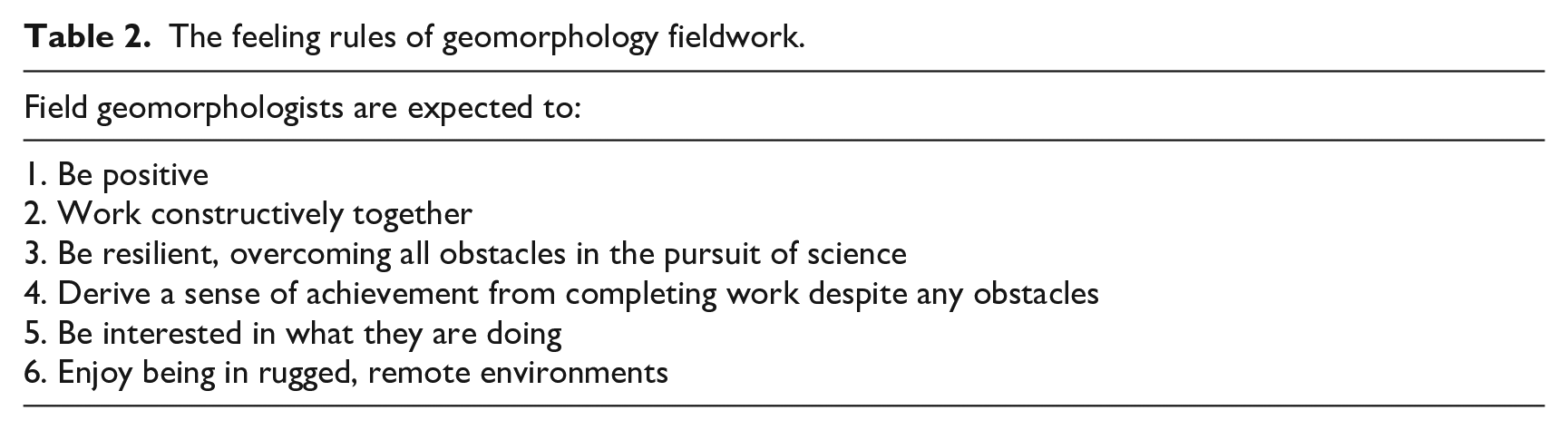
Articulated in this way, it seems readily apparent that feeling rules have a function in facilitating effective fieldwork. Two points are important here. First, field-based geomorphology is not just a disciplined way of thinking about the world/landscapes but a disciplined way of being. Critiques of fieldwork cultures as masculinist and heroic have long recognised this, with some emphasis on corporeal ways of being – a particular ‘body culture’, as Bracken and Mawdsley (2004) put it. Here, we have added insight that this is also an emotional way of being. Second, maintaining this way of being – aligning with or performing the feeling rules – can require emotion work in a variety of circumstances, even for those who most enjoy physical geography/geoscience fieldwork cultures. It is in the nature of feeling rules and emotion work that this work is invisible.
The wealth of literature on emotion work and emotional labour in different contexts and employment sectors indicates that the existence of feeling rules and consequent emotion work are part of the normal functioning of our social lives. In that sense, at least some of the emotion work by geomorphologists articulated here reflects that of working collaboratively in any setting: navigating hierarchies, coping with different ways of working or unmet expectations, for example. But fieldwork is also (often) different. Multi-day expedition-style fieldwork in remote locations detaches people from their normal support networks, requiring them to eat, socialise with and sleep alongside their co-workers. This suggests that fieldwork can be emotionally more intense than collaboration in the context of an office or university department. (Equally, it may be more time-limited than efforts to maintain working relations in those settings.) But as Bracken and Mawdsley (2004) rightly point out, the stereotype of expedition-style fieldwork does not reflect the realities of all fieldwork: one-day (or shorter) visits to local sites for ongoing monitoring are likely more common than might be imagined from literatures on fieldwork. But at least two of the participants in this study were engaged in research using this shorter form of fieldwork, and the stories recounted of field teaching also included non-residential fieldwork. While this kind of fieldwork may be less intense in terms of reduced access to social support networks, pressures to ‘get the job done’ in the limited time available and associated constraints limiting capacity to adapt to adverse weather conditions may be greater. So fieldwork has its own feeling rules and associated emotion work in part because of its occasional nature: it is different from everyday life.
Implications
This article has articulated the feeling rules of fieldwork and the emotion work of geomorphologists in adhering to such rules. In doing so, it brings to light ‘the realities of research’ (Svallfors, 2021 [2020]: xii) and teaching in the field. Although focused here on geomorphology, these feeling rules are very likely common across the field sciences given similarities of white, masculinist, able-bodied cultures (e.g. Nelson et al. (2017) on anthropology, Posselt and Nuñez (2021) and Nuñez et al. (2021) on geoscience, Nordseth et al. (2023) on ecology, Voss (2021) on archaeology).
Articulating feeling rules and recognising emotion work renders them visible, with potential benefits for individuals and the disciplinary community at large. First, it may be possible to better prepare novices for the experience of fieldwork. Rather than this being a hidden part of disciplinary culture – part of the ‘hidden curriculum’ in the context of teaching students (see Burbules, 2008 for a nuanced discussion) – it becomes possible to make clear a likelihood that fieldwork can place a range of emotional demands on those involved. A corollary of this is that the emotion work of fieldwork is normalised, in the sense that it is articulated as part of the ‘normal’ experience of fieldwork. This reduces the risk of early career researchers/fieldworkers thinking such experiences (perceived as negative) are theirs alone (Sundberg, 2003).
Second, it opens the possibility of conversations about how to better create supportive fieldwork environments. All members of the field party contribute to and influence the field environment for others. All participants thus have some responsibility for the impact of their actions on each other, for example, in avoiding the kinds of cultural insensitivities described in the ‘Within the team’ section above. It was clear from interviews that some PIs leading multi-day or multi-week field expeditions are adept at ensuring everyone has some ‘down time’, with room to either socialise or spend time alone as needed. Awareness that the emotional demands of fieldwork are different for different individuals, and may change over time (such as with parenthood or older age), should be helpful. Similarly, recognition that emotion work in the research team is always in the context of power dynamics and relations (Hubbard et al., 2001) is needed. This is illustrated through the example of ‘managing upwards’ recounted in this article: there is usually greater expectation on those leading fieldwork to manage both their own emotions and those of others, but that example was a female postgraduate managing her male advisor. Hochschild (2012 (1983)) observed that feeling rules are often classed and gendered, noting that a greater burden of emotion work falls to women than men. The self-censoring of the early career participant also offers evidence that social dynamics can impact academic contribution to field research practices, with the individual limiting their own influence on the research because of the social hierarchies of academic prestige. This is likely to extend to other social groups, including through the phenomenon of ‘stereotype threat’ (Niemann, 1999; Walton et al., 2013). This is where an individual is aware of negative stereotypes impacting their gender or ethnic group and concerned that poor performance will be interpreted as reinforcing that stereotype, a concern that negatively impacts their own performance. Given the overrepresentation (c.f. Wynter, 2003) of white males in the geosciences and ‘whiteness’ of fieldwork (Hughes, 2022), female researchers, Black researchers, researchers of colour and those with a disability (Rose, 2022) may be most likely to self-censor and to also be junior colleagues.
At the very least, openness that fieldwork entails emotion work makes it possible for those employing and managing field scientists (whether in academia, governmental organisations or commercial consultancy) to recognise, acknowledge and support emotion work. To go beyond this, field leaders likely need to actively strive to achieve a culture in which everyone is able to contribute. Part of this may be clearly articulating expectations of the day ahead, and then reviewing against them at the end of the day, as a means of supporting good working relations. 1 But that too would be dependent on establishing an emotionally or psychologically ‘safe’ culture for all.
Third, articulating the feeling rules of fieldwork provides further insights into the dominant disciplinary culture and the minutiae of how that culture is enacted. Given the colonial roots of fieldwork in geography, shaped by the European cosmological-philosophical-scientific-cultural shift separating mind from body and valorising the heroic pursuit of science as a service (to the State), this means better understanding the ways coloniality may be diffused through the discipline, present in specific sites or moments of individual action and agency. In our interactions with colleagues, and perhaps particularly in our interactions with students – the ways we present, prepare students for, lead and review fieldwork – this offers potential to choose to do things differently. 2
In sum, this article has articulated the feeling rules and emotion work of geomorphology fieldwork, its relevance very likely extending to physical geography and the field sciences more broadly. For many (including the participants in this study), fieldwork is primarily a positive experience – indeed, a key attraction to the discipline, and one that some find particularly inclusive. 3 That fieldwork also entails emotion work is not a negative thing per se, but field researchers are people with bodies and feelings. Acknowledging this fact may be positive for many. In the context of calls to decolonise universities and disciplines, and to develop critical physical geography, this study illustrates the value of geoscientists reflecting and engaging with social scientists (as advocated by Dowey et al., 2021), transcending the disciplinary boundaries into which we have been socialised.
Footnotes
Acknowledgements
I am grateful to all research participants for their generosity in sharing their fieldwork stories and to the three geomorphologists who gave feedback on the pilot questionnaire. I would also like to thank the two anonymous reviewers, for wholly constructive, helpful feedback on the manuscript.
Data availability statement
The data that support the findings of this study are not openly available in order to preserve the anonymity of participants, recognising that details of their research/fieldwork may render them identifiable.
Declaration of conflicting interests
The author declared no potential conflicts of interest with respect to the research, authorship, and/or publication of this article.
Funding
The author received no financial support for the research, authorship, and/or publication of this article.
