



Abstract
Recent mobility scholarship suggests that in adopting a holistic perspective on just transitions towards low-carbon mobility, scholars should attend to the role of knowledge production and the exclusions it enacts. However, this call has yet to be realised, for analytical tools and empirical studies are scarce. In this article, I fill these gaps, arguing that it is crucial to focus on the ‘politics of non-knowing’: contested understandings of what is unknown and what should and can be known. Drawing on the case study of the datafication of cycling in four European cities, I lay bare car-centrism’s epistemic effects, including a lack of data on cyclists, vehicle-centred understandings of knowledge and the instrumentalisation of non-knowing in political debate around cycling. I also examine the role of smart technology in these discussions. In closing, I propose a research agenda on the politics of non-knowing in just mobility transitions.
You asked about how we count, but I think what I’ll start with, though, is . . . who we don’t count. Quite often the answer to that is pedestrians [. . .] When you start to count pedestrians, as well as people on bikes it changes the way that you design your junctions or your intersections. If you don’t count them, it’s not surprising you design them essentially for the car.
Introduction
Given climate change, congestion, air pollution and persistent inequalities in mobility and accessibility, the need for societies to transition to low-carbon, fairer mobilities – what I term just mobility transitions – has become obvious (Adey et al., 2021; Schwanen, 2021; Wågsæther et al., 2022). Diverse actors aspire to steward these transitions. They range from cycling, walking, and transit activists to the ever-adaptable car industry, from entrepreneurs developing micro-mobility solutions to those in big tech who offer ‘data-driven’ solutions to mobility and accessibility challenges. Policymakers must make choices amid this shifting landscape of visions. A key aspect of decision-making in this context, which has only recently received some attention in mobility scholarship, is the role of knowledge in just mobility transitions. What kind of knowledge is used to develop policy? Who produces it? Which assumptions does it entail? Whose knowledges are ignored? Practices of producing and using knowledge matter for how just transitions are understood and enacted. This is because the current high-carbon mobility regime structurally excludes certain groups and their knowledges from participating in the governance of transitions, rendering certain values, worldviews, needs and behaviours invisible (Lowe, 2021; Schwanen, 2021; Sheller, 2018).
The epistemic dimensions of just mobility transitions may be crucial, but little research has put them front and centre. Instead, they are often mentioned alongside other aspects and processes that need to be considered. Empirical research on the politics of knowledge production in mobility remains scarce (exceptions include Butz and Cook, 2018; Moran, 2021; Sosa López and Montero, 2018). Furthermore, the dynamics of epistemic struggles and knowledge contestation are under-theorised and as yet unintegrated into key discussions around transitions in mobility scholarship and the multiple situated politics of mobility (Cresswell, 2010). Finally, amid the digitalisation and ‘smartification’ of mobility, as well as the use of big data and data-driven governance, there is little discussion 1 on how these processes influence epistemic struggles: could they empower those marginalised by practices of knowledge production or do they maintain the existing politics of mobility?
In this article, I fill these gaps and advance the debate on just mobility transitions by foregrounding their epistemic dimensions. Bringing together mobility scholarship, critical perspectives from digital geographies and research on the social construction of ‘non-knowing’, I propose an analytical framework for understanding the epistemic struggles entailed in mobility transitions and demonstrating its applicability through a case study. Through this framework, I make several key theoretical contributions: bringing the ‘politics of non-knowing’ framework (Beck and Wehling, 2012) into mobilities scholarship, linking it to the notion of the politics of mobility and developing a research agenda on the politics of non-knowing in just mobility transitions. Empirically, in this article, I analyse the politics of ‘non-knowing’ in action, applying my framework to the datafication of cycling in four European cities. I provide critical insight into the epistemic dimensions of the transition away from car-centric societies, how various actors define, evaluate, contest and mobilise non-knowing in the process, as well as the role played by smart technologies.
First, I present relevant discussions in mobility scholarship and digital geography, before outlining my framework for approaching the politics of non-knowing. Then the case study and methodology are set out. In the article’s main section, I discuss how the politics of non-knowing are implicated in cycling data in Amsterdam, Copenhagen, Dublin and Manchester and suggest how this theoretical lens might be applied to just mobility transitions more broadly. I conclude by elaborating a research agenda for future work in this area.
The politics of non-knowing and just mobility transitions
The politics of mobility, mobility justice and knowledge
Recent contributions in the study of sustainability transitions in general and transitions to low-carbon mobility in particular have underscored the need for policymakers to include justice-related goals in transition policies and for scholars to theorise and examine just transitions (Adey et al., 2021; Mullen, 2021; Sheller, 2015, 2018; Swilling et al., 2016). In discussions concerning how such transitions can be achieved, mobility scholars have argued that prevailing forms of knowledge in mainstream mobility planning must be challenged if mobility is to become more inclusive than it currently is (Kębłowski and Bassens, 2018; Schwanen, 2021; Smeds et al., 2020). In particular, its guiding rationales, underlying assumptions and over-reliance on quantitative methods, as well as the lack of diversity among transport officers, come in for critique (Lowe, 2021; Priya Uteng, 2021; Sheller, 2018; Vigar, 2017). Scholars urge the importance of critically examining the process of generating mobility knowledge; the worldviews, values and premises on which it is built; the effects of the predominance of quantitative methods; and the underrepresentation of women, minority genders, racial and ethnic minorities, and so forth in mainstream mobility planning (Lowe, 2021; Porter and Dungey, 2021; Schwanen, 2021; Sheller, 2018). To make knowledge production in the field of mobility more inclusive and make just transitions possible, one must ask which forms of knowledge production count as legitimate and useful and which do not, whose voices and situated knowledges are ignored, and how this epistemic marginalisation can be transcended (Schwanen, 2021; Sheller, 2018; Verlinghieri and Schwanen, 2020).
The scholarship nevertheless has several gaps. First, by and large, it lacks fine-grained, situated, and empirical accounts of the processes of knowledge production that centre the epistemic dimensions of the politics of mobility, show the multiplicity of understandings of what constitutes relevant and useful knowledge in specific mobility contexts and reveal the epistemic struggles around contested mobility policy goals. Second, mobility scholars have only recently begun developing analytical frameworks that specifically target the epistemic aspects of just mobility transitions and these frameworks have not linked these epistemic dynamics to the situated politics of mobility at multiple scales. 2 Drawing on Cresswell’s (2010) definition of the politics of mobility as ‘the ways in which mobilities are both productive of [. . .] social relations [of power] and produced by them’ (p. 5), I propose that there is much to gain from a detailed investigation of how the politics of mobility are related to the politics of knowledge production and use. In particular, it can be fruitful to borrow theorisations from social epistemology and the sociology of knowledge that have focused, for instance, on how different rationalities; types of argumentation and methods of data collection, analysis and presentation can be mobilised politically – on theories of how scientific inquiry is always selective and how power relationships shape various actors’ perceived credibility (Baert and Rubio, 2012). One approach developed in these disciplinary fields is the study of ignorance or non-knowing (Gross and McGoey, 2015b, 2022; Proctor, 2008). I would like to argue that applying this strand of thinking in an analysis of the epistemic dimensions of the politics of mobility can be very productive. This approach focuses on the social construction of silences and invisibilities in public discourse. It is these absences of certain types of knowledges, produced by diverse actors that debates on just mobility transitions and mobility justice seek to highlight. In the next section, I elaborate on the field of study concerned with the social production of ignorance and the specific framework that I apply in this article.
The social production of ignorance and politics of non-knowing
The social construction of ignorance has been theorised by historians of science, social psychologists and sociologists of knowledge (for an overview, see, for example, McGoey, 2012b; Smithson, 2008). The overlapping fields of ignorance studies and agnotology emerged as an approach to ignorance conceived of not as ‘an objective lack of knowledge’, but as something that is socially produced, maintained and contested (Proctor, 2008: 7; see also Gross and McGoey, 2015a). Ignorance is not ‘natural’ but a social construction with social causes and consequences. It can be mobilised by various social actors to stall or call for action. As Sedgwick (2008) aptly writes, ‘[I]gnorance is as potent and as multiple a thing [. . .] as is knowledge’ (p. 4). Intentional ignorance may take the form of ‘manufactured’ or ‘induced’ doubt, ambiguity and uncertainty. Classic examples of how ignorance is produced and utilised in social debate in this way are those of how the tobacco industry and climate change sceptics have called for ‘more research’ to obstruct decisive action (Proctor, 2008). McGoey (2012b) discusses how various actors use ignorance strategically as a ‘productive asset’, actively constructing and preserving knowledge gaps in their organisations to avoid responsibility if their products or services become implicated in serious harms to the public.
Ignorance is not always intentional but may still have negative consequences, such as when policies are discovered to have detrimental effects after their introduction. When ignorance is intentional, it is not always malicious. In some cases, there may be a scientific or broader social consensus that it is best not to investigate some matters because of the costs (e.g. the suffering of research subjects) or consequences (e.g. the choices that one may face after conducting genetic testing) associated with acquiring knowledge. For McGoey (2012a), creating ignorance also be ‘emancipative’ in situations ‘where deliberate ambiguity becomes a weapon against the dogmatic certainties and schematic impositions of others’ (p. 7).
A key insight from agnotological approaches is that the production of new knowledge and ignorance (or non-knowledge) go hand in hand; they are always co-produced, for in choosing to focus on something, one simultaneously chooses to ignore something else, even if inadvertently (Baert and Rubio, 2012; Proctor, 2008). For Gross and McGoey (2015a, 2022), ignorance is therefore not an exceptional or a ‘deviant’ state, but a ‘regular’ part of human experience and decision-making, both individual and collective. Particularly relevant to this article is the idea that the exact form that collective ignorance takes is political and demands scrutiny. Thus, Schiebinger (2004) discusses a ‘non-transfer’ of knowledge between Surinam and Europe in the context of colonial science in the 18th century. She focuses on a plant, flos pavonis, that had abortive qualities and was used by enslaved women to prevent their children from being born into slavery. Knowledge about this specific use of flos pavonis, Schiebinger shows, was not part of the massive production and transfer of knowledge in botany in general and concerning plants’ medical uses in particular. Documenting various forces behind colonialist knowledge production, which were entangled with racial and gender oppressions, she concludes that ‘gender politics lent recognizable contours not to a distinctive body of knowledge but to a distinctive body of ignorance’ (Schiebinger, 2004: 247).
The interrelated production of knowledge and ignorance has a distinct geographical dimension; several geographers have recently mobilised agnotological approaches (Katsinas, 2019; Marquardt, 2016; Murrey and Jackson, 2020; Scheel and Ustek-Spilda, 2019; Slater, 2016, 2021; Stel, 2016). Ignorance is produced socially and spatially. This might be through some places being ignored or excluded from knowledge production; knowledge about places being produced in some ways rather than others; or knowledge being produced at particular scales, such as through the aggregation of data that renders certain issues invisible (Frickel and Kinchy, 2015). In view of these insights, as well as on discussions of the epistemic aspects of mobility (in)justice outlined earlier, it is plausible to suppose that the dynamics of selective, partial, inaccurate or non-existent knowledge production outlined earlier apply to mobilities too. It is pertinent to ask, paraphrasing Schiebinger (2004), how does mobility politics shape particular bodies of ignorance?
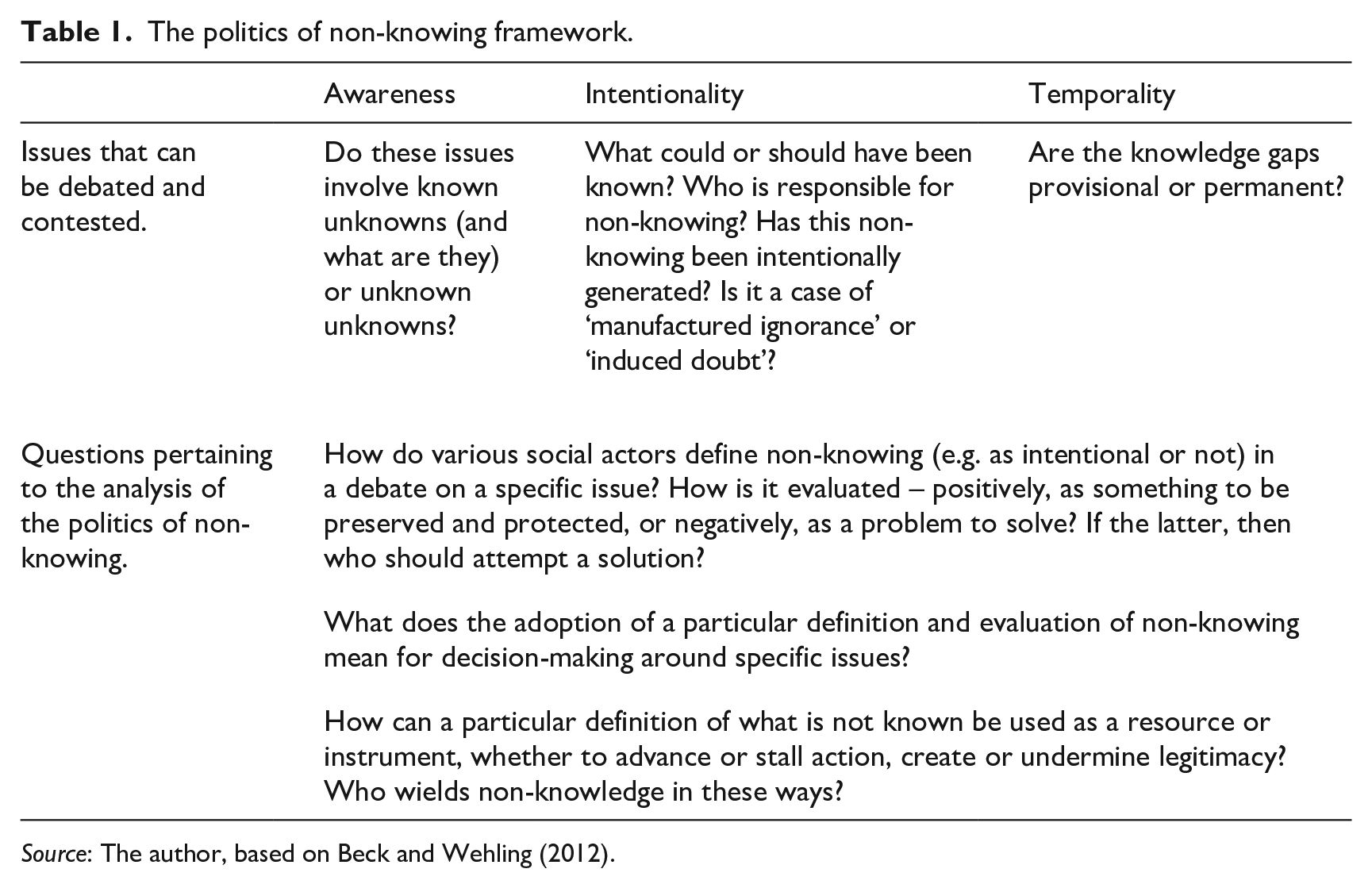
Drawing on these literatures, I argue that ideas relating to the social construction of ignorance should be applied to the politics of mobility. This has not been done as of yet. 3 Specifically, I would like to employ a theorisation of ‘the politics of non-knowing’ developed by Beck and Wehling (2012), which is somewhat broader than many agnotological accounts of non-knowing (Table 1). Although an agnotological approach is not necessarily restricted to the study of intentional, ‘manufactured’ ignorance or uncertainty, this is what a significant number of studies mobilising this approach have focused on (Aradau, 2017). Beck and Wehling (2012), in contrast, are interested in a broader discussion of how social actors define, contest and mobilise various dimensions of non-knowing. Furthermore, they hold that the term ‘ignorance’, unlike non-knowing, retains a negative and somewhat active connotation whereas they set out to explore a multiplicity of ways in which the lack of knowledge may be created, defined and evaluated. 4 Accordingly, they define the politics of non-knowing as ‘emerging social debates and conflicts concerning the recognition, definition, evaluation and communication of what is, or is supposed to be, not known’ (Beck and Wehling, 2012, p. 34).
The politics of non-knowing framework.
Source: The author, based on Beck and Wehling (2012).
In analysing specific cases of a politics of non-knowing, Beck and Wehling (2012) propose three dimensions ‘along which social actors contrastingly define and appraise what is not known’ (p. 38). The first is the (un)awareness of non-knowing: a lack of knowledge may be spoken in terms of ‘known unknowns’ (more or less specific gaps in knowledge that one may act on) or ‘unknown unknowns’. The latter is impossible to act upon, but it can be mobilised in a social debate, for instance, to argue that a certain technology should not be applied because its consequences are too complex to oversee and thus belong to the sphere of ‘unknown unknowns’. The point of contestation or the ‘political’ aspect of non-knowing, here, refers to the choice of whether a situation should be framed in terms of unknown unknowns (we do not know what we should be looking for) or limited knowledge (a known unknown that can be transcended); these two different framings may lead to different decisions.
The second dimension is that of intentionality, along which ‘non-knowing is differentiated according to the degree to which it seems to be attributable to the actions or omissions of individuals, social groups or organisations’ (Beck and Wehling, 2012, p. 39). Intentional non-knowing may refer to one’s own lack of knowledge or an attempt to keep others from knowing something. The politics of non-knowing associated with this dimension have to do, first, with the discussion and contestation over ‘what actors in a given situation could or should have known’. Second, controversies associated with intentionality might also revolve around the question of ‘how much one should know and what one should better not know’. Intentional non-knowing or ‘conscious ignorance’, for instance, can refer to ‘to the “right not to know” in predictive genetic testing’ (Beck and Wehling, 2012, p. 40). Third, it is within the dimension of intentionality that Beck and Wehling (2012) place the produced ignorance and manufactured doubt on which agnotological approaches have focused (Proctor, 2008).
The third dimension refers to the ‘temporality or persistence of non-knowing’. Here, one can distinguish between certain gaps in knowledge that are ‘provisional’ (i.e. something ‘not yet known’) and others that cannot ever be known (Beck and Wehling, 2012). Controversies over this dimension are not limited to but may relate to disputes over new technologies: Whereas critics point to unknown unknowns and to the enduring ‘unknowability’ of complex causal interconnections, the supporters of technologies assume that the relevant gaps in knowledge are specifiable and can be overcome within manageable time scales. (Beck and Wehling, 2012, p. 41)
Practices that define and evaluate specific instances of non-knowing using these dimensions are political in that the framings or constructions of non-knowing that win out and predominate over others shape public decision-making. Importantly, credibility in these debates, as well as access to means of producing and disseminating knowledge, is unevenly distributed among social actors, principally governments, private companies, research institutes, activists and people belonging to different social groups. Hence, the propositions concerning what is unknown and what can and should be known put forward by different parties have unequal weight. Beck and Wehling (2012) therefore stress the importance of investigating ‘who acquires the public power of definition over what is not known, its scope, its relevance and its possible consequences’ (p. 34).
The value of this approach consists, first, in how it clearly distinguishes different dimensions along which various social actors can evaluate non-knowing. It makes it possible for scholars to analyse the complexity of ‘definitional struggles’ over what is unknown, what should be known and what can be known; how various views may be linked to specific interests and implicated in power relationships; and the consequences of these debates. Second, according to Beck and Wehling (2012), particular framings or constructions of non-knowing are both objects of controversy and powerful political instruments or resources: The appeal to non-knowing can serve, on the one hand, to reinforce one’s own claims to knowledge or to justify corresponding research projects and, on the other, to undermine the (alleged) knowledge of others, to represent it as incomplete and to delegitimise it. (p. 51)
Analysing the politics of non-knowing therefore also entails investigating how non-knowing is used, by whom, towards what ends and with which results (Table 1).
Incorporating the politics of non-knowing into mobility scholarship
My argument has two strands. First, I claim that ideas from the studies of ignorance or non-knowing, specifically Beck and Wehling’s (2012) framework for approaching the ‘politics of non-knowing’, stand to enrich mobility scholarship. Second, I posit that the ongoing processes of mobility’s smartification, digitalisation and datafication, as well as the ways in which they intersect and potentially clash with the just mobilities agenda, require that those working in the field engage with the social construction of ignorance.
Processes of knowledge production and use in mobility are undoubtedly political and contested in the context of struggles for mobility justice (Moran, 2021; Schwanen, 2021; Sheller, 2018; Smeds et al., 2020). Despite this, mobility scholars have paid them surprisingly little attention. This began to change with the development of discussions around smart mobilities, digitalisation and the datafication of mobility: processes that introduced information and communication technology (ICT) and Internet of Things (IoT) technologies into mobility practices to expedite the planning, monitoring, governing and implementation of mobilities. Echoing and developing discussions in digital geographies and critical data studies, mobility scholarship began investigating concerns around the production and use of mobility-related data. Critical geographical research on smart cities and data-driven urban governance has argued for an examination of the politics of data (Kitchin, 2014; Leszczynski, 2016; Sadowski, 2019). Mobility scholars, likewise, have argued that ‘smart’, ‘digitalised’ or ‘datafied’ mobilities might potentially enact exclusions, maintaining or exacerbating existing inequalities because of a lack of representation of certain groups and experiences in the data on which they are based (Kwan, 2016; Schwanen, 2017; Vecchio and Tricarico, 2019). Furthermore, practices of data extraction, the monetisation of private data and enclosure of the ‘digital commons’ by the operators of various mobility services, also come in for critique (Sareen, 2021; Spinney and Lin, 2018). A recent theoretical intervention made by Behrendt and Sheller (2023), in particular, brings together the fields of critical data studies and mobility studies in order to interrogate the role of ‘datafication in the production of uneven mobilities and differentiated mobile subjects’ (p. 14).
In this article, I advance this debate by incorporating a focus on the politics of non-knowing into the discussion and developing a broader agenda on the social construction of non-knowing in the context of just mobility transitions. Much like the research discussed earlier, I draw on insights from critical technology and data studies, but attend to the other side of the picture. When employed to collect data, often within smart cities frameworks, smart technology does not just reveal knowledge. It obscures it too – through omissions and exclusions, but also through sheer information overload and by producing irrelevant knowledge. In these ways, it creates not only new knowledge but new kinds of ignorance too (Morozov, 2013; Parviainen, 2017). These observations resonate with studies of the social construction of ignorance and non-knowing, highlighting that the production of knowledge and ignorance entail and constitute one another. Unsurprisingly, some have suggested that the development of big data is only increasing the relevance of this approach, for ‘ignorance is not only generated from the absence of evidence; it can also emerge from conditions of evidentiary wealth’ (Frickel and Kinchy, 2015: 179).
Processes of mobility’s datafication, digitalisation, and smartification are already well under way. Indeed, traffic management systems work with real-time data, both in their daily operation and the development of predictive models. Multiple mobility service operators – from ride-hailing to bike-, car-, scooter- and step-sharing services – are used around the world. These processes are seen as part and parcel of mobility’s present and future worldwide (Canzler and Knie, 2016; Docherty et al., 2018; Pangbourne et al., 2020), yet their relationship with transitions to just mobilities is contested. To review literature questioning the impact of datafication, digitalisation and smartification on carbon emissions and the inclusivity of mobility would go beyond the scope of this article. For now, suffice it to say that it cannot be taken for granted that smart technology is having positive impacts on sustainability and mobility justice. Existing and potential smart mobility services have been criticised for possibly aggravating current mobility systems’ negative environmental and social effects rather than helping alleviate them (Groth, 2019; Milakis et al., 2017; Pangbourne et al., 2020; Spinney and Lin, 2018). Therefore, although the application of smart technology in mobility is by no means the only area in which to investigate epistemic struggles and their impact on the politics of mobility, it is critically important for just mobility transitions. And the lens of the politics of non-knowing is perfectly suited to exploring its epistemic dynamics.
In this article, I apply the framework focused on the politics of non-knowing to the case of the datafication of cycling. In this way, I develop a research agenda for a politics of non-knowing in just transitions. The following section explains why this case is particularly interesting when it comes to exploring these questions.
The datafication of cycling
There is consensus among scholars that cycling must play a significant role in transitions to low-carbon mobility and that local governments should create space for cycling to assume that role. Nevertheless, most cities in the world prioritise cars. In geography, planning and mobility scholarship, research on cycling experience, policy and infrastructure has grown exponentially over the last couple of decades. Yet, little work attends to the ways in which knowledge production and use are implicated in cycling’s subordinate status. To be sure, some scholars and activists have pointed out that cyclists, like pedestrians, have been marginalised in practices of counting (Oldenziel et al., 2016). Still, little is known about how this has affected and continues to affect cycling policy and planning. Moreover, the recent smartification and datafication of cycling realised through the introduction of IoT and ICT technologies, has led some to emphasise the connection between a lack of data and cycling’s marginal status: Currently, cyclists are
European Cyclists’ Federation believe that the new era of big data might therefore represent a unique chance for cycling (European Cyclists’ Federation, n.d.). Public–private projects that use smart technology to gather cycling data have proliferated around the world in the past decade, including in cities such as Portland, Dublin, Vienna, London, Brussels and Melbourne. One company, which supplies smart biking lights that collect data on cyclists’ movement, makes a case for their technology in terms characteristic of the wider sector: [T]he challenge is how to improve our cities [by] encouraging more people to cycle. The key is data. But no one is willing to pay for the deployment and maintenance of the sensor infrastructure to collect it. We’ve solved that problem. We’ve created ICON. [. . .] It monitors location, near-miss events, accidents, road services and temperature with incredible accuracy. This creates never before seen data giving cities the tools to make safer roads. (see Sense, 2017, emphasis mine)
There is also academic interest in the potential of new sources of cycling data (Lee and Sener, 2020, 2021; Sanguinetti and Alston-Stepnitz, 2023; Willberg et al., 2021). Although discussion on various technologies’ limitations and specific uses continues, there is little doubt that more knowledge about cycling is necessary. Behrendt’s (2020) study of European policy documents on IoT and mobility supports the sentiments expressed by the European Cyclists Federation and cycling tech sector. For Behrendt, ‘being data-poor’ in contexts of smart mobility ‘increases the risk of cycling becoming invisible in policy and industry discourses’. She therefore proposes ‘a data-rich cycling utopia’ to counteract the car’s domination (Behrendt, 2020: 104).
However, some scholars have argued that there is enough knowledge about cycling to elevate its status in car-centric cities. It is a lack of political will, not knowledge, that keeps cycling marginal (Darnton, 2016; Nello-Deakin, 2020). To refer to missing data, in this view, is almost to manufacture ignorance or induce doubt (Proctor, 2008). It amounts to stalling action: ‘the endless demands of decision-makers for yet another study, evidence review, survey or workshop is no more than an intellectually respectable way of deferring a decision, and of doing nothing’ (Darnton, 2016: 164).
This discussion suggests that the datafication of cycling represents an interesting case of the politics of non-knowing. For some, a lack of knowledge is a spur to action (e.g. launching smart data collection pilots, pursuing academic research). Others critique appeals to missing data, suggesting that they are merely ways of maintaining the status quo. Furthermore, given the bicycle’s recent ‘rise’ as a challenger to the car, debates around cycling knowledge and a lack thereof might be indicative of the shifting politics of mobility. Cycling has become central in debates on just mobility transitions. It is often seen as a harmless technology and truly low-carbon solution (unlike electric automobility, which is associated with high environmental costs). Also, it is a relatively inexpensive and simple technology: a low-threshold solution to air pollution, congestion, accessibility and public health problems. Yet cycling policies and infrastructure construction can lead, even if only indirectly, to various forms of exclusion (Hoffmann, 2016; Stehlin, 2019). Scholars have also argued that cycling’s smartification should not be automatically seen as beneficial for everyone. They may precipitate very different outcomes depending on the normative visions behind solutions such as bike-sharing services, the management of cycling infrastructure, and smart cycling devices, and on how they are implemented (Médard de Chardon, 2019; Nikolaeva et al., 2019; Popan, 2019).
Finally, developments in cycling are part of the datafication of mobility more broadly, in which there is more interest in gathering data on walking and intermodal mobility, and an emphasis on the data-driven governance of urban mobility. To account for what has been widely dubbed ‘data thirst’ and its entanglement in the politics of mobility, I adopt an understanding of datafication as not just the introduction of smart technology to collect cycling data, but also the attention being paid to cycling data more broadly. It includes expressions of the urge to get more data; the belief that data should be collected and used; attempts to collect various types of cycling data related to cycling on the part of local authorities, private companies, activists and others.
Research design and methodology
To understand how the politics of non-knowing operate in discussions of the datafication of cycling, how these politics relate to the politics of mobility, and what can be learned from them for just mobility transitions, the article presents the results of analyses of four European urban contexts: Dublin, Manchester, Amsterdam and Copenhagen. Each municipality has collected data using smart technology between 2017 and 2019 in the hope that it will prove useful for cycling policy. I will focus on two successful cycling cities and two aspiring cycling cities to reveal possible variations in discussions around non-knowing, cycling, and the politics of mobility. Amsterdam and Copenhagen are seen as worldwide leaders in cycling, with bike trips constituting, respectively, 35% and 41% of all trips in these cities in 2017 (Københavns Kommune, 2017; Nikolaeva and Nello-Deakin, 2020). Amsterdam has recently launched an ambitious vision for dramatically reducing cars’ role in the city (Gemeente Amsterdam, n.d.); Copenhagen’s aim to become the world’s first carbon-neutral capital is well known (The City of Copenhagen, 2018). To raise their low-cycling rates, Dublin and Manchester have invested in cycling infrastructure and bike-sharing schemes. Both cities host multiple activist communities engaged in various forms of research and cycling advocacy. Activism is more institutionalised in Amsterdam and Copenhagen, where it is largely pursued through cyclists’ unions.
In total, 80 individuals were interviewed during the research in 2018–2019. An approximately equal number of interviewees were connected to each city; a few interviewees (specifically technology developers) were familiar with more than one context. Respondents included city officials in transport planning and policy, representatives of cyclists’ organisations, and various professionals involved in data-collection projects, such as project managers, innovators and researchers. The interviews focused on methods of collecting cycling data (including but not limited to smart technologies), the availability of data necessary for planning, as well as perceived knowledge gaps, their causes and ideas concerning how to fill them. Interviews were recorded with interviewees’ permission. The transcribed interviews were coded thematically in two stages. The first, inductive stage generated multiple codes that captured the main ideas around knowledge and non-knowing related to cycling; in the second stage, the codes were consolidated into main themes linked to Beck and Wehling’s (2012) framework. That framework’s three dimensions do not exclude one another; debates linked to one might be discussed under the other two. By discussing each theme under a specific dimension in the following sections, I have sought to highlight the most prominent aspect of that theme’s relationship to non-knowing.
Awareness of non-knowing: Missing data on cycling and (slowly) moving away from car-centrism
Known unknowns: Invisibilities in car-centric cities
One of the main themes that emerged from the data was the idea that there is a dearth of data on cyclists and growing awareness thereof. The ‘invisibility’ of cyclists was often mentioned in this regard alongside the lack of data on pedestrians’ movements. This is illustrated by the epigraph and the following statement from a City of Copenhagen official: In a city like Copenhagen where 48% of all trips are done by foot or by bike, it’s quite a large proportion of traffic that is just completely invisible.
The interviewees suggested that this awareness has been growing with cycling’s increasing prominence in all four cities in the context of climate mitigation policies and public health targets. This goes especially for Amsterdam and Copenhagen, which have large numbers of cyclists and ambitious goals for transitioning to low-carbon mobility. According to some interviewees, a broader interest in smart technology and big data has played some role in developing projects that relate to cycling data collection. 5 Still, this broader interest was not a determinate factor.
In all four cities, interviewees spoke at length about specific knowledge gaps that I have discussed in terms of ‘known unknowns’. For instance, they mentioned that they lack data on cyclists’ real-time movements (available for car traffic), do not know why people choose one route over another, and lack accurate data on accidents and injuries. Many emphasised the importance of the latter. A Danish official working on cycling safety noted that the asymmetry in data on car accidents and cycling accidents is critical. This asymmetry, she suggested, indicates that there is too much focus on ‘metal being crumpled’ rather than on people’s safety.
The causes of these knowledge gaps seem related to the politics of mobility in car-centric cities and societies. According to the interviewees, transport research methods have been developed first and foremost to measure and understand car traffic, and to a lesser degree public transport. In other words, the priority has been monitoring vehicles that move in standardised, easily predictable ways. For a long time, cyclists’ movements have been of marginal interest, even in apparently successful cycling cities such as Amsterdam and Copenhagen: You planned for cars and you took bikes along. We started cycling more and more and we acknowledged we need something more real [in terms of data]. In the car world, we have big models that shape [. . .] our policy choices, our planning choices, and we did not have that for cycling. (A key figure in the Dutch Cyclists’ Union)
This narrative is confirmed by an official at the municipality of Amsterdam’s traffic management department, who lists a few reasons for there being fewer data on cyclists’ movements as compared to car traffic: traffic management departments’ ‘traditional’ focus on cars before a more recent ‘paradigm shift’; the technical difficulty of detecting bicycles accurately; and, relatedly, the flexibility and freedom of cycling, which entails diverse, unpredictable movements at different speeds through a variety of spaces: Cyclists [. . .] will get from A to B whether you want it or not. They are not limited to the bike road. They are limited to anywhere they can cycle [. . .] Detecting bicycles is much more difficult than cars because they behave more like a swarm of birds than as a line of cars. Cars are basically easy. You can recognise them by their license plate. You can recognise them by their weight. You can recognise them because they’re going very, very fast. Easy. Cyclists are difficult. They might be going ten kilometres per hour. Is it someone jogging or is it a cyclist? They could also be going thirty miles an hour, is it a car or is it a bike?
According to this official, now that more attention is being paid to cyclists in Amsterdam and nationally and the number of cyclists is growing in Amsterdam, there is a clear awareness of these knowledge gaps. There is also a desire to know more to be able to support the growth of cycling and provide safety in a cost-efficient way.
Similarly, a former manager of projects related to the smart city in Copenhagen discussed the possible roots of cyclists’ and pedestrians’ invisibility. The causes include a lack of financial incentives and, curiously, these mobilities’ limited negative impact on the city: We were specifically interested in pedestrians and cyclists because they are . . . a group . . . that we know the least about and that’s because they leave little trace, they don’t make noise, they don’t wear down the streets. There’s not a lot of incentive to actually collect data about them because you don’t have to spend that much money. [. . .] Especially pedestrians. We know almost nothing about those.
Interviewees in Manchester and Dublin also mentioned traffic managers’ traditional focus on cars. According to the officers working at Transport for Greater Manchester (TfGM), planning cycling infrastructure had not been their responsibility until recently. Since that changed, monitoring cycling has become important in drawing in investment for new cycling infrastructure. The officers shared that data on cycling (and walking) remains ‘patchy’ and their interest in new technologies is connected to a desire for better data. In Dublin, respondents also mentioned car-centric planning and knowledge production and dissemination. A cycling activist described how activists had noticed that the Central Statistics Office did not publish data related to cycling in their annual Transport Omnibus, whereas the data related to cars was detailed. They contested this discrepancy, raising awareness of the gap: We wrote to them and asked them why there was no mention of cycling. The following year, they actually reported the number of Dublin bike-share users . . . Sometimes, they were more interested in publishing the number of cars sold rather than the number of [bike] trips.
When it comes to the (un)awareness of non-knowing in cycling, car-centric thinking at a national level appears to be important in all four contexts. In Copenhagen, a transport researcher commented that some ‘traditional traffic planners’ at the Danish Road Directorate ‘just see bicyclists as work on the side, something on the side that interferes with car traffic’. In the Netherlands, some interviewees suggest that even transport officials who cycle themselves do not necessarily comprehend cycling and cycling knowledge. Indeed, they try to ‘copy-paste’ solutions from automobility when developing smart technology solutions for cycling data collection. Therefore, even in Amsterdam and Copenhagen, some interviewees believed that available cycling data need to ‘catch up’ with car data and that smart technology can help achieve that.
Unknown unknowns: The complexity of cycling knowledge
The predominance of cars in mobility knowledge has led to not only marginalised knowledge on cycling, but also a particular understanding of what counts as valid, useful knowledge in mobility policy and planning. The datafication of cycling poses questions to that understanding: What constitutes relevant cycling knowledge? Do we know what we do not know? Although many professionals talk about concrete knowledge gaps, the notion of unknown unknowns has also surfaced in some interviews, specifically in relation to cycling’s difference from driving. Indeed, it is seen as more embodied, personalised, flexible, free, independent and liable to being shaped by moods, feelings and preferences than driving. This generates challenges not just for collecting data, but also for understanding what kind of data one should collect in the first place and where to look for it.
Many interviewees suggested that knowledge about cycling is more complex than knowledge about cars. Given that cycling behaviour is much less regulated than driving and the diversity of cycling practices, mere numbers are a poor proxy for what happens on the street. In Amsterdam, where cyclists dominate some areas and this diversity is particularly prominent, many interviewees articulated the limitation of ‘numbers’. This was expressed by an official working at the municipality: If you give me a collection of numbers on car parking in an area, I can tell you what the problem is and what the solution is. If you give me the numbers on bike parking from the same area [. . .] I can tell you nothing. So numbers on their own tell you nothing (translated from Dutch by the author)
When asked if any type of data was very helpful to cycling policymakers, another Dutch cycling expert talked explicitly about unknown unknowns: ‘it’s very difficult to say, sometimes [relevant data] comes from unexpected areas’. A lot of data is gathered by people’s smartphones, automobiles and various actors such as the police and hospitals. There might be important data there that no one has thought of.
Interestingly, smart technology is perceived as able to turn unknown unknowns into known unknowns or knowledge gaps. Thus, a project manager (responsible for a pilot using devices mounted on bikes of volunteers to collect cycling data in Amsterdam) explained that he wanted to see if anything important was being missed: ‘What kind of data can we get from it? What can we do with the data? What things can the data tell us instead of what we already know?’ He also describes the challenge of deciding on the categories among which users could choose in classifying their experiences on the connected mobile application. Their experiences (and the possible meanings of those experiences) were so diverse that it was hard to come to an encompassing yet finite list of categories.
Interviewees in all four contexts discussed the necessity of bringing in qualitative data to grasp the multiple facets of cycling experiences. For example, in Dublin a smart device was developed to illuminate cyclists’ experiences by collecting spatial, quantitative and (through prompts) qualitative data. One of its developers said the following: My example is usually: 100 people cycled down the street in 2017. We went to 200 in 2018 [. . .] You doubled your numbers, brilliant, but what types of people? Did they like it? Did they say, ‘I’m giving up cycling next week, it’s miserable, there’s not enough space’?
A cycling planner working in Manchester shared a hope that smart technology will allow for the combination of qualitative and quantitative data. This is ‘essential’, he suggested, and might even allow planners to ‘quantify feelings’ and feed that information into future cycling modelling, based on patterns that differ markedly from currently available driving models.
Not all respondents shared that enthusiasm for technology and the drive to convert the unknown into the known: during interviews in the Netherlands especially, there seemed to be some recognition surfaced that cycling’s complexity and freedom might have a unique value that cannot be completely comprehended, quantified and ‘tamed’. Also, some challenge the very notion of that crucial knowledge on cycling is lacking. This will be my focus in the next section.
Intentionality: Mobilising non-knowing in just mobility transitions
Unintentional non-knowing
Unintentional non-knowing is pervasive: Respondents highlighted how cycling data collected through manual counts at fixed points, automated inductive loops in the road surface and smart mobile devices can be inaccurate and unrepresentative.
6
An awareness of these constraints was relatively consistent across interviewees and contexts. Strategies to transcend the limitations included combining data sources, seeking new sources of data and improving existing sources’ representativeness – by recruiting more diverse volunteers to mount monitoring devices on their bikes, for instance. Unintentional ignorance also arose in the interviews in connection with municipalities’ incapacity – technical, organisational, financial and human – to work with the data, especially that delivered through smart technology. Finally, non-knowing generated by data excess came up too. An application developer involved in an Amsterdam pilot explained how this can come about: Just imagine . . . you go to work every day the same way and there’s a hole. You mark the hole and now it’s on the map. You go tomorrow again, you mark it. Is it now two, is it one?
Professionals across the four contexts also mentioned data that is stored but unused, outdated or no longer accessible or usable for technical or legal reasons. These manifestations of unintentional non-knowing illustrate that producing more data does not necessarily advance one’s knowledge. Issues related to long-term technical and legal access to data (and the distribution of the right of access), database maintenance and institutional capacities for knowledge generation continue to shape non-knowing once data are collected.
Intentional non-knowing as an instrument
The first kind of non-knowing, which is much contested and some view as intentional, is associated with the argument that current knowledge is insufficient or uncertain. According to some interviewees in each context, local governments invoke non-knowing to question the necessity or urgency of investing in cycling or to explain delay or inaction. This appeal to lacking, insufficient, or uncertain knowledge is akin to ‘manufactured ignorance’ or ‘induced doubt’ (Proctor, 2008). Actors might contest the scope, relevance or very existence of such non-knowing. Usually, though not always, it is activists who challenge claims that sufficient knowledge is lacking. An experienced cycling activist from Manchester illustrated this contestation: I’m not opposed to collecting data. It’s important, but so often, it’s been a way of delaying change. Essentially, we know what we must do, particularly in cities like Manchester. We have surveys, we have research, we have studies going back 30-40 years [showing that] people don’t cycle because they don’t feel safe [. . .] It’s easy to say we should be collecting data on where people cycle and where they need facilities [. . .] but it’s so often just a way of dodging the responsibility of acting. [. . .] What we need more importantly is how you get people in positions of political or commercial power to act? [. . .] In a sense, we have the data. It’s coming out of our ears. How do we actually get them to look it up and go, ‘Yes. You’re right’.
An activist from Dublin shared a similar sentiment, referring particularly to the onus of data collection often falling on volunteers in activist circles: ‘We can say “yes, we can collect this data”, now what are you really going to do?’
Furthermore, a transport consultant from Copenhagen discussed current cycling data’s limitations and smart technology’s potential, yet concluded that political will is what matters: ‘I don’t think it’s the data collection that is a major obstacle, it’s more the will to act and make something change’. Investment is also key, according to a former policymaker responsible for cycling in Copenhagen: Copenhagen probably has data it needs to develop for the next decade. It needs money and it needs to be allowed to spend the money it already has, for the infrastructure that is needed.
From the perspective of these interviewees, smart technology pilots, though potentially interesting, are unnecessary and perhaps even a distraction. Political will, funding, and the building of cycling infrastructure must be prioritised; for some activists and experts, new data collection projects are not particularly useful. A representative of Amsterdam’s Cyclists’ Union explained that she sees cycling infrastructure advocacy as more important than smart technology pilots. Traditional forms of activism, she added, are more effective in pursuing action: ‘Changes and improvements in traffic plans are more easily achieved by regularly sitting on a committee rather than by results from such pilots’.
Non-knowing as a motivation to collect more data to defend cycling projects
Usually, it is activists or those working outside official planning and policymaking who frame intentional ‘non-knowing’ as justifying inaction. Against the charge that their intentional ‘non-knowing’ and consequent call for further data justifies inaction, interviewees working in local governments in all four contexts consistently defended the ‘thirst’ for data and the associated non-knowing. They need more data, they argued, not because they miss essential knowledge but to fend off colleagues who are eager to dismiss cyclists unless they receive data convincing them of the urgency, necessity and cost-effectiveness of investing in cycling. Put differently, in cities largely dominated by cars, the burden of proof that investments are necessary falls on those planning for cycling. Cycling projects still require more evidence to gain momentum than car-oriented projects: Still, we need these . . . numbers to have communication with the national level because otherwise [national administrators will say] ‘Now, they want money again’. It’s not the same question if you want to build a highway, ‘That’s investment that will be returned’, but if you talk about bicycle lanes, no, it’s just money out of their window. (the City of Copenhagen’s official)
In Copenhagen, the general argument that cycling is sustainable and healthy is accepted, but data are crucial whenever specific projects require money: Provide the data to the politicians, to the planners and then you can get something done [. . .] [I]t doesn’t always need to be proved that ‘we have these 20,000 bicyclists, why are there no bike lanes?’ It can also be that we have these people here, we know that they’re going over there, we need connections between the two [areas]. (Former policymaker at the City of Copenhagen) [At the national level] the politicians would be like oh, so there was one billion Danish krones, what have we back from the taxpayers’ money? . . . But then they’re building big bridges and waterways, and nobody is [saying] ‘so where have those thousands of billions gone?’ It always struck me like how cycling is not supposed to cost anything. (Project manager, the City of Copenhagen)
In Manchester and Dublin, a need to justify the very existence of cycling infrastructure, for reallocating space that cars might use is perceived as being politically difficult. A planner working at the municipality of Dublin explained that he needs ‘hard facts’ to overcome ‘huge resistance’. A recent plan to redistribute road space to create dedicated cycling infrastructure was rejected, he expanded, because cyclists were seen as unlikely to contribute to local business: In order to prove your case . . . you’re going to come up against people who [will say], ‘Show me why you want to remove cars or how can you prove that things like these need to be catered for’. [Therefore,] data to show that cyclists are consumers too that spend money is really important.
In Manchester, a planner summarised this thinking concisely: ‘The more numbers and figures you can quote, the better it is for everybody all round’.
Intentional non-knowing: Avoiding knowledge
Interviewees mentioned another way of intentionally mobilising non-knowing: avoiding knowledge to preserve one’s ideas or evade extra work or accountability.
7
A Dutch cycling data expert commented that sometimes people ignore data that does not align with their ideas or support political decisions that have been taken. Data can also mean accountability: An app developer active in many European cities mentioned that one (unnamed) city’s administration did not want the project in question to include pothole reporting because ‘they are liable’ if a known pothole causes a fall. Interviewees in all four contexts often noted a lack of one important kind of data: comprehensive and accurate data on cyclists’ fatalities and injuries. A Dublin activist described how There’s lots of data from the Garda [Irish police] that we don’t get, that would be very useful. The Road Safety Authority issues data on fatalities. They don’t issue data on serious injuries. I think that’s a real issue because [. . .] that figure would be frightening for some people.
The strategy of (passively) avoiding knowledge is also mobilised to promote cycling. For instance, everybody knows that automated cycling counters provide very imprecise data. Yet, as interviewees in Manchester, Dublin and Copenhagen suggest, this inaccurate data are used to convey the sheer number of cycling trips to cyclists and the general public, reinforcing the idea that cycling plays an important role in urban mobility (see Figure 1).
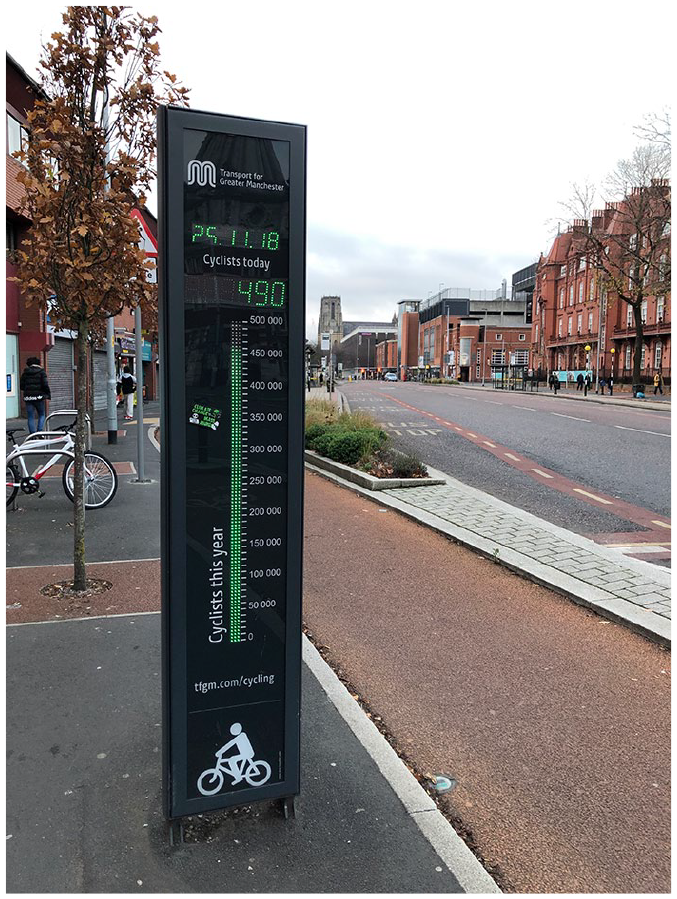
An automated cycling counter, Manchester.
In the same vein, Copenhagen made the news in 2016 by reporting that the number of bike trips had exceeded the number of car trips (Cathcart-Keays, 2016). These reports did not mention, though, that in that particular year, the counts were made on a September day that had been especially warm as compared to previous years. This partly explained the volume of cyclists in 2016 and subsequent ‘drop’. According to someone involved in the counting, nobody inquired about the circumstances of data collection: ‘We don’t keep it secret, but nobody wants to ask’.
Intentional non-knowing and privacy: What should not be known
Finally, privacy considerations also arose in conversations around intentional non-knowing. Many respondents emphasised data that policymakers do not want for legal or ethical reasons. An official from Amsterdam’s traffic management department explained that although having a Radio Frequency Identification chip on every bike in the city could be very informative for real-time traffic management and planning, it ‘would be very bad’ if it became possible to connect those chips to individuals: ‘I just don’t want to have that information’. A Dublin innovator explained how his work with users of other tracking devices prompted reflection on minimal data collection in developing a device for monitoring cycling. He described how users asked ‘how little data can you have to be able to have the same impact as if you collected all the data. That very much informed us’. Privacy-related legislation (GDPR) and the desire to avoid potential issues have significantly influenced data collection in all four contexts; the more tech-savvy interviewees went into considerable detail on this.
There is some debate over cyclists’ own attitudes to privacy. For some, people care little about their data in contemporary digital culture. For others, cycling culture has an element of freedom that people would want to preserve. In relation to this issue, a Dutch interviewee discussed the influence of smart city visions and potentially uncritical implementation of smart technology projects: ‘We can do this’, [they say but] should we? Which problem does it actually solve? The fear I have is that civil services and local government will be so overwhelmed by all those possibilities that they forget to ask those questions.
Another Dutch data expert (involved in planning national data collection) asserted that individuals should be able to ‘opt-in’ to having their bike movements tracked: ‘[Registering a] car is obligatory but [. . .] everybody should be free to use his own anonymous bike. That’s paramount’. To this expert, cyclists’ autonomy has implications for regulation in that more data makes it possible to control cyclists’ behaviour in new ways. Although some may want such regulation (perhaps to regulate bike parking in Amsterdam, which is often perceived as chaotic and unfriendly to pedestrians), others may desire to stay invisible.
Temporality: What is knowable?
The interviewees seldom broached the final dimension: the temporality of non-knowing, that is, its provisionality or permanence. They discussed aspects of ‘knowability’ that I have already covered in analysing other dimensions: the complexity of cycling knowledge, for instance, or issues of feasibility and privacy. The interviewees reflected on how cycling’s diversity, idiosyncrasy and embodied character confound classification and quantification: When it comes to cyclists, you have a very spread speed profile. Some people cycle very slowly, some very fast. You cannot really come to a very real average as such. (former traffic management official, Copenhagen; also see my earlier discussion of unknown unknowns)
Furthermore, various technical and financial issues mean that much data is too costly to collect and possibly unnecessary. This, combined with debates over privacy, suggests that some data will never be available, for cyclists will not ‘opt-in’ to provide it. 8
The politics of non-knowing in just mobility transitions: Synthesising the findings and a research agenda
Having used the datafication of cycling to explore intersections between the politics of non-knowing and of mobility, I have synthesised my findings and extrapolated questions for a research agenda on the politics of non-knowing in just mobility transitions (Table 2). Combining mobility scholarship and ignorance studies, the research agenda in the table’s fourth column poses a series of questions that play into a novel approach to understanding mobility politics broadly and just mobility transitions more concretely.
Synthesis of the findings and a research agenda.
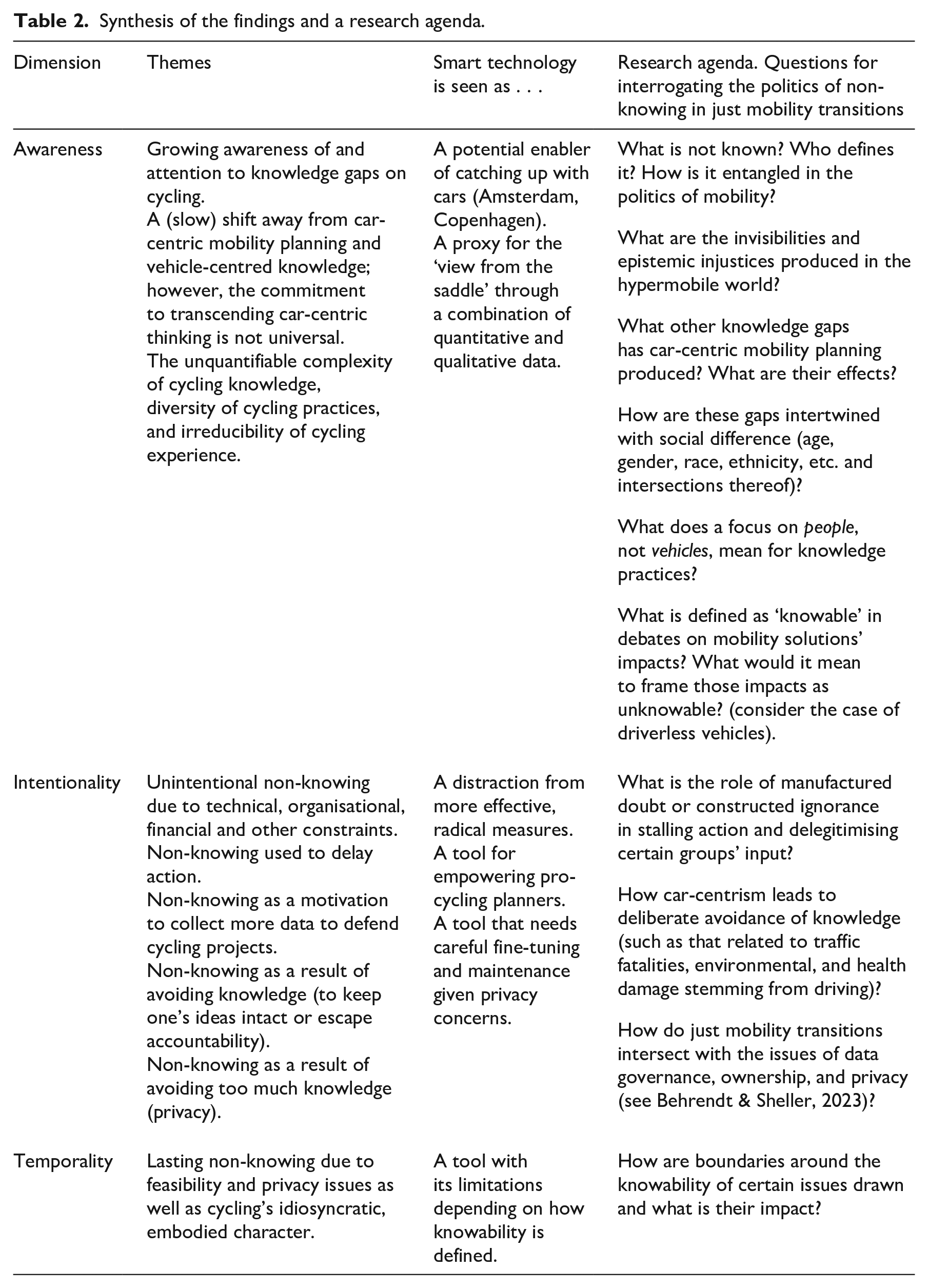
After presenting the table, I draw on current debates in just mobility transitions to discuss how cycling’s datafication exemplifies epistemic struggles in just mobility transitions. To demonstrate this case’s limitations and the research agenda’s analytical potential, I raise several issues pertaining to just mobility transitions, beyond the datafication of cycling.
Beyond the datafication of cycling: Reflection and examples
The case of cycling’s datafication reveals some of the contours of non-knowing in car-centric planning: vehicles are counted, understood and planned for, not people. Put differently, mobility politics shapes the politics of non-knowing, car-centric planning being a prominent force influencing what is unknown. As I expected in undertaking this research, the increased focus on cycling and walking had begun to change this. Given the focus of the research and choice of cities, however, it is possible that other dynamics shaping the contours of what is unknown were not identified. First, the research has taken place in four urban contexts in Northern and Western Europe. It is possible that car-centrism’s global dominance influences what planners, activists, and industry (claim they) do not know in similar ways across the world, at least partially. Still, more research is needed on how ignorance is constructed and mobilised in various contexts. 9 Second, prompted by my focus in this research, the interviewees framed cyclists in opposition to motorists, putting little stress on distinctions involving gender, race, age, income and physical ability. Building on work by Sanguinetti and Alston-Stepnitz (2023), Moran (2021), Smeds et al. (2020), Sheller (2018), The Untokening (n.d.), and others, the proposed research agenda calls for an understanding of the politics of non-knowing in relation to (intersectional) exclusions performed through mobility. This will help establish conditions for just mobility transitions. Scholars should continue unpacking how the entanglement of car-centrism, mainstream transport planning’s technocratic character and societal inequalities have produced ignorance about certain groups’ mobilities and certain types of mobility. They should also trace the interrelations among these forms of ignorance in various geographical contexts. For instance, more is known about commutes than ‘mobilities of care’, despite the fact that these two categories represent an almost equal share of urban populations’ total daily trips (Sánchez de Madariaga and Zucchini, 2019). Yet, planning bodies overlook the massive volume of mobilities of care because the surveys that they typically use do not consolidate such mobilities in one category (Sánchez de Madariaga and Zucchini, 2019). This striking gap connects with the dearth of knowledge on the mobilities of women and children (see, for example, Sagaris, 2020), who are more involved in mobilities of care than men. Furthermore, in many contexts, especially the poorest countries in the Global South (Loukaitou-Sideris, 2020), women often perform mobilities of care (and other types of trips) on foot. Pedestrian journeys, in their turn, are also likely to escape planners’ attention, as this article and earlier research (e.g. Patton, 2007) posit. Thus, invisibilities intersect and accumulate, with potentially dire consequences. Drawing on this insight, Priya Uteng (2021) comments that in the Global South, ‘it will be no surprise that a greater number of (pedestrian) women might be dying in traffic accidents and yet a sex disaggregated analysis of traffic deaths remains unavailable’ (p. 48). Empowering more inclusive mobility planning entails filling such gaps; ignorance studies’ analytical tools can play key roles in identifying their contours, the politics that shape them, and ways of transcending them.
I have argued that mobility justice struggles are epistemic struggles involving not only competing knowledges but also competing framings of non-knowing. What those in power present as non-known has direct consequences for political action. The datafication of cycling demonstrates that non-knowing or partial knowing can be mobilised to precipitate or stall action, to empower or undermine various actors. These insights can be transferred to research on other mobility practices, modes, and subjectivities, as well as to other scales entailed in just mobility transitions. Potential cases might include the politics of non-knowing in aviation and tourism (for some discussion, see Gössling and Scott, 2018) and the promotion of electric vehicles (EVs) and autonomous vehicles (AVs). The latter two cases illustrate how visions of transitions to sustainable mobility are driven by assumptions that are entangled with the politics of non-knowing. Thus, Henderson (2020) discusses how EVs’ multi-scalar negative environmental and social effects are ignored. This is leading to the electrification of mobility being embraced globally as the path towards decarbonised transport – a deeply problematic strategy from the perspective of mobility justice. In societal and academic debate on AVs, uncertainty and controversy surrounding their potential effects are also important (Pakusch et al., 2018; Thomopoulos and Givoni, 2015; Wadud et al., 2016). The proponents of AVs might argue that their potentially negative societal effects are knowable in principle; it is just a matter of time before they are identified and mitigated. Critics, though, can appeal to the potential unknowability of all significant repercussions of introducing AVs onto the streets. Beck and Wehling’s (2012) framework is useful for unpacking such debates.
The datafication of cycling illustrates how using smart technology to collect data amplifies not only knowledge, but also non-knowing, whether through technical and organisational challenges that produce data overload and unused data or through issues concerning representativeness and accuracy. Knowledge and non-knowing do not represent a neat binary, but interact in complex ways (see also McGoey, 2012a). The case also prompts questions as to the limits of what should be known and whether a tension exists between increasing data collection and the loss of some of mobile practices’ autonomy and freedom. This dynamic translates to other mobilities; further research on the datafication of cycling and smartified mobilities broadly could investigate the politics of non-knowing in relation to the commercial data collection practices of tech actors that are larger and more powerful than the municipalities and their partners discussed here. Furthermore, in the era of artificial intelligence (AI) and algorithmic governance, it is critical to examine how algorithms render certain mobile subjects and practices visible while concealing others (Behrendt and Sheller, 2023).
Conclusion
The politics of non-knowing, I have theorised, are part and parcel of the politics of mobility, and thus relevant for just mobility transitions. Drawing on studies of ignorance and non-knowing, I have argued that debates over what is unknown, can be known and should be known reciprocally shape the politics of mobility.
Testing these ideas against cycling’s datafication, I have laid bare car-centrism’s epistemic effects, including the structural ‘ignorances’ that it creates, the invisibility of some mobile subjects, and their struggles to gain visibility. Many pro-cycling stakeholders in government, civil society, and the private sector believe that collecting more data using smart technology can promote cycling where it is currently marginal and enhance cycling conditions in more ‘mature’ cycling contexts. Yet others frame this kind of non-knowing as manufactured ignorance and see requests for data collection and projects as a distraction (this recalls arguments by Darnton (2016) and Nello-Deakin (2020)). Finally, I have broached questions of what should be known and can be known in connection with the perception that the sense of autonomy and personal freedom surrounding cycling is at odds with knowledge production in car-centric cities. This provokes questions regarding the kinds of knowledge that planners should heed, look for, or create in cities that prioritise people over vehicles: Will bicycles become more visible and controllable like cars, with licence plates and chips, or will cycling retain its autonomy (cf Nikolaeva and Nello-Deakin, 2020; Popan, 2019)?
Finally, I have put forward a research agenda on the politics of non-knowing in just mobility transitions, proposing to investigate ‘definitional struggles’ over the awareness, intentionality, and temporality of non-knowing beyond cycling (Beck and Wehling, 2012). This contribution resonates with recent literature on mobility justice as necessarily including epistemic and procedural justice (Behrendt and Sheller, 2023; Sheller, 2018), and offers a concrete analytical strategy, conceptual toolkit and guiding questions. Given increasing investment in data infrastructures and data-driven governance, which promises to expand knowledge on mobility, it is imperative that scholars engage with the construction of various forms of non-knowledge and their role in mobility politics and transitions to fairer and greener mobilities.
Footnotes
Acknowledgements
The author would like to thank all those who participated in this research in Dublin, Manchester, Copenhagen and Amsterdam. All errors and omissions remain with the author.
Declaration of conflicting interests
The author declared no potential conflicts of interest with respect to the research, authorship, and/or publication of this article.
Funding
The author disclosed receipt of the following financial support for the research, authorship, and/or publication of this article: This work was supported by the VerDuS research program Smart Urban Regions of the Future with project number 438-15-160 397, which is (partly) financed by the Dutch Research Council (NWO).
