



Abstract
Overcoming the long-standing distrust of ‘research’ is especially challenging within the colonial structures of Western science. This article aspires to rise to this challenge by conceptualising Pūtaiao as a form of Indigenous research sovereignty. Grounded in Kaupapa Māori Theory, Pūtaiao is envisioned as a Kaupapa Māori way of doing science in which Indigenous leadership is imperative. It incorporates Māori ways of knowing, being, and doing when undertaking scientific research. An essential element of Pūtaiao is setting a decolonising agenda, drawing from both Kaupapa Māori Theory and Indigenous methodologies. Accordingly, this centres the epistemology, ontology, axiology and positionality of researchers in all research, which informs their research standpoint. This approach speaks back to ontological framings of Western scientific research that restrict Indigenous ways of researching in the scientific academy. Furthermore, Pūtaiao offers tools and language to critique the academic disciplines of Western science which are a colonial construct within the global colonising agenda. As such, the theoretical search for Indigenous science(s) and Indigenising agendas explore the dialogical relationship between both knowledge systems – Kaupapa Māori science and Western science. This relationship necessitates setting a decolonising agenda before an Indigenising agenda can be realised, whereby they are mutually beneficial rather than mutually exclusive. This article is an affirmation of the work and discourse of Indigenous scientists. In this way, Pūtaiao becomes a pathway for asserting Indigenous sovereignty over and redefining scientific research for future generations of Māori and Indigenous researchers.
Keywords
Introduction
Pūtaiao is used in the education sector to mean both science taught in Māori medium schools, including mātauranga (Māori body of knowledge, epistemology, and worldview) and more broadly in the New Zealand curriculum, as science. This article critically discusses Pūtaiao by conceptualising Kaupapa Māori Science. Drawing on Kaupapa Māori Theory, we describe some considerations for Indigenous research methodologies and discuss our experiences of attempting to do this work within the Western scientific paradigm and institutions. We weave theory, methodology, and our experiences together to imagine the way forward to decolonise, indigenise, and transform science. First, we describe the cultural and theoretical foundations for Pūtaiao, beginning with Kaupapa Māori Theory. This will focus on structuralist and culturalist decolonising agendas as expressions of Indigenous research sovereignty. Through Kaupapa Māori theory, Kaupapa Māori and Indigenous methodologies are then explored as the epistemological, ontological and axiological basis for understanding Pūtaiao in relation to scientific research. Critically, these methodologies demand centring of the researchers’ positionality within the research standpoint and inform the theoretical framing of research. As researchers, we then reflect on our experiences of researching within the science academy. This theoretical foundation, methodological standpoint and reflective practice lead our collective and radical imagining of a re-emergence of Pūtaiao, transforming science through Graham Smith’s Transformative Praxis of conscientisation, resistance and transformation.
Theoretical understanding of Pūtaiao
Conceptualising Pūtaiao as Kaupapa Māori science (drawing from Stewart’s (2007) Pūtaiao as Kaupapa Māori Science Education) is a political speaking back, researching back and writing back for the inclusion of Te Ao Māori (the Māori world). It also critiques the use and misuse of te reo (the Māori language) in science – specifically languaging, translating, and translanguaging Indigenous languages (hooks, 1994). Pūtaiao is more than a Māori word for science. It is an exploration of the natural world from a Te Ao Māori tirohanga (Māori worldview) that is scientific and informs science. Encompassed by systems of intergenerational knowledge, it is important to understand that Pūtaiao exists and thrives outside of the academy. Pūtaiao is embedded in place and in the people of those places. Grounded in Kaupapa Māori Theory, this article expands the theoretical foundation of Pūtaiao to be a way of being, knowing and doing as Māori in scientific research, ‘undertaken by a Māori researcher, not a researcher who happens to be Māori . . . being Māori, identifying as Māori and as a Māori researcher, is a critical element of Kaupapa Māori research’ (Smith, 2012: 243). Pūtaiao, as a contemporary construct, describes the pū – the origins, rhythms and relationships, of the taiao – the life-giving waters that animate the Māori world of light, broadly understood as the environment and natural world, including humans. Here, Pūtaiao centres, prioritises and critically affirms Māori identity in the context of scientific research and science identity.
Pūtaiao, as Kaupapa Māori science, is firmly positioned in a Māori worldview, and informed by te reo, mātauranga, and tikanga (a value system that underpins Māori culture) holistically interwoven by whakapapa (a way of knowing about the world through intergenerational relationships) and expressed through whanaungatanga (relationships, being in relation through whakapapa) as a way of approaching science. While science asserts that the scientist is the creator of knowledge, Māori ontology, and thus Pūtaiao, asserts that knowledges are held by and within te taiao, to be revealed through whanaungatanga, the relationships grounded in whakapapa.
The use of the terms mātauranga Māori, te reo Māori and tikanga Māori in research unintentionally marginalises the knowledge and epistemology from the Māori worldview by assuming a universal application of these concepts. Informed by the principles of Kaupapa Māori Theory we emphasise the understanding that the use of te reo centres the Māori worldview by default, rather than generalising for all worldviews. Conscious of this positioning, the terms te reo, mātauranga and tikanga will be utilised in this body of work in preference to te reo Māori, mātauranga Māori and tikanga Māori. In other words, mātauranga refers to knowledge already qualified as Māori, rendering the addition of the descriptor ‘Māori’ redundant.
A similar reclaiming of the word Pūtaiao is implicit in the conceptualisation in this article, where Western science more generally would be considered Pūtaiao o te Pākehā. In summary, Pūtaiao reframes the current scientific discourse around the inclusion of mātauranga Māori in science to consider the relationship between Te Ao Māori, and science through Kaupapa Māori Theory and methodologies. Importantly, science is not conceptualised simply as scientific knowledge but understood as a knowledge system. The case for the scientific knowledge system of mātauranga has been made previously (see Hikuroa, 2017). Knowledge systems have been described by Ngata (2021):
When I refer to knowledge systems I mean research, education, academia, scientific practice and publications, the evaluation and funding of science, the access to science and the legitimacy of science and its relationship to policy and government. It is a complex structure, the history of which is rooted in a period called The Enlightenment. The Enlightenment period, as the foundation of modern intellectual theory, was overseen by scientists and philosophers who were investors and clients of the slave trade and Imperial dispossession of Indigenous territories the world over, and their work supported those practices.
Kaupapa Māori theory
Kaupapa Māori stems from Māori identity, philosophies, values and principles. It is both a theory and a collective movement that carves out the theoretical space for te reo, mātauranga, and tikanga to be actualised in research, and knowledge more generally. With Kaupapa Māori, the validity and legitimacy of Māori ways of being, knowing and doing is assumed with the significance of te reo. Given this, Kaupapa Māori is concerned with the struggles for tino rangatiratanga, and collective efforts for autonomy and sovereignty to be realised for whānau (extended family), Hapū (a collection of whānau descended from a shared ancestor), Iwi (a collection of Hapū descended from a shared ancestor) and individual researchers across multiple spheres.
Kaupapa Māori Theory, as articulated by Graham Hingangaroa Smith, requires two simultaneous approaches to decolonisation – structuralist and culturalist (Smith, 2005). Culturalist approaches to decolonisation make theoretical space for, centre and amplify te reo, mātauranga and tikanga, and more broadly, Māori language, knowledge and culture. These can then become the foundations of scientific research. A structuralist approach asks how structures, systems and institutions act as barriers to hinder, oppress and ultimately deny culturalist approaches in research. Importantly, culturalist approaches alone are not sufficient to disrupt, decolonise and transform knowledge systems, such as science. This is illustrated by a critical examination of the colonial origins of science and the consistent use of science as both a justification for, and a tool of, colonial violence and oppression against Māori and Indigenous peoples. Culturalist approaches are distinguished from structuralist approaches by their focus on aligning space, structures and systems with Māori and Indigenous ways of being, knowing and doing. Structuralist approaches focus on acknowledging and addressing settler-colonial power, an essential element of Pūtaiao. Furthermore, this can manifest as intentional processes cognisant of settler-colonial foundations to directly address the core inequities and injustices of institutions that impact the opportunities and success of Indigenous researchers in science and Indigenous science itself.
Structuralist decolonisation of science – An essential element of Pūtaiao
Māori working within the discipline of science, including practitioners of Pūtaiao, are in relation and reflexive dialogue with coloniality in the scientific approach to knowledge. The separation of nature from culture which underpins science is mirrored in coloniality, which attempts to separate knowledge from language, culture, and most importantly, people, to ‘achieve’ objectivity. This demands that the scientist distance, and further, remove themselves from the object of study. Such an approach to mātauranga leads science to ‘reject the people that create and develop these knowledges and deny the validity of Indigenous peoples, autonomy, language, natural resources and cultural knowledges’ (Smith, 2021: 1). This is a stark contrast to Māori approaches to the relationality of knowledge, where ‘Māori hold relational ontology (whakapapa) that assume material communication with humans. Kaupapa Māori treats non-human beings and materials as speaking subjects that act independently . . .’ (Hoskins and Jones, 2017: 53). Reflexivity within science asks the researcher to understand their relationship with the disciplines within science and their field of study. This informs what researchers choose to study, the study methodology and methods, the outcomes of research that are disseminated and how they are disseminated. When framed in this way, even the most valiant and honest attempts at objectivity are still subjective:
No research is ‘objective’ if by objective one means standing outside of social power. For if research is truly impartial, how can we explain why we prioritise some social research projects over others or why some questions are asked, but not others? And how is it that different researchers interpret the same data so differently? (Walter and Andersen, 2013: 43–44)
In undertaking science (in the modern world), we are still in relation with these colonial approaches to knowledge. Even when critically amplifying te reo, mātauranga and tikanga, we are still in relation with science as a colonial construct. We cannot ignore, nor completely remove science in search of a Kaupapa Māori Science. Thus, Pūtaiao explores the dialogical relationship between science, the coloniality of science, and Te Ao Māori, inclusive of Māori worldview, language, knowledge and culture.
Science is often conceptualised through claims of universality and empirical experimentation consistent with the scientific method as a fallible, testable, assessable ‘best’ account of the current knowledge globally. This approach is based on key scientific theories and philosophical commitments to advance human knowledge and has become globally dominant. A community of scientific peers accept this foundation as the most appropriate for the search for an ‘ultimate truth’. The fundamental assumption made here is that science is acultural. Science understood in this way has been critiqued extensively by Indigenous scientists and educators, and increasingly more widely among scientists (Baptista and De Carvalho, 2015; Iaccarino, 2003; Seifert, 2021). Iaccarino (2003) argues,
Moreover, although the language of science is often specialized, and thus inaccessible to nonspecialists, science and culture are not different entities: science is part of culture, and how science is done largely depends on the culture in which it is practiced. (p. 221)
Importantly, these conceptualisations focus on science as scientific knowledge and scientific method, while ignoring the context of science as a knowledge system as described by Ngata above. The fundamental acultural assumption is disproven if science is described as a science system. If culture is acknowledged within the science knowledge system, Western science, in this context, approaches scientific knowledge and methods from a Western worldview, based on Western ways of being, knowing and doing. In contrast, Pūtaiao as Kaupapa Māori science centres Māori ways of being, knowing and doing. Both approaches are equally rigorous and create reliable knowledge. The participation of Māori within the science knowledge system, however, is not a choice to subscribe or assimilate to Western science or Western worldviews. Scientific knowledge and methods, when applied cognisant with colonial history can be used to advance and enhance mātauranga. As articulated by Hal Hovell (quoted in Ngata, 2018: 25), ‘Mātauranga Māori may at times be enhanced by Western science but must never be dictated by it’. Similar sentiments were shared by Will Ngakuru, in a workshop exploring how to address kauri dieback, stating ‘science needs to learn to be on tap, not on top’ (Will Ngakuru, 2014, personal communication).
The first step in conceptualising Pūtaiao is then to set a decolonising agenda. Based on decolonising methodologies, this calls for an understanding and addressing the colonial violence, harm and oppression that has been perpetrated by science (Smith, 1999). Te Rangi Hiroa (1924) reported in the Transactions and Proceedings of the New Zealand Institute (the predecessor of the Royal Society of New Zealand, the apex organisation of science in Aotearoa New Zealand, henceforth Aotearoa), that in 1856 physician and politician Dr Isaac Featherston infamously stated ‘The Māoris [sic] are dying out, and nothing can save them. Our plain duty, as good compassionate colonists, is to smooth down their dying pillow’. This often quoted callous imagery is used to illustrate scientific racism, where the investigation came to these conclusions based on facts, statistics and evidence. Science including eugenics, genetics, genomics, epidemiology have been, and in many cases continue to be, used to scientifically justify racism and colonial violence in the form of ‘genocidal violence (killing of peoples), linguicide (death of languages), epistemicide (destruction of knowledge systems), cultural genocide (destruction of cultures) and ecocide (destruction of eco-systems)’ (Havemann, 2016: 49). Scientific racism is often morally distanced from the current science knowledge system, through claims of pseudoscience. However, as Roberts (2011) warns,
Scientists today can then claim that it was pseudoscience that fell victim to racial prejudice, not real science, which studies racial difference objectively. But what we call racial pseudoscience today was considered the vanguard of scientific progress at the time it was practised, and those who practised it were admired by the scientific community and the public as pioneering geniuses. (pp. 27–28)
The colonial history and ongoing impacts of science need to be addressed before a culturalist decolonisation of science can be realised.
Kimmerer (2013) challenges Indigenous researchers to also acknowledge why we continue to undertake scientific research and the potential benefits to our people, while simultaneously cognisant of its limitations:
I did learn another language in science, though, one of careful observation and intimate vocabulary that names each little part. To name and describe you must first see and science polishes the gift of seeing. I honour the strength of the language that has become a second tongue to me but beneath the richness of this vocabulary and it’s descriptive power something is missing the same something that’s why I was around you and in you when you listen to the world. Science can be a language of distance which reduces a being to its working parts; it is the language of objects. The language scientists speak, however precise, is based on a profound area and grammar, an omission, a grave loss and translation from the native languages of these Shores. (pp. 48–49)
As Māori researchers of science, this is just as true for us. Decolonising science then requires us to hold these two truths simultaneously: the colonial violences of science and the potential contributions of science. To hold both truths in our work requires humility, acknowledging the limitations of science and our knowledge as scientists. It should not be our role to defend science or its systems, when colonial violences justified by scientific racism are indefensible. The lack of acknowledgement of the colonial harm and potential Indigenous benefit of science, simultaneously, contributes to the low participation of Māori in sciences. The lack of acknowledgement of colonial, scientific racism erodes the trust Māori have in the sciences. Due to this lack of acknowledgement, the potential scientific benefits in our mātauranga past, present and future are lessened, while predominantly focusing on science rooted in colonial racism. This also ignores the fact that as Māori, while centring our Māori identity, believe in the potential of science and scientific research to be beneficial to our whānau, Hapū and Iwi. As Smith (2021) concludes,
. . . critique is not enough. We have to continue to act, to use our own imaginations, to enhance our own institutions and forge our own pathways. Decolonization is a practice of hopefulness, a belief that there is a future . . . (p. 285)
Culturalist decolonisation of science – Māori-led and Māori-centred
To give context to culturalist approaches to decolonisation of research in Aotearoa it is important to start with descriptions of Māori language, knowledge and culture in terms grounded in the Māori worldview – te reo, mātauranga and tikanga. In Aotearoa, Te Ao Māori has taonga (treasured gifts) protected under Article 2 of Te Tiriti o Waitangi (The treaty of Waitangi). Article 2 states ‘ngā taonga katoa’ (every treasured gift) which includes te reo, mātauranga, and tikanga. As an institution in Aotearoa, this means science education and research in the academy must carefully and respectfully embed Te Ao Māori, where appropriate, to meet obligations to Te Tiriti o Waitangi as an institution of the Crown.
Te Reo
Translating colonial concepts to te reo, but understanding the word only as its translation into English fails to meet obligations to Te Tiriti o Waitangi. This approach is common throughout the science system and demonstrates a genuine attempt to include te reo, and by extension, Te Ao Māori in science. The appropriate use of te reo Māori calls for an intimate understanding of te reo Māori terms when used, from a Te Ao Māori tirohanga to give words context and meaning. This is significantly different to a simple, one word translation of terms into English. As illustrated by the whakatauākī of the kaumatua Sir James Henare,
Ko te reo te mauri o te mana Māori.
Ko te reo te kākahu o te whakaaro,
te huarahi ki Te Ao Tūroa.
Here, te reo is central to the spirit and self-determination of Māori. More than a mere translation of words, te reo ‘is like a cloak which clothes, envelops, and adorns the myriad of one’s thoughts’ (Smith, 2012: 244), and is the pathway to understanding the enduring natural world. Indigenous words and Indigenous languages offer an intergenerational wealth of knowledge that can inform, educate, reframe, illustrate, inspire and create a deeper understanding and relationality with the many worlds we walk in. This framing of te reo is referred to as translanguaging, grounding the process in the Māori worldview and addressing ‘the incommensurability inherent in this translation process’ (Roberts et al., 1995: 12).
Mātauranga
Reclaiming the meaning of words in Te Ao Māori encourages us to understand Pūtaiao differently. Distinct from Western science, Kaupapa Māori Science defines mātauranga as a superset of scientific knowledge. As articulated in Hikuroa (2017),
Clearly there are significant similarities between mātauranga Māori and science. Specifically, pūrākau and maramataka comprise knowledge generated consistent with the scientific method . . . Both mātauranga Māori and science are bodies of knowledge methodically created, contextualised within a world view. As demonstrated herein, some mātauranga Māori has been generated according to the scientific method, and can therefore be considered as science. (pp. 8–9)
That is, there is a subset of Mātauranga that because of the method used to generate it, can be considered science. The number of Māori scientists and the capacity of scientific knowledge in whānau, Hapū and Iwi is growing and mātauranga Māori is a living, dynamic knowledge system. With that, this subset of mātauranga continues to grow. However, mātauranga is a culmination of knowledge held by Māori intergenerationally, descended from an intellectual genealogy shared across Te Moananui a Kiwa (The Pacific Ocean) and contributed to, articulated by and reiterated for each generation. It contains all that has emerged from Te Ao Māori – te reo, tikanga, and whakapapa. Therefore, much of Mātauranga is beyond the discipline of Western science and can enrich our experience of science when led by Māori and engaged with appropriately.
Mātauranga is central to Kaupapa Māori. Mātauranga is both a body of knowledge, and an epistemology – a way of knowing and worldview. Royal (2009) states that,
The purpose of indigenous knowledge is not merely to describe the world (acquire facts about phenomena) but ultimately to understand how one may live well in it. Indigenous knowledge is thus value-laden and value-driven. It seeks mutually enhancing relationships between the human community and the natural world. (p. 114)
Here, whanaungatanga, relationships, are a critical element of Kaupapa Māori, mediating research at every stage. Extending on this, Hoskins and Jones (2017) express that,
The identity of ‘things’ in the world is not understood as discrete or independent, but emerges through and relates to everything else. It is the relation, or connection, not the thing itself, that is ontologically privileged in Indigenous and Māori thought. (p. 51)
This is the nature of how we come to know as Māori. Literature, both academic and the literature shared through whakapapa kōrero (ancestral narratives, histories), waiata (songs), whakataukī (proverb, aphorism), whakairo (to carve), and many more ways are key to expressions of mātauranga within Pūtaiao. The environment is central to understanding mātauranga, as Durie (2005) explains,
The relationship between people and the environment . . . forms an important foundation for the organisation of indigenous knowledge, the categorisation of life experiences, and the shaping of attitudes and patterns of thinking. Because human identity is regarded as an extension of the environment, there is an inseparability between people and the natural world. (p. 137)
In turn, this exploration of Pūtaiao is naturally and necessarily about our human and more-than-human relationships, with and within the natural world.
Tikanga
Relationships are mediated by tikanga. In short, knowledge of te reo is essential to the communication of tikanga codified and informed by mātauranga. Tikanga is an essential part of mātauranga, neither can be understood independently. Te reo and mātauranga are a part of the understanding of tikanga, and vice versa. Through tikanga, knowledge is translated into practice in the form of ritual and general correctness of actions. Moana Jackson (2020) states that
In simple terms, tikanga is a values system about what ‘ought to be’ that helped us sustain relationships and whaka-tika or restore them when they were damaged. It is a relational law based on an ethic of restoration that seeks balance in all relationships. (p. 140)
In this way, the practice of tikanga can then be an empowering process, ‘People then see tikanga in action, and they do it, feel it, understand it, accept it and feel empowered through experience’ (Mead, 2016: 19). Therefore, tikanga guides all actions and interactions while simultaneously affirming Māori identity. As such, adhering to tikanga as an ethical framework is an essential element to Pūtaiao, and Kaupapa Māori Theory more generally. From this description of Kaupapa Māori Theory, te reo, mātauranga and tikanga, Kaupapa Māori methodologies, drawing on Indigenous methodologies, can explore how these principles and concepts are expressed within scientific research and practice.
Kaupapa Māori methodologies and research
In this section, we shift from Kaupapa Māori as theory to considering Kaupapa Māori research and the implications for methodologies. Before considering Kaupapa Māori methodologies, methodology should be more broadly considered:
Methodology can be viewed as the theory and study of the methods used in research to produce knowledge and make meaning in a given field or discipline of knowledge . . . methodology is what forms the interpretative link between the ways in which knowledge is defined and understood and the practices of inquiry that are used by those who research and conduct scholarship. (Smith et al., 2016: 140)
Kaupapa Māori theory provides the overarching theoretical lens to inform Kaupapa Māori methodologies and therefore Pūtaiao, guiding how research is understood, designed and practised. Here, it may be beneficial to consider the reframing of methodologies by Smith et al. (2016), ‘in its simplest form, methodology explains the pathways between knowledge creation and knowledge production – the formation of knowledge’ (p. 140). Kaupapa Māori methodologies can then be understood as the study of Kaupapa Māori theories and principles that guide the formation of knowledge to inform research practice and methods.
This inherently prioritises a Māori worldview, inclusive of epistemology (Paul-Burke et al., 2020), ontology (Hoskins and Jones, 2017), axiology (Mead, 2016) and positionality (Walter and Andersen, 2013). Wilson (2008) states ‘The ontology and epistemology are based upon a process of relationships that form a mutual reality. The axiology and methodology are based upon maintaining accountability to these relationships’ (pp. 70–71). This construction of Indigenous methodologies provides,
. . . an overarching definition of what a methodology is – a starting point that underpins all methodologies not just Indigenous or just traditional Western methodologies . . . Who we are, the values that underpin our concept of self, our perspectives on the world and our own position within it, our realities, and our understandings of how knowledge is construed and constructed are each part of the complex puzzle involved in exploring the underpinnings of methodology. (Walter and Andersen, 2013: 44–45)
Drawing on the work of Smith (1999), Wilson (2008) and Walter and Andersen (2013), the following theoretical and methodological framework is suggested, relating overarching Te Ao Māori constructs to research paradigms. Indigenous research paradigms are inherently interconnected, relational (Wilson, 2008) and, in this case, considered from the theoretical foundations of Kaupapa Māori theory. This is inclusive of both structuralist and culturalist approaches to decolonising methodologies described above. In the next section, the interconnected components of Kaupapa Māori methodologies are conceptualised.
Whakapapa informs researcher’s epistemology
Epistemology explores what is defined as knowledge, which knowledges are valid, legitimate and valuable, what are the foundational assumptions for what can be known, what constitutes knowledge, and who are knowledge holders – both human and more-than-human (Smith, 2012; Walter and Andersen, 2013). Indigenous epistemology includes entire knowledge systems of Indigenous ‘cultures, worldviews, times, languages, histories, spiritualities and places in the cosmos’ (Wilson, 2008: 74) that results from relationships. Therefore, epistemology is more than a way of knowing (Meyer, 2001).
Kaupapa Māori as critical theory (Smith, 2012) and social constructionism (Le Grice, 2014) inquires into contexts, experiences, coloniality, and intersectionality to explore social and scientific issues of pertinence to Māori. A social constructionist epistemology (Gough et al., 2013) aligns with decolonising agendas by understanding cultural, historical, political and social contexts surrounding a given phenomenon. Exploring the function of knowledges to justify our epistemic marginalisation enables us to disrupt, decolonise and transform these processes (Denzin and Lincoln, 2008). This aligns with Moewaka Barnes’ (2010) approach to Kaupapa Māori research that centres Māori people, culture, and constructs in analysis, rather than accepting an uncritical positioning as ‘other’.
From Kaupapa Māori critical theories and social constructionist approaches we explore how whakapapa ‘provides the theoretical or epistemological basis for a Maori “way of knowing” about the world’ (Roberts, 2013: 93) where ‘whakapapa maps epistemologies (including tribal concepts, principles, ideas, and related practices) and locates them within a particular context’ (Bean et al., 2012). As described by Burgess and Painting (2020),
The concept of whakapapa explains the origins, positioning, and futures of all things. Whakapapa derives from the root ‘papa’, meaning a base or foundation. Whakapapa denotes a layering, adding to that foundation. Rooted in creation, generations layer upon each other, creating a reality of intergenerational relationships. Everything has whakapapa, all phenomena, spiritual and physical, from celestial bodies, days and nights, through to the winds, lands, waters, and all that transpires throughout. (p. 208)
Whakapapa, is not only a body of knowledge but a way of understanding the universe, and all its complexities, by weaving existence together within genealogical constructs as the foundation of Māori ways of being, knowing and doing.
Mātauranga
From this epistemic foundation, the research context for mātauranga can be further explored. However, mātauranga must not be analysed with deconstructive, generalising or universalising intent, as this runs counter to the epistemological assumptions of Pūtaiao – the validity and legitimacy of holistic, interconnected, whakapapa-based knowledge (Le Grice, 2014). Such intent will only continue to suppress cultural knowledge through colonising objectives and practices. Mātauranga is dynamic; connected to the bearer and receiver; in relation to whanau, Hapū and Iwi; includes reading the stars, the moon, environmental patterns and landscapes; includes narratives of colonial resistance and Māori excellence; includes intuitive approaches to relational encounters and meaning making (Smith et al., 2016). Critically, mātauranga reframes what counts as knowledge in the context of science research, in what Jackson (2013) describes as an ethic of prior thought,
That is, that if we are to do research, if we are to make sense of who we are, or what is happening to us, then we must have the confidence to reach back to the prior thought that has been left for us by our old people . . . In a very real way that tradition should be, if you like, the literature review of any research that we do. (p. 61)
This mātauranga could include Toi whakairo (carving) (see Mead, 1986), Raranga (weaving) (see Mead, 1968), Kapa haka (contemporary performance) (see Whitinui, 2007), Whaikōrero (oratory) (see Rewi, 2013), Karanga (oratory) (see Houpapa, 2021), Maramataka (astronomy, fishing and gardening calendars) (Matamua, 2017; Roberts et al., 2006; Tāwhai, 2013), Pūrākau (narratives) (see Roberts, 2013), waiata, mōteatea (songs), oriori (genealogies and invested hopes sung to babies) (see Ngata, 2004), intergenerational wisdom, memory and practice (as referenced in Smith et al., 2016). Whakapapa demonstrates how to weave together diverse sets of practices and knowledges to understand Māori epistemology, and can further include conventional scientific literature, academic accounts of mātauranga, and cultural narratives.
Whanaungatanga informs researcher’s ontology
Ontology considers the nature of reality, how it is observed and investigated (Hathcoat et al., 2019). Indigenous ontologies have multiple realities, as such, relationships hold profound importance within and between these realities (Hoskins and Jones, 2017; Wilson, 2008). For Indigenous peoples, these relationships do not merely shape reality, they are reality; therefore, ‘reality is not an object but a process of relationships’ (Wilson, 2008: 73). As articulated by Hoskins and Jones (2017),
The identity of ‘things’ in the world is not understood as discrete or independent, but emerges through and relates to everything else. It is the relation, or connection, not the thing itself, that is ontologically privileged in Indigenous and Māori thought. (p. 52)
Thus, Indigenous research is relational in its approach, perception and execution of research (Walter and Andersen, 2013). This implies that Indigenous ontology is deeply relational and holistic in a way that overlaps with and, at times, can be considered the same as, an Indigenous epistemology (Wilson, 2008).
Māori experiences of the world that constitute our lived realities are internally diverse, complex and shaped by different proximities to Māori language, knowledge, culture and people, rendering further ontological questions salient (Le Grice, 2014). In a colonial context, where our knowledges and experiences are routinely undermined in academic discourse, an ontologically realist orientation is useful. Here, when conducting research with whānau, Hapū, Iwi and Māori communities – shared experiences, beliefs, ideals and behaviour are interpreted as real and valid to be legitimated in academic discourse. Simultaneously, we might also recognise the internal diversity of Māori experiences and local knowledges, such that there may not be one ‘true’ or comprehensively singular perspective shared by all Māori. Here, a relativist ontology might be useful in situating intersections of age, race, gender, class, sexuality, rural and urban positionalities in a sociocultural context configured by matrices of power relations, and multiple perspectives within and between Iwi, Hapū and whānau. In this way, a Māori ontology is inclusive of specific ontologies of diverse whānau, Hapū and Iwi, based on shared understandings and experiences through whakapapa.
Māori ontology positions all of existence in whanaungatanga, ontologically privileging intergenerational relationships through whakapapa, fundamentally the ‘essential nature of all reality’ (Burgess and Painting, 2020; Hoskins and Jones, 2017). The nature of being is to be in relation, where relationships constitute not only our reality, but who we are. ‘Everything in existence is infinitely and complexly in relation all the time. This shapes a reality of interdependency, where the well-being of the whole is dependent on the well-being of its closely related components, and vice versa’ (Burgess and Painting, 2020: 210). We are intimately connected to innumerable generations into the past, across the present, and equally as important, into the future. The nature of these relationships can be genealogical, social, environmental, astronomical and cosmological in nature (Roberts, 2013).
Whanaungatanga positions people within dynamic relationships between atua (ancestors of continuing influence) and whenua (land) (Tate, 2010), interactive relationships with environmental kin (Jahnke, 2002), as well as the socio-political interactions with and between peoples (Walker, 2004), defining a ‘symbiotic relationship between humans and nature in which the health of each depends upon that of the other, which in turn places responsibilities upon communities and individuals’ (Henwood and Henwood, 2011: 221). It is through whanaungatanga to aspects of whakapapa that mātauranga is gained (Royal, 2009), intimately linking Māori epistemology to Māori ontology. Science asserts that the scientist is the creator of knowledge, Māori ontology, and thus Pūtaiao asserts that knowledges are held by and within te taiao, to be revealed through whanaungatanga, the relationships grounded in whakapapa.
This Māori ontology argues that establishing and maintaining whānau (extended family) relationships with all components of research is fundamental, extensive and ongoing. This must precede and contextualise all other research activities (Le Grice and Braun, 2016). In research, a Māori ontology challenges our conceptualisation of research relationships to expand, in the form of peoples, more-than-human kin, landscapes and environments based on the shared understanding that no interaction is neutral or objective and no land is empty – without connection through whakapapa. A relationship with more-than-human kin, landscapes and environments necessitates two things; one, a relationship with peoples, whānau, Hapū and Iwi, who hold intergenerational relationships within those environments, and two, an acknowledgement that more-than-human kin, landscapes and environments are more than research objects, or even subjects, and are instead research partners. This reorders what constitutes research relationships based on whanaungatanga to reaffirm the importance of relationships in the research process.
Te reo Māori
Fundamental to a Māori ontology is te reo, the means through which we describe the nature of being. Embedded in te reo, and in Indigenous languages more generally, is the grammar and vocabulary that explicitly acknowledges whanaungatanga. Kimmerer (2013) describes this characteristic of Indigenous languages as the grammar of animacy:
In English, we never refer to a member of our family, or indeed any person as it. That would be a profound act of disrespect. It robs a person of selfhood and kinship, reducing a person to a mere thing. So it is that in Potawatomi and most other indigenous languages, we use the same words to address the living world as we use for our family. Because they are our family. (p. 55)
Te reo and the grammar of animacy changes language from ‘it’ to ‘who’, an acknowledgement of whanaungatanga and shared whakapapa. This comes with a set of responsibilities, obligations and customary practices in interacting with our kin that differ significantly from current scientific practice. Kimmerer (2013) continues,
To whom does our language extend the grammar of animacy? Naturally, plants and animals are animate . . . rocks are animate, as are mountains and water and fire and places. Beings that are imbued with spirit, our sacred medicines, our songs, drums, and even stories, are all animate. (p. 56)
In this way te reo and Indigenous languages ‘[remind] us, in every sentence, of our kinship with all the animate world’ by redefining who is animate and aiming for bilingualism ‘between the lexicon of science and the grammar of animacy’ (Kimmerer, 2013: 56).
Implicit to te reo is the knowledge of how to live in and care for te taiao. Culture, language and environmental well-being are interconnected (Maffi, 2005) where the cherishing and uplifting of one independent of others is impossible. Therefore, revitalisation of te reo is mutually beneficial to maintaining, enhancing and advancing mātauranga of the taiao (McAllister et al., 2019) and the enabling of the customary practices of tikanga (Mead, 2016). That is to say, a Māori ontology and Māori epistemology interrelate with a Māori axiology – a Māori way of doing.
Tikanga informs researcher’s axiology
Axiology is informed by intrinsic and extrinsic values, the value systems that guide research practice (Walter and Andersen, 2013), ethics and morals that underpin how research gains knowledge and what knowledge is used for (Cram, 2019; Curtis, 2016). An Indigenous axiology emerges from the relational accountability implicit in Indigenous epistemology and ontology (Wilson, 2008). This refocuses research on the fulfilment of roles, responsibilities and obligations to research relationships – being accountable to whanaunga. ‘The knowledge that the researcher interprets must be respectful of and help to build the relationships that have been established through the process of finding out information’ (Wilson, 2008: 77). Indigenous research must therefore be of direct benefit to Indigenous peoples. This acknowledges that
all researchers make choices within their research, and these choices not only have an integral values base, they also influence how the data are interpreted and presented . . . Gaining insight into our axiological frame . . . allows us to read our own research and that of others reflexively, with an eye to the values informing it. (Walter and Andersen, 2013: 51)
The ‘responsibility to ensure respectful and reciprocal relationships becomes the axiology of the person who is making these connections’ (Wilson, 2008: 79) and is underpinned by whanaungatanga.
Kaupapa Māori research considers the cultural protocols of tikanga to ensure respect and reciprocity within research relationships, specifically the tikanga of communities research engages. This describes and achieves the axiology of Kaupapa Māori methodologies (Cram, 2019) where an attempt is made to translate tikanga into research methodology, methods and the research process. This axiological framing of Kaupapa Māori methodology ensures that methods are culturally responsive and pursue meaningful outcomes for Māori whānau, Hapū and Iwi (Curtis, 2016; Paul-Burke et al., 2020). Mead (2016) states that, ‘Tikanga are tools of thought and understanding. They are packages of ideas which help to organise behaviour and provide some predictability in how certain activities are carried out. They provide templates and frameworks to guide our actions’ (p. 25). As tools of thought and providing templates and frameworks, tikanga can guide all aspects of research. Tikanga is a particularly important foundation for all research relationships with whānau, Hapū, Iwi and Māori communities. Jackson (2020) described that tikanga is what ‘ought to be’ also gives insight into how to restore relationships when they are not maintained or damaged through the research process, for ‘in whakapapa no relationship is ever beyond repair’ (p. 140).
Scientific research creates many cultural nuanced situations where tikanga needs to be considered in new and complex ways. For example, tikanga in scientific laboratory spaces creates new contexts that test Kaupapa Māori axiology. When interacting with more-than-human kin in research, how do we practise relational accountability? Tikanga may become increasingly complex in more technological contexts. In laboratories, what would be the tikanga for relationships with human tissue, such as blood samples, tissue biopsies, cells, molecules, and genetic profiles from commercial, pathological or research sources (Reid et al., 2017)? Furthermore, how do we practise tikanga that includes the data generated from human tissue in that research context? Tikanga does ‘help us to differentiate between right and wrong in everything we do and in all of the activities that we engage in. There is a right and proper way to conduct one’s self’ (Mead, 2016: 25), especially in laboratory settings where tikanga ‘consider human tissue to be tapu, meaning it comes with a set of restrictions’ (Reid et al., 2017: 100).
In centring tikanga, considerations must be taken in terms of ethical approval, informed consent, and the sharing of formal information surrounding parameters of research; storage, management and governance over future decision-making in respect to samples and data generated; the process for returning or destroying samples; and feedback to research partners of findings from their tissues (Reid et al., 2017). Further considerations must be given to collective consent with respect to Māori axiology as data generated could provide information of the wider whānau, Hapū or even Iwi of the donor. Importantly, relational accountability in this Māori axiology extends from the research partner who donated human tissues, to the tissue itself, and even extends to data generated. The same respect and responsibilities to human research partners must also be shown to tissues and to data. The influential work of Indigenous data sovereignty and Māori data sovereignty has made significant contributions to this facet of Māori axiology in research.
Māori Data Sovereignty
Māori Data Sovereignty explores the intersection of tikanga, Māori axiology and Māori data in research. In the academy, Māori Data Sovereignty upholds the Kaupapa Māori principle that Māori research should be governed by Māori (Kukutai et al., 2020), including any data that is about Māori, for Māori, and with Māori. Here, it may be useful to consider the definition of Māori data as information or knowledge from te ao Māori, this includes our people, language, resources, pūrākau, and taiao (Kukutai et al., 2020). Similar to te reo and mātauranga, Māori data are a living taonga and as such, under Te Tiriti o Waitangi, is to be lawfully protected nationally in Aotearoa. Internationally, Article 31 of the United Nations Declaration of the Rights of Indigenous Peoples (UNDRIP) (United Nations General Assembly (UNGA), 2007) outlines the right of Māori ‘to maintain, control, protect and develop’ this definition of Māori data, in short, the right to Māori governance.
For a Māori axiology, data ethics acts as a beginning, a process to create axiological space in research and recognise that in order for Māori Data Sovereignty to be realised, Māori data must be subject to tikanga and Māori governance. Here, Māori Data Governance refers to tikanga, policies, laws, and structures through which Māori exercise control and autonomy over Māori data (Kukutai and Cormack, 2020). Te Mana Raraunga – the Māori Data Sovereignty network – have published a charter outlining tikanga for data, and a Mana Mahi (Governance-Operations) framework to support the inherent rights of Māori with regards to Māori data. In Pūtaiao, this is based on whakapapa in terms of a deep intergenerational relationship with people and the natural world.
Kukutai and Taylor (2016) have identified six key ways to advance Māori Data Sovereignty:
Asserting Māori rights and interests in relation to data.
Ensuring data for and about Māori can be safeguarded and protected.
Requiring the quality and integrity of Māori data and their collection.
Advocating for Māori involvement in the governance of data repositories Indigenous Data Sovereignty.
Supporting the development of Māori data infrastructure and security systems.
Supporting the development of sustainable Māori digital businesses and innovations.
Ethically, the permissions of who should have access to Māori data are complex, nuanced and are usually determined by whānau, Hapū and Iwi. Navigating permissions on data can be further complicated by colonial ownership, colonial structures, multiple Iwi involvement, and finding the right person to speak to. It is pivotal that the right people are asked and that there is a collective consensus on the use, dissemination and publication of Māori data. Important consideration must be given to access to and benefits of, Māori data. Here, the creation of access and benefit sharing (ABS) arrangements is a useful research tool (Lai et al., 2019).
Of particular interest to scientific research are the implications of Māori Data Sovereignty and access and benefit sharing on the environmental data of native species, ecosystems, environments and places. By recognising that data are a living taonga within Pūtaiao, we begin to shift from colonial ownership of environmental data to collective Māori governance of environmental data. The relationship of Māori with taiao is intrinsic, relational and sacred. This is similar for many Indigenous peoples. Thus, research involving Indigenous environmental data more broadly, needs to be Indigenous-led and Indigenous-centred based on this environmental relationship and Indigenous Data Sovereignty.
To fully realise Māori Data Sovereignty and Māori axiologies in research requires institution and government level policy shifts. While policies, such as Vision Mātauranga, focus on unlocking the science and innovation potential of mātauranga they fail to acknowledge the centrality of tikanga, Māori axiology and Māori Data Sovereignty in any interactions with mātauranga (Rauika Māngai, 2020). Having Māori Data Sovereignty, and by extension Pūtaiao, underpin policies regarding mātauranga will ensure the rights of Māori to maintain, control, protect and develop Māori data in research such that it is culturally safe. This will guide institutional and governmental policy shifts to ensure they align with Māori ways of knowing, being and doing, Te Tiriti o Waitangi and UNDRIP.
Whakapapa and Whanaungatanga informs researcher’s positionality
Positionality in research methodology critically reflects on the social, economic, cultural and racial influences of the researcher and on the research. ‘It underpins the research questions we see, the answers we seek, the way we go about seeking those answers, the interpretations we make, and the theoretical paradigms that make sense to us’ (Walter and Andersen, 2013: 46). Importantly, for Indigenous positionality in first world settler nations, there are familiar patterns of racial hierarchy reflected in colonisation and its processes of possession and dispossession; privilege and disadvantage; and entitlement and marginalisation. The outcome of said colonial violence is a pattern of positioning Indigenous peoples towards the bottom of the social hierarchies of those nations. Critical analysis of the social, cultural, economic and racial aspects of individual, collective and national identity are fundamental aspects of framing Indigenous methodologies to navigate the complexities of Indigenous research. ‘Social position is, thus, a verb rather than a noun: we do, live, and embody social position, and as researchers, it covertly, overtly, actively, and continuously shapes how we do, live, and embody research practice’ (Walter and Andersen, 2013: 47).
Indigenous positionality considers how the researcher is located relative to research partners. Māori positionality centres on Māori identity and thus whakapapa Māori is essential for Pūtaiao. This positionality is cognisant of the spectrum and complexity of Māori identity, how we position ourselves as Māori and how others position us. As Māori researchers, our positionality as Māori is at the forefront of Pūtaiao, and is deeply woven into research. In positioning te reo, mātauranga, and tikanga at the centre, and being guided by whakapapa and whanaungatanga through the research, reflexivity and nuance is favoured over a systematic or generalisable approach. It seeks to be relational. Importantly, such relational positioning is considered a strength in Kaupapa Maori Methodologies.
Relational positionality seeks to answer two questions between research partners: Who are we to each other and why do we matter to each other? To honestly answer these questions requires Māori researchers to explore the collective positionality of their whānau, Hapū and Iwi; their positionality to the whakapapa of their whenua, awa (river) and moana (ocean, large body of water); while simultaneously acknowledging their individual positionality within whānau, Hapū and Iwi and the intersections of age, race, gender, class, sexuality, rural and urban (and further nuanced) positionalities. Kaupapa Māori positionality of Māori identity does not seek to be essentialist. Reflection on the knowledge of te reo, mātauranga and tikanga, and the connection to whānau, Hapū and Iwi of Māori researchers are, however, essential. This, of course, is understood in the context of colonial violence and assimilationist agendas. Māori researchers can also conduct research appropriately outside of their whānau, Hapū and Iwi, and environments, requiring the researchers to position the whānau, Hapū or Iwi, and the whenua, awa and moana of research partners. In these instances, the appropriate engagement with cultural narratives is essential.
Wairua
Engaging a relationally contextualised and deeply situated approach to Kaupapa Māori research may activate, reinvigorate, or enhance an awareness of wairua (spirit, spirituality). This may be experienced through thoughts and visceral responses in the context of research, the ebb and flow of knowledge between the researcher and research partners, and may inform an approach to dialogue and reflection that gives shape and form to Indigenous theoretical development (Le Grice, 2017). The Māori concept of pā whakawairua refers to the thoughts and visceral responses when interacting with people and places. Positioning as Māori in collectives of people, whānau, Hapū and Iwi, and in relation to ancestral places not only validates, but also necessitates, experiencing and acknowledging pā whakawairua before undertaking research with people and places.
Moewaka Barnes et al. (2017) have argued that engaging with wairua is an important process for dialogical engagement with communities in research. Further, a wairua approach can challenge the marginalisation of Indigenous worldviews, and enable connections between the ‘seen’ and ‘unseen’ that permeate Indigenous ways of knowing and being. Wairua interweaves Māori epistemology and ontology in our embodied reality, and intimately positions Māori researchers within whānau, Hapū, Iwi, and with whenua, awa, moana, maunga (mountain) and atua (Pihama, 2001). This positional interconnection influences everything we do (Hutchings, 2002), and also informs Māori axiology. Positionality that acknowledges the interconnection of wairua, ecological features, whakapapa and cultural narratives is a distinctively Kaupapa Māori methodology (Evans, 1994).
Kaupapa Māori methodologies in the context of scientific research
Science assumes that researchers employ methodologies that are grounded in their scientific disciplines to decide research methods. Such methodologies are specifically crucial to scientific research as there are ‘expectations that knowledge can be replicated and validated by following the exact same pathways to produce the exact same results’ (Smith et al., 2016: 141). Kaupapa Māori Theory challenges this assumption by providing an alternative theoretical lens to inform Pūtaiao, guiding how scientific research is understood, designed and practised. In reference to Figure 1 below, Kaupapa Māori methodologies, when grounded in Māori ways of knowing, being and doing, can then inform the theoretical framing of the scientific research such that the methods used are not only scientifically robust, but also culturally responsive.
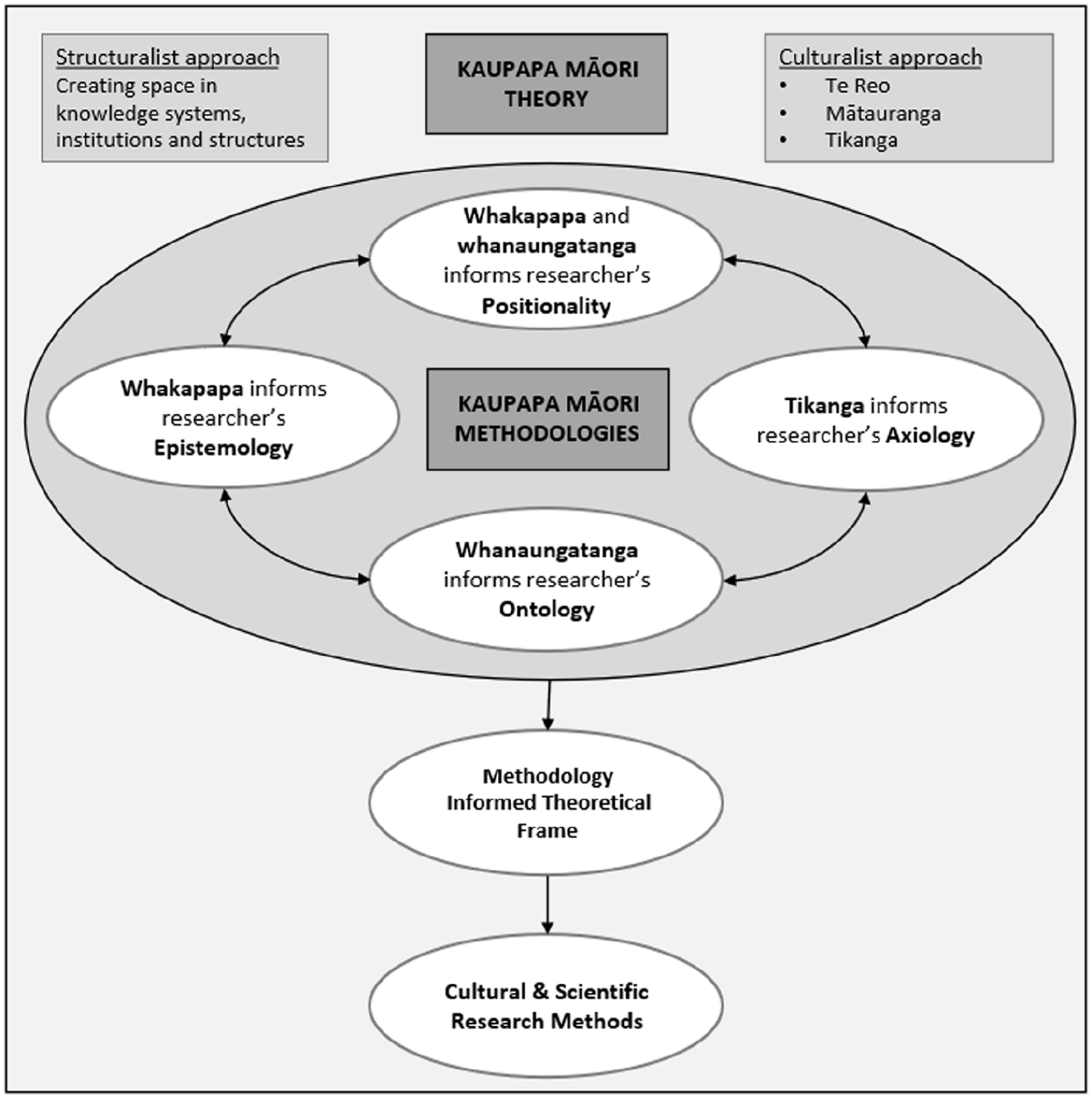
Conceptualisation of a Pūtaiao research methodology.
This may be seen as tension between Kaupapa Māori research and science methodologies, however, Kaupapa Māori theory and Kaupapa Māori methodologies, as conceptualised here, are not prescriptive or essentialising. Specific scientific methods are not explicitly included or excluded. Instead, Kaupapa Māori methodologies act as provocations, encouraging researchers to explore the relationship between culture, theories, methodologies and methods. This provocation acknowledges and aims to embed structuralist and culturalist approaches to decolonising science when designing scientific methodologies and methods in research. As articulated by Smith (2017),
‘Kaupapa Māori theory is not so much a set of principles but a space where Māori can work in ways free of dominant cultural pressures and constraints. It is a space where Māori can grow their self-development and transforming ideas and actions’. (p. 75)
This is particularly important in disciplines that are culturally and socio-politically fraught or problematic. Kaupapa Māori research ‘encourages Māori researchers to take being Māori as a given, to think critically and address structural relations of power, to build upon cultural values and systems and contribute research back to communities that are transformative’ (Smith, 2021: 269). In this way, Kaupapa Māori methodologies, and Indigenous and decolonising methodologies more broadly, enable the co-existence of Māori and Indigenous ways of being, knowing and doing, and scientific knowledge (Smith, 2012).
Reflections on experiences, disciplines and praxis to transform science
Māori experiences within science
There is an ongoing and long-standing history of Māori being excluded and marginalised in science (McAllister et al., 2022; McKinley, 2005). This exclusion and marginalisation is pernicious, occurring from the beginning of tertiary study and reflected in the experiences of Māori students across Science programmes from undergraduate through to postgraduate studies (Theodore et al., 2017; Waiari et al., 2021). These experiences are further amplified as Māori progress through disciplines within Science and in turn constrain the ability for Māori communities to engage with and benefit from Science. Māori researchers face many challenges existing in science including excess labour, racism, appropriate supervision, publication opportunities, and lack of career progression (Haar and Martin, 2021; McAllister et al., 2020; Mayeda et al., 2014). Yet, alongside these broad structural and institutional forms of scientific racism there exist more nuanced forms of oppression within the science system that intentionally limit opportunities. The academy prioritises academic qualification over other Indigenous measures of expertise and experience. This, in turn, is tokenistic and misappropriates Indigenous science. Our ability to use and practice mātauranga within the academy is limited through the fixation on specific methodologies, methods, and outputs that do not account for mātauranga. Ruru and Nikora (2021) offer insight into the experiences of Māori scholars working at the interface of mātauranga and science, some of which mimic our own experiences. For example, Simmonds (2021) speaks of having to divorce her discipline and how,
. . .any attempts at decolonising or transforming the discipline in any real way were always going to be challenged, minimised, diluted and undervalued: not by individuals . . .but rather by the systems of power within which the department and the discipline were firmly entrenched. (p. 130)
Here, Pūtaiao offers a unique opportunity whereby Māori researchers do not have to distance themselves from their culture to fit into a discipline made to discipline us, and instead Pūtaiao supports Māori ways of knowing, being and doing.
Te Taura Here Pūtaiao
At the end of 2020, Te Taura Here Pūtaiao – the kinship binding threads of Pūtaiao – comprising a network of Māori staff within the Faculty of Science at Waipapa Taumata Rau (The University of Auckland) spontaneously formed. This network has created a Kaupapa Māori space envisioned by this group as a space by Māori, for Māori and with Māori. Intentionally, this has centred Māori ways of knowing, being and doing. Aligned with Pūtaiao, the main focus of Te Taura Here Pūtaiao is whanaungatanga among kaimahi Māori (Māori staff). In centring Pūtaiao, academic staff, professional staff, and students – from undergraduate through to Professor – and kaimahi Māori who work with but are not positioned within the Faculty of Science, are included in this network. Establishment of Te Taura Here Pūtaiao is intended to overcome the isolation in theory, education and research caused by the disciplinary bounded departmental and faculty structure of the university.
The work of this network is deliberate and focuses on decolonising, disrupting and transforming the Faculty of Science through the priorities of kaimahi Māori. Impacts of Te Taura Here Pūtaiao rapidly affected kaimahi Māori. For some it became a space that fulfilled a desperate need of cultural safety, whanaungatanga and empowerment. Others reflected the network to be ‘the kind of place I didn’t know I needed until I went’. Te Taura Here Pūtaiao positions itself in parallel with existing faculty governance with collective accountability to Māori kaupapa (approach, topic, purpose). As such it is a structuralist form of resistance that provides a space for the privileging of Māori aspirations and cultural well-being in academia.
Collectivising in this way naturally created collaborative space for Te Taura Here Pūtaiao to contribute extensively to priorities within the Faculty of Science. Collaborative space that would otherwise be difficult, if not impossible to achieve without collectivising. This included navigating cultural safety and cultural double-shift of kaimahi Māori; professional mentoring; empowering student voice; dismantling hegemonic and hierarchical structures by involving undergraduates, postgraduates, academic staff (Professional Teaching Fellows, Lecturers to Professors) and professional staff across the university who are involved in science; discussions to develop a shared understanding of the Faculty of Science context of mātauranga, Kaupapa Māori and Te Tiriti o Waitangi; conceptualising Te Ao Māori Curriculum and Pedagogy development through involvement with the process of the Curriculum Framework Transformation Taskforce, specifically the Pūtoi Ako: Kaupapa Māori pedagogies working group; submissions on university policies and guidelines; collaborating on publications; leading te reo revitalisation initiatives; and influencing university-wide Māori research governance and development.
Although much transformative work has been accomplished since the establishment of Te Taura Here Pūtaiao, structural changes to staffing, resourcing, and funding must continue that encourages, incentivises and acknowledges the important contributions of kaimahi Māori without further increasing the cultural double-shift. Collectivising and creating a Māori community in science is an important step to actualising the transformative praxis of Pūtaiao and addressing structuralist and culturalist barriers within the academy and Western science system.
Pūtaiao: Moving beyond the discipline
In considering the relationship between Pūtaiao and disciplines it is useful to consider how we can be employed and positioned within disciplines of science within the academy, while simultaneously practising Pūtaiao. All disciplines within science are bound by the Western scientific approach. An approach founded upon Cartesian ideals of oppositional binaries: mind being separate from matter, people separate from nature, nature from culture, and subject from object. It prioritises individual rights and classification to focus primarily on the ‘what’. Termed the Order of Things by Michel Foucault, it formed the foundation stone upon which the Enlightenment was established, and from which Western science grew. Given that history, the preference for disciplines is a natural outcome. In practice, discipline has become an invisible, but highly effective structural barrier in scientific research.
For Pūtaiao, founded in Te Ao Māori, and its foundation on relationality, connection and responsibility, the focus is primarily on the ‘why’, with the ‘what’ and ‘how’ following, hence trying to frame it in disciplinary terms makes no sense. At times Pūtaiao might draw from a single scientific discipline, other times it may have people from different disciplines working together, each drawing on different disciplinary knowledge (multidisciplinary), or integrate and synthesise knowledge and methods from different disciplines (interdisciplinary) or create a unity of intellectual frameworks beyond the disciplinary perspective (transdisciplinary) (definitions after Awan, 2022). Fundamentally, when undertaking Pūtaiao, such framings are irrelevant – instead we ask – why should we do this? This informs what we need to do, and how. Indeed, building a team with the required skills is necessary, but, whether the team is uni-, multi-, inter- or transdisciplinary is not important. The ‘why’ is often framed in terms of kaupapa that is what is the kaupapa? In this way, identifying scientific research as Pūtaiao is not a statement of discipline. Undertaking Pūtaiao is a political statement of the centrality of Māori identity in undertaking research that can draw from both knowledge systems and uses the scientific method to realise the goals and aspirations of, and address challenges faced by, Māori communities.
Here, it is important to position Pūtaiao relative to mātauranga and Western science. The intention of Pūtaiao is not to develop mātauranga experts or Indigenous knowledge holders through the academy. Intergenerational knowledge systems already exist outside of the academy to that end. Pūtaiao aims to transform scientific research such that engagement with mātauranga experts is no longer exploitative and extractive, but appropriate, meaningful and beneficial for Māori. This can include engaging Western science and scientists, if and where appropriate. However, humility is required to acknowledge the mātauranga and scientific expertise beyond our scientific training of those we engage with. Partnership in this way requires a tuakana-teina relationship (a relationship between older and younger siblings that shapes the responsibilities and obligations of each person), where we must humble our own scientific knowledge as the teina to the mātauranga experts as our tuakana. This framing the need to transform science as a knowledge system to enable access for whānau, Hapū and Iwi.
Transforming science through transformative praxis
In this article, we lay out many assumptions, obstacles, barriers, structures, institutions, and systems that need to be transformed by Pūtaiao. Kaupapa Māori theory as transforming praxis (Smith, 2017) is explored here to connect theory to practice and transform science to further enable expressions of Pūtaiao that are more complete, complex and nuanced. Smith describes Freire’s (1972) notion of transformative praxis, which highlights conscientisation, resistance, and transformation as a cycle, where ‘Māori experience suggests that the elements of conscientisation, resistance, and transformative action may occur in any order and, indeed, may all occur simultaneously’ (Smith, 2017: 78). Conscientisation, or consciousness raising, has been vital to the development of Kaupapa Māori theory and critiques the continual failure of the existing systems that create structural impediments to Māori education and research aspirations (Smith, 2005). The same rationale necessitates a structuralist decolonising agenda for Pūtaiao to flourish as a research space in Aotearoa. Active resistance against the cultural oppression, misappropriation and exploitation within scientific research continues to be necessary of Kaupapa Māori theory as transforming praxis. Here, Pūtaiao becomes a call to Kaupapa Māori theory to resist the misappropriation of te reo, the exploitation of mātauranga and the oppression of tikanga in scientific research.
Having been denied research sovereignty within the academy, the culturalist decolonising agenda is a fundamental part of resistance. It addresses the need for Māori to have increased autonomy, self-determination and control when engaging with scientific research. Kaupapa Māori theory engages with conscientisation, resistance and transformative action simultaneously, which this conceptualisation of Pūtaiao also requires. Combining a structuralist and culturalist approach to achieve the decolonising agenda of Pūtaiao engages with both raising consciousness of, and resistance against, the oppressive elements of current Western science systems. Within the theoretical space created by Pūtaiao as transformative praxis, physical space must also be created for Māori to come together and collectively transform science. With the theoretical, methodological, practical and collaborative foundations of Pūtaiao explored within this article, we now ask – how do we transform scientific research?
How do we transform scientific research?
It is important to acknowledge here that the ability to ask this question in the academic context of this article already affirms the transformative work previously undertaken by Māori and Indigenous scientists and researchers. Through conscientisation and resistance, theoretical space has been created for Pūtaiao to be undertaken within the current scientific academy. The call to transform scientific research here, then requires that space continues to be made for research of this nature within and beyond the many disciplines of science. Simultaneously, the theoretical foundations of Pūtaiao should be tested, challenged, adapted and expanded upon. Here, centring Indigeneity, Māori identity and Māori science leadership is essential.
Important to the dialogical relationship between Te Ao Māori and science is the power and position of Indigeneity. Often Māori ways of knowing, being and doing are considered optional, as add-ons, a theoretical ‘othering’ by science. As Ngata (2019) notes, ‘Indigenous participation on the margin is vital to the centring of the coloniser’ (p. 45). Culturalist decolonising attempts to include Indigeneity in science on the margins can further centre Western approaches to science. Centring Indigeneity, Māori identity and Māori science leadership can lead to transformative change, whereas theoretical ‘othering’ and participation on the margins further perpetuates the colonising agenda systemic within the current science system. Then, implicit in the question – how do we transform scientific research?–is the question – how do we centre Indigeneity, Māori identity and Māori science leadership in order to transform scientific research?
One way to think about Māori science leadership is through Māori understandings of the growth of trees, as exemplified in the whakataukī below:
E kore te Tōtara e tū noa i te pārae ēngari me tū i roto i te wao-nui-a-Tane
(The Tōtara [Podocarpus totara]
1
does not stand alone in the field, but stands within the great forest of Tane).
This expands the metaphor beyond the growth of individual trees to growing forests. Tree metaphors for Māori leadership are common. Mead and Grove (2004) compared a good leader to a Tōtara tree in a forest: a leader with substance; that stands tall and presents as a leader; works with people rather than alone; is a source of pride; and puts others first. Mead et al. (2006) continue the metaphor to describe Māori leadership conceptualising ‘Rātā whakaruruhau’ (the sheltering Rātā [Metrosideros robusta]) as a model of Māori leadership that emphasises a strong dedication to others; ensuring stability for, and genuinely caring about people under your leadership; highlighting confidence and standing tall in the face of the challenge; and instilling confidence for the future in their people. Mather (2014) explores the following whakataukī,
Kia uru Kahikātea te tū.
(To stand as a grove of Kahikātea [Dacrycarpus dacrydioides].)
Here, the words of Māori leader Tariana Turia (2005) adds clarity to the Māori leadership qualities associated with Kahikātea:
The Kahikātea is our tallest tree, stretching up to over thirty metres to the first branch. With shallow roots, isolated and on their own they are vulnerable. The Kahikātea are commonly found in groves with their roots interlocked, giving each other mutual support – providing a vital foundation, a whakapapa of connections. (p. 48)
Kahikātea as a model for Māori leadership describes a collectivist approach where the collaboration of each individual Kahikātea contributes, and is indeed essential, to success. Here, interdependence of intertwining roots represents the contribution of whanaungatanga to both strength and resilience. Kahikātea are typically the tallest tree in the forest, therefore Kahikātea is a model of Māori leadership that can be utilised to ascend to greater heights. Māori science leadership within Pūtaiao can also be thought of in a similar way. An ecosystem of trees with diverse skills and competencies enveloping a forest. As we raise our canopy together, we are conscious of who is sheltering us and who we should be sheltering as the next generations of trees enter the forest.
To further our forest metaphor, we begin with Pūtaiao as the theoretical foundation, the forest floor that interweaves and connects the diversity of trees in the forest, the diversity of Māori leaders in scientific research. The structuralist and culturalist decolonising agendas of Pūtaiao (discussed above) are exemplified through the diversity of trees within the forest and their subsequent roles. The structuralist decolonising agenda is led by trees that border the forest. Much like māhuri Tōtara, young saplings of Tōtara as young leaders who stand proud and tall. These trees break new ground to expand the borders of the forest creating space for new sites of struggle, conscientisation, resistance and transformation through Pūtaiao. Specifically, Tōtara address the structures, systems and institutions that act as barriers to hinder, oppress and ultimately deny Māori ways of knowing, being and doing in scientific research. The culturalist decolonising agenda can be thought of as both Rātāand Kahikātea. Rātā, those Māori leaders who have climbed high within the scientific academy, make space for experienced and emerging Pūtaiao practitioners under their leadership. With a strong dedication to, and genuine care for others, Rātā provide stability during challenges and confidence in the future for others to practise Pūtaiao. When critical mass has been reached Kahikātea as practitioners of Pūtaiao collectivise and interweave their roots to grow the canopy, providing strength and resilience for each other to collaboratively achieve successful outcomes. Through collaboration, Kahikātea collectively enable te reo, mātauranga and tikanga to be embedded in scientific research, while simultaneously entering into leadership positions within structures, systems, and institutions.
It is important to note that Tōtara, Rātā and Kahikātea models of Māori leadership all require that Māori leaders do not stand alone in the field, but stand together within the great forest of Tane. Pūtaiao offers a theoretical, methodological and practical foundation to connect Māori science leaders with the aim of transforming science. The outcomes of transformational change led by Pūtaiao, whether it be new university courses, academic programmes, research centres, science departments, institutions, or regional and community hubs remain to be seen. It is certain, however, that Pūtaiao conceptualised as Kaupapa Māori science offers many avenues for Māori scientists and researchers to continue to decolonise, transform and ultimately, redefine science into the future.
Glossary
Aotearoa: New Zealand.
Atua: ancestors of continuing influence.
Awa: river.
Hapū: a collection of whānau descended from a shared ancestor.
Iwi: a collection of Hapū descended from a shared ancestor.
Kahikātea: Dacrycarpus dacrydioides, white pine, large forest trees.
kaimahi Māori: Māori staff.
Kapa haka: contemporary performance.
Karanga: oratory.
Kaupapa: approach, topic, purpose.
Kaupapa Māori: Māori approaches, principles and vision.
Māhuri: young tree, sapling.
Mana mahi: Governance-Operations.
Maramataka: astronomy, fishing and gardening calendars.
Mātauranga: a body of knowledge, epistemology.
Maunga: mountain.
Moana: ocean, large body of water.
Mōteatea: songs.
Ngā taonga katoa: every treasured gift.
Oriori: genealogies and invested hopes sung to babies.
Pā whakawairua: the thoughts and visceral responses when interacting with people and places.
Pū: origins.
Pūrākau: narratives.
Pūtaiao: Kaupapa Māori Science.
Pūtoi Ako: Kaupapa Māori pedagogies working group within the Faculty of Science.
Raranga: weaving.
Rātā: Metrosideros robusta and Metrosideros umbellata, large forest trees.
Rātā whakaruruhau: the sheltering Rātā.
Taiao: the environment and natural world.
Taonga: treasured gifts
Te Ao Māori: the Māori world.
Te Ao Māori tirohanga: Māori worldview.
Te Mana Raraunga: The Māori Data Sovereignty network.
Te Moananui a Kiwa: The Pacific Ocean.
Te reo: the Māori language.
Te Taura Here Pūtaiao: the kinship binding threads of Pūtaiao, a network of Māori staff within the Faculty of Science at Waipapa Taumata Rau.
Te Tiriti o Waitangi: Te reo Māori version of the Treaty of Waitangi.
Tikanga: a value system that underpins Māori culture
Tōtara: Podocarpus totara, Podocarpus cunninghamii, large forest trees.
Toi whakairo: carving.
Tuākana-teina: tuakana-teina relationship (a relationship between older and younger siblings that shapes the responsibilities and obligations of each person).
Waiata: songs.
Waipapa Taumata Rau: The University of Auckland.
Wairua: spirit, spirituality.
Whaikōrero: oratory.
Whakairo: to carve.
Whakapapa: a way of knowing about the world through intergenerational relationships.
Whakapapa kōrero: ancestral narratives, histories.
Whakataukī: proverb, aphorism.
Whānau: extended family.
Whanaungatanga: relationships, being in relation through whakapapa.
Whenua: land (also placenta).
Footnotes
Acknowledgements
The corresponding author wishes to acknowledge Te Taiawatea Moko-Mead who contributed valuable comments and discussion in reviewing this manuscript. The authors would also like to acknowledge Milly Heke for her contribution to the early conceptualisation of this article, the reviewers for their thoughtful comments and suggestions that strengthened the article, and the editors for their patience and for creating this opportunity.
Declaration of conflicting interests
The author(s) declared no potential conflicts of interest with respect to the research, authorship, and/or publication of this article.
Funding
The author(s) received no financial support for the research, authorship, and/or publication of this article.
