



Abstract
Compounding systems of marginalization differentiate and shape water-related risks. Yet, quantitative water security scholarship rarely assesses such risks through intersectionality, a paradigm that conceptualizes and examines racial, gendered, class, and other oppressions as interdependent. Using an intersectionality approach, we analyze the relationships between household head gender and self-reported socio-economic status, and water affordability (proportion of monthly income spent on water) and water insecurity (a composite measure of 11 self-reported experiences) for over 4000 households across 18 low- and middle-income countries in Central and South America, Africa, and Asia. Interaction terms and composite categorical variables were included in regression models, adjusting for putative confounders. Among households with a high socio-economic status, the proportion of monthly income spent on water differed by household head gender. In contrast, greater household water insecurity was associated with lower socio-economic status and did not meaningfully vary by the gender of the household head. We contextualize and interpret these experiences through larger systems of power and privilege. Overall, our results provide evidence of broad intersectional patterns from diverse sites, while indicating that their nature and magnitude depend on local contexts. Through a critical reflection on the study’s value and limitations, including the operationalization of social contexts across different sites, we propose methodological approaches to advance multi-sited and quantitative intersectional research on water affordability and water insecurity. These approaches include developing scale-appropriate models, analyzing complementarities and differences between site-specific and multi-sited data, collecting data on gendered power relations, and measuring the impacts of household water insecurity.
Introduction
Household water insecurity experiences are characterized by unacceptable water-related risks, and by failures of water access arrangements to meet context-specific needs and aspirations (Cook and Bakker, 2012; Gimelli et al., 2018; Grey and Sadoff, 2007; Jepson et al., 2017; Shah, 2021). Climate change, urban-industrial demand, and infrastructure failures all, broadly, affect water insecurity (Boretti and Rosa, 2019; Schewe et al., 2014). Intersecting systems of marginalization further, and unevenly, shape the ability to acquire and benefit from safe and sufficient water (Crow and Sultana, 2002; Deitz and Meehan, 2019; Gerlak et al., 2022; Harris et al., 2017; Harris, 2008; Mitra and Rao, 2019; Sultana, 2009, 2020; Thompson, 2016; Truelove, 2019). For example, Deitz and Meehan (2019) demonstrate the interplay between settler-colonialism and institutional racism in the United States, finding American Indian, Alaskan Native, Black, and Hispanic households experience higher odds of water and sanitation insecurity.
The origins of “intersectionality” are credited to Black feminists and abolitionists (Combahee River Collective, [1977] 1995; Crenshaw, 1989, 1991; Truth, 1851). Its inquiry and praxis, Collins and Bilge (2020) historicize, evolved through multi-racial coalitions between Black, Latinx, Asian, and Indigenous women in the global North, and through global South movements, including Dalit feminism (e.g. Govinda, 2022; Omvedt, 1975; Paik, 2021; Rege, 1998; Sharma and Geetha, 2021). Intersectional marginalization emphasizes that systems of racism, patriarchy, homophobia, classism, caste, and ableism are neither independent nor experienced outside of other structures of oppression, but rather, mutually reinforce and co-constitute one another (Collins, 1998, 2015; Crenshaw, 1991). Intersectional approaches have significant potential to enhance our understanding of how water insecurity manifests, and how it is differently experienced across social groups (Gerlak et al., 2022; Harris et al., 2017; Hay, 2021; Sultana, 2020; Truelove, 2019).
In human geography and allied fields, researchers often conduct intersectional analyses using qualitative, place-based research designs, which are well suited to documenting lived experiences as relational, emergent, and context-specific (Rodó-de-Zárate and Baylina, 2018; Valentine, 2007). Recent research, however, elaborates how intersectional experiences may be quantitatively assessed, particularly using regression modeling (Alvarez and Evans, 2021; Bauer, 2014; Bauer et al., 2021; Bowleg and Bauer, 2016; Bowleg et al., 2022; Else-Quest and Hyde, 2016; Hancock, 2007; Rouhani, 2014; Scott and Siltanen, 2017). Quantifying intersectionality raises complex epistemic and methodological challenges (Bowleg and Bauer, 2016). Scholars argue that the conventional main effects approach, central to regression analyses, is antithetical to intersectionality (Bauer, 2014; Bowleg, 2008; Bowleg and Bauer, 2016). Conceptually, main effects examine independent and mutually exclusive associations—not reinforcing ones—and thereby encourage a focus on competing effects between racism, classism, patriarchy, and other power relations (Bowleg and Bauer, 2016; Bowleg et al., 2022; Hancock, 2007). Main effects will not estimate, for instance, gendered experiences of an outcome, such as water insecurity, by race or ethnicity (Bowleg and Bauer, 2016; Rouhani, 2014). Instead, the main effect of identifying as a woman (or rather, an effect of gender oppression) represents the average controlled difference in water insecurity outcomes between gender categories independent of respondents’ racial background (or rather, experiences of racism)—provided the latter is included within the model (Bowleg and Bauer, 2016). Thus, main effects model intersectional experiences as a sum of individuated systems of oppression, instead of the product of mutually constitutive ones (Bowleg, 2008; Bowleg and Bauer, 2016; Hancock, 2007; Weldon, 2008).
Modeling interactions and composite categorical effects are more consistent with an intersectional approach (Bauer, 2014; Dubrow, 2008; Weldon, 2008). Statistical interactions measure the magnitude of difference between one variable, such as household head gender, on an outcome of interest, such as water insecurity, contingent on a second variable, like household socio-economic status (Dubrow, 2008). For example, one could ask, how different are experiences of water insecurity for household heads identifying as men, women, or non-binary in wealthier versus poorer households? Relatedly, composite categorical variables measure water insecurity outcomes specific to different gender-status groups, for instance (Weldon, 2008). This enables, for example, water insecurity comparisons between higher and lower socio-economic status female-headed homes, and higher and lower socio-economic status male-headed homes. Both approaches, however, have limitations (Bowleg, 2008; Choo and Ferree, 2010; Simien, 2007). Many arise from processes of disaggregating holistic intersectional experiences into individual demographic identities, and subsequently using interaction and composite categorical terms, mostly in additive models, to reconstitute these identities as complex experiences (see Bowleg, 2008). Moreover, models force decisions as to which variables compose intersectional analyses (i.e. given statistical limits of n interactions, or n terms within an interaction) (Simien, 2007; Weldon, 2008). Going farther, Buchanan and Wiklund (2021: 30) argue research claiming an intersectional approach using interaction and composite categorical variables alone, misrepresent, de-politicize, and “flatten” intersectionality theory. Intersectional approaches, Buchanan and Wiklund (2021) stress, must (1) name and connect interlocking systems of oppression to the otherwise reductive group-level differences measured by statistical models; (2) recognize how “insignificant” findings may reflect shortcomings in data collection, assumptions, and model selection 1 (Harris et al., 2017); (3) identify how one’s own work may fall short of the ideals of intersectional theory; and (4) advocate for social justice through theory, empirics, and interpretations. We hope to integrate these concerns and others (Bowleg et al., 2022) by framing and interpreting interaction and composite categorical variables as proxies for compounding systems of oppression that shape household water affordability and insecurity experiences.
Our approach builds from the recognition that quantitative geographers and scholars in cognate fields studying water insecurity have rarely and explicitly integrated intersectionality approaches into their analytical practices, despite drawing on environmental justice, feminist, and anti-racist scholarship (cf. Harris et al., 2017; Hay, 2021). This remains the case even as feminist political-ecologists critique the overfocus on gender as an analytic, without serious consideration for how racism, classism, ableism, caste, and other oppressions shape the lived experiences of water insecurity (Mollett and Faria, 2013; O’Leary, 2019). Without intersectional approaches:
[A]nalyses are at risk of overlooking critical dimensions and spaces of water inequality and insecurity that disproportionately impact particular social groups . . . as well as how these injustices might be transformed. (Truelove, 2019: 4)
To advance intersectional research on, and methods for, water insecurity, we analyze data from over 4000 households across 18 low- and middle-income countries (LMICs) managed by the Household Water Insecurity Experiences Research Coordination Network (HWISE-RCN) (Young et al., 2019a, 2019b). We explore how water affordability and water insecurity experiences differ at the intersection of household head gender and perceived socio-economic status. While many approaches for intersectional research exist (Collins, 2015; Else-Quest and Hyde, 2016; Jordan-Zachery, 2007; McCall, 2005), we adopt what McCall (2005) terms an “inter-categorical” approach, focusing on the “relationships of inequality among already constituted social groups” (1784–1785). For our analyses, the proportion of monthly income spent on water was used as an indicator of water affordability, whereas household water insecurity was a composite measure of 11 self-reported experiences related to water access and use (Young et al., 2019a). Central to intersectionality is systemic racism, which shapes water insecurity (Meehan et al., 2020; Ranganathan, 2016; Wilson et al., 2021; Workman and Shah, 2023). It is not examined here, however, because such data were not collected. Acknowledging this limitation, our analyses nonetheless make four conceptual, methodological, and empirical contributions.
First, we contribute an empirical study to assess intersectional experiences of water affordability and water insecurity by household head gender and socio-economic status. This contribution responds to recent calls for intersectional water insecurity approaches (Gerlak et al., 2022; Truelove, 2019). This call was echoed by Harris et al. (2017), who conducted multi-sited analyses to examine gendered differences between water security indicators (i.e. water fetching, knowledge, institutional participation, perceptions of water access, and services) in Ashaiman and Teshie (Accra, Ghana), and Khayelitsha and Philippi (Cape Town, South Africa). They found no significant gendered differences, except for water collection, leading them to conclude that conventional statistical analyses of gender may “require considerable unpacking and nuance . . . to analyze and situate gender in ways that move beyond simple male and female binary understandings” (Harris et al., 2017: 13). Such analyses are positioned to understand the unique lived experiences of water insecurity, and to inform justice-based policy interventions that target structural systems of inequality (Gerlak et al., 2022; Harris et al., 2017; Truelove, 2019).
Second, few studies have examined water affordability and insecurity together (cf. Stoler et al., 2020). Indicators focus on physical water scarcity (Falkenmark et al., 1989: “Water Scarcity Index”), or upon integrating physical scarcity with indicators of poverty to spatialize water stress (Lawrence et al., 2002; Sullivan, 2002: “Water Poverty Index”), adopt a constrained and subjectively weighted set of indicators to assess coarser-scale differences (i.e. beyond the household) (Garriga and Foguet, 2010; Molle and Mollinga, 2003). The analysis of household-level water affordability and insecurity provides a more comprehensive articulation of water-related risks (Gerlak et al., 2022). This contribution, with the preceding one, responds to calls for research to “draw from theories of intersectionality to unpack how multiple axes of marginality shape access, affordability and quality of water” (Gerlak et al., 2022: 2, our italics).
Third, and as above, many studies examine the interlocking effects of racism, patriarchy, class, and caste on water access through qualitative research designs (Harris, 2008; O’Leary, 2019; Radonic and Jacob, 2021; Sultana, 2009, 2020; Thompson, 2016). Multi-sited, intersectional analyses using quantitative methodologies remain exceedingly rare (cf. Harris et al., 2017). As such, Hay (2021: 10) commented, “. . . [T]here have been few applications of intersectionality in water, and no evidence of it being operationalised at scale” (our italics). Our multi-leveled approach assesses how socially differentiated households, nested within heterogeneous socio-spatial contexts, experience water insecurity and unaffordability outcomes (Else-Quest and Hyde, 2016). The ability to assess these outcomes, while controlling for the correlations between households drawn from cluster survey designs, and accounting for the varying sample sizes across clusters, is one contribution of multi-leveled modeling (Alvarez and Evans, 2021). Our results provide evidence of broad intersectional experiences, as derived from a multi-sited dataset, while indicating that their nature and magnitude depend on local contexts. Hence, our analysis contributes an understanding of water affordability and insecurity experiences as products of gender and class oppression, accounting for site-wise variability—consistent with intersectionality as a socio-structural and place-based framework (Alvarez and Evans, 2021; Bowleg and Bauer, 2016; Else-Quest and Hyde, 2016; Sultana, 2009).
Fourth, reflecting on the study’s value and limitations, we identify directions for how multi-sited, quantitative, intersectional research can contribute to household water insecurity methods (Wutich et al., 2017). Our multi-scaled analysis cautions against binarized arguments for “local or generalizable” intersectional research, instead emphasizing a “both/and” approach where local qualitative and larger-scale quantitative data—each with their own partialities, strengths, and limitations—are read together to spur new research questions, tensions, and opportunities (Barnes, 2009; Barnes and Hannah, 2001; Nightingale, 2009; Shah and Harris, 2022).
Intersectionality, water affordability, and insecurity
Colonial, racial, gendered, ableist, class, and caste systems of power and their place-based outcomes (re)produce household water insecurities, and associated adverse social, economic, physical, and mental wellbeing outcomes (Crow and Sultana, 2002; Daigle, 2018; Deitz and Meehan, 2019; Dewachter et al., 2018; Duignan et al., 2022; Gerlak et al., 2022; Jepson et al., 2017; Jones et al., 2005; Leder et al., 2017; Loftus, 2014; Lu et al., 2014; Mawani, 2022; Meehan et al., 2020; Méndez-Barrientos et al., 2022; O’Leary, 2019; Radonic and Jacob, 2021; Ranganathan, 2016; Shah et al., 2021; Sultana, 2009, 2020; Truelove, 2019; Wilson et al., 2021; Wolbring, 2011; Wutich et al., 2022). This section reviews water affordability and insecurity experiences at the intersections of gender and class oppression. Our review supports the formulation of two hypotheses explored in the article.
Broadly, marginalized lower-income communities often use a higher proportion of their income to pay for water services (Cairns, 2018; Mirosa, 2015; Peloso and Morinville, 2014; Rosinger and Young, 2020; Subbaraman et al., 2013). In Metro Manila, for instance, Torio (2018) found the most socio-economically disadvantaged households connected to the privatized water system pay between 7% and 11% of their monthly income for water, compared with an average of 3%–4% for other socio-economic classes. In Texas, Jepson and Brown (2014) documented households in colonias (unincorporated and often lower-income Mexican / Mexican-American communities excluded from municipal boundaries and centralized water services) spend 7% of their monthly income, on average, for water. At a structural scale, capitalist institutions intersect with patriarchal systems of oppression to marginalize and exploit women in distinct ways, leading to differences in asset access, ownership, and control (Crow and Sultana, 2002; Deere and Doss, 2006). From this “double deprivation” (Crow and Sultana, 2002: 713), we may expect systems of gender and class oppression to exclude households from affordable water services, increase the proportion of income spent on water, and moderate impacts associated with water expenditures. While lower-income women disproportionately experience physical and emotional burdens of water collection (Sultana, 2020), they may simultaneously experience higher proportional water costs where expenditures are made, given the systems of exclusion and exploitation above. For example, Reynaud (2006: 20) found single parent families in France, particularly female-headed households, were among “the most vulnerable groups in terms of water affordability.” Such assessments are critical because research finds female-headed households are more likely to pay for and maintain their water services, attributable to perceived gendered responsibilities of water provision and its linked health, hygiene, and food security needs (Kayaga et al., 2003; Sempewo et al., 2021). These examples demonstrate how capitalist systems reinforce gender oppression, and how patriarchal institutions, including gendered responsibilities of water access, reinforce class oppression. Nevertheless, Gerlak et al. (2022) emphasize the need for stronger empirical engagement at the intersections of racism, patriarchy, and classism to understand water affordability experiences.
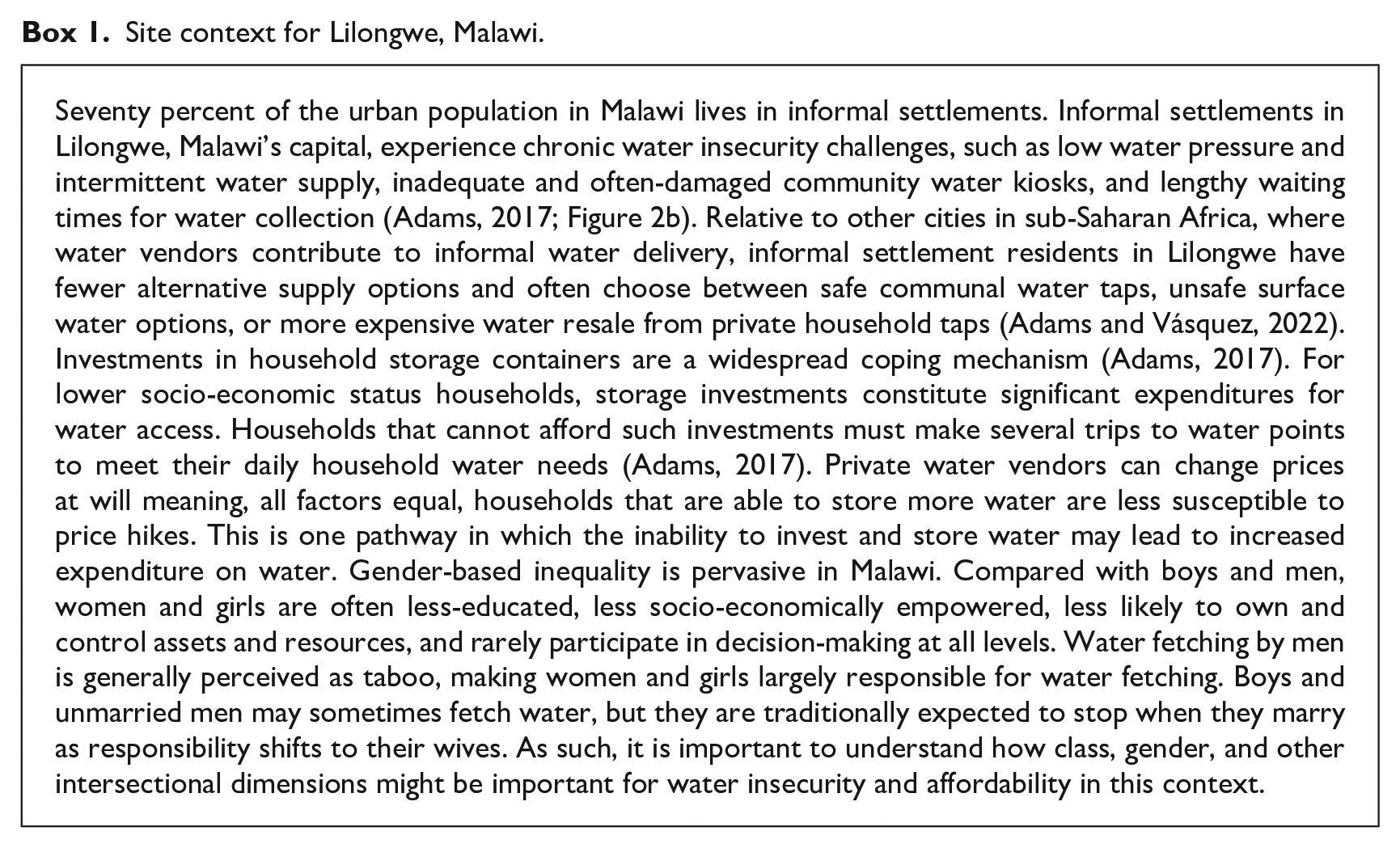
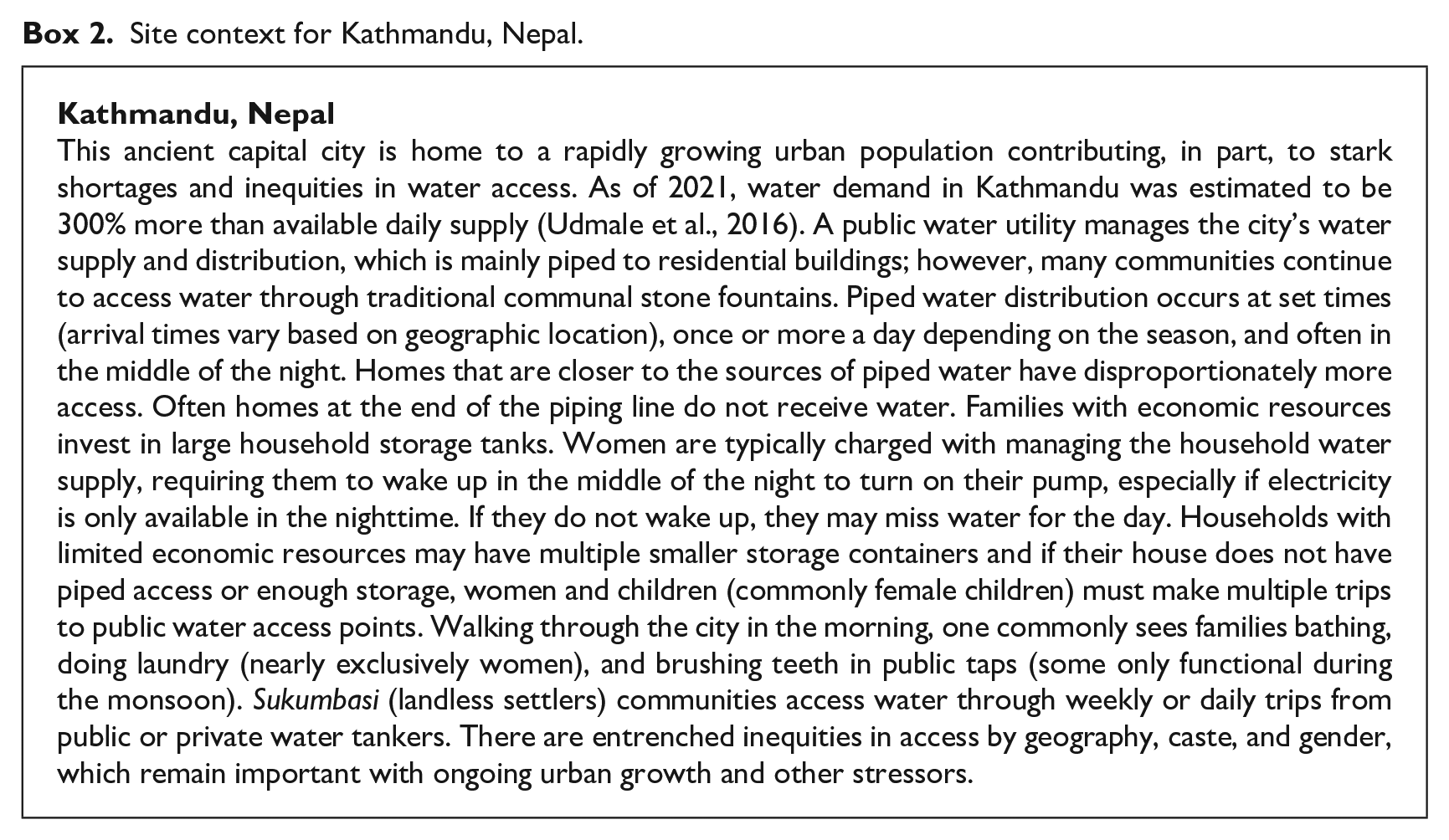
Beyond affordability, multiple dimensions of water insecurity are experienced intersectionally and produce immense harm and violence (e.g. Harris, 2008; Sultana, 2009, 2020; Tallman et al., 2022). Ngarava et al. (2019) used statistical models to analyze water insecurity outcomes for over 5900 female-headed households in South Africa. They find a composite measure of wealth was associated with enhanced “water access” (i.e. a main source of drinking water; reduced supply interruptions; higher water expenditures) and capabilities to purchase water treatment supplies (Ngarava et al., 2019). This research demonstrates how wealth status, on one hand, reduces water insecurity exposures (i.e. interruptions) for female-headed households, and on the other, builds adaptive capacity to buffer adverse impacts (i.e. treating water quality interruptions) (Ngarava et al., 2019). Moreover, the gendered roles and responsibilities of water provision often mean that women, especially women who are socio-economically disadvantaged, disproportionately experience labor burdens (Geere and Cortobius, 2017; Harris et al., 2017; Sorenson et al., 2011), injury (Venkataramanan et al., 2020b), physical and sexual violence (Nunbogu and Elliott, 2022; Pommells et al., 2018; Tallman et al., 2022), and adverse embodied psychological and emotional outcomes (Cole, 2017; Radonic and Jacob, 2021; Sultana, 2009, 2011, 2020; Truelove, 2011; Wutich and Ragsdale, 2008) in contexts where safe, sufficient, and affordable water is not accessible (Lu et al., 2014). For instance, Sultana (2020) shows how residents of Korail, an informal settlement in Dhaka, are denied formal land rights and piped water through gender, class, and migrant status oppression. This exclusion reinforces their intersectional subjectivities as non-citizens, conditions their exploitation in purchasing water (i.e. upward of 11 times the cost per liter than more affluent households connected to the public system), and concentrates physical and emotional burdens on women for collecting, negotiating, and accessing informal water sources (Sultana, 2011, 2020). Related to notions of citizenship, Radonic and Jacob (2021) find the physical, economic, and emotional burdens of water provision of Flint’s on-going water crisis fall disproportionately on Black middle-class women. Intersectional impacts, beyond these cases, are further reproduced by recognitional and procedural injustices, which create additional burdens as marginalized groups seek to adapt, or collectively mobilize for water security (e.g. Shrestha et al., 2020; Sultana, 2020). This scholarship demonstrates how compounding systems of oppression create, sustain, and concentrate water insecurity experiences for socio-economically marginalized women. Boxes 1–3 provide ethnographic illustrations from Lilongwe (Malawi), Kathmandu (Nepal), and Morogoro (Tanzania), three of our sampled sites, which highlight similar dynamics captured from the section above. Together, this scholarship led us to analyze intersectional dynamics important for water affordability and insecurity using our multi-sited data. We hypothesize:
Differences in water affordability and insecurity by household head gender will be largest for those in the lowest socio-economic level (i.e. “interactive” effects measuring differences in the association of gender across socio-economic class).
Female-headed households with a low socio-economic status will (a) spend the highest proportion of their monthly income on water, and (b) have the highest water insecurity scores (i.e. composite categorical effects measuring experiences across intersectional categories).
Both hypotheses reflect the understanding that interlocking marginalities drive water-related risk.
Site context for Lilongwe, Malawi.
Site context for Kathmandu, Nepal.
Site context for Morogoro, Tanzania.
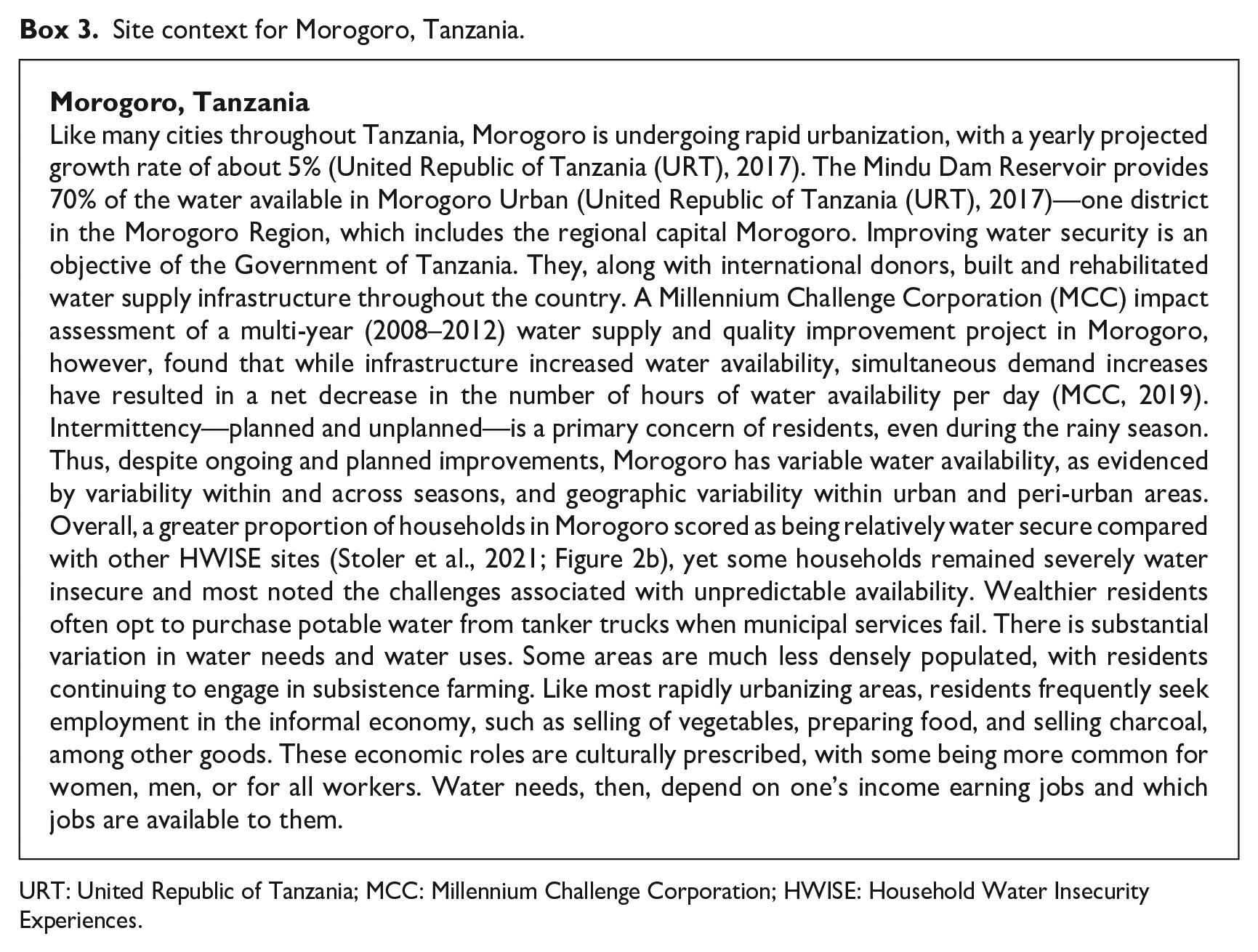
URT: United Republic of Tanzania; MCC: Millennium Challenge Corporation; HWISE: Household Water Insecurity Experiences.
Methodology and dataset
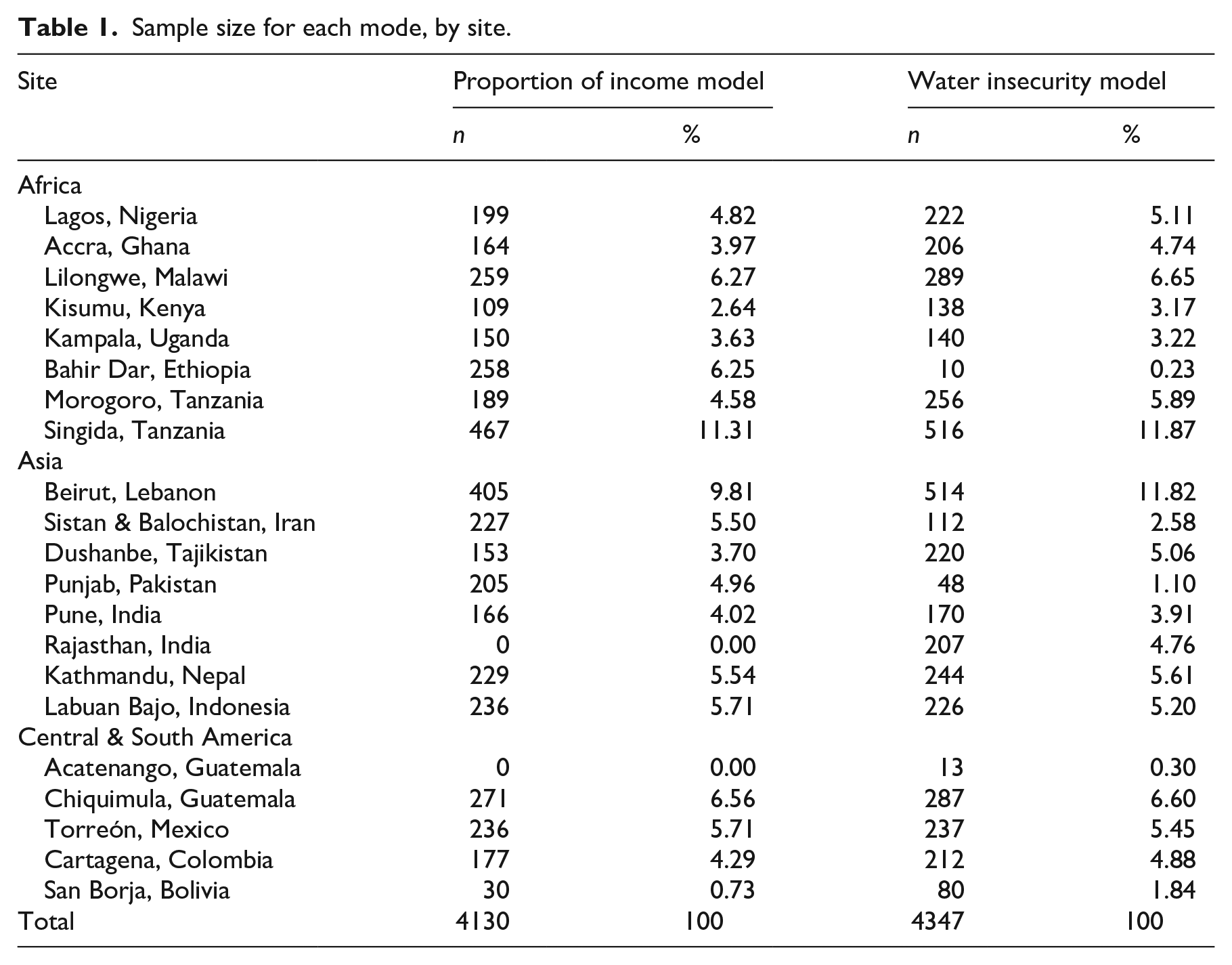
Data were drawn from household surveys compiled and managed by the HWISE-RCN (Young et al., 2019a, 2019b). Data were primarily collected to develop a cross-culturally equivalent tool for measuring water insecurity (Young et al., 2019a, 2019b)—not to conduct intersectionality research on water insecurity. Surveys for the parent study were conducted with 8738 households in 29 sites across 23 LMICs between 2017 and 2018. The cross-sectional design precludes any establishment of causality in the effects reported. Trained enumerators conducted surveys in the local language 2 with a household member who identified as being knowledgeable about their household’s water situation (Young et al., 2019b). The HWISE-RCN’s relationships were leveraged to select sites that maximized heterogeneity in climate, water infrastructure, and water issues, resulting in several sites within the same country. 3 Most sites used random sampling (e.g. simple, stratified, systematic), with four exceptions (Young et al., 2019b). 4 We excluded 4608 observations from the water affordability model across 10 sites and 4391 observations from the household water insecurity model across eight sites because of incomplete data, or in limited cases, data quality considerations. The 21 sampling sites across the 18 LMICs in this article are mapped in Figure 1 and listed in Table 1. We provide the descriptive statistics for the excluded observations in Supplemental Appendix A1, as about half of the total sample was excluded. While statistical differences exist in the household characteristics between the included observations and the observations excluded due to missing co-variate data (Supplemental Appendix A2), many differences are practically small and are not expected to meaningfully affect the associations of interest as reported in the final modeled results. This, however, remains an important limitation.
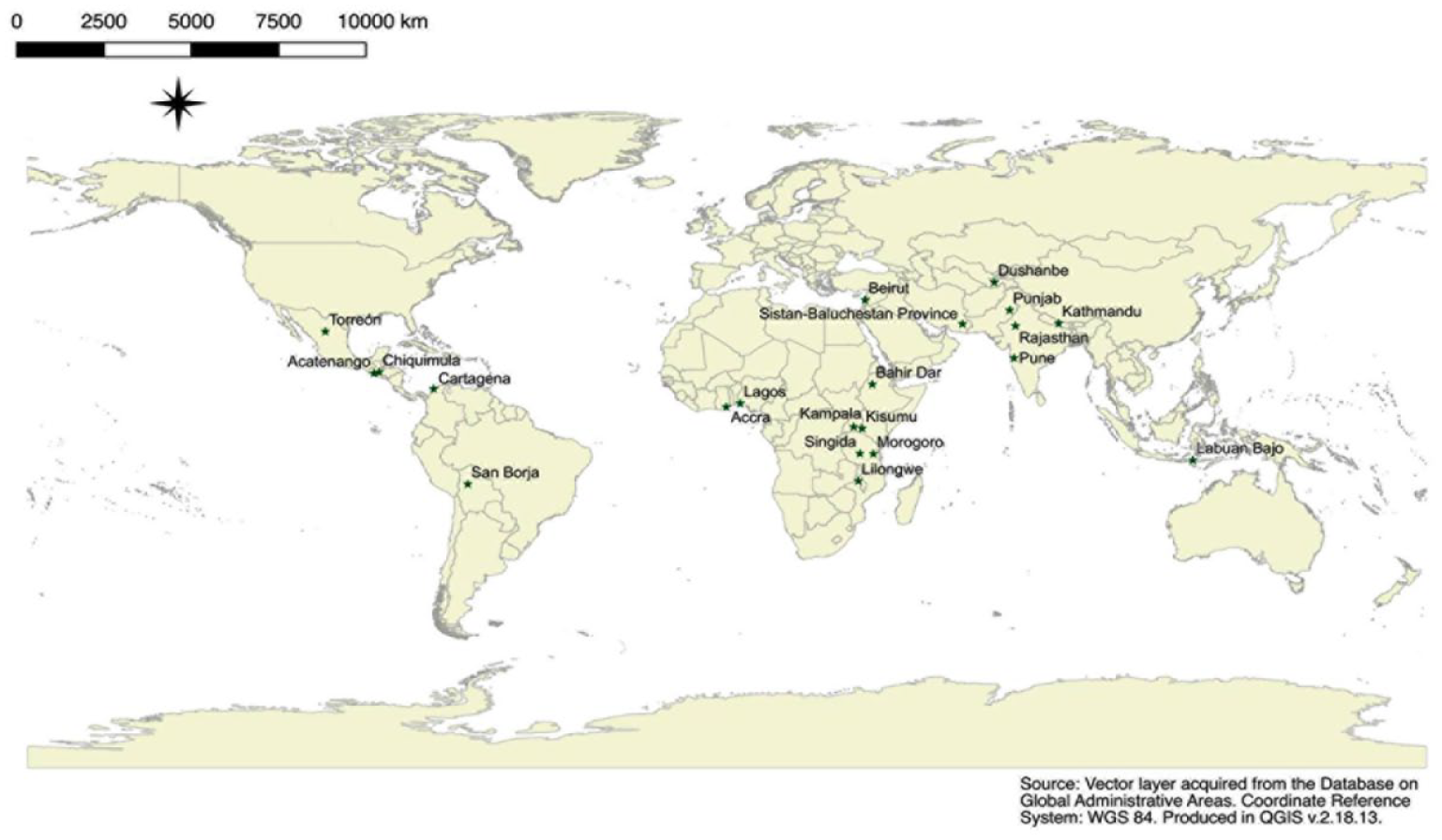
Twenty-one sites in 18 low- and middle-income countries used in the analysis.
Sample size for each mode, by site.
Variables and model selection
Dependent variables: Water affordability and insecurity
Two dependent variables are used in this study, one associated with water affordability and another composite score measuring household water insecurity. We assessed affordability using the proportion of income spent on water per month (household cash expenditure for water per month (USD)/household primary monthly income (USD)). 5 In 2010, the United Nations General Assembly, through Resolution 64/292, recognized the Human Right to Water and Sanitation (HRWS) and called upon member states and the international community “to provide financial resources, help capacity-building and technology transfer to help countries, in particular developing countries, [and] to provide safe, clean, accessible and affordable drinking water and sanitation for all” (United Nation (UN), 2010). One foundational metric of the HRWS is affordability, whereby the cost of water should not surpass 3% of household income (United Nation (UN), 2010). A binary variable for the proportion of income spent on water (0 ⩽ 3% of monthly income spent on water; 1 > 3% of monthly income spent on water) was used as a measure of water affordability. As this benchmark may be contested, we conducted a sensitivity analysis to determine how the associations of interest shift at other thresholds of affordability (between 2% and 5% of monthly income spent on water) (“Results” section).
The second dependent variable is a modified version of the 12-item Household Water Insecurity Experiences Scale (per Young et al., 2019a, 2019b) To leverage data across all sites, we developed a composite score using a subset of 11 items that were asked in all sites. 6 These 11 items represent the frequency of (1) water worry, (2) water source interruption, (3) inability to wash clothing, (4) interruption of plans, (5) changes in food consumption, (6) inability to wash hands, (7) inability to wash bodies, (8) insufficient quantity of water for drinking, (9) anger about the water situation, (10) going to sleep thirsty, and (11) having no useable water or drinkable water (Young et al., 2019a, 2019b; Table 2). Households were asked to report the frequency of each experience in the prior 4 weeks. Response options included: never (0 times), rarely (1–2 times), sometimes (3–10 times), often (11–20 times), and always (> 20 times). Never was then scored as 0, rarely as 1, sometimes as 2, and often/always as 3 (Young et al., 2019a, 2019b). These values were summed to derive a household water insecurity score, ranging between zero and 33. We recognize that this measure of water insecurity may be limited by the questions asked in the standardized survey instrument, and when they were asked (i.e. both by season, and by the prior 4 weeks in which households were asked to answer). This means that 33 may not indicate the “highest possible” value of insecurity and zero may not reflect “perfectly secure.” Over half (55%) of sampled households registered a relatively lower water insecurity score (0–5) (Figure 2a; see Table 3 for descriptive statistics). There was substantial variation in the site-wise distribution of the recorded responses (Figure 2b).
Eleven components of the household water insecurity score.
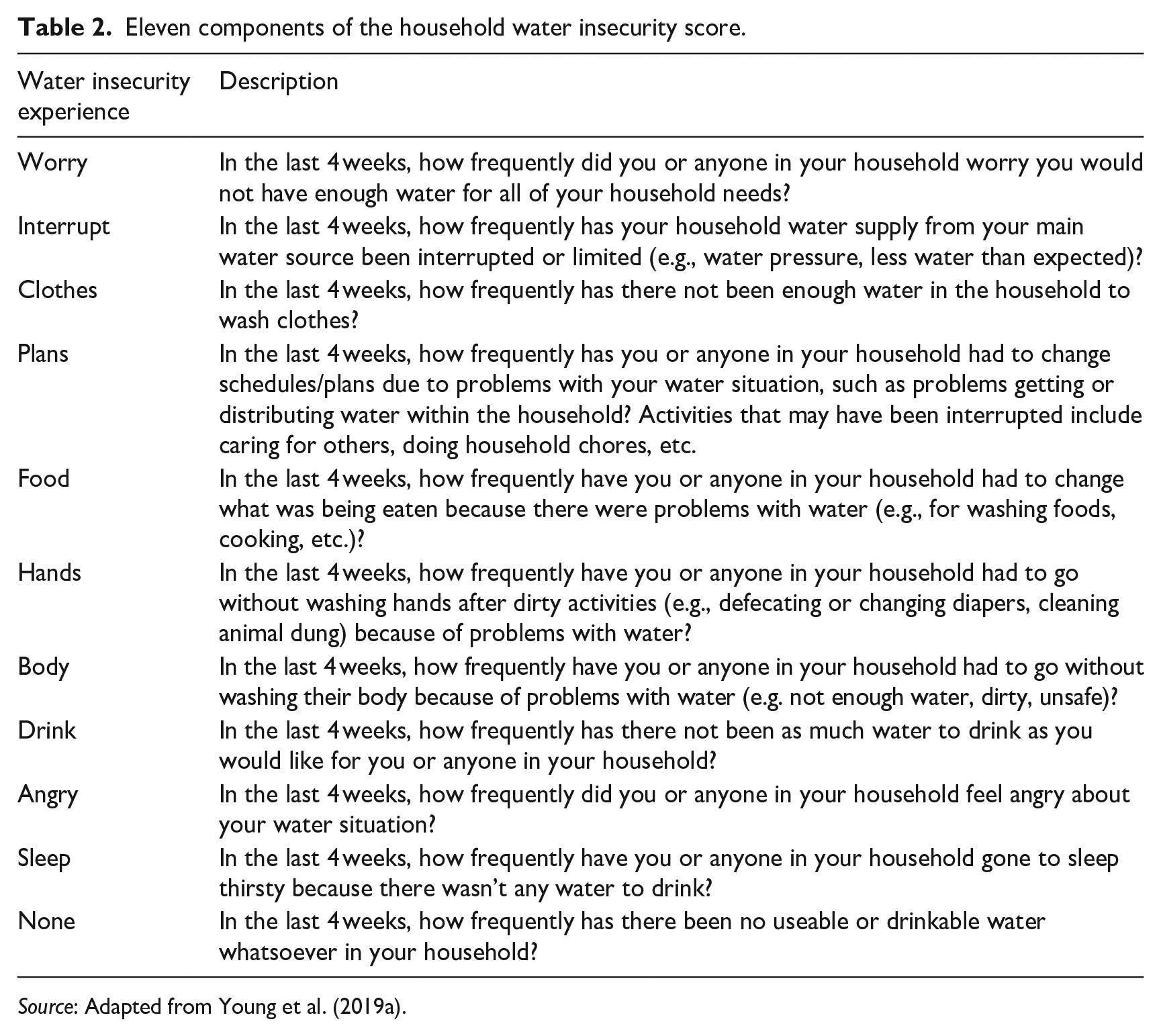
Source: Adapted from Young et al. (2019a).
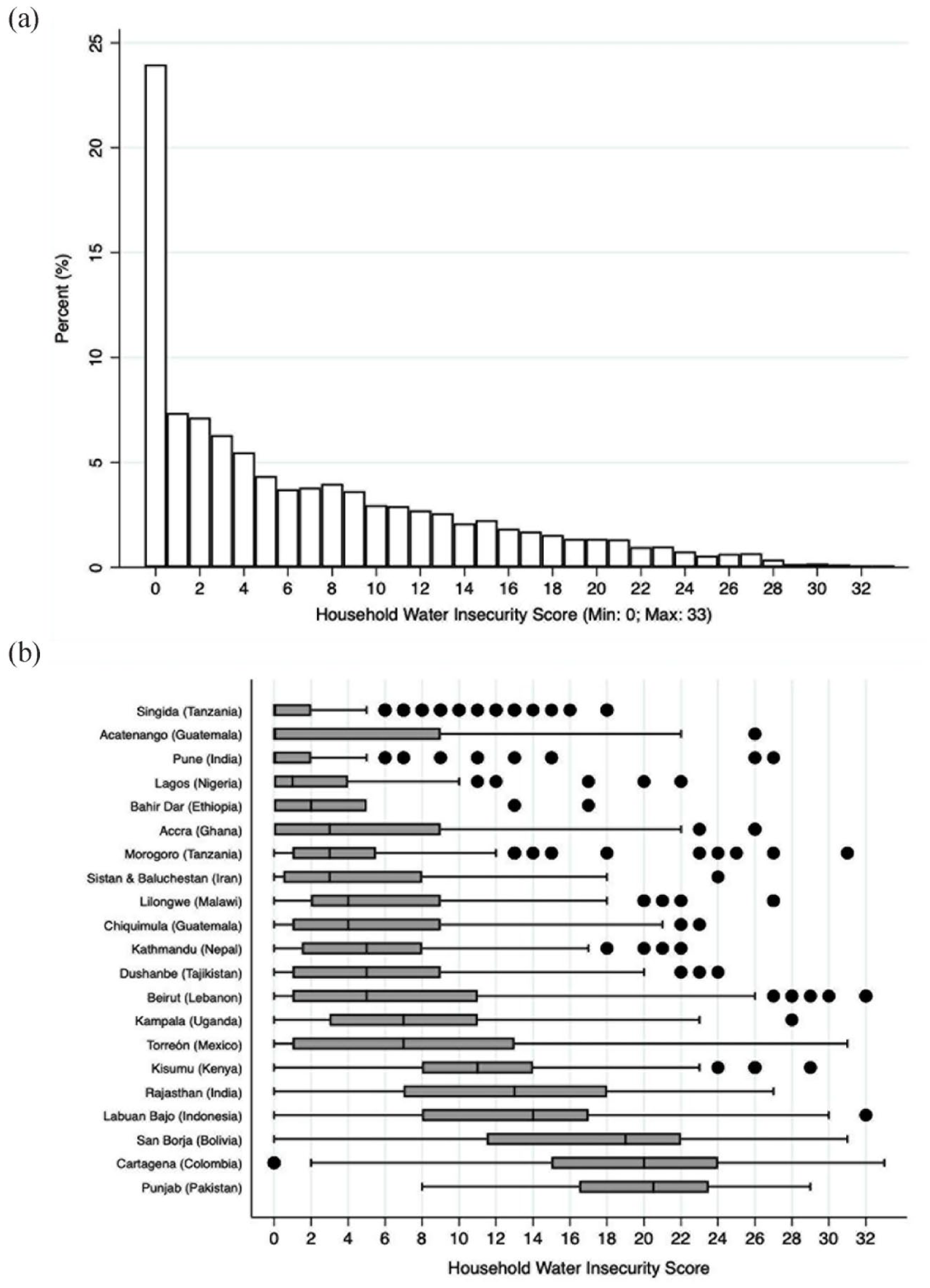
(a) Distribution of household water insecurity scores across all sites (n = 4347). (b) Variation of responses with the interquartile range and outliers (circular points) for the 21 different sites.
Households identities and characteristics for the sample included in each model.
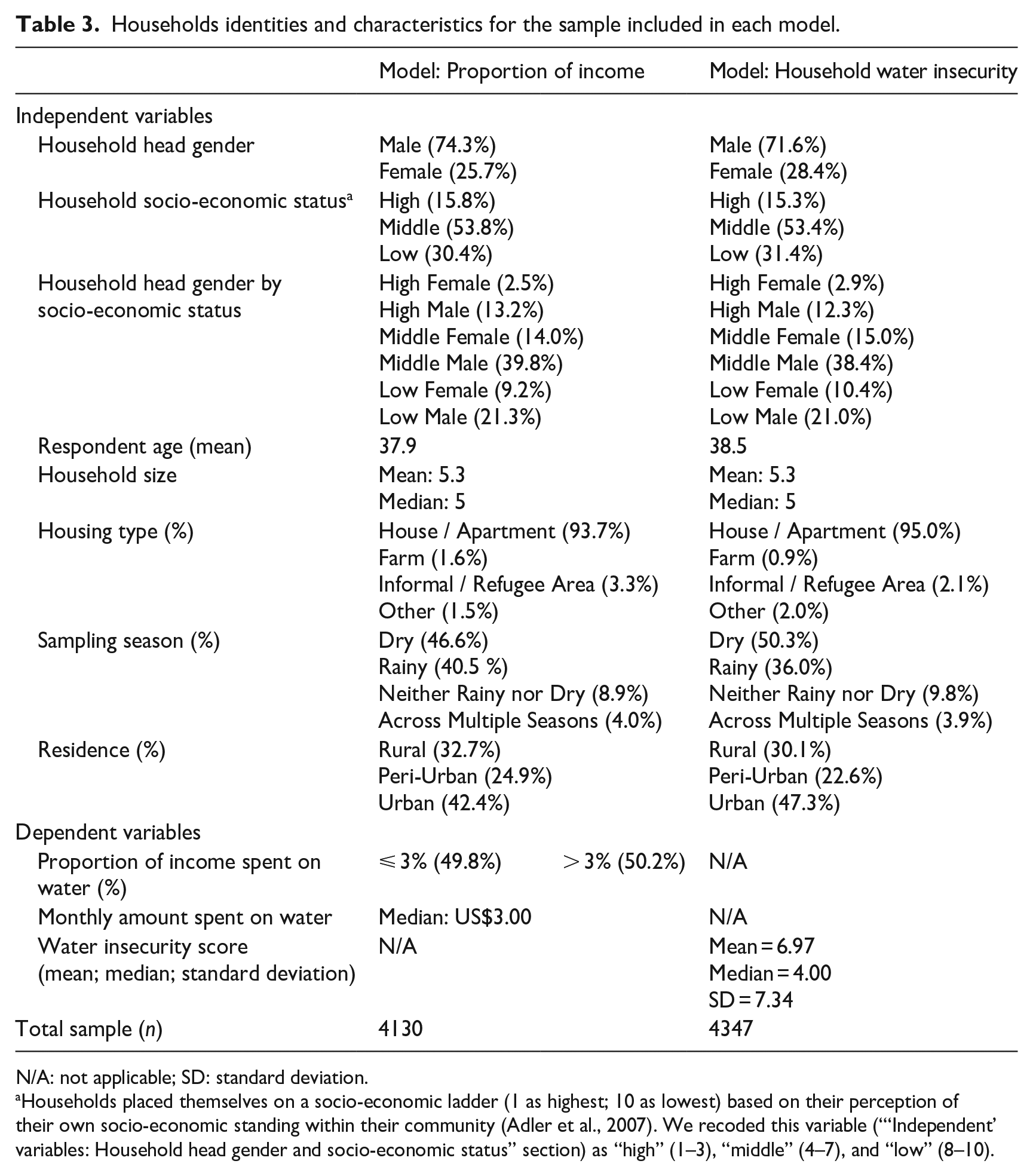
N/A: not applicable; SD: standard deviation.
Households placed themselves on a socio-economic ladder (1 as highest; 10 as lowest) based on their perception of their own socio-economic standing within their community (Adler et al., 2007). We recoded this variable (“‘Independent’ variables: Household head gender and socio-economic status” section) as “high” (1–3), “middle” (4–7), and “low” (8–10).
“Independent” variables 7 : Household head gender and socio-economic status
The intersectional household experiences of interest were gender of the household head and self-reported, relative socio-economic status. Households were asked, “What is the gender of the household head?” and were provided options of “male” or “female.” For socio-economic status, respondents were shown a picture of a ladder with 10 rungs and asked to place their status relative to others in their community on a scale of 1–10 (i.e. MacArthur Scale of Subjective Social Status, Adler et al., 2007). At the top of the ladder (1) are people in a household’s community who are the most affluent, have the highest education, and hold the most-respected livelihoods or occupations (Adler et al., 2007). We collapsed these answers into three categorical levels, corresponding to high (1–3), middle (4–7), and low socio-economic status (8–10) because we were less interested in the difference between neighboring scores and more interested in comparisons between broader categories of socio-economic status.
Based on the structure of the dependent variables, we specified a mixed-effects logistic regression to model water affordability (> 3% of monthly income spent on water) and a mixed-effects censored or Tobit regression to model household water insecurity scores. 8 The proportion of income spent model necessitates a logistic model because the outcome variable is binary (proportion income > 3 = 1; ⩽ 3 = 0). Following prior work (Rosinger, 2018; Rosinger et al., 2021; Stoler et al., 2020), the water insecurity model necessitates a censored (Tobit) model because of left- and right-censoring of the outcome. That is, the scale measuring insecurity could theoretically extend beyond 0 (left) and 33 (right). For each model, we account for the number of household members (continuous), age of the respondent (continuous), season of sampling (rainy, dry, neither rainy nor dry, across seasons), housing type (house, apartment, farm, informal settlement, other), gender of the respondent (male, female), and geographic area of sampling (urban, rural, peri-urban). Both models are multi-leveled, accounting for clustered observations at the site-level, or potential non-independence of observations. We fitted a random intercept for site to account for variation across different geographical areas, assuming a constant correlation between households within a site. That is, to reduce the random variability inherent across sites and produce a more accurate measure of association between our exposure and outcomes of interest, we treated site as a random effect. Furthermore, we clarify that these pooled models are more appropriate than many of the individual, site-specific models (Supplemental Appendix C) because the cell sizes for some intersectional categories in certain sites were small or missing, and hence, relying on certain site-wise regressions may give misleading estimates. By pooling observations, while quantifying site-wise variability, we can derive more reliable associations, even while recognizing further research and data collection within sites must be completed.
We examined the combined effects of household head gender and socio-economic status in two ways aligned with our hypotheses (“Intersectionality, water affordability, and insecurity” section). First, we created a categorical variable with six categories reflecting combinations of gender-head and socio-economic status to assess experiences across intersectional categories. Second, we created an interaction term for the household head gender and socio-economic status variables to assess differences in the association of gender across socio-economic status. Each method was specified in separate regression models.
Results
Proportion of income spent on water
The model results (Table 4) indicate that female-headed households at a high socio-economic status had 2.56 times higher odds of spending > 3% of their income on water (p = 0.002; 95% CI: 1.41–4.67) as compared with male-headed households at a high socio-economic status. For female- and male-headed households at a low socio-economic level, the odds of spending > 3% of income on water were an estimated 2.14 (p < 0.001; 95% CI: 1.42–3.21) and 2.16 (p < 0.001; 95% CI: 1.53–3.04) times higher than male-headed households at a high-socio-economic level. Last, these odds were an estimated 1.10 (p = 0.61; 95% CI: 0.77–1.57) and 1.32 (p = 0.07; 95% CI: 0.98–1.80) times larger for female- and male-headed households of a middle socio-economic status, as compared with male-headed households at a high socio-economic status. Importantly, the compatible association could reasonably range from a modest 23% lower to a moderate 1.57 times higher odds for female-headed households, and a negligible 2% decrease (effectively no difference) to a sizable 1.80 times higher odds for male-headed households with a middle socio-economic status. Furthermore, we find a multiplicative interaction effect, meaning that the association of household head gender differed by levels of socio-economic status (Table 4). The difference in the association of household head gender on the odds of spending > 3% of income on water was 62% (OR: 0.38; p = 0.006; 95% CI: 0.20–0.76) and 68% (OR: 0.32; p = 0.001; 95% CI: 0.17–0.61) smaller at a low and middle socio-economic level, as compared with a high socio-economic level, respectively.
Mixed-effect logistic regression results for proportion of income spent on water (> 3% of monthly income; n = 4130).
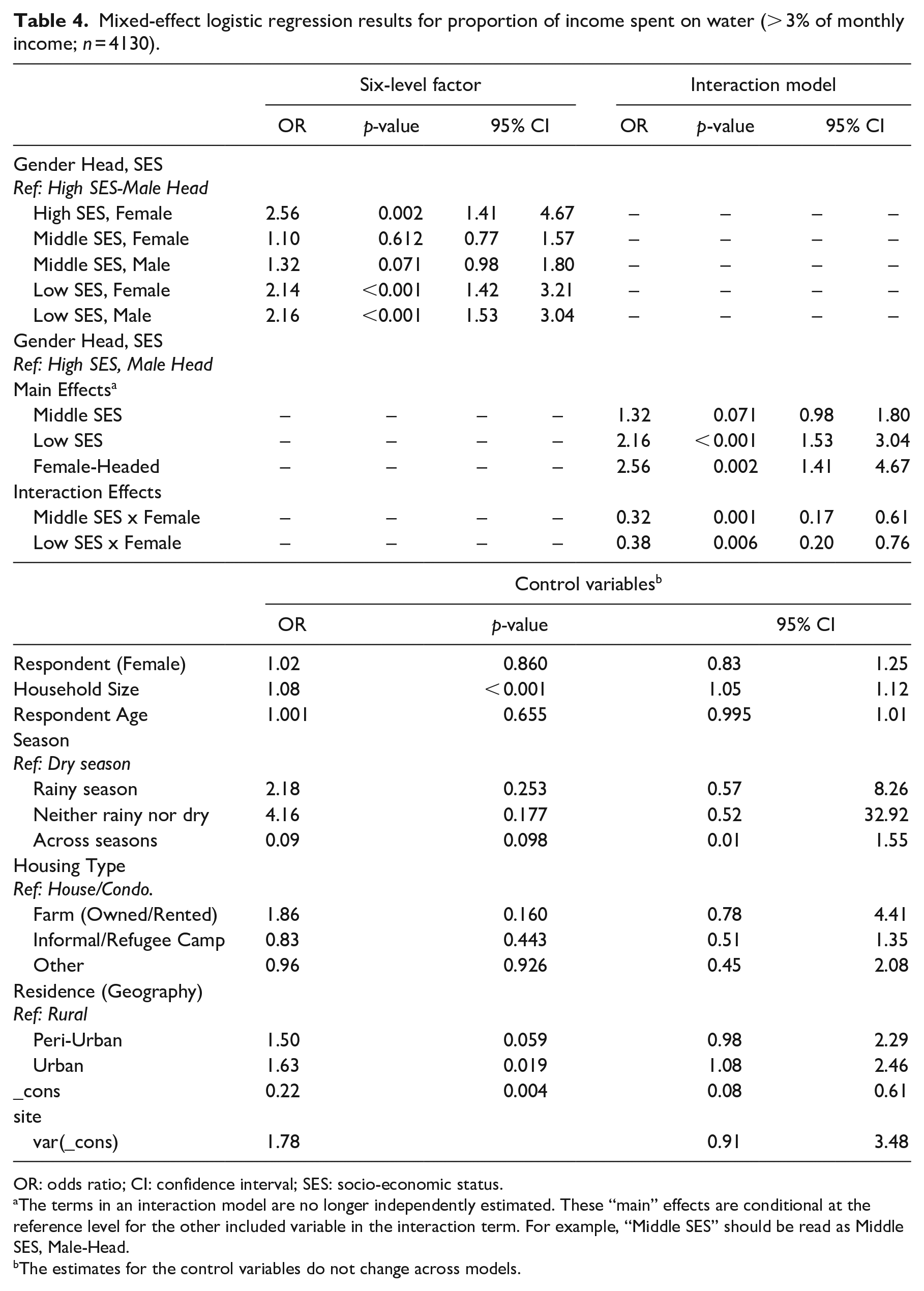
OR: odds ratio; CI: confidence interval; SES: socio-economic status.
The terms in an interaction model are no longer independently estimated. These “main” effects are conditional at the reference level for the other included variable in the interaction term. For example, “Middle SES” should be read as Middle SES, Male-Head.
The estimates for the control variables do not change across models.
While the benchmark of > 3% of one’s monthly income spent on water is described by the HRWS as a metric of water affordability (United Nation (UN), 2010), we recognize that this indicator may be contested. As such, we conducted a sensitivity analysis to determine how the observed associations of interest may change at different benchmarks (> 2%, > 2.5%, > 3.5%, > 4%, > 4.5%, and > 5% of monthly income spent on water). These results are provided in Supplemental Appendix B and described below.
The interaction results described above remain largely consistent across these different benchmarks (Supplemental Appendix B, see Tables B1–B6). The estimates for intersectional categories remain stable up until the 4% threshold of monthly income spent on water. Critically, as the proportion of monthly income spent on water reaches more extreme ends (i.e. 4%, 4.5%, and 5%), we observe marginal increases in the estimated odds of spending such proportions for low socio-economic status households, particularly female-headed homes (Supplemental Appendix B, see Tables B4–B6). This result can be explained, in part, by the expenditure distribution for each intersectional category. Specifically, fewer female-headed households at a high status spent > 4% of income spent on water compared with those at a low status, thereby reducing the odds estimate (Figure 3). The intra-class correlation (ICC) remains stable across all threshold values (2%–5% of income spent)—ranging between an estimated 0.35 and 0.37. This indicates that the random effect of site explains about 35%–37% of the residual variance (depending on the model) or, in other words, that the proportion of spending between 2% and 5% of income on water depends on site membership to a moderate extent.
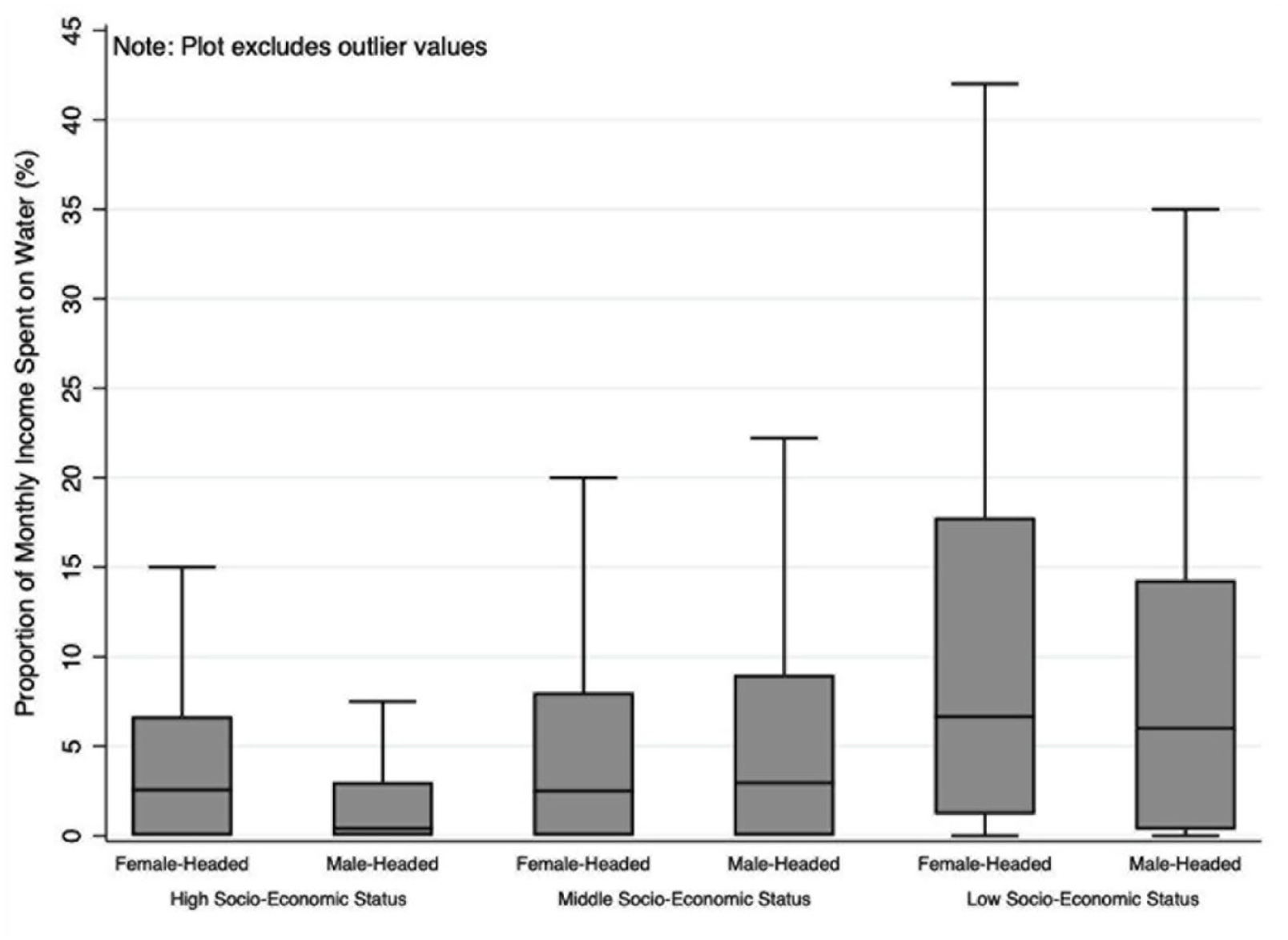
Unadjusted proportion of monthly income spent on water by interquartile range (n = 4130).
In sum, despite these differences in the magnitude of associations, most models indicate a clear interaction, where the difference in the association of head-gender is often largest at a high socio-economic status, as it relates to the odds of spending a certain proportion of income on water.
Household water insecurity
We now report the mixed-effect censored (Tobit) regression results for household water insecurity (Table 5). The coefficient represents the average change in the dependent variable (household water insecurity score) for a one-unit change in the associated predictor variable (or for a category-level change for categorical variables), holding constant the other variables in the model.
Mixed-effect censored (Tobit) regression results for household water insecurity score (n = 4347).
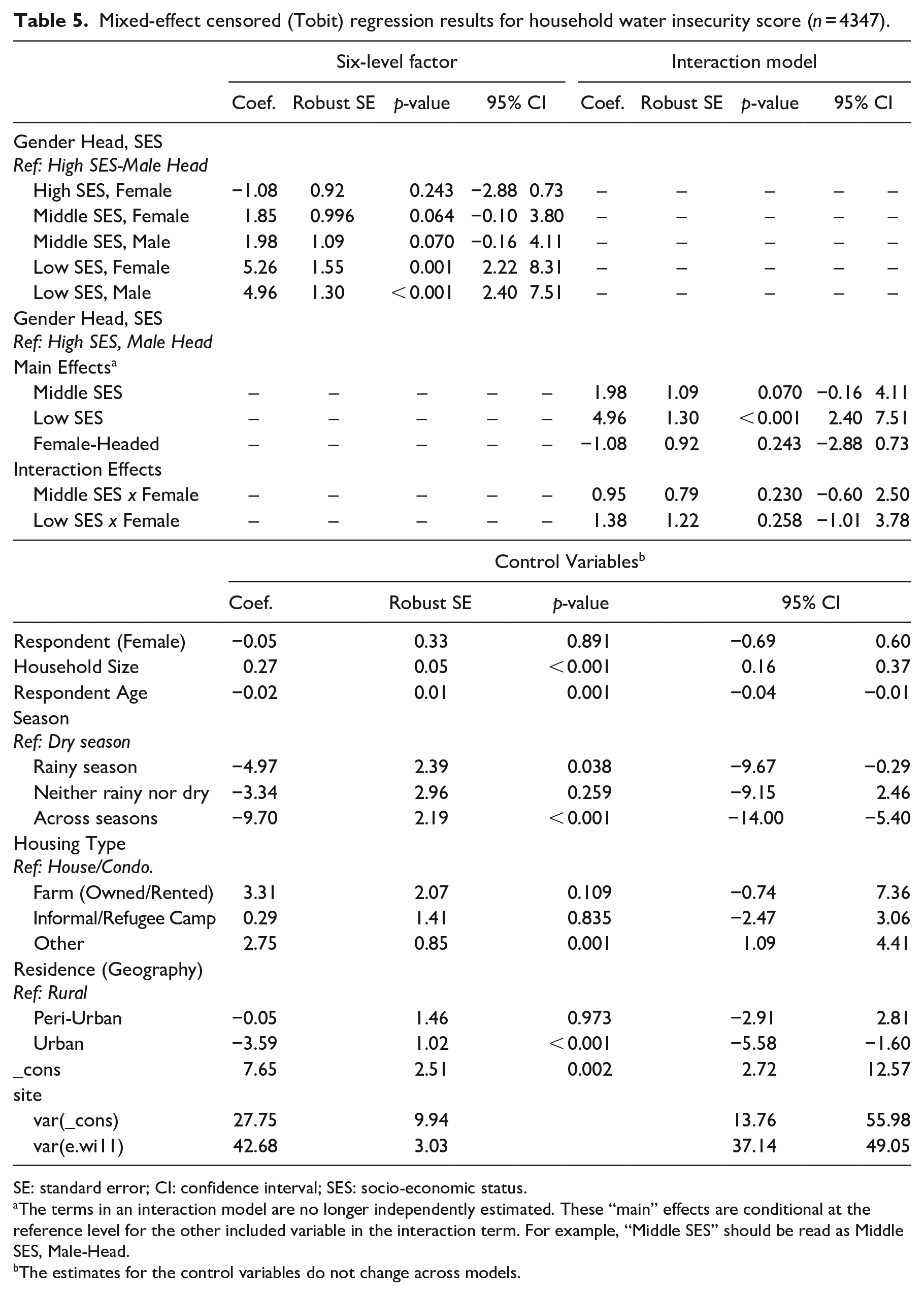
SE: standard error; CI: confidence interval; SES: socio-economic status.
The terms in an interaction model are no longer independently estimated. These “main” effects are conditional at the reference level for the other included variable in the interaction term. For example, “Middle SES” should be read as Middle SES, Male-Head.
The estimates for the control variables do not change across models.
After accounting for potential confounders, we find male- and female-headed households with a low socio-economic status had household water insecurity scores that were an average 4.96 (p < 0.001; 95% CI: 2.4–7.5) and 5.26 points (p = 0.001; 95% CI: 2.2–8.3) higher, as compared with the reference category of high socio-economic male-headed households. Relative to high socio-economic male-headed households, we find female- (B: 1.85; p = 0.06; 95% CI: –0.1–3.8) and male-headed homes of a middle socio-economic status (B: 1.98; p = 0.07; 95% CI: –0.16–4.1) had higher insecurity scores. We acknowledge, however, that this estimated difference is smaller in magnitude and could reasonably range from effectively no difference to a modest 3.8 (female-headed) and 4.1 (male-headed) increase in water insecurity score based on the data and modeling strategy used. The ICC for this model was 0.39, indicating that household water insecurity depends moderately on the site membership.
In sum, water insecurity was negatively associated with socio-economic status (i.e. a lower socio-economic status was associated with greater water insecurity) across sampled sites. The estimated effect of household head gender on water insecurity score within different socio-economic status categories was relatively minor, as can be seen from the categorical predictions and the interaction term. We contextualize and explain these results below.
Discussion and contributions
From our interaction analysis, we expected differences in water affordability and water insecurity by gender would be largest for households with the lowest socio-economic status (see “Intersectionality, water affordability, and insecurity” section). We found, however, that the odds of spending > 3% of income on water between male and female-headed households was 62% (OR: 0.38; p = 0.006; 95% CI: 0.20–0.76) and 68% (OR: 0.32; p = 0.001; 95% CI: 0.17–0.61) smaller at a low and middle socio-economic level, respectively, as compared with a high socio-economic level. This highlights an interaction between household head gender and socio-economic class, as it relates to water affordability. In other words, we observe differences in water expenditures between male- and female-household heads change with socio-economic status. By contrast, the difference in household water insecurity scores by gender was not observed to be meaningful within levels of socio-economic status.
From our composite categorical variable analysis, we expected female-headed households with a low socio-economic status to both have the highest odds of spending > 3% of income on water, and to have the highest average water insecurity scores. Model results indicated that female-headed households at a high socio-economic status had the highest estimated odds of spending > 3% of their income on water (OR: 2.56; p = 0.002; 95% CI: 1.41–4.67), compared with high status male-headed households. This finding, however, starts eroding for more extreme water costs (> 4% of monthly income). As the proportion of income expenditures increase, we observe that the estimated odds of spending such extreme proportions increases, particularly for female-headed homes with a low-socio-economic status. Related to water insecurity, female- and male-headed households at a low socio-economic status were similarly associated with the highest average water insecurity scores. Taken together, the presence and absence of gendered effects within socio-economic status levels across water affordability and insecurity models is an interpretational challenge. Following critical quantitative geographers, our results do not mirror an objective-reality; they are produced through the nuances of data collection, and the models and assumptions made from hypotheses testing (see Bauer et al., 2021; Buchanan and Wiklund, 2021). Thus, it is more productive to interrogate how the data and methods employed reveal (and limit) effects and relations at multiple scales—a subject we return to in the “Limitations: Toward scalable intersectionality research” section. Our findings provide three contributions to water insecurity research.
First, our findings reflect arguments made by feminist political-ecologists, in that gendered experiences of water are neither monolithic nor stable and are instead experienced through structural and place-based systems of oppression—such as class (Crow and Sultana, 2002; Dickin and Caretta, 2022; Nightingale, 2011; Rodó-de-Zárate and Baylina, 2018; Sultana, 2009). Particularly, we find household water unaffordability is related to the combination or interaction of household head gender and socio-economic status, and that estimated intersectional differences related to both affordability and water insecurity exist in certain sites themselves (per Supplemental Appendix C). The implications that gendered relations of water are affected by economic systems reflects the increasingly established understanding of water (in)security as a relational process (Jepson et al., 2017; cf. Mollett and Faria, 2013).
Second, our findings challenge assumptions about water expenditure, namely that significant proportional water expenditures only occur in disadvantaged socio-economic groups (see “Proportion of income spent on water” section). This finding reveals potential challenges in framing water expenditure as an experience of marginalization—and may, in specific contexts, reflect notions of privilege, which intersectionality similarly theorizes (Buchanan and Wiklund, 2021). For example, high expenditures on preferred water or being able to purchase large water quantities for productive needs or wants is very different than spending out of desperation or because of steep water costs. Nevertheless, our results demonstrate lower socio-economic status households are impacted by multiple dimensions of water insecurity—both extreme proportional expenditures and higher average water insecurity scores across sites. We find evidence of “tipping points,” whereby the estimated odds of spending more extreme proportions of income for water slowly increase after 3% for households with the lowest socio-economic status, especially those that are female-headed (“Proportion of income spent on water” section). This suggests these households may have greater proportional water costs and needs, including but not limited to subsistence agriculture, caregiving responsibilities, or emergency water costs (e.g. having to buy more expensive water when lower cost options are not available). Practically then, generic baselines for water unaffordability, even if already high (i.e. > 3% of income spent), may obscure and overshadow the expenditure distribution of disadvantaged socio-economic households. Future research and policy practice should consider the limitations and silences of using standardized, versus context-specific, benchmarks.
Third, we contribute a quantitative approach to a larger body of research on water-related intersectional experiences (Cole, 2017; Harris, 2008; Mitra and Rao, 2019; Sultana, 2020; Truelove, 2019). Modeling approaches are not epistemologically superior and will always be a partial and incomplete approach for analyzing complex intersectional experiences. Such approaches are, however, capable of scaling empirical results through identifying patterns across heterogenous sites (Hay, 2021). Scholars concerned with resource inequities understand that many systems of oppression, including patriarchy and capitalism, occur at global-scales, and hence, models capable of synthesizing multi-site data offer a crucial vantage point to identify broader processes and trends (e.g. Neumayer and Plümper, 2007). Thus, our findings should not be interpreted as a “global statistic” overriding site-specific relations (Supplemental Appendix C) and variation (see reported ICCs, in the “Results” section). Rather, we suggest they be read with the site-wise data and with existing qualitative studies to offer new questions and contestations. Asserted elsewhere, qualitative and quantitative methods at different scales can advance understandings of the lived experiences of water not merely through triangulation, but through examining the divergences and misalignments between data (Shah and Harris, 2022; cf. Morgan, 2019; Nightingale, 2009).
Limitations: Toward scalable intersectionality research
We now identify limitations of our study, and derive from them, four major pathways to incorporate quantitative methodologies and data more comprehensively into scalable, multi-sited intersectional research on water insecurity. 9 Our recommendations follow Hopkins’ (2018, 2019) assertion that geographers advance the theory, empirics, and application of intersectionality research through “understandings of scale, appreciations of place or time-space relations, [and] spatial belonging and identities” (qtd. 2019: 942).
Develop scale-appropriate models
We found patterns across gender and socio-economic status groupings, necessitating further investigation from the data collected in the 18 LMICs. We recognize, however, that a key limitation of our study, and challenge for future research, rests in appropriately scaling such analyses to derive broadly generalizable results for social justice action. Here, we acknowledge the suite of potential biases associated with multi-sited and multi-lingual instruments, and any unknown and unintended variation in our design that limits cross-site comparison. To this end, we recognize intersectional experiences are often deeply place- and context-specific (Harris et al., 2017; Hopkins, 2018, 2019; Rodó-de-Zárate and Baylina, 2018; Valentine, 2007). For example, operationalizing ethnicity, quantitatively, is a challenge (and an opportunity) for intersectional research because of significant variations within and between countries. The scale at which certain intersectional experiences are analyzed, and the systems of power they emerge from, remains a concern. Regionally specific models could operationalize important place-based systems of oppression, such as caste, that structure the lived experiences of water affordability and insecurity.
Neither the HRWS benchmark concerning water affordability, nor the adapted 11-point household water insecurity score are cross-culturally validated measurements (although the 12-item HWISE Scale is validated for comparative analysis, Young et al., 2019a). Cross-cultural validation is a methodology to ascertain the extent to which similar water-related experiences are shared or relevant across diverse socio-ecological and bio-cultural contexts—and is critical for developing broadly generalizable knowledge claims (Young et al., 2019a). For instance, while we believe the HRWS indicator of water affordability is a benchmark worthy of investigation, we understand metrics of water affordability may differ in particular sites, or may not even be a relevant concern in others. The inability to validate our dependent variables across the different site contexts is another of several limitations in assessing the shared natures of water access and insecurity experiences.
Overall, multi-sited research requires careful consideration of outcome and predictor variables, namely, the relations of power, amenable to scaling across cultural, socio-economic, and bio-spatial contexts; or regionally scaled analyses reflecting placed-based systems of marginalization that shape water insecurity experiences.
Discuss site-specific and multi-site results
No matter the scale of analyses, an adequate sample size and response variability for intersectional categories will be necessary to compare scaled results with local site-wise differences. This is a challenge we encountered. For instance, in some sites there was no variation in the household responses to proportion of income spent, which precluded the generation of an odds ratio statistic for a particular group. These site-wise observations, however, are pooled in the multi-sited model and factor into the estimates produced, even while estimates for such observations without response variability are not possible at the site-scale (see Supplemental Appendix C for site-wise regression models). Thus, we encountered challenges in making comparisons across scales in ways that would enable us to articulate convergence or divergence between local and multi-sited experiences. This is a key consideration for future multi-sited and multi-scalar intersectionality research. Future research should strongly consider sampling strategies that maximize variability (e.g. stratified sampling) and encourage larger sample sizes across multiple axes of social difference.
Collect outcome data measuring impacts of water unaffordability and insecurity
A third limitation of the data for our study was the inability to derive household impacts resulting from water expenditure and affirmed water insecurity experiences. We cannot discern or equate experiences with the impacts on food, income, health, or hygiene. This is because households may have different coping and adaptive capacities to modulate the effects of higher expenditure or insecurity experiences (Lemos et al., 2016; Venkataramanan et al., 2020a; Wutich and Brewis, 2014). An expansive literature documents how adaptive capacity is affected through marginalization. As one hypothetical example, even where households may register the same water insecurity score, the impacts of these experiences could diverge considerably. Thus, a focus on the net impacts of water unaffordability and insecurity on a diversity of household needs could reveal more nuanced patterns for certain intersectional groups, given how systems of marginalization compound to affect, not only exposure, but the capacity to respond to it.
Deconstructing gender identities and collect data on gendered power relations
We used gender of household head as a variable for exploring intersectional differences. Our analyses are limited by the assumption that this binary variable is relevant for understanding gender marginalization across cultural and spatial contexts. Further limitations include embedded assumptions of household composition and corresponding outcomes of gender discrimination, household-scale decision-making, and intra-household water-related risks (e.g. Boudet et al., 2018; Harris et al., 2017). Moving forward, deconstructing variables, which may better reflect processes of gender discrimination, could enrich patterns described herein (e.g. Browne, 2008; Young, 2021). For example, data collection could be informed by both generalist, site-, and culturally specific proxies that are representative of gender discrimination. In South Asia, female-headed widowed or partner-away households (e.g. male out-migration) could reveal particular inter-categorical effects (or “intra-categorical” effects (McCall, 2005) between female-headed households). Such processes of survey co-design could occur with target populations (Bowleg, 2008; Buchanan and Wiklund, 2021).
Importantly, we recognize that inter-categorical approaches to analyze intersectionality have limitations even when collecting deconstructed gender or other data (Bauer et al., 2021; Hancock, 2007). Following Sochas (2021), these include caricaturing fixed differences between social categories across place (e.g. Choo and Ferree, 2010; Hancock, 2007), reductively focusing on the categories themselves instead of structural systems of oppression that produce inequities, and indirectly encouraging individual-focused policies that fail to sufficiently challenge structural systems (Buchanan and Wiklund, 2021). Relatedly, we are reminded of Bowleg’s (2008) assertion that fragmenting intersectional experiences into separate identities may be insufficient for understanding how interlocking systems of harm collectively shape outcomes, like water insecurity. A focus on gender, then, could extend beyond deconstructing demographic data, and into collecting data on structures and relations of power across socio-spatial contexts (e.g. Bowleg and Bauer, 2016). The ability to model structural dynamics and relations (e.g. using path analyses) theorized to shape outcomes for certain demographic groups can avoid interpretations of water insecurity that are de-contextualized from interlocking socio-economic and political systems of marginalization (Arora-Jonsson, 2011; Carter, 2009, for broader criticisms).
Conclusion
Concerned with structural and place-based systems of oppression—such as patriarchy, racism, classism, caste, homophobia, heteronormativity, and others—intersectional theory emerged from the lived experiences of Black feminists and broader intersectional coalitions (Collins and Bilge, 2020), arguing that intersecting experiences represent a complex and differentiated whole (e.g. Bowleg, 2008; Crenshaw, 1991). Intersectionality as an epistemology has, in general, been approached methodologically through qualitative research designs, wherein the lived experience of gender, race, and class are articulated in relation to each other. In contrast, quantitative approaches which operationalize identity as variables have been, often rightly, criticized as reductive and essentializing (Buchanan and Wiklund, 2021). That is, gender and race, for example, are not themselves predictive of outcomes when removed from systems of exclusion. We endeavored to contribute a critical and reflective quantitative analysis of intersectional patterns across multiple geographies to the water insecurity scholarship. In recognizing the limitations of our approach—including the partial and incomplete specification of interaction and composite categorical variables—we maintain our study yields three contributions.
First, we find—as feminist political-ecologists have long-argued—that gender-water analyses are, alone, insufficient. To this end, we found water expenditures—measured as the estimated odds of spending > 3% of monthly income on water—between male- and female-household heads differ with socio-economic status. This finding demonstrates differences in gendered relations around water expenditure. Here, the use of interaction and composite categorical variables are important because conventional main effects approaches average across other key axes of difference and risk obfuscating gender as a contingent relation (Bowleg and Bauer, 2016; Harris et al., 2017; Truelove, 2019).
Second, core indicators of water affordability and insecurity require deep, critical analysis. Our models demonstrate that female-headed households reporting a high socio-economic status registered the highest estimated odds of spending > 3% of their income on water, relative to male-headed households of similar status. While this indicates high proportional water expenditures do not occur in disadvantaged socio-economic groups alone, our sensitivity analysis revealed that lower socio-economic households, particularly female-headed, demonstrate slowly increasing estimated odds of engaging in the most extreme proportional expenditures. Had we failed to interrogate the standardized indicator of affordability (>3%), we may have overlooked how the distribution of expenditures shifts, particularly for otherwise disadvantaged intersectional groups.
Third, place-based heterogeneity explains variation in water insecurity and affordability outcomes. This is demonstrated both by the individual site-wise models (see Supplemental Appendix C) and in the random effect of site, which accounted for a moderate share of the residual variance in all models. Pooled models reveal patterns across sites; however, they should not be interpreted as overriding the heterogeneity and nuance of local sites themselves. From this finding, we urge quantitative methodologists to recognize intersectional outcomes as socio-spatial (Sultana, 2009, 2020)—where social positions and their site-wise variability explain observed outcomes.
These results pushed our article to identify several future directions. Moving forward, we recommend quantitative intersectionality research should develop scale-appropriate models, be capable of discussing complementarities and differences between site-specific and regional or multi-sited results, measure the impacts of water insecurity, and collect data on gendered power relations. These recommendations will provide clarity for quantitative research and their interpretation in the pursuit of multi-sited intersectionality scholarship.
Supplemental Material
sj-pdf-1-epf-10.1177_26349825231156900 – Supplemental material for Variations in household water affordability and water insecurity: An intersectional perspective from 18 low- and middle-income countries
Supplemental material, sj-pdf-1-epf-10.1177_26349825231156900 for Variations in household water affordability and water insecurity: An intersectional perspective from 18 low- and middle-income countries by Sameer H Shah, Leila M Harris, Vikas Menghwani, Justin Stoler, Alexandra Brewis, Joshua D Miller, Cassandra L Workman, Ellis Adjei Adams, Amber L Pearson, Ashley Hagaman, Amber Wutich and Sera L Young in Environment and Planning F
Footnotes
Acknowledgements
The authors thank members of the EDGES Research Collaborative at The University of British Columbia for constructive feedback on earlier drafts of this manuscript. They further extend gratitude to Dr Mary A. Painter for their constructive comments.
HWISE-RCN Consortium Authors
Farooq Ahmed, Quaid-i-Azam University Islamabad, Islamabad, Pakistan.
Mallika Alexander, Johns Hopkins University-Byramjee Jeejeebhoy Medical College Clinical Trials Unit, Pune, India.
Mobolanle Balogun, College of Medicine of the University of Lagos, Lagos, Nigeria.
Genny Carrillo, Texas A&M University, College Station, TX, USA.
Stroma Cole, University of Westminster, London, UK.
Shalean M. Collins, Tulane University School of Public Health and Tropical Medicine, New Orleans, LA, USA.
Hassan Eini-Zinab, Shahid Beheshti University of Medical Sciences, Tehran, Iran.
Matthew C. Freeman, Emory University, Atlanta, GA, USA.
Monet Ghorbani, Arizona State University, Tempe, AZ, USA.
Zeina Jamaluddine, London School of Tropical Medicine and Hygiene, London, UK.
Jyoti Mathad, Weill Cornell Medicine, New York, NY, USA.
Jonathan Maupin, Arizona State University, Tempe, AZ, USA.
Patrick Mbullo Owuor, Northwestern University, Evanston, IL, USA.
Javier Morán-Martínez, Autonomous University of Coahuila, Coahuila, Mexico.
Asher Y. Rosinger, Pennsylvania State University, State College, PA, USA.
Marianne V. Santoso, Northwestern University, Evanston, IL, USA.
Roseanne C. Schuster, Arizona State University, Tempe, AZ, USA.
Mahdieh Sheikhi, Shahid Beheshti University of Medical Sciences, Tehran, Iran.
Andrea Sullivan, University of Miami, Coral Gables, FL, USA.
Yihenew Tesfaye, Bahir Dar University, Bahir Dar, Ethiopia.
Alex Trowell, University of Amsterdam, Amsterdam, The Netherlands.
Wendy E. Jepson, Texas A&M University, College Station, TX, USA.
Kenneth Maes, Oregon State University, Corvallis, OR, USA.
Raymond Tutu, Delaware State University, Dover, DE, USA.
Declaration of Conflicting Interests
The authors declared no potential conflicts of interest with respect to the research, authorship, and/or publication of this article.
Funding
The authors disclosed receipt of the following financial support for the research, authorship, and/or publication of this article: The Household Water Insecurity Experiences Research Coordination Network (HWISE-RCN) is supported by National Science Foundation (NSF) #BCS-1759972. The project was originally funded by the Competitive Research Grants to Develop Innovative Methods and Metrics for Agriculture and Nutrition Actions (IMMANA). IMMANA is funded with UK Aid from the UK Government. The project was also supported by the Buffett Institute for Global Studies and the Center for Water Research at Northwestern University; National Institutes of Health (NIH/NIMH K01 MH098902 and R21 MH108444); Arizona State University’s Center for Global Health at the School of Human Evolution and Social Change and Decision Center for a Desert City (NSF SES-1462086); the Office of the Vice Provost for Research of the University of Miami; Lloyd’s Register Foundation for Labuan Bajo; and College of Health and Human Development and Social Science Research Institute at Pennsylvania State University. Co-author AW was supported by National Science Foundation SES-1462086 and DEB-1637590. Co-author LH was supported by the Social Sciences and Humanities Research Council of Canada (#435-2018-0316), and Peter Wall Institute for Advanced Studies at The University of British Columbia.
CRediT Author Statement
Supplemental material
Supplemental material for this article is available online.
Notes
 ).
).
References
Supplementary Material
Please find the following supplemental material available below.
For Open Access articles published under a Creative Commons License, all supplemental material carries the same license as the article it is associated with.
For non-Open Access articles published, all supplemental material carries a non-exclusive license, and permission requests for re-use of supplemental material or any part of supplemental material shall be sent directly to the copyright owner as specified in the copyright notice associated with the article.
