




Abstract
Modern mapping systems can provide almost everything there is to know about the environment, except what Māori know. So our interests are not that apparent in a mainstream context despite it being widely acknowledged that Māori have a unique and intergenerational relationship with the land- and waterscapes, and the presence of legislative requirements to reflect Māori political agenda in resource management decision-making. He Tātai Whenua is a project that seeks to assemble Māori knowledge and place it alongside existing environmental databases to render this knowledge highly visible and ensure a greater impact on Aotearoa New Zealand rights and environmental regimes. The challenge is constructing a process that maintains the integrity of Māori knowledge as it crosses into domains that are beyond the direct control of Māori communities as kaitiaki, guardians of that knowledge. In this article, He Tātai Whenua is the focal point of discussions around the importance of indigenous leadership, data sovereignty and a social justice agenda to maintain the integrity of Māori knowledge and navigate knowledge boundaries in the research activity. Two approaches are introduced. The first reflects on exchanges between knowledge systems to identify pathways that protect the integrity of Māori knowledge. The second considers how Māori environmental knowledge can be assembled and interact with science in a manner that makes sense from a Māori worldview. Together, these approaches enable us to develop a confidence in collaborative research and increased trust in how research outputs derived from Māori environmental knowledge will be used and applied to realise bicultural spatial governance.
He Tātai Whenua is a research project that converts Māori expert knowledge about the landscape into a form that can interact with Geographic Information Systems to improve environmental reporting and monitoring. A key focus of the research is how Māori knowledge and science are brought together so environmental decision-making can ‘genuinely value and utilise two of Aotearoa’s rich knowledge systems’ (Kukutai et al., 2021: 5). In this article, the phrase Māori knowledge-science interface is used to refer to the space where these knowledge encounters occur. This article seeks to understand the nature and potential of encounters at the interface to recognise and amplify the influence of Māori knowledge in environmental management and realise more equitable futures for Māori through an accelerated shift towards bicultural spatial governance.
He Tatai Whenua brought together a team of indigenous 1 community leaders, indigenous researchers, indigenous specialist environmental scientists and social scientists, computer scientists, geospatial scientists, and mathematicians to synthesise a landscape classification system that can explore the Māori world through a geometric and geospatial lens. Our team engaged in wānanga or knowledge exchanges to co-create the Māori landscape classification system. For example, our first set of wānanga were simply knowledge sharing exercises with opportunities to explore how team expertise and technology could be used to articulate Māori understandings of the environment (Proctor and Harmsworth, 2021). There were wānanga to understand how mapping technology and non-Māori understandings of the environment have silenced Māori voices and removed tangible markers of our authority, histories, and relationships. There were wānanga that explored the contemporary relevance of Māori forms of mapping such as whakapapa (Forster, 2019a, 2019b). There were wānanga at significant sites for hapū such as old pā sites (fortified villages), marae (tribal centre), streams, and rivers. Team members walked the land and shared place-based knowledge such as local tribal histories and tribal knowledge of local ecology and biodiversity while other members considered how to capture this information with Geographic Information Systems and other geospatial technology. Wānanga typically involved a lot of talking and reimagining how to visualise and map cultural information alongside environmental data.
This collaborative and place-based approach recognised the strategic importance of Māori leadership and Māori knowledge for environmental management. The goal is to generate new methodologies and new tools to disrupt the dominance of scientific information and eliminate forms of environmental decision-making that provide limited recognition of indigenous knowledge, ways of knowing and associated practices. The status quo lends itself to conceptualising the environment as a commodity that can be owned, exploited and indigenous connections extinguished. Such an approach is considered today to be unjust, discriminatory and unsustainable, requiring a reimagining of environment management to realise a more productive, sustainable and inclusive economy (Ministry of Business Innovation Employment (MBIE), 2019).
This article charts our journey towards these goals with a specific focus on amplifying the influence of Māori knowledge and Māori political agenda in modern mapping systems and environmental management. It brings together our conceptual thinking and reflects on how these have been translated to He Tātai Whenua research outcomes. Key questions include: How can an increased visibility of Māori landscape knowledge be achieved in modern mapping systems? How can Māori perspectives be brought alongside landscape classification systems? How can the integrity of Māori knowledge be maintained? How can knowledge contests be mitigated?
Three analytics are woven together to explore these questions. Analytics in this context could be replaced with terms like theory or methodology and simply provides a schema to guide the research enterprise particularly data analysis. The three analytics are whakapapa, governmentality, and assemblage. The whakapapa analytic explores the Māori knowledge-science interface from a Māori perspective as a domain of encounters. The governmentality analytic considers power issues at this interface due to colonisation and the privileging of scientific knowledge. The assemblage analytic considers how to reconstruct the interface as a more equitable and inclusive space.
The analytics have been constructed from an analysis of genealogical sequences, creation narratives (Best, 1924; Mikaere, 2003; Royal, 2003; Smith, 1913–1915), Aotearoa environmental histories (Ali Memon, 1993; Forster, 2014, 2016; Pawson and Brooking, 2011, 2013; Petrie, 2006; Young, 2004), environmental policies (Waitangi Tribunal, 2011; Williams, 2001a, 2001b) and position documents from Māori academics outlining Māori experiences in and aspirations for the New Zealand research and development sector (Kukutai and Taylor, 2016; Kukutai et al., 2021; Rauika Māngai, 2020; Stats, 2020; Te Mana Raraunga, 2018; The Pūtaiora Writing Group, 2010). Each analytic has its own set of optics for considering how power and influence flows through systems of thought and actions. This information has been mapped and interrogated at wānanga with Māori knowledge systems specialists associated with He Tātai Whenua to test credibility and validity of findings.
The analytics are used here to render the interface knowable; to create a genealogy that defines the nature of and conditions at the interface (i.e. where multiple knowledge systems meet) and reimagine knowledge encounters to enhance and secure the visibility and influence of Māori knowledge. Construction of these analytics is the focus of this article. The analytics applicability is demonstrated through examples of activities at the interface in the Tātai Whenua project. It is argued that culturally appropriate practices are dependent on visualising the interface as an ātea to maintain the distinctiveness of each knowledge system and mediate knowledge encounters towards meaningful, mutually beneficial, and enduring outcomes. The intent is to facilitate engagement in effective collaborative adaptive management and urge a shift towards bicultural spatial governance.
Visualising the interface
This article begins by introducing an approach for visualising the interface or the space where knowledge systems meet. Three analytics are constructed that explore the influence of Māori knowledge on environmental management. This section introduces each analytic – the whakapapa, governmentality, and assemblage analytic – providing information on provenance and intent. An argument for the suitability of this approach is also expressed.
Briefly, whakapapa is a Māori theoretical construct for organising and understanding the world through genealogies; everything has a whakapapa. It is most commonly understood as a system for mapping kinship relationships (i.e. through my parents I am related to my grandparents to my great grandparents and so on) thereby establishing origin, identity and belonging. Whakapapa is a critical source of Māori knowledge. There are whakapapa that reveal links to atua (gods, spiritual forces), that visualise the origin of the world, natural resources and phenomena (i.e. the water cycle) (see, for example, Best, 1924; Royal, 2003; Smith, 1913–1915). The explanatory power of whakapapa has been used to understand new phenomena such as Te Tiriti o Waitangi (Sadler, 2007), Te Tiriti partnerships (Royal, 1998), dispossession through colonialism (Sadler, 2007), indigenous environmental governance (Forster, 2019a, 2019b) and predicting the future (Royal, 1998).
Whakapapa therefore provides an explanation of order and relationships (Royal, 1998). This knowledge base inspires Māori-centred aspirations, agenda, and appropriate actions. In this article, a whakapapa analytic provides a foundation for the research enterprise ensuring that understandings derived from a Māori worldview and Māori political agenda (i.e. indigenous data sovereignty) underpins interpretation and data analysis; whakapapa is a central focus of the inquiry.
Governmentality is a Foucauldian-inspired analytic of power that makes explicit the thoughts involved in the way we govern and are governed (Dean, 1999). Governmentality studies consider whether it is possible to think and act in a different way by mapping systems of thought that underpin activities or operations of government, 2 that influence ‘economic activity, social life and individual conduct’ (Rose and Miller, 1992: 173). It is however much more than a mapping exercise. Governmentality studies explore ‘how those who seek to govern imagine their world and seek to fashion it anew’ (Rose et al., 2006: 100) or put another way these studies consider how the art of government can be disrupted and transformed towards specific political agenda. Dean (1996: 211) refers to this as the ‘moral regulation of individuals’ and taking responsibility for shaping the actions of others towards certain ends. In this context, governmentality is ‘problem-centred and present-orientated’ (Dean, 1999: 3) so lends itself well to research that seeks to disrupt and transform the status quo.
Assemblage extends on this governmentality tradition. It draws on actor–network theory, systems thinking and the work of Deleuze and Guattari (1987) to understand how the social is constituted through networks (Anderson and MacFarlane, 2011). Like governmentality, assemblage too provides an analytic of power by understanding the ‘emergence, multiplicity and indeterminacy’ (Anderson and MacFarlane, 2011: 124) of networks. As a descriptor, assemblage is concerned with how various elements of a system come together to cohere, co-function and disperse. As a concept, assemblage explores the nature of encounters and as an ethos the objective is to facilitate engagement. Assemblage thinking and associated tools are useful for imagining the terrain that Māori landscape knowledge inhabits when brought alongside existing understandings derived from predominantly science and Western-orientated thought. More importantly this approach is useful for imagining how the terrain can be reassembled to ensure just and equitable outcomes for Māori.
The words Western and science are used frequently throughout this article. Western and indigenous are used in an opposing fashion to signal a distinctiveness of origin and a specific legacy. For example, indigenous knowledge in an Aotearoa context refers to knowledge derived from this land known today as mātauranga Māori or Māori knowledge. Western refers to knowledge derived from outside of Aotearoa (from the west – or at least Edward Said (1978) definition of the west) that was linked to European imperialism and colonisation. Western orientations facilitated indigenous ‘absences, silences and invisibilities’ (Smith, 1999: x) by defining indigeneity, controlling our lifestyles, sovereignty and aspirations, and suppressing the development of indigenous knowledge. These imperial legacies of Western knowledge continue to influence knowledge claims of disciplines and research approaches. Science is a very specialised form of Western knowledge that promotes the pre-eminence of observation and experiment for understanding the physical and natural world. Science has been complicit in ignoring and silencing mātauranga Māori (Waitangi Tribunal, 2011) although as our nation becomes more open and responsive towards embodying the spirit of Te Tiriti o Waitangi and indigenous rights today the science sector is being challenged to be more relevant, accessible and inclusive (Kukutai et al., 2021). One response to this dilemma is the inclusion of Māori expertise and Māori knowledge in science advice and decision-making (Kukutai et al., 2021). The intent is to expand indigenous reach and impact by valuing both knowledge systems and facilitate Western and indigenous knowledge conversations rather than contests in the science sector. The science sector is a phrase that refers to Government investment in science and research to generate innovative and transformative changes to New Zealand’s economy, environment, and society.
Rendering Māori knowledge visible
This section introduces some key definitions and information about Māori knowledge, ways of knowing and associated practices. This baseline is needed to understand how the analytics have been generated, interpreted, and leveraged to challenge dominant discourses and practices.
A whakapapa analytic explores genealogical sequences and associated narratives to critique a specific issue. It is used here alongside a governmentality and assemblage critique to render visible the problem of amplifying the influence of Māori knowledge and Māori political agenda on the governing of natural resources in Aotearoa New Zealand (Aotearoa). As an intellectual enterprise, the intent is to map, disrupt and reimaging environmental management to centre the unique and distinct relationships and interests Māori have with land- and waterscapes; in short to facilitate a move towards bicultural spatial governance. Critical to this shift is an exploration of the ways that Māori knowledge and science interact.
A particular focus of the whakapapa critique is the social phenomena of encounters. In relation to Māori knowledge and science, this is revealed through relationships and experiences at the interface. The interface is conceptualised here as a multifaceted space where environmental discourses, institutions, expertise and actors (Li, 2007) co-exist and sometimes interact towards specific ends. This whakapapa analytic of encounters at the interface is used to consider how we can think and act in a different way. It assumes that current environmental management systems are ineffective and inequitable as they fail to substantively reflect Māori political agenda and/or engage appropriately with Māori communities and Māori knowledge (see, for example, Dionisio and Macfarlane, 2021; Hardy and Patterson, 2012; Kukutai et al., 2021; Proctor and Harmsworth, 2021). It also assumes that Māori understandings of encounters can disrupt and transform the status quo and better navigate knowledge boundaries and contests at the interface. The rationale for these assumptions will be explored as part of the forthcoming whakapapa, governmentality, and assemblage critiques.
Genealogical sequences and associated narratives are primary data sources of a whakapapa analytic. These sources provide information about the nature of the world (i.e. order) and the importance of relationships. These glimpses of a Māori worldview map cultural identity and belonging and in doing so provide blueprints (i.e. ‘moral regulation’) for descendants to navigate contemporary life. That is, connections to atua, ancestors and heritage form the basis of Māori systems of thought and ethical behaviour (Walker, 1978).
A whakapapa analytic therefore has an enormous potential to centre Māori understandings of encounters for shaping praxis at the Māori knowledge-science interface. Māori understandings of what counts as appropriate encounters and interactions at the interface strongly support a collaborative future-focused, outcome-orientation approach. By reimagining engagement at the interface in this manner, the intent is to amplify the influence of Māori knowledge and accelerate a shift towards bicultual spatial governance.
Constructing the analytics
This section introduces and applies the three analytics to the issue at hand – improved engagement at the interface to amplify the influence of Māori knowledge in environmental management. It begins with a whakapapa analytics that explains Māori perspectives of encounters and engagement for guiding interactions at the interface. Next is a governmentality critique that provides a genealogy of exclusion to contextualise the invisibility of Māori knowledge in environmental management and contemplate challenges at the interface. The section ends with an assemblance analytic that reimagines the interface as an ātea to facilitate knowledge encounters and engagement.
Whakapapa analytic for rendering the interface knowable
The interface can be conceptualised as a space where Māori knowledge encounters and engages with science. By rendering the interface knowable, it is possible to navigate the diverse array of opportunities and challenges. Sometimes, Māori knowledge and science come together to co-function towards a common end. While these collaborations are few, there are certainly pockets of good practice (see, for example, Clapcott et al., 2018; Hardy and Patterson, 2012; Mercier and Jackson, 2019). Other times, for various reasons, there is little engagement between the knowledge systems, and this disconnect leads to brief unproductive encounters or knowledge contests diminishing potentiality at the interface. For example, at a 2019 Ministry for the Environment workshop introducing the potential of planetary boundaries thinking for facilitating equity and environmental sustainability (Leach et al., 2018) in Aotearoa, Māori participants refused to engage in the conversation as no consideration had been given to Māori environmental goals or Māori expectations of research.
A Māori understanding of the interface is revealed by genealogical sequences that map the emergence of the natural world through a series of relational states and processes that are critical precursors for sustaining life. The abridged genealogical sequence of Te Kore-Te Po-Te Ao Mārama alludes to three key phases where Te Kore and Te Pō are part of the realm of potential being and Te Ao Mārama became the world of sense-perception (Royal, 2003). In the realm of potential being our universe evolved through a series of states; Māori Marsdan recorded 44 states associated with Te Kore and 28 states of Te Po (Sadler, 2007) before Te Mauri the life principle emerged (Royal, 2003). The next evolution in our universe generated the conditions for the world of sense-perception. Māori Marsdan identified four critical processes in this evolution that he labelled the foundation principle of all things, the realm of energy and processes, the realm of the mind and the space-time continuum.
The order of each phase and associated processes is important – matter preceded energy, energy preceded consciousness and then the space-time continuum emerged. This tells us that space was only able to emerge after the basic building blocks were generated; space is a product of foundational principles (i.e. molecules), energy (which makes up space), and consciousness (tools to perceive space) (Royal, 2003). Eventually, space became divided into well-defined, autonomous but dependent domains regulated by guardians known as poutiriao (i.e. te waonui o Tāne, te ao o Tangaroa, te waipuna o Parawhenuamea). These regulatory systems established obligations and responsibilities of poutiriao to protect and encourage appropriate actions thereby maintaining the mauri or health and vitality of the domain.
The process that produced space can be visualised through the following genealogical sequence: te hauora-te ātamai-te āhua-wā-ātea, the breath of life-shape-form-time-space (Royal, 2003: 181). There are three critical elements to this sequence. First, health and well-being are a fundamental basis and function of space. Second, temporal and spatial elements are closely linked. Finally, the first encounter at the ātea was that of Ranginui, Skyfather and Papatūānuku, Earth Mother.
Encounters therefore is a prevalent theme in Māori thought initially revealed through the genealogical sequence Te Kore-Te Pō-Te Ao Mārama. This sequence is recalled through the Māori origin narrative about how the world was created. An abridged and simple version refers to an encounter of Ranginui and Papatūānuku. They met and fell in love existing within Te Pō, the darkness. In time, many children were born living in the space between the parents. This was a cramped and confining existence. To reach their full potential, they needed to transform their world and strategised to separate their parents and create Te Ao Mārama, the world of light. It is in this final state of light that nature and then people evolved. This origin narrative tells a story about ‘how darkness became light, nothing became something, earth and sky were separated and nature evolved’ (Royal, 2007). It explains a process of change, transformation, and expansion that is enacted every day when night gives way to daylight and in Māori welcoming rituals (Durie, 2012). This genealogical sequence and associated narratives position encounters as critical for change, transformation and expansion and creating the conditions to flourish and prosper, a cultural imperative that can be applied to the Māori knowledge-science interface. For example, greater recognition of Te Tiriti o Waitangi in science policy-making demands transformation of the sector towards a more relevant, accessible and inclusive entity (Kukutai et al., 2021).
The encounters themselves emphasise immutable and familial connections. Starting with the first family – Ranginui, Papatūānuku, and their children – atua who created natural resources and natural phenomena. Atua are poutiriao or guardians of the various worldly domains such as the forest, the sea, the river or the sky. This introduces the idea of boundaries and distinctiveness as strategies for maintaining autonomy. In relation to the environment, this means protecting those distinctive elements that define a forest from a waterway or the foreshore. In regard to knowledge, this means recognising the distinctiveness of each system as a protective strategy to resist domination by the other. The points where domains connect are the interface where there is potential for collaborative, productive and enduring encounters to emerge. Autonomy is another critical element of encounters that can be used as a protective strategy to resist domination and enable more enduring and productive engagements to emerge.
Immutable and familial connections also give rise to a system of thought that prioritises an obligation to care and nurture. In relation to the environment, this is called kaitiakitanga. In relation to people, this is known as manaaki and involves elevating the authority and presence of others. Manaaki is associated with acts of love and generosity, promoting relations that are welcoming, protective, and purposeful that prioritise good health and well-being. It is argued here that these are useful values to guide relations at the Māori knowledge-science interface.
Governmentality analytic: A genealogy of exclusion
In Aotearoa, there are several systems for regulating human interactions with the environment. Understanding the relationship between the various systems and how the art of governing the environment has changed both spatially and temporally is critical for considering how power flows through the system and how the system can be fashioned anew (Rose et al., 2006).
The local indigenous system
The local indigenous system is derived from an understanding of the environment as a physical manifestation of Papatūānuku. According to this worldview, atua exist within the natural environment as poutiriao – guardians who were placed in the world and tasked with looking after specific domains or bounded territory. For example, Tane is considered guardian of the forest and has authority over birds and insects that reside in that domain. Tangaroa and Hinemoana are guardians of the sea exercising authority over all life that resides in the sea and all activities that occur in this space such as seafaring navigation, fishing through to the collection of shellfish. There are numerous narratives that explain the activities and interactions of poutiriao providing a blueprint for understanding appropriate actions by setting expectations, standards and behaviours. A key role therefore of poutiriao is to maintain order and balance; their role is protective and regulatory.
This blueprint has guided our ancestors in their interactions with the tribal territory. It permeates all aspects of communal life establishing a set of obligations and responsibilities to protect the life sustaining capacity of the environment to enable communities to flourish. This is achieved by upholding the authority or mana of the atua, the environment and communities.
Actions that acknowledge and enhance mana are highly valued in te ao Māori. This is reflected by the term mana-enhancing practices that promote empowering and constructive interactions (Munford and Sanders, 2011; Ruwhiu, 2008). Mana-enhancing practices have significant implications for operating at the interface by establishing norms of conduct that encourage thinking and acting in ways that generate strong mutually beneficial relations and respect autonomy.
Colonising the landscape
Encounters with those beyond the Pacific at first introduced substantive trade opportunities. The visitors from afar needed food and supplies including access to resources such as timber to repair ships or support whaling or sealing activities (see for example, Jackson, 1975; Owens, 1992; Sorrenson, 1992). Māori actively engaged with visitors to advance their own political and economic goals accessing new knowledge (i.e. literacy) and agricultural technology, and establishing new markets (i.e. flax industry) to enhance the well-being and prosperity of our communities (Jackson, 1975; Orange, 2020; Owens, 1992; Petrie, 2006); relations were largely cordial and mutually beneficial. Contact unfortunately disclosed the enormous potential of Aotearoa for European settlement as indicated in these remarks from English botanist Joseph Banks (1770), ‘the immense quantity of woodland which was yet uncleared but promised great returns to the people who would take the trouble of clearing it . . . the properest place we have yet seen for establishing a colony’.
Eventually, the settlement agenda and reportedly growing tensions between Māori and visitors led to a formalised relationship between Māori and British Crown embodied within Te Tiriti o Waitangi (the Treaty of Waitangi) (Orange, 2020). While this treaty is the subject of much controversy and there is divergence in relation to its meaning and provisions (see, for example, Independent Panel, 2012; Tawhai and Gray-Sharp, 2011), it is generally accepted that it provided for a form of British governance in Aotearoa while also recognising indigenous sovereignty (Orange, 2020). By the 1850s, a British colony was being established and British colonisation changed the physical, social, economic and intellectual landspace of Aotearoa. Regarding environmental management, colonisation accelerated a substantive shift in land tenure and what counts as appropriate land use (Williams, 1999) pushing aside and invalidating the local and reducing indigenous sovereignty over the landscape.
Our knowledge of Papatūānuku sustained through Māori lifestyles – living and walking the land, growing, harvesting and hunting, and as encapsulated within our oral histories and narratives, artworks and songs – were rendered invisible and reduced to lines on a map. The technology of mapping reimagined the landscape according to British understandings and agenda (i.e. Crown sovereignty and British settlement). Māori placenames, relationships with atua, knowledge and tribal boundaries were erased from the public archive (Smith, 1999). Mapmaking facilitated colonialism and Crown sovereignty by ‘establishing various claims to truth and authority’ (Cosgrove, 2008: 9) and determining what is valued and disregarded to enable government through management and control of territory towards certain outcomes – namely British settlement and agricultural development. These priorities were supported by colonial policy that individualised land ownership to facilitate sale of the tribal territory (Williams, 1999) and amalgamation, assimilation and integration policies to disrupt the influence of Maori communities (Williams, 2001a, 2001b); the intent – to eliminate Māori sovereignty and tikanga (appropriate custom) as a basis for governance (Williams, 2001a) and facilitate British settlement and agricultural investment and infrastructure (i.e. drainage). Agriculture became the economic backbone of this country and with it the need to create the conditions that secured the health and vitality of introduced species – grass, cows, sheep, crops and so on at the expense of the endemic. Environmental degradation, loss of biodiversity (Pawson and Brooking, 2011, 2013; Young, 2004), indigenous dispossession, intergenerational poverty (Walker, 1978) and more recently climate change were just a few of the unintended consequences of this development pathway.
The agricultural economy was supported by the science sector fixated on profit through extraction and increased productivity of our natural capital (see, for example, Waitangi Tribunal, 2011). Our knowledge of Papatūānuku was reduced further to land classification systems, knowledge of natural processes, geospatial data and taxonomy. These knowledge forms are mostly devoid of or include simplistic appropriated expressions of indigenous knowledge, ways of knowing and associated practices, and advocate a way of thinking that lends itself to conceptualising the environment as a commodity that can be owned, exploited and extinguished. This approach is considered today to be unjust, discriminatory and unsustainable requiring a reimagining of environment management to realise a more productive, sustainable and inclusive economy and what has been visualised as a ‘transition to clean, green and carbon-neutral New Zealand’ (MBIE, 2019: 6).
Māori communities have a long legacy of resisting this colonial agenda and seeking ways to disrupt the status quo although these efforts had little influence until the 1970s (see, for example, Harris, 2004; Taonui, 2012; Walker, 1978). More substantive gains began to emerge as Māori leveraged Te Tiriti o Waitangi and a rights-based agenda to demand social justice and a greater recognition of indigenous sovereignty. Māori were particularly vocal about the poor health and vitality of waterways and coastal areas and demanded a shift from the development pathway to one that reflected the customary practice of kaitiakitanga (see, for example, Waitangi Tribunal, 1983, 1984, 1985, 1987).
Regarding environmental policy, a substantive shift can be attributed to the legislative recognition of kaitiakitanga initially alluded to in the Town and Planning Act 1977 (Section 3(1)g) and more explicitly in the Resource Management Act 1991. These changes were linked to a restructure of the country’s environmental policy towards greater recognition of sustainable management; a new emergent international trend at the time (McClean and Smith, 2001). Kaitiakitanga in a policy context acknowledges Māori interests in environmental management and obligates state agencies with environmental responsibilities to provide for these interests in resource management processes. For Māori, a key concern is the ability to continue to practice kaitiakitanga – to look after and interact with Papatūānuku and natural resources in the local tribal territory according to custom. The presence of these legislative provisions has increased Māori involvement in both resource management governance (as Iwi/Hapū representatives) and operations (i.e. through Iwi/Hapū Management Plans) raising some visibility of a Māori voice. However, participation in resource management is variable across the country and constrained by issues of power-sharing, resourcing and knowledge contests (see, for example, Parliamentary Commissioner for the Environment, 1998; Te Puni Kōkiri, 2006). Māori frequently report issues engaging with the Crown and government agencies and are critical and disappointed in the lack of timely and adequate environmental outcomes (see, for example, Nuttall and Ritchie, 1995). Māori seek more equitable and effective opportunities and argue that initiating change is reliant on Māori control (Te Puni Kōkiri, 2006), including the power within resource management processes to visualise the environment through a Māori lens and Māori knowledge. The Māori knowledge-science interface therefore becomes a critical site of resistance where knowledge boundaries and contests can be moderated and redirected towards achieving greater outcomes for Māori. Critical to this transformation is decolonising encounters and centering of Māori knowledge and Māori politics in environmental management.
Relating at the interface
The interface is a space where worlds collide, where ideally a common world is formed to tackle joint concerns. Professor Sir Mason Durie (Rauika Māngai, 2020: 23) described the Māori knowledge-science interface as a space with ‘lots of problems, but lots of opportunities’; it is a dynamic and fragile space. In the context of environmental management, encounters at the interface occur between Māori and Māori, Māori and the Crown, Māori and government agencies, Māori and environmental entities, Māori and scientists and, Māori knowledge and science. Navigating the multitude of priorities and interactions is complex.
Many of the problems at the interface stem from knowledge contests. Currently, the interface is an uneven playing field where the rules of engagement have been established and fiercely defended by one side. Scientific knowledge is positioned as valid, authoritative and is therefore highly valued as evident by considerable state support and investment in scientific enterprise (NZ Treasury, 2022 [2021]). In contrast, the value of Māori knowledge has only recently been recognised by the science sector and primarily due to a state directive in the form of the Vision Mātauranga policy (VM). This policy was created to provide strategic direction in research investment. It promotes research that ‘unlock[s] the innovative potential of Māori knowledge, resources and people to assist New Zealanders to create a better future’ (Ministry of Research Science Technology (MoRST), 2007: 2) by contributing to economic growth and sustainable environmental outcomes. The impact of this policy is unclear. It is a challenging policy to enact for several reasons which will now be explored.
To co-function, worlds must be able to cohere. This requires a high degree of relationship building (i.e. respect) and cross-cultural communication. This is a skill set that is not prevalent in scientific training or scientific research practice (see, for example, Hardy and Patterson, 2012). From a Māori perspective, ātea is a critical element for building this capacity and establishing best practice. A genealogical sequence for ātea has been provided earlier. Ātea is often translated as space. It can also mean ‘to clear’ or ‘to free from obstruction’. This alludes to an important function of space. In relation to encounters for example, space is a way to mediate ‘relationships and establish boundaries’ (Durie, 2012: 75). This is commonly seen in pōwhiri or Māori welcoming rituals as the host and visitors are deliberately kept apart until the terms of engagement are disclosed and shared agenda or joint concerns revealed (Durie, 2012). The space between (i.e. the marae ātea) is a place of negotiation mediated by the regulating presence of atua. Three key atua are present at the marae ātea – Papatūānuku, Tūmatauenga and Rongomatāne. Papatūānuku is closely connected to the core values of aroha (love) and manaaki (generosity and caring for others). These values motivate and shape interactions at the ātea strongly advocating for mana-enhancing practices that optimise the health, well-being, and vitality of others. Tūmatauenga and Rongomatāne are balancing forces for moderating risk, the former representing contests and tensions and the latter consensus and peace. These energies interact to create a continuum of valid engagement responses that can occur at the ātea spanning from conflict to dispute resolution (i.e. compromise) to harmony. Relations at the ātea are a useful blueprint for cementing co-functioning at the interface.
Another critical limitation at the interface is the Māori knowledge system itself. It is fragmented, underdeveloped and underresourced (Kukutai et al., 2021; Rauika Māngai, 2020) as a direct consequence of colonisation (see, for example, Waitangi Tribunal, 2011). Yet the VM policy does not invest in this area. It must be supported (i.e. investment) to reach its full potential if it is to influence activities at the interface. This includes being able to contribute to setting agenda, decision-making and regulation of practice. It is difficult to engage in issues of joint concern if your voice and aspirations are invisible. Such influence is only possible if the world in which Māori knowledge is created, developed and nourished is robust and autonomous. This does not mean that Māori have not been able to capitalise on the VM policy. There are a few exemplars of strong, effective and productive Māori knowledge-science collaborations (see, for example, Clapcott et al., 2018; Hardy and Patterson, 2012; Mercier and Jackson, 2019). However, significant resourcing and capacity and capability issues prevent substantive innovation and gains. One response to this dilemma is a rights-based argument that prioritises te Tiriti o Waitangi and indigenous rights particularly those associated with indigenous data sovereignty as the foundation of thought and action (Kukutai and Taylor, 2016; Kukutai et al., 2021; Rauika Māngai, 2020; Te Mana Raraunga, 2018). The approach reframes the problem as a social justice and equity issue to be disrupted and transformed to provide greater opportunities for indigenous enterprise. In practice, this means ensuring the voice and interests of both parties to te Tiriti o Waitangi are reflected equally in environmental management by reimagining current governance arrangements and operational activities including knowledge production processes. Regarding knowledge production, the autonomy of each partner is critical as it determines what counts as reliable and relevant information, provides a measure of control over data interpretation and application and prioritises kaitiakitanga of Māori knowledge. Māori setting expectations (i.e. establishing standards and guides for best practice) is key to realising these goals as it will produce greater expressions of bicultural spatial governance through more equitable and effective participation.
Transforming the interface therefore can be visualised through the following genealogical sequence (Figure 1). Knowledge contests can be offset by self-determination when it leads to indigenous control over data sovereignty.
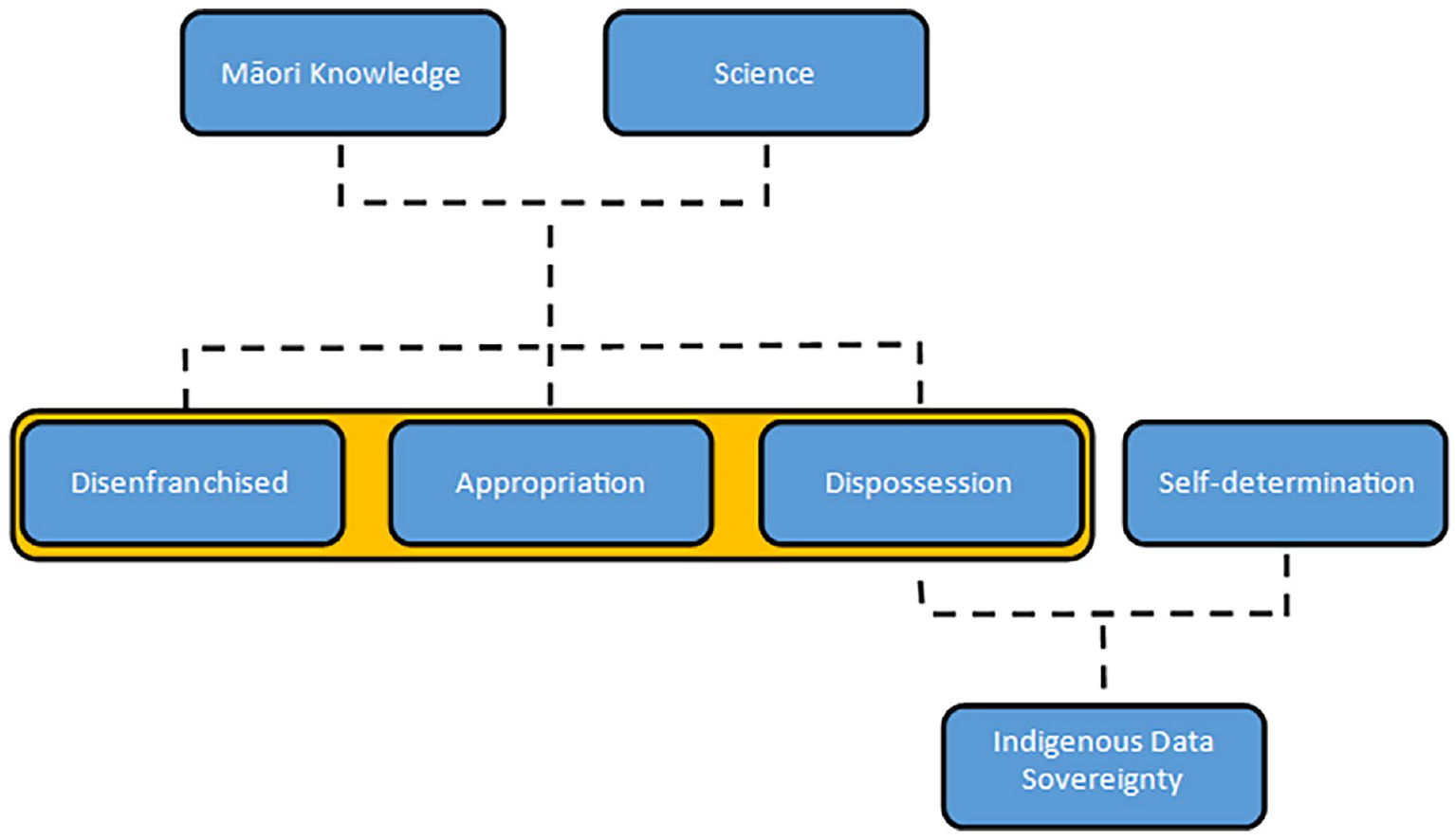
Whakapapa sequence to explain encounters at the Māori knowledge-science interface.
This genealogical sequence acknowledges that initial interactions between Māori knowledge and science have been predominantly unproductive suppressing the use and development of Māori knowledge. A long legacy demanding Māori self-determination over our lives and culture has eventuated, albeit very slowly, in some recognition and limited application of Māori knowledge in environmental management. Further gains can be achieved by decolonising encounters at the interface and privileging Māori knowledge and politics to augment engagement. The adoption of a rights-based approach and more recently indigenous data sovereignty ideals has the potential to amplify the influence of Māori knowledge and accelerate gains for Māori.
In summary, for Māori the VM focus is too narrow as it does not focus on building the capability and capacity of Maori knowledge systems or Maori communities. Rather it invests in research at the interface without little consideration for conditions required for meaningful interactions between knowledge systems. There is also a more fundamental problem associated with a government agency defining and determining use of Māori knowledge. Definitions can be simple, generic and inaccurate. For example, a government agency cannot be a kaitiaki. It can be a steward but a kaitiaki must have whakapapa links and be recognised by the tribe. Māori knowledge is first and foremost a taonga tuku iho, a gift passed down from the ancestors and atua. Māori as kaitiaki of this taonga have obligations and responsibilities to care and protect and ensure its appropriate use. This is difficult to perform when Māori knowledge is removed and relocated into spaces outside Māori control. It is very difficult therefore to co-function in this environment as only a narrow set of outcomes are permissible. To transform the interface, there is a pressing need to dismantling systems that exclude, marginalise and silence. This can be achieved through adoption of a rights-based approach and indigenous data sovereignty ideals and through the centring of ātea as a strategy to mitigate knowledge boundaries and contests at the interface.
Assemblage analytic to render the ātea visible
A key part of reimagining the interface is visualising the space as an ātea (Figure 2). The ātea being explored here comprises of three interdependent spaces; a shared space where Māori knowledge and science come together to deliberate on joint concerns and two separate sovereign spaces where Māori knowledge and science each exist autonomously. Atua can be invited into this shared space to mediate knowledge contests and ensure that mana-enhancing practices underpin interactions thereby establishing best practice. Critical to success is building the capacity and capability to engage through meaningful, mutually beneficial, and enduring relations. These strategies optimise co-functioning and ensure an outcome- and future-focused approach. The autonomous spaces are independent, and independence (i.e. sovereignty) is critical for maintaining the integrity of each knowledge system according to their own ways of knowing and associated practices (i.e. ethics). The intent is to mitigate power contests by disrupting the absolute authority of scientific knowledge towards a recognition that all knowledge systems are relevant and valid. Autonomy, therefore, maximises the ability to cohere in a manner that is collaborative, participatory, just and equitable.
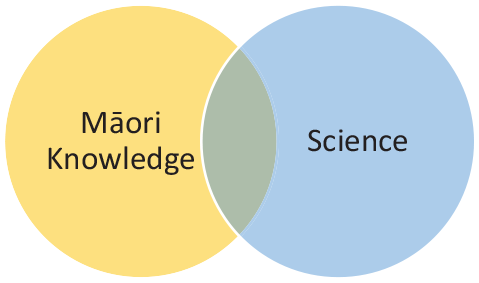
A visual representation of the Māori knowledge-science coherence. The overlapped space is the interface or ātea.
Activities at the ātea
The whakapapa, governmentality and assemblage analytics support a conceptualisation of the interface as an ātea. This conceptualisation renders the interface and what counts as appropriate encounters visible. Visibility is critical for amplifying the influence of Māori knowledge in environmental management. This section explores activities at the ātea as seen in the Tātai Whenua project as an example of how the analytics theory can be expressed in practice.
In the Tātai Whenua project, ātea is used to map the collaborative adaptive management process to weave together hyperspectral remote sensing–derived forecasts and Māori knowledge to indigenise and enhance environmental management. This is critical if both knowledge systems are to inform environmental decision-making and create a shift towards bicultural spatial governance.
Naming and claiming is a decolonising methodology (Smith, 1999). The collaborative adaptive management process is called He Ātea. The use of a Māori name signals a grounding in te ao Māori and an expectation that Māori cultural values, customs and political agenda underpin behaviour and actions to ensure mana-enhancing, constructive and productive relations. The research activity therefore must be inclusive, participatory, and action-orientated (Hardy and Patterson, 2012) and enable multiple knowledge systems and research approaches to be brought together in genuine, meaningful, and enduring ways.
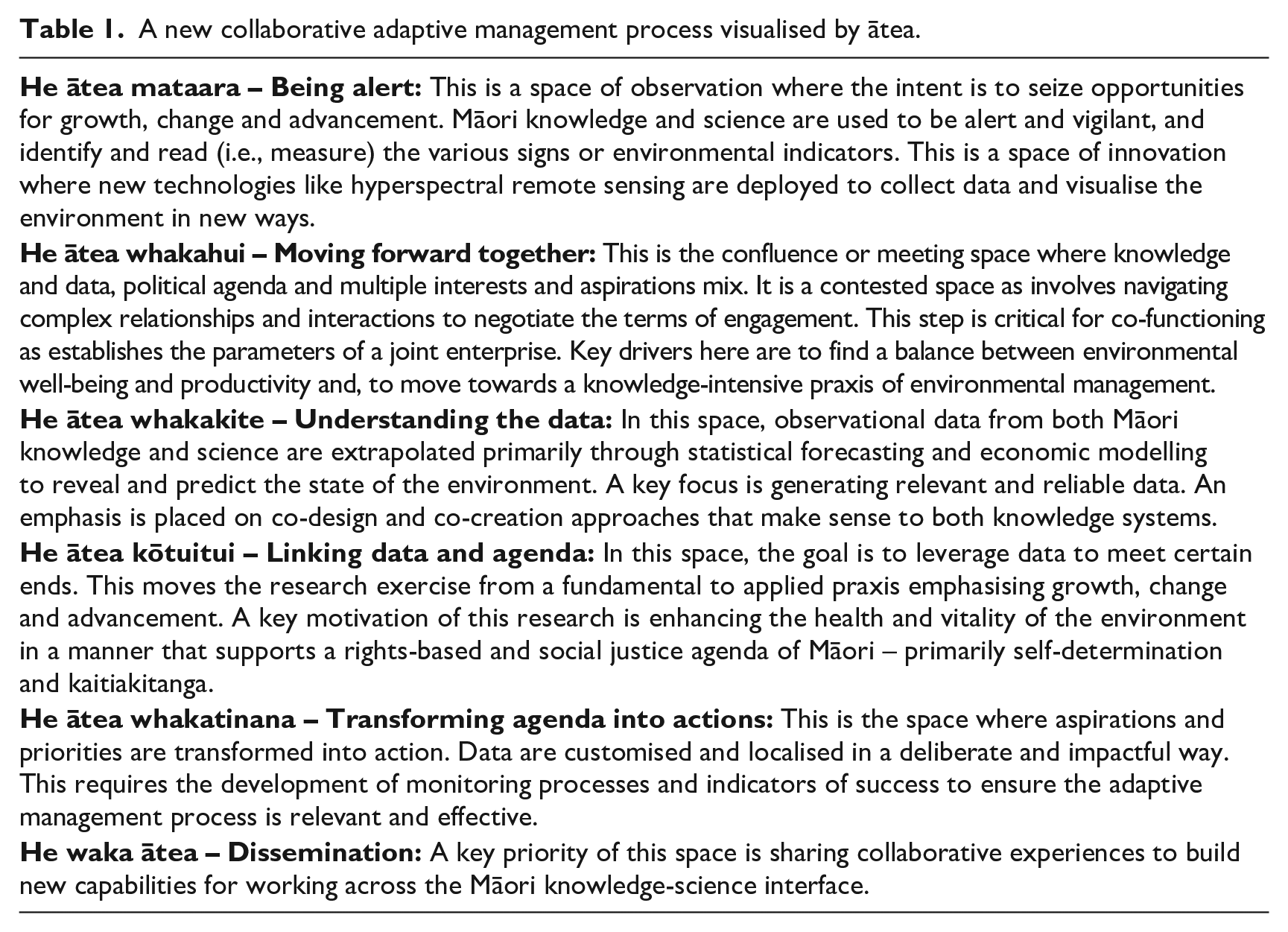
He Ātea visualises as a process a series of distinct but inter-related actions. Table 1 outlines the key intent and activities associated with each space.
A new collaborative adaptive management process visualised by ātea.
Autonomy at the ātea
Autonomy is another key element for optimising engagement at the interface. This is a direct response to the suppression of indigenous knowledge through the colonial project. In this context, autonomy is a strategy for mitigating knowledge contests. It involves upholding the mana and mauri (i.e. integrity) of Māori knowledge to amplify its capacity to influence environmental management.
There are two key autonomy strategies deployed in He Tātai Whenua. The first involves reimagining encounters at the interface according to custom guided by concepts such as ātea and mana. This has already been discussed in length. The second strategy considers how Māori knowledge can be rendered visible and impactful. Our starting point for this was mapping Māori environmental knowledge in a manner reflective of Māori thinking. While the knowledge itself might be old, it is being constructed for a new purpose and care must be taken to ensure that this new form (referred to in the remainder of the article as a new paradigm) has some cultural authenticity and remains connected to te ao Māori. This is critical to avoid misuse and cultural appropriation.
This new paradigm was co-developed by iwi/hapū partners and Māori knowledge specialists through wānanga that considered the nature of Māori knowledge, sources of environmental knowledge and appropriate use. The new paradigm draws on customary understandings of the whare or meeting house to conceptualise Māori expectations of knowledge generation and application. In Māori creation narratives, Ranginui and Papatūānuku were the first whare, and their primary function was to nurture and protect. Another Māori creation narrative where Hinetītama sought knowledge of her parentage highlighted the role of pou (carved posts in the meeting house) as sources of information with instructional intent. So, the metaphor of the whare creates a connection to atua introducing regulatory elements into the paradigm and is a reminder that knowledge is a taonga – a gift handed down from the ancestors. Taonga status is important as it requires Māori knowledge users to consider what constitutes appropriate application.
Another early whare was the whare wānanga – a place of higher learning where Tāne placed the baskets of knowledge for safekeeping and development with the intent that knowledge is used for the common good and to ensure that communities flourish. This creation narrative is expressed in the architect of contemporary carved meeting houses through the rua whetū – a space formed when the rafter of the roof meet on the back wall of the house. This space links the spiritual and physical worlds by acting as a conduit for knowledge and energy from the atua to enter the meeting house and travel down the carved posts to inform and inspire whaikōrero (a ritual of speech-making) and wānanga (a ritual of debate and deliberation). Consequently, the whare can be a place for storing knowledge (known as whare mātauranga), and a space where knowledge can be interpreted and narrated (known as whare kōrero). This new paradigm takes inspiration from all these customary understandings of whare.
The new paradigm is centred around three pou or pillars of a whare called pou taki, pou mātauranga and pou tikanga. Pou taki is where Māori knowledge systems are visualised. This typically involves exploring genealogy sequences and collections or repositories of knowledge associated with tatai whetū (another phrase for creation narrative) and tatai whenua those genealogies that inform us of the order and relationships of nature. Pou mātauranga showcases specific schools of knowledge and associated knowledge forms. For example, kura ahorangi refers to everything that Māori know about the stars and the application of this knowledge to regulating, for example, seasonal practice (i.e. cultivation and harvesting). Pou tikanga is concerned with knowledge production and best practice associated with access, development, and application of Māori knowledge. This is where relationships with iwi/hapū partners is critical. This partnership ensures ethical use of Māori knowledge in this joint enterprise. Such an approach is consistent with Māori expectations of research ethics and data sovereignty. In practice, it prioritises the centring of mana within the knowledge production process to guide encounters and engagement. This reinforces the importance of mana-enhancing practices.
This new paradigm guides He Tātai Whenua research activities. It makes visible an autonomous space where new Māori knowledge can be generated and applied in accordance with custom. It also visualises a series expectations and processes for creating a confluence at the interface where mana-enhancing practices regulate the interaction of Māori and scientific knowledge.
A key research question of He Tātai Whenua was how te ao Māori could be visualised through a geometric and geospatial lens. To address this question, Māori understandings of the landscape were defined, converted into databases and classification systems, and tested for validity using the new paradigm described above. These understandings were co-produced with six iwi/hapū in the Manawatū Catchment and the emergent classification systems applied to new tools and techniques of mapping to visualise Māori understandings of the landscape. Four examples are briefly described here to demonstrate application of the new paradigm.
The standard approach involves collating and translating Māori ‘data’ such as the identification of significant sites and placenames to existing Geographic Information Systems landscape classifiers. This approach has gained increasing popularity with iwi/hapū engaging in Treaty of Waitangi claims and settlement processes and when advancing iwi/hapū interests through local government resource management activities (Proctor and Harmsworth, 2021). He Tātai Whenua extends on this tradition by broadening the data set to include kōrero tuku iho, waiata and whakairo for example and exploring local data related to the Manawatū River and a coastal wetland ecosystem.
A second body of work adopts a corpus linguistic approach to identify, extract, and analyse a broad range of Māori landscape language (sourced from pou taki and pou mātauranga) with the intent of converting the information into a classification system. The emergent classification system has been applied to a Digital Elevation Model and provided a developing base ontology for other mathematical classification procedures (i.e. geomorphic modelling tools) to visualise the landscape from a Māori perspective.
A major work stream within the project was exploring new ways for iwi/hapū to collect information using GPS data, drones, and other free and open source remotely sensed data from satellites (i.e. handset, SPOT, SENTINEL, etc.). This involved a series of wānanga to share information about new technology and data sets and considering how this information could be leveraged to advance iwi/hapū interests. The information generated from these activities was closely linked to a final work stream that explored new ways to visualise mātauranga-a-iwi (tribal knowledge) using fuzzy logic, geostatistical and probabilistic classification processes with advanced modelling tools. Drawing on this research, one of the iwi/hapū partners in this project used hyperspectral imagery and elevation data to pressure local government to address nitrate leaching and nutrient management associated with increased productivity in their rohe. Another hapū partner generated 3D visualisations of significant sites, streams, and their whare tipuna – carved meeting house. The whare tipuna project linked narratives found in the whare to local sites of significance and land images using virtual reality technology. This technology generated an important resource for tribal members to support knowledge transmission, tribal identity and strengthen social cohesion. This information was also used in Iwi Environmental Management Plans, local government regional plans and to inform participation in the Manawatū River Leaders Forum.
Concluding remark
This article provides a critical commentary on the visibility of Māori knowledge and Māori interests in environmental management through construction of a set of analytics (whakapapa, governmentality and assemblage) to understand contests at the Māori knowledge-science interface. These analytics showed that the current system is ineffective and inequitable and must be disrupted and fashioned anew to facilitate a shift towards bicultural spatial governance so that more equitable and effective participation for Māori can be realised. Rights-based discourses and the indigenous data sovereignty movement are identified as critical systems of thought for endorsing and achieving this shift. It is also argued that Māori culture is another critical element for effecting change. Māori cultural understandings and appropriate behaviours underpin the mitigation of knowledge contests – mainly through providing a structure for establishing autonomy, understanding encounters, and transforming relationships as regulated by ātea, atua, and mana-enhancing practices. Such an approach underpinned research activity in He Tātai Whenua and produced research outcomes that amplified the presence and influence of Māori leadership and Māori knowledge in environmental management.
Footnotes
Acknowledgements
This research would not have been possible without the generosity of iwi and hapū in the Manawatū River Catchment area and Māori environmental experts who worked closely with members of the Tātai Whenua project team to increase the visibility of Maori knowledge in environmental management in Aotearoa New Zealand.
Declaration of conflicting interests
The author declared no potential conflicts of interest with respect to the research, authorship, and/or publication of this article.
Funding
The author disclosed receipt of the following financial support for the research, authorship, and/or publication of this article: Funding for He Tātai Whenua from the Ministry of Business, Innovation and Enterprise – ngā mihi nui ki a koutou.
Notes
Glossary
Aotearoa Māori name for New Zealand
aroha love
ātea space, to clear, te free from obstruction
atua gods, spiritual forces
hapū subtribes
He Tātai Whenua name of a research project meaning land classifications
iwi tribes
kaitiaki guardians
kaitiakitanga a Māori cultural practice of caring for and regulating interactions with the environment
kaupapa values, principles and systems of thought
kōrero tuku iho historical narratives
kura ahorangi everything Māori know about the stars and its application to cultivation and harvesting
mana authority, spiritual vitality
manaaki generosity, looking after and caring for people
Māori Indigenous person from Aotearoa New Zealand
marae tribal centre
marae-ātea clear space outside the marae
mātauranga-a-iwi tribal knowledge
mātauranga Māori Māori knowledge
mauri essence, integrity
pā fortified villages
pou carved posts
poutiriao spiritual guardians
pōwhiri Māori welcoming ceremony
pūrākau narratives, storytelling
rua whētu space in the rafter of a carved house
taonga gift, treasure
tatai whetū creation narratives
Te Tiriti o Waitangi a treaty between Māori chiefs and the British Crown signed in 1840
tikanga actions
waewaetakamiria walking the tribal territory and listening to the land
wānanga discussions and deliberations
whakapapa genealogy
whaikōrero speeches
whare house
whare kōrero house of discussion and debate
whare wānanga house of learning
whare mātauranga place for storing knowledge