




Abstract
This article maps the socio-technical interconnections between atmospheric systems, on the one hand, and the infrastructural networks associated with the extraction, production, transport and consumption of energy resources, on the other hand. The exchanges, interdependencies and injustices that arise at this interface can broadly be understood as the ‘air–energy nexus’. Despite energy inequalities almost always being entangled with some form of atmospheric injustice, their intersection has rarely been articulated to date. With the aid of a critical literature review, we focus on the domestic air–energy nexus to explore the ability of air to act as a social and physical agent of deprivation and injustice in the case of energy vulnerability: a condition characterized by a household’s propensity to secure adequate levels of energy services in the home. We argue that an integrated and critical perspective on the air–energy nexus challenges existing understandings of the quality and nature of domestic energy and atmospheric services, such as space heating and cooling. We propose future research and policy directions focused on addressing energy vulnerability in the home by embracing the unruly and fluid character of air–energy interactions, and transcending the socio-material boundaries between indoor and outdoor environments.
Introduction
The energy sector accounts for more than 70% of global greenhouse gas emissions. The properties and circulations of air and the atmosphere, therefore, are one of the key mediating agents between energy flows in society, on one hand, and climate change, on the other hand. What is more, energy injustices (Bickerstaff et al., 2013; Jenkins et al., 2016) are almost always entangled with atmospheric injustices (Brisman et al., 2020). However, while the intersections with broad environmental and climate justice frameworks have been examined in detail (Jenkins, 2018), an explicit focus on air is largely absent from accounts of energy injustices. To a certain degree, this can be attributed to a history of material and political ‘forgetting’ (Irigaray, 1999) of air in philosophy and social science, with Adey (2013: 103) emphasizing that ‘air has escaped our inquiry’ even if ‘it cannot be ‘divorced from our understanding of social and political struggle’. While much has been written about the contribution of human energy-related activities to air pollution in particular, systematic documentations and discussions of the wider relationships between air and energy throughout systems of infrastructure provision (Fine et al., 2017) are few and far between.
At the same time, the global climate challenge has contributed to, inter alia, the proliferation of nexus thinking (Fürst et al., 2017) seeking to uncover the connections between different environmental systems. Nexus approaches emphasize cross-sectoral synergies and trade-offs, while foregrounding the potential benefits – particularly in terms of cost reduction and resource efficiency – of developing integrated policies (Ringler et al., 2013). The ‘water–energy–food’ nexus has assumed a central position in the literature, with authors underlining the need for ‘nexus action’ through a variety of spatial scales and policy mechanisms, despite the lack of universally applicable solutions (Simpson and Jewitt, 2019). However, nexus thinking has been criticized for its promotion of techno-managerial and market-environmentalist paradigms, as well as the inadequate conceptualization of the ‘scalar politics of interconnections between resource sectors’ (Williams et al., 2019: 652). A conceptual space exists, therefore, for developing an integrated and multi-sited perspective on the interface between air and energy, along the lines articulated, for instance, by Foden et al. (2019) for the water–energy–food nexus.
We aim to offer a comprehensive and critical overview of the complex interdependencies between energy and air circulations with an emphasis on social relations and processes. Considering recent critical perspectives of the nexus, we cautiously utilize the framing as a stepping stone towards understanding how ‘interfacing infrastructural formations’ (Monstadt and Coutard, 2019) connect air and energy circulations in society. In our understanding, and following Williams et al. (2019), the air–energy nexus concerns energy activities associated with the capture, use and processing of air and atmosphere, and the air required to extract, transform, distribute and consume energy. Seeking to overcome the ‘elemental prejudices’ that characterize human geography (Jackson and Fannin, 2011: 435) as well as wider energy justice scholarship, we explore the entanglements of air and energy beyond the relatively instrumentalized explanations that dominate existing scholarship, focusing principally on energy use and air pollution as they relate to technology or health. We are inspired by approaches that seek to politicize the nexus through an emphasis on ‘unruly material realities’ (Kelly and Negroni, 2020: 1), inequity and injustice.
The article is underpinned by three research questions. First, we ask how energy, atmosphere and air interact throughout the ‘energy continuum’ (Hernández, 2015), from the recovery of resources and the generation of supply to the flow and use of energy services. Noting the conceptual difference between the notions of air and atmosphere (Philippopoulos-Mihalopoulos, 2016) and including both the physical and, to some extent, affective properties of the latter, we broadly trace how energy activities are embedded in the ‘systematic anthropogenic and machinic manufacture and material conditioning of both “good” and “bad” air’ (Graham, 2015: 195), through an array of socio-technical, political, cultural and economic processes. Given the paucity of scientific and policy perspectives on the influence of whole-systems energy circulations on air in particular, we build on work that has interrogated the socio-natural agency of polluted air as ‘matter out of place’ (Douglas, 1966) – despite its ‘formless, immaterial and invisible’ characteristics (Nieuwenhuis, 2016: 478) – alongside multiple conceptual efforts to build a social science-based ‘aerogeography’ (Adey, 2008). In doing so, we identify a wide range of interactions between air–energy entanglements, including between air pollution, atmospheric carbon and thermal atmospheres. We also extend calls for environmental justice to ‘move indoors’ (Adamkiewicz et al., 2011), recognizing the need to dissolve perceived boundaries between indoor and outdoor environments if we are to understand how energy and air interact throughout the entirety of the energy continuum.
Our second research question is about how the socio-technical relations that arise at the contact points between energy, air and human activity may destabilize existing understandings of domestic life and ‘protected’ indoor spaces. This, in turn, leads us to the third research question: how, and under which conditions, do the material and social properties of air in the domestic domain become a source of inequity and poverty? As a space in which people typically spend a considerable proportion of their everyday lives, and as a space essential to the fulfilment of some of their most fundamental needs (e.g. warmth, coolth, comfort), the domestic sphere is integral to understanding of energy and atmospheric inequalities (Desvallées et al., 2020; Yip et al., 2020). In the context of the socio-material circulations or air within the home, we connect the rise of domestic energy inequalities to the lack of socially and materially necessitated levels of space heating and cooling, ventilation and refrigeration (Bouzarovski and Tirado Herrero, 2017).
We identify multiple socio-technical entanglements between air and energy service deprivation, arguing that the political ecologies of air and atmosphere are fundamental to the rise of distributive and spatial injustice. It should be noted that we tend to use ‘air’ and ‘atmosphere’ interchangeably in the article, especially in relation to atmospheric services (Everard, 2015), despite recognizing the specific meanings and histories involved in this context (Allen, 2020; Graham, 2015). We also foreground the notion of ‘nexus vulnerabilities’, which, based on work in other domains by Dargin et al. (2020) and Luft (2016), aims to capture a household’s propensity to experience a lack of energy services due to infrastructural relations and intersectionalities arising at the contact points of different socio-technical systems: in this case, those of energy and air. By articulating an integrated perspective on the ambient air embeddedness of domestic energy deprivation, we wish to overcome the entrenched ontological binary between indoor and outdoor air quality, whose associated narrative and political representations, we would argue, serve to deepen existing infrastructural inequalities (Day Biehler and Simon, 2011).
In methodological terms, the article is based on a critical review of 201 academic contributions and policy documents. The outputs used for the purpose of the analysis were identified through several connected searches across a range of relevant databases 1 and disciplines – human geography, environmental science, energy, urban and legal studies, sociology, anthropology, political science and engineering. Based on a reading of their abstracts, the outputs were selected for more careful scrutiny and interrogation insofar as they were judged to contain insights relevant to the air–energy nexus. They were subsequently examined with the aid of interpretive analysis methods (Peterson, 2017), resulting in the determination of three broad thematic areas, focusing on, respectively, nexus technologies (as outlined in the work of Williams et al., 2019), domestic air–energy intersections, and nexus vulnerabilities. The three thematic areas are elaborated in sequence in the three sections that follow, reflecting our intention to structure the argument from more general forms of socio-material interaction along systems of energy provision, onto the specificities of the domestic domain; and finally, interrogating the causes and experiences of residential energy vulnerability and injustice. The three sections are followed by a conclusion in which we highlight, inter alia, the ability of air and energy to permeate the social (re)production of physically bounded and engineered spaces. We unsettle the political and institutional imaginations that have allowed different energy–atmosphere relations to be treated within separate knowledge registers.
Nexus technologies: Tracing the connections among energy and air circulations in society
Energy justice frameworks have emphasized the importance of the energy continuum, defined by Hernández (2015) as ‘the confluence of energy supply- and demand-side dynamics [that] links vulnerable communities along the spectrum of energy production and consumption’ (p. 151). Air–energy interchanges occur throughout the energy continuum – from the material recovery of energy sources to the consumption of energy across various sectors. These interchanges are contingent on multiple nexus technologies, which, in line with Williams et al. (2019), can be described as the infrastructural systems through which air and energy are brought together. These energy conversions require the mobilization of nexus technologies, involving the material and affective properties of the atmosphere. Nexus interactions are embedded in every aspect of energy systems, from air conditioning devices or air source heat pumps present in individual homes, to regional and national-scale energy supply patterns and flows. The different properties of air – its temperature, movement and material make-up – both shape, and are shaped, by energy circulations in society. One of the main outcomes of these connections and exchanges is the emission of polluting particles and gases associated with the technological processes that drive energy conversions. However, air is also extensively involved in energy inputs, from the production of heat and power from hydrocarbon resources to the kinetic energy that drives wind turbines. As pointed out by Miller and Keith (2018): ‘To extract energy, all renewables must alter natural energy fluxes, so climate impacts are unavoidable’ (p. 2618).
The impacts of fossil fuel extraction on the atmosphere are by far the most established and well-known dimension of air–energy interactions. There is an extensive literature and public debate on the contribution of human energy production activities to greenhouse gas emissions (Barrett et al., 2013; Rosa and Dietz, 2012). Comparatively less discussed, however, are the more localized air pollution implications of fossil fuel extraction and electricity generation. This entails a multiplicity of effects, starting from the air pollution impacts of coal, oil and gas resource recovery (Ghose and Majee, 2000), with Hendryx et al. (2019) arguing in favour of considering ‘both urban and rural sources of pollution in air quality studies, and appropriate policy steps to address likely rural air pollution from coal mining’ (p. 518). Gas flaring, for example, has been identified as a major contact point between energy activities and ambient air, by acting as ‘a prominent source of VOCs, CO, CO2, SO2, PAH, NOX and soot (black carbon), all of which are important pollutants which interact, directly and indirectly, in the Earth’s climatic processes’ (Fawole et al., 2016: 182). The supply chains of these resources are often long and complex, requiring multiple material transformations and socio-technical networks that themselves entail ambient air interactions. As pointed out by Alvarez and Paranhos (2012), ‘there are numerous individual components used throughout natural gas and oil production systems that are prone to leaks, including compressors, valves, pumps, flanges, gauges, and pipe connectors’ (p. 22).
The atmospheric emissions resulting from the combustion of fossil fuels in large-scale power generation plants, commercial and industrial facilities, as well as the transport sector, have been well documented and extensively researched. In terms of power and heat generation from such hydrocarbons, key relevant externalities include effects on climate change and air quality (Dedoussi et al., 2019). This involves emissions from coal, oil and gas-fired plants alike, all of which are associated with diverse types, quantities and distributions of pollutants (Peters et al., 2020). Importantly, such emissions also occur at the residential level, principally in indoor spaces within the Global South, where they represent a major environmental and public health challenge (Finkelman and Tian, 2018). Emissions from industry are also significant in this context – especially when it comes to the processing of metals, cement, chemicals, as well as the manufacturing and construction sectors – given that various energy flows are also involved in production processes (Sun et al., 2019).
As for transport, it is widely acknowledged that ‘emissions from road, air, rail and water transport have been partly responsible for acid deposition, stratospheric ozone depletion and climate change’ (Colvile et al., 2001), with ‘road traffic exhaust emissions being the cause of much concern about the effects of urban air quality on human health and tropospheric ozone production’ (p. 1537). The extensive body of work in this domain has emphasized the close correlations between carbon emissions, transport energy consumption, and economic growth (Adams et al., 2020) as well as the need for urgent decarbonization efforts (Santos, 2017). At the urban and regional levels, there are impactful policy debates on the air pollution benefits of reducing private car use and promoting modal shifts towards more environmentally and socially sustainable modes of transport (Bigazzi and Rouleau, 2017). Climate change itself has been shown to contribute to localized air pollution through an additional feedback loop, not least because the ‘future climate is expected to be more stagnant, due to a weaker global circulation and a decreasing frequency of mid-latitude cyclones’ (Jacob and Winner, 2009: 51). The recovery of energy from fossil fuels is not the only emitter of polluting particles, however. A significant body of work has shown how electricity and heat extraction from other energy resources – biomass, waste, geothermal, hydropower, nuclear, wind and solar power (described in turn below) – also result in the release of diverse types and quantities of pollutants in the atmosphere. Here, the ‘embodied’ energy – the energy required to produce a material – associated with the energy source is often a primary concern (Lenzen, 2008; Steinhurst et al., 2012).
The air quality implications of biomass burning are particularly extensive, involving a wide variety of energy-related practices and air pollution pathways emanating from – and concentrated in – indoor spaces (Austin and Mejia, 2017). Biomass burning also takes place outdoors, especially for agriculture purposes; while this form of combustion does not have direct energy service implications, it nevertheless provides yet another pathway for the degradation of air quality (Mendez-Espinosa et al., 2019). In the context of Delhi, India, Liu et al. (2018) evidences how ‘providing viable alternatives to agricultural residue burning could help improve post-monsoon air quality for a growing population of 63 million . . . within Delhi’s airshed’ (p. 84). Biomass smoke is a major health concern in the Global South, principally due to the respiratory system effects of indoor particulate matter emissions (Manisalidis et al., 2020). It has also been suggested that the exposure to biomass smoke is associated with COVID-19, due to the broader link between air pollution and disease (Thakur et al., 2020), with vulnerabilities being especially pronounced among low-income groups, such as refugees and migrant workers living in precarious housing. Economic crisis and austerity over the last decade in the Global North have also driven a resurgence in the burning of biomass for heat (Petrova and Prodromidou, 2019). In Greece, the high price of fuel oil conventionally used for heating has led residents to burn cheaper biomass fuels during the cold season, causing serious deterioration of wintertime air quality (Saffari et al., 2013). Burning of biomass can also be driven by cultural preferences with popular wood-burning stoves tripling harmful levels of indoor air pollution in homes across the United Kingdom (UK) (Chakraborty et al., 2020) and contributing 40% of outdoor tiny particle pollution (Department for Environment, Food and Rural Affairs [DEFRA], 2019), reversing decades of clean air legislation in post-industrial cities.
The combustion of household, municipal and industrial waste for heat and electricity recovery is another major vector at the energy–air interface. In this domain, the open burning of municipal solid waste has been recognized as one of the key contributors of particulate matter and dioxin emissions in the urban centres of the Global South (Wiedinmyer et al., 2014). Waste-to-energy incineration plants have historically been associated with multiple emissions concerns – a challenge that has gradually been attenuated thanks to the improvement of air pollution control systems. Yet several long-term disposal issues remain (Dong et al., 2020). In the case of geothermal power production, there is evidence to suggest that, depending on local conditions, this source of energy can lead to emissions of, inter alia, carbon dioxide, hydrogen sulphide as well as various metals, minerals and silicates (Shortall et al., 2015), while ‘heat emitted in the form of steam can affect cloud formation and local weather conditions’ (Shortall et al., 2015: 395). The production of nuclear power also involves multiple interactions with the atmosphere, with operational emissions into local ambient air, including tritium, carbon, and rare gases; accidental radionuclide emissions and radiation pollution are also part of the balance (Barros and Managi, 2016).
The generation of electricity from renewable energy is also characterized by a distinctive interplay between air and energy systems. It is well established, for instance, that the greenhouse gases released by hydropower installations have specific drivers, features and distributions (Kumar and Sharma, 2016). For example, hydropower is a source of greenhouse gas emissions as a result of biomass decomposition during the flooding of reservoirs (Fearnside, 2015; Steinhurst et al., 2012). As for solar power, while its direct atmospheric emissions are negligible, there has been extensive discussion in the literature of the life cycle impacts of this mode of energy production compared to other methods; relative to fossil fuels in particular, they have been found to be significantly lower (Turney and Fthenakis, 2011). Solar power production also influences local air temperatures (Taha, 2013) while itself being affected by the properties of the atmosphere – as evidenced by the attenuating impacts of air pollution on solar output (Bergin et al., 2017). A similar situation exists in the case of wind power, where research has primarily focused on avoided and life cycle emissions (Li et al., 2020), and it has been recognized that ‘wind’s climatic impacts are about 10 times larger than solar photovoltaic systems per unit of energy generated’ (Miller and Keith, 2018: 2).
Wind power is one of the few electric power generation technologies that sources its energy from the kinetic properties of the atmosphere, in effect utilizing the properties of air as an input in the production process. As such, it has been subject to specific socio-technical imaginations, trajectories and regulatory architectures (Kapoor, 2019), and is itself affected by atmospheric processes (Pryor et al., 2020). Bresnihan and Brodie (2020: 0) conceptualize wind power as an extractive frontier that is ‘mobilized within self-sustaining and automated formations’ involving entanglements of data infrastructures, capital and other energy systems. The other significant renewable resource that involves the material input of ‘aerothermal’ energy (Carroll et al., 2020) are air source heat pumps; their specific technological design closely connects them to evolving air-tightness standards, mechanical ventilation and cooling needs, as well as end-use energy behaviours.
Human energy production and consumption activities in the residential, commercial and industrial sectors collectively contribute to changes in the nature and content of atmospheric circulations in the immediate vicinity of populated areas. The urban heat island (UHI) phenomenon is emblematic of this condition: it refers to the ‘higher temperatures experienced in urban areas compared to the surrounding countryside’ (Mohajerani et al., 2017: 522). UHIs are driven, in the main, by the release of anthropogenic heat in the environment, as well as ambient air pollution and broader changes in urban processes, structures and land use (Nastran et al., 2019). Graham (2015) draws attention to the deleterious influence of UHIs on local and global climatic conditions, noting that ‘as well as ameliorating cold winters, UHIs can dramatically accentuate the lethal effects of hot summers within a context of a warming planetary climate’ (p. 197). UHIs have also been shown to impact energy use (Antonopoulos et al., 2019), with ‘cool roofs, cool pavements, and urban vegetation’ (Akbari and Kolokotsa, 2016: 834) being proposed as some of the main mitigating measures. More extreme responses to the phenomenon – and global heating more generally – include the establishment of technologically controlled environments, aimed at creating ‘specialist forms of microclimatic enclosure that are explicitly designed to transcend the emerging limitations and increasing turbulence’ (Marvin and Rutherford, 2018: 1143) of contemporary social life.
As a result of air–energy interactions from the extraction of energy from fossil fuels, the reduction of air pollution is often emphasized as a ‘co-benefit’ of low carbon transitions and technologies (Sovacool et al., 2020). Examples range from justification for the development of regional hydrogen economies (Demirbas, 2017; Dincer, 2020) to settings in which electric heat pumps promise to alleviate the impacts of the use of coal for heating on local air quality (Barrington-Leigh et al., 2019). The implications of new technologies for air quality can also shape local perceptions of, and support for, new forms of energy production, while acting as a political rallying point for resistance to energy-related projects (Scott and Powells, 2020) as exemplified by the case of anti-fracking resistance (Gabrys, 2017; Stasik, 2018).
As a whole, the work reviewed above shows the complex and multi-faceted interactions between air and energy across the energy continuum. They involve different modalities of socio-material transformation, articulated with the aid of overlapping pathways of influence. Each stage of the energy provision chain leads to different forms of ambient air emissions and transformations (Figure 1). At the same time, anthropogenic energy recovery, generation, transport, and consumption activities are also affected by atmospheric processes. Additional feedback loops may be generated through these processes, for example, as a result of the impacts of air pollution on human health and productivity, which in turn influences energy use. Yet, while there is a relatively extensive body of evidence of the individual interactions between particular types of energy activities and ambient air, their infrastructural and social concatenations in specific spatial contexts are less well-known. The domestic nexus (Foden et al., 2019) is one such space implicated in the rise of multiple injustices, and we now turn to its underpinning air–energy interactions and interdependencies.
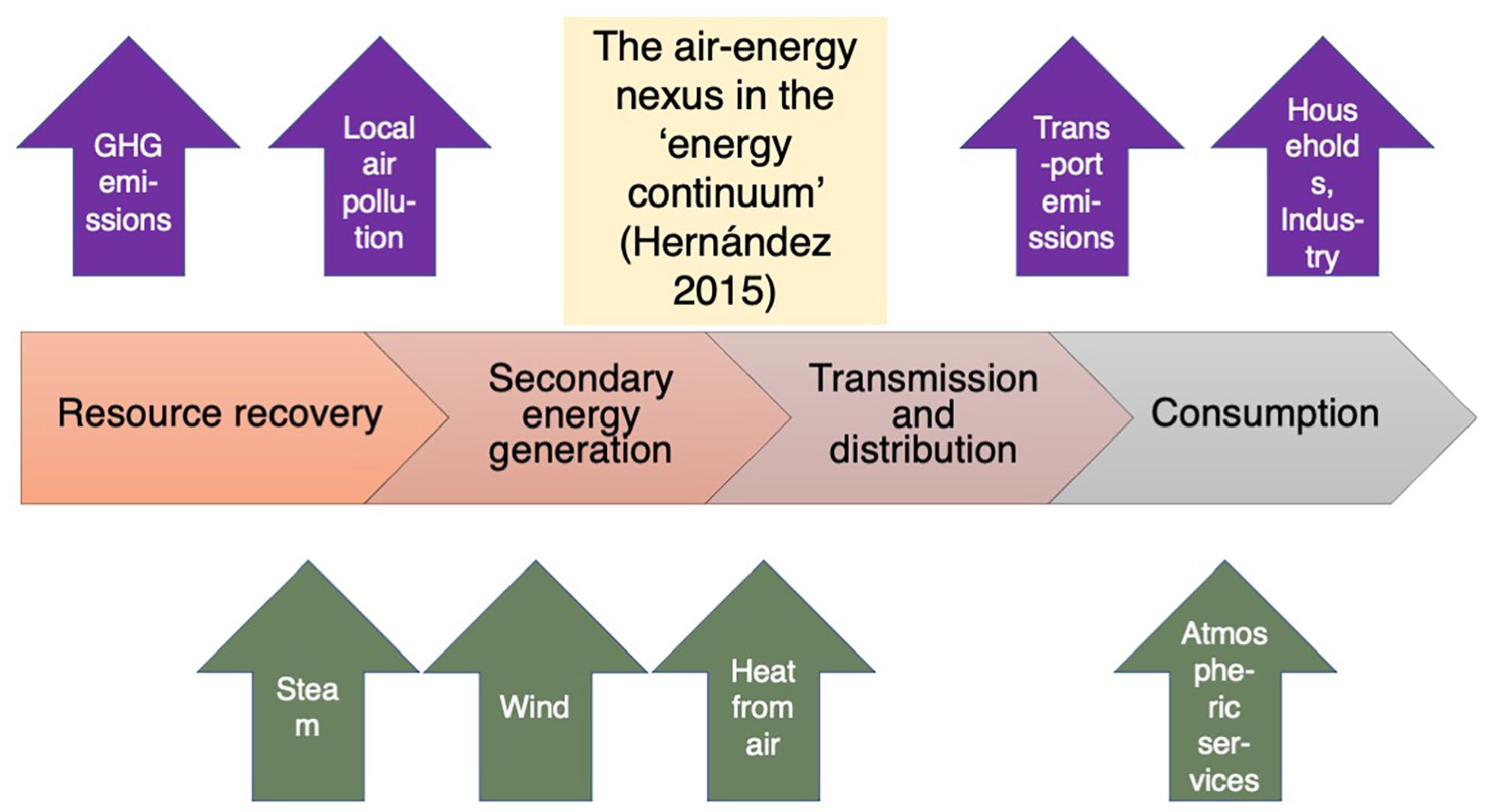
Air–energy interactions throughout the energy continuum.
Air–energy intersections in the domestic domain
To understand the operation of the air–energy nexus in and around the residential environment of the home, a useful first step is to investigate the utility derived from interactions between energy and air in these domains. The notions of atmospheric services (Everard, 2015) and energy services (Bouzarovski and Petrova, 2015; Morley, 2018) provide a useful entry point into this discussion. The former are relatively poorly understood and under-theorized in the literature. As a framework, they have been derived from the broader notion of ecosystem services (La Notte et al., 2017), and refer to the benefits that the atmosphere provides to society (Thornes et al., 2010). Atmospheric services relevant to the domestic domain include, in the main, the provision of air for breathing, the dispersion of air pollution and water, combustion and power. Also of importance are the aesthetic, spiritual and sensual properties of the atmosphere, partly captured through the concept of affective atmospheres (Verlie, 2019); these ‘refer to the feelings that are generated by the interactions and movements of human and nonhuman actors in specific spaces and places’ (Lupton, 2017: 1).
Energy services are also a rather elusive concept – one of the most cited definitions sees them as ‘the benefits that energy brings to human wellbeing’ (Modi et al., 2005: 11) although more recent understandings focus on the ‘the useful work obtained by energy consuming’ (Lin and Li, 2014: 590) as well as the basic and secondary capabilities facilitated by energy use (Bouzarovski, 2022a; Day et al., 2016). A comprehensive review (Fell, 2017) distinguishes between the volume, content and quality of energy services, as well as the motivations that drive them. This position brings important nuances to the debate by emphasizing that the quantifiable amount of the final service received by the consumer is a different dimension to the benefits and satisfaction that it brings. It is associated with the notion that energy services are functions associated with a desired ‘end state’ (e.g. space heating is undertaken for the purpose of obtaining thermal comfort). At the same time, energy services are hybrid socio-technical entities, because they often involve an interaction between the needs, practices and behaviours of the end consumer, on the one hand, and the technologies and infrastructures for the delivery and conversion of energy, on the other hand (Bouzarovski and Petrova, 2015).
The domestic air–energy nexus foregrounds the interdependencies among energy services and atmospheric services, as well as the need to move beyond the physical and conceptual limits of the home. Of no less importance is the recognition of the physical and metaphoric permeability of the domestic domain (Larrington-Spencer et al., 2020), which serves to unsettle established – and highly gendered – perspectives on the boundedness of indoor spaces (Day Biehler and Simon, 2011), while framing the home as a relational infrastructural junction (Bouzarovski and Haarstad, 2019). Atmospheric services, such as the provision of air for breathing, or the regulation of pollution, combustion and humidity, are all moulded by systems of energy provision and consumption. At the same time, key energy services (particularly space heating and cooling, ventilation, refrigeration) are contingent upon the transformation of air’s material properties. What is more, the ‘elemental geographies’ (Adams-Hutcheson, 2019) of air in the domestic domain themselves shape feelings and perceptions of home comfort (Ellsworth-Krebs et al., 2019), which in turn are deeply implicated in flows of energy and energy consumption practices. For example, air pollution has been shown to drive increases in household energy consumption in Korea, as households resort to the quickest and most convenient measures in response to acute pollution episodes that are often relatively energy-intensive (Eom et al., 2020). However, current political and institutional framings of atmosphere treat outdoor and indoor air under separate discursive, regulatory and political registers. Indoor environments have typically have been overshadowed by the issue of air pollution outdoors (Adamkiewicz et al., 2011; Ferguson et al., 2020). For example, across the European Union (EU) the EU Air Quality Framework Directive focuses exclusively on outdoor air quality, while national legislation and guidance regarding indoor air contaminants for countries across Europe is patchy (Settimo et al., 2020).
The qualities of air–energy interactions in the domestic domain are often expressed through feelings of thermal comfort, which can otherwise be described as ‘the heating and cooling of air, water, and materials from which various forms of comfort, pleasure, conviviality, sustenance, and utility are derived’ (Guy et al., 2015: 192). Thermal comfort is contingent on a range of atmospheric conditions, including air temperature, humidity, surface temperatures, ventilation, and the movement of air, all of which shape how energy is transferred within the built environment (Figure 2). It is also highly contextual, varying according to physiological, environmental and cultural factors, and between different household members (Hards, 2013). For example, in the case of air temperature, Royston (2014) describes how people ‘manage heat flows in their homes through diverse skilful engagements, including interactions with a wide range of materials that help to generate heat, move it around, or prevent its movement’ (p. 148). Adequate ventilation – introducing and circulating fresh air into a space and removing stale or contaminated air – is essential to ensure a person’s thermal comfort (Dimitroulopoulou, 2012), allowing for the regulation of high indoor temperatures and preventing overheating.
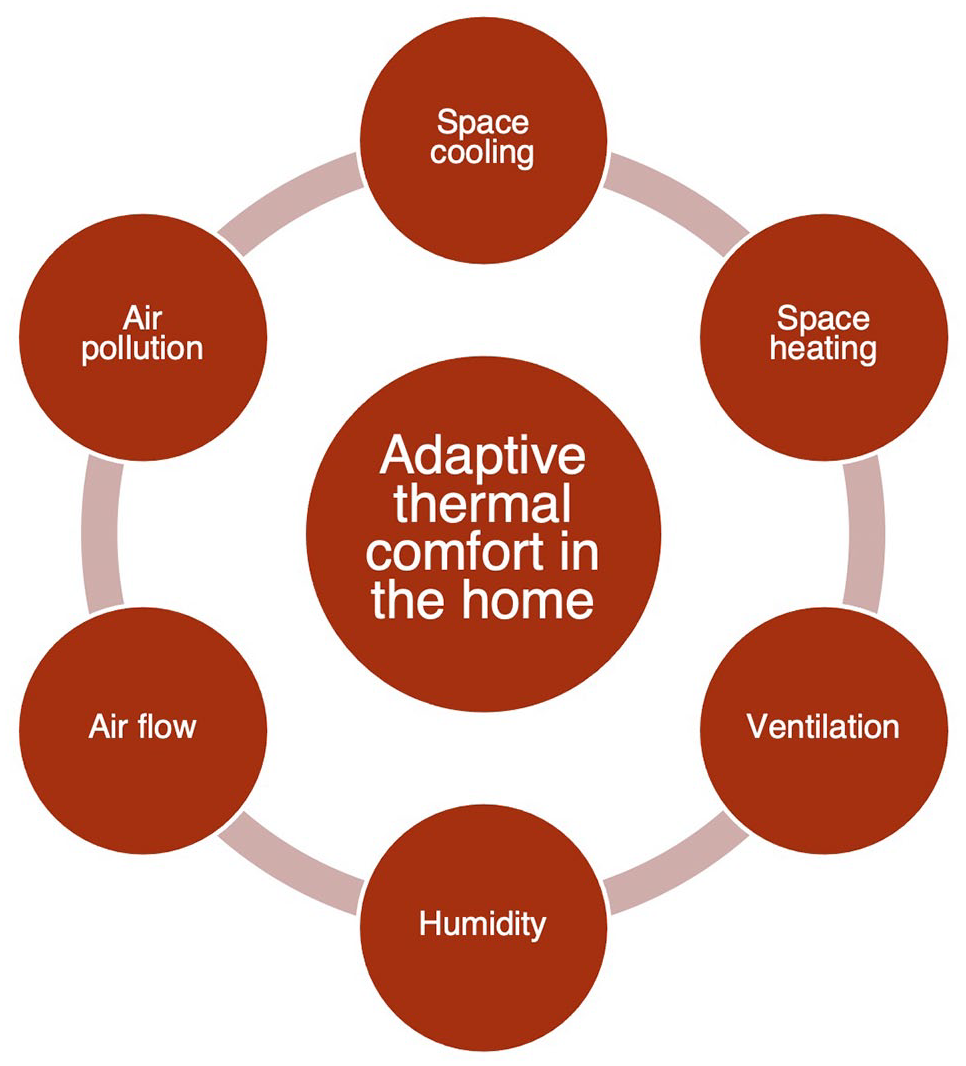
Air–energy services shaping thermal comfort in the home.
As mentioned earlier (in relation to the burning of biomass) domestic energy services, such as heating and cooking can generate harmful indoor pollutants that are transported by the air (e.g. nitrous oxides, carbon monoxide, volatile organic compounds (VOCs) and particulate matters). Ventilation also plays an important role in removing or diluting these toxicities within the home. Like thermal comfort, ventilation practices are highly contextual, shaped by a range of social and technical factors, including the climate, built environment and cultural expectations and social norms (Rudge, 2012). In the UK, where the climate is relatively mild, the historical availability of coal encouraged the use of open fires which in turn demanded high ventilation rates. As a result, the existing housing stock is relatively inefficient, negating the use of mechanical ventilation which is common in new builds in other national contexts (e.g. the United States). Comparatively, in colder climates, air-tightness in buildings is a priority to reduce energy consumption (e.g. Scandinavian countries) (Dimitroulopoulou, 2012). However, there is mounting concern about the unintended consequences of newly airtight buildings in which there is not sufficient ventilation (Bone et al., 2010), especially in circumstances in which the average daily time spent is high (Derbez et al., 2018). Lower rates of air exchange can lead to a rise in humidity, in turn increasing the prevalence of mould and allergens (Ginestet et al., 2020), as well as infectious disease (Sun et al., 2019). Despite this, the removal of sources of pollution remains the most effective way of controlling indoor air quality, compared to diluting concentrations of pollutants via ventilation (Dimitroulopoulou, 2012). However, in those contexts in which outdoor ambient air pollution is especially poor, the benefits of natural ventilation are largely negated (Tong et al., 2016).
Building on this body of work, while taking into account insights from multi-scalar work on ‘energy landscapes’ (Castán Broto, 2019) – as well as the more specific notion of a ‘thermal landscape’ (Sheridan and Dixon, 2016) – can lead to the development of an intervention logic attuned to the complex intersections of atmospheric and energy services. The research reviewed above highlights how air is a carrier of heat: a material property that implicates atmospheric circulations in a complex set of socio-technical linkages surrounding, inter alia, the transfer of energy in the built environment. Thus, and seen through the lens of the air–energy nexus, the thermal landscape of the home includes both indoor and outdoor spaces, as well as overlapping energy and atmospheric circulations.
Nexus vulnerabilities and injustices
Unpacking the inequalities that arise at the interface of air and energy in the domestic domain requires a closer look at the household needs that arise in this context. In that sense, a healthy home that can provide for the wellbeing of its inhabitants needs to have an adequate level of internal temperature, humidity, ventilation, and air quality. However, households that struggle with energy poverty – also referred to as fuel poverty – often live in homes that are insufficiently cool or warm, poorly ventilated, with poor air quality. The current cost-of-living crisis that is unfolding across Europe and beyond has elevate the issue in public conciousness, due to the social impacts of rising energy prices in particular (Carfora et al., 2022; Lloyd, 2022; Stojilovska et al., 2021). Households who are energy poor may themselves contribute to air pollution within and beyond the home – resulting in a situation where socio-technical vulnerabilities replicate each other and become spatially concentrated.
Energy poverty is thus being increasingly understood through the lens of both vulnerability and justice frameworks. Vulnerability encapsulates the multiple factors that underpin a household’s propensity to become deprived of adequate levels of energy services, including the atmospheric services listed above (Day et al., 2016). The concept reveals more complex and dynamic understandings of people’s relationship with energy (Middlemiss and Gillard, 2015). It follows that the presence of energy vulnerability is closely connected to the metabolic circuits of air in the home and beyond (Moles-Grueso and Stojilovska, 2021), because the risk of having a household’s needs being unmet is often contingent upon the inefficient and polluting use of energy, as well as changes in ambient air temperature. Justice principles have also been applied to understand the uneven impacts of, and responsibility for, energy poverty, climate change and poor air quality (Bouzarovski, 2022b; Schlosberg and Collins, 2014; Sultana, 2022), and is therefore a useful language to think across different domains concerned in some way with energy and air circulations in society. In other words, the political ecologies of atmosphere are integral to the rise of distributive and spatial injustice at the residential scale.
In colder climates, the main energy service that presents a significant vulnerability challenge for households is space heating: for example, it has been established that millions of households in Europe are suffering from a lack of adequate warmth in the home (Bouzarovski et al., 2021); and there is mounting evidence that the condition is also present across the Global North more widely (Bednar and Reames, 2020). The prevalence of mould and damp (both considered indoor air pollutants with negative implications for health) are a key indicator of energy poverty related to heating, especially in the European context (Castaño-Rosa et al., 2019). Abatement of the use of solid fuels in the home has major benefits to health and wellbeing, due to the reduction in ambient and indoor air pollution (Meng et al., 2019). Energy-poor households are more likely to live in poorly ventilated homes (González-Eguino, 2015).
The consequences of climate change in cities – extreme winter weather due to climate extremes, and particularly longer periods of hot weather – are generating new requirements for space cooling that are difficult to address in much of the housing stock (Thomson et al., 2019). It has been shown that even in temperate countries, such as Poland and the Czech Republic, large numbers of households report being unable to adequately cool their dwellings in summer (Bouzarovski and Tirado Herrero, 2017). However, the links between air and energy in this context have rarely been conceptualized through a common optic, particularly when it comes to the causes and consequences of household vulnerability (Thomson et al., 2019). Aside from the increased need for space cooling (and space heating during extreme winter events, even if cumulative demand is likely to fall) there is evidence to suggest that interventions aimed at reducing energy poverty – such as the installation of building insulation to improve residential energy efficiency – may exacerbate overheating in buildings during summer (Dengel et al., 2014). In addition to mitigating urban air quality issues (Nowak et al., 2014), green space provides an important cooling function in cities (Wolch et al., 2014). However, environmental justice scholars have evidenced how access to green space in cities is typically poor for low-income, minority communities (Sanchez and Reames, 2019). Communities with poor access to greenspace are often disproportionately vulnerable to energy poverty, compounding their inability to keep cool (Ambrey et al., 2017).
The problem of inadequately cool homes is also being identified as an important avenue of research at the planetary scale. In this domain, relatively little has been said about the availability of domestic space cooling from an energy affordability or access point of view – although much of the literature uses a social vulnerability framing to explore the influence of increased levels of heat in the living environment on human health and wellbeing (but see Kolokotsa and Santamouris, 2015). At the same time, much is being written about heatwave-related mortality and morbidity – from the health effects of direct exposure (heat stroke) to the indirect consequences upon respiratory and cardiovascular systems on warm days. Work in this field has explored the role of socio-demographic factors in influencing vulnerability, as well as the interactions between inadequate domestic energy services, neighbourhood structures and built environment patterns (Jenerette et al., 2016).
The embeddedness of space cooling in the wider natural environment – whereby the boundaries between domestic and outside space become blurred, particularly in homes that are poorly insulated – point to an important yet largely unexplored link between energy vulnerability and the air–energy nexus. Injustices at this interface are mutually interconnected: air pollution is often generated not only by vulnerable households, but they are disproportionately vulnerable to it themselves. In China, the success of ‘coal-to-electricity programmes’ that subsidize electricity and electric heat pumps have been shown to vary by socio-economic conditions (Pachauri, 2019). High- to middle-income households that are able to eliminate coal use benefitted from higher indoor temperatures, reduced indoor air pollution and increased wellbeing. Meanwhile, in low-income districts, the policy was only partially effective, contingent on household wealth with fewer benefits for indoor environmental quality (Barrington-Leigh et al., 2019).
Conversely, irreconcilable tensions also arise at this interface: if using inefficient and polluting fuels temporarily reduces energy vulnerability, it also leads to air pollution. For example, in Chile, conflict exists between policies that simultaneously reduce air pollution and alleviate energy poverty (Reyes et al., 2019). Air Pollution Management Plans have been introduced by authorities in response to severe pollution episodes arising from the use of firewood for domestic heating. Yet, legislating for the replacement of woodstoves, banning the use of firewood, reducing the moisture requirements for firewood and improving the insulation of buildings have been found to be regressive, pushing poorer households into a state of energy poverty, thus sacrificing clean air for colder homes.
Energy–air nexus technologies inside the home – as well as bottom-up strategies to address energy vulnerability – are differentially constrained or enabled by ambient air conditions, both indoors and outdoors. Eom et al. (2020) recognize how ‘in response to acute environmental stresses, such as air pollution, households may resort to quick and convenient adaptation measures that increasing energy use’ (p. 976). In turn, unpleasant and polluted outdoor environments influence how adaptable a household can be in terms of domestic energy usage, flexibility, energy needs and household practices (Yip et al., 2020). In contexts with high indoor air pollution, the use of air conditioning (both directly and indirectly) can be used to mitigate individual exposure. Chen et al. (2010) evidence how, during the warm season, Shanghai residents typically use air conditioning more frequently due to the relatively higher temperature and humidity, thus reducing exposure to air pollutants while indoors. There is also a trend among wealthy Chinese residents to purchase portable electric room air filters intended to offset pollution exposure risk (Sun et al., 2017).
Conclusion
In this article, we have emphasized the need to draw explicit conceptual and policy connections between the socio-technical circulations of air and energy. Our first research question focuses on how energy, atmosphere and air interact throughout the ‘energy continuum’. In response, we have traced the social, technological, spatial and cultural aspects of social relations at the air–energy nexus, identifying feedback loops and interactions that have been somewhat overlooked to date – particularly in relation to the impacts of resource extraction and use throughout the energy system on health, productivity and wellbeing. Our second and third research questions concern how the socio-technical relations at the air–energy nexus may destabilize existing understandings of domestic life, and in turn become a source of inequity and poverty. In response, we have delineated the multiple forces arising from energy–air linkages in the system of provision that contribute to the rise and expansion of energy vulnerability in the home.
Throughout the article, we have highlighted how the social dimensions of energy and air circulations have rarely received explicit treatment in the literature on energy vulnerability and energy injustice, often being treated under separate policy registers. One corollary of this situation has been the emergence of distinct infrastructural binaries across knowledge, policy and practice: between indoor and outdoor environments, and ‘good’ or ‘bad’ air in different material settings. Thus, we would argue that theoretical and policy understandings of domestic energy injustice need to be revised towards a more relational and multi-scalar perspective (Hamilton et al., 2014; Turner, 2016), in which vulnerability is as seen integral to the air–energy nexus. Such thinking provides a vantage point from which to understand the wider range of social and infrastructural measures that can take place to improve the quality of domestic energy and atmospheric services – particularly space cooling and heating. Of particular importance is the recognition that energy–air interactions are socially and technically constructed, partly because air–energy linkages permeate the social (re)production of physically bounded domesticities. The need to unravel the permeability of the home (Larrington-Spencer et al., 2020) in social justice terms, therefore, is a key area for future air–energy nexus research.
In terms of conceptual and methodological development, our analysis underscores the need for understanding both the elements of, and interactions among, energy–air services as they relate to different forms of deprivation and injustice: from air pollution to ventilation, air flow, cooling, heating and humidity. A possible direction of inquiry could be the establishment of hybrid socio-natural methods of ‘process tracing’ (Mahoney, 2015) to establish how different pathways and relations of socio-spatial vulnerability (Turner, 2016) arise and are articulated. A key challenge in this context is the recognition of compounding and intersecting vulnerabilities, many of which have received limited recognition, especially in the context of climate change. Here, we would underline that the experience of thermal comfort in an inadequately cool home is entangled with other socio-material properties of air. Introducing questions of climate justice to the equation foregrounds the fact that not only are energy services made possible by atmospheric services (e.g. warming the home), but energy services in turn have multiple implications for atmospheric services, for example, through cooking polluting the home. Furthermore, while in this article, we focus explicitly on the air–energy nexus, in future we might also extend the limits of our enquiry to a wider range of wider atmospheric ‘nexus vulnerabilities’ that are likely to compound one another.
In policy terms, our contribution highlights the need for developing synergistic energy and climate programmes, so that, for example, efforts to reduce energy poverty do not worsen air quality, and vice versa (Bone et al., 2010; Reyes et al., 2019). What is more, it becomes apparent that the reduction of energy vulnerability is also connected to policies outside the explicit energy and climate domains: forest resources play a key role in reducing the heat effects of climate change, with some of the key considerations in this regard, including the internal characteristics of forests, the spatial distribution of woodland in the landscape as well as land ownership patterns (Walton et al., 2016). Energy services can be provided beyond some of the mainstream approaches that underpin space heating or cooling practices, as well as cost-intensive energy efficiency investment to improve air-tightness. The pathways of provision that emerge through this perspective are already widely practised in various settings across the world. They include the delivery of energy services via collective means (such as publicly available cool or warm spaces); person-level heating and cooling (in part, by utilizing the principles of adaptive thermal comfort); or resilience- oriented measures inspired by traditional building approaches.
Footnotes
Declaration of conflicting interests
The author(s) declared no potential conflicts of interest with respect to the research, authorship and/or publication of this article.
Funding
The author(s) disclosed receipt of the following financial support for the research, authorship, and/or publication of this article: Stefan Bouzarovski gratefully acknowledges support from UK Research and Innovation (UKRI) through the Centre for Research into Energy Demand Solutions, grant reference number EP/R035288/1. His work was also supported by the European Union’s Horizon 2020 research and innovation programme, for the ENPOR project (‘Actions to Mitigate Energy Poverty in the Private Rented Sector’) under grant agreement 899385; and the POWERTY project (‘Renewable energies for vulnerable groups’), part of the Interreg Europe programme, and co-financed by European Regional Development. Caitlin Robinson is supported by a UKRI Future Leaders Fellowship grant (MR/V021672/2).