



Abstract
After a century of accelerating drainage, in the 1960s coastal wetlands became the object of unprecedented protection campaigns around the world. This paper compares the history of three successful cases of coastal wetland protection in the Mediterranean between the 1960s and 1980s: the Rhône (France), Po (Italy), and Ebro (Spain) River deltas. As most of the coast of Mediterranean Europe, these three cases were at the centre of renewed redevelopment attempts, to further expand intensive agriculture, industry, and seaside tourism, which invariably involved wetlands drainage. In these three cases, protection was achieved by establishing “regional parks” in the deltas. We argue that it was not by chance. Wetland advocates at the international, national, and local scales coated their plea for protection in the language of economics, making the case for wetlands’ value as “liquid assets.” They argued that wetland protection could rhyme with development and, abandoning initial projects to protect deltas as national parks, focused their efforts on creating regional parks instead. Stemming from the European regional planning movement, the regional park framework proved expedient to combine development expectations and wetland protection. Thanks to modular land use zoning, it promised to combine productive activities with protected areas, without imposing uniform restrictions on the entire deltas such as those often associated with national parks. The history of these three coastal parks, therefore, sheds light on the counterintuitive but strong relationship existing between coastal development and protection by uncovering the discursive strategies and unlikely coalitions that made conservation possible.
Keywords
Introduction
“Wetlands are never wastelands!” Few sentences convey better the belief in the value of wetlands than this 1964 catchphrase. Published in the leaflet Liquid Assets by the International Union for the Conservation of Nature (IUCN) with the support of UNESCO, it captured the radical break with a long history during which marshes, bogs, and other wetlands had been considered wastelands in need of reclamation. 1 At a time when these predominantly coastal habitats were being destroyed throughout the world at an unprecedented pace, the publication of Liquid Assets marked a turning point in their protection, or, in the words of Anna-Katharina Wöbse, “a change of narrative.” 2
Liquid Assets was one of the outcomes of the MAR conference, celebrated in the Rhône Delta in 1962 and organized by the IUCN, the International Waterfowl and Wetlands Research Bureau, and the International Council for Bird Preservation. The conference was one of the first activities of the MAR project, directed by Swiss philanthropist and ornithologist Luc Hoffmann (1923–2016). MAR took its name from the first three letters of the words that designate marshlands in several languages and aimed to promote their conservation. It was the starting point of a process that led in 1971 to the signature of the Convention on Wetlands of International Importance in Ramsar (Iran), which played a significant role in protecting these endangered ecosystems. 3
The protection sought for wetlands, however, was not spelled out solely in the name of their ecological value. To appeal to decision-makers, Project MAR questioned the economic benefits of drainage and portrayed wetlands as a valuable but dwindling “natural resource.” The very choice of the word “assets” conveyed how central economic arguments were. Drainage was portrayed as less economically profitable than tourism and even hunting was enlisted as a valuable alternative to reclamation. Through Liquid Assets, Project MAR was making the case for wetlands in the name of their economic worth, claiming that their protection was compatible with economic development.
This paper analyzes and compares the protection of coastal wetlands in three Mediterranean deltas: the Rhône (France), Po (Italy), and Ebro (Spain) deltas (Figure 1). Several reasons justify this comparison. After experiencing extensive reclamation throughout the nineteenth and twentieth centuries, the 1962 MAR conference singled them out among the surviving wetlands to protect most urgently. Mediterranean deltas were at the centre of the new valuation of wetlands. Hoffmann’s adventure had begun in the Rhône delta in the 1950s when he bought a large estate there and established the privately funded research centre on migratory birds of Tour du Valat. This was also where he chose to organise the 1962 MAR conference. According to Hoffmann himself, moreover, it was around the Mediterranean shores, and especially its deltas, that the strongest pressure to reclaim wetlands existed, while awareness of their value was still small. 4 Unsurprisingly, Mediterranean deltas loomed large in the MAR lists of European and North African wetlands of international importance. 5
Mediterranean deltas presented similar challenges to protection advocates. There, wetlands cohabited with agricultural and industrial activities that went back to the twentieth century and beyond and that had shaped the very features of the habitats where birds nested and reproduced. 6 They were, in sum, “working landscapes” with multiple uses. 7 Moreover, as most of the coast of Mediterranean Europe, in the 1960s they were at the centre of renewed redevelopment attempts, to further expand intensive agriculture, industry, and seaside tourism, which invariably involved wetlands drainage. Focusing on the Rhône, Ebro, and Po deltas, this paper sheds light on the strategies mobilized in the 1960s, 1970s, and 1980s to preserve wetlands in a rapidly developing Mediterranean littoral, thus contributing to an emerging historiography of “the managed coast.” 8
In the three deltas, wetland protection was accomplished specifically through the model of the “regional park.” This is another reason that motivates this comparison. Regional parks belong to a strand of nature protection which is distinct from the national park tradition. 9 Unlike that tradition, which excluded economic uses of protected landscapes apart from recreation, the regional park model has strong ties with the post-World War II regional planning movement, which sought to accommodate nature protection with the developmental push of the Great Acceleration. While regional parks were extremely popular in the second half of the twentieth century in Europe, very little research has examined them, sometimes dismissing them as incapable of curbing economic activities. 10 This paper contributes to shed light on the role of regional parks in the protection of coastal wetlands.
We analyze and compare the establishment of these coastal parks at the intersection of international initiatives, national politics, and local coalitions, by mobilising archives of international organisations as well as national, regional, and municipal institutions. We argue that presenting coastal wetland protection as compatible with productive activities was decisive to the establishment of parks in the three deltas. We also argue that the choice of the regional park model proved politically expedient because it framed coastal wetlands protection as part of broader regional planning schemes for economic development. This paper therefore joins recent historiography that shows the counterintuitive but strong relationship existing between coastal protection and development. 11 Whereas this scholarship has looked at the viewpoint of regional planners and coastal developers, our paper shows how even environmental advocates embraced the same logic, thus making possible the political coalitions that succeeded in establishing coastal parks.
The article is structured as follows. In the following section, we discuss the links between the case for wetland protection made by the MAR project and the approach to the development and protection of regional planning, most clearly encapsulated in the regional park model. The following three sections analyse the establishment of regional parks in the Rhône, Po, and Ebro deltas. In the conclusions, we discuss the relevance of our case studies for the history of coastal wetlands protection. The Rhône, Po and Ebro river basins and deltas. Source: Authors.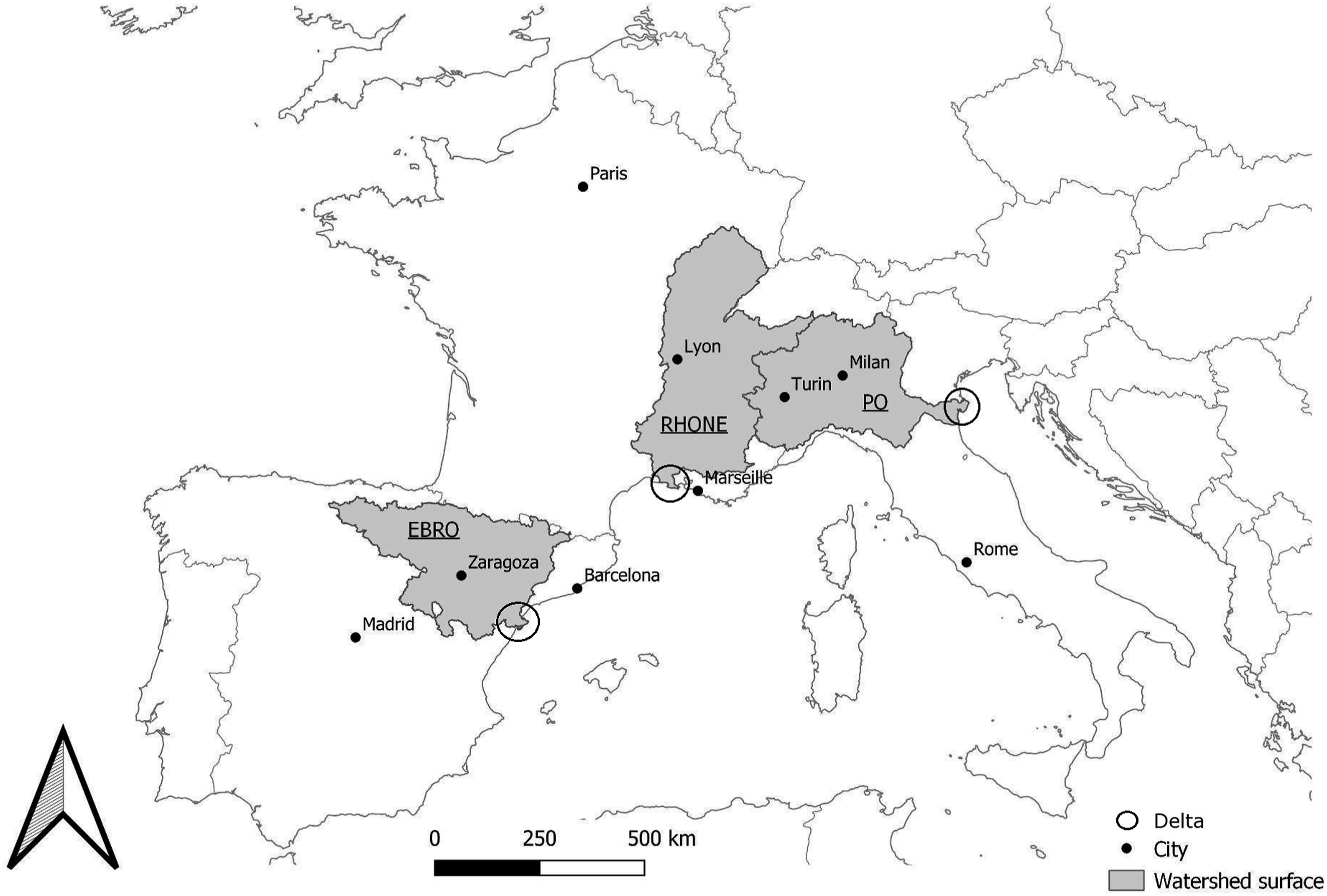
Coastal development and wetland conservation
For centuries, in Europe, swamps and marshes located along rivers and seashores were associated with backwardness and disease. Draining them and transforming them into productive agricultural landscapes was thus a sign of progress and human “conquest” of an unforgiving nature. 12 Deltas were no exception and the attempts to drain them multiplied worldwide during the nineteenth century, with the introduction of steam-engine powered pumps, and accelerated in the twentieth century, with the help of more powerful diesel pumps or cheap electric energy. After the Second World War, in the context of a general acceleration of human intervention in ecosystems, the amount of deltaic land drained around the world reached unprecedented numbers. 13 This was especially true along the coasts of Mediterranean Europe, where new economic initiatives and state policies were driving an unprecedented wave of development. 14
The Po and the Ebro deltas exemplify well this trajectory. There, drainage took off after 1850. During fascism in Italy, it was further encouraged and took on an explicitly social and political turn. 15 By conquering new farmland, building infrastructure, and providing agricultural jobs, the regime sought to stabilise the politically turbulent countryside of the Po Valley. Italian Fascism was a source of inspiration for the regime of General Franco in Spain. The Ebro Delta was declared a “colonization zone” in 1941, just two years after the end of the Spanish Civil War (1936–1939). This designation aimed at boosting agricultural production and attracting new settlers, transforming the delta’s landscape. 16 In the Rhône Delta, also known as Camargue, state-sponsored efforts to drain the coastal lagoons to expand agricultural land were ongoing in the 1920s. However, in the name of aesthetic values, in 1927, the Societé Nationale d’Acclimatation de France (SNAF) reached an agreement with the landowners – the private saltworks company Alais-Froges-Camargue – to establish a reserve of nearly 12,000 ha around the coastal lagoon of Vaccarès. 17 Nevertheless, after World War II development pressures accelerated, and the protected area became an iconic example of a natural reserve under threat. 18
The international campaign led by Luc Hoffmann and Project MAR in the 1960s contributed significantly to introducing a different view of coastal wetlands. A biologist by training and heir to the founder of La Roche pharmaceutical company, Hoffmann acquired a large estate in the marshes of Camargue and in 1954 opened there the private biological station of Tour du Valat. 19 By tracking birds, Tour du Valat biologists documented that Camargue was part of a network of wetlands that played a strategic role in supporting the transcontinental migration of birds across Africa and Europe. 20 Draining wetlands to their disappearance would risk endangering the very existence of these species.
Under Hoffmann’s leadership, Tour du Valat became the centre of an international network of scientists and activists who sought to promote the conservation of coastal wetlands on ecological grounds. 21 In 1960 the International Union for the Conservation of Nature appointed Hoffmann as director of a project on the conservation of wetlands in Europe and North Africa—the so-called MAR project, presented in the introduction of this article. 22 The significance of this initiative, which led in less than ten years to the signature of the Ramsar international treaty, has been rightly emphasised by the recent literature on conservation. As explained by Wöbse, it was “the first time that a habitat type was designated as an object of protection.” 23
Nevertheless, the kind of protection that MAR project members were envisioning for European coastal wetlands was hardly the creation of reserves of untouched wilderness. On the contrary, they strategically coated their plea for conservation in the language of economic value and multipurpose land use planning. 24 The 1962 MAR conference proposed to organise regional conferences “attended not only by biologists but by those representing tourism, recreation, land planning, agriculture, and other interests,” and warned that the conservation of wetlands may depend on being able to bring together these actors. 25 To do so, it was necessary to harmonise economic activities in or around wetlands, by assigning different functions to different zones (or seasons of the year). In this framework, even the protection of wildlife—the main rationale for wetland protection—had to “dovetail in with the rest”. 26
Such propositions were formulated in the context of renewed development pressures on coastal wetlands in Mediterranean Europe. In France, in 1963 the state launched an unprecedented development program aimed at transforming the wetlands of Mediterranean France west of the Rhône delta into an international tourist destination. 27 In the same years, the French state also promoted the further development of a petrochemical industry hub in the lagoons east of the Rhône delta. 28 In Italy, north of the Po Delta, the petrochemical hub of Venice was expanding. 29 To the south of the Delta, the boom of the tourism economy was “totally transforming” Rimini. 30 In the same period, the delta itself saw a further progression of drainage in the Comacchio lagoon. 31 In the Ebro Delta, the slow unfolding of reclamation during the 1950s gave way to larger plans for agricultural drainage after 1967. These projects aimed at draining nearly 30,000 ha, with the goal of replacing rice cultivation with more profitable and intensive irrigated orchards. 32 The Francoist government approved the plan in 1972, building on the 1941 declaration of the delta as a zone of national interest for colonisation. 33
In this context, Project MAR suggested framing wetland protection as part of regional planning schemes. Rooted in a longer tradition, but prominent in the late 1950s and 1960s Europe, regional planning was a policy approach aimed at promoting economic and social development at a subnational level through the careful spatial redistribution of settlements, infrastructure, and economic activities. 34 This included assigning different economic functions (including urban, industrial, touristic, and others) to specific zones and modulating land use rules and regulations accordingly. The MAR conference inscribed its plea in this tradition and recommended that “governments make provision for wetland reserves in all national and regional development plans.” 35 It was not an outlandish request. Nature conservation was part and parcel of regional planning, which, through zoning and land use regulation, aimed to reconcile development and conservation by creating protected areas alongside “growth poles.” Regional planners considered environmental protection as a necessary complement to development schemes, as the natural environment contributed to the economic value of coastal areas and was itself an increasingly sought-after commodity by tourists. 36
In the 1960s, regional parks were emerging in Europe as a preferred model of regional planning schemes, whenever these sought to incorporate nature protection. Known as “nature parks” in the German-speaking world, regional parks were introduced in West Germany in 1956, but had roots in the interwar period. 37 This German model was in turn a declared source of inspiration for French regional planners. In France, regional parks were introduced in 1967 by the same actors responsible for regional planning nationwide, namely the Delegation for Regional Planning and Regional Action (Délégation à l'Aménagement du Territoire et à l'Action Régionale, DATAR). 38 According to DATAR member Olivier Guichard, regional parks were in fact “a capital element of a regional planning policy,” precisely because they allowed to combine development and conservation. 39 In Spain, regional parks were introduced in 1975 following the French model. 40 In Italy, the regional park model was also developed by the milieu of regional planners active in the 1960s and 1970s. 41
The regional park was also embraced by wetland conservation advocates, starting from Hoffmann himself in Camargue. In the three deltas, the national park option was considered first, but later abandoned because most actors considered them too constraining for economic activities. The regional park model was strategically mobilised as a more flexible alternative to the national park. It made it easier to argue for the compatibility of coastal conservation and development and establish protected areas, preserving coastal wetlands from likely disappearance. The emerging historiography on regional parks in Europe has taken notice of the flexibility of this planning model. However, it has also questioned the effectiveness of regional parks in curbing economic activities and interpreted them as a way through which public authorities could show their environmental credentials at a low cost. 42 The cases of the Rhône, Po, and Ebro Deltas complicate substantially this assessment. We will now examine each delta in turn.
The Rhône delta park, 1962–1971
At the turn of the 1960s, the status of Camargue’s wetlands was as precarious as it was ambiguous. To be sure, unlike the Po and the Ebro, part of the Rhône delta had been protected since the 1920s. However, the reserve managed by the SNAF – renamed in 1960 as the Société Nationale de Protection de la Nature (SNPN) – was based on a voluntary agreement with a private company. 43 According to the French administration, this status prevented any real support from the state. 44 By making the Rhône delta the meeting point of world experts in wetlands, the 1962 MAR conference also gave new impulse for its protection.
Preserving Camargue’s wetlands was a core mission of Hoffmann’s research centre already at its establishment in 1954. 45 In 1953, Hoffmann himself had even argued that Camargue deserved the status of “national park.” 46 He was not alone. In 1960, when a new law was about to formalize the statute of “national park” in France, Philippe Lamour pleaded for the same to the national government. 47 Lamour was the head of the “National Company for the Development of Low Rhône and Languedoc” and a fervent advocate of regional planning. His involvement shows the early support of regional planning milieus.
In 1962, despite this advocacy, the project of a national park in Camargue had still not moved forward, due to resistance within the Forest administration. 48 In the attempt to relaunch the matter, the Conseil National de la Protection de la Nature (CNPN), an advisory committee linked to the French government, requested a study presenting the ecological importance of the Camargue to the botanist and university professor in Marseille, René Molinier. 49 Molinier was the Conseil’s regional delegate, but also a member of the SNPN and a participant in the MAR project. He accepted enthusiastically. 50
Molinier’s report sketched the outline of a national park in Camargue. 51 Pointing out several menaces to Camargue (rice cultivation, saltworks, and tourism, but also fires, uncontrolled grazing, and the noise of military planes), he demarcated four zones to be protected, starting with a peripheral area partially open to the public and finishing with a reserve opened only to scientists. 52 The CNPN, however, was sceptical about the immediate feasibility of a national park and suggested establishing an archipelago of smaller reserves. 53
CNPN’s desire to act quickly, even if this entailed renouncing a national park designation, was in a significant part due to pressing threats to Camargue’s surviving wetlands. As mentioned earlier, major tourist and industrial development initiatives were encroaching on the delta. To the west, the French state had started the pharaonic redevelopment of the Languedoc-Roussillon coast. 54 To the east, the petrochemical complex of Berre and Fos was further expanding its operations. In the delta itself, SALICAM, a company that owned the marsh that was protected since 1927, was planning to expand there its saltworks, threatening the ecological balance of the pond. 55 Due to the private nature of the agreement with the SNPN, public authorities had no means to prevent this development without the establishment of a formal, state-sanctioned protection regime. A network of small reserves would have at least provided such a regime for the most directly menaced marshes.
Whereas the national park did not seem a viable option, the regional park increasingly did. Regional planners of the DATAR had started studying the regional park option as early as November 1963, as a complement to national parks for areas that demanded a more complex combination of interests and activities. After a visit to Germany in 1965, their work intensified, leading to the establishment of a National Commission on Regional Parks and, in 1967, to the decree which established the parcs naturel régionaux (Natural Regional Parks, or PNR). Echoing these debates, the CNPN had floated the idea of a “regional park” as an alternative already in 1964. 56 By 1966, the project of a regional park in Camargue was already on the table of the National Commission on Regional Parks. 57
It was also the object of intense negotiations on the ground, among local representatives, Luc Hoffmann himself, and regional planners. Several socioeconomic sectors considered the park a menace to the traditional economic activities of the region such as agriculture and livestock farming. 58 Local authorities too feared that nature protection would come at the expense of the economy. In a public meeting in December 1966, regional planner Olivier Guichard explained that while national parks meant the “absolute protection [of nature],” the regional park model was compatible with economic development and was indeed “a chief component of regional planning.” 59
Establishing a park within this framework would entail negotiating a regional plan with the local authorities, to decide on zones for protection, zones for infrastructure, and zones for economic activities. It gave thus local authorities significant room for manoeuvre and was meant to reassure them. To reassure local actors further, the French administration established a foundation that would manage the regional park. This foundation included representatives of landowners, local authorities, the national government, and “particularly qualified individuals.” 60 Luc Hoffmann was part of it in his double function of landowner and prominent scientist, but so were those who had most to fear from the establishment of a park.
This strategy paid off. Once the institutional compromise had been found, there remained only one obstacle: the fate of the original natural reserve established in 1927, which was still in private hands. In 1970, the Salines du Midi –successor of SALICAM and owners of the marsh– publicly announced their intention to go on with the plan to expand salt production there. 61 However, stakeholders who had finally come together on the regional park scheme publicly opposed the project. Hoffmann went as far as arguing that the regional park foundation should break up if the saltworks expansion went ahead and mobilised the consensus reached on this matter within the foundation as a representation of the “general interest” of the Camargue. 62
Solving the conflict with Salines du Midi provided the final push for the establishment of the regional park. In this case, this was possible thanks to the extraordinary financial means of Luc Hoffmann. In May 1970, Hoffmann informed the Ministry that the WWF, of which he was vice-president, was ready to pay one to two million francs to help buy these lands. 63 The creation of the regional park was approved a few months later, and an agreement with the saltworks was announced in November 1971. The company ceded the more than 13,000 ha of the Vaccarès reserve to the State, in exchange for 1,750 ha of land in the south of the Camargue and a monetary compensation that was not made public. 64 Luc Hoffmann, acting as the vice-president of WWF, handed a cheque of one million francs to French president Georges Pompidou in an official ceremony at the French Republic Presidential palace, to help finance the compensation to the company. 65 As we shall see, this was the only case in which philanthropy played such a prominent role, but it once again highlights the economic challenges faced by wetland conservationists, as well as the obstacles that entrenched property rights represented for ensuring preservation.
The Po delta park, 1964–1988
At the turn of the 1960s, the Po Delta wetlands were also becoming the object of new concerns. Biologists from the Italian National Research Council joined Project MAR in 1963, and MAR included the Po Delta among the wetlands of international importance in 1965. Like the Camargue delta, its wetlands were seen as a hotspot of plant and animal life and an especially important habitat for migratory birds traveling between Africa and Europe.
The arguments of Project MAR scientists found an echo in the growing environmental sensibility of Italian regional planners and environmentalist associations. In 1964, the Po Delta was included in a pioneering Italian scheme by regional planners for the establishment of parks nationwide. 66 It was likely the first time in centuries that plans for the delta did not include drainage but instead wetland conservation. While the plan had no immediate follow-up, it nourished the elaboration of an ambitious countrywide economic and spatial plan published in 1969 by the national government, which equally included the creation of a park in the Po Delta. 67
The project of a park in the Po Delta was also taken up by the conservationist association Italia Nostra (“Our Italy”). Led by Giorgio Bassani, a celebrated novelist from the delta, in 1968 Italia Nostra organised a congress on the Comacchio wetlands, the largest surviving brackish lagoons of the delta. 68 Italia Nostra continued to cast the spotlight on the protection of the southern delta with a new congress in 1970. 69 In 1972, then, Italia Nostra organized a third congress, this time explicitly aimed at discussing the protection of the whole Po Delta. 70 On all these occasions, biologists associated with the MAR project had the crucial role of defending the ecological value of the delta’s wetlands.
These congresses manifested the consolidation of a new vision of the delta as a valuable but menaced ecosystem. MAR ornithologist Leporati, for instance, emphasised that over one year some 126,000 migratory birds of at least ten different species had stopped in the delta during their journey. 71 Many attendees inventoried with preoccupation the menaces threatening this ecosystem, from new drainage schemes to thermo-electric power plants. These congresses also manifested the emergence of a political coalition that opposed reclamation and redevelopment. Under Bassani’s leadership, Italia Nostra had secured the support of local and national authorities, including mayors of delta municipalities, on an agenda that demanded strong action to prevent the destruction of “the largest lagoon complex of the country.” 72
If protection was consensual among participants, it was not clear which was the best way of achieving it. Some thought that it had to be accomplished through a national park. Progetto 80, the ambitious plan published in 1969 by the national government, imagined establishing a national park in the Po Delta. In 1970, echoing these national schemes, the second Italia Nostra congress included a proposal for a national park in the delta, presented as a boon for tourism. 73 In the third congress, however, members of Italia Nostra and planners questioned the national park model. National parks, they argued, enforced a notion of “nature as sanctuary” which collided with the aspirations for development of local actors. They contended that it was preferable, and politically more expedient, to create instead a regional park, which could combine both zones of total nature preservation with zones of mixed-use, including intensive agriculture, tourist resorts, and industries. This solution would secure the consensus of local administrations and economic actors, thus making the project more likely to succeed.
The dichotomy between national and regional parks was at the centre of a country-wide debate. 74 The national park model seemed the one offering the strongest assurance of effective preservation of natural landscapes. The regional park, on the other hand, seemed to allow for a wider and more diverse composition of interests in working landscapes and hence was favored by local actors. The latter option also encountered the favour of the newly-established regional administrations. Regional administrations had been foreseen by the democratic constitution of Italy after the war, but only established in 1971. In 1972, thus, they were very young and still trying to delineate the perimeter of their action in a policy landscape until then dominated by the central state. Environmental policy and especially nature protection was from the outset a central area for them to do so. Veneto and Emilia-Romagna, the two regions whose territories included the Po Delta, had therefore endorsed the 1972 congress by Italia Nostra and its conclusions.
Despite the apparent consensus and institutional support manifest in 1972, subsequent attempts at establishing a park in the delta failed to generate political consensus among stakeholders and never moved beyond the planning stage. 75 Even the 1975 visit of a delegation of the Man and Biosphere project, a UNESCO project with a task force on the protection of Mediterranean deltas, failed to generate enough traction to revive the process. 76 In 1981, the Italian state finally classified the Comacchio lagoons as wetlands of international importance as per the Ramsar convention, providing an additional weapon for those arguing in favour of the establishment of a park in the delta. 77 This, however, did not stop a renewed development push, that included new urbanisation in Comacchio and a contested coal-fueled power plant at Porto Tolle, in the northern delta.
In this fraught context, campaigns for the park took up again. Emilia-Romagna Region launched a new planning attempt, encountering open opposition, from both local actors such as farmers and hunters’ associations as well as the central state, reluctant to acknowledge regional primacy in this matter. 78 The back and forth between the state and the region continued for a couple of years, leading to a revised law in 1987, accompanied by an agreement with the Veneto region for a coordinated initiative on the northern sector.
This time, it worked. In early 1988, the regional parliament of Emilia-Romagna approved a law on the creation of regional parks in its territory, and in the summer of 1988, it approved the law establishing the park on the southern side of the delta. 79 The Emilia-Romagna Delta park was much smaller than the original 1982 proposal, from 150,000 ha to 60,000 ha of protected surface. It also left ample room for multiple economic activities, from fishing to agriculture and tourism, thus limiting the opposition to the initiative. 80 This was the main point for regional institutions. Environmentalist associations, on the other hand, had become more critical of the regional park model as it had finally materialized in Emilia-Romagna, as they considered it ecologically ineffective. 81 Like in the Rhône delta park, local authorities were included in the decision-making process of the park, which was effectively constituted as a consortium between the Regione and the local administrations. 82
The national park option remained on the table for a few more years. The first Italian law on parks, finally passed in 1991 after decades of debates, put a deadline for a coordinated, co-managed park with the Veneto region, after which the state would establish a national park. In the end, however, neither the national nor the coordinated “interregional” park materialized, but simply an additional, autonomous regional park in the Veneto section of the delta, approved in 1997. Among other restrictions, the creation of the parks established a special regulation and hunting, restrictions to energy production plants – allowing only the use of methane – and prohibited issuing permits for extraction or exploration of hydrocarbons. 83
The Ebro delta park, 1973–1983
Unlike in the Camargue or the Po Delta, no initiatives were launched to protect the Ebro Delta throughout the 1960s, despite being included in the 1964 MAR list of wetlands of international importance. This is likely due to the very different political context of dictatorship and its strong developmental drive, well-illustrated by the large plans for agricultural drainage in the region. However, the Francoist dictatorship’s environmental policies began to shift between the late 1960s and early 1970s, in what has been interpreted as an effort to improve Spain’s image abroad. Several national parks were approved, along with domestic environmental regulations. In the run-up to the 1972 Conference on the Human Environment in Stockholm, the dictatorship renamed the forest administration as the National Institute for the Conservation of Nature (Instituto para la Conservación de la Naturaleza, ICONA). 84 While part of the development-oriented Ministry of Agriculture, some of ICONA’s officials warned against the use of pesticides and the danger that agricultural drainage represented for the Ebro’s deltaic ecosystems. In a report written in 1973, the head of ICONA Biological Station recommended to establish a national park in the Ebro Delta, building on its inclusion in the MAR list. 85
Around the same time, other voices made similar pleas. In a report to the state agency on agricultural development, several authors maintained the need to protect the delta —among them the president of the Spanish Ornithological Society, who had participated in the 1964 MAR conference. They underlined that MAR had classified the protection of the delta as an “urgent priority” and warned that drainage was going to “radically alter the natural structure of the [delta] environment”. Therefore, they proposed to preserve several areas with different protection regimes according to their value: one as a biological reserve, another as a natural site of national interest, and two more as a national park. 86 These early proposals for a national park did not take off but clearly show the emergence of a new valuation of the Ebro Delta.
Alerts grew in the wake of Franco’s death in 1975. That year, news spread about two massive tourist development projects for draining and urbanising the Ebro delta’s lobes. These plans attracted regional, national, and international criticism —including that of Luc Hoffmann, who offered the support of IUCN and WWF. 87 Some local ICONA state officials were also critical and pointed out that the Ebro Delta was “crying out for the planning of its territory”. 88 Around the same time, a group of young scientists from the Catalan Institution of Natural History (Institució Catalana d’Història Natural, ICHN) published a massive volume on nature conservation in Catalan-speaking regions of Spain. Closely connected to the growing pro-Catalan movements and participants of the UNESCO-MAB project on deltas, these scientists argued for the protection of the Ebro Delta and conceived it as one of the future national parks of Catalonia. 89 However, the idea of a national park in the delta was not received positively by local stakeholders, reticent to restrictions curtailing economic activities. 90
By then, other options were on the table. In the final years of the dictatorship, while opposition to Franco was growing also on environmental grounds, ICONA launched a project to expand environmental protection across Spain. While the Ministry of Finance denied the funds to materialise protection measures on the ground, legal reforms went ahead, including a new law on nature conservation approved in 1975. One of the key innovations of this law was the creation of a new category of legal protection, directly inspired by French regional parks: the so-called “parque natural” (natural park). In contrast with national parks, aimed at preserving ecosystems scarcely touched by human activities, the law established that natural parks were aimed at “facilitating the contacts of man with nature” and guaranteeing both “the preservation of its values” and the “organized uses of its productions”. 91 Flexibility to combine protection and development and compatibility between preservation and economic activities were, as with French and Italian regional parks, the key features of Spanish “natural parks”.
The “natural park” offered several political advantages in the Ebro Delta. Like its French and Italian homologs, the compatibility of the “natural park” category with economic activities could dissipate the opposition of local actors against national parks. Moreover, it made it possible for the Catalan government, established a few years after Franco’s death, to bypass the central state. The 1975 law specified that the creation of a national park required a state law and that the subsequent responsibility to manage national parks remained in the hands of the Spanish state. However, it was less clear regarding the obligations related to “natural parks.” As a result, when the Catalan land planning department (Departament de Política Territorial i Obres Públiques) assumed legal powers on nature conservation in 1980, it prioritised “natural parks” to initiate an autonomous agenda of protection. The land planning department inherited staff belonging to the park service of the Barcelona province, some of them committed environmentalists with experience in zoning and park management. 92 Advocates of delta protection also participated in the UNESCO-MAB project on deltas to make visible the case of the Ebro. 93 The far-reaching influence of Tour du Valat could also be felt: as remembered by one planning official, the visit that the director of the Catalan planning organism paid to Tour du Valat in the early 1980s was key to convincing him of the value and prestige associated with wetlands preservation. 94
The Ebro Delta was one of the first places where the Catalan land planning department established a “natural park” during the early 1980s. The spark that ignited the approval of the park started from a local conflict. During the summer of 1983, the beginning of drainage works in a coastal lagoon of the municipality of Deltebre triggered the protests of the newly elected municipal government. They received the support of other municipalities, along with hunting and fishing associations. In this context, the Catalan government saw an opportunity to present the legal protection of the delta as the solution to the conflict and obtain the support of the heterogenous coalition that had been established, therefore minimising, at least initially, the refusal of the park by local actors. 95 Accordingly, the Catalan government instructed the officials at the land planning department to adopt a cautious formulation, using the “natural park” designation from the 1975 law and providing ample space for human activities in most of the delta territory. 96
The Natural Park of the Ebro Delta, which initially covered only one-half of the delta, was approved by decree after a fast process during the summer of 1983. As in the French and Italian cases, the institutional configuration of the park gave room to local authorities and stakeholders, who were integrated into the governing board of the park. While it was met with distrust or outright rejection by landowners and farmers, the park’s lack of impact on agricultural and hunting activities helped to appease these stakeholders. Nonetheless, the park regulations ensured the protection of several coastal lagoons by explicitly prohibiting their drainage. After three years of negotiations with landowners, who were reluctant to abandon drainage projects, and state authorities, who challenged the Catalan government’s legal rights to establish the park, a new decree in 1986 granted the park’s expansion to include the other half of the delta, reaching a surface area of more than 7,700 ha. In its opening lines, the importance of preserving the ecological value of the delta territory was emphasised, citing the MAR project. 97
Conclusions
Following the MAR conference in 1962, the Liquid Assets leaflet was an emphatic appeal to those involved in wetlands redevelopment to “at least pause and consider your plans in the light of our arguments.” 98 Claiming the economic value of wetlands and their compatibility with productive use of the land was a cornerstone argument of Project MAR members. Such a line of reasoning, however, involved a tension between the appreciation of wetlands’ wilderness and a realist willingness to reach compromises with economic actors to prevent these environments from complete disappearance.
Project MAR assessment of the wetland’s ecological value was important to put the protection of the Rhône, Po, and Ebro deltas on the political agenda. Not only did arguments of people like Hoffmann point to a “change of narrative” around wetlands. 99 Members of Project MAR were also directly implicated in advocacy, starting with Luc Hoffmann himself in Camargue and the Ebro Delta, but also including the Italian Project MAR members and scientists of the National Council of Research that joined forces with the conservationist association Italia Nostra. Project MAR scientific assessment also served Catalan and Spanish environmentalists, who mobilised the presence of the Ebro in the lists of Project MAR to argue for its protection, while the inclusion of the Po delta wetlands in the Ramsar list allowed the Italians to relaunch the protection debate in the early 1980s. While less effective than MAR advocacy, even the UNESCO-MAB project task force on the protection of deltas arguably contributed to keeping deltas in the spotlight, helping protection campaigns in the Po and Ebro.
Ecological arguments, however, had to compromise with coastal development. Deltas were quintessential landscapes of reclamation and improvement, as well as home to multiple economic activities ranging from intensive agriculture to industry and tourism. These activities were growing at the very same time as Project MAR promoted a change of narrative on wetlands. To make the case for the protection of coastal wetlands, wetland conservationists sought to prove that it would not be detrimental to their agricultural, industrial, and tourist economy. Only by showing that wilderness could rhyme with coastal development it would be possible to gain the indispensable consensus to establish a protection regime.
In the three cases we have examined, regional parks proved capable of achieving this arduous political feat. While conservationists had initially considered the national park model in the Rhône, Po, and Ebro cases, they eventually abandoned it. National parks were seen by most actors as too restrictive and hence not compatible with what an elected representative from the Po Delta described as the “legitimate aspirations” for the development of the locals. 100 This is not surprising when considering the importance of the Swiss experience in the European translation of the national park model, which had interpreted the national park as an ideal landscape of human-less wilderness to be put under “total protection.” 101 When regional planner Olivier Guichard opposed regional parks to “absolute protection” in national parks he had likely in mind that model.
Regional parks, on the other hand, seemed to provide the necessary flexibility to ensure both the protection of wetlands against any further attempt at draining them and guarantee the interests of agriculturalists, hunters, fishermen, actors of the tourism economy, and local representatives, as well as neighboring industrial hubs. This was due precisely to the deep connection of regional parks with regional planning and its sophisticated approach to multipurpose zoning and land use regulation for economic development, to the extent that for some conservationists at the time regional parks may as well have been referred to as “land-use plans”. 102 Instead of providing a catch-all explanation for its success (an alleged low level of protection which made possible almost all kinds of economic activities), our cases thus suggest that regional parks can also be interpreted as key attempts to reconcile tensions between different land uses.
In the cases of the Po and the Ebro deltas, regional parks were preferred for a fundamental political reason: they allowed for the autonomous initiative of regional governments (Emilia-Romagna and Catalonia), bypassing resistances that would have delayed or prevented the adoption of a park designation at a national level. In the Rhône, on the other hand, the regional park flexibility alone was not enough to ensure protection, as Hoffmann had to intervene to compensate the saltworks for the conservation of the salt marshes of Vaccarès to make it possible to establish the park. Nevertheless, in the three cases, the regional park model was undoubtedly key to overcoming the resistance of economic actors and local representatives, who were integrated into the park authorities and given a voice in the decision-making about the parks, all while preventing further drainage of wetlands in the three deltas.
The adoption of regional park schemes in our three cases exemplifies the success of this protection regime in Europe. Regional parks were a key juridical and policy tool for the conservation of wetlands in deltaic landscapes under strong economic and political pressures. This should encourage historians to give more attention to regional parks and regional planning in the history of nature protection. While our knowledge of the history of national parks now rests on firm ground, there is still much to do to understand the role that this tradition of nature protection had in containing, if not stopping, the developmentalist flood of the Great Acceleration after World War II.
However, regional parks also illustrate the ambiguities of wetland conservation in the context of accelerated coastal development. While it would be tempting to oppose conservation and development, the preservation of surviving coastal wetlands in Mediterranean deltas was not so much the outcome of the conservationist front overcoming the development front. Our case studies show that protection was more the outcome of a compromise, limited but effective, between development and conservation advocates. Regional parks, and regional planning more broadly, offered a point of convergence for local actors aspiring for growth, planners interested in including environmental protection as an economic value, and wetland advocates willing to compromise to save what they could.
Footnotes
Acknowledgments
We are grateful to Lino Camprubí for his comments on an earlier version of this paper. We also thank Tom Demange for valuable research assistance on the Rhône delta park.
Declaration of Conflicting Interests
The author(s) declared no potential conflicts of interest with respect to the research, authorship, and/or publication of this article.
Funding
The author(s) disclosed receipt of the following financial support for the research, authorship, and/or publication of this article: The authors gratefully acknowledge support from an Émergence(s) grant from the City of Paris for the project “Shifting Shores: An Environmental History of Morphological Changes in Mediterranean River Deltas in the Twentieth Century” of which this is an output. Santiago Gorostiza’s work was later supported by the EU-Next Generation and Ministerio de Universidades de España (María Zambrano grant 2022) and by the European Research Council under grant number H2020- ERC-StG-101042252.
