



Abstract
This paper evaluates Nils Kreuger’s and Teodors Ūders’ engagement with the sea on two sides of the Baltic coast, noting the diffusion of landscape, seascape, and coastline in paintings of Öland and Halland in Sweden, and the Dunte seaside in Latvia. Extending a discussion of artist encounters with coastal seaside communities reveals the ecological and cultural complexities characteristic of this environment. Kreuger’s paintings, while experimenting with tone, light, and form are rooted in the distinctive island landscape of Öland and the weather-beaten coastline of Halland. While for Ūders, the Dunte seaside presented a return to a ‘primeval’ nature, associating symbolism, impressionism, and realism with coastal life. In borrowing ideas from the natural sciences to describe visual culture, I contend with historic methods of ecological and agricultural cultivation, and contemporary ecocritical readings of art history, with regards to the Baltic coastal ecotone. The interaction with the sea and coast, on two sides of the Baltic, grapples with the regional identity, cultural specificity, and ecological variables of the shore; from woodland clearing and seaweed cultivation to the distinctiveness of the grasses, beaches, boulders, and water. This critical evaluation is not simply concerned with images of ecosystem damage and decline; rather these paintings are aware of the respective topographies, ecologies, and landscapes of the Swedish and Latvian Baltic coastline. As such, I consider these paintings not only within the social, historical, and visual narrative of Nordic and Baltic coastal art history, but as records of cultural and ecological memory.
“[T]he edge of the sea is a strange and beautiful place”, wrote the American environmentalist Rachel Carson, it “has a dual nature, changing with the swing of the tides, belonging now to the land, now to the sea”. 1 In the 1950s, Carson sought to draw attention to the global coastline, asking her readers to engage with the indeterminate tidal nature of the sea and the multitude of human and other-than-human life that exist along its periphery. The water’s edge is constantly shifting, moving back and forth as the swell of the tide consumes the shore, before retreating back in on itself. It is demarcated by sand dunes, rocks and boulders, shallow pools of sea water left behind by the outgoing tide, of human and other-than-human social and agricultural activity, and marine biological life stranded on the shore. It is a temporal and temporary liminal zone, where the cycles of day and night configure and shape the landscape and determine the social activities that take place at this cultural and ecological meeting point. “Rhythms of human activities resonate not only with those other living things but also with a whole host of other rhythmic phenomena”, as Tim Ingold articulates in his seminal paper Temporality of the Landscape (1993). 2 The interchangeability of the land and sea along the Baltic coastline offers insight into the cyclical nature of human and other-than-human activity that took place in this marginal space. Extending a discussion of artist encounters with coastal landscapes reveals the ecological and cultural complexities of this distinct ecotone – a point where two biomes meet – and rethinks the narrative of the wider Baltic shoreline.
Beyond marine painting, the sea, shore, and seaweed have been marginally represented in art historical scholarship, although interest in interdisciplinary coastal art histories is rapidly reshaping these visual encounters. 3 Where Maura Coughlin usefully articulates that the “shoreline has often been represented as a tidy, linear boundary between the varied topography of the land and the flat surface of the sea”, 4 Rebecca Solnit contributes to this discussion by describing the seashore as an ‘edge’ where “it defies the usual idea of borders by being unfixed, fluctuant, and infinitely permeable”. 5 Drawing comparison with the Japanese ukiyo-e woodblock prints of Hokusai and the photography of Henri Cartier-Bresson, Melody Jue, meanwhile, writes of the underwater, tangled, floating worlds of giant kelp (Macrocystis pyrifera), where she asks of the seaweed “Do you sway, or have sway?” 6 A recent series of photo-essays co-edited by Jue and Maya Weeks has extended the swaying form of seaweed across global geographies. 7 Expanding upon arts-based ecological thinking explores the pictorial dimensions to an environmental history, upon which this study of the Swedish and Latvian Baltic coasts intends to build.
A number of Baltic historians, including Ulrike Plath, have adopted an environmental approach to Baltic history that considers the concept of Umwelt in relation to how landscapes are shaped and perceived, and draws further attention to questions of land use beyond the prevailing ethnocentric focus in the history of the region. 8 ‘Entangled’ perspectives on the Baltic, offer a point of departure, and instead looks to the role of gardening, serfdom, and foodways in shaping different landscapes and environmental histories. 9 Seaweed also played an important part in Indigenous diets, with scenes of seaweed harvesting among Haida and Nuu-chah-nulth communities on the North Pacific coast, for example, appearing in the ethnographic photography of Edward S. Curtis in the early 1900s. 10 Today, these concerns often extend to revitalising kelp forests and maintaining traditional food sources and harvesting practices. 11 This agricultural orientation towards the coastline differs from Tricia Cusack’s consideration of the socio-cultural relationship to the sea and shoreline. While the seashore might be a marginal or peripheral place, it also came to play a central role in nineteenth-century society either as a popular resort or a key port. 12
The intertwined narrative of coastal agriculture, landscape, and cultural production in Baltic landscape painting recognises both past and present ecological imperatives and allows for an interdisciplinary perspective of pictures traditionally associated with stylistic and national tropes. My discussion is not restricted to one Baltic region, but rather offers an entangled assessment of the distinctive topographies, geologies, and agricultural activities that emerge along neighbouring Swedish and Latvian coastlines. Thinking about the sea and shoreline as a shared space, this paper delves into the human and other-than-human factors at play at this liminal zone, from the movement and gathering of seaweed, to the grazing of cattle, and the millennia-old rocky outcrops that punctuate the coast. As Philip Steinberg writes, “coasts are exceptionally rich spaces for understanding the linkages that constitute maritime regions, they are useful spaces for unpacking the fundamental binary between land and water”. 13 Shoreline extraction, coastal erosion, and moving dunes have all subsequently resulted in a co-produced landscape, and the histories that shaped, and continue to shape, these coastal environments might be encountered in art historical depictions of the shore.
Considering the work of Nils Kreuger (1858–1930) on the west coast of Sweden and the island of Öland off the south east coast, and Teodors Ūders (1868–1915) along the Vidzeme shoreline of Latvia, I am concerned not with reaffirming national frameworks, but rather indicate an ecological mobility that accounts for the environmental history and ecological present of Baltic coastal landscape painting. Grappling with regional identity, cultural specificity, and the ecological variables of the shore, I contend with historic methods of ecological and agricultural cultivation and extraction, and contemporary ecocritical readings of art history, as regards the Baltic coastal ecotone. Ūders and Kreuger’s work offers an entangled, rather than parallel, history of the Baltic coastline that is about an environmental reality rather than centred on artistic intention. Their work articulates the visual and ecological complexities of this region, and consequently how these might be used to better negotiate our future relationship with coastal environments.
The seasonality of the shoreline
While we might look upon the sea as a never-ending vastness, it and the shoreline, in particular, have helped delimit human maritime communities for centuries. John R. Gillis identified how the intertidal zone – where the sea meets the land between high and low tides – was previously conceived by those who lived near it as a “marsh realm [which] is neither landscape nor seascape”. 14 In The Human Shore, Gillis shifted the perspective on coastlines from marine biological life, including flora and fauna, to the “human element of coastal ecology”. 15 Exploring the cyclical and temporal nature of human and other-than-human activity along the circum-Baltic coastline and in the work of Kreuger and Ūders, I shed light on the human effect on, and co-existence with, marine ecosystems.
Contemporary to Kreuger, the Swedish author August Strindberg (1849–1912) wrote at length of the Swedish Baltic archipelago, describing it as a hybrid and transitional space, “a blend of land and water”. 16 The title of his 1890 novel I Havsbandet is itself derived from a Swedish term used to denote “the outmost edge of the archipelago where the transition from land to water and the exchange and intermixing elements takes place”. 17 Here, the archipelagic islands are used as a “spatial border and imaginary border”, and the site where the protagonist in I Havsbandet Axel Borg establishes common agricultural practices on its shore, including growing potatoes and using seaweed ash to salt his fish. 18 The gathering of seaweed or wrack was, and in some places still is, a traditional agricultural economy throughout Europe, as well as on the Pacific and Atlantic coasts of North America. The 2023 exhibition, A Singularly Marine & Fabulous Produce: The Cultures of Seaweed, on display at the New Bedford Whaling Museum, traces the industrial, scientific, and aesthetic fascination with seaweed across visual and material cultures from 1780 to the present. 19 With this, it largely accounts for seaweed along the eastern shoreline of the U.S. In coastal Ayrshire, Scotland, fishermen shore seaweed off the rocks to be sold to farmers on the mainland for use as manure; 20 and along the Brittany coastline of France, seaweed gathering was a prominent cultural and economic tradition that sustained fishermen, farmers, and artists alike.
At the fishing village and beach resorts of Luc-sur-Mer in Normandy, the Swedish painter Charles Fredrik Hill (1849–1911) made a series of paintings, including Coast Scene, Luc-sur-Mer (1876, Göteborg Museum of Art), which visualised the abundance of seaweed that washed onto the shore. Torsten Gunnarsson describes these canvases as “sea as marshland” paintings, where the green-black of the kelp encircles the tideline. 21 Notably missing from Hill’s paintings, however, is the cultural relevance of seaweed and coastal agriculture as evidenced in the contemporaneous paintings of fellow Swede August Hagborg (1852–1921). In works such as French Beach Scene (n.d.), Hagborg centres the human involved in the processes of gathering and raking seaweed, oyster picking, and hand-net fishing, and reveals the symbiotic relationship between people and the environment, indicating what Michelle Facos terms “the cyclical rituals of peasant life”. 22 Kreuger’s work, like that of Ūders and Hagborg, indicates how the coastal ecotone was a meeting point for, what Coughlin describes as, the “many curious forms of attention”. 23 As seaweed is dredged from the sea and the tree stump is prised from the earth, Kreuger and Ūders bring to the fore the human presence along the Baltic coastline, centring the types of agricultural labour taking place along this varied topography.
Furrows mark the beach in Kreuger’s Seaweed Carters, Halland Coast (1898, Figure 1), crisscrossing and swirling across the sand as the seaweed carters return from their work. Facos described how Seaweed Carters was an example of Kreuger’s “harmonious scenes of traditional cultivation”.
24
Water has filled the shallow crevasses left in the shore, forming reflective pools around the rocks that are scattered before the incoming tide. These are not the hefty boulders that Ūders’ grapples with on the Latvian shoreline, but rather pebbles and stones left awash by the outgoing tide. A swirl of beach wrack extends across the foreground of the composition, demarcating the shore from the land, while the sudden shock of green to the right conveys a rootedness in a terrestrial environment. The deep-sea is not the focus of Kreuger’s painting, occupying only a narrow strip beyond the emerging carts and horses, rather it is the shoreline which forms a hub of activity. Nils Kreuger. The Seaweed Carters, Halland Coast (1898). Oil on canvas, 90 × 129 cm. Göteborg Museum of Art. Public domain.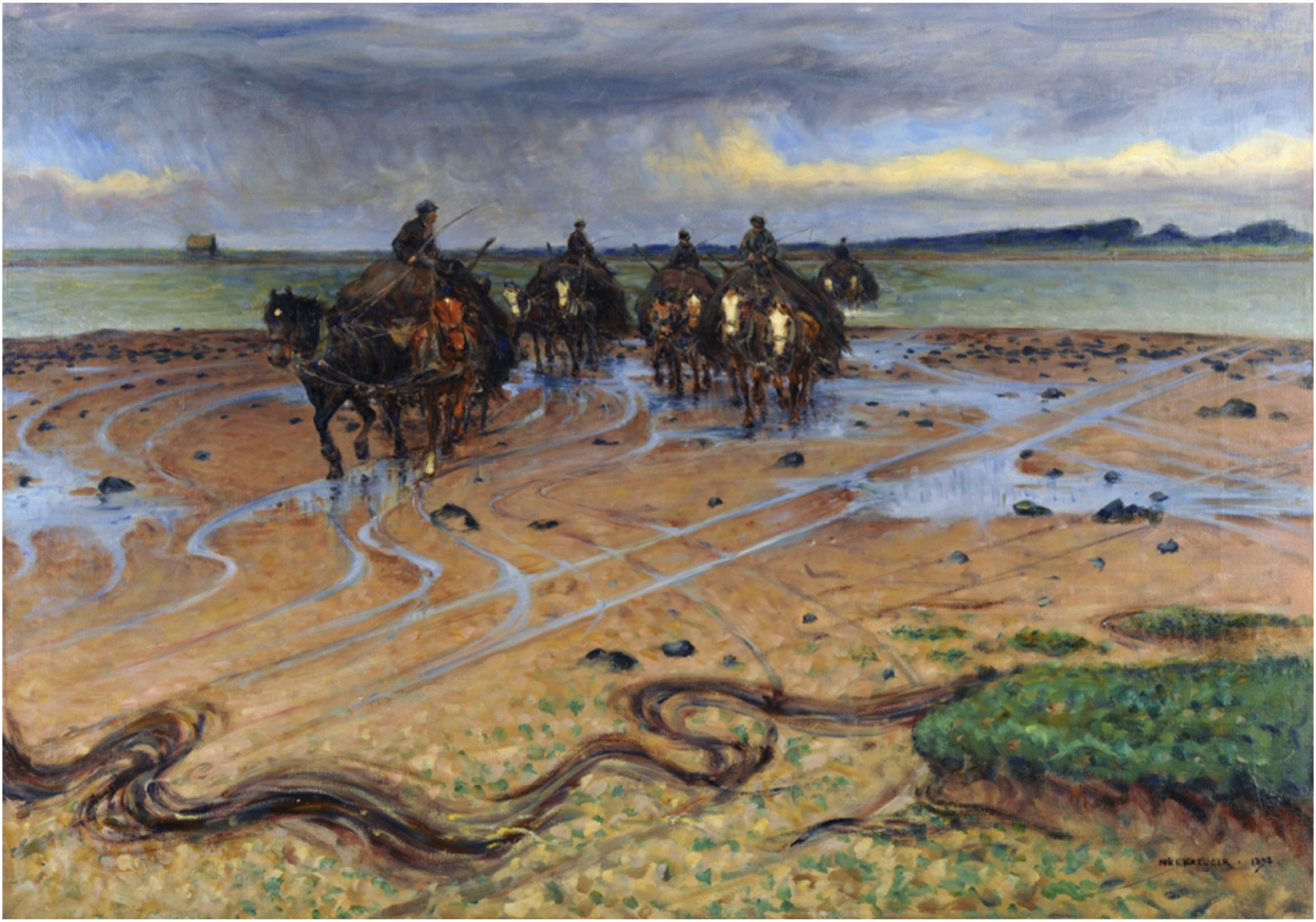
Described in the context of national romanticism, Seaweed Carters, as with Kreuger’s other works of Halland and Öland, has been perceived as responding to an “imperative for cultural specificity” through the inclusion of traditional practices such as the gathering of seaweed. 25 However, as mentioned, such activities were increasingly prevalent across coastal Europe during the nineteenth and twentieth centuries. Gunnarsson also writes of artists laying claim to their own territory in “search for national identity and traditional lifestyles”. 26 A number of earlier works by Kreuger, including Spring Ploughing (1884) in Göteborg Museum of Art, indicate a similar interest in agricultural process that is not restricted by national borders. This image in particular conveys the same tangible patterns left in the landscape by the horse and plough. As Facos subsequently asserts, “Kreuger deliberately sought vistas close in feeling and structure to those familiar from French naturalism and impressionism, rather than landscapes considered uniquely or typically Nordic”. 27 Here, we might refer back to the work of Hill and Hagborg. The theme of seaweed harvesting existed as both a decorative and modernist trope, with compositional motifs and ideas crossing seas and oceans (notably between Europe and North America), and with scenes of coastal agriculture emerging from burgeoning artist colonies, appearing at international exhibitions, and in print within dedicated journals and magazines. While indicative of coastal peasant life, Seaweed Carters represents the shoreline as a shared space between human and other-than-human communities. Instead of providing nationalising commentary, Kreuger’s painting recognises the cultural and ecological complexities of the littoral zone in the trans-national narrative of the Baltic coastline.
Ūders’ Clearing the Woodland (c.1910-1912, Figure 2) has been described in a similar vein. The Latvian art historian Eduards Kļaviņš, wrote of this painting as fusing an “ideological realism of vital, simple folks engaged in hard work with plein air lighting effects”.
28
Adopting Ūders’ own notion of ‘Real Symbolism’, his scenes from Vidzeme and the Dunte seaside relayed the life of local fishermen and peasants, and yet Clearing the Woodland distinguishes itself from other coastal examples in the lack of the mystical and ‘primeval’. Instead, Ūders’ painting unearths the seasonal patterns of life on the coast. During the quieter winter months, fishermen often went to work in the forests that punctuate this coastal Baltic landscape. Unlike in Kreuger’s beach scenes of Öland and Halland, where there is no sight of a sapling or bush, in Clearing the Woodland the stump of a tree is the centre of attention, as it is forcibly removed from the earth. Using the boulder as leverage, the man is actively clearing the shoreline, while the woman looks on. The horse waits patiently, seemingly attached to a cart that will perhaps remove the tree stump from its place embedded in the grassland running parallel to Vidzeme’s sand dunes. Bart Pushaw describes the figure as “an agent of environmental destruction”,
29
participating in the process of clearing the shoreline of its distinguishing characteristics and unique biodiversity. Although we might perceive this as humankind enacting their destructive will on the environment, we might conversely consider comments made by Inglis that one cannot “treat landscape as an object if it is to be understood. It is a living process; it makes men; it is made by them”.
30
With this, the coastal landscape has been, and is actively being, shaped by human extraction, intervention, and destruction. Teodors Ūders. Clearing the Woodland (Celmu laušana), (c.1910–12). Oil on canvas, 74.5 × 115 cm. Collection of the Latvian National Museum of Art, Riga. Photo: Normunds Brasliņš.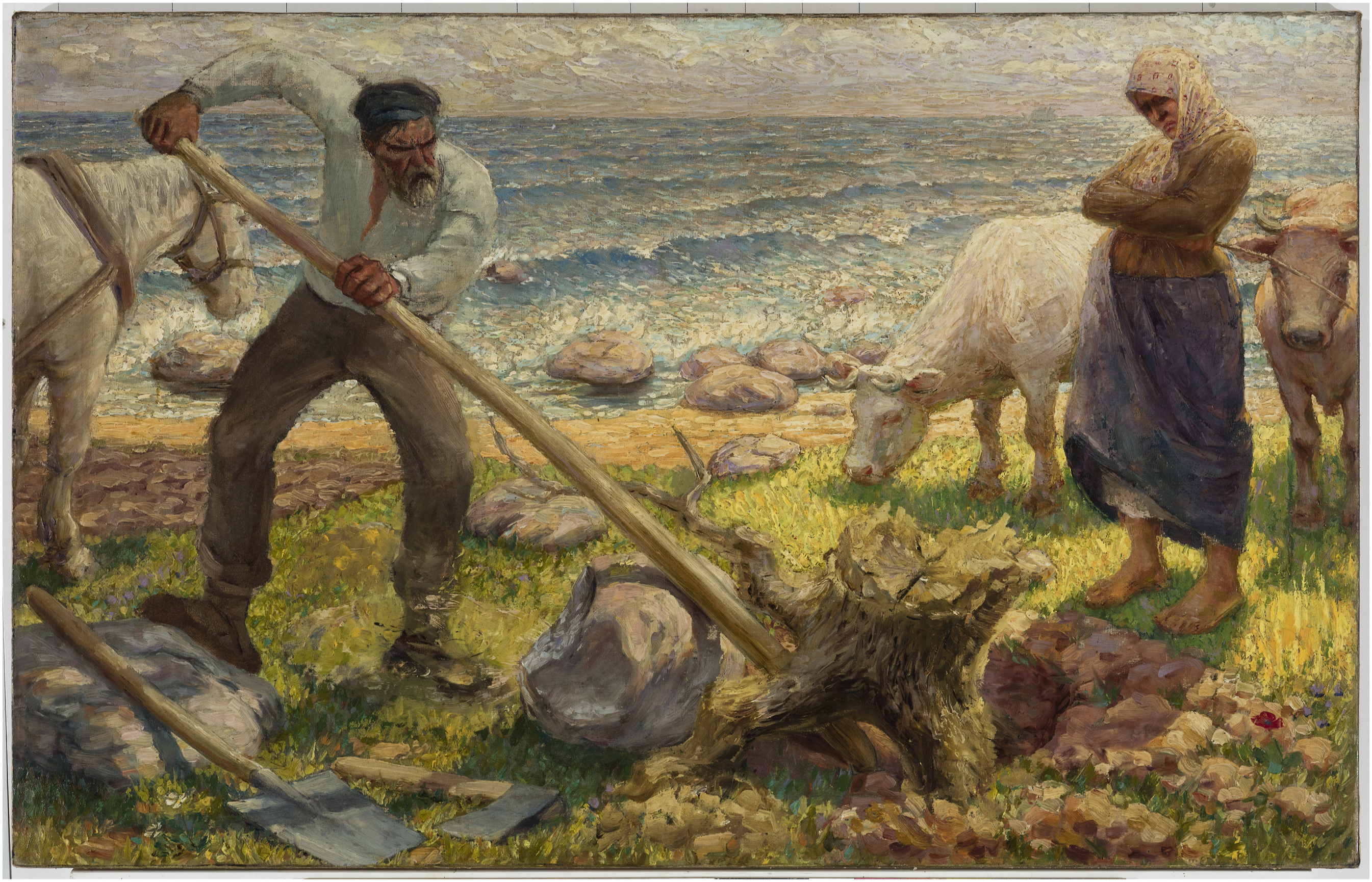
Despite the perception that the sandy shores of the Baltic were “adverse to agriculture”, 31 in Latvia, efforts seem to have been made to combat the in-hospitability of the sand and sea that fight over the shoreline. Chopped trees were transported to the beach by horse and cart, where they were stacked into high piles, awaiting the summer weather to be transported by boat to ships and later sold. Consequently, nearly every farmer had a horse, for “it dragged the boats into the sea and onto shore, transported fish, sea weed [sic], manure, wood”. 32 In the collection of the Latvian National Museum of Art is Ūders’ The Rights of the Strongest (1914), which reaffirms the importance of the horse amidst the process of tilled earth. The process of collection and the gathering of kelp from the seabed and seashore is, in Kreuger’s Seaweed Carters, obscured by the mode of transportation; the importance of the horse in the agricultural process is, as in the work of Ūders and many other seaweed harvesting pictures, evidenced here. Women would in turn collect pine branches, forming mounds on the beach, for them to later be used at home for firewood. Human intervention in the act of clearing land, and wider deforestation, continued into the twentieth century, and both effected, and was affected by, the dunes that consume northern Latvia’s shoreline.
At low tide, the “ecoclines of the shore” are exposed and encompass the many ecological variables of the shoreline. 33 This includes the gathering of seaweed, the process of which is made tangible in the literal lines imprinted in the sand. With the activities of the workers and horses temporarily marked on the landscape, through rhythmically undulating lines of water, sand, and seaweed, biographer of Kreuger, Kjell Boström, described how “against blue-grey, kelp-brown and sand-coloured background the sapphire-blue tracks glisten, along which the heavy loads relentlessly pull towards the foreground in a tired caravan”. 34 This play of lines has been described by some, including Boström and Gustaf Näsström, as evoking the rhythmic movement of Jugendstil and the tonalism of stämningsmåleri, or the atmospheric application of tone and colour prevalent in turn-of-the-century Nordic landscape painting. “The area around Varberg is inviting, especially at dusk, when the stars light up the fortress ramparts, and the heavens above roar over the beach’s surf”, writes Näsström. 35 Describing the atmospheric effects in Kreuger work, Näsström commented on the unique topography of Varberg within Swedish landscape painting. 36
Extending across the Baltic and into the Kattegat strait, that in-turn joins with the North Sea, Kreuger’s Seaweed Carters is situated at a “transitional area between the fully marine Atlantic Ocean and the brackish Baltic Sea”.
37
Due to low salinity and lack of rocky coastlines, the Baltic Sea and Kattegat Strait are characterised by a relatively low diversity of seaweeds. However, bedrock and smaller stones, pebbles, and boulders along the coasts of Sweden, Finland, and Estonia, in particular, provide a more favourable substrata for algal species diversity. Drifting Clawed Fork Weed (Furcellaria lumbricalis or Furcellaria fastigiata), a species of red algae, was the primary seaweed stock in central Kattegat until the mid-twentieth century. A sample collected in 1905 from the Koster Islands north of Varberg preserves two tendril-like fronds of the seaweed; the blades spread out and pressed onto the page (Figure 3). Following the depletion of Baltic stocks by intensive harvesting, the gathering of Clawed Fork Weed is now largely concentrated in Estonia. It is likely, therefore, that in Seaweed Carters, the seaweed being harvested was the aforementioned species that would drift on the tide gathering in similar swirling patterns of beach wrack. Meanwhile, various and opportunistic red, green, and brown algal genera have increased. These offer a potential bioresource and simultaneously cause ecological hazards such as the bi-annual algal blooms that suffocate and eutrophicate the surface and beaches of the Baltic.
38
As such, Seaweed Carters evidences the cyclical and temporal nature of human and other-than-human activity on Varberg’s coastline. Furcellaria lumbricalis (Hudson) J.V. Lamouroux, Collected in Koster, Bohuslän, Sweden, July 1905. University of Michigan Herbarium. https://www.gbif.org/occurrence/1989493281.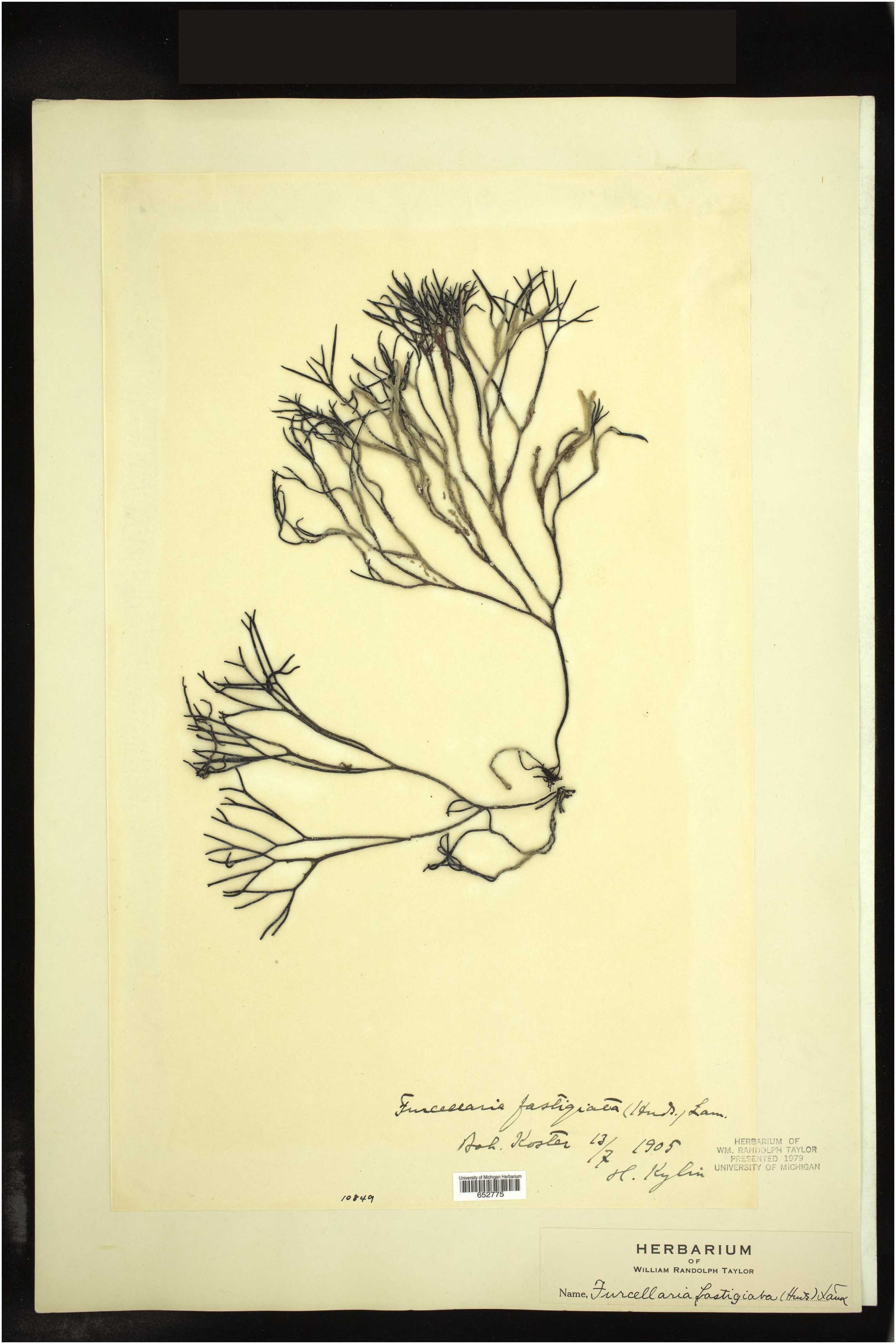
The development of botany and geology as scientific disciplines during the nineteenth century further led to a heightened interest in the natural history of the shore. Seaweed collecting for classification purposes was already a prevalent activity for natural historians by the end of the eighteenth century, but during the nineteenth century the collecting and naming of different marine algae became increasingly popular among both women and men interested in marine botany. In the mid-nineteenth century, the expansion of railway networks facilitated easier access to coastal regions and encouraged the curiosity of the amateur naturalist. Seaweeds were also among the first subjects of cyanotype photography, as Jue discusses in her work on the photomedia of kelp. 39 The cyanotype process involved the exposure of an object on light-sensitised paper to direct sunlight and most notably appears in the impressions made by Anna Atkins (1799–1871) in the 1840s. In other instances, samples of seaweeds were pressed in-between sheets of paper. Molly Duggins traces a trio of seaweed albums that circulated throughout the British Empire and ended up in the National Herbarium of New South Wales, Sydney, and their role as “a visual testament to the marine mania that gripped Britain in the mid-nineteenth century”. 40
Denmark and Sweden, meanwhile, played a leading role in scientific kelp-based research during this period, yet little has been said about the visual culture that responded to these trends. 41 The Swedish botanist and taxonomist Carl Linnaeus first used the term algae in 1753, and numerous pressings of different seaweed genera are held within the archives of the Linnaean Society. While in Denmark, in the City Hall in Copenhagen, algae-inspired frescoes painted by Jens Møller-Jensen (1869–1948) and his wife Sigrid Vold (1875–1968) between 1902-03 adorn the ceiling. 42 Seaweeds illustrate its corners and crevices. These motifs were likely inspired by texts such as the botanical atlas Flora Danica (1883) or by botanists and phycologists such as Frederik Borgensen (1866–1956) and Lauritz Kolderup Rosenvinge (1858–1939) whose research considered the marine algae of the Faroe Islands and Denmark, respectively. Bladder wrack (Fucus vesiculosus), serrated wrack (Fucus serratus), spiralled wrack (Fucus spiralis), Arctic wrack (Fucus evanescens), Irish moss (Chondrus crispus), and living knotted wrack (Ascophyllum nodusum) are all individually painted in decorative patterns of blue, red, green, and brown. Their visual forms were intended as reminders of Denmark’s position as a maritime kingdom.
Beyond its aesthetic and scientific roles, the uses for seaweed most prevalent among coastal European communities, was the demand for glass and iodine, achieved through the burning of kelp. Farmers would wait for the tide to go out and dredge the seaweed from the seabed either by hand or with rakes; pile it up, burn it, and then leach out the iodine from the ash. Often this was controlled by seasonal restrictions, in part as a protective measure for those fish and shellfish that inhabited this marine environment. This process manifests itself in Kreuger’s later work, By the Seaweed Stack (1902, Figure 4), where the kelp has been piled into a mound on the coastal edge, unlike the undefinable mounds of seaweed atop the wagons in Seaweed Carters. When seen together, these two paintings, alongside Ūders’ Clearing the Woodland, communicate the circum-Baltic coastal ecotone as a transitional and mobile space linking agricultural process and “mankind with the mineral, vegetable, and animal kingdoms”, as described by Alain Corbin.
43
We may better understand our shorelines, when we consider the human relationship to the water’s edge alongside the other-than-human life that inhabits this liminal zone. Nils Kreuger. By the Seaweed Stack (1902). Oil and ink on panel, 49 × 61 cm. Thielska Galleriet. Public domain.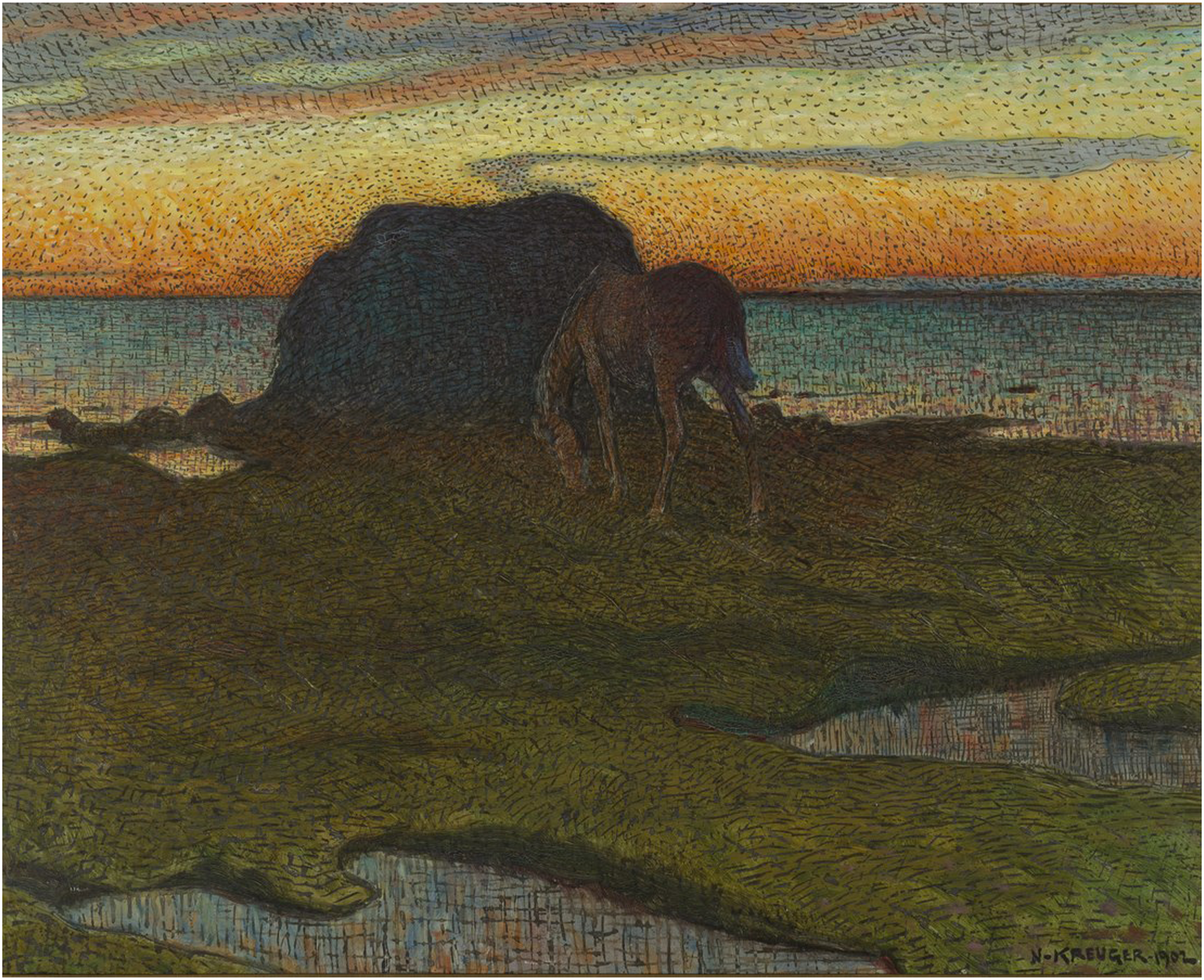
Beaches, boulders, and biodiversity
Upon arrival on the Swedish island of Öland in 1741, Linnaeus remarked that: “as soon as we had touched the beach we noticed that this land was totally different from the other Swedish provinces”.
44
The distinctiveness of Öland can be found in its geology. Throughout the island its rocky composition is found close to the surface, resulting in thin soil, and an abundance of fossils as the German geologist Vickers Oberholtzer remarked on a later visit to the island in 1894.
45
Painted at the southern edge of the island, this distinct geology manifests itself in Kreuger’s painting Stones on the Beach (1905, Figure 5). Where the Baltic Sea stretches across the horizon, and the foreground is dominated by the large undulating form of a limestone boulder. Shaped by water and wind, this red and grey stone, as with the others that punctuate the shoreline beyond, exists on the periphery of the flat and barren landscape of the Stora Alvaret that typifies the southern coastline of Öland. This vast limestone terrace stretches across the southern reaches, extending to the outermost shoreline. The cows between the land and water, and the silhouetted shape of the boat far out to sea, are the only indicators of life. Where for the cows the shoreline is pasture, the boat alludes to the sea as a site of human activity. And as the malleable shape of the stone might momentarily focus our attention, the brown haunches of the cows instead remind of what we cannot see; the imperceptible beach that disappears behind the rocks, dividing the land and water. Nils Kreuger. Stones on the Beach (1905). Oil and ink on panel, 17 × 35 cm. Thielska Galleriet. Public domain.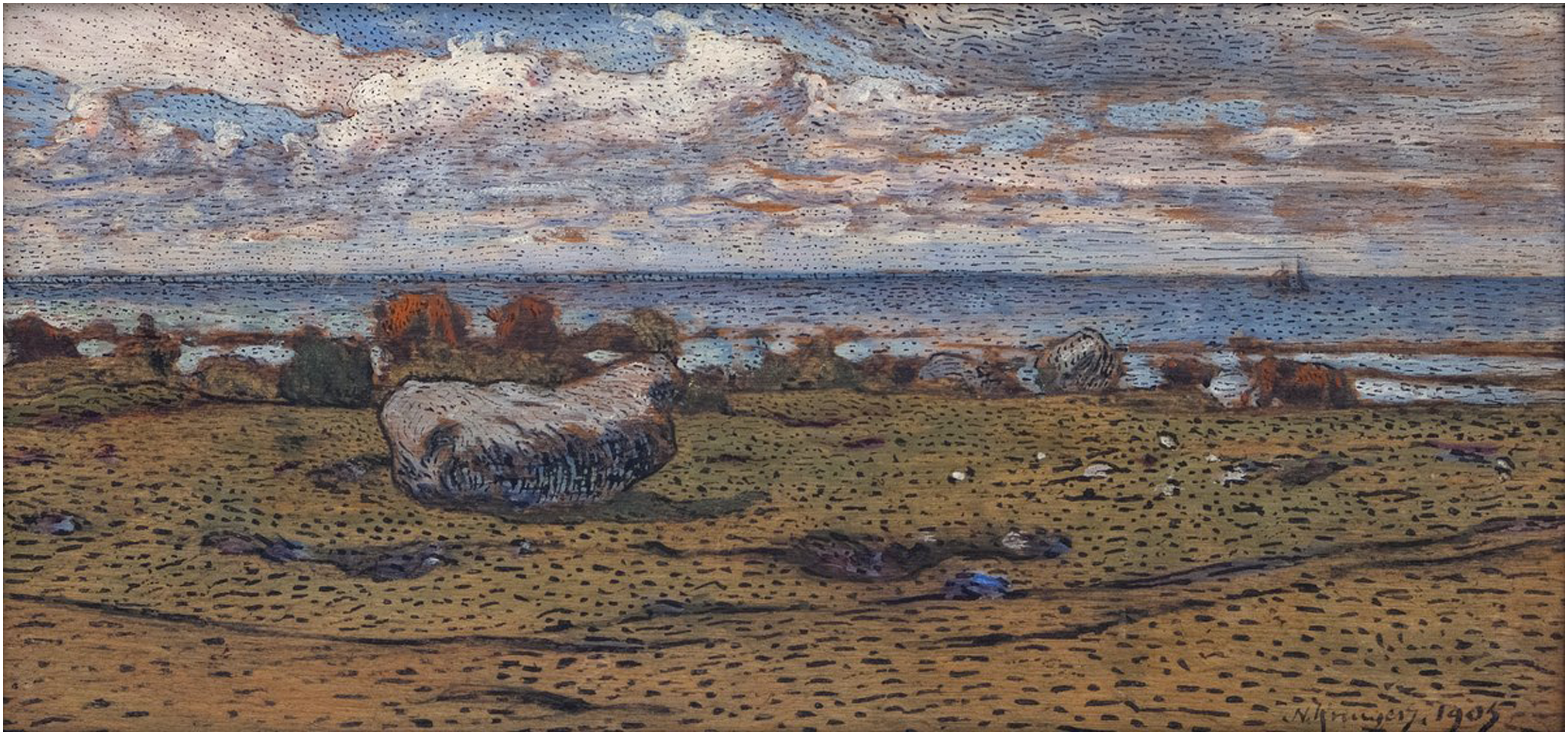
At the horizon, the sky is dashed with dots and lines of ink, building into longer strokes upon the darker clouds. Upon closer observation the “atmosphere vibrates with fine swirling lines like air currents in a graphic representation of a wind tunnel”. 46 Applied more thickly atop the grass, the ink reinforces the contours of the land, sea, and sky, where ‘the local colours shine brightly but are bound by lines and dots’. 47 This uniformity across terrestrial and marine environments dissolves the idea of the shoreline as a threshold. Prior to the eighteenth century, the sea was “fearsome, repulsive, and chaotic deep”, 48 yet here, in Kreuger’s painting, the edge between land and sea is no longer a daunting prospect, instead the beach is hidden from view. With this, Kreuger’s work represents the coastline or seashore as a confluence of different ecologies, landscapes, people, and animals. These emphasise the entangled relationship between the human and other-than-human worlds, and the distinctiveness of Baltic coastal biodiversity.
Writing in 1911 about Kreuger’s paintings of horses, Martin Sheppard posited whether, rather than being “paintings of nature they seem at first glance to be designs”. 49 Suggesting that Kreuger referred to his own paintings as “colored drawings”, Sheppard described the artist’s process, from first painting on canvas or wood with oil, before going over the composition with ink, either using a paint brush or quill pen. 50 The use of ink has subsequently been misattributed to pointillism, where the latter implies the technique of applying countless dots of complementary colours, which together builds up the image. Here, Kreuger’s technique is only connected with pointillism insofar as dots are used and his application of Indian ink in overlaying the composition is also thought to take its inspiration from the ink sketches of Vincent van Gogh. 51 As in Stones on the Beach, in By the Seaweed Stack, dots and dashes of Indian ink cover the image, shrouding the burning orange of the sky. Lines of ink cross-hatch upon the water, distorting the surface reflections. This pattern recalls that the shallow coastal waters of the Baltic Sea are a “mosaic of dynamic habitats”. 52 Lines fragment and distort the singularity of the sea, and instead evidence the dynamism and duality of this environment. The grass is similarly a flurry of short curved and straight lines, hurriedly scribbled across the prevailing terrestrial environment. The seaweed stack is left as a silhouette amidst the chaotic surface of oil colours and ink that imagine the fate of the mound, awaiting the moment it will be set alight and mirror the fiery sunset on the horizon. Boström makes further mention of a study for Seaweed Carters that is similarly overlayed in Indian ink, and where close-up the patterns obscure the reality of the terrain. 53
Articulating the immensity of the fields and open landscape, Boström recorded the artist’s tendency to regularly sketch on the alvar during his summer’s in Öland.
54
One such example is By the Beach (1905, Figure 6) which was sketched using pastel and pen ink. The surface colour of the panel is visible beneath the blue, green, and brown pastel shades that distinguish the sky, sea, and the sparse vegetation of the alvar. Horses graze by the shoreline, boulders form stepping stones out to sea, and small huts built above the water suggest human activity or recreation. Often these sketches would be worked into larger compositions in his studio in Borgholm, or later on return to Stockholm, and often conveyed the “infinity of the sea and of the sky”.
55
If in Kreuger’s Stones on the Beach the shore is defined by rocks, stones, and cows grazing upon scrubby grassland, then this is only one example of the ambiguity of the shoreline, where it can vary from “level areas of sand or pebbles to cliffs” as well as eroding and shifting “with the action of flowing water”.
56
With the Stora Alvaret, the thin, nutrient-deficient soil that leads down to the coast, covering the limestone bedrock, is under constant threat from erosion, as a consequence of both wind and tide. Covering approximately 26,000 hectares, the Stora Alvaret accounts for half the area of Öland, known as the “Agricultural Landscape of Southern Öland”.
57
While to the north of the island, the landscape is thick with forest, to the south the open, windswept alvar distinguishes Öland as a unique biodiversity (having been listed as a UNESCO World Heritage Site in 2000). The turbulent tides of the Baltic, increasing sea-levels and flood risks, moreover, contributes to sustained coastal erosion along the variable circum-Baltic coastline; from the rocky shores of northern Sweden; the sand dunes of Latvia, as seen in the Vidzeme shoreline of Ūders’ work; and the tidal flats, salt marshes, and dunes of Germany’s northern shore. The hybridity of the shoreline indicates a move from sea to land and is itself an unpredictable and variable zone. Nils Kreuger. By the Beach (1905). Pastel and ink on panel, 17 × 36 cm. Thielska Galleriet. Public domain.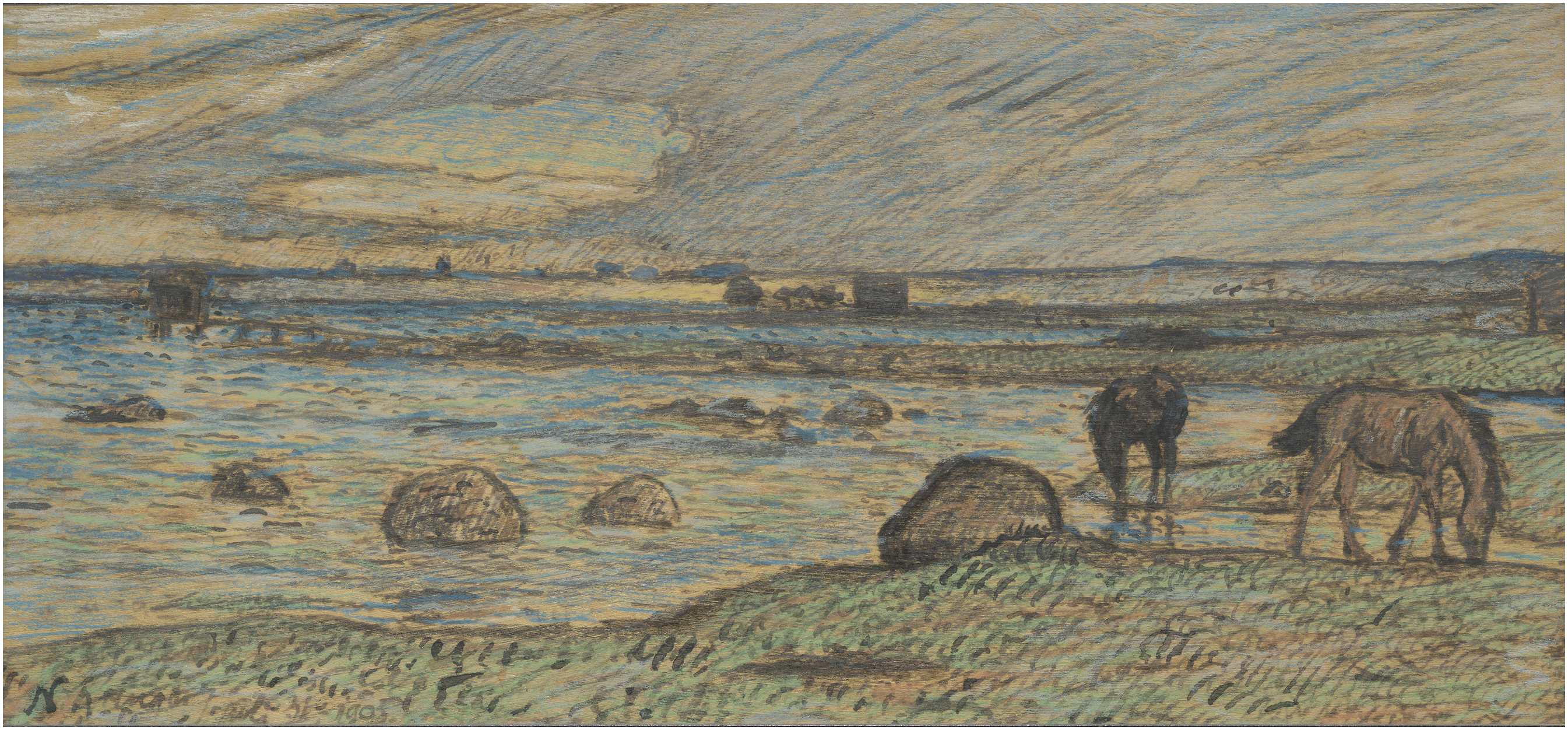
Alvar is an incredibly rare environment, only existing in a number of places around the world, including a few other locations around the Baltic, notably the Swedish island of Gotland and northern Estonia. Similar alvar landscapes occur in the Great Lakes region of the U.S and Canada. Persistent drought, a seasonal cycle of drought and flooding, and historically fire, have all been proposed as possible explanations for the unique conditions presented by alvar environments. The “desolate grandeur of the desert landscape about the plateau of Alfvaren [sic]” as art historian Carl Laurin described it similarly shaped artistic responses to the local environment in the work of Öland-born artist Per Ekström (1844–1935). 58 Wide, brightly lit vistas, encompassing a panoramic perspective of the coastal alvar prevails in his compositions of Öland. In an article for The International Studio published in 1923, Christian Brinton describes Kreuger’s “pantheistic love of nature and the brilliant, although short-lived, solar glory” which finds “its apogee in the canvases of Ekström […] who paints the gleaming disk with a freedom and furia”. 59 Motivated by what Brinton perceived to be a “national sense of color” that ‘liberated painting from a slavish servitude to objective representation’, Kreuger’s Stones on the Beach, in particular, distinguishes between various surfaces and textures of the thin soil, rocky outcrops, and far-reaching Baltic sea. 60 The local population who reside there are omitted from the artists' view of the landscape, instead their presence is alluded to through the livestock they keep, and the methods of transportation or dwellings they require, as also seen in By the Beach. The horses and cows that characterise Kreuger’s Öland paintings are observed “in the open air and in movement”. 61 He has “followed them browsing or wandering over a rocky land, breathing the salty air on the coast of the sea, and almost in the sea”. 62 Although, the Öland farmers allegedly protested Kreuger’s depiction of their horses as far too meagre. 63
The Latvian coastline is by contrast a complex amalgamation of landscapes. The North Vidzeme Biosphere Reserve which extends across 60 km of the northern Latvian coastline, is characterised by lakes, glacially formed hills, sandy beaches, coastal meadows, and areas of bare rock. These coastal meadows have traditionally been maintained by grazing, and often indicate the remnants of the broad leaf forests that once denoted this coastal ecology. The neighbouring Polish Baltic coastline, in the district of Gdansk, is similarly characterised by a coastal forested landscape, where woodland grows out of its sandy shores. In Ūders’ Clearing the Woodland, it is perhaps one of these coastal meadows, or aizjomi, that we are viewing. Intended as a form of seaside management, coastal fields were constructed in depressions between the sand dunes, either by lowering them to access groundwater or raising them to emphasise the banks between. 64 With the arrival of the Soviet army in the early twentieth century, many of these aizjomi were left to grow over, forest shrubland encroaching once more into the dune environment. Indicating the social-cultural relationship with the sea and shore, Ūders’ scenes of local peasants from northern Vidzeme alludes, therefore, to the dependency of humans on the coastal environment.
Engaging with the various topographies of the shoreline, as in Kreuger’s Stones on the Beach, Ūders’ work conveys the human and other-than-human elements of the coastal ecosystem through a prism of washed blue and green tones. This use of colour has previously drawn comparison with the Swiss painter Giovanni Segantini (1858-1899) and might also draw comparison with the palette employed by Kreuger. This brightly lit palette disregards earlier ideas of the sea as ‘fearsome’ and ‘repulsive’, and like Kreuger conceals any notion of bad weather or destruction, either at sea or on the shore. Where, in Clearing the Woodland, the sand dunes of the Vidzeme coast are constantly altering the intertidal zone and indicate the many distinct habitats that compose the coastline, Ūders draws attention to both the plight of Latvia’s coastal forests, but also, as Pushaw indicates, the pressing conservation issue of rocks. Boulders and pebbles are scattered along the shore, or as previously mentioned, are used as leverage to extract a tree stump from the ground. By the mid-nineteenth century, local conservationists were less concerned with issues of deforestation and endangered flora and fauna, and more with the fate of Latvia’s many coastal rocks. As such, Kreuger’s Stones on the Beach and By the Beach might further elucidate the geological significance of Öland’s limestone alvar, as scientific studies have sought to recognise these rocks as offering a unique habitat for certain species of lichen. 65
Turning an ecological gaze back to Stones on the Beach, Kreuger’s painting might be considered as an indicator of local agricultural life and the distinct biodiversity that characterises southern Öland. For over six millennia, people resided on the island, with farming beginning over five thousand years ago. Many of the farms and villages have been in the same place since the Middle Ages. While felling trees and clearing land took place throughout Öland’s human history, this accelerated some 2000 years ago as the island’s population began to grow. 66 On the one hand, human activity might be assumed to have devastated the environment, yet it equally transformed it into a uniquely biodiverse space. The relationship between humans, cattle, and the natural environment resulted in a surprising and distinctive biodiversity. For example, over seventy percent of Sweden’s insect species can be found on the alvar, and it is home to a number of plant species unique to this part of the world, and which in turn demarcate its temperate and glacial geological history. However, it is the co-existence between humans and cattle that distinguished this southerly region.
The sight of cows grazing upon the beachgrasses that grow along the edge of the sand in Stones on the Beach, drawing a line between shore and land, is perhaps unexpected. And yet, in Öland, farmers often allowed their cattle and horses to graze freely on the yellow, brown, and green grass of the alvar. Over 25,000 people live on Öland year-round, but they are surpassed by the approximately 40,000 cows and sheep that compose their livestock. 67 With this said, the number of farmers is steadily on the decline. Writing about Kreuger for the 1922 volume Scandinavian Art, Laurin described the “simple greatness in his cows, whose heaviness and clumsiness have never been pictured so faithfully, and one may add, so beautifully”. 68 Despite Linnaeus' initial assessment that Öland’s barren landscape was as a result of overgrazing, cattle have proven to be fundamental in maintaining the alvar and its biological diversity. During the late twentieth century following politically enforced restrictions, cattle were restored to the alvar, once again increasing its size which had reduced dramatically and been taken over by encroaching and invasive plant species. The impact of human and other-than-human agents in the development and shaping of the alvar is such that while anthropogenic forces have adversely affected the alvar over the millennia, it is human involvement and the utilisation of the land as pasture that has made it of global importance. With this, Kreuger’s work indicates this coastal environment as a site of unique biodiversity, and also comments on its history as a human, cultural landscape through the inclusion of the grazing cattle and the distant outline of the boat fading into the horizon.
As sites of ecological preservation, coastlines are also important locations of environmental change and catastrophe. The Baltic Sea has in-turn been proposed as a marine “time machine”, that we might learn from its ecological past so as to help manage anthropogenic impacts on future seas. 69 Ingold described the rhythms of human activities, moving with the tide, and of a seasonal and temporal human space that engages with the other-than-human. With this Kreuger and Ūders’ paintings might be used to convey the entanglements of humans and environment along the Baltic coastal ecotone. These two artists, who have not previously been situated in conversation with one another, communicate similar activities and urgencies around the Baltic. Pushaw wrote that, “[a]rt and visual culture, just like human creations, are deeply entangled with fragile ecologies”. 70 With around forty percent of the world’s people now living within 100 km of the coast, 71 and with rising sea-levels consistently altering the coastal edge, communities are increasingly being forced away from their homes and livelihoods. Along the German Baltic shoreline, over two-thirds of the coast is being eroded; 72 and in Latvia, severe flooding caused by increased storms and sea-level rise threatens coastal dunes and populated territories. 73 Where the coastal and inland dune habitats of northern Latvia define the topographical landscape, they also create an important natural barrier, as beaches and dunes play a part in reducing coastal erosion. These works, therefore, might be used to indicate historical and present-day coastal agricultural activities, alongside attempts to preserve and protect circum-Baltic shorelines and marine ecologies. In redressing coastal landscape painting beyond the restrictive confines of national borders, they might instead recognise the human and other-than-human agencies residing around the water’s edge in a time of unprecedented anthropogenic change.
Footnotes
Declaration of conflicting interests
The author(s) declared no potential conflicts of interest with respect to the research, authorship, and/or publication of this article.
Funding
The author(s) received no financial support for the research, authorship, and/or publication of this article.