



Abstract
This article explores Maria Edgeworth’s letters on her 1833 Connemara tour as a starting point to investigate the connection between Ireland’s western district and the Scottish Highlands in the cultural imagination. Through Edgeworth’s acquaintance with and interest in the works of the Scottish engineer Alexander Nimmo, I go on to establish the historical links between Scotland and coastal infrastructural developments along Ireland’s Atlantic seaboard. I offer a focused study of the creation of the fishing village of Roundstone by analysing an archive of texts, maps, reports, and images to highlight the ways in which colonial infrastructures, coastal community building, and the knowledge production of natural history are grounded in an archipelagic practice. Ultimately, this article reveals how a turn to coastal infrastructure developments brings into focus the multiple temporalities of archipelagic romanticisms.
Keywords
Maria Edgeworth in the ‘Irish Highlands’
When the opportunity presented itself to the Irish writer Maria Edgeworth to travel from Ireland’s Midlands westward to explore the Atlantic region of Connemara in October 1833, she embraced it. In her mid-60s at the time, she decided to join the English baronet Sir Culling Smith (‘of old family, with large fortune and small figure’) and his recently wedded wife Isabella Carr on an exploratory tour as she considered it ‘the best opportunity I could ever have of seeing a part of Ireland which from time immemorial I had been curious to see’. 1 The name of the region translates as ‘bays of the sea’, a coastal landscape with off-shore islands, peninsulas, lakes, and the mountain ranges of the Twelve Pins and Maamturk Mountains. Connemara’s perceived remoteness on the edge of Europe made it an ideal repository for what Edgeworth called ‘great works’: 2 Romantic imaginings of coastal environments for writers and artists, a challenge for the political economist, a laboratory for agricultural improvers, a place of work for the coastal engineer, an investment for the opportunist, a haven for the naturalist, and a livelihood and home for those who worked and lived along its shores. In what follows, I consider Edgeworth’s reflections on her Connemara tour as a starting point to investigate the connection between Ireland’s western district and the Scottish Highlands in the cultural imagination. I go on to show how her tour opens out to the ‘great works’ of the Scottish engineer Alexander Nimmo that brings into focus the historical links between Scotland and coastal infrastructural developments along Ireland’s Atlantic seaboard. With a focus on the temporalities of infrastructures via the creation and development of the fishing village of Roundstone, I investigate a rich archive of surveys, reports, texts, and images to highlight the ways in which colonial infrastructures, coastal community building, and the knowledge production of natural history are grounded in an archipelagic practice.
Edgeworth’s Connemara tour was motivated by a combination of factors that corresponded to her identities as writer, reader, and improver. There was her personal interest fuelled by stories she had heard; then, the publication of travel texts that drew wider attention to this coastal region in the Romantic imagination; and, importantly, 1820s infrastructural developments that created new coastal roads and fishing villages. Writing about her travel almost half a year later in vivid letters to her brother Michael Pakenham in India, Edgeworth reflects on her initial perceptions and motivations: ‘Smugglers and caves, and murders and mermaids, and duels, and banshees were all mingled with my early associations with Connemara’. 3 These ‘early associations’ were reawakened by Henry Blake’s Letters from the Irish Highlands in 1825. This influential text was written by the Blake family of Galway who had taken up residence at Renvyle House in the early 1820s, a coastal seat with views out to Inishbofin and Inisturk. The Blakes’ Letters point to the ‘adventures … of smugglers and their adherents on this coast, [which] would afford as many striking incidents as the life of Dirk Hatteraick and his crew; and replete, no doubt, with as many horrors’. 4 In other words, life on the Connemara shores was seen to offer rich inspiration to writers. Part of the inspiration draws on connection with Scotland, not least the suggestion that the west coast might be imagined as ‘the Irish Highlands’. The Letters drew on Walter Scott’s Guy Mannering (1815) with its popular and dramatic smuggling plot. This was arguably a promotional ploy on the part of the Blake family to tap into the thriving tourism industry in the Scottish Highlands, spurred on in great part by Scott’s writings. 5 The Blakes considered tourism to be a means to address the region’s economic deprivation and, such a reference suggests, the literary pen might assist in promoting Connemara as a desirable destination. 6 Those who Edgeworth encounters on her 1833 journey likewise evoke a coastal imaginary that is worthy of Scott’s pen. When she meets a Scottish waterguard by the name of Captain Bushby, for instance, he tells her that ‘There are immense caves on this coast, which were the free-traders’ resort, and would have been worth any money to Sir Walter Scott’. Edgeworth herself peppers her account with an anecdote ‘which will show you how like the stories in Walter Scott were to the scenes which have lately been passing in Connemara’. 7
Though not reaching the status of Scott’s literary achievements, Letters from the Irish Highlands did its part in raising the reputation of the region as they offered ‘the first comprehensive introduction to this terra incognita’. 8 And the Letters popularised Connemara as the ‘Irish Highlands’ with the phrase circulating subsequently implicitly and explicitly in other letters and travel texts. Investigating this early nineteenth-century imaginative connection contributes to what Murray Pittock in Scottish and Irish Romanticism describes as ‘a properly archipelagic understanding of British Isles Romanticism’. 9 In his study of late nineteenth-century Irish tourism and the way in which it is shaped by the example of the Scottish Highlands, Kevin James argues that contemporary comparisons ‘were structured around putative similarities between the mountainous western landscapes, wind-swept islands and shimmering streams, and also around apparent contrasts between Scotland’s highly-developed tourist sector and the shaky infrastructure and poor reputation that bedevilled Irish tourism’. 10 Turning to the earlier period, I show the ways in which Edgeworth’s tour brings into focus an emerging coastal infrastructure, shaped by Scottish expertise and experience, that afforded access to a recently romanticised Irish landscape. By drawing on critical infrastructure studies, I explore how these emerging infrastructure developments call into existence a plurality of narrative promises. These narratives, in turn, reveal the multiple temporalities of archipelagic romanticisms.
Edgeworth noted that the Letters contributed to raising her curiosity ‘to see all that wild country on the shores of the Atlantic, and with capabilities so vast, and ways of living so different from any other part of Ireland’. 11 Apart from an early articulation of the West’s exceptionalism and the romantic descriptor ‘wild’, her reference to Connemara’s ‘capabilities’ signals the future-oriented perspective with which she approaches the region. This latter aspect was strengthened further by her connection to the Scottish surveyor and engineer Alexander Nimmo who enabled access to the region via the development of Ireland’s road network and harbours. Indeed, Nimmo’s work in the West was a crucial inspiration for her journey: ‘Further and further, and higher and higher Nimmo and my brother William raised my curiosity’, wrote Edgeworth, ‘and deepened my interest about that country. You know that Nimmo carried out great works there, roads and bridges’. 12 Nimmo had died in 1832, but her comment signals the extent to which her approach to Connemara is coloured not only by somewhat timeless tale-tell, folkloric, and mythical imaginings but also by infrastructure’s promise of material progress and improvement. And it is Nimmo’s infrastructural work that shapes Edgeworth’s embodied coastal travel experience.
Temporalities of coastal infrastructures
It was, to say the least, a poorly prepared and planned trip due to insufficient understandings of the local terrain and road network, English ‘ever incompetent notions of time and distance’, as well as an unsuitable mode of travel. 13 Her leading companion Sir Culling Smith was, as Edgeworth tells her brother, ‘determined to see’ all that he had heard about the region’s developments of late with the establishment of fishing villages and fairs, and, ‘after studying the map of Ireland and road-books one evening’ at Edgeworthstown, sought to discover Connemara with Galway, Westport and the Barony of Erris ‘in a week'. 14 Edgeworth appears bemused by Sir Culling’s naïve approach to the journey, ‘without route or knowledge of roads, distances or time it would take to see the country’. 15 Indeed, much of her recollections focus on inconvenient and un-romantic travel in the context of non-existing, impassable, obstructed, or incomplete roads rather than on aesthetic appreciations of coastal scenery as might perhaps be expected.
Although there were no roads for horse-drawn carriages, Edgeworth’s party travelled through the Connemara landscape in ‘an open or half open German britchka’ that fitted five and was full of ‘inconvenient conveniences’. 16 It was equipped with ‘a sliding table to draw out, which never drew out, to eat or write upon’, ‘wells for holding writing boxes and dressing-boxes, out of which no power could extract them in time of need’, ‘maps shut with spring catches were to let down from the top, but when down, there was darkness visible or so little light from the side panels that I could seldom make out anything, especially since the maps showed no crossroads and our Irish guide-book was indeed an Irish guide-book’. 17
Edgeworth’s dwelling on the vehicle’s ‘inconvenient conveniences’ indicates the way in which the party moved through this coastal landscape in a mode of exposed rather than enclosed travel.
18
Sir Culling Smith ‘had a great curiosity to see Clifden, which he heard was a new creation in Connemara’.
19
This emerging coastal town was founded in 1812 by John D’Arcy, who had invested in the development of regional road networks. On their journey from Oughterard to Clifden, the party detoured and stayed at Corrib Lodge in Maam to enquire about Nimmo’s new road [Figure 1]. This place of rest had been built by Nimmo himself, ‘for his own residence when he was overseer of public works in these parts, but dying, as usual with public work overseers in Ireland, in debt, his lodge was turned into an inn, and is now kept by his Scotch servant who used to come with him to Edgeworthstown’.
20
They learned from Mr Rourke that ‘Mr. Nimmo’s road was not opened’ as ‘one mile or so remained unfinished’ that would have connected the two parts of existing new road making the journey ‘unpassable’ for ‘man or horse or boy or Connemara pony’.
21
The old road was the only possibility, but no carriage had dared to attempt passage. Once en route to Clifden on the old road, they got stuck in sloughs and assistance was required to become unstuck. Locals flocked ‘from all sides’ of the mountains and fields ‘at the sight of the strangers, horses and carriage, such as had never been seen before’, to come to the rescue.
22
Rather than experiencing the journey through the coastal landscape from the comfortable seat of a modern carriage, Edgeworth was taken in the arms of ‘a great giant, of the name of Ulick Burke’ who ‘proceeded to carry me over’.
23
Corrib Lodge and Nimmo’s Bridge, from Mr. and Mrs. S.C. Hall’s Ireland: Its Scenery, Character, & c (1843) © This image is reproduced courtesy of the National Library of Ireland.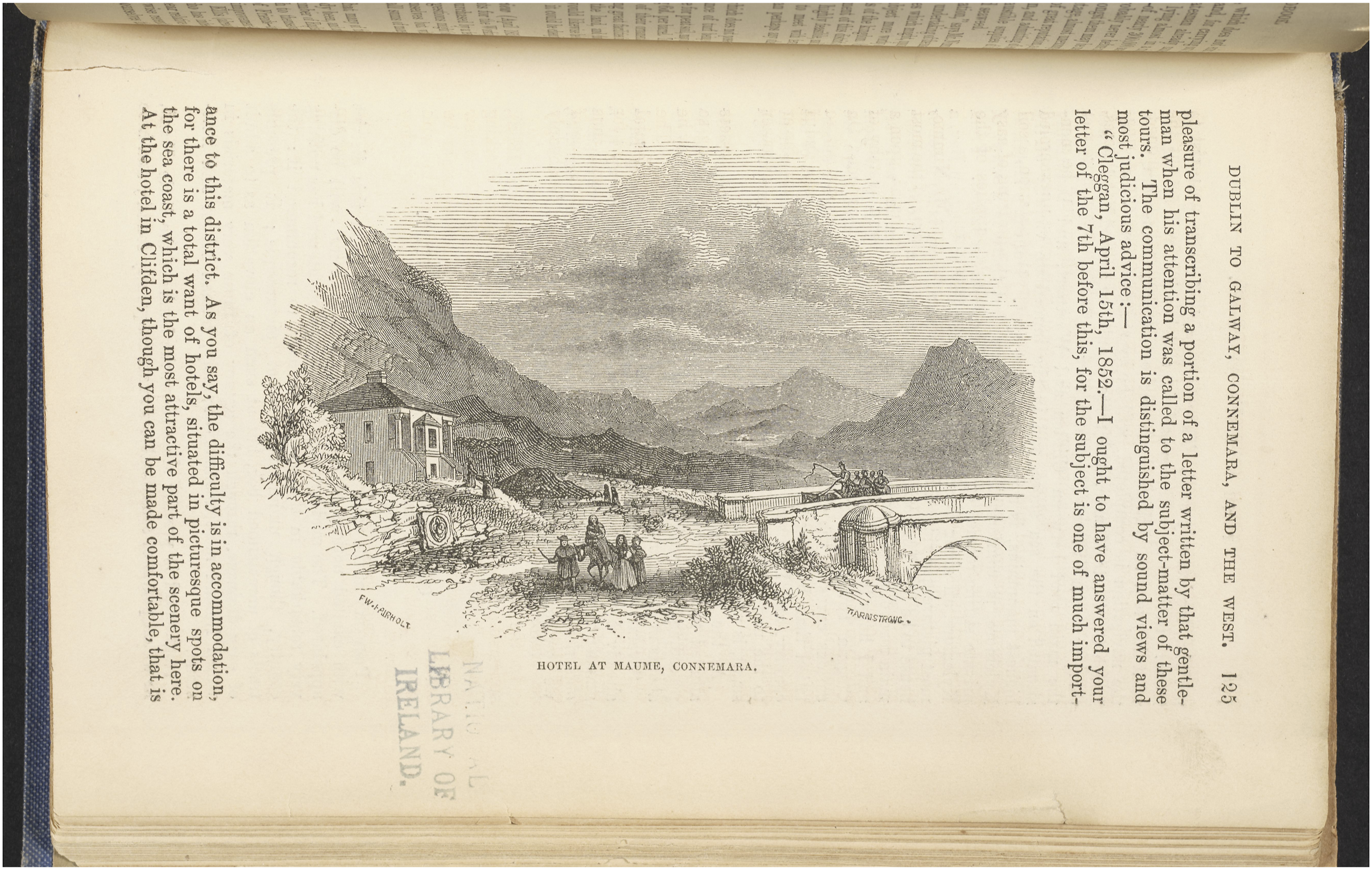
The co-existence of different temporal registers in the locality is nowhere better expressed than in Edgworth’s description of old and new roads running (almost) in parallel, one useable and the other the prospect for future travel: ‘I should have observed to you that while we yet could look about us, we had continually seen, to increase our sense of vexation, Nimmo’s new road looking like a gravel walk running often parallel to our path of danger, and yet for want of being finished there it was useless and most tantalising’. 24 Ironically, the modern vehicle was too modern for the old road structures and yet the new infrastructure was not advancing fast enough to accommodate the carriage. Malcolm Kelsall reads the ‘German Britchka’ as ‘a time-travelling machine which has returned to a pastoral world which is both an emblem of primitive disorder … and temporal disjunction, neither the old “Ireland” that was, nor the new “England” that is’. 25 In his analysis of Edgeworth’s Connemara tour, the journey westward meant, ‘historically, to travel backwards in time’. 26 However, the roads appear to represent the past and the future coexisting in the present. The ‘tantalising’ new road gestures toward a future vision for the region. Kelsall’s reading of this new road ‘as a kind of parody of the appliance of science in a region where only a bog trotter, familiar with the sloughs, could pass in safety’ dismisses the coastal engineering and infrastructural developments too quickly. Rather, as Claire Connolly has argued in relation to Anthony Trollope’s Irish roads, ‘roads redirect the flow of time between past, present and future. They act upon the present moment, breaking forms of spatial and temporal connection where they might be expected to build social relationships’. 27
Edgeworth’s passage, then, offers an invitation to investigate the confluence of multiple historical temporalities and their local meanings. Her Connemara tour presents the region as an other country, a part of the island that is unfamiliar to her. A visiting tourist’s observation, her representation appears to encompass what David Lloyd describes in Irish Times as ‘caught in a time-lag, trapped in a stage of development, or non-development, that represents a moment in the past of the more modern outsider. In its backwardness that country will appear savage, or feudal, or perhaps merely a little quaint, a suitable object for nostalgia and romanticization’. 28 Drawing on Lloyd’s argument for ‘multiple temporal trajectories’ and the ways in which they ‘emerge most clearly at the edges’, David Gange proposes a productive way to ‘demobilize the linear temporality of imperial modernity that was embodied in the quantification of Irish landscape for integration into British political economy’. 29 Alexander Nimmo’s surveying work, road and coastal engineering developments for the Office of Public works and the Commissioners of Irish Fisheries fall precisely into such activities that aimed to fold Ireland into Britain’s economy.
Nimmo’s coastal surveys and the attendant development of a road network were aimed to relieve distress in the western districts of Ireland, enable the emergence of local industries as well as improve communication and trade routes at a regional and national scale. The work was undertaken as part of the British Government’s vision to fold Ireland more firmly into the United Kingdom in the aftermath of the Act of Union of 1800. As such, the project was what Akhil Gupta describes as ‘a biopolitical project that aims to address the health and welfare of the population while also facilitating discipline and control; and an aspirational project that functions as the symbol and index of a future becoming’. 30 The surveying and coastal engineering projects that Nimmo engaged in were projects to make technical infrastructural improvements, but they were also the means through which colonial power was excised to ‘discipline and control’. The colonial gaze of these engineering projects is perhaps most fully revealed in James Donnell’s report on the state of fishery piers and landing quays of November 1826, when he comments that coastal facilities ‘will have the effect of creating a town or village, thereby concentrating the population, and ... render men at present but partially civilized, amenable to the operation of the laws, and subservient to the better arrangements of society’. 31 [my italics] As Joana Gaspar de Freitas, Robert James, and Isaac Land posit in their editorial to Coastal Studies & Society, to understand coastal environments it is not enough to know how they work, but ‘they have to be considered also as living spaces and imagined futures, features that are embedded in local cultural practices and meaning-making traditions’. 32 Nimmo’s surveys and such reports offer early nineteenth-century articulations of ‘imagined futures’, and the material interventions brought on through the infrastructural developments resulted in changes to local cultural practices as well as contributing to an expanding infrastructure of knowledge production.
Through direct and targeted intervention in local economies and environments, new harbours, fishing villages, and coastal communities were called into existence. The execution of such large-scale developments relied on knowledge obtained through geological surveys among other things, and expertise was drawn especially from Scotland. Along with his fellow Scotsman William Bald who surveyed and conducted engineering projects mainly in Co. Mayo, Nimmo designed numerous roads in the West of Ireland and build over 30 piers along the country’s west and east coasts. Though he only received two entries in the index of the monumental Coastal Atlas of Ireland, his work is praised for making ‘immensely positive and undervalued contributions to the lives of thousands’ by improving such activities as ‘food gathering and production capacities of many isolated western coastal communities’. 33
Gupta argues that the ‘conventional view of infrastructural projects as beginning with planning and ending with inauguration misses the dynamic nature of infrastructural time in favor of a well-worn script of modernity’. 34 Edgeworth’s frustration at Nimmo’s unfinished road suggests both that she expected the ‘script of modernity’ and that she registered difficulties with it. Her assessment of public works’ projects that run over budget and do not complete according to plan or are abandoned when the leading engineer succumbs to death already has embedded a suspended or delayed vision of progress. Edgeworth’s description encapsulates Gupta’s proposition of understanding ‘infrastructures as a process that is characterized by multiple temporalities, open futures, and the constant presence of decay and ruination’. For Gupta, to ‘conceptualize infrastructure as a process’ means to think of it as ‘a thing-in-motion, ephemeral, shifting, elusive, decaying, degrading, becoming a ruin but for the routines of repair, replacement, and restoration (or in spite of them)’. 35 Edgeworth’s reference to Nimmo’s unfinished road may leave the coastal futures of Connemara’s community and its visiting tourists in suspension. But it is the wider road network and, in particular, Nimmo’s creation of Roundstone that allows a thick description of place that brings to the surface not only the multiple temporalities embedded in coastal infrastructures, but also the multiple temporalities of archipelagic romanticisms.
Ireland’s romantic Scottish coastal village: Nimmo’s Roundstone
Alexander Nimmo’s name is perhaps most familiar in its connection to the village of Roundstone, whose most well-known resident was the English cartographer, mathematician, and writer Tim Robinson. When he moved to Roundstone in 1984, Robinson lived right at the end of Nimmo’s pier in a house called ‘Nimmo’s House’. From his workstation, Robinson had a view over Roundstone Bay with the Twelve Pins rising toward the sky. [Figure 2] Right by ‘Nimmo’s House’ is a commemorative plaque that gives the year 1825 as the birth of the harbour and village [Figure 3]. The commemorative stone at the quay signals to Nimmo’s Scottish birth and dates the founding of the village to 1824, a minimal discrepancy in time that points to infrastructure as ‘a thing-in-motion’. Raised on Scottish coastal engineering expertise via Nimmo and attracting at least in part a Scottish community, it becomes clear that the ‘Irish Highlands’ were not only a cultural imaginative formation but grounded in historical material realities; ‘Roundstone was largely a Scottish foundation’, Robinson writes.
36
Today, it is folded into Ireland’s coastal route of the ‘Wild Atlantic Way’, its origin in Scottish-led colonial improvements obscured in the process.
37
View of Roundstone Harbour from Nimmo’s pier, 2022. Author’s photograph. Tim Robinson’s ‘Nimmo’s House’ and commemorative plaque. Author’s photograph.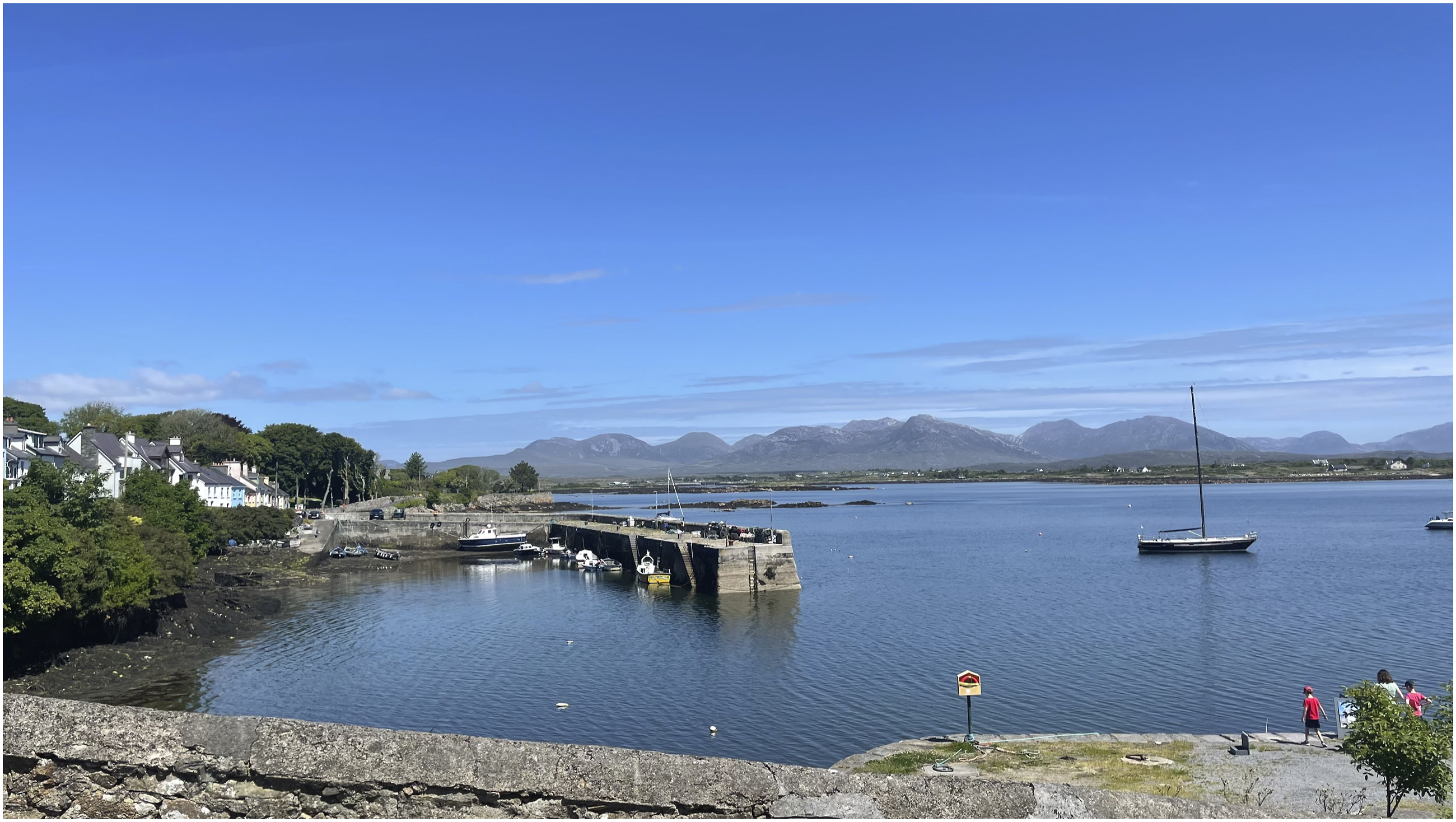
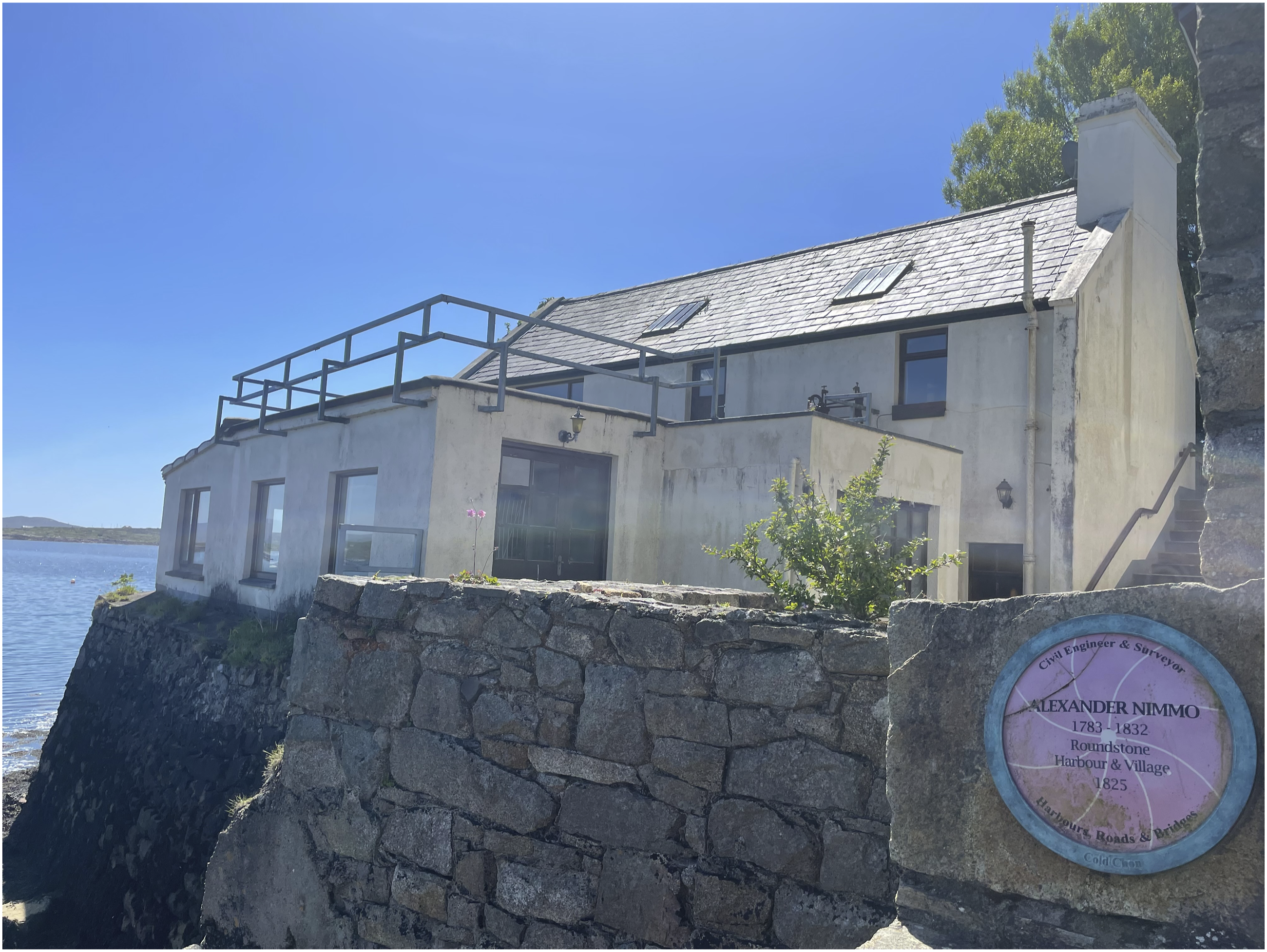
Born in Kirkaldy in 1783, Nimmo abandoned a career as a schoolmaster to pursue civil engineering. 38 His first major surveying work was his 1806 Inverness survey where he was tasked with boundary mapping in the Scottish Highlands. Thomas Telford, known as the ‘Colossus of Roads’, was a friend and mentor of Nimmo’s and had recommended him for the Inverness survey. Telford had been commissioned by the government to undertake a survey of the Highlands and Islands to develop plans for improvement as well as coastal infrastructures under the Scottish Highland Roads and Bridges Act of 1803. 39 In the Scottish context, these early nineteenth-century developments built on General George Wade’s military road project that had started in the 1720s, ‘a massive road- and bridge-building programme that would transform the Scottish landscape’ and open up to ‘commerce and trade, as well as to philosophical and scenic tourism’. 40 Here, too, infrastructure signals the connective tissues between past, present, and future. By the late eighteenth- and early nineteenth centuries, Fredrik Albritton Jonsson has demonstrated, ‘Scotland became a laboratory for the Enlightenment’ through various ‘improvement projects between 1750 and 1820’, among them ‘the planned villages of the British Fisheries Society’. 41 In Enlightenment’s Frontier, Albritton Jonsson traces the ways in which ‘[i]mprovers now [after 1783] imagined internal colonization and urbanization in the Highlands as an alternative to the expense of overseas empire’. 42 And the scientific knowledge and practice of engineers such as Telford’s and Nimmo’s was transferred to Ireland.
Equipped with such connections and experiences, Nimmo was first employed by the Commissioners for the Bogs of Ireland in 1811. Thus, when he accepted the appointment ‘as a Civil Engineer attached to the Board of Commissioners for Irish Fisheries’ in 1820 to undertake a coastal survey to establish suitable sites for fisheries, he was already well familiar with the environment, and the economic and social particulars of the region. 43 He was aware, he noted in an 1827 report, ‘of what operations were most necessary for the improvement of this country, and in conducting them I have been equally anxious to keep in view the benefit of the fisheries as the extension of agriculture’. 44 His task was very much the Irish equivalent to Telford’s in the Scottish Highlands, bringing into view the material realities of an archipelagic archive.
Connemara, Nimmo’s survey found, was home to a predominantly coastal population with ‘twenty thousand [of fifty thousand in the wider region] chiefly resident on the coast’.
45
Nimmo’s aim to extend agriculture to fisheries is no doubt connected to his observation that ‘the sea coast and all these lakes abound with fish’. With ‘no less than four hundred miles of sea shore’ in the district and a further ‘fifty miles of shore’ around Lough Corrib, ‘there are perhaps as many miles of shore of the sea or navigable lakes as there are square miles of surface’.
46
Already within the first year, Nimmo had identified a location for a new coastal village. Among Nimmo’s surveys for the Commissioners is one of ‘The Harbours of Roundstone and Birterbury’ [see Figure 4], dating from 1823. Here, Roundstone is marked as a village with notice of ‘Mr Reville’s Ho’. (in reference to Nimmo’s pay-collector Joseph Reville) and ‘Police Barrack’ along with a pier made from rough granite, the construction of which had begun in 1822 and that resulted in ‘some business in curing herrings, and shipping turf and kelp’.
47
Roundstone’s indented coast is characterised through mud banks and flat rocks that dry at low water, where Nimmo marks out points for ‘good anchorage’ and locations of oyster beds. The Harbours of Roundstone and Birterbury with part of the Coast of Galway from Slyne Head to Mynish Island, Surveyed by Alexander Nimmo, 1823, 23.5 × 29 in. MR 14.B.281 (10) © Royal Geographical Society (with IBG). 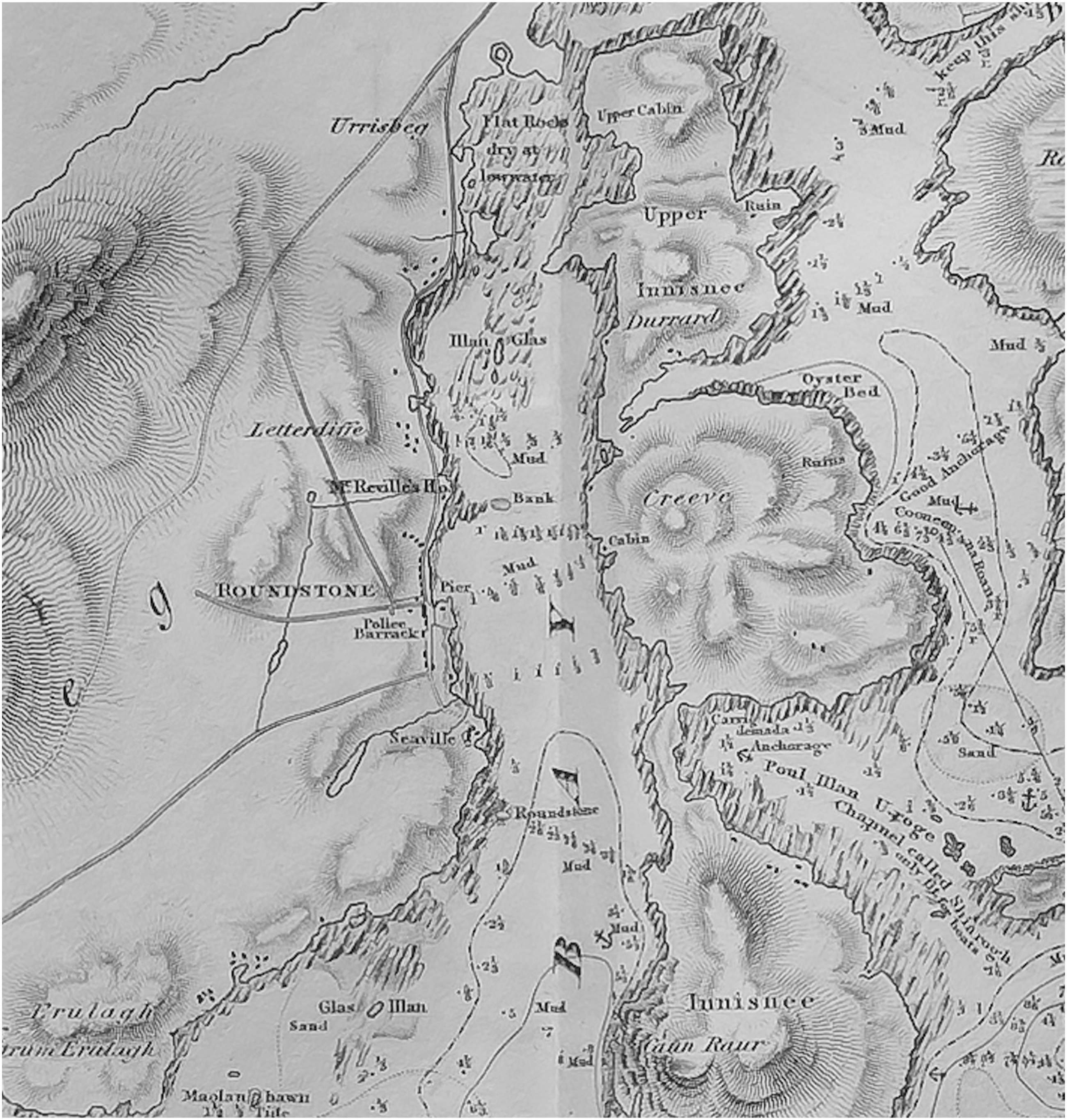
Nimmo had a ‘lease under Mr Thomas Martin’ and was expecting ‘soon to have a tolerable fishing village; several people are already settled there, and I am building a store for the purposes of the fishery’. 48 The fishing boats in use at the time were predominantly small boats such as currachs and rowing boats. As Noël Wilkins reminds us, it was larger boats such as hookers that needed piers or quays to bring goods to land. 49 Tim Robinson notes ‘a typical Nimmo touch’ that points to his ‘thought for the practicalities of the fisherman’s trade: in an oblique flight of steps down the face of the wharf, one step is of limestone rather than granite, and marks the half-tide level. There is a low limestone-capped parapet along the seaward side of the jetty, outside which the jetty’s granite bodywork swells out in a smooth wave-defying mass to its foundations, like the curve of the belly of an upturned, broad-beamed boat from keel to gunwale. Again, unfortunately, this splendid curve was compromised, and the jetty was resurfaced in concrete, covering its limestone coping-stones, in the repairs or botch-job of 1990’. 50 Such observations give an indication of the aesthetics and practicalities of early nineteenth-century coastal infrastructures, and the ways in which such infrastructural heritage has become overwritten through subsequent processes of repair and maintenance.
Nimmo’s 1823 survey and 1827 report articulate a coastal future for Roundstone as he deems it ‘most favourably situated for promoting the fishery, being to the southward of Sline-head. Boats can reach the productive bays and banks in its vicinity, when those to the northward cannot venture into the turbulent sea off that headland’. Funds for ‘the site for a fishing village … adjacent to the quay’ came from the Mansion House Committee and from the Government in 1822, so that work could begin and ‘the building lots set rapidly’. 51 With the coast road into Roundstone under way and the pier under construction, Nimmo’s personal interest seemed vested in this particular coastal harbour. As Halliday notes, in an 1824 valuation for the Church of Ireland, 20 acres of the Letterdife townland are listed as ‘Mr Nimmo’s part’. 52 Two years later, the lease was extended substantially to 240 acres by Thomas Martin of Ballynahinch Castle and granted for three lives and 99 years. Kathleen Villiers-Tuthill contends that Nimmo may well have been resource driven in his focus on Roundstone by identifying it as a key site for regional coastal development and potential further connections westward across the Atlantic. She remarks, ‘Strangely enough, Nimmo would seem not to have considered his enterprise in the west as in any way smacking of jobbery and no one seems to have suggested so at the time. However, it was, to say the very least, opportunistic’. 53
Letters relating to Nimmo’s work at the National Archives of Ireland indicate his opportunism to an extent. Writing from Westport in August 1823 to the Chief Secretary Henry Goulburn at Dublin Castle, Howe Peter Browne (the 2nd Marquis of Sligo) complains about Nimmo’s conduct as he ‘has by degrees excluded, at least in this County, all the Irish Persons who have hitherto been employed as
Roundstone, as a fishing village that came into being in Ireland during the Romantic period, constitutes a nod in a web of multiple temporalities that not only entangles perceptions and historical realities of past, present, and future but equally amalgamates the different temporalities of the Romantic movements across the archipelago. The infrastructural developments were funded by the English government, operating on an economic currency that had not yet gained traction in Ireland’s Atlantic regions. In a letter to the Undersecretary William Gregory, Nimmo writes that ‘considerably difficulty has been experienced in Mayo – from the refusal to take British silver in payments until proclaimed by the Lord Lieutenant’. 56 Elsewhere, he writes about ‘considerable claims for compensation, on what is called the English Road, by Mr Martin, & Mr Fausset’, revealing how such infrastructural work is being perceived in the locale by resident landowners. 57 Nimmo’s regular reports to government officials at Dublin Castle lend weight to Gupta’s conceptualisation of infrastructure as process, whereby ‘the moment the construction is “complete,” ruination starts operating. What keeps infrastructure functioning, then, is the continuous work of maintenance’. 58 Writing to Henry Goulburn in late 1825, for instance, Nimmo notes that the ‘traffic of loaded carriages has been drawn to the new roads’ that calls for a maintenance programme ‘for the future repair’. He adds, ‘I suppose it will be now desired to have the roads marked in English miles in consequence of the assimilation of weights and measures’. 59 With infrastructural developments arrive new ways of economic exchange, measuring and navigating distances, which in turn require new approaches to matching time to distance.
As the case of Roundstone demonstrates, such universalising approaches to mapping English temporalities onto either Scottish or Irish historical realities fall short of acknowledging local particularities. This is equally true for temporal markers of literary periodisation; as Julia M. Wright comments, ‘Mapping British dates onto Irish cultural history yields stark differences rather than shared literary and philosophical concerns’. 60 Irish and Scottish Romanticisms run on different temporalities in terms of their periodicity, shifting with the tides of Romantic scholarship. For Alex Benchimol and Gerard Lee McKeever, for instance, an exploration of Cultures of Improvement in Scottish Romanticism is book-ended by 1707 and 1840, a period across which ‘Scotland moved from being a largely agrarian and feudal society at the time of Union to one of the most urbanized, industrialized, globalized and economically developed in Europe by the first third of the nineteenth century’. 61 The narrative for a Scottish Romanticism begins with the temporal marker of the Acts of Union of 1707. While political history has also been seen as directive for literary and cultural developments in Ireland, Claire Connolly remaps the terminal markers in her introduction to Irish Literature in Transition, 1780-1830 by breaking ‘with previous accounts of Irish culture in adopting a form of periodisation familiar from literary rather than political history’. 62
From an archipelagic perspective, all the English, Irish and Scottish temporalities become entangled. As I’ve shown, behind Connemara’s ‘English roads’ and ‘English miles’, and coastal developments sit the temporalities of improvements in the Scottish Highlands. In relation to his ‘critical regionalism’ approach to the Solway Firth, McKeever argues that ‘we must combat a tendency to view the forces of modernization as essentially integrating: history was generating new, intricate geographies rather than superseding them, and literature was active in the process’. 63 In the Irish context, for Connolly, ‘history works its way into the imaginative writing of the period with the force of a rival genre, or perhaps as an alternative methodology’. 64 To take this suggestive approach of history as methodology to the coast means to invite a range of texts into the conversation, from Edgeworth’s private letters of a retrospective account of her Connemara tour to travel books in public circulation, surveys, reports, statistical observations, and local histories. Nimmo’s coastal infrastructures led to place-based ways of living in and understanding of coastal ecologies, with Roundstone as the centre of a knowledge infrastructure about Ireland’s natural history.
Coastal Infrastructures’ Narrative Promises
In his 1827 report, Nimmo reflects with surprise on the import of the work in the region since his arrival. He writes that ‘the result [of the various public works, roads as well as piers] has far outrun what I had anticipated. Trade and commerce have been introduced into the extremity of Conamara, capital has accumulated in a surprising degree, and with it enterprise and exertion in the fisheries, agriculture, and in foreign trade; cargoes of country goods, salt, timber, &c., are now imported direct into Conamara’. 65 With such commerce came, Nimmo asserts, the material introduction of currency: the ‘peasantry, who were almost entirely unacquainted with money, now pay their rents in cash, a thing heretofore unknown; they are well clad, evidently in new stuff; they bring to the markets of Clifden a variety of articles for sale, and never depart without making some purchase’. 66 In other words, coastal engineering and road infrastructures ushered in new modes of economic exchange and with it a capitalist spirit. Nimmo’s report promotes a narrative of successful improvement that brought on economic benefits and his lines project a hopeful vision for a promising future of prosperity that, of course, functions also as justification for on-going infrastructural developments. But does this narrative map onto historical realities? What narrative promises were opened and/or closed down by coastal infrastructures?
Nimmo’s coastal infrastructures certainly contributed to an increased interest among travellers to the region, and – as I explore – workers who contributed to the infrastructural projects became subsequently economic beneficiaries of the tourism enabled by their work. As Edgeworth’s letter notes, Corrib Lodge in Maam was transformed from Nimmo’s ‘lodge … into an inn’ run by his Scotch servant, a clear signal of the extent to which colonial coastal infrastructural developments laid the foundations for tourism. 67 For the servant-cum-innkeeper, one form of employment transformed into another and with an increasing interest among travellers for the region, new social relationships and productions of knowledge formed along infrastructural networks. And with the influx of travellers came an influx in travel writing about the region. Travel writing, by its very nature, captures impressions in time. As such, the genre offers valuable resources in understanding the temporalities of environmental, cultural, economic, and social changes. Travel texts had a wide-ranging readership and the observations made travelled into governmental reports and parliamentary gazetteers as they were thought to provide up-to-date information.
While Nimmo draws an account of Roundstone’s environs with a hopeful and prosperous future, Edgeworth’s account with its reference to a stagnant road network in 1833 suggests a different narrative. And she was not alone in her estimation. Just a few months prior to Edgeworth’s 1833 trip to Connemara, the Englishman William Bilton visited the region in that summer and, in the resulting The Angler in Ireland (1834), his observation on Nimmo’s ‘chief failing’ is strikingly similar to Edgeworth’s frustration at the ‘tantalising’ incomplete new road. Bilton writes that ‘the whole line is rendered useless by a mile or two that is unfinished or impassable,’ and he blames Nimmo for being ‘too fond of commencing more than he could complete’. 68 This criticism on the point of scale, however valid it may or may not have been, disregards Nimmo’s death that made it impossible for him to complete all projects he was involved in.
The reader of Edgeworth’s letters and Bilton’s travel book is left wondering what will become of these incomplete infrastructures, whether the missing ‘mile or two’ will be completed or whether the project will be abandoned and fall into ruin. For Gupta, ruination is a state of ‘in-between-ness, between the hopes of modernity and progress embodied in the start of construction, and the suspension of those hopes in the half-built structure’. 69 In this moment of suspension, closure or narrative endings are not possible. But, Gupta argues, ‘this openness in the temporality of infrastructure is important to preserve because it allows us to tell richer narratives about the life of infrastructure’. 70 And, depending on who tells the narrative, competing narratives emerge that are strongly coloured by temporal experiences in place. Nimmo’s report, Edgeworth’s letters and Bilton’s travel book embody what Hannah Appel in ‘Infrastructural Time’ describes as a process where ‘linear time fractures into constellations of futurity and deferral, teleology and stasis’. 71 Appel finds that narratives of ‘developmental “progress,” infrastructural and otherwise, too often comes not through the reliable teleology of developmental time, but through the fitful temporalities of imperial formations’ in her case study of intensive infrastructural development in Malabo, Equatorial Guinea. Her source analysis is suggestive in its attention to the ways in which colonial administrators and state officials ‘narrate these infrastructures [of oil and gas that are the ruins of the future] in progressive terms’ while ‘their constellation of deferral, promissory notes, abjection, and abandonment easily belie those narrations’. 72 Nimmo’s own narrative, given his representative role for the Commissioners is aligned with a colonial infrastructure project and, as such, it is unsurprising that he offers a progressive narrative. Travel texts, subsequent reports, as well as statistical accounts – all time-bound in their observations and documentation of information – point toward moments of deferral and abandonment.
The material realities of coastal infrastructures form the foundations for the creation of narratives of Roundstone and how to represent coastal environments and communities. With the publication of travel texts such as Bilton’s, Roundstone – and Connemara by extension – become increasingly noted for their picturesque aesthetics. Bilton’s description here points ahead to mid-twentieth-century visual representations of a picturesque village such as in Letitia Marion Hamilton’s paintings of the place: The white cottages of Roundstone, clustering round the base of the hill of the same name, the broken rocky shores that on all sides encircle the Bay, the gigantic arms that it extends deep into the land, the fishing-boats idly rocking in the little port, with the many others skimming across the blue waters in every direction, and, beyond and above all, the lofty chain of the Twelve Pins piercing far into the azure vault of heaven, unstained by a single cloud - these several objects of beauty alternately engaged my eye and charmed my mind, as our tiny frigate shot across the bosom of this fine harbour.
73
The wider deferred road network coupled with a rather stagnant than thriving economy results in contrasting views across a range of texts, statistical accounts, and reports.
In the account of the Scotsman Henry Inglis’s visit to Roundstone from 1834, for instance, the reader encounters ‘a straggling village’ that ‘cuts no great figure’. 74 Inglis’s review of the state of a place that was ‘little more than seven years old’ brings to light the indeterminable birth for the village that, in his estimation, ‘has an aspect of tolerable prosperity’. In his estimation, the ‘the site of Roundstone was ill chosen’, leading him to speculate that ‘it will never rise to any great prosperity’. 75 With around ‘thirty-five houses’ and ‘eight or ten building[s]’, 76 Roundstone started to appear in official travel guidebooks, in which Inglis’ sentiment of an unrealised potential is underlined. In the third edition of Charles Hamilton’s Leigh’s New Pocket Road-Book of Ireland (1835), it finds a mention as a village ‘founded by the late celebrated engineer Mr Nimrod [sic], but it is not thriving’. 77 As the village passed its 10th anniversary, the initial promise of a coastal future for the region seemed to have withered in the aftermath of Nimmo’s death. Lieutenant Hunter, the Coast Guard Officer reporting on Roundstone and surrounding area in 1836, remarked that ‘There are not any regular fishermen here’. 78
Following Nimmo’s death in 1832, his brother John continued to reside in Roundstone and offered written evidence to the Commissioners, noting in 1836 that the fishermen in the village ‘all had land; and the combination of pursuits is injurious: the men are bad fishers and bad husbandmen’.
79
Samuel Lewis’s Topographical Dictionary allows insights into the expansion of trade in and around Roundstone by 1837. He estimates that about 250 people were ‘employed in trading and fishing’, with Roundstone pier and quay being ‘frequented by about 30 sailing-boats, averaging 10 tons, and 40 rowing-boats, of 4 tons each, the former being also occasionally engaged in bringing corn, kelp, and turf to Galway’.
80
The entry for Roundstone in the Parliamentary Gazetteer of Ireland quotes extensively from Inglis’s travelogue to highlight ‘the singularity of its panoramic prospect’.
81
When the village was ‘only about 20 years old’ in the 1840s, Roundstone had shown some prosperity, ‘ranking as the seat of population in the great district of Cunnemara’, but (drawing no doubt on Inglis) ‘it has been pronounced by many intelligent persons to be built so ineligible as to site that it will never, in any probability, rise to any great importance’.
82
On the eve of the Famine, Roundstone village consisted of 63 houses and a population of 396 of which 26 families were engaged in agriculture and 39 in manufactures and trade.
83
A fair was held twice a year in June and October.
84
By the mid-1850s, Kelly’s hotel, deemed ‘excellent’ in one guidebook, is noted as having ‘been recently enlarged by the proprietor’ in indication of an increasing tourist traffic in the area.
85
Judging by James Mahony’s illustration of the view from Kelly’s hotel over Roundstone bay, it also offered its visitors a romantic coastal view [Figure 5]. ‘Roundstone from Kelly’s Hotel’, illustration by James Mahony in Hand-Book to Galway, Connemara, and the Irish Highlands (1854). Author’s photograph.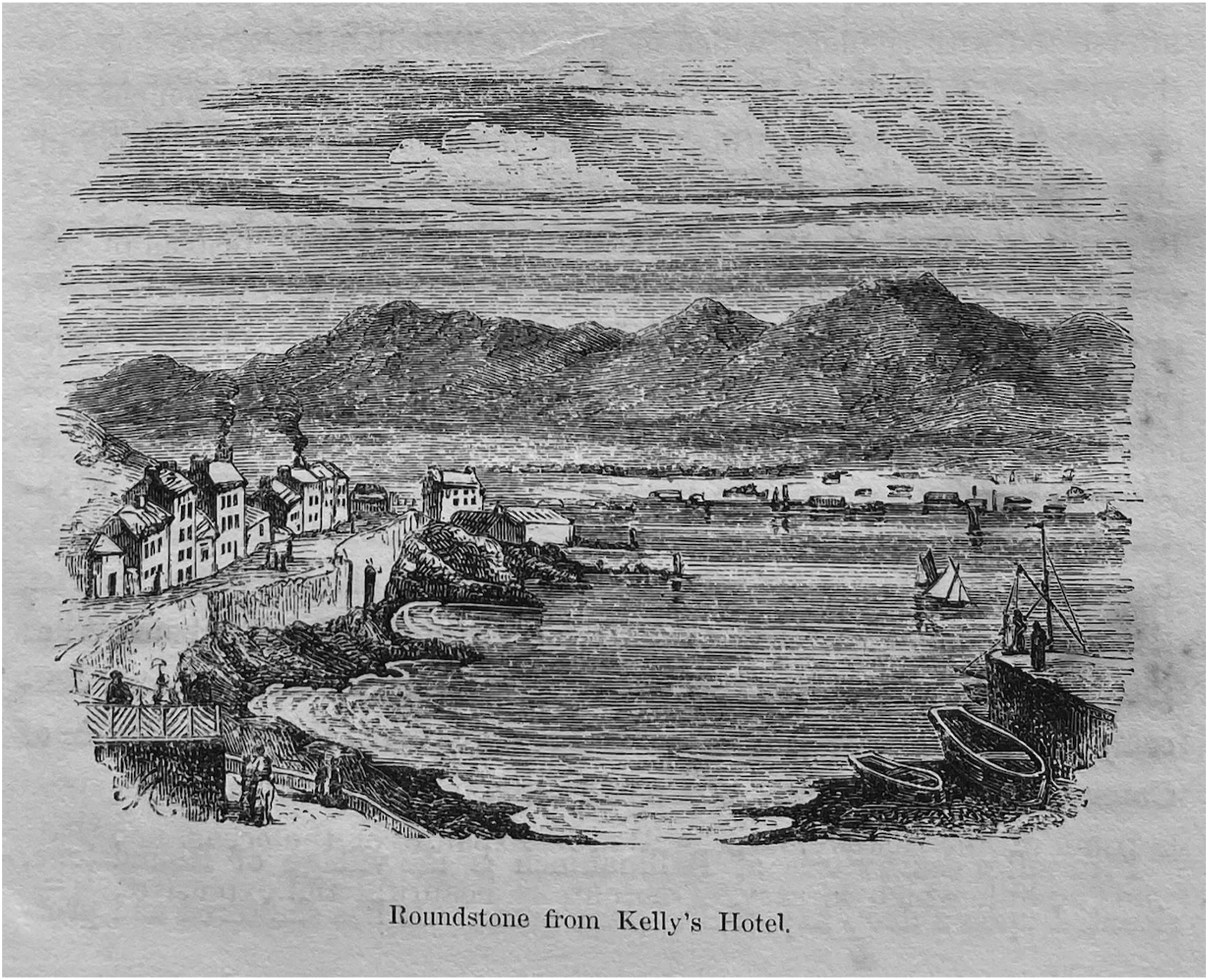
Travelling on Nimmo’s road in the mid-1840s, the Halls lauded the ‘justly-celebrated engineer’ ‘who civilized this wild district’. 86 In passing, they comment on ‘the small but rising and improving town of Roundstone’ which is ‘acquiring importance in commerce under the protecting care of its landlord’. Their reference to ‘the most famous of all the Connamara salmon fisheries’ at Ballynahinch provides further detail; ‘it is leased to a Mr Roberts, a Scottish gentleman’. 87 This, it can be assumed, is John Robertson (originally from Dumbarton) who held a lease of the Timbeola Salmon Fishery from 1839 for 23 years along with leases of the fisheries in the Barony of Moycullen and, later, the fishery in Betraghboy Bay. 88 Robertson is also praised in George Preston White’s A Tour in Connamara (1849) for the ‘considerable employment’ his salmon fishery is offering. White positively comments on the ‘agricultural improvements’ and new technologies introduced by Robertson; he manufactured ‘tin cases for putting the provisions up’, whereby ‘Fish, flesh, fowl, vegetables, milk &c. are all preserved in this way’. 89 Robertson had acquired a processing patent in 1829 with a plant established in Connemara, ‘where the salmon and oysters were boiled, picked and hermetically sealed in canisters before being sent off to Dublin, London and other markets’. 90
Echoing the Blakes’ Letters from the Irish Highlands, the cultural connection between the two regions reappears in the travel writing of Reverend Henry M’Manus who spend several months in Roundstone the early 1840s. Writing about his earlier experiences in the 1860s in Sketches of the Irish Highlands, he notes that ‘once so inaccessible, [this region] has been wonderfully opened up since that time. In consequence, its wilds have lost the garb of mystery and romance in which they were once invested’. 91 He had travelled via a Bianconi car that regularly passed between Galway and Clifden on Nimmo’s road. Where Edgeworth was teased with the prospect of the new road, M’Manus enjoyed the scenic route without much trouble: ‘the very road itself which we travel is peculiar, having no ditches nor hedges on either side, and frequently winding in graceful curves round the margins of the lakes and the spurs of the mountains. Altogether, to a stranger having taste for such scenes, this region is a theatre of wonders. It might almost be called a new world, being a panorama of the wildest, strangest, and sublimest objects in nature’. 92 Here, Roundstone and environs are veiled in romantic vocabulary that, on the one hand, is consciously looking back to reveal what Appel refers to as ‘developmental time’; on the other hand, ‘the wildest, strangest, and sublimest objects in nature’ descriptors could equally be lifted off a twenty-first-century travel brochure of the Wild Atlantic Way. McManus remembers Roundstone in the 1840s as a village of ‘near one hundred’ ‘slated houses’ with ‘an air of freshness’ about it, a stark contrast to ‘its present appearance’. 93 With a considerable herring fishery, ‘the prospects of the little community were not unpromising. But, alas! since that time the herring fishery, not only there, but all along the west coast, has proved an utter failure. In consequence, Roundstone has rapidly gone downhill; and at present it is the very picture of desolation’. 94 Nimmo’s engineered coast with its vision for a coastal future of a prosperous fishing industry did not seem to have materialised. It finds a mention in Murray’s Handbook for Travellers in Ireland (1864) as a ‘little seaport’ ‘that at one time was destined to fulfil a great purpose, no less than to be the starting-point from Ireland to America. For this end a good road was made to it, and a convenient pier built by Nimmo the engineer, who saw in the beautiful and capacious bay capabilities of no common order. But the course of events at Galway will most likely preclude the chance of Roundstone ever emerging from its obscurity’. 95
Yet attending to the ways in which Nimmo’s coastal infrastructures established a mixed Irish and Scottish local community that made a living from tourism in these quarters means to discover narratives that further enhance an understanding of the infrastructures of knowledge production and rescue them from obscurity. Only a couple of months prior to Edgeworth’s private letters to her brother, a short letter appeared in the Dublin Penny Journal of January 1834 that drew attention to the botany of the ‘wild mountains of Roundstone’. 96 Intended to alert those with an interest in natural history to the ‘great variety of plants which I see neglected’ in the region, the author refers to the ‘Mediterranean heath (Erica Mediterrana) which was not known to be a native of Ireland, until lately discovered by Mr M-, of the College Botanic Garden, Dublin’. 97 Indicative of an increasing interest in Ireland’s natural history, the letter is revealing in its appeal that more attention could be given to the island’s botany. The letter may have found an audience among travellers to the region. Bilton remarks in The Angler in Ireland that ‘This district, and especially the hills above Roundstone, are said to be uncommonly rich in botanical rarities. The heaths particularly attracted my eye by their variety and beauty’. 98 It was, however, the area’s marine flora that became a subject of scientific interest. Roundstone, readers are informed, may be of interest for its mosses and seaweed specimens: ‘I believe there is no part of Ireland where such a variety of moss may be found as here, and in no other part of this island did I see such a variety of sea-weeds as are driven ashore in this neighbourhood; in fact, the flowers are left here heedlessly to decay without the knowledge of a botanist’. 99 The author, who signed off with ‘W. Mac’ has been identified by Charles Nelson as William McCalla, an inhabitant of Roundstone village. 100
McCalla, Nelson estimates, was only ‘about 20 years old’ at the time and a rough sketch of his life can be drawn from scattered references and, most importantly, through his interactions with naturalists in and beyond Ireland with whom he corresponded and for whom he supplied specimens. As such, McCalla is a crucial nod in a web of knowledge production, especially about Ireland’s marine botany, and he presents a case study for the way in which natural history was an archipelagic practice. McCalla’s father was a Scottish soldier who was, according to Michael Halliday’s Roundstone: A History, ‘perhaps the first innkeeper in the village’. 101 Nimmo’s founding of the village, then, attracted a small local Scottish population and with the development of road networks in the district, tourism emerged as an industry. Through the inn, McCalla was able to meet a host of botanists who made their way to the region. As has been noted, ‘Any botanical visitor to Roundstone during this period was sure to meet William McCalla, and virtually the only one apart from P.B. O’Kelly of Ballyvaughan and members of the staff of Queen’s (later University) College, Galway. He was the first resident of the region to have an interest in and a knowledge of plants’. 102
Only a year after McCalla’s letter appeared in the Dublin Penny Journal, the English botanist and archaeologist Professor Charles C. Babington, following a meeting of the British Association in Dublin, travelled westward in the company of his friends, the botanist and entomologist R.M. Lingwood as well as the geologist J. Ball, both from Christ’s College, Cambridge. That visit in August 1835 resulted in the publication of Babington’s ‘Observations’ on this ‘land of promise in all departments of British natural history’ in the Magazine of Natural History. 103 Babington blames preconceptions of the region as one of the ‘wilder or more distant parts of Ireland’ and ‘the almost total want of accommodation in the smaller towns’ for the limited exploration by naturalists. 104 Their journey encompassed a very similar route to Edgeworth’s as they travelled from Galway to Oughterard, onwards to Maam, Tully, Clifden and back to Maam. Like Edgeworth, Babington comments on the ‘new and direct road’ from Clifden to Oughterard. His ‘observations’ give a sense of the place in flux, where the rising villages along the Atlantic seaboard have not yet reached formal existence on maps: ‘Neither [Clifden], Roundstone, Lenane, nor Ma’am, are noticed in any map of Ireland that I have seen: indeed, there is no map yet published which gives at all a correct delineation of this part of the country: I ought, perhaps, to except the great map of the county; but of that I am not certain.’ 105 The map of Connemara’s botanical riches was equally in the process of being drawn and Babington is guided by none other than McCalla himself, who leads him to ‘Craigha Moira’, ‘a low but extensive mass of rocky ground’ where ‘E. Mackaiàna’ can be found. He further shows the Cambridge Professor ‘the station of Gypsocállis mediterránea (Erìca Hooker), in Glan Iska, a boggy valley upon Urrisbeg Mountain’ where it grows in tufts, while also bringing him to the ‘station for Adiántum Capíllus-Véneris, at the foot of a rock facing south west, on the bank of Lough Bulard’. 106
In admiration, Babington offers further details about McCalla’s life and botanical practice: ‘This young man’, he writes, ‘although labouring under very great difficulties, has by his own unassisted exertions, and with an almost total want of books, obtained a very complete knowledge of the geology, mineralogy, conchology, and botany of the neighbourhood of Roundstone. He has now, I am happy to learn, obtained the situation of national schoolmaster at Ballinahinach’. 107 For Babington, it had been a successful visit ‘to a district which I cannot but consider much more interesting to an admirer of romantic wild scenery, than even the celebrated lakes of Killarney; and the surprising number of rare plants which are here collected together, as well as the nearly total ignorance which exists of its productions in the other departments of natural science, cannot fail to make it peculiarly interesting to the scientific traveller’. 108 McCalla’s knowledge of the coastal ecologies is further exhibited in an appended ‘List of Species of Shells found near to Roundstone’. 109
In October 1835, the curator of the botanic garden at Trinity College Dublin James Mackay, also a correspondent of Edgeworth, wrote to none other than William Jackson Hooker at Kew with specimens of what I suppose to be an undescribed species [of] Heath [Erica mackaiana] which was found in July last by Wm. MacCalla the Innkeeper’s son at Roundstone Cunnamara within a few miles of the place where I first found the Erica mediterranea. The young man who found it was a boy at School when I last visited Cunnamara in 1829* [sic] and has since that time paid a good deal of attention to the study of natural history, hitherto with very little assistance and promises to be a useful person in the country. He is now in Dublin and I intend to give him my assistance in the prosecution of the study of botany.
110
Nelson’s clarification with reference to Erica mackaiana indicates that Mackay was honoured with the discovery of this heath. Yet the letter implies that McCalla can be credited with its discovery. The local knowledge McCalla developed through self-motivated study and an interest in his surroundings clearly impressed Mackay but he did not consider him an authority but merely ‘a useful person in the country’. In his essay ‘Botany – a Roundstone View’, Tim Robinson refers to Robert Shuttleworth, ‘a young English medical student acting on Mackay’s behalf’ who came to the village and collected Erica mediterranea. Robinson suspects that Shuttleworth’s ‘young guide’ was McCalla. 111 This is highly plausible, and it could, in fact, be argued, that McCalla was the gateway to knowledge production of the district in the 1830s and 1840s. Another of McCalla’s mentors was Dr John Scouler, a Scotsman and naturalist who, in 1833, had been appointed Professor of Mineralogy to the Royal Dublin Society. Scouler, according to Nelson’s research into correspondence between Scouler and Hooker, had plans for McCalla to travel to the south island of New Zealand to collect plants and was keen for Hooker to meet McCalla. His letter of November 1841 to Hooker is revealing: ‘I hope that in a few days you shall see this wild man I have caught in Cunnemara’. 112 Nothing came of the New Zealand trip due to a series of delays and McCalla’s ill health, but we find here another instance of the ways in which an archipelagic practice is built on colonial coastal infrastructures.
McCalla continued to collect specimens, especially algae, for sale to interested collectors and botanists. Indeed, McCalla’s collecting activity became so well known among the Irish and British elite of natural historians that, in 1848, the naming of a specimen was disputed. The phycologist William Henry Harvey (Trinity College Dublin) corresponded with Hooker regarding a naval officer, Mr Peters, who sought his assistance in naming seaweeds: ‘I almost anticipate that they are not of his own collecting and preparation – but McCalla’s. If Mr Peters has ever been at Roundstone, Connemara, he could have bought any quantity of beautifully prepared specimens at a cheap rate from the innkeeper’s son’. 113 The letter is rather different in tone to Scouler’s. Harvey shows respect for McCalla’s industriousness and praises his methodology, implying that he is due more credit than official records in natural history are giving him.
Harvey himself had repeatedly drawn on McCalla’s knowledge in the preceding years and many references to Roundstone and McCalla can be found in his three-volume Phycologia Britannica, or, A history of British sea-weeds (1846-151). Most importantly, Harvey acknowledged McCalla’s contribution to the knowledge of Ireland’s marine plant-life in Plate LXXXIV Cladophora Macallana, Harv. Cladophora Macallana, Harv., in William Henry Harvey, Phycologia Britannica, Vol. I (1846). © This image is reproduced courtesy of the National Library of Ireland. This handsome Cladophora was, in 1840, communicated to me by Mr Mc’Calla, as a new species, but it was not until last summer that I had an opportunity of seeing it in its place of growth, and examining it in a fresh state. At Roundstone, in August, I dredged it in considerable plenty, and convinced myself that it was quite distinct from any described British species; and as I have reason to believe it to be new to botanists, it gives me great pleasure to give it the name of its discoverer, who has well earned such a tribute by the many additions he has made both to the Fauna and Flora of the west of Ireland; and who is now engaged in the preparation of an excellent work containing dried specimens of Irish Algæ, one volume of which has already appeared.
114
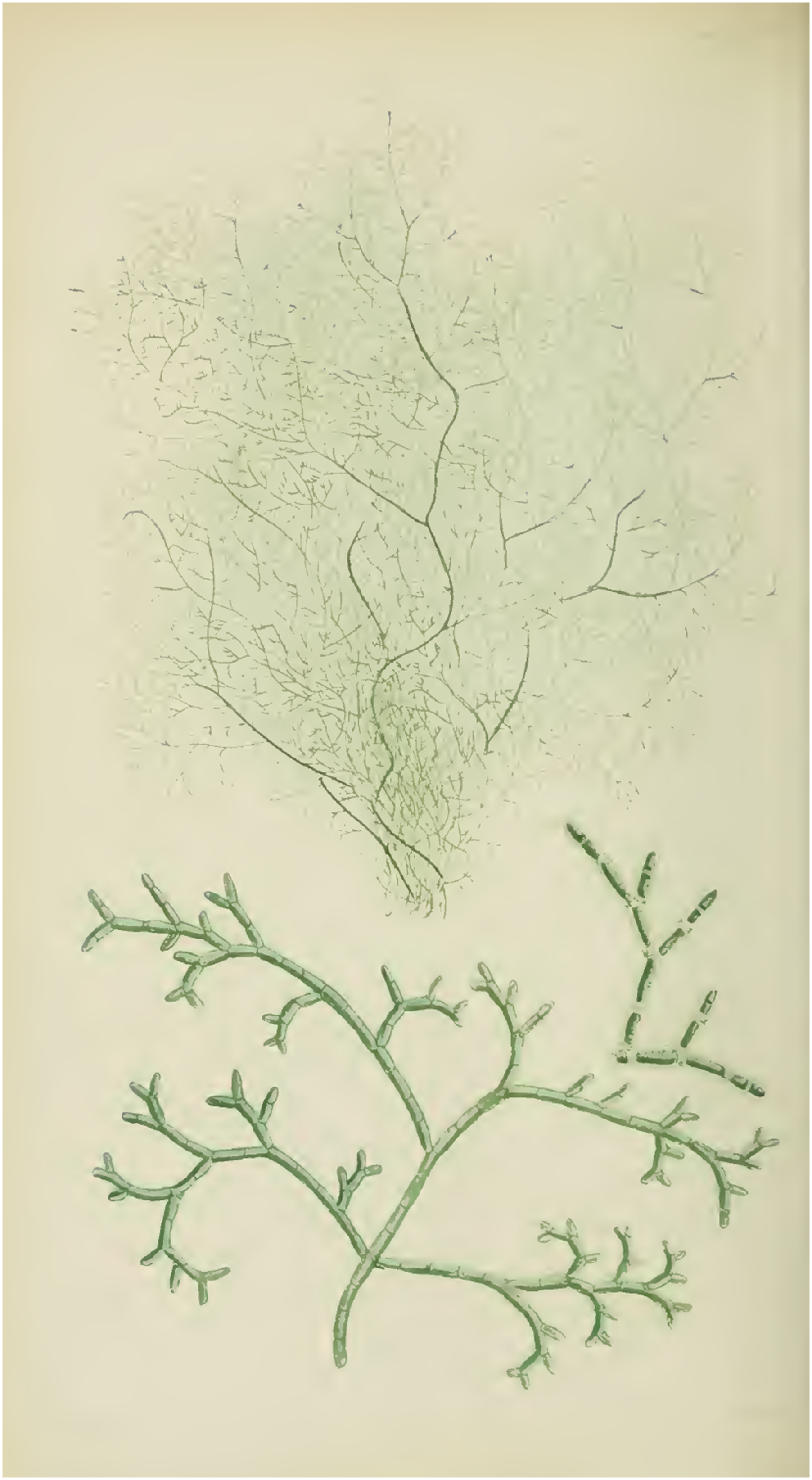
McCalla’s two-volume Algæ Hibernicæ was published in Dublin by Samuel B. Oldham in 1845 and 1848, respectively. The Royal Dublin Society awarded him a silver medal for Volume 1.
115
A copy is held at the National Library of Ireland; there is no preface or introduction to either volume, only indexes of species. Many of the specimens included in the volumes were collected in Roundstone Bay, such as Codium amphibium [Figure 7].
116
While Harvey’s Phycologia Britannica is readily available and digitised, McCalla’s contribution remains relatively hidden. It offers insights into the ways in which local (amateur) knowledge fuelled and facilitated official natural histories, and brings to light the intricacies of knowledge production and who was acknowledged as an expert. Codium amphibium, Moore., William McCalla, Algæ Hibernicæ, Vol. 1 (1845) © This image is reproduced courtesy of the National Library of Ireland.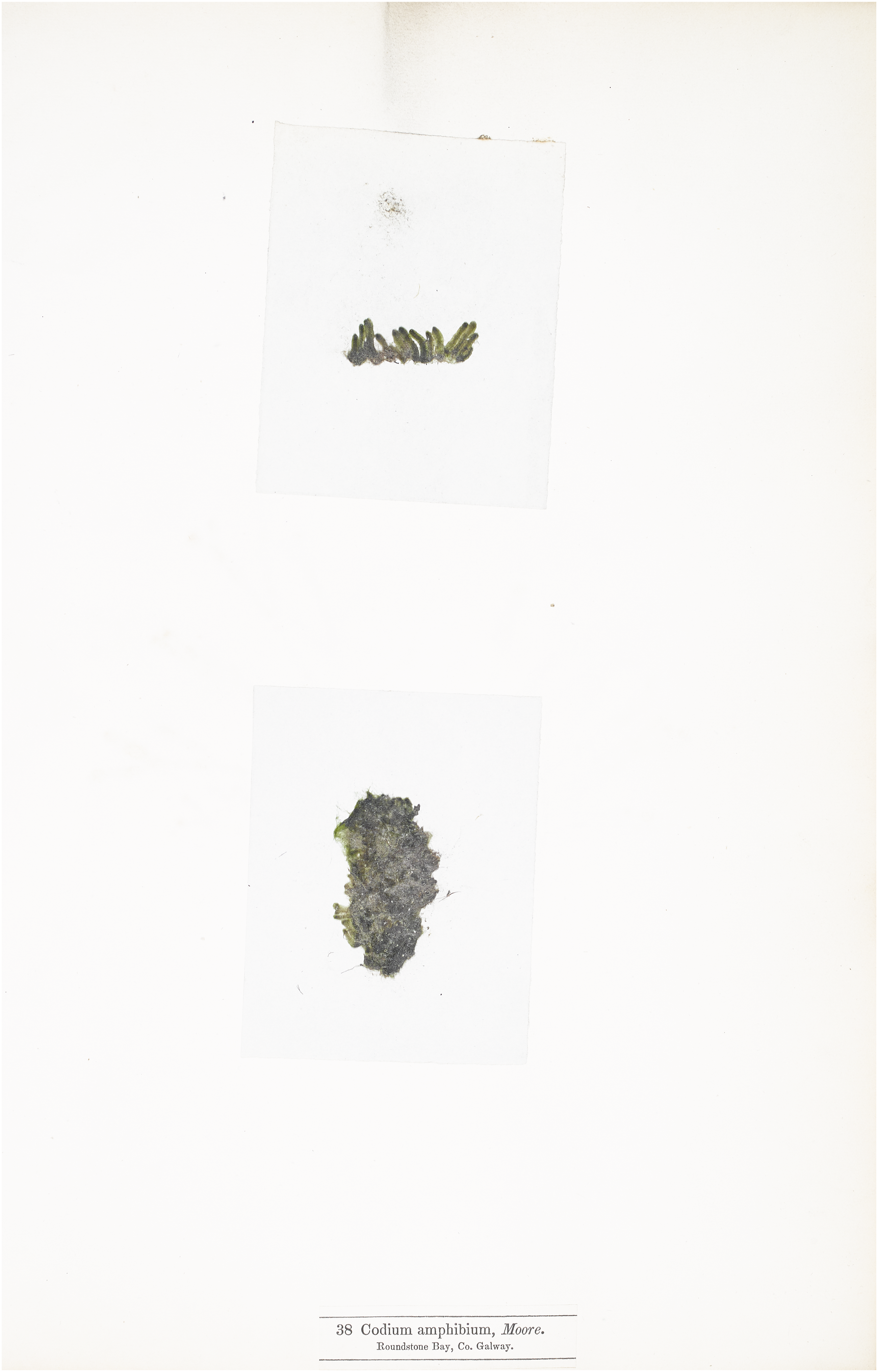
McCalla appears to have made a key contribution in putting Roundstone and Connemara on the map of natural history. Even after his death in 1849 his name and legacy lived on. Nearly 20 years after Babington, in the summer of 1852, John Hutton Balfour – Professor of Botany at Edinburgh University and nominated keeper of the Royal Botanic Garden in Edinburgh – and a group of colleagues paid a visit to Ireland for the purpose of botanical excursions. After some initial time was spent in Dublin, the party travelled onwards to Galway and Roundstone where they ‘proceeded to the inn kept by Mr. Macaulay, the postmaster, the father of Wm. M’Call, who died of cholera in 1849, and who did so much to promote our knowledge of Irish seaweeds’. 117 Balfour elaborates that McCalla’s father has ‘taken the name of Macaulay, which he says is his correct family name’ and that he ‘is a Scotchman by birth’. 118 McCalla’s father appears to have been very proud of his son’s achievements as the ‘old man [is] constantly speaking of the merits of his son, to whose memory he has erected a monument in the churchyard of the Presbyterian Chapel’ to which he took the party of eminent botanists. 119 With continuous interest in the region’s botany, the father must have taken on the role of his son to an extent as Balfour notes that ‘Mr Macaulay accompanied us in the car about a mile to show us a station for Erica Mackaii’. 120 At Maam, an inn was run by Mr Rourke who entertained Balfour and his colleagues with ‘tales of Irish and other botanists who had visited his hotel’. 121
Archipelagic romanticisms on the coast
Back at Mr Rourke’s inn, I end where I began with Edgeworth’s Connemara tour. Neither land nor sea proper, 1830s Roundstone and environs emerge as amphibious places where the literary, scientific, political, and colonial coast meet and run on multiple temporalities: a new village with emerging but not-yet complete infrastructures, an engineered and administered coastal community in the midst of a district that would become – by the late nineteenth century – the locus for a traditional or authentic Irish nation, where mythical imaginings sit side by side with the application of transnational scientific knowledge, and where knowledge production is an archipelagic practice. It is this very co-existence of multiple historical temporalities and cultural imaginings that I consider indicative of archipelagic coastal romanticisms. The writer Edgeworth was looking for the experience of an authentic Ireland in the ‘Irish Highlands’; the Scottish engineer Nimmo was looking for the area’s coastal promises when surveying and overseeing infrastructural projects along the Atlantic shores; the Scottish botanist McCalla, who had settled in the area in the process of Roundstone’s creation, was looking for marine botany to record the diversity of coastal ecologies in the 1830s and 40s. Each of these views is entangled in the politics of progress and cultural reckoning, lived coastal experience and colonial ‘improvements’, and the socio-political infrastructures of knowledge production. Such a historical chorus of voices offers glimpses into the entanglements of infrastructure, environment, and aesthetics.
A turn to the coast not only makes visible the co-existence of multiple temporalities in a particular location, but also collapses and merges the boundaries of periodisation of Romanticism, be it English, Irish, Scottish or European for that matter. Coasts as places of change, of departure and arrival, as environments lived in and passed through invite a turn to narratives of promise and deferral. Today’s tourist who travels along Ireland’s Wild Atlantic Way and stops at Roundstone to stand on Nimmo’s pier therefore stands in the matter of an on-going temporality. It is here that multiple interpretations of the temporal merge. From here, the road opens out to further comparative investigations of colonial and vernacular infrastructural developments as well as linguistic pluralities and their temporal registers. As Mick Lennon and Fiadh Tubridy highlight, exploring temporalities ought to play a key part in environmental planning for coastal change. ‘Where a plurality exists’, they state, ‘differentials thereby emerge as to whose temporal interpretation should be privileged in decision-making processes’. 122 As Roundstone approaches its 200th anniversary in 2024, more narratives of ‘developmental time’ are sure to emerge.
Footnotes
Acknowledgements
I wish to thank Nessa Cronin for inviting me to present an early version of this article to the Irish Studies seminar series at NUI Galway; I’m grateful to respondents Muireann O’Cinneide and David Gange for their incisive comments along with contributors to the seminar, including Deirdre Ní Chonghaile and Anne Sofia Karhio. Special thanks to Noël Wilkins for answering queries about Nimmo’s work in Roundstone; to Claire Connolly for comments; to Penny Fielding for supporting the project; and to the anonymous peer reviewers whose constructive feedback has contributed much to the sharpening of this on-going investigation.
Declaration of conflicting interests
The author(s) declared no potential conflicts of interest with respect to the research, authorship, and/or publication of this article.
Funding
The author(s) disclosed receipt of the following financial support for the research, authorship, and/or publication of this article: This research has been supported by funding from the European Union’s Horizon 2020 research and innovation programme under the Marie Skłodowska-Curie grant agreement No 890850. Research was undertaken during a secondment at the Moore Institute, National University of Ireland, Galway.