



Abstract
This study reviews our understanding of the materiality of the coastline, considering it as a function of post-modern ecology and drawing from it narratives of the Anthropocene. It redresses the theoretical and ontological understandings of archaeologists, geographers, historians and creative artists at a unique urban coastal setting. In doing so, it responds to the work of Ϸóra Pétursdóttir in her 2018 work analysing ‘Drift’ and the tensions found within the inter-tidal zone between human and non-human actors in a remote setting. This study aims to challenge Pétursdóttir’s work within an urban setting. This is achieved through photographic survey of Eastney Spit, to the east of Portsea Island on the south coast of England, and the lived experience of its environment and history. It argues that exploration of materials at the maritime borderland can enable re-evaluation of our relationship with the coast as a lived, urban environment. Through the manipulation of material, historically, artistically or unconsciously, the land and seascape of Eastney have been forever altered by both tangible and intangible cultural forces. As such, the concept of 'drift' is applied to evaluate the corruption of maritime forces and the entangled manipulation of materials that forms unique connections between matter and ontology along contemporary urban coastlines.
‘There was a magic about the sea. People were drawn to it… It was a living thing that was as unpredictable as a great stage actor: it could be calm and welcoming, opening its arms to embrace its audience one moment, but then could explode with its stormy tempers, flinging people around, wanting them out, attacking coastlines, breaking down islands’.
1
This study principally responds to the theoretical understanding of Ϸóra Pétursdóttir in her 2018 work analysing ‘Drift’ and the tensions between ecologies in the tidal zone at the dawn of the Anthropocene.
2
In doing so, it engages with an inter-tidal zone, partly curated by human engineering and habitation, in contrast to the remote Northern Norwegian coastline explored by Pétursdóttir. Pétursdóttir’s work draws from archaeological understandings of materiality, seeing the remote beach as a place of gathering and sedimentation within which synthetic articles (buoys, nets, floats, ropes, bottles etc.,) are tumbled and tangled with natural fabrics (stones, driftwood, seaweed etc.,) by the natural forces upon the beach.
3
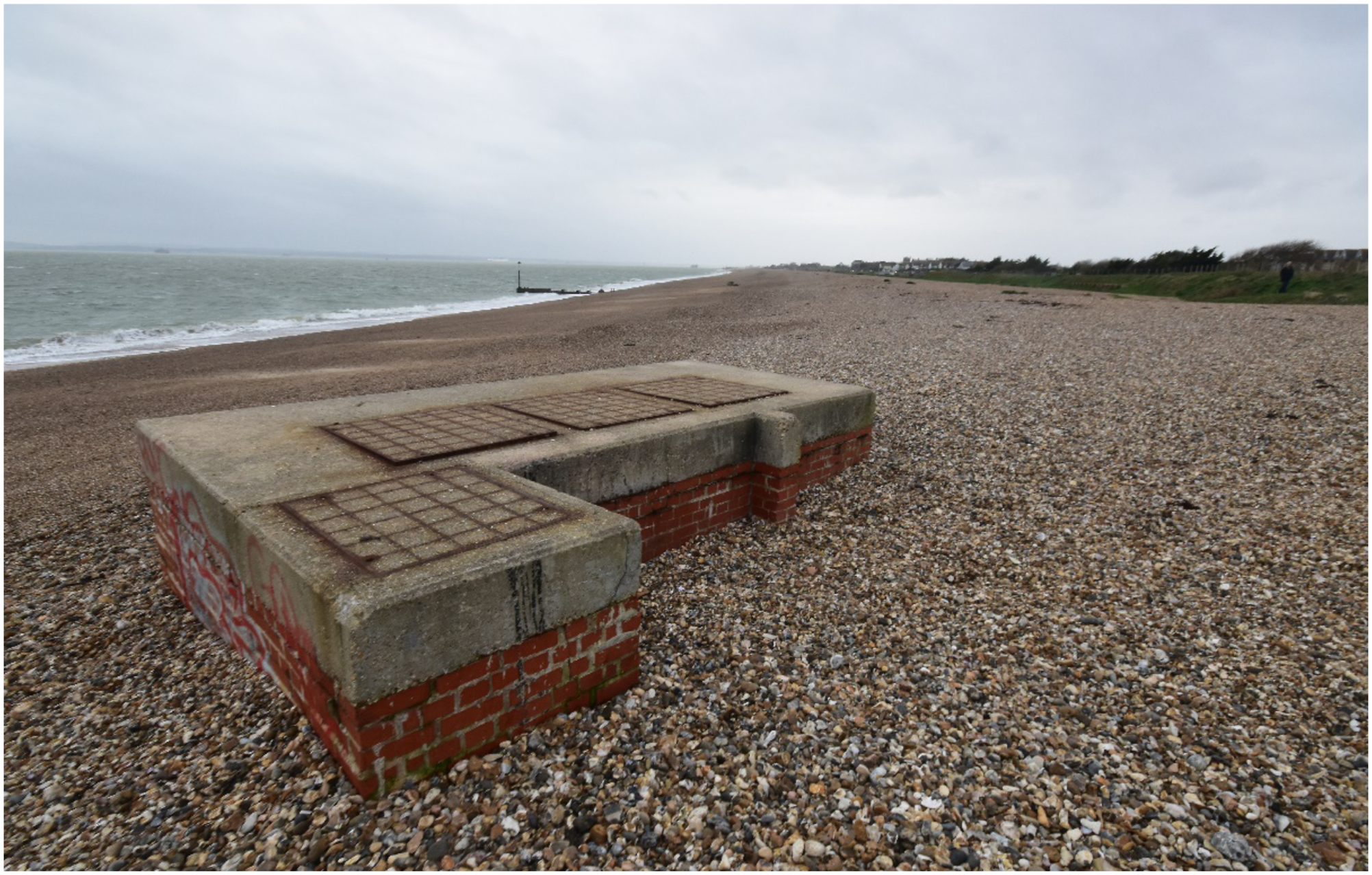
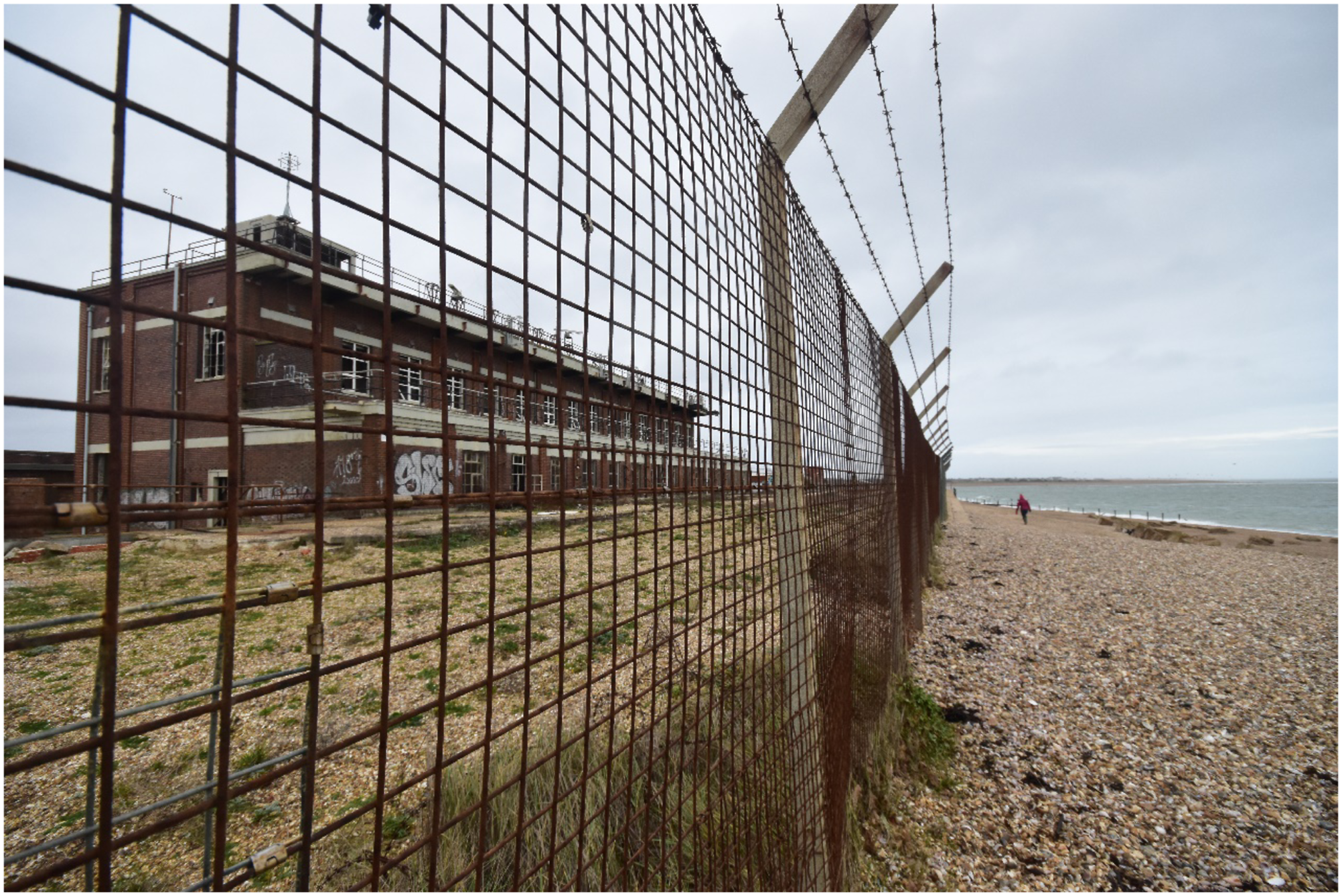
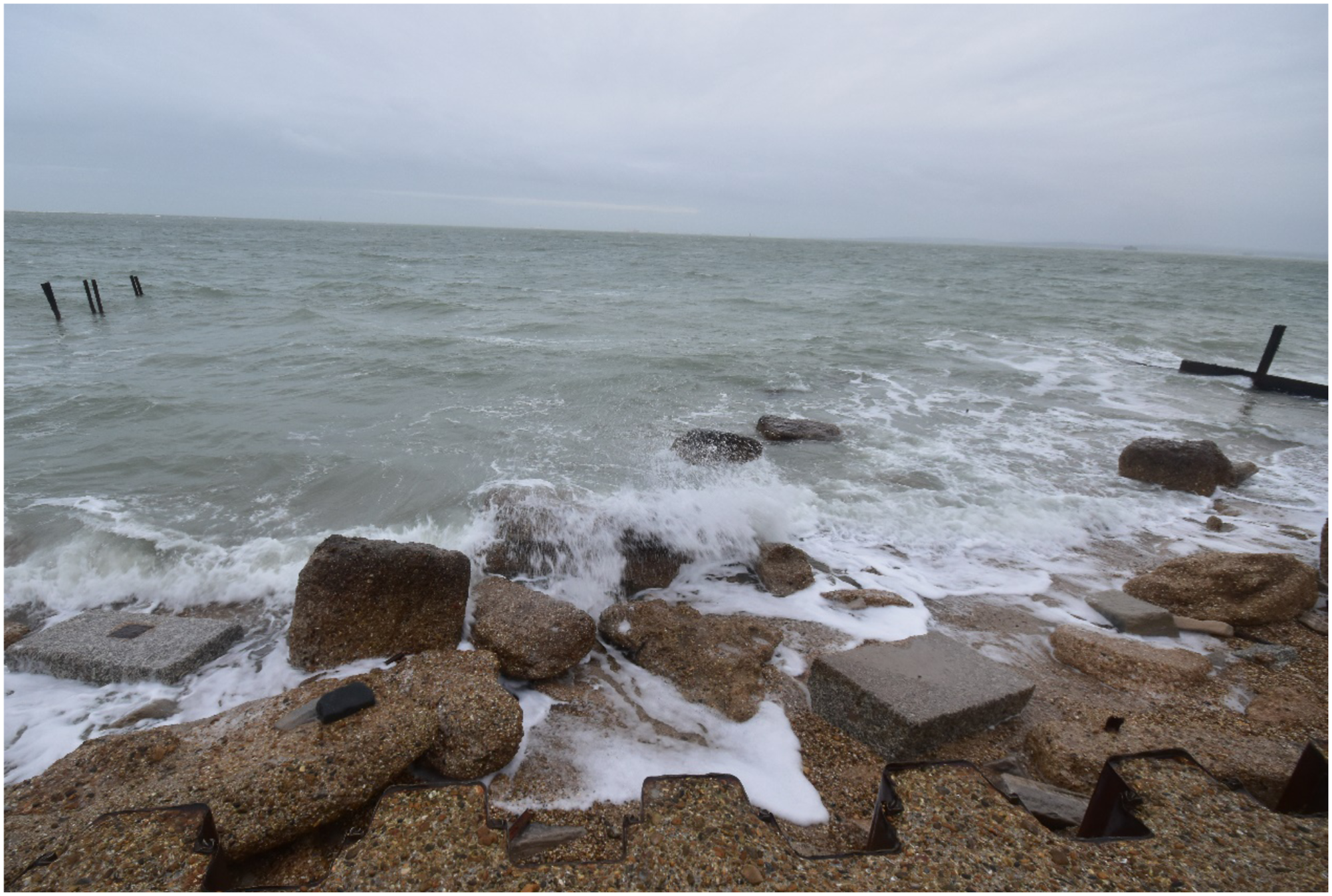
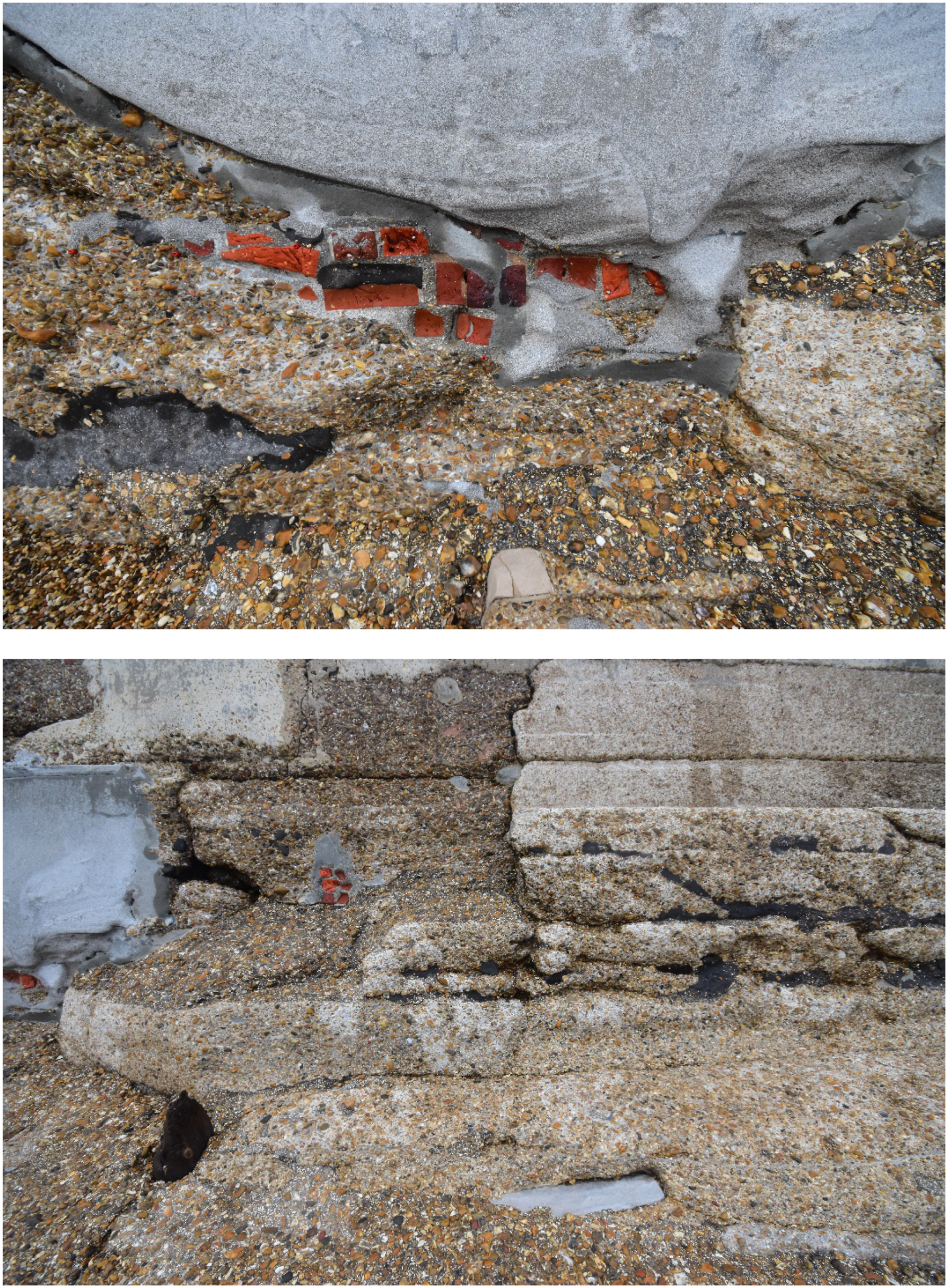
This understanding of the boarder between land and sea best displays the entanglement of materials in the Anthropocene Epoch; a proposed geological unit of time marked by the impact of humans on climate and ecosystems. Gabions lining the shore of Eastney adjacent to the Langstone channel. Map of Eastney with approximate area of study outlined (original image retrieved from OpenStreetMap.org). North-facing photographic image of Eastney beach and Langstone channel. South-facing photographic image of Eastney beach and Langstone channel. South-West facing photographic image of Eastney Lake. East-facing photographic image of a small boat submerged with its hull facing the surface off Eastney beach in Langstone channel. South-facing photographic image of abandoned anti-submarine cable at Eastney beach that once crossed Langstone channel, now covered with aquatic plant matter. South-facing photographic image of abandoned cable at Eastney beach. South-facing photographic image of upturned small boats moored at the peninsula of Eastney beach. (a and b) West-facing photographic images of the inland inhabited beach of the Spit, facing Eastney Lake. East-facing photographic image of Eastney Beach at its southerly Solent front. South-facing photographic image of Eastney Beach at the waterline of its southerly Solent front. West-facing photographic image of Eastney Beach at its southerly Solent front where a brick and concrete structure is partially buried by shingle in the foreground. East-facing photographic image of the abandoned rifle range at Eastney Beach on its southerly Solent front. South-facing photographic image of the revetments and rock armour at the easterly extent of Eastney Beach, looking out to its southerly Solent front. (a and b) North-facing photographic images of the Sea wall at Eastney Beach on its southerly Solent front showing the stratigraphy of repair and damage with different materials including brick and concrete used interchangeably. The slump and weathering making it comparable to the natural stratification of cliff faces. East-facing photographic images of the Sea wall at Eastney Beach on its southerly Solent front. Scaled image of two stamped ceramic pebbles from the ‘million pebbles’ sculpture collected from Eastney Beach on its southerly Solent front.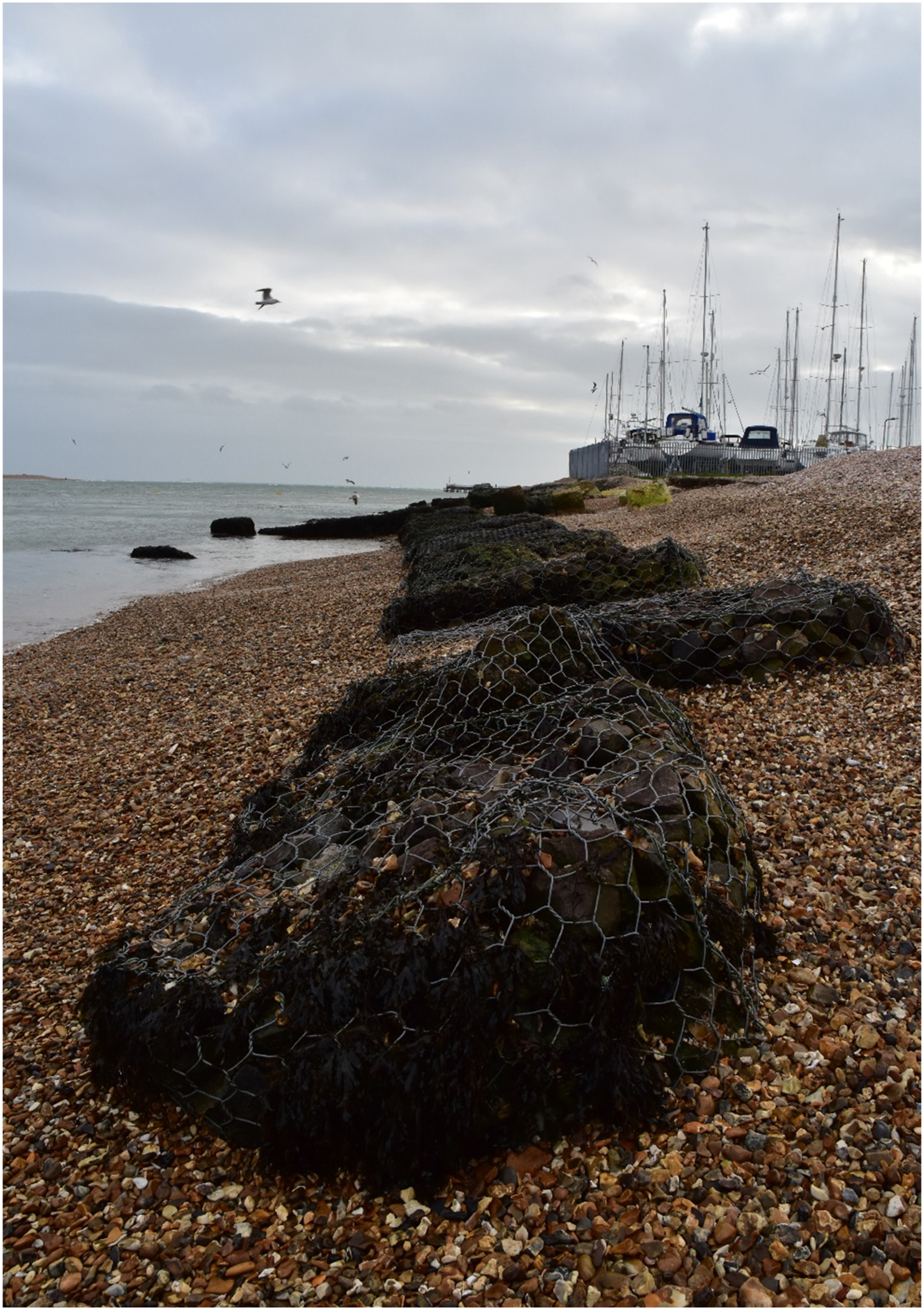
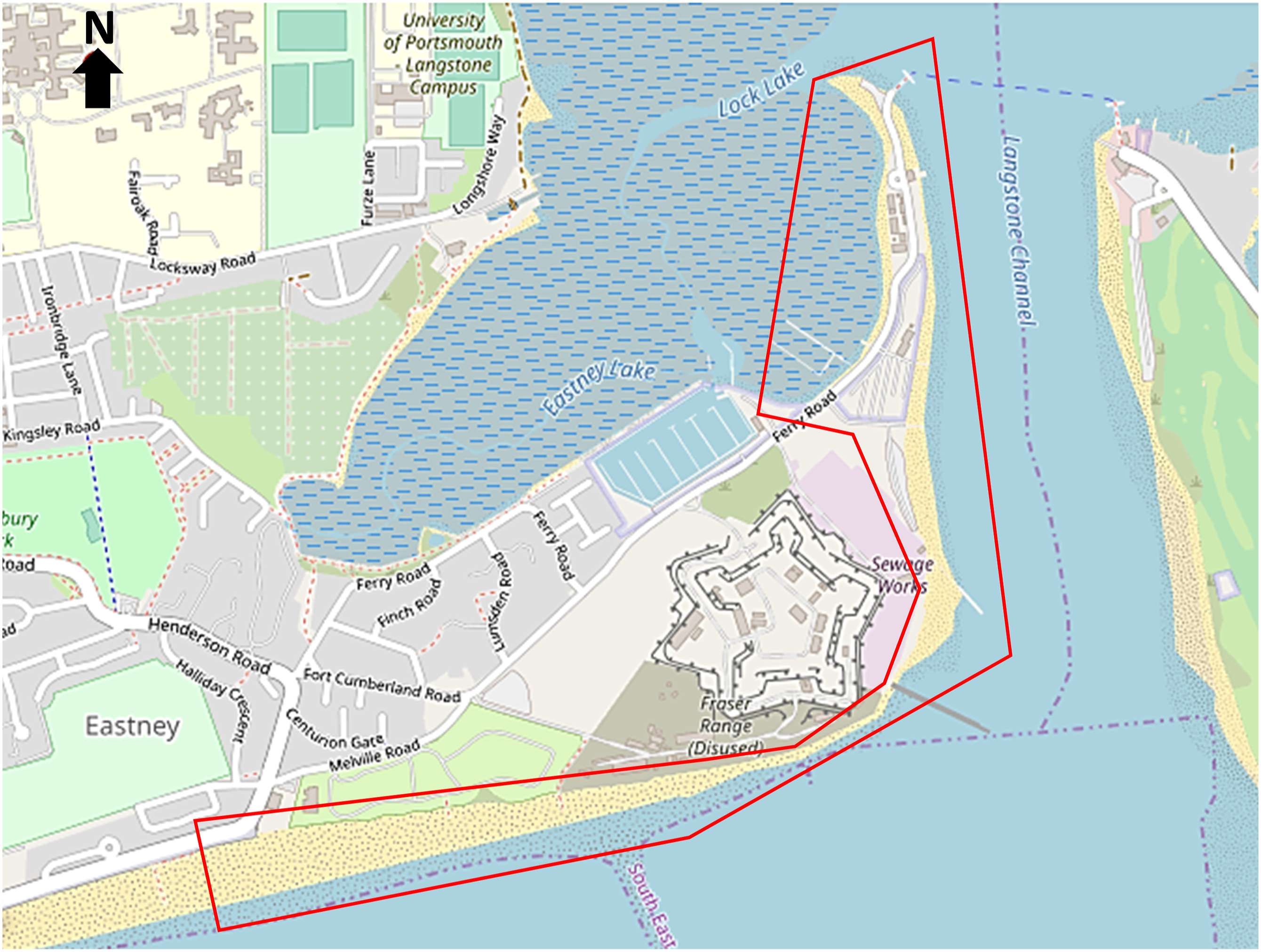
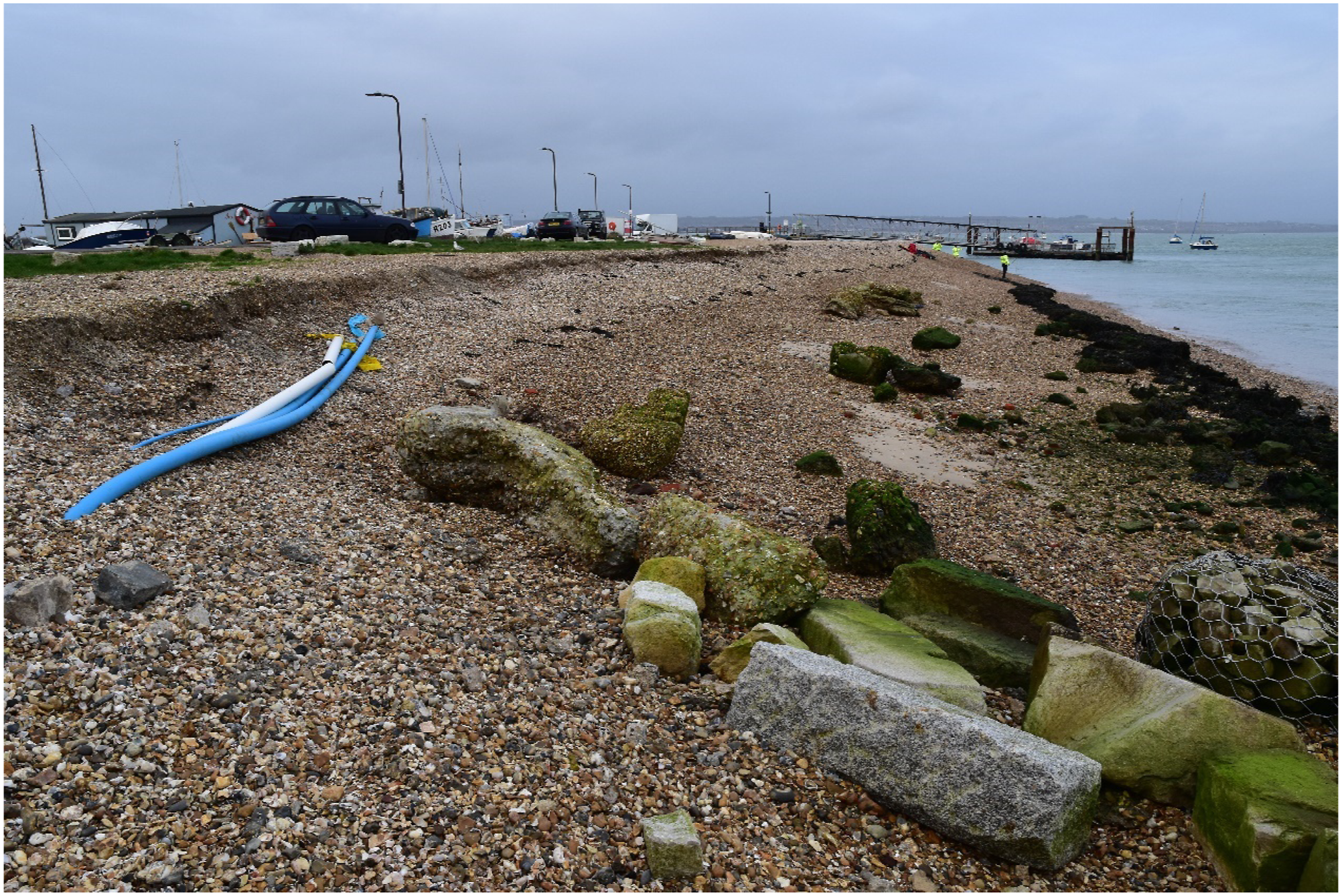
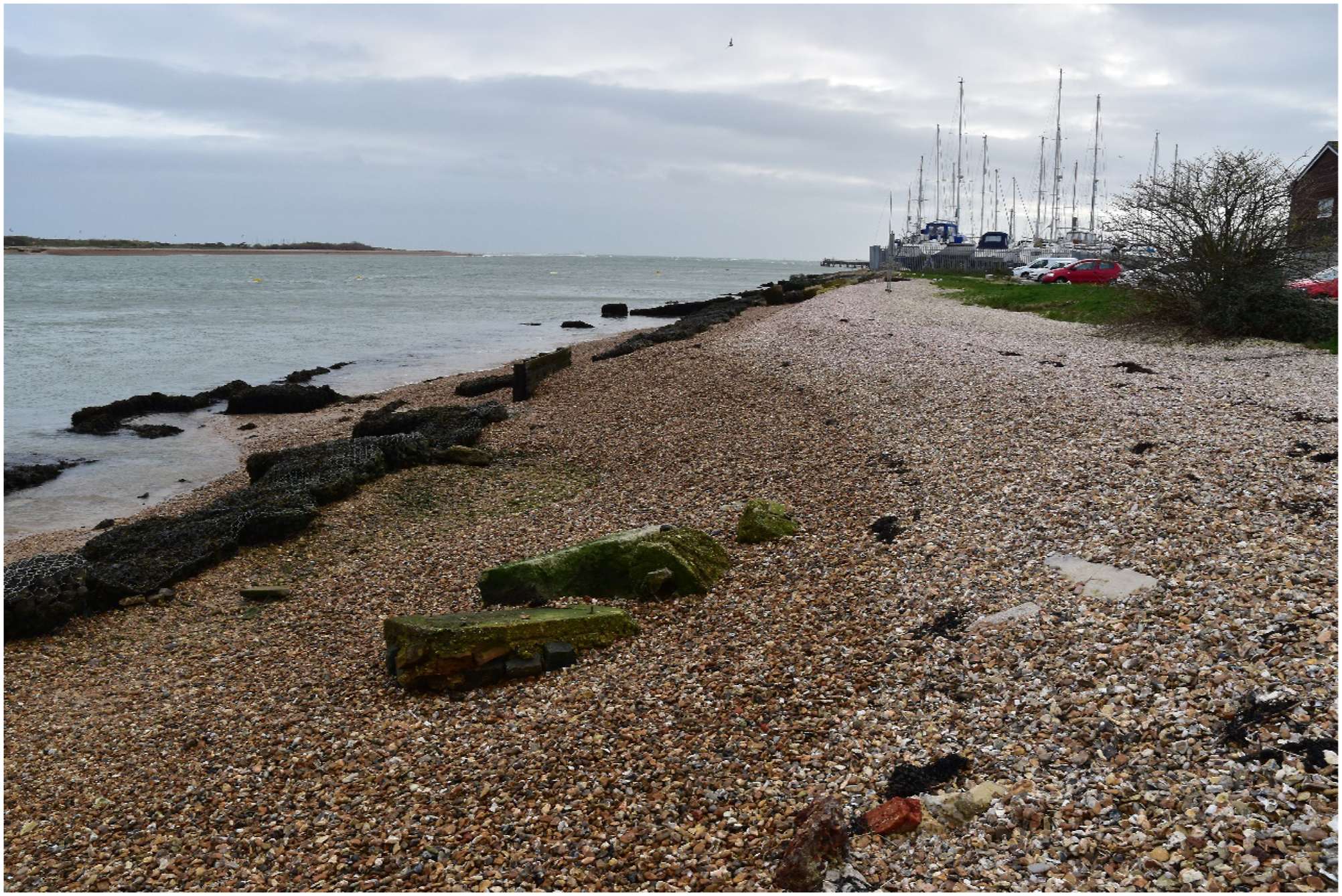
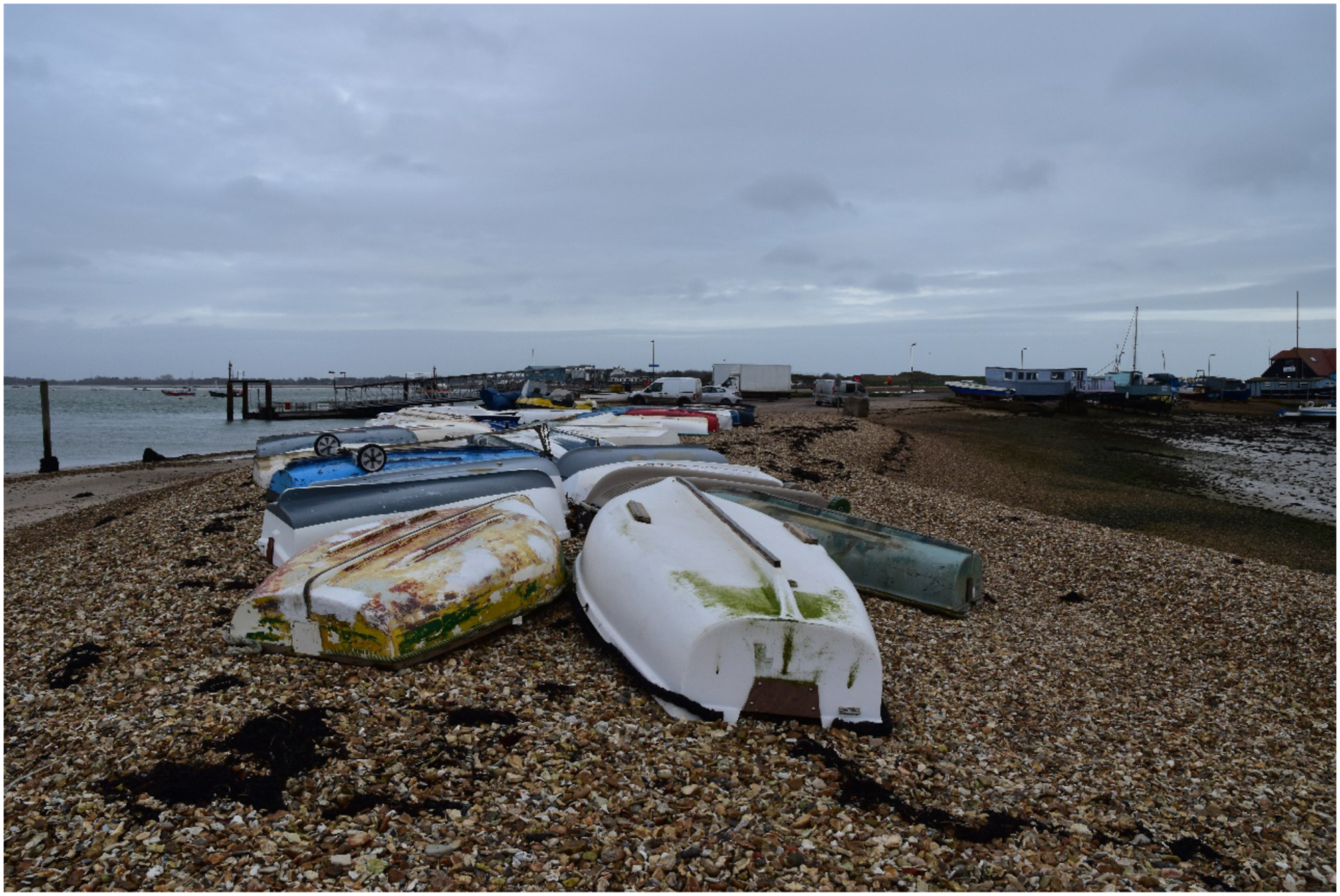
In contrast to fieldwork undertaken in remote arctic shorelines, this article is a study of a coastal environment unseparated from ‘the hassle of civilisation’. It questions our understanding of the sea surrounding our urban, military and recreational spaces and the role they play in formalising landscapes of the Anthropocene. Furthermore, this work adds development to thought regarding the materialism of populated coastlines and how as archaeologists and historians we interact with such fluid spaces as the seafront. In considering the sea as a ‘great stage actor’, we perceive it to be actively involved with the creation of meaning within a material-semiotic approach. This essay aims to explore the idea of a coastscape of the Anthropocene and how its material expression interacts with the natural forces of the world to create modernist values and assemblages within the landscape (Figure 1). In doing so, it draws into question our comprehension of oceanographic materiality in line with a ‘wet ontologies’ approach to thinking of the oceanic, questioning how through submersion and interaction with the sea materials undergo continual reformation in both their physical and cultural character. 4 It argues that this ‘Drift’ in the Anthropocene, as proposed by Pétursdóttir, is derived from our miscomprehension of the qualities of matter at the border between the sea and land.
This paper collates the thoughts and evidence from fieldwork along the coastline of Eastney, Portsmouth, the UK (Figure 2). This fieldwork was conducted over the course of 1 day in January of 2020, approximately 2 hours before the maximum retreat of the sea at low tide (c. −0.90 m). The area is one of significance, its use one of changing identity that amalgamates the past and present. It is a place of permanency and transition. Its implication as a place of archaeological research is one of two sides that comments on the materials of the Anthropocene and the human shaping of material at this watery borderland. Its geological space becoming one of the Anthropocene; the atmospheric, geologic, hydraulic and biosphere systems forever altered by human presence. This landscape of coastline is one of the modern epochs; settled in, travelled through and reinterpreted, an ideal case study of an Anthropogenic coastline.
Eastney is by no means the nearly forgotten beach of Eidsbukta 5 but a place of human reflection in the busy waters of the Solent. It is also not the harbour that invites aircraft carriers, freighters and cruise ships into Portsmouth but a quieter haven. The pace of life here is dictated by the motions of the tide rather than notions of industry. A small vessel gets trapped in the rapid tide with sails full but moves nowhere as a small ferry prepares to cross the thin strait separating Portsea and Hayling islands waiting for the last cyclist to board, already 10 min late. Eastney then becomes a place of stillness and reflection, its nature capturable by photograph.
The length of coastline is two-faced, two-sided. One faces outwards to the sea bearing the force of the churning, raging waves. The other turning inwards to the land, protected, sheltered and harboured. Thus, it is a landform divided in two. The landscapes and uses of each present contrast and are defined by the energies of the sea exerted upon them. As a spit, it is characterised by the deposition of materials subject to the drift of the sea. Geographically understood it is the product of longshore drift; the transportation of sediments and materials moved by the dynamic motion of the waves meeting the shoreline at an oblique angle to gather deposits in the swash zone. Between the two interfaces of coastline Langstone channel acts as a funnel, syphoning in and out the material of the oceanic environment, dispersing and collecting matter in and out of the harbour to the rhythm of the tide, disrupting the motion of longshore drift. As such, Eastney becomes a place of accumulation.
The human presence on the split can also be described as an accumulation on two fronts. The sea-facing south side protecting the fragile intertidal saltmarshes behind it also has had defensive and political agendas woven into the landscape by human hands. Fort Cumberland, a pentagonal-shaped artillery fortification, has guarded the entrance to the harbour since 1747 from the eastern Solent. The north-facing side of Eastney spit has become a place of harbouring and refuge, of relocation and sedimentation. The displacement of people during the bombing of the city during World War II found people taking up sanctuary on the northern shore of Eastney Lake. A community, living in the displaced materials of the area (houseboats, railway carriages and fisherman huts), still holds a presence in the area. Eastney is an area of exposure and discovery; it enables the understanding of oceanographic materiality and movement as directed by more-than-human factors and functions as an unofficial nudist beach in warmer weathers.
In studying Eastney as a construction of the Anthropocene, it provides a contrast to the remoteness of Pétursdóttir’s study and questions its implementation within an urban maritime setting. Eastney is both a land and seascape lived in, travelled through, manipulated and reshaped by human efforts. It is an urban ecology both in its terrestrial and marine states. The waters of the Solent are as domesticated in description as the terrestrial space that outlines it. This is a political, economic, military, social, fluid space that is a thriving hub of activity, not a distant landscape abandoned by its occupants where human connection is recalled in memory; rather, this is a present and vivid environment.
Colouring the Anthropocene
In Ϸóra Pétursdóttir’s original article, colour is excluded from photographs of Eidsbukta, Norway. 6 She explains that that in greyscale our preconceptions are pacified, definitions dulled; that grey amalgamates the landscape of natural and manmade into one assemblage. Colours becoming indistinct ‘flattens the plane’ and draws the contrasting colours of neon fishing lines, floats and other paraphernalia of the Anthropocene, in comparison to the bleached, stark shades of grey of pebbles and drift wood that otherwise form backdrop to unnatural pops of colour ‘opposing the environment’. 7 Pétursdóttir argues that this greyscale is the natural state of Eidsbukta; the removal of colour from the photos within her work reflects this.
However, that is not the nature of the material at Eastney (Figure 3). The colours are vibrant and contrasting; to present it otherwise would be to deprive the landscape of its character as a borderland of the Anthropocene and devoid the reader opportunity to experience the nature of such space through photography. Colour as a means of archaeological comprehension has arguably been marginalised within debates and theoretical understanding, particularly when incorporated into cultural debates. 8 When used, colour can reconstruct patterns of interaction and identity, rematerializing understandings of the past and present in art and in life. 9 The presentation of colour in the photographic record of the Eastney shoreline landscape is justified as such. Colour is the nature of the Anthropocene – the bright neon’s of plastics drifted and interned with the materials of the natural world, boldly displaying itself as ‘other’.
A landscape of contours, churnings, drifting and reordering
‘The notion of Anthropocene brings forth a rhythmic tension, breechings in notions of time, frictions between what has been and what is becoming, between the abrupt and the gradual, the now and the distant’.
10
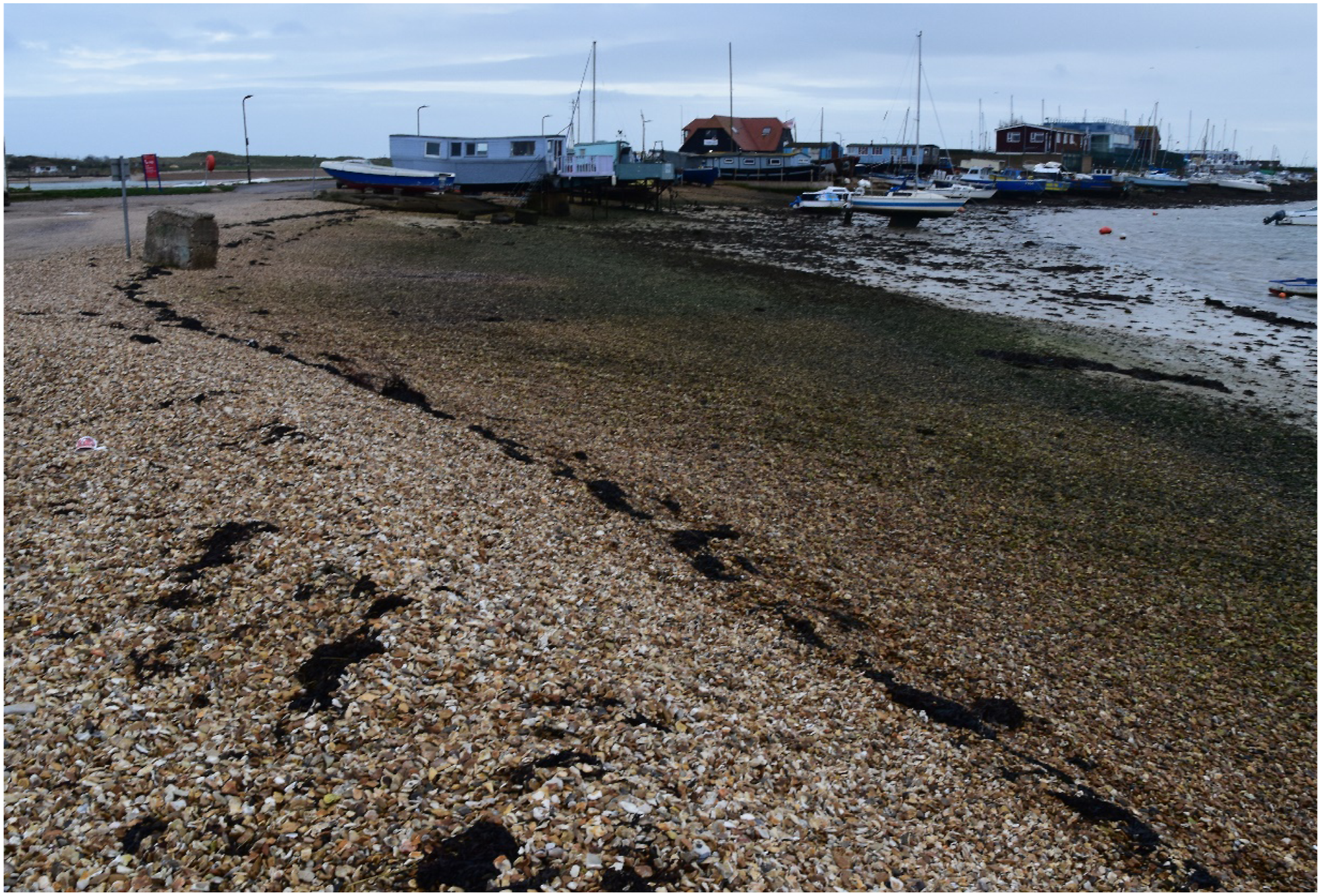
The colours of contours lining the beach of Eastney reflect the dynamism and materiality of the sea itself in the Anthropocene. It calls us to question the ontologies of time and space, the conjuring of material into place. 11 The gathered topography of Eastney is the combination of the natural motion of particles churned, drifted and reordered by the water and wind as well as the materials deposited there by human agency. To Bennett, movement is defined by the displacement of material characteristics across space; thus, materials come to be defined through their mobility and the action of forces upon them. 12 Place can therefore be understood in terms of motion, and space becomes an unstable background of impermanence as materials are unfolded and reordered in line with Steinburg and Peters understanding of fluid spaces. 13 This motion is outlined as contours where tides, waves and weather have manipulated the space, colour and texture of the assemblage of material within this intertidal zone (Figure 4).
By reintroducing colour into the beach scene, we can more clearly see this manipulation; the sun bleaching of pebbles and shells at the height of the beach exposing the waterline at high tide, a harsh comparison to the rich mosaic of wettened pebbles and stones submerged by the tides. This contrast can also be extended to texture with the wetter stones smoothed by coarse attrition; the white shells are flaked and sharp, broken into jagged pieces alongside more angular stones then their downslope counterparts. This difference in materiality is subtle but contrasting it is the difference in understanding and experiencing the wetness of the sea; of being part of the hydro-elemental assemblage of the sea and being excluded on its periphery.
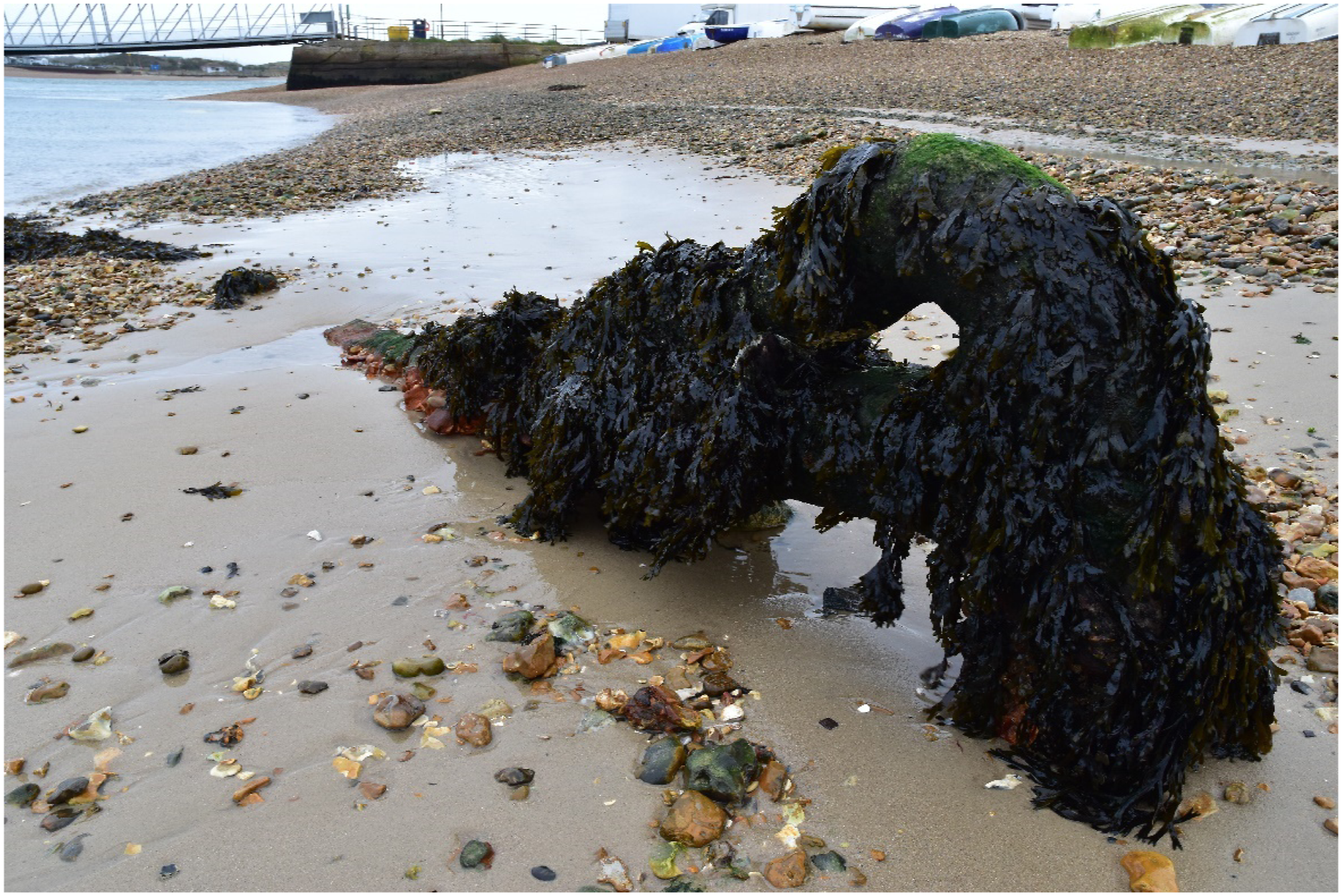
Similarly, Pétursdóttir’s rejection of the colour green as the ‘hope of the Anthropocene’ 14 comes into contrast with the traditional association and use of the colour with ecology and the environment. 15 Green is internally absorbed into the configuration of place and often used as the terrestrial contrast to the blue of the oceanic. However, green is also of the sea; of decay and reabsorption into the biosphere, of the impending encroachment of the sea ever threatened by climate change. What then is the ‘hope of the Anthropocene’? At Eastney, the colour marks this threat of watery engulfment, of rising tides and sea level. The saltmarsh, on the northern side of the spit, is stained a myriad of greens from the stagnation of water. It lays the seas claim to the shore. As a more-than-human manipulation of landscape, plants on the shoreline of the coast and inland waters are often overlooked and their presence diminished in black and white image, leaving a shaded gradient of biology on the shore. Understanding the vividity of green, questioning this presence of colour, is to re-evaluate this Anthropocenic hope. Intertidal flora is ambivalent to the materials of the Anthropocene, the encroaching covering of greenery on coastal management features such as gabions and concrete blocks as well as across natural sediments exemplifies this. Green is the bleach of the sea; it shows the lifeblood of the water as a source of nutrients, the colour of submersion that leaves it stain over time, building contours to show both its permanence and transience (Figure 5).
This landscape is a gathered topography that reflects the discrepancy and continuity of the before and after, the wet and the dry, as Pétursdóttir analyses of the Nordic coast. 16 The horizontal space of the beach as a ‘plane of temporal ridges folded against each other’ generating notions of time and space is underivable from other landscapes; the conditions to explore such ontologies are confined to the waterside. 17 To understand such a formation of materials altered, derived from and moved by the water, we must account for the rhythmic turbulence and dynamism of the sea as part of the material world – reanimating and rematerializing the particles and space belonging to the oceanic. 18
Here too at Eastney is an assemblage of drift, not the voluminous debris of the North Atlantic as studied by Pétursdóttir, but the debris of the Solent and the people who occupy it. Pebbles moulded into an extension of land at the edge of Portsea Island by longshore drift. This assemblage is born of the sea – formed by ‘a dynamic pattern of repetition and reformation that provided stability and texture in an environment of underlying instability’. 19 In understanding the scientific principles of Lagrangian and Eulerian fluid dynamics, we can describe and calculate the movement of individual particles and their action; we comprehend the sea in the context of its mobility. 20 However, through the application of scientific principle we cannot understand the fluid dynamics of intangible forces or of cultural comprehension, in such spaces this calculation is redundant.
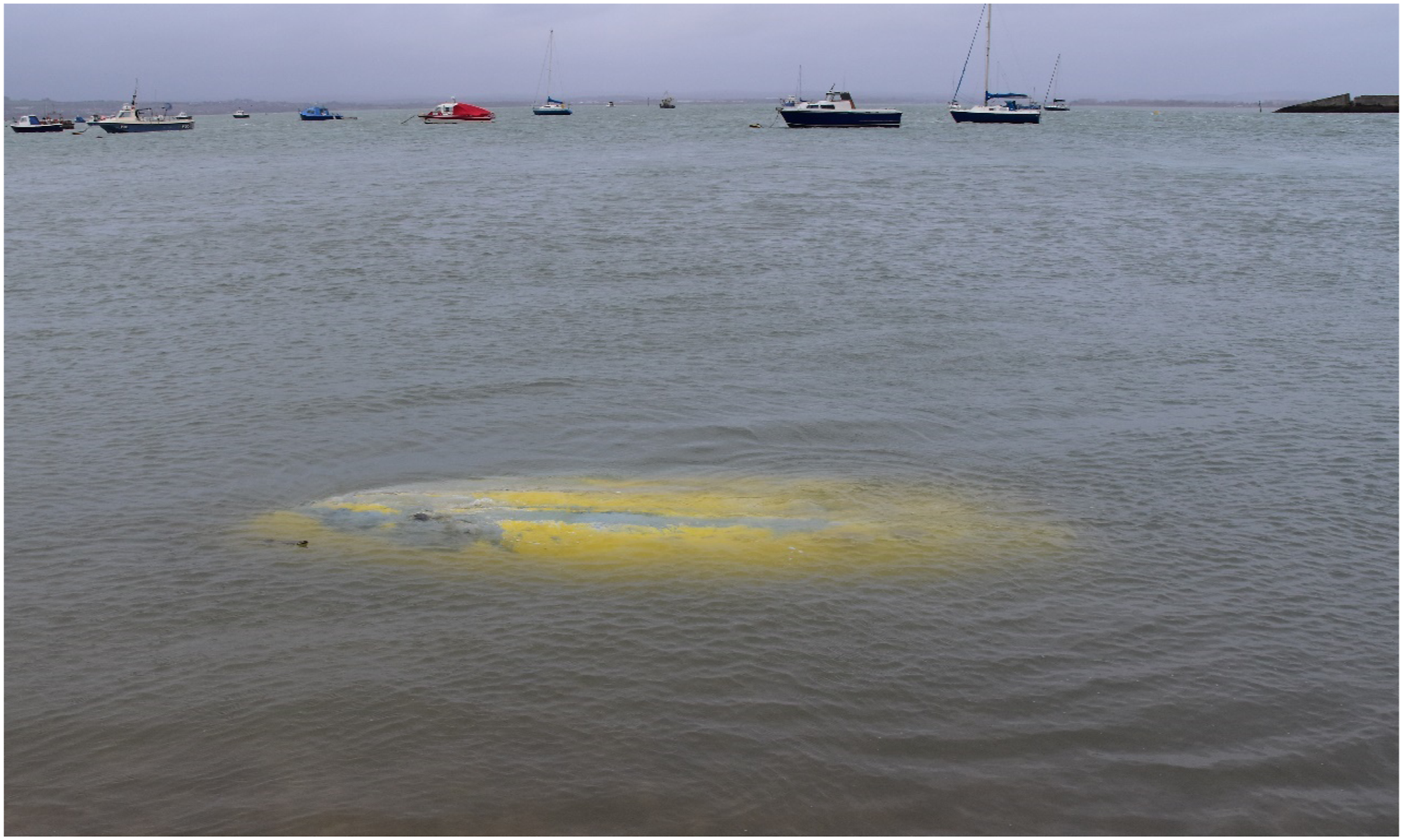
We also cannot understand such intertidal spaces in purely horizontal terms but understand that the space where we observe these materials at low tide alters under submersion, that ‘drift’ as a function of fluid dynamics changes material characteristics and alters the assemblage of things. This essay proposes that under the concept of ‘wet ontologies’, we can better understand this transformation as a process of volumisation and materialisation, that the intertidal zone is an extension of this ‘wetness’ of the sea enacted upon materials beyond liquid. 21 Materials in the intertidal zone can thus be perceived as ‘belonging to the sea’ though their submersion, if only periodical (Figure 6). That their terrestrial claims would be removed if not for being tethered to the shore. A change in ontological assumptions can be drawn forth and discussed while thinking of the importance of a terrestrial tether; of materials torn from or set loose to drift subsequently changing in their relationship to terrestrial political, economic and social constructs. For example, flotsam and jetsam, in their submersion and having been ‘given up to the sea’, some would argue that they have been washed clean of ownership and are subject to the right of ‘finders-keepers’. However, this is not a law that any court would uphold. Drift here takes on the role as an actor, redistributing wealth from the oceanic to the coast.
An environment of the Anthropocene
‘Materiality is never apprehensible in just one state, nor is it static or inert. Materiality is not glue, binding and holding other, less material, things (social relations, cultural meanings) together … materiality is always already scored across states (solid, liquid, gaseous) and elemental (air, fire, water, earth). As such, as variously turbulent, interrogative and excessive, materiality is perpetually beyond itself’.
22
As Eastney Spit is born of drift it is still formed by it, an endless churning and reforming of material – its assemblage remains forever unfinished and incomplete. 23 Through the concept of extension, Steinberg and Peters comprehend such landscape as a ‘reach’ of space that displays the presence of the sea as a more-than-wet phenomena; that describes the materiality of the sea in excess of its liquid form. 24 The intertidal zone thus fluctuates between the hydrosphere and the geosphere as a unified ‘sphere’ of Earth systems; the habitation of biosphere in both ‘wet’ and ‘dry’ conditions.
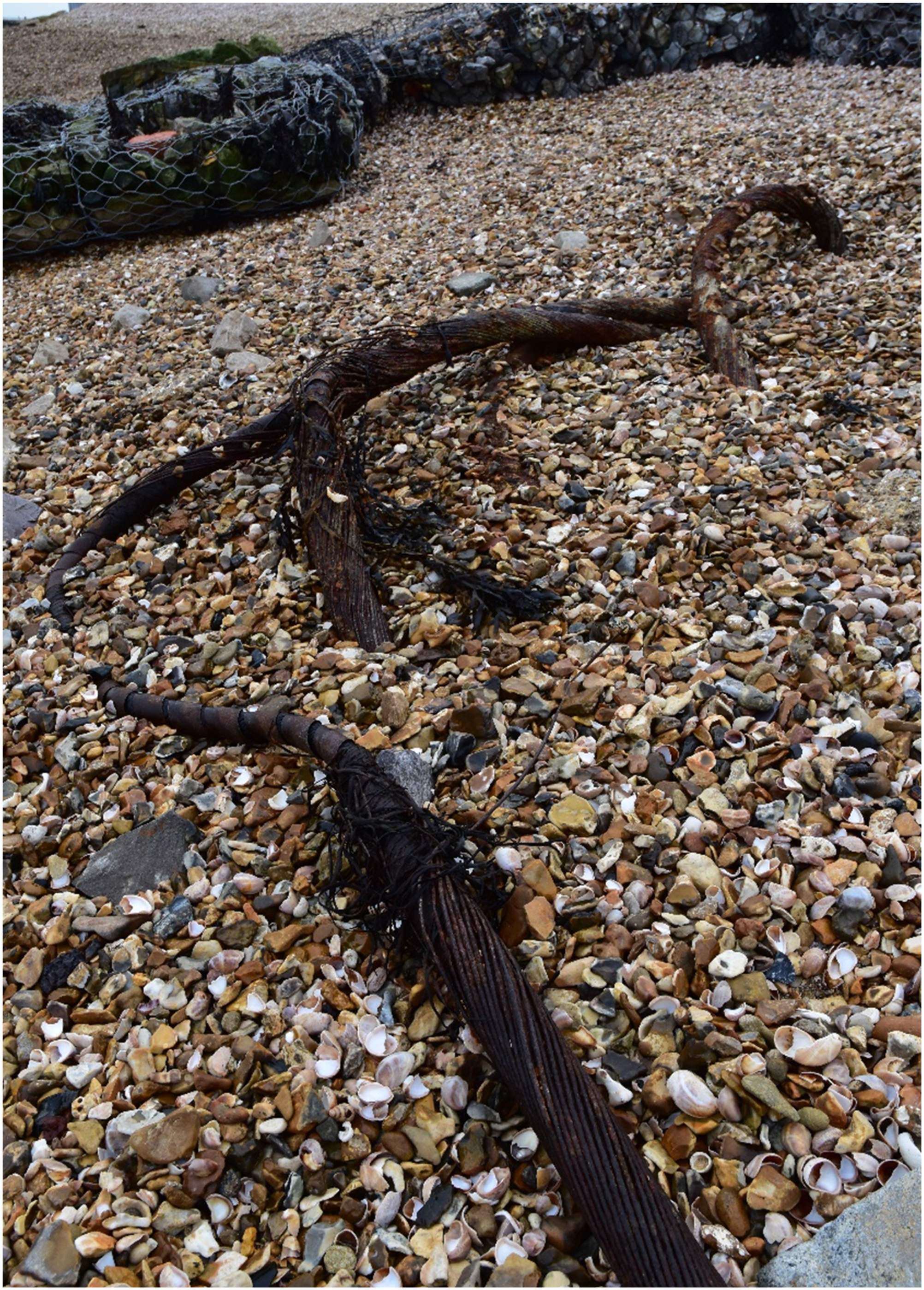
Eastney cannot be excluded from its human influence: it unifies too the ‘anthropo-sphere’ within the ‘geo’ and ‘hydrosphere’ (Figure 7). As an accumulation symbolic of the Anthropocene, the beach, however remote, cannot exclude itself from the wider, interconnected systems of human life and its haptic engagement with the environment. 25 Tim Ingold summarises that the divide between the natural and physical properties of a component of the planet has no neat definition and conceives the world as a meshwork, an entanglement of people and environments that intersect and interweave. 26 At Eastney this interweaving is visually present; the tangled remains of past structures, defences and manipulations of the environment tangled amongst the drifted material of the sea. Hydraulic action exposing and concealing so as to intertwine space and time into further convolutions; ‘things arrive announced, then disappear again under the waves; buried history comes to the surface; traces of the past are exposed and erased’. 27
Here at Eastney, we can see the contours of the beach as that of the Anthropocene; an assemblage with an archaeological layer meshed within it as an ‘open system’ where the ontological immaterialities are laid out as evidence adjacent to the materials they relate (Figure 8). 28 The contours of the beach, formed not only by pebbles and plant matters creating ‘temporal ridges’ but also the accumulation of small boats at the tip of Eastney Spit, submerged and animated at high tide, left to form one with the static deposits of drifted material at low tide at the top of the beach. These maritime materials of man are tethered and left to endure the cyclic, rhythmic eclipses of the tide, moving with the pulse of the sea as if it were the breath of the living thing. Upturned, these small boats reflect the ‘otherness’ of this space, a world not entirely of any ‘sphere’ but encompassing all – an upturned and reordered space (Figure 9).
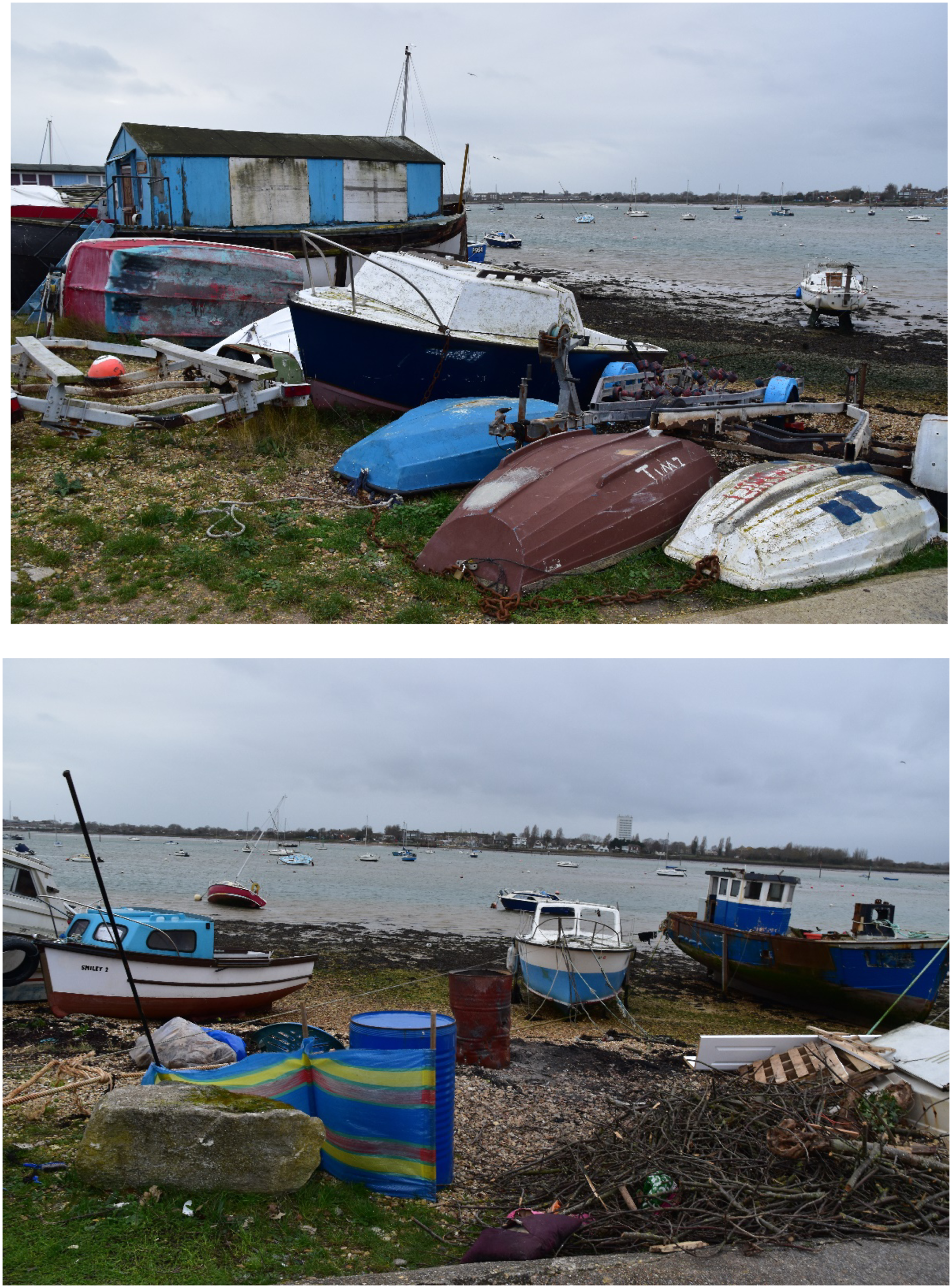
This north side of Eastney Spit sees the agglomeration of the Anthropocene (Figure 10). The remnant influence of those sheltering from the Blitz is observable on the northern internal shore of the spit, looking out to the salt marsh, as the scattered paraphernalia of a maritime community. House boats and makeshift dwellings, their viability a point of disagreement between owners and the city council, still embody the wartime spirit of ‘make do and mend’ in their seemingly patchwork construction. Like the small boats moored at the top of the beach, their positioning is somewhat removed from contexts, isolated by their tidal retraction of the water’s edge and the ebbing of time. As area of residence and resilience, the ocean in excess can be seen to mesh with human life on this peninsula. This is an assemblage of materials drifted together by human endeavour and abandonment, a churning of life stories and circumstances that have reshaped this landscape and moulded along the boundary of earth and ocean utilising those fabrics that arrive unannounced from the depths and drifting of the sea. 29
As an archaeological space, Pétursdóttir utilises the beach as an assemblage of ‘unparalleled affluence’ that is neither cultural nor natural in its representation. 30 This assemblage of archaeological and anthropological material is not bound to each other, it is not dependent or binding to any one thing but the formation of an accumulation in flux; perhaps this is where value is found. That this accumulation of the natural and the cultural at Eastney may not be economically affluent, particularly in contrast with is westerly naval and commercial port, but in its liminality is found worth. As those who utilise the environment interact with it, so they are imposed upon by the materiality of the sea in its sound, taste, smell and touch. In conducting this study the saltiness of the air, the light spray caught by the wind, stuck to the pores of skin and wires of hair exposed to it. As such, even beyond the water line the entire spit was covered by a maritime umbrella off sensation in materiality, where some might find mindfulness.
Borderland
‘It is almost too telling that along this imagined border, in the liminal zone between the known and unknown, the distinct and proximate, we find things; accumulating in increasingly intimidating qualities – the unruly mongrel of material culture’.
31
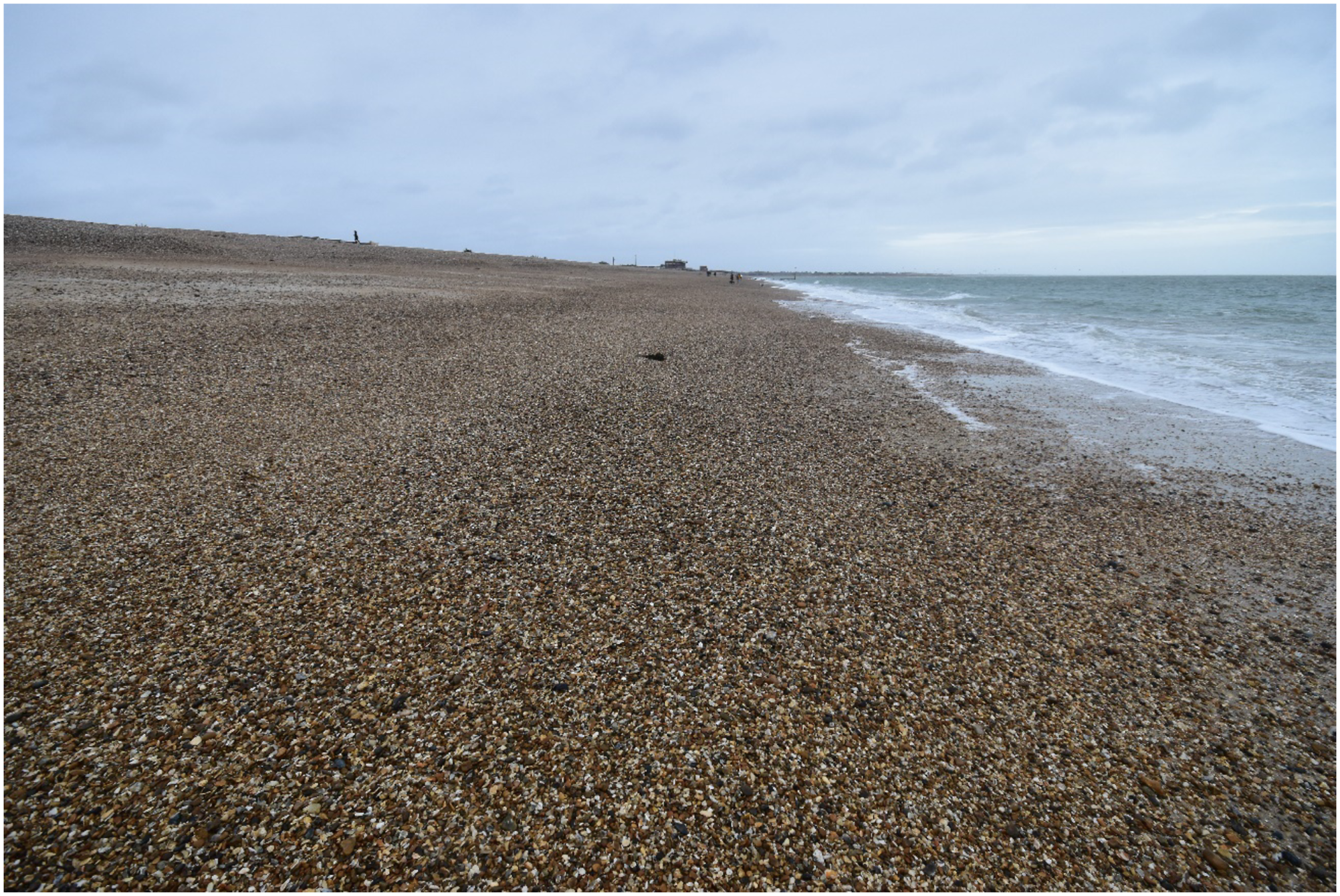
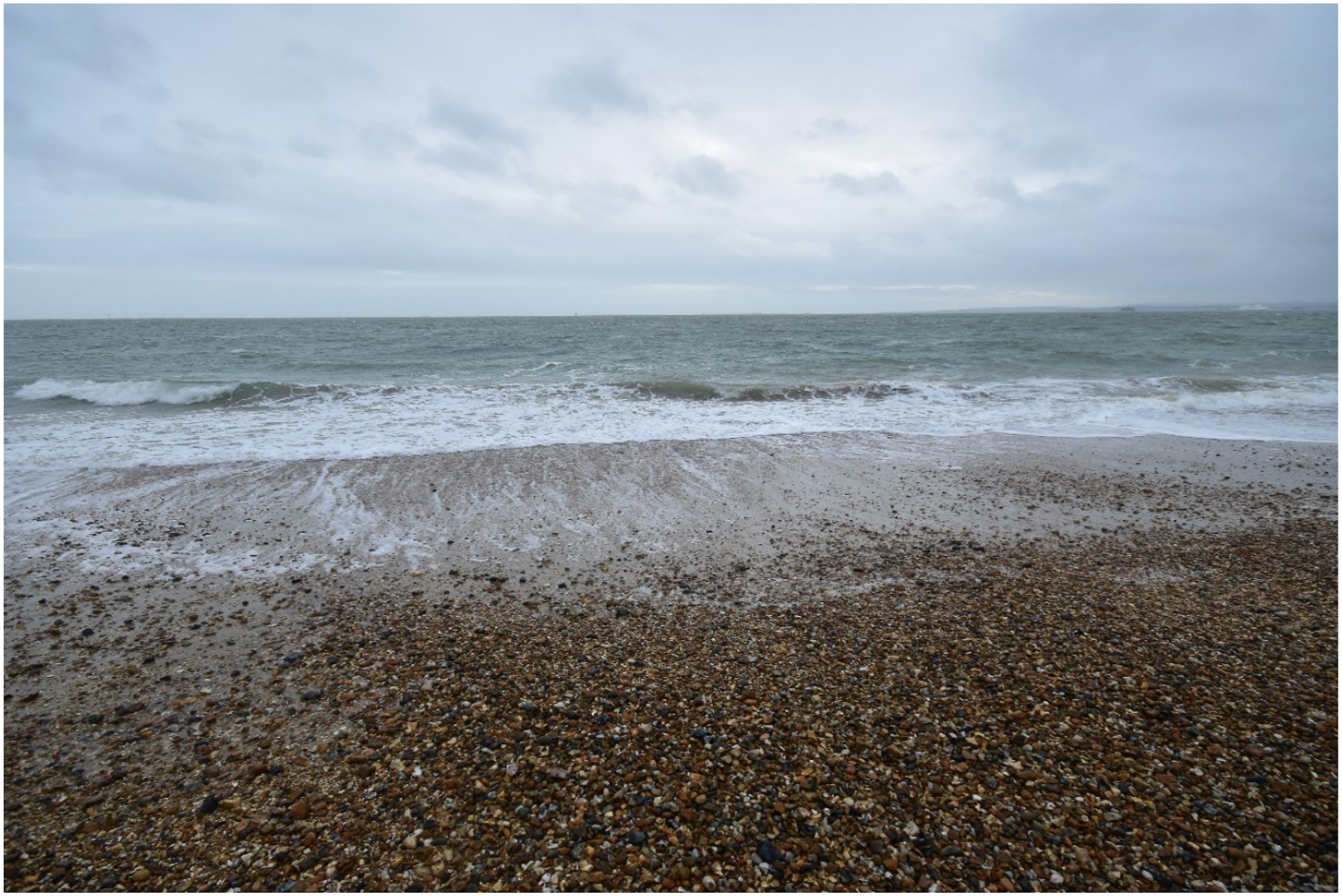
Here the discussion turns outwards, looking away from the northern extent of the spit, we turn to its southern facing and out-to-sea, the landscape confronted by the elemental and material manifestation of the open sea. Here the beach forms a borderland between the sea and habitable land, the folds and ridges of shingle rising to form a barrier, obscuring the rest of the world. Standing at the waterline you are confronted on one side by the vastness of the sea overlooking the natural maritime amphitheatre of the Solent, on the other a gradient of deposited, drifted material forming a wall to the world beyond it; the esplanade and residential buildings of Eastney at the eastern extent of Southsea beach. The promenade and beach huts at the top of the beach are obscured by this large ridge of shingle. It is a bleak and obtuse landscape that forces a connection between the elemental experiences of the sea, land and sky. Standing on the edge of a seemingly horizontal seascape, on the horizon Anderson’s account of reorientation on the ocean’s surface where an individual becomes repositioned not within halves of air and land but a sphere of fluctuating materiality – the sea and the air as an encompassing globe, becomes imaginable (Figure 11 and 12). 32
In looking outwards, we utilise our perception as one of horizontal stability, understanding the ocean as a churning plane of water, looking out onto it as a point of articulation with the sky. The work of Steinberg and Peters invited the perception of the oceans and seas as bodies of volume; having the capacity to support mass and take on voluminous dimensions that churn, flow and drift. 33 This is the borderland wherein these vertical and voluminous forces are translated into horizontal motions (Figure 12). The energetic disturbance of particles, of waves crashing into another state of fabric to reorder and dissipate, retreating to its analogous solution as it backwashes into the volume of the sea once again. 34 This is the motion of drifting, the pushing and pulling of fabric on the border between the terrestrial and aquatic, from which ‘wet ontologies’ can be exposed. 35
This is the intensity of the shore, making you shrink and swell with the unceasing motion of the sea as a fluid entity. 36 However, there is reclamation of this motion, a human desire to corrupt the forces of drift and tame this frontier. Here at the borderland between the sea, an ‘unwearied unconquerable power’ 37 , and a fortified landscape defended against not only from political enemies but also the destructive and untameable power of the sea. This borderland archaeology not only looks at the frontier of the beach, as a tug-of-war between material elements, a fight between the solid and the liquid, but also as an extension of human territorial imperialism. In their work, the intertidal archaeological project CITiZAN has mapped such a tug of war as part of their Solent Harbours discovery programme. 38 Forthcoming publications will demonstrate the value of community archaeology in such littoral places and develop further framework for projects working with the public in boarderland archaeology. Here the beach does not appear as an unparalleled wilderness, lined by car and mobile home parks, cycle and pedestrian paths, providing access for ‘citizen scientists’ and dog walkers alike. What is demonstrated but the CITiZAN project is the opportunity to understand materials of this coast scape as the remnants of a reinforced political boarder. This is not to say this project is one of preservation or artefact collection. Instead, it surveys the demilitarisation of this shore by the erosive power of the sea and enables contemporary contrast in the experience of this space with surveyed historic remains. Concrete structures of the World and Cold Wars are broken down and worn to pebbles to join as non-distinct elements of the seashore. In the fight between terrestrial fortifications and the sea, one has time and volume as an advantage (Figure 13).
The fortification and militarisation of the shoreline at Eastney prompt the idea of the horizon as a political boundary, as posited by Weizman. 39 Sitting atop of the bolstered beach, these structures are kept a distance away from the churning, voluminous mass of the water by revetments and rock armour, left on the high ground to survey a defensive horizon. Here is to be found a defined borderland, marked by fence and walls, between the terrestrial and ‘the hydrosphere’ (Figure 14). 40
These defensive structures represent the struggle for space fought on a planar level, that protects the coast across a level surface, providing the security of a horizontal space. 41 Thinking of the sea as volume within an ontological perspective, we rematerialize the water to think of our politicisation of the sea beyond the surface; thinking of it as a space not simply moved on but through and within. We can perceive the politicisation of the seascape as a space of discontinuous layers folding into a projection of terrestrial power; ‘the question of geopolitics … [is] not, then, simply a politics of the solid land but in relation to water, ice, subsoil, and the submarine’. 42
This is the wilderness of the shoreline; abandonment and disuse, a rusty fence guarding a space of natural reclaim – the beach encroaching upon the concrete surfaces of an old rifle range. This abandonment emphasises the changing perception of the oceans and sea. It is no longer an ‘expanse of oceanic horizon’ 43 but a voluminous ungraspable space of verticality, a new territory of control and conflict beyond the control of a terrestrial borderland. In reviewing the coastline as a borderland, we must contrast our material understandings of terrestrial and maritime landscapes to understand our own cultural projections onto such elemental spheres.
The corruption of drift
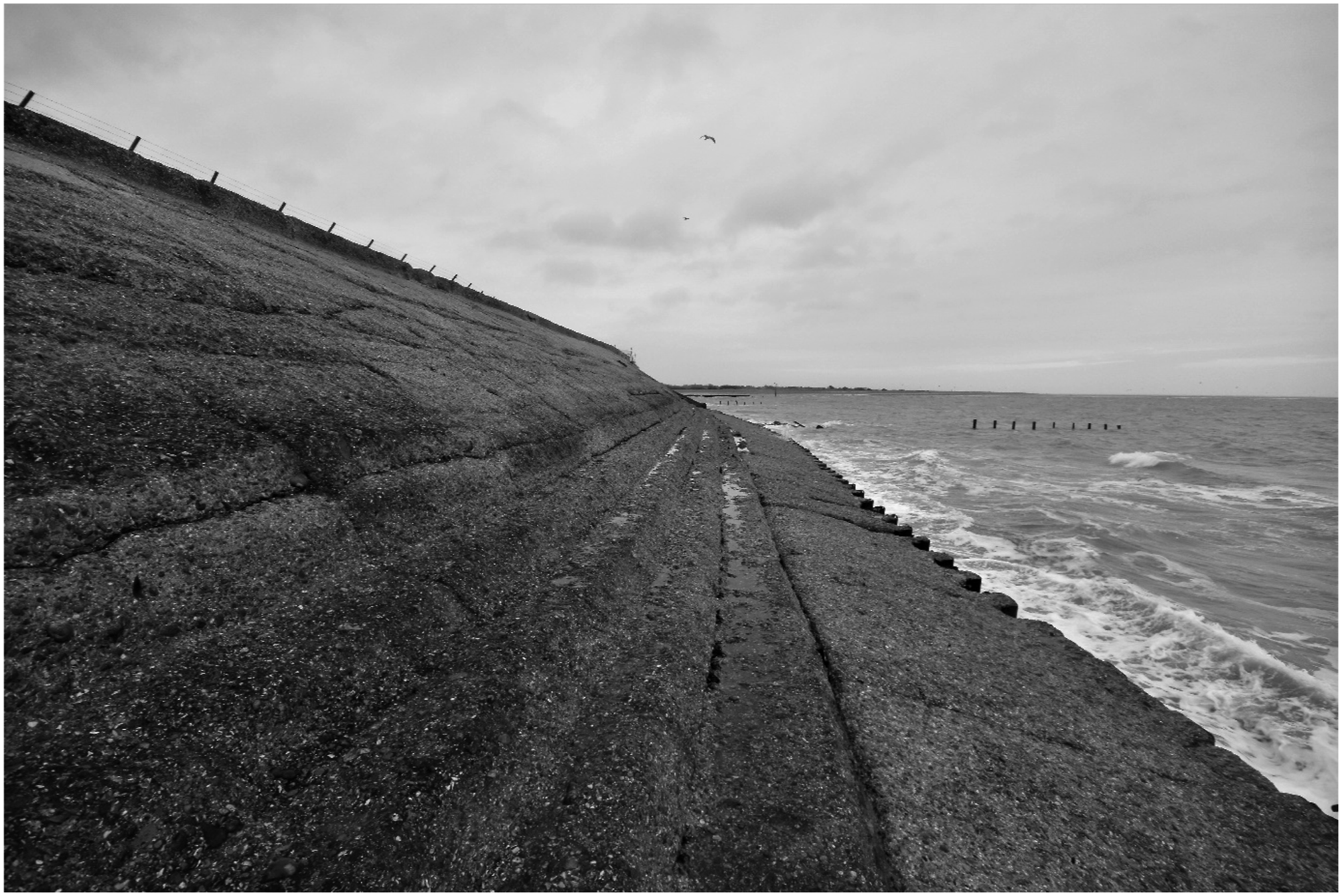
By drawing up barriers to the afront of the sea, we have corrupted the pattern and flow of drifted materials. In this urbanised and militarised borderland, the manufacture of coastal defences not only mitigates against the erosive characteristics of the sea but also brings them into harsh light. The corruption of drift is thus the restriction of material and displacement of energy acting upon an immovable and unnatural landscape designed to contain it. As such the materials of the Anthropocene form their own contours, marking the human effort to contain the lineation of the coastal borderland which in its natural state is forever mobile and unceasing in change. Here a landscape of permanence is cast upon the beach, the sea reclaiming fabric in abrasive motion willing a return to a ‘drifting’ state. Here the force of the sea is shown in brutalist measures, colliding with the materials of the Anthropocene – concrete, folded metal – with the enraged and unspent power of the waves (Figure 15 and 16).
In doing so the sea creates its own archaeology, wearing down the edge of human deposits built to contain it. It manipulates and forms its own stratigraphy on its enclosure. Patterns in hard rock are projected vertically, rather than laid out neatly across a sparse foreshore. What results is a patchwork of hydraulic action, repaired and patched up, maintained in a permanent state of stabilisation and management by human hands. The assemblage of containment left in an indefinitely unfinished state by the power of the sea, it maintains its power as one of chaos and rearrangement clawing at the edge of the human world. We reassemble and reshape our defence against it and manage its power through sea walls. We corrupt drift with groynes as a soft solution. Here is the Anthropocene at the borderland, drift and abandonment, the reality of a harsh landscape and the managed borderland that protects our solid terrestrial existence. Here the Anthropocene is grey (Figure 17). It is not a wilderness; it is not contained, yet the green of the biosphere has not laid claim. It is a borderland of contrast that exposes and erases human existence – wipes our footprints from the sand and protects our tellurian stasis. The sea is reclaiming, its materiality demanding of volume willing to contain more, absorbing and cyclic, empowered through persistency and ever-emerging potential. 44
Drift as an art-form
‘Humans are always in composition with nonhumanity, never outside a sticky web of connections or an ecology of matter’.
45
In greyscale, this landscape of the Anthropocene is indisputably abstract in its liminal shades. It is an unnatural manipulation of image and material from which further ontological questions are summoned; it plays with the juxtaposition of the Anthropocene and the often-harsh contrast of manmade material characteristics against the natural, rendering colour as flat to disguise the vividity of anthropogenic materials. Pétursdóttir’s assumptions of patina present the coast as a more-than-human environment whilst affording the landscape artistic merit by inviting an abstract consciousness. 46 Though expression of the Anthropocene is not always as vivid as the neon of plastics, even with such a patina it is still bold and present in such representation.
The artistic manipulation of drift has demonstrated how we imprint ourselves into the materials of the coastline in our refection of this borderland space, both with and without consciousness of it in a juxtaposition of conceptualisation. It exemplifies Ingold’s consideration of planetary and human processes as within a ‘meshwork’ of entanglements. 47 As such, drift has long been corrupted as a force of entanglement, manipulating materials into abstract art-forms that composes connections between matter and ontology.
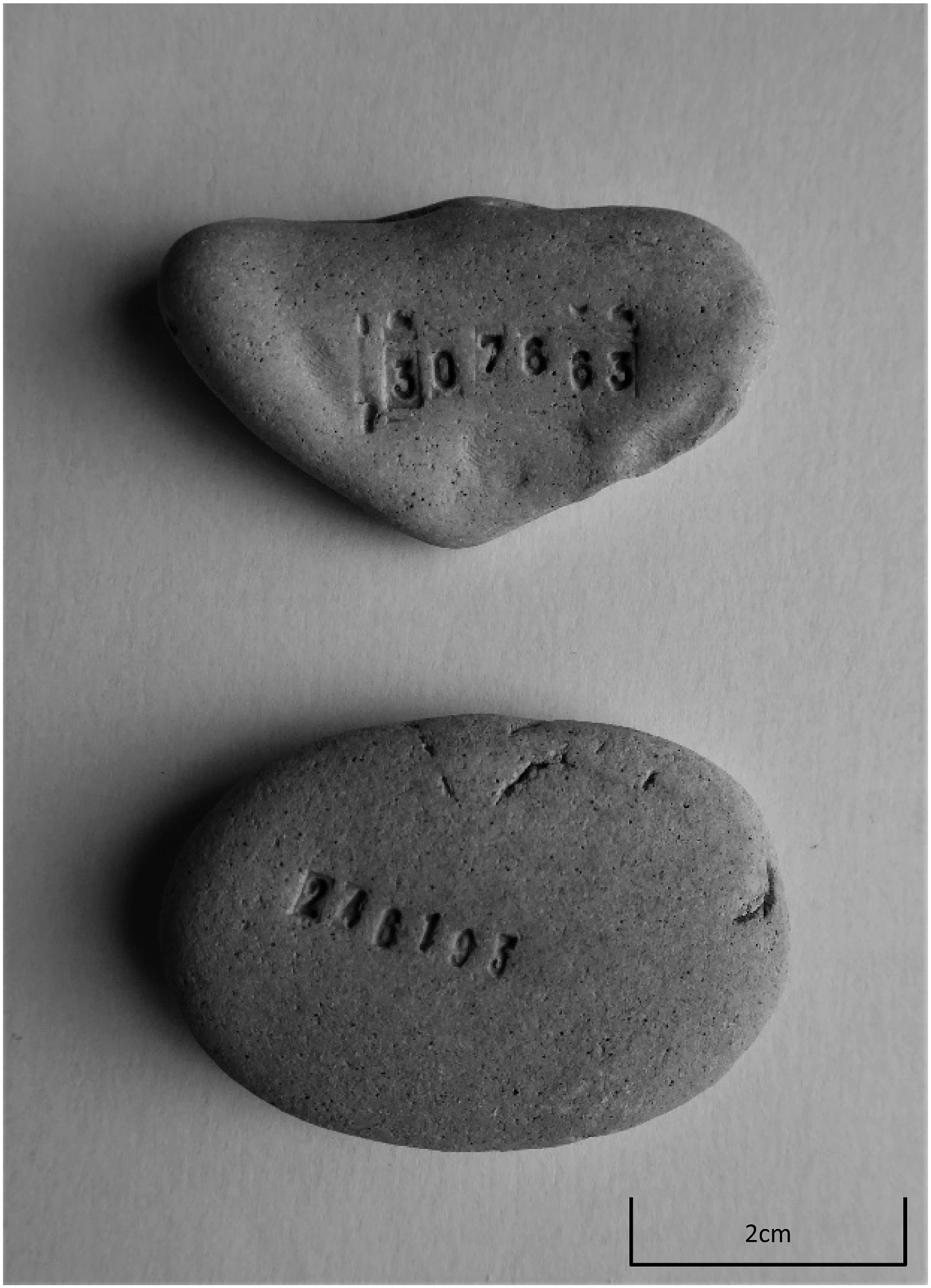
Found amongst the stones at the shoreline of the Solent-facing beach at Eastney, two curious ‘pebbles’ were collected during this study (Figure 18). Both stamped with a unique number for identification they also bear the fingerprint impressions from whoever made them. As part of a single sculpture, the ‘One Million pebbles’ was created by the Portsmouth-based artist Pete Codling who threw them into the Solent at some time between 1994 and 2010. 48 The project aimed ‘to create a handmade monument to the people, by the people, for the people … that would be subversively hidden’, amongst the materials of the south-coast beach. 49 It involved thousands of individuals over a 17-year period creating 500,000 decorated and stamped fired-clay pebbles that would then be thrown into the Solent by the bucket load at regular periods. Like the assemblages of drift, this project will remain forever unfinished; a lack of funding forcing its end, the pebbles made and released reaching only half of its intended number. However, this was never a project intended to be completed but to remain intertwined an in drift as ‘Objects of No fixed Abode’, that speaks directly to the collector. 50
Codling invites drift to be the primary manipulator of the many parts of this manmade sculpture, lending oceanic forces artistic licence to move, abrade, lose and discover. Drifts frictions, tensions and rhythms are thus exposed for their ‘breechings in notions of time’. 51 As an art-form, it leaves Eastney as a sculptural landscape forever incomplete, indiscriminately re-sorted and reformed. This is a more-than-human artwork that actualises Whatmore’s principle of an ‘ecology of matter’ 52 , binding together fragments of the artifactual and natural world in a random cohesion of materials. It is a material accumulation of both volume and identity.
Here, materials of human creation hide in plain sight without the need for a greyer patina then already provided by British weather. Even in greyscale, the abstract nature of this borderland between Portsea and the Solent is made brilliantly apparent. Drift here is not just something that happens unnoticed but is an understood manipulative force that exists in a constant state of reinterpretation. This conceptual art-form emphasises the unrelenting change of this environment and materialises the cultural infusion of landscape. It typifies Ingold’s assumptions of the material world being an unorganised divide in the displacement of matter. What is observed here is the melding of landscape with the dominance of human population who has come to understand the rhythmic, cyclic change and random manipulation of materials at the ‘dawn of the Anthropocene’ wherein we place ourselves within a narrative of geological deep time. 53
Conclusion
The sea and the Anthropocene each bear witness to the longevity and volatility of matter and thus serve as a reminder of unruly heritage. 54 Of historical revisionism and archeological practice, illuminating and reburying, drawing forth new understandings. Pétursdóttir compared drift to dark matter as an unknown, un-materialled entity that persists and shapes this world. 55 In both remote and urban studies, there can be witnessed a ‘drift’ in the Anthropocene; an unknown force that shapes our materials and culture that binds us together and pushes us apart, that remains intangible and unanswerable.
Ultimately, are we not all adrift? Drawn and shaped by invisible forces, reshaping and reconsidering our place in the Anthropocene. Codling’s pebble sculpture (see Figure 18) provides us a tangible reminder of the part we play, of humanities intertwinement and impact upon the environment we inhabit. Pétursdóttir reminds us of the scale of this impact and has furthered her discussion to consider how both physical and ideological climate changes have affected this shifting world. 56 The beaches of both Eastney and Eidsbukta are places of dynamic changes, of shifting materialism and ontologies; with the effects of climate change, these shifts and clashes of materiality are to become more voluminous. This watery boarderland is one of encroachment with new needs fortification and defence, of new political, social and economic conflicts subsequence of environmental change imposing across greater spaces, both off- and on-shore. The maritime landscape allows us to ponder upon the ontologies of space and time as an environment of constant creation and destruction, a volatile and persistent space that under the power of fluid motion is in continual production and displacement. 57 We must better understand as sea levels rise. However, this littoral space also offers mindfulness, to contemplate our own drift and perhaps conversely find some solidity; something we can tether ourselves to like an upturned boat (see Figure 9).
We invite ourselves into the materials of the shoreline, crossing and interacting with the borderline to understand or control the liquid hydrosphere, to experience it in all comparable dimensions and sensations. However, there is no neat divide as we apply ourselves so the sea from the coastal boarder; it acts upon us and our materials displacing and replacing just as we act upon it. As such we should think of the ocean as its own entity, having possession and malleability of material and philosophies; an actor creating meaning. 58 That in interacting with the hydrosphere ownership, identity and meaning are forever altered and made. Materials of the Anthropocene can transcend political, economic and cultural meanings enforced upon them by terrestrial perspectives and be found anew under the influence of drift. This malleability remains unseen yet evident in its persistent distortion and resorting of natural and synthetic materials, manipulating the stratigraphy and dimensions of each environment and coming to define our relationship to the maritime boarder.
What is evident from the comparison of study between the beaches of Eastney and Eidsbukta is that a reconsideration of the human and more-than-human experience of coastal regions will play an incremental role in forthcoming archaeological thinking as deposits of the Anthropocene amass on these planes of drift. 59 In review, these borderlands connect both the solid and fluid landscapes and describe the potential, coincidence and contingency of materials empowered by drift. From such study we can talk of things, materials and concepts outside of their original context and divulge narrative devoid of classification and definition. 60 We can realise the agglomeration of society and environment as a hybrid association of people and things drifted together, articulated in random and spontaneous disorder derived from an unknown source of ‘dark matter’.
Footnotes
Notes
Author Biography
 .
.