



Abstract
Part visual essay, the case study reported here considers the classist implications of over-attending to (spoken) language in the workplace. Rooted in the core principle of multimodality, the paper surfaces ways of doing/knowing which inevitably sit beside (next to) words, but which also sometimes exist besides (in spite of) words. The empirical stimulus for the paper is fieldwork conducted in Extremadura, Spain; here, in fields and factories, we find work that is highly accomplished and meticulously coordinated, but which for practical reasons is conducted almost entirely without speech – for hours on end. By privileging language work and “talk on the job”, discourse scholars not only misrecognize the complex semiotic organization of jobs but effectively sideline whole domains of working-class, manual labor. These matters thus have ethical and political ramifications as well as epistemological or methodological ones.
Not a syllable was breathed. Nothing was heard but the low, steady, over-ruling hum of the iron animals. The human voice was banished from the spot. Melville (2017 [1855]: 1506)
In 1855, Herman Melville published in Harper’s Magazine a short story titled “The Paradise of Bachelors and the Tartarus of Maids”. The story combines sketches of two very different working spaces. The first sketch depicts young male lawyers from one of London’s Inns of Court, gathered together to enjoy a sumptuous end-of-day meal. The second sketch depicts young women at work in a New England paper factory. The contrast is highly gendered and highly classed; it is also sociolinguistically structured. For the young men, working life takes place in an ordinarily tranquil, care-free paradise, and their sociable meal is full of “good talk” and “pleasant stories.” Melville sums things up as follows: “And throughout all this nothing loud, nothing unmannerly, nothing turbulent.” For the young women, however, things are very different. Working in the abysmal hell (Tartarus) of the factory, they appear to Melville like mere cogs in a vast machinery. More to the point, they are subsumed within the “low, steady, overruling hum of the iron animals” and must therefore work for hours on end in silence – theirs is a workplace where, says Melville, “the human voice was banished.”
Written nearly 170 years ago, Melville’s story captures nicely the straightforward point of my paper here. 1 Coming as no surprise to scholars of multimodality, there is an unfortunate but inherent bias in the prominence typically given to language in the workplace (see, for example, Vine, 2018) – and most especially language in its overtly spoken or written forms. This bias has ethical and political ramifications as well as epistemological and methodological ones. By privileging language work and “talk on the job” (both explained shortly), discourse scholars not only misrecognize the complex semiotic organization of jobs, but effectively sideline whole domains of working-class, manual labor. Even research which focuses specifically on so-called blue-collar work (see Lønsmann and Kraft, 2018 for an overview) and which otherwise attempts to redress the bourgeois tendencies of workplace discourse studies, this too can appear somewhat “professional” and “white-collar. 2 The contradiction arises partly through a determined – and important – effort to highlight how workers talk in and about their work, rather than (a) attending to more covert, indirect ways language is embedded in work, and/or (b) giving proper consideration to work which happens beside/s words – largely without speech, that is.
I will return to these biases in a moment, but I want first to say something about the empirical basis of the current paper. In early 2020, I received funding for implementing a discourse-focused commodity chain methodology (see Thurlow, 2020a) as part of a project titled Articulating Privilege. 3 In seeking to deepen geographical thinking in sociolinguistics, the main analytical intention has been to see what it might look like to de-fetishize a single text or practice: the business class airline meal, selected as an epitomic manifestation of contemporary privilege. Along these lines, I have been mapping together the different social voices and social worlds connected (hence articulated) through the production, consumption, and disposal of a business class meal. In Marxist terms, these are the social worlds typically obscured or erased in the manufacturing and exchange of goods (see Marx, 1909 [1857]: 81 et seq., on commodity fetishism). As with most commodity chain analyses, it is not necessary to examine everything; instead, key moments and indicative processes are selected for analysis. To this end, an analytic focal point in my study has ended up being one of the most basic of ingredients in many business class meals: the tomato.
In the wake of pandemic restrictions, the Articulating Privilege project has not focused on discourse in quite the way I had intended it; as such, I have not ended up listening to people so much as watching them. This has partly been a matter of social distancing and highly restricted access, but it also concerns the nature of work at the heart of tomato agriculture and production. In this sense, and following Bateman (2022: 42), the current paper offers itself as a small-scale case study – a “conjectural analysis” – foregrounding the materialities and bodily modes of multimodal practice. Admittedly not providing a detailed analysis of actual working practices in the way that Barndt (2002) does, the paper represents a supplementary intervention for multimodality studies by way of a disciplinary critique vis-à-vis workplace discourse studies.
My fieldwork encounters with tomatoes – especially wasted tomatoes like the ones shown in Figure 1 – have also prompted me to ask, where is a tomato? By asking this question, I consider what it might look like to “de-sign” or “de-symbolize” the tomato by centering its spatialities and materialities (Thurlow, 2023). The social life of a tomato most certainly does not reside solely or exclusively in its representation (cf. Appadurai, 1986); its meaning is not straightforwardly contained by the word T-O-M-A-T-O nor even by the thing itself. In principle, the tomato which ends up on the plate of a business class meal is constituted also by those left to rot in fields. By attending to the where (or how) rather than the what of tomatoes, the politics of a commodity chain analysis is also readily connected to the principles of non-representational theory – as I propose later, this is yet another way language is confirmed as partial and parochial. Wasted tomatoes left to rot on the edge of a field.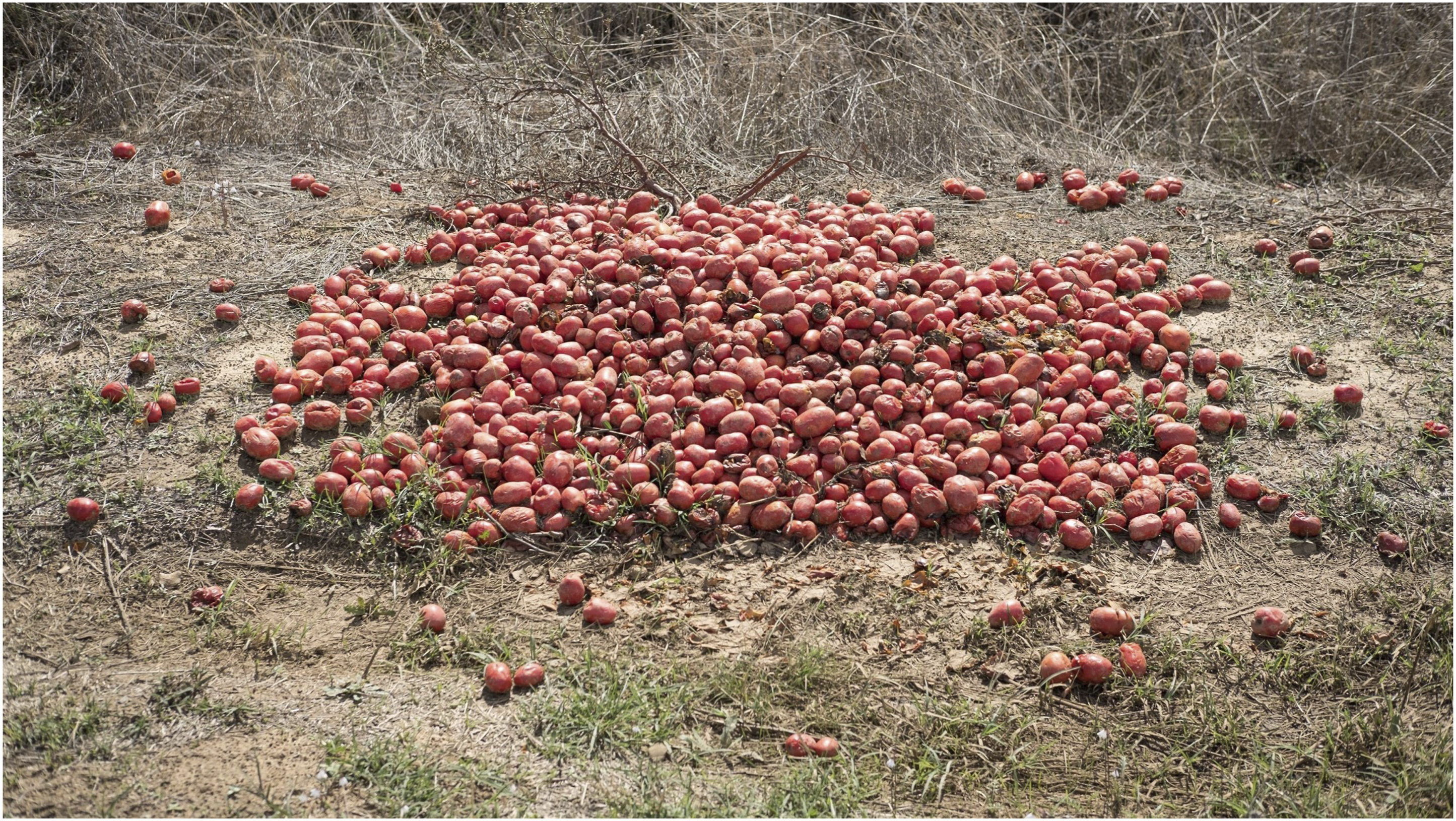
The bias of language and “language work”
Arising from my fieldwork, and as someone who has themself been heavily invested in the study of “language work” (Thurlow, 2020b), I have found myself observing and then thinking about working practices which are highly accomplished and meticulously coordinated, but which, for practical reasons, are conducted almost entirely outside spoken language. Ultimately, I have found myself confronted by – and entangled in – what Duchêne (2020) sees as the entrenched class biases of discourse studies. While the published geography of discourse studies is a very Northern and largely urban one (Britain, 2012; Bassey and Makoni, 2023), it also reinscribes a fairly middle-class gaze too (Machin and Richardson, 2008). The collective tendency appears to be a preference for familiar, accessible, and often quite tidy places. This most likely explains our lack of attention to waste, for example, and to the places and people who manage waste. There is, though, another way in which the field’s systemic class bias emerges.
In determinedly giving prominence (always or only) to language, discourse scholars are necessarily drawn towards certain practices and away from others. In the workplace, for example, the tendency has for so long been to focus on language work and/or “talk on the job”. Understandably but unfortunately, these priorities detract in problematic ways from the complex semiotic and embodied organization of jobs. These inherent biases also effectively sideline whole domains of working-class, manual labor which, for all sorts of concrete, structural and unequal reasons – are largely talk-free. As Kulick and Rydström (2015) observe from a very different perspective it is empirically and ethically unacceptable to predicate human agency and worth on the presence/absence of speech.
Scholarship on language work has been strongly motivated by an explicit concern for surfacing and/or legitimating the work of exploited “blue-collar” workers (e.g., Cameron, 2000; Duchêne, 2011; Heller, 2010). These scholarly engagements are always well-intentioned and politically spot-on; they have also made an important contribution to sociolinguistics. Once again, however, the collective investment in language means scholars can overestimate its importance in both semiotic and sociological terms. Language scholarship has certainly tended to sideline worlds of work where language is not only marginalized or less consequential, but where it is often rendered impossible by the inhospitable, antisocial setting in which work takes place for many people (cf. Hovens, 2020; Piller and Lising, 2014). In fact, working in a place where talk of any kind is feasible may, relatively speaking, be something of a privilege.
There are many places of work – many ways of working – which feel somewhat removed from the kinds of banter described by Daly et al. (2004) or by Holmes and Marra (2002). 4 In these cases, respectively, readers learn about the use of expletives and “whingeing,” and then how humor contributes to workplace culture. Language is evidently key to the management of interactions and identities, but for this, it must be possible in the first place. For many other kinds of workers, talk is actively discouraged, practically inconvenient, or just impossible. In a rare exception for workplace discourse studies, Piller and Lising (2014: 46–47) make precisely this point about migrant workers in a meat-processing and -packaging plant: “the speed and physically demanding nature of their work left virtually no scope for talk.” This is the kind of antisocial work setting which is my own focus in this paper: places where language undoubtedly exists but as something peripheral or “spectral” vis-à-vis the regular, routine work at hand. One might, for example, allow for the “documentary regimes” (Cavanaugh, 2016) structuring the work and/or the language of instruction inevitably “frozen” (cf Norris, 2004) into tasks: the numerous regulatory texts and instruction manuals by which the work has most probably been prefigured and organized. Working with otherwise complex interactional and human-machine processes, many people are nonetheless obliged to spend hours of the day working beside/s words – that is to say, without overt speech or writing.
In spite of its name and its origins, even ethnomethodology maintains a fairly narrow sense of “method”, one almost exclusively committed to demonstrating the role of language in work - as a means for organizing work. In reviewing Garfinkel’s (e.g., 1964) foundational approach to workplace studies, for example, Rawls (2008) highlights his interest in “orienting objects,” “mutually attended sequences,” and “situated actions”, none of which necessarily presuppose discursivity. However, Garfinkel ultimately prioritizes “accountability” – the sense in which actions are communicated, narrated, and otherwise discursively framed. 5 It is this priority which seems to have had a lasting impact on conversation analysis which, for all its multimodality (e.g., Heath and Luff, 2021; Mondada, 2011), is typically more concerned with documenting the way language organizes and structures work, rather than the other way round. Once again, therefore, it is talk (and texts) which are given priority and prominence, even if there are many settings where the machinery is overbearing and where mechanisms dictate the flow of work. Even, that is, when other semiotic modes and bodily actions are surely giving shape and meaning to workplace and other practices – not least of which are gestures (see Johnson, 1978) and movements (cf. Van Leeuwen, 2021).
Working with tomatoes and without words
Extremadura is one of Spain’s 17 autonomous communities, bordered by Portugal to the west and Andalusia to the south. Extremadura is also Spain’s poorest, most thinly populated autonomous community, with some of the highest unemployment rates in mainland Spain. Thanks in great part to the vast Guadiana river – Spain’s fourth longest – Extremadura is however home to the country’s most significant tomato agriculture and production. 6 In 2019, for example, Extremadura produced some 2.2 million metric tons of tomatoes. 7 By my calculation, that is something like 5.5 billion tins of chopped tomatoes.
The water from the Guadiana – and specifically its huge Orellana reservoir – makes possible a massive viaduct, canal and irrigation system feeding a vast fertile region known as Las Vegas Altas del Guadiana (see Figure 2). To give a sense of the scale and status of the tomato agriculture, there is Miajadas, a small town on the northern edge of Las Vegas Altas. With a population a little over 10,0000, Miajadas is a 20-min drive from Don Benito which is four times bigger and lies much more in the heart of the Altas Vegas region. This has not stopped Miajadas from declaring itself The Tomato Capital of Europe (see Thurlow, 2023, for more about this). Canal and irrigation system feeding Las Vegas Altas del Guadiana.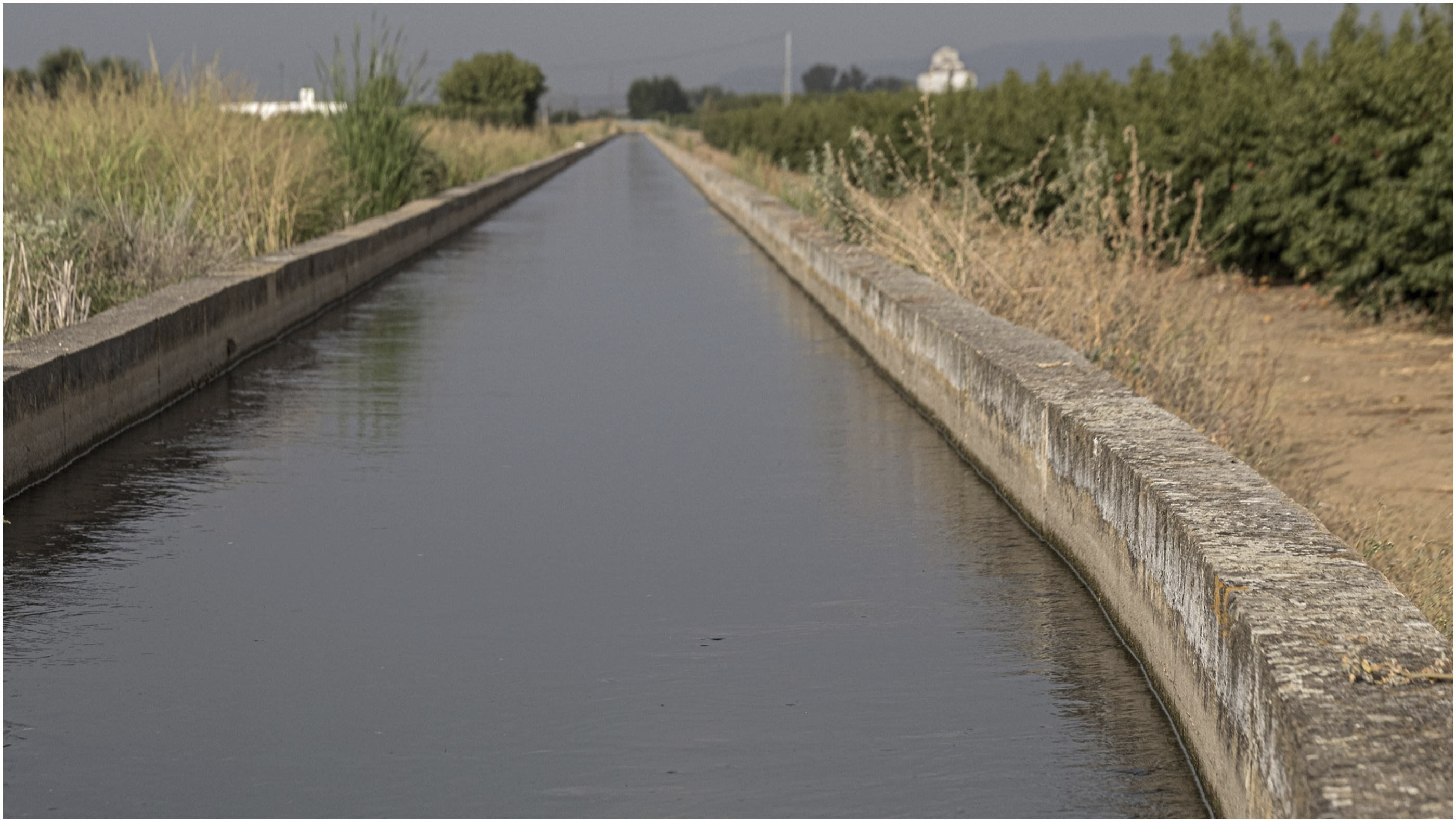
More than just a branding strategy, a spectacular tomato sculpture on the edge of town (Figure 3 Public landmark in Miajadas, Tomato Capital of Europe.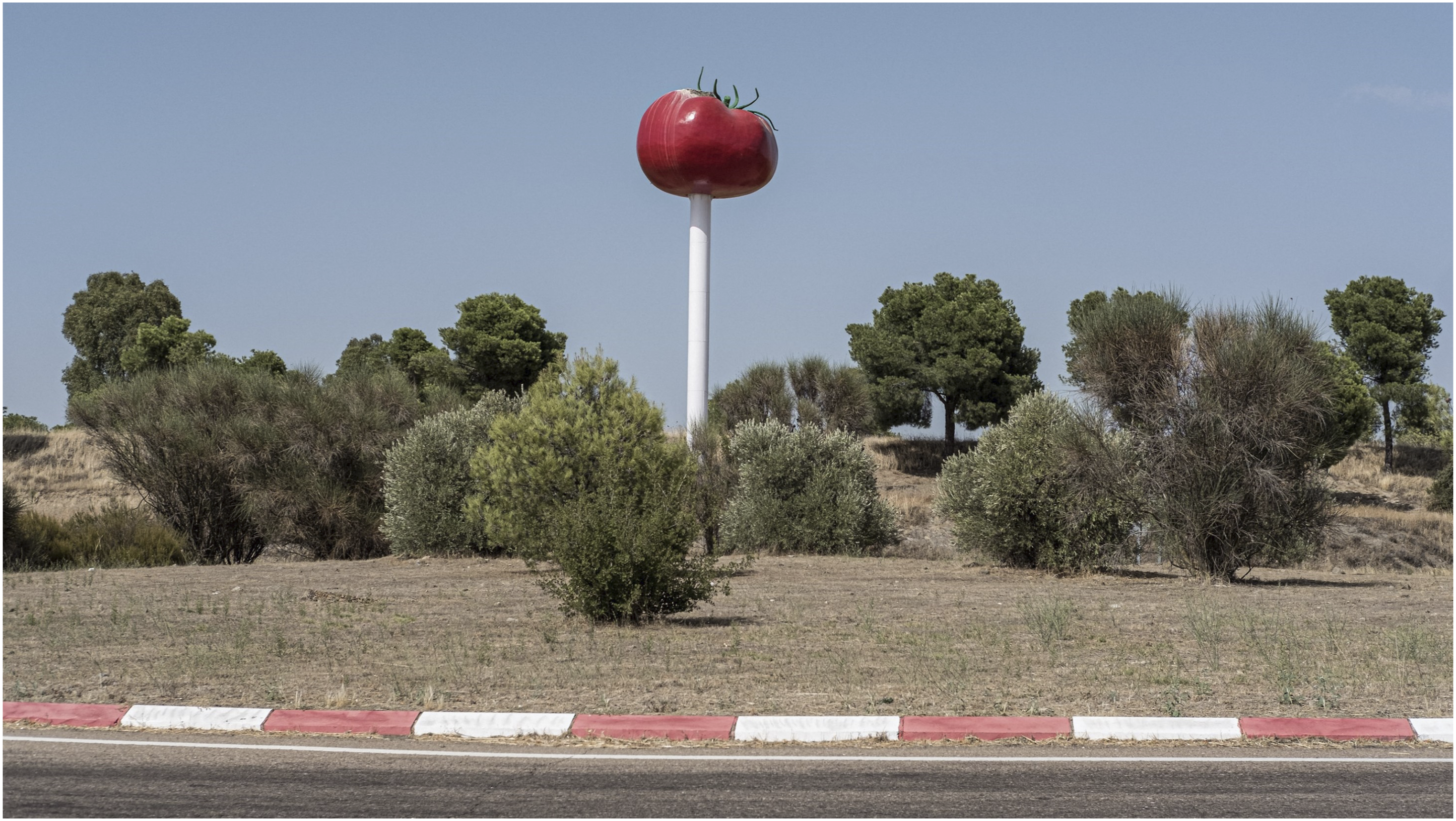
It is putting things mildly to say that tomatoes are big business in Miajadas and Extremadura as a whole. An image like the one in Figure 4 gives another sense of the scale of things: from just one of Miajadas’ production plants, this shows the holding area for tomatoes being delivered non-stop, everyday from the fields of Las Vegas Altas. Speaking of fields, I turn to the first of two key working sites. One of Miajadas’ tomato processing plants.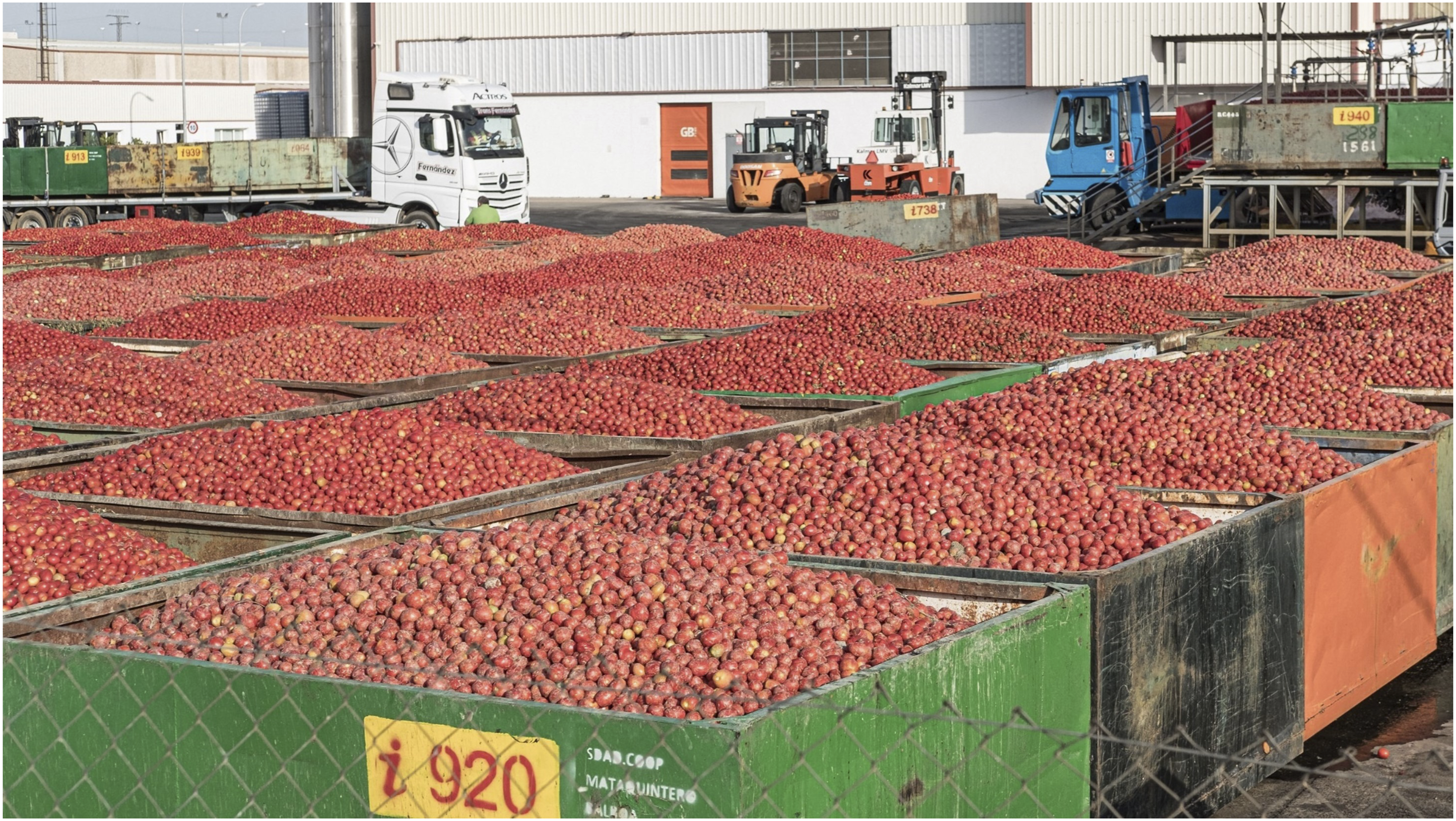
Part 1: The field
Access to workplaces in a time of pandemic was not easy. There is also a fraught ethics in interfering with – and taking time from – people working in quite demanding, extreme conditions. As it is, I had deliberately but not tactfully timed my fieldwork to coincide with the peak of the harvest season spread over a two and a half-week period in August, September, and October 2021. Before arriving, and because of pandemic-related restrictions, I had managed to secure only tentative or provisional access to processing plants.
Crisscrossing Extremadura by car, my photographer collaborator and I ended up spending hours – in some of the hottest and driest conditions imaginable – observing tomatoes being harvested. One of our richest encounters came after pulling off a main road, having spotted a team at work (see Figure 5). With permission from the farmer, and after assuring him we were only photographing not videoing, we started to get a sense of the way things worked. Harvesting Roma tomatoes in an Extremadura field.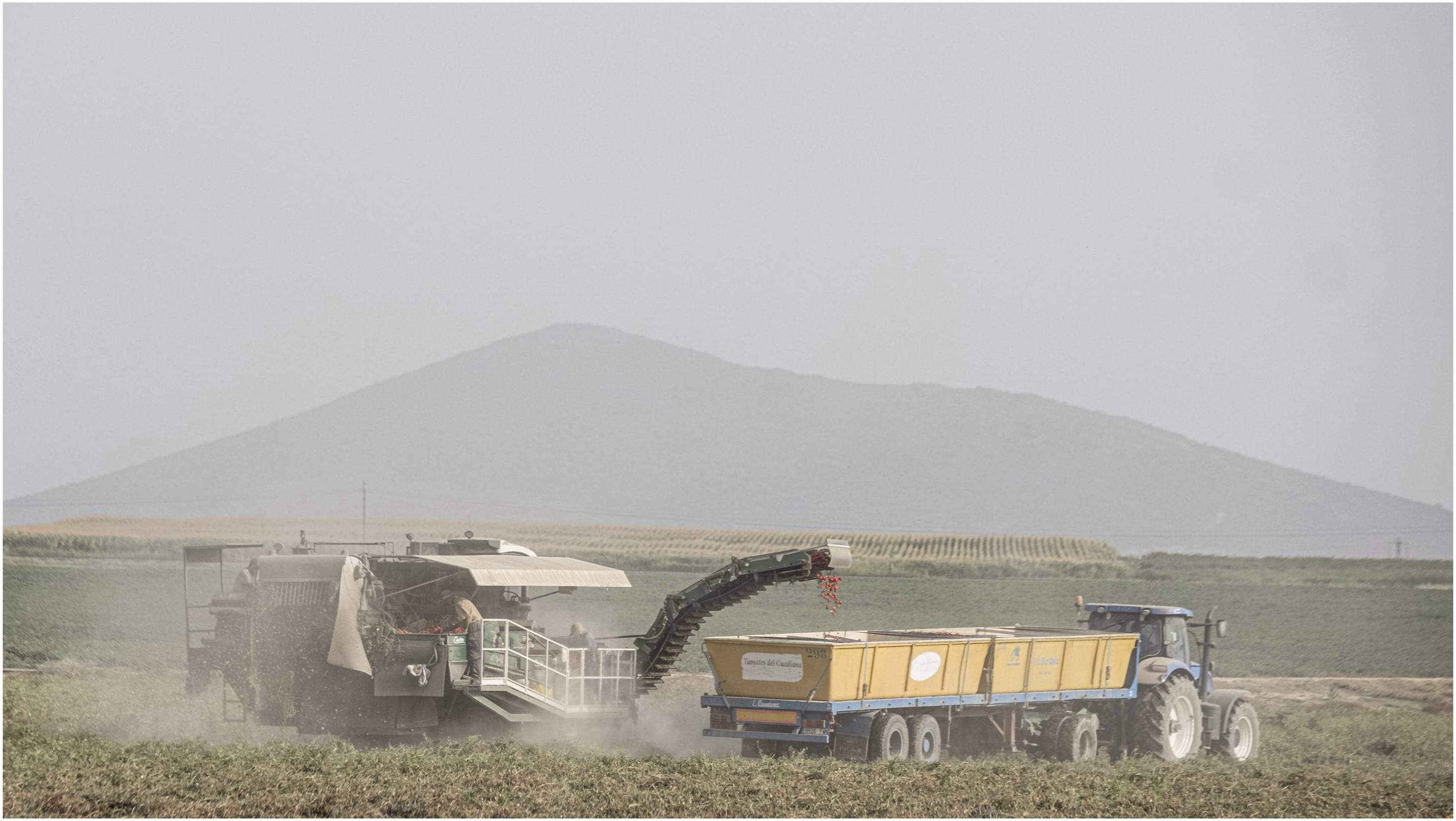
At this point, it is important to note that the tomatoes being grown and produced in this part of Spain are intended for processing. These are Roma tomatoes bred for their tough skins, all of which makes possible machine-harvesting which is unlike, say, the kind of tomato agriculture that happens in the Andalusian province of Almería – tomatoes which look much more like the ones in someone’s salad; these rely on hand-picking. None of which is to say that the work in Extremadura is necessarily any easier. The dust is visible in the image. As for the heat, my word will have to suffice: it was very, very hot – rising to 45°C (113°F). There was a strong, pervasive smell emanating from the pulverized, dust-mixed tomatoes left behind on the ground.
My focus in the context of this paper is the complex but noisy interaction between machines and humans happening in this work. I would like to give a feel for this (if I can) by way of the four-image montage in Figure 6. Montage showing harvesting choreography.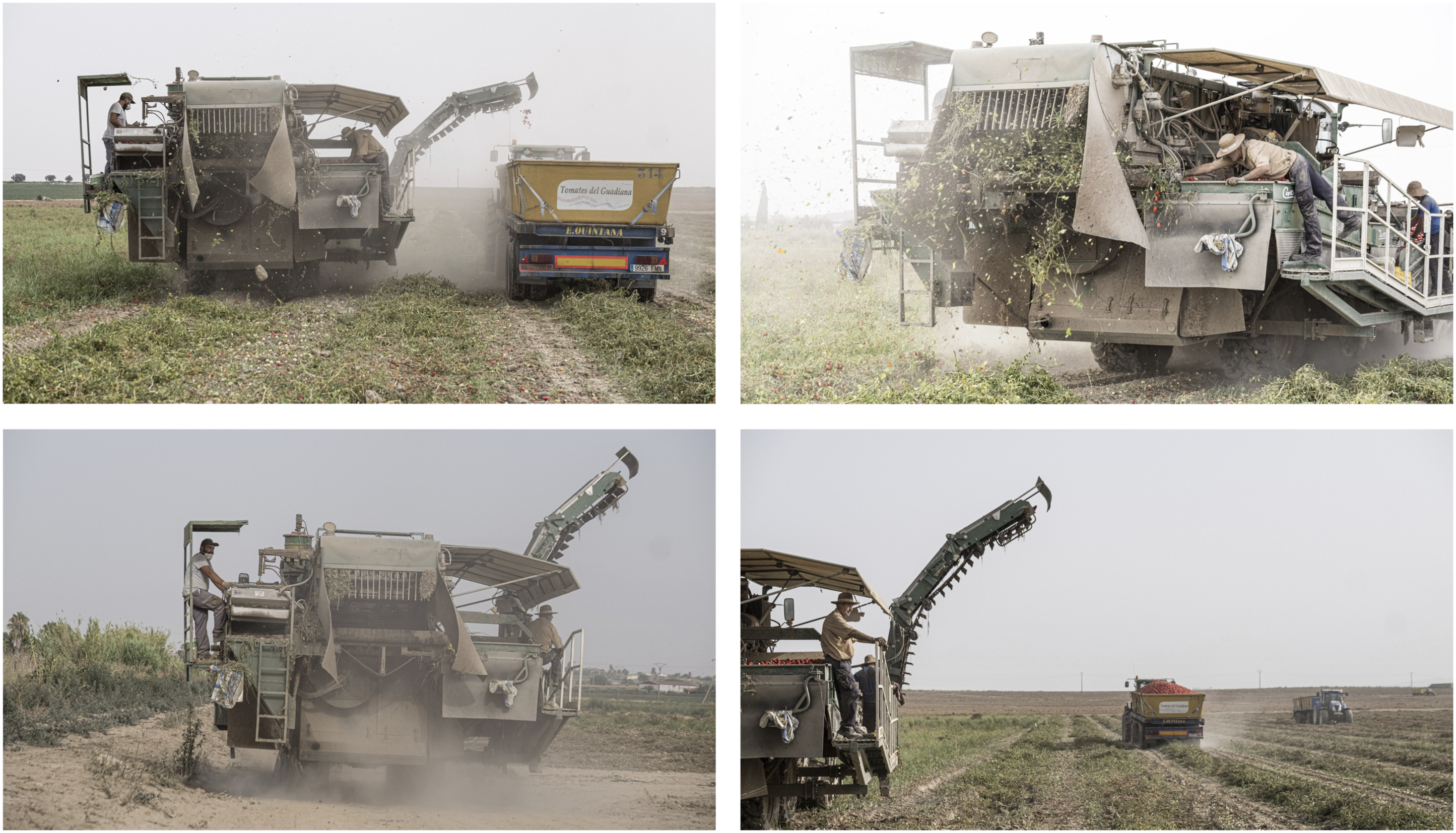
A team of four people work on the harvester itself: three at the back, one driving. There is also a driver in the truck which follows alongside. Two of the men at the back sort through the tomatoes, rapidly selecting out unripe tomatoes; the third man, on the other side of the machine, keeps the waste material from clogging as it passes out the back.
The harvester lines itself up and the tractor pulls in alongside. With a contorted squeaking sound, the feeding arm lowers into place, and the slow progression across the field begins. Each row takes about 20 min for one pass. 8 There is an incredible choreography between the tractor/trailer and the harvester: making sure the tomatoes are spewed into the trailer and then spread evenly across the bed of the trailer. With a little toot of the horn the harvester driver signals to the tractor driver to move forwards. What comes off the harvester is a vivid red spew. Later, as I will show, each truckload will be assessed for its weight but also the quality of the tomatoes – it will be valued and priced.
The harvesting machine looks like galumphing, lumbering Iron Man creature as it inelegantly turns in order to start consuming another row. Alternatively, it is like something out of a Heath Robinson cartoon, although a lot less whimsical. 9 In spite of the gigantic machinery, everything is executed in a delicately orchestrated procedure. This is an ostensibly automated process, but only just. It is only through the hands-on work – and technical skill – of the workers that the process is accomplished, and quality is maintained.
I am reluctant to romanticize this work in any way; to do so would be an act of pure condescension. This is not easy work, nor is it pleasant. Nonetheless, I call attention here to two aspects of the work. First, there are the prosthetically enhanced, embodied knowledges at work. While it is tempting to think of the men working for the machine, it also feels as if the machine is an extension of their bodies. 10 As I say, this is bulky work but also intricate and even delicate – both within the harvester but also between the harvester and the truck. Here the coordination is really striking. The truck gets very full, but the men appear to keep loading it without losing any tomatoes: some 20 feet of tomatoes poured into a mountain on the back of the truck. The two drivers cannot take their eye off the ball for a second. For all of them, it is a constant, relentless process with total concentration – the kind of concentration mythologized and celebrated when it happens in an operating theater. 11
The second aspect I want to highlight is this: it is all incredibly noisy work which somewhat paradoxically makes it also very silent work. For certain, there is no chance here for banter. This is work which is simply too tough for talk. Not only is the machinery incredibly noisy, the men are obviously also isolated from each other: in the harvester cabin or tractor cabin, or on the other side of the harvester – five people working together but effectively alone. Even when there is a momentary break between loads, the workers appear to seize the opportunity for silent respite. The work is not only noisy it is also demanding and exhausting. And it is relentless too.
No sooner has one truck been filled to capacity when another comes into view to take its place. And the whole noisy, dusty process starts up again. I later learned that, in this particular field, the men would be working (during peak season) from before dawn until after sunset – some 12 to 15 hours.
Elsewhere in the field (Figure 7), the previous truck driver works alone, undertaking another final, superficial sorting of the tomatoes (no green ones on the top) before netting the containers for transportation to a processing plant – the factory. A truckload of tomatoes being netted for transportation.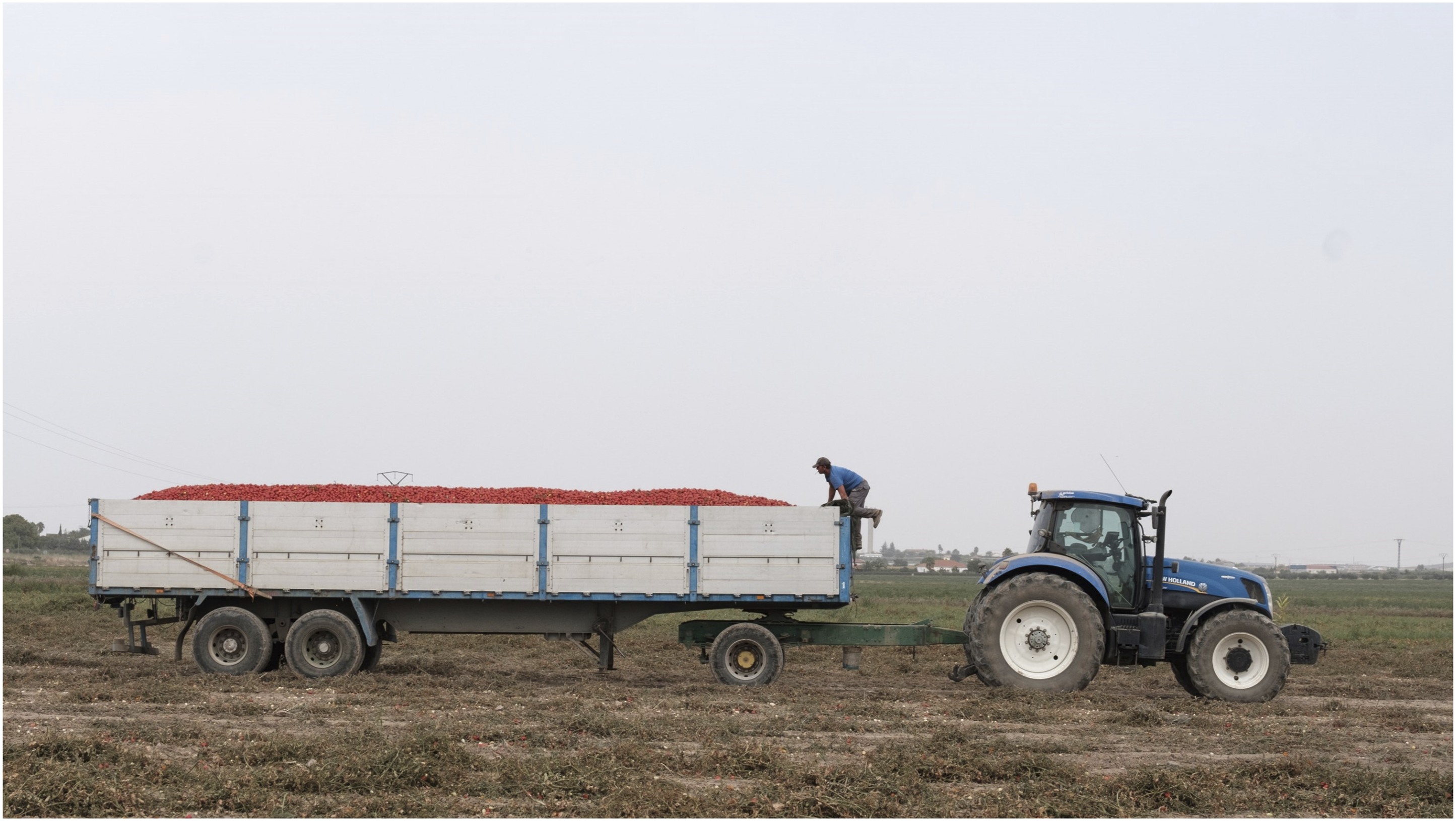
Part 2: The factory
My photographer collaborator and I struggled getting access to one of Extremadura’s processing plants where harvested tomatoes are turned into tinned tomatoes, tomato pastes, salsas and ketchup, and other derivatives. Even without additional restrictions brought about by the COVID pandemic, these facilities function with strict, medical-like hygiene protocols; they are also wary for proprietary reasons. Eventually, though, we did get access – tightly controlled and timed – to one of the large plants in Don Benito (not Miajadas). It was an eye-opening experience, partly as an ordinary citizen who, like most people, remains so ignorant about the origins of their food, but also as a researcher seeking to answer the question, where is a tomato?
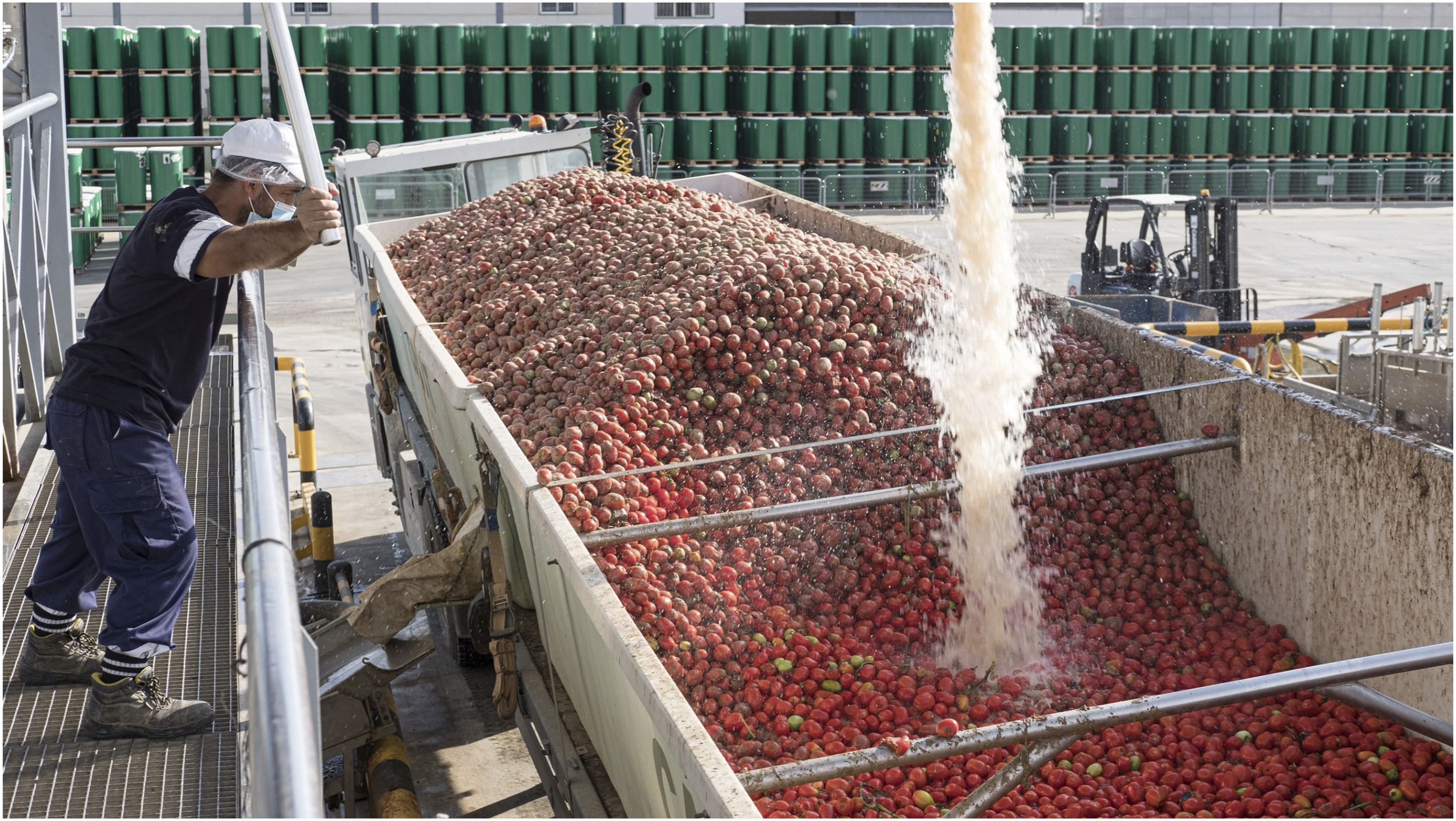
Arriving more or less directly from fields across the Las Vegas Altas region, loaded trucks pull into the processing plant. First, they must pass weigh-stations where samples are also taken for quality control – see Figure 8. This is the precise point at which the value of the load is given a price. This moment of arrival is another where a highly skilled choreography between humans and machines is revealed – see Figure 9. The work is, once again, noisy and, for the most and longest part, solitary. These men – and it was all men – guide huge hoses up and down, left and right across the containers, simultaneously washing the tomatoes and pushing them (with the force of the water) out of the containers into the underground conveyor system. Weigh stations and off-loading at a processing plant. Tomatoes being washed and pushed into the conveyor system.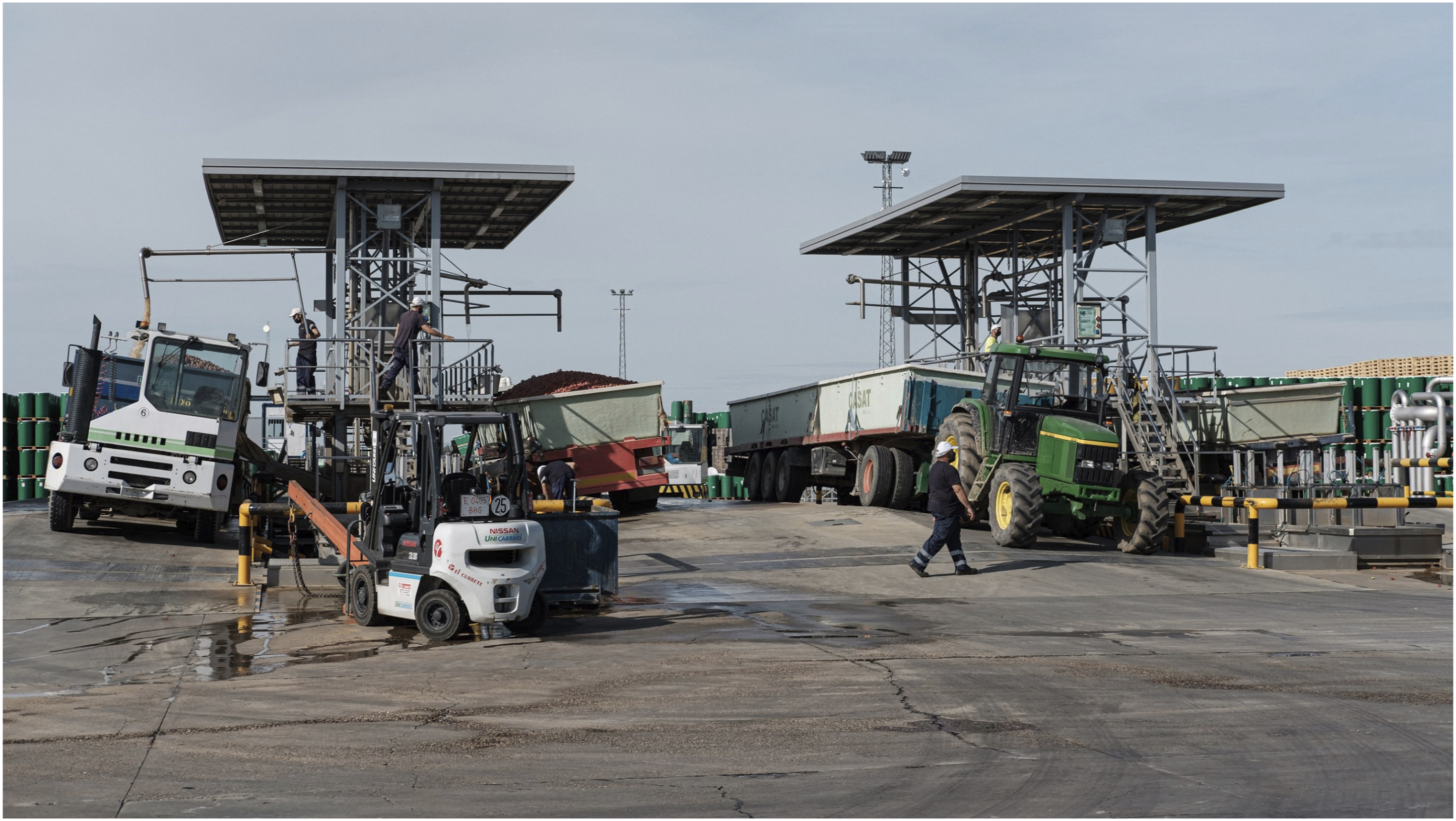
The pre-washed and partially sorted tomatoes then begin a high-tech processing journey as they enter the factory itself. More specific detail about the machine processing is beyond the scope of my paper and my understanding, but, again, I offer a four-image montage – the one in Figure 10. Montage showing the main tomato processing stages.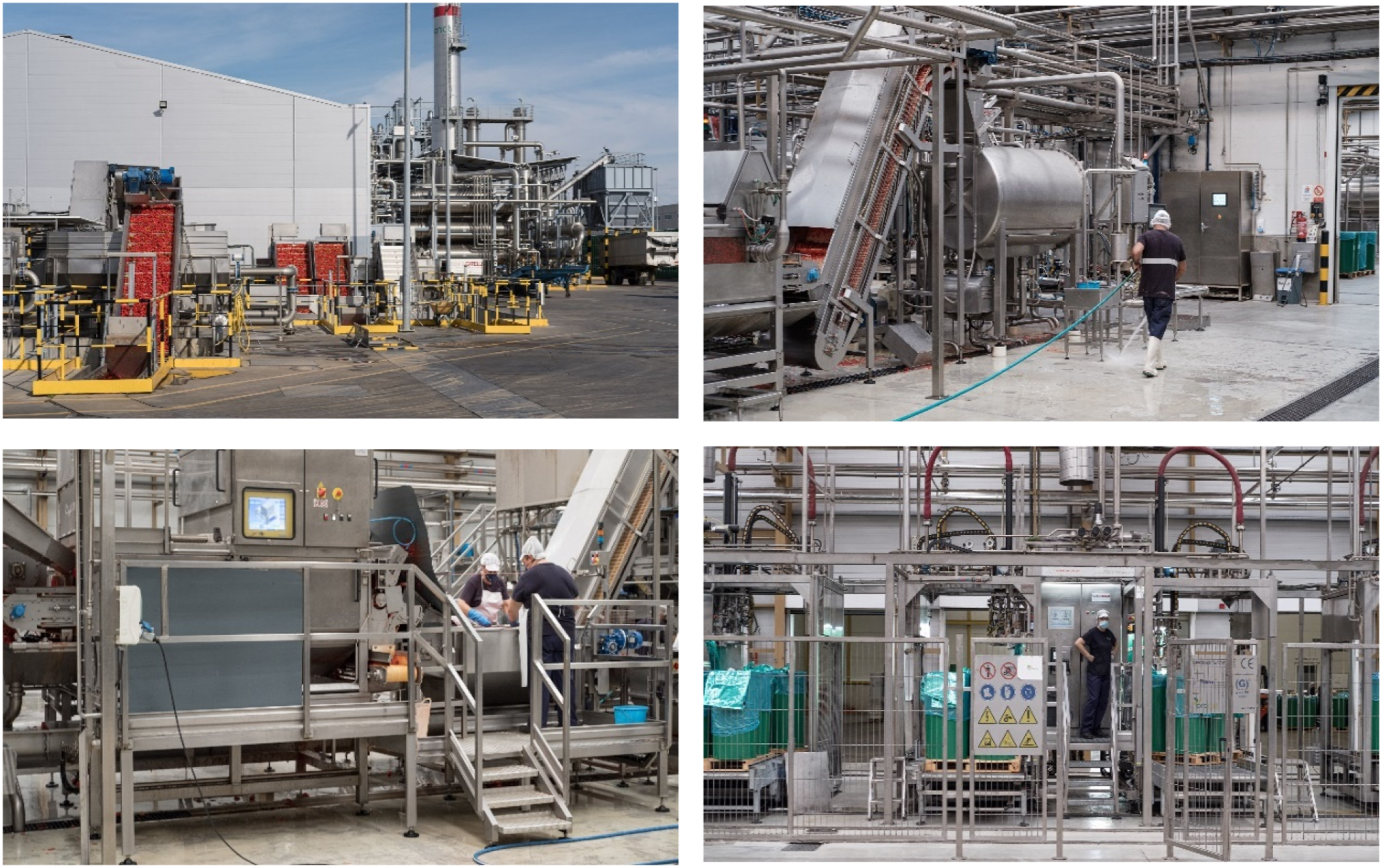
The red carpet of tomatoes is fed through a number of intricate, machine-driven sorting and preparation processes. Everything is remarkably clean and hygienic but also incredibly noisy. Once again, for all its automation, the process inevitably demands the hands-on labor and careful attention of people. These are some of the people who work in eight-hour shifts – three such shifts during peak season through the day and night.
It is here that we found women stepping into the work. The two women shown in the bottom-left image stand immediately across from each other and cannot take their eyes off the conveyor belt. The machinery is fast and loud. Once again, there is no chance for talking here. This is more of the same noisy silence – more work without words. Further down the line, we came across another woman, almost caged, working in concert with machinery. This time, the task is to oversee the bagging and binning of the finished product. Each barrel must be lined manually with a large green bag. This is even more solitary work – even more silent, no less noisy.
Conclusion: The partiality and provinciality of language
As an intellectual … I assume that I have a large responsibility to play my part in producing accounts of the world which are both apt, and which are not designed to advantage certain groups to the detriment of others. (Kress, 2015: 69)
From the outset, I have understood the current paper to be making a modest, supplementary intervention. This is most certainly the case for multimodality studies which is fundamentally grounded in a recognition of the “partiality” of modes, to use Kress’ (2015) terms, and most especially the modes of speech and writing. Notwithstanding, my small-scale case study offers itself a more targeted, disciplinary critique vis-à-vis workplace discourse studies and the classist implications of its over-attention to (spoken or written) language. Still following the lead of Kress – as quoted above – my contention is that, by privileging language work and “talk on the job”, discourse scholars not only misrecognize the complex semiotic organization of jobs but effectively sideline whole domains of working-class, manual labor which regularly and systematically occur besides words.
To be sure, the critique being advanced here is not simply directed at others; I myself have been academically invested in both language work and “talk on the job” in different ways. Nor is the intention to tell discourse scholars not to be discourse scholars – to suggest otherwise is patently daft or at least unreflexively defensive. There is surely a need for research centering language/s in the workplace, just as there is value in directing sociolinguistic attention to so-called blue-collar workers. As Gonçalves and Kelly-Holmes (2021) and their contributors demonstrate, regardless of how marginal language/s may be – or may seem to be – to the work at hand, words are often unjust, exploitative, and oppressive (see also Lorente, 2017). The goal of the current paper is rather to understand work in more multimodal and sociomaterial terms (cf also Jones, 2014) – in other words, to highlight practices which inevitably sit beside (or next to) words, or which sometimes exist besides (in spite of) words. In this sense, and borrowing from Chakrabarty (2000), the politic is not one of going “beyond” language but rather one of provincializing language, especially vis-à-vis material, embodied, and multisensory experiences.
In thinking through the sociomaterialities of both tomatoes and privilege, I have found myself orienting to Thrift’s (2008) non-representational theory (see Thurlow, 2016; cf also Lorimer, 2005) – an intervention aimed mostly or initially at geographers. Thrift’s main objective is to center embodied, material practices and everyday ad hoc knowledges; these are ways of doing and knowing which are – to use his terms – “fugitive”, “spurious,” and largely “pre-cognitive”. This, argues Thrift (2008: 91), is the dimension of beneath-the-surface paratexts: “‘invisible’ forms which structure how people write the world but which generally no longer receive attention because of their utter familiarity. … they have become a kind of epistemic wallpaper.” For my current purposes, the notion of the “paratext” has been very useful, mostly for its sense of implicit, habituated practice. In other words, practices which work at the level of procedural rather than declarative (or spoken) knowledge – maybe not unconscious but, at least, semi-conscious.
Non-representational theory is not without its limitations. In this regard, dissenting voices from within geography offer some useful insights for sociocultural linguistics too. Houston and Pulido (2002), for example, problematize both Thrift on non-representational theory and Butler (e.g., 1990) on performativity, insofar as her ideas have been taken up by geographers at least. Ultimately, argue Houston & Pulido, these are both approaches which can abstract the body too far; in Butler’s case, this is done by overdetermining the discursivity of the body, and in Thrift’s case it is done by decontextualizing the minutiae of bodily actions. By the same token, say Houston and Pulido (2002: 404), attention to bodily actions and embodied practices should not come at the expense of attention to the structural, economic conditions of – in their case – the “laboring body.” Invariably, therefore, there is a middle ground to be found between too much discourse on the one hand and too much materiality on the other. There is surely also a lesson here for those language scholars turning enthusiastically to the analysis of bodies and stuff.
Just as language scholars need always to be pressing at the borders of language, they also need to keep rethinking the boundaries of the field. In this regard, it is striking how many places sociolinguists hardly ever venture; notably, these include the fields and factories where so many people work every day – far more than work in schools, hospitals, or law firms. Nor is it just a matter of where one looks which counts; it is also how one looks or what one looks at which is important. As wordsmiths – relatively elite language workers and self-professed word experts – it is perhaps no wonder that sociocultural linguists think about the way words matter even when they clearly do not. Starting from the assumption that words always structure everything is, however, not only a rather self-referential point of view it is also a somewhat privileged perspective on the way the world works. And, as I say, these biases or oversights have ethical and political ramifications as well as epistemological and methodological ones; it is not just semiotic practices that end up being neglected but whole social worlds too. The challenge, then, is one already summed up nicely by Pennycook (2021: 234): “So let us sharpen our critiques of all that is unjust in the world, work towards more astute understandings of material conditions, and develop even better understandings of how language and work operate.” A loaded truck waiting silently for collection.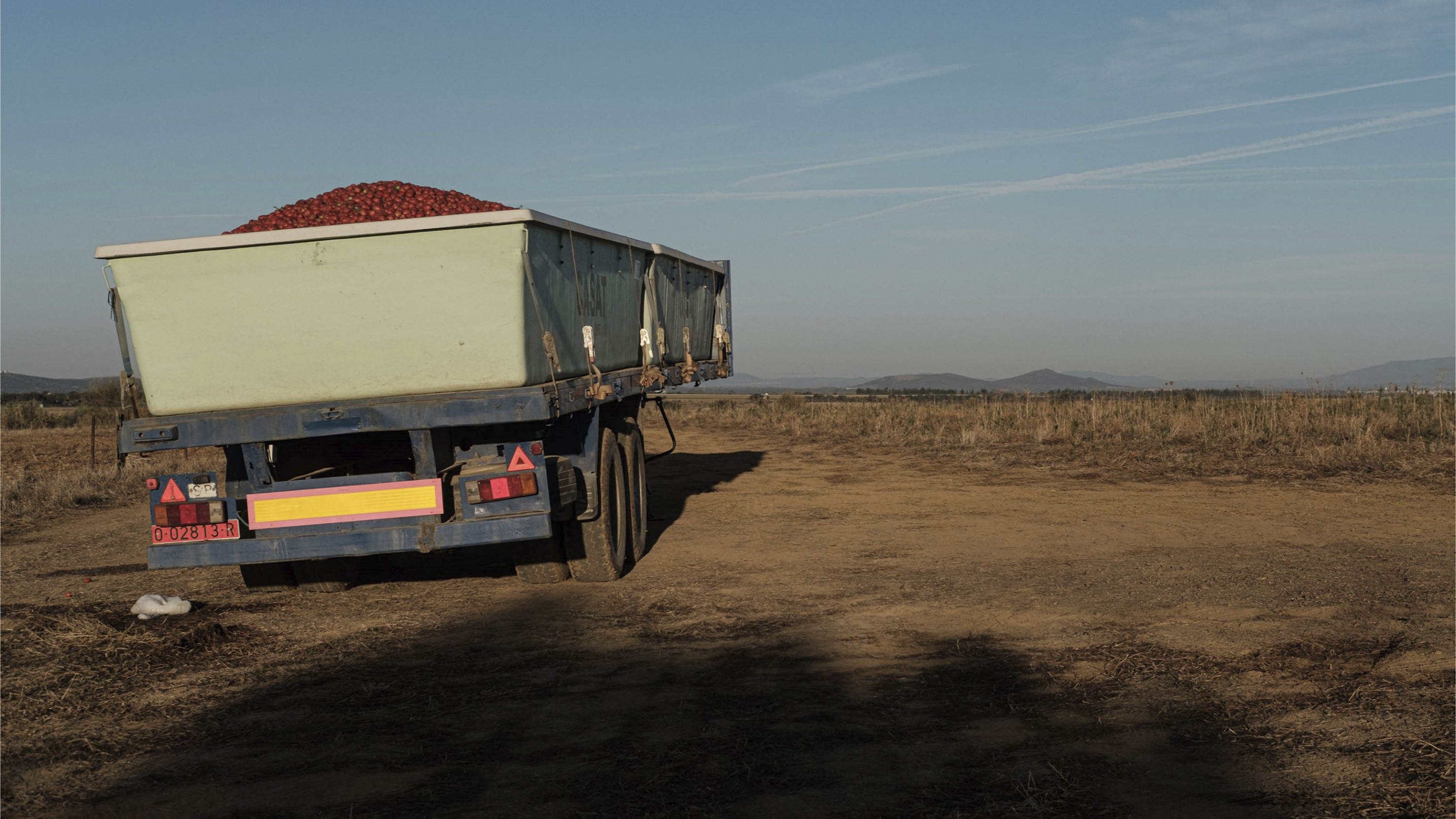
Footnotes
Acknowledgements
As the photos used here attest, I am hugely indebted to my collaboration with Bern-based photojournalist Daniel Rihs ( ). Anonymously, I am very grateful to the farmer who gave us permission to spend time in his field and the company which gave us access to their processing plant – this opportunity to watch and learn is definitely not taken for granted. I also thank Nick Spengler for telling me to read Melville’s short story, and my two reviewers for their constructive feedback and suggestions.
Declaration of conflicting interests
The author(s) declared no potential conflicts of interest with respect to the research, authorship, and/or publication of this article.
Funding
The author(s) disclosed receipt of the following financial support for the research, authorship, and/or publication of this article: This work was supported by this paper arises from the project Articulating Privilege: A New Geographical Methodology for Sociolinguistics funded by the Swiss National Science Foundation (CRSK-1_190183).