




Abstract
This article reflects on a transdisciplinary curricular project in a Japanese language course that employs audio–visual subtitling to promote students’ critical literacies in languages, cultures, and media. Drawing on Nornes’s (2015) notion of “sensuous subtitling,” which embraces the incorporation of the “materiality of language” into translation, we present how students’ experimental subtitlings potentially make a transformative intervention into how the characters are sensed and felt through film viewing. As Japanese-speaking women teaching Japanese language and culture at an English-speaking university in Canada, we use our bodies as racialized and racializing sites to explore the affective potentials of interlingual subtitles and their pedagogical implications. We reflect on students’ subtitling of Korean Japanese film Where Is the Moon (1993, dir. Yoichi Sai) that embodies race and senses through various cinematic techniques. Students’ subtitlings reshaped the “intercorporeal” space in which the cinematic bodies of the characters touch our bodies (Sekimoto and Brown, 2020).
Keywords
Introduction
This article reflects on a transdisciplinary curricular project implemented in an advanced Japanese language course co-taught by two instructors with different disciplinary expertise in media and cultural studies (Ayaka Yoshimizu) and applied linguistics and language studies (Saori Hoshi). Our collaborative instruction involves a practice of translanguaging (Li, 2018) where students constantly shuttle between English and Japanese in critiquing and generating new understandings of course materials. More specifically, we implemented English–Japanese and Japanese–English subtitling of audiovisual media that address the themes of gender, sexuality, race and colonialism, and aim to promote students’ critical and experimental approaches to subtitling as a process to negotiate, question, or subvert the oppressive forces of source and target languages and cultures. In this article, we explore how students’ subtitlings potentially make a transformative intervention into the ways in which the viewers experience race as a multisensory, affective event, which we conceptualize as the processes of transmediating race and senses.
Bringing together our respective disciplinary backgrounds in media and cultural studies and applied linguistics, we reflect on students’ subtitlings of Korean Japanese film Where Is the Moon (1993, dir. Yoichi Sai) where they translated and transmediated embodied expressions of race that are communicated through various cinematic techniques. As Nornes puts it, subtitling requires “extraordinarily close form of textual analysis where every element of verbal and visual language is read off the image, repeatedly, line by line, even frame by frame” (2007: 1) before making each subtitling choice. In our instruction, we draw our bodily attention to the affective and sensuous experience of film viewing in addition to optical and representational aspects of the cinematic text. Such experience has been theorized by film scholars as “haptic visuality” (Marks, 2002), “carnal experience” of films (Sobchack, 2004), or “tactile eyes” (Barker, 2009). By calling attention to the cinematic effect on bodies, students are encouraged to bring their awareness to not only the symbolic meanings of race but also their embodied experience of race and reflect on it critically as part of their subtitling process. In this paper, we discuss how students’ subtitles reshaped the intercorporeal site in which the cinematic bodies of the characters touch our bodies, affecting the way in which race is felt and sensed in the act of viewing (Sekimoto and Brown, 2020).
As Japanese-born, Japanese-speaking migrant women, who teach Japanese language and culture at an English-speaking university in Canada, we use our own bodies as racialized and racializing sites of knowing and examine the affective and transformative potentials of interlingual subtitles. Before we present our close and embodied reading of students’ subtitlings, we first introduce Sai’s film by situating it in the history of colonialism and race in Japan and outline our theoretical approach to subtitles as a multimodal site of transmediating race and senses. While avoiding medium essentialism or privileging of audiovisual translation as the most effective site for critical engagement with multimodality and race, we discuss how subtitles as a medium are capable of making a difference to the viewers’ cinematic experience of race in its unique, multisensorial way. We conclude our article by discussing some implications of sensuous subtitling as pedagogy to nurture anti-racist relationality.
Project context: “Race” in Japan
Our co-taught course entitled Japanese Media and Translation is a fourth-year Japanese language course. When we offered it in the fall of 2021 the class consisted of one advanced learner of Japanese, one Japanese heritage speaker with L1 English, and seven L1 speakers of Japanese with varied levels of English proficiency. All of the students had East Asian ancestral backgrounds. Students in this course are informed by sociolinguistics and critical subtitles studies 1 to deepen their knowledge of language and audiovisual translation, and produce their own English or Japanese subtitles of (un)translated films. Language acquisition not being the sole goal, this course employs a practice of translanguaging whereby instructors and students with diverse linguistic and cultural backgrounds shuffle between Japanese and English for class activities, including lecture, discussion, presentations, and group work. Ultimately, the goal of the course is to develop students’ translingual, transcultural, and transmedial literacies through their collaborative subtitling work. The course consists of three thematic units: (a) language and subtitling studies, (b) gender and sexuality, and (c) colonialism, race, and Indigeneity.
To introduce the unit titled “Colonialism, Race, and Indigeneity,” the class first examines how “race” in Japan has been constructed by providing the historical context of Japanese empire building and colonialism. This includes the discussion of how the category of the Yamato minzoku (people) was manufactured in the process of empire building and colonial expansion in an attempt to emulate and compete with the western empires; how the Yamato were constructed as direct descendants of the emperor, and thus the ideal ruler of East Asia and beyond; and how a mechanism of “race,” both similar to and different from its Western counterpart, was invented in Japan as a technology of colonial subjugation and population management, marker for hierarchization, and production of inequality (Morris-Suzuki, 1998; Oguma, 1998; Sakai, 1999). 2 Japan’s colonial subjects, such as Ainu, Ryūkyūans, Koreans, Taiwanese among others, have historically been viewed as inferior to the Yamato while actively being incorporated into the Japanese empire.
Our class also attends to more recent labor migrants from Southeast Asia, South America, Middle East among other places, who began to further diversify Japanese society in the mid-1980s. While filling the labor shortage of unskilled labor, these newcomer migrants with or without official legal status in Japan have hardly been integrated into Japanese society and are sometimes pushed into the underground economy, given restricted rights to live and work in Japan and access to social benefits (Shin, 2010). In the first part of this section of the course, therefore, students learn how “race” is constituted by multiple factors such as language, culture, and citizenship, in addition to blood, lineage, and physiological characteristics (Yamashiro, 2013).
Despite having a multiracial, multiethnic, and multicultural history Japan is hardly perceived as such today. Quite contrary, the idea that the Japanese have always been a racially, ethnically, culturally, and linguistically “homogeneous people” (tan’itsu minzoku) became prevalent in the post-WWII period and continues to be widely accepted and even reinforced in recent years among powerful conservative politicians who publicly proclaim such ideas and right-wing history education that significantly downplays Japan’s colonial past. 3 Sai’s film Where Is the Moon is an important educational resource as it makes visible and portrays the complex identities of the members of colonial migrants from Japan’s colonial period and labor migrants who began to arrive in Japan in the post-WWII neo-colonial context.
Race and senses in
Where Is the Moon
Tsuki wa docchi ni deteiru (Where Is the Moon, 1993) is based on a novel entitled Taxi kyosokyoku (Taxi Crazy Rhapsody) (1981) by Yang Sol-gil, a Zainichi Korean (Korean migrants who moved to Japan during the colonial period and their descendants) writer. This was adapted into a film by a Zainichi director (Sai), a Zainichi scriptwriter (Chong Wushin), and a Zainichi producer (Lee Bongou). Distributed by Cinequanon, a Zainichi film company, it is the first Zainichi crossover film that grew in popularity and achieved distribution and commercial success. Most importantly, the film marked its significant departure from and even successfully satirized the conventional representation of Zainichi that had stereotypically depicted them as victims of discrimination and poverty, and the source of social problems (Dew, 2016; Ko, 2010).
Sai’s film features Tadao, a second-generation Zainichi taxi driver, his first-generation Zainichi mother, and Connie, a Filipinx migrant who works at a so-called “Philippines-themed pub,” a bar staffed by Filipina hostesses, owned by Tadao’s mother. Other characters include: yakuzas, an Iranian driver, an ex-boxer with chronic brain damage, a stutterer, and a taxi driver who used to be a member of the Self Defence Forces and has no sense of direction. Being surrounded by characters who are variously marginalized in Japanese society, Tadao and Connie’s racial differences do not necessarily reinforce the binary between the Yamato and its racial others and rather showcase the diversity among people who live in contemporary Japanese society. In fact, the film critically appropriates and transforms stereotypes of Zainichi by refusing to characterize Tadao neither as a poor Korean nor as a Korean yakuza, but as a cheerful and loveable man you could easily encounter in our everyday life (Ko, 2010). As we will detail below, the representation of Connie similarly marks a departure from typical portrayals of Filipinx workers in sexual services industries in Japan.
To fully understand how the racial stereotypes of Zainichi Koreans and Filipinx migrant workers are presented, critiqued, and subverted cinematically, Sekimoto and Brown’s (2020) theorization of race and racism is particularly useful. In Race and the Senses (2020), they conceptualize race and racism as “assemblages of somatosensory experiences and intersubjective affectivity” (21). Rather than a social construction, a set of ideas, or a discursive formation, race is an embodied “event,” a site for body-to-body encounters, interactions, and transformation. Racist exclusion and violence happen when a particular type of body gets turned into a tangible object that looks, smells, sounds, feels, and tastes in certain ways, different from how the body of the individuals that are part of the dominant or privileged population do. Contrary to the widely held notion of our sensory perception to be individual, biological, and unmediated by social and cultural processes, senses are in fact social, cultural and have been used as a political tool to produce inequality and stereotypes and for exclusion and othering (Bull et al., 2006; Classen, 1993; Hertzfeld, 2001; Howes, 2022; Manalansan, 2006).
In Where Is the Moon , Connie’s racial difference is more easily noticeable by her look compared to Tadao who can easily pass as Japanese. At one moment in the film, Tadao’s co-worker Hoso explicitly makes comments on her “dark” skin. On the other hand, Tadao’s difference is instead primarily racialized by how he and other Zainichi Koreans sound, smell, taste, and feel like. Apart from the repeated line that Hoso outwardly utters, “I hate Koreans, but I like you Chu-san,” the viewer encounters Tadao’s experience of racism most explicitly in the sequence of interaction between Tadao and his customer in the cab. Their conversation is triggered by the customer who notices Tadao’s name, Kan Ch'ung-nam (姜忠男), displayed on the dashboard. The customer says, “I know this character. ‘Ga’ in shōga 生姜 (ginger). Is your name Ga, driver?” The only occasion when he (and many other Japanese people) sees this Chinese character is in the word shōga 生姜, food that is strongly associated with the Chinese. After Tadao corrects the customer by replying, “I’m Kan,” the customer ignores it (he keeps calling Tadao “Mr Ga” afterward) and immediately follows up with another question, “Are you Chinese?” In this interaction, Tadao is othered by how his name is incorrectly read out loud as “Ga”—the sound of the word feels even more foreign than the look of the character does—and the flavor and smell of ginger evoked by the customer’s line. When Tadao corrects the customer again by saying, “I’m Korean,” the customer goes on to talk about his “Zainichi friend” from his childhood. When he visited the friend’s house and ate the apples the family served him, he recollects, “they tasted like kimchi” and, in fact, everything at his home “smelled like kimchi.”
Korean race is also constructed by affectivity and, namely, how their “blood boils” so easily. The reference to the stereotype of Zainichi Koreans as “violent” (Wada-Marciano, 2012: 117; Dew, 2016: 101) is made elsewhere in the film but it is brought up again by the Japanese customer on the cab. After questioning the validity of the Japanese military’s “comfort women” system to be an issue of political debate, the customer mentions the 1992 Los Angeles riots and says, “That was wild. They (Koreans) fired many shots.” By this time Tadao sees no point in correcting the customer and simply replies, “They are scary, aren’t they.”
In Where Is the Moon , we argue that the complexities of how the main characters perform their identities and negotiate and subvert racial stereotypes can be experienced most profoundly in the ways they talk and sound, and particularly, their translanguaging practice, where they juggle Japanese and English, Tagalog, and/or Korean. Furthermore, one interesting characteristic of Connie is her excellent command of the Osaka dialect. In fact, while Ko (2010) suggests that the film’s representation of Connie “does not show any dramatic departure from conventional images of Filipinx immigrants” (157), we contend that Connie’s vigorous use of the regional dialect not only overturns stereotypical images of foreigners held by Japanese people as not competent in the language and dialects (SturtzSreetharan, 2015), but also reinforces her subversive identity who, as a transnational migrant living in Tokyo, would not conform to the convention of speaking Standard Japanese, or a Tokyo dialect, that both Tadao and his mother use. Connie’s unconventional representation in the film suggests a challenge to linguistic racism against transnational migrants in Japan as well as the exploitative relationship between Connie as a migrant worker with precarious immigration status and Tadao’s mother as a business owner. In our teaching context, her use of Osaka dialect made our students, who mostly identify themselves as “competent” Japanese speakers, aware that their knowledge of language is still incomplete and that they are less competent in the specific dialect used by a supposedly “foreign” character.
However, subtitling can significantly change the way the characters and their identities are perceived by the viewer who relies on interlingual translation. Before presenting our analysis of students’ subtitling works and their embodied effects, we discuss how we approach subtitles as a multimodal, sensuous, and affective medium in the context of our teaching.
Subtitling, multimodality, and senses
Gambier (2013) writes that audiovisual translation is “mainly concerned with the transfer of multimodal and multimedia speech...into another language/culture” (45). Interlingual subtitling is a specific type of audiovisual media translation where spoken dialog in one language is transferred or transmediated into written texts in another. Gambier’s definition is noteworthy because it immediately allows us to recognize subtitling as a site of transmediality. As a form of translation, subtitles intermediate, or “bridge,” languages and cultures for foreign viewers, while transferring the spoken dialog into written text (Elleström, 2021). While, at one level, subtitling is a “mimetic process that aims to reproduce the semantics, style and other verbal elements,” at another level, it is simultaneously a highly creative process that results in the production of a “new audiovisual text which differs from the source text in terms of both form (subtitles are added) and function (different audiences are targeted)” (Kapsaskis, 2020: 555). As such, subtitling can also transform as much as retain the meaning and affective textuality of the original work (Elleström and Salmose, 2019).
In addition to being a site of transmediation, subtitles are also a multimodal medium by its own light. Subtitles are essentially “written text” that usually appears “at the lower part of the screen” (Diaz Cintas and Ramael, 2007: 207). In this sense, they emerge as a new formal element that is added to the original media product. As Flynn (2016) suggests, subtitles are simultaneously written text, and communicates to us at a linguistic level, but also graphic marks, which also engages us visually. When we write subtitles are multimodal, we draw on the notions of communicative modes “as complex, constructed, impure hybrids, with crucial overlaps” (Fornäs, 2002: 89) where any mode of representation (writing, speech, audiovisual texts, etc.) can engage us in multisensorial ways and be experienced simultaneously linguistically, visually, aurally, haptically, olfactorily, and so on (Bal, 2003; Lehtonen, 2000). As a multimodal medium, subtitles can also transmediate and newly produce non-representational, spatiotemporal, sensorial, and affective effects that cannot be reduced to discursive communicative processes of interpretation and meaning-making (Elleström, 2021; Flynn, 2016).
While subtitles occupy an ambivalent status in the realm of audiovisual culture and are often treated as “an invisible superimposition, unlike the traditional superimposition of either sound or image” (Sinha 2004: 173), “bad” subtitles can also be hypervisible to the point where they cause affective and embodied responses ranging from fatigue and disengagement to frustration and even resentment (Flynn, 2016; Nornes, 2007; Sinha, 2004). In other words, subtitles become part of the “media assemblage” that shape our embodied viewing experience as a whole (Flynn, 2016).
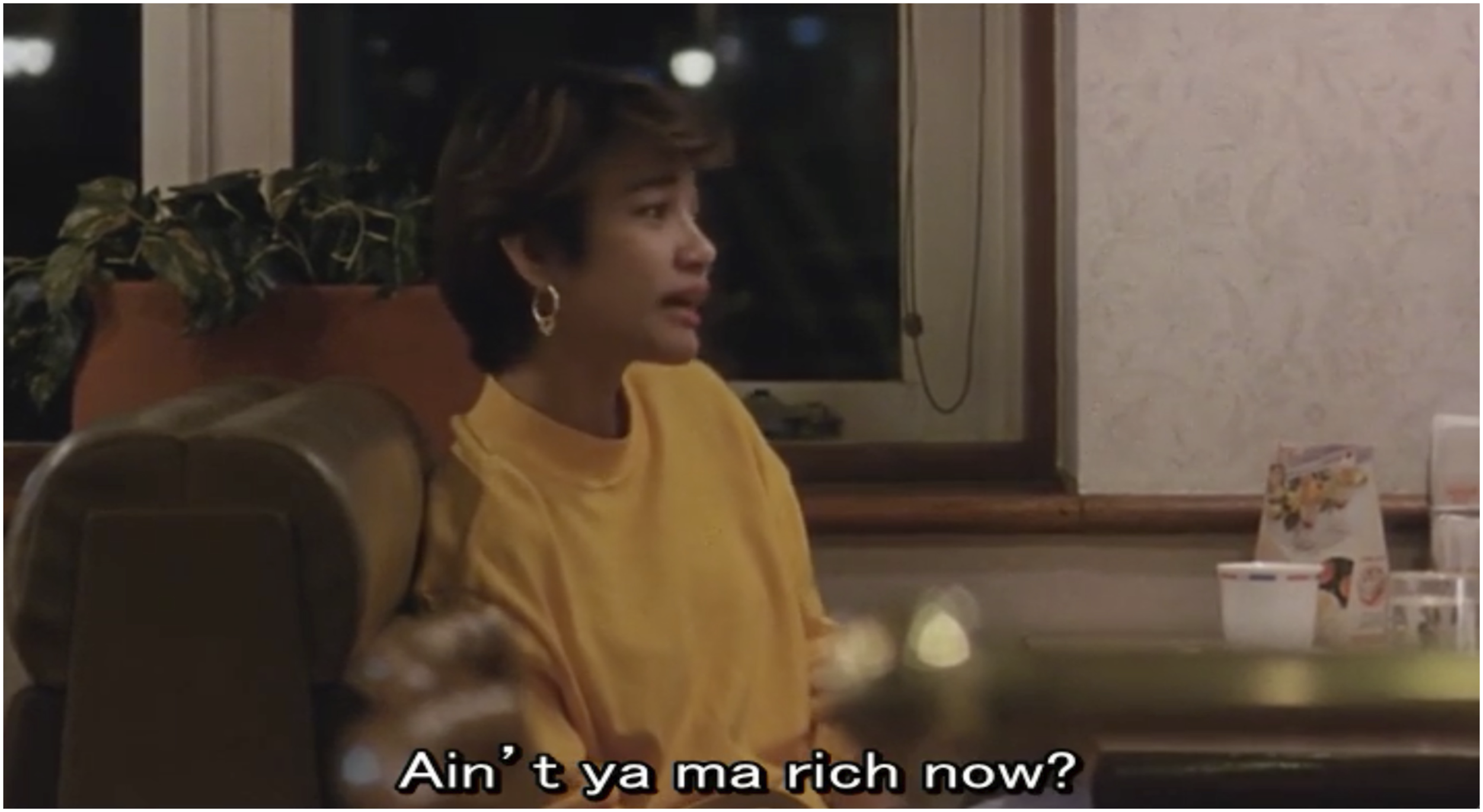
When we compare the subtitling works by Group #1 and Group #2 on Connie’s same line (see Figures 1 and 2), for example, the difference between the two are evident not only at a linguistic and semantic level, but also as graphic marks, where they are located and how they interact with other formal elements within the frame, and how they affect us the viewer at a non-representational level. Here, the subtitles by Group #1 (Figure 1) is placed right in front of Connie’s month and draws the viewer’s attention to the upper half of the screen. The use of the thick shadow font highlights the words themselves against the images that are now relegated to the background. In contrast, the subtitling by Group #2 (Figure 2), which appears at the bottom of the screen, renders the images central. The use of the wider font makes the words look less tense and adds lighter tones to Connie’s utterance. Subtitling by Group #1. Subtitling by Group #2.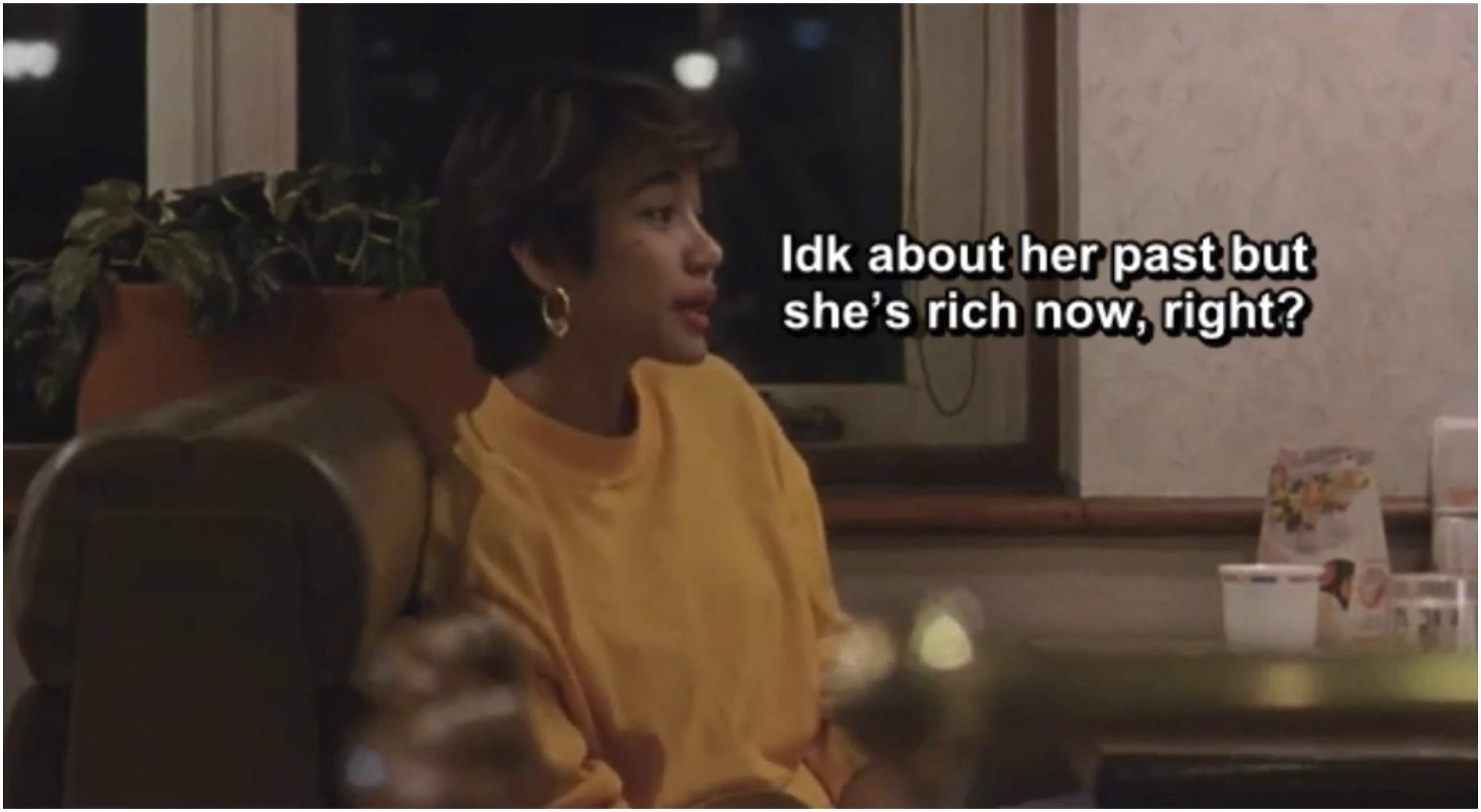
In our course, we introduce to students Nornes’ notion of “sensuous” subtitling (Nornes, 2015), or originally “abusive” subtitling, the term he initially used to introduce the idea and later replaced it with the former which he found unnecessarily “aggressive” (Josephy, 2017: 134). Nornes discusses how there is a tension between familiarization and de-familiarization of the source language and culture through the process of subtitling. Conventional subtitling often domesticates the source language and culture to make them easily consumable to the target audience. On the other hand, a more creative and experimental approach, which Nornes calls “sensuous” subtitling, incorporates the “materiality of (the source) language” into translation and rather reveal the foreignness of the source language and culture that cannot be conveniently made comprehensible (Nornes, 2015). The resulting translation puts the spectator in touch with the foreign film, with its otherness, which resists the viewer’s easy consumption of the source language and culture.
To illustrate, Nornes (2007) uses the example of Rob Young’s subtitling for Tenamonya Connection (1991) directed by Masashi Yamamoto. To translate one of the characters’ swear word, “Konchikusho,” Young subtitled it using special characters as follows: !%&$#!@!!. Rather than retaining the meaning of the original line, Young’s subtitling communicates to the viewer the confusion and affective experience of the character. Sensuous subtitling like this one offers the viewer potential for affective transformation (Flynn, 2016); it gives non-representational, bodily effects on viewer and allows us to have indeterminate experience beyond the intention of the subtitler.
Students’ subtitling works: Reshaping our intercorporeal racial encounters
In our course, we implemented two subtitling assignments that involved translanguaging and peer collaboration. Students perform critical subtitling projects, informed by critical approaches to subtitling, the history of colonialism and race in Japan, and the politics of language in Japan, which we outlined in this article thus far. This article specifically focuses on the second subtitling assignment where student groups created English subtitles for two scenes from Tsuki wa docchi ni deteiru (Where Is the Moon, 1993).
There were a total of four groups and two groups were assigned the same scene. First, students used a shared annotation platform to work on a micro-analysis of linguistic and extralinguistic features (intonation, pitch, gesture, etc.) and other cinematic elements (mise-en-scène, visuals, sound, etc.) that constitute the scene they were assigned to translate. Then, based on their close analysis, students produced their own subtitles using a subtitle editing program. Each group presented their own subtitles to the class, explained their subtitling choices, and implications of the resulting work. As a class, we also compared and contrasted two versions of subtitles of the same scene.
In the following subsections, we present our “embodied close-reading” of students’ subtitling work as mediated by our own experiences of race. Following Sekimoto and Brown’s (2020) statement, “Our bodies do not simply respond to sensory stimuli based on a predetermined function of a sensory receptor, but every sensory encounter opens up a possibility of altering the body prosthetically” (22), we view subtitles as a catalyst for the viewer’s “intercorporeal” encounter with cinematic bodies, which potentially makes a transformative intervention into how race is sensed and felt in and beyond the act of film viewing.
In examining students’ subtitling works we draw on what Stoller (1997) calls “sensuous scholarship,” and particularly the recent efforts in the field of sensory studies (Howes, 2022) to recognize scholars’ own bodies and senses as “means of our inquiry” as well as the “object of our investigation” (Sekimoto and Brown, 2020: 1; also see Pink, 2009; Elliott and Culhane, 2017). Within film and audiovisual media studies Sobchack (1992, 2004), Marks (2002), and Barker (2009) among others have developed embodied approaches to studying cinematic experience. Rather than arguing that embodied approaches are superior ways of mastering the object of criticism, they point to the partial, processual, and generative nature of knowing that becomes particularly palpable when we examine how the meaning of film gets materialized through our bodies and in specific context. Below, we consciously insert our sensory memories of racialization as Japanese-born, Japanese-speaking migrant women coming to North America to pursue higher education in English-speaking institutions. While these reflections may seem irrelevant to the subtitled film being discussed we include them as a practice of “sensory embodied reflexivity” (Culhane, 2017: 60), which involves critical examination of how our positionalities and past experiences affect the ways we make sense of the film. Our past experiences of race or racialization matter in making interpretations about racialized characters in the film and even deciding what counts as a racial (cinematic) encounter. Thus, our methodology strives to make our close-readings accountable. By starting our analysis from particular, personal, and embodied experiences of film viewing, we hope to cultivate an ethics of criticism that is both acutely aware of the “limits of sensory knowledge” (Marks, 2002: 20) and attuned to the responsibilities that arise from our intimate, embodied experiences.
Scene #1: Ayaka’s embodied close-reading of students’ subtitling
Groups #1 and #2 tackled the task of subtitling a scene that involves a conversation between Connie and Tadao. The scene (00:25:39–00:27:38) takes place at a famiresu or a “family restaurant,” which is a type of casual chain restaurant that caters to families with children and young people with a variety of menu items with relatively low prices. Tadao and Connie sit at the corner table farthest from the entrance. In this scene, Tadao flirts with Connie as he describes his honest and sincere character and exaggerates the hardship his family endured under Japan’s colonial rule by fabricating his family story. He highlights their shared marginality in Japanese society and attempts to convince Connie that he understands her struggles of living and working in Japan, perhaps more so than Japanese men, who would otherwise be a more ideal partner because of their dominant status and ability to sponsor her to become a permanent resident in Japan. Tadao’s attempted manipulation of Connie, which hints at existing stereotypes of Southeast Asian women as innocent and docile (Iwabuchi, 2002; Kondo, 1997), fails when Connie questions his story, knowledge, and performance of a savior role.
I would like to start my embodied close-reading of students’ subtitling works by reflecting on a particular moment in the fall of 2002 when I was in my early 20s and beginning my one-year exchange program at the University of Washington as a student from Japan. This brief moment was brought to my mind as I watched the subtitled interaction between Tadao and Connie, the two characters that are both affected by colonialism but are racialized differently in Japanese society. The moment I recount also involves an interaction between two racialized bodies, including my own, with sexual overtones. While I am much more privileged as a middle-class Japanese citizen being in the United States on a student visa than Connie as a working-class Filipina being in Japan on a temporary visa, both cases reveal the experience of race and racialization that occur in the interactions not just between white and non-white or Yamato and non-Yamato bodies but also among racialized bodies in complex ways.
In the early months of my exchange program, I used to explore downtown Seattle on my own on the weekend to familiarize myself with the city. On this particular day, I decided to rest at a restaurant located in Pioneer Square, one of the most popular tourist destinations in the city. My memory is not entirely reliable, but I probably sat by the window and just ordered coffee, and was listening to a live jazz session happening at the other end of the restaurant. When the session was over, a black drummer approached me and began speaking to me. What could possibly make this immature, foreign, stranger woman interesting enough to talk to? He sat beside me and said, “If you are interested in learning how to play the drums, come to my apartment. I offer private lessons. I love Asian women!” He then stroked his nape of the neck with his hand, showing the areas of what we call in Japanese eriashi and unaji, the body spot that connotes eroticism in Japanese cultural context, which is popularly known outside of Japan through representations of geisha.
Embarrassed, slightly annoyed, and also excited about being approached by a professional jazz drummer—that was it. I did not engage in the conversation for a long time, but responded to him politely without showing any discomfort. I acted as a stereotypical quiet and nice Japanese woman. In fact, I did not have a strong emotional reaction to his words and gestures at that immediate moment. The reference to geisha through his gesture would have been more upsetting if I was not so intellectually and culturally naïve. But as a middle-class person of the Yamato race from a country where my people dominate, this was the first time, in my memory, when my body was explicitly racialized and othered and I did not have a language to make sense of it.
What makes this brief exchange more complicated, however, is the fact that I was also equally viewing him based on existing racial stereotypes of black people. To me he appeared as a black jazz drummer with an excellent command of rhythm and an ability to “dance with the beat.” I also gathered, too quickly I suppose, based on a limited amount of information he gave me (that he offered lessons at his private home rather than a rented studio or a music school) that he was undereducated and financially struggling. Despite the fact that I do not recall exactly what I said to him in reply, I clearly remember an image I pictured in my mind. In that image I saw a small, shabby apartment room where he sat behind his drum set. I was not in the picture but a spectator casting my gaze at him from a hallway. Half of the drum set and his body was blocked out in my view, being outside the door frame. Being simultaneously racialized and racializing, my conversation with the black drummer was a moment when racial stereotypes manifested at discursive and embodied levels, but nothing further happened then in a way that enabled me to meaningfully unpack or question it. While my encounter with the drummer in Seattle did not register in my body particularly strongly then, students’ subtitling of Connie’s speech brought me back to this moment and unsettled the racial stereotypes that were at play in my interaction with him.
What strikes me about the famiresu scene is how Connie, through her response to Tadao’s flirtation, evades and even defies racial stereotyping of Filipinx women that exist in Japanese society at large in a contradictory binary both as easily exploitable “slave-dolls” and as deceptive and “cunning scavengers” (Suzuki, 2000). In the original cinematic work, Connie’s strong sense of dignity is conveyed largely by her assertive command of the Osaka dialect. However, given that it is impossible to completely convey the nuances of the Osaka dialect in subtitles, both Groups #1 and #2 had to tackle the question of how to effectively transmediate the differences in the characters’ speech styles and their materialities. The subtitling by Group #1 was especially remarkable for their effort to use subtitles as a formal element to evoke the affective experience of marginalization, make visible the negotiation of power between the two characters, and transmediate-as-transform Connie’s subversive speech.
Given that Tadao was born and raised in Japan and Connie is relatively a newcomer migrant, Tadao is more knowledgeable in Japanese vocabulary. As Tadao attempts to persuade Connie into believing in his narrative, he describes himself as an earnest man using a Japanese word gudon. “Gudon” is a word that refers to stupidity and silliness but it is a literary and sophisticated expression and hardly used in everyday conversation. Not knowing the word, Connie asks, “What’s gudon?” Her first utterance in the scene already comes across as strong and bold to me as someone who, both in English-speaking and Japanese-speaking contexts, would be too scared to ask such a question at the risk of sounding ignorant. A few students who subtitled this scene commented that they have never heard or used the word gudon in their lives while being L1 speakers of Japanese or a heritage Japanese speaker, and considered somehow retaining the inaccessibility of the word significant in subtitling his line.
While Group #2 translated the word into its English counterpart, “blunderous,” which would be similarly advanced a word, Group #1 decided not to translate it into English. Refusing to familiarize the word through translation, they used the original Japanese word “gudon” and spelled it with romanization, so the audience would experience the foreignness of the word like how Connie does in this scene. Connie’s utterance of the word in her reply to Tadao is italicized to highlight the perceived foreignness of it. To answer Connie and explain the meaning of the word “gudon,” Tadao shows off his knowledge of English and says, “It means pure.” However, Connie, who is more familiar with English than Tadao due to the colonial legacy in her own homeland cannot make out Tadao’s utterance because of his thick Japanese accent. Connie repeats the word loudly and in a high-pitch voice and then immediately follows up by saying, “Oh, pure,” correcting his pronunciation. While her knowledge of English results from the history of US colonization of her country, her competency in English places her in somewhat a powerful position in Japan as English is considered as a language that is superior to Japanese. Thus, Tadao’s attempt to put himself in a superior position and teach Connie Japanese unintendedly ends up reversing the power dynamic between the two characters. Here, Group #1 decided to italicize Tadao’s utterance of the word “pure” to highlight its foreignness to the speaker. Connie’s imitation of Tadao’s pronunciation is subtitled in the italic font, too, because the word as uttered by Tadao sounds foreign to her. This time, the word is also spelled in romanization of Tadao’s pronunciation of the word “pyua.” The three dots with commas are added before “pyua” to convey her confusion, although the exclamation mark added after the question mark expresses her assertiveness.
This group also creatively used subtitles as a “hypervisual” medium to add new meanings to the original media product. This scene begins with the camera moving from one end of the restaurant toward Tadao and Connie sitting at the corner of the other end of the restaurant. Along with Tadao’s words describing the socio-economic “position” in which Filipinx migrant workers are placed in Japan, the marginality of both of the characters is expressed in the mise-en-scène, through their position in the space and the small area that they occupy in comparison to a Japanese waiter who walks toward the camera (Figure 3). Subtitling by Group #1.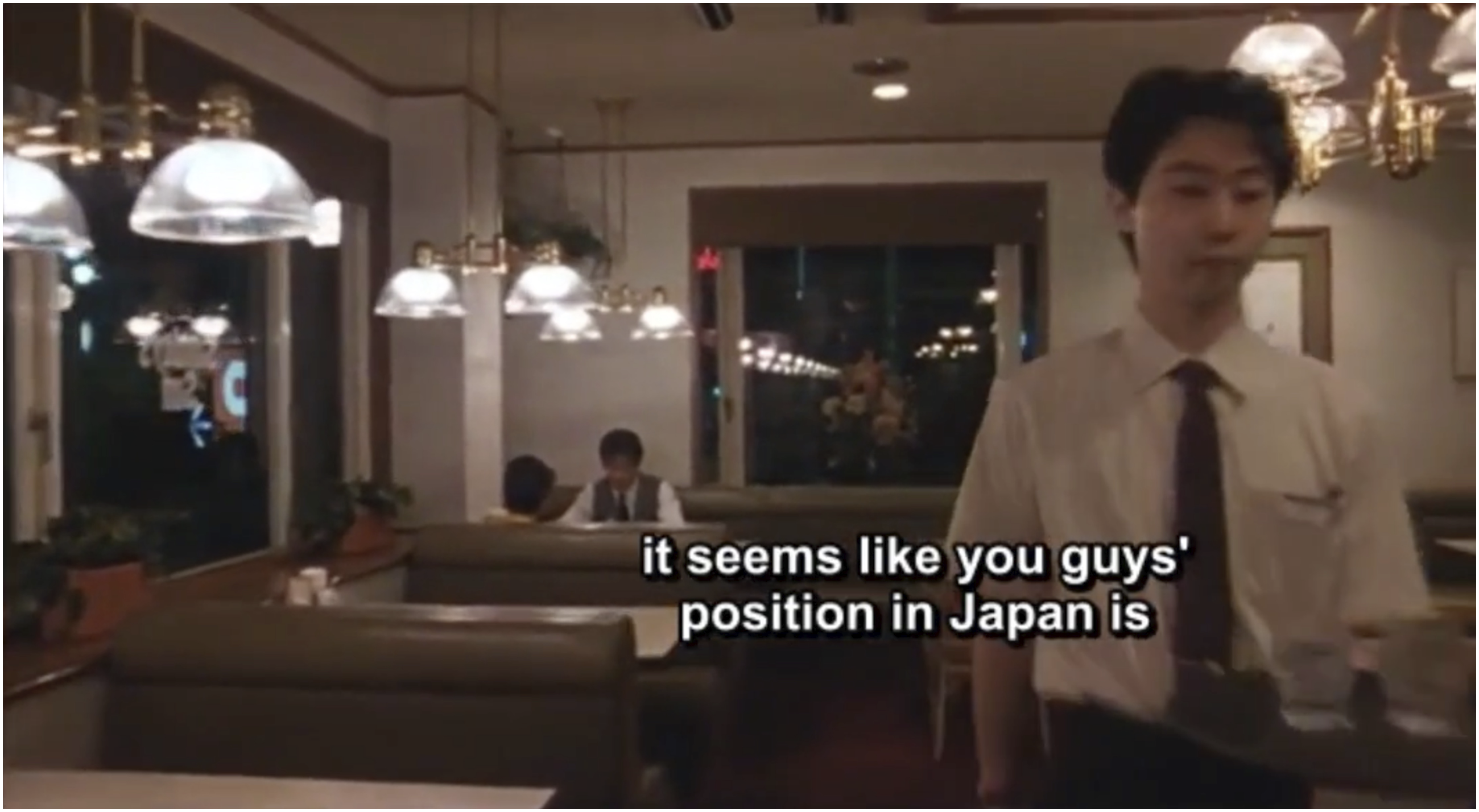
As we see in Figure 3, Group #1 intentionally placed their subtitles way above where they would normally appear. Students explained that they wanted to use the subtitles like part of the film set to highlight Connie’s further marginality in relation to Tadao’s due to her gender, race, immigration status, and occupation. They used subtitles to produce a sense of suffocation and being “trapped” in the space by placing Connie between Tadao and Tadao’s words in written text.
However, Connie negotiates and even subverts the power hierarchy throughout this scene by correcting Tadao’s English pronunciation, as discussed above, and constantly interrupting Tadao with short and direct phrases in Osaka dialect, a variation of Japanese that Connie is more competent than Tadao is. Osaka dialect is one of the major regional dialects used in the western part of Japan. This dialect is often associated with active commerce in the region and sales pitch. It is also known for its blunt and comical way of speaking and is often associated with manzai, an Osaka-based comedy form where two comedians exchange jokes at a fast pace.
The students in Group #1 pointed out that as Connie starts interrupting and questioning Tadao, the camera also moves to the side of the characters, showing each character in profile with the equal size and height, which formally expresses the “dissolution of hierarchy” (Figures 4 and 5). They placed subtitles at the equal height, too, right in front of their mouths just like how a speech bubble would appear in a comic strip, to enhance the effect of the camera work. The evocation of the comic form visually lightens the tone of the dialog and effectively transmediates the materiality of Connie’s Osaka dialect and its association with manzai. Subtitling by Group #1. Subtitling by Group #1.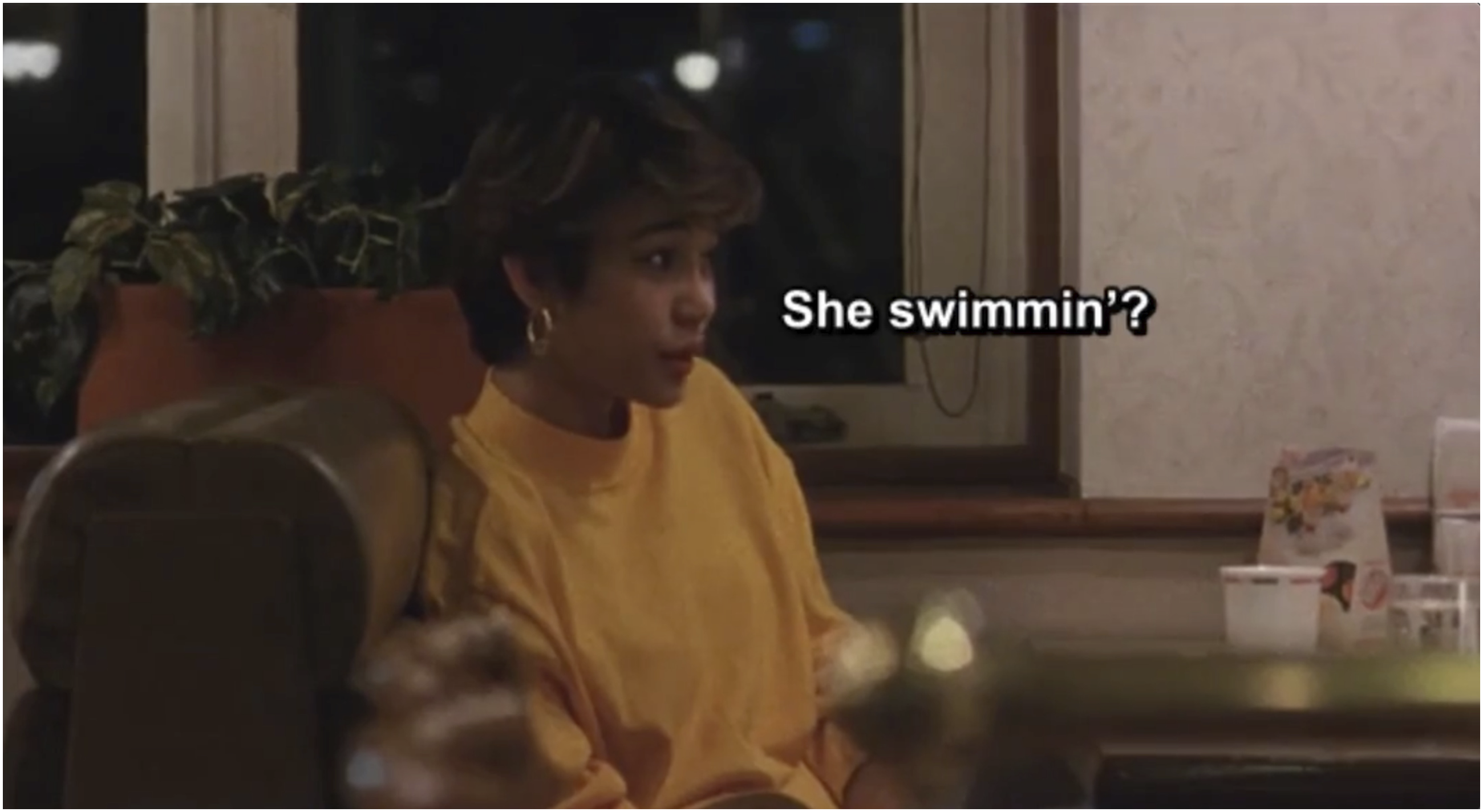
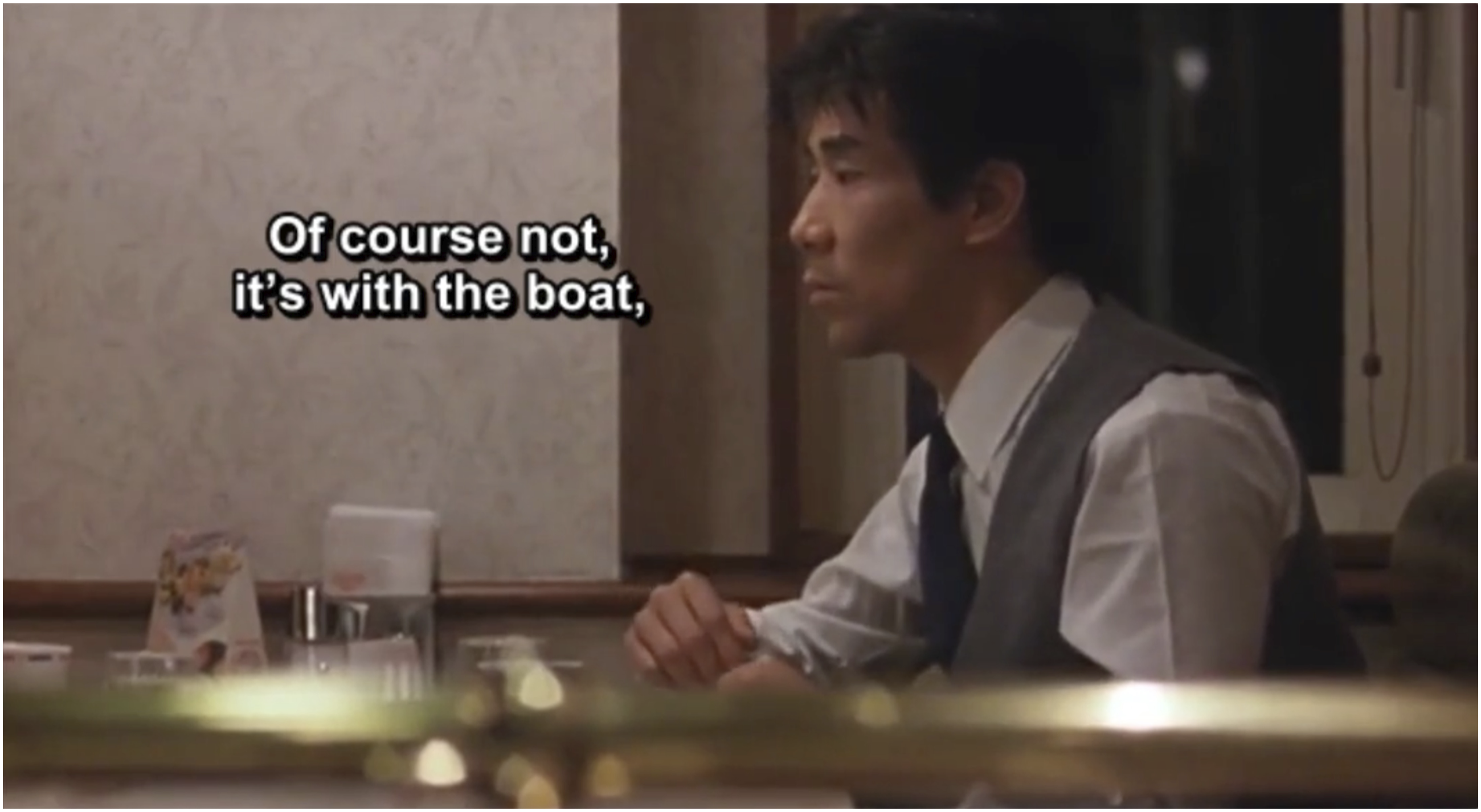
Group #2 drew on a translation strategy, which Nakamura (2020) calls “adequation” where translators choose an existing style of the target language based on some shared features found in the original style of the source language. Group #2 discovered through research that Osaka dialect is often rendered into Southern American English in translation, and employed Southern American English to accentuate Connie’s use of the regional dialect. This style’s link to Black English calls attention to Connie’s racialized identity in addition to her distinct speech style, although that was not necessarily an effect intended by the group.
Group #1, in contrast, chose the “text-style slang language commonly used among teenagers” to replicate Connie’s sharp, witty, and fast-paced speech. Although the students in Group #1 did consider using Southern American English, they explained, they were not confident and comfortable to use this variation because of their unfamiliarity with it. Instead, the texting language felt like their own and easier to manipulate for their creative subtitling project. For example, to Tadao who tries to convince Connie that he understands the situation of Filipinx migrant workers, Connie’s replies in subtitles, “R u hittin’ on me?” When he overly dramatizes family history and narrates how his mother migrated to Japan for the sake of family, Connie disrupts and asks, “She swimmin’?” She further follows up, “Idk about her past but she’s rich now, right?” While successfully invoking Connie’s difference in speech style when compared to Tadao, subtitling by Group #1 also transformed Connie’s original speech and produced new materiality of Connie’ speech that looked and sounded young, cool, urban, and savvy. This made a stark contrast with the version produced by Group #2 where Connie sounded and felt more rural and idyllic. The use of texting language made the character more relatable to student subtitlers and also non-conforming to the existing stereotypes of Filipinx hostesses. To me, who is from an older generation and not versed in English texting culture to the same degree, Group #1’s subtitling was experienced as somewhat unsettling and rebellious, rather creating a distancing effect. In this way Connie transformed into a character beyond my full comprehension and reach.
However, it is precisely the exposure to the two versions of the subtitled famiresu scene that makes my film viewing experience transformative. The possibility that the same exact encounter can be experienced radically differently through subtitling conjured up my past encounter with the black drummer and the image of him in his apartment that I pictured in my mind two decades ago. The students’ works raise questions, What else could I have said to him in response to his imagination of “Asian women”? How else could I have imagined his life as a jazz drummer? Why was I a spectator in my imagination of the drummer? What other, anti-racist relationality was possible?
Scene #2: Saori’s embodied close-reading of students’ subtitling
Groups #3 and #4 worked on the scene that features Tadao, his mother, and Connie in the dimly lit pub (00:25:39–00:27:38). The scene starts with Tadao sitting at the bar counter and Connie standing behind the counter while the camera is slowly moving to capture Tadao’s mother yapping and a group of Filipinx hostesses sitting at the corner of the room. Tadao’s mother, the bar owner, is making boisterous remarks that thriving in business lies in “joining our hands together” by transcending national and ethnic borders. She continues on to make an appeal for filial relationships with the Filipinx girls to think of her as their real “Mama” instead of “mama-san,” a term that addresses a female owner in the bar industry. To this, Connie responds indifferently by saying “we are just common migrant workers”—her blunt response in Osaka dialect effectively “brushes off” the mama-san’s naїve pleading to ethnic and familial solidarity, suggesting a division between the Filipinx temporary workers and the Zainichi employer. Such division also permeates the mise-en-scène, in which Connie stands behind the bar counter that separates Tadao and Tadao’s mother. Although Connie may not have diverged far from the dominant image of a Filipinx woman working in the entertainment and sex industries (Ko, 2010), her competent use of Osaka dialect subverts stereotypes of foreign immigrant workers that are often subject to unfair treatment and exploitation in the workplace due to language barriers and prevailing racism in Japanese society.
Both student groups considered the following aspects in their subtitling processes: 1) how Connie’s use of Osaka dialect plays its role in transmediating race; 2) how the characters (Connie, Tadao, and Tadao’s mother) negotiate their identities in the interaction; and 3) how race is manifested as embodied experiences in the cinematic discourse. While sharing some similar features, subtitles by Groups #3 and #4 differ in engaging the viewers at (extra)linguistic, sensorial, and affective levels, which will be explicated in the section that follows.
In addition to Connies’ translanguaging practice between Tagalog, Japanese and English, her vigorous use of Osaka dialect is what makes her a very unique, defiant and somewhat empowering identity in the film. Both Groups #3 and #4 transmediated Connie’s speech in a way that reflects her way of speaking in Osaka dialect. In this scene, the pub owner directs her accusation to Connie by saying “you are responsible for my failing business.” To this, Connie responds bluntly in a command form, hito no sei ni sentoite, both student groups decided on their translation “Don’t blame me” (Group #3) and “Don’t blame it on me!” (Group #4), respectively—a direct, unmitigated response as a most efficient way to reject the owner’s accusation.
This scene captures Connie standing and holding her cigarette behind the bar counter, which position herself as a capable worker who has the most insights into the power dynamics within the marginalized community (Dew, 2016), and whose uniquely racialized, interstitial position feels unaffected by her exploiter, who is not an imperial-Japanese counterpart but a Zainichi Korean employer. The characterization of Connie as a linguistically competent, Filipinx migrant worker in the Zainichi-owned business cannot be of more significance in overturning the binary structure of Zainichi vis-à-vis Japanese, and subverting the conventional power relationship between the exploiter and the exploited.
I now turn to another part of the scene, where Tadao uses the Korean kinship term eomeoni (“mother”) in his response to his mother. Tadao responds by saying “Stop it eomeoni” when his mother directs her yapping to Tadao, “Who do you think I’m working hard for!” Both student groups leave the Korean word eomeoni untranslated with no provision of English translation in their subtitles.
The groups’ decision to keep the address term eomeoni in their subtitles has several implications. First, the italicized eomeoni leads the viewer to feel something foreign or unfamiliar, the affective elements that go beyond linguistic representation (Flynn, 2016). Secondly, when eomeoni is uttered, Tadao’s gaze is directed to his mother out of the frame while Connie is looking away from them (Figure 6). The contrast in the direction of their gazes reveals Tadao’s orientation to a filial relationship with his mother, which Connie is excluded from. Viewed from the concept of indexicality (Cook, 2008; Ochs, 1996), the social meaning of eomeoni is more than what the word means (“mother”). The addressing of eomeoni in this particular scene indexes that Tadao and his mother share the same linguistic and ethnic identity as Zainichi Koreans; it also indicates that Tadao, now as a grown-up, is advocating his independence of financial support from his mother. Encountering such an untranslated element in the subtitled film also evokes various affective responses from the viewers including myself. Knowing that this Korean word can stay Korean in the English subtitle liberated my body, which had long been programmed to accommodate my senses within the context of dominant English hegemony where any foreign words are rendered into English or at least English-like. Subtitling by Group #4.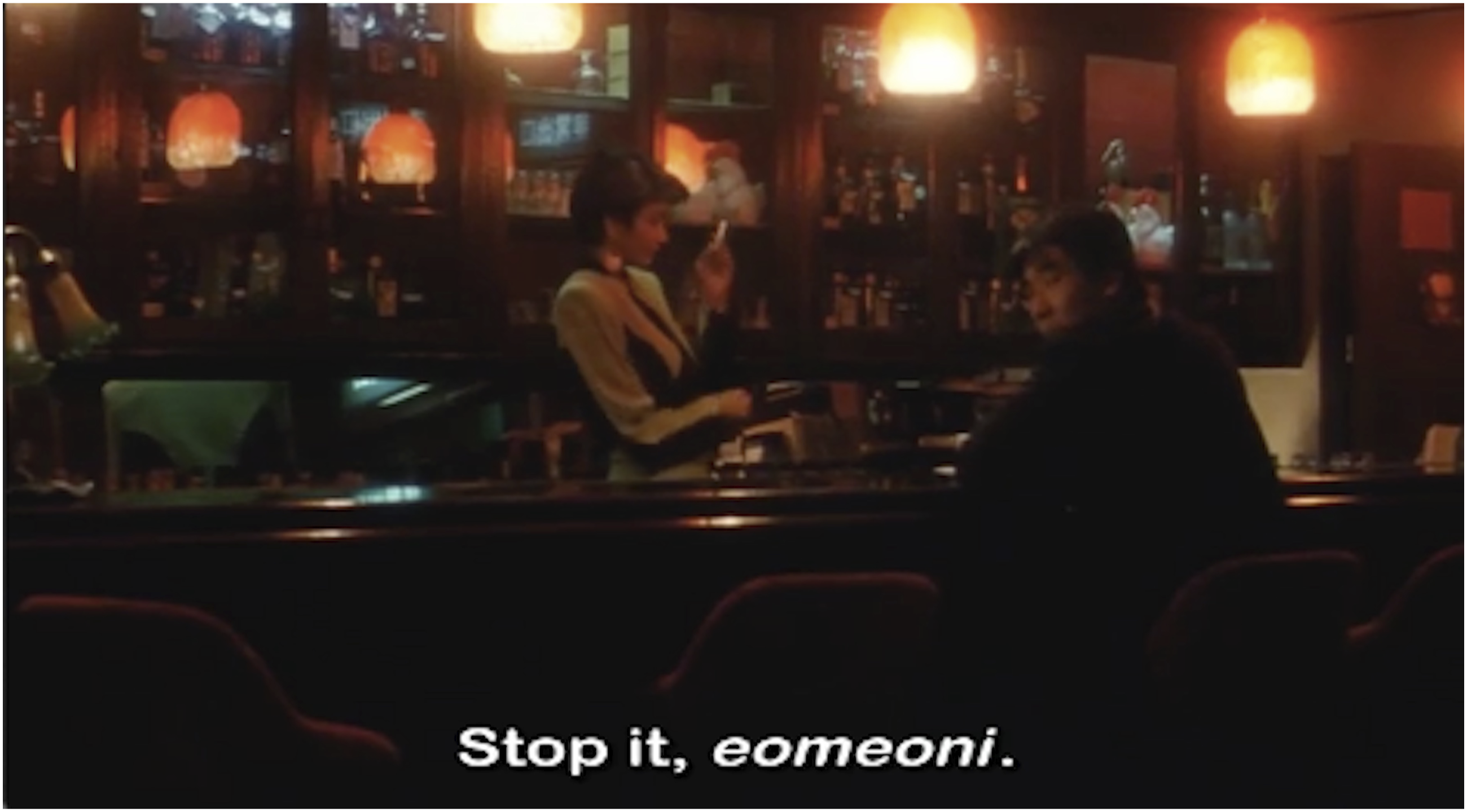
My racialized experience began as I attended a small liberal arts college in upstate New York where the student population was predominantly white, and most students speak Standard American English, despite some regional and dialectical variations. As one of the racialized students whose first language is not English, I had cultivated my fear of language—any language including my own. My sense of otherness was felt through not knowing what “sucks” means and mishearing it as “socks.” It took me years to learn that “How are you” is a mere greeting, not a question to deliberately respond to. I wish that I didn’t have to lie by saying “I’m fine, thanks” when I was never feeling fine. In my racialized body, learning another language like English was not about learning a new means of communication but about learning a new “how” of speaking, which involves an embodied process of acquiring new styles of affective and sensory experiences (Sekimoto and Brown, 2020): when I was performing the bodily act of uttering something like English, it felt like my racialized body were constantly being x-rayed for anomaly.
Therefore, in an anatomical sense, the act of speaking English was so painstaking that my racialized body escaped into self-alienation. My self-alienation from the act of speaking evolved into the practice of art making for self-expression. My art making practice prescribed a remedy to overcome my fear of speaking because it allowed me to stay nonverbal if I wish, share affect and senses unarticulated, and yet find connections with others. While seemingly irrelevant to one another, the affective effect of the untranslated eomeoni on the screen allowed me to revisit the sensation of my art making in that both experiences constituted a niche to “unlock” my long-lived racialized body.
In the next example, Group #3 provided their translation using an emoji, as an example of sensuous subtitling. A smiley face emoji :) was used to translate Connie’s speech ending in Osaka dialect, minna de chikara o awasete gambarima Subtitling by Group #3.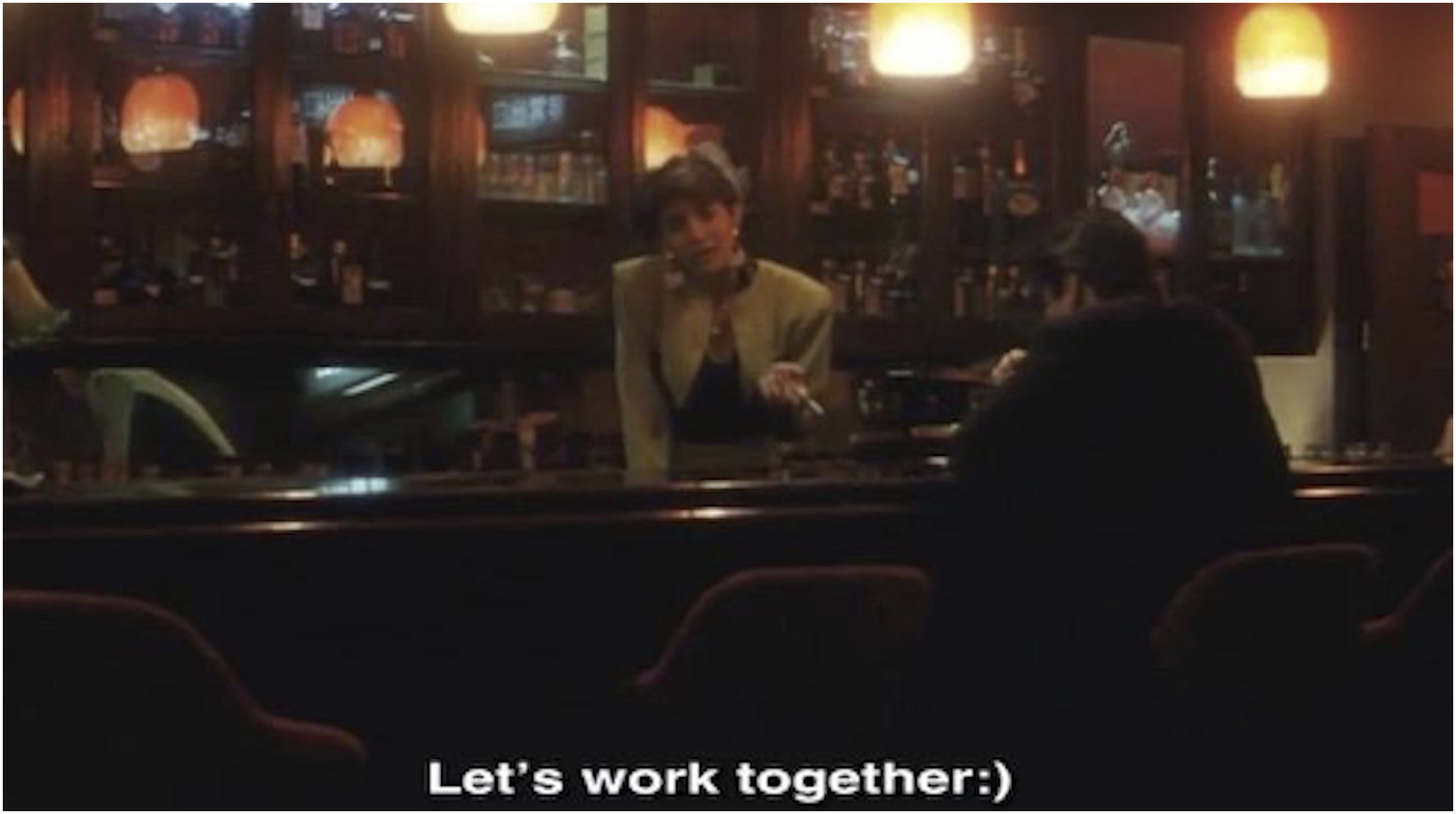
The unconventional use of emoji in subtitles leads us to consider how affect can be expressed through interlingual subtitling and can potentially bring the viewers to more embodied experiences beyond language and translation (Flynn, 2016). This is also associated with the perspective of subtitling as a “visual supplement” designed to make speech more accessible (Lundeen, 1999). Group #3 consists of two L1 speakers from Tokyo, who only speak Standard Japanese. In contrast to Group #2’s translation choice of employing Southern American English, Group #3’s decision on the use of emoji stems from their unfamiliarity with the Osaka dialect. This speaks to how students’ linguistic identities might impact their translation decisions as it opens up a new possibility of sensuous subtitling to explore how to best express Connie’s melodic Osaka dialect in translation and deploy the smiley face emoji to match the prosodic “affect'' felt through Connie’s speech. While the insertion of emoji can explore the affective transformation of subtitling as a visual supplement to speech including gesture and tone of voice, the students’ choice of the smiley emoji :) did not align with my senses of Connie as a subversive body and it disoriented my engagement with the character, because the emoji :) alone could not convey sarcasm and apathy nuanced in her response to Tadao’s mother about the politics of ethnic identity.
In their intralingual translation, students also negotiated the untranslatability of linguistic features that are available in one language (Japanese) but are not available in another language (English). One such feature is a Japanese sentence-final particle yo, which is encountered repeatedly throughout the film. Dew (2016) addressed the film’s use of repetition as most evident at the level of dialog, which “creates a kind of mechanical comedy, but it also flattens the characters out into types” (p. 91). Having no referential meanings, particle yo is often used to highlight the epistemic gap between speakers in Japanese (Hayano, 2011) and index the speaker’s epistemic stance to invoke the recipient’s “registration” of yo-marked talk such as news telling, response, request, and command in Japanese spoken discourse (Morita, 2012). Another account for the pragmatic function of yo by Yoshimi (1997) is the expression of “non-shared affective stance” in request and command sentences which render the speaker’s utterance more forceful, but the forcefulness comes from the speaker’s intense emotional state and attitude.
Notably, yo is ubiquitous in the film’s discourse, including many lines the Zainichi taxi drivers deliver to their colleagues, ware ware Zainichi wa
I find a striking difference between the two student groups (Groups #3 and #4) in their subtitles of the same scene where the mama-san makes an emotional appeal to Asian ethnic solidarity in her yo-marked talk to her Filipinx employees, kokkyo o koete, minzoku o koete, te o toriawanakucha naranaino Group #3: Set aside ethnicity and border lines (first frame) This is the time to work together hand in hand! (second frame) Group #4: to join hands and work together regardless of nationality and ethnicity.
In regard to mama-san’s emotional speech marked with yo, students were challenged to translate this non-referential yo in the target language (English) which has no equivalent to it. As we can see in the group translations above, Group #3 replaced it with an exclamation mark, to index the owner’s high affect for her rhetoric to be understood by the viewer; however, such affective force is not communicated through the work of Group #4, which marks the line ending with a period. Group #4’s decision on marking it with the period left me with a sense of frustration, because their subtitling failed to express mama-san’s affective stance for ethnic solidarity.
The reason that their ubiquitous use of yo touches my body sheds light on the underlying fact that no one in the film shares a common ground, except for one commonality— a group of individuals who are marginalized and excluded from Japanese society. The prominence of yo in the dialog among Zainichi Koreans and in the mama-san’s plea to Filipinx hostesses suggests a binary sense of us and them, that is, an intra- and inter-ethnic heterogeneity that creates conflicts of knowledge, power, and identity among those maginalized in post-colonial Japan. Yo, in their sense, serves as an affective force to have their voices be received and understood, in these unfillable epistemic gaps between the people and races—exploitative Zainichi versus exploited Zainichi, Filipinx versus Koreans, Zainichi Koreans versus Japanese, etc.—in desperate pursuit for connectivity, collectivity, and ethnic solidarity.
Conclusion
This article discussed how subtitling can be implemented in the context of teaching and learning as a pedagogical tool to develop students’ criticality in engaging with racial identities of the characters. Students’ subtitling works involved careful analyses of the characters’ identities constructed through their linguistic and extralinguistic resources and of how race and senses are transmediated through various cinematic forms. In their subtitling processes, students encountered and negotiated the untranslatability of the source language into the target language. Using an experimental approach to subtitling, or “sensuous subtitling” in Nornes’ term, students worked closely and intimately with the materiality of multimodal expressions and came up with different ways to intermediate-as-transform the sense of the original expressions. Based on our embodied, close-readings of students’ works, we explored how the subtitles produced by students affect our viewing bodies and perceptions at a non-representational level beyond the intention of the subtitlers. We also showed how each of our past experiences could potentially affect the ways in which race-as-transmediated-through-subtitles is experienced and how students’ sensuous subtitlings can offer a site for critical reflexivity to reflect on, question, and unsettle our experiences of race and racialization in the past, present, and future.
By employing a critical and creative approach to subtitling and encouraging students to feel the cinematic bodies of the characters through subtitling, we hope to advance anti-racist education in our classroom and beyond. Students were assigned the tasks of subtitling utterances of the characters whose identities might not align with their own or translate the language or speech style that were not completely familiar to them. While felt as a challenge to students both practically (due to the unfamiliarity with the particular dialect or linguistic style) and ethically (because there is always a risk of misrepresentation and cultural appropriation), this practice created opportunities for them to raise their awareness of the potential danger of othering the characters through their translation choices, and “reorient” and “re-habituate” their “bodily-ways-of-being-with-others” to foster anti-racist relationality (Sekimoto and Brown, 2020: 142). For example, Group #1 and Group #3 turned Connie from a “foreign” migrant who speaks Osaka dialect into a character that belongs to their own digital-cultural group by employing youth texting language (Group #1) or an emoji (Group #3) in subtitling her speech. When this was contrasted with Group #2’s decision to use Southern American English, the difference was remarkable in terms of how the student subtitlers and we as instructors-viewers were brought in contact with the character.
Finally, this article is still limited in scope because it did not fully examine the roles of subtitlers’ identities in transmediating race and senses in subtitling. Future reflection should take into account the implications of subtitlers’ own identities for translating characters’ speech. What does it mean for a L1 speaker of Japanese with Japanese ancestral background to translate Connie, Tadao, or his mother’s speech? What does it mean for a Japanese speaker with another ethnic background or for a diasporic heritage Japanese speaker? How do their various racial experiences affect their translation processes and outcomes? How do the racial identity and experience of each student inform one another in collaboratively translating the characters’ speech? These questions need to be explored further in future projects.
Footnotes
Declaration of Conflicting Interests
The author(s) declared no potential conflicts of interest with respect to the research, authorship, and/or publication of this article.
Funding
The author(s) received no financial support for the research, authorship, and/or publication of this article.