



Abstract
In this article, we examine the ways 17 Latina/o bilingual teacher candidates (TCs) employed spatial rationales to make meaning of why they mostly leverage English within their bilingual teacher education classes at their Hispanic-Serving Institution. We asked: (1) How do TCs interpret the predominance of English on campus and the bilingual teacher education program? (2) What do TCs’ understandings reveal about the nature of the structures sustaining the hegemony of English? To answer these questions, we drew upon the raciolinguistic perspective and critical notions of space and place. Findings reveal that despite the University’s mission to serve Latina/o students, TCs still experience English as connected to the United States and the predominantly white community where campus is located, and Spanish as belonging in Mexico and the heavily Mexican and Mexican American neighborhoods south of the city. Our analysis suggests that this mapping of language and race ideologies onto particular spaces/places—or what we have termed raciolinguistic landscapes—reflects and reproduces boundaries that uphold institutionalized systems of exclusion. Findings have implications for bilingual teacher education, with regards to ways to help TCs critically engage raciolinguistic landscapes.
Keywords
So I would work on the South side, or kind of Downtown and then head up to the North side, and it would be like switching [languages] because I would speak Spanish for the Spanish speakers, and then on the North side is me and the Anglos” (David, Member-checking session).
In the epigraph above, David—a Tejano bilingual teacher candidate (TC)—reflects upon the predominance of English on his university campus and in his bilingual teacher education program. As he states, location largely determines whether he can hear and speak Spanish (the South side) or English (the North side). While David specifically refers to a linguistic switch when moving from South (where he works) to North (where he attends college), his reflection on linguistic boundaries also accounts for racial divides in the city where he resides. Just as David, many of his fellow Latina/o TCs often referenced space and place as key elements shaping the ways they leveraged their linguistic skills at the Hispanic-serving institution they attend, situated in a part of town far removed from the Mexican and Mexican American, Spanish-speaking communities.
In this article, we examine the ways 17 Latina/o bilingual TCs employed spatial rationales to make meaning of why they and their classmates mostly leverage English within their bilingual teacher education classes at their university campus in Central City (pseudonym). This study answers the questions: (1) How do TCs interpret the predominance of English on campus and the bilingual teacher education program? (2) What do TCs’ understandings reveal about the nature of the structures sustaining the hegemony of English? We drew upon the raciolinguistic perspective (Rosa and Flores, 2017) and notions of space and place (Helfenbein, 2021; Schmidt, 2013) from critical geography to examine the role that the geographical arrangements TCs mentioned play in how they experience their language practices within and beyond the institution.
As we demonstrate, TC’s experiences complicate the stories the Hispanic-serving institution they attend tells about itself to the broader community. Specifically, TCs’ accounts indicate that despite the bilingual teacher education program’s goal to set multilingualism as the norm and the university’s plan to serve Latina/o students, participating TCs (for whom Spanish is an important identity marker and cultural heritage) still experience English as connected to the United States and the predominantly white community where campus is located, and Spanish as belonging in Mexico and the heavily Mexican American neighborhoods on the South side. Findings suggest that understanding how ideologies of language and race become institutionalized requires attention to the spaces/places where racialized subjects and the institution are geographically situated.
Theoretical framework
Rosa and Flores’s (2017) raciolinguistic perspective supported our analysis of Latina/o bilingual TCs’ perceptions of English and Spanish as belonging in distinct locales across the US–Mexico border, across the Southwest Texas city where they live, and within the Hispanic-serving institution where they are completing their bilingual teacher education. In keeping with the raciolinguistic perspective, our analytical focus centered on examining the racially hegemonic modes of perception—listening and seeing subject positions—reinforcing the predominance of English within this institution and shaping the extent to which TCs feel that they can leverage Spanish. In our analysis, we understand racially hegemonic modes of perception as ideological positions (i.e. whiteness) that can be enacted not only by individuals (white and non-white) but also by institutions, as well as their policies and technologies (Flores and Rosa, 2015).
Rosa and Flores’s (2017) call prompted important critical research focused on how racially hegemonic modes of perception manifest within US schools via educational policies (Hernández, 2017; Sung, 2018), pedagogical practices (Chavez-Moreno, 2021a; Flores et al., 2018; García-Mateus, 2020), school designations (Flores et al., 2020; Chaparro, 2019; Rosa, 2016), and student interactions (Braden, 2019; Dexter, 2020; Ricklefs, 2021). However, this research has paid little attention to space/place as factors reinscribing raciolinguistic ideologies or ideologies that frame the linguistic practices of racialized individuals as deficient and in need of management (Rosa and Flores, 2017). Yet, our TCs’ reasoning for the hegemony of English was based on the location of the institution in the nation and Central City, suggesting that raciolinguistic ideologies become mapped into spaces/places: what we call raciolinguistic landscapes. Their descriptions pointed to the need to consider space/place in analyzing the institutionalization of raciolinguistic ideologies.
To theorize the concept of raciolinguistic landscapes, we drew from the field of critical geography. Specifically, we drew on critical geography scholars’ understanding that educational institutions (schools) are embedded within “sedimented histories, economic and cultural contexts” that have “connections to multiple layers of government” (Helfenbein, 2021: 3). In other words, we acknowledge that schools and curricula are connected to and reflective of place, where place is conceptualized as a “subjective understanding of a particular, localized setting [or space].” Drawing from critical geography, we understand educational institutions as “spaces filled with meaning for those that spend time there in particular and localized ways,” (p. 4) and therefore, we recognize that schools are the locus of power asymmetries and contestation.
Public spaces such as schools are places where individuals interact socially and politically with one another in ways that are often contested (Schmidt, 2013). Individuals moving within the same space (e.g. a classroom, the halls of a school) may feel included or excluded, treated civilly or otherwise based on their varying subjective identifications. Through these interactions, individuals learn to develop “both a sense of the self as a subject and knowledge of how and where to deploy this subjectivity across an uneven and exclusive landscape” (Schmidt, 2013: 545). Exclusion from spaces/places can deprive individuals from accessing and/or demanding access to social, political, and educational resources (Schmidt, 2013). Against this backdrop, education scholars examine the understandings that current uses of space/place advance among members of a community and the extent to which these allow members to imagine themselves as belonging across and having rights within spaces/places.
Considering the above, raciolinguistic landscapes, as we conceptualize them, are spatially-oriented racially hegemonic modes of perception that construe racialized speakers and their language practices as belonging in distinct locales (i.e., places and spaces). In other words, raciolinguistic landscapes are conflations of language, race, and space/place that construe racialized individuals as having rights only within racially-marked locales (e.g., the home, Latinx communities, south of the border) that stand in contrast (physically and metaphorically) to the sites where whiteness and English are construed as the norm. Ecologically, raciolinguistic landscapes can be understood as broad (the entire US constructed as white and English monolingual) or more local (areas of a city or neighborhoods framed as racially different).
Literature review
Bilingual teacher education scholars concur that TCs must develop a solid understanding of the sociopolitical and historical factors shaping the schooling of racialized bilingual learners (Garza et al., 2020). This critical understanding of the broader context is key to bilingual teacher preparation in the face of the anti-immigrant and anti-Spanish climate surrounding bilingual education (Alfaro, 2018; Palmer, 2018; Ek, et al., 2013). In fact, more and more often, Latina/o TCs have to work “against dominant political and social forces that seek to disempower [...] marginalized communities” (Téllez and Varghese, 2013: 129) while ensuring that they are making a positive impact on the lives of the Latina/o emergent bilingual learners that they serve (Ramirez et al., 2018).
Scholars have advanced conceptual tools that promise to fulfill the criticality goals embedded in bilingual teacher education. One such concept is critical language awareness, which implies developing an understanding of “how language conventions and language practices are invested with power relations and ideological processes which people are often unaware of” (Fairclough, 1992: 7). Critical language awareness starts from the understanding that language is never neutral but always loaded with “issues of power, hierarchy and dominance, as well as contestation, resistance and transformation” (Alim, 2018: 207). Building upon this concept, García (2017) proposed critical multilingual language awareness, under which framework the role of the teacher educator becomes guiding TCs to not only acknowledge “linguistic diversity but also question the concept of language itself” (p. 263) by recognizing that language is “socially created and therefore socially changeable” (p. 266).
Premised on the necessity for TCs to become able to interrogate the societal factors weighing down on bilingual education, Bartolomé (2004) and Alfaro and Bartolomé (2017) posited that bilingual TCs must develop political clarity and ideological clarity. Political clarity involves acquiring a deepening consciousness of the sociopolitical and economic realities of educational settings. On the other hand, ideological clarity refers to the capacity to determine the extent to which one’s own ideological stances uncritically reflect broader societal ideologies that maintain socioeconomic and political hierarchies, as well as unequal power relations. Supporting TCs to develop political and ideological clarity is intended to help them envision ways to undo and counter a legacy of discrimination and symbolic violence against communities of color.
Two other concepts that can be leveraged in bilingual teacher education are critical consciousness and sociopolitical consciousness. The former “involves the process of overcoming pervasive myths through an understanding of the role of power in the formation of oppressive conditions” (Cervantes-soon et al., 2017). Developing critical consciousness requires that TCs interrogate their own privilege, which is believed to assist them in countering marginalizing discourses and macro-level inequalities. The latter, sociopolitical consciousness, refers to TCs’ capacity to apprehend “historical and current social inequities” (Freire, 2020) and transform institutionalized structures of marginalization. Sociopolitical consciousness equips TCs to take an activist stance towards the sociopolitical conditions marginalizing communities of color and realizing the biculturalism, bilingualism, and biliteracy goals of bilingual education.
These concepts share a common concern for enabling TCs to understand the broader contexts where bilingual education unfolds, as well as for equipping TCs to question power. These concepts also share a lack of explicit attention to spatial factors enabling existing power asymmetries and inequalities. In other words, attention to space and place has been missing in their conceptualization of the critical awareness, clarity, and consciousness required to interrogate systems of oppression. Particularly, we notice little emphasis on the ways geographical arrangements and spatial relations reflect and reproduce the structures of oppression that marginalize communities of color. In this article, we demonstrate that centering awareness, clarity, and consciousness in bilingual teacher education also requires situating power within raciolinguistic landscapes that profoundly shape racialized individuals’ lived experiences.
Methodology
Research context and participants
The data we analyze in this paper come from a year-long critical ethnography Fallas-Escobar conducted in Central City (pseudonym), a large Southwest Texas metropolitan area with a history of segregation. To illustrate, in the early 1900s real estate developers included deed clauses stating that African Americans and Mexicans could not own or rent property in the north areas of the city, where economic development was flourishing. These segregationist practices forced Mexicans and Mexican Americans to settle in the West and South sides and African Americans in the East side. Later, in the 1930s, the Home Owners Loan Corporation (HOLC)—a federal government agency—further contributed to this segregation by creating redlining maps ranking these sides of the city as declining or hazardous. HOLCs’ depiction of Mexican and Mexican Americans as non-productive and a burden motivated banks to rank them as financial risks, hindering their opportunity to purchase property. Today, Central City’s Mexican and Mexican American population (over 60%) continues to live predominantly on the South and West sides.
More specifically, Fallas-Escobar conducted this critical ethnography at a large public Hispanic-serving institution—Metropolitan University or Metro (Pseudonym)—that shares Central City’s history of exclusion by virtue of its location on the Northwest side. Metro was originally founded in the 1960s with the express mission of serving the Mexican and Mexican American population of the broader metro area. 1 Therefore, the construction of Metro’s campus on the Northwest side was controversial because such location made higher education inaccessible to the Mexican American community it was meant to serve. Metro was founded at a time when three quarters of families in Central City did not have the means to send their children to universities out of state. Given such a commendable goal, many believed the campus would be built in close proximity to this population, either downtown or somewhere on the South or West sides.
At the time of selecting a site for Metro, multiple options were on the table, including sites in the South side, the Westside, and the Downtown areas—housing the Mexican American population—as well as sites in the North and Northwest areas—where the white, upper-class population lived. Initial requirement for site selection established that the property be no less than 200 acres. County commissioners offered 400 acres on the South side for the construction of Metro, hoping that it would serve to help its underserved population and economically revitalize the area. At this point, the Board of Regents increased the requirement to 600 acres. In the end, the Board selected a 600 acres site on the Northwest side, causing many to wonder why they had chosen this location over others on the South side or Downtown areas. Metro sits upon this history of racial segregation and exclusion that continues to characterize Central City.
The Bilingual Education Department at Metro offers a BA in Interdisciplinary Studies with a Bilingual Concentration. Of the 16 Bilingual Concentration classes, five are taught in Spanish, three in English and Spanish, and the remainder in English. Documents available on the university’s website do not specify if both English and Spanish are used in the same class or if the classes are offered in English or Spanish depending on the instructor’s preference. However, TCs reported that although they communicate in both languages across the Bilingual Concentration courses, English still has a strong foothold—except for courses taught entirely in Spanish. Although the classrooms where TCs take their classes do not showcase Spanish because they share space with other departments, the Bilingual Education Department features signs in Spanish and paintings of well-known Latina/o cultural figures. Within this department, all but one of the faculty identify as Tejanas/os, Latinas/os, Chicanas/os, or Latinas/os and all faculty identify as bilingual.
Fallas-Escobar conducted the study in the class “Language Development in Multilingual Contexts,” which students take in their third year. The class was taught by an experienced faculty who identifies as a Spanish-English bilingual, working-class, immigrant, Mayan Chicana, with a background in American Studies and Urban Education. Although this class is meant to be taught in English because it is also offered to non-bilingual education majors, the instructor occasionally used Spanish and encouraged students to use their communicative repertoires as desired. Out of 29 TCs taking this class, 17 opted to participate in the study, of whom four self-identified as Mexican, four as Hispanic, one as Puerto Rican, and eight as Mexican American. Out of the eight TCs who self-identified as Mexican American, at times one also self-identified as Tejano and two as Chicanas to draw attention to their cultural and linguistic experiences as racial minorities in the United States. Most TCs hailed from Texas while a few had grown up in Mexico or other US states and later moved to Texas. Out of these 17 TCs, nine agreed to collaborate as focal participants.
Data collection and analysis
Fallas-Escobar first engaged in participant classroom observation (N = 17) in the target class, in his capacity as a doctoral candidate collecting data for his doctoral dissertation. Once he had built rapport with TCs, he conducted individual semi-structured interviews (N = 14) and collected classroom artifacts (17 final reflection papers TCs wrote about their experiences as bilingual speakers, 17 language portraits TCs created about their linguistic repertoires, two student-generated photographs of the local community, and 187 discussion posts TCs wrote in reaction to class readings). During the remainder of 2021, he conducted follow-up interviews (N = 9) and held group member-checking sessions (N = 2) with focal participants.
This present article focuses on data rendered textually such as interviews, Fallas-Escobar’s observation field notes, and classroom artifacts including TCs’ online discussion posts and final reflection papers. In addition, we also include multimodal data such as the language portraits that TCs created for their class. Specifically, the language portrait consisted of visual/narrative representations TCs crafted of how and with whom they use their communicative repertoire. For analysis purposes, we only included portraits in which TCs used notions of place/space (See Figure 1 for an illustration) to make meaning of their lived experiences of language (N = 7). Given the predominance of text data in this study, we employed Jewitt (2014) and Serafini’s (2022) “beyond the visual” approach to inventory signs and symbols across data that helped us examine TCs’ spatial understandings. Lara’s language portrait.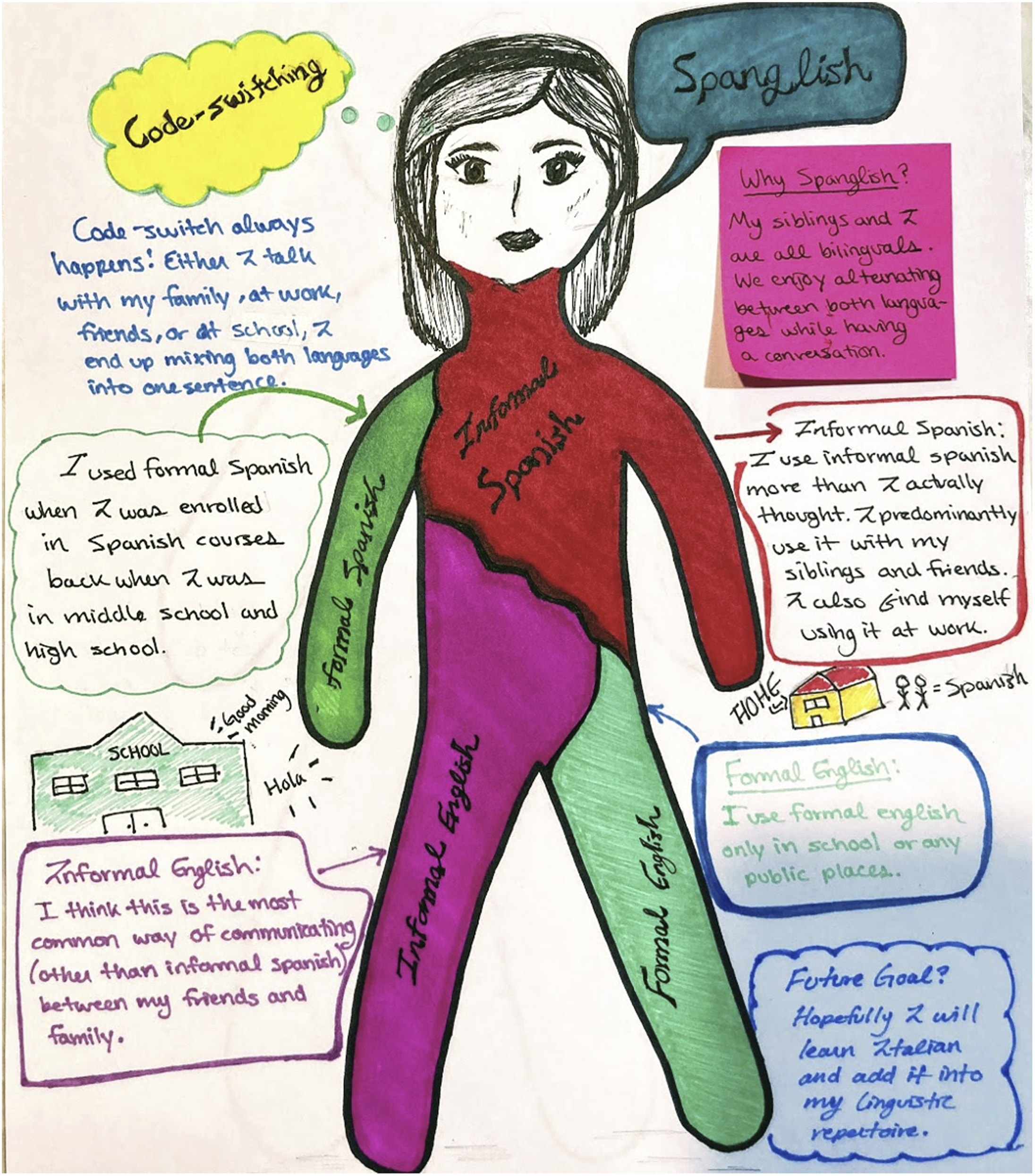
Several TCs organized their language portrait spatially, centering themselves, positioning buildings on the peripheral, with Spanish appearing at home and English taking up institutional spaces such as work and school (Archer, Lara, May, Amori, and Mexicana de Corazón, and Montse). A frequent pattern among TCs was depicting school buildings and their houses with labels indicating which languages are predominant in these spaces/sites. These visuals were accompanied by text further elaborating the ways in which place and space played an important role in determining which linguistic resources they could deploy and how. In the findings section, we analyze Mexicana de Corazón’s and Montse’s portraits to illustrate this phenomenon.
To reduce text/visual data, Fallas-Escobar engaged in open and focused coding (Saldaña, 2015), using NVivo 12. Open coding (e.g., versus, process, and value coding) indicated TCs understood language practices in terms of North and South (e.g. North/South of the US.-Mexico border, North/South side of the city) and home and school, where school tended to be thought of as being North of neighborhoods they come from (See Figure 2). Fallas-Escobar categorized these codes under the sub-themes of “place-based boundary making” and “space-based boundary making.” Drawing on the raciolinguistic perspective, he put these sub-themes under the broader theme of “rationalizing raciolinguistic boundaries” (Axial coding). Deroo started collaborating for the present article after all data had been collected, transcribed, and reduced/coded. Summary of data, coding, and themes.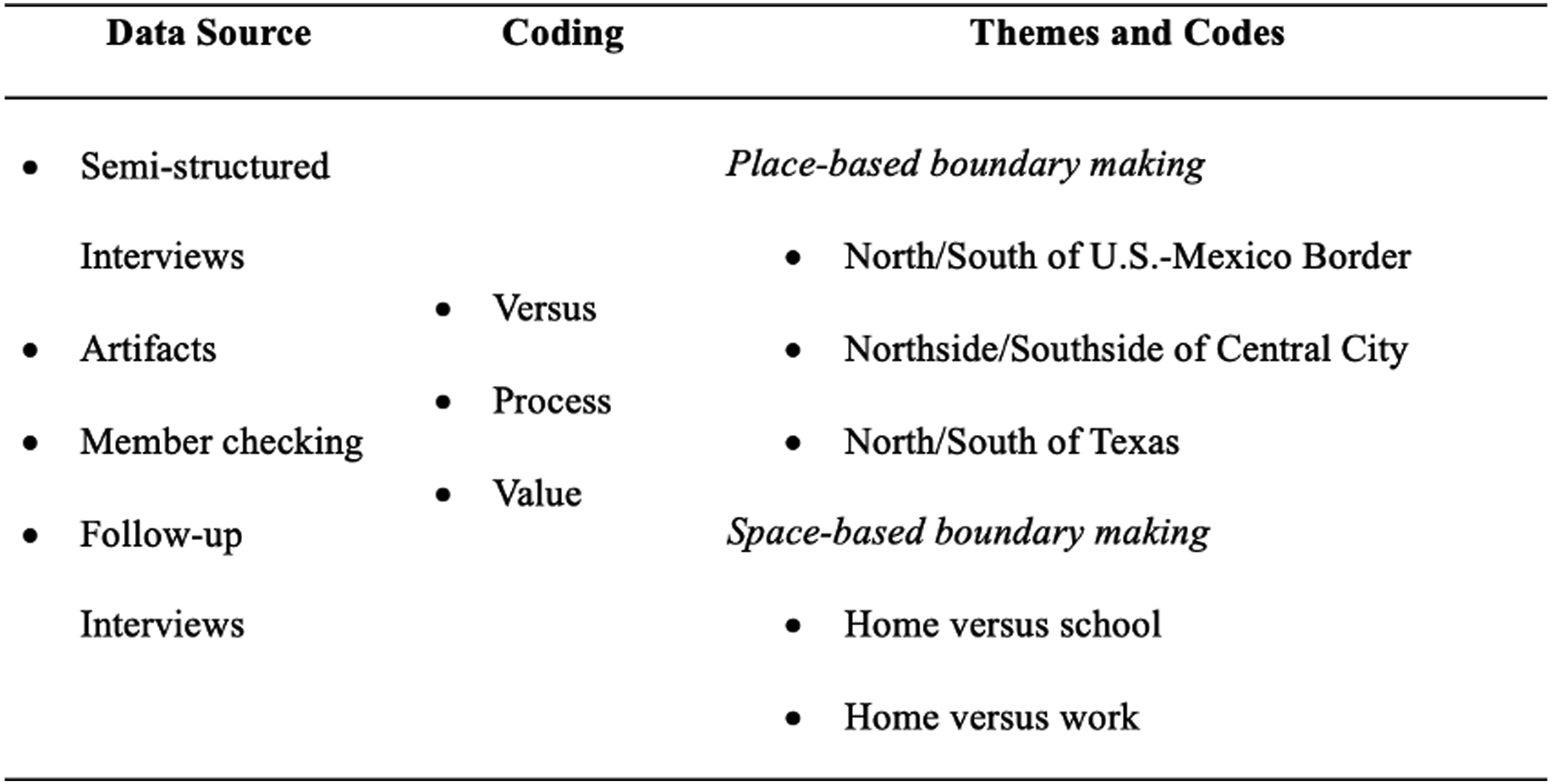
Having identified instances where TCs referenced space/place as an organizing element, Fallas-Escobar and Deroo analyzed them using critical discourse analysis (CDA) at three stages. At the description stage, we attended to lexical/grammatical aspects of these instances. At the interpretation stage, we examined the situational context of these instances: Who was involved? What was at stake? What was the context? At the explanation stage, we asked three broad questions of each instance: (1) “What power relations at situational, institutional, and societal levels help shape these discourses? (2) What elements of MR [participants’ assumptions] which are drawn upon have an ideological character? and (3) How is this discourse positioned in relation to struggles at the situational, institutional, and societal levels? Does it contribute to sustaining existing power relations or transforming them?” (Fairclough, 2015: 175). During implementation of CDA, we resorted to notions of space/place from critical geography to provide more nuanced analysis of the spatial element of TCs’ understandings of their lived experiences of language.
Positionality
Fallas-Escobar identifies as a Latino, bilingual (Spanish and English) language scholar who works at the intersection of critical applied linguistics and anthropology of education. His work focuses on Latina/o/x bilingual teacher candidates’ negotiation of identity at the nexus of language and race. Fallas-Escobar was familiar with Metro and its Bilingual Education Department prior to entering the field, since he had previously served as instructor of record for the Bilingual Concentration. Deroo identifies as a white, bilingual male (English and Mandarin) who worked as a language teacher and teacher educator in China for 10 years prior to beginning his PhD. In his work with teacher candidates, he cultivates his students’ Critical Multilingual Language Awareness through direct instruction on the construct and by presenting TC with multimodal learning tasks and coursework that help students to interrogate language ideologies. He joined this work to support its theoretical framing, findings, discussion and implications. Deroo has no connection to Metro nor the participating TCs.
Findings
In this section, we address three sub-themes we established in our CDA analysis of TCs’ reflections about why English is predominant on campus and in the Bilingual Concentration at Metro: (1) their noticing the framing of Spanish as out-of-place, and their invocation of (2) broad and/or (3) local raciolinguistic landscapes to understand their lived experience of language.
Noticing the framing of Spanish as out-of-place at metropolitan university
For nearly 30 years, Metro has held a Hispanic-serving institution (HSI) status; a designation granted to higher education institutions serving a student population that is at least 25% Hispanic-identifying. In the case of Metro, its Hispanic population rises above 55%. This designation enables the institution to apply for funds to improve their academic offerings for and academic attainment of Hispanic individuals. In fact, Metro prides itself as having been founded based upon the dream for social mobility and success of the city’s largely Mexican/Mexican American population. Due to the number of degrees it grants to Hispanic students, Metro also holds a Seal of Excelencia, for its commitment to Hispanic student success.
During the 2022 spring semester, Metro launched a publicity campaign on the university’s website and on campus. The campaign has introduced a new discourse: Metro as a Hispanic-thriving institution that takes bold steps to help Hispanic students thrive. This emerging discourse positions Metro as an institution that pursues “a bold education” and creates “bold futures.” The website even showcases Spanish and hybrid languaging in its website: “Creando futuros audaces, futuros ‘bold’” (See Figure 3). The use of Spanish is indeed a “bold move” considering Metro’s complicated history with its campus being built far removed from the marginalized peoples it was meant to serve. Yet, beyond Metro’s past, the usage of Spanish and Spanish-English code-switching in this campaign does not coincide with TCs’ experiences. Example of Metro’s campaign on its website.
Participating TCs perceived Spanish as mostly absent across campus at Metro. They expounded that whenever Spanish showed up, it became implicitly framed as out-of-place. When asked to describe how she employs her linguistic skills at Metro, Dolores (Puerto Rican) explained she feels that English is the default language in scholarly spaces: “All learning, everything that we do that’s educational, or scholarly, needs to be in English. And then Spanish is just a different space. I don’t feel that there’s room for Spanish in scholarship at Metro” (Interview). Dolores stated that even in her Mexican American Studies classes, nobody but her seized the opportunity to use Spanish: “In my Mexican American Studies class, […] sometimes when I say something in Spanish, I get blank faces, so I don’t know if they didn’t expect me to speak Spanish. People just respond back in English or don’t say anything at all. Yeah. So, then they go back to English” (Interview).
Dolores possibly interprets the silence and blank faces following her Spanish to be indicative of English as the default language on campus, as a result of other experiences with Spanish being marked as an unexpected language at Metro: So, for this lit review that I’m doing, right? There was a dissertation that I wanted, that was from Puerto Rico, and it was written in Spanish. And in order for me to get it from my library, I felt like I had to jump a few hoops. And I actually had to go request it and they had to bring it to me. Um, but they (the librarians) kept saying to me, ‘oh, it’s Spanish! Oh, it’s in Spanish!’ Well, the whole title of it was in Spanish, so I know! I don’t know maybe that comes from where people thought that the book was going to be in English, even though the title was in Spanish (Interview).
In her account, Dolores wondered why the librarian felt compelled to highlight several times that the book was in Spanish, which Dolores thought was obvious given the title. She then reasoned that the librarian’s constant reminders may be grounded on the fact that students assume sources at the library are going to be in English. Dolores frequently mentioned that even within spaces occupied exclusively by Spanish-speaking individuals, Spanish rarely becomes mobilized.
In addition to noticing the weak presence of Spanish, TCs such as Flor (Mexican American) described English as being the predominant language even in spaces designed to prepare bilingual professionals capable of serving Latina/o youth from Spanish-speaking communities: But at Metro, it’s kind of like, you don’t use both languages. Like, there’s not a lot of code switching. But in class, like when I’m observing (completing field experiences), and when I’m with the students, like, there is bilingualism going on, because some students, like they could be mid conversation, they’ll be like, “Oh, miss, like no entiendo esto [I don’t understand this] (Interview).
In the excerpt above, Flor not only pointed to the absence of Spanish—or what she calls code-switching—but also brought attention to how mobilizing only English in the teacher education classroom runs counter to her experiences as a TC conducting observations in classroom spaces where fluid and dynamic alternation of linguistic resources is the norm.
Most of the 17 TCs reported experiencing Spanish as largely absent (out of place) at Metro and expressed a desire for the language to be leveraged more not only orally but also in reading and writing. Against this backdrop, Fallas-Escobar encouraged TCs to reflect on why English was the default language at Metro. As participating TCs engaged in this reflective work, they invoked rationales that mapped raciolinguistic ideologies onto particular spaces/places.
Mapping raciolinguistic ideologies onto the nation: the national raciolinguistic landscape
When prompted to reflect upon the hegemonic role of English at Metro, TCs evoked a spatial rationale that mapped raciolinguistic ideologies onto the United States and Mexico. For instance, Montse (Mexican) observed, “a pesar de que somos estudiantes de que estamos en la carrera para maestra bilingüe, no escucho muchas personas que lo practiquen, y obviamente dices, estoy en América, no se puede exigir que sólo hablen español” [Even though we are preparing to become bilingual teachers, I don’t hear many people practicing Spanish, and obviously you think, I’m in America, so you can’t demand that they only speak Spanish] (Interview). In her reflection, Montse expressed concern that TCs are not practicing Spanish, which she attributed to Metro’s location in the United States, a country imagined to be English monolingual.
Mexicana de Corazón (Mexican) had a similar view on English hegemony. She observed that the linguistic dynamic in many of her classes is, “voy a darte la clase en inglés, pero vamos a hablar del inglés y del español” [I’ll teach the class in English, but we’ll speak about both English and Spanish] (Interview). Mexicana de Corazón also attributed this language practice within her degree program to Metro’s location in the United States: “Estamos en un país donde la mayoría de hablantes es en inglés” [We are in a country where most people speak English] (Interview). Mexicana de Corazón’s and Montse’s rationale suggests that they understand the hegemony of English at Metro to be reflective of national discourses framing the United States as English monolingual, despite the fact that the country does not have an official language and the staggering numbers of Spanish-speaking Latinas/os at the national (13.5%), state (29.4%), and city levels (60%) (US Census Bureau, 2018).
The aforementioned national discourses are rooted in the one nation-one language ideology that can be traced back to the emergence of modern European Nation-States in the 1800s and 1900s. This ideology created a monolingual-monocultural political imaginary or raciolinguistic ideology that connected a language to a nation (Makoni and Pennycook, 2007), allowing the ideological construction of the United States as white and English monolingual and Latin America as brown and Spanish monolingual (Rosa and Flores, 2017). Thus, these TCs’ reasoning suggests that the dominance of English at Metro responds to the mapping of raciolinguistic ideologies spatially onto the United States within which whiteness is institutionally reproduced via an English hegemony that dismisses linguistic hybridity and heterogeneity in Central City and at Metro.
This mapping of raciolinguistic ideologies has in fact shaped TCs’ perceptions of the extent to which their Spanish belongs and can be leveraged across geo-spatial locales. For example, several TCs frequently used the phrase “se me sale el español” [my Spanish slips/comes out] to describe their own and even professors’ “accidental” usage of Spanish in class at Metro: (1) “a veces se me quiere salir el Español” [sometimes my Spanish wants to slip out/come out] (Archer, Mexican American, Interview), and (2) “I’m taking a behavior class. He’ll (the professor) sometimes speak Spanish. I’ll notice that sometimes se le sale el español [his Spanish slips out/comes out]” (Interview, Larissa, Mexican). In Spanish, “salir” implies “pasar a estar afuera de un lugar cerrado o limitado” [step out of an enclosed and limited place/space] as in “el perro se salió de la casa” [the dog came out of the house], “la verdad salió a la luz” [the truth came out]. And therefore, “salir” in “se me/le sale el español” frames Spanish as situated inside limited bounded spaces and characterizes occurrences of Spanish as accidental and outside of the norm.
Demonstrating an awareness of this national raciolinguistic landscape, Mexicana de Corazón used spatial representations in her language portrait to depict the roles of Spanish and English in her daily life. Her portrait shows herself in three settings: home, school, and work (See Figure 4). Importantly, her heart is depicted in the color representing Spanish language across all three settings, because it was her first language and she “prefers it over English.” Despite acknowledging Spanish as core (symbolically represented by a heart) to her identity, the extent to which she can draw on Spanish is directly connected to the spaces she occupies. At home, she reports thinking in Spanish and speaking in both English and Spanish. In addition, she uses English for completing school assignments because readings and assignments are in this language. At work, she moves across languages since the restaurant where she works serves Spanish-speaking customers from the community. Conversely, at Metro, she thinks, reads, speaks, [and] writes in English. Mexicana de Corazón’s Portrait.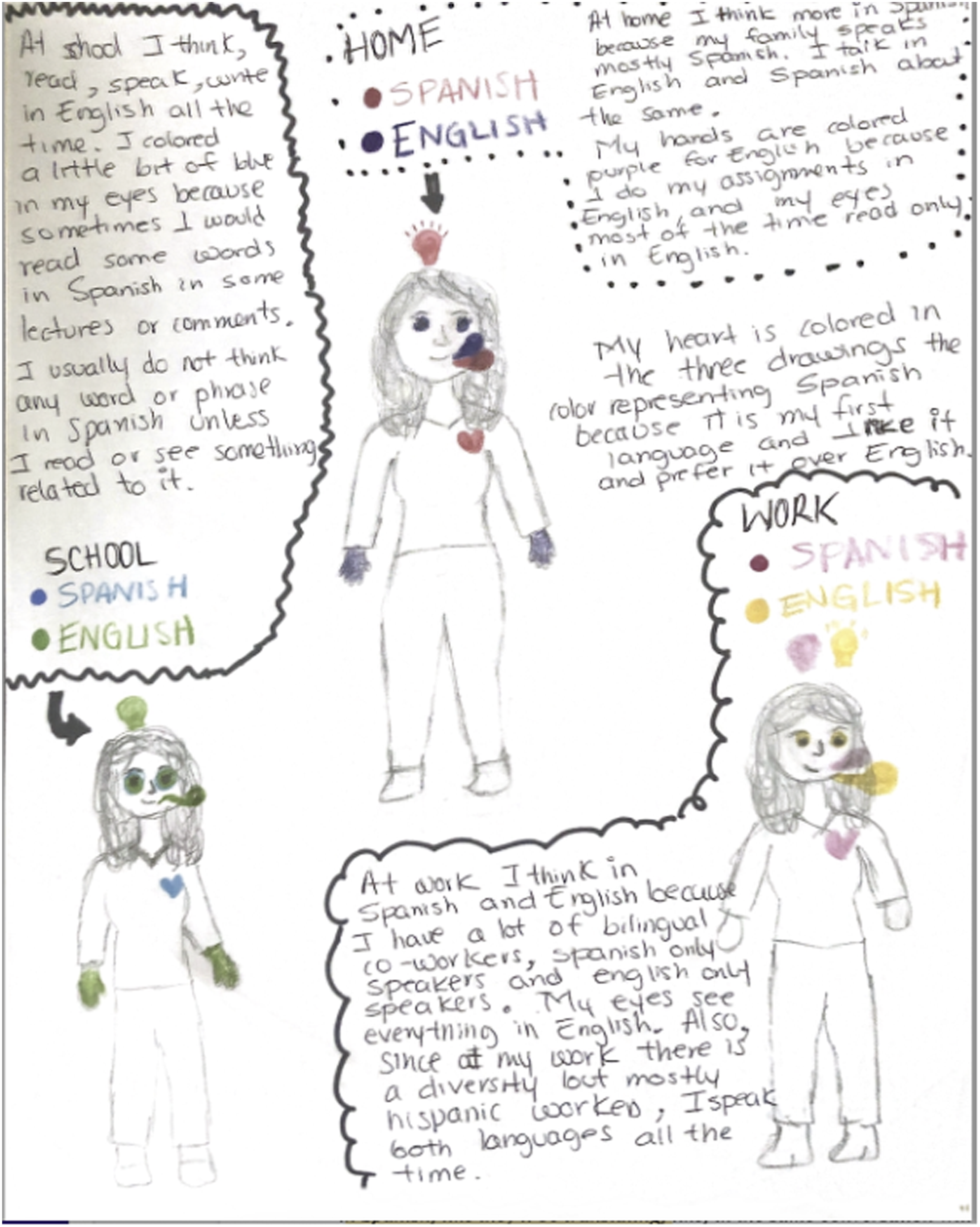
In her language portrait, Montse (Mexican) also depicted her language practices in ways that showed her understanding of this raciolinguistic landscape (See figure 5). First, she drew the map of Mexico in green and also used green to explain that she mostly speaks Spanish at home (a language that reminds her of Mexico). Conversely, she colored the map of Texas in blue and used blue to write the name of Metro (covered for anonymity), where she tries “her best to speak English.” However, besides bringing attention to home and school/work as spaces where she deploys her languages differently, Monte powerfully depicted the restraining force U.S. institutional settings can have on her language practices by drawing herself with a muzzle. Montse’s visual, with contrasting colors across spaces, alludes to the way she feels at the elementary where she works and at Metro, where she cannot leverage her Spanish skills as much as she would prefer. During interviews and member-checking sessions, Montse also stated that when she travels to Mexico, she has to make a big effort to not let any English slip out because her cousins would frame her as “creida” [arrogant] and tell her that “se le subió El North” [Living up North went to her head]. Montse’s portrait.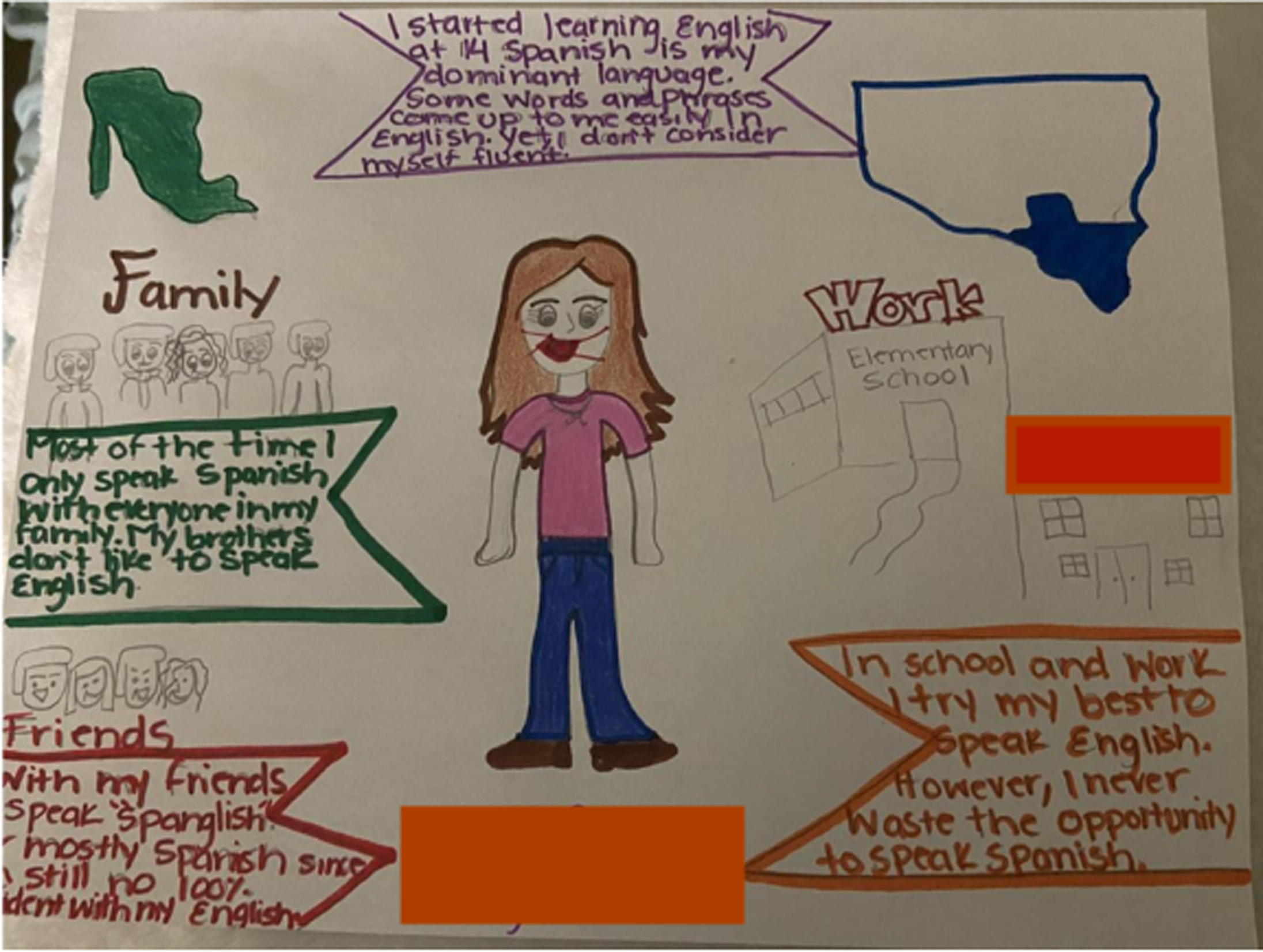
Following the logic of this national raciolinguistic landscape construing Spanish as out-of-place in the United States, other TCs positioned the language as existing South of the United States or placed it along a spatial continuum. For example, David (Tejano) explained that “authentic Spanish” lies in Mexico, that there is “some” Spanish in the border towns, and that the further north in Texas one goes the less Spanish and the more English one finds (Interview). Likewise, Flor (Mexican American) stated during a class discussion that her son speaks “really good Spanish” even though “he has never been to Mexico” (Class observation).
Mapping raciolinguistic ideologies onto Central City: the local raciolinguistic landscape
TCs who are long-term residents of Central City evoked a more local raciolinguistic landscape (the Northwest side versus the South side of the metropolitan area), to make sense of the absence of Spanish on campus. As some suggested, the erasure of Spanish at Metro should be examined at a more local spatial scale, as the main campus—located in the predominantly white and middle class Northwest side of Central City—contrasts with the South side neighborhoods in which many TCs grew up. They pointed to the link between city areas, race, and language choice/practices by providing descriptions of what these city areas look and sound like.
For instance, May (Mexican) described the South side as a heavily Mexican part of town where, “you see a lot of Mexican restaurants, literally in every little corner of every street, you have a Mexican restaurant, they have a lot of like snack shacks, little snack places” (Follow-up interview). Gaby (Hispanic) described this area similarly and shared that the flea market, specifically the puestos de comida [food stands] and restaurants on the South side, give her a sense of home because “you see a lot of Spanish there, the Spanish music, the Spanish culture […] You see the culturas [cultures] over there and it’s just más humilde [more simple and humble]” (Interview). This is a sense of home that the Northwest side of Central City does not give her. In fact, on the Northwest side of town, one mostly finds luxurious hotel resorts, large fast food restaurants, apartment complexes, and primarily white neighborhoods.
The image in Figure 6—which Gaby provided—illustrates the cultural diversity found in the heavily Mexican/Mexican communities lying 20 miles opposite to the predominantly white Northwest side of town. Gaby’s photograph highlights a mural on the side of a laundromat with a central statement “We [heart] our South Side.” This statement is reinforced by the words: “Family, Cultura, Pride” on the right side of the mural. In addition, the mural depicts Latina/o individuals engaging in cultural practices such as a woman making tortillas and what appears to be a family near a vehicle with the words “community first.” In the foreground, a bus shelter can be seen. Gaby’s image powerfully captures the milieu of her community (the South side), both through the mural and its location on the side of a laundromat behind a bus stop as a space where she feels her cultural practices are best represented. Spray-painted murals with cultural representations like this cannot be found on the Northwest side where Metro is located. Gaby’s representations of cultural diversity in his communities.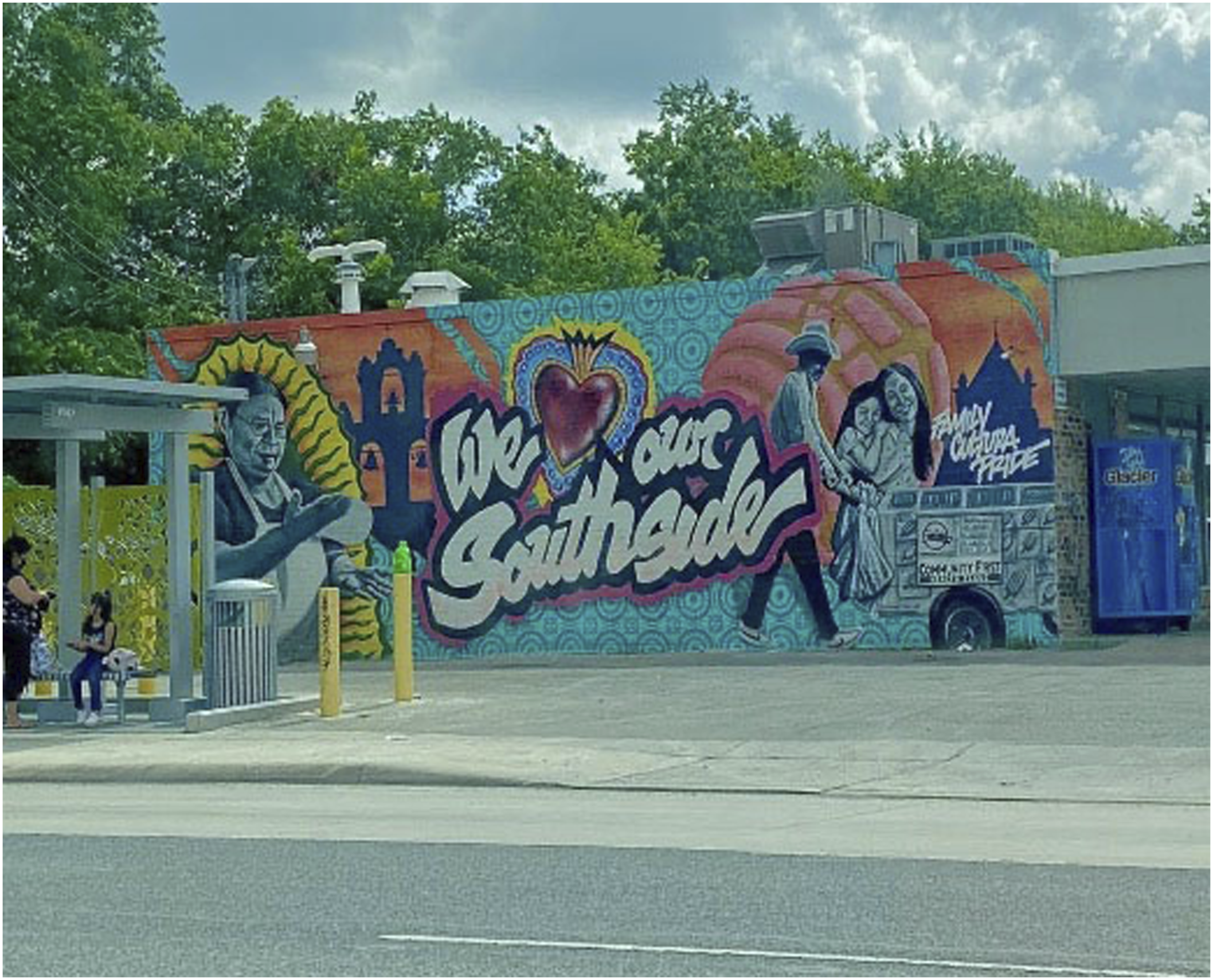
TCs also described the South as linguistically different from the Northwest side. They characterized the former as more linguistically diverse, with Spanish and “Spanglish” having a strong presence. Spanglish is the popular name given to the variety of Spanish spoken in the US, in which speakers fluidly and dynamically draw on their linguistic resources to make sense of their multilingual/cultural worlds (García, 2009). David shared a picture to illustrate this linguistic diversity and fluidity (See Figure 7). The picture shows a sign that directs restaurant patrons to where they can park, combining a word in Spanish “parquear” [Park] with a word in English “here.” Gaby (Hispanic) engaged in translanguaging herself to discuss the fluidity of language employed on the South side: “You go to a taqueria [taco place/stand], te van a hablar en español [they will speak Spanish to you], even if you don’t know (Spanish), they’re gonna still do it. They’ll understand you somehow, you’re going to understand them somehow” (Interview). Here, Gaby’s own linguistic choices reflect the fluidity of communication on the South side where vendors speak Spanish and patrons English, without disrupting the business transaction. David’s photographic illustration of linguistic diversity in his community.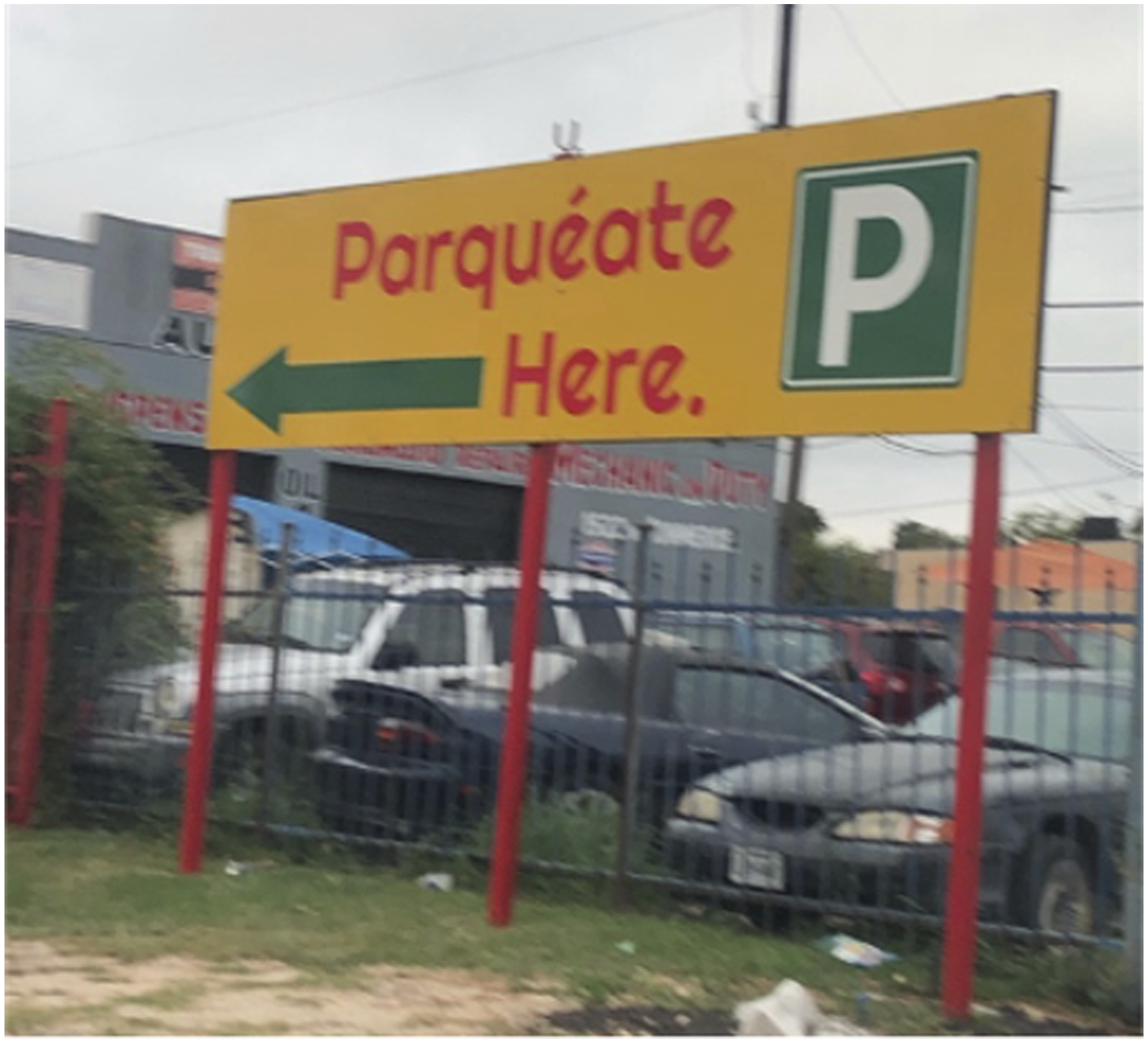
Flor (Mexican American) provided additional examples of the dynamic language practices common in South side neighborhoods: “you could be mid conversation, and they would be talking to you in Spanish, like they’ll be translating, like, in the same conversation will be like, ‘Oh, you know, like, what did you do this weekend?’ And they’ll be like, ‘Oh, hicimos una carne asada [Oh, we grilled meat] with the family. And that’s how it is on the Southside’” (Interview). In this hybrid linguistic and cultural space, full of linguistic variation, South siders flow in and out of English creatively, fluidly, and unboundedly. Like Flor, many other Latina/o bilingual education TCs (e.g. May and Dolores) characterized the South side of town as spaces/places where Spanish and Spanglish are reflective of the milieu or social fabric of the communities.
These fluid language practices are largely absent from Metro, even when the institution states to be at the service of Hispanic students, many of whom come from these South side neighborhoods. They described the Northwest side as heavily white and English monolingual: (1) “once you start moving north, then you see, you see more, or you don’t see it [Spanish/bilingualism] as much anymore” (May, interview), (2)“when you switch to the other side, you don’t see it (people speaking Spanish or bilingually) that much, so en el Norte no [not in the Northside]” (Gaby, Interview). David also attested to the spatially-informed linguistic differences between the South and the Northside, as we documented in the epigraph at the beginning of this article. María (Mexican American) believes that “If [Metro] was further south, like more downtown, you would see it, like you would see the Spanish speakers and everything like that” (Interview).
Discussion and implications
As we documented here, TCs interpreted the absence of Spanish at Metro by evoking (1) national and (2) local raciolinguistic landscapes that conflate language, race, and space/place. The former landscape construes the United States as predominantly white and English monolingual, and thus, Spanish as not belonging in the nation, despite the rising numbers of Spanish-speaking Latinas/os at the national, state, and city levels. Likewise, this raciolinguistic landscape positions Spanish as existing and belonging in Mexico, which is imagined as Spanish monolingual. On the other hand, TCs also evoked a local raciolinguistic landscape that constructs Spanish as belonging in the heavily Mexican/Mexican American neighborhoods lying opposite to the location of Metro’s main campus (the South side of town). In TCs’ perspectives, the university’s location in the United States and in the Northwest side of Central city positions the campus as a largely English monolingual space, and by extension, Spanish as out of place.
TCs’ experiences with Spanish as out-of-place contradicts Metro’s goals as a Hispanic-serving institution and its current objective to position itself as Hispanic-thriving. While not all U.S. Latinas/os speak Spanish and Spanish is a colonial language in Latin America (Chávez-Moreno, 2021b), for many Latinas/os in Central City (40%) the Spanish language represents a cultural link and sense of identity. Therefore, it behooves Metro to examine the ways it may be reinscribing national and local raciolinguistic landscapes. One first step toward this examination should be for leadership in the Bilingual Education Department to propose and execute departmental and institutional initiatives to historicize Metro and situate the bilingual teacher education program with this history. An important part of this retrospective work implies exploring the ways Metro and the bilingual teacher education program may still hold views and practices that perpetuate histories of exclusion and discrimination: To what extent are the department and the institution reflective of a history of racial discrimination as enabled by geo-political spatial arrangements? Answering this question should help TCs understand what social, spatial, and political conditions inform teaching and learning at Metro in regard to language use. Furthermore, exploring this question can also help TCs understand what role the Bilingual Education Department plays in reckoning with a history of linguistic and spatial segregation.
One way Metro can start unsettling raciolinguistic landscapes and, by extension, systems of exclusion, is to allow Spanish to flourish across campus spaces. When Fallas-Escobar asked TCs what changes they would like to see on campus and the Bilingual Concentration, they described a linguistic landscape that reflected the type of dynamic languaging they experience in spaces/places like border towns and the South Side—Border/South side bilingualisms—akin to Anzaldúa’s (1987) Borderland spaces. And thus, Metro’s goal to create “futuros bold” could include making space for Border/South side bilingualisms. Doing so would be a good step toward reckoning with the institution’s connections to histories of racism against the Mexican families who lived in Texas before the border crossed them. Yet, we are afraid that in the face of current political pressures to eliminate Diversity, Equity, and Inclusion initiatives from public Universities in Texas, making space for Border/South side bilingualisms on campus becomes even more challenging.
This ideological construction of English and Spanish (and their speakers) as occupying distinct national and local spaces/places perpetuates the historical subjugation of Latinas/os in Central City and the United States, for whom Spanish and bilingualism are intimately tied to their identities (Ek et al., 2013; García, 2009; Zentella, 2017). These raciolinguistic landscapes maintain the colonial project of keeping Latinas/os and their linguistic practices “in their place” by flattening out linguistic heterogeneity across Central City and the United States in ways that reinscribe linguistic, national, and racial boundaries. That is, they advance whiteness by invisibilizing the strong presence of Spanish speakers in the state and the nation and corralling them into precarious symbolic and material spaces/places. Against this backdrop, promoting a heightened sense of sociocultural and political awareness, clarity, and consciousness in bilingual teacher education that does not consider raciolinguistic landscapes and their implications, would fail to interrogate the intricate ways in which geographical arrangements and spatial relations are deeply implicated in reinscribing structures of marginalization and inequality.
Considering the above, future studies on raciolinguistic ideologies in K-16 would do well to identify the role of space/place in examining how racially hegemonic modes of perception reinscribe existing structures of inequality that grant rights to some and deny them to others. Attending to the intersection of space and raciolinguistic ideologies is crucial because their conflation may keep racialized individuals from being able to imagine themselves as belonging across and having rights within geographies they occupy. As we illustrated in the findings, the location of Metro on the Northwest and the fact that campus looks nothing like the spaces/places TCs hail from keep them from leveraging their bilingualism and from feeling at home. If left unchallenged, raciolinguistic landscapes can keep turning Metro into undemocratic spaces for the reproduction of whiteness, despite the racial and linguistic heterogeneity in Central City. Examining raciolinguistic ideologies in connection to space is also important because racialized TCs and the students they will teach inhabit spaces that prioritize the needs of business and the wealthy, as reflected in the decision to build Metro on the Northwest side.
While existing work in bilingual teacher education has focused on critical (multilingual) language awareness as a means for developing sociopolitical consciousness and clarity, a focus on these components alone may not go far enough. In light of our findings, we believe the following multimodal teacher learning tasks—language portraits, linguistic landscapes, and photovoice (See Figure 8)—can support TC’s critical engagement with raciolinguistic landscapes. Specifically, we believe asking TCs to inventory language practices in response to space/place may explicitly reveal how language use, as situated within broader geographies and systems of power, becomes indexed spatially and racially. Such interrogations may further reveal histories of language use and racial relations as inextricably bound up and enregistered across linguistic, local, and nation-state borders and boundaries. We believe addressing spatially distributed inequities can lead to more just educational experiences, so that racialized individuals' linguistic and cultural practices may flourish within and beyond the spaces/places where they live and learn. Multimodal learning tasks to interrogate raciolinguistic landscapes.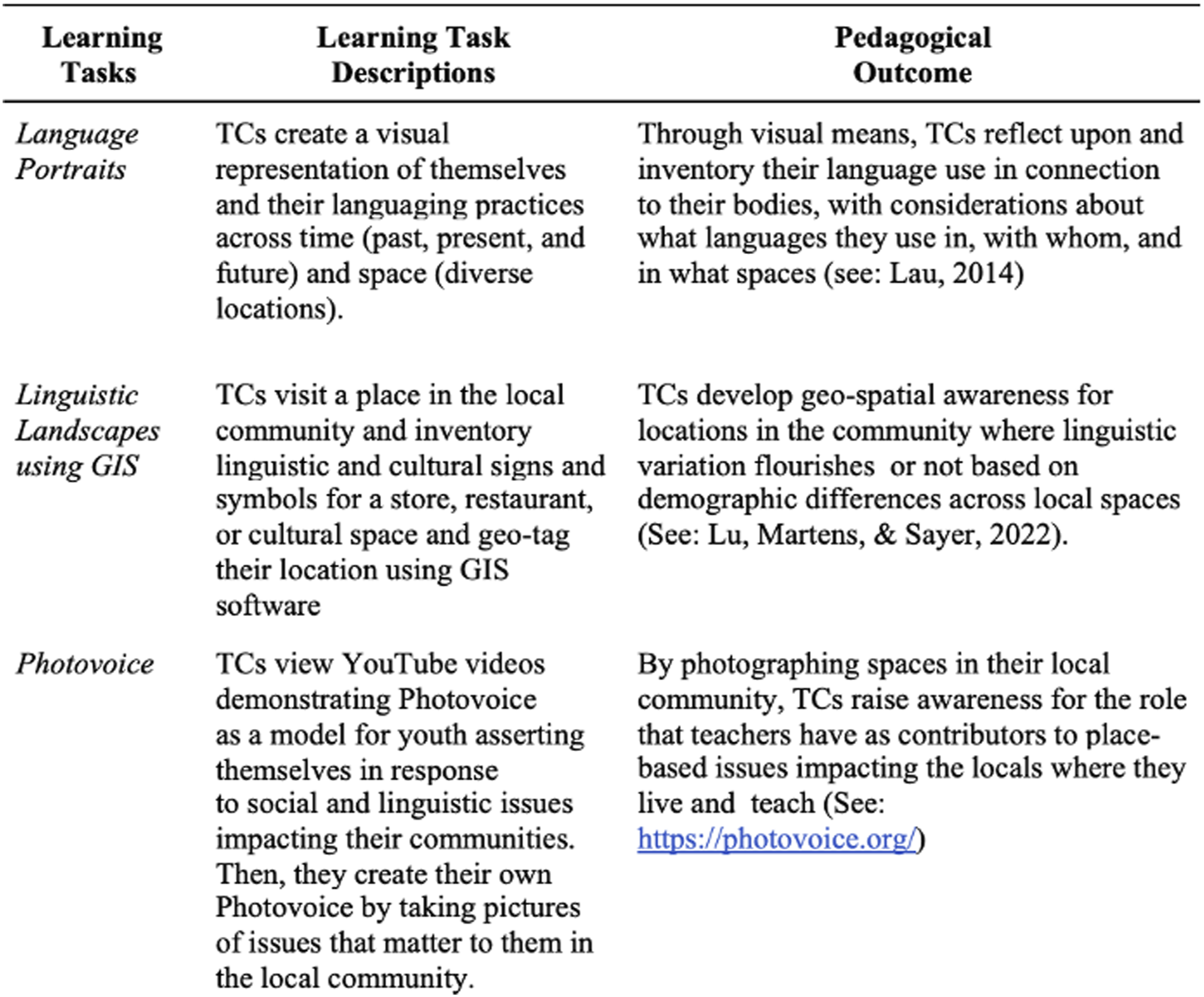
Footnotes
Declaration of conflicting interests
The author(s) declared no potential conflicts of interest with respect to the research, authorship, and/or publication of this article.
Funding
The author(s) disclosed receipt of the following financial support for the research, authorship, and/or publication of this article: Part of this research was supported by The International Research Foundation (TIRF) for English Language Education via a doctoral dissertation grant.