




Abstract
In this article, we propose ‘literacies of immanence’ as a term for sensory-laden, embodied multimodal practices that happen when researchers get out of the way to allow for modal diversity in meaning making. The learning encounters that we observed during our research combined senses with a kaleidoscope of modes that were hard to describe through more traditional multimodal methods. Literacies of immanence is the most fitting phrase for these practices because they were fluid, open, and they did not rely on written and spoken texts. Researching in a primary and secondary special school that are part of an academy trust in the southwest of England, the research team engaged in research-creation propositions (Truman, 2021) where we watched and built on multimodal meaning making supplementing it with story-making activities. Writing and sharing fieldnotes and filming interactions, we abandoned original plans and instead shaped methods and theoretical framings around the population of learners we met. Fieldnotes were shared on a blog and filmmaking helped us to describe and draw out multimodal, immanent literacies and their epiphanic qualities. This article features fieldnotes along with images of multimodal-sensory encounters and ways that they helped us relate to the learners, their teachers and Head Teacher as well as each other as researchers. The article is of relevance to researchers looking for ways to capture visible and invisible modal practices at work across settings and a movement away from a definite or true-false rendering of multimodality to one that allows for divergent ways of being with modes.
Keywords
A fuchsia scarf cascades and floats overhead. Bare feet touch the cold, damp climbing structure. The green and silver pompom filigrees furl about little fingers. Pink-coloured streaks in strict flamingo drawing lines. Jump higher and higher with Mr. Rob. Bear hug a best friend. February 17th, 2022
Introduction
This article presents research that took place in a primary and secondary special school in the southwest of England. We propose that the concept of literacies of immanence affords an opportunity to pay attention to learning encounters with palpable felt and affective modes of communication that emerge in the moment. Research-creation works through propositions that are an alternative to research questions as a form of speculation pointing towards the potentials of what may emerge, rather than what is already present (Truman, 2021). This article is a way to think through our encounters in the special school inviting multimodal and literacy researchers to adopt more neurodivergent perspectives on meaning making (i.e., beyond neurotypical frameworks). The research began as a study of children and young people’s stories of lockdown but ended up as a study that follows children and young people’s sensory engagements which we describe as literacies of immanence. The cause for this shift in focus emerged from the covid pandemic. However, the reason for the change grew from our encounters with students. They taught us to reconsider our plans to compose spontaneous stories with what was to hand and to learn how to go beyond spoken and written language communication and research within a world of feelings and senses.
What is central to the article is the diversity of learning needs in both schools. Primary and secondary students in the academy trust have a range of disabilities and most students are neurodivergent. After the research and writing up this article, we discovered a great deal about ourselves as researchers and how much we need to learn about neurodivergence as immanent and the rich potential of sensory-multimodal methods across learning contexts.
Researchers and project background
We started the research with the notion of covid stories which describe big or small moments during lockdown and pandemic times that stay with you and that call to mind how you felt during lockdown and the early days of Covid-19. At the time, our intention was to create a healing, open space to talk about ways that we all experienced the pandemic. Steve as an artist-researcher was the creative force behind the project and Jennifer and Yun were his co-researchers. Together, we planned an intensive week as ‘story gatherers’ which soon turned into a series of Friday visits and then into four Fridays from mid-January until the end of March 2022. It was always going to be a small-scale research study with no intention of huge ambitions. Quite simply, we wanted students to engage in literacy activities prompted by story sharing circles and storying practices. Jennifer admires Georgakopoulou-Nunes’ (2017) notion of small stories as an interplay of ideas and practices that have increased and adapted to social media storying. Our intention was not to engage with digital small stories told about pandemic days, but instead more traditional stories written, oral, or hand drawn. To extend the research over the three months, we distributed story boxes to archive them over time, but the boxes got lost or destroyed in the shuffle of busy school days.
We visited two school sites, a primary and secondary site, that are a part of an academy trust. Teachers in the school talked about the ways that the academy trust shapes its planning and pedagogy around the specific needs of students. We came to this school through word of mouth and reaching out to the Head Teacher. Having secured funding, 1 we contacted a few schools and this trust was open to us as a team and to our research aims. We worked with approximately 50 students in the primary school aged from 5 to 13 over 5 days and with 20 students at the high school aged from 14 to 17 over 4 days. The teachers and Head Teacher were very generous with their time and sharing perspectives on the research.
For visits at both schools, Steve took film footage with a roving camera, Yun recorded thoughts and observations in her notebook, and Jennifer focused on relational, multimodal moments with children. After each visit, we wrote about observations on the research blog. What started off as perfunctory, descriptive blog posts soon became meditations on the research and how we felt inside and outside of it. Jennifer and Steve introduced Yun to research approaches and methods and had her shadow them during fieldwork, sharing blog posts, and asking her to read articles on research-creation (Springgay and Truman, 2017).
To get a feel for the tone and scope of the research blog posts, we offer an excerpt from Steve’s fieldnotes: It was nice to walk through the school, I wondered what more I could do with them – I could spend a little time in each class capturing some video clips – I could go in to collect the story boxes and make a song and dance about it, not literally but I could go in role as the keeper of stories. I wasn’t sure how much more I could do that would make sense to everyone. I thought about a focus group with the kids, and I couldn’t see how this could work. I thought about all the teachers and teaching assistants and wondered if we could do some sort of reflections with them – get their ideas about expressions and identities. This was a passing thought; they were all too busy. The fieldnotes provided a position and a place of relative distance. It was a good point to come too and it’s like talking through practice in that we didn’t really know we needed to do it until it became the logic for the day, what we needed to do emerged in the doing. Steve Pool, 20 Jan. 2022
Steve’s research accounts move in and out of time. As he expresses it, they allowed each research day to be separate from itself. The task was to teach Yun how to emulate a reflexive voice, but in her own style, and move into the research process, immerse herself in the convention and discourse of writing fieldnotes. We taught Yun how to fully understand what it means to take a position and to not only place a relative distance between herself and the school, but also to be reflexive enough to move her past into the present moment. Deviating from the norm of writing fieldnotes in isolation, as private spaces, we opted instead to share our fieldnotes on a blog. This was challenging because they were no longer personal and we each in our own way had to mediate across our voices and thoughts. We found ourselves writing up our fieldnotes and then reviewing them before sharing which gave us pause to think about the intimacy of fieldnotes for researchers.
Ethical practices and consent
As with all research, once we had a sense of the school’s culture and we had more of an understanding of the population of learners, we revisited our ethical practices and approaches to consent. Most of the children and young peoples’ parents and guardians provided signed consent for them to participate. Most if not all students struggled to fit into formal structured educational settings, so we adjusted the nature of consent (e.g., no participation vs. some participation vs. full participation) and explained the study and their participation in consultation with teachers and the Head. Early on we decided that we would focus on materials, texts, movements, and senses and no faces appeared in video footage and photographs. We discussed the nature of consent with children and young people and ethics became a part of our longer conversations with Yun about research processes and practices.
Diverse learners and multimodal reframing
In this section, we summarise literature on multimodality in relation to special education. As a multimodal scholar, Jennifer found that her multimodal research methods broke down at the beginning of the research. Rather than entering the field and expecting to document and analyse design and compositional practices by children and young people, the research centred instead on senses and more specifically, becoming through senses. What does tinsel on a pompom feel like when it scrunches between two fingers? How does light shift in fuchsia fabric when it canopies in the air? Is it different when someone is under the fabric? Jennifer had encountered these ephemeral and slippery practices before, but only as a part of everyday life and not the sole focus for research on multimodal compositions. Add to this that covid had shifted our relationship with objects and contact, so we were aware of trying to be socially distant whilst at the same time playful and emergent with modes, objects, and materials.
The starting point for the research is multimodal literacies. That is, we entered both school sites considering what and how many modes of expression and representation are in play and what relevance these modes played in our understandings about different learners. Our own sense of multimodal literacies was that it opens communication, compositions, and pedagogies beyond words to other non-linguistic forms of meaning making and these other forms or modes are often secondary, sometimes invisible in schools. This sense of multimodal literacies as a democracy of modes (as an ideal) and ways that multimodality invites in the non-representational and felt chimed with the population of learners in the academy trust.
Considering neurodiversity
We are not experts in neurodiversity or autism so for us, the sole focus was on observing modes and the immanence of their literacy practices. Drawing on research and writing by Shannon (2019), we take our definition of autism as dynamic, diverse, and filled with contingency. Shannon’s research in schools with A/autistic students gives us more possibilities and contingencies to capture complexities as we interpret our fieldnotes. His research methods have a rich openness in terms of multimodality and how individuals inhabit spaces through synaesthesia. In his research in primary schools, Shannon conducts sensory experiments with A/autistic young people to access forms of embodied listening and there is frequently an eliciting and pull on synaesthesia as a part of experiencing planned practices and activities. Synaesthesia involves a crossing of senses or as Shannon describes it, “the experiencing of one sense as another” (Shannon, 2021a: 14). Attuning himself to a carousel of experiments with senses, Shannon, (2021a; 2021b) unsettles an arbitrary pathologizing of sensory experiences and thereby reveals and discovers contingency in autism. We noticed synaesthesia in all of the classrooms we observed. Rather than noticing a single, solitary sense, there were a myriad of senses that blended and morphed into each other, displaying Ceraso’s (Ceraso, 2018: 328) notion of “embodied listening”. This article focuses on synesthesia as a way into learning and being across these classrooms (Rowsell and Abrams, 2021). There are some noteworthy research studies that move multimodality into disability studies that enriched our thinking during the writing process. Of particular note, Kleekamp’s (2020) article illustrating ways that secondary students in an isolated special education class engaged in literacy practices through neuroqueer asocial actions and embodied inventions when framed as competent by teachers and staff. The insightful intersection of special education with multimodality helped us recognise normative and deficit orientations around literacy teaching in special education contexts. So too, Flewitt, Nind, and Payler’s (2009) article that explores the notion of inclusive literacies gave us the idea that children with learning difficulties interpret and use a range of modes and sign systems as they make meaning across educational settings. Together, these scholarly contributions alongside a study by Faux (2005) on special education students’ multimodal improvisations of multimedia stories, built a more informed picture to interpret neurodiversity, multimodality, and sense-led meaning making.
Challenging our own assumptions about what multimodal research should and should not look like, we had to be more flexible and accepting of emergence and immanence than we had been in the past. It comes down simply to it being foreign to us and the reframing of multimodality really pushed our thinking. Our deliberate use of the phrase literacies of
Bailey conducts ethnographic research with children and young people documenting their gaming practices as identity practices and this micro-narrative and ethnographic work demonstrates ways that children and young people construct identities through game play. Bailey (2021) writes about his own life-long interest in gaming and connects this ruling passion (from the work of Barton & Hamilton) to neurodivergent ways of making meaning and engaging in literacy practices. Connecting his own story as neurodivergent with his ethnographic research, Bailey intersects the fields of autism with literacy studies and multimodal literacies. In his book (2021), Bailey writes about his own life-long passion for videogame play and how he played alongside gamers in the Banterbury Minecraft world and gaming club that he developed as a part of his research. Bailey says that you cannot reify what it means to be autistic, but generally speaking “autistic people are understood to experience the world in ways that are different to those who are considered neurotypical” (Bailey, 2021: 27). What we recognised were rhizomatic sense-led meaning making that Kress signals in Before Writing (Kress, 1997), but it feels like these early more expansive spaces for multimodal meaning making have been lost – except within early years research (Pacini-Ketchabaw et al., 2016; Sakr, 2017; Schulte, 2019; Trafi-Prats, 2017). This became particularly prominent when Steve co-created a collage with a group of year 9 and 10 students in the secondary school (Figure 1 below). There was a rhizomatic, emergent quality to students drawing colourful small stories on large sheets of black and white paper. Young people went in so many directions as they added to the collage, with more subversive signs and images like Ukrainian and Russian flags blended in with elaborate drawings of skateparks and gardens. What came alive is Bailey’s contention that “children’s explorations of the everyday as part of a process of becoming, in which their past experiences play a significant part. Describing this process as ‘becoming’ emphasises its ongoing, fluid, changeable and emergent nature, rather than suggesting a process that is fixed” (Bailey, 2021: 287). The emerging collage.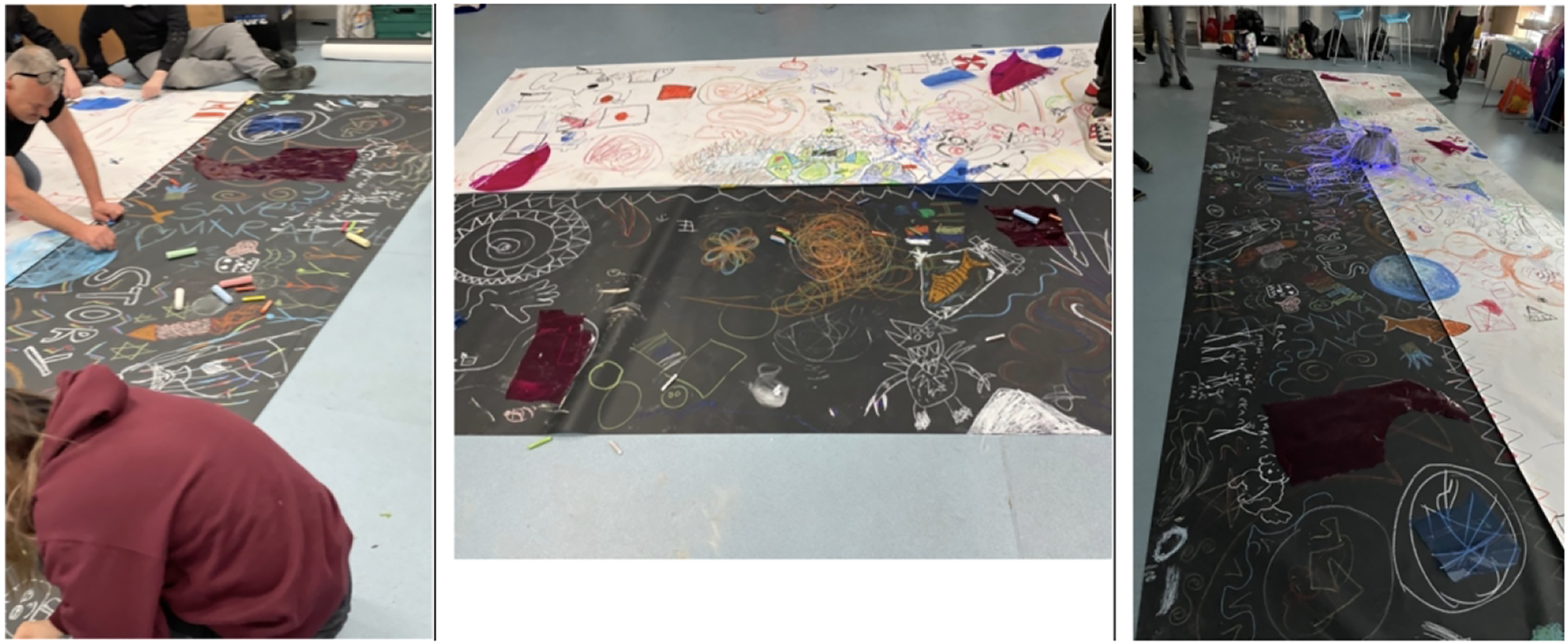
Disrupting medicalised models of autism, Bailey allowed us to recognise autism as an assemblage merging restrictive medicalised language with socio-cultural and idiosyncratic definitions. Calling into question narrow definitions of neurodiversity invited us to think about the relationship instead of neurodiversity and multimodal and literacy studies. After all, we are literacy, multimodal, and arts-based researchers and our own backgrounds informed our way into the research. What we realised over the course of the research is just how far multimodality and literacy studies need to move to capture neurodiverse perspectives across age ranges.
Synaesthesia and sensory research methods
Reframing multimodal research methods and drawing on theorising student identities through Shannon and Bailey led us to synaesthesia. Synaesthesia is important in that we experienced the school all at once. It felt like jumping into an unprompted, involuntary joining of senses that were all jostling in. It took a while to figure this out and connect it to the research. The fieldnotes allowed us to recognise this fully. Adopting synaesthesia gave us what Steve called a modal breathing space to share across researchers, teachers, students, and the Head.
There is psychologically oriented research on synaesthesia, but we take our orientation from social interaction and an ethnographic lens. Psychologically oriented research emphasises how brains process senses and neurological and cognitive responses to senses and stimuli. As multimodal ethnographers, we are more concerned with social and relational dimensions of sensory and synaesthetic responses – how do senses impact engagements, understandings, emotions, and literacy practices? Kress (2003) is most helpful here and although not an ethnographer, his writings take a situated look at multimodal meaning making and he maintains that it is in “the realm of synaesthesia, seen semiotically as transduction and transformation, that much of what we regard as ‘creativity’ happens” (Kress, 2003: 36). Kress emphasised how individual and agentive synaesthesia is due to its capacity for transformation (a smell becomes a colour) as opposed to acquisition or skill development (Kress, 1997, 2003).
There is a tradition within multimodal theory and scholarship of folding in synaesthesia and senses into multimodal work (Jewitt, 2005; Kress, 1997). There has been more recent research exploring sentient and sensory ways of engaging, making, and experiencing modes (Leonard et al., 2015; Rowsell and Shillitoe, 2019). For instance, Lenters and Whitford (2018) consider the notion of embodied literacies in their research on comedy and improv as literacy practices. The researchers spotlight a moment of improv as students spontaneously create texts together and examine closely entangled materialities, bodies, and senses. Applying sociomaterial theory, Lenters and Whitford show how children embody and relationally share comedic texts. Jewitt’s research on sense-oriented research attends to the powerful role of touch with technologies (Jewitt et al., 2020, 2021) and digitally mediated communication. Jewitt et al. (2020, 2021) illustrate how touch technologies can evoke memories, thoughts, and the overall social implications of digital touch for communication.
As we wrote ethnographic fieldnotes and began to share them we realised that the experience had triggered different responses, we all felt the space differently yet the experience, especially after 3 years of covid restrictions, felt very personal, affective and difficult to render into words.
Adopting research-creation
As mentioned, after our first visit to the academy trust it became apparent that our plans for telling, collecting and writing stories with students could not work. We recognised that we would have to open ourselves up to respond to situations as they emerged and attune ourselves to how the young people we were working with communicated and related to their worlds. Steve suggested we explore research-creation as it combines research with creative actions that could attune to the specific needs of the school and the young people on their own terms.
Research-creation as a methodological tradition activates arts practices to research through movement, art, and modalities (Truman and Springgay, 2015). We understand research-creation as more of an active way to co-research within sites and what appeals to us about it is that it is not as invasive as moving into a site and documenting its culture. It suits the We Are Our Stories research well because it allowed us to engage in arts practices, however small and everyday, in order to have deeper understandings about the children and young people. Shannon approaches his research in similar ways and we draw inspiration from his several research studies where he shows how art and modalities instantiate theory into practice (Ben Shannon, 2021; Shannon, 2021a). Shannon’s applications of research-creation allowed us to take neurotypicality out of literacy. By this we mean, literacy by its nature is built on an autonomous, standard, neurotypical model of the ways that people should read, should write, should think, should listen, and should communicate (Street, 1984). This kind of framing of literacy practices is not only inaccurate and unrealistic, it is actually dangerous because it removes so many learners who do not fit a neurotypical mould from classrooms.
The research that we conducted in the primary and secondary school would not be possible within a neurotypical framing of telling stories, reading stories, or writing stories; it had to be a literacy based within modal flexibility or what Shannon calls, from Whitehead, an interpretation of modes that moves away from true-false distinctions (e.g., words should be read in isolation from visuals) to an openness and to “how potential feelings other than true or false might be lured” (Shannon, 2021a: 8). Shannon argues that modes simultaneously carry a true/false distinction (e.g., major chord and minor chord), while at the same time modes and modal logic “expand upon how that truth is conditioned” (Shannon, 2021a: 7). Research-creation invited a drawing out of bodies and thinking. Certainly, what we observed during our brief window in the primary school were bodies moving and constantly doing things like pushing and playing with sand or drawing circles. It is challenging to document this carousel of multimodal ways of being and thinking through traditional research methods which are by their nature premised on neurotypical assumptions, broadly speaking.
Take for instance how Steve worked with children and youth in the primary and secondary schools. Steve was intending to use video projection mapping to add a digital element to a final event that we had hoped would share fragments of stories. He set himself a challenge of trying to capture the visual feel of the school, what he describes as the spaces of affective buzz. Finding filming liberating, the roving camera gave Steve a focus and as the day progressed, he felt himself following his camera into the space. Steve draws on ideas from research-creation specifically with ideas from process philosophy and the focus on research on the making-thinking-doing of research that creates something new (Manning and Massumi, 2014). What unfolded during Steve’s artistic practices with children and young people was enabling constraints as in playing with the notion that modes have true/false binaries (e.g., words need to be written to exhibit literacy practices) and instead, he found new possibilities by exploring different modes and modal combinations. Staying within a true/false modal binary is like asking an artist to have a single colour for a pallette or insist a film is produced in black and white. The rules are to be taken seriously yet within the creative processes they are rules that can be transgressed if a process demands it. Within our project, ethical guidelines dictated that children’s faces could not be filmed or identified. Instead of seeing this as a difficulty, it was treated as an enabling constraint shaping the type of footage that could be recorded. The film clips focused on hands, on feet, on movement and on the detailed textures of materials. The focus and orientation of our filming was constrained by external rules, yet this helped to create something new and shaped our thinking giving us direction and a sense of purpose. Steve tried to draw on ethnographic filmmaking to capture the flow of feelings and sensations without thinking about stories or dialogue or timeline. It started as a rough idea, and he was not sure if he would end up using the footage. Steve found filming liberating in that he knew he had to capture our day through experiencing it through the camera lens (we were aware how precious it was to do fieldwork in a school). He was intending to take simple short clips that could project onto surfaces as video loops at a final sharing event.
Research-creation as a lens let us recognise literacies of immanence as modes on the move in a classroom space. Steve moving around with his camera with Yun and Jennifer circulating and relating with students modally and through gestures and movements transformed the research space into one that defies the true/false orientation to literacy and that instead let in a host of other senses, bodies, and ways of being and thinking.
Sensing fieldnotes
As co-researchers and with Steve living in Sheffield, the blog gave us a way to communicate regularly about our We Are Our Stories observations: to plan and to reflect on what we observed and thought. Our blog posts move from description to more holistic meditations on the school, our own histories in school, cultures, and tying together conceptual threads. There was some account of children’s knowledge production, but mostly we dwelled in feelings, senses, memories, and connections. We tried to pay close attention to not only senses, but also to what arose from senses – how we identified sensory rhythms and synchronicities across them. The fieldnotes lean closely into the primary school and they stretched our ways of thinking about the school and ourselves.
What ultimately happened is that fieldnotes were our primary research tool and our blog became our listening space. There was a looking-with children as children, teachers, and the Head Teacher went about their day. Fieldnotes emerged as a heuristic and as we wrote and shared them within the blog, we recognised that they were acting as more than a research tool, creating a collective thinking and listening space. Yun’s steady induction into the idea of ethnographic accounts of people and their everyday, even mundane habits, activities, and quirks, became stronger, moving from descriptive accounts and listing activities to getting inside of the sensory life of the school and her own resonances with them. Yun’s February 17th fieldnotes (our third visit) show a marked attunement to moving into the site and embedding her own life into the experiencing of research: When I know I have to get up early the next day, I usually can't sleep the night before. So, I struggled to get up and made a bagel for myself and walked to Clifton on the 17th. I waited for Jennifer and Steve for a while, and watched a woman pruning plants on a tree. Then I saw Steve and waved to him. Jennifer asked me to go upstairs. It's been a while since we last saw each other, and it’s great to meet them. Jennifer was holding a big box, which has a Chinese sticker on it, that says “white; mugs; without cover”. That amused me and made me think of the ‘everything is made in China’ joke. When we went downstairs, we met our driver, who was sipping his coffee and enjoying the morning time. Yun, 17 Feb. 2022
Manning (2013) talks about “choreographic thinking” as a moving, relating, and composing within a field of actions and reactions with others but also with ourselves and this is the way that we felt within this brief but intense research study. For us, fieldnotes captured the modally and sensorially laden nature of the research, but also the strong degree of improvisation and non-representational literacies at play (Leander and Boldt, 2013).
Extending on writings by Manning and her work in the Senselab in Montreal, across classrooms there were material things that served as anchor points or quilting points. For instance, the elusive story boxes distributed to each classroom disappeared within a day. There was an interplay between stuff, people, and senses and the rawness of all of them.
To illustrate the interplay of stuff, people, and senses, we offer a moment during one of our visits. Steve brought an assortment of objects, props, and artifacts. One is Spiros which is a scary, dirty old seagull puppet (see Figure 2) that he brought for the February 17th visit and he also brought a crystal ball. The purpose of the crystal ball was for Jennifer to see into it for stories (elicited or exorcised) and Spiros was a way for Steve to invite conversations about covid stories from children. Both objects failed to meet their full potential in this research. Instead, children leapt onto the crystal ball and they wanted to touch Spiros’ dirty old beak. All the same, Spiros became a key figure for the day and children seemed to gravitate to him. As Steve noted: I kept calling Spiros the seagull Stavros – I think it is OK as they are both Greek names, but Stavros may be a bit offensive like calling everyone from Australia Bruce. … Spiros seemed to be a hit – I also brought a Crystal ball to capture stories – I notice Jennifer says collect stories this was an interesting thing as I think of capture in the Deleuzian sense of the mechanism of capture and the abstract machine – the ball presenting the plane of both the virtual and the actual – a potential proposition of immanence. Steve, 17 Feb. 2022 Spiros the story-telling seagull.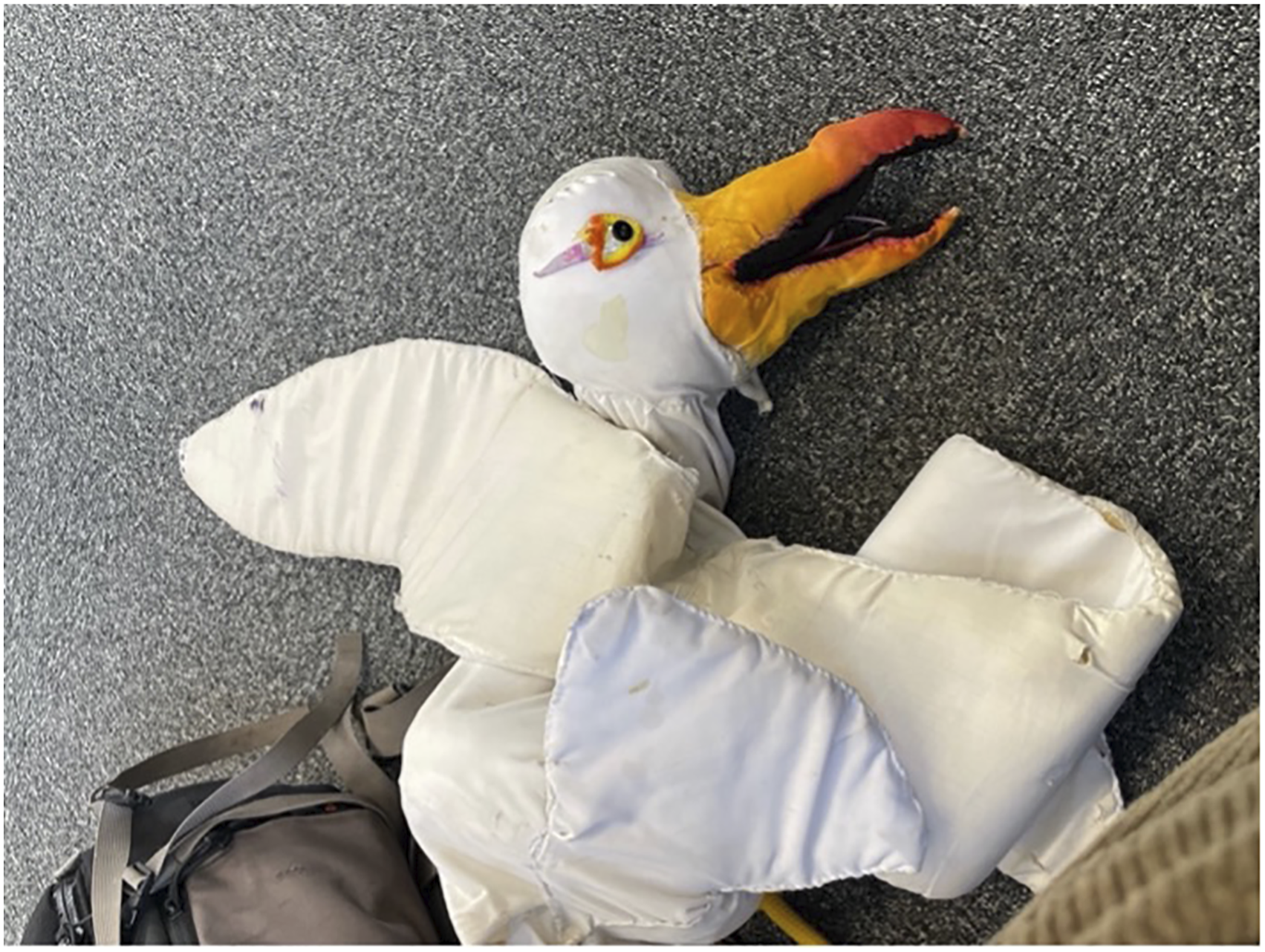
It took a while to pitch these epistolarian exchanges with the level of detail, reflection, and reflexivity that we felt they demanded. Yun’s steady induction into the art of fieldnote writing stands out as a research epiphany for all three of us. Yun moved from fact-sharing to describing feelings to starting to really sense being in and inside of the special school – mind, body, and spirit.
Literacies of immanence as beyond language
Why literacies of immanence? Immanence helps us to address the very different nature of multimodality as equal, intersecting, and sensorial. Literacies of immanence represent a conflation of senses and modes that were orientations to being, knowing, and doing of research. The concept of literacies of immanence is not complete or worked through; it is emergent, it grew from the feeling of language that felt beyond representation. We adopt it as a term to reach towards what we felt in a space together, telling stories, sharing thoughts, and sensing our ways into the world. Memories from childhood, jumping, sand between our toes, climbing and sliding and feeling gossamer fabrics brush across our cheeks. We understand immanence to mean completely contained within itself, to be intrinsic, self-contained yet not separated from, to be in flow.
In the special school, there was a diffuse atmosphere of senses, vibrations and synaesthesia. Rather than making language a central modality, there was a democracy across modalities guided by senses, objects, and poetics of relations. Eliciting Glissant’s poetics of relation, Erin Manning speaks of socialities that develop between and across life in the making and concepts rise up from people activating them together in a common space. Describing the work of Deligny, Manning captures what we observed across spaces, making “visible the shape of their movements in order to elucidate, from these movements, the orientations that composed the everyday” (Manning, 2020: 159). Manning describes Deligny’s work with young people spotlighting “ways of bodying in the moving” (Manning, 2020: 159). It is about seeking out desire in movements and the forces of forms together. What we observed can be encapsulated in Manning’s statement: “To feel the world in formation is to jostle the edifice of representation that neurotypicality upholds” (Manning, 2020: 250). What we witnessed was a feeling-with stuff and in-the-moment desires. The sociality of relations oriented and moved neurodivergent children and young people into multiple directions. The literacies of immanence on display in these sites gave us a window into what synaesthetic socialities that relations can uphold.
Immanence and synaesthetic literacies
The noise of our positionalities, aims, research questions, and theorising removed from view gave us room and a breathing space to attune. We came back to immanence as running through our observations within fieldnotes and discussions. To develop agreements about terms that we used during the research, we shared our own definitions. Here is Steve’s definition of immanence: Immanence is a complicated word that is best understoodby thinking of potentials - things that are not yet in the worldbut are on the edge of becoming. In Deleuze, who writes verydifficult philosophy, he talks of the plane of pure immanencewhere every possibility of what is and may be exists in itsfull potential.
We liked this definition most as it came closest to what we saw during our visits to the primary school – especially our 17 Feb. 2022 visit. Atkinson (2017) describes immanence in his writings on arts education as a learning encounter that matters for a learner. He speaks of relaxing established parameters of practice to respond to immanence of local practices. To think about and actively access the suddenly possible “that may transgress the framings and values of transcendent forces” (2017: 5). “Immanence naturally allows an unlearning to happen” (Atkinson, 2017: 7). It would be false to say that unlearning was a stated aim for teachers in this school, quite the opposite actually. There was lots of teaching and indeed learning. But, there were many moments on the edge of becoming and an abundance of potentials. Sensing literacies gives a breathing space to listen to potentials and to children’s internal capacities and pathways into literacy (Kress, 1997).
What came out strongly from our fieldnotes and Steve’s sensory ethnographic filming moments were immanent moments with objects of all sorts in all kinds of spaces. For example, there is a bare foot (see Figure 3) theme that ran throughout the day as seen in this fieldnote by Steve with an accompanying visual: What I notice: kids are happy generally and what I see: Kids with no shoes onKids with Odd shoes onKids with no socks onKids with one sock on.Lots of children try and put their finger in Spiros’s mouth. Steve, 17 Feb. 2022 The immanence of bare feet.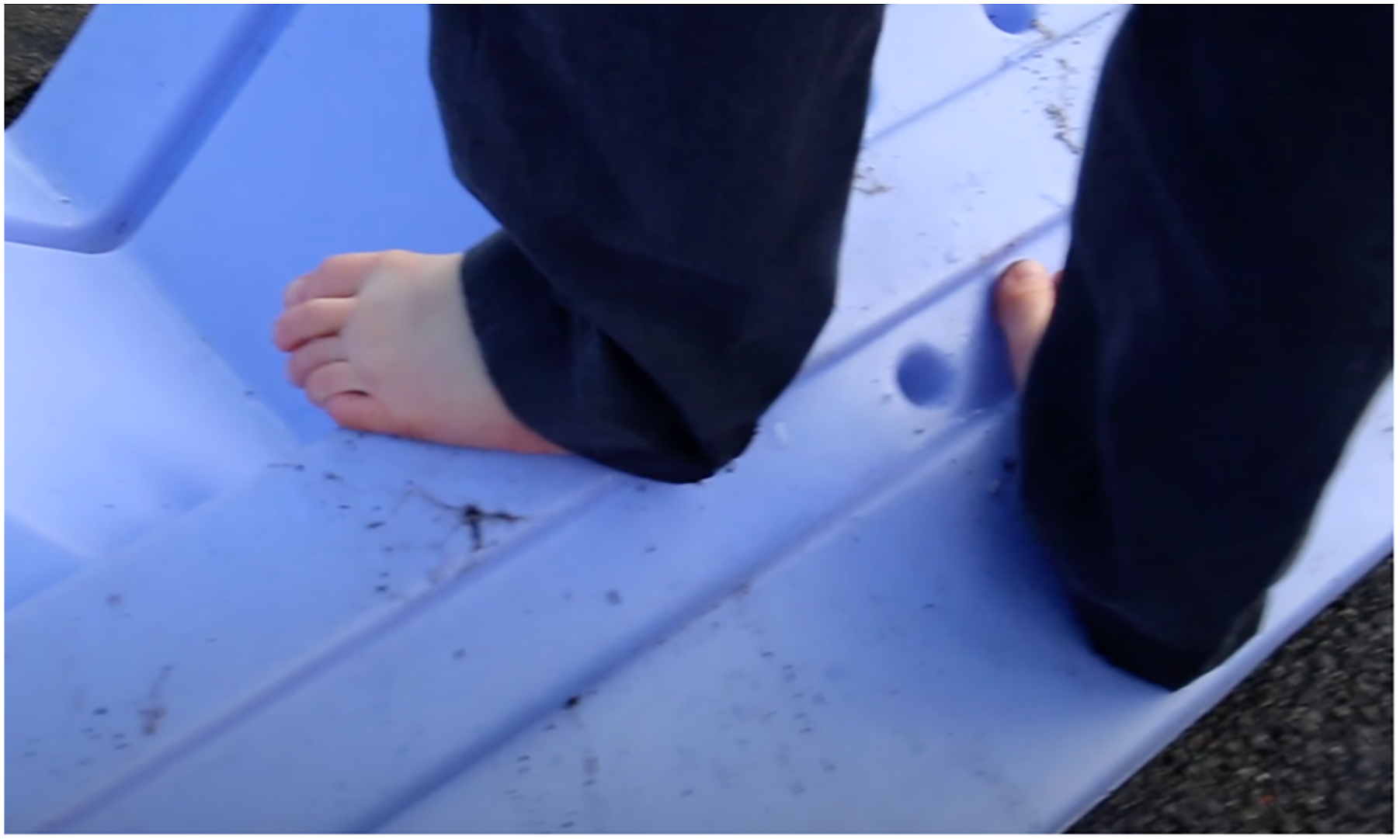
Certain images stick, such as the bare feet on the cold plastic on a February day. The feet reminded Jennifer of another project with adults when they produced a collage of feet within a community that had to do with seeing through a living literacies approach (Pahl et al, 2020). The role of objects stuck too (Ahmed, 2014). There were definitely moments of becoming during the day such as the classroom with children floating fabrics in the air.
They were brilliant and so engaged with different objects, fabrics, materials. One boy stayed on the floor for most of the 30 minutes with different swathes of fabrics on top of him. He loved it when Yun and I and the teacher and I made a canopy for him to go under. There were two other girls who also liked the canopy activity. At one point, Steve got under the fuchsia swathe of fabric and filmed being under the fabric. There was another girl who liked to put the leopard-print fabric around her shoulders and looked regal wearing it like a robe. Jennifer, 17 Feb. 2022
A classroom that stood out for us was one with three children sashaying colourful gossamer fabric. It was a scheduled break time in the day and some children went outside to play whilst others preferred to improvise with fabric and glittery pompoms. There was a sense of joy as a boy and girl played with and under the bright pink and leopard printed swathes of fabric. The picture shows one boy who was particularly taken with the gossamer and specifically the feel of it on his skin and wrapping himself up like a Mummy (see Figure 4). We wanted to see what it was like inside of the canopy of colour too, so Steve went under the canopy himself (happened right after the photo). Sand between toes, the sight of gossamer fabric in the air, these moments defined children’s experiencing of their schooling worlds. On the edge of becoming under fuchsia gossamer fabric scarf.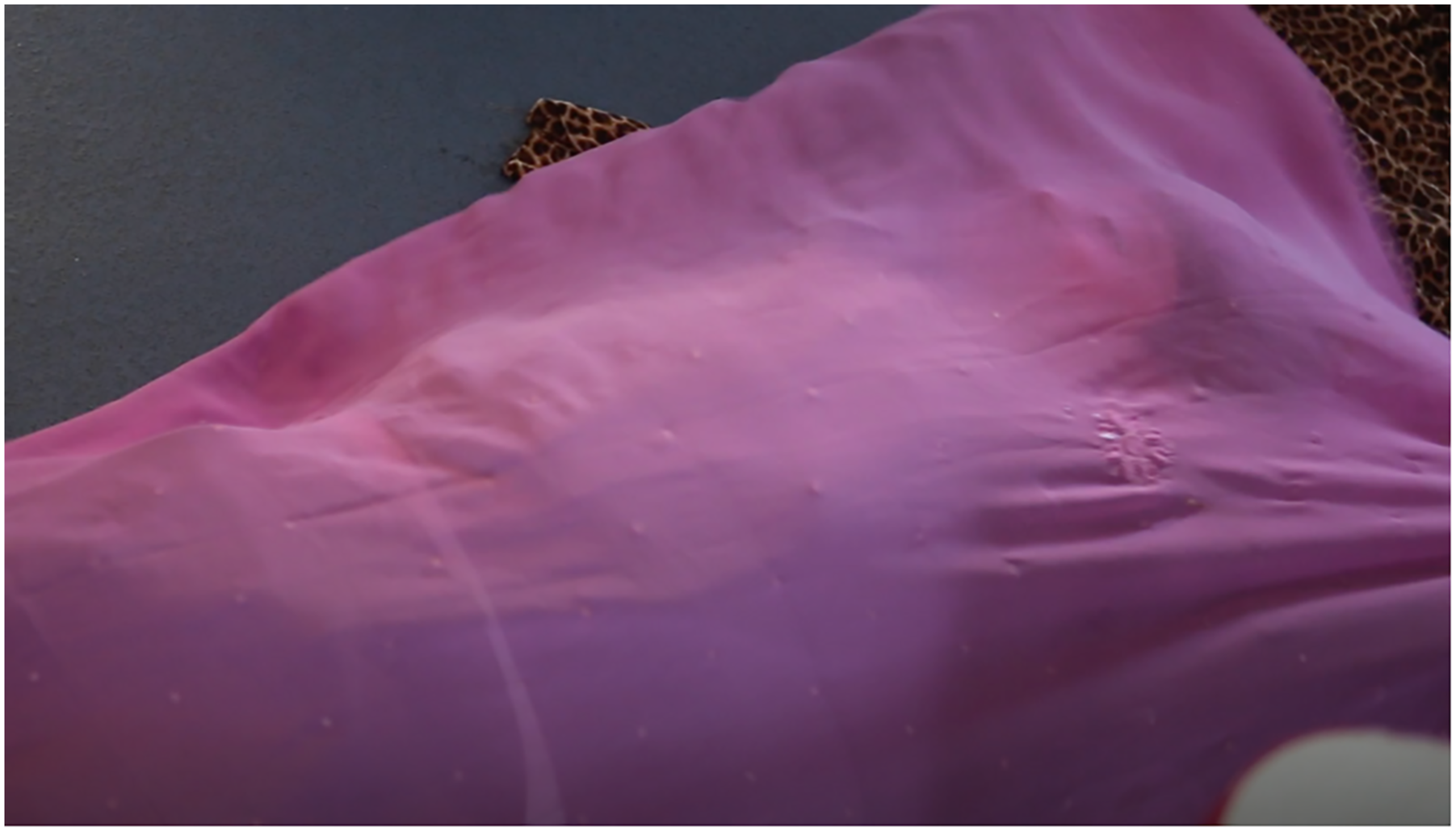
Sensing a pompom
During our research days, we paused many times to note and later discuss how children negotiated across modes of colour, textures, light, made sounds, gestured, jumped in particular ways guided by natural gut instincts and what can be drawn out by these tacit practices (as they relate to literacy, identity, schooling to name a few connections). Synaesthesia as a framing concept relates to sensing literacies because it is about our perceptions versus actual realities. Do the tinsel green threads in the visual below feel cold and flexible or stiff and warm? What sound does it make when it swirls? Do these modes remind you of anything? This questioning came to mind for us. The boy in Figure 5 was fixated on the green and silver pompom and seemed to love the feel of the filigree. Synaesthesia in a pompom.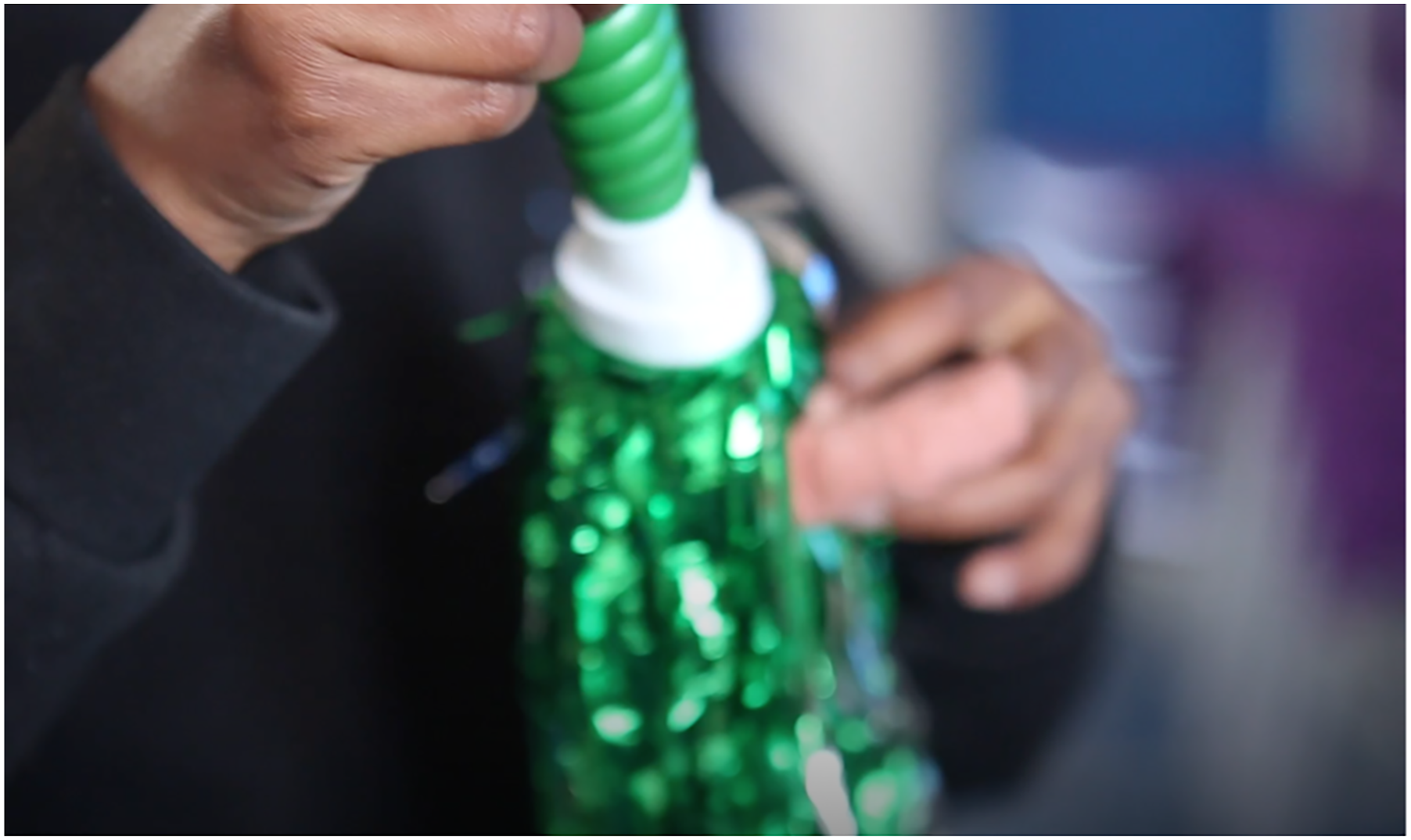
These questions and their implied associations are embodied and immanent which makes them integral to where we are in the moment of listening, thinking, and of course sensing. They are language-less, but communicative. The sensed literacies carry with them a resonance that keep our attention, albeit brief.
Given we came around Valentine’s Day, there were remnants of hearts and red glitter (and pink sand) on the sand table. We gravitated to the sand table and it resurrected memories in other primary classrooms we visited moving sand around (see Figure 6). We rolled our sleeves up and got into the spirit of it and moved the grainy pink heart sand too. Although it would be false to say that we were not more than a little nervous about getting in close together and touching the same sand, hearts, and glitter with covid rates rising and fear of getting it. But as Steve articulates below, there was something very synaesthetic about the sand signalling movement triggering memories and our engagements with it became a way of communicating. Moving pink sand, feeling its grit and grain. … sand and confetti for valentine’s day. I get my camera and start to film – I lift into a collecting zone – I can feel the sense of a ravelling, but the switch is hard – pulling focus is hard – I start to think that this is the collecting and it is all about the sensory – not affect but what we feel how we interact – stories told with and through our bodies – things in spaces beyond language – these are the stories of the classroom. Steve, 17 Feb. 2022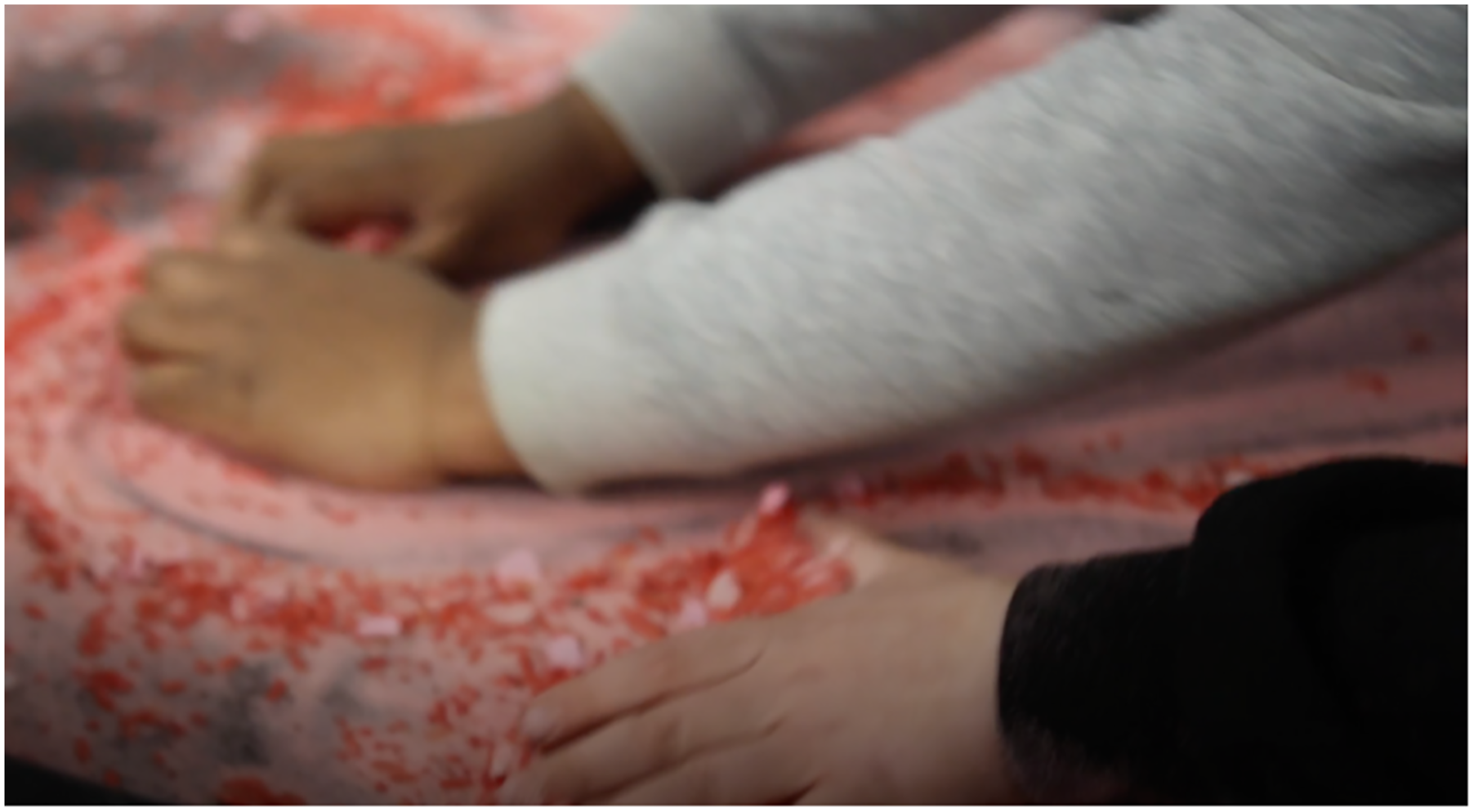
As the picture shows, there was an infectious energy to moving the sand. At first, we were reticent about getting our hands and fingers in the sandbox, but once we got into the spirit of it with the other children – we sensed their excitement.
Drawing, fingers, connections
There were familiar school-like literacy practices witnessed over the course of the day such as writing, drawing, and mapping ideas. Admittedly these “school-like” moments felt less authentic, immanent, and unbridled compared with the pompom, fabric, and sand table, but they did exhibit strong sensed literacies. There was some moving from an idea to form when we gave them an idea for drawing or writing a story and they set to work, but there was always a question as to whether they were doing it to make the researchers or their teachers happy or whether they actually wanted to do it. Or perhaps it is our own efforts in this article to push against developmental definitions of literacy and multimodal meaning making leading to skills and instead invite readers to consider the knowledge claimed and perceptions ignited through literacies of immanence. All the same, there was evidence of sensing literacies through touch, drawing, fingers and object engagements. There was abundant touch and touch was associated with skills. Yun was particularly adept at describing the sensorial potential of drawings. Both Jennifer and Yun sat for longer periods in the day with children as they talked, drew, shared, and touched pens and paper. The boy drew the gingerbread man with a pencil at first. At first glance, I cannot recognize the pattern he was drawing, so I asked him and he told me it was a gingerbread man. This boy was really creative and he could not stop drawing. He drew two sheets of paper full of gingerbread men. After that, he even wanted to keep drawing on the heart-shaped paper that they have used for Valentine’s Day. Instead of drawing, a boy wrote down his classmates’ names and connected them together with lines to show the friendship relation of them. I am wondering if he was like an observer, as he didn’t write his name into the relationship net. Maybe he observes his classmates every day and notices their relationship and that’s why he could reveal them with a net. Yun, 17 Feb. 2022 (see Figure 7) Sensing The Gingerbread Man.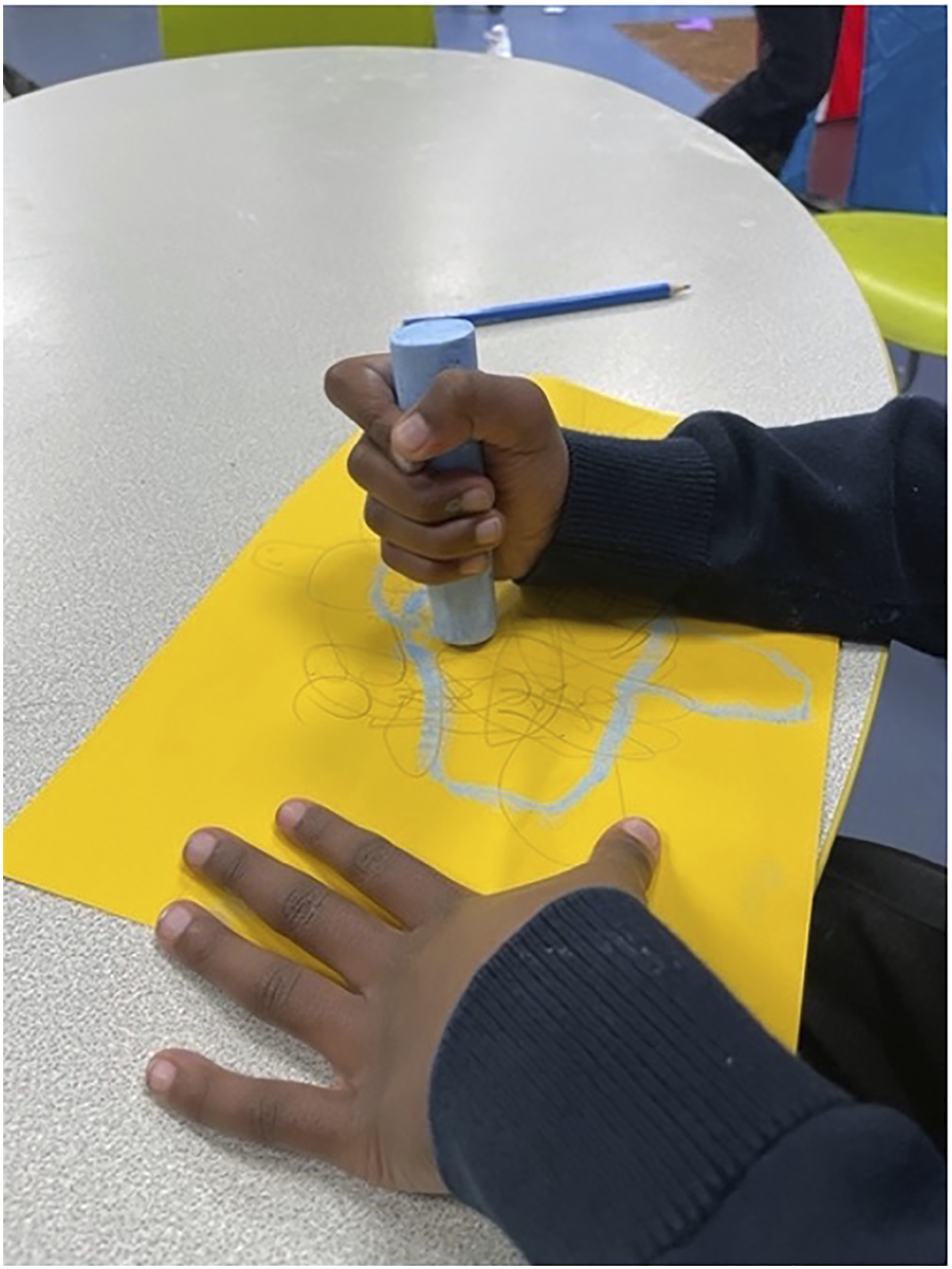
Concluding thoughts
Our first encounter with the school was intense, physical, emotionally charged, funny, chaotic, joyous, and challenging. After a few minutes we realised that our carefully planned project, with its seagull hand puppet, crystal ball and acid free archive boxes was not going to work. It was good to know that this was not our fault as nothing that had been planned before could possibly have worked in a way that we could have predicted.
We cannot move away from the felt experience of the day and how it made us feel. Covid-19 had shaped the way we were able to work yet its legacy was held within our bodies, how we interacted and how we moved through the world. The experience of walking through school and seeing the communication, energies, joy and struggles snapped us into a state of heightened awareness. We quickly recognised that we could not do what we had planned. We had aimed to collect small stories from lockdown yet because we were still immersed in more than its aftermath, we moved and were inspired by what we came to describe as the affective buzz of the school. All our senses were drawn into play in a new story that was expanding and flowing through us.
What sticks with us from our day sensing literacies of immanence are the entanglements with objects like three children swooping on the crystal ball or children touching Spiros, Steve’s dirty old seagull puppet. The ripples of affect throughout the day, the smell of school dinners, and the immense care by teachers seen throughout the day. It was a sober reminder that education really needs a greater acknowledgement of the felt sensibilities of children. You cannot strip away a body’s knowledge of the world through a singular focus on skills. Once we acknowledge that language would not be our main vein of inquiry and shifted to multiple modes and senses that unravelled from them, we were more relaxed about what we did and what we found. With that said, at the end of the research, we equally acknowledged how much our own research has overly concentrated on developing literacy and research and education more generally (driven often by economic ambitions) concentrates overly on what children should learn and the acquisition of certain types of knowledge over others.
Literacies of immanence involve being within the experience of pedagogical spaces and mediating them based on learners in the room. This looser approach is not always comfortable and there were times when, physically and emotionally, we were concerned, but moving through them we appreciated that is a part of the process – especially with students in the primary school who had specific ways into learning. There is something essential to observing embodiment and sensory engagements in special schools where language is not as privileged as other modes. There is more democracy of modes and senses. By this we mean, students did not privilege conventional schooling practices like writing or reading text, but instead drew, moved, and played with sand as they saw fit. This type of research felt more modally equal to us than our previous research in that we had to pay more, closer attention to the orchestration of different modes and senses such as smells, sounds, colours, and attention to the assemblages of sensory conditions. We think of this carousel of multimodal engagements as about emergent becoming and literacies of immanence. There is a sense of coming at the research sideways instead of head-long to focus on what literacies do to someone or how one experiences them.
Footnotes
Declaration of conflicting interests
Jennifer Rowsell is a member of the Editorial Advisory Board of Multimodality & Society. The author did not take part in the peer review or decision-making process for this submission and has no further conflicts to declare.
Funding
The author(s) disclosed receipt of the following financial support for the research, authorship, and/or publication of this article: This work was supported by the University of Bristol’s Temple Meads fund.
Correction (January 2026):
Author disclosure statements have been updated.