




Abstract
The UK government uses news conferences, press releases, official websites, mainstream and social media to provide advice and information about the COVID-19 pandemic. This information has become ‘source material’ for social media users to react to government announcements in ‘digital popular culture’; that is, memes and short videos shared on social media. Close examinations of both reveal how different views of the nation are articulated whilst giving and reacting to pandemic information and advice. Here, we analyse a sample of official government webpages on COVID-19 announcements and reactions to these in digital popular culture. We employ Multimodal Critical Discourse Studies to understand how the modes of lexica and images work individually and together to articulate views on the nation. Through such an analysis, we reveal not only what the public ‘receive’ from the government, but also broadly held ideas and beliefs by the public on the nation.
Keywords
Introduction
Throughout the pandemic, the UK government has communicated advice and information about COVID-19 through news conferences, press releases, official websites, and mainstream and social media. Much of this has become source material for ‘digital popular culture’, including memes and short videos shared on social media. Whilst offering COVID-19 advice, information and reactions to these, both government information and digital popular culture articulate discourses about the nation. In this study, we analyse a sample of UK government announcements and public reactions to these in digital popular culture. A close critical analysis of government announcements reveals what the public ‘receive’ in terms of representations of the nation. Likewise, an analysis of memes and short videos that react to these announcements demonstrates how the public feel about the nation, digital popular culture being ‘intrinsically linked to the logic and rhythms of …the ways a society expresses and thinks of itself’ (Denisova, 2019: 2). In other words, in this chapter we use digital popular culture as a barometer to understand the public’s broadly held ideas and beliefs about the nation, or as Raymond Williams (1963) would say, a society’s ‘structure of feeling’. Previous studies in a number of contexts reveal how digital popular culture articulates views about the state, nation and nationalism (Papacharissi, 2015; Denisova, 2019; Wiggin, 2019; Merrin, 2019; Way, 2016). In this study, we directly link views about the nation in digital popular culture to governmental COVID-19 announcements.
Digital popular culture, politics and the nation
The nation is not a natural, timeless entity, but a relatively recent ‘imagined political community’ (Anderson, 1991: 5) or mental construct (Wodak, De Cillia, Reisigl and Liebhart, 1999; Hobsbawm, 1993; Billig, 1995). Each nation is imagined as a community with shared interests and characteristics, despite their evident inequalities. Though the nation may feel rooted in the remote past, ‘what makes up the modern nation is made up of fairly recent symbols, or national histories and invented traditions’ (Hobsbawm, 1993: 14), such as the Scottish tartan or mythical stories of an Irish past (Trevor-Roper, 1993; Mac Laughlin, 2001). All this ‘imagining’ and ‘mental constructing’ involves language and affect to create ‘feelings’ of national pride, communicated not only by politicians, but also by the media and felt by the public (Moores, 2000; Billig, 1995; Hobsbawm, 1993). The media represent the nation in ‘political’ news and in the seemingly mundane, such as weather reports (Billig, 1995), sports (Bishop and Jaworski, 2003), opinion letters (Flowerdew and Leong, 2007) and symbolism on mastheads of newspapers (Higgins, 2004). It is here we see national identities become “a routine way of talking and listening” (Billig, 1995: 109).
Digital popular culture plays a key role in imagining the nation, given it is an integral part of our lives, transforming how we inform, communicate and entertain (Way, 2021; KhosraviNik, 2017). Some scholars are sceptical about its political role, viewing social media as a site where ‘gossiping is far more common and interesting to people than voting…. [and] embarrassing videos and body fluid jokes fare much better than serious critiques of power’ (Boyd, 2008: 243–4). Social media is also characterised as misinformation, jokes, commercialisation and polarisation where we engage in ‘scroll culture’, guided by our thumbs, skimming, reading, liking and commenting on a constant flow of artefacts that entertain and inform (Way, 2021a). Furthermore, producers’ ideas and those who share memes may be misunderstood, with parodic voices being ‘mistaken for, and (re)posted as, sincere voices (and, potentially, vice versa: sincere acts could be deemed parodies)’ (Dynel, 2021: 191). All the same, much of this is highly ideological, digital popular culture being ‘infused with ideas and values, with discourses about how we should run our societies, what we should prioritise, how we should communicate, and judgements about identities and actions’ (Bouvier and Way, 2021: 345).
Much research has focused on the political roles of memes. They offer a ‘public commentary’ on our lives (Milner, 2018: 2357), a place where ‘a society expresses and thinks of itself’ (Denisova, 2019: 2). Memes deliver a range of voices to users with ‘discussions on socio-political topics, airing their views on the current events… and provide insight into current social and political issues, being vessels for public sharing of serious information and opinions’ (Dynel, 2021: 176). However, memes do not communicate ideas using well-constructed logical arguments. Rather they amplify feelings and affect (Way, 2021b; Denisova, 2019; Merrin, 2019; Wiggins, 2019; Vásquez, 2019; Papacharissi, 2015). It is through satire, parody, affect and fun that memes criticise those in power, positing ‘an argument, visually, in order to commence, extend, counter, or influence a discourse’ (Wiggins, 2019: 11).
There are a number of studies which investigate the role of memes in national politics in relation to various issues, such as Egyptian water problems, Chinese censorship, and a Ugandan online anti-guerrilla political campaign (El Khachab, 2016; Kligler-Vilenchik and Thorsaon, 2015; Wallis, 2011). Other studies have examined the role of memes in constructing American nationalism. For example, Wiggins (2019) examines how memes construct distinct and sometimes disturbing ideas of American nationalism, and Way (2021), Denisova (2019), Merrin (2019) and Glasser (2017) consider the role of memes in Donald Trump’s America. Therefore, there is recognition that different media ‘draw upon slightly different nationalistic discourses’, suiting the interests of producers (Way and Akan, 2012: 22; Way, 2011). This becomes evident in our analysis of the UK government communications about COVID-19 and the public response in digital popular culture.
COVID-19 and (digital) popular culture
COVID-19 has been described as an unprecedented global pandemic, impacting all aspects of life, medically, psychologically, economically and socially (e.g. Weatherall et al., 2022). Humour can play important roles in times of crisis such as these, by being used as a collective defence mechanism and offering solidarity to those who are affected (Dynel and Poppi, 2018, 2020; Dundes, 1987). During the pandemic, humour has offered ‘psychological relief’ (Dynel, 2021: 176) and acted as a ‘coping mechanism to deal with the difficult circumstances of home quarantines’ (Aslan, 2021: 10). For example, memes have made light of how we cope with lockdowns, attitudes to work, masks, social distancing, public events, and stockpiling of supplies like toilet paper and soap (Aslan, 2021; Dynel, 2021). Memes have also played more negative roles as ‘superspreaders’ when (mis)information is shared or amplified by social influencers or accounts with large followings (Green et al., 2021). The spread of information (and misinformation) via memes has occurred in tandem with government daily briefings around the world.
Some studies have considered how COVID-19 relates to nationalism and ‘the nation’ in popular culture. For example, Martikainen and Sakki (2021) examine Finnish news coverage of Sweden’s response to COVID-19. They examine images and headlines and reveal how news media coverage is shaped by nationalism through ‘moralizing, demonizing, and nationalizing’ (Martikainen and Sakki, 2021: 388). In another study, Tao (2021) examines how Chinese Weibo social media users encounter two dominant discourses about the nation when confronted with COVID-19 information: that is, ‘cyber nationalism and binary opposition between China and the rest of the world’ (Tao, 2021: 622). Weibo users use parody, rhetorical questions and constructed dialogues to praise those who contribute to the national COVID-19 campaign while those deemed unpatriotic are seen to be ‘damaging the national image of China’ and ‘collaborating with foreign anti-China forces’ (Tao, 2021: 627- 629). Our study of UK government COVID-19 communications and digital popular culture adds to this under-examined area of study.
Sample
Our two samples are taken from a larger ongoing project that examines how digital popular culture responds to UK government announcements throughout the pandemic since 16 March 2020. We mapped several major government announcements about the pandemic (16 in total) and then accessed the original press conference scripts from the GOV.UK Web site. 1 In this present study, we analyse the webpage for these announcements which include the scripts read by Prime Minister Boris Johnson. We chose our sample of memes and short videos from the ‘best of’ lists from The Tab, Mail Online and The Handbook online newspapers and magazines. These lists were chosen as they provide 292 memes and short videos that are widely distributed and shared, viewed by audiences both on ‘best of’ websites and elsewhere on social media.
For this study, we chose two governmental announcements: The introduction of the three tier system to replace the second lockdown on 2 December 2020 and the introduction of Tier four and the tightening of Christmas Mixing Rules on 19 December 2020. 2 These two announcements were chosen as they are temporally close to each other (17 days a part) at a time when the pandemic was firmly a part of life in the UK (9 months since the first government announcement). Furthermore, the first announcement includes the removal of some restrictions while the second introduces more restrictions for some people.
Memes that directly respond to the 2 December announcement were harvested from The Tab’s ‘Shed a tear for these 24 quality tier announcement memes’ 3 whilst memes responding to the 19 December announcement were taken from The MailOnline’s ‘How the Grinch stole Christmas… starring Boris Johnson!‘ 4 and The Handbook’s ‘20 Memes That Got Us Through The Tier four News’. 5 This search produced 56 memes which make up our sample. Like previous work in Multimodal Critical Discourse Studies (MCDS), a deep analysis of the whole dataset (i.e. 56 memes) is not undertaken due to constraints of space (see Kress and Van Leeuwen, 2001; Machin, 2007; Way, 2021). To reveal patterns within the 56 memes and construct a representative sample, an initial quantitative content analysis is undertaken to determine how nationalism is expressed in terms of representations of place, social actors and other symbols of the nation. This initial examination is a strategy adopted in seminal work using discourse analysis (Van Dijk, 1991). These findings inform our selection of nine memes for deep analysis.
Approach
In communication, imagery has ‘always been with us’ (Mitchell, 2005: xiv) with its importance in communication ever-increasing (Ledin and Machin, 2018). By its very nature, social media is multimodal, characterised by a ‘rich combination of text, picture, audio, video that digital media make possible’ (Aslan, 2021: 9). MCDS examines not only texts, but ‘texts in context’. MCDS finds its origins in Critical Discourse Analysis and Halliday’s (Halliday and Matthiessen, 2014) functional grammar which investigates how linguistic and visual choices reveal broader discourses articulated in texts (Kress and Van Leeuwen, 2001). MCDS usefully reveals how each mode with their unique ‘affordances’, and in conjunction with other modes, articulate discourses (Ekwall, et al., 2021; Machin and Mayr, 2012). Discourses can be thought of as views of the world which project certain social values and ideas and contribute to the (re)production of social life. The aim of analysis is to reveal what kinds of social relations of power, inequalities and interests are perpetuated, generated or legitimated in texts both explicitly and implicitly (Van Dijk, 1991). Here, we consider how each mode (language and images) in government websites, memes and short videos, play a role individually and with other modes articulate discourses about the nation (Way, 2021; Milner, 2018; Yus, 2019).
We examine how participants are represented linguistically, following Van Leeuwen (1996, 1995) and Fairclough’s (2003) seminal work, which has been used extensively to reveal how certain representations are constructed and maintained to serve certain political interests (Wodak and Weiss, 2005; Bishop and Jaworski, 2003; Wodak et al., 1999). We consider how participants are named and how their actions are represented, including who does what to whom and whether participants are represented as active or passive. We apply social actor analysis to images, following the approach developed by Kress and Van Leeuwen (2021, 2001) and Machin (2007). These scholars define three broad analytical categories for analysing the visual representation of social actors: positioning, participants, and actions. Choices in relation to the composition of images are also analysed, taking into account the internal ‘flow’ or organisation of an image and salience. Not all visual elements are analysed for each Web site image, meme or short video. Instead, we use a selection of analytical tools from Kress and Van Leeuwen (2021) and Machin (2007) based on their usefulness in revealing discourses about the nation.
Analysis
Press conference webpages
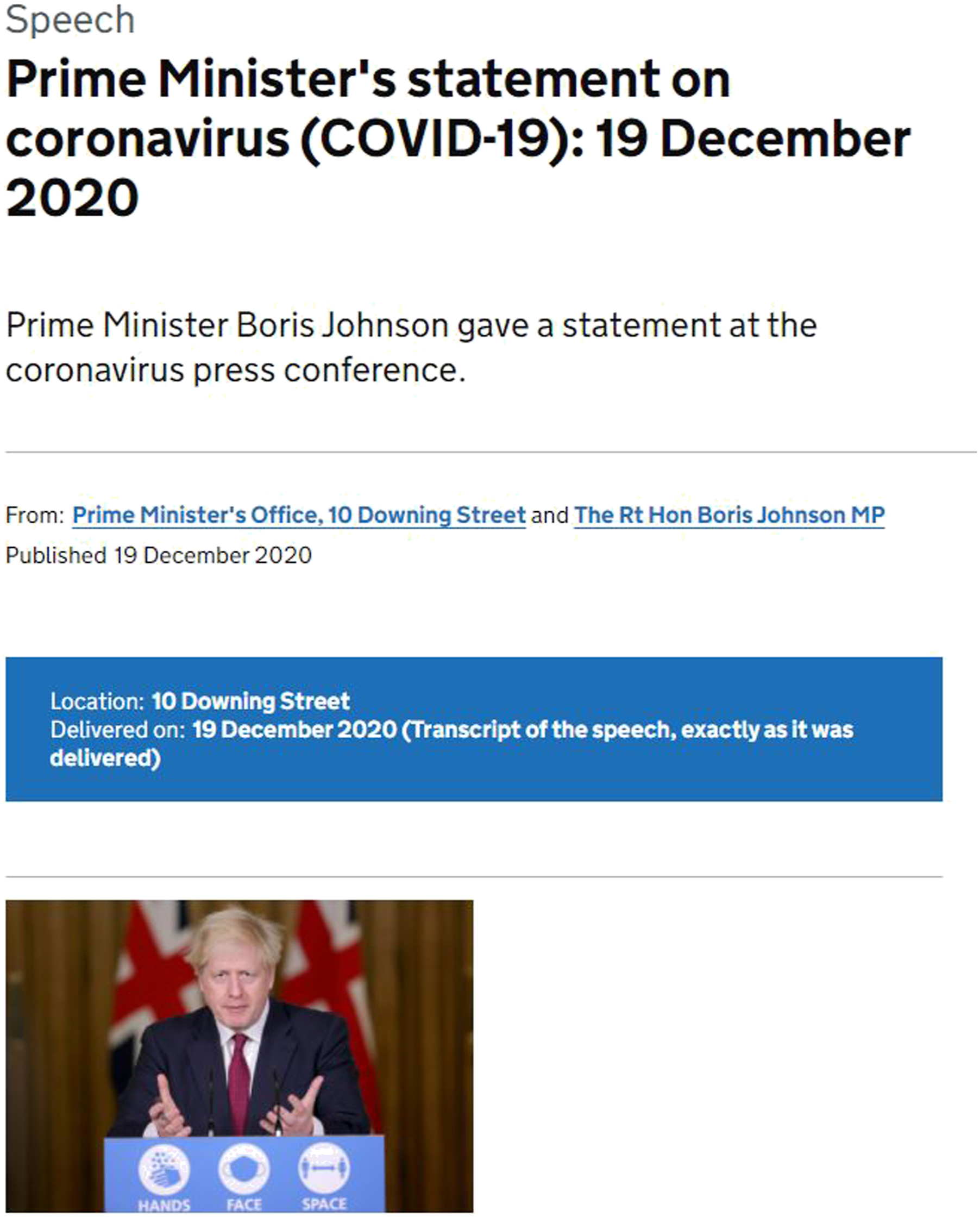
Each announcement in the press conference webpage includes a title, contextual information, photograph and the announcement ‘exactly as it was delivered’ (see Figure 1). Alongside information of COVID-19, the webpages were found to articulate the following discourses in relation to the nation: (a) The UK is an important part of a global order that is victim to COVID-19; (b) The economy is an important aspect of the nation, though other aspects of the nation are defined (geography, culture/family relations); (c) The UK government, headed by an all-powerful Johnson is strong, active and successful; and (d) To succeed, ‘you’ must follow Johnson’s advice. We now examine how these discourses are articulated on webpages. 19 December 2020 webpage.
6
The UK is an important part of a global order that is victim to COVID-19
Announcements represent a disempowered world victimised by COVID-19. Consider these extracts from 2 December: ‘It is almost a year since humanity has been tormented by COVID.’ ‘Across the world, economic output has plummeted and a million and a half people have died.’
The subjects ‘humanity’ and global ‘economic output’ in each dominant clause (Van Dijk, 1991: 216) occur in sentence constructions that emphasise the temporal and spatial scale of the pandemic: ‘It is almost a year and Across the world’. Victimisation is emphasised in lexical choices of humanity being ‘tormented’, economies ‘plummeted’ while people ‘die’. Pronouns also play a pivotal role in articulating discourses of victimhood. For example in passages that articulate global victimisation, the pronouns ‘we’, ‘our’ and ‘us’ sit alongside lexica ‘across the world’ and ‘humanity’.
Scholars point to the vagueness and fluidity of pronouns such as ‘we’ used by politicians to suit their interests (Billig, 1995; Fairclough, 1989). Johnson uses ‘we’ to construct not only a global victimisation group, but also a UK government that is a legitimate part of the global order, and a united British population. Consider these excerpts from 19 December: ‘I want to stress we are not alone in this fight – many of our European friends and neighbours are being forced to take similar action.’ ‘The Chief Medical Officer last night submitted our findings so far to the World Health Organisation and we will continue to be totally transparent with our global partners.’
In the first sentence, ‘we’ constructs a united British population who ‘are not alone in this fight’. Echoing pro-Brexit government discourses, ‘we’ are distinct from ‘our European friends and neighbours’ and ‘our global partners’ (second sentence). Unpopular actions are legitimised because ‘we’ are ‘being forced’ to do so, though by who is unclear due to the absence of an agent responsible for this action. Alternatively, the government, named as ‘we’ in the second sentence is represented as an active, cooperative member of the global order submitting ‘our [governmental] findings’, while ‘we’ are ‘totally transparent’. In fact, the UK is represented as a global leader in: ‘The U.K. has by far the best genomic sequencing ability in the world, which means we are better able to identify new strains like this than any other country.’
Here, the UK is ‘by far the best’ in genomic sequencing. This sense of UK importance can be seen in Johnson’s 2 December claim that vaccines are ‘an idea that was pioneered in this country by Edward Jenner in 1796’. Jenner was an English scientist who pioneered the concept of vaccines and created the world’s first vaccine (for smallpox). Though an important 200 year old medical breakthrough, Johnson excludes mentioning that present COVID-19 vaccines have been created and developed by scientists and pharmaceutical companies from around the world, including China, Germany and the US. As such, speeches give us a sense of UK nostalgic importance alongside present greatness.
The economy is an important aspect of the nation, though other aspects of the nation are defined (geography, culture/family relations)
Announcements map out geographic areas of the UK like ‘London’, ‘the South East’ and the ‘East of England’, ‘these areas’, and ‘the rest of the country’. There are also lexica used to suggest unity in mapping out the whole nation in ‘around the country’, ‘this country’, and ‘the 350,000 people across the UK who have already had their first dose’. Cultural, family and economic aspects of the nation include ‘retail, indoor gyms and leisure facilities, and personal care services’, ‘communal worship’, ‘households’, ‘grandparents’, ‘grandchildren’, and ‘families’. The economy, and aspects of it, are mentioned more than other cultural or social aspects of the nation and its importance is emphasised. Consider these excerpts from Johnson’s 2 December announcement: ‘Today in England we have ended national restrictions, opening up significant parts of the economy in doing so; but also replacing them with tough tiers to keep this virus down.’ ‘Across the world, economic output has plummeted and a million and a half people have died.’
The economy is mentioned near the beginning of both sentences and phrases connote its importance. Health and deaths are de-emphasised at end of sentence positions, with the former only suggested in ‘keep this virus down’.
The UK government, headed by an all-powerful Johnson is strong, active and successful
In the introductory titles and contextual information on both sample pages, Johnson’s name appears five times (2 December) and four times (19 December), a clear case of emphasising Johnson through overlexicalisation (Kress, 1985). In the headings, his power is emphasised being named functionally as ‘Prime Minister’ and ‘PM’ (Van Leeuwen, 1996). ‘Prime Minister Boris Johnson’ and ‘The Rt Hon Boris Johnson MP’ in the contextual information see a combination of semi-formal naming with honorifics, the former suggesting closeness with the latter connoting legitimacy and power (Van Leeuwen, 1996: 56). Johnson is active in ‘[he] gave a statement at the coronavirus press conference’, an act associated with those in power. The location marker ‘Prime Minister’s Office, 10 Downing Street’ reminds readers the place of power in UK politics, similar to ‘the White House’ in the US.
On both pages, we see an image of Johnson in a shoulder shot with a serious facial expression directly addressing viewers in an empowering ‘demand image’ (Kress and van Leeuwen, 1996: 127–128). He wears a navy blue jacket, white shirt and tie, suggesting seriousness, formality and respect. On 19 December, Johnson stands behind a podium, hands outstretched connoting knowledge, power but also passion. Two British flags in the background suggest national importance, while a background of a book cabinet on 2 December suggests knowledge and ‘following the science’.
In Johnson’s announcements, he names institutions and people directly associated with the government including ‘the government’, ‘Our advisory group on New and Emerging Respiratory Virus Threats – NERVTAG’, ‘Our experts’, ‘Kate Bingham and the Vaccines Task Force’, ‘Your Prime Minister’, ‘Joint Committee on Vaccination and Immunisation’, and ‘Cabinet’. Functional namings suggest the importance of specific people (example: ‘The Chief Medical officer’), more generic names (example: ‘ministers on the Covid Operations Committee’) and institutions (example: ‘Medicines and Healthcare products Regulatory Agency’). Namings emphasise the importance of Johnson’s government. Furthermore, they are active in they ‘announce’, ‘accept’, ‘approve’, ‘prepare’, ‘celebrate’, ‘analys [e]’, ‘improve’, ‘know enough’ and hold meetings. This is an active government connoting power and positivity.
Johnson represents the government and nation headed by an all-powerful Johnson. Consider these excerpts from 19 December: ‘As Prime Minister, it is my duty to take the difficult decisions, to do what is right to protect the people of this country.’ ‘As your Prime Minister, I sincerely believe there is no alternative open to me. Without action, the evidence suggests infections would soar, hospitals would become overwhelmed and many thousands more would lose their lives.’
In both, Johnson emphasises his position and power through functional namings and dominant sentence position (Van Leeuwen, 1996). He uses singular first person pronouns to connote that it is he alone who makes correct decisions ‘to do what is right’. All the while, he deflects blame on introducing a fourth tier by claiming it is his ‘duty to make difficult decisions’, having ‘no alternative open to me’. Excluded from this representation are alternative courses of action that he did not consider throughout the pandemic which led his critics to point out that he acted ‘too little, too late, too flawed’ (BMJ, 2020). As such, Johnson represents himself as righteous and powerful by ‘protect [ing] the people of this country’ from infections, death and overwhelmed hospitals.
To succeed, you must follow Johnson’s advice
In both announcements, new measures are introduced, arranged after a sense of UK success has been articulated. On 2 December, Johnson justifies the move to the tier system in: ‘We’ve got to stick to our Winter Plan, a comprehensive programme to suppress the virus…’
Here, ‘our’ governmental regulations are not represented as ‘We have decided…’ but justified through ‘our Winter Plan’, an anonymous ‘plan’ that de-couples Johnson agency from these unpopular rules. These are further legitimised through the plan being a ‘comprehensive programme’ implemented to keep society functioning. Throughout each announcement, ‘we’, ‘our’ and ‘us’ are overlexicalised (18 times on 2 December and 41 times on 19 December). Pronouns change to second person ‘you’ and third person ‘they’ when regulations are announced. We find ‘you’, ‘community’, ‘your area’, ‘yourselves and those you love’ collocated with negativity such as ‘those tiers’, ‘continued hardship’, ‘continue to be tough’, ‘sacrifices’, ‘rules’, ‘restrictions’ and ‘burden’. So, unlike an active and successful UK government, ‘you’ sits alongside negativity and struggle.
Both announcements end on a feeling of hope in ‘as we do all this … we will succeed: and together reclaim our lives and all the things about our lives that we love.’ So, ‘our’ success depends on following Johnson’s regulations and suffering hardships that Johnson has the power to invoke, yet dissociates himself from. These final words have very low modality, the only modal lexica used is ‘will’. By using low modality, Johnson emphasises positivity around the nation led by himself and his successful government in ‘defeating’ COVID-19.
Memetic responses
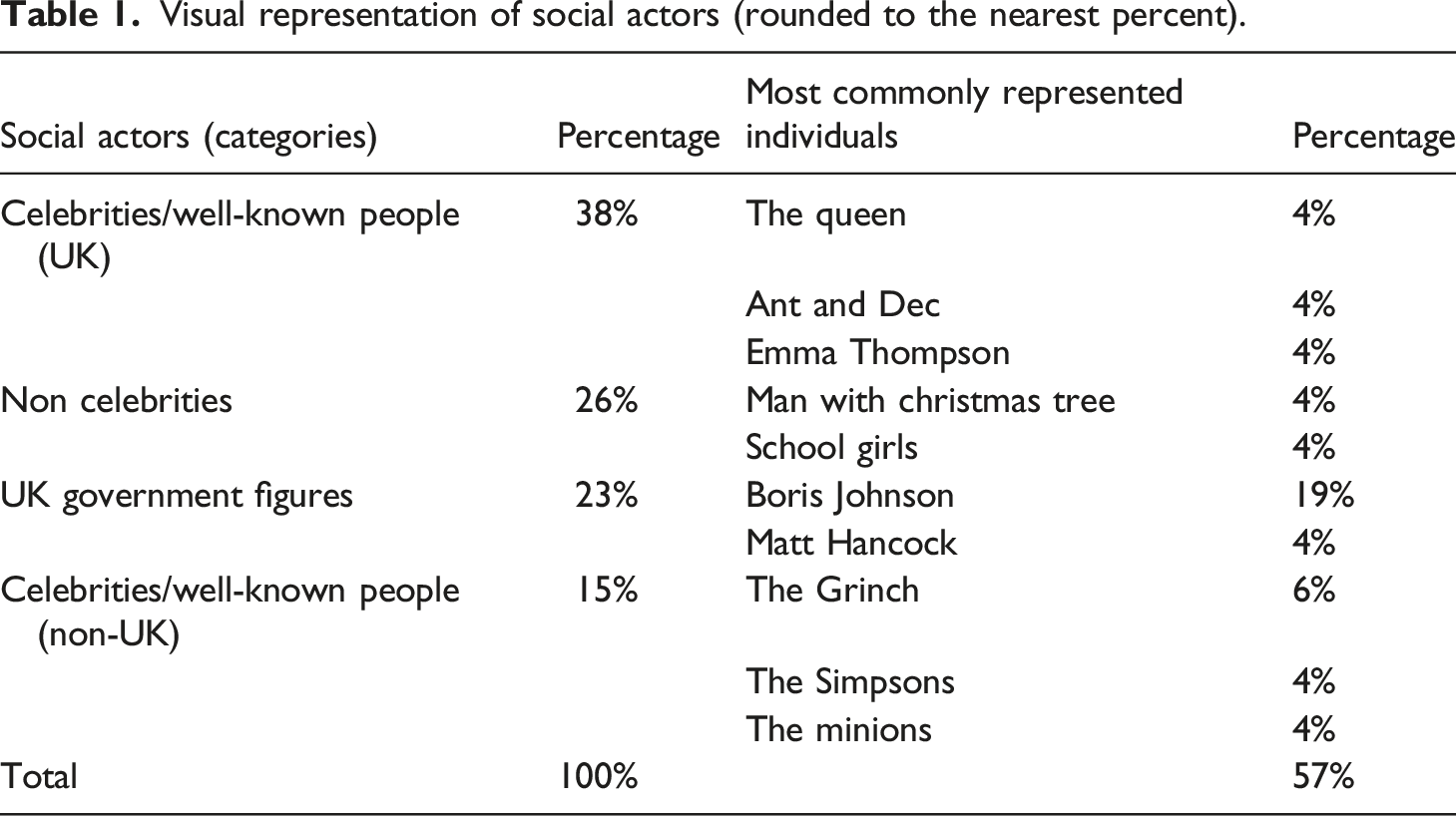
Visual representation of social actors (rounded to the nearest percent).
In lexica, differences are evident in how the nation is expressed. Place is much more clearly established with the UK named as ‘The whole UK’ and ‘Britain’, the home nations of ‘Scotland’, ‘Wales’ and ‘Northern Ireland’ identified, as well as the county of ‘Cornwall’, the cities of London, Manchester, Birmingham, Preston, Hull, Newcastle, Wolverhampton and the London area of ‘Kings Cross St Pancras’. We also find aspects of the nation represented in references to Tiers and the Tier system, (National) lockdowns and pubs.
Lexical representation of social actors (rounded to the nearest percentage).
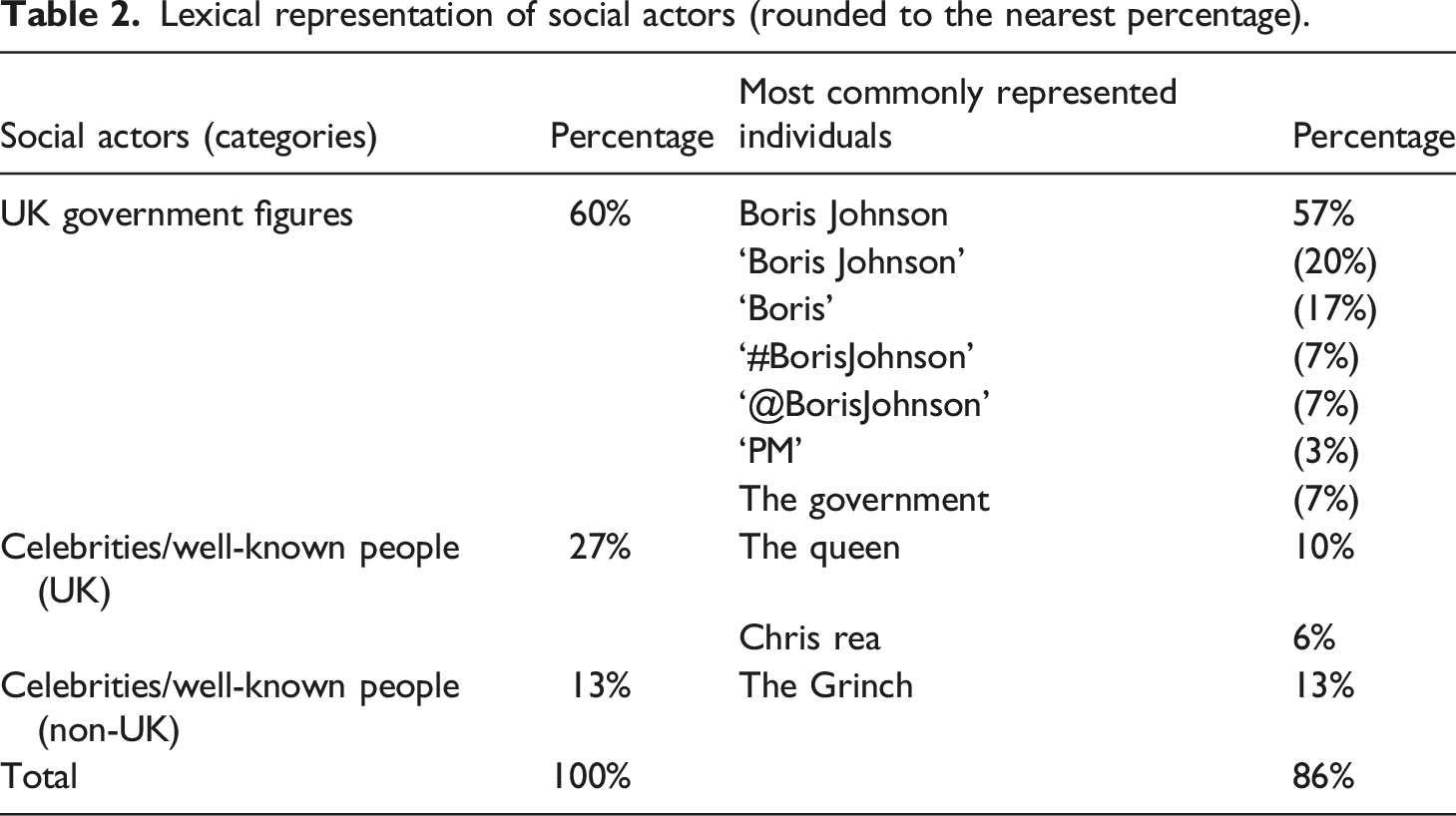
The above examination confirms the emphasis of social actors, and specific social actors in the sample of 56 memes. To reflect these numbers in our MCDS sample of nine memes, we select three memes with visuals of Johnson (one as the Grinch, one with non-celebrities, one on his own), two of television celebrities, one of the queen, two of non-celebrities, and one with no social actors. We analyse this smaller sample using MCDS to demonstrate how a sense of the nation which is very different than government announcements is articulated. We examine these memes through the lens of the four dominant national discourses seen in government announcements.
The UK is an important part of a global order that is victim to COVID-19
Unlike government announcements, memes do not represent the UK as part of a global order. They either represent an aspect of the UK (example, TV celebrity Ant and Dec or a flag) or something/someone of international recognition (example, The Simpsons). However, similar to government announcements, memes articulate universal victimisation from COVID-19, though these are in a British context.
This can be seen in Figure 2 The Queen and universal victimisation.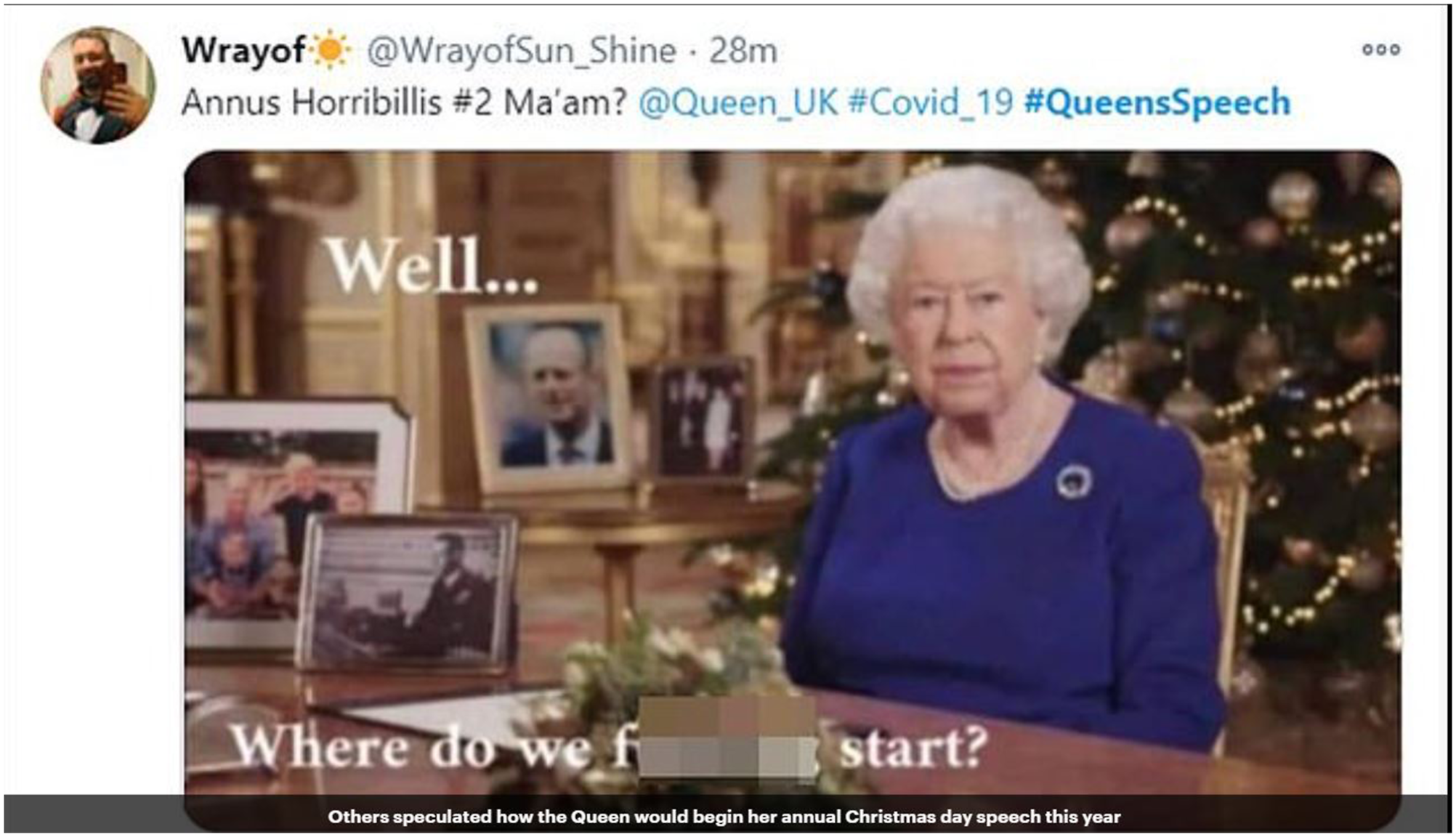
In the image, her facial expression accentuates victimisation. But the image also confirms her power. She stares at viewers in a demand image, with photographs of (powerful) members of the British Royal family in clear view. Her clothes and surroundings of gold and opulence suggest economic power. Furthermore, power is connoted by naming her ‘Ma’am’ in the title alongside three functional namings. Though she was restricted in her social and work activities due to COVID-19 and restrictions, this meme suggests that she is one of us despite her life being anything but ‘normal’. As such, represented as being a victim of COVID-19 restrictions accentuates the idea that this was universal within the UK.
The economy is an important aspect of the nation, though other aspects of the nation are defined (geography, culture/family relations)
Memes do not share government announcements’ emphasis on the economy, though they map out the nation geographically and culturally in both lexica and imagery (see above). Figure 3 is one such example. Literal mapping of the nation.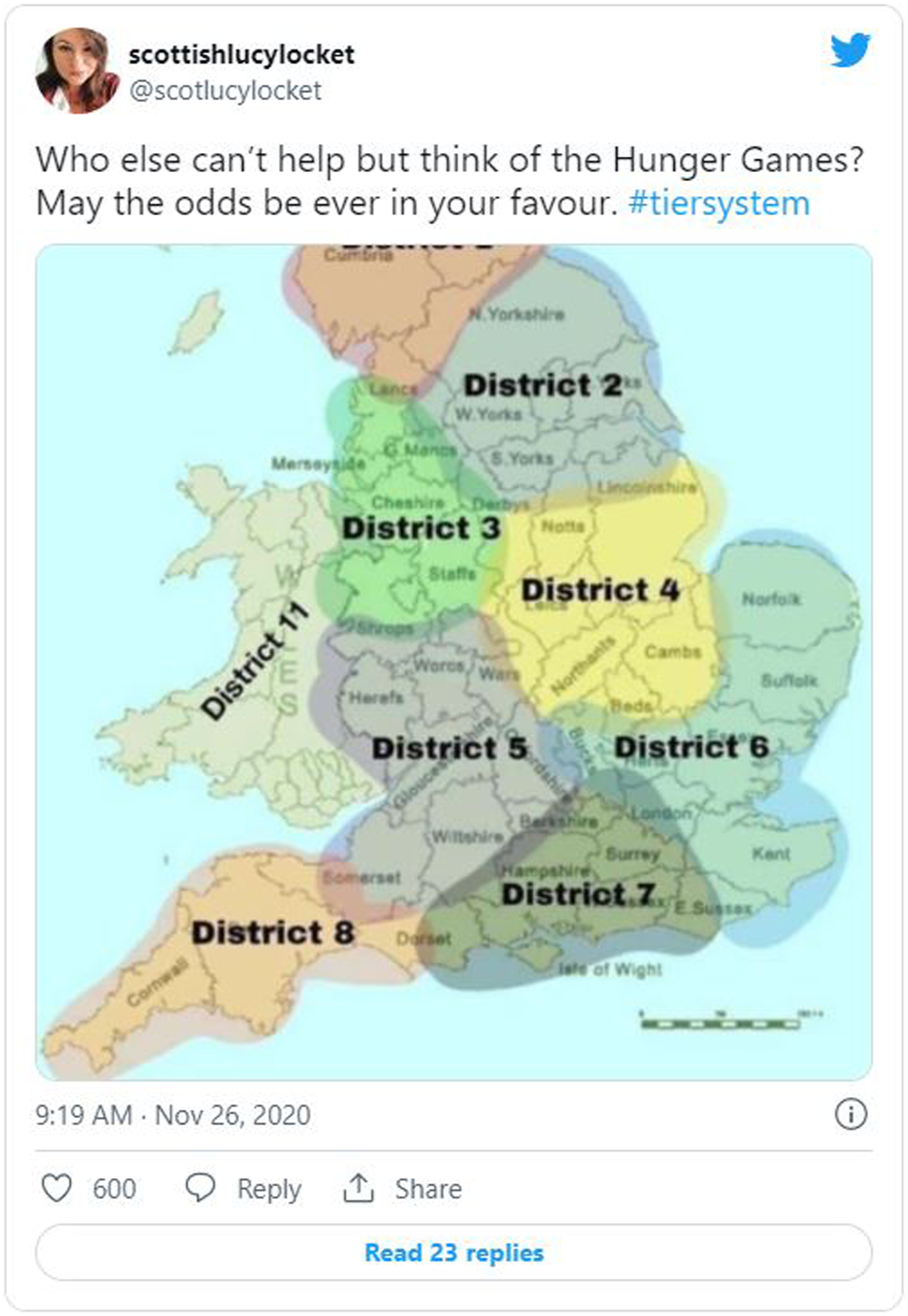
Throughout governmental announcements, the pronoun ‘we’ is used to suggest UK unity in fighting and defeating COVID-19. This meme criticises both the idea of UK unity and the 2 December introduction to the tier system by referencing the Hunger Games film (2012). In the film (and 2008 book), contestants from districts fight to the death. Though alliances are made, it ultimately depends on disunity to win. In the meme, we see only parts of the UK represented visually with Scotland and Northern Ireland excluded, though Scotland is referenced in the meme’s creator ‘scottishlucylocket’. Colours and text map out ‘districts’ of the UK, with the caption linking the film to a dystopian UK which is not unified due to the tier system.
Unlike government announcements, there is an abundance of representations of UK culture throughout the sample. Memes include British cultural icons such as Harry Potter, Sir Bruce Forsyth in the Generation game, Jeremy Clarkson, Richard Hammond and James May from Top Gear, television presenting duo Anthony ‘Ant’ McPartlin and Declan ‘Dec’ Donnelly, and singer-songwriter and guitarist Chris Rea. In the vast majority of images, white males (many famous) are the main protagonists. With the exception of one meme that represents the revolving members of the girl group ‘The Sugarbabes’, only 19 women feature, while 44 men feature, of which only two men and one woman are not white. As such, the cultural aspect of the nation constructed through COVID-19 memes is very exclusive.
Though the economy is not represented directly, working class people are represented in the sample as truth sayers who are ridiculed for their simplicity, a phenomenon seen in reality television (Eriksson and Machin, 2017; Eriksson, 2015; Skeggs and Wood, 2012). Studies reveal how the working class are for the most part represented as crude and morally problematic, but also during ‘times where social unity is required…. all working class people were represented as honest and hard-working with simple pleasures’ (Eriksson and Machin, 2017: 2). Similar discourses are found in Figure 4 Ridiculed simplicity.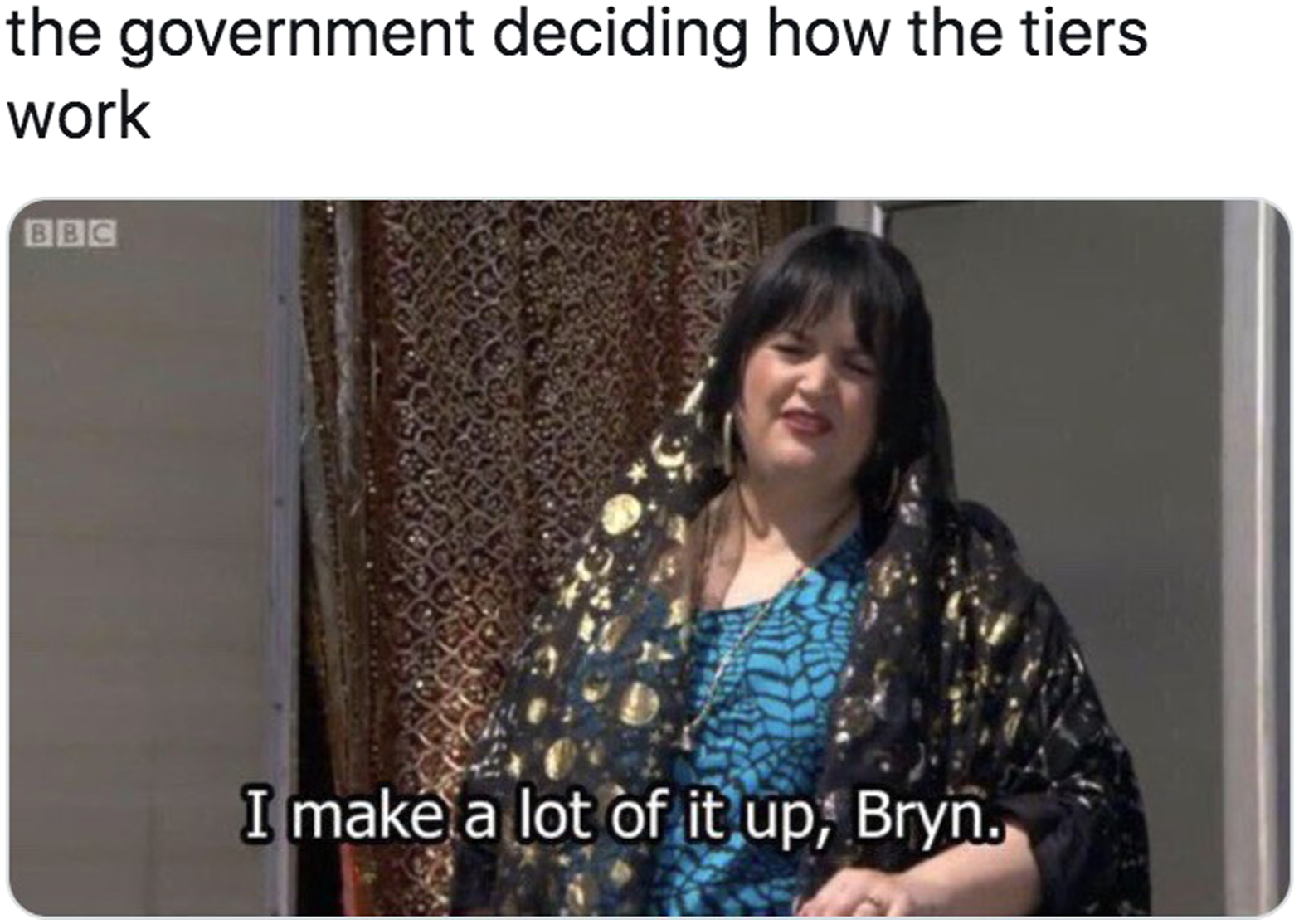
This image is taken from the British sitcom Gavin and Stacey, 8 that ran from 2007 until 2010 and centred around relations and family differences between Gavin from Billericay, Essex and Stacey from Barry, Wales. Stacey’s best friend Nessa appears in the meme. Her character includes many stereotyped traits of working-class women: that is, she has a strong local accent (Welsh), works in menial jobs (including an arcade), sports tattoos, engages in one-night stands, and has a baby out of wedlock. Her character is whimsical, unconventional but frank, evident by her reported speech ‘I make a lot of it up’. However, the caption turns her simplicity into criticism, crediting ‘the government’ with the reported speech. The government’s impersonal naming makes criticism and ‘othering’ easier (Fairclough, 2003: 149) while the mental process ‘deciding’ is an action with no agency connoting less power than if agency was represented (Fairclough, 1995). Together, reported speech and caption articulate a discourse of governmental haphazard decision making.
Imagery further articulates this discourse. Nessa’s facial expressions suggest disgust and a lack of caring, not dissimilar to Nessa’s television character. She acts as a metonym for the government that disregards the people’s feelings, thoughts and wishes. All the while, we laugh with Nessa and the working class for being able to articulate things simply and honestly.
The UK government, headed by an all-powerful Johnson is strong, active and successful
Memetic responses contradict governmental representations of an active and successful government. One common criticism of Johnson is he is a clown and memes represent the government as such. In the caption of Figure 5, the government is credited with ‘coming up with the tiers’. Though represented as active, this verbal phrase carries connotations of making things up as you go along, unlike the government ‘developing’, ‘formulating’ or ‘discussing’. Government clowns.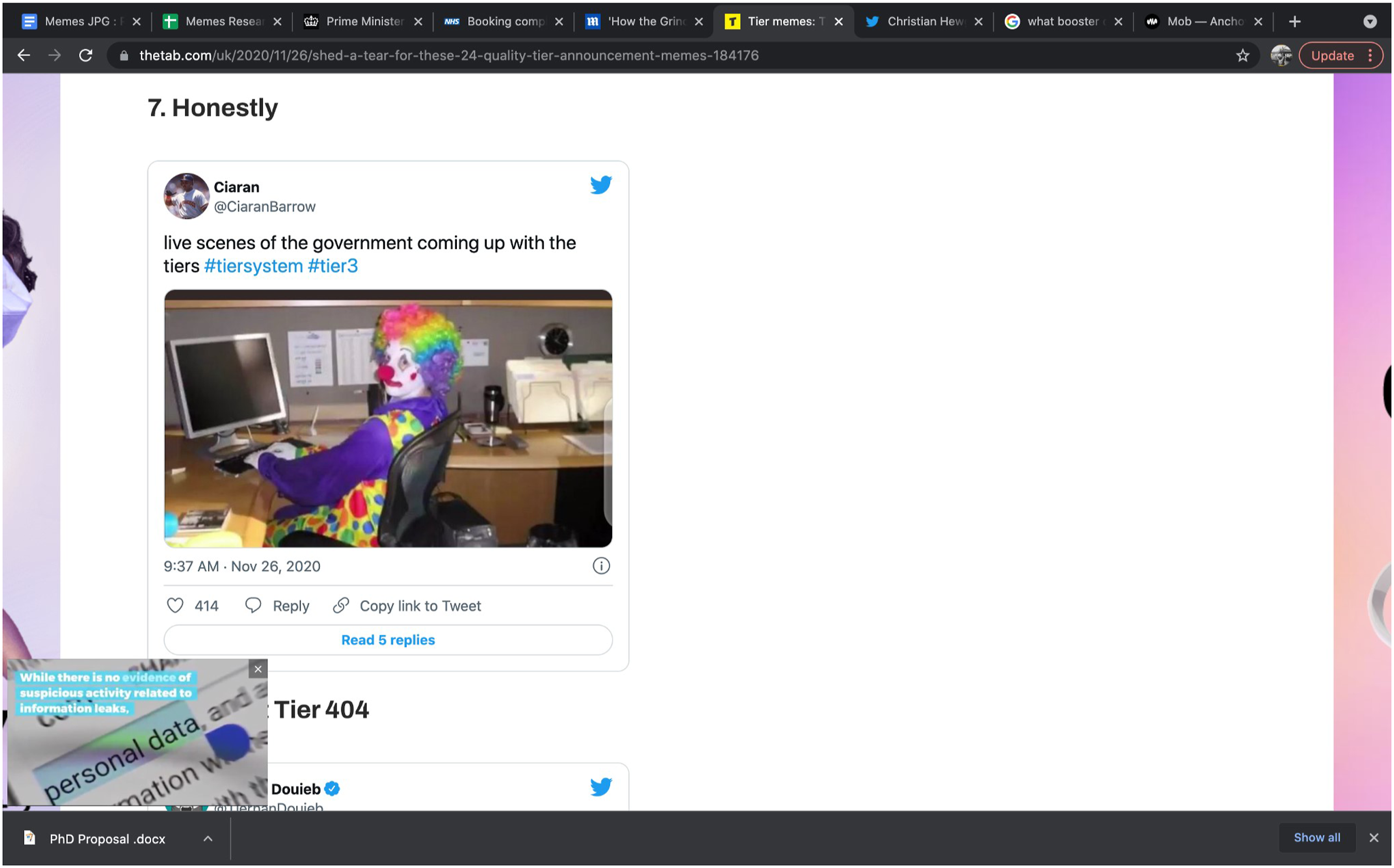
The image features a clown, salient through positioning in the centre of the image and bright clothes. He is active typing whilst looking directly at the viewer. Though these are empowering characteristics, the clown looks over his shoulder, his painted face wears a concerned look and his computer screen is off. These suggest he has been ‘caught in the act’ of being incompetent, pretending to work when in fact he is just a clown. As such, the meme articulates the idea that the government is incompetent and without a plan.
The government is also represented lacking sympathy for ‘the people’ while announcing restrictions. We see this in Figure 6, a memetic response to the beginning of the 2 December tier system. The caption is reported speech announcing that Jane is in tier one, the tier with the least severe restrictions. The image makes clear it is Johnson who is announcing and deciding tiers, both empowering acts. However, the seriousness of the announcement is subverted by inclusions and exclusions. Though tier one included regulations on 16 aspects of life including education, work, accommodation, large events and leisure, these restrictions are excluded, with pub openings being the only inclusion. This plays into Johnson’s image of being ‘one of the people’ who likes going to the pub. However, it also connotes a lack of sympathy for UK residents by only including this less serious aspect of life (going to the pub), accentuating Johnson’s frivolous handling of COVID-19. The inclusion of ‘enjoy’ and ‘happy’ further adds to this discourse. Uncaring government.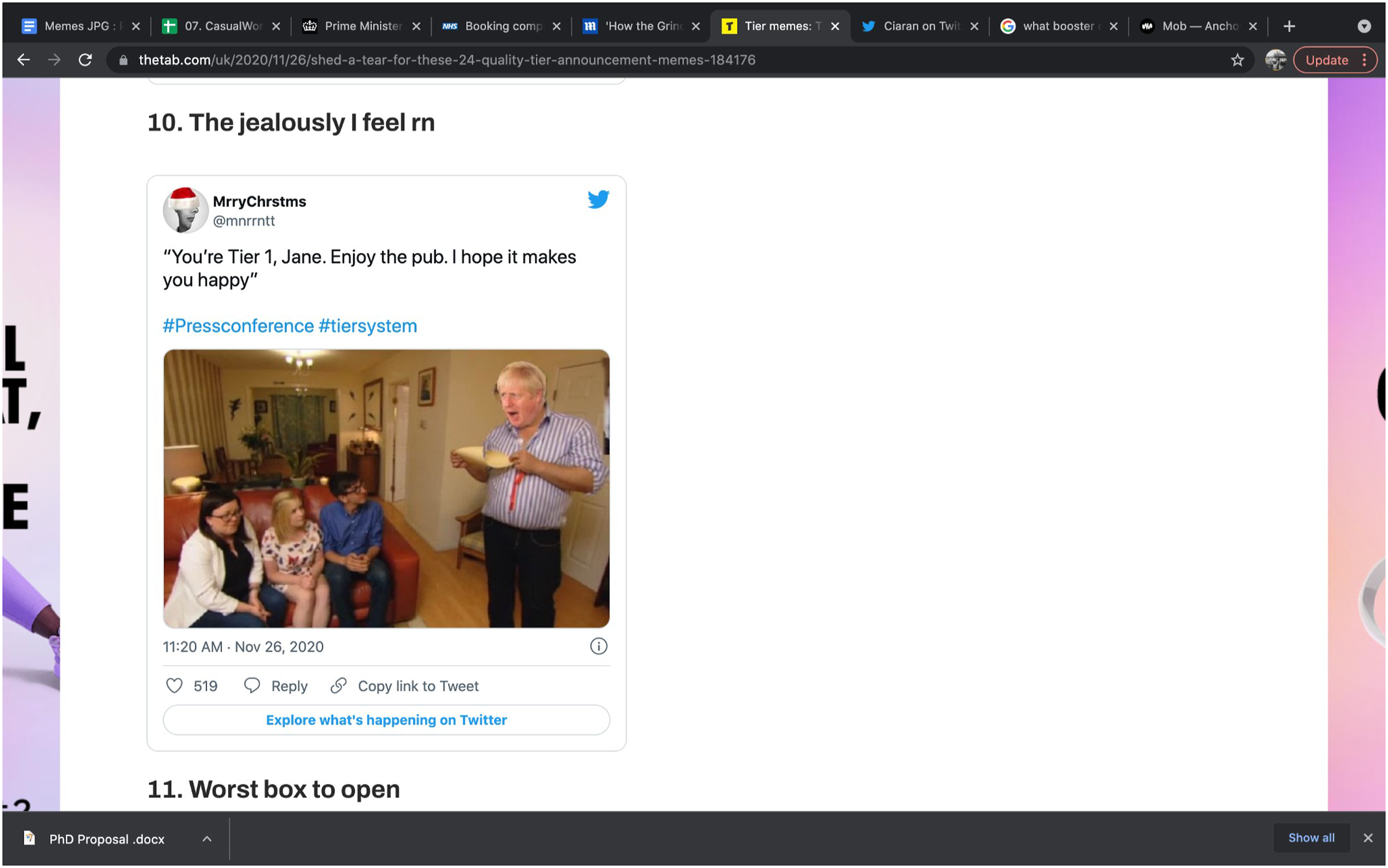
In the image in Figure 6, Johnson is salient, his head superimposed onto another’s body. He is actively speaking. However, his wide open mouth and tucked in chin suggests that he is yelling, a negative representation. Johnson does not look ‘respectable’, his shirt too tight, sleeves rolled up and the top few buttons of his shirt undone. He is holding a piece of paper that has been rolled up, connoting a lack of care. He does not look at viewers or other participants, connoting disengagement with us all (Kress and Van Leeuwen, 2021). Three adults sit on a couch listening. A lack of power is connoted through the vertical angle of interaction that looks down on them (Kress and Van Leeuwen, 2021). They look up to Johnson with clasped hands and lean forward, disempowered, their fate in his hands. Excluded are all the other decision makers and stake holders in deciding restrictions, including Chief Medical Officer Chris Witty, the science community, business owners, and economic interests. So, like government announcements, we have an empowered Johnson leading the nation. But unlike the announcements, he is an uncaring, disengaged clown while ‘the people’ are powerless, subjected to his fanciful whims.
Though restrictions were represented in government announcements as necessary duties for the health and wealth of the nation, memes suggest that the government is uncaring to the point of laughing at ‘us’, as suggested in Figure 7. In this meme’s caption, ‘Boris’ is not represented announcing measures to control COVID-19, but ‘cancelling Christmas’. This represented act emphasises negatively, along with the prepositional phrase ‘with 5 days to go’, reminding viewers of changed and cancelled Christmas plans. Laughing at ‘us’.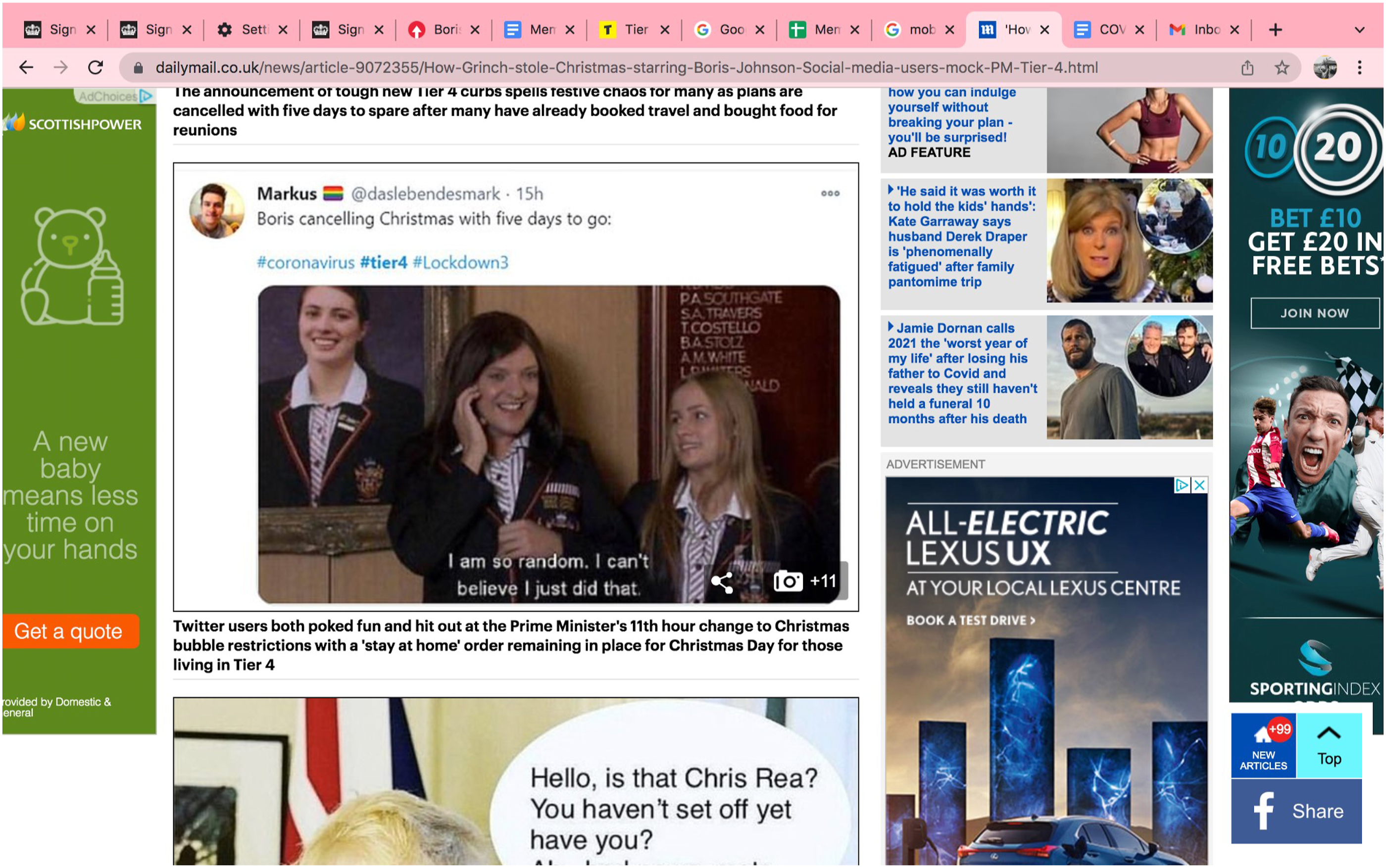
The image features two girls in school uniform. The crest on their lapels, panelled walls and a heavy framed hanging picture suggest this is a school of good standing, perhaps with reference to the private schooling most Tory MPs are privileged to receive. Though privileged, they are uncaring and whimsical, articulated in the reported speech assigned to the girl in the centre of the image. She faces the camera, though she does not look at viewers connoting a lack of engagement with viewers, a metaphor for disconnected politicians. She smiles, though the hand on the side of her face suggesting that she even surprises herself at times. In her reported speech, ‘I’ is used three times in the 10 word monologue, active although no agency or details of her actions are represented. She describes herself as ‘random’, a direct criticism of Johnson and his decisions being made ‘on the hoof’. She says she ‘can’t believe I just did that’, though what she has done is unsaid and a surprise to herself, emphasised by the hand gesture to her face. Sentence structure and lexica like so ‘random’ and ‘I can’t believe…’ mimic teenage casual talk and gossip, trivialising decisions made by Johnson. As such, this meme leans on a discourse of whimsical decision-making by a government which impacts on the general public.
Three memes in our sample represent Johnson as Dr Seuss’s Grinch,
9
a character popularised in book form, animated film and feature film. The Grinch is a callous and physically ugly outcast who hates Christmas. One year, he steals Christmas presents and ornaments from a village, only to find that the villagers still enjoy the holiday. Figure 8 is a manipulated poster from the feature film which articulates a discourse of a villainous government. Villainous government.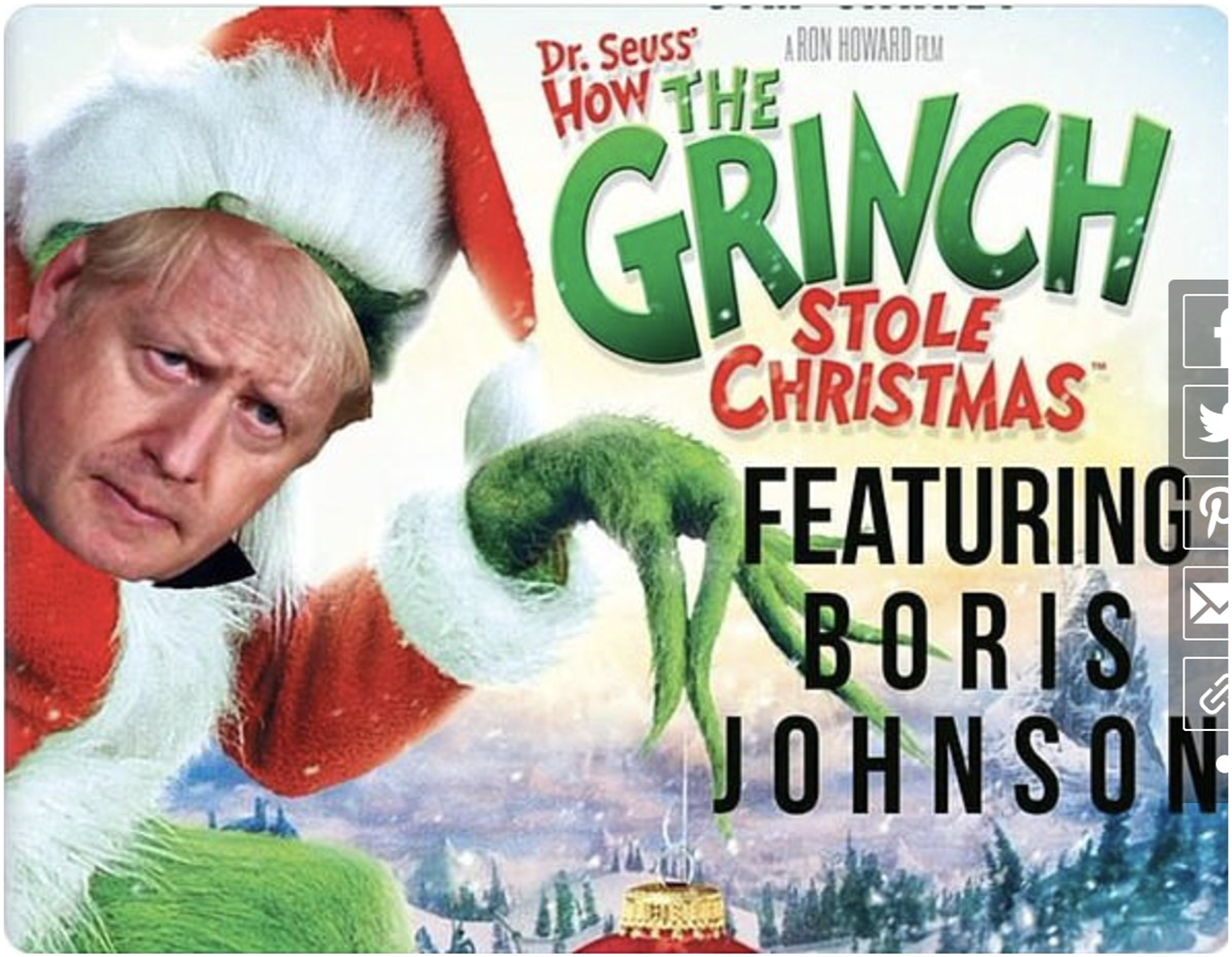
The written red and green text is the original title of the Ron Howard (2000) film. 10 This text presupposes that the Grinch stole Christmas, a presupposition being a ‘taken-for-granted, implicit claim embedded within the explicit meaning of a text or utterance’ that reinforces ideologies without questioning them (Richardson, 2007: 63). This is important when we consider the added text ‘featuring Boris Johnson’. Here, Johnson is named semi-formally with no honorifics, omitting connotations of power and legitimacy. His name appears at the end of the title suggesting a lack of emphasis, though what is presupposed is he is a thief. Bold black lettering connotes the seriousness of Johnson’s decision, unlike the colourful, slanted and variable sized font of the original.
This same ‘thieving’ discourse is articulated in the image. Johnson’s face is salient through size and lighting, superimposed on to the Grinch. He faces the viewer so we have a point of identification, though eye contact is avoided, suggesting he is untrustworthy. He wears a serious facial expression, quite different from the normal joyous connotations of the season. The Johnson creature is bent over in a crouching position suggesting he is sneaky. Though he holds a tree ornament, through cultural knowledge, viewers know he is stealing this. Overall, this meme suggests that the government headed by Johnson is powerful and callous enough to ‘steal our Christmas’, contradicting discourses of a caring and successful government articulated in government webpages.
To succeed, you must follow Johnson’s advice
Memes do not represent Johnson’s rules as the road to success. Many represent the struggles people had in following rules (see queen meme in Figure 2), as well as reluctance to rule following and consequences if rules were broken. A five second reality show excerpt with a voice over exemplifies this reluctance, whilst using the working class as a source of ridicule (and pride) for their ‘down to earth’ truth saying (Figure 9). The public’s frustration at the tier system is articulated in all three modes. The caption empowers Johnson in ‘tak [ing] you’ to tier three. However, this is a negative action, tier three having the most restrictions, while naming Johnson ‘Boris’ connotes a lack of respect. Furthermore, viewers are invited to share in the feeling of disempowerment suggested by the pronoun ‘you’. The woman’s reported speech is one of power and resistance. Johnson is named using the third person ‘he’ and ‘himself’ three times, distinct from ‘I’ and ‘you’ in the dialogue and caption. Her colloquial language (‘ain’t’, ‘nah’) and slang (‘messin’ about’) suggest she is uneducated. This is accentuated with the lack of capitals and punctuation in the subtitles. The profanity ‘f***’ emphasises her anger at the government, while her suggestion that ‘he can f*** himself’ suggests she will not cooperate, emphasised in the final phrase where she claims ‘I ain’t messing about’. he ain’t said tier 3 again? Nah he can f*** himself now i ain’t messing about. Reluctance to following rules by the working-class.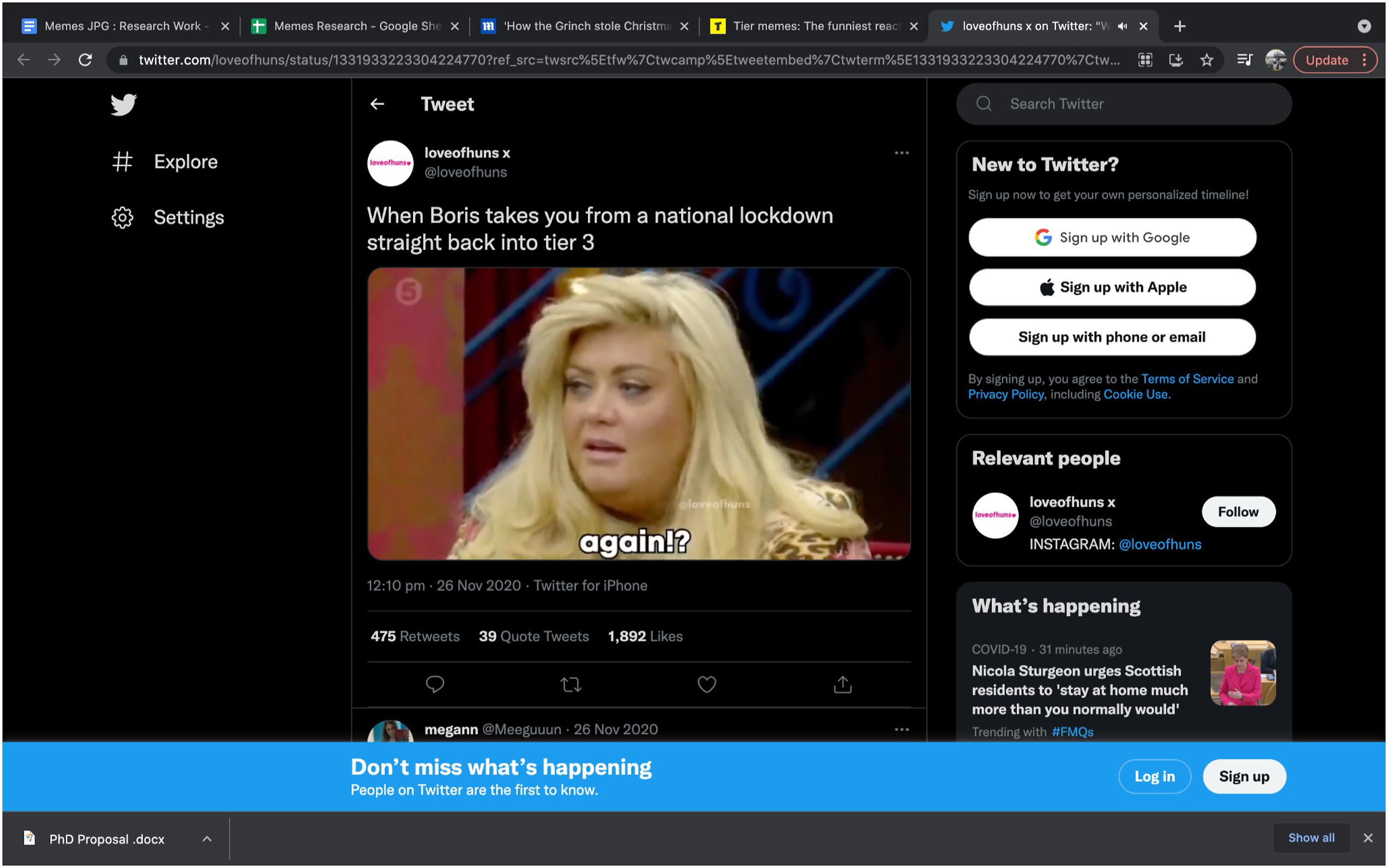
We sympathise with the woman through shot choices. She is in a close up allowing us a point of identification and a chance to see her anger and frustration. All the same, she is represented less powerful than she could be by looking off camera in an offer image. What makes this funny is her frankness expressed in a strong cockney accent, an accent associated with London’s working-class. She is fed up with government regulations and claims she will not cooperate. Ironically, though there were fixed penalties given out to those who broke lockdown rules, it later emerged in 2021, that the government engaged in a large number of lockdown breaches in Downing Street.
Though neither announcement in our sample referred to rule breaking sanctions, these were part of government discourse at the time. Memes tackle this issue, emphasising Johnson’s power and victimisation of ‘the people’, as seen in Figure 10. In the caption, Johnson is named as ‘Boris’ again activated with negative power ‘circling your house’ and ‘giving the order to snipe you down’. Though Johnson’s order is ridiculous, to give an order connotes great power which in this case involves victimising ‘the people’. Using the second person pronouns ‘you’ and ‘your’ directly addresses viewers, creating a closeness to those being victimised. Power and victimisation.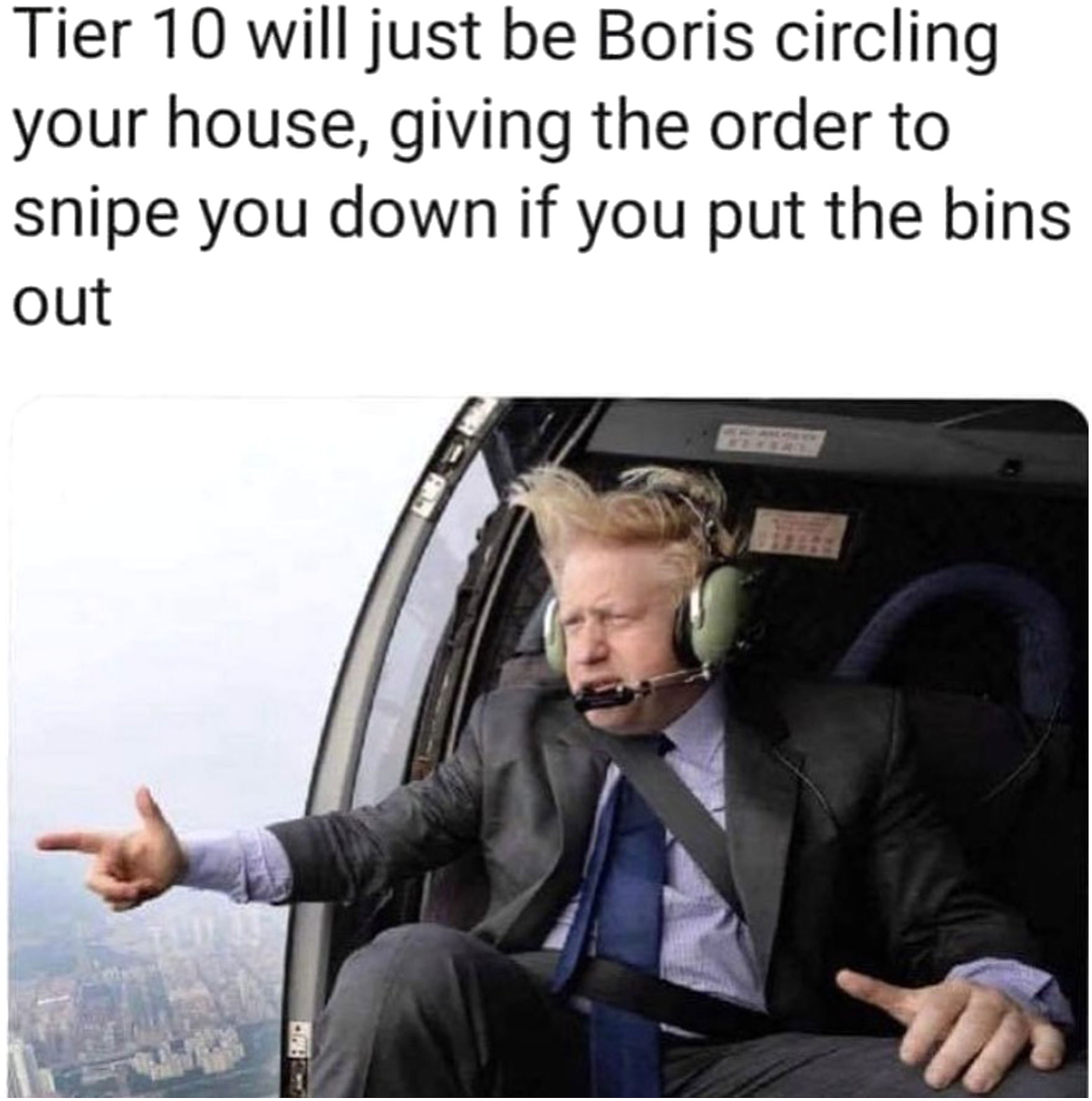
The image features Johnson seated in a helicopter, a vehicle used by those with power, such as the rich or the military. Though suit and tie connote authority, he slouches in his seat, not an ‘upright’ politician. He looks off camera in an offer image whilst pointing his finger in the shape of a gun, as children do when playing. These suggest a lack of respect for Johnson, whilst empowering him as he victimises ‘us’. Memes such as these contradict governmental discourses.
Conclusion
National interests around the globe have determined responses to the pandemic, including vaccination distribution which has seen poorer nations and ‘minorities account [ing] for a significantly greater share of deaths’ than more advantaged populations (Erni and Striphas, 2021: 226). Our analysis of government webpages reveal how the UK government maps out the nation in ways that mirror governmental policies. This supports findings from seminal work on how dominant discourses echo those of the powerful in society (Hall, 1997; Van Dijk, 1991). On government websites, the UK is represented as a key global player, important and distinct from Europe, borrowing from the government’s ‘Global Britain’ post-Brexit discourse. Both historically and presently, it is ‘world leading’. Johnson is represented as a powerful leader of a very successful, active UK government that is defeating COVID-19, with the economy being one of its top priorities. In order to succeed, people in the UK must obey Johnson and his government’s advice.
Our analysis of memes reveals how meme producers react to these ideas. Though memes do not articulate discourses of the UK being part of a global order, they share the idea of universal victimisation at the hands of COVID-19 through the lens of UK culture. Like government announcements, the nation is mapped out geographically, though unlike the government, disunity is suggested. Memes emphasise cultural mapping far more than the government. Though the government emphasises the economy, memes lean on dominant discourses of the working class as being simplistic yet speakers of the truth. This cultural mapping in memes is skewed favouring people who are white, male and famous, echoing previous studies (Matamoros-Fernández and Farkas, 2021). Similar to government announcements, memes represent Johnson as an all-powerful leader. However, memes depict the government as incompetent, led by Johnson, a clown with no plan.
Studies demonstrate how different media can represent various versions of the nation, aligned to political and economic interests (Way and Akan, 2012; Way, 2011). Other studies have revealed the importance of the seemingly mundane in articulating nationalist discourses (Billig, 1995; Bishop and Jaworski, 2003; Higgins, 2004; Flowerdew and Leong, 2007). This study has extended these areas of research by revealing how both government announcements and memes in response to these announcements articulate various forms of nationalism. In a politically polarised nation such as the UK (Fletcher 2021), different forms of nationalism are notable though most memes emphasise white, male and celebrity culture and criticism of the government. This latter point again expands on current research. Scholars tell us that memes are a space for public commentary, where society can express its ideas (Milner, 2018; Denisova, 2019: 2). They highlight and promote discourses that are in circulation in society, influencing awareness and uniting people around ‘issues of common grievances’ (Denisova, 2019: 20). In our study, we find memes react cynically to government announcements, whilst concurrently constructing a nation very different from government communications.
The political potential of memes have limits. They are ‘another move away’ from rational, communicative debate that ‘deliver highly charged satirical critiques that damage opponents and their positions and that inflict a telling ideological burn upon them. They are part of a new politics of affectivity, identification, emotion and humour’ (Merrin, 2019: 222). However at the same time, they act as a barometer that measure how the public feel about not only COVID-19 restrictions, but the government and the nation as a whole. This is important seeing as our engagement with memes is ‘central to our political life, constituting, for many people, their most common mode of political expression, participation and activism’ (Merrin, 2019: 219).
Footnotes
Declaration of conflicting interests
Author Kay L. O'Halloran is a member of the Editorial Advisory Board of Multimodality & Society. The author did not take part in the peer review or decision-making process for this submission and has no further conflicts to declare.
Funding
The author(s) received no financial support for the research, authorship, and/or publication of this article.
Correction (January 2026):
Author disclosure statements have been updated.
