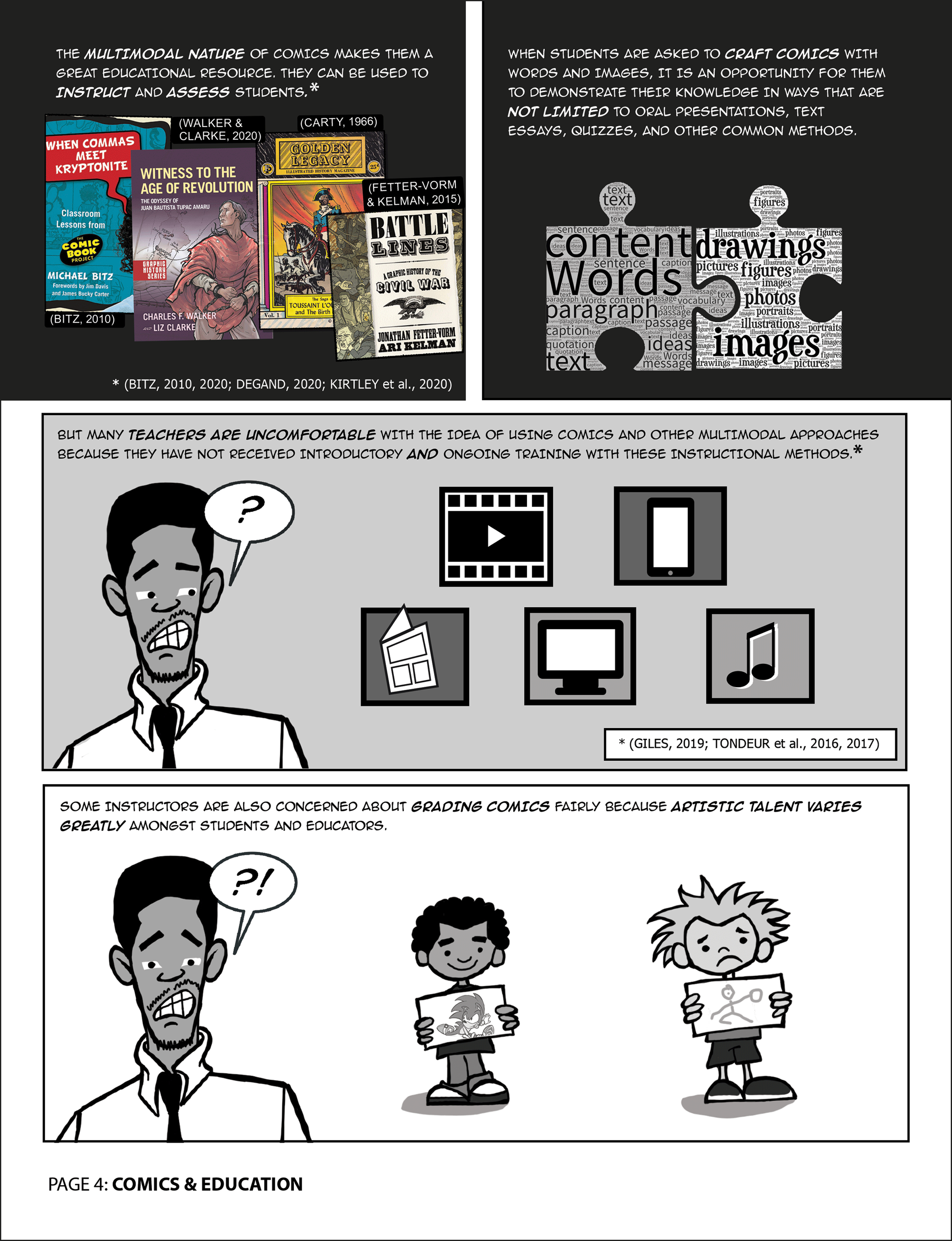
BitzM (2010) When Commas Meet Kryptonite: Classroom Lessons from the Comic Book Project.Language and Literacy Series. Teachers College Press.
5.
BitzM (2020) Lessons Learned from Manga High: A Pedagogical Approach for Educators. InSEA Publications, 34.
6.
BorodoM (2015) Multimodality, translation and comics. Perspectives, 23(1), 22–41.
7.
CartyL (1966) The saga of TOUSSAINT L’OUVERTURE and the birth of Haiti. Fitzgerald Publishing.
8.
ChuK-wCoffeyS (2015) Multimodal Analysis of Graphic Novels: A Case Study Featuring Two Asian Women Travelers. Intercultural Communication Studies, 24(1).
9.
CohnN (2013) The visual language of comics: Introduction to the structure and cognition of sequential images. Bloomsbury Academic.
10.
DegandD (2020) Introducing critical race media literacy in an undergraduate education course about technology and arts-based inquiry. International Journal of Multicultural Education, 22(3), 96–117.
11.
DoctorowNWangJ (2014) Inreal life. First Second.
12.
EisnerW (1985/2008) Comics and sequential art: Principles and practices from the legendary cartoonist. W. W. Norton & Company
13.
Fetter-VormJKelmanA (2015) Battle lines: A graphic history of the Civil War. Hill and Wang.
14.
FlynnN (2018) Comics in the Literature Classroom: How Multimodal Learning Can Create Better Citizens. CEA Forum, 47(1), 2–27.
GilesM (2019) The influence of paired grouping on teacher candidates’ attitude towards technology use and integration. Technology, Pedagogy and Education, 28(3), 363–380.
17.
GreenbergKP (2012) A reliable and valid weighted scoring instrument for use in grading APA-Style empirical research report. Teaching of Psychology, 39(1), 17–23.
18.
GreenbergKP (2015) Rubric use in formative assessment: A detailed behavioral rubric helps students improve their scientific writing skills. Teaching of Psychology, 42(3), 211–217.
19.
HallKJLucalB (1999) Tapping into parallel universes: Using superhero comic books in sociology courses. Teaching sociology, 27(1), 60–66.
JenkinsRDetamoreD (2008) Comics in your curriculum: Teacher-friendly activities for making and integrating comics with reading, math, science, and other subjects in your classroom. Marion: Pieces of Learning.
22.
JewittC (2013) Multimodal Methods for Researching Digital Technologies. In PriceS.JewittC.BrownB. (Eds). The SAGE Handbook of Digital Technology Research, pp. 1–16.
23.
KirtleySEGarciaACarlsonPE (eds) (2020) With Great Power Comes Great Pedagogy: Teaching, Learning, and Comics. University Press of Mississippi.
24.
KraeheAMBrownKD (2011) Awakening teachers’ capacities for social justice with/in arts-based inquiries. Equity & Excellence in Education, 44, 488–511.
25.
KressGvan LeeuwenT (2006) Reading images: The grammar of visual design (2nd ed.). Routledge.
26.
LeeBCawthonS (2015) What Predicts Pre-Service Teacher Use of Arts-Based Pedagogies in the Classroom? An Analysis of the Beliefs, Values, and Attitudes of Pre-Service Teachers. Journal for Learning through the Arts, 11(1), 1–15.
27.
LetiziaAJ (2020). Graphic Novels as Pedagogy in Social Studies. Springer International Publishing.
SmythT (2022) Teaching with comics and graphic novels: Fun and engaging strategies to improve close reading and critical thinking in every classroom. Routledge.
38.
SpiegelmanA (2013) Co-mix Art Spiegelman: A retrospective of comics, graphics, and scraps. Drawn & Quarterly.
TondeurJvan BraakJErtmerPA, et al. (2017) Understanding the relationship between teachers’ pedagogical beliefs and technology use in education: A systematic review of qualitative evidence. Educational Technology Research and Development, 65(3), 555–575.
41.
TondeurJvan BraakJSiddiqF, et al. (2016) Time for a new approach to prepare future teachers for educational technology use: Its meaning and measurement. Computers & Education, 94, 134–150.
42.
Victorian Curriculum and Assessment Authority, Victoria State Government and Australian Curriculum Assessment and Reporting Authority(2016) 2016 Writing marking guide. National Assessment Program: Literacy and Numeracy. Available at:https://www.vcaa.vic.edu.au/Documents/naplan/schools/2016/2016WritingMarkingGuide.pdf (accessed 7 May 2021).
43.
WalkerM (1980/2000) The lexicon of comicana. Museum of Cartoon Art.
44.
WalkerCFClarkeL (2020) Witness to the Age of Revolution: The Odyssey of Juan Bautista Tupac Amaru. Oxford University Press.
BitzM (2009) Manga high: Literacy, identity, and coming of age in an urban high school. Harvard Education Press.
48.
CruzR (2021) Experiencing comics: An introduction to reading, discussing, and creating comics. Cognella Academic Publishing.
49.
DongL (ed) (2012) Teaching comics and graphic narratives: Essays on theory, strategy and practice. McFarland.
50.
IssaS (2018) Comics in the English classroom: a guide to teaching comics across English studies. Journal of Graphic Novels and Comics, 9(4), 310-328.
51.
JenkinsRDetamoreD (2008) Comics in your curriculum: Teacher-friendly activities for making and integrating comics with reading, math, science, and other subjects in your classroom. Marion: Pieces of Learning.
52.
KuttnerPSousanisNWeaver-HightowerM (2018) How to draw comics the scholarly way: creating comics-based research in the academy. In: LeavyP. (ed) Handbook of Arts-based Research, pp. 396-422. The Guilford Press.
53.
LetiziaAJ (2020) Graphic novels as pedagogy in social studies. Palgrave Macmillan.
54.
MillerSV (2021) Hacking graphic novels: 8 ways to teach higher-level thinking with comics and visual storytelling. Times 10 Publications.
55.
MonninK (2010) Teaching graphic novels: Practical strategies for the secondary ELA classroom. Maupin House Publishing, Inc.
56.
NovakRJ (2014) Teaching graphic novels in the classroom: Building literacy and comprehension. Prufrock Press.
57.
SmythT (2022) Teaching with comics and graphic novels: fun and engaging strategies to improve close reading and critical thinking in every classroom. Routledge.
58.
SousanisN (2015) Unflattening. Harvard University Press.