



Abstract

Can necklaces be made to represent the ocean? Can the stubborn solidity of beads evoke the complex fluidity and fugitive shimmer of seawater? This experiment was recently taken on by an unlikely alliance of two projects – a research project called ‘Oceanic Humanities for the Global South’ (OHGS), based in Johannesburg, and the Marigold beadwork co-operative in Bulawayo, Zimbabwe.
Established in 2018 by Isabel Hofmeyr and Charne Lavery, OHGS aims to produce new styles of oceanic and watery research in the humanities that speak to conjoined environmental and decolonial themes. Although older traditions of oceanic research focus on the surface of the ocean, tracing movements of people, ideas and objects, OHGS engages also with a volumetric and material understanding of the ocean, exploring both surface and depth (DeLoughrey, 2017; Steinberg and Peters, 2015). The research has explored the ways in which different media attempt to represent the ocean, with its challenges of scale, visibility, depth, pressure and constant motion. These themes have been investigated across a range of genres, including speculative fiction, underwater photography, durational performance and canonical southern African literature, and across a range of subjects including aquariums, shipwrecks, slave histories, coral reefs and other creatures like abalone and squid (Chan, 2017; Cohen, 2016; Elias, 2019).
Established in the early 1990s, the Marigold beadwork co-operative produces now signature hand-loomed beaded necklaces. For the last decade they have sustained an ongoing monthly production of infinity loops constructed from thousands of tiny individual glass seed beads. There are 17 women in the co-operative in regular contact with Johannesburg-based artist, Author 1, an honorary member who facilitates design development and a broader network for the reception of the precision beadwork produced in the Bulawayo studio. Occasionally Marigold undertake special projects where new designs are specifically developed in response to the work of other artists and researchers. (Figure 1) Front image. Caption: Marigold hand-loomed beaded necklaces. Photography: Liz Whitter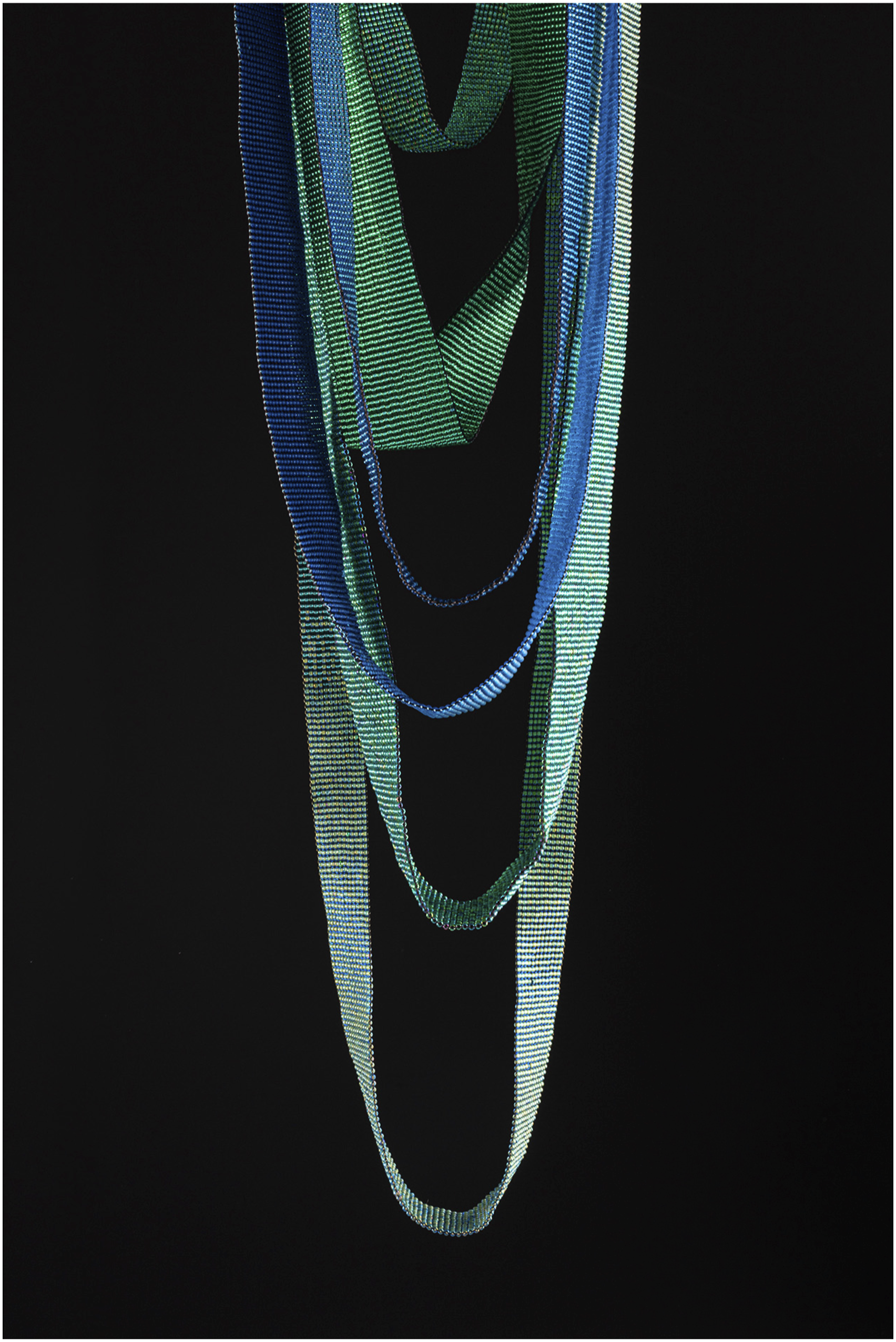
BEAD
Joni Brenner starts us off. A strength of small creative co-operatives like Marigold is their ability to remain open to creative challenges; unlike formal production-line operations, they retain the space for trial and error, reflection, discussion and the slow development of new designs. During lockdown, one new design, created in response to the drama of the pandemic, was an ode to the voice-note, a medium of communication that enabled connection when in person being-together was constrained and the usual ease of contact curtailed. (Figure 2.). An ode to the voice-note: a Marigold lockdown design. Photography: Liz Whitter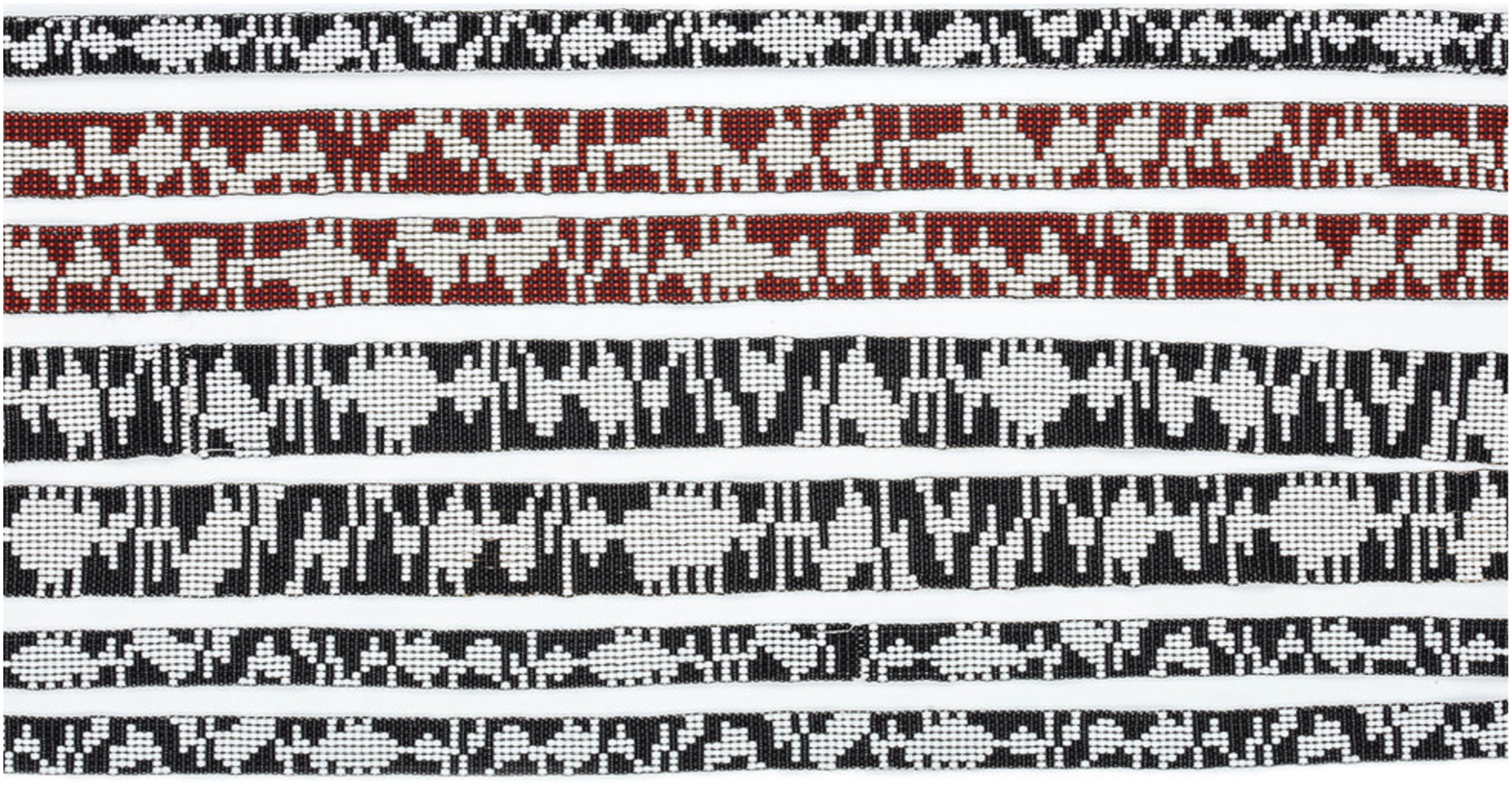
Although verbal, asynchronous communication over messaging platforms was indeed a lifeline, its limitations were highlighted in the development of a particularly complex and challenging new design imagined in response to the Oceanic Humanities project. When the researchers approached me in 2020 with the idea to create an ‘Oceanic Marigold’ my thought was to see if the beaders at Marigold could produce a necklace that felt watery. With my own practice of watercolour painting in mind I wondered if, like watercolour, a beaded necklace created line by line on a loom could shift imperceptibly from one tone to the next, in a gradient from dark to light. The simplest ideas can be the hardest to realise. How do you blend two colours when each insists on retaining its wholeness, its integrity? Beads are not by nature malleable or dissolvable in the way that pigment in water is, or even in the way that marks made in pastel can be smudged and merged. And how, once you give in to the stubbornness of the individual glass beads, do you optically merge two sections of a beaded necklace, inherently defined by a rigid grid, in a way that evokes the shimmer of the ocean?
I sent the team pictures of colour gradients, we exchanged text and voice-notes, and we had verbal phone conversations to discuss the plans and the emerging samples – but something kept getting lost in translation. The necklaces refused to become oceanic. It gave me pause for thought, particularly about how an idea can be intellectually understood while the material manifestation can remain resistant. It required acute attention to and thought about what had been produced, and where it needed to be improved or amended.
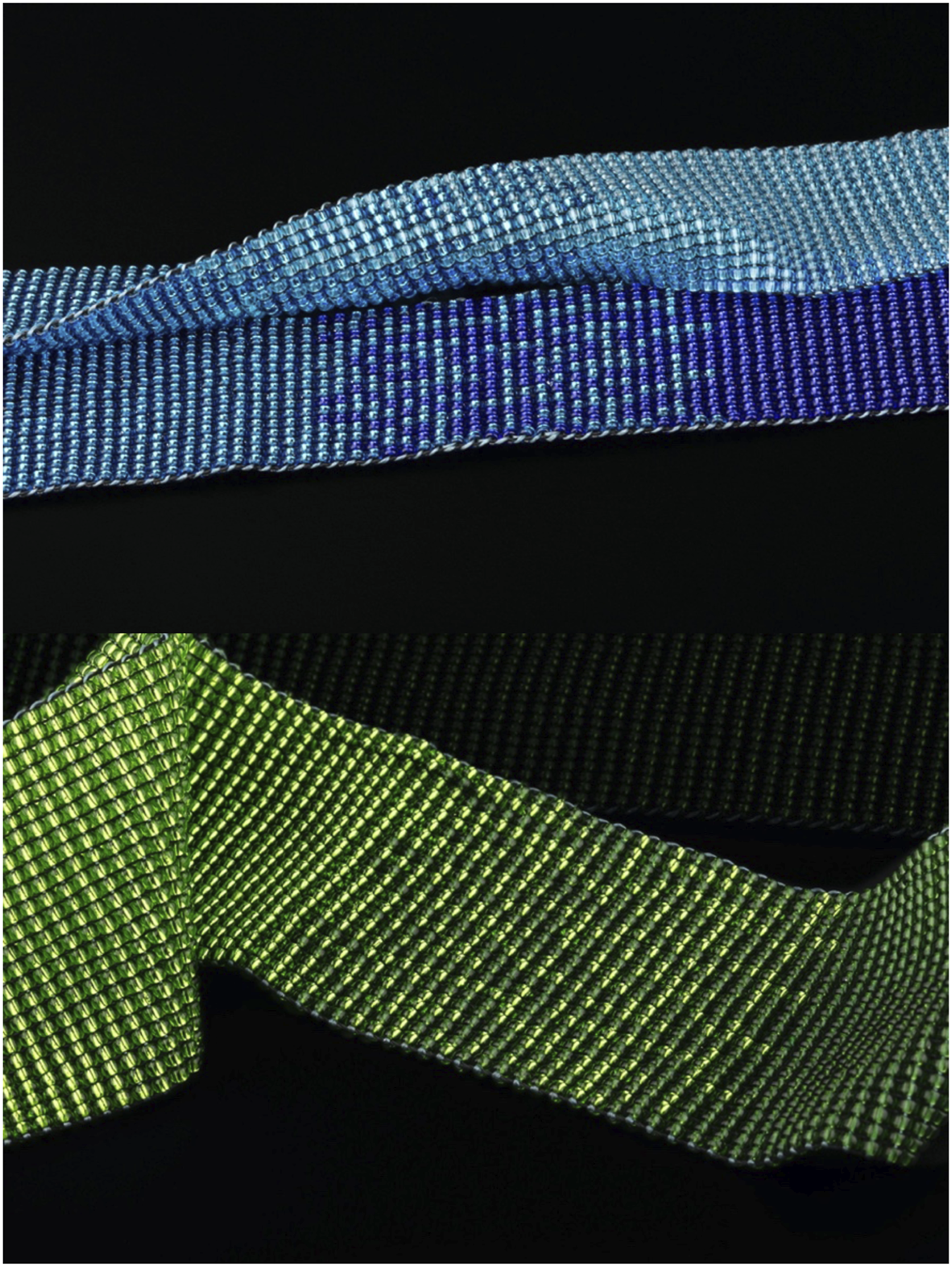
The breakthrough came when I realised that perhaps all the modes of communication needed to come together at once, to enact something closer to in-person conversation, combining voice (and intonation) with a video showing me drawing what I thought was needed, and where the difficult sections were. I made a short video of myself drawing a necklace using green pastels in different tones suggesting that some of the one colour be continued into the next section, while some of the new section infiltrates the previous one. (Figure 3.). Like the beads, the pastels each have their own integrity and are a solid bar of colour. Unlike the beads though, they are easily blended. In the video I could circle the section where the shift from one colour to the next happens, and we could focus our thought on finding a bead-based solution for the blended sections. We identified that the problem with the necklace samples was the static feel of the blended sections. Noting that the ‘infiltrations’ needed to be random as opposed to regulated, we finally arrived at a design that flowed, ebbed, trickled, flooded, crashed and remained alive despite the grid and the limits of the form. (Figure 4.). Long distance mediated attempts to resolve the transitional sections of the necklaces. Optical blending of two colours is facilitated by the random unregulated infiltration of some beads of one colour section into the other. Photography: Liz Whitter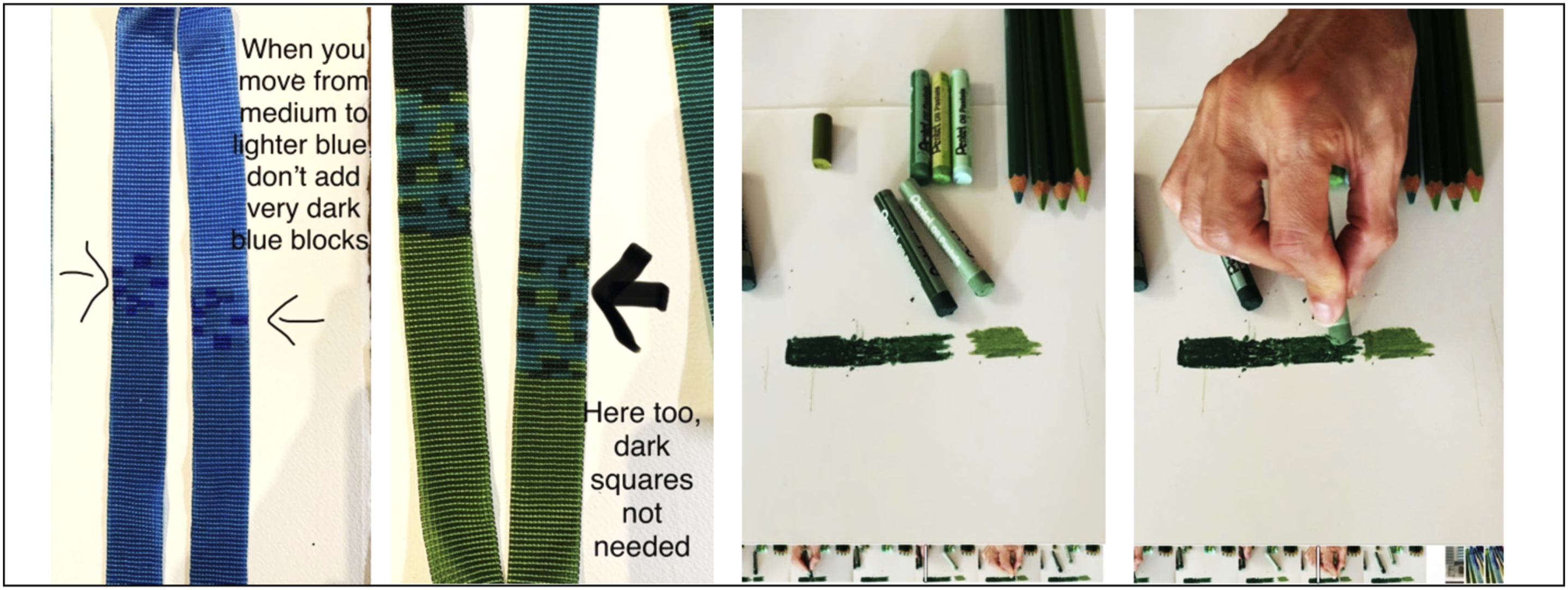
The development of this design relied on multimodal forms of communication; but as objects too, the necklaces contribute a specific material response to an intellectual research project. They form a material correlate to the project, itself immersed in multiple mediations in understanding a complex terrain.
COLOUR
The necklaces proved unexpectedly rich vehicles for exploring and embodying the research questions and findings of the oceanic humanities project. Co-director, Charne Lavery, explains:
Water and air are both fluids, made up of molecules which are sufficiently energetic and far apart to allow for perceptible movement. Water is denser, however. Although light waves flow easily through air, they have to push harder to get through water. Striking the surface, reds fade first and blues last. The last of the light disappears a few hundred metres below the surface, leaving a ‘violet-black’ (Alaimo, 2013) for several more kilometres. Colour in the sea is correlated with depth. The first paintings based on 19th century underwater experience were blue and hazy, capturing these effects (Cohen, 2022). As a result of photographic techniques developed to compensate for the denser medium of water (Cohen, 2016), submarine photographs often appear more crisp and bright than direct experience. Submarines and submersibles which sink deeper into the gloom now return with beautiful images of jewel-like bioluminescent creatures (Widder).
The new Oceanic Marigolds capture these linked depth and colour gradients of the ocean. They also point to its variety: the sunlight, twilight, and midnight depth zones of the sea are distinct, yet fade into one another; similarly, the ocean is not only blue, but includes gold sand, white wave crests, turquoise shallows, green currents, red tides, violet, navy and black depths. Seawater also holds many microscopic creatures and molecular particles, whose concentration changes its transparency to light and therefore its colour. Similarly in the necklaces, beads of one colour mix with beads of another, distinct particles creating the effect of a dissolve.
The necklaces also introduce questions of scale, perception and mediation: the tiny beads, like pixels that cohere to form an image yet remain distinct, look like particles from up close and like flows, fades and waves from far away. Thinking of the beads as individual pixels that cohere to create a perception of flow recalls the digital technology used by the few submarines that explore the depths, producing information using underwater cameras and data streams viewed on screens (Helmreich, 2009). The photographs of the necklaces capture the shine of the beads, a sheen that invokes the reflectiveness of water, the sparkle of bioluminescence, as well as what Tsitsi Ella Jaji (2014) calls ‘sheen reading’. (Figure 5.). Oceanic Marigolds evoke a sense of the ocean, its depth and colour gradients, its shimmer and sheen. Photography: Liz Whitter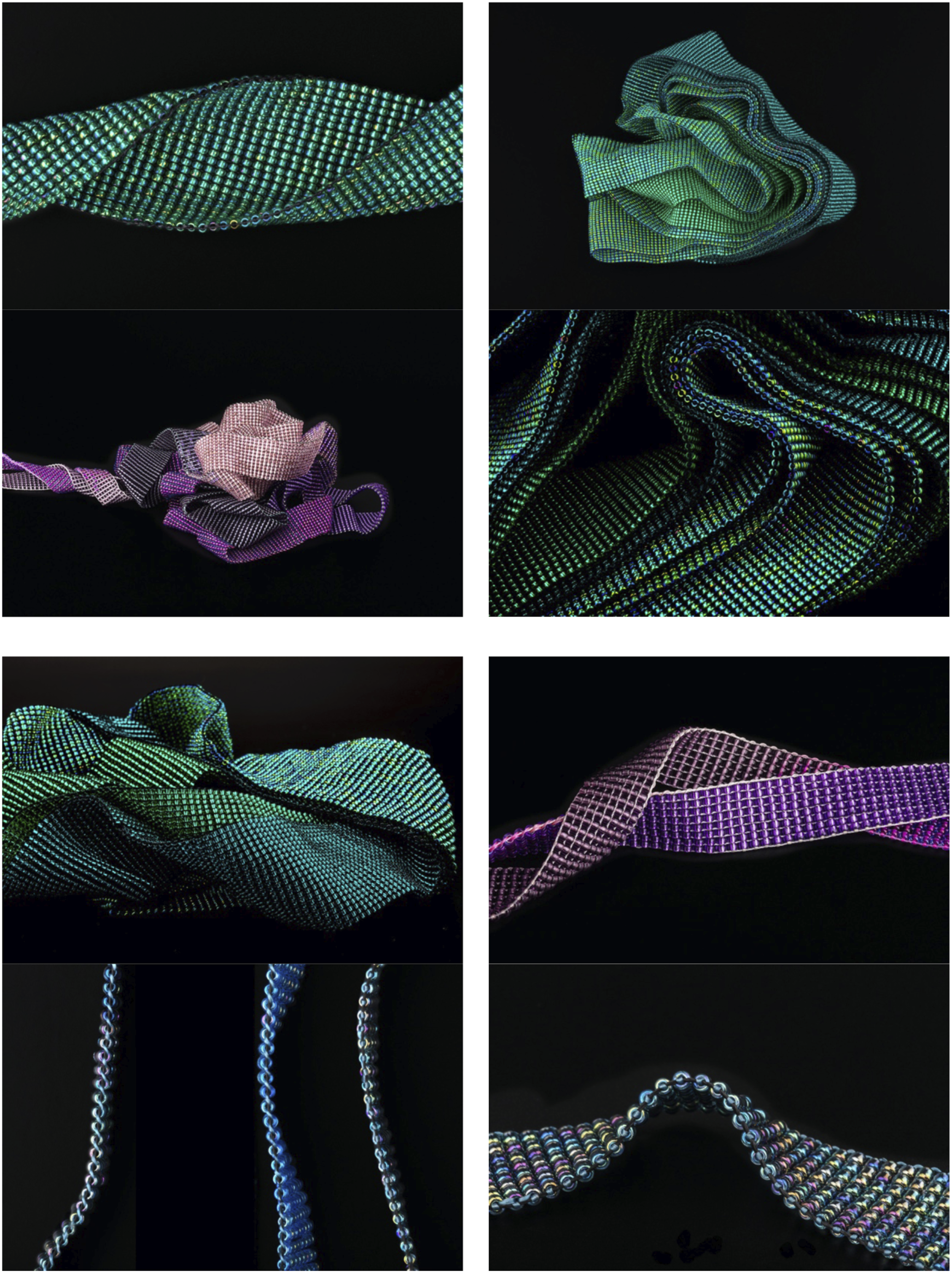
Seawater is a medium (Jue, 2020), and watercolour is one of the mediums in which seas are represented. It is one of the ways in which to ‘limn the beauty of aqueous opticality’ (Cohen, 2016). Colour is also a feature of oceanic change and vulnerability. ‘Coastal darkening’ is occurring due to increased quantities of soil and other particles in seas adjoining environmentally degraded coastlines. The world ocean surface is becoming darker, as more white ice melts into blue seas. Increased outflows of fertilisers are leading to increasing red tides, where tiny sea plants are fertilised to overgrow and turn the sea red.
WATER
The beads are one way of representing the sea; in turn they make for an embodied representation of the OHGS project. Director, Isabel Hofmeyr, threads together some of the different parts of oceanic humanities research in southern Africa.
OHGS has sought to formulate and apply humanities perspectives and methods, both above and below the water line. Working with Marigold on this bead project has intersected with these themes, getting us to think not only about beads and the ocean, but also beads in the ocean.
One entry point into these intersections comes from the workshop that OHGS held in 2019 on Ilha de Mozambique (a small island off the northern Mozambique coast with outsize historical importance). Situated at the southern end of the monsoon zone of the Indian Ocean, the island has been shaped from the 14th century by African, South Asian and European forces. Settled first by Swahili Muslim groups, the island functioned as the headquarters of Portuguese power on the south-eastern seaboard while also providing a foothold for Gujarati merchants. Strolling along the beaches of Ilha today, one cannot but notice shards of pottery and the odd glass or ceramic bead, the product of the numerous shipwrecks occasioned over many centuries by the treacherous shoals surrounding the island. Like small fragments of deep time, these shards and beads are remnants of the vast monsoon-driven trans-oceanic trade routes that linked the coastal entrepots of Indian Ocean and beyond.
As the shards remind us, long distance trade networks leave traces not only on land, but under the sea as well. The ‘shipwrecked’ beads attest to ancient trade routes, while also pointing to the sinister sides of this trade. As a currency, beads were often exchanged for enslaved people. The washed-up beads point to the loss of these lives in shipwrecks. Having been underwater for long periods, the beads on the beach are encrusted with marine matter creating a new order of object. In words of Killian Quigley (an OHGS associate), they are ‘temporally unruly, multispecies, animate-inanimate’ things, subject to concretion, a word derived from the Latin ‘to grow together’ (Quigley, 2020: 9).
Through their lives on, and in, the sea, beads provide a rich site for speculating on how we might analyse the submarine world from a humanities perspective. This question of submerged methods constitutes a major focus of OHGS research. Two papers at the Ilha conference (‘Thinking Oceanically: Ilha de Moçambique/Island of Mozambique’ and the special issue which followed) extend these methods in important directions. Justine Wintjes (2020) investigates a collection of money cowries from a 16th century shipwreck which ended up in a South African museum. Tracing the many lives of these shells, Wintjes explores the ‘agency and aesthetics of materials that have resurfaced from the ocean’. An exoskeleton of tropical sea snails, cowries were harvested in Indian Ocean settings – particularly the Maldives – before being circulated as currency in the Atlantic world where they were used for aesthetic adornment (at times as beads) and for more brutal purposes, namely as currency for trading enslaved people. Charne Lavery (2020) further explores submersion as method, drawing together an 18th century slave shipwreck excavated by marine archaeologists off Cape Town in 2015 and a poetry collection by Yvette Christiansë, Imprendehora, which traces enslaved and indentured experience across the Indian Ocean and South Atlantic. In this ‘meeting between literary and maritime archaeology’, Lavery explores the ‘methodological possibilities of submersion’, demonstrating how to ‘read for, or under water’ (Lavery, 2020: 271).
Linked to these methods of submergence, another important theme in OHGS has been that of indigenous and creolised understandings of water. Southern waters teem with congregations of water deities, ancestors, and magical mermaid-type spirits. Several OHGS graduate student projects have explored how these hydro-imaginaries inform, and are shaped by cultural and literary production. In undertaking this research, they have been able to draw on an oceanic and ancestral turn in much contemporary black South African cultural production which explores the sea as a sacred place of purification, healing, renewal and a site of training for diviners or spiritual healers. By reinstating African understandings of the sea, this work reclaims the maritime environment from European imperial imaginaries.
For instance, in her doctoral study, Confidence Joseph (2021) explored the representation of water spirits in southern African literature. The thesis begins by recalling her memories of water and water spirits in land-locked Bulawayo, Zimbabwe (incidentally also the home of the Marigold project): Growing up in Zimbabwe’s arid city of Bulawayo, my encounters with water bodies were minimal. Despite this absence of tangible water bodies, there was never a shortage of stories pertaining to water spirits believed to reside in different bodies of water like oceans, rivers, dams, and even swamps. … It was not uncommon in our house to find bottles of sea water reverently stashed away. We believed that this water, when sprinkled around the house, offered an extra layer of protection for the family. ... There was, therefore, more to water than what our school teachers taught us. Water bodies were populated with various mysterious beings and spirits, not a vacant space of minute molecules.
For a Fine Arts master’s degree, Oupa Sibeko (2020), an interdisciplinary performance artist, explored the widespread tradition of people bringing bottles of sea water and sand from the coast to give to relatives, friends or employees. As part of the degree, he produced a durational performance Black is Blue which explored these spiritual practices through performance installation, photography and film. Through his academic and artistic work, he directs attention to ontologies of the sea as a source of spiritual inspiration and healing.
Part of this ontological redefinition pertains to sand which is a crucial element in the bottled seawater. In being used to confer good luck and ancestral blessings on people, sand is transformed from an everyday substance into a medium with restorative and magical properties. Glass beads too are transformations of sand, this time in a material rather than metaphysical realm. The two processes – ancestral rituals around sea water and making glass beads – are of course unrelated, yet when set side by side they are reminders of the endless forms of cultural production that the elements and media of the sea enable. The Marigold oceanic necklaces are a further instantiation in this long tradition.
Footnotes
Declaration of conflicting interests
The author(s) declared no potential conflicts of interest with respect to the research, authorship, and/or publication of this article.
Funding
The author(s) disclosed receipt of the following financial support for the research, authorship, and/or publication of this article: This work was supported by National Research Foundation (120813).
Author biographies
 ) based at WiSER, University of the Witwatersrand, South Africa. She researches ocean writing of the global South in a time of environmental change. She completed her DPhil in English at the University of Oxford as a Rhodes Scholar, and her BA at the University of Cape Town. She is a South African Humanities and Social Sciences delegate to the international Scientific Committee on Antarctic Research (SCAR), co-editor of the Palgrave series Maritime Literature and Culture, and a board member of the journal Global Nineteenth-Century Studies. Her monograph Writing Ocean Worlds: Indian Ocean Fiction in English appeared in 2021.