



Abstract
Background:
Gastroesophageal reflux disease (GERD) comprises symptoms of dysphagia, regurgitation, and decreased health-related quality of life (HRQL). Patients failing medical management may require surgery. Magnetic sphincter augmentation (MSA) is safe, however, evidence for use in patients ≥65 years is minimal. The purpose of this study was to determine if MSA can comparably improve symptoms in those 65+ years.
Methods:
This is a retrospective cohort study including patients undergoing MSA (n = 98) from October 2016-September 2022. Symptoms of dysphagia, HRQL, regurgitation, dissatisfaction, and proton pump inhibitor (PPI) usage were measured preoperatively and postoperatively at 3 to 6 months (3-6 m) and ≥1 year in patients <65 and ≥65. Mann-Whitney U tests were used to compare outcomes between age groups and Chi-square tests to assess categorical variables.
Results:
There were no significant differences by age group (P > .05) at 3 to 6 m or ≥1 year in postoperative dysphagia, regurgitation, HRQL, dissatisfaction, and PPI usage. There were significant improvements from preoperative to 3 to 6 months and to ≥1 year postoperatively (P < .001 for all but dysphagia). For dysphagia significant improvement was observed preoperatively to 3 to 6 months in <65 (P = .003) but not at 1+ years (P = .068) but in the 65+ group no differences were observed from pre-to-postoperatively for either timepoint (P = .133 and P = .657, respectively). Patients ≥65 had significantly larger hiatal hernias than those <65 (P = .012).
Conclusions:
MSA is beneficial among GERD patients ≥65, with improvement in symptoms of regurgitation and HRQL, dissatisfaction and PPI use at 33 to 6 months and ≥1 year. Since these improvements are not age-based differences, MSA can equally be used in patients ≥65 years.
This is a visual representation of the abstract.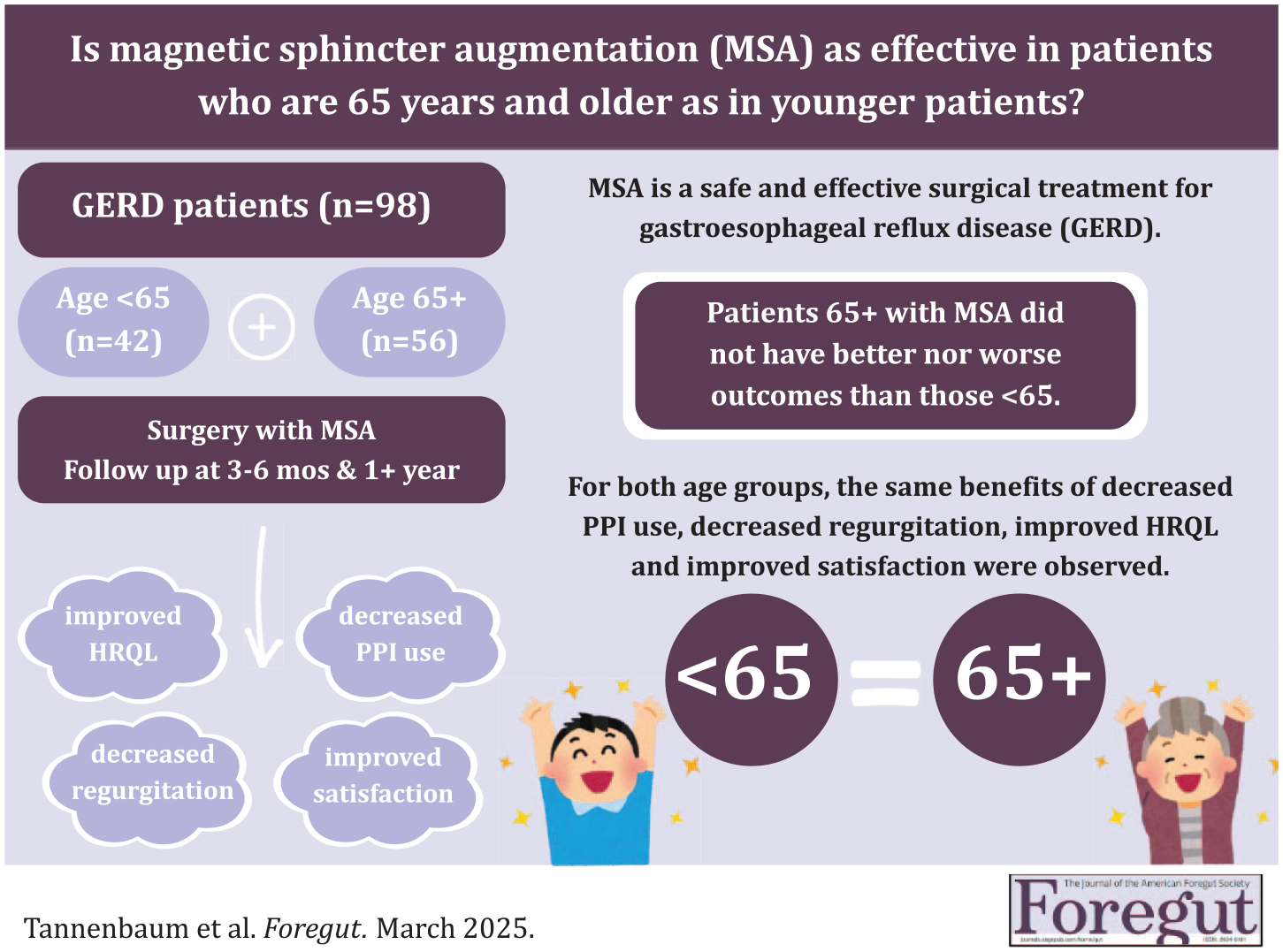
Get full access to this article
View all access options for this article.