



Abstract
Background:
Transoral incisionless fundoplication (TIF) is an endoscopic procedure that can be used to repair small sized paraoesophageal hernia’s (PEH) and reduce reflux in patients with gastroesophageal reflux disease (GERD). Giant PEHs are not amenable to TIF, requiring an operation to reduce the stomach back into the abdomen and fundoplication to help maintain its placement. In the setting of persistent reflux symptoms following surgery, patients require complete re-evaluation testing to determine the need for reoperation. In this study, we review the role of TIF after paraoesophageal hernia repair in patients with persistent reflux.
Methods:
This study is a case series review, analyzing 14 patients who underwent TIF after a paraoesophageal hernia repair between February 2018 and January 2023 at our tertiary referral center. Eligibility criteria included patients with objective findings of a PEH on diagnostic testing. All patients underwent open or robotic assisted PEH repair with a fundoplication using the Da Vinci Xi robotic system (Intuitive Surgical, Sunnyvale, CA). Postoperatively, patients required complete re-evaluation due to persistent reflux. After objective findings suggested persistent reflux, all patients underwent TIF. The primary study outcome was post-TIF symptomatic improvement which was measured with GERD-HQRL questionnaire.
Results:
Out of 14 patients who underwent TIF, 50% reported symptomatic relief, however, majority (5/7) still required PPI therapy. GERD-HQRL results showed an average score of 18.9/50. 71% (10/14) patients reported satisfaction with only 1/14 patients being dissatisfied.
Conclusion:
Transoral incisionless fundoplication after surgical repair of a hiatal or paraoesophageal hernia is a safe and effective way of improving persistent or recurrent reflux symptoms with high patient satisfaction.
This is a visual representation of the abstract.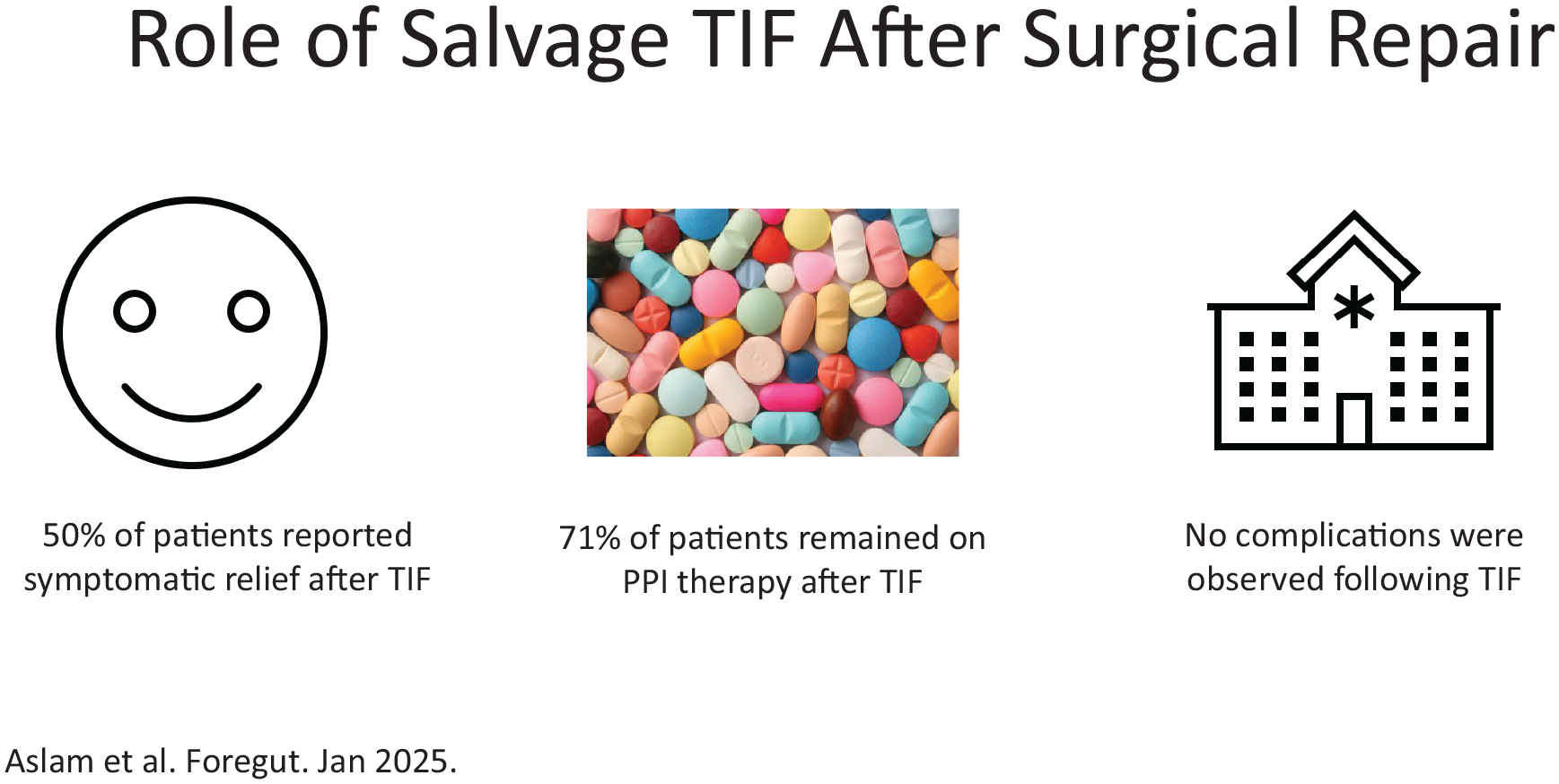
Get full access to this article
View all access options for this article.