




Abstract
Children in out-of-home care are disproportionately represented in the criminal justice system, especially in formal court proceedings and youth custody. Whether this extends to other types of contact, such as police contact as a person of interest, victim, or witness, is unclear. This descriptive study examined a range of criminal justice contacts in adolescence (i.e., police contacts, police cautions, youth justice conferencing, court appearances, and youth custody) among young people who experienced out-of-home care in childhood. Data for >79,000 children were drawn from the New South Wales Child Development Study, with linked administrative records from child protection and criminal justice available from birth to age 17 years. We identified young people placed in out-of-home care before age 10 years (n = 1,715) to determine the prevalence of different criminal justice contacts for these individuals from age 10 to age 17, compared to those who did not experience out-of-home care prior to age 10. Analyses were conducted separately for girls and boys, by placement type (e.g., foster care, family and kinship care), and by number of placements (0, 1, 2, and ≥3). The prevalence of all types of criminal justice contact was significantly higher among those placed in out-of-home care compared to those who were not. Specifically, 62.3% of young people in out-of-home care had any type of contact with the criminal justice system, compared to 22.3% of those with no out-of-home care before age 10. The prevalence of criminal justice contacts was comparable for boys and girls, as well as across out-of-home care placement types and number of placements. While children who experience out-of-home care in childhood are at heightened risk for all types of criminal justice contact, most children who experience out-of-home care did not have a court appearance (88.9%) or experience youth custody (91.5%).
Children who are maltreated experience a range of long-term negative consequences, including mental ill health, domestic violence, poor educational achievement, and criminal justice involvement (Laurens et al., 2020; Li et al., 2016; Malvaso et al., 2016; Tzoumakis et al., 2024). The relationship between child maltreatment and subsequent youth justice involvement is particularly robust, with children placed in out-of-home care being over-represented in the criminal justice system (Malvaso et al., 2018; Ryan & Testa, 2005; White et al., 2024; Yoon et al., 2018). Studies involving high-risk samples of young people in contact with courts or in youth custody often report alarmingly high rates of out-of-home or foster care histories. For example, a New South Wales (NSW) study of 160 court case files found that half of the children with a criminal court appearance had experienced out-of-home care (McFarlane, 2018). In 2020–2021, 60% of young people in detention had contact with child protection services in the previous 5 years, and 25% had been placed in out-of-home care (Australian Institute of Health and Welfare, 2022).
While there is strong evidence of a link between experiencing out-of-home care and subsequent criminal justice system involvement, the relationship is probabilistic rather than deterministic. For instance, in a South Australian study of 71,739 young people who had contact with child protection services followed from birth to age 17 or 18 years, 90% of the 7,424 children placed in out-of-home care did not have a criminal conviction (Malvaso et al., 2017b). Only a few large representative population-based studies have examined the prevalence of criminal justice involvement among young people who experienced out-of-home care (Lima et al., 2018; Malvaso et al., 2017a; Turpel-Lafond, 2009). One population-based study has examined a broader measure of criminal justice system contact (police contact) but did not differentiate the specific type of contact (i.e., whether as a person of interest, victim, or witness) (O'Hare et al., 2023). Prospective population-based studies tend not to show the same extent of overlap compared to retrospective high-risk studies.
Using population-based longitudinal linked administrative data, the current study aims to provide a description of a range of criminal justice system contacts experienced by young people who were placed in out-of-home care in childhood, beyond events associated with formal criminal charges or convictions. Moreover, considering that out-of-home care placement is associated with increased involvement in youth offending among girls compared to boys (from eight studies in the scoping review; Baidawi et al., 2023), we will also examine these patterns separately by sex assigned at birth. In addition, considering the importance of out-of-home care placement type and stability (Font & Kennedy, 2022; Maguire et al., 2024), we will examine different placement types (e.g., foster, family and kinship care) and the number of out-of-home care placements. This descriptive study aims to provide population-based information on overall patterns of criminal justice system contact among those who were placed in out-of-home care to inform policy and service planning. Few studies have the capacity to examine such a broad range of criminal justice indicators within a single large sample.
Method
Participants
Participants were drawn from an Australian longitudinal population-based study of 91,597 children born between 2002 and 2005 in NSW, the NSW Child Development Study (NSW-CDS). The NSW-CDS is representative of the general state and national populations in terms of sex, Aboriginal and/or Torres Strait Islander background, and language background other than English (Green et al., 2024). Participants in the current study include 79,446 young people with complete data available from birth up to their 17th birthday at the data extraction date of March 2021 (data were right censored at their 17th birthday to ensure equal observation periods). Therefore, 12,151 young people were excluded from the current study to ensure all young people were the same age at follow-up. Those excluded were more likely to be female (54.7% vs. 47.3%; OR = 1.4, 95% CI [1.3–1.4]) and reside in the most socioeconomically disadvantaged areas at birth (28.0% vs. 18.3%; OR = 1.7, [1.7–1.8]), relative to those retained; there were no statistically significant differences for any of the other sociodemographic characteristics examined (Whitten et al., 2025). Child protection and criminal justice records were linked by a third-party agency, the Centre for Health Record Linkage (CHeReL), using probabilistic methods. The false-positive linkage rate was <0.5%. Ethics approval was provided by the NSW Population and Health Services and ACT Health Human Research Ethics Committees (HREC/18/CIPHS/49). In this study, girls comprised 47.3% of participants, 8.7% were of Aboriginal and/or Torres Strait Islander background, 15.4% lived in the most disadvantaged neighbourhoods, and 64.3% lived in major cities.
Measures
Out-of-home care placements
Data on out-of-home care placements were obtained from the NSW Department of Communities and Justice's ChildStory data (2001–2020). To maintain the temporal order of the exposure and the outcome indicators for out-of-home care, they were derived using a cut-off of less than age 10 years. This was chosen since (1) the age of criminal responsibility is 10 years old in NSW; (2) childhood is a critical developmental period for experiencing adversity and subsequent delinquency (Connolly & Kavish, 2019); and (3) the majority of first out-of-home care placements are in childhood (84%), all of which makes this age cut-off important for policy considerations. Only 347 individuals (0.4% of the reference group) in the cohort had their first out-of-home care placement at or after age 10 years. In the main analyses, these 347 individuals were included in the reference group, but sensitivity analyses were also conducted with these excluded from the reference group. Binary indicators were created to identify those first placed in out-of-home care before age 10 years for any out-of-home care placement, placement type and number of placements. Four non-mutually exclusive placement type variables were derived for those with at least one of the following placement types: (1) relative and kinship; (2) foster care; (3) parents (this occurs when legal orders are with someone other than the parent and they were with their parent for that period); and (4) other care (e.g., residential care including family group homes, non-related person, hotel or motel emergency, hospital care, or disability hospital care). Note that we did not account for those with multiple placement types in these placement type variables (i.e., individuals could be included in both the foster care and other care variables, for example). We did, however, examine the frequency of placements by creating a mutually exclusive categorical indicator reflecting the number of distinct placements that an individual has been in since their first ever entry up to 2020. This broad indicator used the total number of unique placements of any type (including short-term placements) and could include multiple placements with the same “type” of placement. Based on the distribution of the variable and to minimise low cell sizes, we created the following categorical indicator: 0, 1, 2, and ≥3 placements.
Criminal justice contacts
Eight binary indicators were derived to reflect a range of criminal justice outcomes from the age of criminal responsibility (10 years) to 17 years. Three binary variables were computed for police contact as a person of interest, victim, and witness for all criminal (e.g., assault, robbery, theft, drug offences) and non-criminal (e.g., traffic checks, criminal justice system checks) incidents reported to or detected by the NSW Police Force, as recorded in the NSW Police Force Computerised Operational Policing System (COPS, 2002–2021; Whitten et al., 2025). Four binary variables were computed for police cautions, youth justice conferences, court appearances, and youth custody, as recorded in the NSW Bureau Of Crime Statistics And Research (BOCSAR) Reoffending and Custody databases. The NSW BOCSAR Reoffending and Custody databases include information on all court appearances and outcomes for finalised criminal charges for individuals convicted of at least one proven offence. It also includes all non-court outcomes (i.e., police cautions and youth justice conference diversionary measures) from 1998 to 2022 for persons with or without a proven offence, as well as separate data on custody periods (including remand) with discharge dates between 2000 and 2022 for persons with or without a proven offence. A binary indicator was also created to reflect any contact with the criminal justice system based on all seven variables above.
Sex at birth
Sex at birth (male, female) was determined via consensus across all available record sets in the study; we note that this indicator does not reflect gender identity.
Analysis
Descriptive statistics (counts and prevalence) and univariate Odds Ratios (OR) with accompanying 99% Confidence Intervals (CI) were computed for the eight criminal justice outcomes stratified by: (1) out-of-home care placement (yes/no); (2) out-of-home care placement (yes/no) disaggregated by the young person's sex (male/female); (3) the four types of out-of-home care placement (relative and kinship/foster care/parents/other); and (4) the total number of unique out-of-home care placements (0, 1, 2, and ≥3 placements). Analyses were completed in IBM SPSS 29 (IBM, 2022). Results were considered statistically significant if the 99% CI for the OR did not include 1.00. Due to ethical restrictions, cell sizes of less than 15 were not reported.
Results
Although few (n = 1,715; 2.2%) young people in the cohort were placed in out-of-home care before the age of 10 years, they had a significantly higher prevalence of all types of criminal justice contact compared to those not placed in out-of-home care (see Table 1). Of those with childhood out-of-home care experience, 62.3% had any type of subsequent criminal justice contact; conversely, of those with any type of criminal justice contact in the cohort (n = 18,416), 5.8% had a childhood out-of-home care experience. Nearly half of those placed in out-of-home care had contact with police as a victim, compared to 14.2% of those not placed in out-of-home care during childhood. While the prevalence of youth custody for those with childhood out-of-home care experience was low (8.5%), it was less than 1% for those with no childhood out-of-home care placements.
Criminal justice contacts stratified by out-of-home care placement.
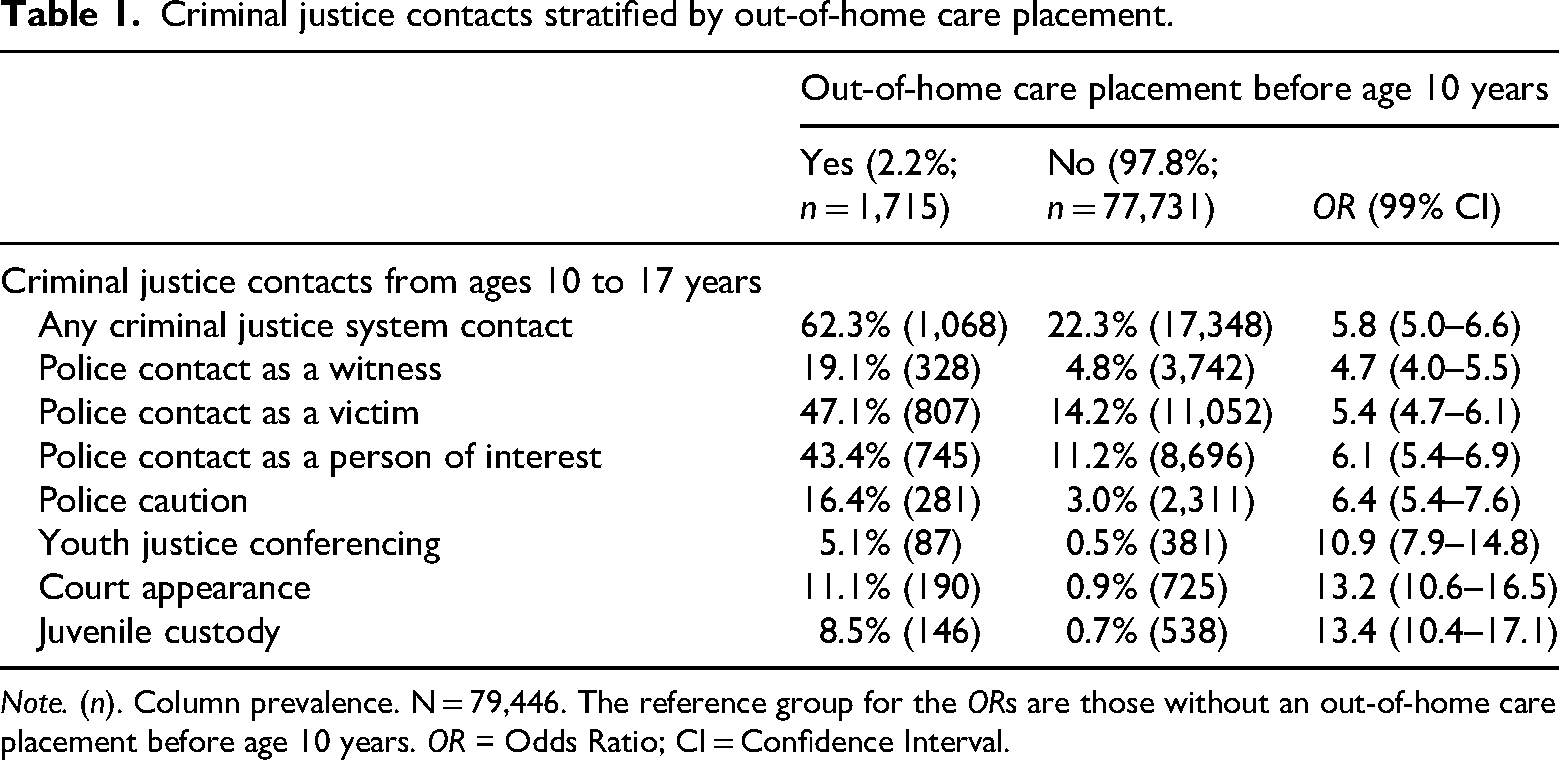
Note. (n). Column prevalence. N = 79,446. The reference group for the ORs are those without an out-of-home care placement before age 10 years. OR = Odds Ratio; CI = Confidence Interval.
Results disaggregated by sex (Table 2) show similar patterns of criminal justice involvement according to out-of-home care placement history. However, only 36% of girls with out-of-home care placement in childhood had contact with police as a person of interest, compared to 50% of boys. Conversely, 51% of girls with out-of-home care placement in childhood had a police contact as a victim compared to 43% of boys. There was a higher prevalence of formal criminal justice system involvement among boys placed in out-of-home care compared to girls who were placed in such care (i.e., youth justice conferencing: 7% vs. 3%, court appearance: 15% vs. 6%, and youth custody: 11% vs. 6%). Although the crude odds of criminal justice contact were higher for girls than for boys, the overlapping CI indicates that any apparent differences by sex could have occurred by chance.
Criminal justice contacts by out-of-home care placement disaggregated by the young person's sex.
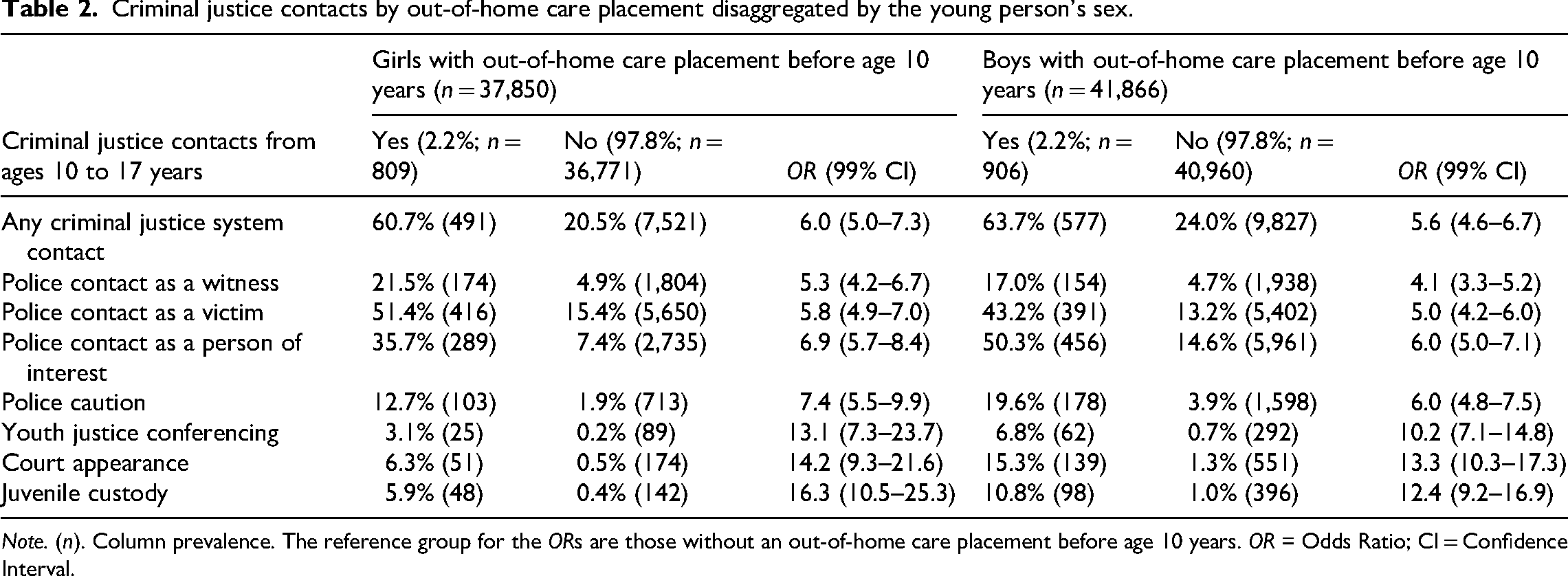
Note. (n). Column prevalence. The reference group for the ORs are those without an out-of-home care placement before age 10 years. OR = Odds Ratio; CI = Confidence Interval.
Results examining placement type (not mutually exclusive) are presented in Table 3. Of the 1,715 young people placed in out-of-home care, 59.1% experienced one placement type, 33.4% had two, and 7.5% had three or more. The most common placement types were foster care (n = 1,161) and relative and kinship care (n = 996), and the patterns of police contact prevalence across these two placement types were similar. Placement with parents (n = 313) tended to have slightly lower prevalence of criminal justice contact compared to the other placement types. For example, youth custody was 7.7% for those placed with parents, compared to 8.6% in foster care and 9.5% in relative and kinship care. Due to the low prevalence of placement in other care (n = 79), it was not possible to examine some of the infrequent criminal justice contacts.
Criminal justice contacts stratified by type of out-of-home care placement before age 10 years.
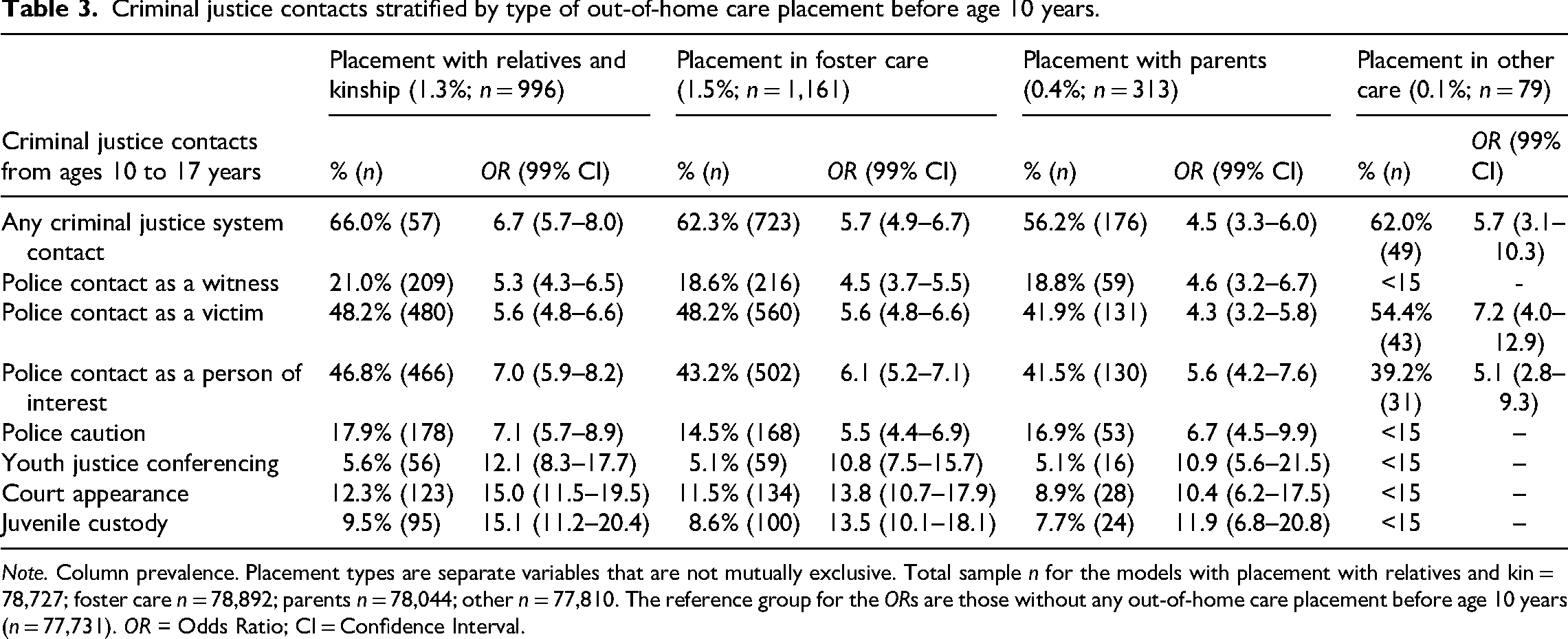
Note. Column prevalence. Placement types are separate variables that are not mutually exclusive. Total sample n for the models with placement with relatives and kin = 78,727; foster care n = 78,892; parents n = 78,044; other n = 77,810. The reference group for the ORs are those without any out-of-home care placement before age 10 years (n = 77,731). OR = Odds Ratio; CI = Confidence Interval.
The results for the number of out-of-home care placements are presented in Table 4. Those with 1, 2, or ≥3 placements had a significantly higher prevalence of criminal justice system contact compared to those with no out-of-home care placement, but there was little difference across the three frequency categories.
Criminal justice outcomes by number of out-of-home care placements before age 10 years.
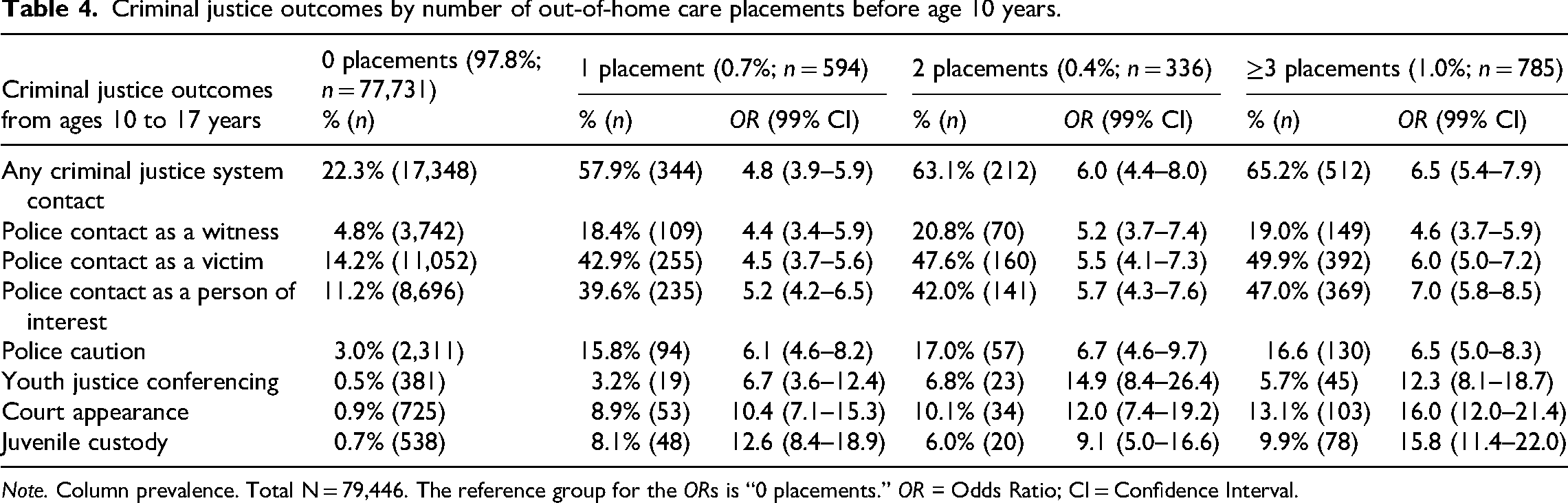
Note. Column prevalence. Total N = 79,446. The reference group for the ORs is “0 placements.” OR = Odds Ratio; CI = Confidence Interval.
Sensitivity analyses for all the above analyses were also conducted, excluding the 347 individuals whose first out-of-home care placement was after age 10 years; the results remained the same (see Supplementary Tables S1–S4).
Discussion
Findings from this large, Australian, population-based study show that out-of-home care placement before age 10 years was strongly associated with various types of subsequent involvement with the criminal justice system, including types of contact beyond formal charges or convictions. However, many children placed in out-of-home care did not have subsequent criminal justice system contact by their 17th birthday for most of the outcomes examined. For instance, over 90% were never placed in youth custody. Notably, when we examined a broad measure of any criminal justice contact that includes police contact as a victim and witness, the prevalence of those with no contact of any type is only 37.7%. Our findings align with a study using linked data on 14,719 children born between 1990 and 1995 in Western Australia, which found that 81% of those in out-of-home care did not experience youth custody (Lima et al., 2018). Our results are also consistent with a South Australia study which found that 90% of those in out-of-home care had no criminal convictions up to age 17/18 years (Malvaso et al., 2017b). A Canadian record linkage study of 50,551 children born in 1986 similarly found that 3% were placed in out-of-home care by age 18 years (compared to 2.6% in the NSW-CDS), 73% of whom did not become involved with youth justice (Turpel-Lafond, 2009). These findings highlight the importance of using large, representative, prospective data to demonstrate the diverse outcomes of those placed in out-of-home care and to highlight that most of these young people do not have contact with the criminal justice system as an offender during adolescence.
Patterns of criminal justice involvement by placement type and number of placements were similar in this study, although we acknowledge that the study may be underpowered to detect differences for those placed in other types of care (n = 79). We did find that the prevalence of criminal justice outcomes was similar for foster and relative and kinship care. While there is much research suggesting that foster care in particular results in elevated high rates of criminal justice contact (Yi & Wildeman, 2018), comparing foster care children to the general population is not the ideal methodological approach to understand differences between placement types (Font & Kennedy, 2022). There are wide variations in the nature and quality of foster care (and other types of care) that need to be accounted for and examined more carefully in future research. Similarly, our measure of frequency of placement does not capture placement quality, which could explain the similar patterns identified across 1, 2, and ≥3 placements found here. Future studies should explore young people's placement trajectories over time to better understand the effect of the timing, quality, and duration of different placement types on rates of subsequent criminal justice contact.
The higher prevalence of broad criminal justice system involvement for those placed in out-of-home care during childhood remains an important public health and policy issue. One potential explanation for this relationship is that young people placed in out-of-home care tend to have experienced higher levels of adversity that accumulate over time (e.g., child abuse and neglect) (Harris et al., 2024; Turney & Wildeman, 2017), disrupting healthy psychosocial development and contributing to the emergence of antisocial behaviours (Moffitt, 2018). Alternatively, the lack of support during the critical transition period from out-of-home care and insufficient integration between the child protection and justice systems can contribute to offending among young people (Herz et al., 2019; Lee et al., 2014). Over-policing and over-criminalisation of young people in care may be another explanation for the higher levels of formal criminal justice system involvement among young people in out-of-home care (Gerard et al., 2019). This is especially likely among Aboriginal people who are over-represented in both the child protection and criminal justice systems (Cunneen, 2020). In forthcoming research conducted in consultation with an Aboriginal lived experience reference group, we will examine the intersection of Aboriginal young people in both the child protection and criminal justice systems while considering Australia's history of colonisation, intergenerational trauma, and systemic racism that has significantly impacted Aboriginal families (Newton, 2019).
Strengths and limitations
One of the advantages of using large administrative data is the ability to examine subgroups of relatively rare phenomena (Thompson et al., 2024). In this study, we were able to examine multiple types of criminal justice outcomes for those who experienced out-of-home care by considering sex, placement types, and placement frequency. Administrative data were not originally collected for research purposes and may include data entry or classification errors. However, these data minimise loss to attrition and avoid recall error and self-report bias. Importantly, the administrative data used in this study reflect system contact and underestimate actual antisocial behaviour and victimisation. We also note that it is likely that individuals in out-of-home care, especially those in residential care, can experience criminalisation of their behaviour while in care, resulting in higher levels of police involvement (Gerard et al., 2019); this could contribute to an over-representation of police contacts in these data. Out-of-home care experiences for older children (first placement at ≥10 years old) were not examined in this study but may represent an important opportunity for later intervention that warrants further investigation in future research. We did not control for covariates, as this was a descriptive study that aimed to provide information on contacts with the criminal justice system at the population level to inform policy and service use. We did not aim to disentangle the causes or explain the high prevalence of criminal justice contact among those who experienced out-of-home care. Other datasets with multiple self-report and official measures of key explanatory factors (e.g., family, intergenerational, socio-economic, school, neighbourhood) would be better suited to determine these causes.
Conclusion
Our findings showed that while there are robust and consistent associations between out-of-home care placement and several types of criminal justice involvement, it is not deterministic. However, our results support the need for training on trauma-informed approaches for police and others involved with young people who are involved with both child protection and criminal justice systems (Newton et al., 2022). These trauma-informed approaches focus on understanding and recognising trauma symptoms, the role of trauma in behaviour, and avoiding re-traumatisation, which can foster improved relationships and trust between young people and police. Those who experienced out-of-home care also had a high rate of police contact as a victim (47% vs. 14% without out-of-home care), suggesting that these young people continue to experience trauma into adolescence and services need to be equipped to support them. Community-based prevention systems for children and families are needed in childhood prior to criminal justice system involvement. For example, Communities that Care is an evidence-based programme where a number of effective preventive interventions are selected in consultation with communities based on their specific needs to reduce initiation into delinquent behaviour (Hawkins et al., 2008). To develop effective programming, future research should also examine the role of resilience (i.e., healthy adjustment despite significant adversity) among those who experience maltreatment and out-of-home care (Daining & DePanfilis, 2007), acknowledging that there are complex multisystemic processes underlying resilience (Ungar & Theron, 2020).
Supplemental Material
sj-docx-1-anj-10.1177_26338076251379336 - Supplemental material for Criminal justice system contacts of young people who were placed in out-of-home care in childhood: A population-based descriptive study of over 79,000 young people in New South Wales, Australia
Supplemental material, sj-docx-1-anj-10.1177_26338076251379336 for Criminal justice system contacts of young people who were placed in out-of-home care in childhood: A population-based descriptive study of over 79,000 young people in New South Wales, Australia by Stacy Tzoumakis, Tyson Whitten, Emma McKenzie, Kimberlie Dean, Kirstie O’Hare, Oliver J Watkeys, Felicity Harris, Vaughan J Carr and Melissa J Green in Journal of Criminology
Footnotes
Acknowledgements
This research used population data owned by the NSW Department of Communities and Justice; the NSW Ministry of Health; Australian Capital Territory (ACT) Health; the NSW Registry of Births, Deaths and Marriages; the Australian Coordinating Registry (on behalf of Australian Registries of Births, Deaths and Marriages, Australian Coroners and the National Coronial Information System); the Australian Bureau of Statistics; the NSW Bureau of Crime Statistics and Research; the NSW Department of Justice; and the NSW Police Force. This research used data from the Australian Early Development Census (AEDC). The AEDC is funded by the Australian Government Department of Education. The findings and views reported are those of the authors and should not be attributed to these departments, or the NSW or Australian governments. Record linkages were conducted by the NSW Centre for Health Record Linkage (CHeReL).
ORCID iDs

Funding
The authors disclosed receipt of the following financial support for the research, authorship, and/or publication of this article: This research was conducted by the University of New South Wales with financial support from the National Health and Medical Research Council (NHMRC) Project Grant (APP1148055) and Investigator Grant (APP1175408 awarded to KD); the Australian Research Council (ARC) Discovery Project (DP230101990) and Discovery Early Career Researcher Award (DE210100113 awarded to ST); and the Department of Health and Aged Care Medical Research Future Fund Million Minds Mental Health Grant (APP2006436).
Declaration of conflicting interests
The authors declared no potential conflicts of interest with respect to the research, authorship, and/or publication of this article.
Data availability statement
Data used in this project have been provided by government or other agencies for the research purposes of the NSW Child Development Study and are unable to be shared with third parties or deposited into data repositories. Researchers wishing to access these data need to apply in writing to relevant data custodians.
Supplemental material
Supplemental material for this paper is available online.
References
Supplementary Material
Please find the following supplemental material available below.
For Open Access articles published under a Creative Commons License, all supplemental material carries the same license as the article it is associated with.
For non-Open Access articles published, all supplemental material carries a non-exclusive license, and permission requests for re-use of supplemental material or any part of supplemental material shall be sent directly to the copyright owner as specified in the copyright notice associated with the article.
