



Abstract
A decade ago, research empirically established that there is a dearth of criminological research on “Indigenous peoples in the criminal legal context of settler-colonial societies” published in elite criminology journals and that the scarce number of published studies primarily employs “silencing research methods” although mainstream criminologists generally prefer non-silencing research methods. Since the hyperincarceration of Indigenous peoples continues and publications on the topic remain scarce, this study set out to verify whether anything has changed over the past decade (2011–2020) with regard to the use of silencing research methods. The findings reveal that when criminologists address the topic Indigenous peoples in the criminal legal context of settler-colonial societies, the use of non-silencing research methods has increased overall, but it is not yet on par with their general use by criminologists and when compared to their use with other hyperincarcerated populations, i.e., African and Hispanic Americans. Also, Indigenous people in the United States face increased silencing. The study concludes that small, non-linear inroads have been made toward ending the discriminatory use of non-silencing research methods with the understanding that the use of such methods alone is insufficient for research to be considered non-silencing or even decolonising.
Decolonising academia
Scholarly debates around the need to decolonise academia have accelerated over the last decade—to the extent that it has gained mass media attention (see, e.g., Heleta, 2016; Muldoon, 2019). The debate occurs both across and within academic disciplines. Cross-disciplinary debates seek to, inter alia, address the decolonisation of research methodologies and methods (Antoine, 2017; De Santolo et al., 2019; Kidman, 2018; Reiter, 2020; Smith, 2016); knowledge and pedagogy in higher education (Bendix et al., 2020; Morreira et al., 2021); and universities in general (Bhambra et al., 2018; Rodríguez, 2018). Aiming to create worldwide links, the Decolonial Studies Research Network (2020) was founded in 2020 and Leon Moosavi (2021) regularly hosts well-attended Decolonial Research Methods webinars. Intra-disciplinary decolonisation debates occur in a wide range of disciplines such as education (Battiste & Bouvier, 2016), engineering (Fomunyam, 2017), psychology (Schmidt, 2019), African studies (Kessi et al., 2021), and sociology (Meghji, 2020), to name a few.
Discipline-specific research in criminology and criminal justice studies has contributed to the overall debate on decolonising academia. Aside from criminological research that addresses the decolonisation of crime policies and practices such as policing (see, e.g., Porter, 2016), criminologists also critically examine the discipline as a whole (Agozino, 2019; Aliverti et al., 2021; Blagg & Anthony, 2019; Cunneen & Tauri, 2016; Deckert, 2024; Tauri, 2017). They look at decolonising specific theoretical strands of criminology, e.g., Queer Criminology (Ball, 2019), Southern Criminology (Ciocchini & Greener, 2021; Deslandes et al., 2022; Dimou, 2021; Moosavi, 2019), and Historical Criminology (Guerzoni & Miller, 2021), and they advise on discipline-specific decolonisation strategies (Murdoch & McGuire, 2021). A growing number of scholars argue that decolonising criminology is impossible because it is innately colonising and therefore call for its abolition (e.g., Porter, 2019; Saleh-Hanna et al., 2023; Tuck & Young, 2012; Watego, 2021; see also Staines, 2023).
Debates around the decolonisation of academia and individual academic disciplines have been accompanied by discussions of the “coloniality of power”, the “coloniality of knowledge”, and decoloniality theory. Since the concept of decolonisation provides the basis of this study, it is necessary to delineate decolonisation from decoloniality.
Decolonisation versus decoloniality
The decolonisation of academia “includes all intellectual efforts to free theory and ideology from distorting bias” that were and are being caused by (neo-)colonial power (Hull, 2021, p. 63). Since decolonising scholarship seeks to reveal false claims that are based on bias, it is truth-focused, meaning that it is based on the idea that universal truths do exist. Decoloniality theory, on the other hand, argues that universal truths do not exist, but rather that several (more localised) truths or knowledges co-exist (Ndlovu-Gatsheni, 2013). The theory of the “coloniality of knowledge” explains that through colonial expansion an oppressive knowledge hierarchy was established that privileges Western knowledge over other knowledges. Individual positions in this knowledge hierarchy are said to correlate with positions in the power hierarchy, which was, in turn, created by the “coloniality of power”. The theory of the coloniality of power explains that with colonial expansion a power hierarchy was created through “the codification of the differences between conquerors and conquered in the idea of race, a supposedly different biological structure that placed some in a natural situation of inferiority” (Quijano, 2000, p. 533) and the global division of labour along those imagined racial lines (Quijano, 2000). Later, Quijano (2007) expanded on these ideas arguing that both the coloniality of power and the coloniality of knowledge are part of a “colonial matrix of power” that exerts social, political, economic, and cultural control across four interconnected domains: economy (land, labour, natural resources); government (law, police, army); gender/sexuality; and knowledge (epistemology, education, research). Decoloniality theory has, however, been critiqued (see, e.g., Chambers, 2020; Hull, 2021).
Regardless of such criticism and notwithstanding their different epistemic premises, decolonisation and decoloniality share some important characteristics. They both recognise that the production of knowledge is influenced by social, economic, political, and cultural factors and both advocate for the uncovering and critiquing of knowledge claims that are affected by hegemonic biases (Chambers, 2020). With their goal to disrupt (neo-)colonial narratives, both are political in nature and since decoloniality theory insists on the existence of multiple knowledges/truths, it implies that it does not outright reject the efforts made by decolonising scholars. As Hull (2021) points out, “[w]hen decoloniality theory first emerged (in Aníbal Quijano's innovative writings) […] it exemplified the broader, truth-oriented sense of intellectual decolonization” (p. 63), and the internal logic of decoloniality theory necessitates that “all theoretical approaches or sets of assumptions are to be treated as equals” (p. 72). Hence, the decolonisation approach employed for the current study, which seeks knowledge about the discriminate use of research methods by criminologists, is not at odds with decoloniality theory.
Neo-colonisation in academic discourse through the use of silencing research methods
This study adopts a definition of discourse as developed by Foucault (1969) and refined by Said (1979) understanding it as a system of thought that seeks to explain the world by making statements about it. In doing so, discourse creates new knowledge, simultaneously limiting the same because it must reject alternative explanations that jeopardise the internal consistency of its ongoing narrative. Indigenous knowledge, for example, was systematically suppressed or ignored until the 1980s because Western scholars considered it incompatible with the scientific paradigm due to “cosmological, epistemological and ontological” differences (Nakata, 2007, p. 183). Discourse, therefore, constructs the domain it describes and the identity of the subjects within it, and—if it dominates and thus becomes mainstream—it generates social, political, and cultural power (Said, 1979).
Mainstream criminological discourse narrates stories about crime and deviance with the criminal/deviant in its focus and victims, witnesses, and legal professionals in its peripheral vision. With time, criminological discourse generated sufficient social, cultural and political power to institutionalise itself in the academic discipline of criminology (Foucault, 1969) almost entirely divorced from its legal, sociological and medical legacy. Academic criminological discourse survives by constantly shaping and expanding its thematic boundaries (Cohen, 1988) while maintaining its ongoing othering narrative of “the criminal/deviant” (Agozino, 2003; Lynch, 2000; Tauri, 2012; Young, 2011).
Discourse's main mode of transport is language. Words create discourse and words disseminate it. Words become powerful because as the constitutive element of a prevailing discourse, they enable social and political control of certain populations (Foucault, 1969; Lessa, 2006; Van Dijk, 2008). Discursive power manifests in a variety of ways through language: what topics are discussed with regard to certain populations; how such a topic is discussed; how often the discussion occurs (frequency); and who drives and takes part in the discussion (Delgado, 1984; Porter, 2019). Where discourse is published also exerts discursive power. For example, research published in elite academic journals is—due to their status and profile—particularly associated with high-quality research (Northcott & Linacre, 2010).
When negative topics dominate the discourse about a specific population, the population is constructed as a threat that requires social control (Van Dijk, 2008). Criminological discourse is inherently negative because it has chosen the social problem of “crime” as its defining subject (Young, 2011). Agozino (2003) argues that with this focus on an intrinsically negative topic, criminology was deliberately designed to provide an ongoing destructive narrative that justifies the socio-political control of the criminalised Other.
Negative undertones that create “the Other” can also manifest in the chosen instruments of language, i.e., in rhetoric, syntax, and lexicon. For example, in Western discourses, a negative image is evoked when using passive sentence structures because they imply that the people described are lazy or indifferent (Harding, 2006; Van Dijk, 2008).
How frequently a topic is discussed with regard to a certain population also generates power because the quantity of discourse determines which ideas become mainstream (Centola et al., 2018). Deckert (2014) defined silence in a particular discourse as the complete absence of a population that is affected by the discourse and found that discourse in elite mainstream criminology journals is relatively silent about Indigenous peoples hyperincarcerated by the settler–colonial states of Australia, Canada, Aotearoa New Zealand, and the United States. Hyperincarceration means that the rate of incarceration exceeds the so-called “inflexion point” of 429 per 100,000, at which imprisonment generates criminogenic tendencies within the affected community (Liedka et al., 2006) because imprisonment becomes normalised and breaks down social ties that would normally encourage desistance from crime (Brown 2010). “It is this ‘inflexion point’ that turns incarceration rates from a social concern into a social problem” (Deckert, 2024). The body of research published in elite mainstream criminology journals is relatively silent on Indigenous people compared to both their rates of incarceration and publication rates on other hyperincarcerated populations, i.e., African and Hispanic Americans. In other words, while hyperincarcerated African and Hispanic Americans are well covered in elite criminology journals, hyperincarcerated Indigenous people remain a footnote.
Considering that most authors who publish in elite mainstream criminology journals cite universities as their institutional affiliation, it can be said that university scholars have privileged access to this particular discourse (Van Dijk, 1993, 2008). The discursive power that manifests in who talks (Cook, 2008; Delgado, 1984; Fairclough, 2001; Guerzoni & Walter, 2023; Phelan, 2009; Porter, 2019) is acknowledged through several studies that seek to identify the most cited scholars in criminology—be it in journal articles or textbooks (Cohn et al., 2017; Cohn & Farrington, 2008; Roche et al., 2018; Wright, 1995). Since Indigenous academics are not the ones who dominate criminological scholarly discourse (Asmar et al., 2009; Porter, 2019; Smith, 2016), the decolonisation of contemporary criminological discourse depends, to a large extent, on non-Indigenous scholars centring Indigenous voices and experiences. As the social distance between Indigenous research participants and non-Indigenous criminological researchers was created through marginalisation processes (Moss, 1995), Deckert (2015) argues that non-Indigenous academics can only create a bridge by leveraging the power of Indigenous knowledge and suggests that criminological: research contributes to the marginalization of Indigenous peoples if it (a) primarily employs silencing research methods when studying Indigenous peoples; (b) employs silencing research methods more often when studying Indigenous peoples than criminological research typically does; and (c) employs silencing research methods more often when studying Indigenous peoples than criminological research does when studying other disproportionately incarcerated social groups. (p. 49)
The choice of research methods determines whether populations affected by the study topic take part in scholarly discourse. While silent researchers implicitly or explicitly exclude affected populations entirely, silencing represents a conscious choice to disengage with the studied population. For example, it means that researchers focus on or include Indigenous populations in their study but Indigenous research participants are denied an active voice in the research process (Agozino, 2003, 2004, 2019; Tauri, 2012; Young, 2011). Accordingly, Deckert (2015) applies the term silencing research methods to any research method that totally—not just partially—omits voices of the researched community […], prohibit[s] direct engagement between researcher and research subjects and prevent[s] research subjects from articulating their views […]; and that therefore represent an expression of the scholar's exclusive interpretation of the research subject's experience. (p. 47)
Deckert (2015) uses the term “subject” deliberately in her definition: because only when the researched subject is given the opportunity to communicate views, knowledge, and opinions directly to the investigator, is the dominated “subject” transformed into a research “participant”—in the true sense of the word—as someone who shares the researched experience and arguably the research experience with the scholar. (p. 46)
Criminologists’ preference for non-silencing research methods
As Kleck et al. (2006) found, overall criminologists have a preference for using non-silencing research methods. Reviewing seven leading criminology and criminal justice journals—all of which are also included in the current study—they found that of the 305 empirical-analytical studies published in 2001, 45% drew on survey research; 32% employed archival data (mostly criminal justice records); 26% used data from official statistics; 4% were based on experiments with human participants, and 12% employed qualitative methods such as interviews (7.6%) and observation (6.2%). Considering survey research (N = 137), experiments (N = 12) and interviews (N = 23) non-silencing research methods, their findings mean that 56.3% of all included studies used non-silencing research methods.
In a more recent study, Woodward et al. (2016) examine the current state of U.S. criminology looking for the predominant research methodologies. To that end, they analysed the content of research articles (N = 541) published in seven criminology and criminal justice journals—all of which are also included in the current study—over a two-year period (2013–2014). They found that studies predominantly used quantitative methodologies and that data was obtained mainly without participant contact. It is, however, essential to note that Woodward et al. (2016) only acknowledged participant contact when the authors of an article collected the primary data for the purposes of that publication. When authors used secondary data sets—even when “original data were collected by one or more researchers from the current study but not for the specific article's purpose” (p. 346)—the study was not labelled as having had participant contact. This narrow definition of “participant contact” differs vastly from the current study's definition of “silencing research methods”, because even when using secondary data sets that were originally obtained through the use of non-silencing research methods, the voice of participants remains heard. Therefore, studies that derived their data from such secondary data sets, e.g., the family and community health study, Woodlawn, or national youth longitudinal survey 1997 study, were considered as using non-silencing research methods in the current study because they used data derived from participant voices. In other words, data was collected from people not about people as is the case, for example, when using arrest statistics or census data. Nevertheless, Woodward et al. (2016) found that only 28.8% of articles included in their study had “no participant contact” (p. 250), leading to the conclusion that most articles (71.2%) demonstrated a preference for the use of non-silencing research methods.
Research questions
The following research questions seek to re-examine Deckert's (2015) assertations about the prevailing use of silencing research methods when Indigenous people in the criminal legal contex are studied and corresponding articles published in elite mainstream criminology journals. In doing so, the study draws attention to the ongoing critique that mainstream criminology fails to engage with Indigenous peoples (Blagg & Anthony, 2019; Cunneen & Tauri, 2016; Tauri, 2012, 2017):
Has research published in high-ranked criminology journals over the past decade (2011–2020) primarily used silencing research methods when studying Indigenous peoples in Australia, Aotearoa New Zealand, Canada, and the United States? Has research published in high-ranked criminology journals over the past decade (2011–2020) employed silencing research methods more often when studying Indigenous peoples than criminological research typically does? Has U.S.-based research published in high-ranked criminology journals over the past decade (2011–2020) employed silencing research methods more often when studying Indigenous people compared to criminological research on African and Hispanic Americans that was published in the same journals? Considering the criticism of euro-centric approaches to research, does criminological research show a significant downward trend in the employment of silencing research methods between the two time periods 2001–2010 and 2011–2020?
Research design
This study used the same journal ranking as Deckert (2015) to enable a genuine comparison between articles published in the last decade (2011–2020) and the previous one (2001–2010). Journals ranked as A*, A or B in the Australia and New Zealand Society of Criminology Report on Criminology Bibliometrics Development (Brown & Daly, 2008) were, therefore, included in this study. Firstly, all published materials not based on original research were excluded to determine the number of all research articles. Retracted research articles were also excluded from the count.
From the pool of all research articles, the number of articles on the topic Indigenous peoples in the criminal legal context (henceforth: topical articles) was identified via a keyword-based search, which included title, abstract, keywords, and full-text. The following keywords were used: “Indigenous”, “Indigeneity”, “Aboriginal”, “First Nation”, “American Indian”, “Māori or Maori”, “Native”, “Torres Strait Islander”, “Inuit”, and “Metis or Métis”. It was unnecessary for an article to refer to a particular stage in the criminal legal system to be included, meaning that articles about criminalised behaviours such as violence and drug use entered the data set and so did articles that focused on crime prevention, policing, sentencing, prisons, and victimisation. Theoretical and historical works were also included. Comparative articles that included one or more of the four countries were counted for each of the studied populations. However, articles that exclusively referred to Indigenous peoples outside Australia, Canada, Aotearoa New Zealand and the United States were not included.
In the same way, data was collected for the topics “African Americans in the criminal legal context” and “Hispanic Americans in the criminal legal context” because both populations are also hyperincarcerated considering the four countries included in the study. The following keywords were used for the search: “African-African OR African American”, “Black”, “Afro-American”, “Latino OR Latina OR Latinx OR Hispanic”, “Chicano”, “Spanish”, “person of colour OR people of colour”, “non-White”, and “race OR racial OR racialised”. As a second step, the full text of each identified article was searched for their implicit or explicit exclusion of Indigenous peoples because First Nations people face lower incarceration rates than African Americans but higher incarceration rates than Hispanic Americans (see Deckert, 2024). Hence, any discourse that includes both African and Hispanic Americans as hyperincarcerated populations can be said to also affect Indigenous people.
Finally, the employed research method was identified for each article. If the study used a mixed-methods approach and at least one of the chosen research methods was non-silencing, the study was categorised as non-silencing.
The gathered data was analysed using descriptive statistics to address the four research questions. The proportion of studies that used silencing and non-silencing research methods was calculated for each population and then compared with the proportions identified by Deckert (2015) for the period 2001–2010 to identify the overall trend in the use of non-silencing research methods and trends for each of the included populations.
Limitations
Some journals on Brown and Daly's (2008) list did not publish any topical articles between 2011 and 2020 and may have done so for genuine reasons, i.e., because (a) the topic is outside the scope of the journal, (b) all submitted topical manuscripts were rejected for other reasons than the topic itself, or (c) no topical manuscripts were submitted during the period. Given that most journals published at least one topical article during the examined decade, the subject matter was within the scope of most journals. Hence, only three journals had to be excluded from the study because they did not publish any topical articles, that is neither on Indigenous peoples nor African or Hispanic Americans. While Deckert (2015) had to exclude three journals from the data collection because they only started publishing after 2001, the current study was able to include these three journals. Moreover, unlike Deckert (2015), the current study also had full access to the journal Police Practice and Research, which was thus included in the data collection. On the other hand, due to cost-value considerations, the journal Social Justice: A Journal of Crime, Conflict and World Order had to be excluded from the current study as the researcher did not have free access to the content of this journal. Although the journals included in the current study are not 100% identical to the journals included in Deckert's (2015) study, the data sets remain nevertheless comparable because of the overall data volume and the consistently high rankings of the journals included in both studies.
Findings
Brown and Daly (2008) ranked 44 journals as A*, A, or B in their report on the bibliometrics development in criminology. Three of the 44 listed journals were excluded from the current study. In addition to the exclusions mentioned in the previous section, one journal was excluded because of its explicit focus on South Africa and two further journals were excluded because they did not accept unsolicited material. Two journals changed their name during the collection period: The Australian and New Zealand Journal of Criminology became the Journal of Criminology, and the International Journal of the Sociology of Law took on the name The International Journal of Law, Crime and Justice.
A total number of 11,583 original research articles was identified in the 37 journals that were ultimately included in the study, which compares to 8,887 research articles identified in 35 journals in the previous decade (see, Deckert, 2015).
Articles by topic
Of the total 11,583 research articles, 151 focused on Indigenous people in the criminal legal context compared to 105 out of 8,887 articles in the previous decade.
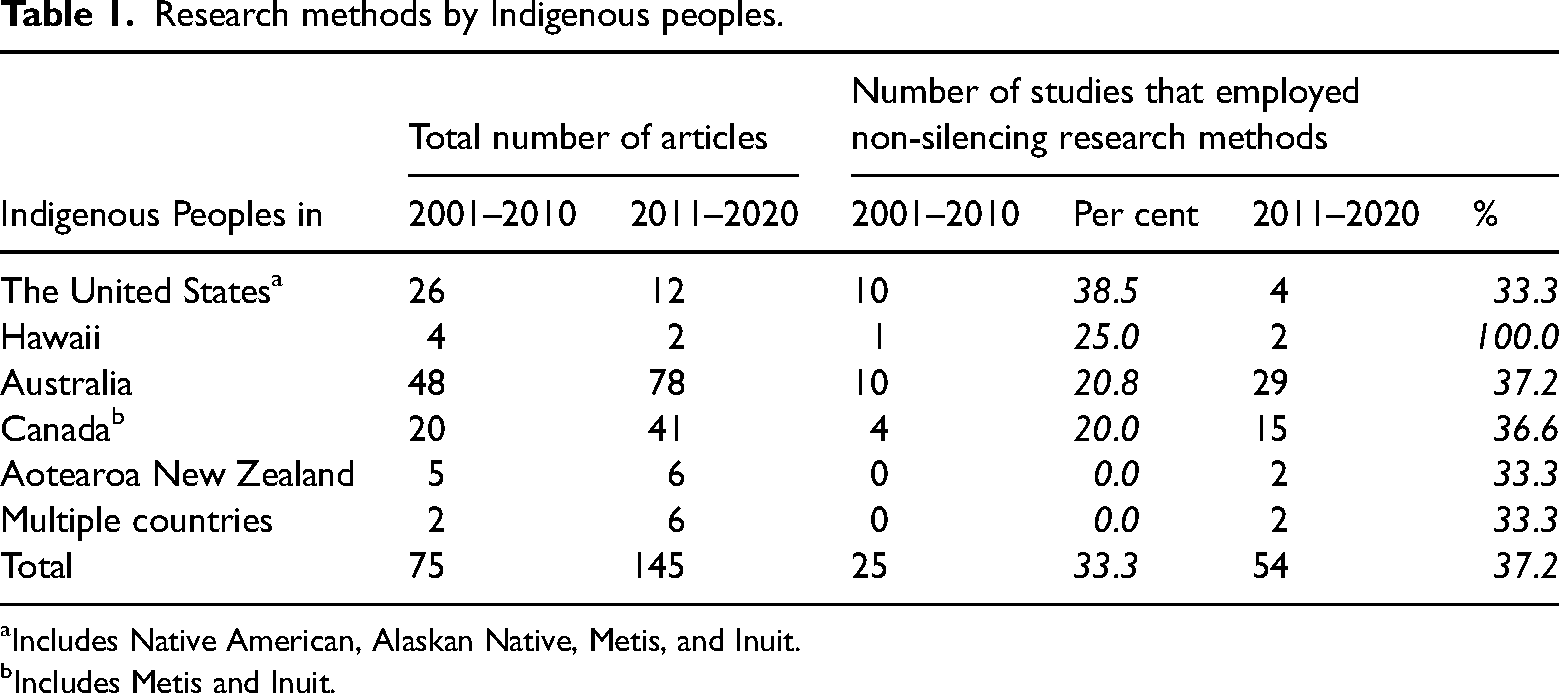
Over half (n = 78) of the 151 articles were devoted to Indigenous people in Australia. About one quarter (n = 41) was dedicated to Indigenous people in Canada. A further 12 articles focused on Indigenous people in the United States, six on Māori in Aotearoa New Zealand, and two on Indigenous people in Hawaii.
An additional 12 articles covered Indigenous people from more than one country. Eight of these 12 articles referred to Indigenous peoples in general, that is, without reference to specific countries. These eight articles were excluded because they lacked the necessary focus on settler-colonial societies for the current study. Of the remaining six articles, three included Indigenous people in Canada, two included Indigenous people in Australia, two included Indigenous people in the United States, and one included Māori. These articles were accounted for (see Table 1) and counted for each of the Indigenous peoples they included (see Table 2).
Research methods by Indigenous peoples.
Includes Native American, Alaskan Native, Metis, and Inuit.
Includes Metis and Inuit.
Research methods by hyperincarcerated population in the United States.
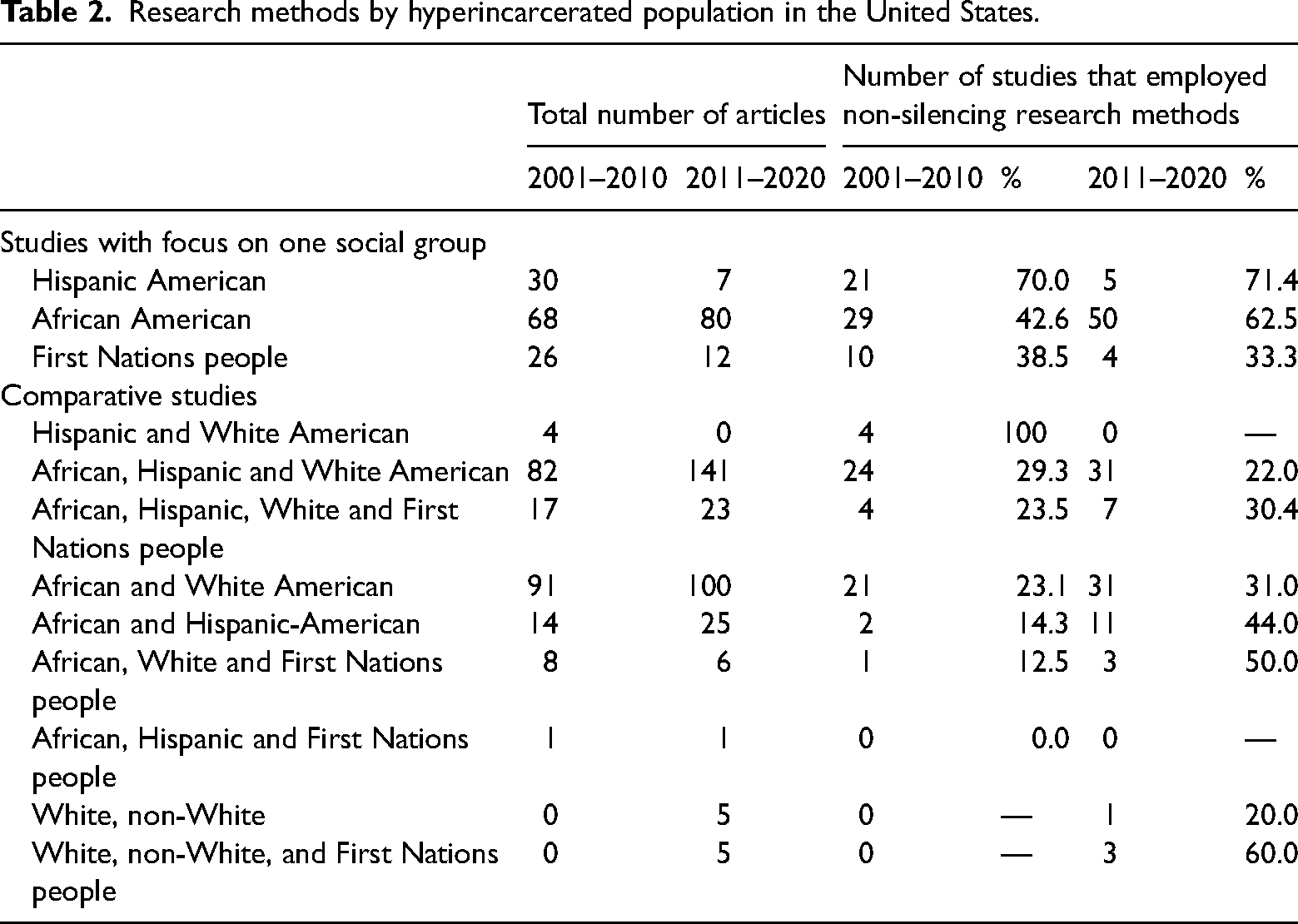
Of the 11,583 articles included in this study, 401 covered African or Hispanic Americans. Of these 401 articles, eight articles were conducted in Canada. Of the 393 U.S.-based studies, 80 focused solely on African Americans and seven solely on Hispanics. The remaining 306 U.S.-based articles included either several ethnic populations or both ethnic populations and Indigenous people in their data sets. Of these 306 publications, 141 compared African, Hispanic and White Americans (up from 82 in the previous decade), 100 compared White and African Americans (up from 91), 25 compared African and Hispanic Americans (up from 14), 23 compared African, Hispanic, White Americans and Indigenous people (up from 17), six compared African Americans, White Americans and Indigenous people (down from eight), one compared African Americans, Hispanic Americans and Indigenous people (compared to one article in the previous decade), and no article compared Hispanic and White Americans (down from four articles in the previous decade). The remaining 10 articles used the categories White and non-White or racialised and non-racialised. While not all of these articles made explicit which populations were included in the non-White group, five studies included Indigenous people in their sample.
Hence, African Americans featured in 296 of the comparative articles (up from 231 in the previous decade) and in a total of 376 studies (up from 281). Hispanic Americans were included in 190 comparative studies (up from 118) and in a total of 197 articles (up from 148). Indigenous people featured in 35 comparative studies (up from 26 in the previous decade) and in a total of 47 studies (down from 52). In comparison, White Americans – a social group that was not hyperincarcerated during the relevant period – featured in 280 of the comparative studies (up from 197 in the previous decade), meaning that only 26 of the comparative studies did not include White Americans.
Of the 217 comparative articles, 35 included Indigenous people in the research data. Of these 35, 13 articles categorised Indigenous people as Indigenous peoples and thus distinct from ethnic social groups. Of the remaining 22 studies, 14 categorised Indigenous people as “other”, six as “non-White”, one as “other non-White”, and one as “minority status”. All these categories contained one or more ethnic minorities next to Indigenous people.
The remaining 182 comparative articles excluded Indigenous people either explicitly or implicitly. Explicitly means that reasons were given for why Indigenous people were excluded from the data collection. Implicitly means that despite their hyperincarceration, Indigenous people were excluded from the study and no reason was given as to why. Twenty-two of these 182 articles excluded Indigenous people explicitly (up from 18 in the previous decade) and 160 articles excluded this social group implicitly (down from 173).
Articles by employed research method
On average, 62% of the studies that focused on Indigenous people in the criminal legal context employed one or more silencing research methods (down from 67% in the previous decade) (Table 1). A slight upward trend in the use of non-silencing research methods can thus be noticed between the two decades.
The use of non-silencing research methods improved in particular for Indigenous people in Australia (up from 20.8% to 37.2%), Canada (up from 20.0% to 36.6%), Aotearoa New Zealand (up from 0% to 33.3%), Hawaii (up from 25% to 100%) and studies that included multiple Indigenous peoples in the four countries (up from 0% to 33.3%). The use of non-silencing research methods only decreased for studies that focused on Indigenous people in the United States (down to 33.3% from 38.5%), who were in the previous decade (2001–2010) the “most heard” population. In the more recent decade (2011–2020), the most hear populations were Indigenous people in Hawaii and Australia. However, silencing research methods were still used in more than half of the articles concerned. Overall, non-silencing research tools were used in 37.2% of all studies with a focus on Indigenous peoples (up from 33.3% in the previous decade).
In comparison, 71.4% of all studies that focused solely on Hispanic Americans used non-silencing research methods (up from 70.0% in the previous decade) (refer to Table 2) and 62.5% of all studies that solely focused on African Americans (up from 42.6% in the previous decade).
Overall, comparative U.S.-based studies employed more non-silencing methods when compared to the previous decade. The use of non-silencing research methods only decreased for studies that compared African, Hispanic and White Americans (down to 22% from 29.3%). This finding is remarkable given the complex logistics of administering non-silencing research methods and the greater number of populations involved in comparative studies. These complexities could presumably lead to the use of more silencing research methods, but this does not seem to be the case. As in the previous decade, whether two or more populations were included in a comparative study did not seem to influence the choice of research methods. Markedly, the use of non-silencing research methods increased when comparative studies included Indigenous people.
Discussion
The study set out to answer four research questions, which are addressed in this section.
Addressing research question one
Indeed, studies published in high-ranked criminology journals over the past decade (2011–2020) have primarily used silencing research methods when focusing on Indigenous people in Australia, Canada, Aotearoa New Zealand, and the United States. While 37.2% of topical articles used non-silencing research methods, most studies (62.8%) used silencing ones. The only exceptions to the rule are studies with Indigenous people in Hawaii and comparative studies that use the population categories White and non-White (with the latter label including Indigenous people in the United States). Both of the studies that focused on Indigenous people in Hawaii used non-silencing research methods and so did 60% of the studies that used the comparative categories White and non-White in the United States context. Also, half of the studies (three out of six) that compared African Americans, White Americans, and Indigenous people in the United States (excluding Hawaii) used non-silencing research methods. Although there were almost twice as many articles published on Indigenous people in Australia (n = 78) compared to Canada (n = 41), non-silencing research methods were used in only 37% of studies for both populations.
Like the author of this article, most criminologists are non-Indigenous and, for non-Indigenous criminologists to undertake ethically sound studies with Indigenous communities requires “form[ing] a fresh relationship with Indigenous people as a necessary step in order to heal the harms created by the White man's justice system” (Blagg, 2017, p. 765). Establishing such fresh relationships and using non-silencing research methods can be time-consuming. If criminologists had indeed prioritised the more time-consuming engagement with Indigenous communities and the ensuing non-silencing research methods, this would have explained the overall dearth of topical articles published over the last decade (2011–2020) (Deckert, 2024). However, since criminologists evidently prioritised non-silencing research methods when studying Indigenous peoples in the criminal legal context, the relative silence about hyperincarcerated Indigenous people cannot be explained away by the time-consuming use of non-silencing research methods. On the contrary, the predominant use of silencing research methods should arguably lead to a much higher output rate on the topic. These findings support the ongoing critique that orthodox criminology fails to engage with Indigenous people (Blagg & Anthony, 2019; Cunneen & Tauri, 2016; Tauri, 2012, 2017).
Addressing research question two
It is also true that research published in high-ranked criminology journals over the past decade (2011–2020) employed silencing research methods more often when studying Indigenous people than criminological research typically does.
Overall, between 52.6% and 71.2% of criminological studies published in high-ranking academic journals employ non-silencing research methods (Kleck et al., 2006; Woodward et al., 2016). Hence, criminological researchers generally demonstrate a preference for non-silencing research tools. In other words, while criminologists may not centre the voices of those with lived experience in the criminal legal system, researchers do consider these voices essential.
Notwithstanding this overall tendency, non-silencing research methods remain under-utilised when investigating Indigenous peoples in the criminal legal context. On average, such tools are only used in 37.2% of topical articles. Even for Indigenous people in Australia, who were comparatively the most “listened to” Indigenous people over the decade 2011–2020, the use of non-silencing research methods remained, at 37.2%, well below the discipline's average. The “most silenced” were Indigenous people in Aotearoa New Zealand (33.3%) and the United States (33.3%).
Addressing research question three
The findings evidence that U.S.-based research published in high-ranked criminology journals over the past decade (2011–2020) employed silencing research methods more often when studying Indigenous people compared to research on African and Hispanic Americans that was published in the same journals. The findings confirm that criminologists’ general preference for the use of non-silencing research tools is also present when they focus on African or Hispanic Americans because 62.5% and 71.4% of topical articles respectively used non-silencing research methods, which is on par with the overall average.
Hence, silencing research methods are used more often when studying Indigenous people (66.7%) compared to African Americans (37.5%) and Hispanic Americans (28.6%). For Hispanic Americans, the usage of such methods was not only higher compared to research on Indigenous people and African Americans but it also exceeds the disciplines’ average. Future research may need to determine why criminologists use non-silencing research methods more often when focusing on Hispanic Americans.
Addressing research question four
Compared to the previous decade (2001–2010), criminological research on Indigenous people in the criminal legal context published in high-ranking criminology journals between 2011 and 2020 demonstrates an overall upward trend in the use of non-silencing research methods. While in the previous decade, 33.3% of all studies focused on Indigenous people employed non-silencing research methods, 37.2% did so in the last decade. The upward trend is particularly significant for Indigenous people in Hawaii (up from 25.0% to 100%) and Māori (up from 0% to 33.3%).
On the one hand, the use of non-silencing research methods has declined when studies focused on Indigenous people in the United States (excluding Hawaii). For this population, the use of non-silencing research methods declined from 38.5% to 33.3%. Also, the total number of studies showed a significant decline from 26 to 12. That either means that fewer studies are conducted or that researchers who focused on Indigenous people in the United States—especially the ones that used non-silencing research methods—published their work elsewhere. On the other hand, the total number of comparative U.S. studies that also included Indigenous people increased from 26 to 35 and these same studies also show a significant increase in the use of non-silencing research methods compared to the previous decade. Overall, 19.2% of these studies (five out of 26) used non-silencing research methods in the previous decade (2001–2010) compared to 68.6% (24 out of 35) in the recent decade (2011–2020). Studies that compare Indigenous people, African, Hispanic and White Americans increased the use of non-silencing research methods from 23.5% to 30.4% and studies that compare Indigenous people, African and White Americans from 12.5% to 50.0%. Hence, comparative researchers employed non-silencing research more often than researchers who focused exclusively on Indigenous people in the United States. It was the opposite in the previous decade.
In the previous decade, Deckert (2015) found a minimal upward trend in the use of non-silencing research methods overall. The findings of the current study confirm that this upward trend continues. However, the use of non-silencing research methods is not yet on par with the discipline's average use. Therefore, it can be said that elite criminological discourse continues to silence Indigenous voices, but the trend indicates that the duct tape is slowly peeling off.
Overall discussion
Over the past decade, academic debate about the necessity to decolonise universities in general and scholarly research in particular increased noticeably (Deckert, 2024). This paradigm shift originated in the criticism of euro-centric approaches to research in the 1990s—a discussion led predominately by Indigenous scholars. The Indigenous critique was based on the understanding that the control over discourse production results in content control “and hence, indirectly, the public mind – maybe not exactly what people will think, but at least what they will think about” (Van Dijk, 2008, p. viii).
As part of the discursive elite, academic criminologists have privileged access to public discourses and particularly scholarly debates. Occupying this privileged space, criminologists are in a position to make active decisions about the topics that deserve attention, i.e., how frequently a topic is discussed, and also about who takes part in the discussion. According to Faraldo-Cabana and Lamela (2021), Anglo-American scholars dominate the editorial boards of high-ranked criminology journals and tend to “favour research that fits their worldview”, thus perpetuating knowledge hierarchies that promote Anglo-American scholarship. These findings align with Porter's (2019) observations that Indigenous scholars are “more likely to be writing at the margins of their respective disciplines, more likely to occupy precarious positions within mainstream departments and faculties and less likely to have their work cited in mainstream journals” (p. 131). Due to their privileged position, criminologists can choose to entirely ignore Indigenous people with first-hand experience of the criminal legal system, i.e., either explicitly or implicitly exclude Indigenous people from their data set or data collection despite the ongoing hyperincarceration or they can choose to include Indigenous people in their data collection but employ silencing research methods and thus silence Indigenous voices (Smith, 2016). Rakowski (1993) put it more drastically when referring to such practices as “research apartheid” (p. 77), i.e., a discriminatory practice based on racialisation.
Throughout the past decade, Indigenous people in the United States and Māori in Aotearoa New Zealand were the most affected by both the lack of published research compared to the rate of imprisonment for these two populations (Deckert, 2024) and the use of silencing research methods. While the use of non-silencing research methods has increased for studies that focus on Māori and decreased for studies that focus on Indigenous people in the United States, for both populations only a third of all studies published in high-ranked criminology journals over the decade 2011–2020 used non-silencing research methods, that is about half of the average use in the same journals.
Some might argue that research whose topic is of interest to Indigenous people should always be conducted with Indigenous people; in line with the maxim “nothing about us without us”. Others might argue that expectations for the use of non-silencing research methods in studies that focus on Indigenous people cannot go beyond expectations for the average criminological study, i.e., between 52.6% and 71.2%. However, even when following the latter argument, this study shows that such “reasonable expectations” are not met by research published in high-ranked mainstream criminology journals. Except for studies that focus on Indigenous people in Hawaii, studies focused on Indigenous people in Australia, Canada, Aotearoa New Zealand and the United States fall behind the expected minimum by about 20%. While this is an improvement compared to the previous decade when the difference was 50% (Deckert, 2015), reasonable expectations are not yet met.
That these expectations are not unreasonable is demonstrated by the fact that studies that focus on either African or Hispanic Americans easily meet reasonable expectations. Some may argue that most African and Hispanic Americans concentrate in U.S. cities and most criminological research is undertaken in urban areas, providing criminologists with easier access to research participants of African or Hispanic descent compared to research participants with Indigenous ancestry. However, 71% of U.S.-based Indigenous people also live in urban areas (US Census Bureau, 2010), refuting the accessibility argument due to geographic isolation. Moreover, that remote location does not necessarily constitute an obstacle to academic research, or the use of non-silencing research methods is demonstrated by Australia-based researchers who published most of the articles (n = 78) that focus on Indigenous people and significantly increased their use of non-silencing research methods in the last decade (from 20.8% to 37.2%) although most Indigenous people in Australia live outside the major cities. About 65% of Indigenous people live in the regional and remote areas of Australia in comparison to 29% of non-Indigenous people (National Rural Health Alliance, 2011). However, that does not mean that Australian-based researchers remain beyond reproach. After Indigenous criminologist Juan Tauri (2015) concluded that the choices Australasian researchers make when silencing Indigenous people in their research are based on arrogance rather than ignorance, he suggested that Indigenous criminologists “walk away, and set up our own tent” (Tauri, 2017, p. 780) – referring here the establishment of an Indigenous Criminology (Cunneen & Tauri, 2016) – because, on the whole, Australasian criminology has given Indigenous peoples “very little, except more prison, more brutal policing, and more traumas” (Tauri, 2017, p. 779). His statement speaks to both the ineffectiveness of crime policies based on research that fails to engage with Indigenous communities and the incompleteness of research conclusions that fail to consider the long-term impact of colonisation.
While in the previous decade (2001–2010), criminologists who included Indigenous people in their comparative studies used non-silencing research methods in only 19.2% of all cases, they did so in 68.6% of all studies in the following decade (2011–2020). It may have been reasonably expected that comparative studies that categorise Indigenous people in the United States as “Indigenous”, i.e., as distinct from ethnic minority populations, may have been more conscious about using non-silencing research methods compared to scholars who applied “Othering” labels. However, of the 14 studies that categorised Indigenous people as Indigenous, only three used non-silencing research methods. This compares to three out of 13 in the previous decade (Deckert, 2015). Equally, three of the 10 comparative U.S. studies that categorised Indigenous people as “non-White” used non-silencing research methods.
Arguably not all research studies that are focused on Indigenous people have to involve the use of non-silencing research methods, e.g., theoretical articles written by Indigenous scholars or critical studies that take mass media to task for the negative portrayal of Indigenous peoples. The same can be said, however, about studies that focus on African or Hispanic Americans. Nevertheless, criminologists use non-silencing research methods as often with African Americans as they do on average and exceed the average when focusing on Hispanic Americans. The purpose of this study was not to single out individual researchers but to demonstrate that the criminological discipline in its entirety is still grappling with its colonial legacy.
While criminology—as published in high-ranking academic journals—still fails to address hyperincarcerated Indigenous people in settler-colonial states at an adequate rate and thus mainstream this social problem (Deckert, 2024), this study paid attention to academic criminologists who did write about Indigenous people because academics’ disengagement with Indigenous people has been criticised for more than three decades (Agozino, 2003, 2004, 2019; Tauri, 2012, 2017; Young, 2011). This relentless critique seems to have been fruitful to some extent because, overall, the findings indicate improvement, meaning that criminologists who publish their work in high-ranking academic journals use non-silencing research methods more frequently than in the previous decade. This is particularly noticeable in comparative U.S. studies. Yet, overall parity with the discipline's average remains to be achieved. So, to answer the question asked in the title of this article: “Are we there yet?”, the answer is, “No”.
Conclusion
The overall body of criminological research on Indigenous peoples and the criminal legal system published in high-ranked criminology journals over the past decade (2011–2020) has contributed to the silencing of Indigenous voices in Australia, Canada, Aotearoa New Zealand, and the United States via the use of silencing research methods. Criminologists employ silencing research methods when studying Indigenous peoples more often compared to their average use and compared to their use with other hyperincarcerated populations, i.e., African and Hispanic Americans.
Both the silence about hyperincarcerated Indigenous people and the silencing of Indigenous voices through the use of silencing research methods constitute neo-colonial tools that contribute to the continuation of academic imperialism. Active participation in anti-racist and decolonising criminology requires acknowledging the oppressive practices associated with the white-supremacist intellectual heritage of criminology and accepting responsibility for discontinuing them moving forward. Because the hyperincarceration of Indigenous peoples continues, vast first-hand knowledge about the criminal legal system and its effects resides within Indigenous communities. Ignoring or silencing this knowledge contributes to the social marginalisation of Indigenous people and risks producing erroneous or incomplete criminological knowledge and missing the chance to address and solve existing and new problems (Kelleher, 2011; Rakowski, 1993; Smith, 2016; Stevenson, 1998). While political will is required to adopt social policies based on academic research evidence, such policies are more likely to produce positive outcomes for Indigenous communities if policymakers have access to scholarship that has employed non-silencing research methods within an appropriate methodological and ethical framework (see, e.g., Guerzoni & Walter, 2023; Smith, 2016). In this respect, it needs to be stressed that the current study only sought to uncover knowledge about the discriminating use of research methods by criminologists. As such, it is an interrogation of how whiteness operates within criminology (see Smith, 2014). Although this interrogation adopted a decolonising lens, no claims are being made that the use of non-silencing research methods alone would suffice for criminological research to be considered non-silencing or even decolonising. To not discriminate against Indigenous research participants when selecting or employing research methods is merely that—an anti-racist praxis, which is but one of the integral steps on the road to decolonisation. With reference to Smith (2016) and other Indigenous scholars, Guerzoni and Walter (2023) explain that research only decolonises when criminologists desist from neo-colonial research practices, such as silence, silencing, “cop-out consultation” (p. 495), and “decolonization delegation” (p. 496), and, instead, act upon critical self-reflection with a genuine commitment to Indigenous-led research with and for Indigenous communities.
Footnotes
Declaration of conflicting interests
The author declared no potential conflicts of interest with respect to the research, authorship, and/or publication of this article.
Funding
The author received no financial support for the research, authorship, and/or publication of this article.
