




Abstract
In times of change, individuals may feel disoriented and alienated, be afraid of crime and long for a supposedly better past. Despite these interdependencies, the interrelationships between anomia, nostalgia and fear of crime have remained under-researched. In order to close this gap, the current study investigates whether feelings of nostalgia increase fear of crime and what role sentiments of anomia might play in this context. The results of a university student survey in Austria indicate that both nostalgia and anomia affect the levels of fear of crime reported, and that the influence of sentiments of anomia on worry about crime is partially mediated by feelings of nostalgia. Instrumental variables analyses, employed to defuse the endogeneity issue, confirm the nostalgia effect.
Introduction
The empirical literature on fear of crime is vast and multi-faceted. Fear of crime has been traced to individual vulnerability, personal or vicarious victimisation, media crime reporting, perceptions of disorder, a lack of social integration and low collective efficacy, among other things (for an overview see Boers, 2003; Hale, 1996; Jackson, 2006 or Warr, 2000). It has also been shown that fear of criminal victimisation may serve as a repository for various future-related anxieties generated by societal transformation processes (Farrall et al., 2009).
Nonetheless, only very few studies have addressed the interplay of nostalgia (Farrall et al., 2021) or anomia (Elchardus et al., 2008; Gomme, 1986; Hirtenlehner, 2011; Reuband, 1999; Sacco, 1985) with fear of crime. Hitherto, no inquiry has dealt with these three concepts simultaneously. This is an astonishing lacuna given that all of them thrive on a dissatisfaction with the conditions of life today. The indeterminacy and unpredictability resulting from the accelerated and permanent change characterising contemporary societies may fuel sentiments of anomia, feelings of nostalgia and fear of crime. In times of mass immigration, the perceived “incursion from elsewhere” (Girling et al., 2000, p. 10) may function as a breeding ground for an alienation from the wider and closer lifeworld, a longing for a more harmonious past and worry about crime.
At the heart of this article is the relationship between feelings of nostalgia and fear of crime. Based on a survey of nearly 1,000 students from an Austrian university, we investigate whether nostalgia fosters fear of crime. Acknowledging that both nostalgic feelings and fear of criminal victimisation may be nurtured by the uncertainty and disorientation ubiquitous in rapidly changing complex societies, the conducted study takes sentiments of anomia into account as a possible common cause. Nevertheless, since both a longing for a (supposedly) better past and worry about crime are furthermore linked to a discontent with other aberrations of today's society (among them seemingly high levels of crime), we assume that nostalgia relates to fear of crime net any possible anomia effects.
Although we know much about the distribution of fear of crime across social groups (e.g., that members of more educated and affluent strata are less fearful), there is definitely a lack of research on crime fear and its causes among young adults (Cops et al., 2012). The subgroup of young adults has rarely received special attention in inquiries on fear of criminal victimisation.
Focusing on younger members of the society is also warranted by Farrall et al.’s (2021) observation that (in Britain) the magnitude of the nostalgia–fear relationship tends to depend on age, with a closer association of feelings of nostalgia and fear of crime among younger respondents. Although older people can be expected to be more strongly irritated by radical social change, in reality the occurring transitions have more profound implications for younger individuals’ lives (Cops et al., 2012).
From the outset, the special nature of the employed data must be disclosed. Utilising a student sample from Austria surveyed in the Fall of 2022 implies drawing on young adults who live in a strong welfare state and belong to the middle and higher social strata of the country's population shortly after they have been exposed to the COVID-19 pandemic. While the pandemic may have shaken people's sense of security and increased various anxieties (Sloan et al., 2021), our respondents must nevertheless be expected to range on the lower end of the country's fear of crime continuum. In general, university students can be assumed to exhibit higher levels of self-control, future orientation and rationality than the average population (Kleck & Sever, 2018). The latter implies that the underlying sample may be biased against finding support for the hypothesised relationships. On the other hand, some students in Austria are afraid of crime. In fact, a quarter (24%) of the participants of our study reported feeling very or fairly worried about crime (own analysis).
Theory and evidence
Nostalgia and fear of crime
Nostalgia describes a “sentimental yearning for the happiness of a former place or time” (Random House Dictionary, cited in Sedikides & Wildschut, 2022, p. 2). The American Heritage Dictionary defines it as a “bittersweet longing for the past” (1994, likewise cited in Sedikides & Wildschut, 2022, p. 2). In substance, nostalgia refers to feelings related to a past time or place (real or imagined, experienced or understood vicariously) which are held in affect and believed to no longer exist as they used to.
Bonnett (2010) argues that nostalgia is a ubiquitous albeit unacknowledged element of people's political imaginations. Politicians often use the concept of nostalgia to create a bleak historical record of the present accompanied by an upbeat assessment of the recent past. Indeed, it is this dissatisfaction with the current state of affairs, coupled with a fear of the future, that is employed by politicians to evoke calls for a return to some earlier condition. Thereby, the past is constructed as a better and safer time (Gaston & Hilhorst, 2018).
During the 1980s, nostalgia was frequently invoked by political leaders both in the United Kingdom and the United States – namely Margaret Thatcher and Ronald Reagan (Gaston & Hilhorst, 2018). Both promoted socially conservative agendas and regularly drew the image of lost family values. More recently, Donald Trump's “Make America Great Again” campaign took the same line. 1 Inspired by examples like these, scholars have noted how both left- and right-leaning (populistic) political leaders develop nostalgic narratives, and, in so doing, facilitate a past-orientated gaze combined with a desire to reproduce “the good old days” (Bonnett, 2010; Gest et al., 2018). Against the backdrop of a fuelled discontent with the present and scepticism about the future, nostalgia manifests itself in a “positively toned evocation” (Davis, 1979, p. 18) of a glorified past.
Other scholars have explored how accelerated change can evoke feelings of loss and longing (Eriksen, 2016). In this context, the perceptions of the past and the memories of it often focus on the stability and virtues of previous eras (Lash & Urry, 1994, p. 246 ff.). The social groups who feel most nostalgic may be those for whom (a) change is identifiable, (b) was initiated by others, and (c) who feel that they were not consulted about those changes (Eriksen & Schober, 2016, p. 3). These sections of the society have often experienced socio-economic downward mobility or at least sense to have lost status and other privileges (Thorleifsson, 2016, p. 108). Their feelings of nostalgia revolve around a set of debates about social identity and social stability during periods of rapid economic and social transition. Nostalgia appears to be provoked by dramatic change(s) seen as having been forced upon a society or community against the members’ will and without their interests having been taken into consideration.
Periods of rapid social upheavals, involving a radical challenge of prevailing values and a fundamental questioning of established social hierarchies, are theorised as being associated with nostalgic (sometimes fictionalised) accounts of “the past” (Wright, 1985). When the world is in flux, the past becomes a transfigured anchor of stability. Thorleifsson, for example, reports that in the case of one of her respondents “nostalgia seemed to be the outcome of accelerated change caused by migration and the neoliberal restructuring of the economy” (2016, p. 109). The selfish individualism plaguing contemporary Western societies (Dardot & Laval, 2013) is often contrasted with the (constructed) camaraderie of the past. This helps to create narratives which emphasise the “togetherness” and “proper values” of previous societies (Thorleifsson, 2016, p. 108).
Against this background, a relationship between feelings of nostalgia and crime-related feelings of unsafety is entirely plausible. In view of the expressive nature of the fear of crime, such a connection even suggests itself. While experiential fear of crime refers to concrete episodes of dread felt in situations of threat, expressive fear of crime describes an individual's general sense of (un-)safety regarding crime and therewith a broad social attitude dyed by a diverse range of insecurities (Farrall et al., 2009). The latter implies that fear of crime cannot be isolated from other risks and uncertainties characterising contemporary societies (Hirtenlehner & Farrall, 2013). In fact, crime (and the fear of it) provides a vocabulary for “an expression of wider concerns about the state of society today” (Farrall et al., 2009, p. 232). The unease about the current condition of the society and the diffuse anxieties triggered by radical transformation processes find an outlet in the language of crime-related feelings of unsafety (Cops et al., 2012; Elchardus et al., 2008; Farrall et al., 2009; Hirtenlehner & Farrall, 2013; Jackson, 2004). Sparks et al. (2001) discerned that discourses about crime often function as a tool for expressing the ways in which social, economic and cultural changes affect people's everyday lives, used by them to communicate their interpretation of the unwelcome transformations their lifeworld undergoes. Accordingly, Jackson (2006, p. 261) described fear of crime as a “sponge” that is capable of “absorbing all sorts of anxieties about related issues of deteriorating moral fabric, from family to community to society”. In particular crime fear's connection to the discontent with life in volatile times and broader anxieties about social change renders it vulnerable to a relationship with feelings of nostalgia (Farrall et al., 2021). 2
An early indirect empirical approximation to the intertwining of feelings about crime and nostalgia can be found in the work of Girling et al. (2000). Their inquiry, undertaken in an affluent suburb of Macclesfield in the late-1990s, demonstrates that “much ‘fear of crime’ discourse is largely about the protection of certain places or territories (…) against incursion, usually seen as coming initially from elsewhere” (Girling et al., 2000, p. 10). This study, based on years of ethnographic work, reveals that what is routinely referred to as “the fear of crime” is actually a way of people speaking about other, more diffuse and harder to grasp perceptions and feelings of change. The expressed fear of crime refers to upheavals in the moral order of the society, in which “young people” are now often portrayed as “lacking respect” for past practices and other individuals. Aside from complaints about a decline in levels of respect, notions of a “better policing” in an earlier, sometimes mythic past, were a common theme among the interviewed residents. These discourses of change, when explored more deeply, have their roots in a sense that there was once a more peaceful, more socially harmonious “past” which has now been lost. Surprisingly, such feelings were not found exclusively among older members of the society (Girling et al., 2000, p. 92 f.).
More recently, using survey data from a large, nationally representative sample of Britons aged over 16, Farrall et al. (2021) directly examined the relationship between feelings of nostalgia and fear of crime. They observed that nostalgia was positively associated with crime fear, even when age, gender, victimisation and a host of other control variables were included in the analysis. Elevated feelings of nostalgia were accompanied by higher fear of crime. There was also some indication that this connection was particularly strong in the junior middle class. From this, Farrall et al. (2021) concluded “that it is the younger (rather than the older) members of society who exhibit the strongest relationship between their feelings of nostalgia and their fear of crime” (p. 355).
Anomia and fear of crime
The concept of anomie was devised by the early sociologist Emile Durkheim (1897) to capture the weakening of normative forces accompanying the process of industrialisation. In his works, Durkheim identified anomie as a by-product of rapid social change. Today's societies are also exposed to massive anomic tendencies (Bohle et al., 2004). Profound transformation processes have shaken the moral order of contemporary Western societies. The accelerated social change manifests itself in developments known as globalisation, flexibilisation, deregulation, pluralisation, individualisation and more recently digitalisation, climate change and mass immigration, to name just a few (e.g., Bauman, 2007; Beck, 1992; Furedi, 2006; Giddens, 1990). The anomic shadow of these transitions is a normative regulation crisis (Dehne, 2017). Moral values and social norms (in fact many established behavioural standards) lose their binding and guiding force are increasingly at the individual's disposition. This lack of normative regulation on the societal level (anomie) fosters sentiments of anomia on the individual level. Societal indeterminacy ends up in individual uncertainty (Dehne, 2017). Underregulation renders people's behaviour unpredictable, thus undermining reliability and familiarity. Accordingly, anomia refers to a sense of disorientation and alienation in a social world that has become increasingly unfathomable, incomprehensible and imponderable (Legge & Heitmeyer, 2012; Srole, 1956). Anomia describes the mental state of an individual that feels overstrained, confused and deeply unsettled by the (perceived) breakdown of the moral norms of the society (Bohle et al., 2004). It is characterised by a dearth of understanding of “how things are” and a lack of certainty about “how things will be” (Miceli & Castelfranchi, 2005, p. 296).
As mentioned above, societal anomie renders the behaviour of other people incalculable. This is one of the reasons why the psychological state of anomia can easily transform into fear of crime. According to Miceli and Castelfranchi (2005, p. 296), people are equipped with a “need to foresee…what will happen, … including…others’ behaviour”. This need for epistemic control involves both the presence (how others tend to act and respond) and the future (what is going to come). An inability to meet this need (i.e., a shortage of epistemic control) results in “anomic anxiety” (Hilbert, 1986, p. 9). Amorphous anxieties related to social change and indeterminacy are readily projected onto crime, which serves as a universally accessible repository for the risks and uncertainties associated with upheaval and normlessness – insecurities that are otherwise difficult to catch and express (Farrall et al., 2009). By transferring diffuse anxieties into concrete fears, they become nameable, communicable, workable and sometimes even surmountable (Cops et al., 2012; Hirtenlehner & Farrall, 2013; Miceli & Castelfranchi, 2005). Displacing amorphous anxieties onto crime helps to divert one's attention from hard to grasp, but deeply disturbing threats to more controllable risks (Hollway & Jefferson, 1997). Thus, crime becomes a code for anomic anxiety – a cipher for a broad array of insecurities related to the transformation of community and society. In the words of Ewald (2000, p. 168), the “discourse about crime and victimisation is part of a process of adaptation to a radically changing world”.
In line with this argument, a small number of studies have shown that higher anomia scores are associated with elevated fear of crime (Elchardus et al., 2008; Gomme, 1986; Hirtenlehner, 2011; Reuband, 1999; Sacco, 1985). Other studies report that anxiety about social change increases fear of crime (Farrall et al., 2009; Jackson, 2004). The repeated observation of significant correlations between measures of general (future-oriented) anxiety and crime-related fear is also instructive here (Chadee et al., 2019; Chadee & Ng Ying, 2013; Guedes et al., 2018).
Joint considerations
Anomia can be expected to be closely intertwined with nostalgia. The “breakdown in the social regulation of individual conduct” (Agnew & Passas, 1997, p. 3) paves the way for a contourless sense of insecurity and a general unease about the current state of society. The more indefinite, inscrutable and incalculable today's world becomes, the stronger the incentive to glorify the past and long for the stability and clarity of earlier days. Disorientation, alienation and irritation in present times promote a romanticisation of former days. Corroborating this reasoning, Adnanes (2007) demonstrated that perceptions of anomie are significantly related to feelings of nostalgia among university students in Bulgaria.
The deliberations above addressed the role of nostalgia and anomia in the formation of fear of crime. Bringing it all together, Figure 1 gives a graphical representation of the conjectured relationships between the three concepts. Both feelings of nostalgia and fear of crime are expected to depend on the level of anomia. It is furthermore assumed that both sentiments of anomia and feelings of nostalgia increase fear of crime, with the effect of anomia being partially mediated by nostalgia. Such a mediation is not implausible: even though feelings of nostalgia and fear of crime are both rooted in anomic indeterminacy, nostalgia may soak up parts of the associated discontent and, by transfiguring the past in a safer time, help to divert it onto crime. A glorification of the past lets the present appear even more threatening.
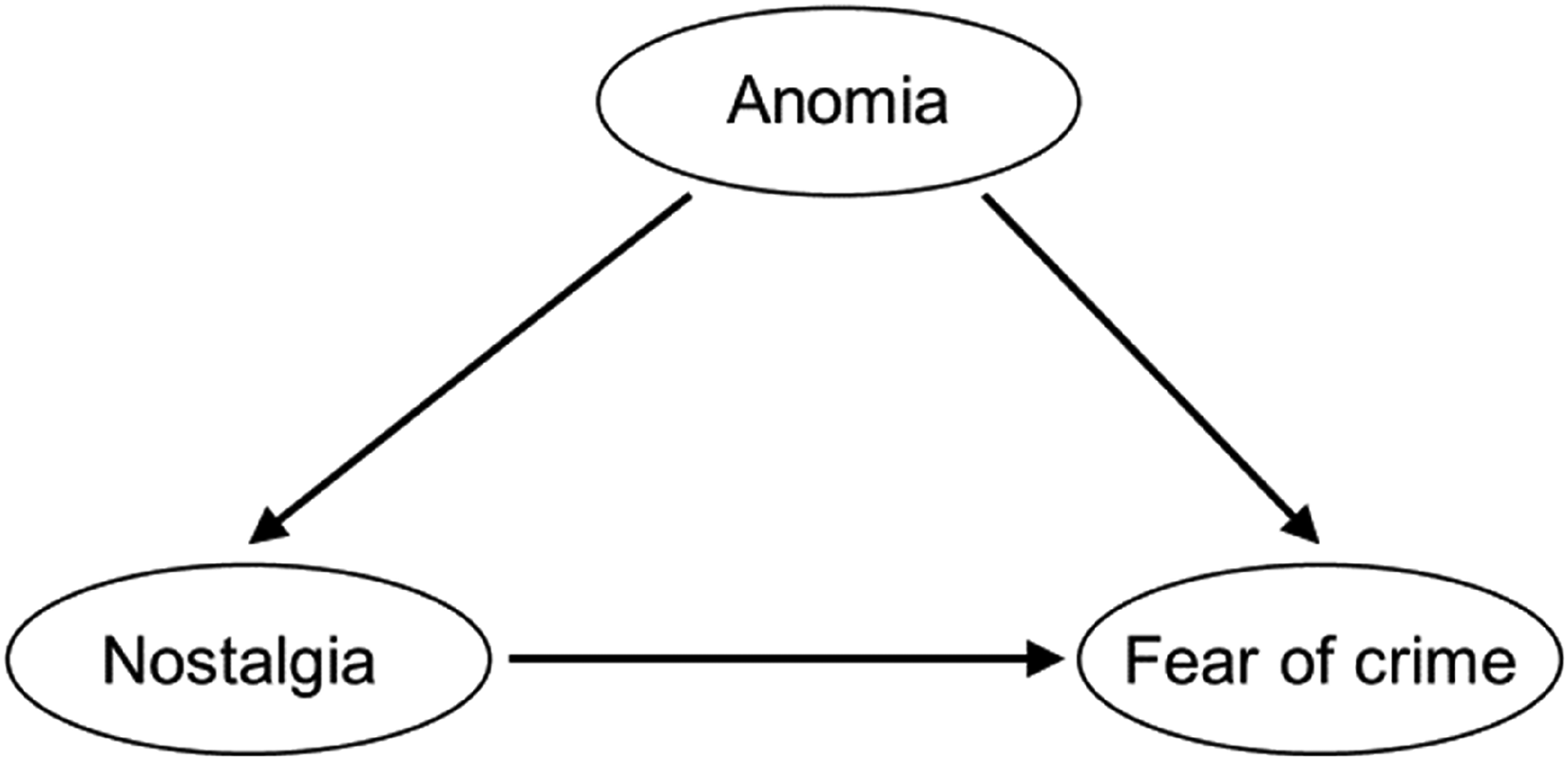
Theoretical model guiding the research.
Methods
Data
The dataset underlying our study stems from a survey of students enrolled at the University of Linz (Austria). Linz, an economically prosperous industrial city with approximately 200,000 inhabitants, is the capital of the province Upper Austria. Its university mainly attracts students from this federal state. Upper Austria is a province of roughly 1,500,000 people that encompasses both urban and rural areas. It is known for a flourishing economy and industry.
The survey was fielded in classroom sessions (lectures and seminars) for undergraduate or graduate students of law, sociology or economics. The implemented convenience sample comprised 22 courses, with attendance figures between 14 and 180 students (Ø = 40 participants). Admittedly, the selection of the courses was arbitrary, guided by the criteria “inclusion of as many students of the named subjects as possible” and “permission of the teacher to perform the survey”. Within the non-randomly chosen courses, every present student was included in the sample.
The survey was carried out in October 2022, usually in the first session of the selected courses. After a short instruction provided by members of the research team, the students received a questionnaire and were asked to fill it in within the next 15 min and then return it to the present team member. To prevent double participation, the survey started with a filter question determining whether this questionnaire had already been answered before. Hardly any student refused to take part in the survey. 3
In total, 890 individuals completed the questionnaire. Fifty-seven per cent of them studied law, 17% sociology and 26% economics. The net sample is dominated by female students (71%). Ninety-two per cent of the respondents are Austrian nationals. The average age of the included students was 22.3 years. The majority (90%) was between 18 and 26 years old. Some 43% lived in Linz, 15% in another town and 42% in a small municipality.
The obtained sample is only partially representative of the student body of the chosen subjects. While the proportion of Austrian nationals is undistorted, the included students are somewhat younger and more often female than the total student population. This deviation may have to do with the arbitrary selection of the courses and the fact that attendance rates vary across age and gender. 4
Measures
Fear of crime: Fear of crime was measured as worry concerning specific offences (Ferraro & LaGrange, 1987). The respondents were asked to indicate their feelings of worry regarding six different infringements. Five answers ranging from “very worried” to “not worried at all” were possible. Here, and in the following, the indicator items were summed to form a composite measure of the underlying concept. The items used to tap into this and other key constructs as well as the corresponding reliability parameters can be found in Appendix A.
Nostalgia: The operationalisation of the nostalgia concept was based on the model developed by Farrall et al. (2021). Six items tapping into the extent of discomfort with the current state of affairs in Austria and the development the country is taking were assessed on a five-point response scale with the end points “totally agree” and “do not agree at all”.
Anomia: Sentiments of anomia were measured using four statements taken from the anomia scale devised by Fischer and Kohr (1980), which has already been used successfully in criminological research (Hirtenlehner, 2011). Each of the employed statements was to be assessed on a five-point answer scale ranging from “totally agree” to “do not agree at all”.
Conservativism: The level of attitudinal conservativism was measured by means of four items drawing on the significance of traditional values. The students were asked to rate each of these statements on a five-category response scale beginning with “totally agree” and ending with “do not agree at all”.
Incivilities: The measurement of perceived incivility combines physical and social sources of irritation (Skogan, 1990). The participants had to assess how much of a problem several nuisances are in their neighbourhood. The four response options ranged from “a great problem” to “no problem”.
Personal victimisation: To determine the presence of direct victimisation experiences, the students received a list with nine different offences and were asked to state for each of these crimes whether it had happened to them in the last twelve months. From these responses, a dichotomous index variable was created, with 1 indicating the presence and 0 indicating the absence of personal victimisation. Half of the respondents (49%) reported having fallen victim to at least one of the nine offences.
Sociodemographic background: Several sociodemographic characteristics were included as control variables. The respondent's age was measured in years. Sex was coded 0 for males and 1 for females. A binary variable differentiates Austrian (0) from foreign (1) citizenship.
Analytic plan
The data analysis starts with a series of ordinary least squares regression models (Weisburd et al., 2022) predicting fear of crime from nostalgia and anomia. As the target variable is non-normally distributed and heteroscedastic, 5 the models are based on cluster-robust standard errors (Cameron & Trivedi, 2010). These standard errors provide wider confidence intervals, which correct for the nonnormality and heteroscedasticity of the residuals, and furthermore take account of the hierarchical organisation of the data, that is, the nesting of students in courses. 6
In order to answer the chicken-and-egg question, we must address the simultaneity problem inherent in our cross-sectional data. The endogeneity issue refers to the fact that nostalgic sentiments can be both a cause and an effect of fear of crime. Ignoring this possibly, reciprocal causation can result in biased estimates (Bushway & Apel, 2010). Instrumental variables analyses are a promising way to solve this problem. They can determine the net effect of a predictor on a response variable, adjusted for a possible feedback effect of the criterion on the regressor. Instrumental variables techniques are widely applied in economics (Angrist & Pischke, 2009; Johnston, 1984) and have recently begun to enter the field of criminological research (Angrist, 2006; Bushway & Apel, 2010). Their main idea is to compute predicted values of the regressor involved in the endogeneity issue and to use these fitted values instead of the original scores of the regressor to estimate its effect on the outcome variable. To calculate the predicted values of an endogenous regressor, instrumental variables (at least one) are necessary.
If we denote the dependent variable with Y (here: fear of crime), the endogenous predictor variable with X (here: nostalgia) and the instrumental variable with Z (here: conservativism), then the fitted values of X are computed via
The instrumental variables Z must fulfil the following conditions (Lousdal, 2018):
Relevance assumption: The instrumental variables Z are capable of predicting or “explaining” the endogenous regressor variable X. Exclusion assumption: The instrumental variables Z exercise a direct effect on X but only an indirect effect on the outcome variable Y through X. More precisely: Z may be correlated with Y, but only through its relationship with X. The partial correlation of Z with Y, controlling for X, must be zero. Exogeneity assumption: The instrumental variables Z are uncorrelated with the error term of the outcome variable Y. This implies that Z and Y do not share common causes.
As outlined above, a good instrumental variable Z “has the property that changes in Z are associated with changes in X but do not lead to changes in Y (except indirectly via X)” (Cameron & Trivedi, 2010, p. 178). Here, conservativism – a mindset characterised by a preference for the preservation or restoration of long-established familiar conditions (O’Hara, 2011) – is employed as instrumental variable because it exhibits a natural close relationship with a sentimental yearning for earlier times. On the other hand, a direct connection of this concept with fear of crime that is not mediated by nostalgia seems implausible. Both assumptions will be assessed (and corroborated) in the results section.
7
Different approaches to implement the instrumental variables framework have been proposed in the literature (Uddin et al., 2015). We will draw on the generalised method of moments (Baum et al., 2007), a two-step technique allowing for heteroscedasticity and correlated error terms. In a first step, the nostalgia values of the students are predicted from a linear regression model. Thereby, we rely on the respondents’ level of conservativism as instrumental variable. In a next step, a linear regression model is fit using the predicted nostalgia scores to explain fear of crime. With the employment of the predicted nostalgia score as independent variable, we ensure that only the variation in nostalgia that is not caused by the respondent's own worry about crime serves to determine its impact on fear. The predicted nostalgia value, perceptions of disorder, personal victimisation experiences and a few sociodemographic covariates are introduced as independent variables into the second-stage equation. The estimation equation for the second-stage model is:

All regression models were fit using STATA 14. Cluster-robust standard errors were employed in all model estimations.
Results
The statistical analysis starts with a glance at the bivariate correlations of the concepts at the heart of this study. Table 1 reports the corresponding product-moment correlation coefficients. The findings show that fear of crime is positively associated with both feelings of nostalgia and sentiments of anomia. Nostalgia and anomia are closely interrelated, with higher nostalgia scores being accompanied by elevated anomia values. This pattern of correlations harmonises with the theoretical model underlying the present research.
Product-moment-correlations.
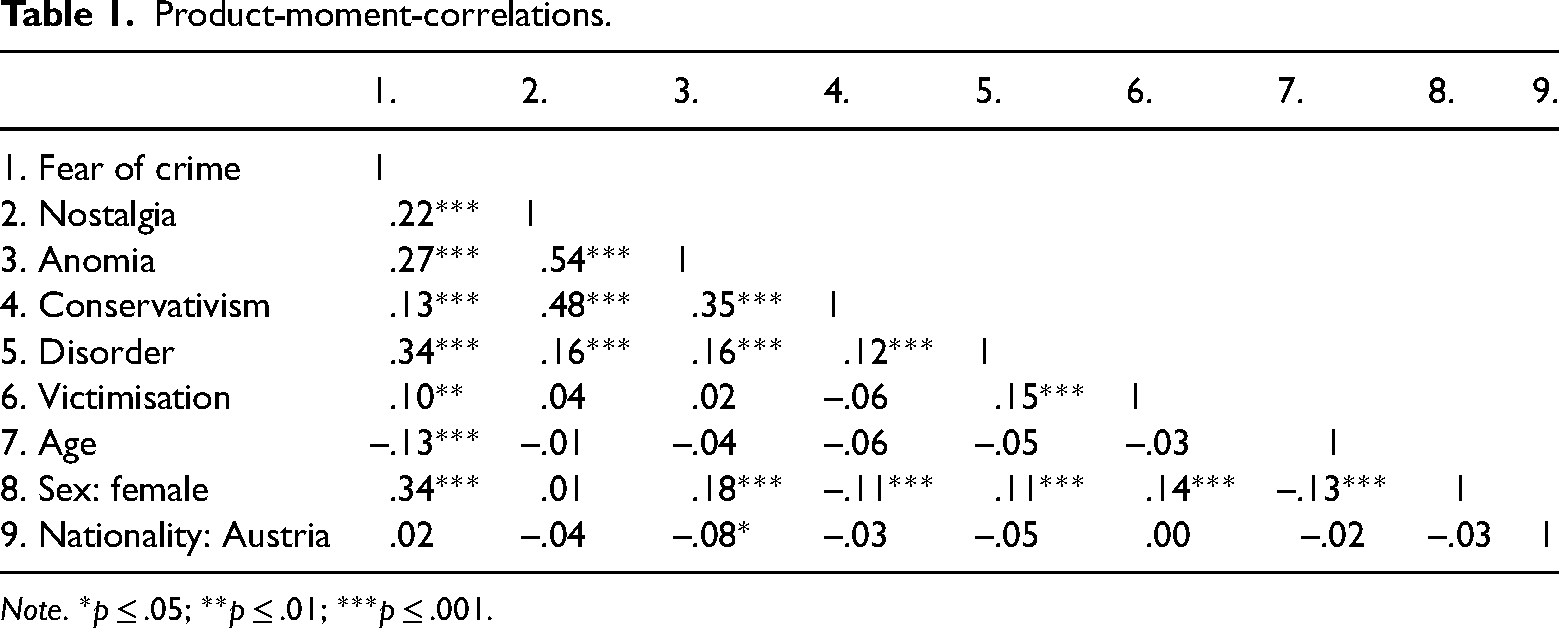
Note. *p ≤ .05; **p ≤ .01; ***p ≤ .001.
Ordinary least squares regression
To disentangle the relationships between the concepts, several ordinary least squares regression models are estimated. Table 2 presents the results.
Ordinary least squares regression models predicting fear of crime.
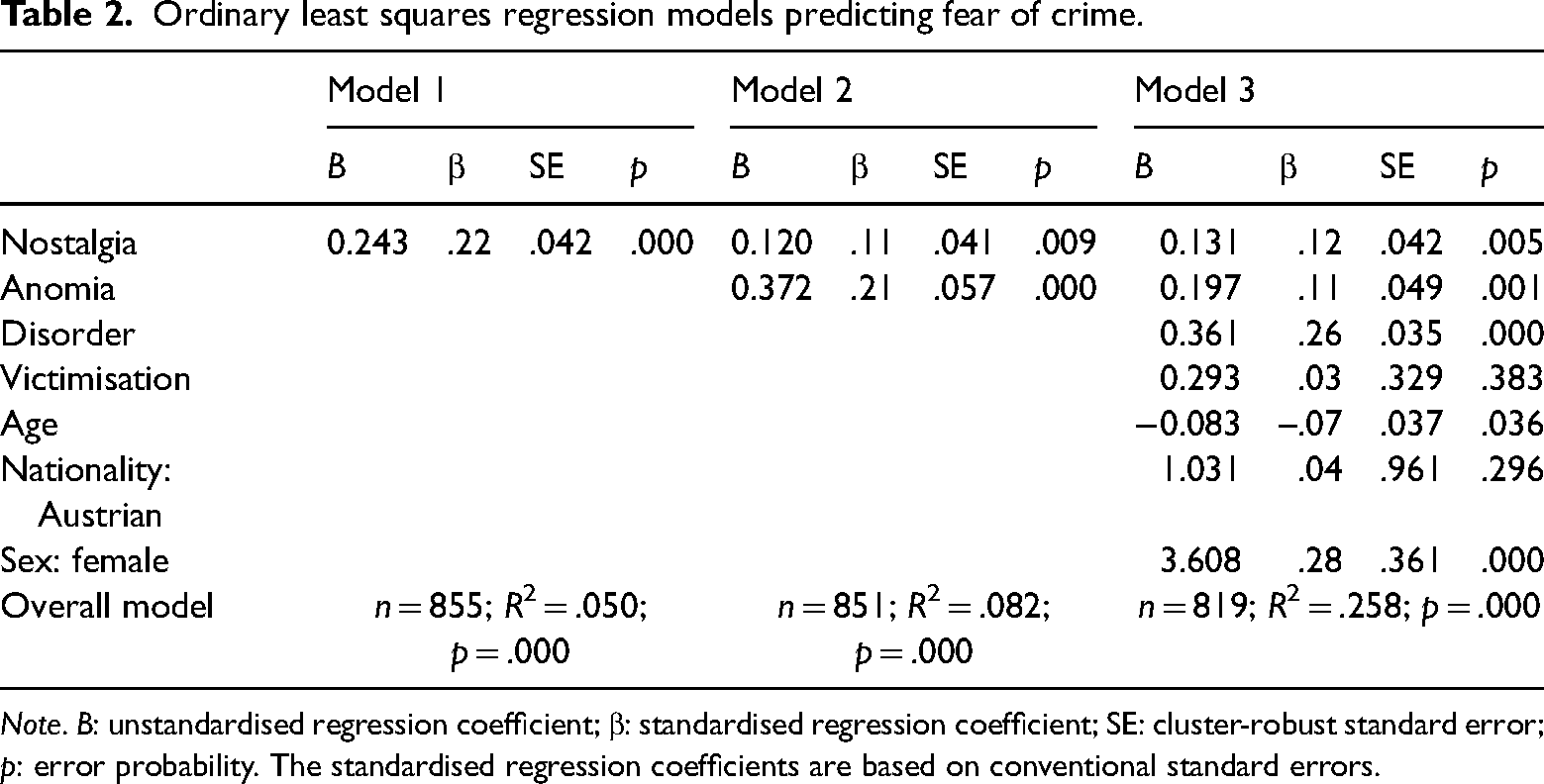
Note. B: unstandardised regression coefficient; β: standardised regression coefficient; SE: cluster-robust standard error; p: error probability. The standardised regression coefficients are based on conventional standard errors.
Model 1 includes only nostalgia as an independent variable. It displays a significant relationship between feelings of nostalgia and fear of crime. Stronger nostalgic feelings go together with increased worry about crime.
Model 2 contains anomia as additional predictor. Its findings indicate that sentiments of anomia significantly relate to fear of crime, with greater anomic disorientation going hand in hand with more intense worries about crime. Introducing sentiments of anomia into the equation halves the regression weight of the nostalgia measure, but the latter still remains systematically associated with fear of crime.
The observed dynamic has several substantive implications. First, it corroborates that both nostalgia and anomia affect the level of fear of crime. Then it reveals that the relationship between nostalgic feelings and worry about crime is partially, but not completely spurious. It is true that anomic sentiments (the impression of an inscrutable and unpredictable world) foster not only concerns about crime, but also a longing for a better (possibly safer) past. Regressing the nostalgia score on the anomia measure yields a standardised effect parameter of .54 (p = .000). This accords well with the findings of the correlation analyses. Nostalgic feelings, in turn, facilitate fear of criminal victimisation. A Sobel test (Baron & Kenny, 1986) also indicates that the “influence” of anomia on fear of crime is partially mediated by feelings of nostalgia. The corresponding indirect effect, although rather modest in absolute terms (β = .06), achieves statistical significance (Z = 2.86; p = .004). 8
Model 3 finally incorporates a series of control variables. Both anomia and nostalgia retain significant explanatory power under this condition. Among the covariates, perceived disorder and the respondents’ sex prove to be most influential. Perceptions of disorder increase fear of crime. Females are more afraid of crime than males.
Admittedly, the non-random nature of the underlying sample poses a problem for significance testing. Here, the p-values just tell us how large the error probability were, had we drawn a simple random sample from the affected student population. The more our convenience sample approaches this ideal, the greater the informative value of the conducted inference-statistical tests. To ensure that the null hypothesis can be rejected even in light of the limitations of our data, we re-estimated Model 3 from Table 2 with a bootstrap procedure (10,000 resamplings) to obtain more appropriate test statistics. This robustness check leads to the same conclusions: Both nostalgia (p = .001) and anomia (p = .003) are predictive of elevated worry about crime. The observed relationships between the concepts do not appear to be the exclusive result of sampling error.
Instrumental variables analysis
The previous analyses established that feelings of nostalgia vary with fear of crime net of sentiments of anomia and several other determining factors. However, nostalgia represents an endogenous regressor in the sense that the extent of nostalgic feelings may itself depend on the degree of worry about crime. Safety concerns may trigger a yearning for a less threatening past. Hence, in order to correct for bi-directionality or, put differently, to ensure that only the effect of nostalgia on fear of crime and not the reverse relationship is being tested, the further analysis switches into an instrumental variables framework.
Instrumental variables analysis means that in a first step the nostalgia measure must be regressed on an instrument (here: attitudinal conservativism) to obtain fitted nostalgia values that are unaffected by the respondent's level of worry about crime. Conservativism qualifies as instrument because it is immediately predictive of an individual's extent of nostalgia without exerting a direct influence on fear of crime. The conservativism score is closely correlated with the nostalgia measure (r = 48; p = .000), while it exhibits no significant direct correlation with fear of crime (rpartial = .03; p = .409). 9 According to the first-stage regression, the instrument alone explains 12.6% of the variance in the level of nostalgia. With a value of 51.96, the robust F-statistic clearly exceeds the minimum threshold of 10. Thus, all employed diagnostic statistics suggest that conservativism represents an adequate (in fact even strong) instrument. Furthermore, the presumption that conservative people tend to long for past circumstances seems very plausible in theoretical terms. The detailed results of the first-stage regression can be found in Appendix B.
In a next step, the fitted values from the first-stage regression can be plugged into a second-stage equation in place of the endogenous predictor. Table 3 presents the results of this second-stage regression, in which fear of crime is regressed on the predicted nostalgia score, anomia and a series of covariates. The control variables are the same as in the third ordinary least squares model. Significance testing is again based on cluster-robust standard errors.
Results of the second-stage regression of the instrumental variables analysis (dependent variable: fear of crime).
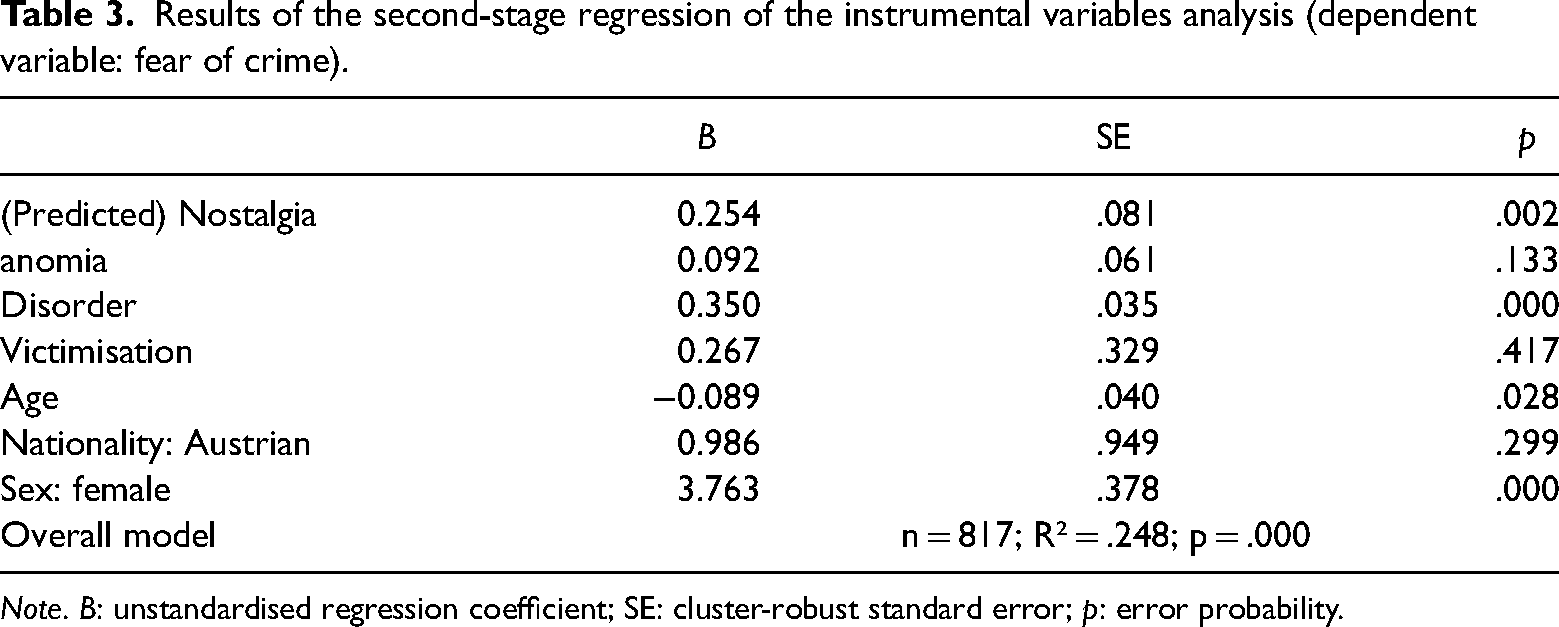
Note. B: unstandardised regression coefficient; SE: cluster-robust standard error; p: error probability.
The generalised method of moments estimation reveals a significant influence of the instrumented nostalgia measure on the intensity of fear of crime, with nostalgic feelings increasing fear of criminal victimisation. This observation lends credence to the notion that feelings of nostalgia are indeed a cause and not (only) an effect of concerns about crime.
Sentiments of anomia are not significantly related to fear of crime in the instrumental variables model. This may be due to a nonnegligible correlation of the anomia score with the level of conservativism (r = .35; p = .000).
Among the included covariates, perceptions of disorder and the respondents’ sex turn out to be consequential again. Being female and perceiving more disorder contribute to higher fear of crime.
Conclusions
The subject of the present study was the interplay of nostalgia, anomia and the fear of crime. The hypothesised connection of these concepts was based on the insight that all of them have to do with a discontent with the current state of the society and the development it takes.
The findings of a survey of university students in Austria revealed complex interrelationships between these three constructs. In ordinary least squares regression models, both nostalgia and anomia prove to be predictive of an individual's intensity of fear of crime. Regarding the implications of anomia for the degree of fear of crime, a partial mediation via nostalgia could be observed. Sentiments of anomia foster not only fear of criminal victimisation, but also feelings of nostalgia, which in turn facilitate worry about crime. The decline in the size of the nostalgia effect after controlling for anomia suggests that the intertwining of nostalgic feelings and fear of crime is indeed partly due to their joint embeddedness in perceptions of change and the associated disorientation. As a whole, this relationship structure is clearly consistent with the theoretical model guiding the research.
The significant connection of worry about crime with feelings of nostalgia and sentiments of anomia even when controlling for established crime-related and sociodemographic determinants of the former corroborates that fear of crime “is as much a barometer of social and economic changes as it is a feature of crime rates” (Farrall et al., 2021, p. 356). Therewith it backs the symbolic paradigm of the pertinent research according to which abstract feelings of malaise and a diffuse sense of insecurity are represented in the fear of crime (Elchardus et al., 2008). With a view to fear prevention, the consequences of this insight are straightforward: The obtained findings accord with the idea that strengthening people's resilience against worry about social change (e.g., through a reliable state welfare policy) might help to keep fear of crime at bay (Hummelsheim et al., 2011).
To tackle the problems resulting from a possibly reciprocal relationship between feelings of nostalgia and fear of crime, in a second analytical step instrumental variables models were employed to determine the true existence of a nostalgia effect. Instrumental variables analyses can estimate the net effect of a predictor on a response variable, adjusted for a conceivable feedback effect of the response on the predictor (Bushway & Apel, 2010). Using students’ level of conservativism as an instrument of their nostalgia score, we found again support for the presence of a positive influence of nostalgic feelings on fear of crime. This gives confidence that indeed nostalgia increases fear, and not (solely) the other way around.
The observed nostalgia effect on crime fear raises questions regarding the underlying mechanism. There are several reasons why “feelings of longing for a way of life now past and unrecoverable” (Farrall et al., 2021, p. 341) may bring about “an emotional response of dread or anxiety to crime or symbols that a person associates with crime” (Ferraro, 1995, p. 23). Both emotional states are expected to flourish among people who are negatively affected by processes of social change beyond their control. Both are fuelled by a dissatisfaction with the conditions of life in contemporary society – a dissatisfaction that may in part be due to a negative assessment of the crime situation. While nostalgic feelings may enable individuals to distance themselves from the present, fear of crime serves as a code through which they can express their discomfort concerning the various ailments of late modernity (including the diverse insecurities it has brought) (Hirtenlehner & Farrall, 2013). Finally, a sense of nostalgia may render people pessimistic or sceptical about the future, which may in turn facilitate fear of crime. Conducting exploratory qualitative interviews may be a promising approach to gaining more clarity in this matter.
Of course, the findings of the presented study must be assessed in light of its methodological properties. Here, some limitations must be disclosed.
First of all, the data underlying the analyses have a cross-sectional format. Establishing causal relationships between concepts measured at the same point in time marks a highly problematic endeavour, especially when bi-directionality is possible. Taking account of this issue, we relied on instrumental variables analyses to determine the effect of nostalgic feelings on fear of crime. Future research on this topic will nevertheless benefit from a longitudinal design.
The student survey was conducted at the end of the COVID-19 pandemic. It may well be that the pandemic has contributed to an elevated sense of insecurity (Sloan et al., 2021) that in turn promoted fear of crime, anomic disorientation and alienation as well as a longing for past (better) times. In this period, the interlacing of crime fear, nostalgia and anomia may have been stronger than usual.
The employed measurement of fear of crime may be seen critically. We rely on an established measure of the intensity of worry about crime that taps into the expressive dimension of the concept (Farrall et al., 2009). Comprehending fear of criminal victimisation as a diffuse future-oriented anxiety about crime makes perfect sense given the goals of our analyses. However, whether feelings of nostalgia and sentiments of anomia also influence the frequency of concrete episodes of experienced fear of offences – the experiential dimension of the construct (Farrall et al., 2009) – and how all this shapes people's quality of life represents a worthwhile subject for further inquiry. Maybe nostalgia and anomia affect particularly the anxious – those who report being afraid of crime but never felt fearful in the last year (Farrall et al., 2009).
It must also be noted that students in Austria can be assumed to represent a population with comparatively low levels of fear of crime. They are young and tend to come from the middle and higher socioeconomic classes. Hence, whether the relational dynamics observed among students in Austria apply also to other population groups and other countries, remains an open question. We conjecture that our sample is biased against detecting the hypothesised relationships and interpret the presence of supportive evidence even under “unfriendly” conditions as indication that nostalgia and anomia will predict fear of crime also in other demographic groups. But this issue calls for additional research, at best in the form of nationally representative panel surveys. Here it may also make sense to include an individual's level of uncertainty tolerance as possible moderator of the strength of the investigated relationships.
Footnotes
Declaration of conflicting interests
The authors declared no potential conflicts of interest with respect to the research, authorship, and/or publication of this article.
Funding
The authors received no financial support for the research, authorship, and/or publication of this article.

Notes
Appendix A. Measurement instruments.
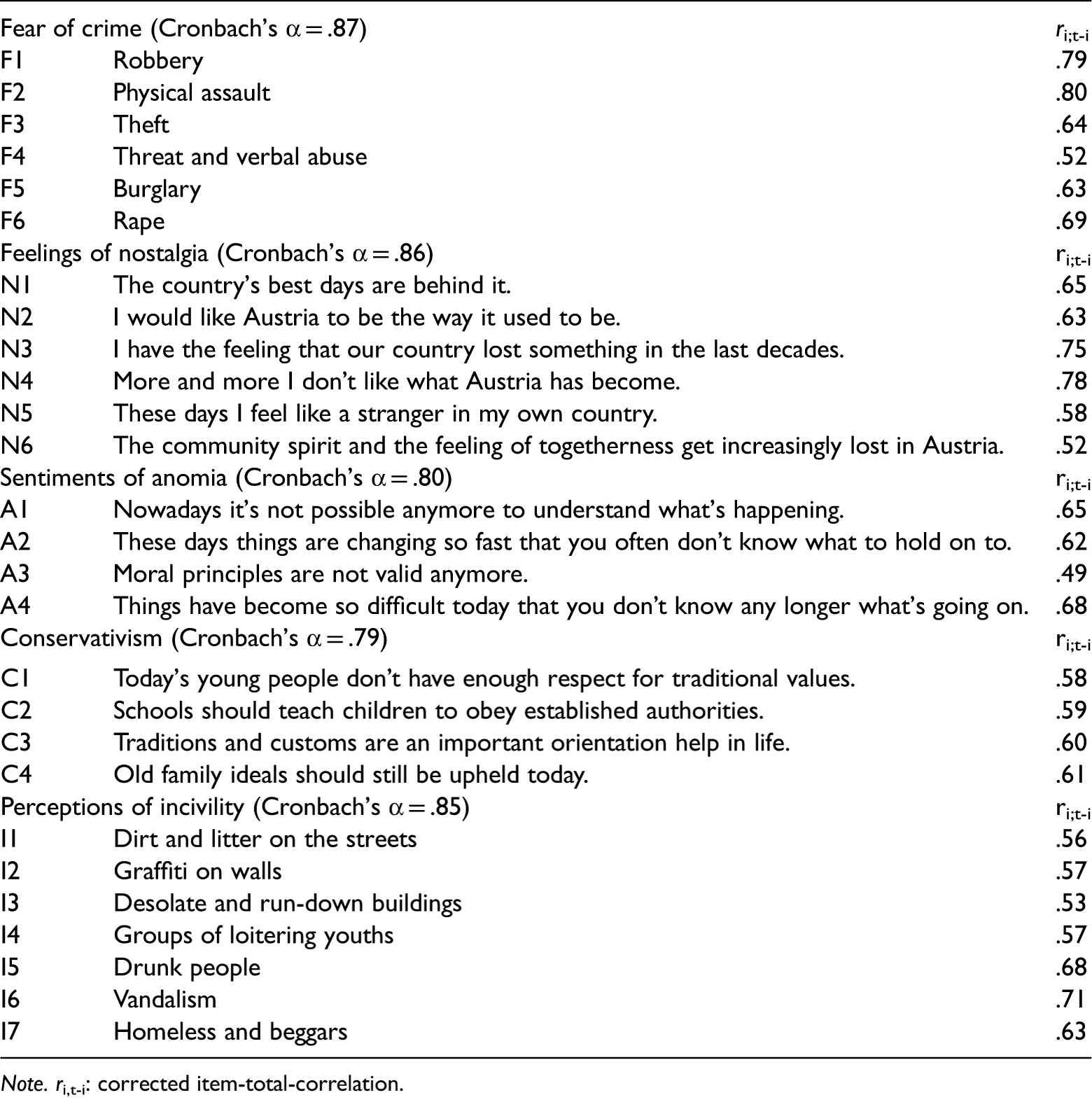
| Fear of crime (Cronbach's α = .87) | r i;t‐i | |
| F1 | Robbery | .79 |
| F2 | Physical assault | .80 |
| F3 | Theft | .64 |
| F4 | Threat and verbal abuse | .52 |
| F5 | Burglary | .63 |
| F6 | Rape | .69 |
| Feelings of nostalgia (Cronbach's α = .86) | ri;t‐i | |
| N1 | The country's best days are behind it. | .65 |
| N2 | I would like Austria to be the way it used to be. | .63 |
| N3 | I have the feeling that our country lost something in the last decades. | .75 |
| N4 | More and more I don’t like what Austria has become. | .78 |
| N5 | These days I feel like a stranger in my own country. | .58 |
| N6 | The community spirit and the feeling of togetherness get increasingly lost in Austria. | .52 |
| Sentiments of anomia (Cronbach's α = .80) | ri;t‐i | |
| A1 | Nowadays it's not possible anymore to understand what's happening. | .65 |
| A2 | These days things are changing so fast that you often don’t know what to hold on to. | .62 |
| A3 | Moral principles are not valid anymore. | .49 |
| A4 | Things have become so difficult today that you don’t know any longer what's going on. | .68 |
| Conservativism (Cronbach's α = .79) | ri;t‐i | |
| C1 | Today's young people don’t have enough respect for traditional values. | .58 |
| C2 | Schools should teach children to obey established authorities. | .59 |
| C3 | Traditions and customs are an important orientation help in life. | .60 |
| C4 | Old family ideals should still be upheld today. | .61 |
| Perceptions of incivility (Cronbach's α = .85) | ri;t‐i | |
| I1 | Dirt and litter on the streets | .56 |
| I2 | Graffiti on walls | .57 |
| I3 | Desolate and run-down buildings | .53 |
| I4 | Groups of loitering youths | .57 |
| I5 | Drunk people | .68 |
| I6 | Vandalism | .71 |
| I7 | Homeless and beggars | .63 |
Note. ri,t‐i: corrected item-total-correlation.
Appendix B. Results of the first-stage regression of the instrumental variables analysis (dependent variable: feelings of nostalgia).
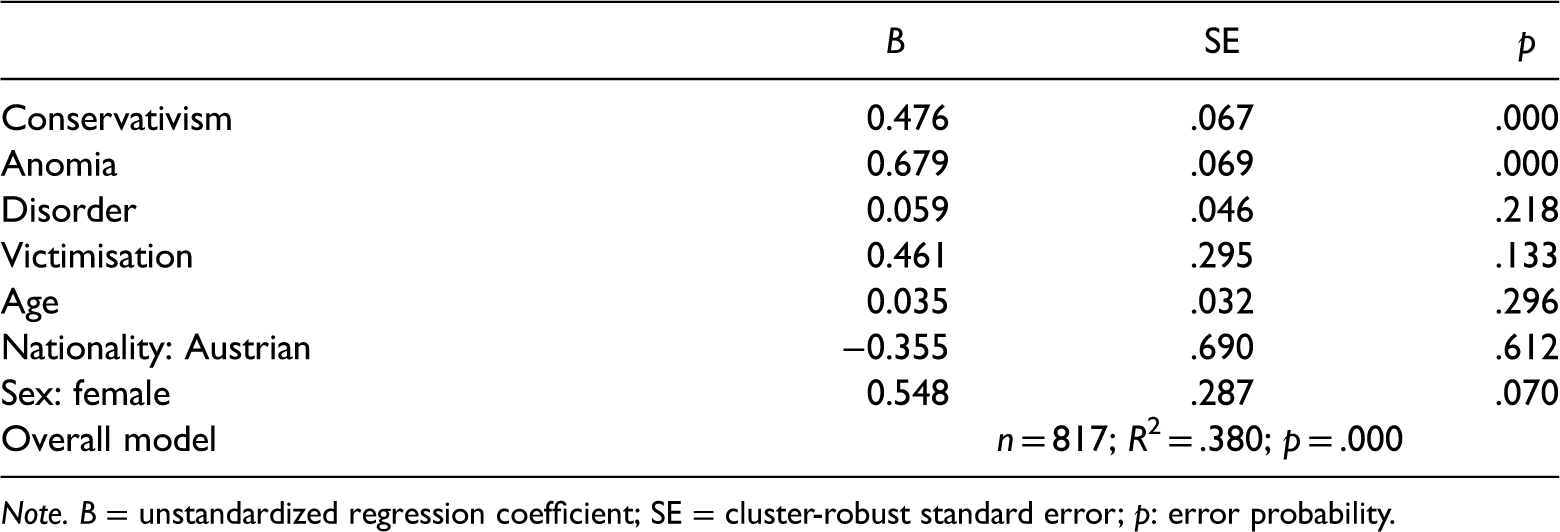
| B | SE | p | |
|---|---|---|---|
| Conservativism | 0.476 | .067 | .000 |
| Anomia | 0.679 | .069 | .000 |
| Disorder | 0.059 | .046 | .218 |
| Victimisation | 0.461 | .295 | .133 |
| Age | 0.035 | .032 | .296 |
| Nationality: Austrian | −0.355 | .690 | .612 |
| Sex: female | 0.548 | .287 | .070 |
| Overall model | n = 817; R2 = .380; p = .000 | ||
Note. B = unstandardized regression coefficient; SE = cluster-robust standard error; p: error probability.