




Abstract
In an effort to understand the segment of the juvenile population that seemingly ceases engaging in delinquency during adolescence, the relationship between a performance competency (task persistence) and offending was explored in 3,928 youth (2,005 boys and 1,923 girls) from the Longitudinal Study of Australian Children. Three waves of data, with adjacent time periods separated by two years, were used to test the hypothesis that a change in task persistence would correlate with a change in future delinquency. Given that the two dependent variables in this study (delinquency at Time 2 and delinquency at Time 3) followed a negative binomial distribution, negative binomial regression and binomial logistic regression analyses were performed. Results from both analyses confirmed the hypothesis that a rise in task persistence from Time 1 to Time 2 would predict a decrease in delinquency from Time 1 to Time 2 to Time 3 and that a static measure of task persistence at Time 1 would predict a change in delinquency from Time 1 to Time 2. These results suggest that task persistence may be a competency capable of suppressing delinquency during a developmental period in which delinquency ordinarily rises.
A person need not enrol in therapy to loosen the grip of delinquency, crime, or general antisociality on their behaviour. In fact, the majority of individuals who desist from crime and delinquency probably do so without treatment. That most individuals recover without formal intervention has been documented with substance abuse (Price et al., 2001; Walters, 2000) and is strongly implied for crime and delinquency in research on turning points and desistance (Niebuhr & Orrick, 2020; Wyse et al., 2014). This suggests that spontaneous remission or natural recovery is the main mechanism by which people exit a drug or criminal lifestyle. Just because the change is spontaneous or natural, however, does not mean that it is random or haphazard. There are reasons why it occurs, even if we don’t know what those reasons are. One such reason is the development of competencies, and another is the alteration of environments (Walters, 2022). By cultivating social, cognitive, developmental, and performance competencies, a person may decrease the odds of their future involvement in a delinquent or criminal lifestyle. Environmental changes that are capable of protecting an individual from future involvement in delinquency and crime could potentially call upon alterations in one's family (either the family of origin, or if married, their current family), peer, neighbourhood, school, or work situation to bring about a change in behaviour.
Turning points (Sampson & Laub, 2016), despite their significance, are not the only reason why people desist from crime without treatment. Another reason is that they mature out of this behaviour. This is perhaps best illustrated by the age-crime curve in which offending has been found to follow a distinct pattern with age—normally beginning in late childhood/early adolescence, peaking in mid-adolescence, and dropping off in late adolescence/early adulthood (Hirschi & Gottfredson, 1983; Shulman et al., 2013). This does not mean that change cannot occur before late adolescence/early adulthood. Thus, while the most common situation is for offending to begin in early adolescence and end in late adolescence, the so-called adolescence-limited pattern (Moffitt, 1993), alternate trajectories exist. One such alternative is Moffitt's life-course-persistent pattern in which offending begins in late childhood and ends in mid- to late adulthood. Another is a childhood-limited pattern in which offending begins and ends in childhood (Gutman et al., 2019; Sentse et al., 2017). Offending, it would seem, is characterised by variability, and it is this variability that may offer clues as to how early offending can best be managed. The purpose of the current investigation was to determine whether changes in certain competencies from late childhood through middle adolescence predict reductions in the likelihood of delinquency in youth during a period in life (i.e., early adolescence) when offending normally begins.
Task persistence, academic performance, and delinquency
Competencies are behaviours grounded in a skill set, informed by knowledge, and shaped by attitudes designed to allow the person to achieve specific goals and objectives (Bandura & Schunk, 1981). As previously stated, there are several categories of competency, to include social competencies, cognitive competencies, developmental competencies, and performance competencies. The focus of the current investigation was on the performance competency known as task persistence. To be successful and achieve one's goals and objectives in life, one must learn to handle adversity, overcome obstacles, and cope with the frustration of initial failure, all three of which can block attainment of these goals and objectives (Carroll et al., 2013). Persisting in a task is therefore essential in completing the task and receiving the benefits conferred by completion. Research indicates that task persistence contributes to academic achievement (Mih & Mih, 2013; Schmerse & Zitzmann, 2021) and correlates inversely with dropping out of school (Fitzpatrick et al., 2015). In one study, early adolescent task persistence predicted educational attainment and occupational success all the way into middle adulthood (Andersson & Bergman, 2011). Finally, there is evidence to suggest that task persistence correlates with effortful control to the point where someone with high task persistence will also display strong effortful control (Mägi et al., 2018). As such, task persistence may be less of a personality trait or temperament dimension than it is a performance competency.
There are several reasons why there might be an inverse association between task persistence and delinquency, the latter being defined as juvenile behaviour that is illegal or unacceptable to most people. First, given that Mägi et al. (2018) discovered that effortful control is directly linked to task persistence while being inversely correlated with delinquency (Bao et al., 2015; Gottfredson & Hirschi, 1990; van der Voort et al., 2013), a reasonable assumption is that low task persistence and delinquency are also linked. Second, as previously shown, low task persistence is associated with poor academic achievement and dropping out of school, both of which are strongly associated with delinquency (Bae, 2020). Third, youth who exhibit weak task persistence are often characterised as impulsive and lacking in frustration tolerance (Winward et al., 2014); similar terms have been used to describe delinquents (Contreras et al., 2011). It is therefore surprising that there are so few published studies on task persistence and delinquency and just two studies of note on task persistence and externalising disorders. In the first of these studies, Letcher et al. (2004) discovered that low task persistence in early adolescence correlated with the presence of such externalising behaviours as conduct disorder, hyperactivity, and substance abuse. In the second study, Chang and Olson (2016) noted that low task persistence in pre-school children predicted externalising behaviour when these children were 6 and 10 years of age.
Present study
The present study sought to test a postulate central to the social-cognitive-developmental theory of crime (Walters, 2022) which states that building competencies is one way youth avoid or abandon delinquent behaviour. An increase in a competency, therefore, should lead to a decrease in delinquency in youth from a general population sample of early to mid-adolescent respondents. Besides controlling for demographic variables like age, sex, race (Indigenous vs. non-Indigenous), and socioeconomic status, the current study also controlled for peer delinquency, parental knowledge, and school achievement. The hypothesis tested in this study held that a change (increase) in task persistence in early adolescence would predict a change (decrease) in delinquency in middle adolescence.
Method
Participants
The sample for this study came from the Longitudinal Study of Australian Children (LSAC: Australian Institute of Family Studies, 2018). The LSAC is composed of two nationally representative cohorts, a large group of Australian youth followed from birth (B cohort) and a large group of Australian youth followed from kindergarten (K cohort). For the purposes of the present study, Waves 5 (age 12–13), 6 (age 14–15), and 7 (age 16–17) of the K cohort were relabelled Times 1, 2, and 3 and positioned to investigate the dynamic relationship between task persistence and delinquency. The current sample of 3,928 youth (2,005 boys and 1,923 girls) from the LSAC-K had complete data on at least six of the 12 variables examined as part of this study. This represents 97% of the full LSAC-K sample (n = 4048). The average age of participants at the beginning of the current study was 12.41 years, 51.0% of the sample was male, and 2.8% of participants were Indigenous or First Nations individuals (102 Aboriginal, four Torres Strait Islander, and three Aboriginal and Torres Strait Islander).
First Nations status is not the only measure available in the LSAC capable of potentially providing ethnicity/race-relevant information. Country of origin (i.e., born outside Australia, 6.0% of sample) and the language spoken in the home (non-English, 12.0%) are also available for participants in the LSAC-K. However, no birth countries other than Australia and no languages other than English accounted for more than 0.8% of LSAC-K participants. When First Nations status, non-Australian countries of birth, and household languages other than English were correlated with delinquency at ages 12, 14, and 16, only First Nations status achieved significant effects (r = .05–.10, p < .01 vs. r = .01–.02, p > .05 for birth country and r = .00–.04, p > .05 for language). First Nations status was therefore the only ethnicity/race-relevant variable included in the current investigation.
There is no disputing the fact that First Nations people are overrepresented in the Australian adult and juvenile corrections systems. Although Indigenous youth report offending at twice the rate of non-Indigenous youth, they are 15.6% times more likely to be remanded to a juvenile detention centre than non-Indigenous youth (SCRGSP, 2004). This raises the possibility that Indigenous youth receive diversion and community corrections services significantly less often than non-Indigenous youth. Historical and structural conditions of colonisation, institutional racism, systemic bias in the adult and youth corrections systems, over-policing of First Nations neighbourhoods, and social and economic marginalisation of First Nations families have also been cited as possible explanations for elevated levels of criminal and correctional involvement in First Nations youth and adults (Cunneen, 2007). For these reasons and because Indigenous status was the only ethnicity/race-relevant variable in the LSAC-K to correlate with delinquency, Indigenous status, or identity served as the lone ethnicity/race factor in this study.
Sample weights
Cross-sectional and longitudinal sample weights designed to account for a child's probability of inclusion in the LSAC-K and adjust for non-response are available for all participants in the LSAC. These weights, however, were not used to calculate the descriptive statistics or conduct the regression analyses in the current investigation. The reason for this was two-fold. First, the vast majority of variables that served as covariates in the construction of weights for the LSAC-K were not part of this study (e.g., parental age, mother educational level, child reading level) or if they were (e.g., Indigenous status) they served only as control variables (Norton & Monahan, 2015). Second, the use of a complete case method like Full Information Maximum Likelihood (FIML) and a very large sample served to negate the need for sample weights. It should be noted that when the regression analyses were performed with weights as part of a supplemental analysis the results did not change.
Measures
Task Persistence. Task persistence, which served as the independent variable in this study, was assessed with the four-item persistence scale from the School-Age Temperament Inventory (SATI: McClowery, 1995). A parent rated each item [“Homework incomplete unless reminded” (reverse-coded), “Remembers homework without reminders”; “Goes back to task after interruption”; “Difficulty completing assignments” (reverse-coded)] on a five-point scale (1 = never, 2 = rarely, 3 = half the time, 4 = frequently, 5 = always), and a mean rating that could range from 1 to 5 was calculated. The internal consistency of this four-item scale was good at Times 1 (α = .81) and 2 (α = .81).
Delinquency. Time 3 delinquency served as the dependent variable in one analysis, and Time 2 delinquency served as the dependent variable in a second analysis. The scale used to assess delinquency in the LSAC-K was adapted from Moffitt and Silva's (1988) Self-Report Delinquency Scale (SRDS). The version of the SRDS used at Times 1 and 2 of the LSAC-K included 17 items (e.g., “Got into physical fights in public”; “Skipped school for a whole day”; “Stole something from a shop”; “Took a vehicle for a ride/drive without permission”). The version of the SRDS used at Time 3 included two additional items (i.e., “Sold illegal drugs”; “Attacked someone with the idea of harming them”). Respondents rated each item on a six-point scale—0 = not at all, 1 = once, 2 = twice, 3 = three times, 4 = four times, 5 = five or more times—for the past year. Summing the scores produced a total score that could range from 0 to 95. Because about two-thirds of the sample achieved scores of 0 on the two delinquency outcome measures (Times 2 and 3) and both sets of scores followed a negative binomial distribution (overdispersion statistic: Time 2, Wald = 18.72, p < .001; Time 3, Wald = 20.42, p < .001), they were treated as quasi-count measures and subjected to negative binomial regression. Internal consistency (α) ranged from good to excellent (Time 1 = .89, Time 2 = .82, Time 3 = .89).
Control Variables. There were seven control variables included in this study. Four of these variables were demographic in nature: age (in years), sex (male = 1, female = 2), Indigenous status (no = 1, yes = 2), and family socioeconomic status (SES: rating based on the mother's and father's education and employment). The other three control variables were school achievement, peer delinquency, and parental knowledge. Age, sex, and SES were selected as control variables for this study based on their well-documented relationship to delinquent and antisocial behaviour (Elliott et al., 1989). Indigenous status, on the other hand, has been found to correlate significantly with involvement in the juvenile justice system (Cunneen, 2007). School achievement (Schmerse & Zitzmann, 2021; Skinner & Saxton, 2019), peer delinquency (McGloin & Thomas, 2019; Watt et al., 2004), and parental knowledge (Bobakova et al., 2015; Kerr & Stattin, 2000) were included as control variables based on their known associations with delinquency and persistence as well as for their role in early adolescent development (Brown & Larson, 2009; Lahey et al., 2008; Mih & Mih, 2013).
The parent most familiar with the child's behaviour rated the child's school achievement on a five-point scale (1 = well below average, 2 = below average, 3 = average, 4 = above average, 5 = excellent), and the child responded to a seven-item peer delinquency scale (e.g., “kids I know … get into trouble, get into trouble at school, get into fights, smoke cigarettes, drink alcohol, try drugs, have broken the law”) with a five point rating scale (1 = none of them, 2 = one or two of them, 3 = some of them, 4 = most of them, 5 = all of them) and the results summed to produce a score that could range from 7 to 35 (α = .78). Parental knowledge was based on an averaging of mother and father responses to two questions (“Know where child is”; “Know who child is with”) each of which were rated on a five-point scale (1 = never, 2 = almost never, 3 = about half the time, 4 = almost always, 5 = always). Ratings for the two questions correlated .50 for mothers and .56 for fathers.
Missing data
There was only a modest amount of missing data in this study (6.8%), and while attrition varied from one wave to the next of the LSAC, the portion of non-response never exceeded one-quarter of the sample (Norton & Monahan, 2015). Two-thirds of the sample (65.5%), in fact, had complete data on all 12 study variables, 16.8% were missing data on one variable, 16.3% were missing data on two to four variables, and 1.5% were missing data on five or six variables. Seven of the 11 variables had less than 5% missing data. The four variables with more than 5% missing data were school achievement (14.5%), persistence-2 (16.3%), delinquency-2 (16.3%), and delinquency-3 (26.6%). In this study, missing data were handled with FIML, a procedure that uses non-missing data to estimate the population parameters and standard errors for the full sample. FIML likewise assumes that data are Missing At Random (MAR). Although there was no reason to doubt that the data were MAR, this assumption is often untested because the data required for testing are usually missing. Research indicates that FIML is less biased and more precise than traditional missing value procedures like simple imputation and listwise deletion (Allison, 2002).
Research design and statistical analyses
A longitudinal fixed-sample panel design was implemented with data from three waves of the LSAC-K—Time 1 (age 12–13), Time 2 (age 14–15), and Time 3 (age 16–17). Given the dynamic nature of the research hypotheses, lagged independent and dependent variables were employed (Wilkins, 2018). Thus, a change in task persistence from Time 1 to Time 2 served as the independent variable, and a change in delinquency from Time 1 to Time 2 to Time 3 served as the dependent variable. Time 1 indicators for age, sex, Indigenous status, family SES, school achievement, peer delinquency, and parental knowledge all served as control variables in this study. In a second analysis, task persistence at Time 1 served as the independent variable, and a change in delinquency from Time 1 to Time 2 served as the dependent variable. As before, age, sex, family SES, school achievement, peer delinquency, and parental knowledge served as control variables.
Four sets of analyses were performed. In the first analysis, a negative binomial regression was performed to determine whether a change in task persistence from Time 1 to Time 2 predicted a change in delinquency at Time 3. In the second analysis, task persistence-1 was tested as a predictor of delinquency at Time 2, controlling for delinquency at Time 1. Because the delinquency data for this study, given that each item was truncated at a count of five, is best considered quasi-count, a set of binomial logistic regression analyses were also performed with the outcome measures (delinquency-2, delinquency-3) dichotomised as zero versus one or more. Descriptive statistics were computed with SPSS Version 26 (IBM, 2019), whereas the regression analyses were performed with Mplus 8.3 (Muthén & Muthén, 1998–2017).
Results
Table 1 lists descriptive statistics and inter-variable correlations for the 12 variables included in this study. Because the dependent variable for the first analysis, delinquency-3, was heavily skewed (Skew = 6.67), leptokurtic (Kurtosis = 61.98), and followed a negative binomial distribution, the data were analysed with negative binomial regression. The dependent variable for the second analysis, delinquency-2, was equally skewed (Skew = 7.76) and leptokurtic (Kurtosis = 93.30). Testing for collinearity revealed no evidence of multicollinearity between predictor variables for either the delinquency-3 (tolerance = .435–.993, variance inflation factor = 1.007–2.299) or delinquency-2 (tolerance = .500–.993, variance inflation factor = 1.007–1999) analyses.
Descriptive statistics and correlations for the 12 variables included in this study.
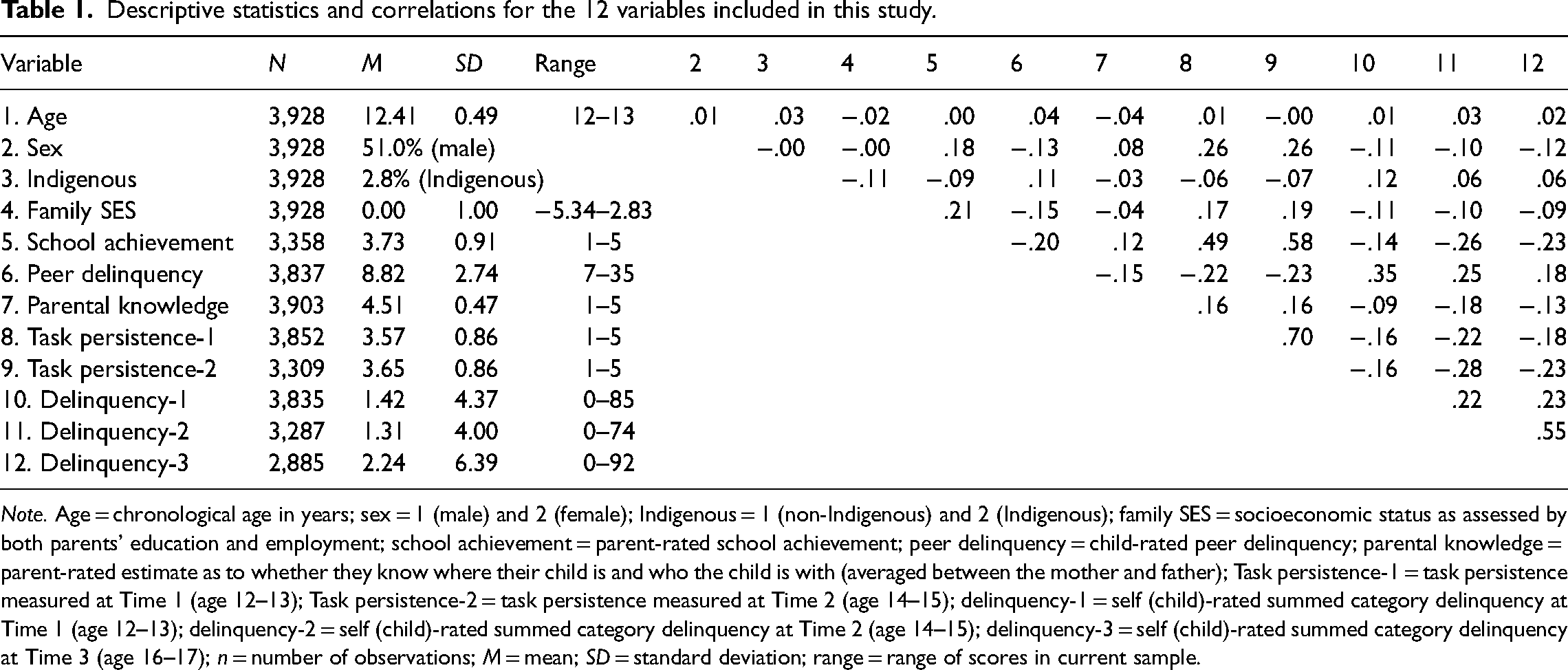
Note. Age = chronological age in years; sex = 1 (male) and 2 (female); Indigenous = 1 (non-Indigenous) and 2 (Indigenous); family SES = socioeconomic status as assessed by both parents’ education and employment; school achievement = parent-rated school achievement; peer delinquency = child-rated peer delinquency; parental knowledge = parent-rated estimate as to whether they know where their child is and who the child is with (averaged between the mother and father); Task persistence-1 = task persistence measured at Time 1 (age 12–13); Task persistence-2 = task persistence measured at Time 2 (age 14–15); delinquency-1 = self (child)-rated summed category delinquency at Time 1 (age 12–13); delinquency-2 = self (child)-rated summed category delinquency at Time 2 (age 14–15); delinquency-3 = self (child)-rated summed category delinquency at Time 3 (age 16–17); n = number of observations; M = mean; SD = standard deviation; range = range of scores in current sample.
Table 2 provides summaries of a negative binomial regression analysis of delinquency-3 and a negative binomial regression analysis of delinquency-2. The results of the delinquency-3 analysis (left side of Table 2) revealed that a change in task persistence from Time 1 to Time 2 predicted a change in delinquency from Time 1 to Time 2 to Time 3, controlling for age, sex, Indigenous status, family SES, school achievement, peer delinquency, and parental knowledge (OR = 0.801). A standardised coefficient of −.15 indicates a modest suppressant effect of an increase in task persistence on subsequent delinquency. The right side of Table 2 indicates a comparable effect (β = −.15) for Time 1 task persistence on a change in delinquency from Time 1 to Time 2. Of the six control variables, school achievement, peer delinquency, and parental knowledge achieved significance in both analyses.
Negative binomial regression analyses of the continuous delinquency-3 score, controlling for delinquency-1 and delinquency-2, and of the continuous delinquency-2 score, controlling for delinquency-1.
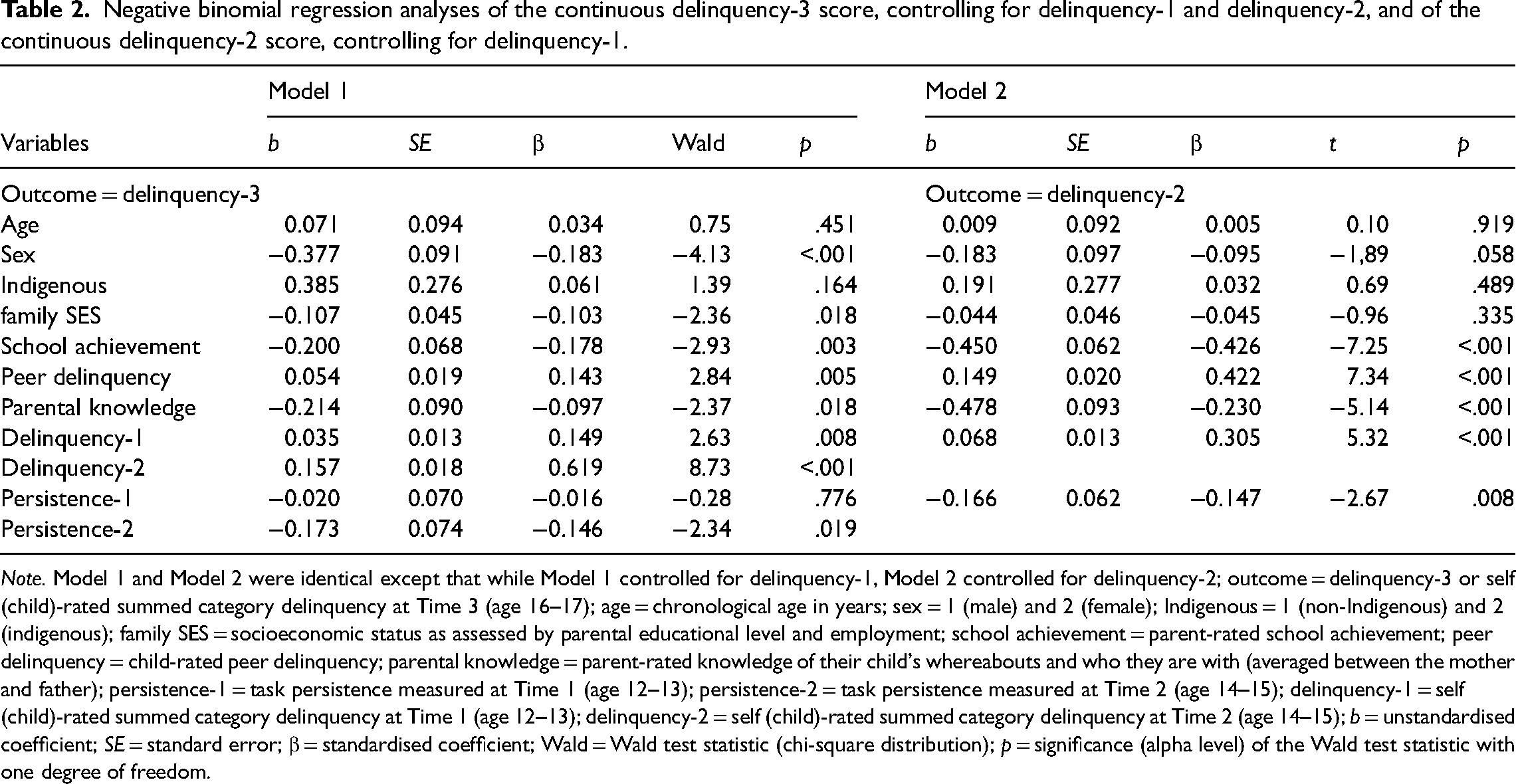
Note. Model 1 and Model 2 were identical except that while Model 1 controlled for delinquency-1, Model 2 controlled for delinquency-2; outcome = delinquency-3 or self (child)-rated summed category delinquency at Time 3 (age 16–17); age = chronological age in years; sex = 1 (male) and 2 (female); Indigenous = 1 (non-Indigenous) and 2 (indigenous); family SES = socioeconomic status as assessed by parental educational level and employment; school achievement = parent-rated school achievement; peer delinquency = child-rated peer delinquency; parental knowledge = parent-rated knowledge of their child's whereabouts and who they are with (averaged between the mother and father); persistence-1 = task persistence measured at Time 1 (age 12–13); persistence-2 = task persistence measured at Time 2 (age 14–15); delinquency-1 = self (child)-rated summed category delinquency at Time 1 (age 12–13); delinquency-2 = self (child)-rated summed category delinquency at Time 2 (age 14–15); b = unstandardised coefficient; SE = standard error; β = standardised coefficient; Wald = Wald test statistic (chi-square distribution); p = significance (alpha level) of the Wald test statistic with one degree of freedom.
Table 3 presents the results of binomial logistic regression analyses of dichotomous (1 = present, 0 = absent) indicators of delinquency-3 (left side of the table) and delinquency-2 (right side of the table). Paralleling the negative binomial regression results, task persistence at Time 2 controlling for task persistence at Time 1 predicted a reduction in delinquency at Time 3 controlling for delinquency at Times 1 and 2. An odds ratio of 0.783 indicates that a one unit increase in task persistence predicted a 22% decrease in delinquency controlling for all other variables in the equation. Negative binomial regression also revealed that task persistence at Time 1 successfully predicted a reduction in delinquency from Time 1 to Time 2. In this case, a logistic regression odds ratio of 0.843 denotes that a one unit increase in Time 1 task persistence predicted a 16% decrease in delinquency controlling for all other variables in the equation.
Logistic regression analyses of the dichotomised delinquency-3 score, controlling for delinquency-1 and delinquency-2, and of the dichotomised delinquency-2 score, controlling for delinquency-1.
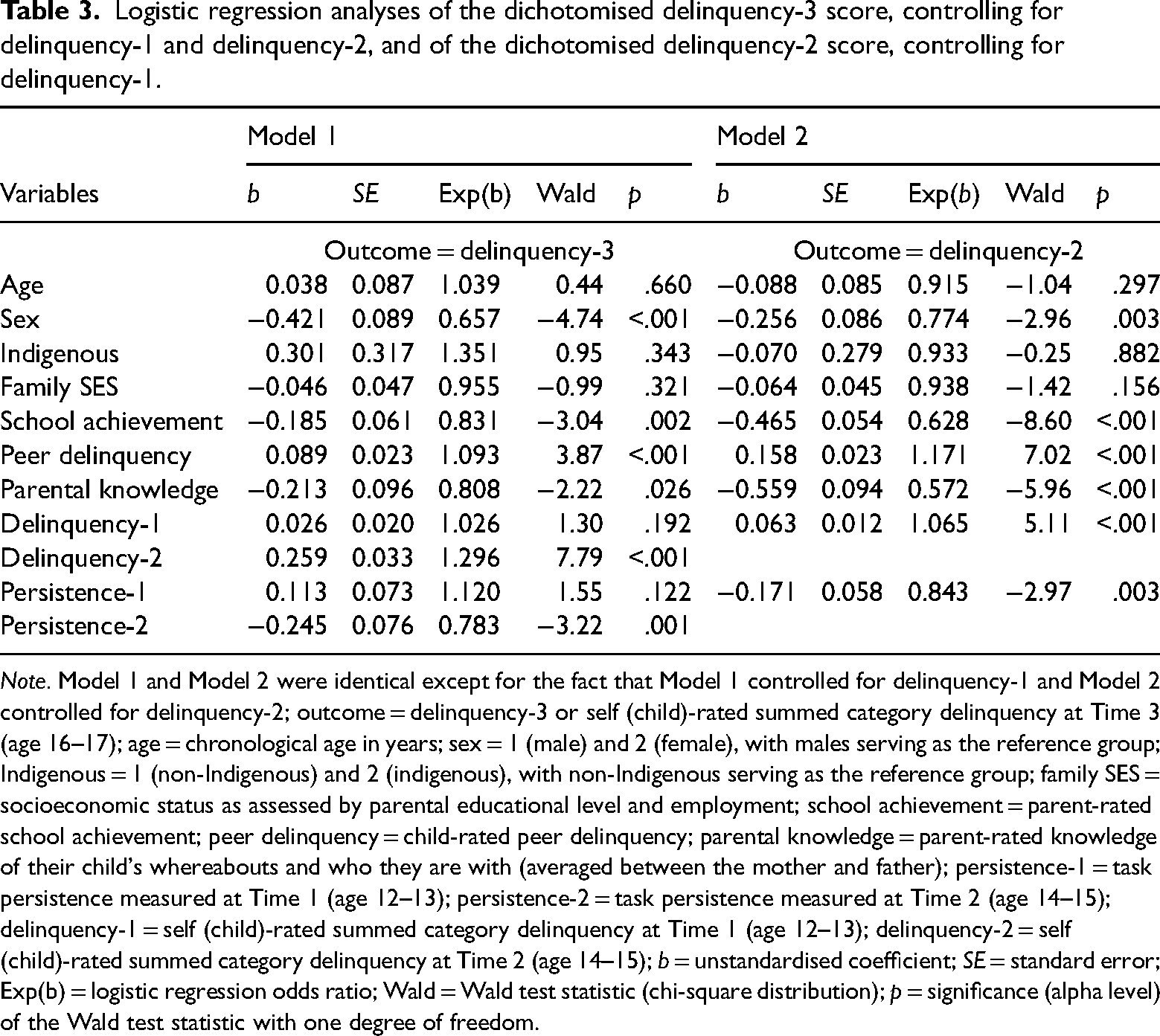
Note. Model 1 and Model 2 were identical except for the fact that Model 1 controlled for delinquency-1 and Model 2 controlled for delinquency-2; outcome = delinquency-3 or self (child)-rated summed category delinquency at Time 3 (age 16–17); age = chronological age in years; sex = 1 (male) and 2 (female), with males serving as the reference group; Indigenous = 1 (non-Indigenous) and 2 (indigenous), with non-Indigenous serving as the reference group; family SES = socioeconomic status as assessed by parental educational level and employment; school achievement = parent-rated school achievement; peer delinquency = child-rated peer delinquency; parental knowledge = parent-rated knowledge of their child's whereabouts and who they are with (averaged between the mother and father); persistence-1 = task persistence measured at Time 1 (age 12–13); persistence-2 = task persistence measured at Time 2 (age 14–15); delinquency-1 = self (child)-rated summed category delinquency at Time 1 (age 12–13); delinquency-2 = self (child)-rated summed category delinquency at Time 2 (age 14–15); b = unstandardised coefficient; SE = standard error; Exp(b) = logistic regression odds ratio; Wald = Wald test statistic (chi-square distribution); p = significance (alpha level) of the Wald test statistic with one degree of freedom.
Because conditioning on an earlier estimate of a predicted variable, as was done in the current investigation with delinquency, can create endogenous selection bias or a collider effect (Elwert & Winship, 2014), I performed a sensitivity analysis by re-running all analyses with prior measures of either task persistence or delinquency removed. After doing so, the coefficients for task persistence in the two negative binomial and two binomial logistic regression analyses remained roughly the same or increased slightly. These findings are inconsistent with endogenous selection bias or a collider effect as an explanation for the current results. The results also did not change when listwise deletion replaced FIML as the means of handling missing data.
Figure 1 provides a breakdown of participants reporting and not reporting delinquency at each of the three time periods. Although there is a fair degree of continuity between those who displayed delinquency during all three time periods and those who did not display delinquency in any of the three time periods, there was just about as much movement from delinquency to non-delinquency as there was from non-delinquency to delinquency. Figure 2 depicts changes in task persistence from Time 1 to Time 2. These results demonstrate a comparable level of fluidity. Thus, despite a correlation of .70 between the two task persistence scores over a 2-year period, there was a fair amount of movement in both directions (up and down).
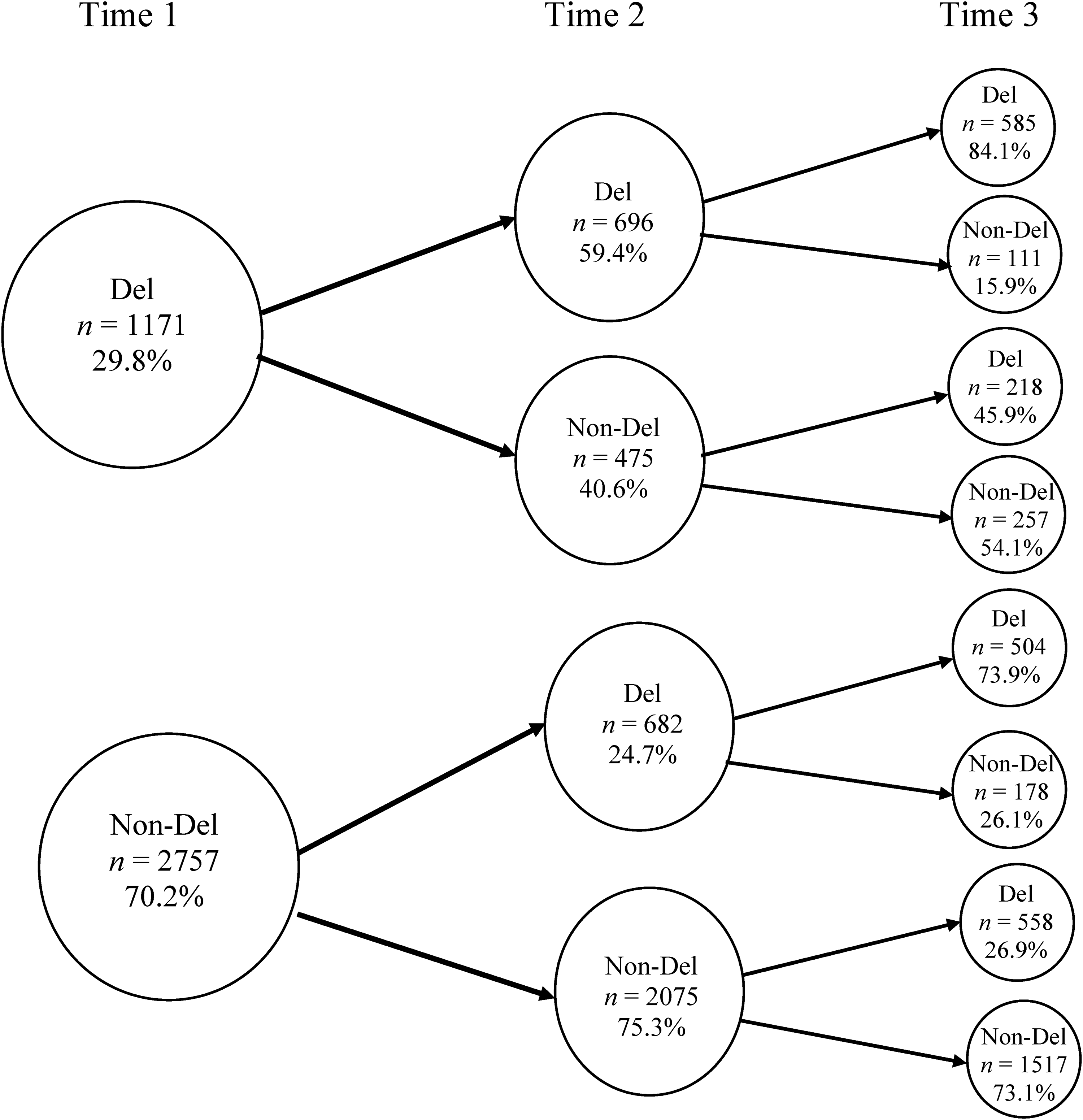
Breakdown of participants with and without delinquency at Times 1, 2, and 3.
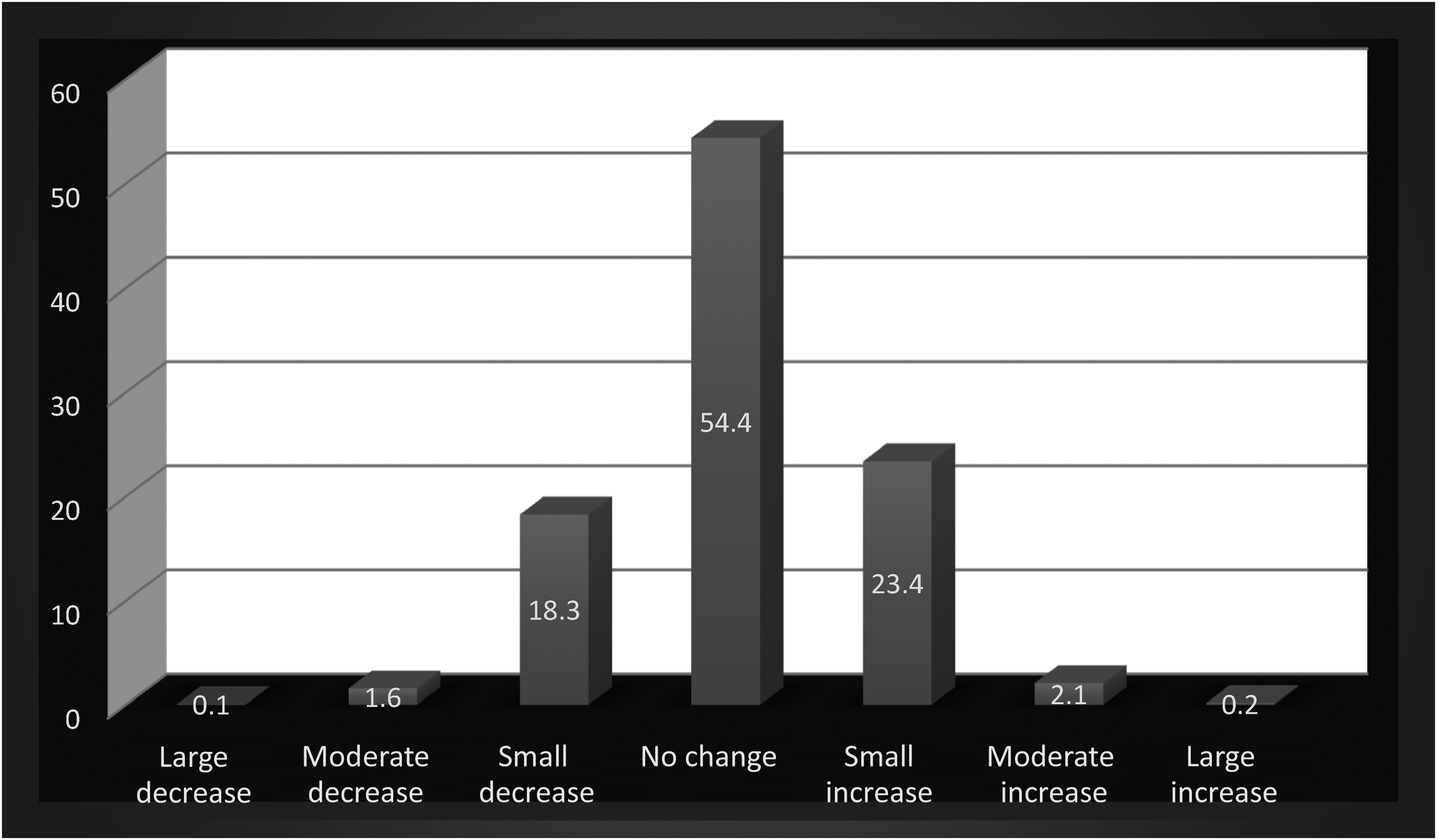
Proportion of cases showing a large, moderate, or small decrease, no change, or a small, moderate, or large increase in task persistence from Time 1 to Time 2. Note. Large decrease (−3.00 thru −2.50), moderate decrease (−2.49 thru −1.50), small decrease (−1.49 thru −0.50), no change (−0.49 thru +0.49), small increase (+0.50 thru +1.49), moderate increase (+1.50 thru +2.49), and large increase (+2.50 thru +3.00) on a four-point scale.
Discussion
The purpose of this study was to investigate a competency in a general population sample of early to mid-adolescents. The competency selected for this study was task persistence, and the outcome was delinquent involvement. My goal in conducting this study was to shed light on the relationship between task persistence and a child's involvement in delinquent activities, given the limited amount of research that has thus far published on this topic. I predicted that a rise in task persistence from Time 1 to Time 2 would predict a decrease in delinquency from Time 1 to Time 2 to Time 3 and that task persistence at Time 1 would predict a decrease in delinquency from Time 1 to Time 2. Subjecting a quasi-count measure of delinquency to negative binomial regression analysis and a dichotomous measure of delinquency to binomial logistic regression analysis, this hypothesis received support whether the outcome was delinquency-3 or delinquency-2, missing data were handled with FIML or listwise deletion, and the sample was or was not weighted. There was also no evidence of endogenous selection bias or a collider effect when prior measures of delinquency were removed from the equations predicting Wave 3 and Wave 2 delinquency. The robustness of these findings was further corroborated by the fact that the effects remained significant even though age, sex, Indigenous status, family SES, school achievement, peer delinquency, and parental knowledge were controlled. In this study, controlling for school achievement was particularly important given the strong relationship that exists between task persistence and school achievement in this and previous studies (Andersson & Bergman, 2011; Mih & Mih, 2013; Schmerse & Zitzmann, 2021). In fact, school achievement may well be a competency in its own right.
Changes in delinquency and task persistence
As indicated in Figures 1 and 2, delinquency and task persistence achieved both stability and change in this study. A little more than half the sample displayed stability on the task persistence indicator from Time 1 to Time 2 (Figure 2), and slightly more than half the sample displayed stability in delinquency status across all three time periods (Figure 1). Moreover, movement between delinquency and non-delinquency and between Time 1 and Time 2 task persistence went in both directions equally. This suggests that while there was a moderate degree of stability in both scores, there was also evidence of change in a significant portion of cases. Thus, while the scale used to measure task persistence in this study was extracted from a temperament inventory, it would appear that the construct assessed by these four items may be more fluid than one would normally expect of a temperament measure. We might reasonably assume, then, that the task persistence measure employed in this study is assessing a performance competency more so than a trait or temperament dimension given that it displayed as much variability as delinquency over a period in the life course when offending is both increasing and decreasing in roughly equal amounts. Additional research needs to be brought to bear on this issue, particularly as it relates to the age-crime curve.
Theoretical implications
Of the various implications that can be drawn from this study, perhaps the most important is that it confirms predictions from the social-cognitive-developmental theory of crime regarding some of the components of the change process. According to the theory, change, whether assisted (treatment) or unassisted (natural recovery), occurs in stages (Walters, 2022). The first stage is motivational in nature. The individual's motivation for change is based on one or more crises that lead the individual to conclude that criminal behaviour is not getting them what they want or getting them something they do not want (utilitarian perspective) or that criminal behaviour is morally wrong (moral/ethical perspective). Identifying and developing crises may not be as vital for someone who has not yet formed a commitment to a criminal lifestyle (McMurran, 2002), which is probably the case for the vast majority of youth in the LSAC. Hence, most of the sample could probably bypass the first step and start with the second step: building competencies and changing environments. As depicted in Figure 1, there was just as much movement from delinquency to non-delinquency as there was from non-delinquency to delinquency during early to mid-adolescents for participants in the current study. Not everyone went from non-delinquency to delinquency as one might assume from the age-crime curve; a good portion, in fact, moved in the opposite direction, one reason being the building of competencies like task persistence. The lesson learnt from all this is that group averages can obscure individual differences in delinquency transitions during adolescence.
Research implications
In studies like the current one, the existence of longitudinal data allows for proper temporal order between variables. This does not guarantee, however, that the variables will have proper temporal direction. Just because a researcher measures the independent variable before the dependent variable does not mean that the effect of the independent variable preceded the effect of the dependent variable (Preacher, 2015). It could be argued that the effect of the dependent variable extends back to a time preceding administration of the independent variable. Under such circumstances, the dependent variable could have caused the independent variable rather than the other way around. To help establish the temporal direction of variables in a sequence, we must control for prior levels of the predicted (dependent) variable (Cole & Maxwell, 2003). This creates a lagged dependent variable and an opportunity to assess variable change. By controlling for prior levels of an independent variable, we could create a lagged independent variable to go along with the lagged dependent variable, although lagged independent variables are rarely encountered in social science research because they greatly reduce the odds of a significant effect. By making the predictor variable compete for variance with an earlier version of itself, lagged independent variables significantly increase the burden on the predictor, often to the point of non-significance (Wilkins, 2018). The lag in the dependent variable was assessed starting at Time 1 in an effort to capture changes in delinquency from Time 1 to Time 2 that might have been missed had the lag been measured starting at Time 2, and it was assessed starting at Time 2 in order to provide a more conservative test of the hypothesis. In the end, both lagged effects were significant.
Practical implications
The LSAC provides a representative sample of Australian youth. As such, it likely contains little more than a handful of children who were receiving treatment for antisocial behaviour at the time of the study. For this reason, the current results may have more implications for unassisted change than they do for assisted change or treatment. Even so, these findings have potential implications for how we go about developing intervention programmes for delinquent youth. Regardless of whether the change is assisted or not, the same basic principles would seem to apply. According to social-cognitive-developmental theory (Walters, 2022), the change process is the same whether the person is going through a formal treatment programme or changing on their own. And according to the present results, building competencies for task persistence can be helpful in reducing future delinquency. As a result, building and strengthening a youth's task persistence competencies could be relevant for a significant number of delinquents in and out of treatment. Research indicates that the self-regulatory skills associated with task persistence correlate with increased mindfulness, defined as non-judgmental awareness of self (Evans et al., 2009). A subsequent study found that students randomly assigned to a brief mindfulness training condition displayed significantly greater persistence on a hyperventilation challenge than students who did not receive the mindfulness intervention (Carpenter et al., 2019). The strategic content learning approach, designed to promote self-regulated learning through a recursive cycle of cognitive activities, has likewise been successful in promoting task persistence (Butler, 1998; Heller & Marchant, 2015).
Limitations
This study benefitted from several strengths, to include a very large sample, the use of internally consistent measures derived from multiple sources (i.e., child and parents), and a fixed-sample longitudinal design with temporal order and direction between the predictor and outcome variables. This does not mean, however, that this study was free of limitations. First, there was the 2-year gap that separated the waves in the LSAC. As the time gap between assessments grows, so will the odds that one or more intervening variables unrelated to the study hypothesis are partially or fully responsible for the results. Three such variables (peer delinquency, parental knowledge, and school performance) were controlled for in the current study, but others exist. A second potential limitation of this study concerns the large sample size. Usually, the problem with sample size is a lack of power resulting from an undersized sample (Button et al., 2013). The opposite occurred in this study. The fact that the sample was less than a hundred participants shy of 4,000 raises questions about the clinical significance of these findings. A review of the effect size indicators (standard coefficients and odds ratios) reveals effect sizes, which while on the small to modest side, did not differ much from effect size estimates obtained in other studies in this general area (Chang & Olson, 2016; Letcher et al., 2004), particularly given the fact that the current study utilised lagged independent and dependent variables.
Conclusion
There is still a great deal of more research that needs to be done before we can fully understand how building competencies promotes assisted and unassisted change. The current study examined whether a between-person rise in persistence competencies predicted a decrease in delinquency during a high-risk period for delinquency development (i.e., early adolescence). There is a need to explore within-person changes as well to determine the effect of persistence competencies on crime desistance, deceleration, and acceleration. It also remains to be seen whether targeting persistence competencies in programmes designed to develop and strengthen task persistence actually decrease offending and recidivism in more serious and habitual offending groups than were available in the LSAC-K. Another area for future research is identifying the programme components needed to maximise the formation of task persistence skills. Finally, as previously mentioned, additional research is required to determine whether task persistence is more of a competency, as proposed by social-cognitive-developmental theory, or more of a trait or temperamental dimension, as suggested in some of the earlier work in this area (see Andersson & Bergman, 2011). There is still plenty of work to be done before we can fully answer these and other questions and make effective use of the change mechanisms believed to stem from competency development and growth.
Footnotes
Declaration of conflicting interests
The author declared no potential conflicts of interest with respect to the research, authorship, and/or publication of this article.
Funding
The author received no financial support for the research, authorship, and/or publication of this article.
