




Abstract
Coordinated multi-agency approaches are a key strategy for responding to recidivist family violence. This paper presents a follow-up quantitative evaluation of Alexis: a coordinated police-social services approach to recidivist and high-risk family violence piloted in Victoria, Australia. State-wide police data was collected for 75 perpetrators 20 to 36 months since case closure following Alexis intervention. Results indicated that 38 perpetrators (51%) had no further recorded incidents of family violence. The remaining non-mutually exclusive categories indicated that 17 (22%) had perpetrated family violence against the original Alexis victim in another location (outside the pilot catchment zones); 28 (37%) had perpetrated family violence against a different victim; and 8 of the prior two groups (11%) had perpetrated violence against both Alexis and non-Alexis victims. Those classified as low recidivists before intervention were less likely to have a further recorded incident of family violence during the follow-up period compared to high recidivists. Implications for police and policy-makers are discussed with reference to intimate partner violence and parent abuse by adult children.
Keywords
Family violence, also known as domestic violence, often refers to behaviour within familial and intimate partner relationships that is used to gain or maintain power and control, and can take many forms including physical, sexual, emotional and financial abuse (Australian Institute of Health and Welfare [AIHW], 2018). Family violence is a widespread problem, with approximately one in three women worldwide subjected to physical and/or sexual intimate partner violence in their lifetime (WHO, 2021). Perpetrators of family violence often have high rates of recidivism (Hulme et al., 2019). In Australia, for example, police data indicated that 51% (n = 15,611) of perpetrators were involved in at least one other recorded incident of family violence within four years (Millsteed & Coghlan, 2016), and in another study, almost a quarter of perpetrators (23%, n = 255) committed a further family violence offence within six months (Morgan et al., 2018). Police statistics from Victoria have also indicated that recorded recidivist family violence has increased over time, and that repeat perpetrators accounted for almost 75% of all recorded incidents between 2006 and 2015 (n = 470,645: Millsteed, 2016).
Given the over-representation of repeat offenders and their disproportionate contribution to the harm and economic burden of family violence, working to address recidivist family violence has been identified as a crucial strategy within prevention and response efforts (Cattaneo & Goodman, 2005; Morgan et al., 2018). One key strategy has been the adoption of coordinated multi-agency responses, whereby different agencies (e.g., police and social services) work together to proactively engage families and address individual-level issues in order to prevent future offending (Breckenridge et al., 2016). The following article reviews literature on coordinated approaches to family violence and their evaluations, before moving to the current longitudinal and quantitative evaluation of a police-social services response in Victoria, Australia: Alexis - Family Violence Response Model (henceforth referred to as “Alexis”).
Coordinated multi-agency models
Coordinated multi-agency responses to family violence have become increasingly common over the past four decades, in recognition of their potential to improve service delivery outcomes for victims and accountability of offenders through collaborative approaches (Breckenridge et al., 2016). Established in Minnesota in 1980, the “Duluth Model” appears to be one of the first known versions of a coordinated response to family violence (Shepard & Pence, 1999). Since then, there has been a steady rise of coordinated responses to family violence across the United States (e.g., Boots et al., 2018; Davis & Taylor, 1997; Hovell et al., 2006; Salzman, 1994; Stover et al., 2009; Whetstone, 2001), the United Kingdom (e.g., Davies & Biddle, 2018; Farrell & Buckley, 1999; Robinson, 2006; Robinson & Payton, 2016), New Zealand (e.g., Balzer, 1999; Campbell & Jones, 2016), and Australia (e.g., Centre for Innovative Justice, 2016; Cussen & Lyneham, 2012; Hamilton et al., 2021; Meyer, 2014; Putt et al., 2017; Rodgers et al., 2022; Zmudzki et al., 2019).
Broadly speaking, coordinated models can take a number of distinct forms across different jurisdictions. Program design generally reflects specific community needs, criminal justice mechanisms, family violence service systems, and the involvement of multiple stakeholder organisations (e.g., police, housing support, child protection: Breckenridge et al., 2016). Organisations may come together via committees, advisory groups, or centres (e.g., “one-stop shops”) to improve referral network coordination and service delivery (Mazerolle et al., 2018). For example, in the UK, one best-practice coordinated response model is a Multi-Agency Risk Assessment Conference (MARAC), which involves fortnightly meetings where multiple stakeholders discuss and share information relating to individual and high-risk cases of family violence in a local area (Robbins et al., 2014).
Coordinated police-social services models commonly involve specialist family violence units or teams within police departments that formally collaborate with social services or include an embedded social worker within the unit (Breckenridge et al., 2016; Exum et al., 2014; Farrell & Buckley, 1999; Hamilton et al., 2021; Hovell et al., 2006; Weisz et al., 2006). Staff tend to be specially trained and deal with complex and high-risk cases of family violence. Police are responsible for crisis intervention and disruption of family violence (e.g., arrests, administering intervention orders), while social workers provide victim and perpetrator support, education and referrals to relevant services (e.g., counselling, drug and alcohol services). Such programs can also include a second responder element, where program representatives make follow-up visits to victim's homes after a police call-out to a family violence incident (Davis et al., 2008; Mazerolle et al., 2018; Stover, 2012).
Evaluating coordinated response models for recidivist family violence
Evaluations of coordinated approaches to family violence tend to be varied in terms of design and outcome measures. This partly reflects their responsiveness to local contexts and policy frameworks (Breckenridge et al., 2016; Mazerolle et al., 2018). Within Australia, there are also no standardised data collections on family violence services and police data is complicated by inconsistent legislative definitions and response mechanisms across jurisdictions (Australian Institute of Health & Welfare [AIHW], 2018). An Australian meta-evaluation of coordinated multi-agency approaches to violence against women indicated that while there appears to be benefits of integrated approaches, the effectiveness of such approaches is still inconclusive (Breckenridge et al., 2016). The meta-evaluation, along with international research (e.g., Hovell et al., 2006; White et al., 2005), highlights that to date, the evidence base for coordinated models is primarily qualitative and process-focused, with few studies focusing on robust outcome measures.
Of the limited quantitative studies available, official recidivism rates have commonly been used as an outcome measure of success (Davis & Taylor, 1997; Exum et al., 2014; Farrell & Buckley, 1999; Hovell et al., 2006; Rollings & Taylor, 2008; Shepard et al., 2002). Farrell and Buckley (1999) argue that repeat victimisation is a useful measure for police-led models as it reflects that police contact is in response to call-outs, and therefore reductions in victimisation should be evident in reduced call-outs. They contrast this with changes in overall crime rates, which could reflect multiple factors and lack the more direct link with active police responses. It is important to note, however, that administrative datasets, such as police callouts, are limited because a significant amount of family violence goes unreported to police (AIHW, 2018; Millsteed & Coghlan, 2016), and increases in callouts could potentially reflect victim-survivors’ positive experiences and confidence in help-seeking (Rollings & Taylor, 2008).
Studies examining recidivism rates have delivered mixed findings. For example, one quasi-experimental study in the US (n = 825) found a higher rate of recidivism among households who received intervention from a police-social services team compared to a control group: 1.7 odds ratio on repeat police call-outs over 14 − 19 months (Hovell et al., 2006). Conversely, another quasi-experimental study in the United States (n = 891) found that offenders engaged by a specialist police unit with an embedded counsellor had significantly lower rates of recidivism across an 18–30 month evaluation period: offenders who received intervention from the specialist unit were approximately 50 percent less likely to have a repeat offence compared to offenders engaged by a standard police unit (Exum et al., 2014). Differences may be due to a number of factors. Hovell et al. (2006) used police call-out data from specific households to measure repeat offending whereas Exum et al. (2014) identified repeat offenders through an electronic search for individual suspect names and subsequently collated all incidents over the period of interest. Exum and colleagues’ approach focused on the perpetrator by tracking the prevalence and frequency of all family violence offences by an identified suspect against any victim, effectively going beyond the initial victim of the index incident or the use of recorded household as a proxy for offending or victimisation.
Other studies have also found reductions in family violence recidivism following exposure to a coordinated police-social services response (Farrell & Buckley, 1999; Shepard et al., 2002; White et al., 2005). For example, in its first year of operation, repeat domestic incident calls decreased by 1.5 percent in a U.K. police division that involved a specialist domestic violence unit, whereas they increased across six divisions without a specialist unit (Farrell & Buckley, 1999). The study found, however, that the specialist unit did not appear to have an impact on “chronic” households (eight or more calls to a household per year), where recidivist domestic violence accounted for a disproportionate volume of call-outs (Farrell & Buckley, 1999).
More recently, a two-year evaluation of a U.K. Multi-Agency Tasking and Coordination Approach (MATAC) used police and program offender data to measure changes in recidivist family violence (Davies, 2018). The MATAC focused on male perpetrators of domestic violence, and included a Recency, Frequency and Gravity Model (RFG) analysis tool to identify and target high-risk repeat offenders for discussion and management at monthly partnership area meetings (Davies & Biddle, 2018). Partner agencies could also recommend known perpetrators to be engaged by the MATAC, allowing for previously unreported offending to be captured by the program (Davies, 2018). Identified high-risk perpetrators were then delivered a warning letter by a MATAC representative, which served as an entry point into behaviour change and victim support services (Davies, 2018; Davies & Biddle, 2018). Quantitative analysis of police data including RFG scores, offending history, and MATAC actions undertaken indicated a reduction in both overall and domestic abuse-related offending of perpetrators. The study found a reduction of 39 percent in domestic abuse offences between pre-admission and point of discharge among the 66 perpetrators engaged in MATAC interventions (Davies, 2018). These findings were complemented by other qualitative components of the evaluation. Partner agencies generally acknowledged improvements in partnership engagement and coordination, and while there were some ongoing concerns about victim safety and risk management, victims themselves reported feeling protected during the program's duration (Davies, 2018; Davies & Biddle, 2018).
The current study
The current study aimed to extend a previous evaluation of a coordinated police-social services approach in Victoria, Australia: Alexis - Family Violence Response Model. The pilot (beginning December 2014) operated in three local government areas and focused on high-risk recidivist households, where police attended three or more times regarding incidents of family violence in the previous 12 months, or where an attending police member believed that future significant incidents of family violence were likely. The pilot's core objectives were to hold recidivist perpetrators accountable through the enhancement of interagency collaboration, and to reduce recidivist family violence for women and children in the household. A mixed-methods evaluation of the pilot indicated preliminary support for the model. As of April 2017, 75 out of 111 clients of Alexis had their cases closed for 12 months or more, and the average number of callouts per client decreased from 5.5 to 0.8 after Alexis intervention, suggesting an 85% reduction in family violence recidivism for clients managed by the Alexis model (see Harris et al., 2017 for further details). A qualitative evaluation also indicated support for the model by professional stakeholders involved in the daily operation of the approach. They perceived that the model was generally working successfully to integrate services, engage victims and perpetrators in relevant services and reduce reoffending (Hamilton et al., 2021).
While promising, the previous quantitative evaluation only included data from the Alexis pilot catchment zones. The current evaluation aimed to gather state-wide additional data on the perpetrators engaged by Alexis to gain a more robust picture of whether the model worked to reduce family violence recidivism, and if so, who it worked best for. The follow-up evaluation focused on four main questions: (i) Did Alexis perpetrators cease the use of violence in Victoria up to three years since their case files were closed following Alexis intervention? (ii) Did Alexis perpetrators use violence against the original victim in a different location? (iii) Did Alexis perpetrators continue to use violence with a different victim? (iv) Which perpetrators were more likely to cease using violence up to three years since their cases were closed following Alexis intervention?
Alexis – family violence response model background
Recognising the disproportionate representation of recidivist family violence households, and gaps in access to and uptake of family violence services, Victoria Police developed the Alexis model in collaboration with a community family violence specialist service. The pilot was also established following a series of highly publicised family violence-related deaths in the state and increasing state and public recognition of the prevalence and harms of this violence. Indeed, it ran parallel to the Royal Commission into Family Violence (RCFV: State of Victoria, 2016), which made 227 recommendations to improve the response to and prevention of family violence, with several recommendations focusing on the provision of specialist and integrated family violence support services and improved policing responses.
The Alexis model is similar in structure to other international coordinated police-social services responses to family violence (e.g., Exum et al., 2014; White et al., 2005). It comprises three main components: (i) a specialist family violence worker who is embedded within a police unit (ii) a coordination team, and (iii) an executive group. The family violence worker is responsible for supporting victims and perpetrators by engaging them with relevant services (e.g., counselling, housing, drug and alcohol support), while police are responsible for case management and criminal justice intervention. The coordination team is convened by Victoria Police and comprises key agencies (e.g., child protection, corrections) that meet on a monthly basis to discuss families (recidivist or high-risk households) and their engagement needs. The main goals are to ensure stronger integration of services, encourage information sharing amongst agencies to gain a more holistic understanding of the family, provide a streamlined interface for clients working with multiple agencies, and promote re-engagement of clients where disengagement has occurred. The executive group involves senior representation from all agencies on the coordination team. The executive's role is to ensure the sustainability of the model, deal with systematic issues that might arise in the coordination meetings and identify areas for future development.
Method
Formal ethics approval was gained through Victoria Police and RMIT University ethics committees. The research team provided the community family violence specialist service involved in Alexis with the original de-identified spreadsheet of clients who were managed during the Alexis pilot period (clients were demarcated by a random 6-letter code that was generated by an online organisational system). This spreadsheet also included some demographic information about perpetrators (e.g., gender, their relationship to the victim, whether they had complex needs). Complex needs were considered to be aspects such as mental health or substance abuse issues. A staff member from this specialist service (who was bound by the organisational code of conduct and confidentiality) filled in any known identifiable information about the Alexis clients and then provided this spreadsheet to Victoria Police.
Victoria Police conducted a state-wide search of police databases to answer the first three research questions: (i) Did Alexis perpetrators cease the use of violence in Victoria up to three years since their case files were closed following Alexis intervention? (ii) Did Alexis perpetrators use violence against the original victim in a different location? (iii) Did Alexis perpetrators continue to use violence with a different victim? Frontline police are required to complete and file risk assessment and management reports (L17 forms) after they attend an incident of family violence. L17s are then formally recorded on official police databases. The number of L17s was used as the measure of success in the original evaluation of Alexis, therefore, it was deemed to be the most accessible measure to test the current research questions for the original cohort.
Victoria Police subsequently removed any identifying data from the spreadsheet and returned it to the research team for analysis. The final spreadsheet included data for 75 perpetrators managed by Alexis. Data was entered into SPSS for analysis, with a focus on the number of L17s recorded for perpetrators post Alexis case file closure through to December 2018 (i.e., when the project data collection phase ceased). Individual case files were closed between 20.5 to 36 months (M = 29, SD = 4.86 months), or in other words, up to three years. Therefore, to clarify: after the Alexis pilot started in December 2014, most perpetrators received intervention in 2015 and 2016, with individual case closure dates. We were then interested in examining L17s during the period from their individual case closure dates through to December 2018 across Victoria (not just the pilot catchment zones) to gain a more robust picture of whether the model worked to reduce family violence recidivism.
Results
Descriptive analyses
Overall, 38 of the 75 perpetrators (51%) had no further L17s recorded between 20 to 36 months since their case was closed following Alexis intervention. The remaining non-mutually exclusive categories indicated that 17 perpetrators (22%) had L17s against the Alexis victim in another location (outside of the Alexis pilot catchment zone), 28 (37%) had L17s against a different victim, and 8 of the prior two groups (11%) had L17s against both the Alexis victim and a non-Alexis victim post case file closure. Table 1 provides a breakdown of the different perpetrator groups and their associated L17 status.
Numbers and percentages of perpetrators with and without recorded L17 s post Alexis case file closure.
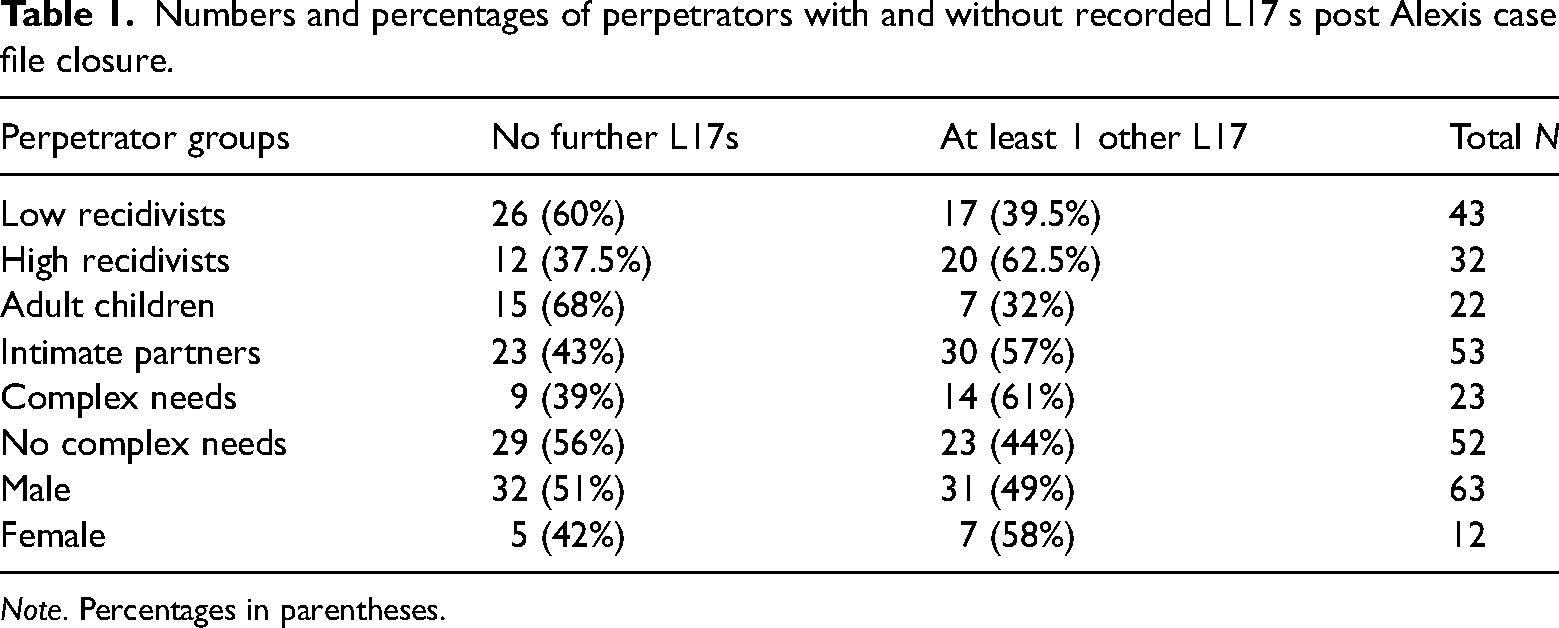
Note. Percentages in parentheses.
Perpetrator groups comprised four dichotomous variables: (i) Recidivism group: low recidivists who had up to five L17s recorded prior to any Alexis intervention and high recidivists who had six or more L17s prior to any Alexis intervention; (ii) Cohort: perpetrators who used violence towards intimate partners and adult-children perpetrators (over 18 years of age) who used violence towards their parent/s; (iii) Complex needs status: perpetrators with identified complex needs and perpetrators without identified complex needs and (iv) Gender: male and female. Preliminary analyses revealed there were no significant differences between the perpetrator groups when it came to case file closure times: Recidivism group, t (73) = .24, p = .81; Cohort, t (73) = -0.56, p = .58; Complex needs status, t (73) = 1.8, p = .07; and Gender, t (73) = -0.29, p = .77. Therefore, case file closure time did not impact the results.
Inferential analyses
A binary logistic regression analysis was performed on the four different perpetrator groups to ascertain the likelihood of having at least one other L17 recorded between 20 to 36 months since their case file was closed following Alexis intervention. The data met the binary logistic regression assumptions of independent observations and no perfect multicollinearity. The logistic regression model was statistically significant, χ 2 (4) = 10.15, p = .038. The model explained 16.9% (Nagelkerke R2) of the variance in family violence recidivism (L17s or no L17s) post case file closure and correctly classified 62.7% of cases. Recidivism group was the only variable that added significantly to the model (p = .021); those classified as high recidivists were 3.43 times more likely to have an L17 recorded up to three years since case file closure from Alexis intervention than low recidivists (95% CI 1.21 to 9.71). Cohort of perpetrators was marginally non-significant in adding to the model (p = .072); Adult-children perpetrators were .30 times less likely to have an L17 recorded up to three years post case file closure than intimate partner perpetrators (95% CI .08 to 1.12). Complex needs status and gender did not add significantly to the model (ps > .48).
Discussion
To our knowledge, this is one of the first longitudinal follow-up evaluations of a coordinated police-social services response to recidivist family violence in an Australian context. Results indicated that just over half of the perpetrators ceased the use of family violence in Victoria 20 to 36 months (on average 29 months) since their case files were closed following Alexis intervention – at least according to police data. This suggests there was a level of sustained success following the model's previous evaluation, which only measured 12 months post Alexis intervention (Harris et al., 2017). Such results are consistent with research from the United States, which used a similar follow-up period and method in measuring recidivism when examining a specialist police and social services unit for domestic violence (Exum et al., 2014).
The findings provide some support for the model's underlying theory of change: that some families are not engaged with necessary support, and a more integrated response by police and social services can help connect families to relevant services and in turn reduce violence. The model's underpinning assumptions share similarities with Sullivan's evidence-based theory of change underlying how domestic violence program activities impact survivors’ wellbeing (e.g., through safety planning, providing information on family violence; increasing access to social support: Sullivan, 2016). The mechanisms of the model's success can be further seen in case studies, whereby the Alexis team engaged in multiple home visits and correspondence to identify issues that were specific to each family and the use of violence (e.g., one case where violence ceased when the perpetrator was provided with a court order, housing assistance and drug and alcohol support: Hamilton & Harris, 2021).
There were, however, several areas of concern regarding perpetrators’ use of continued violence and the response model's ability to meaningfully reduce this following intervention. The results showed that a substantial number of perpetrators used violence against the original victim in a different location, and/or continued to use violence with a different victim, including new intimate partners and other family members (e.g., children and parents). These findings exemplify the methodological value of gathering state-wide data beyond the original pilot catchment zones to gain a more comprehensive understanding of the model's success in reducing recidivist family violence. They also point to the limitations of policing and social service responses for the prevention of recidivist family violence, particularly for those considered high recidivists (six or more L17s prior to Alexis engagement). Research in the United Kingdom also found that a specialist police and social services unit had limited success with “chronic” domestic violence offenders (Farrell & Buckley, 1999). This suggests that further work on engaging high recidivist perpetrators and enhancing their service engagement early may be needed to improve their outcomes and support long-term behaviour change. It may also speak to the lack of perpetrator specific interventions available for referral at the time of the pilot, with social service interventions largely limited to Men's Behaviour Change Programs (MBCP), which have showed varied levels of success depending on the evaluation measures (O’Connor et al., 2021). Intervention measures such as GPS tracking and electronic monitoring were also emerging during the pilot period, with preliminary evidence showing they might help to reduce family violence recidivism and enhance safety for victim-survivors (Nancarrow & Modini, 2018).
Moreover, as a tertiary prevention model that responds to users of violence after the reported event(s), there are limitations for how coordinated police-social services approaches can address drivers of family violence beyond the individual-level. There is a need for these models to be carefully and deliberately connected to primary prevention efforts that aim to challenge community- and societal-level drivers, including the normalisation of violence, dominance and control within interpersonal relationships (Our Watch, 2021). Such efforts would reinforce the messaging and support received through contact with police-social services models like Alexis. There is a further need for primary prevention efforts to better recognise the complex experiences of violence victimisation and perpetration present within any population group (Brush & Miller, 2019). Indeed, this improved integration and expansion of prevention and response is a focus for the continued roll-out of the Victorian RCFV.
The results indicated that the Alexis model worked best for low recidivists (less than six L17s prior to Alexis engagement) and potentially adult children who used violence towards their parent/s. Parent abuse by adult children is often an under-recognised form of family violence, with limited social service and criminal justice options that are tailored to such families (Hamilton & Harris, 2021). The finding that the model achieved good results with adult children perpetrators may speak to the lack of referral option pathways for this cohort. The Alexis model managed to engage these perpetrators and provide case coordination across referrals to existing mental health, substance use, and homelessness programs. The findings suggest, therefore, that a coordinated police-social services response may be a promising approach to parent abuse. Previous research, however, has also highlighted the need for further specialised programs that are tailored to the needs of adult children (Hamilton & Harris, 2021).
During the follow up period, there were no significant differences in the recorded L17s based on the gender of perpetrators. The finding regarding gender is somewhat contrary to other research, which has found men are more likely to re-perpetrate family violence than women (Millsteed & Coghlan, 2016). It is possible our sample of female perpetrators was not large enough to detect a significant difference. The women in our sample were also largely perpetrators of violence towards their parents rather than intimate partners. Research examining parent abuse has found mixed results regarding the gender of perpetrators, with some studies finding no gender differences in the perpetration of abuse (e.g., Pagani et al., 2009) and some reporting mothers are at a greater risk of abuse from their sons (e.g., Boxer et al., 2009). Moreover, the police data in this study recorded gender as a binary variable, which limited the ability to explore any patterns regarding gender diversity outside of the cisgender binary.
The complex needs status of perpetrators did not contribute significantly to predicting recidivism during the follow up period. As a reminder, complex needs were considered aspects such as mental health and/or substance abuse issues and were recorded based on known identifiable information. It is possible that those categorised as no complex needs had undetected or unrecorded complex needs. Indeed, there are many reasons why people may be reluctant to self-report illegal substance use or mental illness (e.g., stigma; Henderson et al., 2013; McGregor & Makkai, 2003). Other research has found that mental health and substance abuse issues were significant risk factors for family violence recidivism (Millsteed & Coghlan, 2016). It is important to remember, however, that this sample of perpetrators were already involved in the Alexis model due to family violence recidivism, and as stated above, the Alexis workers helped to refer perpetrators to relevant mental health, drug and alcohol, and homelessness programs, which might have been key to some perpetrator's deterrence in offending (at least during the follow up period). Nevertheless, the raw data indicates there is further work needed to address family violence recidivism in perpetrators with complex needs.
Caveats
The results suggest that the Alexis model worked best for low recidivists, however, without a control group, it is impossible to say whether their outcomes were better because of Alexis intervention, or whether they were less likely to reoffend regardless. Qualitative research into the model indicates Alexis members have greater time and resources to invest in more intensive case management to connect families to relevant services (above standard policing responses), which may play a key role in recidivism rates (Hamilton et al., 2021; Hamilton & Harris, 2021). Nevertheless, future evaluations should aim to incorporate control groups into their design to explore this finding further.
While the Victorian-wide data painted a more comprehensive picture of family violence recidivism, it is possible that perpetrators also continued to use violence in other parts of Australia or abroad. Tracking recidivism data across a whole country would be fruitful but would require coordination of policing organisations and ethics committees. It is also important to note that the recidivism data in this study reflects only those instances where police have been called to an address and subsequently filed a Risk Assessment and Management Report (i.e., an L17 form), therefore, this study should be considered a representation of recorded incidents only. There may be further family violence call-outs that did not result in an L17 record or were recorded as a different offence (Farrell & Buckley, 1999; Rollings & Taylor, 2008). It is also well documented that many instances of family violence (and other forms of violence against women) go unreported to police, and therefore police and other administrative data is likely to underestimate rates of perpetration and victimisation (AIHW, 2018; Millsteed & Coghlan, 2016). Official recidivism rates, however, are accepted internationally as a valid indicator of a coordinated policing model's success (Davis & Taylor, 1997; Exum et al., 2014; Farrell & Buckley, 1999; Hovell et al., 2006; Rollings & Taylor, 2008).
The data examined in this project is now a few years old, with the data cut-off period ending in December 2018. Delays in data analysis were due to the COVID-19 pandemic and associated lockdowns in our state of residence. Nevertheless, coordinated police and social service responses are still emerging in Australia and across the world (e.g., Morgan et al., 2020; Petersen et al., 2022; Rodgers et al., 2022). The policy landscape relating to family violence has not substantially altered in that time, in Australia at least, with the ongoing implementation of the Victorian RCFV recommendations on perpetrators focusing more on long-term support and behaviour change. The most recent National Plan to End Violence Against Women and Children 2022–2032 (Department of Social Services, 2022) likewise includes priority actions for improving integrated services for prevention and response. Importantly, the rates of reported family violence in Victoria have steadily increased between the financial years of 2018 to 2022 (Crime Statistics Agency, 2022) reflecting in part the effects of the COVID-19 pandemic and associated lockdowns on women's and family safety (Pfitzner et al., 2022). Therefore, the data and findings from this study remain timely and relevant for future policy-making to address these significant rates of family violence.
Conclusion
This evaluation study has provided some evidence for the long-term effectiveness of a coordinated police-social services model in reducing recorded recidivist family violence, in particular for those considered low recidivists in Victoria, Australia. These findings, along with prior research (Hamilton et al., 2021; Hamilton & Harris, 2021; Harris et al., 2017) suggest that an integrated model with a specialist family violence worker embedded within a police unit can be a useful approach to responding to cases of recidivist family violence, beyond standard frontline policing responses. As others have also argued (Morgan et al., 2020), such an approach should not be prioritised at the expense of other primary and secondary prevention initiatives but rather viewed as one promising strategy for addressing the high rates of police callouts for recidivist family violence; engaging repeat perpetrators in relevant social services and criminal justice interventions; and responding to the immediate risk and safety needs of victim-survivors who opt for police assistance. It is clear, however, that much more work is needed to intervene early and engage high recidivists (i.e., chronic perpetrators), who account for a disproportionate amount of family violence both in Australia and internationally.
Footnotes
Declaration of conflicting interests
The author(s) declared no potential conflicts of interest with respect to the research, authorship and/or publication of this article.
Funding
The author(s) disclosed receipt of the following financial support for the research, authorship and/or publication of this article: This work was supported by The Salvation Army (no grant number).
