




Abstract
The 2020-2025 Dietary Guidelines for Americans, which serves as the basis for federal nutrition policy in the United States, recommends that adults who choose to consume alcohol do so in moderation, stating the following: “Adults of legal drinking age can choose not to drink, or to drink in moderation by limiting intake to 2 drinks or less in a day for men and 1 drink or less in a day for women, when alcohol is consumed.”
The Dietary Guidelines also state that “drinking less is better for health than drinking more” and that “the amount of alcohol and calories in beverages varies and should be accounted for within the limits of healthy dietary patterns.”
For individuals with diabetes, dietary management, including alcohol consumption, is a factor in managing glucose and health outcomes, so thinking about how alcohol fits into dietary patterns is all the more critical.
Alcohol and Diabetes
For individuals with diabetes, dietary management, including alcohol consumption, is a factor in managing glucose and health outcomes, so thinking about how alcohol fits into dietary patterns is all the more critical. A 2019 consensus report on nutrition therapy for adults with diabetes or prediabetes (Evert et al) provides the following recommendations:
It is recommended that adults with diabetes or prediabetes who drink alcohol do so in moderation (1 drink or less per day for adult women and 2 drinks or less per day for adult men).
Educating people with diabetes about the signs, symptoms, and self-management of delayed hypoglycemia after drinking alcohol, especially when using insulin or insulin secretagogues, is recommended.
The importance of glucose monitoring after drinking alcohol beverages to reduce hypo-glycemia risk should be emphasized.
Alcohol Knowledge Check
To learn more about how to help consumers understand the Dietary Guidelines for alcohol, the Distilled Spirits Council of the United States (DISCUS) offered an educational session on the topic to a group of food and nutrition experts. What stood out among session participants was the surprising amount of alcohol in some craft beers, high-alcohol wines, and ready-to-drink beverages. They soon recognized the importance of measuring the volume of beverages to determine how many standard drinks are in a container and reading labels to determine alcohol by volume.
In January 2022, DISCUS invited a group of food and nutrition communicators (eg, registered dietitians, nutrition experts, food influencers, journalists, and health educators) to complete an online survey to assess their awareness and knowledge of the Dietary Guidelines for alcohol and key alcohol-related definitions (N = 29). Respondents then attended a 15-minute, in-person presentation on standard drinks and the Dietary Guidelines for alcohol. A week later, they completed a follow-up survey (n = 27) to assess knowledge and intentions.
Prior to the presentation, 41% of respondents considered the alcohol content of a beverage when they purchased or consumed it. After the presentation, that percentage more than doubled, with 93% saying they would think about alcohol content the next time they purchased or consumed it (Figure 1). In addition, less than a half (48%) knew at baseline that ethanol is the pure alcohol in all beverage alcohol, and slightly more (69%) knew the recommended daily limits of moderate alcohol consumption for males and females. At follow-up, 81% knew that ethanol is in all beverage alcohol, and 81% knew the recommendations for moderate consumption. (Figure 2).
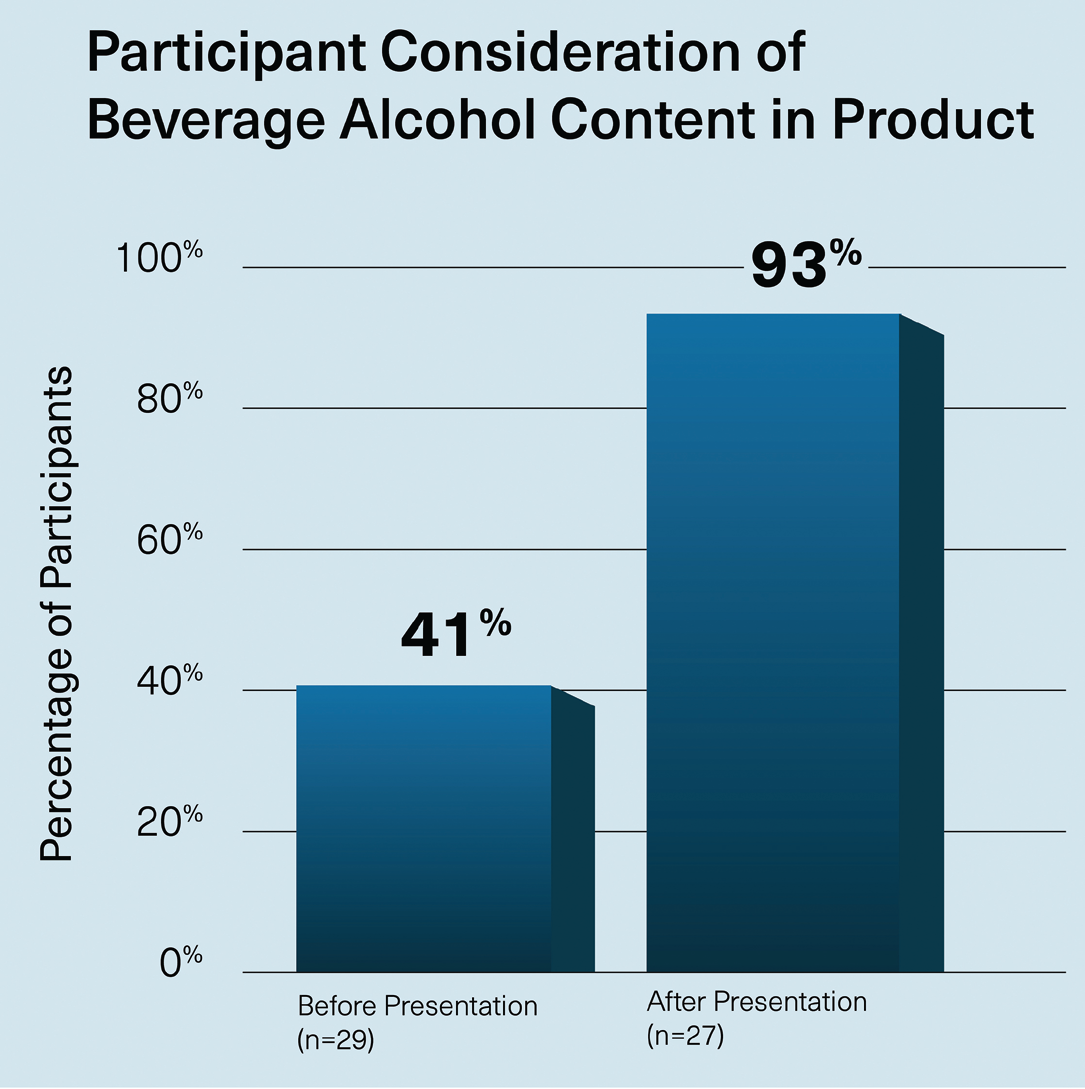
Survey responses to “The next time I buy/consume alcohol I take into consideration . . . the alcohol by volume (e.g., % ABV, proof).”
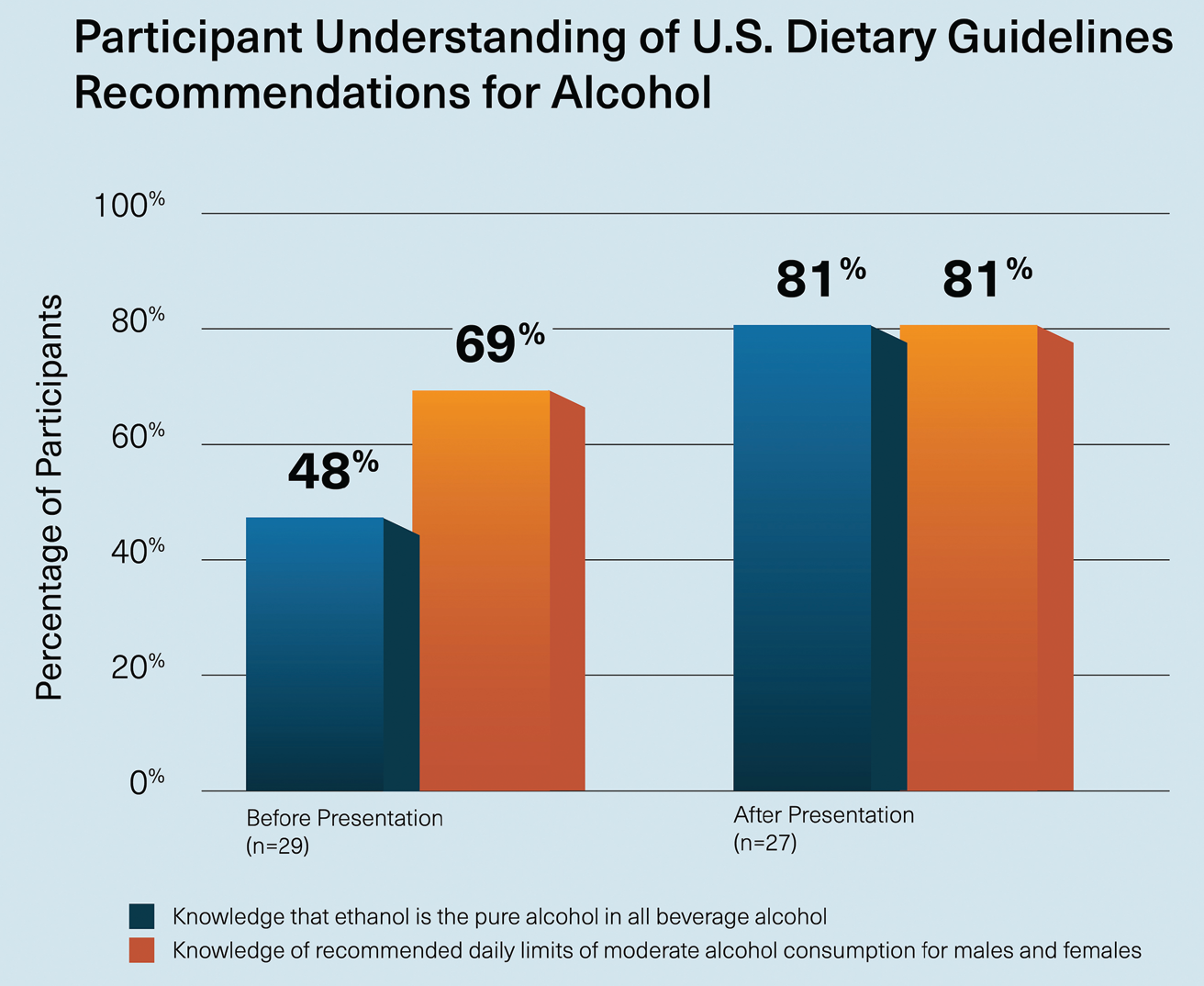
Survey responses regarding knowledge that ethanol is the pure alcohol in all beverage alcohol and knowledge of recommended daily limits of moderate alcohol consumption.
What Counts as a Drink?
Knowing the definition of a standard drink is an essential aspect of drinking alcohol responsibly. And experts agree. The U.S. Treasury Department published their report on competition in the markets for beer, wine, and spirits in February 2022 and stated that “ensuring consumers are informed about the nature of alcohol beverages promotes public health goals,” and it points to requests for “the adoption of standard drink sizes to make it more clear to the public and consumers what is in each product.”
The Dietary Guidelines defines a standard drink, or drink-equivalent, as containing 14 g (0.6 fluid ounces) of pure alcohol. This is not to be confused with alcohol by volume (ABV), which shows the percentage of a beverage that’s alcohol. Drinks with a higher volume have lower ABV, but a standard drink still contains 14 g of alcohol.
Common examples of a standard drink are shown in Figure 3 and include the following:
1.5 ounces of 80-proof distilled spirits (40% ABV)
5 ounces of wine (12% ABV)
12 ounces of beer (5% ABV)
12 ounces of a canned, ready-to-drink (RTD) beverage (5% ABV).
The standard drink equivalent definition has been an accepted guideline for nearly 40 years, has long been incorporated into alcohol educational materials developed by federal and state agencies including the Office of the Surgeon General, the Centers for Disease Control and Prevention, and the National Institutes of Health, and is used by the US Department of Agriculture and the Department of Defense, among others.
The Dietary Guidelines defines a standard drink, or drink-equivalent, as containing 14 g (0.6 fluid ounces) of pure alcohol.
How Many Drinks Are in That Bottle Anyway?
There’s alcohol by volume, and then there’s volume of alcohol. Today’s beer, wine, and distilled spirits products come in a range of container types and sizes, making it a challenge for consumers to know how many standard drinks they are consuming. That said, you can calculate how many standard drinks are in a container using its volume (typically shown as ounces or mL) and the ABV.
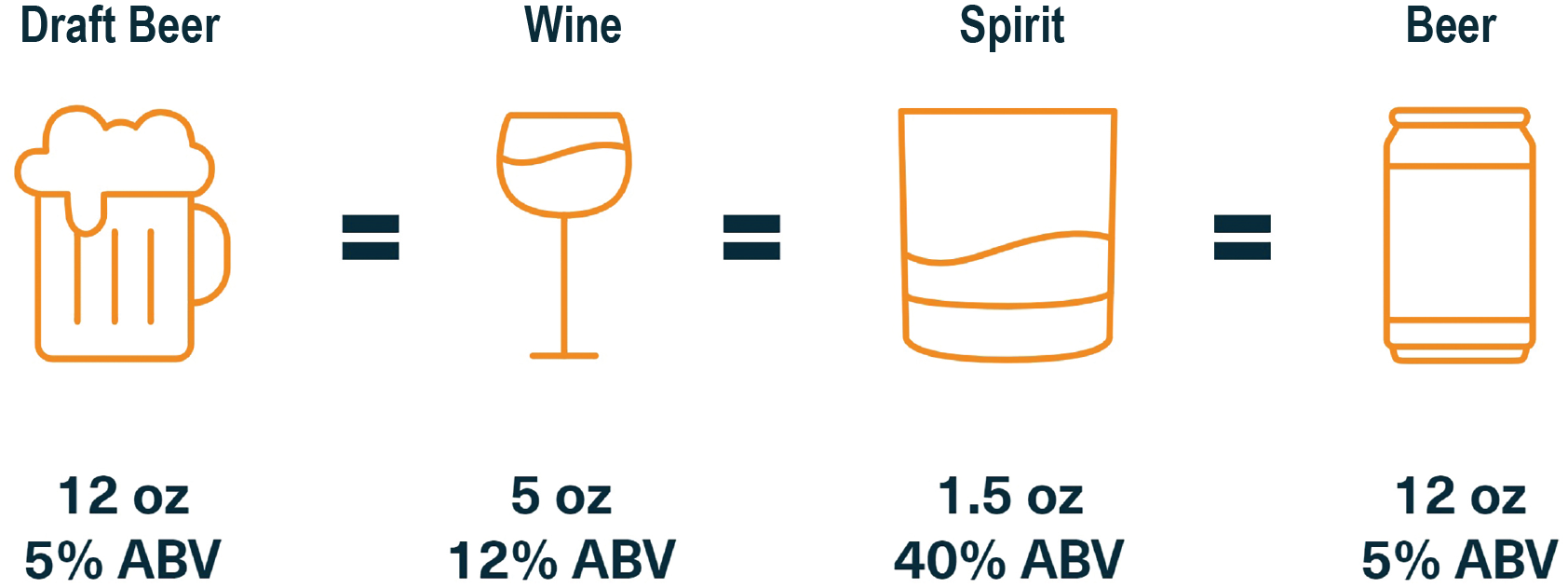
Common examples of standard drink equivalents.
Today’s beer, wine, and distilled spirits products come in a range of container types and sizes, making it a challenge for consumers to know how many standard drinks they are consuming.
To make the standardized drink definitions accessible to consumers and to assist individuals in making responsible decisions regarding alcohol consumption, the DISCUS launched a new website, StandardDrinks.org. The site features an interactive drink calculator and other resources. The calculator allows users to input the volume, or container size, and the ABV of their beverage to see how it measures up to what constitutes a standard drink. The tool can help adult consumers practice responsibility and track their consumption.
For people with diabetes, it is important to use this resource in conjunction with the recommendations found in the 2019 nutrition consensus report for people with diabetes and prediabetes (Evert et al.).
Practicing Moderation
As stated on StandardDrinks.org, “When it comes to alcohol, there is no beverage of moderation, only the practice of moderation.” A drink is a drink. Treating beverage types differently sends the dangerous message that some forms of alcohol are “safer” than others. A standard drink equivalent—whether it’s a distilled spirit, beer, or wine—contains the same amount of the same pure alcohol (ethanol).
Knowing what “moderation” means and what a standard drink is can help adults who consume alcohol to do so responsibly. It is important to also remember that excessive drinking can cause serious health and other problems. Furthermore, the Dietary Guidelines advise that some people should not drink alcohol, including those who are pregnant or might be pregnant, are under the legal age for drinking, have certain medical conditions or are taking certain medications that can interact with alcohol, are recovering from an alcohol use disorder, are unable to control the amount they drink, or plan to drive or take part in other activities that require skill, coordination, and alertness.
“When it comes to alcohol, there is no beverage of moderation, only the practice of moderation.”
In Summary
Some individuals with diabetes may enjoy alcohol in moderation in accordance with the recommendations in the Dietary Guidelines after consultation with their physician or health care provider. Advising people with diabetes about moderate alcohol consumption as a part of a personalized diabetes care plan is an essential role of diabetes care and education specialists. To that end, it is imperative that diabetes care and education specialists educate themselves about alcohol, what counts as a drink, and the recommendations about alcohol specific to people with diabetes. ■
Footnotes
Disclosures
StandardDrinks.org is a website created by the Distilled Spirits Council of the United States (DISCUS), the national trade association representing distilled spirits. The website is part of DISCUS’s ongoing efforts to disseminate the messages of the US Dietary Guidelines as a USDA MyPlate Strategic National Partner.
Duality of Interest
Amanda T. Berger is employed by the Distilled Spirits Council of the United States. Kathleen Zelman declares having no professional or financial association or interest in an entity, product, or service related to the content or development of this article.
Funding
The authors declare having received no specific grant from a funding agency in the public, commercial, or not-for-profit sectors related to the content or development of this article.
Amanda T. Berger, PhD, is with Distilled Spirits Council of the United States (DISCUS) in Washington, DC.
Kathleen Zelman, MS, RDN, is the founder of the No Nonsense Nutrition website, cohost of the True Health Revealed podcast, and former director of nutrition at WebMD.