



Abstract
Background
The field of implementation science acknowledges the importance of diversity within research teams including members from diverse disciplines and with lived expertise in practical implementation (e.g., administrators, front-line workers, patients/clients). Gaps remain in the successful implementation of proven substance use treatment interventions.
Methods
This paper will outline the rationale for the purposeful inclusion of researchers with lived experience (RLE) related to substance use disorder (SUD) within implementation science research studies focused on improving SUD services.
Results
We posit that researchers with such experience can help address research-to-practice gaps by (1) building strong community partnerships, (2) engaging in conversations around effective interventions through knowledge translation, (3) providing community-congruent approaches to evaluation, and (4) aiding in dissemination and sustainability efforts.
Conclusions
We end by offering recommendations for researchers without lived experience as they intentionally collaborate with RLE.
Plain Language Summary
Implementation science usually involves and prioritizes community collaboration; however, there are often barriers to community collaboration because the community may not trust researcher intentions or there might be challenges to identifying shared language. Researchers who have lived experience with substance use disorders might be able to make community collaborations between researchers and community members easier through shared knowledge of both research and lived experience. The involvement of researchers with lived experience may also help community-based organizations find the best ways to use evidence-based practices. We describe ways that the intentional involvement of researchers with lived experience may improve implementation outcomes and ultimately improve the services received and experiences of community members.
Keywords
Introduction
Best practices for implementation highlight the need to include researchers from across disciplines, on-the-ground community partners, and people who are affected by implementation (i.e., patients/clients; Cacari-Stone et al., 2014; Caron et al., 2015; Eccles & Mittman, 2006; Minkler, 2008; Sprague Martinez et al., 2020; Wallerstein & Duran, 2010). However, despite best efforts to include partners at various levels, barriers to adoption and implementation shortcomings still emerge. For example, long-acknowledged research-to-practice gaps persist in the utilization of new evidence-based practices within substance use disorder (SUD) treatment—attributed to the lack of appropriate training, readiness, and inadequate resources to facilitate adoption (Miller, 2007; Miller et al., 2006). Practitioners across disciplines express that researchers do not truly understand the complex and dynamic contexts they navigate in their daily work (Montgomery & Smith, 2015). Furthermore, perceived conflicts between grassroots approaches to prevention, treatment, and harm reduction and researcher-defined evidence-based practice complicate these challenges across SUD-related systems (Rush & Urbanoski, 2019).
We posit that the purposeful inclusion of implementation science researchers with lived experience (RLE) can help close these research-to-practice gaps. We define RLE broadly and as they pertain to SUD, as people whose lives have been directly impacted by SUD who also have formal, often doctoral-level training in implementation science and related fields. This may include people with SUD or who are in recovery, or those who have close, personal relationships with people who identify in these ways, such as family members, partners, and friends who have acted as caregivers. We choose to use the term SUD but recognize that others with lived experience may be more comfortable with the term addiction or other terminology and have chosen only one term for consistency. 1
Prior work highlights the value of RLE in biomedical research and suggests that within this field, RLE can provide a depth of understanding into the basic human processes involved in SUD, potentially reducing stigma by helping others in the field understand that people with SUD can also hold an identity as a researcher (Stull et al., 2022). Community-based participatory research and other community-engaged research methods have been used for decades to address substance misuse, address SUD-related stigma, and improve SUD treatment and related policies (Hayashi et. al., 2012; Nieweglowski et al., 2018; Windsor et al., 2021). A number of research teams and institutes have highlighted the benefits of close collaboration between researchers and people who use drugs or people who identify as in recovery from SUD, particularly when people with lived experience shape and guide the research process (Ashford et al., 2019). For example, the National Institutes of Health (NIH) Helping to End Addictions for Life (HEAL) initiative also recently established “HEAL Connections” (https://heal.nih.gov/resources/connections), a work group focused on translating HEAL funded research into action through the utilization of lived experience panels to support knowledge translation and dissemination of research results to reach community partners outside of academic institutions. However, while all of these methods appropriately include persons with lived experience in the research process, few report the specific inclusion of RLE in their research teams and design (Banfield et al., 2018).
As an extension of prior work (Stull et al., 2022), we sought to clarify the attributes and experiences of RLE which may facilitate improvements in implementation science. First, we leveraged Proctor's Implementation Outcomes (Proctor et al., 2011) to examine how RLE could contribute to an improvement in each domain. We identified gaps in the field within each implementation domain based on our formal training in implementation science and extensive collective experiences as people with lived experience supporting implementation. These experiences have included the implementation of evidence-based practices in school-based settings, criminal-legal settings, treatment settings as drug and alcohol counselors, collegiate recovery settings, mutual aid through 12-step groups, harm-reduction programs, and other community settings. Next, we organized these contributions within the core elements of implementation (Koh et al., 2020; Shelton et al., 2020, 2021) to guide our group exploration.
In this conceptual paper, we summarize the ways RLE specifically can advance the field of implementation science by offering unique perspectives to facilitate adoption and implementation within SUD-related settings—improving prevention, treatment, and harm-reduction efforts. The purpose of our work is to highlight opportunities for more intentional integration of RLE in the field of implementation science.
Improving the Adoption and Implementation of Evidence-Based Practices and Programs Through Collaboration with Researchers with Lived Experience
RLE are attuned to community engagement, which may improve knowledge translation and thereby the implementation of evidence-based practices and programs (Chapman et al., 2020; Pinto et al., 2021). First, as a bridge between research teams and practitioners/service recipients, RLE can translate knowledge smoothly through familiarity with the jargon, mannerisms, and commonalities between groups. Not only can they translate scientific knowledge into usable information for practitioners and service recipients, but they can translate on-the-ground knowledge needed for effective research to other researchers, both from their own experience and through unique rapport with local practitioners and service recipients. As such, RLE, as a translation bridge, facilitate the transfer of knowledge from researcher to practitioner/service recipient and practitioner/service recipient to researcher. Transferring knowledge between disparately situated groups, such as research teams and SUD service providers/service recipients, cannot happen without fundamental understanding of the languages and communication styles used by each group. Through a foundation of mutual understanding, community partners become more comfortable with the proposed evidence-based practice when the research team is willing to put the new knowledge identified about the community context into action. Additionally, RLE may also provide guidance to others on a research team without lived experience on communication to help facilitate the trust building and knowledge transfer process. Through mutual understanding, there is room for changes in attitudes and beliefs on the sides of both the community and the research team, which leads to opportunities for improved uptake of intervention core components and appropriate adaptation. This process sets the stage for adoption, long-term sustainment, and dissemination of evidence-based practices and programs (Figure 1).

Implementation Process for Evidence-Based Practices and Programs Adoption and Adaptation Supported by Researchers with Lived Experience
It is important to clarify that not every RLE will be a good match for every community partnership. RLE are not a homogonous group, and each hold their own intersectional identities (e.g., cultural background, racialization, socioeconomic context, language) and perspectives on incorporating those identities and experiences into their research. Thus, RLE intersectional identities may influence this relationship between research teams and communities. Additionally, there is a clear need to center leadership from Black, Native American, and Latinx communities, which are disproportionately impacted by drug overdose and experience more barriers to accessing treatment compared to White individuals with SUD (Hughes et al., 2022). RLE with intersectional identities are uniquely positioned to both support the process of knowledge translation within their respective communities and to help identify necessary implementation considerations to address stigmatization, discrimination, and cultural incongruence. From another perspective, RLE will also have diverse lived experiences and comfort with disclosure and may be at varying stages or on different pathways of recovery. Those who did not participate in specific modalities like Medications for Opioid Use Disorder (MOUD) may lack a nuanced knowledge, or even stigmatize some modalities (e.g., aversion toward MOUD observed in some 12-step recovery groups; Andraka-Christou et al., 2022; Woods & Joseph, 2018). While these differences among RLE exist, RLE may have a more intricate understanding of these nuances and thus a heightened awareness of their own contextual knowledge gaps. Importantly, as described in greater detail in the section, “Strategies for Collaborating with RLE,” the work cannot fall exhaustively or exclusively to one individual researcher to act as a knowledge bridge nor to implement community recommendations in the implementation process.
Leveraging the unique experiences at the intersection of lived and academic expertise, RLE may improve adoption and implementation of evidence-based practices and programs as we will describe under the four core elements of implementation science research (Koh et al., 2020; Shelton et al., 2020, 2021): (1) community engagement (2) development, selection, adaptation, and implementation of evidence-based interventions; (3) models, frameworks, and evaluation approaches; and (4) methods for dissemination and sustainability. Of course, we do not mean to suggest that implementation science work cannot be conducted without RLE, but that RLE may accelerate the pace of science when conducting implementation science research with community partners and may improve the quality or outcomes of such science and potentially make it more responsive to community needs.
Community Engagement
We propose that intentional inclusion of RLE as leaders in implementation science efforts is different than engaging study populations of interest in scientific processes. RLE have a unique lens through which they understand the complicated systems and interactions that people with substance use histories encounter while also having formal academic training in implementation science. From a lifespan perspective, the experiences of RLE may include interactions with multiple systems of care, such as child welfare, juvenile justice, educational settings, specialty treatment centers, aftercare settings, supportive housing, corrections, hospitals, and clinics (Bronfenbrenner, 1979; Nargiso et al., 2015; Nichols et al., 2021). Lived interactions with these systems enhance collaborations with community partners and may advance the identification of potential barriers and elements of social and structural stigma that might otherwise go unnoticed (Ahern et al., 2007; Morgan et al., 2015; van Boekel et al., 2013). As such, RLE who have expertise in implementation science offer opportunities to accelerate implementation efforts, building trust and knowledge translation among a complex array of systems and community partners.
RLE can facilitate knowledge translation and thereby implementation of evidence-based programs and practices through tailoring communications for a variety of audiences. For example, RLE may tailor information for practitioners who work with patients or clients with SUD as RLE integrate what they know from a patient-centered perspective (having been patients or clients themselves or having loved ones who have received care) with the scientific objectivity that comes from rigorous evidence generated through research (Aikenhead, 2008; Chapman et al., 2020). In other words, RLE can act as knowledge mediators between research teams and community partners such as treatment professionals, physicians, nurses, school staff, and corrections officers (Crowe et al., 2017). Similar to findings from research on the benefits of peer support workers, community partners may also be more likely to trust information coming from someone with lived experience, whom they perceive as understanding the context (Stack et al., 2022). This may, in part, be due to community partners’ anticipation of positive intentions for conducting the research in the first place. This could be particularly true for RLE who were drawn to conduct research in the field of SUD because of firsthand experience. In contrast, researchers without lived experience may need to prove their good intentions more gradually. Thus, in instances when a researcher feels it appropriate to disclose their own experience, it may create a rapport with practitioners, especially when those practitioners also have lived experience (e.g., behavioral treatment settings, medication for opioid use disorder treatment settings). We provide an example of how contextual understanding may support the research team in the implementation process in Figure 2.
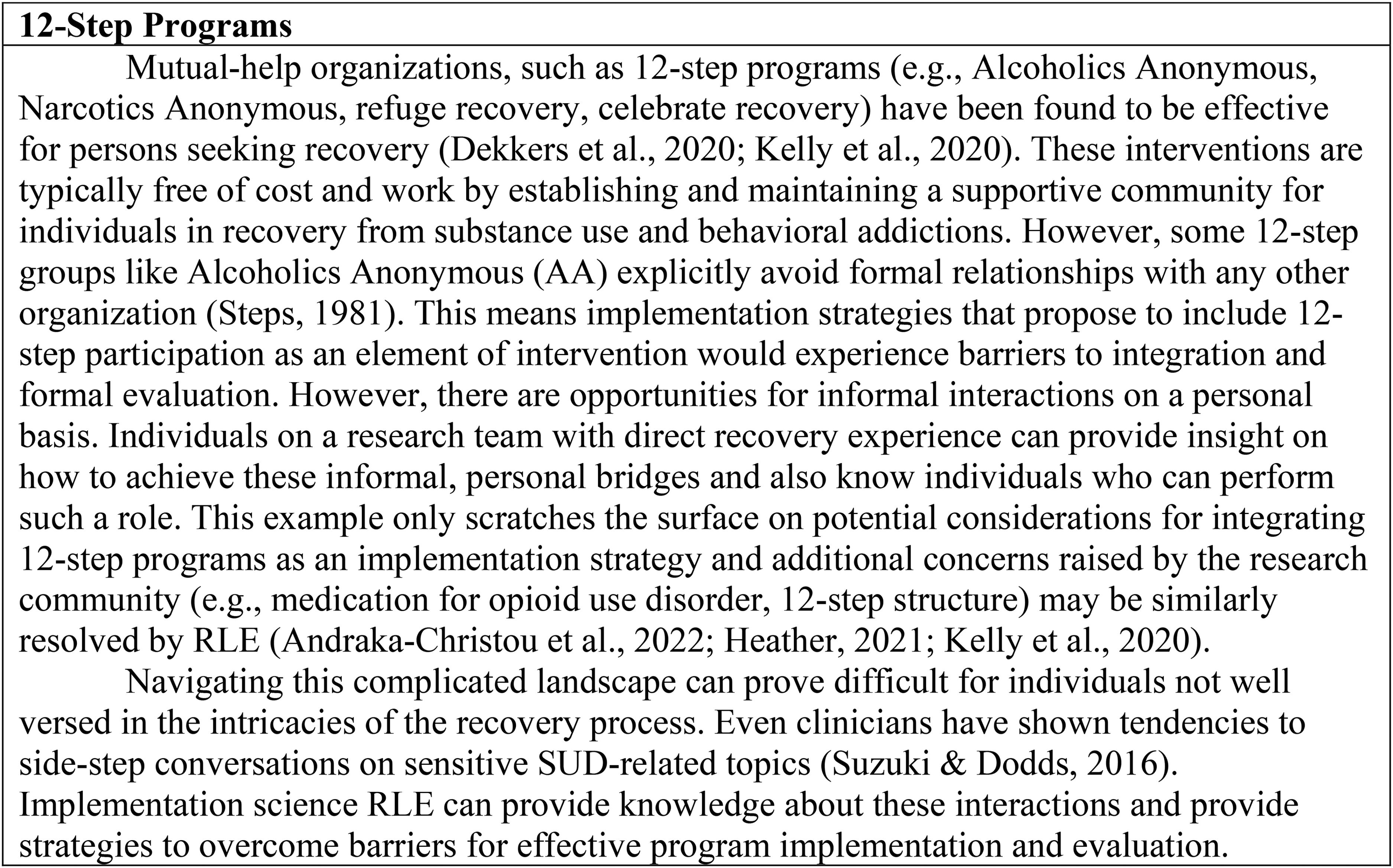
Contextual Understanding of 12-step Program May Support the Research Team in the Implementation Process
RLE can also improve equitable implementation when their experiences are intersectional, such as when researchers are, for examples, Black, Indigenous, Latina/o/x, two-spirt, lesbian, gay, bisexual, queer, transgender, those who experienced pregnancy and parenting with SUD, or those with prior criminal-legal system involvement. Cultural context and appropriateness (i.e., how well a practice fits in a given context) are key to successful implementation (Proctor et al., 2011). It is also imperative that any intervention not inadvertently exacerbate stigma-related barriers. Local lived experience may also confer additional benefits, given the importance of understanding the geographic context in which a SUD intervention is implemented. For example, a researcher who has a background of substance use while living in a rural area may more readily perceive why certain interventions that are effective in urban settings might fail in more rural contexts. Frequently, implementation efforts are not acceptable to the local population, and thus a great deal of time and effort is wasted when these interventions do not result in positive outcomes. The use of cultural adaptation (CA) models in implementation science driven by persons with lived experience could increase attention to culture making evidence-based treatments more responsive to the needs and preferences of diverse populations such as persons with lived experience of SUD (Cabassa & Baumann, 2013). RLE provide explicit cultural insight that can identify barriers and improve acceptability, thereby improving outcomes and cost effectiveness overall.
Development, Selection, Adaptation, and Implementation of Evidence-Based Interventions
RLE can aid in the development, selection, adaptation, and implementation of evidence-based interventions. Recognizing connections between conditions on the ground and the empirical evidence requires a nuanced understanding that may also include early detection of potential barriers and how they might be overcome. Further, RLE may have direct insight into how individuals across institutions might be engaged, making it possible to address a complex issue with strategic solutions. Implementing interventions to prevent, treat, and reduce harm among people with SUD also occurs in highly variable social and organizational contexts (May et al., 2016). Including perspectives of trained researchers who lived through, and found recovery within, such a milieu may sidestep barriers not readily apparent in the existing literature, leading to a more streamlined process of program selection and implementation.
RLE might also increase organizational acceptability and program credibility, thereby influencing program adoption. RLE have training and personal experiences which they can draw upon to help identify stigma or other potential barriers to a program's acceptability. Personal and intentional disclosure of lived experience has been proven to reduce stigma (Burns et al., 2021; Ross et al., 2020). Reducing the stigma associated with a program or practice can improve the likelihood of program adoption. For example, learning about how MOUD has positively impacted the life of a researcher may reduce stigma among community partners by reconstructing the narrative that MOUD is “switching one substance for another” or helping practitioners understand the safety of MOUD use during pregnancy and lactation and importance of providing MOUD for pregnant and postpartum people (Klaman et al., 2017; Madden et al., 2021).
Furthermore, RLE may have an intimate understanding about the functionality of a program or a particular service setting, and thus, pre-emptively anticipate challenges and identify solutions to implementation barriers. They can also identify innovative service settings that other researchers may not be aware of. For example, a researcher who has previously attended a syringe exchange program may be able to suggest implementation strategies and service settings that are more likely to have long-term successful outcomes. They can also help to balance the feasibility of an intervention with its scientific impact (Proctor et al., 2011). Implementing SUD-related interventions is a complex process, as researchers navigate a web of service settings in various geographical areas and reimbursement structures (Ducharme et al., 2016; May et al., 2016). Even when an intervention may appear to be culturally appropriate and cost effective, it may not be feasible within a particular geographic region or service setting. We provide an example of potential challenges apparent to RLE related to issues stemming from animal models of treatment for SUDs in Figure 3 and Therapeutic Communities in Figure 4. Often, RLE have navigated and/or conducted studies related to the delivery of treatment interventions and may have insight that may improve the probability of selecting the most impactful and feasible practice or implementation strategy.
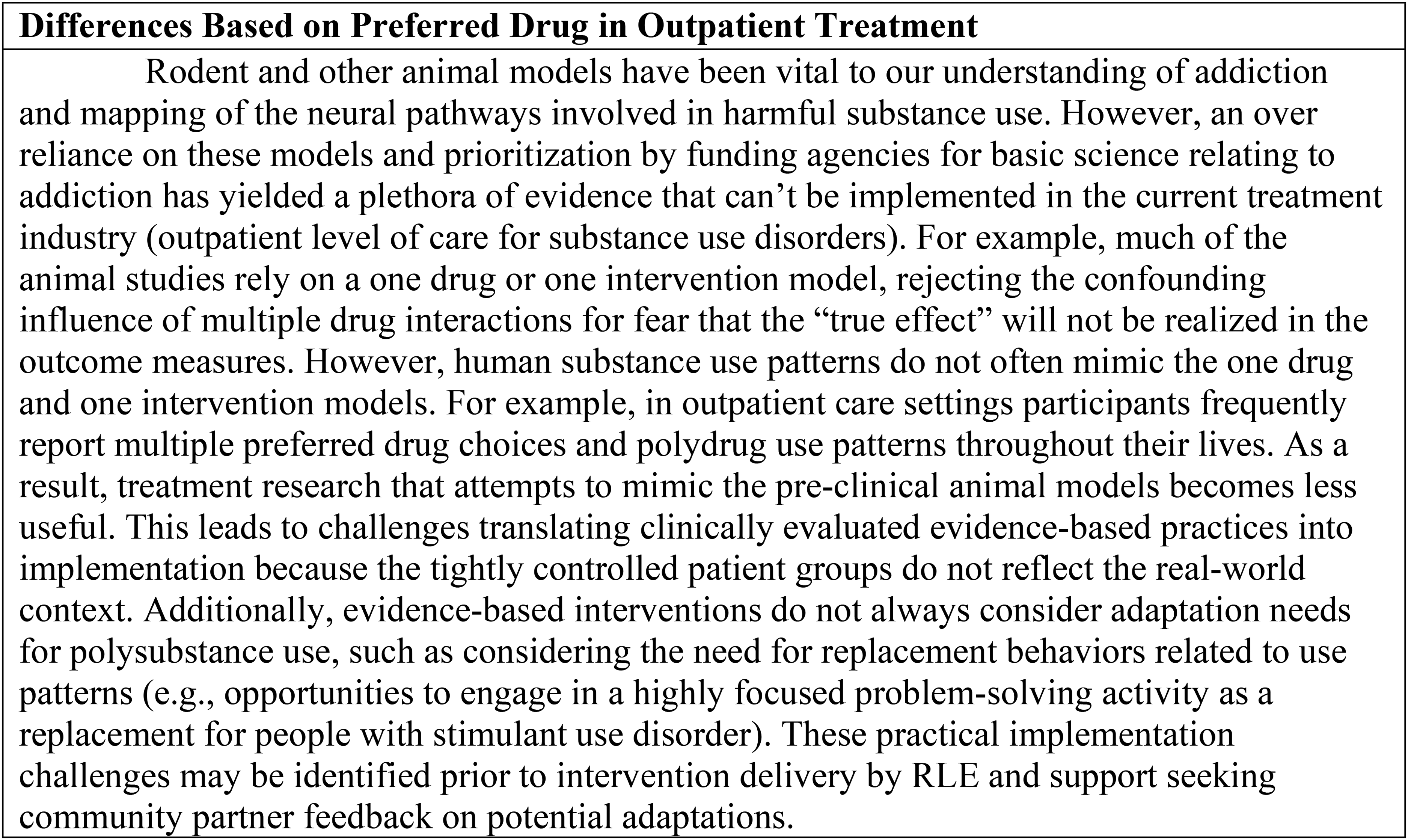
Potential Challenges That May Be Unnoticed by Non-RLE as It Relates to Context-Dependent Drug Differences in Outpatient Treatment

Potential Challenges That May Be Unnoticed by Non-RLE as It Relates to Therapeutic Communities in Prisons
RLE may be able to have more candid conversations with community partners regarding failures of implementation efforts in institutions such as the justice system. Given the array of available interventions and complexity of intervention-context fit, community partners and practitioners may experience barriers to intervention selection and implementation (May et al., 2016). Comprehending how these barriers function and, most importantly, how they might be surmounted, can be greatly improved with lived experience that is frequently unavailable in empirical research (Figure 5 and Figure 6). Therefore, research teams are left to either explore every possible complex interaction between interventions and contexts or engage with individuals with personalized knowledge. The latter may lead to reduced transaction costs and maximized efficiency.

Ways Gender May Influence Intervention Acceptability as it Relates to Harm-Reduction Interventions

Pregnancy Considerations for Peer Support Models and the Need for Specialized Training
Models, Frameworks, and Evaluation Approaches
The selection of a model or framework for implementation guides the options that are considered during the implementation process and the approach to evaluation. RLE can help assess gaps in existing models and frameworks and make recommendations on implementation and evaluation strategies to fill those gaps. While researchers conducting implementation work often focus on a specific practice or program that has been developed after many years of research, implementation science considers the context and whether or not additional practices or programs or de-implementation would produce the most benefit (e.g., in the case of some group-based treatments; Hogue et al., 2021; Moos, 2005). While there are few models and frameworks focused on de-implementation of harmful practices, specifically considering outcomes for people with SUD, de-implementation may be an important first step toward reducing harm and improving community outcomes. RLE may be able to quickly identify problematic practices within systems and specify important de-implementation steps. At a minimum, they may offer insights into extraneous variables to be measured in evaluation.
Regarding evaluation approaches, RLEs may elucidate reasons why treatment options as presented may not reach certain individuals or why people may not adhere to a program or treatment regimen as prescribed. For example, screening, brief intervention, and referral to treatment (SBIRT) in emergency department settings has been implemented to connect people with SUDs to treatment. However, it is well known that people with SUD may not disclose, or may understate, their substance use. Alternative conversation strategies during the screening phase of SBIRT may enhance willingness to disclose (Barata et al., 2017). This could include a conversational, rather than educational or assumptive approach. Researchers without lived experience may also arrive at similar conclusions, however, the benefit of RLE is that the insights may be timelier and lead to improved implementation outcomes.
RLE may be particularly useful in helping translate the importance of intervention key components (i.e., program differentiation) to improve the likelihood of fidelity to the intervention. They may also be able to readily identify areas for adaptation and help to tailor fidelity measures to adaptations. Fidelity to core intervention components and appropriate intervention adaptation may improve the overall quality of delivery and, in turn, participant satisfaction and outcomes (Carroll et al., 2007; Mihalic, 2004).
RLE may also improve upon the data collection instruments through which other implementation constructs are measured, such as reach (Proctor et al., 2011). For example, if a harm-reduction intervention is designed for implementation with people who are unhoused (a notoriously difficult population to track; Eyrich-Garg & Moss, 2017), RLE may provide insight into how best to measure the overall reach of the intervention and/or follow enrolled subjects over time. Further, RLE can help identify practical outcome measures (positive or negative) beyond the typical abstinence measures in common practice (Paquette et al., 2022). Their personal experience highlights the non-linear process of engaging with treatment and, thus, the need for outcomes beyond simple binary notions.
The approach to evaluation may also be improved by RLE through hiring and training practices. Specifically, RLE may be more motivated to recruit, hire, train, and support research staff, students, and early career investigators with lived experience. We anticipate that a research team of individuals with lived experience could provide benefit to the field as they would face fewer obstacles communicating personal experiences, as others on the team readily understand these experiences. This shared understanding, similar to what has been described thus far, would enable rapid action to overcome implementation barriers.
Methods for Dissemination and Sustainability
Dissemination is defined as how an intervention is communicated and promoted to key community partners for adoption (Bauer et al., 2015). RLE can serve as powerful advocates for the broad dissemination of effective interventions that have been proven to work in identified communities of interest. It is often interactions with people in recovery that serve to reduce stigmatization (Clement et al., 2012; Livingston et al., 2012). RLE can use scientific knowledge and personal stories of recovery to positively influence decision making toward the implementation of successful interventions.
Sustainability is defined as the extent to which a newly implemented treatment is maintained or institutionalized within a service setting's ongoing stable operations (Proctor et al., 2011). RLE can improve the sustainment and alignment of an intervention among service recipients, which may increase organizational willingness to sustain the intervention. Moreover, these researchers may contribute to the early identification of potential barriers to implementation, thereby increasing the likelihood of long-term sustainment. As stated above, RLE likely have insight into barriers to implementation, which includes the long-term sustainability of evidence-based interventions, particularly in specific contexts. Thus, inclusion of such researchers may provide early knowledge of contextual elements that would not necessarily disrupt implementation of an intervention but could make sustainability difficult.
Strategies for Collaborating with RLE
We have described reasons why it may be helpful to have leadership from and collaboration with people with lived experience. However, researchers without lived experience may ask about ways to collaborate with people with lived experience without exploiting their experiences or engaging in performative allyship (i.e., trying to demonstrate a moral compass instead of dismantling oppressive systems; Ekpe & Toutant, 2022). Here we provide some guidance on best practices.
Consider That Many Colleagues May Have Lived Experience That They Have Not Yet Chosen to Disclose
To say that implementation science research ought to support the inclusion of RLE should not overshadow the fact that many RLE are already conducting research and contributing to the field. The stigma of SUD as a largely concealable or invisible condition means that the costs and benefits of disclosure are often carefully evaluated: in some professional settings, the benefits may be minimal (i.e., because experience with SUD is not framed as a valued professional asset) while the potential costs—being judged, discredited, devalued, or pigeonholed—may seem high. Thus, we recommend that, in addition to recruiting additional implementation science researchers with lived SUD experience, it is critical to establish a climate in which existing colleagues would feel safe and valued in disclosing relevant personal experiences (Joachim & Acorn, 2000). Although such shifts in institutional culture can be slow, small changes may have a significant impact. Intentional pursuit of creating a supportive climate includes not using stigmatizing language to describe people with SUD, acknowledging positionality as a RLE as valuable, recognizing that lack of lived experience can be a limitation, and positioning people in recovery or active addiction as experts. From that perspective, it is also important when interacting with RLE to acknowledge that the researcher has both research expertise and lived expertise.
Intentionally Recruit Undergraduate/Graduate Students, Post-Docs, and Junior Colleagues with Lived Experience
Inclusion of lived experience as a desired quality in personnel vacancy postings frames lived experience as an asset rather than a liability. Possible strategies include stating in a job posting a preference for individuals with lived experience or asking about whether an individual has lived expertise relevant to the position that they would like to disclose during a job interview (after noting that such expertise is desirable). Furthermore, the presence of other researchers, especially senior faculty, that model openness to lived experience speaks volumes. To promote safety, it is also important that people in positions of power (e.g., interviewer, supervisor) are open to disclosing their own experiences or lack thereof if there is an invitation to those with less power to disclose their own lived experiences. Of note, when taking on mentees with lived experience, it may be helpful to identify additional mentors with lived experience to help them navigate applying their experiences in research settings.
Creating an environment conducive to inclusion of RLE, however, requires considering the institutional environment. Many higher education institutions, for instance, require all applicants to answer whether they have a criminal record and, if so, complete an arduous process of approval, which usually involves recounting this criminal history in detail. The felony question itself, and the process of overcoming the check mark on the “yes” box for a prior conviction, create a barrier that discourages many applicants from even beginning the process. So, work is necessary not only in creating positions for RLE but also in ensuring the environment in which the position is being offered does not limit the process for RLE with prior criminal-legal system involvement. Faculty who are RLE may be helpful in pointing out some of these barriers, however, the work to address systems must be a concerted effort that includes those without lived experience as allies and intentional drivers of systems change. RLE, especially those with prior criminal-legal system involvement, already carry the additional burden of inequitable systems and need support from those who are more resourced to support inclusion.
As a concrete example of efforts to foster inclusion of RLE, The University of Washington at Tacoma has expanded its doctoral program in higher education leadership to prioritize applicants with lived experience (https://www.tacoma.uw.edu/soe/EdD). Other efforts to expand research into recovery support services have created postdoctoral fellowships specifically designed to attract, hire, and train RLE, in addition to other training opportunities (https://www.jeapinitiative.org/).
Provide Dedicated Support to RLE in the Research Environment
Ongoing, dedicated support promotes retention of RLE and fosters continued professional growth. Within the research environment, federal agencies such as NIH should prioritize inclusion of RLE and create pathways for meaningful participation in research, as outlined in the most recent strategic plan (National Institute on Drug Abuse, 2023). Institutions can remove employment restrictions related to prior arrests or convictions, acknowledging that RLE with a history of criminal-legal system involvement may be deterred by the requirement of a background check, especially without explicit justification. Additionally, researchers without lived experience, particularly those in leadership positions, can extend principles of allyship to interactions with RLE—for example, amplifying the voices of RLE, openly acknowledging lived experience as a valuable asset, and promoting action based on RLE lived experiences. Finally, opportunities for connections between RLE will provide spaces for mutual support and collaboration. For example, four of the five authors of this article met through participation in the Initiative for Justice and Emerging Adult Populations (JEAP), a National Institute on Drug Abuse-funded research group that has centered lived experience of community board members, but also early career investigator trainees and postdoctoral fellows.
Develop Appropriate Methods to Measure and Report Outcomes of Efforts to Include People with Lived Experience in the Research Process
Efforts to support and expand the inclusion of individuals with lived experience in implementation science research should be documented and measured within research institutions and for implementation research studies. These may include short-term outcomes such as greater numbers of RLE and contributions toward the growth, development, and inclusion of RLE, and long-term outcomes such as the contributions of RLE to the field, the development of novel areas of research, and the ways in which knowledge transfer occurs during the course of a study. Establishing metrics to document inclusion efforts and RLE efforts can also be leveraged for research fields where other lived experiences are relevant yet underutilized. Measurement could include researchers’ organizational role and contributions, domains of implementation science included in the research, and researchers’ personal characteristics, backgrounds, and types of lived experiences. With these indicators, institutional leaders and research teams may be able to assess and rigorously evaluate whether the inclusion of RLE improves implementation outcomes. It may even be possible to extract these data from positionality statements and retrospectively assess the relationship between lived experience, or lack thereof, and research methods and outcomes. Purposeful solicitation of positionality statements may help advance implementation science from this perspective.
Limitations and Future Directions
Our goal in publishing this manuscript is to create a safe space in academia for RLE and to break the silence for others with lived experience. It can be demoralizing to have relevant experiences to share and not have a safe space to share those experiences. We are not suggesting that SUD-related implementation science research cannot be conducted without RLE. To the contrary, we know many strong allies who have advanced the field in remarkable ways without lived experience. However, we do suggest that lived experience may help to reduce the amount of time it takes from the development of an evidence-based intervention to the implementation of that practice in a given community or setting. We also realize that the authors’ experiences do not embody or represent all possible lived experiences and have only scratched the surface on considerations related to intersectionality, equity, and inclusion. Future research and scientific inquiry into this topic could reveal whether having a research team member with lived experience measurably changes implementation outcomes. For example, investigators may randomly assigns sites to receive support from an RLE to assess whether those sites have improved intervention adherence or create adaptations that improve the effectiveness of the intervention. Beyond RLE, understanding how the personal attributes of a researcher may impact study and implementation outcomes is an area ripe for investigation.
Conclusion
We are people with SUD, people with loved ones with SUD, and we are implementation science researchers. We hope that our work will help other researchers understand that those identities can be held at the same time and reduce the pressure to live in the shadows for our fellow RLE. We also hope to convey that, as it relates to SUD, stigmatization of SUD can hinder the progress of research—RLE may help challenge the status quo of stigmatization toward people with SUD and contribute to improvements in research practices to advance the field of implementation science.
Footnotes
Declaration of Conflicting Interests
The author(s) declared no potential conflicts of interest with respect to the research, authorship, and/or publication of this article.
Funding
The author(s) disclosed receipt of the following financial support for the research, authorship, and/or publication of this article: This article was supported by Grant P50DA048756, Grant R24DA051950, Grant R24DA051973, Grant L30DA056944, and Grant K01 DA053391-01A1 from the National Institute on Drug Abuse, National Institutes of Health (NIH). The content is solely the responsibility of the authors and does not necessarily represent the official views of the NIH
National Institute on Drug Abuse, (grant number K01 DA053391-01A1, P50DA048756, R24DA051950, R24DA051973, L30DA056944).