




Abstract
The optimal design of reinforced concrete beams (RCBs) and structures with an objective of improving the chosen performances is an important problem in the field of construction works. Recently, the concrete beams, structures, and walls are strengthened externally by bonding fiber-reinforced polymer strips (FRPS). Usually, FRPS are employed in rehabilitation of existing beams, bridges, and other structural elements. This article modifies the problem of designing new RCBs with appropriate selection of FRPS with a goal of exploiting the benefits of FRPS such as higher tensile strength, better corrosion resistance, higher stiffness-to-weight ratio, and longer life. It, firstly, proposes an artificial neural network-based mathematical model for assessing the performances of RCBs bonded with FRPS from the data obtained from 69 FRPS-glued RCBs and then develops an optimal design procedure employing flower pollination-based optimization, which is imitated from the pollination process of plants, for obtaining design parameters of FRPS-glued RCBs with a view of enhancing both the ultimate load and the deflection ductility. It presents optimal design parameters of five FRPS-glued RCBs and experimentally validates the performances.
Keywords
Introduction
The reinforced concrete (RC) has been popularly employed almost in all construction activities in the world due to several advantages such as high compressive strength, good resistance against fire damage, durability, and less maintenance. The design employing standard design codes by experienced engineers cannot be considered as optimal, they are striving to lower the material cost of the beams and structures at the cost of other performances. The prime requirements of strength and durability can be achieved besides reducing the material cost by tailoring and solving the problem as optimization problem with one or more objectives of enhancing various performances, while at the same time satisfying several constraints. The optimal design of RC beams (RCBs) and structures is more complex than that of steel structures because RC involves three components of concrete, steel, and formwork, while the steel structure involves only the steel. Even a small variation in the design parameters will have great impact on the performances and the material cost. The optimal design involves the selection of appropriate design parameters and the quantity of reinforcement that minimizes the chosen cost function. The RC design optimization problem may be a nonconvex and nonlinear owing to the large number of design parameters, multidimensional solution space, and rigorous constraints and becomes the most challenging optimization problem in the domain of structural engineering. 1,2
The optimal RC structural design problems have been traditionally solved by employing mathematical techniques such as linear programming, sequential linear programming, nonlinear programming, direct search (DS), and discrete optimization. These methods demand differentiable and continuous cost functions and a good starting solution. Besides, they may suffer due to poor convergence with more design variables and land at suboptimal solutions. Several hybrid versions combining augmented Lagrangian multipliers and nonlinear programming, gradient projection and sequential linear programming, sequential linear and sequential convex programming, gradient approach and sequential quadratic programming, and so on have been suggested to overcome the aforementioned drawbacks of the traditional approaches. A survey of research work, reported for optimal design of RC structures, has been done with a suggestion of focusing more on cost optimization of realistic RC space frames by Sarma and Adeli. 3
Swarm intelligence-based optimization techniques such as evolutionary algorithm, genetic algorithm (GA), simulated annealing (SA), charged system search, bat algorithm, harmony search (HS) optimization, artificial bee colony, and particle swarm optimization (PSO) have been recently employed for solving the structural design problems to overcome the drawbacks of traditional methods. The convergence of these approaches have further be increased by inheriting the good features of other techniques, such as GA with DS, heuristic PSO and ant colony optimization (ACO), PSO and ACO, ACO and HS algorithms, heuristic Big Bang–Big Crunch and HS scheme, PSO and finite element analysis, and PSO with decision-making for solving the structural design problem. These approaches in general begin with a swarm of random starting solutions and simultaneously perform multiple searches in the problem’s entire solution space over hundreds of iterations with a view of obtaining the global best solution. They possess the advantages of not requiring a good starting solution, handling many qualitative objective and constraint functions that may be discontinuous, discrete and nondifferentiable, and offering the global best solution. 4 –10 .
The external bonding of fiber-reinforced polymer strips (FRPS), comprising of either carbon and glass fibers or glass and aramid fibers, 11 have been widely accepted method of strengthening concrete beams, structures, and walls in recent years. They are especially employed in rehabilitation of existing beams, bridges, and other structural elements due to one or more reasons, such as seismic upgrade, poor construction, defects in design, increased load carrying demands, damage of structural elements, and degradation caused by aging, which may make the structures obsolete. The FRPS-based strengthening has several advantages, such as higher tensile strength, better corrosion resistance, higher stiffness-to-weight ratio, longer life, easy installation, enhanced flexibility, excellent fatigue behavior, nonmagnetic, versatility in size and geometry, and lesser maintenance over traditional steel strips.
Over the years, a number of analytical equations along with design guidelines were empirically developed for estimating the requirements of FRPS for strengthening the structures and beams. Though the developed equations offer FRPS reinforcement requirements within certain limitations, they are not rational and simple-to-do calculations besides offering less accurate solutions in many instances. The significance and failure patterns of FRPS-glued RC structures have been exhaustively studied through conducting various tests and investigated the failure patterns by several researchers. 12 The aforementioned survey clearly portrays that the RC design problems have been tailored as optimization problems and solved by both mathematical-based and bio-inspired optimization algorithms, while the performances of bonded FRP strips on weakened RC structures and beams have been extensively studied. Hawileh et al. experimentally studied the FRPS-bonded RCBs with different anchorage schemes under cyclic loading and discussed the different failure modes along with the resulting ductility. 13 Haya et al. investigated the performances of RCBs strengthened by externally bonded FRPS with different wrapping configurations and compared the performances of a U-wrapped T-beam with two completely wrapped rectangular beams. 14 Nawaz et al. experimentally studied the shear strength behavior of RCBs cast with Lava lightweight aggregates as a replacement of normal coarse aggregates and found that most of the beams failed in a similar fashion due to diagonal tension shear crack. 15 Siddika et al. reviewed the issues concerning to FRP-based RCBs for different loadings and discussed their performances in respect of strength, durability, and so on, besides outlining the applications. 16 Nayak et al. studied various structural design parameters of tall structures taking into account wind loadings and earthquakes and discussed the design procedures. 17 Brütting et al. applied mixed-inter linear programming for designing frame structures from a given stock of reclaimed elements with a view of lowering of embodied greenhouse gas emissions. 18 Zhao et al. performed optimization of 13 design parameters of overall structural design problem with wind loading distributions through a hybrid algorithm involving gradient descent and grid search besides ensuring structural safety, stability, and economy. 19 Kareem et al. experimentally studied the effects of FRPS on concrete beams and found that the external bonding enhances the flexural capacity, crack initiation and propagation, stiffness, post cracking behavior, deflection, and ductility of the beams. 20 Omar et al. employed machine learning techniques for assessing the performances of side-bonded and U-wrapped FRPS on RCBs. 21 Nasser et al. performed experimental study on RCBs glued with medium and high cord density galvanized steel mesh and evaluated the durability of the strengthening systems after exposing them into sunlight and immersing them under saline water for several months. 22 The problems of designing RCBs and the selection of appropriate FRP strips have not been combined and methods solving both the problems simultaneously have been hardly reported in the literature.
Recently, a flower pollination-based optimization (FPO), imitated from the pollination process of plants, has been outlined for solving optimization problems. 23 In this method, problem solutions are represented by pollens of flowers and the pollination is related with sharing of pollens between local flowers and also from the global best flower. This article endeavors to build an artificial neural network (ANN)-based mathematical model for assessing the performances of RCBs bonded with FRPS from the experimental data obtained from number of constructed beams and proposes an optimal design procedure employing FPO for obtaining design parameters of FRPS-glued RCBs with a goal of improving the selected performances.
Proposed method
This article endeavors to develop a simple intelligent beam design tool (IBDT) for obtaining optimal design parameters that improve the chosen performances of the FRPS-glued RCBs, for a given size requirement by the design engineer and/or mason. As there is no standard mathematical model for designing the FRCS-glued RCBs, the article attempts to first develop an ANN-based model (ABM) that relates the beam dimensions and design parameters, such as the steel ratio (SR), stirrups spacing (SS), FRPS thickness (FT), breath (B), width (W), and length (L) with the chosen performances from the experimentally obtained data and then builds the IBDT employing FPO and ABM for obtaining optimal design parameters. The following sections explain ABM and IBDT.
Proposed ABM
The IBDT requires the estimation of the performances of a trial design parameters of an FRPS-glued RCB but there is no such standard tool available in the literature. It is well-known that ANN is the popular tool in developing a mathematical model that relates the given input data with the target data. The IBDT, therefore, employs the ANN model in relating the design parameters with the performances.
ANNs are highly interconnected information processing networks that simulate human brains and have the capability of building complex mathematical functions for relating the given input with the output data. The architecture of ANNs comprises a number of neurons that employs a sigmoid or hyperbolic tangent activation function for processing the sum of weighted inputs to evaluate its response, in between the input, output, and hidden layers as shown in Figure 1. It is mathematically represented as follows:


Architecture of ABM. ABM: ANN-based model; ANN: artificial neural network.
The ANNs require back-propagation-based training that adjusts the connection weights to perfectly map the training data set and validating the model using testing data. The number of hidden neurons influences the learning process and becomes significant while designing ANN models. The basic rule is to choose lower number of hidden neurons that offer good results for testing and unseen data sets. Trial and error procedures are used in choosing the number of hidden neurons. According to Hecht–Nielsen, the number of hidden neurons is chosen to be 2(m + 1), where “m” is the number of input neurons, for a single-hidden-layered ANN. 24 Fourteen hidden neurons are considered in the proposed ANN model. The success of the ANN models primarily depends on the training and testing data set. In this regard, a part of the data set have been experimentally obtained in the laboratory by the authors, and the remainder has been collected from the published articles available in the literature. 25 –31
Experimental data
Two sets of rectangular RCBs, each set containing 10 beams, with cross section of 150 × 250 mm and L of 3000 mm has been cast (Figures 2 and 3), while adapting series and longitudinal SR of 0.603%. Two-legged 8 mm diameter stirrups have been provided at 150 mm and 125 mm c/c, respectively, for the two sets. The concrete materials of Portland cement (53 grade), coarse aggregate, and fine aggregate, possessing specific gravity of 3.15, 2.74, and 2.64, respectively, have been employed for casting with mix proportions of 349, 1222.35, and 662.43 kg/m3, respectively, along with water of 1921 kg/m3. For each set, nine beams have been strengthened by hybrid FRPS with different combinations of Glass Fiber Reinforced Polymer (GFRP) and Carbon Fiber Reinforced Polymer (CFRP) as given in Table 1, while the remaining one is treated as a control beam without external FRPS bonding. After 28-day curing, these beams have been tested under two-point bending over a simple span of 2800 mm in a test bench of 500 kN capacity as shown in Figure 3. The crack development and propagation have been monitored carefully by observing the concrete surface through a magnifying glass while testing, and the measurements such as ultimate load (UL), deflection ductility (DD), yield load (YL), deflection at YL, service load (SL), deflection at SL, and deflection at UL have been taken at mid-span and also at loading points. The observed measurements are furnished in Table 2.

Fabrication of beams.

Measuring the performances of the beam.
Specifications of hybrid FRPS.

FRPS: fiber-reinforced polymer strips.
Observed performance measurements.
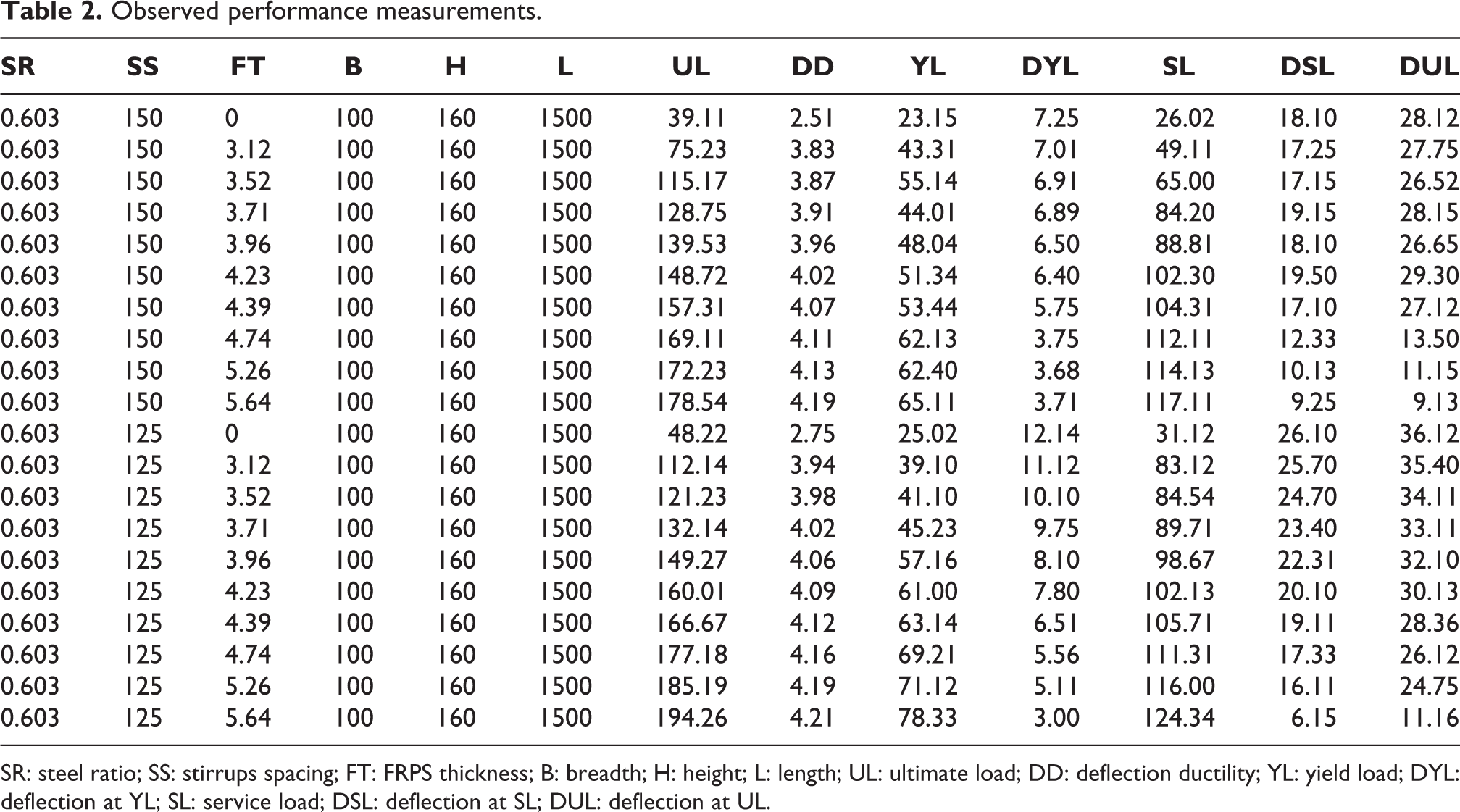
SR: steel ratio; SS: stirrups spacing; FT: FRPS thickness; B: breadth; H: height; L: length; UL: ultimate load; DD: deflection ductility; YL: yield load; DYL: deflection at YL; SL: service load; DSL: deflection at SL; DUL: deflection at UL.
Subsequently, another set of data of 49 FRPS-glued RCBs have been collected from the published articles available in the literature, 25 –31 which contains the dimensions, SR, spacing of stirrups, thicknesses of FRPS, YL, SL, and UL of all the beams.
Formation of data set
The purpose of ABM is to obtain the beam performances under extreme stress conditions for given dimensions and design parameters of the FRPS-bonded beams. The beam dimension and parameters such as the SR, SS, FT, B, W, and L of the beam are considered as inputs to the neural network. Analyzing the observed performances of Table 2, it is very clear that the enhancement of UL and DD improves the remaining performances listed in the table and hence are considered as the prime performance indicators of the beam. These two performance indicators are thus treated as outputs of ABM. The proposed ABM is, therefore, built with six inputs and three outputs. The number of hidden layers is chosen by a trial and error process. The input and output variables are also indicated in Figure 1. The training and testing data set comprising the input (X) and the target (T) vectors for ABM are taken from the experimental and collected data as mentioned below:

The output and hidden layer neurons are modeled by tangent hyperbolic and linear activation functions, respectively, and back-propagation is adopted for training the network. The training is performed by adjusting the connection weights to correctly map the training set vectors at least within a defined mean squared error limit during training. The development of ABM is explained through Figure 4.

Development of ABM. ABM: ANN-based model; ANN: artificial neural network.
Proposed IBDT
The proposed IBDT aims to find optimal design parameters such as SR, SS, and FT, for given beam dimensions of B, W, and L in such a way to maximize the prime performance indicators of UL and YL. The design problem can be tailored as a multiobjective optimization problem as follows:


where x represents the vector of design parameters, {SR, SS, FT}.
It employs FPO, which is inspired from the pollination process of transferring pollens among flowers through pollinators such as bats, birds, insects, and other animals, in obtaining the optimal design parameters of SR, SS, and FT that maximize the chosen objectives of UL and DD. There are two forms of pollination: abiotic and biotic. In biotic, the pollen is carried by a pollinator, while in abiotic, the pollination does not involve any pollinators. The pollination of 90% of plants are biotic, while the remaining 10% are abiotic. Pollination can be performed by cross-pollination or self-pollination. Cross-pollination represents the transfer of pollen from a flower of a different plant, while self-pollination is the fertilization of one flower from the pollen of the same flower or different flowers of the same plant, which usually takes place when there is no reliable pollinator available. As the pollinators such as birds and bees can fly a long distance, cross-pollination may happen at long distance. Such pollination can be referred to global pollination. Besides, birds and bees may possess Levy flight behavior with fly or jump distance steps obeying a Levy distribution. The flower pollination process of optimally reproducing the plants can be modeled as an optimization process by adapting the following four steps: Step 1: Cross- and biotic-pollination processes represent global pollination and the flying of pollinators obey Levy flight. Step 2: Self- and abiotic-pollination processes represent local pollination and do not require any pollinators. Step 3: Flower constancy, developed by insects, is on par with a reproduction probability representing the similarity of two flowers involved. Step 4: A switch probability
Although each plant may possess multiple flowers, which release billions of pollen gametes, it is assumed for simplicity that each plant possesses only one flower that releases only one pollen gamete. The design problem employing FPO involves the representation of design variables and the formation of a fitness function. In FPO, the pollen gamete of each flower represents a solution point xi of the chosen problem. Therefore, the pollen of each flower in FPO comprises the design parameters of SR, SS, and FT as follows:

The global and local pollinations are so performed that maximizes the following fitness function:

where w 1 and w 2 represent the relative weight parameters to UL and DD, respectively, and their sum should be equal to one.
The ABM model is employed to obtain the beam performances UL and DD for a given set of design parameters and beam dimensions. In global pollination, the insects transfer the pollen gametes over a long distance, thereby performing the pollination and reproduction of the fittest, flower*, and the global pollination step can be represented by:

where
Since pollinator travels to long distances using different distance steps, which is modeled by a Levy flight as follows:

where
The local pollination, represented by Steps 2 and 3, can be mathematically defined as follows:

where ε is a random number;
Most of the pollination are done by local flowers than those of distant flowers, which is controlled by a switch probability
The procedure of producing a new group of flowers by performing global and local pollination on a randomly generated initial group of flowers is denoted as an iteration. The group of flowers produced at the end of an iteration is treated as initial group of flower, and the iterative process is continued for a fixed number of iterations. The best flower possessing the largest fitness is taken as the optimal solution, after convergence. The iterative process of the proposed design method (PDM) is shown in Figure 5.
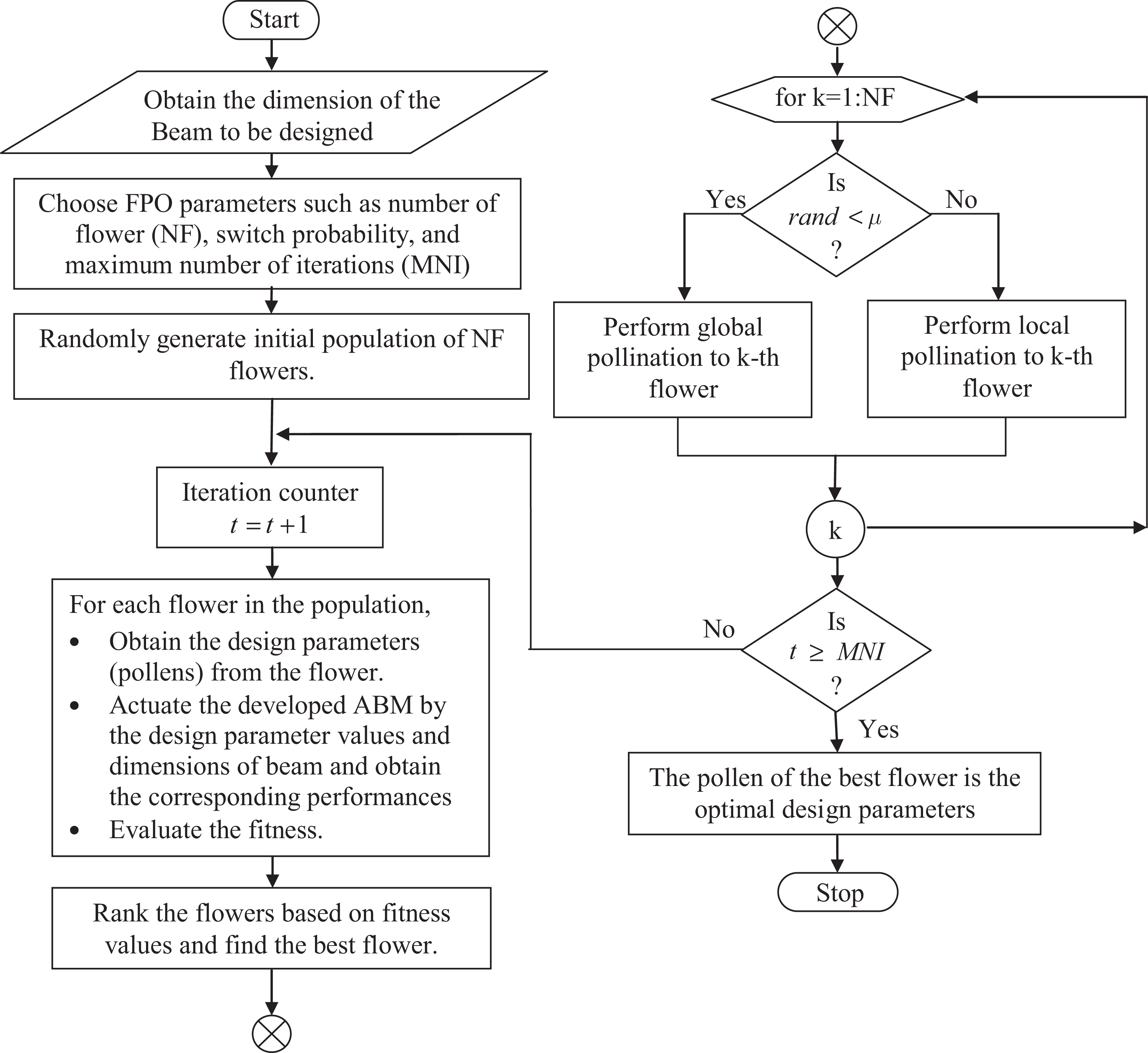
Flow of the IBDT. IBDT: intelligent beam design tool.
Results and discussions
The proposed IBDT has been applied in designing 5 RCBs with dimensions furnished in Table 3. The L of the beams ranging from 1100 mm to 3000 mm, while the W and B are in the range of 100–250 mm. The same design problem has also been solved by employing the existing GA- and PSO-based design procedure with a goal of portraying the superiority of the developed method. It is to be noted that IBDT-, GA-, and PSO-based methods employ the same ANN model developed in the previous section.
Size of the beams for optimal design.

RCB: reinforced concrete beams.
The parameters of five optimally designed RC beams (ORCB) by the IDBT, GA, and PSO methods are given in Table 4 and their performances of UL and DD are graphically compared in Figures 6 and 7. It is very clear from the figures that the proposed IDBT is able to provide the largest performances for both UL and DD for all RCBs compared to those of GA and PSO, thereby illustrating the superior performance of the developed method.
Optimal design by developed methods.

SR: steel ratio; SS: stirrups spacing; FT: FRPS thickness; ORCB: optimally designed RC beam; IBDT: intelligent beam design tool; GA: genetic algorithm; PSO: particle swarm optimization.

Comparison of UL performance. UL: ultimate load.

Comparison of DD performance: (a) UL and (b) DD. DD: deflection ductility; UL: ultimate load.
To experimentally validate and verify the performance of the optimal design of the proposed IDBT, ORCB-5 was constructed in the laboratory using the optimal SR, SS, and FT parameters of 0.876604, 166.737376, and 5.041747, respectively, and tested on the test bench. The experimental performances are compared with that of the simulation performances in Figure 8. It is very clear from the figure that the experimental values closely approach the simulation performances of the proposed IDBT, thereby validating the developed method.

Experimental comparison of the performances.
Conclusion
FPO is a population-based optimization algorithm for solving multimodal optimization problems. In this algorithm, problem solutions are represented by pollens of flowers and the pollination is related with sharing of pollens between local flowers and also from the global best flower. A set of RCBs with and without FRPS has been fabricated and tested for measuring various performance parameters. Employing both the experimentally obtained data and the data available in the literature, an ANN-based mathematical model for assessing the performances of RCBs bonded with FRPS has been developed. This ANN model is able to predict the performances in terms of UL and DD from a given set of design parameters. The problem of designing new RCBs with appropriate selection of FRPS with an objective of maximizing both the UL and the DD has been formulated and a method involving FPO has been developed to solve the formulated design problem. The optimal design obtained by the proposed IBDT is able to provide better design than those of GA- and PSO-based approaches. Besides the experimental results yielded the UL of 364.263 and DD of 4.864, which closely match with the simulation performances and validate the PDM. The limitation of the developed design tool is that it may not design curved beams and structures, as the ANN was modeled using straight beams’ data. The other objectives such as material cost, maximum crack W, number of cracks, and energy ductility can be considered in the proposed design approach as future work. The design procedure can be further enhanced by considering more data by fabricating and testing more number of RCBs with different parameters, adaptively tuning the FPO parameters, and developing hybrid FBO with other classical optimization techniques.
Footnotes
Acknowledgements
The authors gratefully acknowledge the authorities of SASTRA, Tanjore, Tamil Nadu, and Annamalai University for the facilities provided to carry out this work.
Declaration of Conflicting Interests
The author(s) declared no potential conflicts of interest with respect to the research, authorship, and/or publication of this article.
Funding
The author(s) received no financial support for the research, authorship, and/or publication of this article.
