




Abstract
For high-performance concrete (HPC) beams reinforced with hybrid Carbon Fiber Reinforced Polymer/Glass Fiber Reinforced Polymer (CFRP/GFRP) tendons, the nonlinear shell beam mixed element is studied and the whole mechanical process is analyzed. The CFRP/CFRP tendons are simulated with spatial beam element and the HPC beam is modeled with the layered shell element. With the coordination of nodal linear displacement and rotational displacement of CFRP/GFRP tendons element, the contribution of CFRP/GFRP element to stiffness matrix of nonlinear shell beam mixed element is deduced. Then, Jiang’s yielding criterion, Hinton’s crushing criterion, and so on, are used to describe the material nonlinearity of concrete. The new kind of nonlinear shell beam mixed element is achieved and the three-dimensional nonlinear calculation program is developed. The calculative results are consistent with the development trend of test results, which shows the correctness of the nonlinear shell beam mixed element and the reliability of the development program. The mixed element can accurately simulate the geometric configuration of CFRP tendons and realize the tension-compression-bending-shearing performance of CFRP tendons, which is helpful to fully reflect the reinforcement effect of reinforcement in the structure. The computational stiffness is defined and the stiffness degradation experiences three change processes. During the whole processes in the proposed typical load cases, the CFRP/GFRP tendons are still kept in the elastic stages.
Introduction
In practical engineering, steel corrosion severely affects the normal working conditions of the reinforced concrete structures or prestressed concrete structures and weakens the durability of the structure. Thus, how to improve the durability of the structure effectively becomes a hot research topic. 1 –3 It is proved in lots of achievements that substituting the high-performance composite tendons such as Carbon Fiber Reinforced Polymer/Glass Fiber Reinforced Polymer (CFRP/GFRP) tendons for regular steels is one of the effectual methods to resolve the problem of steel corrosion. 4,5 Undoubtedly, the high-performance composite steels have broad application prospects in bridge engineering and architecture engineering. Therefore, more attention has recently been focused on the mechanical characterizations of the concrete structures reinforced with the high-performance composite CFRP/GFRP tendons. 6 –9 The compressive responses of the concrete with fiber-reinforced composite tendons under cyclic loads are achieved through experiment research 10,11 and the whole course tests of the HPC beams with internal GFRP tendons and prestressed CFRP tendons are finished to achieve the deformations of the HPC beams and the strains of prestressed CFRP tendons. 12,13 Nonlinear mechanical performances of the limited quantity of beams with CFRP tendons are gained through failure experiment research and some design suggestions are broached for the beam with CFRP tendons. However, it is impossible that the failure experiments are always carried into execution to achieve the nonlinear performances of the HPC beams with fiber-reinforced CFRP/GFRP tendons, which makes how to derive the efficient theoretical computation methods with the finite valuable experiment data of the HPC beams with CFRP/GFRP tendons become quite significant. 14 –16 The HPC beam with fiber-reinforced CFRP/GFRP tendons is composed of several materials with different mechanical characterizations and how to derive the efficient nonlinear element model is the key to ensure the accuracy of mechanical analysis. 17,18 Currently, the macromechanical behaviors of reinforced concrete structure are mainly implemented with nonlinear combinative element. Except for the application of FRP tendons, there are also some research achievements about beam structures reinforced with FRP sheets. The experimental studies on the flexural performance of reinforced RC beams strengthened with prestressed hybrid CFRP/AFRP fiber sheets are carried out and the calculation formula of flexural capacity of the beams strengthened with fiber sheets is deduced. 19 –21 There are other important applications for glass materials. The structural laminated glass (LG) beams including reinforcement rods are investigated and special attention is spent on the effect of embedded rod features, consisting of GFRP, CFRP, or stainless steel reinforcement tendons, which can offer a certain benefit to the bending performance of traditional LG beams, including positive effects on stiffness, resistance, and redundancy. 22 Shape-memory alloy wires are used as an efficient reinforcing system for traditional LG panels, which are used as cladding walls in facades, having, in fact, typically high size-to-thickness ratios, and major restrictions in design are proved by prevention of glass failure and large deflections. 23 Some other experiments are completed on the flexural performance of RC beams strengthened with CFRP/GFRP sheets and the tensional anchorage fixture of prestressed hybrid CFRP/GFRP sheet is improved to ensure that the fiber sheet does not peel and the tension stress of FRP from the reading of torque wrench is precisely controlled. 24 –26 Through the relevant research, the author has achieved that hybrid fiber CFRP/GFRP composite materials can make use of the advantages of different fibers and optimize the comprehensive mechanic performance of the fiber composite material. At the same time, it can significantly reduce the cost, and the mixed level of prestressed CFRP/GFRP fiber sheet, namely the optimal mixture ratio between the CFRP material and GFRP material, has been gained. 27 At present, the research results of composite-reinforced beams mainly focus on the experimental aspect, and it is undoubtedly of great significance to carry out the nonlinear finite-element numerical analysis.
In the studied reinforced concrete structures, the CFRP tendons have the properties of corrosion resistance, lightweight, high strength, small elastic modulus, and so on, which can be a substitute for the prestressed steels. As for HPC beams with fiber-reinforced CFRP/GFRP tendons, the prestressed CFRP tendon and the GFRP tendon are modeled by spatial beam element and HPC beam is modeled by layer shell element, and then, a new three-dimensional nonlinear shell beam mixed element is constituted. Based on the compatibility of displacements and rotations of the nodes of CFRP tendon element, the contribution stiffness matrix of the prestressed CFRP element to the shell beam mixed element is attained. The nonlinear analytical procedure is compiled and the typical examples are analyzed.
Shell beam mixed element for HPC beam with fiber-reinforced CFRP/GFRP tendons
Degraded shell element
The structural behaviors of concrete, such as yield and cracking, need to be expressed by integration along with the direction of shell thickness. The layered method is simple and effective to solve this problem. The integration problem of discontinuous function is transformed into the summation problem of finite-term series. At the same time, a large number of ordinary steel bars in the beam can also be treated by layer elements, which can ensure the engineering accuracy. In this article, the shell beam mixed element is used to simulate the bending of the prestressed CFRP tendon. In Figure 1, the curved coordinate system is noted as

where

(a) Coordinate system and (b) rotational displacement of degraded shell element.
Shell beam mixed element
The prestressed CFRP tendons in the HPC beams can be tackled as a combinative element because they are the main reinforcements. The yield strength of the GFRP tendon is evidently higher than that of the steel, thus, the GFRP tendon can be replaced for the common steel to become the configuration reinforcement, which can be tackled as beam element like the CFRP tendon in degraded shell element in Figure 2. The total Lagrange bar element is applied to deal with prestressed CFRP tendon, and then, a kind of the beam shell mixed element is generated. 26 Unfortunately, the total Lagrange bar element, which can only embody the axial tensile–compressive characteristics of the CFRP tendons, fails to depict the main shearing or bending characteristics. In comparison with the total Lagrange bar element, the adopted beam element is able to realize the comprehensible reinforcement effect of the prestressed CFRP tendons. Thus, the prestressed CFRP tendons are modeled by spatial beam element, and then, based on the principle of the displacement compatibility and virtual work, the nonlinear shell beam mixed element is generated.

Shell beam mixed element with CFRP/GFRP tendons.
The CFRP tendon is modeled by spatial beam element and it is assumed that the bonding property between the CFRP tendon and concrete material is perfect, which means the compatibility of displacement that can also be explained as the linear displacements and the rotational displacements of the CFRP tendon is the same as those of the concrete at the same node. From interpolation with shape function, the displacement field functions of the degraded shell element are achieved as





where n is the node number of the degraded shell element, Nr
is the shape function of the r’th node, hr
is the node thickness at the r’th node.
The shell beam mixed element is shown in Figure 2, where the prestressed CFRP tendon is simulated by spatial beam element. In Figure 3, the nodes of the prestressed CFRP tendon element are denoted as A and B. Through the displacement field function equations (2) to (7) of the degraded shell element, the linear displacements and the rotational displacements of the beginning node A and the ending node B are expressed with the node displacements of the degraded shell element as


where

Similar with the CFRP tendon, the GFRP tendon can be tackled in degraded shell element in the same way. As for
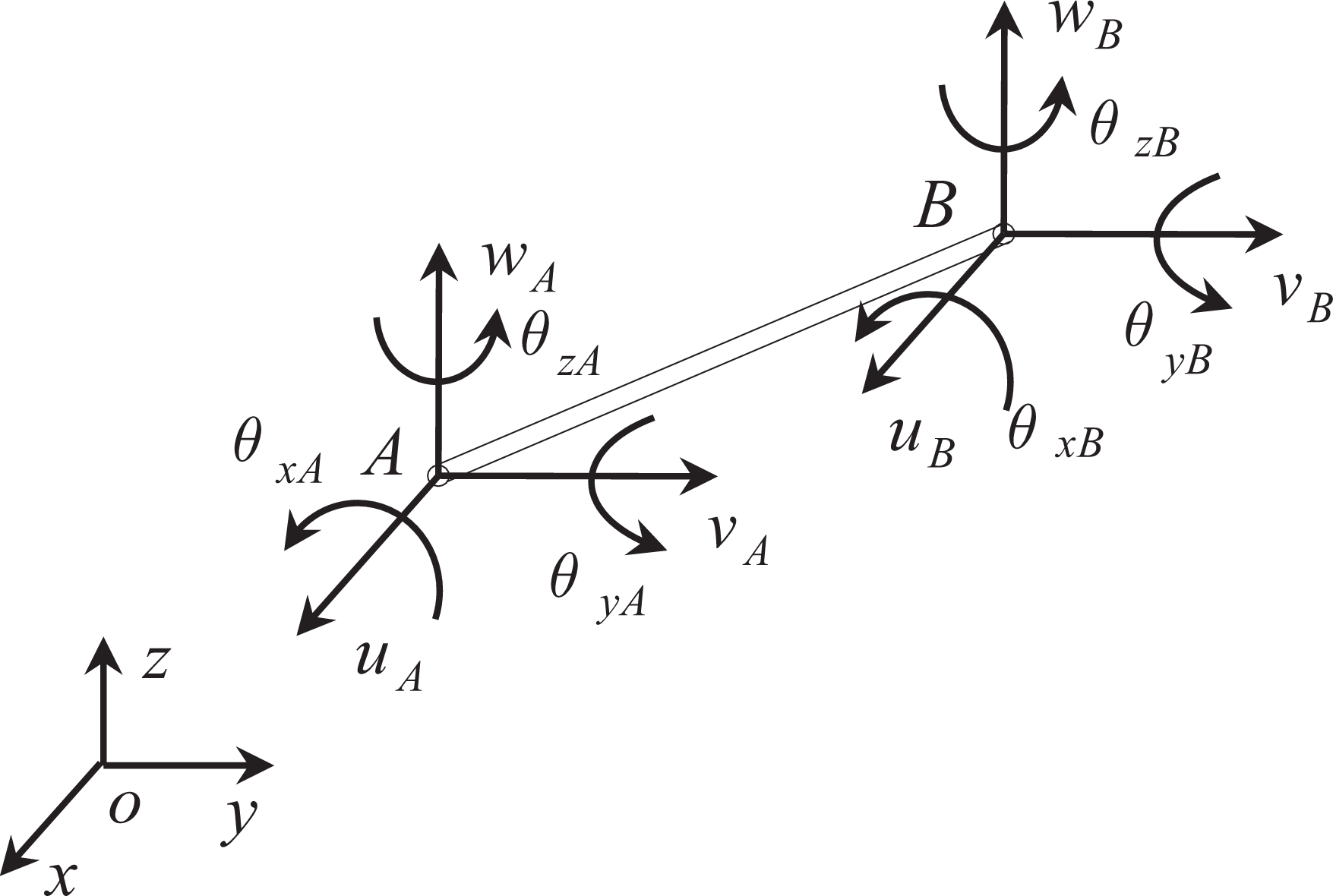
Spatial beam element of CFRP rebar.
The contribution matrix of the CFRP/GFRP tendon element to the shell beam mixed element is derived as

where

Layered shell element model.
Then, the stiffness of the shell beam mixed element can finally be achieved as

where
After the establishment of the nonlinear finite-element model for the HPC beam reinforced with hybrid CFRP/GFRP tendons, the whole failure process of the structure can be calculated and analyzed according to the experiment or design scheme. The ultimate load of the structure can roughly be predetermined by trial calculations in advance, and then, the ultimate load can be divided into several load increment steps for iterative calculations. The displacement convergence criterion can be used in each increment step, which is the same as that in the literature. 27
Material model of the shell beam mixed element
Material model of HPC
The tensile strength and the compressive strength of the HPC in the HPC beam are evidently elevated in comparison with common concrete material. The degraded shell element lies in three-dimensional stress state because the transversal shearing effect is considered in it. The material nonlinearity of the HPC is described with Jiang’s four-parameter yielding criterion as

where I
1 is the first constant of the two-order stress tensor. J
2 is the second constant of the two-order deviatoric stress tensor.
The crushing behavior is linked to concrete strain, and the Hinton’s crushing model is combined with the expression as

where
Material model of GFRP tendon
The GFRP tendon has much higher tensile strength, which makes it generally lie in the elastic stage during the whole course analysis of concrete beam structure. To research the mechanical performances of the GFRP tendon in the whole course analysis, the linear mechanical model is used to depict the GFRP material. The GFRP tendons in the nonlinear shell beam mixed element are managed when the GFRP tendon reaches the tensile strength.
Material model of CFRP tendon
According to corresponding experiments, the tensile strength of the CFRP material can reach a fairly large data of 2400 MPa, which is nearly seven times as the ordinary prestressed steel. Due to the high strength property of the CFRP material and strong resistance of corrosion, it can sometimes be designed into the prestressed CFRP tendon. The assumption is that before the prestressed CFRP tendon reaches the tensile strength and ruptures, it lies in perfect elasticity state, which can also be understood that when the prestressed CFRP tendon reaches the tensile strength, it fails at all.
Establishment of the mechanical model and analysis of the example
Experiments of the specimen beams
The specimen beams in the experiments are, respectively, numbered the specimen beam 1 and 2, 10 which have the same total length, the computed span, and the sectional dimension. The total length is 3700 mm, the computed span is 3500 mm, and the sectional dimensions are 150 × 250 mm2. The CFRP tendons and the common steels in the specimen beams are shown in Figure 5 and the design parameters are listed in Table 1, where the jacking control stress refers to the maximum stress that can be jacked with the CFRP tendon and the effective prestress refers to the actual stress stored in the structure after deducting the loss of prestress. The bonded prestressed reinforcements in the two specimen beams are all the CFRP tendons of 1Φ12.5. The common reinforcements in the specimen beam 1 are the GFRP tendon and those in tensile region of the specimen beam 2 are the common steels, which are called tensile tendons in Table 1. The concrete material is the HPC of grade 50, which is reinforced with polypropylene monofilament fiber to improve the early mechanical performance. The compressive and tensile strengths of the HPC, the tensile strength and the ultimate tensile strains of the GFRP and CFRP tendons, and other material properties are presented in Table 2.
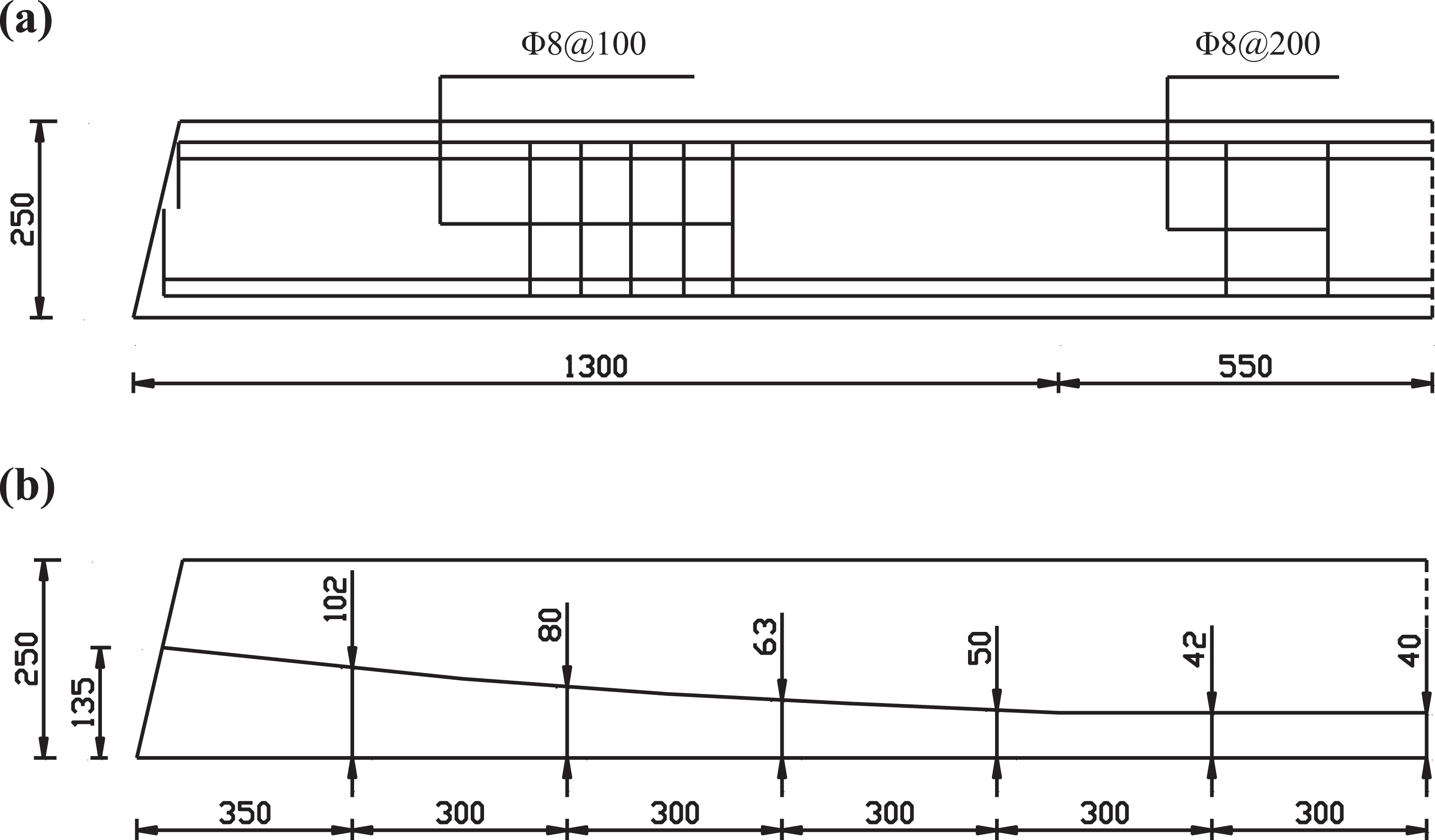
Disposition of the prestressed CFRP tendon in the HPC beam. (a) Common steels and (b) CFRP tendons. HPC: high-performance concrete.
Parameters of the two specimens of concrete beams with prestressed CFRP tendon.

Material properties of CFRP, GFRP, and concrete.

Calculative results of the specimen beams
According to the derived nonlinear shell beam mixed element and material models of the CFRP tendon, the GFRP tendon, and HPC, the computational procedure called NONCGB.for is successively written and developed in FORTRAN language. The typical HPC beams selected from the literature 10 are analyzed in detail to verify the correctness and reliability of the derived element and the developed procedure. The finite-element model of the specimen beam is found with a nonlinear shell beam mixed element, where the prestressed CFRP tendon and the GFRP tendon in the specimen beam 1 are modeled with spatial beam element and the HPC and the common steels are all modeled with layered shell element. The specimen beam is divided into 60 elements, where the number of the shell beam mixed element is 12.
For the one-third load case in Figure 6, the added loads at each load position in each load step are 3.0 kN, it is that the total added loads in each load step are 6.0 kN. Based on the developed three-dimensional nonlinear computational procedure, the midspan deformations of the two specimen beams in each load step and the strain increments of the prestressed CFRP tendons together with the corresponding experimental data are achieved in Figure 7.

One-third span load case in the experiment.
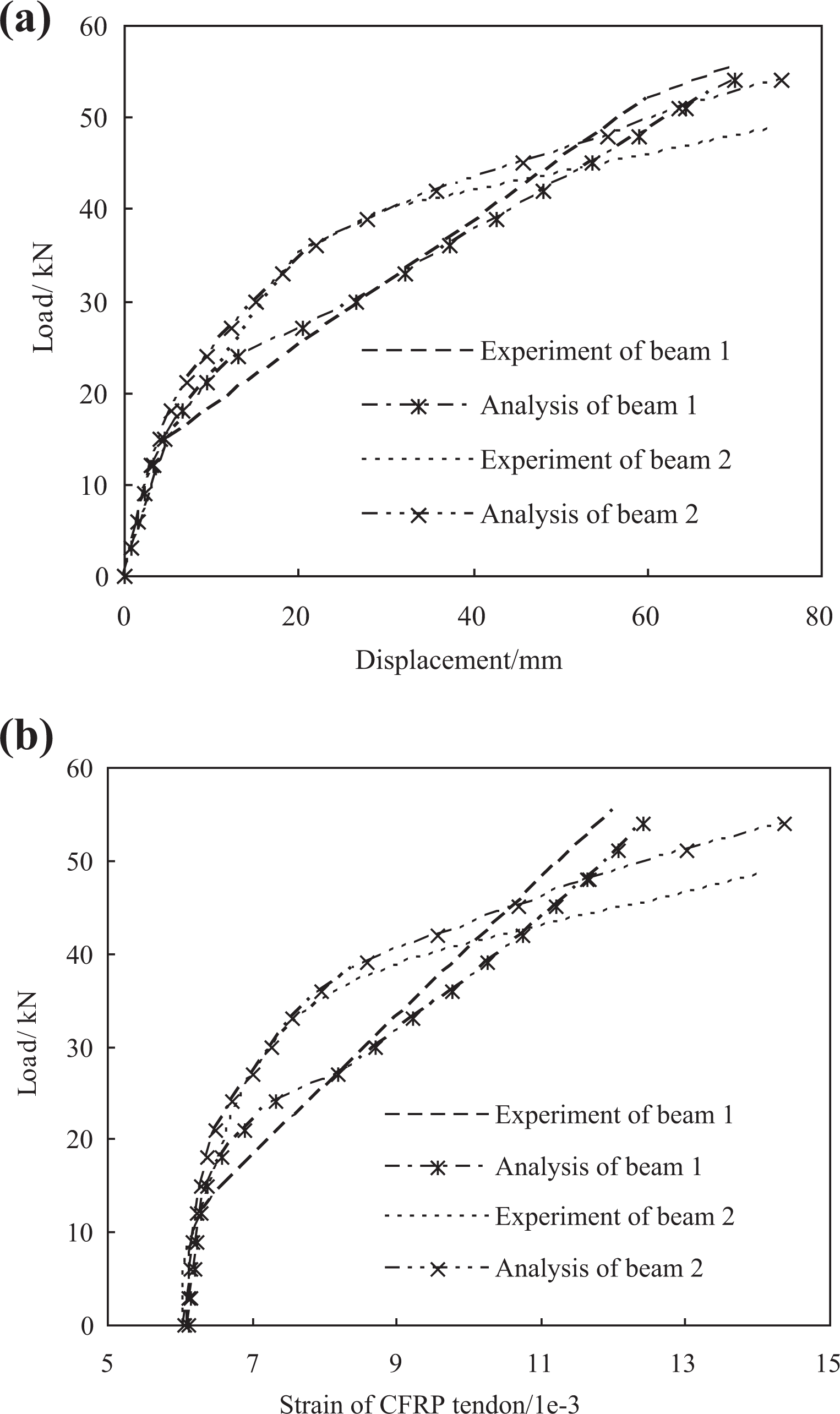
Displacement and CFRP strain of midspan of the two specimen beams. (a) Midspan displacement and (b) CFRP strain.
From the comparison with the computational results and experimental data in Figure 7, it is indicated that the midspan deformations of the two specimen beams and the strain increments of the prestressed CFRP tendons achieved from the developed nonlinear finite-element procedure have the same development trends as the experimental data. The calculative results are in satisfying agreement with those experiment results, which proves the accuracy of applying the nonlinear shell beam mixed element in the HPC beams strengthened with the CFRP and GFRP tendons, the correctness of the developed procedure, and the rationality of the relevant criteria, depicting the material nonlinearity of the HPC. When the added loads reach about 18 kN, there exists an inflexion in the curve of the midspan deformation of the specimen beam 1 and in that of the strain increment of the prestressed CFRP tendon. After that, the two curves in the specimen beam 1 keep linear until the beam structure fails, which is different from the specimen beam 2. After the first inflection point of the specimen beam 1 in Figure 7(a) appears, the GFRP tendons keep linear elasticity until the structure fails, and there is no second inflection point. However, after that of the specimen beam 2 in Figure 7(a) appears, the common steels also keep linear elasticity until the second inflection point appears, but then the common steels enter the elastic-plastic stage until the structure fails. From the strain development data of the CFRP tendon in Figure 7(b), it is shown that due to the high strength property of the CFRP tendons, those two prestressed CFRP tendons are both retaining in the elastic stage, whose actual strains are both below the ultimate strain.
Computational results of different load cases
To comprehensively research the mechanical performances of the HPC beams reinforced with the CFRP and GFRP tendons, the typical uniform load case for the specimen beam 1 shown in Figure 8 is confirmed to complete the whole course analysis. To make comparisons conveniently, the added loads in each load step are uniformly kept 6.0 kN in the whole course analysis. In Figure 8, the uniformly distributed load q in each load step is 1.7 kN/m. From the computational procedure of the nonlinear shell beam mixed element, the results of the midspan deformation development, the strain development of the CFRP tendon, and that of the GFRP tendon of the HPC beam strengthened with the CFRP and GFRP tendons in the two typical load cases are achieved in Figure 9.

The uniform load case.

Computational results of the two different load cases. (a) Midspan displacement, (b) CFRP strain, and (c) GFRP strain.
From the results in Figure 9, the regularities of the midspan deformation development, the strain development of the CFRP tendon, and that of the GFRP tendon of the HPC beam appear to be uniform on the whole. Due to the prestress effect of the prestressed CFRP tendons, the GFRP tendons initially exist in the compressive stress state when the HPC beams are subjected to the initial loads. Then, when the added loads are increased, the compressive strains of the GFRP tendons are gradually converted into the tensile strains. However, the maximum tensile strain of the GFRP tendons in the two typical load cases, which is equal to 9.8 × 10⁻³, is evidently below the ultimate tensile strain, and therefore, the GFRP tendons are kept in the elastic state. Similarly, due to the high strength of the CFRP tendons, the maximum tensile strain of the CFRP tendons in the two typical load cases, which is equal to 13.0 × 10⁻³, is also below the corresponding ultimate tensile strain, which is equal to 16.8 × 10⁻³, and thus, the GFRP tendons are kept in the elastic state as well. The structural response under uniform load in Figure 8 is generally better than that under concentrated force in Figure 6, which can also be understood from the mechanics of materials. For homogeneous beams, the maximum bending moment under uniform load is only one-twelfth of that under concentrated force. Therefore, the allowable load of the beam under uniform load is several times larger than that under concentrated load.
Sensitivity analysis of computational stiffness degradation
From the results in Figure 9(a), the computational stiffness degradation is researched and the computational stiffness is herein defined as the ratio of the load to the corresponding displacement. To reflect the essence of the problem, the stiffness results are normalized to 1, that is, the maximum initial secant stiffness is treated as 1. Thus, the results of the normalized computational stiffness degradation are gained in Figure 10.

The results of the normalized computational stiffness degradation.
It can be achieved from Figure 10 that the stiffness degradation has experienced three change processes. In the initial linear elastic stage, the computational stiffness basically remains unchanged; afterward, the stiffness gradually degenerates until the second inflection point. Then, the stiffness is degraded rapidly until the structure fails. For one-third load case, the normalized computational stiffness is 1 while that is only 0.683 in uniform load case. Because under the same added loads, the computational stiffness of the first load case is larger than that of the second, which is also indicated in Figure 9(a). Therefore, the degradation of computational stiffness is sensitive to the concentration degree of load distribution, that is, when the load distribution is more concentrated, the computational stiffness degradation is more serious, and vice versa.
Conclusions
The nonlinear shell beam mixed element is derived in which the prestressed CFRP/GFRP tendons are modeled with the spatial beam element. The HPC and the common steels are modeled with shell element. The contribution matrix of the spatial beam element of the prestressed CFRP/GFRP tendon to the nonlinear shell beam mixed element is also derived. The computational results of the midspan deformation and the strains of the prestressed CFRP tendons are in satisfying agreement with the experiment achievements, which validates the correctness of the derived nonlinear element and the reliability of the developed procedure.
For three-dimensional structure simulation analysis of the HPC beam reinforced with the CFRP/GFRP tendons, it is quite important to actualize the spatial prestress effect of the CFRP tendons. The spatial beam element can synchronously take the tensile, compressive, shearing, and bending mechanical performances into consideration, which can comprehensively reflect the reinforcement effect on the studied structures.
When the tensile region reinforcement is the GFRP tendon, the curves of the midspan deformation and the strain of the CFRP tendon are both kept linear on the whole until the beam fails after an inflexion appears, which distinctly differs from the case that the tensile region reinforcement is the common steel. After the first inflection point of the specimen beam 1 appears in the load–displacement curve, the GFRP tendons keep linear elasticity until the structure fails, and there is no second inflection point. However, after that of the specimen beam 2 appears, the common steels also keep linear elasticity until the second inflection point appears, but then the common steels enter the elastic–plastic stage until the structure fails.
Footnotes
Declaration of conflicting interests
The author(s) declared no potential conflicts of interest with respect to the research, authorship, and/or publication of this article.
Funding
The author(s) disclosed receipt of the following financial support for the research, authorship, and/or publication of this article: This work was supported by the Fundamental Research Funds for the Central Universities [No. NS2020009], the National Natural Science Foundation of China [Nos 41272325 and 11232007], Jiangsu Transportation Science and Technology Project of China [No. 2019], and Research Fund of STECOL Corporation [No. KJ-2019-032].
