




Abstract
The coupling interaction between nonlinear solitary waves in one-dimensional granular chains and damaged composite material plates is considered. Based on Hertz contact law and meso-mechanical model of stiffness reduction of composite material plates when the fiber breakage is the main damage mode, the coupled differential equations of particle chains and damaged composite material plates are derived. By solving the differential equations with Runge–Kutta method to get the velocity and displacement curves of particles and analyzing the delays and amplitude ratios of reflected waves, it is found that the damage quantity, fiber volume fraction, and thickness of damaged composite material plates as well as gravity have an effect on solitary waves. The preliminary research results provide a theoretical basis for nondestructive testing of damaged composite material plates by using solitary waves.
Introduction
The research fields of composites include metal matrix composites, ceramic matrix composites, and polymer matrix composites. Fiber-reinforced polymer composites have been widely used in high performance structures due to their excellent mechanical properties, and the assessment of fatigue damage status and remaining life prediction of FRP composite structures has become a hot issue. Residual stiffness is an important parameter in nondestructive testing (NDT), 1,2 which is reasonable to characterize the fatigue damage accumulation of the composite material. 3,4 A novel method for nondestructive evaluation of damaged composite material plates using highly nonlinear solitary waves (HNSWs) is introduced in the present article.
The propagation of HNSWs in one-dimensional particle chains composed of tightly arranged and elastic contact particles has recently been studied extensively across many research fields. 5,6 Solitary waves propagate in a granular chain as compactly supported nonlinear waves, whose amplitude and velocity depend on size, geometry, the properties of the elastic chain particles, and the disturbance amplitude. 7 –10 Mackay 11 demonstrated experimentally that the propagation of solitary waves in particle chains follows the Hertz contact law. Job et al. 12,13 found that the main characteristic reflection of solitary waves depends on the mechanical properties of the contact medium, which provided an experimental basis for the application of solitary waves in NDT.
Nonlinear solitary waves in one-dimensional particle chains have also been successfully used to develop NDT methods to evaluate the basic mechanical properties of materials and structures. 14 –18 Yang et al. studied the reflection of solitary waves from linear elastic media, 19 thin plates, 20 and orthopedic implant 21 during the period of interaction. They found that the delays and amplitude of the reflected waves are highly sensitive to the structures Young’s modulus, geometry, and boundary conditions and confirmed that solitary wave detection can be applied to medical field. Other authors have investigated the possibility of using solitary waves in the particle chain for NDT of the internal pressure and the rubber degradation of tennis balls, 22 measurement of the strength of concrete surfaces, 23 the detection of the axial stress of the beam, 24 and assessment of elastic solids containing a spherical void 25 as well as rigid polyurethane foams, 26 and more.
Recently, some studies examined numerically and experimentally the interaction between solitary waves in particle chains and laminated composite beams, the results of this study indicated that the reflected solitary waves are highly sensitive to directional variations of the flexural modulus. 27,28 Kim et al. 29 experimentally and numerically analyzed a detection method based on HNSWs, which diagnosed hidden delamination in composite panels, the research results demonstrated the possibility of detecting non-visible defects in fiber-reinforced composites.
In this study, we use theoretical and numerical approaches to examine the interaction of solitary waves with fiber fracture composite material plate. By varying some properties of damaged composite plates, we study the effect of the damage, fiber volume fraction, and thickness of damaged composite material plates on the travel time and wave amplitude of reflected solitary waves.
The outline of this article is as follows: In “Theoretical model” section, we describe the theoretical model of coupling of particle chains and damaged composite plates. In “Numerical results” section, the details of numerical calculation are given and the measurement results are discussed and analyzed. In “Conclusions” section, we summarize some conclusions of this study.
Theoretical model
A one-dimensional horizontal particle chain model is established to study the interaction between solitary waves and adjacent damaged composite plates. As sketched in Figure 1, the initial position of the particle chains and the middle surface of the damaged composite material plate are represented by dotted lines, after the initial velocity v is applied to the first particle, the position of each particles and damaged composite material plate (thickness h) are represented by solid lines.

Coupling between particle chains and damaged composite material plate.
The collision between particles will produce a stress wave propagating with velocity Vs forward, which is called HNSWs.
Differential equation of particles
It is assumed that the Hertz contact law is satisfied among particles. As shown in Figure 1, under the impact of the first particle, the displacement of the ith particle from the initial position is Ui (i = 1,…, N), the compression between the (i – 1)th particle and the ith particle is δi = [Ui− 1 - Ui]+, and the meaning of [Ui− 1 − Ui]+ is max (Ui− 1 − Ui, 0).
The first particle is only affected by the second particle. According to Newton’s second law and Hertz contact law, the differential equation of the first particle is given by

where
The ith particle is simultaneously subjected to the forces of the (i-1)th and (i+1)th particles. The differential equation of the ith particle can be written as

When the terminal particle interacts with the plate, there will be two kinds of displacement: the compression δ between the terminal particle and the plate as well as the lateral displacement UN+1 of the plate. The relation between them and terminal particle displacement UN is given by

Assuming the contact force between the terminal particle and the composite material plate is F. According to the Hertz contact law applicable to composite materials, 30 the relationship between the contact force and compression is

The equivalent elastic modulus of composite material

where
The differential equation of the terminal particle is obtained by combining equations (3) and (4).

Differential equations of damaged composite material plate
According to the micro-mechanical model of composite materials, the elastic properties of fiber-reinforced composites are determined by the percentage of matrix and fiber, respectively. The elastic constant of a single-layer board can be written as

where
Figure 2 shows the damage model of fiber breakage. 31 Ignoring the effect of longitudinal matrix crack, the effect of fiber breakage on damaged composite material plate (length a, width b) is only related to the percentage of fiber breakage and the length of degumming at the fiber–matrix interface.

Schematic diagram of fiber breakage.
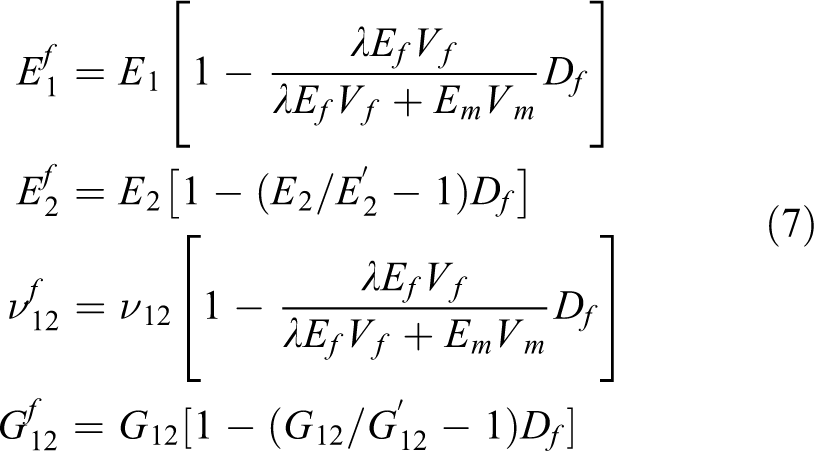
The four elastic constants
The percentage of fiber breakage Df can be expressed as
Here,

where
The thickness of composite material plate is smaller than other dimensions of the structure in the engineering research (the composite material plate considered in this article is a thin plate), it is generally assumed to be the plane stress state in the analysis and design of composite materials, therefore, stress–strain relationship of orthotropic single-layer plate can be expressed as follows

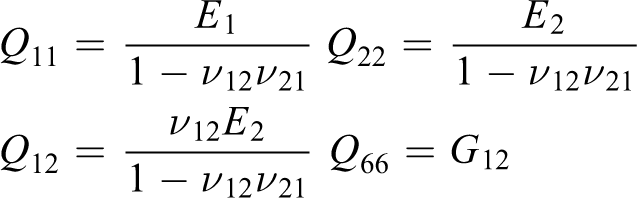
Stiffness coefficient can be expressed as
The midplane coordinate axis of the orthotropic single-layer plate is consistent with the elastic direction. The bending stiffness matrix can be expressed as

The force between the terminal particle and the damaged composite plate is simplified as concentrated force F. We use the principle of minimum potential energy to solve the bending problem of special orthotropic plates, the total potential energy of the plate is

Boundary conditions of four-sided simply supported plates are

Using the Rayleigh–Ritz method, the deflection w is expressed as

The deflection at the contact point between the terminal particle and the damaged composite material plate is the lateral displacement of the plate from the initial position. Assuming that the particle chain acts on the center of the damaged composite material plate, the second-order approximation of the deflection is obtained.

The second derivative of equation (12) with respect to time can be obtained.

Here,
According to equations (1), (2), (5), and (13), we obtain complete differential equations.

If the particle chains are placed vertically, the coupled differential equations are

where, the value of δi* is as follows

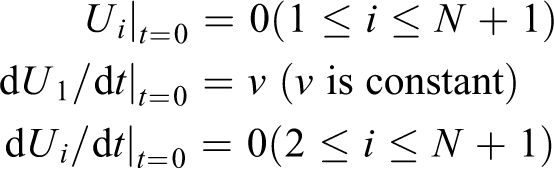
Equations (14) and (15) are composed of N + 1 second-order differential equations, and the initial conditions are
Numerical results
The second-order differential equations are solved by Runge–Kutta method. We analyze the effects of damage, fiber volume fraction, and thickness of damaged composite material plates as well as gravity on solitary waves. It is assumed that the particle chain is composed of 25 stainless steel spheres with radius of 4.76 mm, density of 7800 kg/m3, Poisson’s ratio of 0.28, and Young’s modulus of 200 GPa. The initial velocity of the first particle is 447.2 µm/ms. In all calculations performed here, we use the perturbation velocity of the 13th particle to represent the propagation of HNSWs in the chain in all calculations performed here.
The effect of damage on solitary waves
It is assumed that the fiber and matrix of GFRP composites have longitudinal tensile modulus of Ef = 74 GPa and Em = 3.2 GPa, shear modulus of Gf = 30 GPa and Gm = 1.2 GPa, Poisson’s ratio of vf = 0.32 and vm = 0.356, and the plate with a size of 1000 × 1000 mm2. Other parameters of composite material plate: elastic modulus E1 = 45 GPa, E2 = E3 = 10 GPa, Poisson’s ratio v12 = 0.28, and shear modulus G12 = 4 GPa.
In Figure 3, we present the perturbation velocity curve of the 13th particle upon the damage quantity Df. The damage quantity of these two composite material plates is Df = 0.1 and Df = 1. For the case Df = 0.1 (Figure 3(a)), the arrival of the incident wave (IW) at 13th particle is observed at time tin = 0.2129 ms and the amplitude of the incident velocity (Ain) is 304.3 μm/ms. The interaction between the incident solitary wave and the damaged composite material plate results in multiple reflected solitary waves. The primary solitary waves (PSWs) and secondary solitary waves (SSWs) propagate to the 13th particle at time tPSW = 0.6267 ms and tSSW = 0.7888 ms, respectively.

The curves of the perturbation velocity of 13th particle: (a) Df = 0.1 and (b) Df = 1.
It can be seen from Figure 3(b), the damage quantity Df = 1 is considered, PSW and SSW appear later, and the amplitude of the reflected solitary wave becomes smaller. The increase of D f means that the damage degree is more serious. When the terminal particle interacts with the plate, the bending stiffness of the composite material plate decreases and the transverse displacement of the contact point increases with the increase of D f . Therefore, the duration of the PSW and SSW propagating to the 13th particle becomes longer, and the APSW and ASSW become smaller.
The delays represent the time interval between the IW and the reflected wave reaching the 13th particle. We define the following four parameters, the delays and the amplitude ratios of PSW and SSW can be written as

Figure 4 shows the change rule of f and τ, corresponding to composite material plate with the damage quantity from 0.1 to 1. The results indicate that τPSW and τSSW gradually increase but range of variation is small, fPSW and fSSW gradually decrease, and the value of fSSW is close to 0.

The effect of damage quantity Df on f and τ.
The effect of fiber volume fraction on solitary waves
Fiber content is an important parameter in the design of microstructure of composites. In the following analysis, we discuss the effect of the change of fiber volume fraction of the damaged composite material plate on the solitary waves. Figure 5 shows the curve of the delays and amplitude ratios changing with fiber volume fraction Vf, and lies within the range of 0.1 ≤ Vf ≤ 0.9 for the damaged composite material plate (Df = 0.3) considered here. As seen from equations (6) and (7), the increase in fiber volume fraction Vf, affecting elastic constant and bending stiffness of damaged composite plates, effectively increasing the amplitude of reflected wave and decreasing the delays of reflected wave.
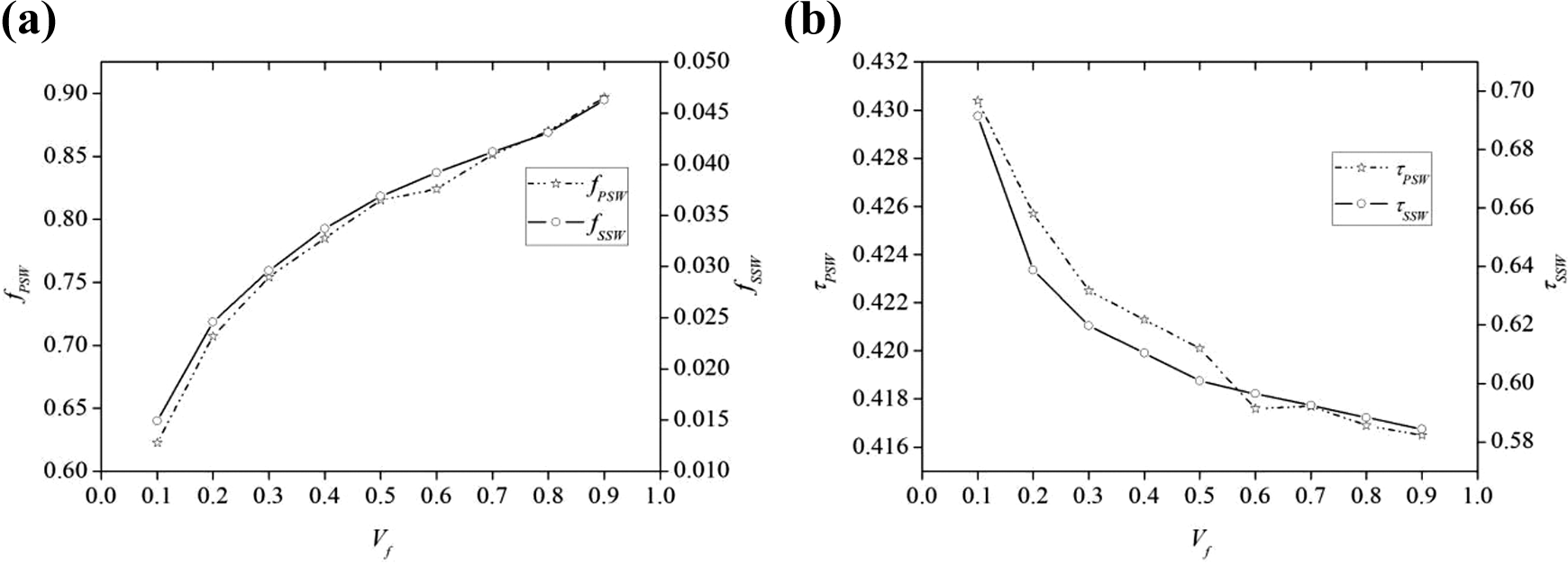
The effect of fiber volume fraction Vf on f and τ.
The effect of thickness on solitary waves
It can be seen from Figure 6 that the horizontal granular chain interacts with the damaged composite material plate (Df = 0.3) of thickness h = 12 and 50 mm, respectively. We notice that particle chain collides the plate of thickness h = 12 mm, possibly due to the occurrence of smaller plate thickness. The surface layer of the plate has a sharp vibration and the vibration amplitude even exceeds the displacement of each particle, APSW and ASSW are relatively small (Figure 6(a) and (b)). The composite material plate can be regarded as a composite material semi-infinite space body when the thickness of the plate is 50 mm or larger, PSW and SSW appear earlier and APSW and ASSW increase (Figure 6(c) and (d)). The same conclusions are obtained when the particle chain is placed vertically, as shown in Figure 8.

The velocity and displacement curves in horizontal granular chain: (a) velocity curve: h = 12 mm; (b) displacement curve: h = 12 mm; (c) velocity curve: h = 50 mm; and (d) displacement curve: h = 50 mm.
In Figure 7, prediction of the effect of the thickness h and measurement range of 10 ≤ h ≤ 60 are considered. As seen from equations (9) and (12), the transverse displacement at the contact point of damaged composite material plate decreases with the thickness of the plate increases, which leads to the acceleration of the rebound process of reflected solitary wave and the delays gradually decreases. As the thickness increases, damaged composite material plate almost do not produce transverse vibration and the plate dissipation energy is more and more small, therefore, amplitude ratio gradually increases and the values of f and τ tend to be stable. In addition, a large amount of energy dissipation cause that the particle chain and damaged composite material plate cannot rebound again when the thickness of the plate is 12 mm or small.
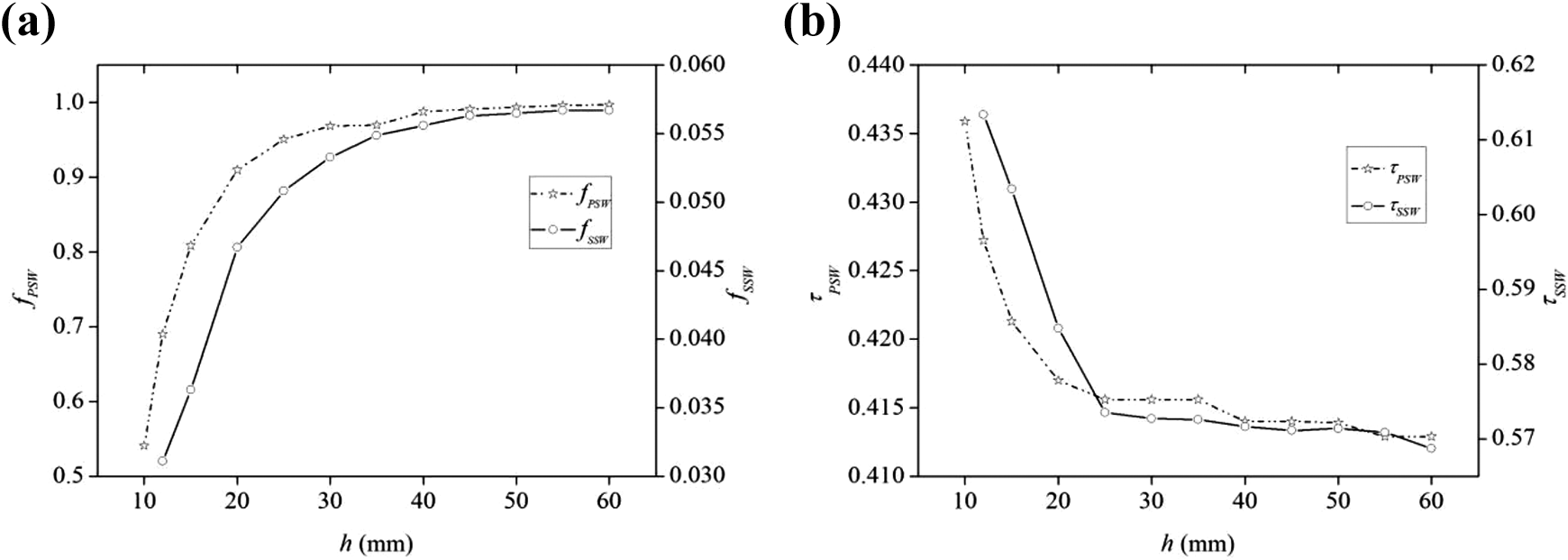
The effect of thickness h on f and τ.
The effect of gravity on solitary waves
For comparison, the restricted particle chain is placed vertically. Pre-compression is generated due to the influence of gravity, which makes the propagation distance of the reflected solitary wave become shorter, while the propagation speed of the solitary wave remains unchanged. By comparing the Figures 6 and 8, it is found that the reflected solitary wave in the vertical particle chain reaches the 13th particle slightly earlier than that in the horizontal particle chain.

The velocity and displacement curves in vertically granular chain: (a) velocity curve: h = 12 mm; (b) displacement curve: h = 12 mm; (c) velocity curve: h = 50 mm; and (d) displacement curve: h = 50 mm.
Conclusions
Based on the results and discussions of the coupling mechanism of one-dimensional particle chain and damaged composite material plates, the following four conclusions can be drawn. The PSW is sensitive to the damage of fiber breakage composite plate. The existence of damage affects the coupling of particle chain and composite material plate. The damage degree of composite material plate can be evaluated by the variation law of primary reflected solitary wave. The amplitude ratios increase and the delays decrease of the reflected solitary waves with the increase of fiber volume fraction. The change rule can be used to determine whether the fiber content in composite material plate is reasonable. The thickness of the plate can be detected according to the occurrence of reflected wave and the variation of amplitude, and the influence range is 12–60 mm. This result indicates that the thickness of the composite material thin plate plays a leading role in the formation of reflected solitary waves. Gravity causes pre-compression among particles in vertically granular chain. The effect of gravity makes it take less time for the reflected solitary wave to reach the 13th particle.
As a new nondestructive evaluation tool, one-dimensional granular chains can be used to detect some properties of damaged composite material plates by using the sensitivity of HNSWs to materials.
Footnotes
Declaration of conflicting interests
The author(s) declared no potential conflicts of interest with respect to the research, authorship, and/or publication of this article.
Funding
The author(s) disclosed receipt of the following financial support for the research, authorship, and/or publication of this article: This work was supported by the Natural Science Foundation of Shaanxi Province (nos 2018JM1028 and 2018JM1033) and the Central University Special Funds of China (grant number 310812171003).
