




Abstract
An anti-/deicing component of composite materials for wind turbine blades is usually carried out under heating conditions. In order to study the ice adhesion properties of composite anti-/deicing component under heating conditions, an experimental platform for measuring ice adhesion force on composites was set up. Based on the heating parameters such as the heating temperature, heating voltage, and heating time, the experiments of ice adhesion of composite anti-/deicing component under deicing conditions were designed by orthogonal analysis. In this article, ice adhesion forces on composite anti-/deicing component were measured at −9.74°C, −11.58°C, −14.1°C, and −16.84°C by the proposed experiment platform, and the real ice adhesion forces under various heating parameters were measured. Through the analysis of experimental data and fitting method, the relationship between various factors and ice adhesion on composite anti-/deicing component was expounded. The influence weight of each heating parameter on the ice adhesion was analyzed. In addition, the mathematical model of ice adhesion on composite anti-/deicing component under deicing condition was established to describe the influence of deicing variables on ice adhesion in the experiments. According to the fitting function of the experimental data, the relationship between the heat consumption of composite anti-/deicing component and ice adhesion force in the process of heating is in accordance with the inverse power exponential expression, which reveals the internal relationship between ice adhesion force and energy consumption.
Keywords
Introduction
As a new type of renewable and clean energy, wind energy has a broad application market. The working condition of wind turbine blades directly affects the efficiency of wind energy conversion. Wind energy-rich areas are mostly distributed in plateau and mountainous areas, which usually have low temperature and high humidity in winter. Thus, the wind turbine blades are prone to icing. 1 –3 For instance, Canada expects to generate more than 10 GW of wind power by 2020, and 90% of its wind power equipment will be installed in cold climate regions. 4 Furthermore, many wind turbines manufacturers clearly point out that the extreme operating temperature is −20°C, while other manufacturers state the operating temperature can go as low as −30°C, and limit ranges as low as −40°C. 5
Icing of wind turbine blade will have a serious impact on the wind power system. The ice on the blade destroys the aerodynamic shape, reducing the efficiency of wind power equipment. The blade icing also poses a certain threat to the safety of maintenance staff. According to the statistics data, ice formation on the blade causes a detrimental effect on the aerodynamic performance with up to a 30% lift decrease, combined with a 50% drag increase of the blade. 6 –8 Additionally, the limitations imposed by safe operation of the turbine as well as the negative impact of inefficient heating cycles for deicing the blade can lead to 22% loss of electric energy production in the daily winter cycle, 9 with peaks up to 40–50%. 10,11
In order to effectively deal with the problem of icing on composite wind turbine blades, a large number of scholars have conducted in-depth research on the mechanism of anti-/deicing of wind turbine blades 12 –14 and anti-/deicing methods. 15 –17 However, the key problem of anti-icing and deicing of wind turbine blades lies in the study of ice adhesion force on the surface of wind turbine blades. Therefore, the ice adhesion force has been extensively studied by researchers. Guerin et al. 18 integrated the mechanism of mechanical adhesion and electrostatic adsorption and put forward an analytical model of the adhesive shear stress of unconstrained icing under different conditions. They used centrifuges to test the ice adhesion of three different substrates at different temperatures. Kraj and Bibeau 19 measured the adhesion force of ice on the leading edge of wind turbine blade through ice wind tunnel experiments. The experimental results show that the adhesion force of ice on the curved surface increases with the decrease of temperature. Matsumoto et al. 20 used scanning probe microscopy to measure the strength of icing adhesion on the surface of cooling solids. The icing adhesion was measured and analyzed at nano-/microscale. Janjua 21 measured the ice adhesion strength of three different metals by spinning centrifuge and discussed the influence of surface roughness, contact angle parameters, liquid moisture content, and the size of the adhesive droplets on the adhesion strength.
In recent years, with the rise of superhydrophobic coatings, more and more scholars elaborate the generation of ice adhesion from the point of view of surface energy and combine superhydrophobic strength with ice adhesion to study. Makkonen 22 commented and explained theoretically the results of ice adhesion on the surfaces of various materials and applied the established mathematical model to analyze the reduction of ice adhesion strength. Jeon et al. 23 proposed a manufacturing method to reduce the ice adhesion strength of aluminum surface by surface texture treatment. The probability model of ice adhesion breaking off was given by statistical method, and the ice adhesion strength of manufactured aluminum surface was reduced by 95%. Varanasi et al. 24 observed the frost nucleation process of superhydrophobic surface by scanning electron microscopy. The experimental results show that the ice adhesion of hydrophobic surface increases obviously after frosting and has a strong linear trend with the total surface area. Frost formation seriously damaged the anti-icing performance of the superhydrophobic surface. Chen et al. 25 proposed a new deicing model that established a phase-change temperature gradient on an interface to alter the contact stability between the substrate surface and the ice. It is found that compared with the ice adhesion strength on the smooth sample, the ice adhesion strength on the sample with phase-change temperature gradient is significantly reduced. Zhao et al. 26 built a simplified theoretical model and applied superhydrophobic coating on concrete surface by spraying method. The experiment result indicated that the ice adhesion strength of coated concrete was one order of magnitude lower than that of uncoated concrete.
Based on the above research, many scholars have carried out theoretical research and experimental analysis on icing adhesion. While the mathematical model and experimental data of ice adhesion mentioned above cannot expound the relationship between ice adhesion and heating condition parameters, nor does it take into account the factors affecting the icing adhesion of composites wind turbine blades under heating conditions, such as heating voltage, heating time, and heating temperature. Consequently, relatively few investigation of ice adhesion for composites wind turbine blades under heating condition has been reported. Therefore, it is necessary to study the ice adhesion force of composite anti-/deicing component under heating condition in depth and discuss the influence of heating parameters on the ice adhesion under heating conditions.
In this article, in order to obtain real ice adhesion forces to composites anti-/deicing component under heating conditions, measurements of ice adhesion forces are carried out under different heating parameters. Through the analysis of experimental data and fitting method, the relationship between various factors and ice adhesion was expounded, and the influence weight of each heating parameter on the ice adhesion was analyzed based on the orthogonal experiment. Furthermore, the mathematical model of ice adhesion under deicing condition was established to describe the influence of deicing variables on ice adhesion in the experiments. According to the fitting function of the experimental data, the relationship between the heat consumption and ice adhesion force in the process of heating is in accordance with the inverse power exponential expression, which reveals the internal relationship between ice adhesion force and energy consumption.
Experimental apparatus
Experimental design
All the experiments are performed in a low-temperature environment. In these experiments, the low-temperature environment is provided by the refrigerator. The refrigerator can achieve a low temperature of −25°C, with a temperature fluctuation of ±1.5°C. The anti-/deicing components of wind turbine blade are powered by experimental power supply in the experiments.
Because the influence of the shape of the ice surface on the ice adhesion force can be ignored, a unit composites plane of the anti-/deicing of the wind turbine blade is selected as the ice adhesion experimental unit. The composites anti-/deicing component in the experiment is made into a flat structure with dimensions of 100 × 100 mm2.
As shown in Figure 1(a) and (b), the composites anti-/deicing components of wind turbine blade are composed of heat transfer layer, insulation layer, heating pad, and rotor skin. The heat transfer layer is made of four layers of glass fiber, and insulation layer consists of three layers of carbon fibers. A heating pad is embedded in the middle of heat transfer layer and insulation layer. The surface roughness of composites anti-/deicing component is 3.2 µm, and the same roughness test samples are used in the experiments.

Schematic of composites wind turbine blade anti-/deicing component: (a) ice sketch of test sample for icing adhesion force and (b) structural schematic of the test sample.
As shown in Figure 2, a digital display electric push–pull dynamometer is employed to measure the ice adhesion force between the ice accretion and the composites anti-/deicing component of wind turbine blade. The composites anti-/deicing component is horizontally fixed on the experimental platform of the electric push–pull dynamometer through a designed fixture. The push–pull dynamometer is fixed on the mobile platform and applies thrust by controlling the movement of the mobile platform. The ice is formed by spraying supercooled water drops in the ice mold. After supercooled water is frozen, the ice mold strips around the ice deposit are removed. The electric push–pull dynamometer applied a thrust on the one side of ice, and the direction of thrust is parallel to the surface of anti-/deicing component. When the thrust reached a certain value, the ice layer will break away from the iron surface under the coupling action of deicing heating and thrust. Thus, the experimental value recorded is the ultimate ice adhesion force during the deicing process. Through collecting the data of ice adhesion force under deicing condition, the relationship between heating parameters and ice adhesion force has been studied in depth.

Schematic of ice adhesion force test platform.
Experimental conditions
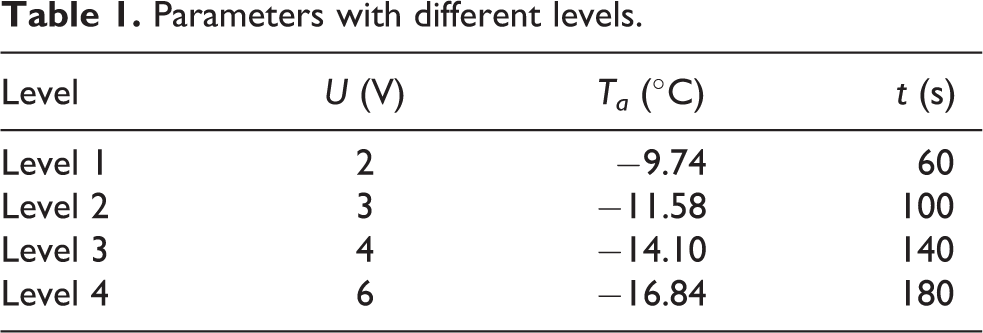
During the experiments, the data of ice adhesion force at different heating temperature, power supply voltage, and heating time were measured. In order to analyze the influence of the above factors on the ice adhesion force, the orthogonal experiments were designed. Four levels were selected as shown in Table 1. Ta represents the deicing temperature during deicing process, U is the power supply voltage, and t denotes the heating time. The experiments were performed based on the orthogonal table (see Table 2).
Parameters with different levels.
Orthogonal test of ice adhesion under deicing condition.

Considering the influence of supercooled water droplets on the adhesion of ice, deionized water was used to icing on the anti-/deicing components by spraying. The freeze condition was set at moderate icing condition, that the deicing temperatures were set at −9.74°C, −11.58°C, −14.1°C, and −16.84°C, respectively. The freezing process lasts for 60 min for each experiment, and the ice thickness is 4 mm, with the shape of ice accretion 50 mm long and 40 mm wide. The ice thickness is ensured by the height of the ice mold and the content of the supercooled water drops sprayed.
During the deicing process, according to the orthogonal experiment table, different voltages and heating time were applied for the anti-/deicing component of wind turbine blade by the energy supply. The power supply voltages were set to 2 V, 3 V, 4 V, and 6 V, respectively. The heating time was set at 60 s, 100 s, 140 s, and 180 s, respectively. In the process of measuring ice adhesion force, the equivalent pulling force was gradually increased, and the feeding speed of the electric push–pull force meter was set to 20 mm/min. During the experiments, the heating time and the value of ice adhesion force at the moment of ice falling off were recorded. The maximum range of the electric push–pull force meter is 500 N, with the index value of 0.1 N. The accuracy of the electric push–pull force meter is ±0.5%. The iron surface temperatures of anti-/deicing component were collected by infrared thermal imager. The range of Testo 869 infrared imager (Germany) is −20°C to 280°C, with the index value of 0.2°C. The accuracy of the infrared thermal imager is ±2%.
Experimental procedure
The orthogonal test table was established by means of orthogonal test. Because there are several influential variables involved in the ice adhesion force of wind turbine blade anti-/deicing component in the process of deicing, the relevant variables were selected and the data of ice adhesion force measured were processed. The ice adhesion strength on the surface of the anti-/deicing component of wind turbine blades is calculated by using the following formula

where S is the area of icing surface on the anti-/deicing component and
Based on the above experimental design, the specific experimental process is as follows: firstly fix the anti-/deicing component sample of wind turbine blade on the test rig and adjust the temperature of the refrigerator to the required level; then spray the supercooled water droplets covering the ice mold on the anti-/deicing component sample and keep 60 min to form ice layer; operate the deicing system of the anti-/deicing component to deicing; turn off the power and turn on the electric thruster and apply the uniform load on the ice accretion; record the test results of the electric push–pull force meter when the ice falls off and repeat the following experiments; calculate the ice adhesion strength and discuss the mathematical model of ice adhesion force.
Ice adhesion of composites anti-/deicing component
By establishing the mathematical model of ice adhesion force under deicing conditions, the ice shedding conditions on the surface of composites anti-/deicing component under the combined action of rotating centrifugal force and ice adhesion force can be quantitatively analyzed. Owing to the fact that ice on the surface of the wind turbine blade absorbs heat when heating the anti-/deicing component, the ice adhesion force between the ice and the anti-/deicing component of the wind turbine blade will change over time. Moreover, in the process of wind turbine blade surface melting, a melting ice layer is formed on the surface, but the thickness of the melting ice layer is nanometer level, which is small enough relative to the size of the whole blade and can be ignored. Therefore, the mathematical model of ice adhesion force under deicing condition can be used to quantitatively analyze the change of ice adhesion strength during heating process. In this article, the structures of the anti-/deicing component unit and installation location are shown in Figures 1 and 3. By combining the mathematical deduction with the experimental data, the factors influencing the ice adhesion force of wind turbine blades under deicing conditions are analyzed.

Structure diagram of wind turbine blade anti-/deicing unit.
Given the characteristics of ice adhesion force, it is considered that the ice adhesion force is uniformly distributed on the surface. Compared with centrifugal force and ice adhesion force, the gravity effect of ice accretion is ignored. Thus, the mechanical critical condition of ice shedding is satisfied as the centrifugal force of ice layer is in equilibrium with the ice adhesion force. The assumptions are as follows
27
: The adhesion force of icing uniformly distributes on the interface between icing and iron surface. The influence of waving effect on ice adhesion during rotor rotation is ignored. The accretion ice is uniform and equal in thickness. The volume change of ice during melting is ignored. The repeated icing on the surface of the wind turbine blade during the process of deicing is neglected. The changes of volume and performance of ice during melting are ignored.
Taking the surface icing of the composites anti-/deicing component of wind turbine blade as the research object, considering the medium icing condition of wind turbine blade, the power supply heating of the composite anti-/deicing component of wind turbine blade is employed by operating the deicing system. When mixed icing occurs, part of ice on the surface area melts into water film under heating of anti-/deicing component. The melted liquid water film evaporates under the action of wind. Then the melt area forms partial small areas of dry surfaces, and there is still ice in the remaining area where water film has not been formed. Based on the above analysis, assuming that the ice adhesion force uniformly distributes on the selected small unit surface of composite anti-/deicing component, a mathematical model of ice adhesion force under deicing condition is established. The unit icing area is selected as the mathematical deduction unit on the anti-/deicing component of wind turbine blade for analysis (see Figure 4).

Schematic of mathematical derivation unit of ice adhesion force.
According to the above assumptions, the heating pad of the anti-/deicing component consumes electricity during heating and converts it into heat energy

where U is the power supply voltage, R is the resistance value of heating pad (R = 4.28 Ω), and t is the heating time.
When partial melting occurs, under the action of centrifugal force and residual ice adhesion force, the ice will fall off. The critical value of the instantaneous ice adhesion force when ice drops off is set as

In the formula,

where F is the total initial ice adhesion force on the surface of wind turbine blades without deicing,
In the process of deicing, the remaining unmelted ice absorbs part of the heat of the anti-/deicing component, reducing the ice adhesion force of the remaining ice. Considering the above influence on ice adhesion force, a modification coefficient of ice adhesion force K is introduced. K value is related to the adhesion state, ice uniformity, ice surface morphology, and material of the deicing area. The modification coefficient can be obtained by fitting the experimental data, which can be used to correct the deviation of the residual ice adhesion force caused by deicing heating. Thus, the residual adhesion force F 0 after melting can be written as

In the process of ice accretion melting, the energy is mainly absorbed in the form of latent heat and sensible heat. Considering the energy dissipation and loss in the process of ice accretion absorption, the energy transfer coefficient is introduced into the energy expression of ice accretion absorption. The energy absorbed by the wind turbine blade anti-/deicing component can be expressed as

where
For the ice layer with the original ice thickness h, the mass of the icing can be written as

In the process of ice melting, the influence of the volume change of ice accretion on the quality of ice melting can be ignored, and the thickness of ice after melting is used in the calculation of ice melting. Thus, the mass of melted ice on the anti-/deicing component of wind turbine blade can be expressed as

where

Therefore, equation (8) is substituted into equation (6), and the following expression of melted ice area is obtained

Substituting equation (10) into the previously described equation (5), the remaining ice adhesion force can be expressed as

Thus, based on the above derivation, the following equation holds

where

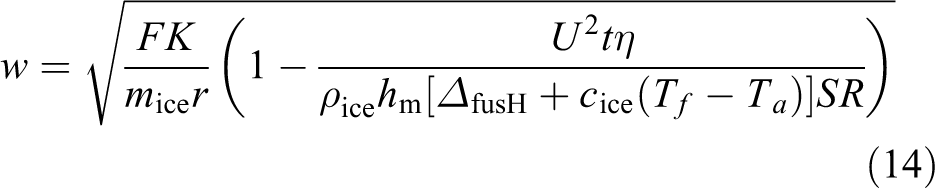
According to the derivation of the mathematical model of the ice adhesion force of the wind turbine blade of equation (13), when the ice mass of the wind turbine blade is
Results and discussion
Based on the mathematical model of icing adhesion force on the surface of wind turbine blade anti-/deicing component established in the third section, the experiments of ice adhesion force on the surface of wind turbine blade anti-/deicing component were carried out, and the data were processed and sorted out (see Table 2). Through the orthogonal optimization method, the weights of various factors that affect the efficiency of deicing and ice adhesion force of wind turbine blades were analyzed.
Through the orthogonal analysis of the data in Table 2, the weight order of variance of each factor is as follows: range of the heating time (59.97) > range of the heating temperature (57.65) > range of the heating voltage (48.50). Based on the above analysis, the most effective factor is the heating time, followed by the heating temperature. Among the factors, the heating voltage exerts the least influence on the ice adhesion force.
Figure 5 is the variance analysis chart of influence on ice adhesion. According to the variance analysis, the third level of deicing voltage, the first level of heating temperature, and the fourth level of heating time correspond to the minimum mean value of each variable parameter. In the optimization process, the minimum ice adhesion force is taken as the optimization objective. Therefore, based on the variance analysis, the optimized deicing parameter variable for each parameter is as follows: under heating temperature of −9.74°C, 6 V for the heating voltage, and 180 s for the heating time.

Influence of deicing parameters on ice adhesion force.
In order to further explain the effect of deicing conditions on the ice adhesion force of wind turbine blades, 12 groups of ice adhesion experiments were supplemented in this article (see Table 3). The collected ice adhesion data of anti-/deicing component are sorted out to get Figure 6.

Results of ice adhesion force (deicing voltage is 5 V).
Supplementary experimental data of ice adhesion.

From the analysis of Figure 6, there is a correlation between the deicing time and ice adhesion force at different deicing temperatures under 5 V deicing voltage. With the increasing heating time, the ice adhesion force of composites anti-/deicing component decreases, which indicates that it is consistent with the variable relationship of the established mathematical model. Besides, it can be found that under the same heating temperature, with the increasing heating time, the ice adhesion force of the surface of the anti-/deicing component of the wind turbine blades decreases. The icing adhesion of the surface of the anti-/deicing component in the low-temperature environment is higher than that in the high-temperature environment under the same deicing time.
Figure 7 shows the experiment data selected from three groups of orthogonal experiments and four groups of supplementary experiments. Based on the analysis of ice adhesion experimental data, it can be seen that the ice adhesion force decreases with the increasing heating voltage and heating time, which shows that the relationship is consistent with the established mathematical model variables.

Results of ice adhesion force (deicing temperature is −9.74°C).
By comparing test 18, test 3 with test 22, it is shown that under the same heating time, with the increase of deicing voltage, the ice adhesion force of the blades decreased gradually. The above conclusion shows that the increase of deicing voltage promotes the melting rate of ice layer and reduces the value of ice adhesion.
In the mathematical model of ice adhesion deduced by equation (13), the expression U2t/R presents the heat energy (Q) provided by the power supply in the process of deicing. Therefore, considering the power consumption in the process of deicing, the heat energy consumption is calculated by the experimental data. The relationship between the heat energy (Q) of the deicing power supply and the ice adhesion force under the same deicing temperature is analyzed by the method of data fitting.
Based on the data obtained from the ice adhesion experiment of wind turbine blades, the heat energy supported by the power supply in each experiment was calculated and analyzed according to the different deicing temperature. Among the five groups of experiments conducted at −9.74°C, the relationship between the electric energy consumed by deicing and the icing adhesion force is obvious.
The curve fitting is shown in Figure 8. The fitting function shows that the fitting effect of heat energy and ice adhesion force in the process of deicing conforms to the power function relationship. According to the fitting result, the correlation coefficient R 2 is 0.96813. It can be concluded from the figure that at the beginning of the electric deicing process, the heat input for deicing will significantly reduce the ice adhesion force value, while with the continuous input of heat the effect of unit heat on the decrease of ice adhesion force becomes smaller.

Relationship between the heat energy and the ice adhesion force (deicing temperature is −9.74°C).
In order to verify the above conclusion, the ice adhesion parameters at −11.58°C were selected for curve fitting. Figure 9 shows the fitting curve of selected six groups of experimental data. By calculating the heat energy dissipation of each group, the relationship between ice adhesion force and energy consumption during the deicing process was explicated.

Relationship between the heat energy and the ice adhesion force (deicing temperature is −11.58°C).
The data curve fitting of the experimental results is shown in Figure 9. According to the fitting result, the correlation coefficient R 2 is 0.94316. It can be found that there is also an obvious power function relationship between the heat energy and ice adhesion force, which verifies the correctness of the above conclusions.
Moreover, from the analysis of Figures 8 and 9 we can see that under the same energy input for deicing, the ice adhesion force at −11.58°C is much greater than that at −9.74°C. Taking the input heat energy of 300 J as an example, the ice adhesion force value at −9.74°C is about 155 N, while that at −11.58°C is about 243 N. The above results show that more heat energy is needed in the process of deicing at low temperature in order to achieve the purpose of deicing. The above conclusion is consistent with the relationship between the deicing temperature and the critical ice adhesion force described in the established mathematical model (see equation (13)), which indirectly verifies the correctness of the ice adhesion mathematical model.
Conclusions
Given the influence of heating conditions on the ice adhesion force, an experimental platform for measuring ice adhesion force of composites anti-/deicing component was set up. Based on the parameters of heating such as the heating temperature, heating voltage, and heating time, the experiments of ice adhesion force of anti-/deicing component under heating conditions were designed by orthogonal analysis. The ice adhesion forces were measured by the shearing force at the interface between the composites anti-/deicing component and the ice layer. In addition, a mathematical model of ice adhesion force of composite blade anti-/deicing component under heating condition was proposed. According to the established mathematical model of icing adhesion of composites anti-/deicing component, the relationship between the parameters of wind turbine blade heating condition and ice adhesion force was discussed.
According to the orthogonal test results, the most effective factor is the heating time followed by the heating temperature. Among the factors, the heating voltage exerts the least influence.
Considering the factor of power consumption of deicing, the relationship between the heat energy of heating and ice adhesion force of wind turbine blades was studied. Through the fitting of experimental data, it can be found that there is an obvious power function relationship between the heat energy of heating and ice adhesion force. Under different heating temperatures, the coefficients of power function relationship will be different.
The relationship between various parameters (such as heating voltage and heating temperature) and ice adhesion force was discussed. Through the ice adhesion mathematical model of composite anti-/deicing component proposed in this article, the deicing of composite rotor can be predicted. For example, when the model is trained based on neural network, it can predict the ice adhesion parameters under different icing conditions and realize intelligent control of blade deicing. Therefore, the mathematical model of ice adhesion force under deicing condition provides theoretical guidance and experimental support for the deicing of wind turbine blades.
Footnotes
Author contributions
The following contributions were made to this research: Ice adhesion experiment arrangement, LC and YZ; writing—original draft preparation, YZ and HL; writing—review and editing, LC; project administration, LC and YZ; funding acquisition, LC. All authors have read and agreed to the published version of the manuscript.
Declaration of conflicting interests
The author(s) declared no potential conflicts of interest with respect to the research, authorship, and/or publication of this article.
Funding
The author(s) disclosed receipt of the following financial support for the research, authorship, and/or publication of this article: This work was supported by the Natural Foundation of Shandong Province (ZR2019BEE068); the State Key Laboratory of Mechanical System and Vibration (MSV-2019-13); the Fundamental Research Funds of Shandong University (2018GN034); the 13th Five-Year Plan Equipment Pre-Research Fund (61402060404); and the Key Laboratory of High Efficiency and Clean Mechanical Manufacture at Shandong University, Ministry of Education.
