




Abstract
The parametric resonance or instability challenge in designing laminated composite is crucial in areas such as aeronautical and marine where structures experience dynamic loading. Shape memory alloy (SMA), a type of smart material, has been used to improve the structural behaviours of composite plate using its well-known property of shape memory effect. It is also known that mechanical couplings that exist in unsymmetric composite can increase the instability of the composite. In this study, the SMA property has been exploited to generate recovery stress in the composite to improve its parametric instability problem. The unsymmetric composites were embedded with SMA fibres, and the formulation for the dynamic instability of this composites was developed using finite element method. The third-order shear deformation theory of composite was applied. The results were initially validated for the case of composite without SMA. Following that, the parametric instability behaviour of unsymmetric composites was studied under the effect of several parameters. It was found that the mechanical couplings that exist in the unsymmetric composite have increased the instability of the composite, but the presence of the SMA can significantly reduce this instability.
Introduction
Composite material has been widely used in a wide range of industries today 1 –3 while shape memory alloy (SMA) has been exploited to improve the composite properties such as fatigue life 4 and its structural behaviours. 5 SMA is a type of smart material that induces stress or strain as its temperature is increased to above a transition temperature called the austenite start temperature. The stress or strain inducement is possible due to the act of one important property of SMA, which is well known as the shape memory effect (SME). Intensive studies on the SMA have been conducted in the past decades in attempts not only to model the SMA characteristics 6,7 but also to apply the SME and other unique properties of the SMA in areas including structural health monitoring, 8 earthquake resistance 9 sports and recreational 10 and medical. 11 Specifically, the SME property of the SMA has been manipulated in the past to improve the structural behaviours of composites including vibration 12 buckling 13 –15 and thermal buckling 16 and adaptive structures. 17 –19
Parametric resonance is one type of dynamic instability, indicating its occurrence when a structure shows increasing transverse vibration such that fatigue failure is inevitable if the vibration does not stop. 20 Compared to force resonance that occurs when the excitation frequency coincides with the natural frequency of the structure, parametric resonance can occur at several values of excitation frequency when the structure experiences time varying change in its properties such as stiffness. Parametric instability occurs to all forms of isotropic or anisotropic structures that undergo, among other things, periodic variation of compressive load. The B-spline finite strip method was used in the parametric instability analysis of prismatic plate and laminated composite structures. 21 The first-order shear deformation theory (FSDT) was used to derive the coupled Mathieu equations. The degree of instability of the structure with respect to parameters such as thickness to length ratio and degree of orthotrophy was measured using a dynamic instability index. Sahoo and Singh 22 used the inverse hyperbolic zigzag displacement theory of composite to solve parametric instability of laminated composite and sandwich plates. It was shown that the theory provided more efficient solution to the sought parametric instability chart. Using a refined higher order theory, Babu and Vasudevan 23 conducted parametric instability study on rotating delaminated thickness tapered composite plates, applying the classical laminated plate theory. Yusof and Rasid 24,25 investigated numerically the parametric instability behaviour of composite plates using the FSDT and the third-order shear deformation theory (TSDT) of composite. Parametric instability of composite plates has also been studied in wide variety of other areas such as the variable angle tow composite laminates, 26 laminated composite curved and flat panels subjected to periodic non-uniform in-plane compressive loading 27 and composite panels subjected to area delamination and hygrothermal effect. 28 However, the study on the parametric instability improvement made by smart material such as the SMA, especially on fully anisotropic (unsymmetric) composite structures, can hardly be found in literature.
Tsai and Chen 29 used SMA to enhance the parametric resonance behaviour of composite, but the study was limited to beam structure. Furthermore, several studies were conducted on the effect of symmetric and unsymmetric lamination of the bistable laminated composites. 30 Recently, Roslan et al. 31 published articles on the influence of SMA’s active strain energy tuning (ASET) method on the parametric resonance of orthotropic composites using different composite lamination theories. The current study is to further this work on the parametric instability improvement made by SMA, now moving on to fully anisotropic structures. The Mathieu–Hill equation was derived based on the higher order shear deformation theory (HSDT) that includes the warping degree of freedom. By expanding the displacement to include the third-order terms in the warping degree of freedom, the HSDT has the advantage of avoiding to average the transverse shear throughout the composite thickness as it is done for the FSDT and as such more accurate answer can be obtained. The results of instability charts are compared to those of the symmetric composite, and the degree of instability of the unsymmetric composite plate is analysed with regard to several parameters.
Methodology
The material properties of the SMA and the glass–epoxy (GE) composite used here are given in this section. Also, the configurations and dimensions of the laminated composite plates are specified. Following that, the finite element method (FEM) governing equation for the parametric instability problem of the SMA composite plates is derived. The equation is solved through programming codes and flow chart, as shown in Figure 2, which is used in the development of the codes.
Materials
The unsymmetric composite used in this study has the configuration of [0/06/θ6/0] such as shown in Figure 1(a) where the angle of orientation, θ, can be either 15°, 30°, 45°, 75° or 90°. 32 The outer layers with 0° angle of orientation are the SMA-epoxy (SE) layers (darkened in Figure 1) while GE are the constituent of other layers. The 0° for the SE layers refers to the direction of the SMA fibres, while for other layers, the angle is for the direction of glass fibres. For comparison purpose, symmetric composites having the configuration of [0/03/θ6/03/0], as shown in Figure 1(b), are also analysed. The square plate used in this study has side dimensions of a = b = 500 mm. The ratio of length over thickness, a/t, is specified for each case study. The boundary condition used throughout the study is pin supported at both ends of the plate.

The angle of orientations for (a) unsymmetric and (b) symmetric composites.
The SMA used in this study is the nickel–titanium alloy, better known as Nitinol. The material properties of the glass fibre, epoxy and Nitinol are given in Table 1. The subscript ‘m’ refers to martensite phase of Nitinol at low temperature, while the subscript ‘a’ refers to austenite phase of Nitinol at high temperature. The prediction of the recovery stress, σ r, and the Young’s modulus, E s, of Nitinol as it is heated to a certain activation temperature, T a, was done using the Brinson model. 27
Material properties of the composite. 23
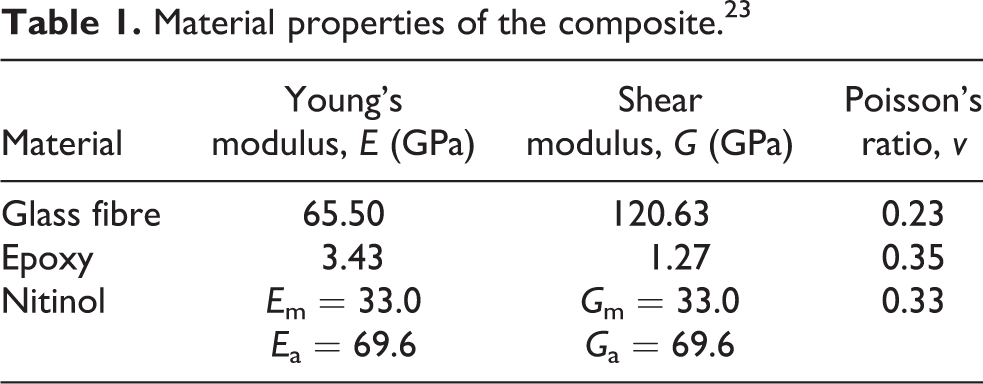
Table 2 gives the properties of the SMA along with the related parameters needed for the application of the Brinson model. The parameters of critical stress start, σ cr,s, and critical stress finish, σ cr,f, are the stress values needed for the beginning of the reorientation process of the SMA at low temperature below Martensite finish temperature, M f, where with the addition of stress, SMA reoriented itself from temperature-induced martensite to stress-induced martensite (detwinned martensite). This is one of the improved features added in the Brinson model from the earlier models of Tanaka 33 and Liang and Rogers 34 where with this addition, the quasi-plasticity 35 behaviour of SMA at low temperature is considered. Furthermore, with the given parameters, the maximum residual strain of εL = 0.058 can be obtained if the stress in the stress-induced martensite form of SMA is released after reaching, σ cr,f.
Parameters of the SMA for the Brinson model. 27

SMA: shape memory alloy.
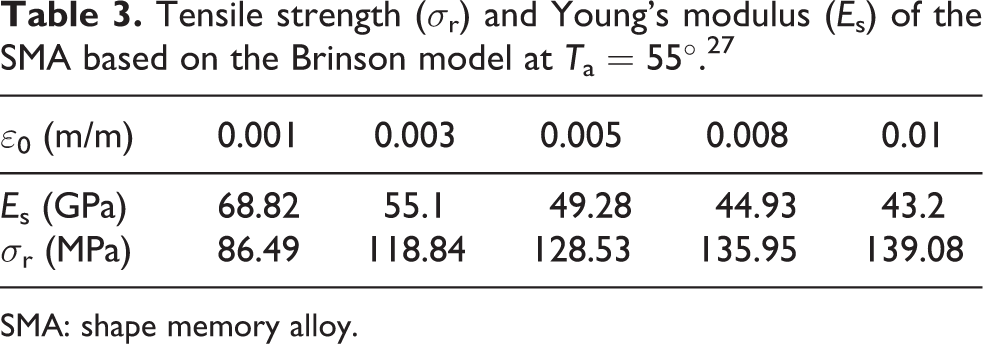
Solving the Brinson model at certain temperature, T a, and the SMA initial strain, ε 0, the σ r and E s of the SMA were obtained as given in Table 3. As an example, with pre-strain of ε 0 = 0.001 given to SMA before it is embedded into layers of laminated composite plate, the Brinson model predicts that the recovery stress that can be induced within the SMA is σ r = 86.49 MPa. In addition, with the thermoelastic transformation occurring from martensite to austenite, the new improved Young’s modulus of the SMA is E s = 68.82 GPa. The increase of these two values are the reason for the parametric instability improvement of the laminated composite plate in this study.
Tensile strength (σ r) and Young’s modulus (E s) of the SMA based on the Brinson model at T a = 55°. 27
SMA: shape memory alloy.
The Mathieu–Hill equation
The Mathieu–Hill equation is derived here using FEM according to the TSDT. Following that, the Mathieu–Hill equation is solved using the Bolotin’s method to obtain the eigenvalue equations that determine the instability charts of the SMA composite plates. The effective properties of the SE layer and the GE layer were derived using the rule of mixture. A perfect bonding is assumed between SMA and matrix. For example, through the rule of mixture, the Poison’s ratio, v

and the shear modulus in two-direction, i

The displacement field of the SMA-laminated composite plate is assumed to be as stated below 32

where u
0, v
0 and w
0 are the midplane displacements in x, y and z directions, respectively. The rotations in the x-z plane is

or

where

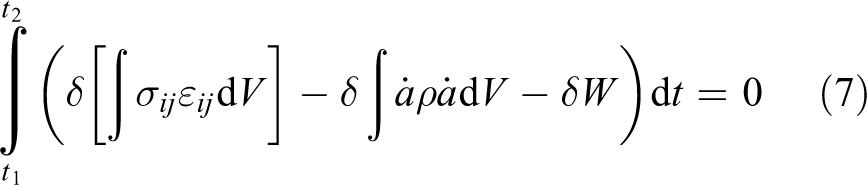
Applying the standard FEM procedures and conforming to the Hamilton’s principle such as
the parametric instability equation for composite plate with embedded SMA is

where

where

In Bolotin’s method of solution, it is assumed that the solution of {q}(t) is a series, for a period of T such as
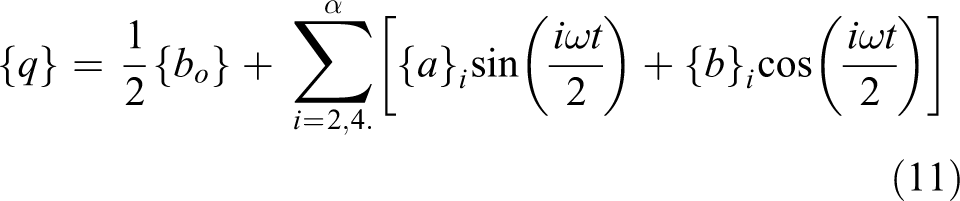
Inserting equation (11) into equation (8) and equating coefficients for sin(ωt) and cos(ωt) terms, the solution to equation (10) is

In this work, equation (12) divides dynamic instability region into lower and upper stability boundaries by knowing the values of α, β and

The flow chart for the source codes.
Results and discussion
The formulation and codes are firstly validated based on past results. The effects of several parameters on the parametric resonance of the unsymmetric composite were investigated.
Validation
As data related to parametric resonance of unsymmetric composite are limited in the literature, the validation of the codes has been done on symmetric composite. Parametric instability analysis has been conducted on a composite with symmetric cross-ply configuration of [0/90/90/0]. Rectangular plate was used where side length is 500 mm. The a/t ratio is 25. Table 4 represents that the non-dimensionalised frequency values obtained in this investigation agreed closely with results from various methods of finite strips 35 and FEM. 12 It shows here that with a rather simple addition of warping terms in the displacement field equations of the present HSDT model, the results obtained are in excellent agreement with the results coming from more complicated models or formulations in the work of Wang and Dawe, 21 Zak et al. 38 and Chakrabarti and Sheikh. 39
The validation on the developed formulation and source codes.

HSDT: higher order shear deformation theory. ΩU: Upper frequency, ΩL: Lower frequency.
Furthermore, the presently developed formulation based on the HSDT can be seen in Figure 3 to agree strongly with the FSDT-based formulation developed by Zak et al.. 38 In this study, the activation temperature (T act) is equal to 55° while the initial strain (ε o) is 0.01, and through the Brinson model, the recovery stress induced (σ r) is equal to 139.8 MPa while the SMA Young’s modulus is 43.3 GPa. Furthermore, WO is the case of the composite without SMA, while WS is the case of the composite with the addition of SMA. It shows that using the HSDT, accurate results can be obtained without having to estimate the shear effect of thickness using the shear correction factor as in the FSDT. Furthermore, the induction of the recovery stress and the increase of the Young’s modulus with the addition of SMA into composite can be seen to greatly improve the parametric instability behaviour of the composite by shifting the frequency centre to the right. The non-dimensionalised frequency centre (frequency at β = 0) can be seen to shift from 15.363 to 28.92, an increase of about 88%. Furthermore, the trend of this finding is in close agreement with the results for FSDT-based formulation developed by Chakrabarti and Sheikh. 39 In contrast, Pradyumna and Bandyopadhyay 40 observed that the origin of instability regions obtained by the HSDT formulation has higher excitation frequency parameters than the corresponding value for the FSDT formulation. The origin of instability regions offered a higher excitation frequency with increasing width of dynamic instability regions, possibly due to the increase of shell stiffness and curvature. 41

The comparison between the instability charts correspond to the present HSDT and the FSDT. HSDT: higher order shear deformation theory; FSDT: first-order shear deformation theory; WO: composite without shape memory alloy; WS: composite with shape memory alloy.
The effect of the mechanical coupling
To study the effect of the mechanical couplings on the dynamic instability of SMA composite plates, four configurations of laminated composite were used where the first two configurations are the 12-layer symmetric composite, [03/θ6/03] (S12L), and unsymmetric composite, [06/θ6] (US12L). The unsymmetric composite here is known to give mechanical coupling as opposed to the first symmetric configuration of composite, as studied by Lagace et al. 32 who studied buckling of unsymmetric composite laminates. The other two configurations are the 14-layer symmetric, [0/03/θ6/03/0] (S14L), and unsymmetric composites, [0/06/θ6/0] (US14L), where the outer 0° layer is for the embedment of SMA fibres. The study was conducted on rectangular composite plate with aspect ratio, a/b = 0.5, while the ratio of length to thickness is a/t = 25. The SMA, having 0.008 m/m as initial strain, is heated to activation temperature, T a = 55°C to give σ r = 135.95 MPa and E s = 44.93 GPa, which are listed in Table 3. Figure 4 shows that the presence of mechanical couplings can greatly increase the instability of the composite plate. This can be seen by the frequency centre (frequency at β = 0) of the instability chart that is moved to the left from 52.635 of the S12L composite to 37.367 of the US12L composite, which is a decrease of about 29%. Similarly, in a study by Birman 42 while applying an analytical method, it was found that the frequency centre shifted to the left when the composite was changed to unsymmetric composite. This was especially true for composite plates with large aspect ratio. The instability of the unsymmetric composite can be seen to greatly improve when the 0° layers are simply added to the top and bottom layers of the composite. The effect of adding the outer 0° layers seems to be unaffected in the case symmetric composites. This finding agrees well with the previous work of the same author. 13
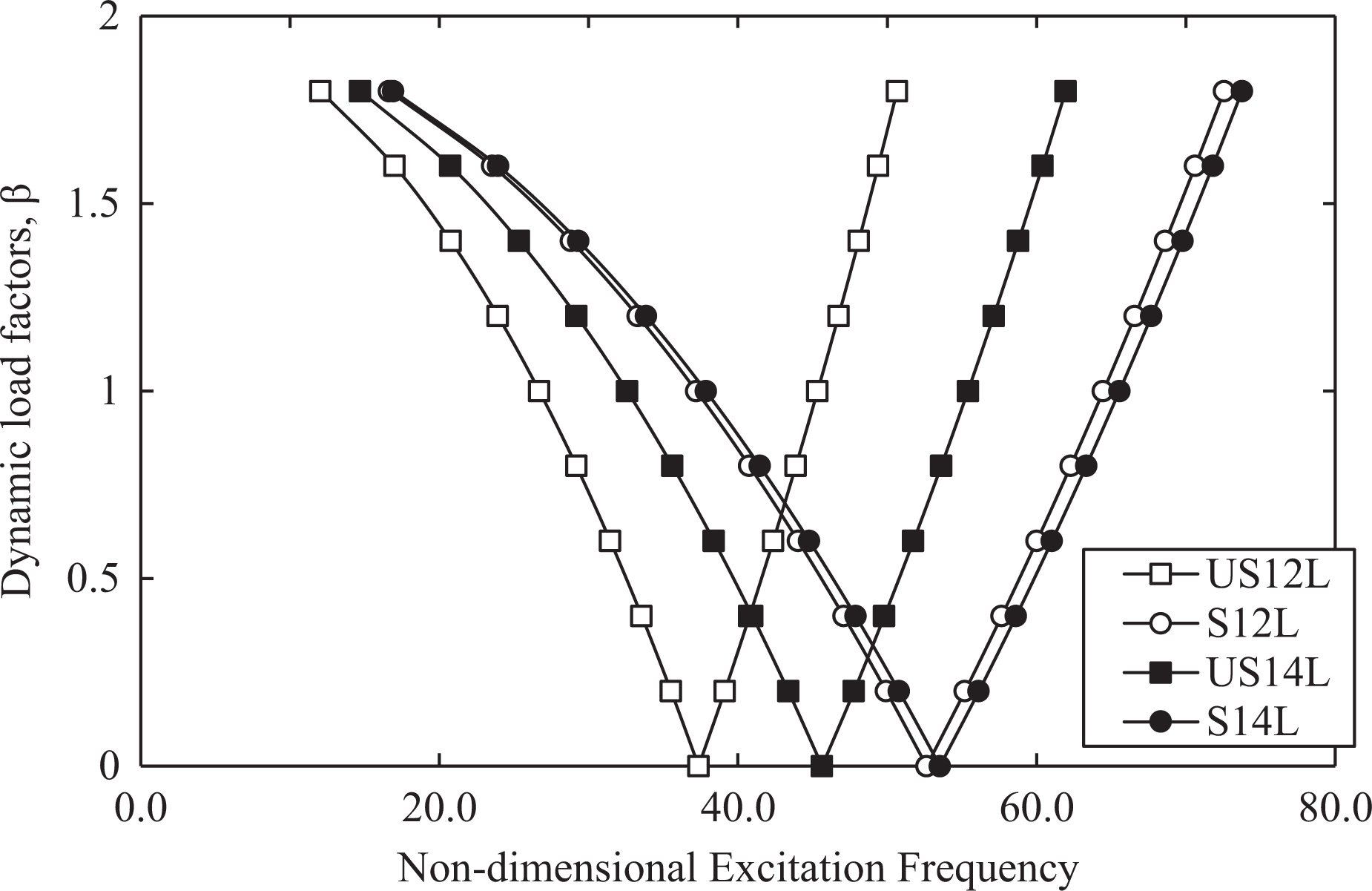
The comparison between the instability charts correspond to the symmetric and unsymmetric composite in the case of WO. WO: composite without shape memory alloy.
The effect of SMA on the parametric instability of unsymmetric composite can be seen in the study conducted on the 14-layer composite plates with and without SMA. Figure 5 shows that the unsymmetric composite plate, US14L-WO, shows higher instability than its symmetric counterpart, S14L-WO. It can be seen that the shifting of frequency centre is from 53.524 to 45.632, a decrease of about 15%. However, with the addition of SMA fibres at the outer layers of the composite in US14L-WS, the instability chart is seen to move to the right to give an improvement to its parametric instability state. This is consistent with the effect of SMA that shift the post-buckling path of composite plates to the right 42 and also shifting instability chart of composite beams. 29 In addition, Park et al. 41 mentioned that the natural frequencies of the plate with SMA are lower than those of the plate without SMA fibre due to the increase of the weight of plate and decrease of the thermal large deflection. They evaluated the vibration behaviour of the composite plate embedded with SMA fibres that is studied using the FEM based on the FSDT. The optimal design has the design variable as the SMA fibre angle, stacking sequence, volume fraction and initial strain of the SMA filter should be performed in order that SMA is applied to the structures effectively.
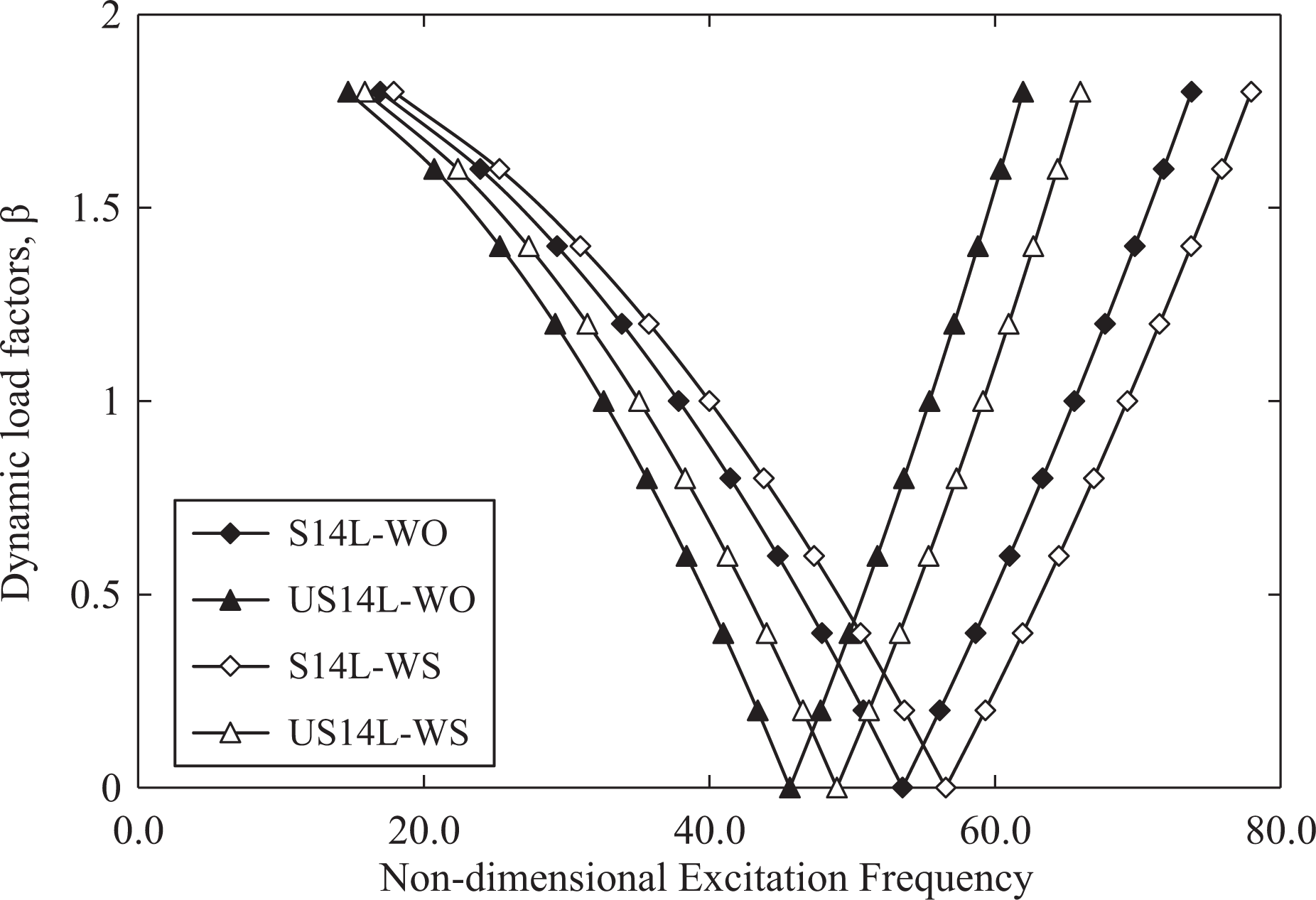
The comparison between the instability charts correspond to the symmetric and unsymmetric composites in the case of WO and WS. WO: composite without shape memory alloy; WS: composite with shape memory alloy.
The static load factor effect
The unsymmetric composite used in this part of study has a configuration of [0/06/906/0]. The ratio of length to thickness is a/t = 100. Figure 6 shows the instability charts of the unsymmetric composites for different values of static instability factor, α (a). It shows that as α is increased, the frequency centre and the instability chart move to the left for both cases of composite without SMA (WO) and composite with SMA (WS). This means that the instability is increased as α is increased. At the same time, the width of the instability chart also increases as α is increased. This also means that as α is increased, the instability of the composite plates is increased as the instability region is increased. A study by Sahoo and Singh 22 on the dynamic instability of sandwich composite plate found similar behaviour where the onset of instability regions occurs earlier with wider instability region for the gradual increase of static load factor. The effect of SMA with the addition of the recovery stress can be seen to obviously improve the instability of the composite by shifting the instability chart to the right. However, the region of instability increases at the same time with the addition of the SMA to the composite as α is increased. It can thus be said that the ASET effect of the SMA improves the parametric instability of unsymmetric composites merely by postponing the onset of instability region but at the same time does not improve the instability through reduction of area of instability that is due to the increase of α. This is in line with the finding for the effect of SMA on symmetric composite, as stated by Yusof et al. 43 This inability of the SMA can be improved if the sources of recovery stress such as the initial strain, activation temperature and the volume fraction of the SMA are increased. In the study by Tsai and Chen, 29 the increase of initial strain, activation temperature and volume fraction of SMA was seen to not only increase the frequency centre of the instability chart but also decrease the region of instability.

The effect of the static load factor, α (a) on the dynamic instability of unsymmetric composites. WO: composite without shape memory alloy; WS: composite with shape memory alloy.
The length to thickness ratio effect
In this section, the effect of thickness of SMA composite plate with [0/06/90°6/0] configuration is studied by varying the a/t ratio of the composite plate. The SMA with initial strain of ε 0 = 0.005 is activated at T a = 55°C to give σ r = 128.53 MPa and E s = 49.28 GPa, based on the Brinson model simulation (see Table 3). Figure 7 shows the plots of instability charts for different a/t values correspond to the case of composite without SMA (WO) and composite embedded with SMA (WS). The plot shows the instability decreases as the thickness is increased for both cases of WO and WS. This can be seen when the instability charts are shifted to the right as thickness is increased. However, the width of the instability chart can be seen to increase as the thickness is increased. Similar effect can be seen for the case of orthotropic plates. 31 An interesting finding for the case of sandwich structure is when the thickness of the core with respect to the thickness of face is increased, not only the centre of frequency is shifted to the left but also the region of instability is increased. The SMA had a greater influence on thinner composite plates where the amount of jump of the frequency centre to the right is much higher than those of the thicker plate where at a/t = 25, the effect of SMA can be seen to be very small. This higher influence of SMA on thinner plate can be seen in the problem of static instability problem, 42 natural frequency 43 and critical buckling. 44 –46

The instability charts of composite plates for WS and WO cases having different a/t ratios. WS: composite with shape memory alloy; WO: composite without shape memory alloy.
Conclusions
The investigation on the parametric instability of unsymmetric composite plates with embedded SMA was performed using FEM. The development of the parametric resonance equation was done based on the HSDT of composite. Validation analysis conducted showed that the developed formulation and codes gave accurate results compared to past results. Several studies were performed to investigate the effect of several parameters on the parametric instability of unsymmetric SMA composite plates. It was found that as the mechanical coupling increases, the parametric instability of composite plates was increased as the chart shifted to the left, and the addition of SMA to the composite is capable of decreasing the instability by shifting the charts back to the right.
Footnotes
Acknowledegement
Appreciation is given to Universiti Teknologi Malaysia and Ministry of Higher Education under Fundamental Research Grant Scheme, Industry International Incentive Grant and ‘Geran Universiti Penyelidik’ (GUP) Tier 2 for financial support provided throughout the course of this research project. They also thank Ministry of Education Malaysia and Universiti Putra Malaysia for the financial support through the Visiting Scholar (Post-Doctoral) scholarship.
Declaration of conflicting interests
The author(s) declared no potential conflicts of interest with respect to the research, authorship, and/or publication of this article.
Funding
The author(s) disclosed receipt of the following financial support for the research, authorship, and/or publication of this article: This work was supported by Universiti Teknologi Malaysia and Ministry of Higher Education under Fundamental Research Grant Scheme, R.K.130000.7840.4F880, Industry International Incentive Grant Q.K.130000.3043.01M46 and ‘Geran Universiti Penyelidik’ (GUP) Tier 2, Q.K.130000.2656.17J66.
