The constitutive expressions of unsteady Newtonian fluid are employed in the mathematical formulation to model the flow between the circular space of porous and contracting discs. The flow behavior is investigated for magnetic field-dependent (MFD) viscosity and heat/mass transfers under the influence of a variable magnetic field. The equation for conservation of mass, modified Navier–Stokes, Maxwell, advection diffusion and transport equations are coupled as a system of ordinary differential equations. The expressions for torques and magnetohydrodynamic pressure gradient equation are derived. The MFD viscosity , magnetic Reynolds number , squeezing Reynolds number , rotational Reynolds number , magnetic field components , , pressure and the torques , which the fluid exerts on discs are discussed through numerical results and graphical aids. It is concluded that magnetic Reynolds number causes an increase in magnetic field distributions and decrease in tangential velocity of flow field, also the fluid temperature is decreasing with increase in magnetic Reynolds number. The azimuthal and axial components of magnetic field have opposite behavior with increase in MFD viscosity.
Study of squeezing flow between parallel discs has attracted engineers and scientists due to its vast engineering applications such as compression and injection shaping, braking devices, pumping of heart, rotating machinery, bearing with liquid metal lubrication, hydraulic shock absorbers, modeling of metal and plastic sheets, thin fiber, paper sheets formations, and squeezed film in power transformations. According to Lenz’s law of motion of a conductor into a magnetic field, electric current is induced in the conductor and creates its own magnetic field. When currents are induced by motion of a conducting fluid through a magnetic field, a Lorentz force acts on the fluid and modifies its motion. In magnetohydrodynamics (MHD), the motion modifies the field and vice versa. This makes the theory highly nonlinear.1,2 Hughes and Elco3 studied the squeezed flow of an electrically conducting fluid between two discs in the presence of a magnetic field. It has been shown that the load capacity of the normal force which the fluid exerts on the upper disc is dependent on the MHD interactions in the fluid. Verma4 also studied the squeeze film lubrication of a magnetic fluid between two approaching surfaces in the presence of an externally applied magnetic field. Krieger et al.5 studied the MHD lubrication flow between parallel stationary discs in an axial magnetic field. They also obtained excellent agreement between theory and experimental results until the transition to turbulent flow occurred. Rahimi-Gorji et al.6 investigated the unsteady squeezing nanofluid flow and heat transfer using Galerkin method for the solution of governing nonlinear differential equations in the presence of variable magnetic field. Acharya et al.7 studied the squeezing flow of two types of nanofluids such as Cu-water and Cu-kerosene between parallel plates in the presence of variable magnetic field. The nonlinear differential equations are solved numerically by RK4 method with shooting technique and analytically using differential transformation method. Saidi and Tamim8 investigated the unsteady three-dimensional nanofluid flow, heat and mass transfer in a rotating system in the presence of an externally applied magnetic field. Khan et al.9 studied the MHD flow of a viscous incompressible fluid between parallel discs. The governing system of equations is solved using homotopy analysis method (HAM). Khan and Shah10 investigated the magnetic squeeze film flow between rotating discs with induced magnetic field effects taking the radial, azimuthal, and axial components of magnetic field as
with velocity components
computing the response of radial and azimuthal magnetic fields to squeezing rates and relative disc rotation. The flow of a fluid film squeezed between two rotating parallel plane surfaces in the presence of a magnetic field applied perpendicular to the surface was studied by Hamza,11 and it showed that the magnetic forces and the centrifugal inertial forces have opposite effects. Shah et al.12 studied the effects of magnetic field on lubrication flow between two discs and showed that the magnetic field increases the fluid load on upper disc. Kuzma et al.13 studied the MHD squeeze film by taking the fluid-inertial effect and buoyant forces. Their results showed an excellent agreement between theory and experiment. Hayat et al.14 studied the squeezing flow of nanofluid between two parallel plates in the presence of magnetic field. They neglected the induced magnetic field for small magnetic Reynolds number and concluded that temperature of fluid is decreasing for large values of squeezing parameter. Nabhani and El Khlifi15 numerically investigated the squeezing film between two porous circular discs in the presence of an externally applied magnetic field. An implicit finite difference scheme is used to discretize the governing unsteady nonlinear equation and solve the new system of equations by Gauss–Seidel method. The radiation effect on squeezing flow between parallel discs is studied by Mohyud-Din and Khan.16 HAM is employed to obtain the expression for velocity and temperature profiles. They observed an opposite behavior of the velocity profile for suction and injection of fluid for all involved parameters. Hatami et al.17 investigated the heat transfer of nanofluid flow between parallel plates in the presence of variable magnetic field. Using homotopy perturbation method, they concluded that Nusselt number has direct relationship with Brownian motion parameter. Heat transfer analysis of squeezing flow between parallel discs is studied by Azimi and Riazi18 for GO-water nanofluid flowthe squeeze film lubrication of a magnetic fluid between. Verma4 studied the squeeze film lubrication of a magnetic fluid between two approaching surfaces in the presence of an externally applied magnetic field. He assumed that the applied magnetic field M has components of the form
The squeezing flow with rotating discs under the influence of variable magnetic field is also studied in detail by Ibrahim19 and Kumari et al.20 Sunil et al.21 and Domairry and Aziz22 conducted a theoretical investigation of the combined effect of magnetic field-dependent (MFD) viscosity and rotation on ferroconvection in the presence of dust particles subjected to a transverse uniform magnetic field and provided the approximate analytic solution for the squeezing flow of viscous fluid between parallel discs with suction or blowing. There is great interest in the rotation of fluids in a rotating magnetic field with viscosity, where large rotational velocities can be achieved. This phenomenon can be used for the construction of various kinds of pumps, automotive magnetorheological shock absorbers, novel aircraft landing gear systems, biological prosthetics, and also for nonmechanical mixing of fluids, for example, spacecraft fuels. Because of its great scientific and applied interest, it is attempted to discuss the influence of rotation and how MFD viscosity affects the magnetization in fluid.
Nomenclature
p
Pressure (N m−2)
C
Dimensional concentration
Cylindrical polar coordinates
Radius vector of the disc
ur
Radial velocity (m s−1)
Velocity vector
Azimuthal velocity (m s−1)
Greek symbols
uz
Axial velocity (m s−1)
Rotation vector
t
Time (s)
Lower disc angular velocity
Tu
Temperature at upper disc (K)
Thermal conductivity (W m−1 K−1)
Tl
Temperature at lower disc (K)
Dynamic viscosity
Cu
Concentration at upper disc
Kinematic viscosity (kg m−1 s−1)
Cl
Concentration at lower disc
Relative angular velocity
Prandtl number (v/k)
Fluid density (kg m−3)
Strength of magnetic field
α
Positive constant
Squeezing parameter
Similarity variable
Strength of magnetic field
Transformed fluid temperature
Distance between two discs (m)
Stefan–Boltzmann constant
B
Induced magnetic field
No
Constant number
Soret number
Transformed fluid concentration
Dufour number
Mean absorption coefficient
cp
Specific heat of fluid (J kg−1 K−1)
Subscript
D
Molecular diffusion coefficient
u
Fluid condition on upper disc
kT
Thermal diffusion ratio
l
Fluid condition on lower disc
Tm
Mean fluid temperature (K)
Superscript
qr
Radiative heat flux (W m−2)
Dimensionless variable
Radiative parameter
Derivative with respect to
Schmidt number
Existing information on the topic witnessed that the MFD viscosity of a squeezing flow between porous discs for viscous fluid under the influence of heat/mass transfers and externally applied variable magnetic field in polar coordinates has never been reported, and this is the very first study in the literature. In the following sections, the problem is formulated, analyzed, and discussed through graphs and tables.
Formulation of the problem
Consider an unsteady, incompressible, laminar, and electrically conducting viscous fluid flow caused by the rotation of two squeezing discs, parallel and smooth as shown in Figure 1. The discs are rotating with different angular velocities proportional to and , where , are the representative angular velocities of lower and upper discs, respectively, with dimension .23 The distance between discs at time t is , apart, where l is representative length equivalent to the discs separation at .19 The lower porous disc is prohibited from moving in the axial direction, where upper disc is rotating and moving toward or away from constrained lower disc. The fluid is assumed to be incompressible having a variable viscosity24 given by , where is the viscosity of the fluid when there is no magnetic field. The variation coefficient of viscosity has been taken to be isotropic, that is, . Hence, in the component form can be written as , , and . Further, B, M, and H are related by where M is the magnetization when the magnetic field is H and is the magnetic permeability of vacuum. The effect of shear dependence on viscosity is not considered since it has negligible effect for a mono-dispersive system of large rotation and high field. As a first approximation for small field variation, linear variation of magneto-viscosity has been used, hence where Ho is uniform magnetic field and Mo is the magnetization when the magnetic field is Ho. The movable disc is affected by the magnetic field H defined as
where Mo and No are used to dimensionless Hr, , Hz and , are the magnetic permeability of outside and inside media between the two discs, respectively. Following experimental study, the above parameters of magnetic field are zero on the lower disc.24 The induced magnetic field in the fluid is generated by the magnetic field H. Under these assumptions, the governing equations in vector form are25,26:
Equation of conservation of mass is
Equation of conservation of momentum is
Maxwell’s equations are
Equations of heat and mass transfer are
Geometry of the problem.
Boundary conditions
The boundary conditions are chosen as
where ur, , and uz are respectively the radial, azimuthal, and axial components of velocity; p is the pressure; T is temperature; C is concentration; is thermal diffusivity; is fluid density; D is diffusion coefficient; Tm is mean fluid temperature; Tl and Cl denote the temperature and concentration at the lower disc while Tu and Cu are the temperature and concentration at the upper disc, respectively; is kinematic viscosity; is electrical conductivity; cp is specific heat at constant pressure; is conductivity; is velocity of upper disc; are the angular velocities of upper and lower discs; is thermal diffusion ratio; is Stefan–Boltzmann constant; is the mean absorption coefficient; and qr is the radiative heat flux such that (Khan and Shah10).
The following similarity transformations27 are chosen for reducing the partial differential equations (1) to (6) from cylindrical coordinates to a system of ordinary differential equations
Equation of continuity is identically satisfied and the momentum, Maxwell’s, heat and mass transfer equations take the following form
and the boundary conditions are reduced to
where is the relative angular velocity of discs, is squeeze Reynolds number, is rotational Reynolds number, is Bachelor number, is magnetic Reynolds number, is MFD viscosity parameter, is strength of magnetic field in z direction, is strength of magnetic field in direction, is suction/injection parameter, is Prandtl number, is Schmidt number, is radiation parameter, is Soret number, and is the Dufour number.
Approximate analytical solution
The analytic method HAM24,28 is used to solve system of equations (8) to (13). Due to HAM, the functions , , , , , and can be expressed by a set of base functions as
where , , , , , and are the constant coefficients to be determined. Initial approximations are chosen as follows
The auxiliary operators are chosen as
with the following properties
where , , , , , , , , , , , , , and are arbitrary constants.
The zeroth order deformation problems can be obtained as
The nonlinear operators of equations (9) to (13) are defined as
where is an embedding parameter; , , , , , and are the nonzero auxiliary parameters; and Nf, Ng, Nm, Nn, , and are the nonlinear parameters.
For , we have
so we can say that as varies from 0 to 1, , , , , , and vary from initial guesses , , , , , and to exact solution , , , , , and , respectively.
Taylor’s series expansion of these functions yields
It should be noted that the convergence of above series strongly depends upon , , , , , and .
Assuming that these nonzero auxiliary parameters are chosen so that equations (34) to (39) converge at . Therefore one can obtain
Differentiating the deformation equations (34) to (39) with respect to and putting , we have
subject to the boundary conditions
where
and .
Finally, the general solution of equations (58) to (63) can be written as
and so the exact solution , , , , , and becomes
Optimal convergence control parameters
It must be remarked that the series solutions (58) to (63) contain the nonzero auxiliary parameters , , , , , and which determine the convergence region and also rate of the homotopy series solutions. To obtain the optimal values of , , , , , and , here the so-called average residual error defined by Liao28 was used as
where is the total squared residual error. The total average squared residual error is minimized by employing Mathematica package BVPh .28
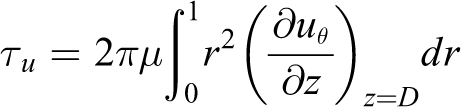
The torques exerted on the discs
The frictional moment or torque which the fluid exerts on the upper disc is given24
but so the above equation becomes
For the lower disc, the corresponding result is
which are the dimensionless exerted torques of the fluid on upper and lower discs.
The normal force or pressure of fluid on discs
According to Shah et al.,24 the pressure or the normal force which the fluid exerts on the upper disc is given as
where in for conditions on the side of the disc and denotes the pressure at the edge of the disc at time t. Let us assume that and using equation (8), we get
where , which is the dimensionless pressure on the upper disc. The positive or negative numerical values of Fpres will be according to the force which the fluid acting on the upper disc is in the positive or negative direction of the z-axis, respectively.
Error analysis
The problem under consideration is solved by package BVPh 2.0 for a maximum residual error using a computing machine with installed memory of GB and processor of Intel(R) core(TM) CPU GHz. Analyses are carried out using order approximations. Error analysis performed in Figure 2 and tabulated results given in Tables 1 to 9 support the authentification of results for different involved physical parameters.
Total residual error profile of (a) , (b) , (c) , (d) , (e) , and (f) for fixed values of ,, , , , , , , , , , , and .
Total residual error for different order of approximations taking fixed values of ,, , , , , , , , , , , and .
m
CPU time (s)
2
0.69
6
5.2
11
11.7
16
24.3
21
44.1
26
74.3
31
119.1
36
184.5
40
256.5
Computations for , , , , , and with ,, , , , , , , , , , and and various values of
.
HAM result
Numerical result
0.1001
0.0140
0.0993
0.0929
0.9015
0.8981
0.0140
0.0993
0.0929
0.9015
0.8981
0.2002
0.0521
0.9876
0.1862
0.8030
0.7962
0.0522
0.9876
0.1862
0.8030
0.7962
0.3003
0.1082
0.9834
0.2805
0.7044
0.6944
0.1083
0.9834
0.2805
0.7044
0.6944
0.4004
0.1763
0.9808
0.3716
0.6055
0.5929
0.1763
0.9808
0.3716
0.6055
0.5930
0.5005
0.2504
0.9800
0.4737
0.5063
0.4919
0.2504
0.9800
0.4737
0.5063
0.4919
0.6006
0.3244
0.9809
0.5737
0.4065
0.3915
0.3244
0.9809
0.5737
0.4065
0.3915
0.7007
0.3924
0.9835
0.6763
0.3059
0.2918
0.3924
0.9835
0.6763
0.3060
0.2918
0.8008
0.4483
0.9876
0.7818
0.2046
0.1931
0.4483
0.9876
0.7818
0.2046
0.1931
0.9009
0.4862
0.9932
0.8902
0.1023
0.0955
0.4862
0.9932
0.8902
0.1023
0.0955
HAM: homotopy analysis method.
Convergence of HAM solution for different orders of approximation for , , , , , and when ,, , , , , , , , , , , and .
m
1
3.00595917
0.07676626
−0.92589583
−0.93460354
0.99932281
1.01406377
5
3.00701050
0.07387897
−0.92738629
−0.93331303
0.98418369
1.01812071
10
3.00701099
0.07387896
−0.92738629
−0.93331304
0.98371264
1.01825226
15
3.00701099
0.07387896
−0.92738629
−0.93331304
0.98370961
1.01825520
20
3.00701099
0.07387896
−0.92738629
−0.93331304
0.98370953
1.01825522
25
3.00701099
0.07387896
−0.92738629
−0.93331304
0.98370953
1.01825522
30
3.00701099
0.07387896
−0.92738629
−0.93331304
0.98370953
1.01825522
35
3.00701099
0.07387896
−0.92738629
−0.93331304
0.98370953
1.01825522
40
3.00701099
0.07387896
−0.92738629
−0.93331304
0.98370953
1.01825522
HAM: homotopy analysis method.
Optimal values of convergence control parameters versus different orders of approximation with fixed values of ,, , , , , , , , , , , and .
Order
hf
hg
hm
hn
CPU time (min)
2
−102.065
−1.0029
−1.0396
−2.0345
−3.1942
−1.0741
0.1
3
−302.151
−1.6707
−1.3943
−2.4366
−1.7222
−0.5789
1.2
4
−375.804
−1.2747
−1.3993
−2.6746
−0.1852
−0.8075
7.7
5
−586.382
−1.7362
−1.6181
−2.7142
−0.1694
−0.7751
53.9
6
−781.235
−2.2512
−1.8266
−2.9008
−0.1522
−0.5291
431.1
Computations for , , , and with ,, , , , , , , , , , and various values of .
HAM result
Numerical result
0.1
3.0396
0.1456
0.9274
0.9334
0.9998
3.0657
0.1458
0.9276
0.9335
0.9998
0.5
3.0111
0.0298
0.9274
0.9334
0.9998
3.0111
0.0298
0.9274
0.9333
0.9998
1
3.0054
0.0149
0.9274
0.9334
0.9998
3.0054
0.0150
0.9274
0.9333
0.9998
1.5
3.0036
0.0099
0.9274
0.9224
0.9998
3.0036
0.0100
0.9274
0.9223
0.9998
2
3.0027
0.0075
0.9274
0.9224
0.9999
3.0027
0.0075
0.9274
0.9223
0.9998
HAM: homotopy analysis method.
Computations for , , , and with , , , , , , , , , , and and various values of .
HAM result
Numerical result
0.5
3.0105
0.0298
0.8319
0.8445
0.9998
3.0105
0.0298
0.8320
0.8445
0.9998
1
3.0013
0.0298
0.7012
0.7206
0.9998
3.0096
0.0298
0.7013
0.7207
0.9998
1.5
3.0101
0.0298
0.5976
0.6204
0.9998
3.0091
0.0298
0.5976
0.6204
0.9998
2
3.0085
0.0298
0.5139
0.5381
0.9998
3.0086
0.0298
0.5139
0.5381
0.9998
2.5
3.0082
0.0298
0.4453
0.4698
0.9998
3.0082
0.0298
0.4453
0.4698
0.9998
HAM: homotopy analysis method.
Computations for , , , and with , , , , , , , , , , , and various values of .
HAM result
Numerical result
0.1
3.0734
0.0739
0.5150
0.5393
1.0133
3.0734
0.0740
0.5150
0.5394
1.0133
0.5
3.0735
0.0739
0.5150
0.5392
1.0133
3.0733
0.0739
0.5150
0.5392
1.0133
1
3.0743
0.0738
0.5150
0.5391
1.0133
3.0748
0.0738
0.5150
0.5390
1.0133
1.5
3.0760
0.0737
0.5150
0.5391
1.0133
3.0750
0.0738
0.5150
0.5388
1.0133
2
3.0774
0.0736
0.5150
0.5390
1.0133
3.0770
0.0737
0.5150
0.5386
1.0133
HAM: homotopy analysis method.
Fluid pressure and torques on upper and lower discs with , , , , , , , , , , and various values of .
HAM solution
Numerical solution
0.1
−90.6705
0.0335
−0.0338
−90.6706
0.0334
−0.0339
0.5
−90.5757
0.0343
−0.0340
−90.5757
0.0343
−0.0341
1
−90.2796
0.0354
−0.0343
−90.2796
0.0355
−0.0343
1.5
−89.7862
0.0365
−0.3457
−89.7862
0.0365
−0.0345
HAM: homotopy analysis method.
Fluid pressure and torques on upper and lower discs with , , , , , , , , , , , and various values of .
HAM solution
Numerical solution
0.1
−192.47
−0.7583
−0.6939
−192.47
−0.7583
−0.6939
0.5
−18.01
−0.9779
−0.6655
−18.01
−0.9779
−0.6655
1
−9.49
−1.2845
−0.6185
−9.49
−1.2845
−0.6185
1.5
−9.21
−1.5982
−0.5983
−9.21
−1.5982
−0.5983
HAM: homotopy analysis method.
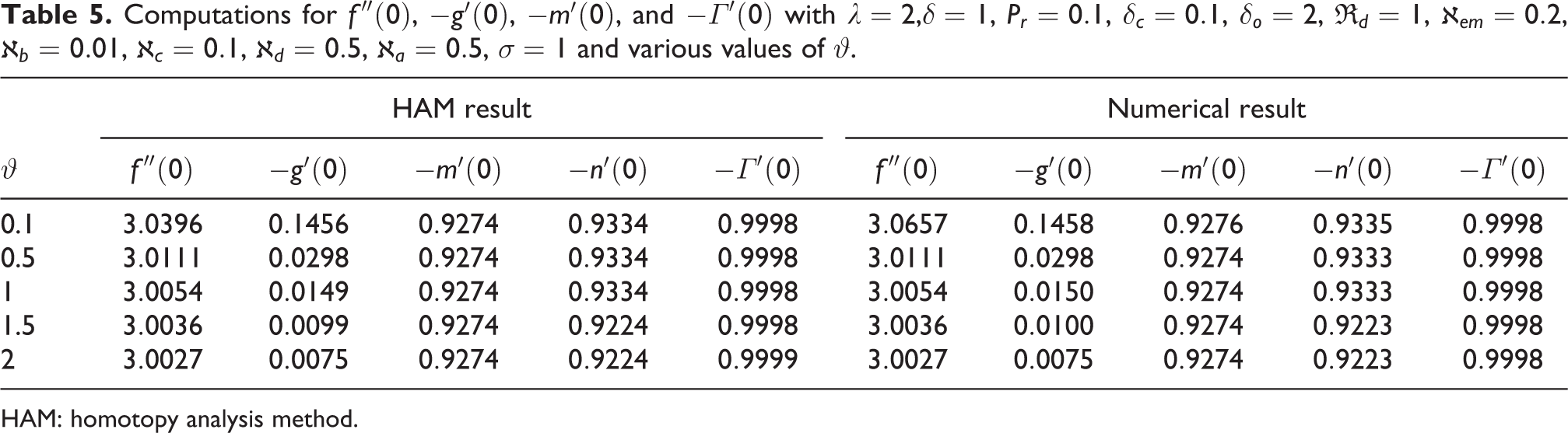
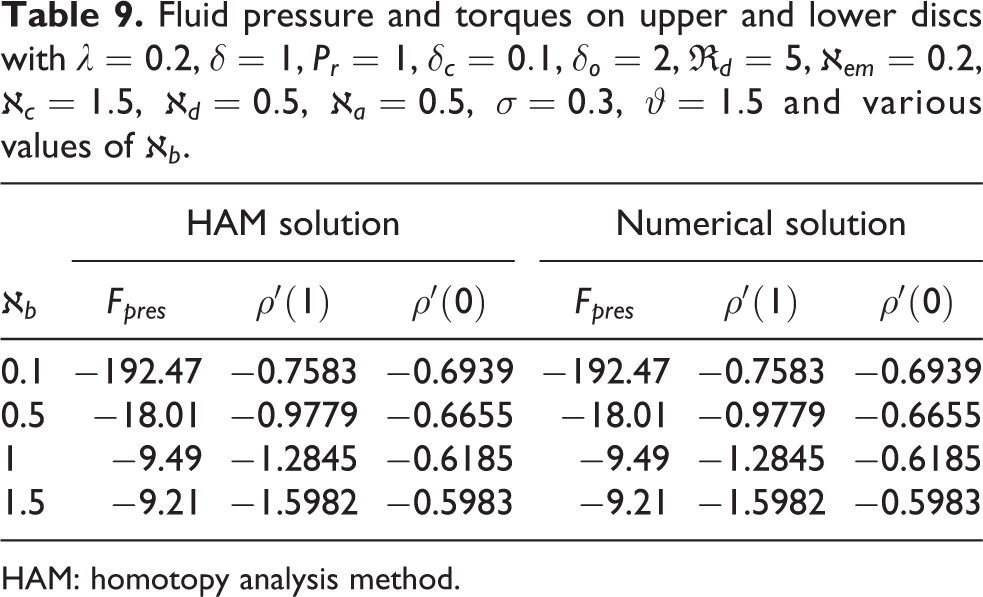
Figure 2 illustrates the maximum average residual error at different orders of approximation for , , , , , and . It is clear from subfigures that error is almost continuously reduced up to order of approximation. Table 1 presents the total residual error for different order of approximations taking fixed values of ,, , , , , , , , , , , and . Table 2 shows comparison of HAM results to numerical values of , , , , , and with ,, , , , , , , , , , and and various values of . Table 4 presents optimal values of convergence control parameters as well as the maximum values of total average squared residual error versus different order of approximation. Here, it is noticed that the solution obtained from momentum, energy and transport equations converges to exact solution as we increase the order of approximation. More justification of our accurate solution is supported with the help of Table 3 for numerical values of , , , , , and . Here, it is clear that the solutions almost converge at order of approximations. Tables 5 to 9 compare the numerical values of HAM and BVP for different values of and fixed values of remaining involved parameters.
Results and discussions
The mathematical formulation for the constitutive expressions of unsteady Newtonian fluid is employed to model the flow between the circular space of porous and squeezing discs in the form of equations (8) to (13) subject to the boundary conditions given in equation (14). These equations are solved and compared for numerical investigations through HAM and BVP . HAM is an analytical method that gives solution in series form while BVP4c package is a numerical solver which is an adoptive mesh method that adopts nonuniform meshes for setting error in each step size. BVP is described as collocation codes which solves BVPs by computing a cubic spline on each subinterval of a mesh of given interval, so the method can be viewed as a collocation method or a finite difference method with continuous extension. Parametric analyses are carried out for the dimensionless parameters such as MFD viscosity parameter , magnetic Reynolds number , rotational Reynolds number , squeezing Reynolds number , axial magnetic force parameter , and tangential magnetic force parameter . The influence of these flow parameters is depicted both graphically and numerically for velocity components , , ; magnetic field components , ; temperature variation ; and mass transport variation . Representative values are used to simulate physically realistic flows.
Figure 3(a) and (b) illustrates the effect of rotational Reynolds number on and . An increase in means increase in angular velocity of lower disc or decrease in fluid viscosity. As expected, increase in angular velocity of lower disc is pushing the fluid in radial direction due to which is increasing as shown in Figure 3(a). It is also noticed that is gradually decreasing as it crosses the central region. The same but opposite behavior of the fluid is seen for azimuthal velocity . The effect of rotational Reynolds number is also illustrated for the magnetic field components and in Figure 4(a) and (b). It is seen from this figure that increasing angular velocity of lower disc gives strength to both azimuthal and axial components of magnetic field. Figure 5 displays the influence of magnetic Reynolds number on the axial and azimuthal induced magnetic field distribution. It is obvious from the figure that increasing the ratio of the fluid flux to the magnetic diffusivity is increasing azimuthal induced magnetic field. However, a slight increase is seen for which decreases near the upper disc.
Profile of (a) and (b) for different values of and fixed values of , , , , , , , , , , , and .
Profile of (a) and (b) for different values of and fixed values of , , , , , , , , , , , and .
Profile of (a) and (b) for different values of and fixed values of , , , , , , , , , , , and .
The effect of is illustrated for the and in Figure 6. It is clear from this figure that as fluid flux is getting higher, fluid has no effect on azimuthal velocity distribution, but as fluid moves toward upper disc its velocity decreases. Similarly, fluid temperature is decreasing with increase of fluid flux or decrease of magnetic diffusivity. Figures 7 and 8 investigate the effect of on , , and , respectively. The relative angular velocity parameter represents the rotations of discs in same direction and in opposite direction . By choosing suitable values of in the range , it is possible to investigate the different flow regimes in fluid domain. The influence of on is shown in Figure 7(a). It is noticed that rotation of discs in same direction is increasing near upper disc. It is also noticed that as fluid moves toward upper disc is gradually increasing. Rotation of discs in opposite direction has opposite behavior on as shown in Figure 7(b); similarly Figure 8 shows that axial magnetic field is increasing by rotation of discs in same direction and vice versa during opposite rotations.
Profile of (a) and (b) for different values of and fixed values of , , , , , , , , , , , and .
(a and b) Profile of for different values of and fixed values of , , , , , , , , , , , and .
(a and b) Profile of for different values of and fixed values of , , , , , , , , , , , and .
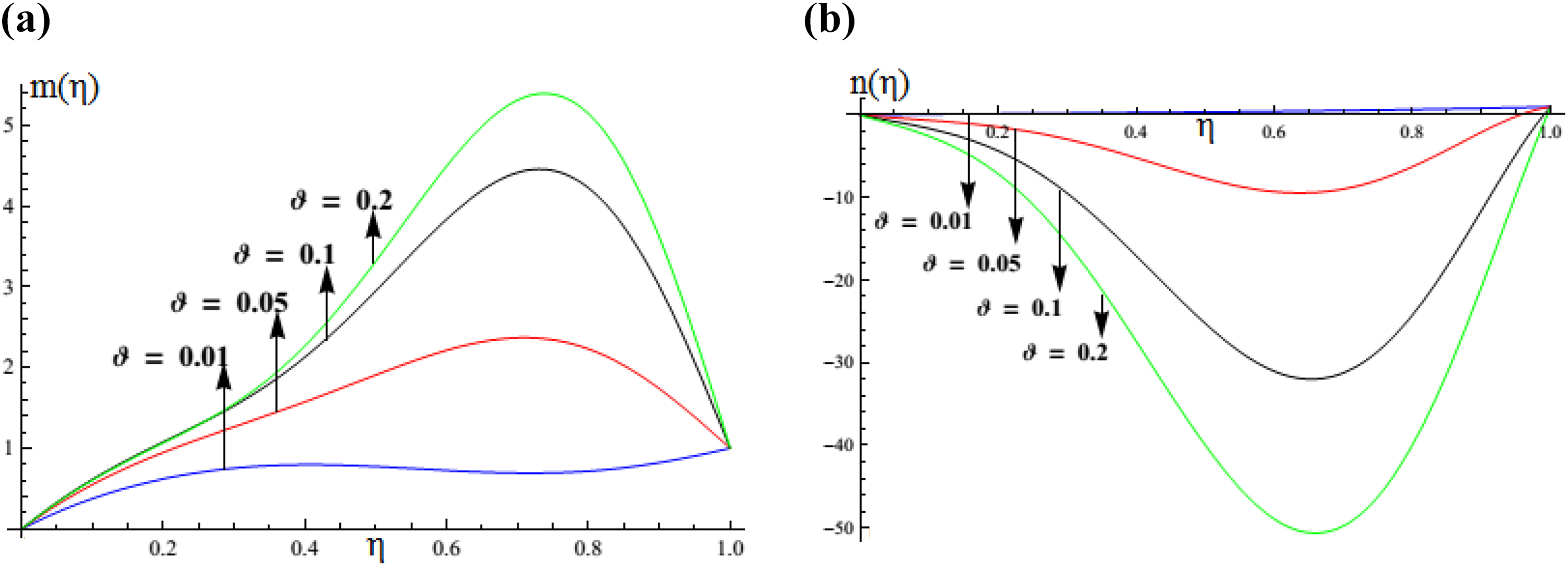
Figures 9 and 10 study the influence of MFD viscosity parameter on , , , and . As fluid viscosity is getting higher, the radial velocity starts increasing, but when fluid crosses the mid-domain it starts decreasing. It is also noticed that increase in viscosity is decreasing azimuthal velocity. Maximum decrease is seen in mid-domain of fluid. Figure 11 depicts the influence of dimensionless azimuthal magnetic force parameter on radial velocity and axial induced magnetic field distribution. The influence of will be dominant in the vicinity of upper disc where its angular velocity is less than the angular velocity of the lower disc . The radial velocity is accelerating up to mid-domain with acceleration of as shown in Figure 11(a), whereas is decelerating. Similarly, Figure 12(a) indicates that is getting higher with increase of . Hence, should be used to increase the axial velocity. Figure 13 is made for the H-curves and Figure 14 shows the effect of on . Tables 5 to 9 numerically investigate the current problem for different values of involved parameters. All results have excellent agreement with the results obtained via BVP . The variation of load or pressure and torques that the fluid exerts on upper and lower discs are shown in Tables 8 and 9. The normal motion of upper disc and rotational motion are set to be the same, that is, . We noticed that the load or pressure is always negative and decreases for both and . Also, increase in is increasing the torque on upper disc. Table 5 numerically investigates the influence of for and . It is clear from the table that increase in viscosity decreases both and . Similarly, Table 6 depicts the influence of magnetic Reynolds number which decrease both and .
Profile of (a) and (b) for different values of and fixed values of , , , , , , , , , , , and .
Profile of (a) and (b) for different values of and fixed values of , , , , , , , , , , , and .
Profile of (a) and (b) for different values of and fixed values of , , , , , , , , , , , and .
Profile of (a) and (b) for different values of and fixed values of , , , , , , , , , , , and .
H-curves profile of , , , , , and for fixed values of , , , , , , , , , , , , and .
Profile of for different values of and fixed values of , , , , , , , , , , , and .
Concluding remarks
In this study, the MFD viscosity of a squeezing flow for viscous fluid under the influence of heat/mass transfers and externally applied variable magnetic field has been investigated. HAM is used to determine the series solution of fluid velocity components , , ; magnetic field components , ; and mass and temperature distribution , . Exceptional stability and convergence characteristics have been demonstrated with HAM. The physical key parameters emerging have been investigated graphically in detail including dimensionless , , , , , and .
Main upshots of this article are presented as below:
The induced magnetic field distribution and are increasing functions of rotational Reynolds number. Further, the radial and azimuthal velocities are directly affected by an increase in .
Magnetic Reynolds number causes an increase in magnetic field distributions and decrease in tangential velocity.
Fluid temperature decreases by increase in the magnetic Reynolds number.
The azimuthal and axial components of magnetic field have opposite behavior with increase in MFD viscosity.
It is observed from Table 5 that increase in MFD viscosity decreases and .
It is clear from Table 6 that increase in magnetic Reynolds number decreases both and .
Footnotes
Acknowledgment
The authors would like to thank the Department of Basic Sciences and Islamiat (BSI), University of Engineering and Technology (UET), for providing the necessary computing facilities required for this work.
Authors’ contributions
All authors contributed equally and significantly in writing this article. All authors read and approved the final manuscript.
Declaration of conflicting interests
The author(s) declared no potential conflicts of interest with respect to the research, authorship, and/or publication of this article.
Funding
The author(s) received no financial support for the research, authorship, and/or publication of this article.
References
1.
RashidiMRostamiBFreidoonimehrN, et al.Free convective heat and mass transfer for MHD fluid flow over a permeable vertical stretching sheet in the presence of the radiation and buoyancy effects. Ain Shams Eng J2014; 5: 901–912.
2.
KhanAShahRAShuaibM, et al.Fluid dynamics of the magnetic field dependent thermosolutal convection and viscosity between coaxial contracting discs. Results Phys2018: 9: 923–938.
VermaP. Magnetic fluid based squeeze film. Int J Eng Sci1986; 24: 395–401.
5.
KriegerRDayHHughesW. The MHD hydrostatic thrust bearing—theory and experiments. Lubr Technol Trans ASME1967; 89: 307–313.
6.
Rahimi-GorjiMPourmehranOGorji-BandpyM, et al.Unsteady squeezing nanofluid simulation and investigation of its effect on important heat transfer parameters in presence of magnetic field. J Taiwan Inst Chem Eng2016; 67: 467–475.
7.
AcharyaNDasKKunduP. The squeezing flow of Cu-water and Cu-kerosene nanofluids between two parallel plates. Alax Eng J2016; 55(2): 1177–1186.
8.
SaidiMTamimH. Heat transfer and pressure drop characteristics of nanofluid in unsteady squeezing flow between rotating porous disks considering the effects of thermophoresis and Brownian motion. Adv Powder Techol2016; 27: 564–574.
9.
KhanAShuaibMShahRA. Squeezing flow analysis of a viscous fluid between co-rotating discs with Soret and Dufour effects. Heat Trans Res2018; 49(11): 1103–1118.
10.
KhanAShahRA. Influence of cross-diffusion and radiation on mixed convection between rotating discs in the presence of a variable magnetic field. Eur Phys J Plus2019; 134. DOI: 10.1140/epjp/i2019-12396-5.
11.
HamzaA. The magnetohydrodynamic effects on a fluid film squeezed between two rotating surfaces. J Phys D Appl Phys1991; 24: 547.
12.
ShahRAKhanAShuaibM. On analysis of squeezing flow between rotating discs with cross diffusion effects under the influence of Coriolis and centrifugal forces. Int J of Fluid Mech Res2017; 45(1): 1–17.
13.
KuzmaDMakEDonnellyR. The MHD squeeze film. J Fluid Mech1964; 19: 395–400.
14.
HayatTMuhammadTQayyumA, et al.On squeezing flow of nanofluid in the presence of magnetic field effects. J Mol Liq2016; 213: 179–185.
15.
NabhaniMEl KhlifiM. Non-Newtonian inertial MHD porous squeeze film lubrication between circular discs. Tribol Int2016; 94: 373–382.
16.
Mohyud-DinSKhanS. Nonlinear radiation effects on squeezing flow of a Casson fluid between parallel disks. Aerosp Sci Techol2016; 48: 186–192.
17.
HatamiMJingDSongD, et al.Heat transfer and flow analysis of nanofluid flow between parallel plates in presence of variable magnetic field using HPM. J Magn Magn Mater2015; 396: 275–282.
18.
AzimiMRiaziR. Heat transfer analysis of GO-water nanofluid flow between two parallel disks. Propul Power Res2015; 4: 23–30.
19.
IbrahimF. Unsteady flow between two rotating discs with heat transfer. J Phys D Appl Phys1991; 24: 1293–1299.
20.
KumariMTakharMNathG. Nonaxisymmetric unsteady motion over a rotating disk in the presence of free convection and magnetic field. Int J Eng Sci1993; 31: 1659–1668.
21.
SunilSharma AKumarP. Effect of magnetic field dependent viscosity and rotation on ferroconvection in the presence of dust particles. Appl Math Comput2006; 182: 82–88.
22.
DomairryGAzizA. Approximate analysis of MHD Squeeze flow between two parallel disks with suction or injection by homotopy perturbation method. Math Probl Eng2009; 2009. Hindawi Publishing Corporation. Doi: 10.1155/2009/603916.
23.
NanjundappaCShivakumaraSArunkumarR. Benard–Marangoni ferroconvection with magnetic field dependent viscosity. J Magn Magn Mater2010; 322: 2256–2263.
24.
ShahRAShuaibMKhanA. Dufour and Soret effects on heat and mass transfer with radiative heat flux in viscous liquid over a rotating disk. Eur Phys J Plus2017; 132: 342.
25.
WangC. The squeezing of a fluid between plates. J Appl Mech Trans ASME1976; 43: 579–582.
26.
ShahRAShuaibMUllahM, et al.Free Convection from an infinite disk rotating in a vertical plane with variable magnetic force. J Comput Theor Nanosci2017; 14: 1–12.
27.
ShahRAKhanAShuaibM. On the study flow between unsteady squeezing rotating discs with cross diffusion effects under the influence of variable magnetic field. Heliyon2018; 4: e00925.
28.
LiaoS. An optimal homotopy-analysis approach for strongly nonlinear differential equations. Commun Nonlinear Sci Numer Simul2010; 15: 2003–2016.