




Abstract
Taking into consideration the latest advances in both ceramic and polymer fields, a new generation of high-performance polymer composites based on the state-of-the-art MXene (Ti3C2(OH)2) ceramics and one of the leading high-performance thermosets, namely the phthalonitrile resins, is presented. The synergistic combination between the two phases led to nanocomposites exhibiting an outstanding thermal stability with starting decomposition temperatures not less than 484°C for 3 wt% of nanoloading. The tensile properties were as high as those obtained with fiber-reinforced polymer composites. For instance, the tensile strength reached its highest value of 276 MPa for the maximum loading of 3 wt%. The morphological studies carried out by scanning and transmission electron microscopies corroborated the improvements of the thermal and mechanical properties. Undoubtfully, such materials expected to be used in extreme conditions can be seen as the next generation of ceramics-reinforced polymer composites.
Introduction
Ceramic-reinforced polymer composites have been one of the most studied fields in the last few decades owing to the exceptional properties of the resulting materials. Meanwhile, the ease of preparation and the numerous possible combinations between the two phases have led to an overwhelming number of scientific articles dedicated to the subject. 1 –3 However, it has come to our attention that the obvious majority of the ceramic-reinforced polymer composites were limited to the use of the traditional ceramic fillers, such as alumina, titania, and zirconia, while the major improvements are those related to the changes in the molecular design of the polymeric matrices or of the molecular fillers. 4 Therefore, aiming at the preparation of high-performance polymer materials, one should take into account the latest advances in both ceramic and polymer fields. Following this point of view, we have recently initiated several research using the state-of-the art MAX phase ceramics and phthalonitrile (PN) resins as one of the leading high-performance thermosets. Herein, we are extending the investigation to other newly developed ceramic nanosheets known as the MXene. The motivation behind these research is to develop a new generation of ceramic-based polymer composites with excellent mechanical and thermal properties for extremely exigent applications.
The MXenes can be obtained by removing the A layers from MAX phase precursors following an hydrofluoric (HF) acid etching procedure. 5 The MAX phases, also known as the new generation of ceramics, are ternary nitrides or carbides having the general formula M n +1AX n , where M is an early transition metal, A is an A-group element (mainly group IIIA or IVA), X can be either carbon or nitrogen, and the value of n can be either 1, 2, or 3. 6 Thus, MXene compositions can be easily adjusted by a suitable choice of the MAX phases. As a new type of graphene-like 2-D nanosheets materials, MXenes have recently received significant attention. Because of their unique electrical properties such as graphene-like morphology, low shear strength, excellent mechanical strength, adsorption properties, and high specific surface area, MXenes are a very promising additive for the improvement of the tribological and mechanical properties of polymers. 6,7
PN resins stand on the leading edges of the highly performant polymers owing to an appropriate combination of extremely valuable features, such as excellent thermal stability, good mechanical properties, low water uptake, and superior flame resistance, to name a few. 7 In our previous works, we reported on the synergistic combination between the PN resins and the MAX phases, namely the Ti3AlC2 8 and Ti3SiC2, 9 leading to highly performant polymer nanocomposites and herein, we are extending the study to the effect of a newly developed MXene (Ti3C2(OH)2) nanosheets on the thermal, mechanical, and morphological properties of the bisphenol A-based PN resin.
Experimental
Materials
Bisphenol A, 3-aminophenol, and 4-nitrophthalonitrile were obtained from VWR reagents (France). N, N-dimethyl sulfoxide (DMSO) and potassium carbonate were purchased from Sigma-Aldrich (France). 3-Aminophenoxy phthalonitrile (3-APN) and 2,2-bis [4-(3,4-dicyanophenoxy)phenyl] propane (BAPh) monomers were prepared in our laboratory following the procedure described in our previous work. 10 The Ti3AlC2 powder was also synthesized in our laboratory, as described elsewhere. 8 Five grams of Ti3AlC2 powder was immersed in 50% of HF acid for a period of 5–6 h. After that, the suspension was rigorously and thoroughly washed with ethanol to create hydroxyl groups of the MXene outer surfaces. The as-such obtained materials (Ti3C2(OH)2) were dried in a vacuum oven at 70°C overnight. To isolate the Ti3C2(OH)2 nanosheets, 1 g of Ti3C2(OH)2 was poured into 10 ml of DMSO and the mixture was mechanically stirred for 3 h. The solvent was then removed by filtration and centrifuge. Then, the Ti3C2(OH)2 was immersed in deionized water, sonicated for at least 1 h, and then dried in a vacuum oven for 12 h. A statistical study of the nanosheets dimension was performed and the obtained results suggested an overall size of about 60 nm. A schematic description of the synthesis process is shown in Figure 1.
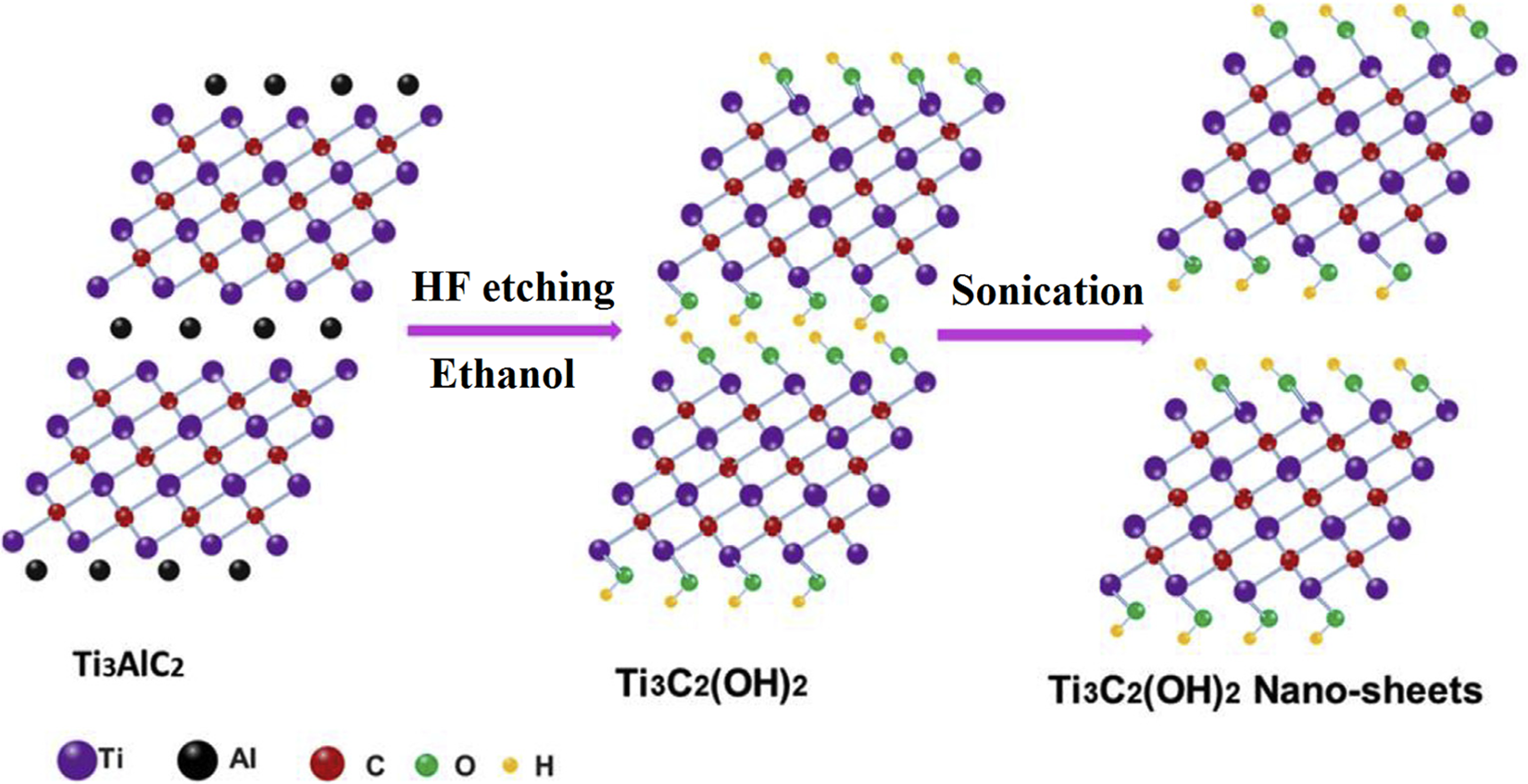
Schematic description of the synthesis process of the studied MXene nanosheets.
Preparation of PN/Ti3C2(OH)2 nanocomposites
The nanosheets silane surface modification was achieved by mixing the Ti3C2(OH)2 nanosheets and the chosen silane coupling agent in an appropriate solvent (ethanol) for a period of 3–4 h. Following a rigorous filtration process, the Ti3C2(OH)2 nanosheets were dried in a vacuum oven for 24 h. The weight ratio of 90:10 was adopted between the BAPh and the 3-APN. The choice of such ratio was done after an extensive literature review. The latter mixture of monomers was melted and the reinforcing phase with various contents ranging from 1 wt% to 3 wt% at increments of 1 wt% was added. To obtain void-free thermosets, the mixtures were first sonicated for 10 min, dried in a vacuum oven at 120°C for 5 h, and then transferred to an appropriate steel mold according to the test shape requirements. The samples were finally cured by a hot compression molding technique following the curing procedure of 240°C for 2 h, 260°C for 3 h, 280°C for 6 h, and 300°C for 6 h, respectively. Hereafter, the cured nanocomposites were noted as P(BAPh)/MXene.
Characterization techniques
Differential scanning calorimetric (DSC) analysis was performed on a PerkinElmer 8000 DSC (Perkin Elmer, USA). The thermal stability of the studied nanocomposites was investigated by a TEXAS instrument thermogravimetric analyzer Q50 (Texas Instruments, USA) at a heating rate of 20°C/min from 50°C to 820°C under nitrogen atmosphere at a flow rate of 50 ml/min. The tensile tests were recorded on the LLOYD EZ 20 universal material testing machine (AMETEK Lloyd Instruments, UK) following the ASTM D3039 M standard. The fracture surface morphology of the composites was investigated using a scanning electron microscope (SEM; Hitachi, model SUM800 (Hitachi, Japan)) at 15 kV with a gold deposition on the samples. The dispersion of the Ti3C2(OH)2 nanosheets within the polymeric matrix was investigated by a high-resolution JEOL-2100 (JEOL, USA) transmission electron microscope (TEM).
Results and discussion
The effect of the MXene nanosheets on the curing behavior of the PN resin was studied by DSC. This investigation was used to monitor the changes that can occur in the position of the curing peak and the enthalpy of polymerization. From the obtained curves shown in Figure 2(a), it was clear that the increase in the nanosheets loading only affected the enthalpy of polymerization, whereas the position of the peak was quite the same for all of the studied compositions. Indeed, the enthalpy of polymerization varied from 28.3 J/g to 21.5 J/g when the amount of the reinforcing phase increased from 0 wt% to 3 wt%, while the maximum of the exothermic peak remained at around 240°C. Similarly, the maximum of the endothermic peaks, ascribed to the melting of the BAPh monomers, also remained at values close to 187°C. The heat of polymerization reduction is generally targeted since void-free materials can be obtained by doing as such. In terms of thermal stability, the introduced MXene effectively improved PN thermal resistance. As can be seen in Figure 2(b) and Table 1, the starting decomposition temperatures and the char yield at 800°C were highly improved on increasing the amount of the MXene nanosheets. For instance, T 5% and T 10% were increased by 39°C and 156°C, respectively, when the amount of nanofillers reached 3 wt%. Thus, similar to the traditional ceramics, the (Ti3C2(OH)2) nanosheets were proven to improve the thermal stability of the neat PN resin.

(a) DSC thermograms of BAPh/MXene nanocomposites at the heating rate of 20°C/min; (b) thermal stability of the P(BAPh)/MXene nanocomposites; and (c) tensile stress/strain curves of the P(BAPh)/MXene nanocomposites. BAPh: 2,2-bis [4-(3,4-dicyanophenoxy)phenyl] propane; DSC: differential scanning calorimeter.
Thermal properties of the P(BAPh)/MXene nanocomposites under nitrogen atmosphere.
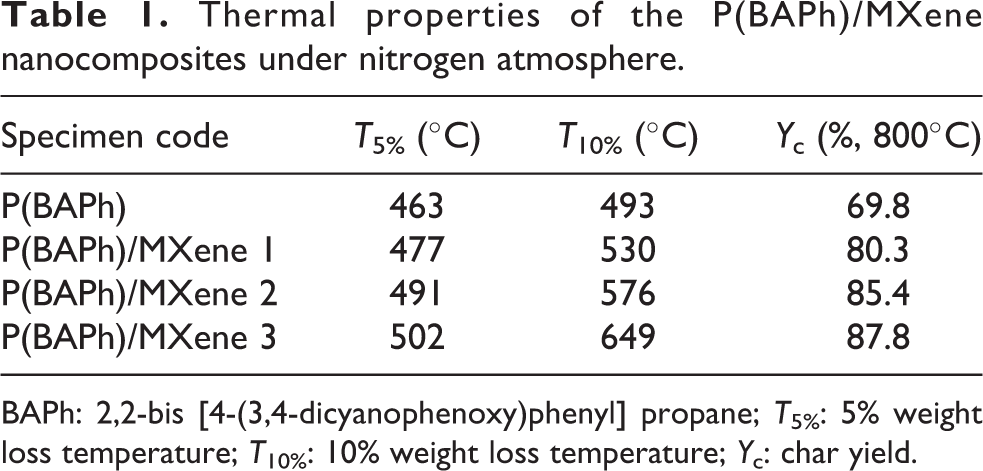
BAPh: 2,2-bis [4-(3,4-dicyanophenoxy)phenyl] propane; T 5%: 5% weight loss temperature; T 10%: 10% weight loss temperature; Y c: char yield.
The tensile stress–strain curves are also shown in Figure 2(c). A gradual and substantial increase in the strength was noticed on increasing the amount of the reinforcing phase. For instance, the neat resin exhibited a tensile strength of about 40 MPa. This value was greatly improved, reaching one of the highest tensile strengths in the field of PN-based composites of 276 MPa at 3 wt% of nanoloading. Meanwhile, it was also noticed that the strain remained at a value close to that of the neat resin. Indeed, such behavior, previously observed for the Ti3AlC2- and Ti3SiC2-reinforced PN nanocomposites, is typical for this class of ceramic. 8,9 For example, the P(BAPh)/Ti3AlC2 displayed interesting tensile performance with a tensile strength of about 88 MPa and a strain of around 1.7% for 15 vol% of nanoloading. Thus, in terms of strain behavior, the MAX phases and the MXene ceramics are quite similar. On the other hand, the layered structures of the MXene nanosheets enable a huge capability of resistance to crack propagation resulting in nanocomposites with enhanced tensile strengths. Broadly, the MAX phases and their related MXenes are also known as soft ceramics having a reduced impact on the strain. Such interesting properties allow the preparation of composites with better toughness than those prepared from the traditional ceramics. 11 It is also important to state that efforts to further improve the mechanical properties by increasing the amount of the MXene nanosheets were hindered by the presence of a considerable agglomeration negatively affecting the overall properties of the nanocomposites.
The tensile fractured surfaces of the P(BAPh)/MXene nanocomposites were analyzed by SEM and the obtained images are shown in Figure 3. The PN resins as any other high-performance thermosets are brittle materials. When subjected to a tensile test, the initial fractures propagate in a homogenous environment without any obstacle resulting in long fracture lines and poor strength (Figure 3(a)). On the other hand, when well-dispersed nanofillers are present within the matrix, the propagation of the fracture lines is hindered by these nanoparticles. When a fracture line hits a nanoparticle, it will be deviated in another direction and as the amount of nanoparticles increases, the deviations are more frequent. Therefore, the necessary amount of energy to break a nanocomposite sample will be higher. In other words, the presence of nanoparticles allows the polymeric matrix to withstand elevated amount of stress, and as a result, the strength is enhanced. Although accurate measurement of the cracks size is quite impossible to achieve, the SEM images provide a clear indication about their general size, which is clearly microsized. Furthermore, the homogenous dispersion of these cracks indicated an acceptable dispersion and adhesion between the PN matrix and the MXene.

SEM micrographs of the fractured surface of the P(BAPh)/MXene nanocomposites at various MXene contents: (a) 0 wt%, (b) 1 wt%, (c) 2 wt%, and (d) 3 wt%. BAPh: 2,2-bis [4-(3,4-dicyanophenoxy)phenyl] propane; SEM: scanning electron microscope.
To further investigate the nanosheets dispersion in the PN matrix, TEM analysis was performed for the nanocomposites containing 3 and 4 wt% of MXene nanosheets and the obtained images are shown in Figure 4. Although some agglomerations were depicted for the P(BAPh)MXene 3 nanocomposite (Figure 4(a)), their size was in acceptable limits. Meanwhile, the results clearly confirmed that a good state of dispersion was achieved even at 3 wt% of nanoloading. Further increasing the nanosheet loading was deemed unacceptable, since the presence of large size agglomerations (Figure 4(b)) negatively affected the mechanical performances of the nanocomposites.
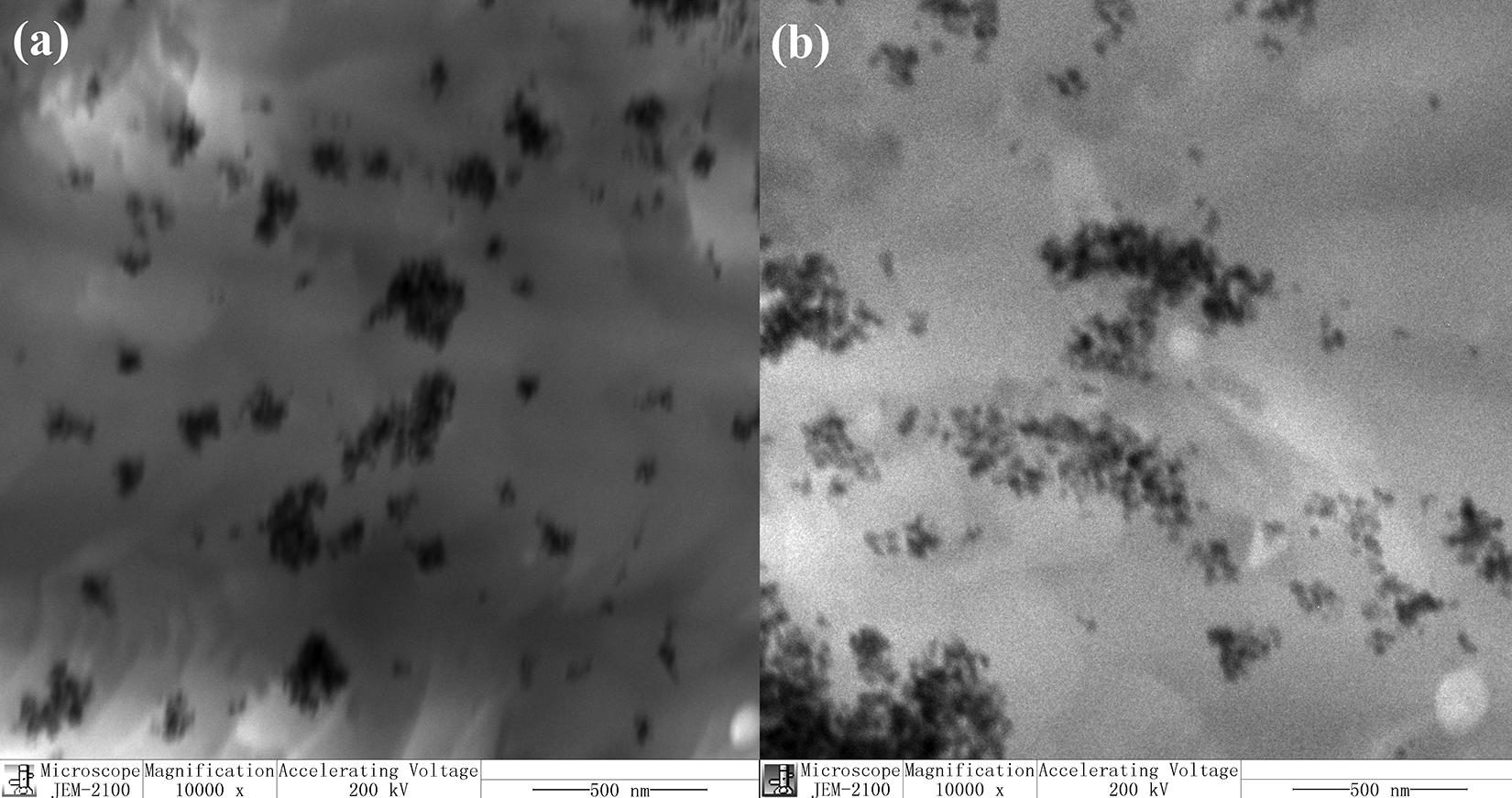
High-resolution TEM images of the P(BAPh)/MXene nanocomposites at various MXene contents: (a) 3 wt% and (b) 4 wt%. TEM: transmission electron microscope; BAPh: 2,2-bis [4-(3,4-dicyanophenoxy)phenyl] propane.
Conclusions
Taking into consideration the latest advances in both ceramic and polymer fields, a new generation of high-performance polymer composites was prepared. The prepared MXene-reinforced PN composites exhibited outstanding thermal stability along with exceptional tensile performances. The 2-D layered structure of the MXene and its good dispersion and adhesion within the polymeric matrix are behind those enhanced performances. Meanwhile, the morphological investigations monitored by SEM and TEM confirmed the enhancements seen in both thermal and mechanical properties. Overall, this study highlighted the fact that when state-of-the art individual materials are brought together, great benefit could be obtained from their composites.
Footnotes
Declaration of conflicting interests
The author(s) declared no potential conflicts of interest with respect to the research, authorship, and/or publication of this article.
Funding
The author(s) received no financial support for the research, authorship, and/or publication of this article.
