



Abstract
This article attempts to provide a theoretical model of a small local mangrove economy. The structure of the model is based on observations from a qualitative field survey conducted in the Sunderbans region of West Bengal. The study showed that fishery is the primary source of income in this region. Agriculture is practised by many, but due to soil salinity, the sector, at best, provides sustenance for the family. Most of the other requirements are met from goods bought from outside. The role of the forest cover on shrimp cultivation is captured through the productivity effect, which increases the output per unit of labour and capital. In this structure, an optimum tariff on the timber industry is derived, and it is shown that the optimum tariff depends on the intensity of the productivity effect.
Introduction
Mangroves are a type of tropical forest, uniquely positioned at the dynamic interface of land and sea. They are found along coasts and estuaries throughout the tropics and subtropics and are capable of thriving in salt water. Mangroves form the foundation of a highly productive and biologically rich ecosystem, which provides a home and feeding ground for a wide range of species, many of which are endangered. Although mangroves make up less than one percent % of all tropical forests worldwide, they are highly valuable ecosystems, providing an array of essential goods and services, which contribute significantly to the livelihoods, well-being and security of coastal communities. Despite its value, the mangrove ecosystem is one of the most threatened on the planet. Mangroves are being destroyed at rates 3–5 times greater than average rates of forest loss, and over a quarter of the original mangrove cover has already disappeared. While environmentalists and environmental economists are extremely concerned about these disappearing mangroves and substantial research has been carried out on this, capturing or estimating the role of the mangrove forests in the ecosystem presents a huge challenge as most of the empirical studies are piecemeal studies and focus on one or some role of these forests and do not estimate their role in its entirety. A theoretical structure, which explains the interactions between the market forces and the eco-system, is yet to be provided, and this article attempts to take a first step in this respect.
The timber from the mangrove forests are sometimes used for construction, fuel wood, furniture and other household objects and paper and fibres. The extraction of this timber damages the forests and affects the ecological balance. In recent times, efforts have been made to protect these mangroves and restrict the use of timber from them. Mangrove forests serve as a natural breeding ground for shrimps and offshore fisheries. A variety of important species such as shrimp, fish and crabs use mangroves as nursery areas as the trees and root networks provide food and shelter from predation.
Shrimp cultivation provides a good amount of foreign exchange and serves as a source of livelihood to many living in and around these forests. The biodiversity in mangrove ecosystems attracts a lot of tourists and is another source of livelihood. In the past two decades, another very important role of the mangrove forests has been widely discussed—the protection they offer from natural calamities like super cyclones and tsunamis.
Badola et al. (2012) studied the attitude of local communities towards conservation of mangrove ecosystem in the east coast of India. This study, though conducted with the protection service of mangrove forest as its backdrop, mainly concentrates on the direct use of mangrove forest by the local community and their attitude towards its conservation. Valiela et al. (2001), Barbier and Cox (2003), Barbier (2007), and Sathirathai and Barbier (2001) empirically estimated the mangrove–fishery linkages in Southeast Asia and in other countries. These studies show that conserving mangroves for shrimp cultivation was financially attractive, but this does not make conversion of mangroves into commercial fishing pond economically worthwhile.
In India, the protection service of mangrove forest has been studied by Das (2009a, 2009b). She estimated the value of the protection services that mangroves provide in terms of property loss in the Kendrapada district of Orissa. These studies highlight that the extent of damage in a particular area depends on the intensity of the cyclone (reflected in wind velocity and storm surge), as well as on the physical and socio-economic features of the area, viz. location of the village vis-à-vis the coast line, the cyclone eye, the presence of mangroves or other cyclone barriers, etc. In a similar study, Das (2012) examined the role of natural ecosystem and socio-economic factors in the vulnerability of coastal villages to cyclone and storm surge by calculating the probabilities of expected human fatality due to severe cyclone. The results show that villages established in the mangrove habitat areas and those with more marginal workers face a very high death risks. But those villages, which are situated inside the existing mangrove forest or near a major river, face a much lower risk of death. This article has important recommendations like the conserving of mangrove forest in cyclone-prone areas and priority evacuation of villages established in the mangrove habitat before high-intensity cyclone for cyclone hazard management.
In this article, we first give a glimpse of the economy in the mangroves in the Sunderbans region in South 24 Parganas, West Bengal. This is carried out through a qualitative study in six villages and focus group discussions with officers responsible for forest protection in the region. Based on this, we capture the economy–ecology linkage through a general equilibrium model of the local mangrove economy. The structure of the model is based on the observations in this qualitative survey. This economy produces timber from the forest and fishery (like shrimp) in the mangrove areas. Agriculture is also a production activity, though it is assumed to be of very low quality and inefficient as the land in these areas are not very fertile. The rest of the needs of this area is met by buying (or importing) goods/services from the outside world. These have been captured as a complete bundle of importables in our model. As the fisheries sector thrives on the mangroves, a higher extraction of timber depletes the forest cover and adversely affects the productivity in the fisheries sector. This trade-off between the two primary products in this region gives us a lot of interesting results. Given this structure, we derive the effect of an ad valorem tax on the timber industry and its effect on local income. We also derive the optimum rate of tax, which would maximize income.
The rest of the article is organized as follows: in the next section, we describe a typical mangrove economy of the Sunderbans region in West Bengal through a qualitative survey. Based on this, we lay out the basic model of the mangrove economy in the third section. In the fourth section, we study the effect of an ad valorem tax on production and local income. In the fifth section, we conclude the article.
The Mangrove Economy: A Glimpse
In order to form an idea about the structure of a typical mangrove economy in the Sunderbans region in South 24 Parganas, West Bengal, we have conducted a qualitative survey of 50 households in 6 villages of the district. A focus group discussion was also conducted with the Beat Officer of the Duchnikhali Beat Office Officer located at the fringe of the Reserve Forest in the Patharpratima block. The survey was conducted in March 2019, 10 years after the cyclone Aila devasted the region, but before the next cyclone Amphan in 2020. This survey was needed to give us a clear idea about the structure of the economy to be framed in the third section. We interviewed villagers in Krishnadaspur, Sitarampur, Buraburir Tat, Gobardhanpur, Uttar Surendraganj and Satyadashpur of the Patharpratima block.
The discussion with the Beat gave us a good idea about the mangrove forest in the region. The role of the Beat Office at the ground level is to facilitate community development through Forest Protection Committee (FPC), Joint Forest Management Committee (JFMC), Eco-Development Committee (EDC), etc. While JFMCs only focus on the conservation of forest resources, the FPCs cover a wide range of activities. The reason for developing FPCs is to:
combat illegal poaching activities in the forest; reduce heavy dependence of marginalized fraction of the villagers on the forestry resources, which destroy forest cover; help build a good surveillance system by the local people, so that trust and reciprocity among them are built in a consolidated way; and build awareness among the local villagers, who reside in and around the forests, about the protection services rendered by them.
Since the core region is a part of the Reserve Forest, no felling of trees is allowed at present, and therefore, no direct benefits can be distributed to the members of the FPCs. Normally, the mandate of the JFMCs and FPCs allow for a 20% of the cash transfer to the members after the forest resources are economically exploited by the government. This is in practice in other parts of West Bengal. This practice cannot be executed in this region because of its Reserve Forest status. Therefore, the FPC members receive indirect benefit transfer through the forest department and Beat Office. The FPC members are engaged in various economic activities in the village through:
distribution of cash crops that may be grown in the region; distribution of commercially profitable live stocks like poultry chicken, shrimps, crabs, etc.; engaging FPC members in resource building such as building pukka road, digging well for agricultural purposes, distributing tube well in collaboration with local Panchayat, etc. The payments for the resource building by the FPC members are made through the available funds for the 100 days’ work. The Beat Office in collaboration with the local Panchayats and the Office of the block development officer (BDO) distribute work among the FPC members. The one direct benefit is the timely payments for the works, which otherwise get delayed. This heavily reduces the dependence on the forest resources. forest department distributes solar energy panels to the FPC members to adapt to the cheap and sustainable energy consumption; sometimes, emergency electric lights are distributed to the meritorious students working under the FPC; free liquefied petroleum gas (LPG) connections are provided by the forest departments through the FPCs; and a social and cultural bonding is developed by felicitating and appreciating the best-performing FPC among the FPCs and to the individual member belonging to any FPC who made a significant or innovative contribution.
The FPC members are incentivized through coordination between various government departments. No direct cash transfer is given to the Forest Management Committee (FMC) members by the forest department.
The main trees found in this region are Gewa (Excoecaria agallocha), Twara (Tara spinosa), Garan (Ceriops decandra), Garjan (Dipterocarpus turbinatus), Hental (Phoenix paludosa) and Gain (Ginkgo biloba). The demand for these trees is primarily for the building materials, furniture making and small cottage industry. Earlier, the government would lease out demarcated forest area to private parties for commercial felling, but this practice has been stopped after an order from the Supreme Court of India around 15 years ago. There is no such organized timber-related industry in the region. Nowadays, the demand for timber is mainly for the fuel wood for cooking. However, the free LPG connection under the Ujjwala Yojna has reduced that dependence on timber. Though there is no direct dependence on forest nowadays, some marginalized village family, particularly the Sabars and Adiwasis do depend on forest for fuel wood even today. The timber for making big fishing trawlers and small- to medium-sized fishing boats are, however, imported from elsewhere. According to the Beat Officer, the Reserve Forest is more or less intact in size for the past two decades because of the successful community development through the formation of FPCs and JFMCs. People are aware that the forestry resources, particularly mangroves, help prevent inundation and consequent land submerging into the river. So, they are very much active in planting mangroves, with the help of the local Beat Office on the river bank. However, in the villages of Sitarampur and Gobardhanpur, the river bank has caved in for 8–10 km, highlighting the fact that mangrove conservation efforts leave much to be desired, and illegal destruction of the forest is still a reality.
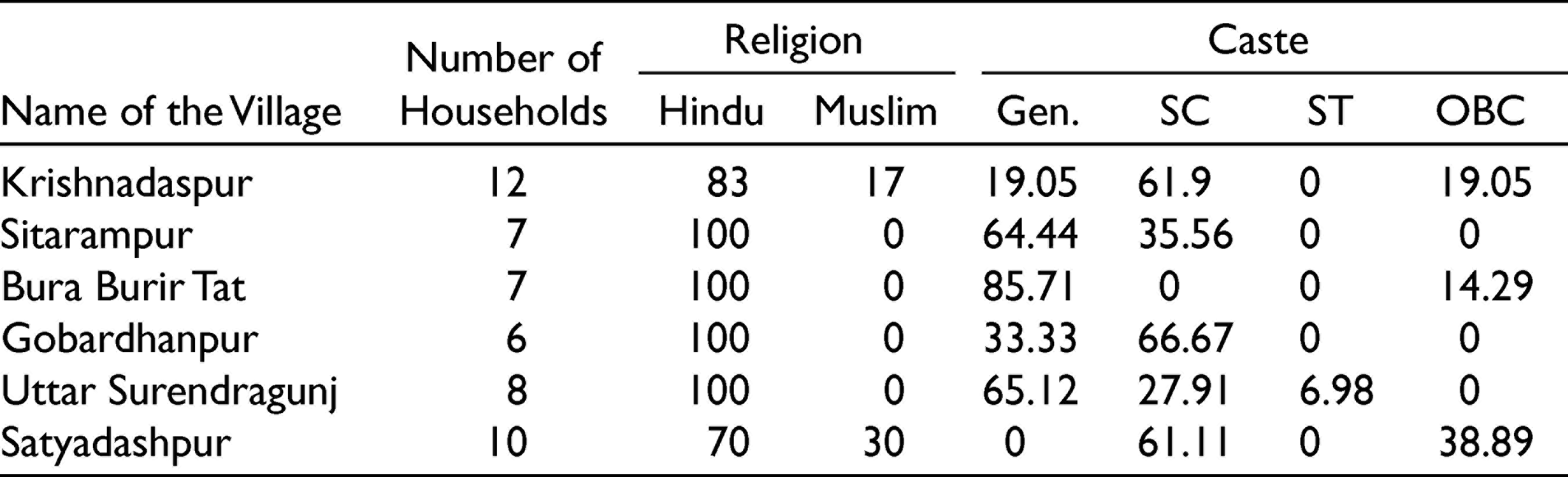
To understand the occupational pattern in the different sectors of this mangrove economy, we spoke to the villagers of these six villages. Table 1 presents the demographic profile of the households. It can be observed that the villagers surveyed are mostly Hindus, and many of them belong to the scheduled caste group. Scheduled tribe families are very rare, but there are some other backward Castes also. All the villagers were literate, but many of them had not received formal education. Among our respondents, 80% had dropped out before Madhyamik (school-leaving exam after Class 10). Most of the villagers were very poor, barely managing to survive. In most of the villages, the average income per household was less than ₹10,000 per month. Sitarampur was the most prosperous among them, where the average income was between ₹20,000 and ₹25,000. In this village, trawler boat making was a big industry, making it the wealthiest of all the villages in the region.
Demographic Profile of Households Surveyed
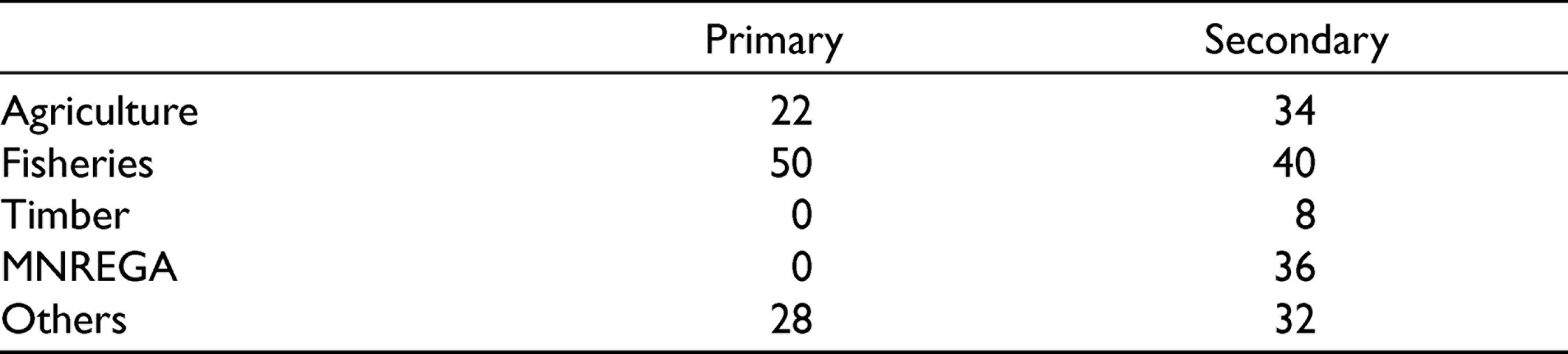
It was interesting to observe that there existed a significant occupational variation, ranging from agriculture to fisheries to casual labourers to even unskilled workers under Mahatma Gandhi National Rural Employment Guarantee Act (MGNREGA). Most of the villagers were involved in multiple activities. Fisheries was the primary source of livelihood among half the respondents and the secondary source was agriculture at 22%. A total of 34% and 40% of the households reported agriculture and fisheries to be their secondary source of income, respectively (Table 2). Thus, 90% of the households were involved in fisheries. A total of 8% of the households said they were involved in timber collection, though it was not their primary source of income. Over the past two decades, dependence on forests has greatly declined due to the intervention of the FPCs and also a realization about the importance of these forests among villagers. A total of 36% of the households reported being involved in the 100 days’ work programme that MNREGA provided through the government, though none of them claimed it to be the principal source of income. Many households reported that family members had migrated to urban areas, mainly Kolkata, and were working as casual labourers or in the informal sector.
Occupational Structure
The Agriculture Sector
Among the agricultural produce, paddy cultivation was the dominant crop, followed by betel leaf cultivation. Seasonal vegetables such as eggplant, tomatoes, chillies, onions, green vegetables, etc., were grown in the front and backyards of the houses. Most of the agricultural produce were meant for self-consumption and very small portion of those were sold in the local market. The major drawback for the agricultural sector in the region was water and soil salinity, making productivity very low and the agricultural sector not very profitable. Thus, though agriculture was the primary activity among almost half the people, it was practised at a subsistence level, explaining the poverty of the region.
The Fisheries Sector
Fisheries was the dominant livelihood in this region, mainly due to its location in the swamp area, connected by the rivers, and was situated near the Bay of Bengal estuary. Also, the region had a natural home ground of mangroves, which was conducive to the kind of fishery activities available in this area. Shrimp fry cultivation and collection, crab cultivation by converting barren agricultural lands, prawn cultivation, salt water fisheries were common in this region. Some of the villages surveyed (Sitarampur, Gobardhanpur and Uttar Surendragunj) were located at a creek connecting them to the sea. These were mainly fishing villages, where most of the fishermen owned fishing boats for off-shore fisheries, fishing trawlers (big-sized country boats) for deep sea or marine fishery. In other villages where the fisheries sector was not a dominant livelihood practice, a number of households were engaged in fish trading. The catch from the marine fisheries took about 3–4 months’ voyage into deep sea in the season, and most of the catches were auctioned in the nearby fish market in Namkhana, Bakkhali and Diamond Harbour ports. The average value of catch per trawler was roughly around ₹5,00,000–10,00,000. The fishing trawlers cost around ₹8 to ₹12.5 million, depending on the modern equipment and safety gears installed. The cost of fuel and other subsistence materials for about 10–15 people per boat for a voyage of 3–4 months was reported to be around ₹250,000–300,000 on an average. Therefore, the profit margin ranged between ₹250,000 and ₹650,000 or ₹700,000, depending on the catch. However, a high degree of uncertainty prevailed in this livelihood due to seasonal weather variation, unregulated catch of marine fisheries and climate change, which were dominant reasons among many. The crab cultivation and the prawn cultivation, by converting agricultural lands, were a more profitable business that required a low capital investment. Credits were available from the local cooperative banks at a low rate of interest (5%–6%). Often, loans were taken to convert personal land to prospective shrimp cultivation. Shrimps, crabs and prawns were sold somewhere in the range of ₹300–500 per kg in the peak season. However, for a profitable fishery business in some areas, mangroves were being cut to prepare swamp land for fishing, thus reducing forest cover, which actually reduced the profitability of the fisheries industry.
The Timber Sector
A few households (less than 2%) were engaged in timber collection from the forests as their primary livelihood. However, 40% reported timber to be their secondary or tertiary source of income. At present, there is no major timber industry due to strict surveillance of the forest department officials. This was often carried out by forming self-help groups (SHGs), involving female members of the households by giving them training through educational camps and helping them find an alternative source of livelihoods. However, a decade ago, timber cutting, processing and selling was one among the many livelihood options.
In order to reduce their dependence on the forestry (especially mangroves), forest officials gave them cash crops for free and necessary training for cultivation. Sometimes, they were provided with shrimp seeds to cultivate shrimp fishery. A social cohort was successfully made by creating awareness and educating the women of the region in such a manner only a few were dependent on the forestry these days.
The Model
The above-mentioned survey gives us an idea about a mangrove economy. To capture this theoretically, we use a general equilibrium framework. The local economy is captured as a small open economy, which imports most of its consumables from the outside world. As we have seen that though timber is no longer an organized sector in this region, it was an important part of the economy until very recently. In many regions, which are not protected yet (i.e., in the absence of any regulation), it continues to be a thriving industry. Thus, we have assumed that economy initially (before regulation) produces two traded goods, which depend on the mangrove forests—timber (T), which is produced by cutting down the trees (and thus destroying the mangrove cover) and shrimp/fisheries (F)—which is produced only for export, that is, there is no domestic consumption. A greater mangrove cover is more conducive to this fisheries sector. So, expansion of the timber sector is costly for the fisheries sector—it reduces the productivity of the factors of production. In addition, the economy produces an agricultural good (A) that is a non-traded good. It is assumed to be a very small sector, which produces no marketable surplus that can be exported to the outside world. This is realistic as the land is not at all fertile in the mangrove region. As the economy cannot produce most of what its needs, a lot of the requirements are procured from the outer world. These are captured as a composite bundle of importables (I). Thus, the economy produces T, F and A and consumes T, A and I. The two traded sectors use labour (L) and capital (K) for their production. The production technology in each sector is assumed to have constant return to scale with positive but diminishing marginal return to each factor of production. While the total mangrove cover has no impact on the timber production as long as the entire forests are not destroyed, its effect on the fish production is captured through the productivity effect of both factors. A greater mangrove cover results in greater concentration of fish and enables greater catch per unit of labour and capital. Thus, the input coefficients of the two sectors can be written as:


where aij is the amount of the ith factor required in the production of the jth good, w, r and R are the wage rate and return to capital and land, respectively, and S is the cover of mangrove forests. This cover is determined by how much of timber is produced such that

where S0 is the initial stock of mangrove forest, and XT is the output of the timber sector.
We assume that the productivity effect on the two factors are identical and captured by μ such that

That is, an increase in the forest cover increases the productivity of labour and capital. Thus, less of both these factors are needed for one unit production of F and aLF and aKF falls.
The non-traded agricultural sector uses labour and land—a factor which is specific to this sector. In addition, since the land in the mangrove region is saline and very infertile, multiple cropping is not possible, and use of fertilizers and irrigation have very little impact on the agricultural production. So, it has been assumed that the agricultural sector has a fixed coefficient production function, that is, there can be no substitution between labour and land.
Since the mangrove economy is very small, it is a price taker for all the traded goods. The price of the non-traded agricultural good is endogenous to the system. The composite import is assumed to be the numeraire good, and its price is set to unity for simplicity. All other prices are relative prices expressed in terms of the price of I. Prefect competition prevails in product as well as in factor market, which imply that the commodity prices



Since A is a non-traded good, PA is the market clearing price, where demand equals supply, that is:

where

where y is the real income of the economy expressed in terms of price of I and

Since land is specific to agriculture, and the production function is a fixed coefficient type, the supply of the agricultural produce is limited by the supply of land. So,

Full employment conditions of labour and capital can be written as follows:


where L+ is the labour available to T and F after the demand is met in the agricultural sector. Note that as the output of A is fixed by the availability of land, and the sector has a fixed coefficient production function, the labour requirement by the agricultural sector is also fixed, making the labour available to the T and N sectors’ invariant.
The supply of A, XA, is determined in Equation (11). Since the market clears, PA is determined as a function of ye through Equations (8) and (9). For any given level of S, the wage rate, w, and the rate of return to capital, r, are determined in the Equations (4) and (5). The rate of return to land is then determined as a function of y and S in Equation (6). The demands for timber (T) and the composite import (I) can then be expressed as functions of relative prices and expected income.


Finally, the impact of economic activities on mangrove forest cover can be observed from

where
To ensure stability in the different markets, we assume that the supply curves are positively sloped. In the timber sector, we find

Similarly, in the fisheries sector:

So, stability requires that
Thus, this static general equilibrium model captures a snapshot view of the ecology–economy inter-linkage where the expansion of one sector (timber) actually harms the other sector (fisheries) directly through the productivity effects. The protection services provided by these forests are generally not visible, and they are observed only when some disaster occurs.
Effect of Environmental Policies
Since mangroves provide essential services to the community in terms of enhanced productivity in the fisheries industry and even more valuable protection services at the face of natural disasters like tsunamis and cyclones, it is important to take some policy measure to protect this ecosystem, as we have observed that strict measures have been taken to protect these forests. In this section, we analyse the effect of an ad valorem tax on timber on the production levels and on the income.
Effect of Ad Valorem Tax on Timber
Let t be the rate of tax imposed by the local government on the value of timber produce, so producers in timber industry pay (
Effect of change in price in post-tax situation can be obtained as follows:

where
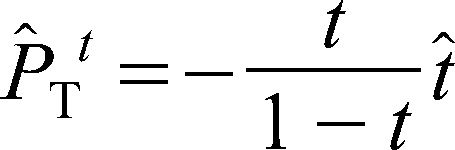
The change in the output of timber sector responds with respect to the change in its relative price. So,

Therefore, it is clear from the above-mentioned expression that the timber output falls unambiguously when an ad valorem tax is imposed on timber.
Similarly, on the other hand, we get the change in output of the fisheries sector as follows:

That is, the output of the fisheries sector increases after imposition of the tax on timber.
Finally, the effect of this tax incidence on the mangrove forest cover can be expressed as follows:

The ad valorem tax on timber output increases the mangrove forest cover by reducing timber output.
Effect of Environmental Policies on Income Level of the Economy
Let yt be the post-tax income level of the economy, Thus,

where,
The effect of the tax on income can be written as follows:

The contribution of the timber sector to the income falls, while the contribution of the fisheries sector increases. That is,

On the other hand,
A 1% increase in the tax rate raises the government revenue at constant output. However, as production of timber falls, lowering the tax base, the net impact on revenue depends on which effect dominates:

Therefore, ultimate change in income can be written as follows:

The optimal tax rate is that which maximizes the level of income. That is, the level of t for which

Thus,
Thus, the stronger is the productivity effect, the higher is the rate of optimal tax.
The intuition behind this is simple. The productivity effect basically captures the negative externality associated with timber extraction. The stronger is this externality, the higher will be the optimal tax needed. The revenue collected may be distributed among the locals and used as incentives to FPC members to ensure forest protection and bring down illegal felling.
Conclusion
This article attempts to provide a theoretical model of a small local mangrove economy. The structure of the model is based on observations from a qualitative field survey conducted in the Sunderbans region of West Bengal. The study showed that fishery is the primary source of income in this region. Agriculture is practised by many, but due to soil salinity, the sector, at best, provides sustenance for the family. Most of the other requirements are met from goods bought from outside. The role of the forest cover on shrimp cultivation is captured through the productivity effect, which increases the output per unit of labour and capital. In this structure, an optimum tariff on the timber industry is derived, and it is observed that the optimum tariff depends on the intensity of the productivity effect.
Footnotes
Declaration of Conflicting Interests
The authors declared no potential conflicts of interest with respect to the research, authorship and/or publication of this article.
Funding
The authors disclosed receipt of the following financial support for the research, authorship, and/or publication of this article: UGC-DSA Programme, Department of Economics, University of Calcutta is gratefully acknowledged.