



Abstract
There are many types of innovations such as technological, social, product, process, marketing and organizational, and institutional innovation is one type. The producer companies (PCs), which are a case of legal institutional innovation in the Indian domain of primary producer organization are more market-oriented co-operative companies and can help farmers buy and sell more effectively. They have gained currency across India during the past 15 years since the amendment to the Companies Act made this possible in 2003, and India now has thousands of such PCs, with many of them being supported by state agencies.
This article examines the uniqueness of these entities as an institutional form wherein principles of co-operation and corporate entity have been combined so that they could be more relevant entities in a globalized and liberalized market environment. It discusses their competitive edge over other forms of producer organizations like co-operative societies in India and farmer companies in Sri Lanka, and new-generation co-operatives in other parts of the world. After discussing some innovations in their governance and management, it concludes by making suggestions for augmenting this institutional innovation for inclusive and sustainable agricultural and rural development.
Keywords
Introduction
In many developing countries, farmer organization into groups and institutions remains poor and insignificant in terms of proportion of the total number of farmers. In India, 29% of farmer households had a membership in a co-operative society, but only 19% availed of any services from co-operatives like fertilizers or credit facilities in 2003. There are only a few sectors in India where co-operatives have some significant presence like sugar in Maharashtra with 40% share of co-operatives in sugar production of the state or milk in Gujarat where co-operatives account for 16% of the marketed surplus of milk. On the input side, it is only in chemical fertilizers that co-operatives have 36% share in production and the credit co-operatives account for 16% of agricultural credit. This is nowhere close to what co-operatives have achieved in the European countries, accounting for 40%–95% of dairy business, 20%–70% of fruits and vegetables, 30%–70% of wine, 15%–90% of meat and 30%–70% of farm input supply across European countries (Mahajan, 2015). Further, there is a large-scale exclusion of small producers from modern processing and retailing value chains—national or global (Singh, 2012). In this context, it is argued that larger farmer entities like co-operatives or other producer institutions are needed to manage the new market interface and benefit from it (Trebbin, 2014; Trebbin & Hassler, 2012).
India now has more than 7,000 producer companies (PCs) a new legal form of producer organization (PO) since 2003, ‘besides thousands of traditional co-operatives across sectors of agribusiness, with many of the former being supported by state agencies of which 80% were registered in just the past 4 years (2016–2019). This was largely due to many government schemes coming into effect from the middle of the decade. Maharashtra accounted for 26% of the total and Uttar Pradesh, Tamil Nadu, Madhya Pradesh, Telangana, Rajasthan, Karnataka and Orissa each had more than 5% of the total. In fact, Maharashtra along with Uttar Pradesh, Tamil Nadu and Madhya Pradesh accounted for half of the registered PCs. However, Madhya Pradesh had the highest percentage of 5 year or older PCs, as it was also a pioneer in setting up these entities immediately after the coming into effect of the Producer Company Act. On the other hand, Uttar Pradesh had very few companies, which are older than 10 years, though it is the second largest in terms of number of PCs with 10% share in the total. By 2019, 6% of the PCs were struck off by the Registrar of Companies (RoC), and 80% of those struck off were in older age groups. A total of 92% of registered PCs were engaged in agricultural and allied activities (Neti et al., 2020).
The number of shareholders ranged from a minimum of mandatory 10 to as many as more than 0.1 million per PC. Most of the National Bank for Agriculture and Rural Development (NABARD) supported PCs (86%) had 500 or less shareholders and all of them together (2,075) had 765,000 shareholders. Only 1% of them had more than 1,000 members. The average number of shareholders per PC was 369 in the case of NABARD and 997 in the case of Small Farmer Agribusiness Consortium (SFAC, a special purpose vehicle of the Ministry of Agriculture and Farmer Welfare) promoted PCs. SFAC had 819 PCs with 8,20,000 members. The average membership across altogether worked out to be 582 shareholders per PCs and the total membership was 4.3 million farmers. The average paid up capital per PC worked out to be ₹1.17 million for all registered PCs and ₹1.22 million for those with active status. This meant that the average shareholding was ₹2,000. Among the top 20 PCs with the paid-up capital, dairy was the biggest sector across the states followed by coconut and one each in fruits and vegetables, poultry and tea. Interestingly, two of them were all-women PCs. Of the 6,926 active PCs, majority had very low paid-up capital even after 2–3 years of being in existence (Neti et al., 2019).
More recently, India’s union government has planned to promote 10,000 more such entities over the next 5 years with additional financing support besides existing policy incentives and schemes for such entities, which include income tax exemption for PCs with turnover upto a ₹1000 millon for PCs and extension of operation greens scheme with an allocation of ₹5,000 million to address price fluctuation in three vegetable—tomatoes, onions and potatoes (TOP)—crops for the benefit of farmers and consumers to all perishable produce. It aims to promote agri-logistics, processing facilities and professional management through the PCs (for details, see Singh, 2021), and many state governments like Odisha (GoO, 2018) and Kerala (GoK, 2015) have policies to promote and support them.
Major research questions on PC structure, in general, include—how far are the PCs an improvement over the existing co-operatives or other models of producer organization (PO)? How relevant and appropriate are the PCs in the context of globalized markets? Do they have robust design and business model to succeed and make an impact on small producer members? Should they be commodity specific or more generic in their business domain as per member needs? Does scale really matter for viability and impact at the member farmer end? How to attend to larger objectives, that is, inclusiveness, democracy and community orientation, through such organizations?
Though the new legal entity of PCs has been around for more than 15 years by now, there are not many studies on this new legal institutional structure with a few exceptions (Singh & Singh, 2014; Trebbin & Hassler, 2012), with some arguing that PCs show a better promise as profit earning entities (Huang et al., 2015; Singh & Singh, 2014) like the new-generation co-operatives (NGCs) in other contexts (Nilsson, 1997), but this has led to a debate. Shah (2016) argues that the Producer Companies Act is a case of fermenting new wine in new bottles as it is like many other versions of the Co-operative Societies Act. This Act over the past 10 years has not led to the emergence of a single PO of the quality and size of an Amul (a successful co-operative dairy brand of milk producers in Gujarat, India) or a sugar co-operative. He finds that a good farmer organization should be based on new ways of doing business (innovation), involving new technology, product development and marketing. Most of the PCs do not have the organizing logic like the value addition model. Most of them do what traders were doing but with greater presumed efficiency and transparency, and many times, their promotion is driven by government schemes and grants. He argues that if producer companies (PCs) promise attractive returns to investment, there is no reason why farmers would not provide capital to such an entity. He is of the view that design thinking for transforming existing conditions into preferred ones is missing. But Ganesh (2017) counters Shah’s argument on the performance of PCs and finds Shah’s comparison of agricultural produce and dairy (milk) PCs (promoted by National Dairy Development Board, hereafter NDDB) is faulty, missing design thinking principles in the PCs is only a minor problem, and it is the larger structural problems of agriculture, which prevent PCs from performing as well as scaling up like the milk PCs, which are provincial in scale and membership. The role of capital and expertise in the success of milk PCs is also ignored, he argues. Milk PCs also do better as dairy activity is more stable and resilient unlike crops and farm produce and also because the frequency of the transaction in the case of milk is much higher than that in case of farm produce. Further, milk is a homogeneous commodity, easy to aggregate and store, and provides immediate returns. On the other hand, all these characteristics are missing in farm produce. Furthermore, most of the milk PCs have mixed membership unlike other PCs. Even though PCs may not make large profits by undertaking activities like farm input supply, they provide significant savings for the shareholders because of the assured supply and quality of inputs. Finally, it is also the nature and type of promoter, which makes a difference (Ganesh, 2017).
This article examines the legal and operational superiority of PCs as compared with NGCs globally, farmer companies (FCs) in Sri Lanka and co-operative societies in India with review of legal aspects of the respective provisions of the various legislations and argues that the PCs are co-operative companies, which are hybrid structures for organizing small primary producers. It examines the various aspects of their organizing and operational principles to understand whether they could play a role in modern market context as business entities that are still mindful of the issues of equity, democracy and inclusiveness. The next section discusses the role of institutions and innovations, and POs to understand the concept and the role of the PCs. The third section provides comparative assessment of the NGCs, FCs and PCs as legal structures in the presence of International Co-operative Alliance principles and highlights the role of the PCs in changing agribusiness environment and their place in India legally compared with the traditional co-operatives. The fourth section examines the innovations adopted/followed by some of the PCs. The fifth section discusses legal and policy aspects of this PC innovation and ways forward for leveraging PCs as innovative institutions as the concluding section.
Institutions, Innovations and Producer Organizations
Institutions and institutional context are important determinants of development. Institutions play an important role in development along with other resources such as technology, capital and enterprise, and together, they determine the cost of transacting and producing (Avelhan & Zylbersztajn, 2018). In small producer–dominated situations like Indian agriculture, the role of institutions becomes even more crucial as there are structural and enterprise-specific constraints like high transaction cost, lack of market integration and interlocking of factor and output markets, which only institutions and organizations can tackle effectively. Institutions help small farmers by way of reducing transaction costs, managing or reducing risk, building social capital, enabling collective action or readdressing missing markets.
There are various terms and concepts used to refer to this in the literature, for example, institutions, institutional framework, institutional environment, institutional capacity, institutional arrangements and institutional mechanisms. Various approaches to institutions confirm that institutions and organizations do matter and economic outcomes cannot be disentangled from the concrete social contexts in which they take place. Institutions refer to ‘rules of the game’ in a society or, more formally, the humanly designed constraints that shape human interaction and economic performance. They are made up of formal constraints like rules and laws, informal constraints like norms of behaviour or codes of conduct, and their enforcement characteristics, and they, altogether, define the incentive structure of the societies and, more so, economies. Institutions are also different from organizations—the former being the rules of the game and the latter the players in the game. But both of them influence each other in terms of which organizations come up and how they evolve, and it is determined by the institutional framework (rules of the game), and they, in turn, influence how the institutional framework itself evolves (Avelhan & Zylbersztajn, 2018; Neilson & Pritchard, 2009; Singh, 2017a).
It is also important to recognize that institutions do not always evolve in an efficient manner, and intentional inefficiency or failures of the institutions are motivated by the capture of value from groups organized in the society. Organizational failures arise when the structure implemented is less efficient than the best feasible structure. Thus, there could be inefficiency by design in the planned structure (Avelhan & Zylbersztajn, 2018).
Innovation is a key to growth and sustainability of an organization and has been given due emphasis in institutional analysis literature (Bhanot et al., 2021; Neilson & Pritchard, 2009).
‘Innovation is the implementation (use) of something new or improved (whether technology or otherwise) in products (goods or services), processes, marketing, or organizational methods. In other words, it means applying ideas, knowledge, or practices that are new to a particular context with the purpose of creating positive change that will provide a way to meet needs, take on challenges, or seize opportunities. Such novelties and useful changes could be substantial (a large change or improvement) or cumulative (small changes that together produce a significant improvement)’ (IICA, 2014, p. 3).
There are many types of innovations such as technological, social, product, process, marketing and organizational, and institutional innovation is one type (IICA, 2014). Institutional innovations entail a change of policies, standards, regulations, processes, agreements, models, ways of organizing, institutional practices or relationships with other organizations, so as to create a more dynamic environment that encourages improvements in the performance of an institution or system to make it more interactive and competitive (IICA, 2014, p. 4). It is a continuous process of incremental change, or it can be a response to a crisis or a failure (Shiller, 2006) or a process of creative destruction (Gatzweiler, 2016). Therefore, institutional innovation can be the creation of new institutions or a change in existing institutions (Raffaelli & Glynn, 2015). Contract farming has been studied as an institutional innovation in agribusiness (Bhanot et al., 2021; Maertens & Velde, 2017). There have also been many other innovations in the production and marketing of various crops, including paddy rice in India (Singh, 2017a) and farm input markets (Singh, 1999).
Small producers globally suffer from lack of capital, skills and information, high business costs, poor access or costly access to services, and weak bargaining power and policy influence (Penrose-Buckley, 2007). Alternatively, they can also be seen as suffering from high production and market risks. Therefore, POs are arguably the only institutions, which can protect small farmers from the ill effects of globalization or make them participate successfully in modern competitive markets by provisioning various services like those relating to production and marketing or financial services besides organizational and management services, which enhance member engagement and lead to producer agency and empowerment (Trebbin & Hassler, 2012) and help small producers reduce or manage better their production and market risks (Shah, 2016). While private agribusiness is better at creating value, POs are needed to capture value for farmer members (Gersch, 2018).
POs not only help farmers buy or sell better due to scale benefits but also lower transaction costs for sellers and buyers, besides providing technical help in production and creating social capital (Bachke, 2009). It is also argued that co-operatives or such POs like co-operatives are needed for small farmers as they help realize better output prices and credit terms, and, thus, they can help eliminate interlocking of factor and product markets into which small farmers are generally trapped (Kumar et al., 2018; Ma & Abdulai, 2016; Patibandla & Sastry, 2004). POs also amplify the political voice of smallholder producers, reduce the costs of marketing of inputs and outputs, and provide a forum for members to share information, coordinate activities and make collective decisions. They also create opportunities for producers to get more involved in value-adding activities such as input supply, credit, processing, marketing and distribution (Farina, 2002).
Co-operatives are different from other forms of organizations not in terms of business functions they perform but in terms of the manner and philosophy with which these functions are performed. The new and potential role of co-operatives in the new economic regime includes provision of inputs, economies of scale, fine-tuning of produce to the market, facilitating more competition in primary markets and capturing surplus in adjoining stages of the value chain. The role of a co-operative is to create an interface between the farmer and global market, provide access to permanent risk-bearing capital for farmers, manage risk for farmers through diversification, set standards in the market, provide more competitive market conditions and market access to farmers, and to promote economic democracy at the grassroot level (Singh, 2008).
POs can be supported by government agencies, non-governmental development organizations (NGDOs), specialist support agencies, donors and other international development agencies, private companies and alternative trading organizations separately or jointly and severally. In building market linkage, the facilitating agency can play the role of a trade partner, broker, coordinator or advisor Further, the orientation of these agencies and organizations differs. For example, whereas NGOs generally focus on market reforms to make markets fair for small producers through such organization of smallholders, other stakeholders like private companies and international agencies focus more on market access and that too with market efficiency and investments. What is needed is a balance between market reform and market access for viability and sustainability of POs. Further, the context is very important to examine as very often there are basic legal, economic or political problems preventing POs from developing successfully (Penrose-Buckley, 2007).
The major factors which could influence the performance of a PO include aspects or problems such as free rider, horizon portfolio, cash flow, influence and control. All of these originate in the way allocation of ownership and control is organized in such entities (Iliopoulos, 2013). The FCs and PCs like their counterpart non-traditional co-operatives or NGCs in the developed countries have legal provisions to tackle some of the above-mentioned problems. Some of these NGCs have been able to reinvent themselves by way of redistribution of residual claim and control rights among patrons. These include redeemability or reassignment of shares or closed or defined membership. Therefore, one can hope that FCs or PCs as NGCs will perform better as their governance and management are more like investor-owned companies (IOCs) (Singh, 2016a).
The health of a PO depends on financial and non-financial performance, and thus, member centrality, domain centrality and patronize centrality become important. Economic viability depends on group attributes, leadership, institutional arrangement, business and financing decision, and the policy environment. On the other hand, governance and management are crucial determinants of non-financial performance, which includes shareholding pattern, appointment of board of directors, capital mobilization and allocation, leadership style, rules, norms and decision-making processes. The organizational viability and sustainability also depend on the nature of community, its agro-ecological and demographic profile, and socio-economic and behavioural factors, which include the attitude of farming communities towards agribusiness (Dey, 2018).
NGCs and PCs as an Institutional Innovation
PCs are a legal institutional innovation providing more business-like entity to primary producers to organize and conduct business without any bureaucratic or government control and interference (Singh & Singh, 2014). In India and many other developing countries, traditional co-operatives were mostly organized under the co-operative structure, like State Co-operative Societies Acts in India. But, due to political interference, corruption, elite capture and similar issues, the co-operatives soon lost their vibrancy and became known for their poor efficiency and loss-making ways. The government support to these co-operatives also declined, though gradually and selectively. At the same time, they face higher competition due to globalization and liberalization policies. The new environment, however, provides new opportunities for co-operatives due to state withdrawal and deregulation. There is an increased need and relevance of co-operatives due to the liberalization and globalization policies, which are marginalizing the resource-poor producers. The major problems of traditional co-operatives have been capital constraint due to the withdrawal of financial support by the government, high competition from other players in the market and access to credit (capital) and technology, besides free riding by members and issue of investment horizon in a co-operative. In fact, internal and external free-riding problems originate in the very nature of the co-operative as an institution as it distributes profits based on patronage, not investment, and because non-members are allowed to do business with the co-operatives on the same terms as members. The horizon problem occurs as members cannot trade shares at market price, and thus, they cannot capitalize their gains when they leave the co-operative. This provision also creates portfolio problems as members cannot diversify their portfolio to reflect their risk preferences. The control problem refers to difficulty of monitoring and controlling management as there is no share market. Finally, influence problem distances investors from control as there is only one member–one vote. These problems also make it difficult for co-operatives to borrow as lenders prefer their loans to be covered by equity against the risk of default (Singh, 2016a).
As a solution to this problem of co-operatives, a new variant called NGCs evolved over time in various parts of the world, especially in the USA and Canada. In Denmark, New Zealand and Australia, many co-operatives in the dairy sector worked more like co-operative companies facilitated by legal and policy measures (Singh & Singh, 2014). The rationale for NGCs comes from market thrust and orientation, which are required due to competition, vertical integration and coordination (backward and forward) by other forms of enterprises, and capital mobilization constraints of traditional co-operatives due to free rider and horizon problems.
An NGC is one which has restricted or limited membership, links product delivery rights to producer member equity, raises capital through tradable equity shares among membership, enforces contractual delivery of produce by members, distributes returns based on patronage, goes for value addition through processing or marketing, and makes use of information efficiently throughout the vertical system. However, it retains one member–one vote principle for major policy decisions (Harris et al., 1996; Nilsson, 1997). The advantages of delivery rights shares for members are assured procurement prices and market share of profits due to value addition (residue claims), and appreciation of share prices due to better performance of the co-operative (Harris et al., 1996). This kind of restructuring, especially equity-linked delivery shares and contractual delivery of produce, helps co-operatives tackle problems of free riding and member investment horizon, which are at the root of financial constraint and opportunism, both of members and of the co-operative. This arrangement by co-operatives has helped them become economically efficient, financially viable and obtain member loyalty wherever it has been tried (Harris et al., 1996; Nilsson, 1997). In practice, though the NGCs have been able to raise 30%–50% of their total capital through delivery rights issues, the problems include (a) off market purchases to meet contract terms by the members; (b) leasing of delivery rights by members; and (c) dependence on non-producer member equity and non-member business (Singh, 2008).
It was found in the case of NGCs in the USA that planning and development, and financing and costs, were the two major factors in the success of the NGCs across various agro-processing sectors (Carlberg et al., 2006). In fact, it was also argued that effective farmer POs need to have clarity of mission; sound governance; strong responsive and accountable leadership; social inclusion; be demand and service delivery driven; have high technical and managerial capacity; and effective engagement with external actors like the government, donors or private sector (Cotula et al., 2019; Thompson et al., 2009). But even this needs to be supplemented by supportive and enabling legal, regulatory and policy environment that guarantees autonomy and level playing field (Thompson et al., 2009).
In the Asian region, there are two unique experiences of organizing small farmers under more business-like entities called FCs or PCs in Sri Lanka (Rosairo et al., 2012) since the mid-1990s and in India since 2003 (Singh & Singh, 2014). In Sri Lanka, a member could own a maximum of 10% of total shares, while there was a large minimum number of members required for an FC to remain legal, a specified territory of an FC, and representation of the government agencies on FC boards. However, unlike in Sri Lanka, in India, there is no maximum limit on shares held by a single member, the territorial limits are national, and there is no government representation on PC Boards (Singh, 2016a; Table 1).
A Comparative View of FC/PC Provisions in Sri Lanka and India
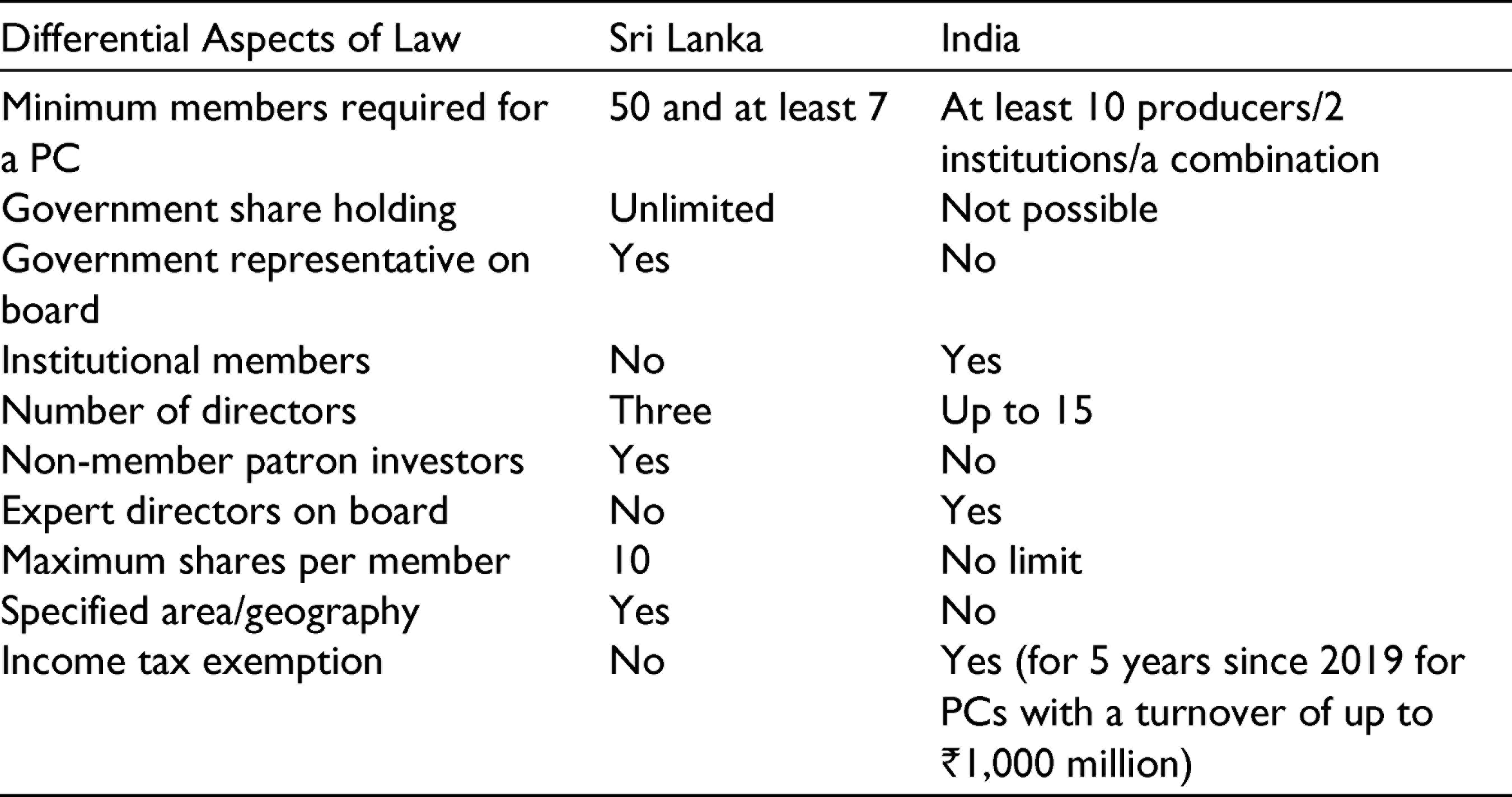
Due to the poor performance of traditional co-operatives in India, it was realized that there was a need to free co-operatives to operate as business entities in a competitive market. This led to the amendment to the Companies Act, 1956, in 2003, which provided for PCs through a separate chapter. PCs came into existence with the amendment of Section 581 of the Companies Act, 1956, in 2003. A PC operates under the regulatory framework that applies to companies, which is distinctly different from that of the co-operatives, which was seen as arbitrary and corrupt. A PC can be registered under the provisions of part IX-A, chapter one of the Companies Act, 1956. The objective of the said company can be production, harvesting, procurement, grading, pooling, handling, marketing, selling, export of primary produce of the members or import of goods or services for their benefit. Its membership can be 10 or more individual producers, or 2 or more producer institutions or a combination of both. It is deemed to be a private limited company, but there is no limit on membership, which is voluntary and open. It is a limited liability company by share and not a public limited company under the Companies Act. It retains the one member–one vote principle irrespective of shares or patronage, except during the first year when it can be based on shares. Like traditional co-operatives, it provides a limited return on capital but can give bonus or bonus shares based on patronage. It is named ‘producer company limited’. It can issue only equity shares, that too, based on patronage. These are not transferable but are tradable within the membership. It is free to buy other PCs’ shares and to form subsidiary/joint venture/collaboration/new organizations. It can have 5–15 directors, one chairperson and 1 ex-officio chief executive, but multi-state co-operative societies can have more than 15 directors for 1 year. It can co-opt expert or additional directors without voting rights. It lays emphasis on member education and co-operation among PCs. If it fails to start business within a year, registration can be cancelled. The audit has to be conducted by a chartered accountant. Thus, a PC is an NGC. It is a co-operative form of business enterprise democratically owned and controlled by active user members. It enjoys the same liberalized regulatory environment as available to other business enterprises, but it has unique characteristics of co-operatives (Singh, 2016a).
Some of the salient features that provide the PC a competitive edge over a traditional co-operative are, first, the PC format provides more legitimacy and credibility in the immediate business environment. It breaks the PO free of the welfare-oriented, inefficient and corruption-ridden image of co-operatives. Second, it allows registered and non-registered groups, like self-help groups or user groups to become equity holders in a PC. This enabling provision is a distinct improvement over the existing legislation on co-operatives, which allows only individual producers to be members. Third, the Act permits only certain categories of persons to participate in the ownership of PCs, that is, the members necessarily have to be ‘primary producers’—persons engaged in an activity connected with or related to primary produce. This ensures that outsiders do not capture control of the company and allows for raising investments from other players in the supply chain who have stated producer interest (Table 2). The Producer Companies Act tries to mitigate professional capability asymmetry between private and co-operative organizations by allowing the co-option of professionals in the governance structure. Thus, small and marginal producers can avail of professional management inputs, while retaining qualitative governance control. Finally, unlike the co-operatives, companies have stronger regulation, making statutory demands on the organization for better disclosure and reporting. This empowers the members to demand operational and fiscal discipline (PRADAN, 2007).
Differences Between Co-operatives and PCs in India
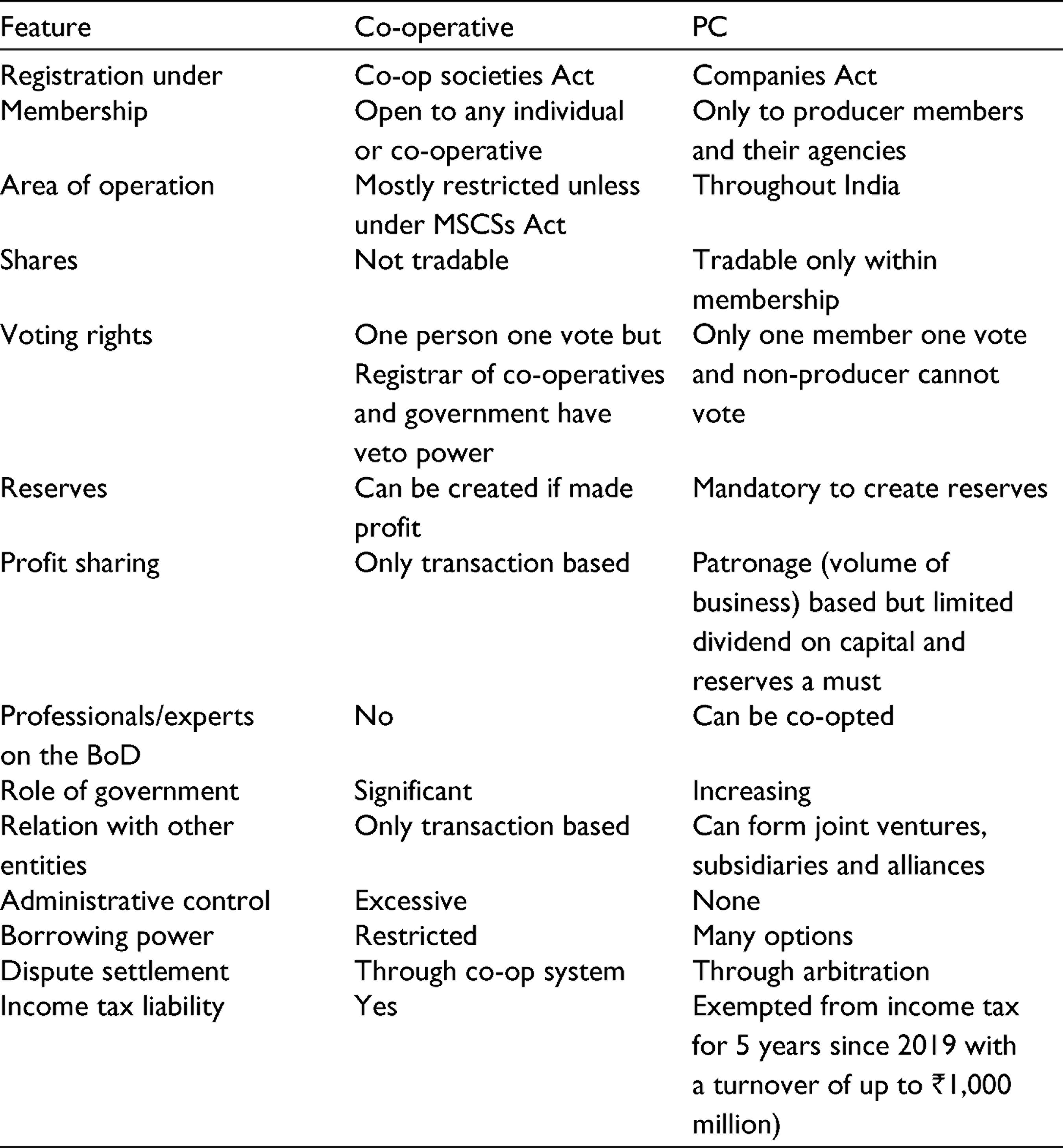
The PCs are aimed at establishing principles of profit-oriented contemporary business organizations within farming communities, to connect them with corporate buyers from the rapidly transforming Indian retail landscape. It gives more freedom to co-operatives as companies to operate as business entities in a competitive market (Trebbin & Hassler, 2012). The major ICA co-operative principles such as (a) voluntary and open membership; (b) one member–one vote principle irrespective of shareholding; (c) limited return on share capital; and (d) distribution of surplus on patronage basis are retained in the PC Act. The membership/shareholding of PCs in India ranges from individual producers to informal self-help groups (SHGs) and individual producers, registered SHGs and individual members, and only institutional members. The membership/shareholding of PCs in India ranges from individual producers to informal SHGs and individual producers, registered SHGs and individual members, and only institutional members (Singh & Singh, 2014).
Innovations in Producer Companies’ Domain
In India, the PCs have tried some innovative mechanisms in governance and management to deal with legal aspects and manage their business performance in a competitive environment. It is known that governance structure plays a major role in making the POs serve both member and business objectives (Harris et al., 1996). Some of them have higher equity mobilization from members to create member stakes and interest among other business entities in undertaking business with these companies. It is possible to mobilize more equity from within the membership. For example, National Dairy Services (NDS, a subsidiary of the NDDB)-promoted milk PCs have three categories of membership based on patronage and equity contribution (Singh, 2021). Further, dividends can be used to build equity. Even in NDDB-promoted milk PCs, member equity dominates capital structure, and healthy retention of earning is practised to build reserves and raise credit worthiness (Shah, 2016). Another major feature of NDDB-promoted PCs during 2013 and 2014 is their design in terms of scale as they are at state or sub-state level, covering more than one district generally. The five PCs are across states of Gujarat, Rajasthan, Andhra Pradesh, Punjab and Uttar Pradesh. One of them is all women member PC in AP with more than 40,000 members. They are only into milk and differ from other PCs as they are backed by professional support from NDDB and have their unique governance structure.
Member involvement is crucial as also suggested by NDDB experience across states to achieve economies of scale and scope and obtain member centrality and patronage. NDDB’s model of promoting milk PCs is based on certain rules of governance to enhance patronized cohesiveness and governance and operating effectiveness which are as follows: first, milk PCs do business with only members, new members can join only during specific windows in each year and only those with minimum supplies of milk can vote. They have to maintain a ratio of 3:1 flush to lean milk supply, and they have to increase their shareholding after one year; second, the face value of the share is revalued periodically, and old members can leave the PC and retire their equity capital at present valuation besides 20% of the directors being co-opted experts; third, the elected board members are forbidden from holding any political office; and fourth, value addition is the mantra for their success. Furthermore, the PCs have an asset light business model of owning low fixed assets and maintaining high asset turnover (Shah, 2016). These provisions have differentiated these PCs from the erstwhile dairy co-operatives promoted by NDDB in India under Operation Flood (Singh, 2015) and made a difference to their physical and financial performance wherein most of them have membership in tens of thousands or even 100,000 in one case and procure milk, which runs into hundreds of thousands of litres of milk per day and have been into profits from the first year itself (Singh, 2021).
Though PCs can, in principle, mobilize more funds through higher member equity, matching equity grants from state agencies, leverage equity for term and working capital loans and even generate surplus out of their business operations for reinvestment, in practice, they have not been able to access most of these sources for various reasons like reluctance of members and banks and even government agencies as all of them expect more robust and promising business performance first (Neti et al., 2019). Therefore, some of the studies and experts recommend private equity insertion to a limited extent for this purpose, for example, allowing select entities to own non-voting or limited voting shares up to 24% as that would not compromise on the producer ownership while giving PCs access to private capital (Mahajan, 2015; Neti et al., 2019). Another alternative is to list these PCs on a special exchange on the lines of SME exchange (Raghunathan & Gupta, 2018). But, on the financing front, the Friends of Women’s World Banking’s (FWWB) role in financing of PCs needs attention as they have designed innovative products for PCs since 2011, and by 2018, they had financed 80 POs, mostly PCs in terms of working capital to PCs, co-operatives and societies for procurement of output, credit services to members, input supply and infrastructure with the first two dominating the loans. The loans were of the order of ₹240 million in 2017–2018 and total financing since 2011–2012 has been of the order of ₹610 million. Every year, 20–30 POs are supported with ₹50–100 million loans at an interest rate of 12%–14% per annum and for a maximum of 18 months (FWWB, 2018). Similarly, some non-banking financial companies (NBFCs) like Ananya Finance and Samunnati have also lent without collateral quite viably. In fact, most of the lending to PCs comes from such agencies (Prasad, 2019). The banks and NBFCs need to learn from this and design more innovative PO-relevant loan products.
Joint ventures and subsidiaries allowed under the Act is a good window for getting to scale and external capital needs to be pursued by PCs to overcome capital and other constraints. A PC in Maharashtra has recently used the provision of joint venture to create a new company in partnership with a corporate entity. Some well-established PCs can take this route to capital mobilization and access to equity to achieve scale and viability.
The PCs were generally too preoccupied with input supply and services or just aggregation of produce for public agencies and were thus not generating very large turnover (Prasad, 2019). In fact, output linkages still remain poor across most PCs, and therefore, the impact on farmers is limited (Singh, 2021). Even in Maharashtra, out of the 13 PCs studied, 5 were mainly dependent on SFAC linkage for public procurement of pulses at minimum support price (MSP), and only two had developed corporate linkages with agencies like Pepsi for potato and Amul for milk and fresh procure supermarkets for vegetables (Badayta et al., 2018). This was also one of the important suggestions by the farmers when asked about how PC performance could be improved and PCs made more useful for them. There were many cases of PCs procuring for the government in pulses and oilseeds and in cereals in some cases, but that was more to avail the MSP and to earn some revenue for the PC and was limited in coverage and volumes. On the other hand, some PCs engaged in contract farming with private agencies like in potato or drumsticks or even seeds and that benefitted farmers in terms of growing a new high-value crop as well as realizing assured and better prices, especially because these crops did not have MSP protection (Singh, 2021).
In this context, it is important to note that the Farmer’s Produce Trade and Commerce Act, 2020, and the Agricultural and Livestock Produce Markets (APLM) promotion and facilitation Acts at the state level provide for private markets and e-markets by FPOs—mostly PCs. This was earlier allowed in the Agriculture Produce Market Committee (APMC) Acts where private wholesale markets could be set up by such entities, and a few dozen of such markets have been set up by PCs in Maharashtra. This is also an innovative practice in engaging with the market and bringing the market closer to farmers and protect their interest in the market by providing an alternative channel besides bringing market orientation and confidence among member famers that they can use such markets to create more competition at the local level. Similarly, some PCs in West Bengal running Sufal Bangla supermarkets as franchisees is an innovative practice for achieving scale and farmer benefit (Singh, 2021). Franchising is a mechanism to cut costs and reach larger markets for farm inputs and services and even output handing. Many PCs and agricultural start-ups have used this for some time now, and this needs to be adopted by more PCs (Singh, 2016b).
Finally, PCs in India have also created federated structures for policy advocacy and collective negotiations with large and institutional markets players. There are already 10 state-level federated PCs, which lobby at the state level for better policy treatment of PCs and their members and also explore markets and sell on behalf of individual PC members after aggregation of produce like mangoes in Gujarat. They also engage with the government, and international and national development agencies like NABARD, to get better terms for PCs as part of their ‘engage’ role for creating better agency for farmers’ empowerment. They have been able to get PC policy tailored to PC requirements and have also been able to push for longer-term support for setting up and enabling of new PCs.
Conclusions
The analysis of issues of mobilizing capital and capacity building in PCs reveals that it involves many steps and can take 5–7 years in order to create a sustainable institution. The PC by-laws should provide for higher member involvement and commitment with contract-like member business relations with the PC. Further, like the NGCs, they can also restrict membership by by-laws to remain viable and not become unwieldy in terms of membership size. These internal governance mechanisms and external facilitation can be crucial in growth and sustainability of the PCs to contribute to small producer growth and development. But majority of the PCs had no external experts or independent directors, and 68% had no women directors on the Board (Prasad, 2019).
Good business plans and strategy are a must to compete in a globalized market and to attract funding. Therefore, adequate attention needs to be paid to this aspect where special support can be provided to help PCs come up with robust business plans, which need not be based only on existing crops and local enterprises of members. More of sustainable trade markets like organic and fair trade should be explored as a part of global and national value chains and networks to capture value for member producers.
The PCs also need to choose their activity portfolio carefully keeping in mind the member centrality. For this, they should do adequate value chain mapping of the relevant commodity sector before undertaking any intervention for the benefit of farmers. It is possible to identify new activities in local areas, which are valuable for small farmers, for example, custom hiring of farm machinery and equipment, which they cannot afford to buy but can rent in. This is being carried out in some parts of India viably by private entities and primary agricultural credit societies and some PCs (Singh, 2017b, 2021).
Furthermore, though PCs are generally focused on small producers to achieve inclusiveness, there is some merit in mixed member PCs in terms of farmers’ base as that helps achieve scale and mobilize more equity. It is also argued that if they are composed of only small and marginal producers, they find it difficult to break even sooner, and later, due to the small scale of their operations, bringing in larger farmers at a later stage creates problems of governance as it was originally designed with patronage cohesiveness.
In the recent context of the new Contract Farming Act 2020 by the Government of India and earlier under the Agricultural Produce and Livestock Contract Farming and Services Act, 2018, at the state level, which provides a freer environment for contracting agencies to work with farmers, PCs can play an important role as intermediaries or facilitators between the farmer members and contracting agencies to make smallholders attractive to such agencies because PC intervention can lower the transaction cost for the PC and bring large number of producers into the contract farming net, which is much needed. In fact, PCs should proactively engage in contract farming with their members for their own procurement as well as for supplying to processors and exporters until they have those capacities. This can help build more robust supply chains to earn buyer confidence and also earn farmer goodwill by bringing stable and assured prices to farmer members.
The PCs can benefit from Essential Commodities (amendment) Act (ECAA, 2020) if they have warehouses and are into processing, storage, packing, transport and distribution—any activity which adds value. The PCs also should proactively make us of ECAA, 2020, to store produce in warehouses and avail loans against it from banks under the warehouse receipts arrangement to realize better prices with deferred sale or to free member farmers from interlocked arrangements in conventional market channels like Agricultural Produce Market Committee (APMC)–based agents or private traders. However, the Farm Produce Trade and Commerce Act, 2020, and the Contract farming Act, 2020, both include the PO under the definition of a farmer. But no PO is involved in production as most of them are into pre- and post-production aggregation, trading and value addition. This needs to be changed to make POs buyers of farm produce in their own right and even contracting agencies which many of them are as they undertake seed and other produce contact farming with their members (Singh, 2021).
The state government needs to step in as they are located close to these entities and should frame definite policies and programmes for organizing and supporting PCs and not just implement central schemes about it. Some states like Punjab, Kerala and Odisha have moved in this direction with policy, and this needs to be encouraged and supported. The union government's push for 10,000 FPOs with budgetary support over the next 5 years through cluster-based business organizations (CBBOs) instead of just depending on local NGOs is another policy step that is welcome but worrying as target-based promotion of farmer organizations by any agency without adequate groundwork and its presence among the communities may lead to the quick spread of such entities. However, it may not lead to robust producer entities wherein members are aware and engaged with PCs. This may compromise the very creation of producer agency and empowerment which is the objective of the policy.
Footnotes
Declaration of Conflicting Interests
The author declared no potential conflicts of interest with respect to the research, authorship and/or publication of this article.
Funding
The author received no financial support for the research, authorship and/or publication of this article.