



Abstract
This article describes trends and policy needs in slum neighbourhoods in Bihar’s capital city, Patna, addressing a gap in the development literature that has largely focused on megacities and rural areas. Patna’s slum population is a large and permanent part of the city, but it remains mostly disconnected from development institutions and assistance programmes. Relative to those in other cities, Patna’s slum residents are poorer, less upwardly mobile, and have weaker and more ambiguous property rights and shallower institutional connections. They received relatively little outside assistance during the first wave of the COVID-19 pandemic and found only one another to rely upon for survival.
Introduction and Background
Bihar, one of India’s most densely populated states, is home to over 100 million people. Considered one of the poorest states, 53% of citizens of Bihar live below the global poverty line of $1.25 per day, whereas the Indian average is 30% (World Bank, 2014). Despite India’s impressive economic growth since the 1990s, the northern state Bihar has lagged behind. The average growth rate of Bihar between 1993 and 2004 was 4.9% against 6.3% for all India. Multiple factors, including overdependence on agriculture, together with skewed land distribution and poor irrigation infrastructure, poor governance and weak administrative capacity have been cited as the reasons behind slow economic growth in the state (Rasul & Sharma, 2014; Singh, 2013; Witsoe, 2013). According to Census 2011, 89% of Bihar’s population lives in villages and are primarily dependent upon agriculture, but about one-third of households are landless and another 15% have holdings smaller than 400 m 2 . Many landless people have migrated to the capital city, Patna, over the past decades and settled in slums, often facing difficult circumstances and the threat of eviction.
Slums are urban neighbourhoods characterized by their ‘precarious legality and almost non-existent level of services’ (UN-Habitat, 2016). In addition to high levels of poverty, most slum residents ‘live in conditions of informality. Many are ‘triply informal’ with informal jobs, … informal properties, … and a lack of city-based identity papers and an unacknowledged and informal existence in the city’ (Rains & Krishna, 2019). The national census of 2011, which for the first time assessed the slum population in all cities of India, severely undercounted the slum population (Bhan & Jana, 2013; Krishna, 2017). In the case of Patna, only 77,034 people were found living in slums, constituting a mere 4.6% of the city’s population. However, over 90% of the capital city, Patna, remains unplanned, and according to some sources, up to two-thirds of the population reside in slums in these unplanned areas (Rodgers & Satija, 2012). Still, official agencies have not formally notified slums in the city.
As a result of undercounting and official non-recognition, slum residents are worse off in Patna than in other state capitals in India. We draw on original surveys conducted in 2016 of 2,155 households in 43 slums selected to represent the geographic spread and economic disparity of slum settlements in Patna—coupled with repeated interviews of key respondents undertaken at six different points in 2020—to highlight some key points about life in slums in Patna before and during the COVID-19 pandemic:
Rather than being homogenous, slums span a continuum of living conditions. There are better- and worse-off slums. Commonly, however, informality is high. As in other Indian cities, slum residents in Patna are not a nomadic group. The majority were born in the city and most have lived there for multiple generations. There is relatively little of both in-migration and out-migration, which differentiates this population from that of circular migrants. Poverty levels are higher and more persistent, and intergenerational upward mobility is lower, in slums of Patna compared to those in Jaipur and Bengaluru. As a result of a difficult legacy and official neglect, property rights are weaker and more ambiguous in Patna’s slums. Not only government departments, political parties, too, are only weakly represented in Patna’s slums. When the greatest privations were being experienced during the prolonged lockdowns of the COVID-19 pandemic, almost no outside assistance was made available; the urban poor in Patna survived by depending upon each other.
These findings fill important gaps in the existing literature. First, while Bihar has gained quite a bit of attention from scholars and practitioners of development in recent years, much of the focus has been on rural areas (DFID, 2011). Even more recently, much of the attention on the impacts of the pandemic have focused on rural Bihar (e.g., Malani et al., 2020).
Separately, a growing body of development work has focused on urban poverty, informality and slums (e.g., Amis & Kumar, 2000; Harriss, 2005; Khasnabis & Chatterjee, 2007; Mahadevia, 2010; Mitra, 2006; Unni & Rani, 2007). Most of this work, however, has focused on India’s five megacities—those with populations greater than 10 million—while the majority of India’s urban citizens live in smaller cities like Patna (United Nations, 2018). This article, in profiling the characteristics and policy needs of Patna’s slums, contributes to an understanding of urban development challenges in Bihar’s non-megacity capital. The article proceeds in nine sections. The second section describes our data; sections 3 through 8 provide evidence on the key takeaways on Patna’s slums. The final section concludes and discusses policy implications.
Data
This article draws primarily on household surveys conducted in 2016. With the help of a research grant from the International Growth Centre, we surveyed 2,155 households of 43 assorted slums in Patna. To select the sample of neighbourhoods, we began with a list of slums provided by the Support Programme for Urban Reforms (SPUR), a partnership between the Government of Bihar and the UK Department for International Development (DFID). This list contained information on the location of each settlement as well as data on the quality of local infrastructure (durability of housing, access to sanitation and access to streetlights) in each neighbourhood. We used these data to classify slums into two groups—those with higher and lower infrastructure quality—based on the results of a cluster analysis. We then randomly selected 40 slums, stratified by location in the city and infrastructure quality. For example, if 20% of the sample frame consisted of slums with lower infrastructure quality located in the northeast quadrant of the city, then 20% of our randomly selected sample would be from the northeast quadrant and would have lower infrastructure quality. To this sample, we added three more slums based on discussions with local partners, who provided the locations of newer settlements of varying conditions spread throughout the city.
For each neighbourhood, we conducted focus group surveys, asking about slum histories, available neighbourhood amenities and an estimate of the number of households in the settlement. We then conducted household surveys. Based on the settlement size, we developed a sampling interval (i.e., every third, fourth, or fifth home), randomly selected a starting point and then followed a right-hand rule to sample either one-third of the households in the settlement (for smaller settlements) or 60 households (for settlements with more than 180 households). We alternated between surveying men and women to ensure our sample was roughly equally composed of men and women. The household surveys spanned topics including demographics, migration histories, livelihoods, tenure and work insecurity, monthly expenditures, policy priorities, political preferences and participation in neighbourhood activities. To compare Patna to other cities, we also draw on original surveys and focus group data that we collected from 4,544 households from 135 slums in Bengaluru and 2,718 households from 45 slums in Jaipur. We followed similar sampling protocols and used nearly identical survey instruments in these cities (see Rains et al., 2019 for more detail).
In addition to the quantitative data, we conducted qualitative interviews in 2016 with 78 local leaders from the neighbourhoods in Patna and 93 local leaders from the slums in Jaipur.
In a follow up data collection effort in 2020, with the help of a second research grant from the International Growth Centre, we conducted repeated structured phone interviews with three key informants each from 20 settlements we previously surveyed in Patna and 20 more from Bengaluru that were selected to represent a wide range of slum living conditions. These interviews focused on understanding the impacts of the COVID-19 pandemic. To learn about neighbourhood outcomes, we interviewed at least one area leader and two other key informants, including at least one female respondent, who were broadly knowledgeable about neighbourhood occurrences. Overall, we conducted six rounds of structured interviews between July and November 2020. In Patna, we also followed up with detailed, open-ended interviews with a selection of 21 key respondents from 9 different settlements.
Not all Slums are Alike: A Continuum of Living Conditions
As in other cities, we find slums in Patna span a continuum of living conditions. We calculate a slum well-being score based on housing durability, crowding, access to safe water and sanitation, and the level of common assets held by slum residents (see Rains et al., 2019 for more details). Figure 1 plots the range of scores in ascending order, illustrating how, within and across cities, slums vary substantially in wealth and infrastructure quality. Patna’s slums are clustered toward the bottom of this multi-city continuum.
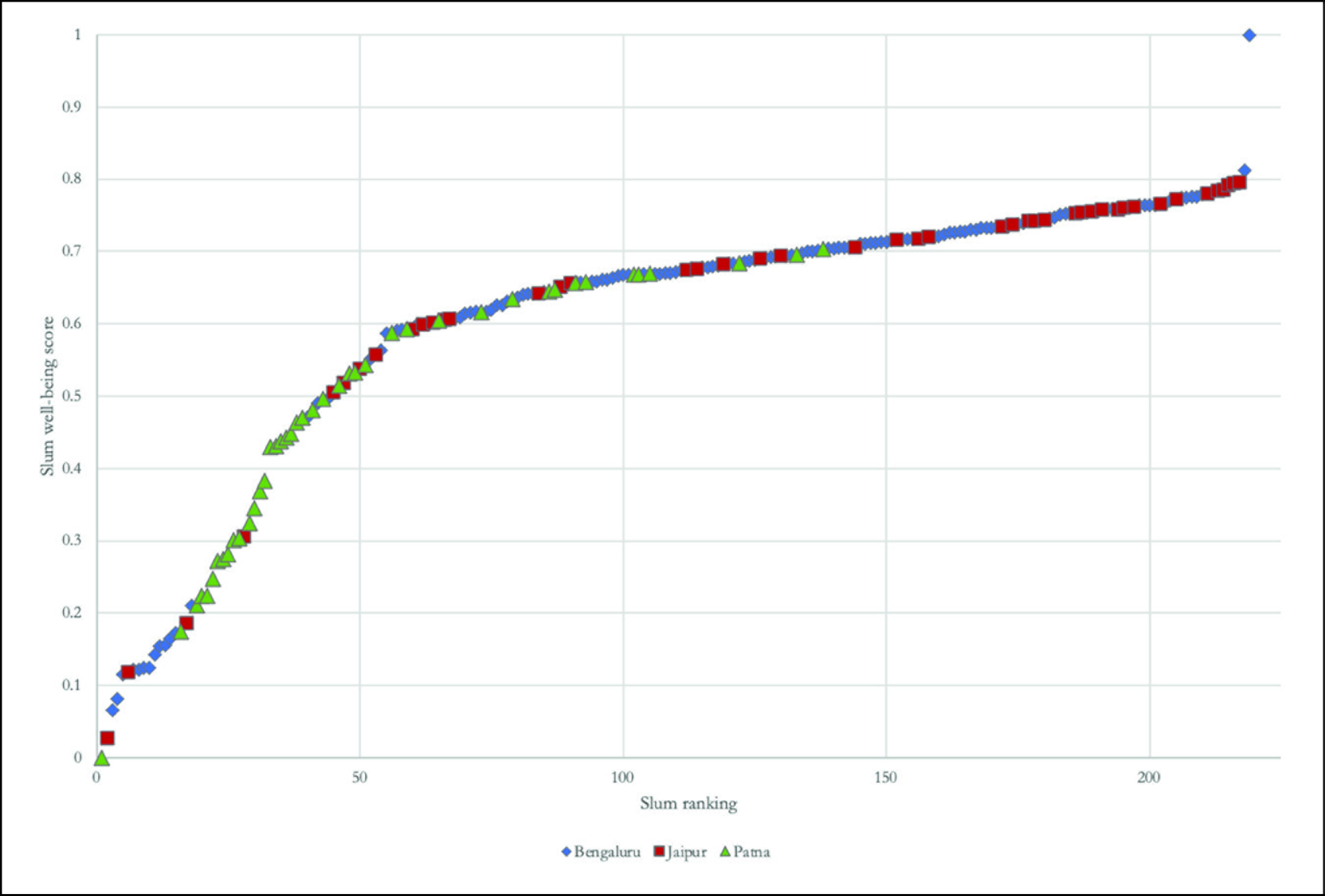
To illustrate the substantive differences associated with different positions on this continuum, we describe conditions in two neighbourhoods. The least well-off slum in Patna, Bagri Basti, 1 is located between a busy road and a railroad track. Nearly, 40 families live contiguously in 9' ◊ 13' houses constructed from mud, posts and recycled banners. No one in Bagri Basti has been to school, and to earn enough to subsist, men, women and children beg and pick trash. There is no water, electricity, sewage or drainage in the settlement, and though residents live well below the poverty line, they lack ration cards. Without any local leaders in the area to assist them, they do not know who to or how to approach the state to request ration cards or other documents.
In contrast, East Madrampura is the most well-off slum in the sample. Nearly 60 years old, East Madrampura is comprised of 600 families that live in larger (12' ◊ 20') pakka houses. Most houses are constructed from concrete (mould) and nearly one-quarter of the houses are multi-storey. Nearly two-thirds of the residents have household water connections and 92% have private toilets. Residents are also much better equipped with identification and other important documents: 93% have or have applied for a voter ID card, 67% have or have applied for a ration card and 88% have or have applied for a unique ID card. In addition, residents name four different local leaders in the settlement who act as liaisons between the neighbourhood and local officials to help residents access services and other resources. Between the two poles represented by Bagri Basti and East Madrampura, living conditions improve incrementally across Patna’s slum neighbourhoods.
Not Nomadic, Mostly Permanent Residents of the City
Importantly, and in contrast to conventional wisdom, we find that most slum residents across these neighbourhoods are neither transient nor recent migrants. Only 29% of residents migrated to Patna from elsewhere. In fact, nearly half (48%) of the residents’ report that two or more previous generations of their family have lived in Patna. Residents have lived in their current homes for an average of 22 years, and the average among migrants, at 16 years, is not much lower. As such, our evidence suggests that slum residents are largely not peripatetic. Table 1 summarizes these and other demographic characteristics of Patna’s slums. We also report information on two other cities for comparison.
Overview of Slum Demographics
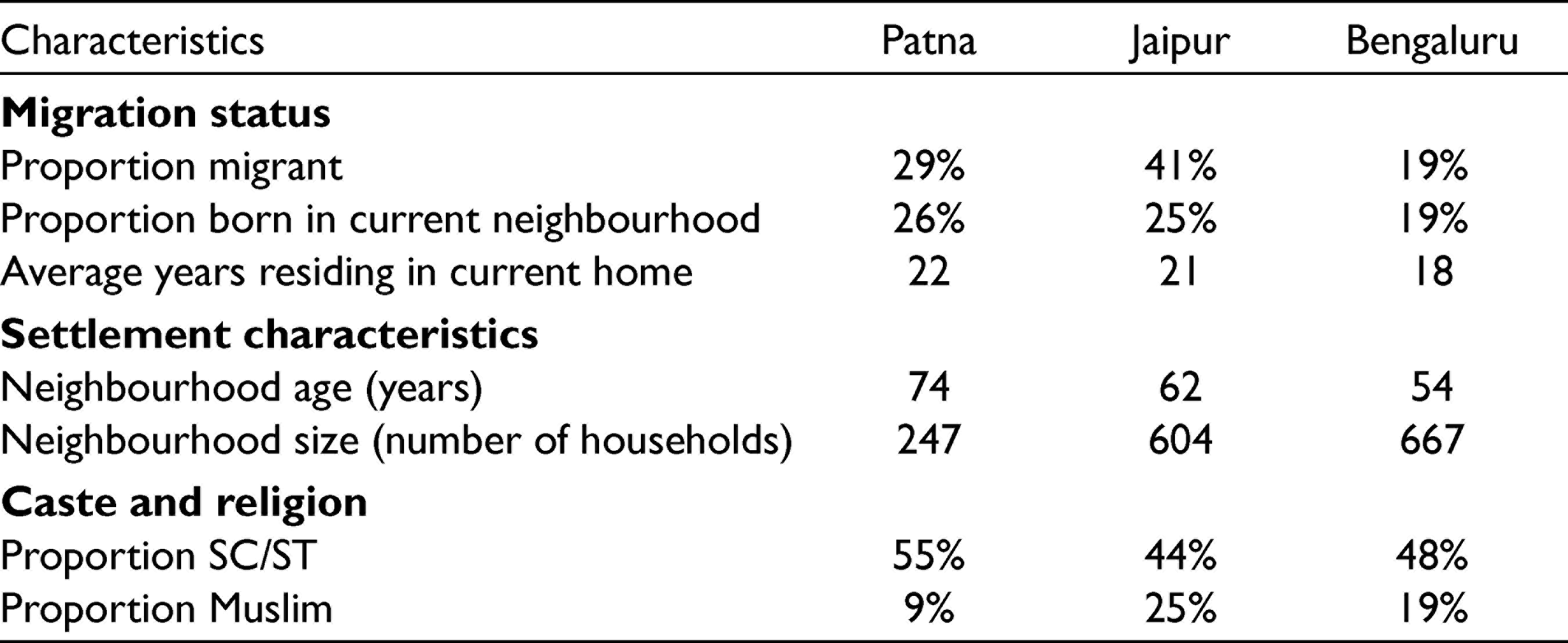
Table 1 also shows the proportion of Patna’s slum residents who are Scheduled Caste or Scheduled Tribe (55%) far exceeds the overall proportion for Bihar (17%) according to census data. 2 In general, lower caste groups are overrepresented across all slums relative to the Indian average (Rains et al., 2019; Shah, 2014). In Bihar in particular, these caste groups have historically been more likely to be landless or to reside on marginal lands than other caste groups, thus more likely to have come into low-income neighbourhoods in the city generations ago (ADRI, 2008).
High and Persistent Poverty Across Generations
The large share of families residing in slums for multiple generations suggests that poverty may be persistent in these settlements. In this section, we describe poverty levels and present findings on prospects for upward mobility.
We draw on a measure of poverty that assesses respondent’s capabilities, and, thus, is more comprehensive than a measure based on income. The stages-of-progress approach is a useful tool to investigate poverty dynamics, and has been applied in diverse rural and urban contexts, including in India (Krishna, 2010; Narayan et al., 2009). With this approach, the respondent specifies how many assets or capabilities, ranked from 1 to 10, they are able to possess or achieve, as well as how many they were able to possess or achieve 10 years ago. The list, which corresponds to increasing levels of well-being—or increasing stages of progress—was developed over time with extensive inputs from the communities under study. The capabilities range from the ability to purchase enough food to the ability to purchase a car.
The average household in Patna reports being capable of achieving 3.8 of the 10 stages. This level corresponds to the ability to acquire food, shelter and primary education for children, but not yet being able to purchase a television. Most (94%) are considered poor according to this measure, which is higher than in slums in Bengaluru or Jaipur (Figure 2).
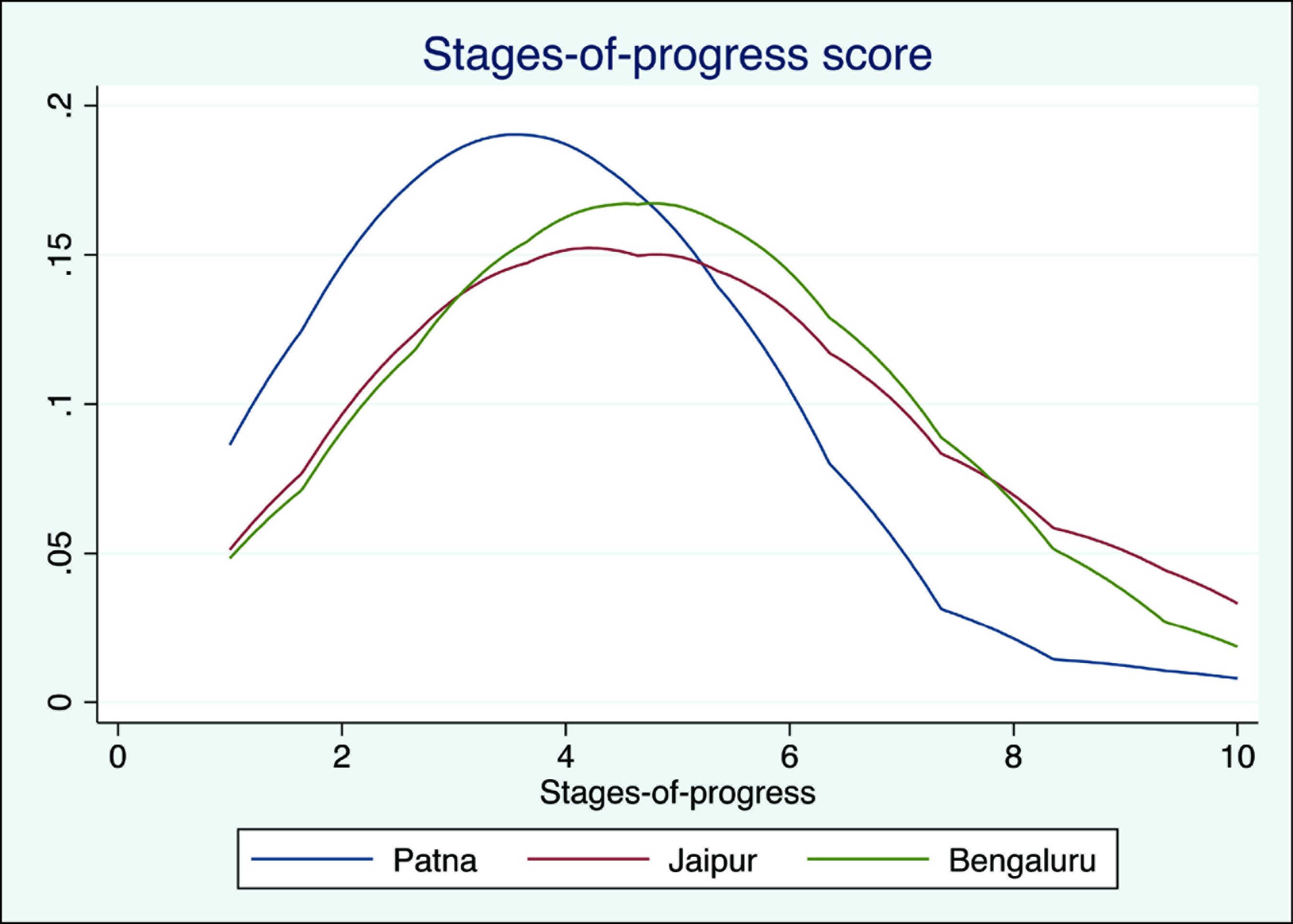
To provide evidence on the extent of upward (or downward) mobility over a 10-year period, we compare the level that the household is capable of achieving at the time of the survey to the level the household reports they were capable of achieving 10 years prior to the survey. We find Patna’s slum residents, in addition to being poorer, have also experienced less upward mobility than their counterparts in Jaipur and Bengaluru. While 60% of Patna’s slum residents experienced some upward mobility based on the changes in their stages-of-progress score, the corresponding figure for Jaipur is 65% and for Bengaluru is 95%. Furthermore, 92% of Patna slum residents remained poor over this duration, compared with 70% in Jaipur and 83% in Bengaluru.
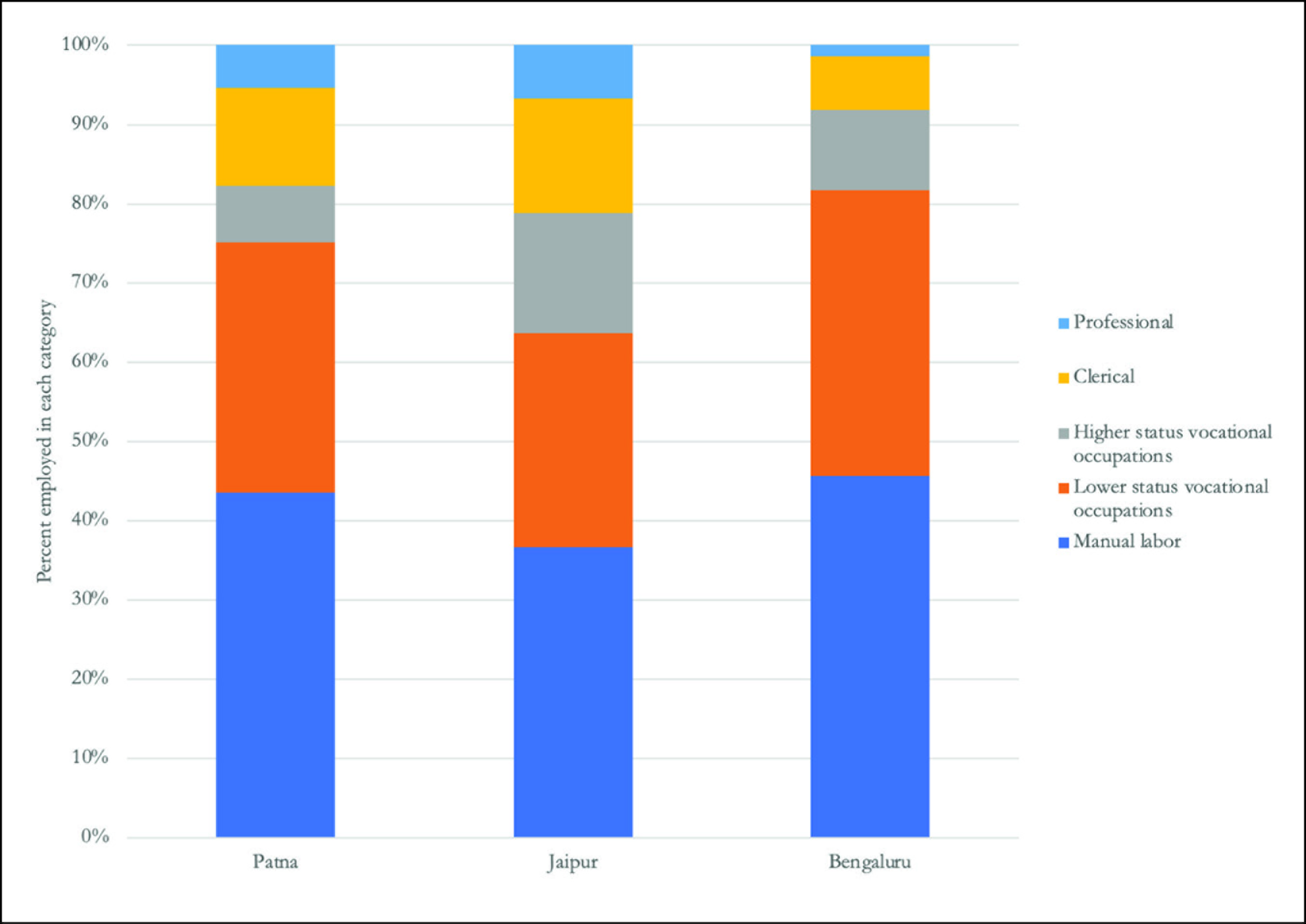
To triangulate these self-reported data, we also examine a measure of intergenerational mobility by comparing parent–child occupations (Rains & Krishna, 2020). The most common category of employment in Patna is in manual labour (44%); the second most common (31%) is in lower status vocational occupations, such as working as a carpenter or butcher. Most slum residents across cities are employed in these two occupational categories (Figure 3). We find the majority of male slum residents (54%) in Patna work in the same occupational category as their fathers did before them, while 29% work in a higher-prestige occupational category than their fathers did. 3 We observe larger intergenerational occupational gains in Jaipur (35%) and Bengaluru (44%). Overall, the evidence from this section reveals relatively high and persistent levels of poverty in Patna’s slums.
Weak and Ambiguous Property Rights
Land ownership in Bihar has historically been ambiguous, and efforts to reform land policies have been highly contentious (ADRI, 2008; Chaudhuri, 1975; Chaudhry, 1988; Ram, 1988). After independence, the zamindars who were granted outsized influence during British colonial rule, were able to retain much of the control of land in Bihar, while the poorer and typically lower caste labourers struggled to access any land. According to Chaudhry (1988, p. 55):
Achievement of the [post-independence land reform] goals would have amounted to a fundamental change in the structure of agrarian relations though there would still have been landlords, tenants, and agricultural labourers. In actual fact … progress…has been slight …. Through lawful and unlawful means, the old zamindar class was able to retain a great deal of land….Much of the transfer of surplus lands was only on paper.
It is perhaps somewhat unsurprising in light of enduring historical legacies, that in today’s slums, which are predominantly occupied by poorer, lower caste individuals on marginal lands, accessing clearly defined property rights is nearly impossible. The legacy is made worse by contemporary inaction.
In fact, to date, Bihar has yet to implement any official slum policy. A draft slum policy was proposed as late as 2011, which included provisions for identification and listing of slums, exploring options for in-situ upgradation, and slum relocation. 4 This stands in stark contrast to other cities that have implemented policies that delineate a process for slum residents to petition for access to land rights. In Bengaluru, for example, there is a clear ‘Slum Act’ that stipulates how slum residents are ultimately either to be relocated or granted property rights. 5 Though ‘[t]he process as described in the law…seems straightforward,…the reality is different—more variegated and complicated. Informality produces ambiguity, opening the window of opportunity for negotiation and intermediation’ (Krishna et al., 2020, p. 7). However, the policy affords slum residents some process to work toward acquiring property rights.
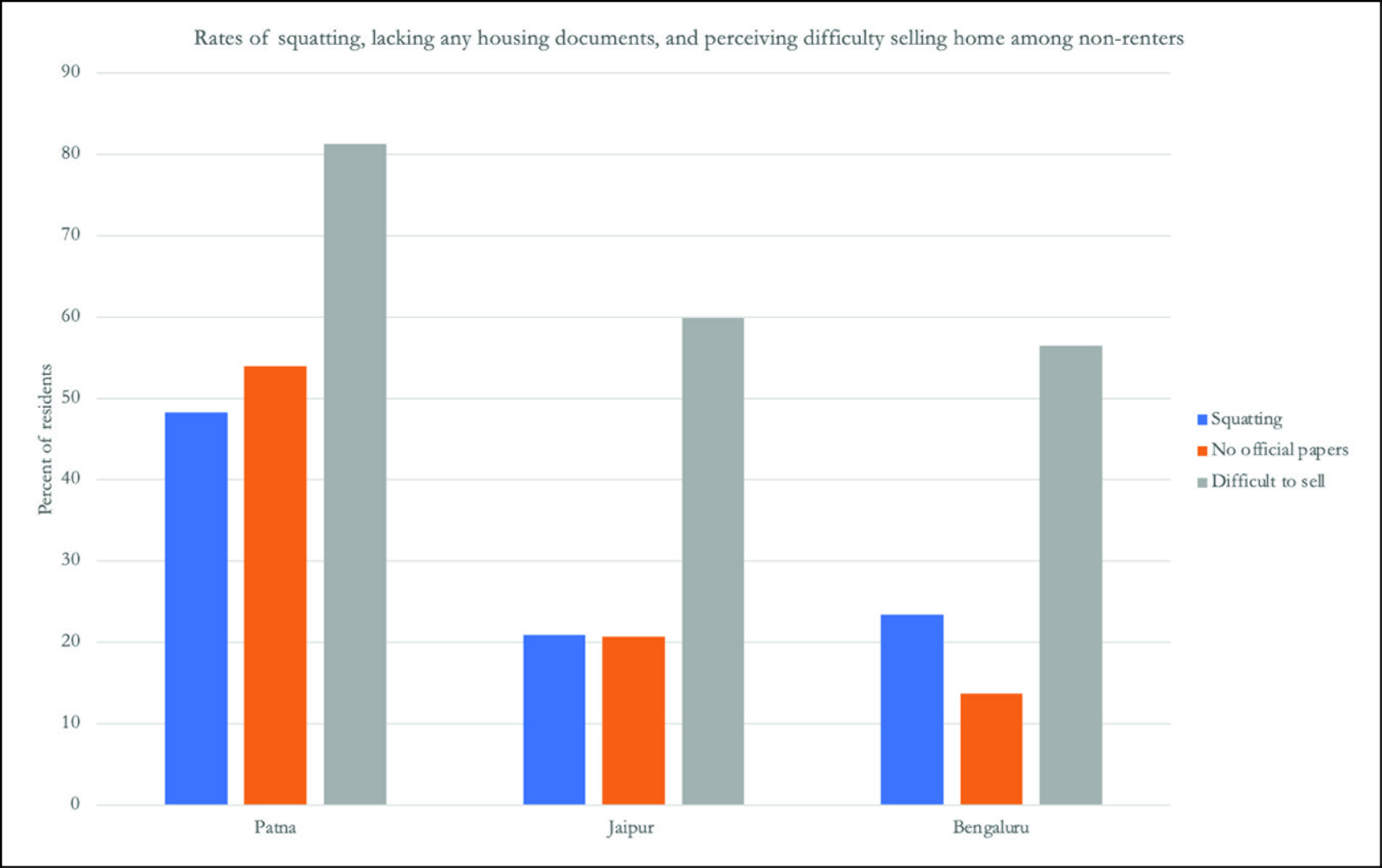
In Patna, though slums have been established for longer on average than slums in other cities (Table 1), property rights are particularly weak and ambiguous. Take, for example, Shivaji Colony, established over 80 years ago. At this point, most people (85%) feel secure from eviction; yet, of the 70% of residents who report they own (rather than rent) their property, only 19% say they purchased their home, and only 26% report that they have an official title (a patta) to their home. Most homeowners instead describe other documents, such as their Aadhaar cards, ration cards, or voter ID cards, as the key documents that they rely on to establish ownership of their homes. Most (67%) non-renters believe it would be impossible or fairly difficult to sell their home as a result. The area leader in Shivaji Colony captures some of this complexity as follows:
What are all these papers related to land? During the British rule, land belonged to the British Government. After the independence, those people who used to be on good terms with the British government, got huge tracts of land measuring 100–2000, 10,000–50,000 bighas of land. We were farmers. Our ancestors did not practice the zamindari system. What is land in that context? When the country became independent, there were red flags hoisted everywhere announcing land retribution slogans …. Slogans claiming land belonged to those were staying on it, was propagated. So, what kind of papers are we still looking? We have no such worries. If the government tries to evacuate this area, I will fight as it’s my land.
6
More generally, our survey data reveal higher reported rates of ‘squatting,’ lower rates of possessing official housing documents, and greater perceived difficulty of liquidating homes among non-renters in Patna (Figure 4). Overall, we find weaker and more ambiguous property rights in Patna than in other urban slums.
These weaknesses in property rights render government development assistance more difficult. Most government schemes related to housing require a land ownership certificate, which only a small fraction of slum dwellers possess. Some settlers who received some form of receipt by the city administration decades ago may have failed to preserve these records, 7 while the vast majority never received any official papers. In such cases, financial aid available for the urban poor remains underutilized. Under the flagship programme for urban development, Jawaharlal Nehru National Urban Renewal Mission, Patna’s administration was reportedly able to construct only 522 of the set target of 25,477 homes for the urban poor. 8
These weaknesses also make evictions more likely. Of the 43 slums we surveyed in 2016, 11 (26%) had been partially or fully displaced as of January 2021. Residents of the remaining settlements expressed substantial concerns about security in their neighbourhoods. As described by one resident in September 2019:
Demolitions are happening all around. We have put all our earnings and constructed this [house]. If this gets demolished, where will we stay? If it gets demolished, where will we go?…. The government still wants people from here to be evicted. This is not something that a government policy should be saying. Before Mr. Nitish’s government came to power it had claimed that those who do not have land will be given three decimals of land. I have photographic evidence that I submitted to the Ministry of Rural Development to show that more than 10,000 people today haven’t got anything but their houses have been demolished.
Fragile Political Networks and Weak Institutional Connections
To mitigate vulnerabilities associated with high levels of poverty and disconnection from formal resources, such as property rights, village residents and slum dwellers rely on party networks and informal local leaders who negotiate with the state to demand services and infrastructure (Auerbach, 2019; Krishna, 2002). In India, and beyond, these local brokers emerge to mediate interactions between slum residents and politicians and encourage neighbours to vote and make claims collectively (Auerbach & Thachil, 2018, 2019; Jha et al., 2007; Paller, 2015). Politicians then target goods and services, such as drainage, public toilets, water pipes and property rights, to the communities that mobilize most effectively (Auerbach, 2016, 2017; Krishna et al., 2020; Lall et al., 2004). In Patna, as elsewhere, slum residents report that these informal negotiations are crucial for development. In fact, 87% of survey respondents in Patna say that serving as a ‘vote bank’ 9 is important for neighbourhood development outcomes, compared with 85% in Jaipur and 76% in Bengaluru. 10 Moreover, in community focus group discussions, we ask how important the relationship between the area’s neighbourhood leader and political parties is in order to get improvements in the quality of services in your community. Every focus group in Patna concluded that this relationship is important and nearly half (47%) reported that it is very important.
However, in Patna, only 28% of respondents think their neighbourhood is an effective vote bank (the corresponding figures are 29% and 41% for Jaipur and Bengaluru, respectively). In general, we find slums’ informal political networks are much weaker in Patna than in other cities. This may be related to the fact that development efforts in Bihar have historically focused on rural areas, with a smaller focus on and lower budget for municipal development (UK Department for International Development [DFID], 2011). Local elected officials describe how, in contrast to other cities like Jaipur or Mumbai, the municipal corporation election in Patna is generally not organized along party lines. According to a councillor from Ward 61,
It usually happens that many candidates from the same party contest in the local body elections, so the party does not support any of its candidates openly. Because if the supported candidate loses and the unsupported candidate wins, he will distance himself from the party and the party’s equation (sameekaran) will be bad.
11
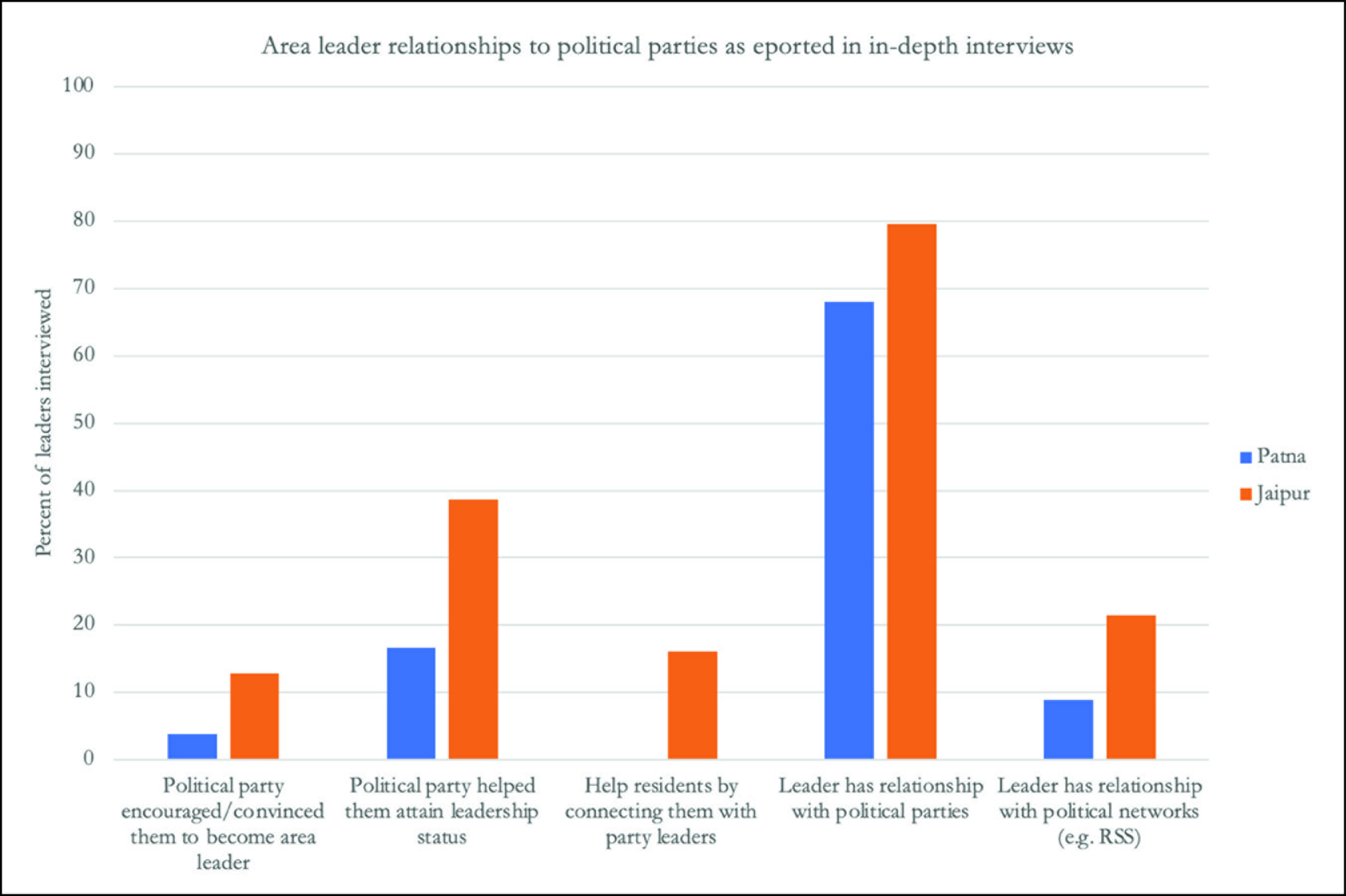
Our in-depth interviews with local leaders from Patna and Jaipur also reveal that Patna’s leaders are less integrated into local political networks (Figure 5). A total of 68% of the local leaders interviewed in Patna report that they are associated with a political party, compared with 80% in Jaipur. Moreover, in Jaipur, regardless of whether the associated party is currently in power or not, almost all of the leaders with party associations say they receive support from this party. This stands in stark contrast to the situation in Patna. As one local leader in Patna says, ‘I supported the elected candidate during the municipal election but after winning he hardly cares about us. He even does not send the sanitation workers for cleaning our basti.’ 12 In Jaipur, leaders describe how, ‘if such things happen, I along with other groups affiliated to the opposition approach the concern ward councillor to get things done’.
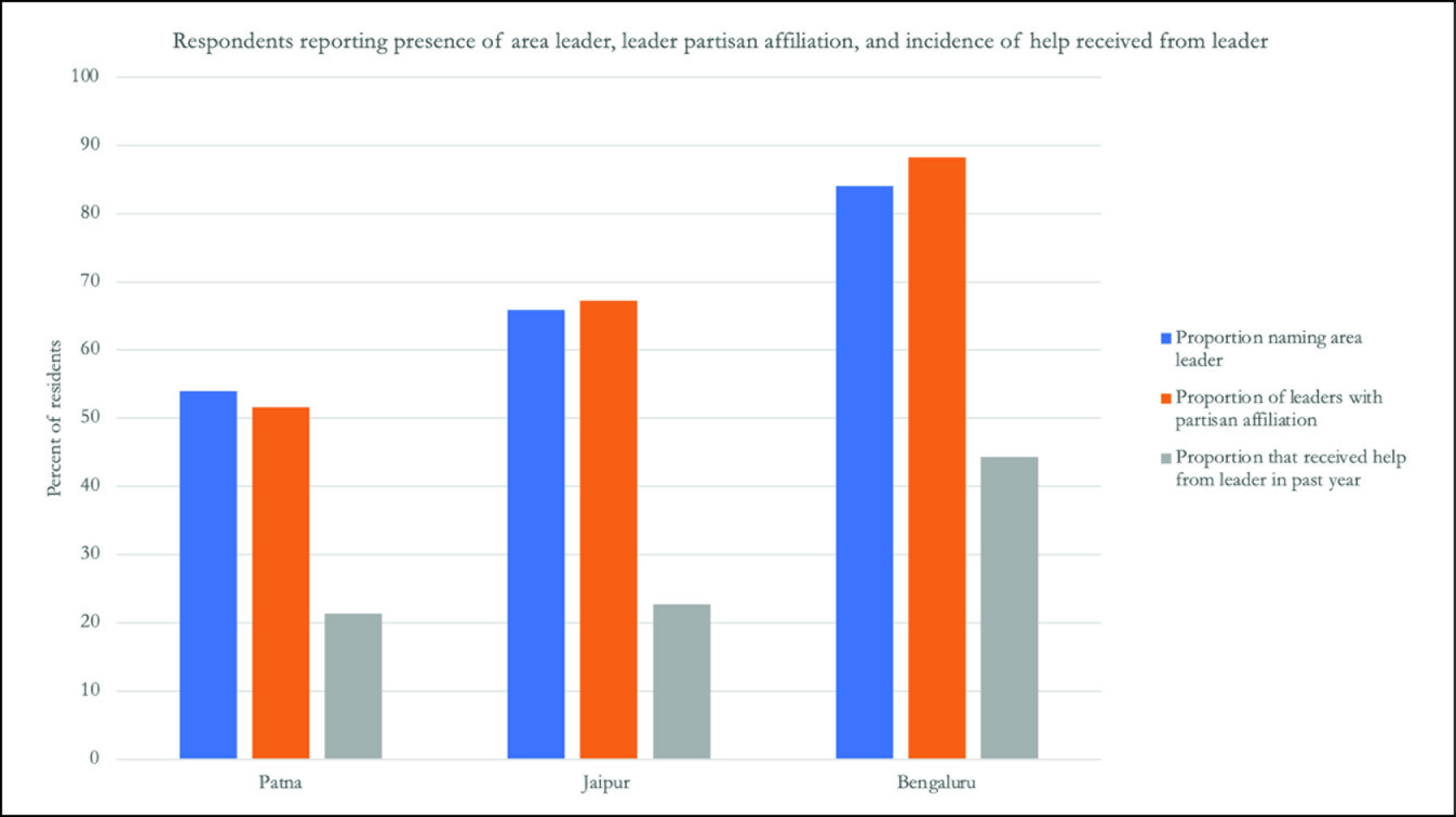
Our household survey data confirm not only that local leaders are less partisan in Patna than in the other cities considered, but also that there are fewer neighbourhood leaders in Patna and these leaders provide help less frequently (Figure 6).
Dealing with the Pandemic—Reliance on Friends and Neighbours
In light of the high levels of economic vulnerability slum residents experienced prior to the COVID-19 pandemic, we collected information on both the health and economic impacts of the pandemic on these communities. In light of the relatively low rates of in- and out-migration and because the initial lockdowns were effectively enforced, including by slum residents themselves, we found that instances of death and illness associated with COVID-19 were relatively few in Patna’s slums during the second half of 2020. However, the economic pain felt by slum residents was severe. In May 2020, key informants estimated that Patna’s slum residents were making only 20% of the incomes they had before the pandemic, and up to 85% of residents had cut back on food and other essentials. Even four months later, during the first fortnight of August 2020, an estimated 67% of slum residents in Patna were yet to get their old jobs back or find new ones. Large numbers were still cutting back on food and other essentials. Four successive months of foregone incomes have put most slum dwellers in dire livelihood situations. Key informants from every slum neighbourhood we contacted, reported that residents had liquidated assets at least once during this period.
Consistent with our survey evidence from 2016 about the relative weakness of informal political networks, we find low levels of party and government assistance in Patna slums in 2020 in response to the pandemic. While some neighbourhoods received government assistance, especially subsidized rations, and occasionally, cash assistance or free or subsidized gas cylinders, this aid (and that from private sources, like cooked food) was mostly received in the early part of the pandemic, and more often in Bengaluru than in Patna (Downs-Tepper et al., 2021).
Instead, neighbours provided the biggest source of assistance to slum residents during the first wave of the pandemic. Many—though hardly all—slum communities helped needy individuals, including the elderly, people with disabilities and widows.
‘After the sudden announcement of the lockdown, I could not move out of my house’, says Seema Devi, 60, a physically disabled woman who lives alone in a kaccha home in Hasanpura slum.
I had limited rations and a little saving from my old-age pension. It got depleted soon. It was my neighbours who offered me food grains, vegetables, and a little money. One of my neighbours approached the ward councillor to expedite the release of my pension. 13
But assistance from neighbours, who are also poor, was not equally forthcoming everywhere, and it began to dwindle as the lockdowns wore on. Instances of mutual assistance were more likely within older and longer-standing slums, those that had acted collectively previously and had a shared history of joint actions, and those with more homogenous population groups.
‘I was not too worried when the lockdown was announced. The community has always come forward to help the poor here,’ says Najma, 37, a mentally ill women who lives, together with her two children in another Patna slum.
We struggled to save our basti from demolition and get pakka road inside the slum. People of my settlement contributed to fix my broken roof two years ago. Since the death of my husband last year, the community has never let me feel alone. The basti people ensured my children and I take at least two meals a day throughout out this pandemic. 14
In another slum, where residents have lived for many generations, reportedly since pre-independence, all the residents are from the same Scheduled Caste group, Musahar, which is at the bottom of the social hierarchy in the state. Most residents struggled for food after the first two months of the lockdown. Because they have acted collectively in the past, they helped one another to the extent possible. ‘Things were okay until April,’ says Chandini Devi, 60 years of age.
The government provided us with food grains and cooked food. But most of us suffered in the following months. My problems were severe, being old-aged and living with a mentally disturbed son. I survived the prolonged lockdown due to my neighbours, who shared their food, and when things got better, also helped me buy vegetables and cooking oil.
Many other slums, also badly affected by the lockdown, did not evince these kinds of mutual assistance patterns. For example, in Badodiya Ghat, another older slum with neither a homogenous population nor a culture of community mobilisation, Sona Kumar, a mother of six children says, ‘my husband is the single earning member in the family. He lost his job during the pandemic and got hit by a motorbike and suffered severe injury.’ Nobody came forward to help, and she was forced to borrow at high interest rates. ‘There has never been trust among the residents here. This mentality has let the basti lag behind for years.’
The pandemic cast a harsh light upon the everyday condition of Patna’s slum residents: poor people here have little recourse except to rely upon one another. Policy interventions are imminently required.
Conclusions and Policy Implications
Several kinds of policies are necessary. Progressively reducing the worst effects of informality is essential. First and foremost, the process of slum notification needs to be established through an official slum policy that recognizes that large numbers of people have been living in slums for far longer than official data or rhetoric suggest. SPUR developed a policy proposal in 2011, but neither this nor any other slum policy has been adopted in Bihar. The process of notification must also be expedited, so the threat of eviction passes, even when individual titles are not given immediately. These means will help anchor a more solid and stable lower-middle class rather than leaving people vulnerable to eviction and therefore unable to make substantial investments in their futures.
Second, stabilizing livelihoods is necessary. Less than 5% of residents in Patna’s slums have formal jobs (with ESI, PF, or gratuity benefits). The conditions of employment must be made more secure progressively, with workplace protections, old-age supports and health-care benefits. Relatedly, slum residents need greater access to education as well as vocational training to help develop the skills needed to advance their careers. We found some NGOs actively engaged in providing these trainings. Nidan, a city-based organization is working on educating children and right based training, and is running an informal school for children in the two of the settlements we studied. Another organization, World Vision is supporting children and street vendors, and promoting self-employment in one of the settlements in our sample. These efforts need to be multiplied and formalized.
In general, more anti-poverty efforts in Bihar should focus on the state’s urban areas. Beyond recognition in the literature that development efforts have largely targeted rural poverty, urban slum residents repeatedly argue that government schemes target rural villages, while turning a blind eye to urban slums. Shreya says, ‘Who will help us?… In villages, they get ₹1 to 1.5 lakhs for building houses. In places like this, there is no such thing.’ 15 Ramesh says, ‘The government is constructing houses [and] toilets in villages. In some places the government is giving money for construction of houses. The government is not giving us anything and we are staying this way in sheet [houses].’ 16 Targeted anti-poverty policies and assistance are urgently required in Bihar’s urban areas in order to support this long-rooted, yet disconnected, urban slum population.
Footnotes
Declaration of Conflicting Interests
The authors declared no potential conflicts of interest with respect to the research, authorship and/or publication of this article.
Funding
Funding to collect the original data used in this article was provided by the International Growth Centre.