




Abstract
This article focuses on the growth–employment relationship and the determinants of labour force participation rate. In the time-series framework, employment is seen to have a greater impact on GDP rather than vice versa. This is quite consistent with the literature that employment contracts can be long term in nature, and they are usually not flexible in the short run. Hence, fluctuations in the commodity market do not affect employment immediately. The effect of employment on growth through the demand linkage is usually overlooked, which is brought out by this study, suggesting that demand deceleration caused by sluggish expansion in jobs can make economic growth unsustainable in the long run. From supply side of labour, poverty-induced participation in the job market is evident, and women are seen to be largely engaged in the agricultural sector. The effect of physical infrastructure on women’s work participation is positive. Large household size and child to women ratio affect women’s work participation adversely. On the whole, the positive effect of health and education and a strong impact of physical infrastructure on labour market participation of rural women are evident.
Introduction
An important aspect of inclusiveness can be assessed in terms of employment generation in relation to economic growth. While the short-run relationship between growth and employment can be subjected to a number of factors, not enabling one to reflect on the inclusiveness with profundity, the long-run association can be an important consideration. However, for this one will need to have access to both time-series information on growth indicator and employment. In India, the GDP figures are available annually, but the employment figures were collected once in 5 years by the National Sample Survey Office (NSSO) till the introduction of the periodic labour force survey (PLFS) in 2017–2018, which came as a substitute for the Labour Bureau’s annual survey on labour force and employment. Labour Bureau’s annual series is too short to facilitate any analysis in the time-series framework though the panel data modelling was attempted by Mitra and Okada (2018). In one of our past studies based on the NSS data on total employment and the Directorate General of Employment Training (DGET) annual data on the organized sector employment, we generated a long time series on employment (Kumar et al., 2018). Using that information in this article, we reflect on the growth–employment relationship, on the one hand, and growth–price relationship, on the other.
Another way of reflecting on the inclusiveness is to consider the determinants of labour market participation. If the supply-side factors compel people to participate in the labour market and the labour demand grows sluggishly, there can be residual absorption of labour in low productivity activities, as open unemployment may remain unaffordable by many. In the second part of the article, using the Labour Bureau’s data on labour force participation, this article tries to infer on these lines.
Empirical Reflections
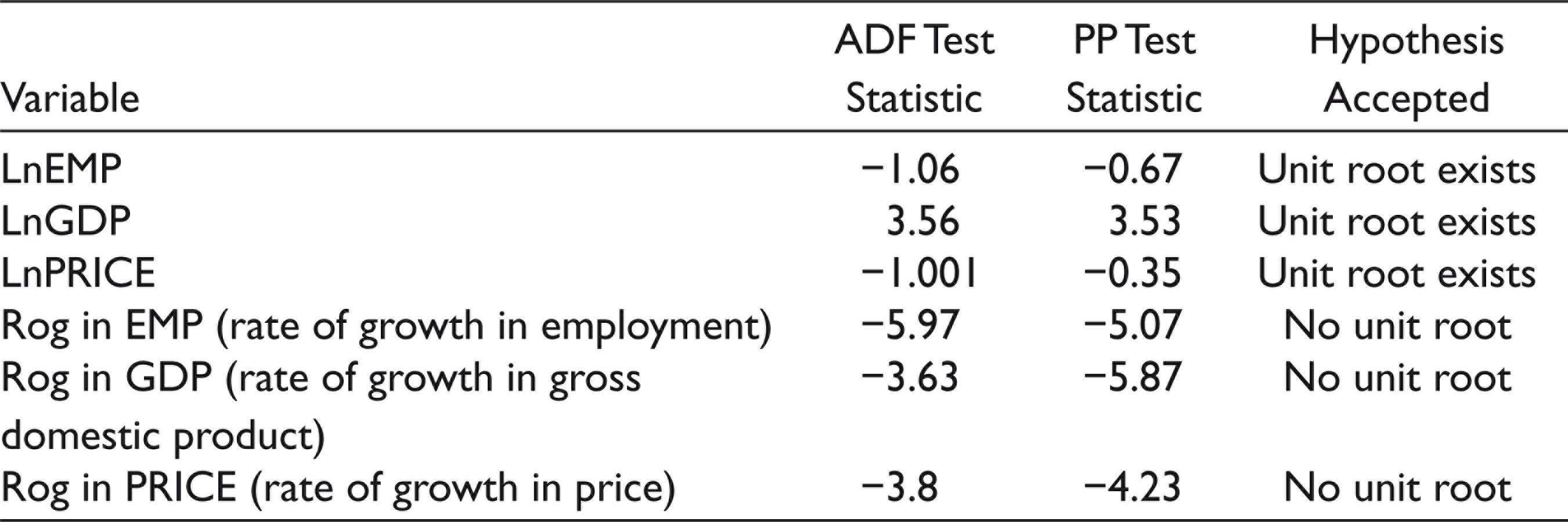
In the time-series framework, we have considered employment and GDP to examine the strength of association. Both the series are non-stationary in the level form though in the first difference form (i.e., the rate of growth since the original variables are taken in log form), they are stationary (Table 1). There is also a co-integrating relationship between the variables (Table 2), and hence, Vector Error Correction Model has been estimated (Table 3).
Unit Root Test
Co-integration Test

Vector Error Correction Model
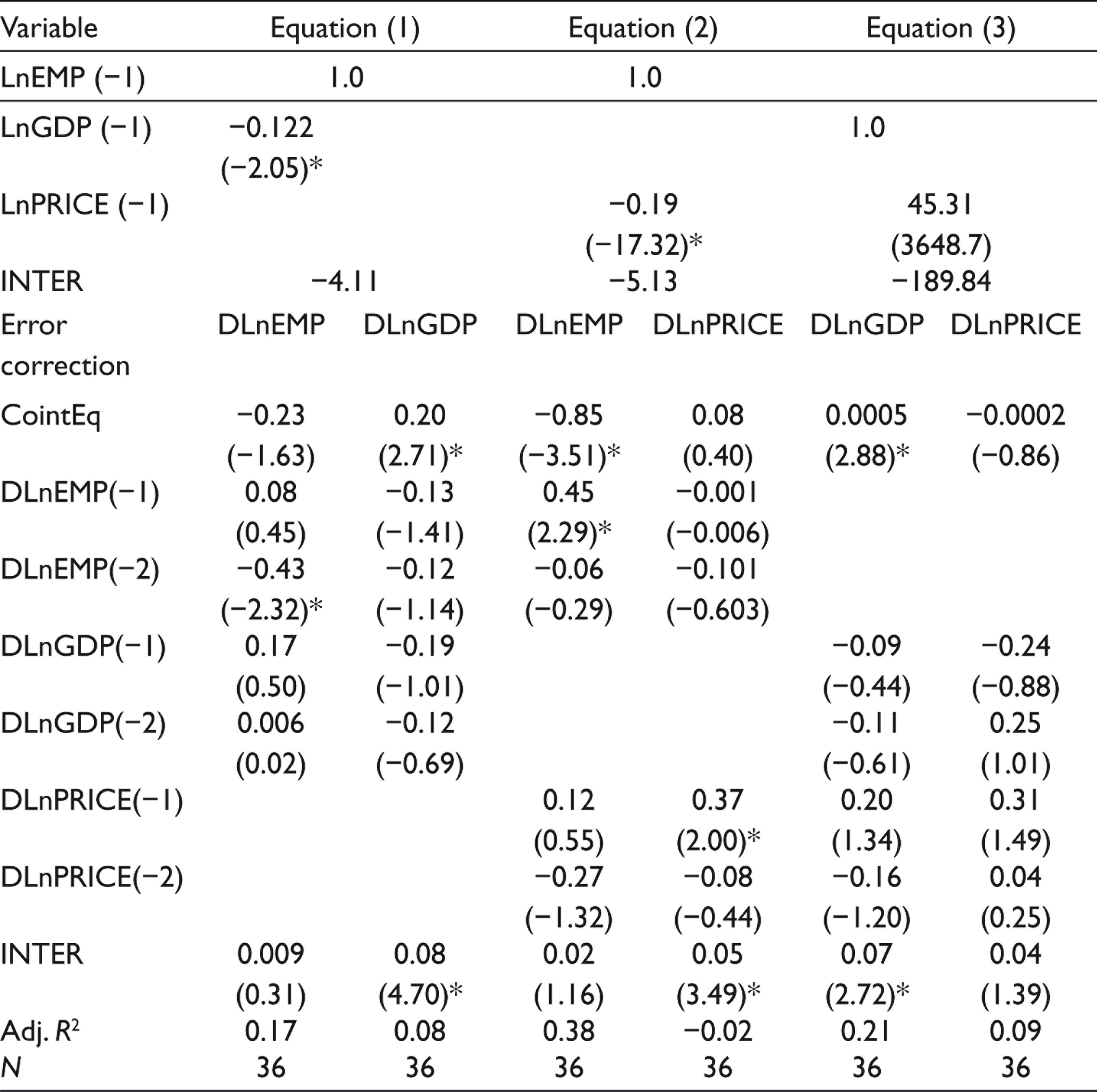
The impulse response of employment to GDP shock is very nominal to begin with (0.004 at the end of 1-year period) though over time it declines to 0.001 by the 5th year (Table 4). However, subsequently, it rises marginally and remains at around 0.002 from the 7th year onwards. On the other hand, the response of GDP to employment shock is greater in magnitude both in the short run and in the long run, and, more importantly, the response tends to increase over time instead of dying down. The variance decomposition results also confirm that employment accounts for nearly half of the GDP variance in the long run while GDP constitutes less than 2 percent of the employment variance, though both have an increasing tendency over time (Table 5). From all this, it may be inferred that employment has a greater impact on GDP rather than vice versa. This is quite consistent with the literature that employment contracts can be long term in nature, and they are usually not flexible in the short run. Hence, fluctuations in the commodity market do not affect employment immediately. On the other hand, reduction in employment can have an adverse effect on output, as there can be a deceleration in demand. After all, for sustaining production in the long run, the effective demand must grow; with sluggish expansion in jobs, the purchasing power of the population will not rise to eliminate the excess supplies in the commodity market.
Impulse Response Function

Variance Decomposition

In the employment–price constellation, the response of employment to price shock and the response of price to employment shock are almost similar in the long run (0.007). However, the sign in both the cases is positive, implying that price rise through expansion in output by incentivizing the producers encourages employment, and employment expansion can result in price rise by raising the effective demand for goods and services. In terms of variance, decomposition of employment prices are seen to play a significant role, as they account for nearly one-fifth of the total variance in employment. On the other hand, employment is not able to influence the prices to any significant extent as they constitute only around 2.5 percent of the price variance in the long run. In other words, employment expansion does not seem to be inflationary and, on the other hand, an expansionary monetary policy is seen to be beneficial for the economy, as prices influence employment significantly, substantiating with evidence of the impact of monetary variable on the real sector of the economy.
Turning to GDP–price relationship, it is seen that the response of GDP to price shock is positive and has a tendency to increase in the long run. This would tend to indicate that price rise can provide an inducement to production. On the other hand, the response of price to GDP shock is negative, and the absolute magnitude is higher than the response of GDP to price shock, with a slight declining tendency in the long run. This implies that prices rise with respect to a decline in the production and vice versa, while production does not respond to prices so significantly. From the variance decomposition, it may again be noted that the prices account for nearly one-tenth of the production variance, while GDP constitutes a little less than one-third of the price variance, meaning that production influences prices to a much greater extent than the monetary variable’s impact on production. For controlling inflation in the economy, it will be, therefore, quite meaningful to augment production. However, comparing the impact of prices on both production and employment, the findings are contrasting because price rise is seen to be more beneficial for employment creation rather than output expansion. This means that employers may be having provision to employment creation, which they may be deliberately suppressing, in order to avoid labour issues and to maximize profit. The possibilities of employment creation are explored with a rise in product prices even without expanding production proportionately. This is an important finding from a policy point of view which tends to corroborate the Philip’s curve hypothesis but without really adhering to the output expansion mechanism. With a rise in prices, leading to an increase in profitability, one component of employment, which seems to be secondary to the employer, gets a boost.
Determinants of Labour Force Participation Rate: A Panel Data Analysis at the State Level
Labour force participation rate (LFPR) is an important indicator of development. With increased human capital formation, people are able to participate in productive activities that result in higher levels of value addition. Without human capital formation, a high level of labour market participation is also evident, but that is associated with low levels of labour productivity. How labour market participation can improve with rising labour productivity is, therefore, an important research and policy question. Particularly in societies experiencing rise in life expectancy, the population must be engaged in productive activities so that they are able to save enough for the future (for old age). India has witnessed considerable decline in fertility rate with an increase in the percentage of population in the working-age brackets, which is seen to be the source of demographic dividend. But such benefits can materialize and enhance economic growth only when, from the supply point of view, there is skilled and highly employable labour force, and there are enough opportunities to absorb them productively from the demand side (Mitra, 1994). The new technology is skill intensive and the dynamic industrial transformations in the 1990s significantly changed the nature, content and extent of skills development as far as the domestic suppliers are concerned. However, in India, a large majority of young people still continue to have limited access to education and training as the dropout rates are high despite an expansion in the capacity of educational institutions and enrolments (Mitra & Okada, 2018). The skill mismatch index is huge, indicating poor employability of a large percentage of the available labour force. Dreze and Kingdon present evidence to suggest that school participation, especially among girls, responds to a wide range of variables, including parental education and motivation, social background, dependency ratios, work opportunities, village development, teacher postings, teacher regularity, midday meals and also school quality.
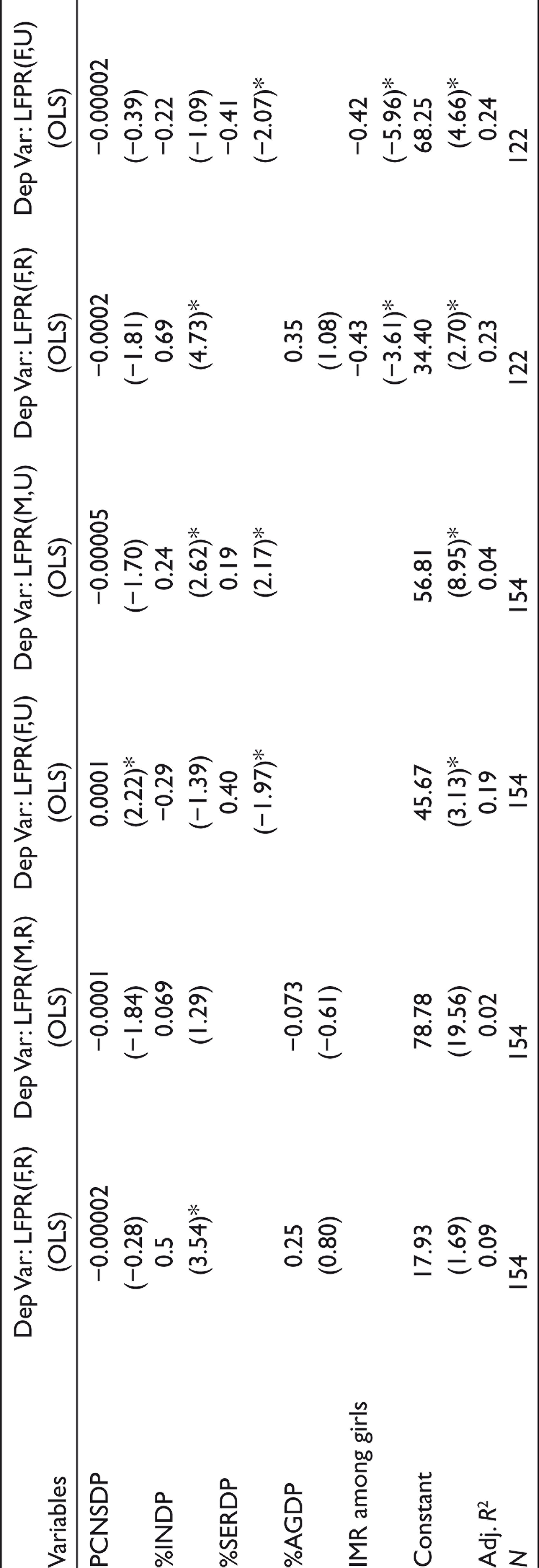
Since Labour Bureau has supplied data for five time points corresponding to each of the states and union territories, we have tried to carry out the panel data analysis as well. But in this exercise, only a limited number of variables, such as per capita income, the sectoral shares in gross state domestic product and the infant mortality rate (IMR), could be included.
The results from Table 6 indicate that the female participation rate in the rural areas is influenced by industrialization. The rural diversification possibly creates more opportunities in which women workers can step into. The service sector, on the other hand, reduces participation, refuting some of the popular views which suggest about women’s preference to work in this sector. The residual activities carried out in this sector with meagre earnings can discourage women from participating in the labour market (‘discouraged dropouts’). However, the female health condition measured in terms of infant mortality rate is a strong determinant of their participation both in the rural and in the urban areas (Table 6).
Regression Results for Labour Force Participation Rate: Panel Data Analysis (OLS results)
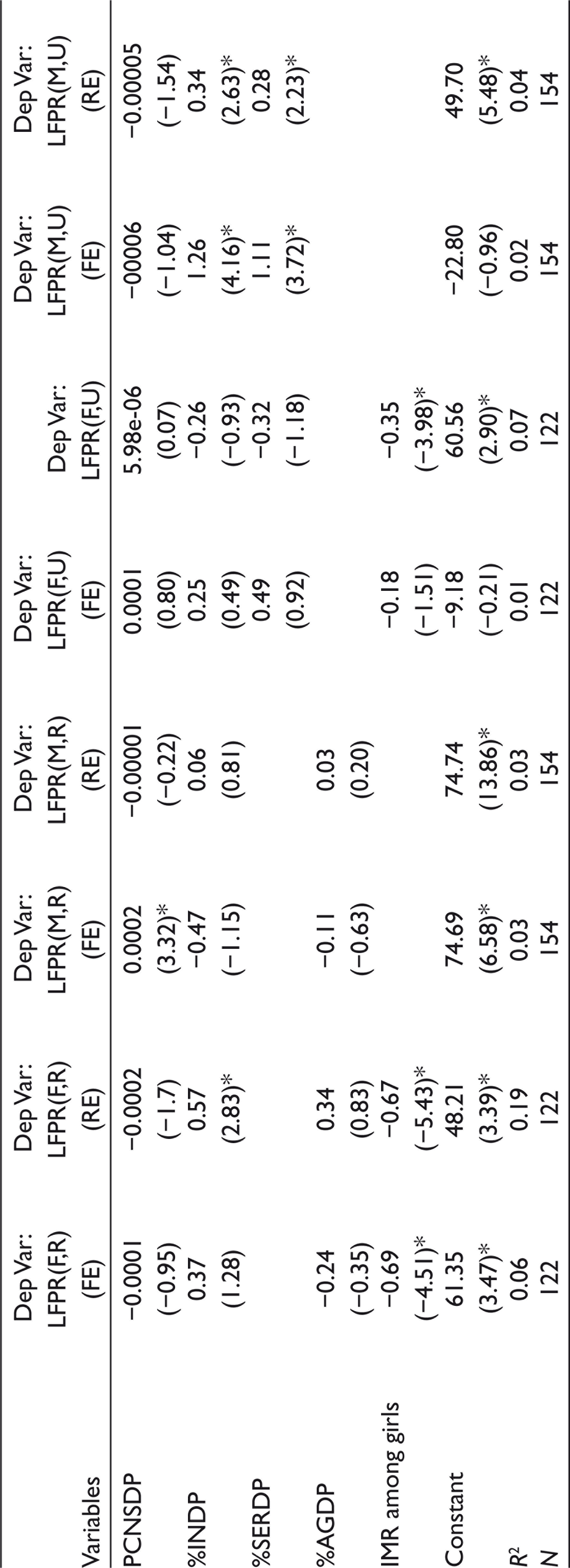
For rural males, none of the variables turns out to be significant though the overall growth index is statistically significant in the fixed effect (FE) model (Table 7). The positive effect of industry and services is evident in the case of urban males, across all the three models (classical ordinary least squares—OLS, FE and Random Effect).
Regression Results for Labour Force Participation Rate: Panel Data Analysis (fixed effect and random effect models)
Keeping the literature in view, suggesting the beneficial effect of women’s access to income and its positive effect on nutrition, education and health of the children, we have turned the causality from participation to IMR after controlling for growth. Both female participation and economic growth are seen to reduce IMR among girls as well as boys. And this beneficial effect of female participation is evident across both rural and urban areas as can be seen from all the three models (Mitra & Okada, 2018). However, the participation definitely has a beneficial effect on children’s health, particularly in the case of girl children: with an increase in female labour force participation, the IMR among girls in both the rural and the urban areas tends to decline.
Labour Force Participation Rate and other Correlates: Cross-Sectional Results at the State Level
In this section, we turn to the cross-sectional analysis to identify the determinants of work and labour force participation (WFPR and LFPR). The variables which are chosen are as follows: household size (HHSZ); literacy rate (LIT); child to woman ratio (CHILD); female to male ratio in the population (F/M); urbanization level (URBN); percentage of scheduled caste (SC) and scheduled tribe (ST) population; per capita net state domestic product (PCNSDP); percentage of agriculture, industry and services in total gross state domestic product (AG, IND and SER); state-wise road length (in km.) in relation to 100,000 population (ROAD); per capita consumption of electricity (ELEC); credit to deposit ratio of scheduled commercial banks (CRE–DEP); percentage of households with access to safe drinking water (WATER); IMR; fertility rate (FR); and gross enrolment rate in classes 1–8 (ENROL). As these variables have been gathered from various sources, they do not refer to one specific year. Second, while some of the variables are available for rural and urban areas, and males and females separately, some others such as infrastructure, growth and composition of growth and urbanization are aggregative in nature. IMR and enrolment are reported among girls and boys separately without any reference to area, while accessibility to safe drinking water is reported for rural and urban areas.
Some of these variables are self-explanatory, but some others need elaboration. For example, the female to male ratio is taken to represent visibility of women: with larger number of women in a region, the participation rate is likely to increase as solidarity and bargaining power of women may rise. A balanced sex ratio may mean less violence against women, which may motivate and provide a conductive environment to participate in the labour market. IMR is taken to represent the overall health condition of the population and so is the case with the access to safe drinking water. The total fertility rate (TFR) or child to woman ratio (a broad indicator of fertility) covers the demographic pressure and the dependency on women. The overall household size is another indicator of dependency, keeping in view that in India the joint family system is still prevalent in many regions. ROAD and ELECT represent physical infrastructure, while CRE–DEP is an indicator of financial infrastructure.
The factor analysis has been carried out for males and females and for rural and urban areas separately (Mitra & Okada, 2018). In relation to work participation rate among rural females, four factors are seen to be statistically significant. Corresponding to the most important factor, that is, factor 1, women’s work participation rate does not have a significant factor loading. In factor 2, however, it enters with a factor loading of 0.74. It has a strong positive relationship with the incidence of ST women population confirming the view that among the ST population, women are earners in addition to their household responsibilities. On the other hand, the incidence of SC population reduces the women’s work participation rate. In the rural situation where caste system is more prevalent, it is possibly more difficult for SC women to find jobs. Poverty-induced participation is evident, and women are largely seen to be engaged in the agricultural sector. What is most striking is the effect of physical infrastructure on women’s work participation. Other studies confirmed increased female enrolment in schools in response to improved infrastructure (Dreze & Kingdon, 1999), and, here, we notice the positive influence of road network on female work participation. Literacy is also seen to have a mild positive association with work participation, while IMR shows a negative association. The positive relationship between female to male ratio and participation is distinct, more so in factor 3. Urbanization level is, however, not seen to raise women’s work participation rate in the rural areas. In other words, although states with higher levels of urbanization are expected to have positive spillover effects, rural areas are somehow not seen to have experienced positive spillover effects, at least in terms of women’s work participation rate. Large household size and child to women ratio affect women’s work participation adversely, as observed in factor 3.
Instead of work, if we consider the labour force participation rate, some of these findings are discernible in factor 1 itself. SC incidence reduces the labour participation, while women join the labour market extensively among the tribes. Poverty-induced participation, additional requirement of female labour in the agricultural sector, the positive effect of health and education, a strong impact of physical infrastructure on labour market participation and the lack of urbanization’s spillover effect on rural women’s labour participation are also evident. That the demographic pressure reduces labour market participation is brought out by factor 3. The positive association between the increased presence of women, measured in terms of female to male population, and the labour market participation is also verifiable across all the three statistically significant factors.
Turning to rural male work participation, it has the highest factor loading in factor 4 compared to the other three. The overall growth in the rural areas, measured in terms of rural consumption expenditure per capita, the financial infrastructure (credit to deposit ratio) and the overall urbanization in the state are seen to raise the male participation. Rural diversification has a positive effect as the percentage of agriculture in gross state domestic product is negatively associated with participation. From factor 2, in which the male work participation takes a moderate factor loading, the positive impact of literacy and the adverse effect of demographic variables are observed evidently. Many of these findings are, however, not confirmed as we shift to labour force participation. There is rather evidence on poverty-induced participation in agricultural activities, that is, factor 3. Besides, large household size tends to raise the male labour market participation, which could be because of economic compulsions. Urbanization reduces the rural male participation possibly because the economically active participants migrate out from the rural areas.
In the urban context, the female work participation with the highest factor loading in factor 2, among all the three factors, unravels the positive effect of literacy and road infrastructure. The female to male ratio is also positively associated with participation. Again, the positive relationship with the incidence of the ST population and a negative one with the SC population comes out sharply. High demographic pressure and poor health reduce participation. Urbanization, industrialization and growth in services, all three, show positive effect on participation, very mildly though.
In relation to the labour force participation rate, by and large, similar findings are obtained if we consider the most important factor and the one in which the female labour force participation takes the highest factor loading: factor 1 and factor 3, respectively. In factor 1, in fact, all the infrastructure variables are positively associated with urban female labour force participation. Financial infrastructure possibly allows women to set up small businesses that enable them to earn.
Among the males in the urban areas, the demographic pressure is seen to reduce participation quite contrary to the belief that large family size or a large number of children force men to participate in the labour market. In low-income households, large family size and participation in petty activities coexist. But the male respondents often do not consider those activities as proper jobs, and hence, they claim to be outside the workforce. Growth shows a positive impact on participation. At very high levels of income, participation is expected to decline, but India being one of the low-income countries, it is unrealistic to expect a negative association between them. Similarly, literacy and better health conditions tend to improve participation, irrespective of whether we use work or labour force participation rate. Usually, literacy or enrolment is expected to cause withdrawal from the labour market, but our findings, based on the cross-sectional data, suggest that though in certain age groups it occurs in the short run, regions with better human capital formation reveal higher participation rates in the long run.
Conclusion
The long-term employment growth has been sluggish in India; in fact, the downsizing of employment in the public sector and the lack of rapid employment generation in the organized private sector have resulted in a decline in the aggregate employment growth after 1984. Thereafter, the employment growth has never been able to match the employment growth experienced during the period from 1975 to 1984. It is also noted that employment has a greater impact on GDP than the impact of GDP on employment. This is quite consistent with the literature that employment contracts can be long term in nature, and they are usually not flexible in the short run. Hence, fluctuations in the commodity market do not affect employment immediately. On the other hand, any reduction in employment can have adverse effect on output, as there can be a deceleration in demand. In fact, in the present context of the COVID-19 pandemic-hit lockdown, the subsequent livelihood loss bears testimony to this argument. The effective demand in the economy has fallen so drastically due to the loss in the purchasing power that the economic growth is unable to pick up.
While pursuing the capital-intensive technology in the production process, these facts pertaining to the demand side need to be reflected upon. The new technology, which is increasingly becoming labour saving, may not be able to sustain the long-run growth, due to the lack of effective demand. Export demand has a number of constraints; unless the competitiveness is extremely high, it is unlikely that the exports can sustain the long-run growth. Hence, the classical conceptualization of a close association between growth and employment is instrumental to the long-run steady state of the economy.
From the supply side, poverty-induced participation is evident, and women are largely seen to be engaged in the agriculture sector. Large household size and the child to women ratio affect women’s work participation adversely. On the whole, the positive effect of health and education and a strong impact of physical infrastructure on labour market participation of rural women are evident. The overall growth in the rural areas, measured in terms of rural consumption expenditure per capita; the financial infrastructure (credit to deposit ratio); and the overall urbanization in the states are seen to raise the male participation. Rural diversification also shows a positive effect.
In the urban context, the female work participation unravels the positive effect of literacy and road infrastructure. The female to male ratio is also positively associated with participation. High demographic pressure and poor health reduce participation, while urbanization, industrialization and growth in services all three show positive effect on participation, very mildly though. Among males in the urban areas, literacy and better health conditions tend to improve participation. Usually, literacy or enrolment is expected to cause withdrawal from the labour market, but our findings, based on the cross-sectional data, suggest that although it occurs in the short run in certain age groups, regions with better human capital formation reveal higher participation rates in the long run. Some of these findings have important policy implications for bridging the gap between labour demand and supply.
Footnotes
Declaration of Conflicting Interests
The author declared no potential conflicts of interest with respect to the research, authorship and/or publication of this article.
Funding
The author received no financial support for the research, authorship and/or publication of this article.