




Abstract
In response to the social inequities that exist in health care, the NIH-funded Consortium of Eosinophilic Gastrointestinal Disease Researchers (CEGIR) recently formed a diversity committee to examine systemic racism and implicit bias in the care and research of eosinophilic gastrointestinal diseases (EGIDs). Herein, we describe our process, highlighting milestones and issues addressed since the committee’s inception, which we hope will inspire other researchers to enhance diversity, equity, inclusion, and accessibility (DEIA) in their fields. Our journey began by establishing mission and vision statements to define the purpose of the committee. Regular discussion of diversity-related topics was incorporated into existing meetings and web-based materials were shared. This was followed by educational initiatives, including establishing a library of relevant publications and a speaker series to address DEIA topics. We then established a research agenda focused on the following actionable items: (1) to define what is known about the demographics of EGIDs by systematic review of population-based studies; (2) to develop a practical tool for reporting participant demographics to reduce bias in EGID literature; (3) to examine health disparities in the care of individuals with eosinophilic esophagitis who present to the emergency department with an esophageal food impaction; (4) to examine how access to a gastroenterologist affects the conclusions of published research examining the prevalence of pediatric eosinophilic esophagitis; and (5) to develop a model for examining the dimensions of diversity, and provide a framework for CEGIR’s ongoing projects and data capture. In addition to promoting consciousness of DEIA, this initiative has fostered inclusivity among CEGIR members and will continue to inspire positive changes in EGID care and research.
Plain language summary
To address systemic bias in patient care and research in eosinophilic gastrointestinal diseases, the Consortium of Eosinophilic Gastrointestinal Disease Researchers (CEGIR) recently formed a diversity committee. The CEGIR diversity committee has defined its purpose through mission and vision statements and developed structured educational and research initiatives to enhance diversity, equity, inclusivity, and accessibility (DEIA) in all CEGIR activities. Here, we share the process of formation of our diversity committee, highlighting milestones achieved and summarizing future directions. We hope that this report will serve as a guide and an inspiration for other researchers to enhance DEIA in their fields.
Introduction
In 2014, the Consortium for Eosinophilic Gastrointestinal Disease Researchers (CEGIR) initiated its studies supported by funding from an NIH U54 grant [Rare Diseases Clinical Research Network (RDCRN), National Center for Advancing Translational Science (NCATS), National Institute of Allergy and Infectious Diseases (NIAID), and National Institute of Diabetes and Digestive and Kidney Diseases (NIDDK)]. Now in its second funding cycle, CEGIR is composed of 18 US clinical sites and 130 members. CEGIR is dedicated to improving the lives of individuals with eosinophilic gastrointestinal diseases (EGIDs) through innovative research, clinical expertise, and education via collaborations between scientists, health care providers, patients, and patient advocacy groups (PAGs). CEGIR focuses its research on identifying the natural history of rare EGIDs with an emphasis on eosinophilic esophagitis (EoE), eosinophilic gastritis, eosinophilic enteritis, and eosinophilic colitis, and on establishing clinical outcome metrics for therapeutic trials. Importantly, this funding mechanism requires involvement of PAGs in all research projects. CEGIR enjoys the participation of five PAGs: the American Partnership for Eosinophilic Disorders, the Campaign Urging Research for Eosinophilic Disease, the Eosinophilic Family Coalition, AuSEE, Inc. and EOS Network.
EGIDs are a relatively newly described group of disorders, and little is known about their demographic characteristics. EoE is the most common EGID, with a prevalence of 34.4 cases/100,000 inhabitants. 1 However, most data on EGIDs has been collected in the United States and Europe, limiting the generalizability of these assessments. EoE has conventionally been regarded as a disease that predominantly affects White males, and much less is known about the demographics of non-EoE EGIDs. CEGIR investigators have challenged this assumption and hypothesize the actual disease burden of EoE is more heterogeneous between Black and White patients. Considering that the median delay in diagnosis of EoE is 6 years, early recognition and treatment is crucial to prevent progressive features such as esophageal fibrosis and strictures. 2 For Black and other non-White populations, this delay may be even greater due to perceived demographic differences suggested by prior epidemiologic studies. The efforts of the diversity committee to interrogate disparities relating to DEIA are essential for CEGIR’s efforts to continuously improve care for patients with EGIDs.
Inspired by past and recent world events highlighting racial disparities in the United States, including its healthcare system, CEGIR members established the CEGIR diversity committee in August 2020. A major reason to create a diversity committee was to promote awareness of issues related to DEIA in CEGIR-associated research. The committee’s highly interactive group, composed of investigators, trainees, research coordinators, research administrators, and patient advocates, developed its infrastructure and a resultant set of deliverables through transparent and honest conversations about relevant and meaningful issues related to DEIA in research. The diversity committee meets twice per month and is composed of 34 members from the CEGIR membership. Here, we recount milestones and issues addressed since the committee’s inception.
CEGIR diversity committee infrastructure milestones
Development of mission and vision statements created synergy of purpose
To lay the foundation of the diversity committee, several initial discussions were held during our virtual meetings that led to drafting, reviewing, and establishing the following mission and vision statements:
Mission statement
We will develop an understanding of cultural, ethnic, and racial diversity and structural racism, particularly as it pertains to underrepresented populations of patients with EGIDs; strive to examine systemic and implicit biases; identify associated barriers to our research; and integrate the knowledge into our research studies and educational initiatives, so that we can better serve all patients with EGIDs.
Vision statement
CEGIR actively promotes a culture of diversity and inclusivity in its membership, in its innovative research studies, and its educational initiatives.
These two statements form the guiding principles of the diversity committee as well as CEGIR’s general membership and are read by different CEGIR members at the beginning of each of the consortium-wide, bi-weekly meetings and at our annual meeting. In essence, these statements serve as a constant reminder of our commitment to prioritizing the research landscape of DEIA within CEGIR.
Creation of a diversity library and speaker series formed a common knowledge base
Since CEGIR members possessed various knowledge levels on the impact of DEIA on research, an educational platform was developed in which an easily accessible reference library was created using Sciwheel 3 and a schedule of speakers was established. The reference library is populated by CEGIR diversity committee members and provides a rich up-to-date resource for our own knowledge and future publications, particularly with regard to establishing common and correct terminology for DEIA-related topics. Scheduled speakers present and engage in our virtual meetings on areas of DEIA research and discuss their experiences, data, and opinions while encouraging interactive discussions among CEGIR members. In addition, information on DEIA-themed workshops, webinars, conferences, and seminars are continuously shared with CEGIR members. These steps not only enhance CEGIR members’ knowledge of DEIA in research but also facilitate conversations on sensitive topics and learning new ways to approach research through a DEIA lens. Invited experts encourage CEGIR members to recognize biases, deficiencies, and identify potential solutions through various scenarios. Consistent messaging and development of a rigorous knowledge base promotes CEGIR’s efforts to carry out its mission and vision statements.
Establishing a research agenda instilled purpose
To translate learned DEIA concepts into action, a research agenda was established to accrue novel data that would impact issues related to DEIA in EGID research. This element proved critical to the success of the CEGIR diversity committee because it was developed by all members and provided a common shared framework to change the research landscape as currently established. Three areas were chosen based on current knowledge and needs. First, a systematic review of the literature was performed to understand the demographics of EGIDs. Second, efforts were dedicated to developing a reference tool that would allow CEGIR researchers to assess whether studies were conducted, and demographics were reported, in accordance with current guidance in the AMA manual of style. 4 Finally, an agenda was developed to understand clinical observations that may or may not be relevant to disparity in the care of EGIDs. Each of these projects will be described in further detail in the next sections.
Communication platforms promoted sense of community
Prior to the COVID-19 pandemic, CEGIR held an in-person annual meeting and would host ad hoc live meetings at various national academic society meetings. Since the diversity committee was created during the pandemic, all meetings have been virtual. Virtual meetings enabled a robust means of regular communication and included regular and ad hoc virtual meetings at times when most members could attend. Members live in all US time zones; therefore, meeting times are rotated between early morning and evening to accommodate all participating members. Second, during our bi-weekly general CEGIR meetings of the principal investigators, research coordinators, NIH representatives and PAGs, a 5–10 min educational presentation is scheduled that includes updates on work and presentations of pivotal DEIA publications in the field of gastroenterology, allergy, and nutrition. Third, committee members established the ‘Diversity Corner’ 5 on the CEGIR website that summarizes the educational presentations and is available to all CEGIR members and other interested constituents. In total, these elements allow the diversity committee to have a community as well as inform others of its important products.
Importantly, a point of emphasis of the diversity committee was to be proactively inclusive in its membership, involving CEGIR members early and late in their career development, members from all ethnic and racial backgrounds, research coordinators, and our PAGs. This leverages the extensive expertise of the CEGIR group in conducting research, which can be applied towards DEIA research and educational initiatives. This type of organization promoted ongoing and close collaborative interactions among investigators at all stages of their career development and PAGs. PAGs were instrumental in bringing new perspectives, ideas, and expertise to the discussions, as their experience stemming from interactions with patients is complementary to that of the investigators.
Taken together, the development of mission and vision statements, creation of an educational platform, establishment of a research agenda, and formation of viable communication systems provided a robust infrastructure to address DEIA within the CEGIR diversity committee and to establish and integrate DEIA into the fabric of all CEGIR interactions, research, and educational endeavors.
Research projects conducted and milestones achieved
Challenging assumptions about the demographics of EGIDs
Since EGIDs are a relatively newly described group of disorders, little is known about their demographic characteristics. EoE, the most common of the EGIDs, has traditionally been regarded as a disease that predominantly affects White males, and much less is known about the demographics of non-EoE EGIDs. While existing studies of EGIDs frequently describe the sample characteristics, most single or multi-center retrospective studies are not population-based, and are, therefore, subject to selection bias. In addition, many population-based studies do not report the denominator for the reference population from which the EGID population was selected. This selection bias likely extends to participation in clinical trials and may perpetuate stereotypes that contribute to diagnostic disparities in marginalized populations. Consequently, the diversity committee conducted a systematic review of population-based studies of EGIDs to identify the actual demographics of EGIDs. Knowledge acquired will inform the research community to address potential provider biases, enhance recruitment goals for diverse patient populations in clinical trials, ensure proper allocation of resources, reduce diagnostic delay, identify various phenotypes of EGIDs, and tailor therapies accordingly.
As a secondary objective, we analyzed the reporting methods employed by the articles included in the systematic review. We focused on comparisons, organization, and terminology to generate a checklist of best practices for reporting sex, gender, race, and ethnicity based on recent recommendations from the AMA manual of style. 4 We identified several common reporting practices which may contribute to implicit bias. CEGIR members can now use this abbreviated checklist (Table 1) as they prepare their own manuscripts and encourage others to adhere to best practices through the peer review process. This manuscript has been submitted for review. By using appropriate and culturally sensitive reporting practices we can enhance our understanding of how racial, ethnic, and socioeconomic factors influence EGID care to promote a culture of inclusivity in EGID research.
CEGIR checklist for reporting demographics.
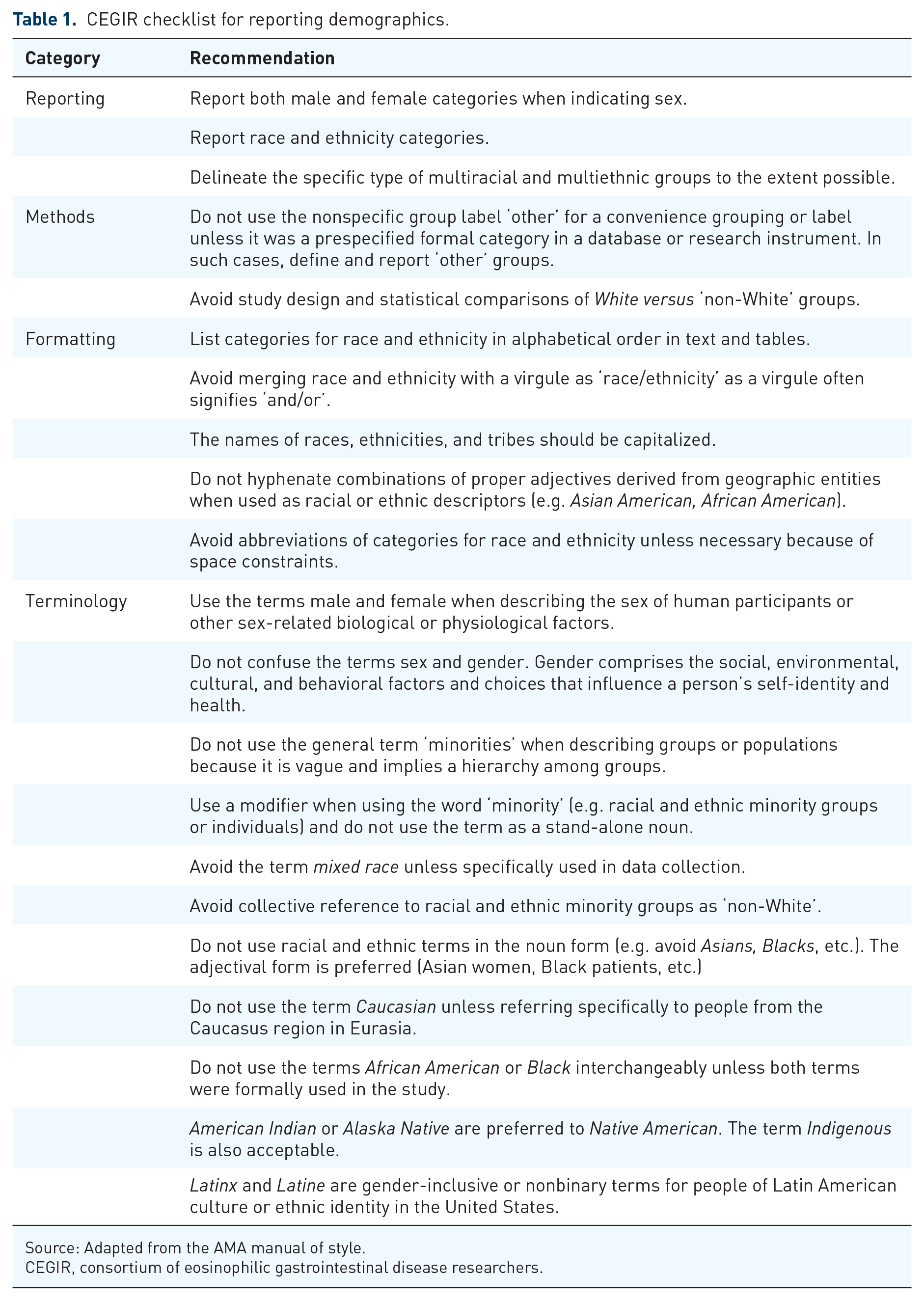
Source: Adapted from the AMA manual of style.
CEGIR, consortium of eosinophilic gastrointestinal disease researchers.
Investigating potential racial and ethnic disparities in the diagnosis of EoE
During the bi-monthly discussions related to the current evidence that identified EoE as a disease that primarily affects White males,6–10 one of the CEGIR investigators presented single-center data suggesting that Black patients presenting to the emergency department with an esophageal food impaction were less likely to receive a diagnostic upper endoscopy with esophageal biopsies as compared to White patients. EoE is known to be one of the leading causes of esophageal food impactions in children and adults.11,12 Since EoE is the most common cause of esophageal food impactions, this finding is critical to help identify barriers to diagnosis and treating patients expediently.
These preliminary findings led the diversity committee to develop a hypothesis-driven study that addressed this concern through a retrospective analysis of eight geographically dispersed CEGIR sites. Because emergency food impaction represents an unequivocal symptom of esophageal dysfunction, the study is designed to identify health disparities among patients presenting to the emergency department with food impaction. We hypothesized that some individuals may be less likely to have endoscopic biopsies and referral to gastroenterology after an esophageal food impaction. A data query will be performed of each site’s electronic medical records using a common clinical research form, and data analysis will be centralized. Results from the study will allow dissection of potential racial or ethnic disparities during the initial stage of an EoE diagnostic evaluation and in those whose disease is poorly controlled.
Examining access to care in EoE diagnosis
In a large, US-based, database study of children enrolled in Medicaid, McGowan et al. 13 determined that EoE was less prevalent among children living in rural areas. The odds of being diagnosed with EoE were lower in rural areas and in areas with more neighborhood poverty. The authors recommended exploration of unique environmental factors that may be protective for the development of EoE in these populations, as EoE is a food/environmental antigen-driven disease. They also suggested the alternate possibility of under-diagnosis of EoE in resource-poor settings. The diversity committee hypothesized this discrepancy was attributable to a disparity in access to care. 13 To receive a diagnosis of EoE, a child must be referred to and evaluated by a pediatric gastroenterologist and undergo a diagnostic upper endoscopy with esophageal biopsies under anesthesia. 14 This requires access to pediatric subspecialty care and a tertiary care center with anesthesia capabilities. The diversity committee examined the distribution of pediatric gastroenterologists in the United States and found that most were in urban communities; therefore, we speculated that the lower prevalence of rural pediatric EoE patients likely resulted from underdiagnosis due to decreased provider access.
The findings were further investigated in a subsequent collaboration with McGowan and colleagues in a study that re-analyzed their previously published data to examine the distance to a pediatric gastroenterology provider. 15 When adjusting for distance to provider, there was no longer an independent, inverse association between living in a rural area and EoE diagnosis. These findings suggest that diagnostic disparities for EoE among children residing in rural areas can be attributed to a lack of access to pediatric gastroenterology subspecialty care. Furthermore, while distance to provider attenuated the association between urban/rural status and EoE diagnosis, this was not observed for neighborhood-level poverty. Children living in areas with higher neighborhood-level poverty continued to be less likely to be diagnosed with EoE. Together, these findings provide important public health information as they suggest that improving access to subspecialty care in various parts of the US may support more equitable diagnostic evaluations for EoE.
Creation of a platform to assess diversity in all CEGIR research on EGIDs
To directly improve CEGIR’s research, the committee developed a tool to assess whether DEIA issues were considered during the development and execution of a research project. The committee took advantage of our PAGs’ expertise and resources related to understanding how diversity can be addressed in the workplace. A PAG member presented an approach to understand the different dimensions of diversity in the workplace termed the Diversity Wheel. This platform was developed in 1990 by Marilyn Loden and Judy Rosener 16 and consisted of a framework for thinking about the different dimensions of diversity within individuals and institutions. Depicted as concentric circles, this Diversity Wheel has been used in many ways to encourage thinking about values, beliefs, and dimensions of identity for people and organizations. The wheel represents the various dimensions of diversity, namely internal, external, and organizational dimensions. Internal dimensions are central to an individual’s experience, have sustained influence on one’s life, and are often the dimensions with which one closely identifies. External dimensions, while critically important in determining one’s identity, have a greater degree of control or self-determination to change. Organizational dimensions contribute to how one experiences their time within an organization, or for our purposes, in clinical research.
In October 2021, diversity committee members and other interested CEGIR members met in a virtual workshop to generate a CEGIR Diversity Wheel to help enhance DEIA in CEGIR investigator clinical trials. Workshop members represented the diversity that exists within CEGIR and were comprised of PAGs, clinical research coordinators, principal investigators, and trainees. Together they applied the CEGIR Diversity Wheel to develop a checklist of DEIA items to incorporate into EoE/EGID clinical trial design and implementation.
An additional task of the committee has been the improvement of data capture in our natural history study, including redesigning our case report forms to collect various social determinants of health including socioeconomics, insurance status, proximity to pollution via geocoding, and access to medical foods among other factors. Together, the CEGIR Diversity Wheel and recent improvements in our data capture have led to changes in CEGIR’s standard operating procedures for all clinical trials and research studies. These efforts will ensure more equity in CEGIR research and more broadly impact all CEGIR members as they address DEIA in their research activities.
The CEGIR diversity committee journey: challenges and future directions
We acknowledge that to rectify existing disparities in the clinical care of EGIDs we must address inclusivity in our research. This will increase the generalizability of EGID research findings and identify areas for improving care in all patients. CEGIR’s efforts to promote DEIA are summarized in Figure 1 and key metrics are noted in Table 2. The successful establishment of a viable virtual platform by the diversity committee has facilitated addressing several important issues and improved our understanding of DEIA in EGID research. This has included an assessment of the diversity within CEGIR membership (Table 2). In the future, we plan to continue current studies and pursue new directions stemming from recent results. We are hopeful that the identification of gaps in knowledge and care will lead to future funding opportunities, as this is a major obstacle to supporting the investigators and infrastructure for these endeavors. By implementing and disseminating the results of the above projects through publications, we have the potential to shape several aspects of EGID patient care, including timely diagnosis and management and enhancing diversity in clinical research participation. The primary goal of the diversity committee is to align CEGIR membership, research studies, and educational initiatives with the clear mission statement that is read aloud at every meeting. We aim to continue our endeavors through promotion of opportunities for underserved populations and underrepresented groups as diverse learners through a career enhancement core, development of patient and provider education initiatives, and dedication of CEGIR pilot funds for DEIA-related research studies.

Summary of CEGIR’s efforts to enhance DEIA in EGIDs.
CEGIR metrics.

Not all members of CEGIR represented.
Based on electronic survey of CEGIR members, n = 62.
Other = Indian
Other = Australian.
CEGIR, consortium of eosinophilic gastrointestinal disease researchers.
