



Abstract
The sociology of violence has undergone a tremendous change over the past 10 years, increasingly arguing that situational factors are key to violence emergence, rather than context factors. Yet, many key questions regarding this novel situational approach remain unanswered: How can situation and context be conceptually specified? Can context be integrated into a situational explanatory model? And what causal understanding underlies situational approaches? To answer these questions, the paper relies on my empirical studies of officer deadly use of force and of collective violence in protests, as well as other scholars’ empirical work. The article first proposes a specified definition of situation and context. Using these concepts, it then proposes a causal specification of the situational approach through necessary, sufficient, and INUS conditions, as well as context factors as risk factors to violence. Third, in an outlook, it argues that this causal relationship between situation, context, and violence can be theoretically framed through an elaborated symbolic interactionism that integrates context into a situational approach. It also discusses the relevance of the debate for violence avoidance and for other research fields.
Keywords
Introduction
In recent years, traditional explanations of physical violence are increasingly challenged. Micro-sociologists argue that previously assumed irrational drives or motivations, structural or cultural factors do not directly lead to violence, rather situational dynamics are key to the emergence of violence (Collins, 2008, 2020; Klusemann, 2009; Drury and Reicher, 2000). Situational approaches saw a broad reception in sociology and social psychology in recent years, leading to what some call “warfare” between researchers advocating for or against situational approaches (Bowman et al., 2015; Braun, 2020; Koepp and Schattka, 2020). While critics acknowledge the situational approach’s empirical explanatory power, they argue, first, that the terminology of the approach is vague and that clearer conceptual distinctions concerning what constitutes a “situation” and what constitutes the “context” is needed (Felson, 2009). Secondly, causal relationships are usually not specified in the situational approach. Thirdly, critics claim we need more ideas regarding how to integrate context and situation theoretically and how to solve the existing micro-macro dichotomy (Collins, 2008; Kron and Verneuer, 2020; Wieviorka, 2014).
In this article, I address these gaps. First, I briefly outline the situational drift in violence research and discuss open questions. Contributing to the first gap, I then propose a theoretically and empirically informed definition of “situation” and “context,” and illustrate the role of situations and of their contexts. To do so, I rely on my empirical study of deadly police violence against black, indigenous, and people of color (BIPOC) in the US—a type of violence where context is usually assumed to play a key role. In the second section, I discuss empirical insights on causal relationships between situation and context, proposing a causal specification through necessary, sufficient, and INUS conditions (meaning
Thus, the paper engages with a core debate in current research on violence by addressing debates around the situational approach to violence and connecting different theoretical approaches to violence. Yet, as the conclusion shows, the considerations formulated here are relevant for social science research beyond the field of violence. Across sociological, criminological, political science, and social psychology research, the increase in visual data on situational processes is leading to a massive surge in studies examining situational dynamics for all types of social phenomena (Nassauer and Legewie, 2018, 2022). Determining the roles of situations and contexts in a variety of outcomes will be a crucial part of social science debates in the years to come.
Situational approaches to violence
In 2008, Collins’ work Violence: A Micro-Sociological Theory set in motion a shift in perspective, as a result of which micro-factors were increasingly seen as central to the emergence of violence (for first approaches in this direction, see also Felson and Steadman, 1983; Garfinkel, 2005 [1963]; Katz 1988). In his analysis of physical violence, Collins neither analyzed ex post statements by victims, perpetrators, or observers, nor documented data on violent events. Instead, he studied visual material in the form of hundreds of photos and videos covering a wide variety of violent and violence-threatening events. His analyses show that people in violence-threatening situations are confronted with what he (2008) calls confrontational tension and fear (ct/f)—a physiological and psychological barrier to violence. Confrontational tension arises not only because actors are afraid of getting hurt, but because of fundamental difficulties in face-to-face interactions (Collins, 2008: 90): Collins (1993, 2005) suggests people are used to peaceful interaction rituals, in which they fall into shared rhythms. Successful interaction rituals give people emotional energy (positive emotional charge, see Collins 1993), while failed rituals drain energy. Violence counters such interaction rituals: In violence-threatening situations, tension rises from going against these rhythms and rituals. Collins (2008) shows that ct/f thereby prevents aggression from turning into violence in most violence-threatening situations.
Collins describes five pathways to violence that allow people to engage in violent acts despite ct/f: (1) audience-oriented and rule-based violence (e.g., boxing matches); (2) confrontation avoidance by engaging in violence from a distance (e.g., drone pilots); (3) confrontation avoidance by deception (e.g., hitmen or suicide bombers); (4) confrontation avoidance through a focus on the technical aspect of violence (e.g., snipers); and (5) attacking the weak. Collins (2009) claims attacking the weak is the most common pathway to everyday violence. In this fifth pathway, violence is often perpetrated against people when they turn away, look to the ground, are positioned with their back to the attacker, or look in the other direction. This enables violent actors to establish “emotional dominance” over another person. While the concept of “emotional dominance” is sometimes criticized as vague (Felson, 2009), it can be understood as a situational advantage that leads to violence becoming possible despite ct/f. Emotional dominance resembles the sports allegory of “possessing momentum.” Collins sees this situational momentum as essential to the emergence of violent action.
In his comparative analysis of different types of violence, Collins (2008) concludes that violent actions follow the same situational patterns of getting around ct/f regardless of prior planning by actors and regardless of the type of violence studied. Even ordered and planned violence is difficult to carry out, with perpetrators having to overcome ct/f in each respective situation.
Micro-sociologists argue that if both violent and non-violent events are included in the analysis, it becomes apparent that context factors are not systematically related to the emergence of violence: Too many violent events do not show prior context factors and too many individuals affected by context factors do not engage in violence (Collins, 2008; Katz, 1988). For example, a large percentage of actors who use violence may be affected by social inequality. However, most people affected by such inequality never use violence, instead suffering inequality and injustice in silence (Horowitz, 2001). Thus, micro-sociological approaches assume that context factors, like social grievances or prior motivations, cannot adequately explain violence (Collins, 2008: 2; see also Athens, 1980; Jackson-Jacobs, 2013). Instead, scholars argue that specific situational dynamics are systematically associated with the emergence of violence. Thus, if context factors lead to violence, they must pass through a “situational eye of the needle” (Collins, 2008: 16). Yet, situational dynamics can lead to violence even in the absence of context factors.
Collins’ study triggered an international wave of empirical research on the role of situational dynamics in the emergence of violence (e.g., Bramsen, 2018; Klusemann, 2009; Mosselman et al., 2018; Nassauer, 2016, 2019). For instance, studies on individual-level violence show that even actors who are motivated to use violence are unable to do so despite motivation and planning. In his study of affluent white youth groups, Curtis Jackson-Jacobs (2013) shows that they often go out in the evening with the primary goal of provoking fights. Although they actively prepare to use violence and are supported in doing so by their peers, ultimately, they very rarely achieve their goal. Despite preparations and existing motivation, specific situational dynamics must be present for them to be able to overcome their ct/f (see also Anderson, 2000).
Harel Shapira’s study on weapons training courses (Shapira, 2016) highlights their emphasis on the situational dynamics that Collins (2008) would summarize as strategies for getting around ct/f. Through these courses, participants essentially learn to bypass ct/f, enabling them to deploy their weapon and use violence. Their motivation alone is usually not enough to do so.
Such studies on individual-level physical violence address the role of situational as well as context factors to violence, including motivations, relative deprivation, gun culture, and peer group influences. Through participant observation, they emphasize that context factors alone cannot lead to violence and suggest that situational dynamics are vital to the emergence of violence. Recent analyses of video data on individual-level violence support these findings. For example, studies show how rarely physical fights erupt, despite actor’s aggressiveness or relative deprivation (Levine et al. 2011; Lindegaard et al. 2015; Philpot and Levine 2016; Weenink 2014).
Analyses of collective violence come to similar conclusions about the relationship between situation and context. For example, combining participant observation, interviews, and video analyses, Isabel Bramsen (2018) shows that violence during Arab Spring protests only erupted when confrontational tension was overcome: for example, when the perpetrators of violence 1) stood elevated (and, thus, were no longer face-to-face); 2) could perpetrate violence from a distance, or 3) visibility was decreased, for example at nightfall.
In his study of the Srebrenica massacre, Stefan Klusemann (2009, see also 2012), analyzes video footage and documentary data to compare the impact of context factors and situational dynamics on the outbreak of violence. He argues that ethnic hatred, as well as other context factors, were present over a long period of time in the Yugoslavia conflict, not just when acts of violence occurred. Moreover, as such context factors are present in many countries and regions where massacres never occurred, they cannot systematically explain violence (see also Horowitz, 2001). Instead, he shows that situational dynamics immediately prior to the outbreak of the massacre, more specifically the establishment of emotional dominance (which Klusemann, also empirically studies as momentum, 2009: 9), were essential to the outbreak of the massacre.
Studying the unfolding of the Bloody Sunday shootings, in which 13 people were shot and 13 others injured by British soldiers during a demonstration in Northern Ireland in 1972, McCleery (2016) arrives at similar results. According to McCleery, situational dynamics on Bloody Sunday were essential to the shootings, not prior orders, motivations of the soldiers, or other context factors underlying the Northern Ireland conflict.
These and other studies on individual and collective violence suggest that grievances may be used ex post as justification for violent action and, thus, are emphasized in newspaper articles by journalists or mentioned in researchers’ interviews with perpetrators and victims. However, these cannot explain if, when, and where violence occurs. The same applies to actor’s motivations. As Katz summarizes for criminal acts of violence, a person with social grievances, an abusive upbringing, or specific motivations for violence, “must suddenly become propelled to commit the crime in a specific situation, in contrast to most other moments of her or his life” (Katz, 1988: 4). Most people do not use violence despite possible motivation or aggression. Violence is always—historically and contemporarily—an exceptional act and empirically rare (Ferguson, 2013; Pinker, 2012; Sussman and Marshack, 2010). When violence does break out, it does so after specific situational patterns.
With its growing success, three primary issues regarding the limitations and drawbacks of the situational approach are increasingly raised (Felson, 2009; Koepp and Schattka, 2020; Wieviorka, 2014). First, it is argued that the approach lacks specifications of concepts and causality: it is unclear what exactly the “situation” means and where the situation ends and the context begins. As Collins’ approach (2008) lacks a specific definition, respective violence researchers define the situation as encompassing very different time-spans: what still belongs to the situation for some is already the context for others (see below). Second, it remains unclear how the two are assumed to be causally connected to violence. While quantitative researchers underline that context factors increase the likelihood for several types of violence, micro-sociologists argue that only situational dynamics are causally linked to the outcome (Collins, 2008; Felson, 2009; Laitin, 2008). Subsequently, some macro-sociologists criticize micro-approaches as context-blind, while micro-sociologists counter that context is studied, but it simply is not systematically connected to violence (Koepp and Schattka, 2020; Kron and Verneuer, 2020; Nassauer, 2019). Lastly, some macro-sociologists see a “current hegemony” of what they label a micro-infused “situationalism” as “coming to an end” (Hoebel and Knöbl, 2019: 14). However, a look at the international literature suggests neither does such a hegemony exist, nor do micro-approaches seem to decline. Rather, in light of a surge in video data on real-life violent events, situational approaches are gaining further momentum (for an overview, see Nassauer and Legewie, 2022). Thirdly, scholars claim it is unclear how we can theoretically locate, or even integrate, “context” into the situational approach and where to situate subjectivity and meaning in the approach (Wieviorka, 2014). In this article, I address these gaps.
“Situation” versus “context”
Terminological specifications
Situational studies of violence take into account “situation” and “context,” suggesting that the former plays a more important role in violence emergence (Bowman et al., 2015; Klusemann, 2012; Nassauer, 2019; see also Reicher et al., 2007; Stott and Drury, 2000). Yet, across most recent violence studies, “situation” and “context” remain under-defined. How can situation and context be conceptualized in order to more precisely analyze and theoretically situate the role of both in the emergence of violence? Where does a situation begin and where does it end? Is a situation not always shaped by the context in which it arises and in which people act situationally?
These questions are further complicated as different violence scholars seem to refer to different periods of time when they talk about “situations.” For example, Collins (2008, 2020) primarily examines the seconds and minutes prior to the emergence of violence, whereas in my protest study (2019) situational dynamics include the hours prior to violence emergence and Klusemann’s (2009) situational approach includes the day prior to violence. Such differences call for a more specific definition. In addition, violence scholars further differ in what they analyze as part of the “situation.” Collins (2008, 2020) understands “situation” primarily as emotional dynamics, micro-rhythms, and entrainment, to which he attributes great importance. Other violence researchers, like Levine et al. (2011), focus purely on situational interactions (e.g., hitting, pushing), and again others, such as Klusemann (2009), Nassauer (2019), or Drury and Reicher (2000), focus on interactions, interpretations, and emotions prior to violent acts.
“Situation,” then, like “violence,” is a broad umbrella term that can be defined in many different ways (see Heitmeyer and Hagan, 2003; Wieviorka, 2003, 2009). Nevertheless, the “situation” is a fundamental sociological concept (Diehl and McFarland, 2010). Like all sociological concepts, this concept can be understood as an analytical entity conceived by researchers with the aim of categorizing empirical data in a meaningful way. Thus, concepts are not necessarily pre-existing empirically, but are defined by researchers through delimitations (Ragin and Becker, 1992). Central elements of a concept form a theory about the ontology of the phenomenon (Goertz, 2006). Thus, concepts should facilitate the analysis of a phenomenon as sensibly as possible, should be comprehensible, and should make theoretical and empirical sense. At the same time, concepts always have gray areas (Ragin, 2000), where closer examination can inherently increase analytic value (Legewie, 2017).
In light of these considerations, I propose to conceptualize the “situation” as follows: The situation begins with the co-presence 1 of the actors who are later involved in (violent) interactions; that is, their temporal and spatial proximity, and includes interactions, interpretations, and emotions of co-present actors from the moment of co-presence until the outcome (here: violence). The situation can take into account physical framing, such as the space in which situational actions take place (e.g., open or bounded spaces). It can also take into account social framing: for example, is the situation an interaction between friends or is it a terrorist act (see also Nassauer and Legewie, 2022: Chapter 3)? Anything prior to this co-presence is what I propose to define as the “context.” The context is everything spatially outside and temporally prior to the co-presence of interacting actors, including systemic structures, culture, and individual attitudes, such as motivations or biases.
This definition allows for the introduction of a measurable empirical start and end point for the analytic unit. Such a definition is already commonly empirically applied in the field, but rarely actually articulated (see Bramsen, 2018; Mosselman et al., 2018; Nassauer, 2016; Philpot et al., 2019). Further, such a definition is theoretically supported by research on interaction rituals and facework (Collins, 2005; Goffman, 1959, 1967), suggesting other people’s body postures and faces, visible in co-presence, have unique properties for interaction dynamics that people are engaged in.
Thus, I argue that “situation” and “context” are not synonymous with “micro” and “macro.” While situational approaches to violence operate in micro-sociological terms, the situation can instead be understood as a specific aspect of the micro-level on which attention is situated. It is where violent action occurs. At the same time, as I show in the following, this concept of the “situation” avoids rigidly demarcating the micro- and the macro-levels, instead facilitating the study of their interplay (called for by, among others, Wieviorka, 2014).
“Situations” and their “contexts”—the case of officer deadly use of force
To illustrate how such a definition of “situation” and “context” can establish micro-macro connections and facilitate analytic-empirical research, I discuss the findings of my study on deadly use of force by officers. This study examines the role of, and relationship between, context and situation for the emergence of violence. Using video, document data, and interviews, the study comparatively analyzes the shootings of three black, indigenous, and people of color (BIPOC) and one white resident by U.S. police, as well as one police-resident encounter without a shooting.
The phenomenon of lethal police violence against minorities is an ideal case to put the situational approach to the test and to examine the relevance of situation and context in the emergence of violence, because it repeatedly raises doubts about the relevance of the situation. These doubts arise because context, in the form of systemic racism and individual racist attitudes, appears to play a distinct role in the emergence of this form of violence (Eberhardt, 2020; Goff, 2016): While African Americans make up only around 12% of the U.S. population, they represent one-third of the civilians shot and killed by police in the United States (Strother et al., 2018). Compared to white individuals, male BIPOC residents ages 15 to 39 are up to 16 times more likely to be killed by U.S. police (Correll et al., 2007; Khazan, 2018) and more than twice as likely as Whites to be unarmed when they are shot and killed (Nix et al., 2017). These numbers indicate clear racial biases by officers, suggesting their attitudes and motivations play a vital role for violence. This makes this type of violence an unlikely scenario for the explanatory power of the situation. If situational factors nevertheless play a role, this presents a strong argument for their importance in explaining violence more generally (Gerring, 2010).
Nevertheless, micro-sociologists (among others Blumer, 1986; Collins, 1981; Garfinkel, 2005 [1963]; Goffman, 1967; Katz, 1988) argue that the situation is key for leading to all types of phenomena, including such violence. First, even the high numbers of lethal use of force in the US amount to only a small fraction of police encounters with BIPOC residents. If racial biases are widespread among police (e.g., Correll et al., 2007, 2011), this implies that racist attitudes alone are not sufficient to cause violence. Further, scholars highlight that even most explicitly racially motivated individuals never kill another person and that direct correlation between the willingness to commit violent acts (even if it is due to racist motivation) and the use of violence does not exist empirically (Collins, 2008; Jackson-Jacobs, 2013). Collins (2009: 572) states:
“Racial hostility, stereotyping, and fear can be part of the initial pattern which contributes to the building up of tension; however, racism by itself does not automatically overcome the barrier of ct/f; even racists need a micro-situational advantage which allows the release of violence.”
However, if the situation is key, why are BIPOC residents so disproportionately affected by police use of force? How are situation and context connected in fatal police violence against minorities?
Results of my study (for details, see Nassauer, 2020) indicate that racist stereotyping is present across analyzed cases of BIPOC victims. These biases usually lead to the police being called to the fatal operation in the first place: in calls to the police and in the passing of information among police, most of the information about the clothing and behavior of the person in question, as well as about the circumstances of the call, are omitted (this is not uncommon in passing information on, see Collins, 2008; Rydgren, 2007). Yet, what is passed on and emphasized is that the person in question is “black” and “dangerous.” Further, the resident is often classified as a “drug dealer” or “gangster” prior to being approached, despite clearly contradictory evidence. This prior framing does not take place in the studied cases of white victims. Thus, context does matter in these instances. This finding is in line with research showing that racist stereotypes, associating black man with “the iconic ghetto”—as criminal and dangerous, prevail in the United States (Anderson, 2012, 2015).
In the analyzed cases with BIPOC residents, data also suggest that biases impact how police officers evaluate the resident during the interaction: Actions of BIPOC residents that are harmless in themselves do not lead to a reinterpretation of the situation by police officers, but officers interpret them as a further indicator that the resident is dangerous (see Nassauer, 2020). For example, officers do not interpret the fact that one of the residents, 12-year-old Tamir Rice, does not run away when they arrive, to mean that he may not be criminal and dangerous. Rather officers assume Tamir does not run away in order to attack them (Ali, 2017). In another case, officers do not interpret the presence of a child and girlfriend in a resident’s car, instead of the second male robbery suspect police were looking for, to mean that the resident, Philando Castille, is not one of the robbery suspects. Instead, officers comment that his phenotypical appearance leads them to believe that he might still be the robber and, additionally, the child may be in danger (Berman, 2017). I argue that racist stereotypes function here as cognitive frames (DiMaggio, 1997; see also Swidler, 1986): they provide a lens through which the actions of the resident are interpreted.
Such cognitive frames generally make it easier for people to evaluate actions and social situations. Research also shows that people tend to stick to a cognitive frame even if new information contradicts this interpretation (DiMaggio, 1997), as visible in the mentioned cases. Thus, the analysis suggests that context, in the form of preconceived racial biases, trickles into the situation: while the actions of white residents are continually re-evaluated in the situation over the course of several minutes (see Wang, 2017), the interpretation of BIPOC resident behavior is interpreted through pre-existing biases.
Thus, my findings suggest that context, here racial stereotypes, can lead to police being called, initiating the interactions between the parties later involved in violence. It can also influence the interpretation of actors engaged in situational interaction: Police officers feel more quickly and more strongly threatened by the BIPOC residents, although the residents show no resistance or otherwise threatening behavior (for details, see Nassauer, 2020). In contrast, one of the white residents violently resists arrest for several minutes; yet, this case does not end in a shooting.
However, situational dynamics seem relevant in all cases for violence to erupt: in each shooting case, including white and BIPOC residents, violence only broke out after specific situational dynamics took place in which ct/f was overcome as the victim was in a situationally weak position (looking down, turning away, or crawling and crying).
In light of these findings, I argue that our definitions of “situation” and “context” should focus on how motives and cultural attitudes play out in the situation and be mindful of the fact that motivations are not static but can change in and through the situation. What is crucial here—and I argue that the above-introduced conceptual distinction allows for specifying this—is that the context is only relevant in the situation, if it shapes how people perceive the situation, their own role, and that of the other person (Blumer, 1986). Systemic racism, prior biases, and officer motivations are only relevant if they shape situational interpretations. Thereby context can heighten tensions and shape cognitive frames when officers interact with BIPOC residents, but officers can also interpret interaction dynamics as threatening without such frames (see Nassauer, 2020). Relying on such a terminology, how can the relationship between situation and context be causally specified?
Situational INUS dynamics and context as a risk factor to violence—reflections on causality
How are situation and context causally connected to a violent outcome? While a detailed discussion of understandings of causality is beyond the scope of this article, two approaches to determine causality can roughly be distinguished (Brady, 2008; Harding and Seefeldt, 2013; Reiss, 2009): First are approaches that are summarized within the so-called “alternative outcome framework.” In these approaches, causality is thought of in terms of a population of individual cases, each having two potential outcomes: one where the causal factor is present and one where it is not. The challenge is that we can really only measure one state at a time. Either the causal factor was present, or it was not. This difficulty can be circumvented, for example, by manipulating causal factors in experimental designs to examine their average effect. However, regression analyses can also be assigned to this approach, using different prior assumptions and models to estimate the average causal effect of a factor (Morgan and Winship, 2014: 29 ff).
Second are approaches that assume causality can be investigated through logic and set theory based approaches (Harding and Seefeldt, 2013; Ragin, 1987, 2000). Such scholars use either detailed case analyses (e.g., through Causal Process Tracing, see Bennett, 2016; Blatter, 2012a; Blatter and Blume, 2016; or Video Data Analysis, see Nassauer and Legewie, 2018, 2022) or systematic case comparisons in which causality is studied through regularities in the occurrence between cause and effect (Ragin 1987, 2008). This approach to causality commonly combines detailed case analyses and systematic case comparisons (Harding und Seefeldt, 2013). Both approaches to causality also frequently make use of the determination of causal mechanisms (Blatter and Blume, 2016; George and Bennett, 2005; Grzymala-Busse, 2016; Hedström and Swedberg, 1998; Rohlfing, 2012) and counterfactual thinking, albeit in different ways (Mahoney et al., 2013; Morgan and Winship, 2014; Rubin, 1974).
In the following, I develop ideas on causality for the emergence of violence, based on my empirical study of protest violence. This study used detailed case analyses together with systematic case comparisons to examine the emergence of violence (for details, see Nassauer, 2016; 2018a, 2019). In this study, I examined situational factors on protest violence, comparing their relevance with that of context factors. To do so, I used video data, document data, participant observation, and interviews to systematically analyze 30 violent and peaceful protests in the United States and Germany. First, I created dense case descriptions using Video Data Analysis (Nassauer and Legewie, 2018, 2019, 2022) and Process Tracing (Beach and Pedersen, 2019; Blatter et al., 2016; Gerring and Thomas, 2006) to identify causal mechanisms and processes. I also applied Qualitative Comparative Analysis (Ragin, 1987, 2008), employing constant comparison of cause and effect as well as case-based counterfactual thinking (Mahoney et al., 2013) to identify how factors interact in a systematic way to lead to protest violence (see Ragin’s 1987 concept of complex causality). Thus, I identified evidence suggesting a possible causal relationship and giving reason to hypothesize and further explore this relationship (for details, see Nassauer, 2019). Based on these results, I propose ideas for a causal understanding of situation and context for the emergence of violence.
Two empirical findings illustrate my causal classification of context factors. First, literature on protest violence commonly assumes participation of protesters motivated for violence is central to the emergence of violence. However, this context factor alone did not influence the emergence of violence in my study. Protesters usually remained peaceful, even when demonstrators attempted to provoke violence by, for example, pushing other protesters against the police line, donning masks, and picking up rocks. Other protests, however, ended in violence, although only demonstrators from non-violent groups participated (e.g., the hippie movement or other pacifist groups). Across cases, specific situational factors systematically took place prior to the emergence of violence—in demonstrations with and without participants willing to use violence, with and without specific policing strategies, and across different protest and policing cultures (for details, see Nassauer, 2019). My case comparisons indicate that violent participants need situational factors to be violent and that violence can also occur without such participants.
Second, scholars in protest policing often assume that the context factor of police strategies significantly contributes to the emergence of violence, especially if the police take the “hard line” approach (so-called “escalated force protest policing,” Della Porta and Reiter, 1998b: four; see also McPhail et al., 1998; Rafail et al., 2012). Yet, my findings and those of similar studies in the field (Drury and Reicher, 2000; Maguire, 2016) question the relevance of policing strategies for the emergence of violence. In my study, no systematic relationship between police cultures, strategies, or tactics, and the emergence of violence was found. In line with studies in social psychology (Gorringe et al., 2012; Reicher et al., 2004; Drury and Reicher, 2000; Stott and Reicher, 1998), findings indicate that the previously planned police strategy did not significantly shape actual police behavior during demonstrations. In only about half of the analyzed cases was the pre-announced strategy implemented (Nassauer, 2019). Thus, police strategies can influence interactions, but they do not show a systematic influence on the emergence of violence. My analysis explains this, among other things, by the fact that the course of the operation and officers’ assessment of the participants and their actions have a decisive influence on their actions on the ground. Various officers described deployments in interviews—which I conducted as part of participant observation complementary to Video Data Analysis—as dynamic sequences. In these sequences, they understand police actions as reactions to the behavior of protesters. Consequently, according to officers, strategies are adapted to the respective situational dynamics. Thus, an announced strategy or tactic, which is often assumed to be a key context factor, can neither be equated with specific police actions during the protest, nor with the emergence of violence.
By using Qualitative Comparative Analysis (QCA, Ragin, 1987, 2008) and case-based contrafactual thinking (Mahoney et al., 2013), my study suggests that since no systematic differences between peaceful and violent demonstrations can be identified in terms of actors’ motivations, strategies, or other context factors, such factors cannot systematically explain why some of the demonstrations end in violence while others remain peaceful.
My protest study (and my police use of force study, see above) instead suggest that when specific situational processes occur, violence follows. Without these processes, violence does not erupt. These processes are shaped by specific combinations of interactions that lead to situational reinterpretations of the situation, the role of the self, and the other, thereby changing emotional dynamics.
As Figure 1 illustrates, the empirical patterns identified in the protest study suggest that situational processes are necessary for violence, while context factors are neither necessary nor sufficient for violence. Sufficient conditions are present when a condition X always leads to event Y, but there may be other circumstances under which Y occurs. Necessary conditions are present when Y never occurs without X occurring before, but X alone is not sufficient to cause Y (Ragin, 1987, 2000, see also Legewie, 2013, 2019). I identify the same context factors in violent and non-violent events. Findings suggest that violence can occur without the presence of these context factors. Thus, context factors to violence are neither necessary nor sufficient for protest violence according to my study. Empirically, this pattern looks different for situational factors: situational processes (i.e., situational interactions, interpretations, and emotions) systematically lead to violence; violence does not occur in their absence. Thus, they are necessary and sufficient for violence in my study of protest violence. Other empirical research suggest they are necessary for various types of violence (Collins, 2009; Jackson-Jacobs, 2013; McCleery, 2016), however it is still unclear whether situational processes are indeed sufficient. Context, situation, and violence.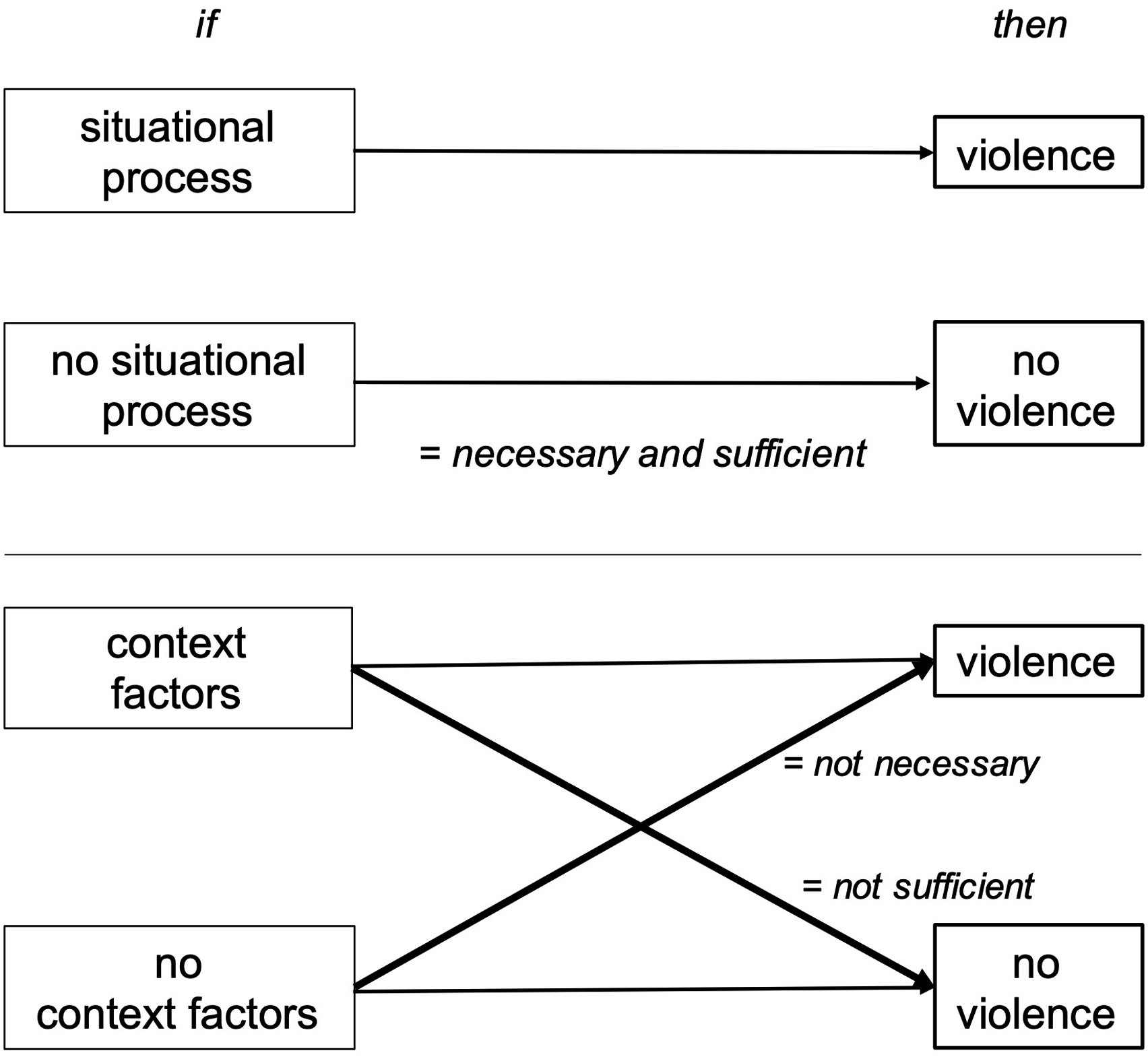
Figure 2 further specifies this causal connection. Each situational process consists of situational mechanisms that jointly occur during the protest (as specified above, between the co-presence of actors until violence breaks out), such as “communication problems between police and protesters,” “property damage,” and “spatial incursions” during the protest (one group enters another group’s space), see mechanisms C, D, E in Figure 2. Thus each of the situational mechanisms forms an INUS condition to violence (i.e., an insufficient, but necessary part of an unnecessary but sufficient condition to violence). This means that a single situational mechanism, such as “spatial incursions,” cannot lead to violence, but combinations of INUS conditions as situational processes can. The three conditions just mentioned lead to a reinterpretation of the situation, thereby changing the interpretation of the role of the own group, the other group, as well as emotional dynamics. Increasing tension is visible after such a combination occurs, leading actors to use violence once they gain emotional dominance in a micro-situation (for details, see Nassauer, 2019). Combinations of these INUS-factors in the form of situational processes can be sufficient for the emergence of certain forms of violence, such as protest violence in the United States and Germany.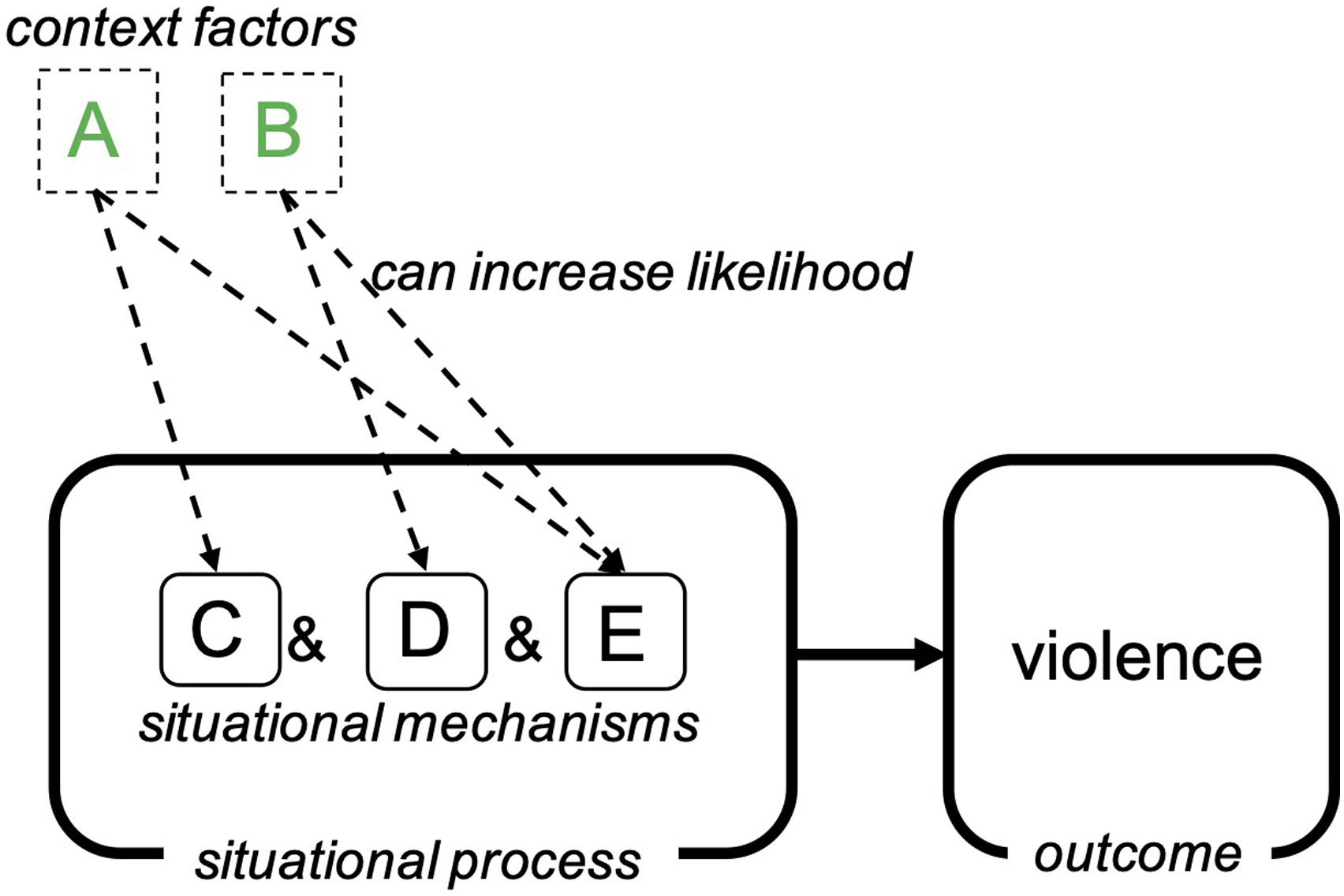
As Figure 2 illustrates, while situational processes can emerge without context factors, the former can also be facilitated by the latter. First—as the study of lethal police use of force also indicates—context factors can lead to motivations that bring actors into violence-threatening situations in the first place. Second, context factors may increase the likelihood of specific situational factors leading to violence. For example, in my protest study, police may be more likely to fail to communicate with demonstrators during times in which police use escalated force strategies (context factor A), resulting in communication difficulties (an INUS condition to protest violence, situational mechanism C in Figure 2). The presence of violently motivated participants (context factor B in Figure 2) may increase the likelihood that property damage will occur during the protest (situational mechanism D in Figure 2). Both escalated force policing strategies and the presence of specific protest groups can make the occurrence of Spatial Incursions more likely (situational mechanism E in Figure 2). However, all three situational mechanisms can occur even in the absence of context factors, such as A or B. Technical communication problems can also arise during times of a de-escalating negotiated management police strategy, for instance due to technical problems. Additionally, Spatial Incursions can also be used by other groups and individuals (Nassauer, 2021). Thus, context and situation are a loosely coupled system: they can be connected but do not have to be. Moreover, the situational mechanisms that are facilitated by a context factor cannot lead to outbreaks of violence on their own, but only together with specific other situational mechanisms as a situational process: For example, in one out of three identified processes to violence, communication problems plus escalation signs, plus spatial incursions form a “missing information” path (see Figure 2, for details, see Nassauer, 2019) 2 Combinations of interactions change situational interpretations and emotional dynamics, which are further vital elements of situational processes (see definition above).
This means that, even if a context factor facilitates a single situational mechanism, this single situational mechanism (and thereby the context factor) is not sufficient to lead to violence. Thus, in this empirically identified pattern, context factors are neither necessary nor sufficient for the emergence of violence, rather they can represent risk factors to violence (Bowman et al., 2015), which, among other things, can increase the likelihood for specific situational mechanisms to occur, thus increasing the likelihood for situational processes to violence.
While other scholars show that specific context factors increase the likelihood of violence, I argue that the underlying reason for this empirical finding is that context factors increase the likelihood for specific situational factors. Thus, I argue for a possibilistic-probabilistic hybrid (see also Blatter, 2012b): Context factors increase the likelihood of specific situational factors, but situational processes (combinations of these factors) are necessary for violence.
Studies suggest similar patterns for violence eruption during protests in non-democratic countries (Bramsen, 2018), during physical brawls (Athens, 1980; Collins, 2008; Jackson-Jacobs, 2013), during ethnic violence (Klusemann, 2009, 2012; see also Horowitz, 2001), and officer-involved shootings (Nassauer, 2020, see above). Future research needs to systematically examine if this causal proposition holds in further types of violence, such as terrorist attacks or mass shootings, where context factors may be particularly strong. Existing research on these types of violence (Collins, 2008, 2014; see also Rochette, 2019) suggests even these perpetrators plan to avoid intersubjective contact with victims. To be able to use violence, they also must situationally avoid confrontational tension and fear (see also Collins, 2020). Based on existing research in the field, it is likely that situational processes are not in and of themselves sufficient for all types of violence, but still necessary for the emergence of violence.
Elaborated symbolic interactionism—an outlook on theoretical approaches to situation and context
My formulated propositions on concepts and causality assume that situation and context are conceptually separable, but influence each other in specific systematic ways in the emergence of violence. How can this empirical connection be specified theoretically and how can a causally specified context be located or integrated into a situational approach?
As a first step into this direction, I propose an “elaborated symbolic interactionism.” In the spirit of Swidler’s (1986) sociology of culture and based on above-discussed empirical studies, I propose that culture in situational explanatory approaches can be understood as a toolbox of symbols, stories, rituals, and worldviews. The above studies illustrate this in the form of police cultures (such as escalated force policing at protests; Della Porta and Reiter, 1998a), as well as symbolic racism (such as Anderson’s, 2012, “iconic ghetto” interpretation during officer-resident interactions). This toolbox is used by actors to solve various problems, thus influencing their actions. Context factors, like preconceived motives, strategies, and cultural backgrounds of actors, can influence not just their repertoires of actions and expectations, but also their interpretations, interactions, and emotional dynamics during the situation. Culture does not act; rather it shapes people who are acting (Swidler, 1986; see also Jasper, 2014).
Yet, cultural interpretations, as well as motives and preconceived strategies, can change during the situation: culture is refracted through the situation like a prism. Thus, the situation remains the central reference point. Everything that can be socially realized is only realized in the situation (Dewey, 1997), meaning that all given social events and phenomena, whether “social change,” “property,” or “personality,” are only manifestations of situations or results of vital situational turning-points (Collins, 1981, 2020).
At the same time, based on the aforementioned studies, I argue situations are not only shaped by emotional dynamics and second-to-second rhythms, but also by actors’ reinterpretations and interactions in co-presence. This is illustrated in the findings on protest violence. I argue that a stronger focus on subjectivity and meaning-making by individuals may not just complement a situational approach, but also allows for situating context in the approach (see also Wieviorka, 2014). In line with sociologists concerned with meaning-making (Blumer, 1986; Goffman, 1959) and research in social psychology (Reicher, 2001; Stott and Drury, 2000), social identities and motivations can change through situational interaction—as do emotional dynamics. In protests, combinations of interactions lead to the perception that normally relied-upon routines have broken down and that one is in danger (Nassauer, 2019). Therefore, combinations of interactions seem vital for actors’ meaning-making and subsequent reinterpretations (as described in the elaborated social identity model, for example, Stott and Reicher, 1998; and symbolic interactionism, Blumer, 1986) and are key components in leading actors to overcome confrontational tension and fear (as described by Collins, 2008). The protest study further highlights that situational factors are necessary and can even be sufficient for some types of violence, while context factors can be understood as risk factors for violence.
Building on my specified concepts and propositions on causality, the proposed elaborated symbolic interactionism supplements the first three premises of symbolic interactionism by four further premises. These additional premises are based on recent violence research, including, but not limited, to my two studies discussed above, as well as the conceptual and causal considerations discussed here. Blumer’s (1986) symbolic interactionism argues: 1. People act towards things because of the meaning these things have for them. 2. This meaning is created through social interaction. 3. Meanings are changed by an interpretive process that the person uses in their3 engagement with the things they encounter.
To explain the emergence of violence, the proposed elaborated symbolic interactionism additionally suggests: 4. During this interpretive process, people draw on a cultural toolbox and rely on interpretative frames. 5. Interpretations shape emotional dynamics, which, in turn, influence reinterpretations and interactions. 6. Situational dynamics (interactions, interpretations, and emotions of actors from the moment of co-presence to the event to be explained) are necessary for (and can be sufficient for some types of) violence. 7. Context factors (such as structural factors and motivations) may favor the likelihood of certain situational interpretations and interactions, thus constituting risk factors for violence.
This theoretical proposition assumes that social structures and culturally shaped patterns of perception and attitudes can be relevant for acts of violence, but only if they influence situational interpretations or interactions. Yet, what happens in the respective situation and which situational dynamics develop is essential for the emergence of violence. Thus, this theoretical outlook builds on the conceptual and causal discussion above. It specifies the role of context in situational approaches to violence and allows merging micro- and macro-approaches to violence into one framework. In addition, it integrates interaction dynamics, with emotions and meaning-making (e.g., Blumer, 1986; Collins, 2008; Levine et al., 2011; Wieviorka, 2009).
Conclusion
This paper addresses a core debate in current violence research: how are situation and context connected and what inferences can be drawn for causal explanations in violence research and beyond? To answer these questions, I first propose a specified conceptual delineation of situation and context. Second, I propose a causal specification through necessary, sufficient, and INUS conditions. Third, in an outlook, I propose a theoretical framework that situates these causal connections between situation, context, and violence in an elaborated symbolic interactionism.
Identifying situational patterns and illuminating their interaction with specific context factors will remain a promising focus of violence research in the coming years. Furthermore, it will be important to examine the extent to which this relationship varies by type of violence. While specific context factors may act as risk factors to increase the likelihood of situational INUS conditions in some violent phenomena, they could potentially act as INUS conditions themselves in other violent phenomena (i.e., be part of processes leading to violence along with situational mechanisms). Empirically guided theory debates can help to further refine these connections.
At the same time, every day the proliferation of ever-smaller recording devices, in smartphones, drones, body cameras, and surveillance cameras, is increasing the amount of visual data exponentially (Legewie et al., 2019; Nassauer and Legewie, 2022). This development makes it possible to shed light on the situational dynamics of violent phenomena, especially if combined with document data, interviews, and participant observation. 21st century video data allow to analyze when and under which circumstances violence actually erupts as well as which situational dynamics and specific context factors are relevant for its emergence (Collins, 2008; Legewie and Nassauer, 2018; Nassauer and Legewie, 2018, 2022).
These insights also allow us to take leaps in violence avoidance, with Video Data Analysis (VDA) studies and the insights they produce often having real-life implications. By understanding how micro-level processes happen (and possibly shape larger social structures), we might be able to change them. If we know how situational dynamics escalate an event, we can use them to de-escalate. Situational video-based analyses in recent years have developed measures to counter the emergence of collective violence (Hylander and Granström, 2010; Reicher et al., 2004; Nassauer, 2015), as well as individual-level violence (Collins, 2008; Levine et al., 2011; for criminal behavior, see also Stickle et al., 2020). Certainly, practical implications derived from macro-level analyses are also, and will remain, highly relevant as well. However, starting at the micro-level can enable more immediate potential for intervention. Thus, these situational video-based violence studies have a very practical side, offering avenues for violence avoidance through an intimate understanding of micro-level dynamics.
Lastly, the here-discussed debate of situation versus context is not only of relevance to violence researchers. With beginning of a golden age of video analysis (Collins, 2016), we are also at the beginning of a golden age of microanalysis of social processes and events more broadly. Argued in micro-sociological terms (see among others Collins, 1981; Goffman, 1967), situational interaction, interpretation, and emotion form the basis for all events and processes that we can empirically observe and data on them are growing rapidly. Recent video-based studies underline the role of situational dynamics for gendered interaction (Mendelberg et al., 2014), non-violent crime (Mosselman et al., 2018; Nassauer, 2018b; Stickle et al., 2020), policing (McCluskey et al., 2019; Sytsma et al., 2021), or jury deliberation processes and interrogation techniques (Alison et al., 2013; Diamond et al., 2006). Employing video data, the relevance of situational dynamics is also highlighted in organizational (LeBaron et al., 2018) and medical care research (Asan and Montague, 2014; Lingard et al., 2004), as well as learning sciences and education research (Alibali and Mitchell, 2007; Derry et al., 2010; Elsner and Wertz, 2019; Golann et al., 2019; Kanngiesser, 2019). In this respect, debates in other research fields that deal with how to link the micro-level, and macro-level, situation and context, can also benefit from the ongoing debate in violence research (see also Krause et al., 2021). Beyond the field of violence, similar closer examinations of the causal connection of situation and context to the outcome would be fruitful. Therefore, the discussion on situation versus context is not only relevant for violence research, but can also make valuable contributions in other social science research fields.
Footnotes
Acknowledgements
I would like to thank Nicolas Legewie for his invaluable feedback on causality and concepts, as well as Randall Collins, Elijah Anderson, and Jack Katz for our inspiring exchanges on violence, situations, and context. I would further like to thank the anonymous reviewers for their constructive feedback, and Thomas Kron and Astrid Schulz for their comments on earlier versions of this article. I thank the Fritz Thyssen Foundation for the grant to conduct my research project on officer-involved shootings at Yale University in 2020.
Declaration of conflicting interests
The author(s) declared no potential conflicts of interest with respect to the research, authorship, and/or publication of this article.
Funding
The author(s) disclosed receipt of the following financial support for the research, authorship, and/or publication of this article: This work was supported by the Fritz Thyssen Foundation (Travel Grant, research stay at Yale University, 2020).
Availability of data and material
All data and material are available online.
