




Abstract
Major theories of participation in genocides and mass killings offer seemingly opposing explanatory logics for how and why individuals come to commit violence. The long-standing consensus on “perpetrator ordinariness” contrasts with explanations that continue to highlight the prior, intensely held negative attitudes and beliefs about the victim group. I propose a theoretical reconciliation. Radicalization would be better theorized not only as an antecedent to the act of violence but also as a consequence of it. Killing transforms individuals. A well-established point in social psychology, not only do attitudes drive behaviors, but behaviors also shape attitudes. Some perpetrators dehumanize their victims, internalize exclusionary ideologies, and otherwise develop negative sentiments toward their victims following their participation in the violence. Attitudinal shift becomes a form of dissonance-reduction. Perpetrators come to espouse radical beliefs in order to justify their actions. This revised theorization has implications for our understanding of (1) perpetrator heterogeneity: individuals must vary in their vulnerability to radicalization, and (2) non-instrumental violence: why we often observe the infliction of gratuitous pain and suffering on victims. I re-interpret testimony of perpetrators from Rwanda, the Holocaust, Bosnia-Herzegovina, and Cambodia to support the article’s central theoretical proposition.
Are the perpetrators of genocides and mass killings radicalized before or after the act of violence? For nearly two decades, a scholarly consensus had prevailed on the character of perpetrators of atrocities and mass killings. It had become conventional wisdom to state that perpetrators were generally “ordinary individuals” caught up in extraordinary situations (Browder, 2003; Jensen and Szejnmann, 2008; Waller, 2002). Perpetrator “ordinariness” carried with it the implication that individuals need not hold intensely negative antecedent attitudes or beliefs about their victims before harming them. Proponents of the ordinary killer thesis claimed instead that situational forces and psycho-social mechanisms induce and enable individuals to commit violence, even atrocious violence, against others. Obedience to authority (Milgram, 1963), compliance and social influence (Kelman, 1958), conformity to group pressures (Asch, 1956), diffusion of individual responsibility (Staub, 1989), and situational role adoption (Zimbardo et al., 1973) all presupposed perpetrators need not be radicalized beforehand. Yet this consensus sat uncomfortably with other prominent theories of genocidal and ethnic violence that implied individuals held extreme pre-existing negative attitudes and beliefs toward the victim group. These include explanations that emphasized the prior essentialization and dehumanization of the victim group (Hagan and Rymond-Richmond, 2008); the internalization of ideologies or narratives that are exclusionary of the victim group (Kaufman, 2006; Leader Maynard, 2014; Semelin, 2005; Snyder, 2000; Weitz, 2003); the emergence of animosities expressed as resentment, fear, and even hatred toward the victim group (Petersen, 2002); and the development of beliefs in the justification in targeting the victim group (Fein, 1990). More recently, however, research into genocide perpetrators has begun to move beyond the distinction implied by these two approaches (Baum, 2008; Newman, 2019; Smeulers et al., 2019; Williams and Buckley-Zistel, 2018). In this article, I build on this work and suggest these two approaches are not necessarily contradictory. I propose a refinement in how we theorize the relationship between radicalization and participation to help reconcile them.
My central proposition is that we should theorize radicalization, by which I mean the process leading to intensely held negative beliefs or attitudes toward the victim group, not only as an antecedent to violence but also as a consequence of it. 1 Individual attitudes and beliefs may transform through the act of violence itself. Perpetrators can come to essentialize and dehumanize their victims, adopt nationalistic or other ideological commitments, develop antagonistic sentiments, and seek to justify violence morally, as a result of their participation in killing. Individual attitudes and beliefs as well as preferences, identities, loyalties, and motivations may all be endogenous to the violence itself. Each act of violence transforms the participant further. A well-established point in psycho-social theory, not only do attitudes drive behaviors, but behaviors may also drive attitudes. It is in this way that individuals who participate reluctantly initially, may come to engage enthusiastically subsequently.
In support of this proposition, I draw on survey evidence and perpetrator testimony from the Rwandan genocide as well as published interviews by other researchers of individuals who experienced the Holocaust, Bosnia-Herzegovina during the collapse of the former Yugoslavia, and Cambodia’s killing fields under the Khmer Rouge. A significant amount of perpetrator and survivor testimony exists in the public domain in respect of these cases, and I re-interpret these sources to substantiate the article’s central theoretical claim.
My findings have several observable implications for our knowledge and understanding of perpetration more generally. First, we should expect to observe heterogeneity in perpetrator attitudes and beliefs ex ante toward the victim outgroup. Logically, if radicalization is both cause and consequence of violence, some individuals must radicalize before, and some after committing violence. Individuals vary in their vulnerability to radicalization. Second, we would expect the passage of time to be an important factor. If each act of violence is transformative of the participant, then the length of time that the conditions permissive of violence continue to exist will shape the extent to which an individual radicalizes. Participation may be better considered as a temporal continuum than as a single discrete event. Relatedly, the scale of participation may also matter. If individuals vary in their vulnerability to radicalization, in cases where participation is limited, we might expect to see more prior radicalization. Conversely, in cases of mass participation, we would expect to see more individuals who radicalize following the violence. Finally, if we theorize radicalization as both antecedent and consequent to violence, non-instrumental violence—the infliction of gratuitous pain and suffering on the victims—becomes explicable. Perpetrator cruelty becomes reconcilable with perpetrator coercion, for instance, if we accept that individuals initially pressured into violence subsequently radicalize and participate willingly.
This article is structured as follows. In the section “Theoretical framework” I set out the two competing theoretical approaches to perpetrator participation and present a reconciliation of them both. In the sections “Evidence from Rwanda” and “Evidence from other cases”, I adduce evidence in support of this theoretical reconciliation, drawing on evidence of perpetration primarily in Rwanda, but also in the Holocaust, Bosnia-Herzegovina, and Cambodia. Finally, I conclude by discussing the observable implications of these findings for the perpetration of violence in genocides more generally.
Theoretical framework
I begin by proposing a definition of the term radicalization in the specific context of genocides and mass killings. Radicalization, in genocides and mass killings, is the process through which individuals develop intensely negative, that is extreme, beliefs and attitudes toward a perceived outgroup. Importantly, it is conceptually distinct from participation in the violence (McDoom, 2012). Radicalization is not a behavioral construct. Its foundational idea is that exclusionary action targeting the perceived outgroup becomes perceived as in some way justified. Outgroups are deserving of their treatment and this legitimizes an individual’s participation in their targeting, and indeed an individual’s non-participation in their defense. Doing nothing—standing-by—is also seen as legitimate. The justification for targeting may manifest in a number of ways. I give three common examples. First, radicalization may manifest in the internalization of ideological beliefs that are in some way exclusionary of outgroup members. Common exclusionary ideologies include those which promote the idea that outgroup members do not belong to the nation or else are responsible for some injustice committed against the ingroup in the past. Second, radicalized individuals may come to essentialize and dehumanize outgroup members. 2 If outgroup members are deemed all the same and likened to animals, they more easily fall outside of the “universe of moral obligation” (Fein, 1990). Finally, radicalized individuals may come to fear outgroup members as a threat. This threat may be material or symbolic in nature—security risks and status threats are both drivers of radicalization—and action is therefore justified to eliminate the threat.
The question of whether radicalization occurs ex ante or ex post violence is an attempt to reframe the long-standing theoretical debate over whether situation or disposition better explains individual participation in genocidal violence. This debate, originally framed as a choice between these two constructs, was aptly illustrated in the debate between eminent Holocaust scholars, Goldhagen et al. (1996), over how and why ordinary Germans came to participate in the violence. Goldhagen (1997) had argued Germans were in the grip of a culture of “eliminationist anti-Semitism,” that is to say pre-existing attitudes and beliefs drove ordinary Germans to participate in the Holocaust’s violence. Ordinary Germans were “willing executioners.” Browning (1992), in contrast, found nothing unusual in the beliefs and attitudes of the members of a German Reserve Police Battalion and argued instead that situational and psycho-social forces such as conformity and peer pressures better explained their horrific actions. Members were “ordinary men.” They did not hold extreme negative views beforehand of those they targeted.
The situationalist position advocated by Browning has strong support from social psychologists. Asch’s (1956) research on conformity, Milgram’s (1963) experiments in obedience and authority, and Zimbardo et al.’s (1973) work on role adoption in a prison simulation have become the foundational studies underpinning a scholarly consensus on perpetrator character. Perpetrators are often ordinary individuals who, when exposed to certain situations and circumstances, are capable of extraordinary violence (Browder, 2003; Waller, 2002). Notwithstanding this consensus, however, in disciplines other than social psychology, the idea that mass or genocidal violence follows the development of extreme attitudes and beliefs continues to be articulated. Sociologist Helen Fein (1990) has argued that perpetrators come to see their victims as “outside of the universe of moral obligation.” This view is consistent with the process of dehumanization (Hagan and Rymond-Richmond, 2008). The moral restraints on violence against individuals weaken if dehumanized. Political scientist Stuart Kaufman (2001) has argued for pre-existing mass sentiments as a necessary condition for extreme ethnic violence. Ordinary individuals internalize “hate narratives” that denigrate the perceived outgroup. He finds evidence of these narratives in the Sudan and Rwanda. Relatedly, Scott Straus (2015), another political scientist, identified “founding narratives” established at critical junctures in the formation of nation-states as central to explaining why some countries succumb to genocidal violence and others not. These narratives reflect widely held beliefs within the population which, if they are not inclusive in nature, enable the targeting of minority groups. Leader Maynard (2014) has argued that political ideologies provide the motivation ex ante for individuals to kill by articulating the justification of violence. Historians Eric Weitz (2003) and Ben Kiernan (2009), in comparative studies of genocide, also conclude that ideology played a fundamental role a priori in their cases. Another political scientist, Jim Snyder (2000), has argued for the emergence of widespread ethno-nationalist ideologies during democratic transitions and suggested this ideology was present in Rwanda before its genocide. All of these theories, which operate at a more macro-level than psycho-social theorization, are premised on the idea that extreme negative views of perceived outgroups are held or develop within societies before the violence begins.
On the face of it, these two theoretical approaches appear to oppose each other. However, the positions become reconcilable by accepting the basic theoretical proposition that not only do attitudes drive behaviors, but behaviors may also drive attitudes. Radicalized individuals may participate in violence but participation may also radicalize individuals. This idea in fact is already well-established in social psychology. It is implicit, for instance, in Staub’s (1989) concept of a “continuum of destructiveness.” People “learn by doing,” and they change as a result of what they do. Individuals and the whole group change as they begin to harm members of another group. They justify their actions by increasing devaluation of that group and by coming to believe that moral and humane values that protect people’s well-being do not apply to members of the devalued group. This evolution may end in a reversal of morality, killing the other becoming the right thing to do. A psychological and behavioral evolution—steps along a continuum of destruction—can lead to extreme violence. Perpetrators may be motivated by their commitment to cause (ideology and enmity to the other) and comrades. (Staub, 1989: 192)
Staub recognizes then that an individual’s attitudes, beliefs, and values change through the act of violence itself. It is in fact a continuous process as each act of violence radicalizes an individual a little more. Radicalization is an evolution. A construct closely related to the notion of a continuum of destruction is that of “escalating commitments.” The theoretical logic runs as follows. An individual begins, willingly, with a small act. This initial act commits the individual to continuing on the same pathway they started on and leads them to participate in the next, bigger act. Waller (2002) describes the process aptly: “The road to extraordinary evil often takes the form of a sequence of seemingly small, innocuous incremental steps—a series of escalating commitments” (p. 339). The relevant idea behind escalating commitments then is that it is the action that leads the attitude. An individual’s willingness to participate increases because of their previous participation.
Newman and Erber (2002) have one of the most sophisticated theoretical articulations of the proposition that behaviors drive attitudes in the context of genocide and mass killings. They see the distinction between situation and disposition as a false choice because, they argue, individual dispositions are not “fixed” but are instead endogenous to behavior.
Goldhagen’s analysis, however, could have benefited from an appreciation of a basic and important principle supported by over 40 years of social-psychological research; that is, while attitudes do indeed give rise to behavior, it is also the case that one’s behavior affects one’s attitudes and beliefs. And if one’s behavior—the very behavior that shapes one’s attitudes—is at some point affected by one’s social context, then clearly, isolating a given behavior and trying to categorize it as “caused by the situation” or “caused by one’s attitudes and dispositions” is a fruitless exercise. (Newman and Erber, 2002: 52)
In fact, Newman and Erber go further and argue that “situations” are also rarely fixed. They argue situational pressures are shaped by “social contexts.” Moreover, people’s behaviors in turn shape social contexts. There is consequently a dynamic and mutually reinforcing relationship between dispositions, situations, and social contexts.
In explaining why individual attitudes and beliefs change as a result of committing violence, a consensus is crystallizing on the operation of a dissonance-reduction mechanism (Hinton, 1996; Newman and Erber, 2002; Staub, 1989). Individuals feel psychological pressure to reconcile their behavior harming an individual with their belief that violence is morally wrong. The response is to change one’s view on the legitimacy of the violence. Individuals come to believe their actions are morally justified. This is indeed the foundational idea behind radicalization: belief in the justification of action targeting a perceived outgroup. Radicalization is the product of dissonance-reduction. Newman and Erber explain the mechanism well: Justifying and rationalizing what one does leads one to do more of it and do it more easily. Derogation leads to brutality, brutality is justified, even more brutal behavior follows, and the violence can escalate all the way to genocide. (Newman and Erber, 2002: 55)
The phenomenon in fact has long-standing empirical support from lab-based experimental work in social psychology (Brock and Buss, 1964; Goldstein et al., 1975). It has led to its articulation as “just world” theory (Lerner, 1980). In a just world, individuals who are targeted must in some way deserve how they are being treated.
Evidence from Rwanda
As a relatively recent world historical event, and one in which civilian participation in the violence was extensive, Rwanda’s genocide has permitted direct, close-contact research on its perpetrators. The genocide was remarkable for both the scale and speed of its violence and of the civilian mobilization. By my estimate, between 491,000 and 522,000 ethnic Tutsi were killed, representing nearly three-quarters of the Tutsi population, along with several tens of thousands of Hutu; roughly one in five adult Hutu men committed an act of violence; the extermination was achieved in little over 100 days, and in fact most of the violence may have been completed in the first 2 weeks, and it took place in almost every community where Tutsi lived across Rwanda. 3
I first visited Rwanda for 10 months in 2003 and in this time was able to conduct a survey of 294 Rwandans. I asked a range of questions to measure socio-demographic characteristics as well as attitudes and beliefs. The survey was stratified by region and by perpetrator status: 151 northerners and 143 southerners; and 104 confirmed perpetrators and 190 non-perpetrators. I also undertook ethnographic research in four communities to build a portrait of life before the genocide as well as to establish what transpired during the genocide. The four communities—cellules, the smallest unit in the Rwandan administrative hierarchy at the time—were selected from the north and south of the country. I focused on the regional comparison in both the survey and ethnographic studies purposely. The north had been the location of several Hutu-headed principalities that had persisted into the colonial era; it was home to the smallest percentage of Tutsi in the country and was also the front-line of the civil war that had begun in October 1990. In contrast, the south was the historic location of the Tutsi-headed monarchy in Nyanza, was home to the largest concentration of Tutsi in the country, and was relatively insulated from the war’s effects due to its distance from the war-front. Given these differences, we would expect to see more radicalization ex ante in the northern than in the southern community.
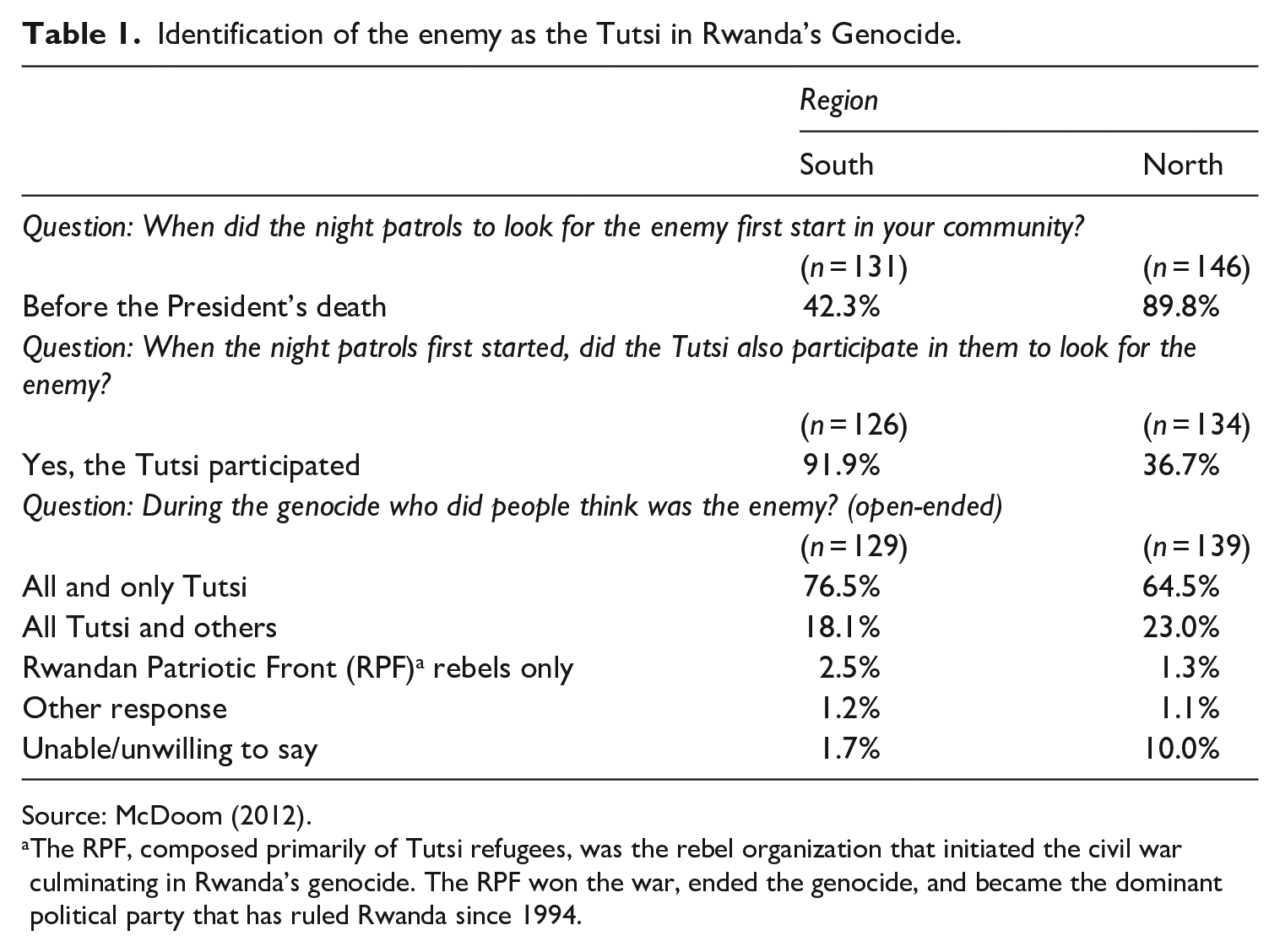
One indicator of radicalized attitudes among Rwandans may be found in the popular understanding of the “enemy” during the war. Did Rwandans perceive only the rebel combatants as the enemy or did they see all Tutsi—including their civilian neighbors—as such a threat? More importantly for the article’s argument, did this perception of the enemy change after the genocidal violence began? The conflation of civilian and combatant members of the outgroup would indicate a strong negative attitude toward the Tutsi minority group. However, asking respondents to recall the views they held before the outbreak of genocide and their participation in the violence carries evident methodological risks: memory recall and ex post rationalization among them. To mitigate these risks, I approached the question of pre-genocide views indirectly in the survey. I first asked respondents when irondo—the Kinyarwanda term for the nocturnal security patrols undertaken by civilians during the war—began. I then asked respondents whether Tutsi participated in these security patrols alongside Hutu. In radicalized communities where the ethnic distance between Hutu and Tutsi would have been high, it would be unlikely the Tutsi would have joined the Hutu in security patrols. Table 1 shows that in the north nearly 90% of respondents reported the patrols began before the start of the genocide, signified by the president’s assassination, in comparison with only 42% of southern respondents. This is unsurprising given the proximity of the north to the war’s frontlines. However, in those communities where night patrols did take place, only 37% of northern respondents reported Tutsi participation in contrast with 92% of southern respondents. In other words, in the north, security patrols began before the genocide started and these patrols usually did not include Tutsi. This suggests some degree of anti-Tutsi radicalization pre-genocide in the north. In contrast, southern communities organized fewer security patrols before the genocide, but when they did, they commonly included Tutsi. I then followed these two questions with a third, direct question concerning the perception of the enemy after the violence was underway. In both north and south, approximately 90% of respondents categorically stated people believed all Tutsi were the enemy. Attitudes then must have changed in the south following the start of the killing.
Identification of the enemy as the Tutsi in Rwanda’s Genocide.
Source: McDoom (2012).
The RPF, composed primarily of Tutsi refugees, was the rebel organization that initiated the civil war culminating in Rwanda’s genocide. The RPF won the war, ended the genocide, and became the dominant political party that has ruled Rwanda since 1994.
In addition to the survey evidence on enemy perception, I also asked survivors to describe the relationship with their Hutu neighbors before the genocidal violence began. I wanted to establish whether strongly negative attitudes were visible or otherwise known to outgroup members before the violence began. The story is again different between north and south.
What happened in your community after the war started in 1990?
For those who had radios, they were afraid but for those who did not, they were not concerned. It was everyone who was afraid—not just the Hutu but also the Tutsi as they had both heard there was war. But there were no problems between Hutu and Tutsi as a result here. There was nothing bad said about the Tutsi at the time. Perhaps people said it in their huts but they did not say it to me. (Véronique, Hutu woman married to Tutsi farmer, aged 31 at time of interview, Tamba cellule, southern Rwanda)
What happened to Tutsi in your community after the war started?
The relationship changed between Hutu and Tutsi in Mutovu. Those who liked each other started hating each other [Hutu and Tutsi].
Did everyone hate the Tutsi?
No, it was not everyone who hated the Tutsi.
Did anyone attack the Tutsi then?
There were no Tutsi harmed in Mutovu during this time. But there were some Hutu who were saying to the Tutsi that: “It is you who have invaded Rwanda” as they made the association with the Inkotanyi.
4
Nothing else much happened in Mutovu. We were afraid in 1990 as we were afraid the Hutu might kill us. (Jérome, Tutsi survivor, aged 33 at time of interview, farmer, Mutovu cellule, northern Rwanda)
In the southern community, Véronique reports little change in the attitudes between Hutu and Tutsi with the start of the war. If there was suspicion or hostility in respect of the Tutsi, it was not overt, she tells us. In contrast, Jerome reports a marked change in Hutu attitudes toward Tutsi with the start of the war. Hutu members of his community accused their Tutsi neighbors of being part of the rebel invasion. This anti-Tutsi sentiment was overt. Hutu in Mutovu then appeared more radicalized than those in Tamba before the genocide began.
It was not only the survivors who reported more positive attitudes toward Tutsi in the south and more negative attitudes in the north. Hutu who participated in the violence also offered insights into differential radicalization pre-violence.
Did the political parties cause Hutu and Tutsi to separate?
In 1991 there were meetings of parties. Everyone tried to belong to a political party. There were parties who taught solidarity like PSD [Social Democratic Party], while MDR [Democratic Republican Movement] taught otherwise. And it was in the meetings that they started to say that the PL [Liberal party] was really the RPF disguised.
Who was saying this?
It was the MDR leader Emmanuel Rekeraho who said this. But still this hatred was not very strong. Even when Habyarimana died on the 6th [April 1994], on the 10th there was a baptism of a Tutsi businessman’s son, Denis Kabandana, and both Hutu and Tutsi attended. The tensions were not very visible. But maybe they were in people’s heads. (Oriel, Hutu accused of genocide-related crimes, aged 45 at time of interview, primary school teacher, Butare central prison, southern Rwanda, April 2003)
Oriel tells us that even 4 days after the president was assassinated, in his southern community, Hutu and Tutsi continued their lives together with little or no separation between them. Hutu were even invited to and attended the baptism of a Tutsi child. Yet the violence would begin only 8 days after this event. Oriel’s characterization of Hutu-Tutsi relations in the south immediately before the genocide contrats with that of Grégoire in the north.
What happened in your community after the RPF attached the Ruhengeri prison in 1991?
When the Inkotanyi attacked a second time in Ruhengeri, this reminded the villagers of the Tutsi presence, and this made the Tutsi flee fearing attack. After this second attack, all the Tutsi from Ruginga fled to Uganda and Zaire. They only came back after we [Hutu] fled in 1994. (Grégoire, Hutu convicted of genocide-related crimes, farmer, aged 37 at time of interview, Mutovu cellule, northern Rwanda)
The Tutsi in the northern community then were viewed as complicit with the RPF (Rwandan Patriotic Front) and were held responsible for the prolonged insecurity. This popular sentiment forced the Tutsi to flee the community as early as 1991, 3 years before the genocide began. The attitude of Mutovu residents had radicalized then long before the violence began.
In sum, the contrast between north and south in life before the violence, and specifically the difference in the quality of interethnic relations, strongly suggests that some Rwandans—particularly in the north—had radicalized before the genocide, but others—particularly in the south—had not. Yet individuals from both the northern and southern communities would come to participate in the violence and, crucially, would overwhelmingly come to see all Tutsi as the enemy during the genocide, including their civilian neighbors. Attitudes toward the Tutsi appeared then to transform as a result of the violence. Perpetrators and non-perpetrators alike observed this transformation. Here is how Oriel, himself a killer, described a transformation in the behavior of another killer who became known for his zeal to kill in his community.
How did he show his commitment to kill?
He killed so many people. He also killed them in a hard way.
What do you mean?
At first he used to hit the person on the head to kill them quickly. But then later he would chop them in other places so they didn’t die immediately. (Oriel again)
Oriel tells us, this man, when he first engaged in violence, sought to complete the act of killing quickly. It suggests an attitude that did not relish violence. With the passage of time, however, his attitude hardened and he sought to prolong the pain and suffering of his victim by killing them slowly. He became cruel.
How did they choose which place to attack?
When they attacked a home, somebody would say so and so had cows. And they would plan to meet there. In the first days people went by force to go and rescue [gutabara in Kinyarwanda] and after that they went voluntarily because they could get property. (Léopold, non-participant, aged 32 at time of interview, April 2003, Mwendo cell, southern Rwanda)
Léopold, from the same community as Oriel, did not participate in the violence but he observed how some of his neighbors, initially coerced into the violence, continued to participate without being pressured or compelled to do so. In this case, he describes the change in attitude as one from reluctance to material opportunism.
This change in attitudes toward the victim group and toward the violence is legible in interviews other researchers have conducted with Rwandan perpetrators. Jean Hatzfeld (2005) interviewed, in great depth, nine perpetrators. While the published testimony was not intended for social scientific inference, it provides suggestive insights into perpetrators attitudes and beliefs at the time. Unlike in my interviews, Hatzfeld’s interviewees spoke primarily of their own actions rather than those of other perpetrators.
. . . Me, I don’t know why I started detesting Tutsis. I was young, and what I liked most was soccer: I played on the Kibungo team with Tutsis my own age, we passed the ball around without any hitch. I never noticed any unease in their company. Hatred just showed up at killing time; I latched on to it through imitation, to fit in. (Pio, aged 20 at time of perpetration, farmer’s son, Nyamata, central Rwanda) (Hatzfeld, 2005: 218)
Pio reports interethnic interaction as commonplace in his community before the genocide and describes ethnic “hatred” as a sentiment that materialized for the first time at “killing time.” He simply “latched on to it.” The implication is that the negative sentiment—he termed it hatred—chronologically followed, not preceded the killing. Others confirmed a shift in attitudes occurred but not necessarily toward hatred.
The more we saw people die, the less we thought about their lives, the less we talked about their deaths. And the more we got used to enjoying it. . . (Fulgence, aged 33 at time of perpetration, farmer, Nyamata, central Rwanda) (Hatzfeld, 2005: 226)
Fulgence describes an attitudinal shift toward indifference as the violence continued. In fact, he describes both desensitization and sadism. He reports the loss of empathy for the victim group and at the same time pleasure in killing them. Others confirmed gradual habituation to the violence.
Man can get used to killing, if he kills on and on. He can even become a beast without noticing it. Some threatened one another when they had no more Tutsis under the machete. In their faces, you could see the need to kill. But for others, on the contrary, killing a person drove a share of fear into their hearts. They did not feel it at first, but later it tormented them. They felt frightened or sickened. Some felt cowardly for not killing enough, some felt cowardly for being forced to kill, so some drank overmuch to stop thinking about their cowardice. Later on they got used to the drink and the cowardice . . . (Alphonse, aged 39 at time of perpetration, farmer and small businessman, Nyamata, central Rwanda) (Hatzfeld, 2005: 49)
Alphonse tells us some individuals became addicted to violence while others never became accustomed to it and continued to feel repulsed by it. Individuals differed in their reactions to the act of violence. Attitudinal change was heterogeneous.
Some began the hunts with nerve and finished them with nerve, while others never showed nerve and killed from obligation. For others, in time, nerve replaced fear . . . (Pancrace, aged 25 at time of perpetration, farmer, Nyamata, central Rwanda) (Hatzfeld, 2005: 48)
Pancrace also describes diversity in the attitudes of perpetrators. If we interpret “nerve” as indicative of a determination to kill Tutsi, then some were radicalized before the killing; some never radicalized; while others radicalized with the passage of time.
Fujii (2009), in a remarkable ethnographic study of two Rwandan communities, interviewed 82 Rwandans, including 28 individuals accused of participating in the violence. The low-level perpetrators who comprised the majority of those whom she interviewed, she termed “joiners.” The testimony she chose to publish does not provide as clear evidence of radicalization through violence as Hatzfeld’s subjects. However, in her interpretation of the interviews, she draws theoretical conclusions that are supportive of this proposition. Fujii’s central argument is that it was not antecedent attitudes based on ethnic fear or ethnic hatred that led individuals to kill. There was not prior radicalization. She argues instead social ties and group dynamics drove individuals to join the violence. Yet Fujii does recognize attitudes changed through participation. However, for Fujii, it is participation in the group, not participation in the violence per se that is transformative of the individual. It was the collective nature of the violence that is fundamental. She states, “I argue that it was not increasing fears and hatreds that propelled Joiners to continue their participation over time, but the constitutive power of killing in groups” (Fujii, 2009: 175). Group dynamics were central to the transformation she observed in her subjects. “Joiners did indeed become like those around them through regular contact and exposure. They adopted the same attitudes, beliefs, and understanding of what was appropriate to do during war and mass murder.”
In fact, Fujii corroborates Staub’s notion of a “continuum of destruction” and Waller’s idea of “escalating commitments.” She writes, “Through interacting in groups and acting as a group, Joiners came to participate in the violence through a series of graduated steps. Each step taken created momentum for the next” (Fujii, 2009: 154). She describes these steps as a process: “The process of descent into violence was not only dynamic; it was also self-reinforcing. Each step taken created momentum for the next” (Fujii, 2009: 160). For Fujii, the transformation was chronologically simultaneous with and subsequent to joining the group. In Rwanda, the violence was overwhelmingly committed in groups.
As a core piece of the evidence that would support one of the most compelling theoretically grounded explanations of Rwanda’s genocide, Straus surveyed 210 self-confessed Rwandan perpetrators. His survey was designed to test competing theories for what drove Rwandans to kill. Overall, Straus found little evidence to support the prior radicalization of most of his respondents. The survey did not find evidence of ethnic hatred, strong ethno-nationalist commitments, or deeply instilled racism. He concludes that “explanations that centre on social distance, ethnic antipathy, racist culture, and propaganda are insufficient explanations of participation in genocide” (Straus, 2015: 134). Yet at the same time, Straus found that the more violent perpetrators he surveyed—those who had killed the most—did exhibit attitudes indicative of ethnic antipathy and the internalization of racist propaganda. Straus does not consider whether these attitudes pre-date or follow the commission of violence, but his findings do show that individuals varied in their levels of radicalization. While he does not interpret his findings in this way, they are consistent with the possibility that some of his respondents may have radicalized before the genocide while others did not.
Evidence from other cases
It is not only in the crucible of Rwanda’s genocide that we may find evidence of individuals experiencing shifts in their attitudes and beliefs as a result of committing violence. In Cambodia, the violence driven and organized by the Khmer Rouge between 1975 and 1979 also involved the participation of a significant segment of the civilian population as agents of Pol Pot’s brutal regime.
Hinton’s (2004) anthropologically grounded explanation of why Cambodians killed suggests some antecedent radicalization of the perpetrators. Hinton introduces the concept of “genocidal priming”: “hot” situations that make genocide more likely and that include “effective ideological manipulation, a breakdown in moral restraints, discriminatory political changes” (Hinton, 2004: 301) among other things. More relevantly for the notion of radicalization, he argues that there must be also “ideological take” among the perpetrators. Individuals internalize ideological beliefs, but the ideology must be localized so that they have cultural meaning and resonate with them. Hinton also observed the processes of essentialization and dehumanization of the victims: “The exclusion and devaluation of a group of individuals sets them outside a given community. Dehumanization morally justifies harming them” (Hinton, 2004: 257). All of these forces—genocidal priming, ideological take, and dehumanization—appear to be processes Hinton suggests operate before violence.
Yet Hinton also refers to changes in individuals that occur through the act of violence itself. Desensitization, he suggests, was widespread, for instance.
Over time, most Tuol Sleng cadres probably lost their moral inhibitions and became desensitized as a result of living in this highly structured institution of violence, being exposed to intense political indoctrination and training, and regularly observing or participating in the abuse of prisoners. (Hinton, 2004: 258)
More pertinently for radicalization, however, Hinton refers to “psycho-social dissonance.” By this he means the mechanism that operates when individuals attempt to overcome their understanding that violence is morally wrong with the fact that they are in fact committing it.
Moreover, we need to remember that perpetrator motivation can change through time . . . Genocidal perpetrators seem to engage in similar cognitive shifts, as they overcome moral prohibitions against killing by dehumanizing their victims, displacing responsibility, and morally justifying what they have done (by diminishing the negative effects while placing greater emphasis on ideological beliefs that legitimate their actions). (Hinton, 2004: 309)
For Hinton, these “cognitive shifts” that occur as a result of killing include then the moral justification of violence and the internalization of ideological beliefs. As one of his informants explained the actions of a local cooperative leader known to have killed repeatedly, “He wouldn’t have the heart to kill people and might have even pitied their victims. After executing a few people, however, killing became normal to them, a way of proving their bravery” (Hinton, 1996: 827).
Williams (2017) in his interviews with Cambodians who experienced the killing fields found similar transformative processes at work. The extraction and consumption of human livers was a common motif in accounts of the violence and atrocities committed in Cambodia. Here is how one of Williams’ interviewees explained this practice.
There was the belief that eating the liver enabled people to cut off their heart. It was true that people ate people’s liver. [. . .] They ate human liver because they wanted to prevent themselves from being shocked by killing people. Then they could kill people. They wanted to change themselves to be able to kill people without pity. They were cruel. They were really cruel. [. . .] [Eating liver made them] more cruel. [. . .] When they ate more, their eyes became red. When people saw them, they were afraid of them. [. . .] (Williams, 2017: 195)
For William’s interviewee, livers were taken and eaten in order to transform individuals so that they stopped empathizing with their victims and became capable of acts of extreme cruelty. Hinton reaches a similar conclusion in respect of liver consumption.
Eating human liver, then, may help perpetrators overcome this psycho-social dissonance: they incorporate qualities that enable them to become audacious, brave, dispassionate, and resolved enough to commit the most transgressive of acts, killing another human being. Like a person who is extremely inebriated, a liver-eater is able to act without hesitation or forethought. As one person observed, “If they are told to kill, they will kill. That person wouldn’t think much. They eat liver in order to be able to kill.” (Hinton, 2004: 315)
In research into the perpetrators of the war and genocide in Bosnia-Herzegovina, Clark (2009), citing Stewart (2008), also suggests changes occurred in individuals as a result of the war. Strictly, the testimony published does not suggest it was the act of violence itself that transformed the actor. It more broadly supports the notion that violence changed all those exposed to it—whether as actor, victim, or observer.
It was war. And during war everyone was doing bad things. Bad became normal. (Clark, 2009: 431) [. . .] after months of sustained fighting, war and death had become people’s reality, a fact that changed the entire moral dimension of a land and its people. In some, the human spirit was completely transformed: what would have once been considered atrocious was now considered commonplace. (Clark, 2009: 431)
Clark suggests the attitudinal transformation was more than simply the banalization and routinization of violence. Drawing on testimony from the International Criminal Tribunal for the former Yugoslavia, she also points to the development of ethnic hatred among those who experienced the war.
We didn’t even notice how we were drawn into the vortex of inter-ethnic hatred and how neighbours were no longer able to live beside each other, how death moved into the vicinity, and we didn’t even notice how we had got used to it. Death became our reality. Unfortunately, it became everyday reality . . . We lost ourselves in hatred and brutality. And in this vortex of terrible misfortune and horror, the horror of Srebrenica happened.
5
The defendant Clark cites, Dragan Obrenović, implies that this hatred was not present before the war began. It developed as the violence intensified. It evokes Staub’s idea of a continuum of destruction. Clark in fact explicitly references Staub’s theoretical construct but refines it based on her observation that her research subjects were simultaneously capable of acts of cruelty and kindness. Rather than a linear descent into violence, she argues individuals moved between pro- and anti-social behaviors.
In view of these dramatic variations, therefore, it is perhaps more helpful to conceptualize the perpetrators’ deportment more in terms of erratic movements up and down a sliding scale of positive and negative behavior rather than a steady development along a continuum of destruction. (Clark, 2009: 437)
Finally, although the Goldhagen-Browning debate on perpetrators of violence in the Holocaust has largely been settled in favor of Browning’s idea of “ordinary men” rather than Goldhagen’s claim of “willing executioners,” a close reading of Browning’s work reveals he too suggests participant attitudes to the violence changed as a result of killing. Browning clearly states he does not believe the men enrolled in the police battalion he studied were ideologically radicalized before joining the battalion. He points out, first, that the ideological materials given to them were limited, rudimentary, and unlikely to be persuasive, and second, that most of these messages about racial purity would have resonated more with younger Nazis and not with middle-aged men who already had families and who made up most of the police battalion. Notwithstanding this claim, Browning nonetheless goes on to recognize that some of these men did change as a result of killing.
Once the killing began, however, the men became increasingly brutalized. As in combat, the horrors of the initial encounter eventually became routine, and the killing became progressively easier. In this sense, brutalization was not the cause but the effect of these men’s behavior. (Browning, 1992: 161)
While Browning believes then the prior ideological devaluation of the Jews was absent in the beliefs of members of the police battalion, he does suggest that exposure to the situational and psycho-social forces that initially led members to kill—peer pressure, conformity, and deference to authority—quickly evolved and the violence became more voluntaristic and more cruel. Lifton’s (1986) well-known interviews with Nazi medical doctors working in the concentration camps corroborate Browning’s claim of the gradual development of an attitude of indifference to the pain and suffering of those targeted. The activities of these doctors included experiments that were horrifyingly cruel in their nature.
When you see a selection for the first time—I’m not talking only about myself. I’m talking about the most hardened SS people . . . you . . . how children and women are selected. Then you are so shocked . . . that it just cannot be described. And after a few weeks one can be accustomed to it. And that cannot be explained to anybody. (Lifton, 1986: 197)
Lifton in fact described the phenomenon of “doubling.” Doctors who performed these atrocious acts of torture and cruelty inside the camps would, outside of the camps, lead ordinary pro-social lives as husbands, fathers, friends, and neighbors. Their radicalization may not be evident outside of the context of the camp. This evokes Clark’s research in Bosnia where she found individuals could be at one moment capable of terrifying cruelty yet in another moment display human kindness.
In all four cases then, Rwanda, Germany, Bosnia-Herzegovina, and Cambodia, there is evidence to suggest that perpetrators were altered by the act of violence. They developed attitudes and beliefs that were exclusionary of the victim group as a consequence of killing.
Observable implications
Although the various pieces of observational evidence I have drawn together here evidently do not permit clear causal inference, they are suggestive of the idea that radicalization may occur not only before violence but also as a consequence of it. This proposition has a number of observable implications that would merit further investigation. I highlight two.
First, we would expect to observe diversity in attitudes and beliefs toward the victim group and the violence, even among low-level perpetrators, before violence is committed. As a matter of simple logic, if radicalization is both cause and consequence of violence, some individuals must radicalize before the violence and some after it. Yet psycho-social theorizing implicitly assumes—or perhaps more accurately others infer from such theories—that individuals will react to situational forces in similar ways when exposed to them. These theories do not incorporate or otherwise explain variation in vulnerabilities to peer pressure, conformist forces, deferring to authority, and role adoption. In the absence of an explanation of such variation, the implication is that these mechanisms are to be observed universally. It is in part for this reason that the oft-repeated claim that anyone is capable of such violence is made. Perpetrators are ordinary people caught up in extraordinary situations. Yet, logically, this cannot be the case if some individuals are indeed radicalized before the violence and others subsequent to it. Individuals must vary in their susceptibility to violence, with some drawn into it sooner than others. The idea that individuals would vary in their vulnerability to radicalization is already widely accepted in studies of terrorists. We should recognize this is very likely the case also for genocide perpetrators.
In fact, perpetrator heterogeneity ex ante is not a new finding in genocide studies. Even the classic psycho-social studies cited typically in support of the ordinary perpetrator thesis provide clear evidence of heterogeneity in individual susceptibility to psychological and situational forces. Milgram’s (1963) obedience experiments show that only 26 of his 40 research subjects were willing to turn the dial all the way to the point that the actor-participant lost consciousness; 14 or 35% refused to do so. In Zimbardo et al.’s (1973) prison simulation, only 4 of the 12 college students who played the prison guards developed disturbing sadistic tendencies in their roles. Baum (2008) has recognized this variation and argued that differences in personality traits and levels of emotional development account for why some individuals may become perpetrators, some rescuers, and others bystanders in case of mass violence. Individuals differ in their vulnerability to such violence. Interestingly, he cites evidence that the relative distribution of these types will vary across societies and cultures. It is important to note that while these experiments provide evidence of heterogeneity in laboratory settings, systematic evidence of variation in attitudes and beliefs among real-world perpetrators is much rarer given the obvious methodological and ethical challenges implicit in identifying perpetrators ex ante and measuring baseline attitudes and beliefs. Almost all of the data on perpetrator attitudes and beliefs are observed ex post. This may in part explain why individuals seem “ordinary” when interviewed outside of the contexts in which they in fact committed violence.
Perpetrator heterogeneity is observable not only ex ante, but also ex post in the effect of the violence on individuals. Not everyone “radicalizes.” There is considerable evidence that individuals react differently to their participation in violence. The changes experienced as a result of violence are not identical across individuals. In the cases I cite above, there was evidence to suggest some individuals became insensitive and habituated to the violence; some acquired sadistic tastes and derive pleasure and excitement from the power over another human being that violence gives them; others came to seek the thrill of transgression; some continued to be repulsed by the killing; and, of course, some radicalized and developed intense negative attitudes and beliefs about their victims. Radicalization is an important effect of participation in violence, but it is only one possible outcome of it.
The second implication is that we would expect to observe radicalization within society to vary along two dimensions: the passage of time and the scale of participation in the violence. If the conditions permissive of violence exist for a prolonged period of time, this would affect radicalization in at least two ways. First, if each act of violence is transformative of a person, then as more time passes and an individual commits more acts of violence, we would expect to see more changes in this individual. Time would intensify the attitudes and beliefs that individuals develop as a result of committing violence. As mentioned above, however, radicalization is only one outcome among several possible changes that may be observed in an individual. Other changes may occur and also intensify as time passes. The importance of the passage of time is implicit in Staub’s notion of a continuum of destruction. Individuals who kill repeatedly will be more affected than individuals who kill once only. Second, if individuals differ in their vulnerability to radicalization, then logically some must radicalize sooner than others when exposed to the same situation or to similar conditions. We would expect to observe “early” and “late” radicalizers. If radicalization is a process that unfolds over time, then as more time passes and the conditions for violence remain unchanged, the chances increase that more and more individuals will radicalize and be drawn into the violence. Time then will also affect the scale of participation.
The scale of participation is also the second dimension along which we would expect to observe radicalization to vary. Time is evidently not the sole determinant of the scale of participation. The state, for instance, has a significant role in mobilizing the population. It has both the capacity to monitor and enforce participation as well as the authority to legitimize violence—or at least not to punish those who commit violence. In Cambodia, Rwanda, and the Holocaust, for instance, the state, captured and controlled by extremists, played a major role in involving the civilian population in the implementation of policies that targeted particular segments of the population. The scale of participation matters as a determinant of the relative distribution of radicalization prior and subsequent to violence. In cases where civilian participation is limited, we would expect to observe radicalization that occurs primarily ex ante. Only a few individuals—“early” radicalizers—would commit to violence at an early stage when the costs of participation are still high. However, in cases where the participation is massive, we would expect to observe more radicalization that occurs ex post as participation becomes less risky as the number of participants increases. As more individuals come to participate in the violence, the well-documented psycho-social mechanisms of obedience to authority, conformity, peer pressures, and role adoption should play an increasingly important role.
Perpetrator heterogeneity and the importance of the passage of time and the scale of participation are each implications of the proposition that radicalization may also follow as well as precede the act of violence. Further research and evidence—both within and across cases—are needed to substantiate them.
Conclusion
Existing theories of participation in genocidal violence appear to differ dramatically in their explanations of how and why individuals come to commit acts of atrocity. The long-prevailing view that perpetrators are typically ordinary individuals caught up in extraordinary situations suggested the perpetrators were usually not radicalized beforehand. Proponents argued individuals rarely possessed extreme negative attitudes and beliefs about the victim group ex ante and instead came to commit violence through the operation of psycho-social mechanisms linked to obedience, authority, conformity, and role adoption, among others. However, various other theories emphasized the antecedent and gradual dehumanization and essentialization of victim groups, strong prior ideological commitments that denigrate or exclude the victim groups, and beliefs in the moral justification of targeting victim groups.
I have argued these two theoretical perspectives on participation are not necessarily oppositional. They become reconcilable if we recognize that some individuals may radicalize before committing violence and others may radicalize after it. Attitudes may shape behaviors, but behaviors may also shape attitudes. Perpetrators should be recognized as heterogeneous in their dispositions and consequently will differ in their vulnerability to radicalize. Extremists may hold or develop strong views ex ante but non-extremists—ordinary individuals—may develop these views ex post. They are initially drawn into violence through the operation of well-documented psycho-social mechanisms but once engaged in the violence, they develop strongly negative attitudes and beliefs toward their victims. Some theorists have explained this process as a form of dissonance-reduction. Perpetrators need to reconcile their actions with their beliefs. Radicalization ex post then becomes a form of psychological self-defense. The perpetrator is uncomfortable with committing violence while knowing or believing it to be morally wrong. More evidence of the operation of this mechanism in the real world and outside of laboratory settings is needed.
Evidencing radicalization ex post is, more generally, methodologically challenging. The extreme negative attitudes and beliefs that individuals develop through committing violence may be evanescent. They do not endure outside of the context in which the violence was committed. Interviewing perpetrators after the event—often in contexts in which the violence has been denounced as illegitimate—will mean these extreme views are unlikely to be observable. Eichmann, sitting in an Israeli court room 16 years after the Holocaust, may well have seemed banal to Arendt (1963). However, he may well have appeared a different man to those he commanded and supervised at the time. Researchers will need to rely on evidence other than interviews or testimony collected ex post to enable them to observe individual attitudes and beliefs as they existed at the time violence was being committed.
Finally, the idea that radicalization may occur both before and after violence may also help resolve another enduring puzzle in studies of genocidal violence and mass atrocities (Fujii, 2013). The widespread phenomenon of non-instrumental violence—violence whose primary purpose is not to kill individuals or to eliminate groups—is difficult to explain in genocides if we are also to believe that individuals are ideologically uncommitted to violence and/or are coerced or pressured into killing by the situations and social contexts in which they find themselves. Why do some individuals prolong and magnify the pain and suffering of their victims, seek to humiliate them, or else enjoy performing or being observed to perform extreme acts of cruelty? Why do perpetrators not always kill as quickly and painlessly as possible if their action is not a matter of volition? What accounts for rape and sexual violence often reported in cases of genocide? Desensitization or habituation to violence cannot explain the desire to degrade or to cause gratuitous pain to victims. Such behavior in fact implies precisely the converse: individuals are experiencing some sensation from the act of violence. Pre-existing sadistic tendencies may in part explain this behavior. However, the pervasiveness of needless cruelty and sexual violence in cases of genocides (Weisband, 2017) suggests the behavior is not attributable only to the existence of long-standing sadists. The idea that radicalization may follow violence may also account for some of it. Individuals learn to dehumanize their victims, to believe the violence is morally justified, and to accept ideologies that exclude or denigrate. If perpetrators believe the victim group deserves to die, and there is impunity for their actions, under such conditions they may feel no compunction for their actions. They may consequently feel emboldened to explore macabre and perverse desires within themselves. Non-instrumental violence becomes explicable if we accept radicalization may also occur through the commission of violence.
Footnotes
Declaration of Conflicting Interests
The author declared no potential conflicts of interest with respect to the research, authorship, and/or publication of this article.
Funding
The author received no financial support for the research, authorship, and/or publication of this article.